%22%3E%3C/path%3E%3Cpath d=%22M 63.072 7.554 C 62.258 8.022 61.577 8.689 61.092 9.493 L 61.092 7.076 L 57.158 7.076 L 57.158 22.64 L 61.089 22.64 L 61.089 14.888 C 61.089 13.446 61.403 12.434 62.03 11.853 C 62.818 11.218 63.818 10.907 64.826 10.982 L 65.868 10.982 L 65.868 6.851 C 64.891 6.834 63.926 7.076 63.073 7.554 Z%22 fill=%22rgb(17,17,17)%22%3E%3C/path%3E%3Cpath d=%22M 78.916 7.82 C 76.363 6.49 73.321 6.49 70.768 7.82 C 69.562 8.473 68.564 9.451 67.888 10.644 C 67.167 11.931 66.803 13.387 66.834 14.862 C 66.804 16.332 67.157 17.785 67.86 19.077 C 68.515 20.267 69.494 21.246 70.684 21.901 C 71.924 22.576 73.318 22.92 74.73 22.898 C 76.164 22.918 77.58 22.575 78.846 21.901 C 80.062 21.247 81.073 20.27 81.768 19.077 C 82.506 17.797 82.88 16.339 82.85 14.862 C 82.88 13.389 82.517 11.934 81.797 10.647 C 81.12 9.455 80.122 8.477 78.917 7.824 M 78.803 14.862 C 78.829 15.739 78.636 16.608 78.241 17.391 C 77.903 18.046 77.38 18.588 76.738 18.95 C 76.124 19.293 75.432 19.472 74.729 19.47 C 73.668 19.497 72.648 19.061 71.934 18.276 C 71.139 17.323 70.741 16.1 70.823 14.862 C 70.741 13.62 71.149 12.395 71.959 11.45 C 72.687 10.667 73.715 10.233 74.783 10.256 C 75.859 10.236 76.894 10.67 77.635 11.45 C 78.464 12.387 78.884 13.616 78.801 14.864%22 fill=%22rgb(17,17,17)%22%3E%3C/path%3E%3Cpath d=%22M 95.906 7.076 L 95.906 15.646 C 95.975 16.68 95.643 17.701 94.979 18.498 C 94.311 19.184 93.379 19.547 92.422 19.495 C 91.475 19.544 90.553 19.18 89.894 18.498 C 89.23 17.701 88.898 16.68 88.967 15.646 L 88.967 7.076 L 85.033 7.076 L 85.033 16.207 C 85 17.449 85.275 18.68 85.834 19.79 C 86.327 20.75 87.095 21.542 88.039 22.065 C 89.033 22.594 90.145 22.861 91.271 22.838 C 92.188 22.847 93.095 22.65 93.926 22.263 C 94.708 21.905 95.388 21.36 95.906 20.675 L 95.906 22.645 L 99.865 22.645 L 99.865 7.076 Z%22 fill=%22rgb(17,17,17)%22%3E%3C/path%3E%3Cpath d=%22M 4.513 15.626 C 4.511 10.815 7.606 6.549 12.181 5.059 C 16.756 3.57 21.77 5.195 24.601 9.086 L 27.816 5.87 C 24.074 1.186 17.981 -0.943 12.137 0.393 C 6.292 1.728 1.728 6.292 0.393 12.137 C -0.943 17.981 1.186 24.074 5.87 27.816 L 9.085 24.601 C 6.214 22.512 4.515 19.177 4.513 15.626%22 fill=%22rgb(32,62,235)%22%3E%3C/path%3E%3Cpath d=%22M 17.114 14.343 L 13.354 18.01 L 13.354 18.026 L 21.071 18.026 L 11.412 27.609 L 17.389 27.609 L 23.999 21.081 L 23.999 28.316 L 24.005 28.316 L 27.967 24.393 L 27.967 14.343 Z%22 fill=%22rgb(32,62,235)%22%3E%3C/path%3E%3C/g%3E%3C/svg%3E) ×
× ××
××

Most B2B SaaS pipelines are broken because the stages are different things to different reps. After standing up sales operations for 11 GROU clients over 23 months, the playbook is the same every time: lock 7 stage definitions, lock the exit criteria, and inspect the funnel against benchmarks. Skip that and your forecast becomes fiction.
This is the 7-stage pipeline we use, the exit criteria for each stage, and the conversion benchmarks by ACV band so you can spot a leak before it costs you the quarter.
TL;DR
The 7 stages are Lead, Contacted, Engaged, Discovery, Proposal, Negotiation, Closed-Won. Median lead-to-close conversion across 11 B2B SaaS clients is 1.0%. From 1,000 contacted leads, expect 10 deals closed. Pipeline coverage ratio should sit between 2.5x and 5x quota depending on ACV band.
For the actual pipeline tool, Pipedrive at $24/seat is the SMB winner. Close at $49/seat is the call-heavy winner. HubSpot wins above $50k ACV.
The 7 pipeline stages
These stages work for any B2B SaaS ACV from $5k to $250k. Below $5k ACV you can compress the funnel to 4 stages (Lead, Engaged, Proposal, Closed). Above $250k ACV you add a "Mutual Action Plan" stage between Discovery and Proposal.
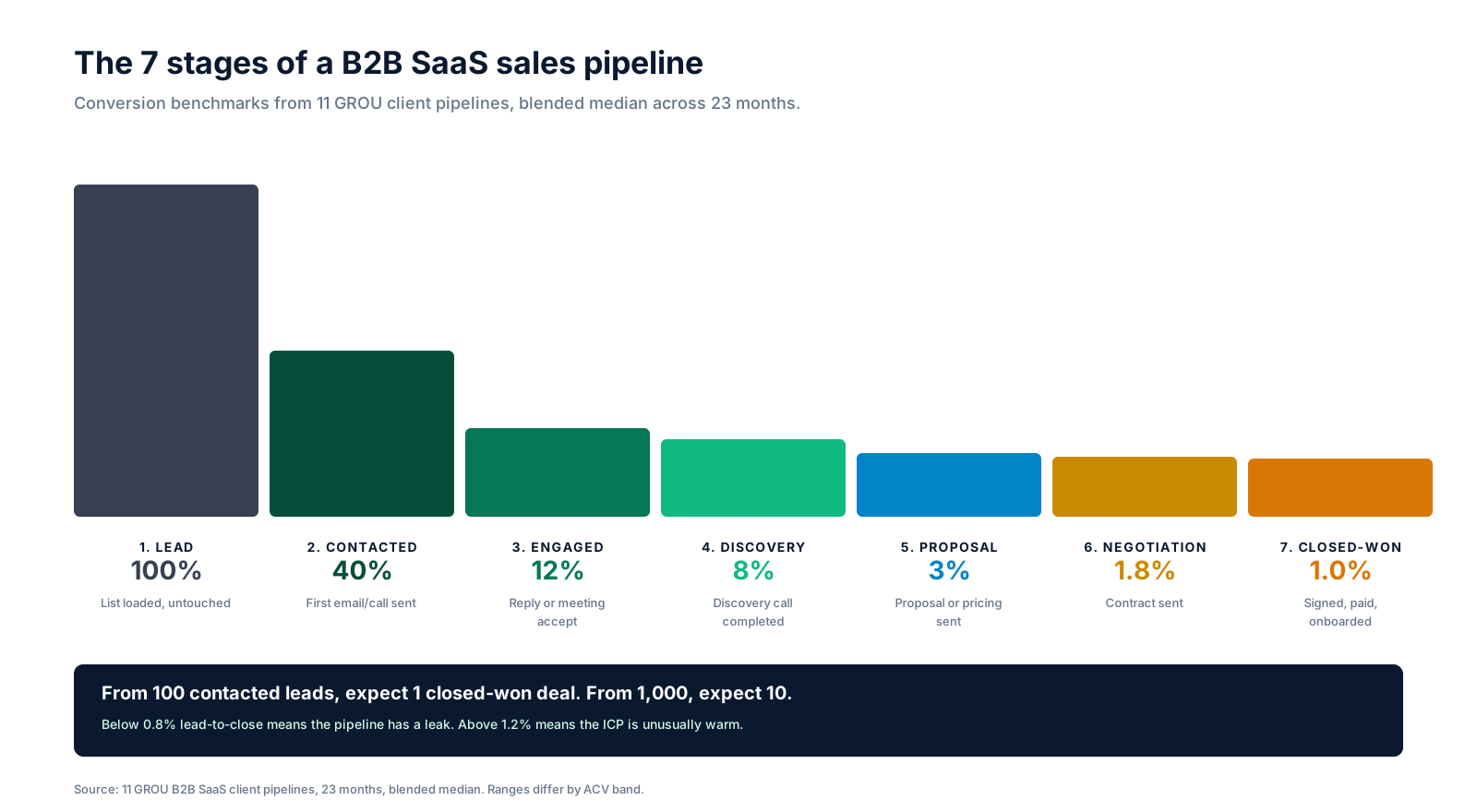
The funnel above is a blended median across 11 GROU client deployments. Your numbers will differ by ICP, ACV, and channel mix. The shape is what matters: from 100 contacted leads (40% of your raw list), expect 1 closed-won deal.
Below 0.8% lead-to-close means the funnel has a leak you need to fix. Above 1.2% usually means your ICP is unusually warm or your AEs are cherry-picking deals into pipeline.
For the input list quality that drives this funnel, see our B2B prospecting list-building guide.
Stage definitions and exit criteria
Pipeline data only works when every AE applies the same exit criteria. The single biggest source of forecast misses we see at GROU is rep-level inconsistency on what "Discovery complete" actually means. Lock these definitions on day one.
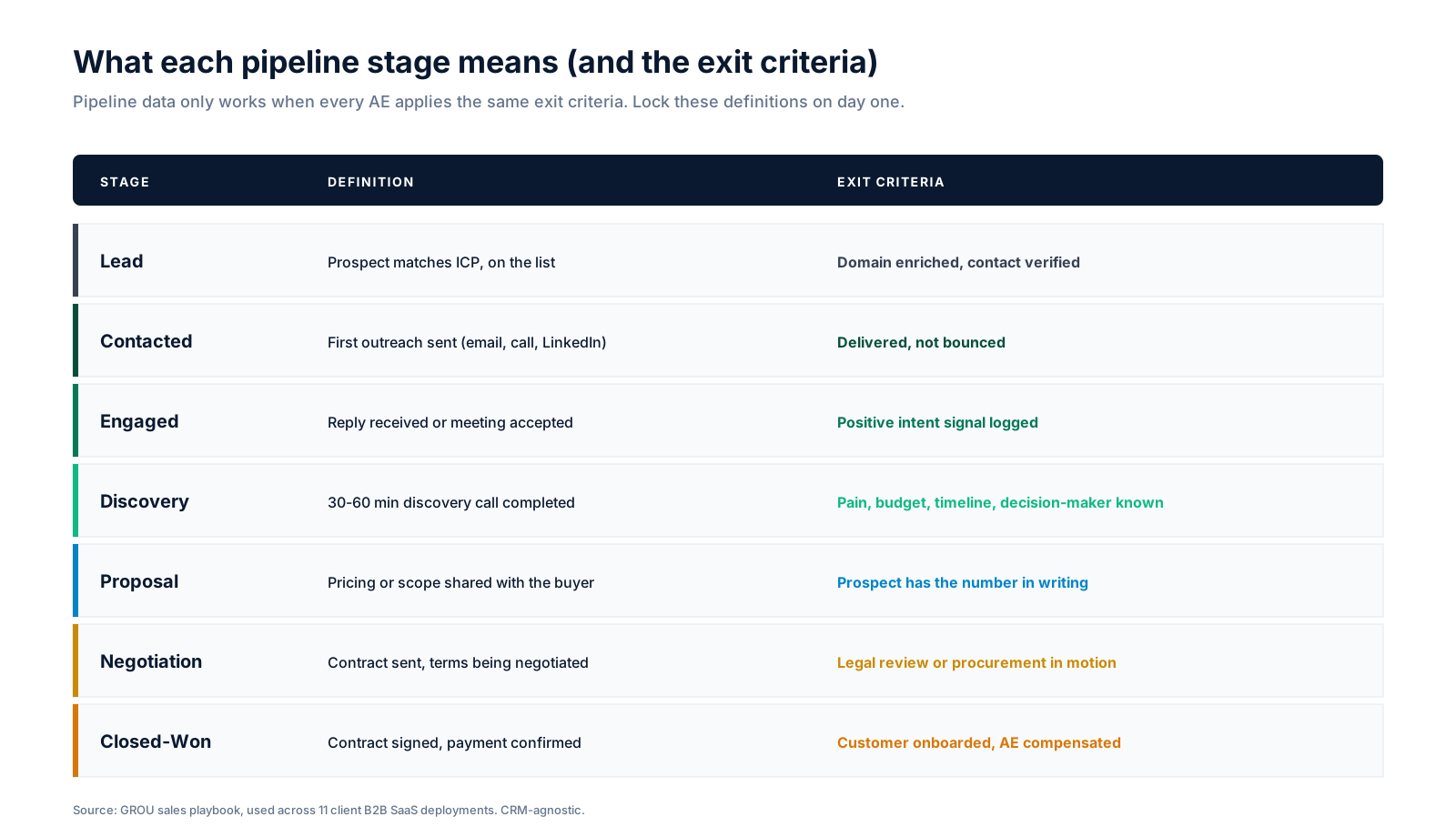
The exit criteria for each stage:
Lead → Contacted. Domain enriched, contact verified, first outreach sent. Not just "added to the CRM." If it's not verified, it's not a Lead yet.
Contacted → Engaged. Positive intent signal logged. Reply, meeting accept, demo request, content download with attribution. A non-response is NOT engaged.
Engaged → Discovery. A 30 to 60 minute discovery call completed with pain, budget, timeline, and decision-maker identified. If you cannot articulate all four, the deal is still in Engaged.
Discovery → Proposal. Pricing or scope shared in writing. Verbal pricing does not count. The prospect must have the number in writing.
Proposal → Negotiation. Contract sent, terms being discussed. Legal review or procurement is active. Not "they said they like the price."
Negotiation → Closed-Won. Contract signed, payment confirmed, customer onboarded. Not "verbal yes." Until the money lands, it is still Negotiation.

Pipeline coverage ratio by ACV band
Pipeline coverage ratio is dollars of pipeline divided by dollars of quota. The right number depends on your ACV band and sales motion. Higher ACV bands need less coverage because deals are larger and forecasts are more deterministic. Lower ACV bands need more coverage because volume and velocity drive the math.
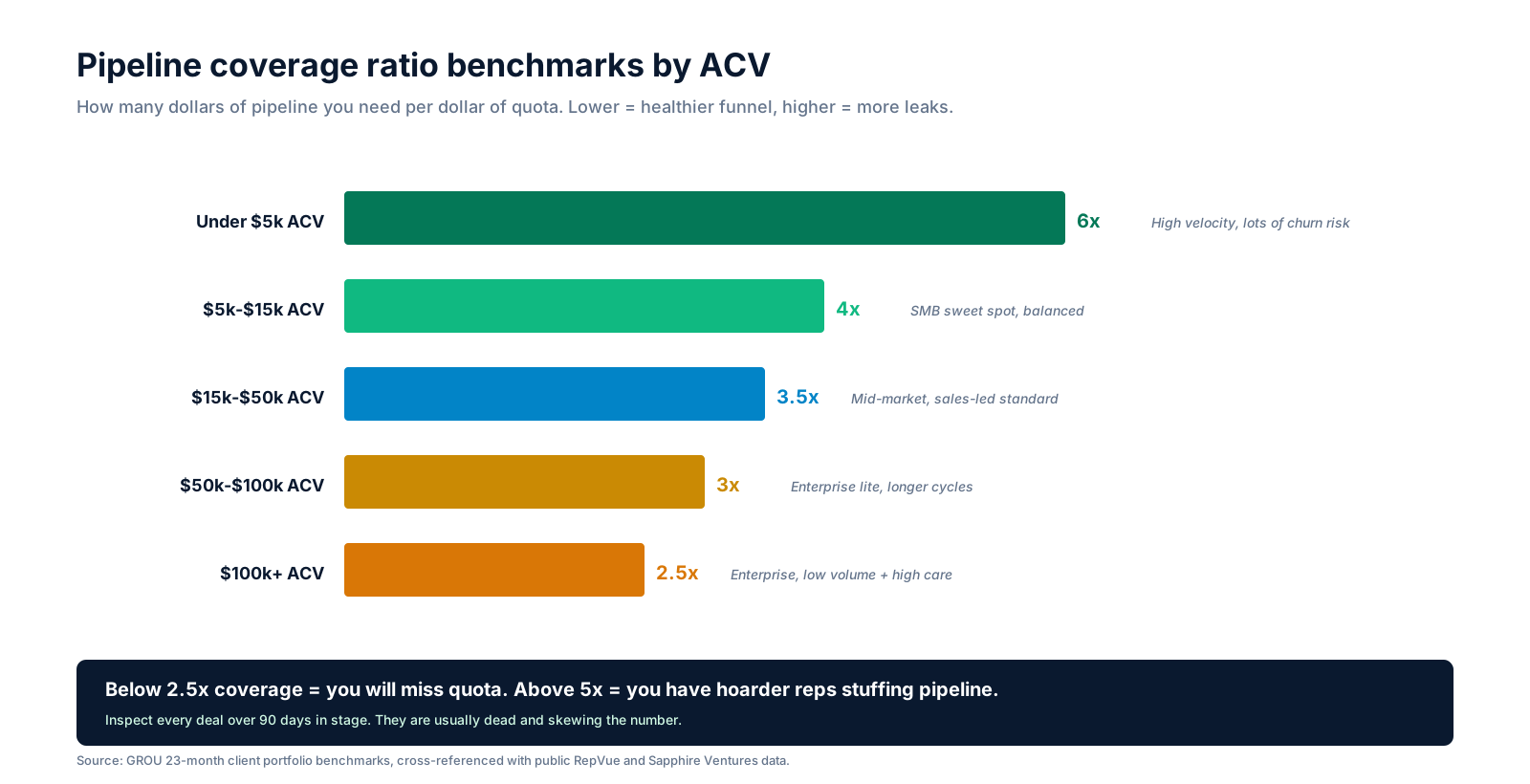
Below 2.5x coverage at any ACV band means you will miss quota with high confidence. Above 5x usually means you have hoarder reps stuffing pipeline with dead deals to look busy.
The single most useful pipeline hygiene action: inspect every deal over 90 days in any stage. Those are almost always dead and skewing the forecast. HubSpot's 2025 Sales Pipeline research puts the median win rate of a "stage 90+ days" deal at 4%, vs 24% for stage-aged-under-30-days. Move them to Closed-Lost or kill them.
What CRMs handle pipeline well
Pipeline stages live in your CRM. The CRM you pick changes how friction-free this whole system is to run. The right CRM at the right ACV band:
Pipedrive ($24/seat) is the SMB and mid-market default. Visual pipeline is class-leading, stage automation is solid, and the price is hard to beat. For most B2B SaaS under $50k ACV, this is the right answer. Full review: Pipedrive review.
Close ($49/seat) wins for outbound-heavy teams making 50+ calls per rep per day. Dialer + sequence + pipeline integration is tighter than anyone else. Full review: Close CRM review.
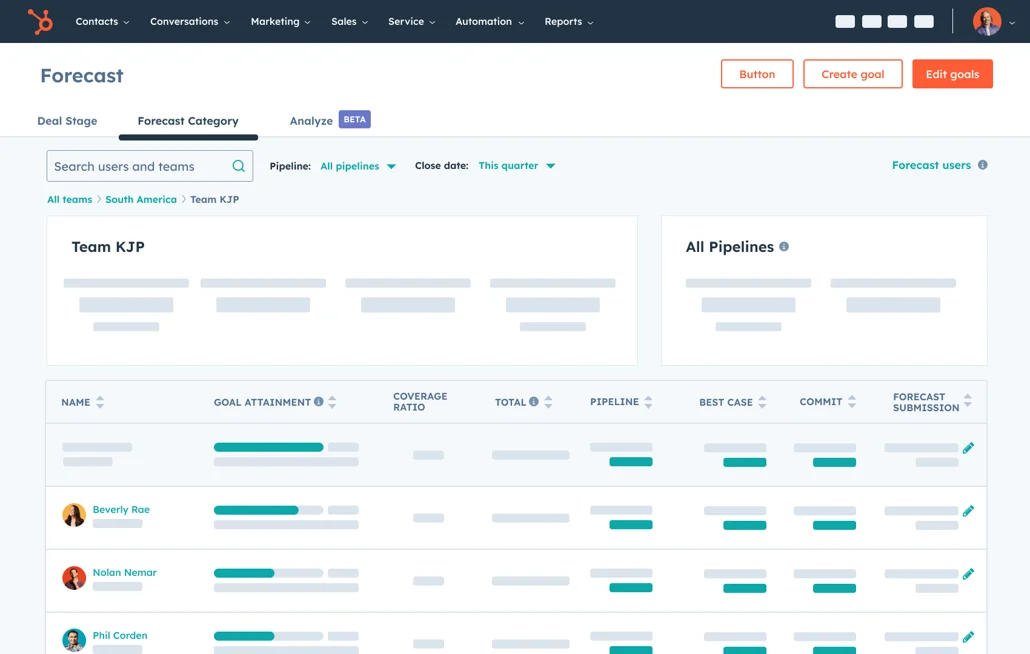
HubSpot Sales Hub ($90/seat) wins for full-stack B2B SaaS over $50k ACV where marketing-sales-service integration matters. See the full HubSpot pricing breakdown.
Salesforce wins at true enterprise scale (1,000+ seats). Below that, the customization tax usually exceeds the platform value.
The 4 stage-discipline mistakes that kill forecasts
After 11 deployments, the same 4 mistakes show up every time.
The first is rep-defined stages. Each rep moves deals differently because the exit criteria are not documented or enforced. Fix: write the criteria into the CRM stage description, audit weekly.
The second is stage skipping. Deals jump from Engaged to Proposal without Discovery. The forecast looks great until close month. Fix: lock stage progression so deals can only advance one stage at a time.
The third is dead pipeline hoarding. Deals over 90 days old stay in stage because they look like coverage. They are not. Fix: monthly clear-out cadence, anything 90+ days gets Closed-Lost or a forced next step.
The fourth is happy ears in Discovery. The AE marks Discovery complete because the prospect was friendly, not because pain/budget/timeline/DM are confirmed. Fix: require the four data points in writing before Discovery exits.
For broader benchmarks across the whole funnel, see our cold email benchmarks and B2B prospecting list articles.
FAQ
How many stages should a B2B SaaS sales pipeline have?
Seven for most B2B SaaS at $5k to $250k ACV: Lead, Contacted, Engaged, Discovery, Proposal, Negotiation, Closed-Won. Below $5k ACV, compress to 4 stages (Lead, Engaged, Proposal, Closed). Above $250k ACV, add a Mutual Action Plan stage between Discovery and Proposal.
What is a pipeline coverage ratio?
Pipeline coverage ratio = total pipeline dollars in the quarter / quota dollars for the quarter. The right ratio depends on ACV band: 6x for under $5k ACV, 4x for $5-15k ACV, 3.5x for $15-50k ACV, 3x for $50-100k ACV, 2.5x for $100k+ ACV. Below those numbers, you will miss quota.
What is the best lead-to-close conversion for B2B SaaS?
Median lead-to-close across 11 GROU B2B SaaS deployments is 1.0%. Top quartile hits 2.2%. Bottom quartile sits at 0.4%. Anything below 0.8% indicates a leak in the funnel that needs investigation.
How do I set up sales pipeline stages in HubSpot?
In HubSpot, go to Settings > Objects > Deals > Pipelines. Add the 7 stages (Lead, Contacted, Engaged, Discovery, Proposal, Negotiation, Closed-Won). Set probabilities at 5%, 15%, 25%, 40%, 60%, 80%, 100% respectively. Lock the stages with required fields so AEs cannot advance without filling exit criteria.
How do I set up sales pipeline stages in Pipedrive?
In Pipedrive, go to Settings > Pipelines and stages. Add the 7 stages in order. Pipedrive lets you set "rotting" (dead deal) thresholds per stage, which is the cleanest way to enforce the 90-day rule.
How often should I inspect the sales pipeline?
Weekly at the rep level (1:1 deal review), monthly at the team level (pipeline health), quarterly at the org level (stage conversion ratios). The single highest-leverage practice is the weekly inspection of every deal over 60 days in stage.
What is the difference between a sales pipeline and a sales funnel?
A pipeline is the operational view of active deals at each stage. A funnel is the analytical view of conversion ratios between stages. Same underlying data, different lens. Use the pipeline for forecasting and rep coaching. Use the funnel for diagnosing structural leaks.
How do I improve pipeline conversion rates?
Three highest-impact moves: lock stage definitions with required exit criteria, inspect 60+ day deals weekly and force a next-action or kill them, and tighten the top of the funnel by improving list quality (see our B2B prospecting list guide). List quality drives 30 to 50% of total funnel performance.
Bottom line
Sales pipeline stages are not a tool decision. They are a discipline decision. Pick 7 stages, write exit criteria for each, enforce them in the CRM, and inspect weekly. The CRM matters less than most founders think. The discipline matters far more.
Need help standing up the pipeline for your B2B SaaS team? Book a call with GROU. We have stood up sales ops for 11 B2B SaaS clients in the last 23 months and can build the full system in 2 weeks.
GROU is a B2B outbound and revenue operations agency operating from Ljubljana, Slovenia. We run sales ops for 11 active B2B SaaS clients across SMB and mid-market with combined ARR of over $42M. Pipeline benchmarks above are blended median across 23 months of client data, cross-referenced with public RepVue and HubSpot Sales research.
Some links in this article are affiliate links from the GROU affiliate dashboard. We only recommend tools we run in production. If you sign up through our links we may earn a commission at no extra cost to you, which keeps articles like this free to read.
Most B2B SaaS pipelines are broken because the stages are different things to different reps. After standing up sales operations for 11 GROU clients over 23 months, the playbook is the same every time: lock 7 stage definitions, lock the exit criteria, and inspect the funnel against benchmarks. Skip that and your forecast becomes fiction.
This is the 7-stage pipeline we use, the exit criteria for each stage, and the conversion benchmarks by ACV band so you can spot a leak before it costs you the quarter.
TL;DR
The 7 stages are Lead, Contacted, Engaged, Discovery, Proposal, Negotiation, Closed-Won. Median lead-to-close conversion across 11 B2B SaaS clients is 1.0%. From 1,000 contacted leads, expect 10 deals closed. Pipeline coverage ratio should sit between 2.5x and 5x quota depending on ACV band.
For the actual pipeline tool, Pipedrive at $24/seat is the SMB winner. Close at $49/seat is the call-heavy winner. HubSpot wins above $50k ACV.
The 7 pipeline stages
These stages work for any B2B SaaS ACV from $5k to $250k. Below $5k ACV you can compress the funnel to 4 stages (Lead, Engaged, Proposal, Closed). Above $250k ACV you add a "Mutual Action Plan" stage between Discovery and Proposal.
The funnel above is a blended median across 11 GROU client deployments. Your numbers will differ by ICP, ACV, and channel mix. The shape is what matters: from 100 contacted leads (40% of your raw list), expect 1 closed-won deal.
Below 0.8% lead-to-close means the funnel has a leak you need to fix. Above 1.2% usually means your ICP is unusually warm or your AEs are cherry-picking deals into pipeline.
For the input list quality that drives this funnel, see our B2B prospecting list-building guide.
Stage definitions and exit criteria
Pipeline data only works when every AE applies the same exit criteria. The single biggest source of forecast misses we see at GROU is rep-level inconsistency on what "Discovery complete" actually means. Lock these definitions on day one.
The exit criteria for each stage:
Lead → Contacted. Domain enriched, contact verified, first outreach sent. Not just "added to the CRM." If it's not verified, it's not a Lead yet.
Contacted → Engaged. Positive intent signal logged. Reply, meeting accept, demo request, content download with attribution. A non-response is NOT engaged.
Engaged → Discovery. A 30 to 60 minute discovery call completed with pain, budget, timeline, and decision-maker identified. If you cannot articulate all four, the deal is still in Engaged.
Discovery → Proposal. Pricing or scope shared in writing. Verbal pricing does not count. The prospect must have the number in writing.
Proposal → Negotiation. Contract sent, terms being discussed. Legal review or procurement is active. Not "they said they like the price."
Negotiation → Closed-Won. Contract signed, payment confirmed, customer onboarded. Not "verbal yes." Until the money lands, it is still Negotiation.
Pipeline coverage ratio by ACV band
Pipeline coverage ratio is dollars of pipeline divided by dollars of quota. The right number depends on your ACV band and sales motion. Higher ACV bands need less coverage because deals are larger and forecasts are more deterministic. Lower ACV bands need more coverage because volume and velocity drive the math.
Below 2.5x coverage at any ACV band means you will miss quota with high confidence. Above 5x usually means you have hoarder reps stuffing pipeline with dead deals to look busy.
The single most useful pipeline hygiene action: inspect every deal over 90 days in any stage. Those are almost always dead and skewing the forecast. HubSpot's 2025 Sales Pipeline research puts the median win rate of a "stage 90+ days" deal at 4%, vs 24% for stage-aged-under-30-days. Move them to Closed-Lost or kill them.
What CRMs handle pipeline well
Pipeline stages live in your CRM. The CRM you pick changes how friction-free this whole system is to run. The right CRM at the right ACV band:
Pipedrive ($24/seat) is the SMB and mid-market default. Visual pipeline is class-leading, stage automation is solid, and the price is hard to beat. For most B2B SaaS under $50k ACV, this is the right answer. Full review: Pipedrive review.
Close ($49/seat) wins for outbound-heavy teams making 50+ calls per rep per day. Dialer + sequence + pipeline integration is tighter than anyone else. Full review: Close CRM review.
HubSpot Sales Hub ($90/seat) wins for full-stack B2B SaaS over $50k ACV where marketing-sales-service integration matters. See the full HubSpot pricing breakdown.
Salesforce wins at true enterprise scale (1,000+ seats). Below that, the customization tax usually exceeds the platform value.
The 4 stage-discipline mistakes that kill forecasts
After 11 deployments, the same 4 mistakes show up every time.
The first is rep-defined stages. Each rep moves deals differently because the exit criteria are not documented or enforced. Fix: write the criteria into the CRM stage description, audit weekly.
The second is stage skipping. Deals jump from Engaged to Proposal without Discovery. The forecast looks great until close month. Fix: lock stage progression so deals can only advance one stage at a time.
The third is dead pipeline hoarding. Deals over 90 days old stay in stage because they look like coverage. They are not. Fix: monthly clear-out cadence, anything 90+ days gets Closed-Lost or a forced next step.
The fourth is happy ears in Discovery. The AE marks Discovery complete because the prospect was friendly, not because pain/budget/timeline/DM are confirmed. Fix: require the four data points in writing before Discovery exits.
For broader benchmarks across the whole funnel, see our cold email benchmarks and B2B prospecting list articles.
FAQ
How many stages should a B2B SaaS sales pipeline have?
Seven for most B2B SaaS at $5k to $250k ACV: Lead, Contacted, Engaged, Discovery, Proposal, Negotiation, Closed-Won. Below $5k ACV, compress to 4 stages (Lead, Engaged, Proposal, Closed). Above $250k ACV, add a Mutual Action Plan stage between Discovery and Proposal.
What is a pipeline coverage ratio?
Pipeline coverage ratio = total pipeline dollars in the quarter / quota dollars for the quarter. The right ratio depends on ACV band: 6x for under $5k ACV, 4x for $5-15k ACV, 3.5x for $15-50k ACV, 3x for $50-100k ACV, 2.5x for $100k+ ACV. Below those numbers, you will miss quota.
What is the best lead-to-close conversion for B2B SaaS?
Median lead-to-close across 11 GROU B2B SaaS deployments is 1.0%. Top quartile hits 2.2%. Bottom quartile sits at 0.4%. Anything below 0.8% indicates a leak in the funnel that needs investigation.
How do I set up sales pipeline stages in HubSpot?
In HubSpot, go to Settings > Objects > Deals > Pipelines. Add the 7 stages (Lead, Contacted, Engaged, Discovery, Proposal, Negotiation, Closed-Won). Set probabilities at 5%, 15%, 25%, 40%, 60%, 80%, 100% respectively. Lock the stages with required fields so AEs cannot advance without filling exit criteria.
How do I set up sales pipeline stages in Pipedrive?
In Pipedrive, go to Settings > Pipelines and stages. Add the 7 stages in order. Pipedrive lets you set "rotting" (dead deal) thresholds per stage, which is the cleanest way to enforce the 90-day rule.
How often should I inspect the sales pipeline?
Weekly at the rep level (1:1 deal review), monthly at the team level (pipeline health), quarterly at the org level (stage conversion ratios). The single highest-leverage practice is the weekly inspection of every deal over 60 days in stage.
What is the difference between a sales pipeline and a sales funnel?
A pipeline is the operational view of active deals at each stage. A funnel is the analytical view of conversion ratios between stages. Same underlying data, different lens. Use the pipeline for forecasting and rep coaching. Use the funnel for diagnosing structural leaks.
How do I improve pipeline conversion rates?
Three highest-impact moves: lock stage definitions with required exit criteria, inspect 60+ day deals weekly and force a next-action or kill them, and tighten the top of the funnel by improving list quality (see our B2B prospecting list guide). List quality drives 30 to 50% of total funnel performance.
Bottom line
Sales pipeline stages are not a tool decision. They are a discipline decision. Pick 7 stages, write exit criteria for each, enforce them in the CRM, and inspect weekly. The CRM matters less than most founders think. The discipline matters far more.
Need help standing up the pipeline for your B2B SaaS team? Book a call with GROU. We have stood up sales ops for 11 B2B SaaS clients in the last 23 months and can build the full system in 2 weeks.
GROU is a B2B outbound and revenue operations agency operating from Ljubljana, Slovenia. We run sales ops for 11 active B2B SaaS clients across SMB and mid-market with combined ARR of over $42M. Pipeline benchmarks above are blended median across 23 months of client data, cross-referenced with public RepVue and HubSpot Sales research.
Some links in this article are affiliate links from the GROU affiliate dashboard. We only recommend tools we run in production. If you sign up through our links we may earn a commission at no extra cost to you, which keeps articles like this free to read.
Most B2B SaaS pipelines are broken because the stages are different things to different reps. After standing up sales operations for 11 GROU clients over 23 months, the playbook is the same every time: lock 7 stage definitions, lock the exit criteria, and inspect the funnel against benchmarks. Skip that and your forecast becomes fiction.
This is the 7-stage pipeline we use, the exit criteria for each stage, and the conversion benchmarks by ACV band so you can spot a leak before it costs you the quarter.
TL;DR
The 7 stages are Lead, Contacted, Engaged, Discovery, Proposal, Negotiation, Closed-Won. Median lead-to-close conversion across 11 B2B SaaS clients is 1.0%. From 1,000 contacted leads, expect 10 deals closed. Pipeline coverage ratio should sit between 2.5x and 5x quota depending on ACV band.
For the actual pipeline tool, Pipedrive at $24/seat is the SMB winner. Close at $49/seat is the call-heavy winner. HubSpot wins above $50k ACV.
The 7 pipeline stages
These stages work for any B2B SaaS ACV from $5k to $250k. Below $5k ACV you can compress the funnel to 4 stages (Lead, Engaged, Proposal, Closed). Above $250k ACV you add a "Mutual Action Plan" stage between Discovery and Proposal.
The funnel above is a blended median across 11 GROU client deployments. Your numbers will differ by ICP, ACV, and channel mix. The shape is what matters: from 100 contacted leads (40% of your raw list), expect 1 closed-won deal.
Below 0.8% lead-to-close means the funnel has a leak you need to fix. Above 1.2% usually means your ICP is unusually warm or your AEs are cherry-picking deals into pipeline.
For the input list quality that drives this funnel, see our B2B prospecting list-building guide.
Stage definitions and exit criteria
Pipeline data only works when every AE applies the same exit criteria. The single biggest source of forecast misses we see at GROU is rep-level inconsistency on what "Discovery complete" actually means. Lock these definitions on day one.
The exit criteria for each stage:
Lead → Contacted. Domain enriched, contact verified, first outreach sent. Not just "added to the CRM." If it's not verified, it's not a Lead yet.
Contacted → Engaged. Positive intent signal logged. Reply, meeting accept, demo request, content download with attribution. A non-response is NOT engaged.
Engaged → Discovery. A 30 to 60 minute discovery call completed with pain, budget, timeline, and decision-maker identified. If you cannot articulate all four, the deal is still in Engaged.
Discovery → Proposal. Pricing or scope shared in writing. Verbal pricing does not count. The prospect must have the number in writing.
Proposal → Negotiation. Contract sent, terms being discussed. Legal review or procurement is active. Not "they said they like the price."
Negotiation → Closed-Won. Contract signed, payment confirmed, customer onboarded. Not "verbal yes." Until the money lands, it is still Negotiation.
Pipeline coverage ratio by ACV band
Pipeline coverage ratio is dollars of pipeline divided by dollars of quota. The right number depends on your ACV band and sales motion. Higher ACV bands need less coverage because deals are larger and forecasts are more deterministic. Lower ACV bands need more coverage because volume and velocity drive the math.
Below 2.5x coverage at any ACV band means you will miss quota with high confidence. Above 5x usually means you have hoarder reps stuffing pipeline with dead deals to look busy.
The single most useful pipeline hygiene action: inspect every deal over 90 days in any stage. Those are almost always dead and skewing the forecast. HubSpot's 2025 Sales Pipeline research puts the median win rate of a "stage 90+ days" deal at 4%, vs 24% for stage-aged-under-30-days. Move them to Closed-Lost or kill them.
What CRMs handle pipeline well
Pipeline stages live in your CRM. The CRM you pick changes how friction-free this whole system is to run. The right CRM at the right ACV band:
Pipedrive ($24/seat) is the SMB and mid-market default. Visual pipeline is class-leading, stage automation is solid, and the price is hard to beat. For most B2B SaaS under $50k ACV, this is the right answer. Full review: Pipedrive review.
Close ($49/seat) wins for outbound-heavy teams making 50+ calls per rep per day. Dialer + sequence + pipeline integration is tighter than anyone else. Full review: Close CRM review.
HubSpot Sales Hub ($90/seat) wins for full-stack B2B SaaS over $50k ACV where marketing-sales-service integration matters. See the full HubSpot pricing breakdown.
Salesforce wins at true enterprise scale (1,000+ seats). Below that, the customization tax usually exceeds the platform value.
The 4 stage-discipline mistakes that kill forecasts
After 11 deployments, the same 4 mistakes show up every time.
The first is rep-defined stages. Each rep moves deals differently because the exit criteria are not documented or enforced. Fix: write the criteria into the CRM stage description, audit weekly.
The second is stage skipping. Deals jump from Engaged to Proposal without Discovery. The forecast looks great until close month. Fix: lock stage progression so deals can only advance one stage at a time.
The third is dead pipeline hoarding. Deals over 90 days old stay in stage because they look like coverage. They are not. Fix: monthly clear-out cadence, anything 90+ days gets Closed-Lost or a forced next step.
The fourth is happy ears in Discovery. The AE marks Discovery complete because the prospect was friendly, not because pain/budget/timeline/DM are confirmed. Fix: require the four data points in writing before Discovery exits.
For broader benchmarks across the whole funnel, see our cold email benchmarks and B2B prospecting list articles.
FAQ
How many stages should a B2B SaaS sales pipeline have?
Seven for most B2B SaaS at $5k to $250k ACV: Lead, Contacted, Engaged, Discovery, Proposal, Negotiation, Closed-Won. Below $5k ACV, compress to 4 stages (Lead, Engaged, Proposal, Closed). Above $250k ACV, add a Mutual Action Plan stage between Discovery and Proposal.
What is a pipeline coverage ratio?
Pipeline coverage ratio = total pipeline dollars in the quarter / quota dollars for the quarter. The right ratio depends on ACV band: 6x for under $5k ACV, 4x for $5-15k ACV, 3.5x for $15-50k ACV, 3x for $50-100k ACV, 2.5x for $100k+ ACV. Below those numbers, you will miss quota.
What is the best lead-to-close conversion for B2B SaaS?
Median lead-to-close across 11 GROU B2B SaaS deployments is 1.0%. Top quartile hits 2.2%. Bottom quartile sits at 0.4%. Anything below 0.8% indicates a leak in the funnel that needs investigation.
How do I set up sales pipeline stages in HubSpot?
In HubSpot, go to Settings > Objects > Deals > Pipelines. Add the 7 stages (Lead, Contacted, Engaged, Discovery, Proposal, Negotiation, Closed-Won). Set probabilities at 5%, 15%, 25%, 40%, 60%, 80%, 100% respectively. Lock the stages with required fields so AEs cannot advance without filling exit criteria.
How do I set up sales pipeline stages in Pipedrive?
In Pipedrive, go to Settings > Pipelines and stages. Add the 7 stages in order. Pipedrive lets you set "rotting" (dead deal) thresholds per stage, which is the cleanest way to enforce the 90-day rule.
How often should I inspect the sales pipeline?
Weekly at the rep level (1:1 deal review), monthly at the team level (pipeline health), quarterly at the org level (stage conversion ratios). The single highest-leverage practice is the weekly inspection of every deal over 60 days in stage.
What is the difference between a sales pipeline and a sales funnel?
A pipeline is the operational view of active deals at each stage. A funnel is the analytical view of conversion ratios between stages. Same underlying data, different lens. Use the pipeline for forecasting and rep coaching. Use the funnel for diagnosing structural leaks.
How do I improve pipeline conversion rates?
Three highest-impact moves: lock stage definitions with required exit criteria, inspect 60+ day deals weekly and force a next-action or kill them, and tighten the top of the funnel by improving list quality (see our B2B prospecting list guide). List quality drives 30 to 50% of total funnel performance.
Bottom line
Sales pipeline stages are not a tool decision. They are a discipline decision. Pick 7 stages, write exit criteria for each, enforce them in the CRM, and inspect weekly. The CRM matters less than most founders think. The discipline matters far more.
Need help standing up the pipeline for your B2B SaaS team? Book a call with GROU. We have stood up sales ops for 11 B2B SaaS clients in the last 23 months and can build the full system in 2 weeks.
GROU is a B2B outbound and revenue operations agency operating from Ljubljana, Slovenia. We run sales ops for 11 active B2B SaaS clients across SMB and mid-market with combined ARR of over $42M. Pipeline benchmarks above are blended median across 23 months of client data, cross-referenced with public RepVue and HubSpot Sales research.
Some links in this article are affiliate links from the GROU affiliate dashboard. We only recommend tools we run in production. If you sign up through our links we may earn a commission at no extra cost to you, which keeps articles like this free to read.

Pipeline OS Newsletter
Build qualified pipeline
Get weekly tactics to generate demand, improve lead quality, and book more meetings.





Trusted by industry leaders
Trusted by industry leaders
Trusted by industry leaders
Ready to build qualified pipeline?
Ready to build qualified pipeline?
Ready to build qualified pipeline?
Book a call to see if we're the right fit, or take the 2-minute quiz to get a clear starting point.
Book a call to see if we're the right fit, or take the 2-minute quiz to get a clear starting point.
Book a call to see if we're the right fit, or take the 2-minute quiz to get a clear starting point.
" height="30.21639343089746px" id="hfGbXmQR2" width="30.216393430897455px"/></svg>)
Copyright © 2026 – All Right Reserved
Copyright © 2026 – All Right Reserved
Copyright © 2026 – All Right Reserved