%22%3E%3C/path%3E%3Cpath d=%22M 63.072 7.554 C 62.258 8.022 61.577 8.689 61.092 9.493 L 61.092 7.076 L 57.158 7.076 L 57.158 22.64 L 61.089 22.64 L 61.089 14.888 C 61.089 13.446 61.403 12.434 62.03 11.853 C 62.818 11.218 63.818 10.907 64.826 10.982 L 65.868 10.982 L 65.868 6.851 C 64.891 6.834 63.926 7.076 63.073 7.554 Z%22 fill=%22rgb(17,17,17)%22%3E%3C/path%3E%3Cpath d=%22M 78.916 7.82 C 76.363 6.49 73.321 6.49 70.768 7.82 C 69.562 8.473 68.564 9.451 67.888 10.644 C 67.167 11.931 66.803 13.387 66.834 14.862 C 66.804 16.332 67.157 17.785 67.86 19.077 C 68.515 20.267 69.494 21.246 70.684 21.901 C 71.924 22.576 73.318 22.92 74.73 22.898 C 76.164 22.918 77.58 22.575 78.846 21.901 C 80.062 21.247 81.073 20.27 81.768 19.077 C 82.506 17.797 82.88 16.339 82.85 14.862 C 82.88 13.389 82.517 11.934 81.797 10.647 C 81.12 9.455 80.122 8.477 78.917 7.824 M 78.803 14.862 C 78.829 15.739 78.636 16.608 78.241 17.391 C 77.903 18.046 77.38 18.588 76.738 18.95 C 76.124 19.293 75.432 19.472 74.729 19.47 C 73.668 19.497 72.648 19.061 71.934 18.276 C 71.139 17.323 70.741 16.1 70.823 14.862 C 70.741 13.62 71.149 12.395 71.959 11.45 C 72.687 10.667 73.715 10.233 74.783 10.256 C 75.859 10.236 76.894 10.67 77.635 11.45 C 78.464 12.387 78.884 13.616 78.801 14.864%22 fill=%22rgb(17,17,17)%22%3E%3C/path%3E%3Cpath d=%22M 95.906 7.076 L 95.906 15.646 C 95.975 16.68 95.643 17.701 94.979 18.498 C 94.311 19.184 93.379 19.547 92.422 19.495 C 91.475 19.544 90.553 19.18 89.894 18.498 C 89.23 17.701 88.898 16.68 88.967 15.646 L 88.967 7.076 L 85.033 7.076 L 85.033 16.207 C 85 17.449 85.275 18.68 85.834 19.79 C 86.327 20.75 87.095 21.542 88.039 22.065 C 89.033 22.594 90.145 22.861 91.271 22.838 C 92.188 22.847 93.095 22.65 93.926 22.263 C 94.708 21.905 95.388 21.36 95.906 20.675 L 95.906 22.645 L 99.865 22.645 L 99.865 7.076 Z%22 fill=%22rgb(17,17,17)%22%3E%3C/path%3E%3Cpath d=%22M 4.513 15.626 C 4.511 10.815 7.606 6.549 12.181 5.059 C 16.756 3.57 21.77 5.195 24.601 9.086 L 27.816 5.87 C 24.074 1.186 17.981 -0.943 12.137 0.393 C 6.292 1.728 1.728 6.292 0.393 12.137 C -0.943 17.981 1.186 24.074 5.87 27.816 L 9.085 24.601 C 6.214 22.512 4.515 19.177 4.513 15.626%22 fill=%22rgb(32,62,235)%22%3E%3C/path%3E%3Cpath d=%22M 17.114 14.343 L 13.354 18.01 L 13.354 18.026 L 21.071 18.026 L 11.412 27.609 L 17.389 27.609 L 23.999 21.081 L 23.999 28.316 L 24.005 28.316 L 27.967 24.393 L 27.967 14.343 Z%22 fill=%22rgb(32,62,235)%22%3E%3C/path%3E%3C/g%3E%3C/svg%3E) ×
× ××
××›
›
›
›
LinkedIn Sales Navigator pricing 2026: full breakdown
LinkedIn Sales Navigator pricing 2026: full breakdown
LinkedIn Sales Navigator pricing 2026: full breakdown
LinkedIn Sales Navigator pricing 2026: full breakdown
LinkedIn Sales Navigator pricing 2026: full breakdown
LinkedIn Sales Navigator pricing 2026: full breakdown

Author
Aljaz Peklaj

Sales Navigator is the most expensive prospecting subscription most B2B teams will ever justify, and the easiest one to buy at the wrong tier. In 2026 the lineup is three plans: Core for individual prospectors, Advanced for teams that want CRM sync and TeamLink, and Advanced Plus for enterprise RevOps. The prices moved in LinkedIn's late-2025 restructure, the annual discount is the real price, and the product still refuses to show you an email address. Here is the whole picture, including the math on when each tier pays.
TL;DR
Sales Navigator Core runs $99.99/month billed monthly or about $79.99/month on annual (~$960/year). Advanced lists at $179.99/month or about $139.99/month annual (~$1,680/year), though some 2026 sources report it at $149 monthly after the late-2025 restructure, so confirm at checkout. Advanced Plus is custom-quoted, typically from around $1,600 per seat per year upward. Core gets you the search engine: 1B+ profiles, 40+ filters, lead lists, 50 InMail credits, job-change alerts. Advanced adds TeamLink, buyer intent signals, Smart Links, and CRM sync. Advanced Plus adds real-time CRM sync, SSO, and API access. The catch every buyer discovers late: Sales Navigator deliberately shows no emails or phone numbers, so budget for an enrichment layer on top. The 30-day free trial auto-bills, so calendar the cancellation date the day you start it.
The 2026 plans and real prices
LinkedIn quotes monthly prices but discounts roughly 20% on annual commitment, which is how most teams actually buy.
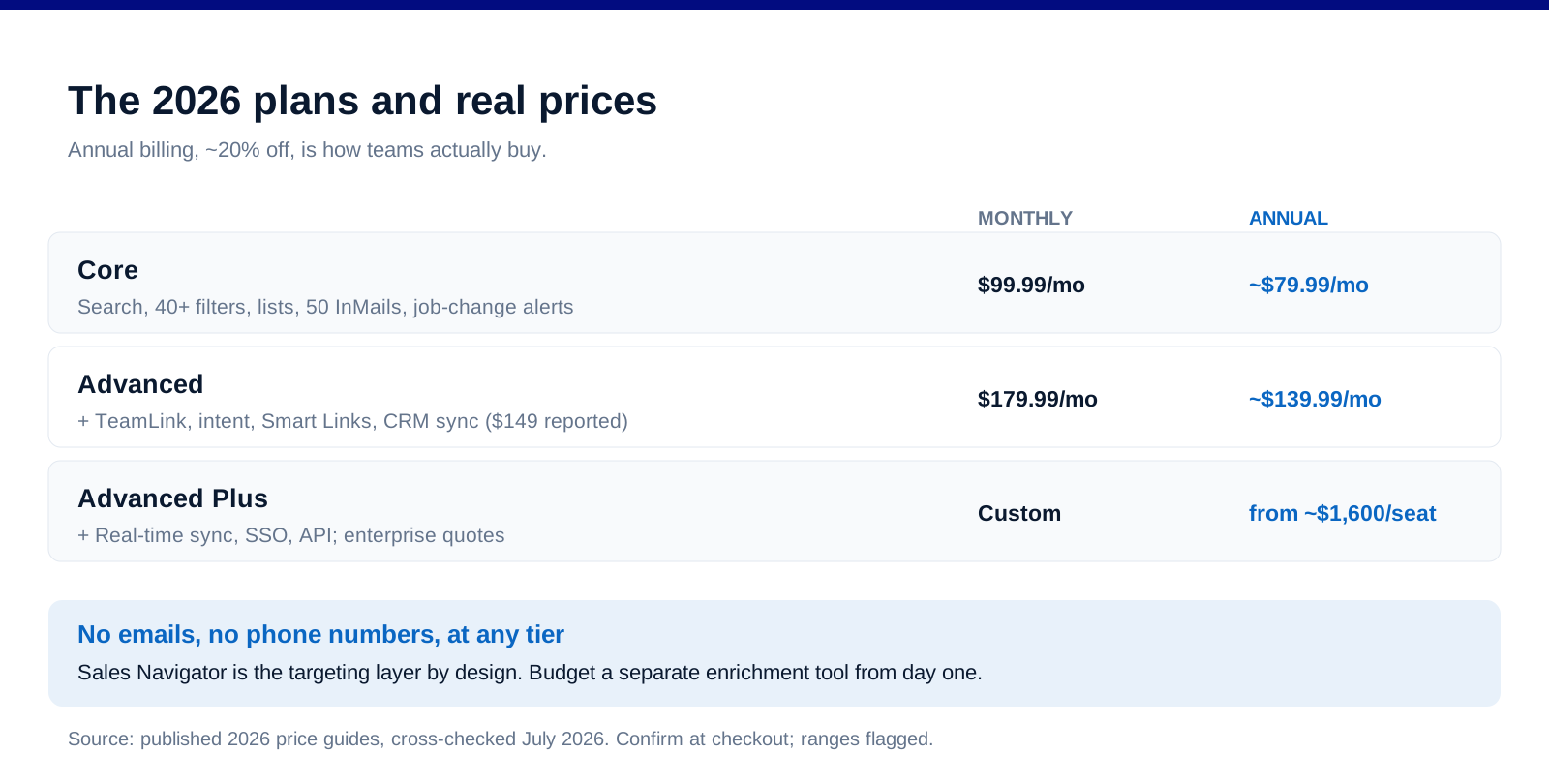
Core: $99.99/month, ~$79.99/month annual. The full search product for one seat: unlimited search across 1B+ profiles, 40+ advanced filters, saved searches with alerts, lead and account lists, 50 InMail credits a month, and real-time job-change signals on your saved leads. For a founder or a single SDR, this is 90% of the product's value.
Advanced: $179.99/month, ~$139.99/month annual. Everything in Core plus TeamLink (see whose network already reaches your prospect), buyer intent signals, Smart Links (trackable content that shows who opened what), shared team lists, and bidirectional CRM sync with Salesforce, HubSpot, and Dynamics 365. Several 2026 price guides report Advanced at $149 monthly post-restructure; treat $149-179.99 as the honest monthly range and check the checkout page.
Advanced Plus: custom, typically from ~$1,600/seat/year. Real-time CRM sync, TeamLink Extend across the whole company, SSO, API access, and dedicated support. Priced by conversation with sales, aimed at 50+ seat RevOps deployments.
What each tier actually adds
The tiers are not bigger quotas of the same thing; each adds a different kind of leverage.
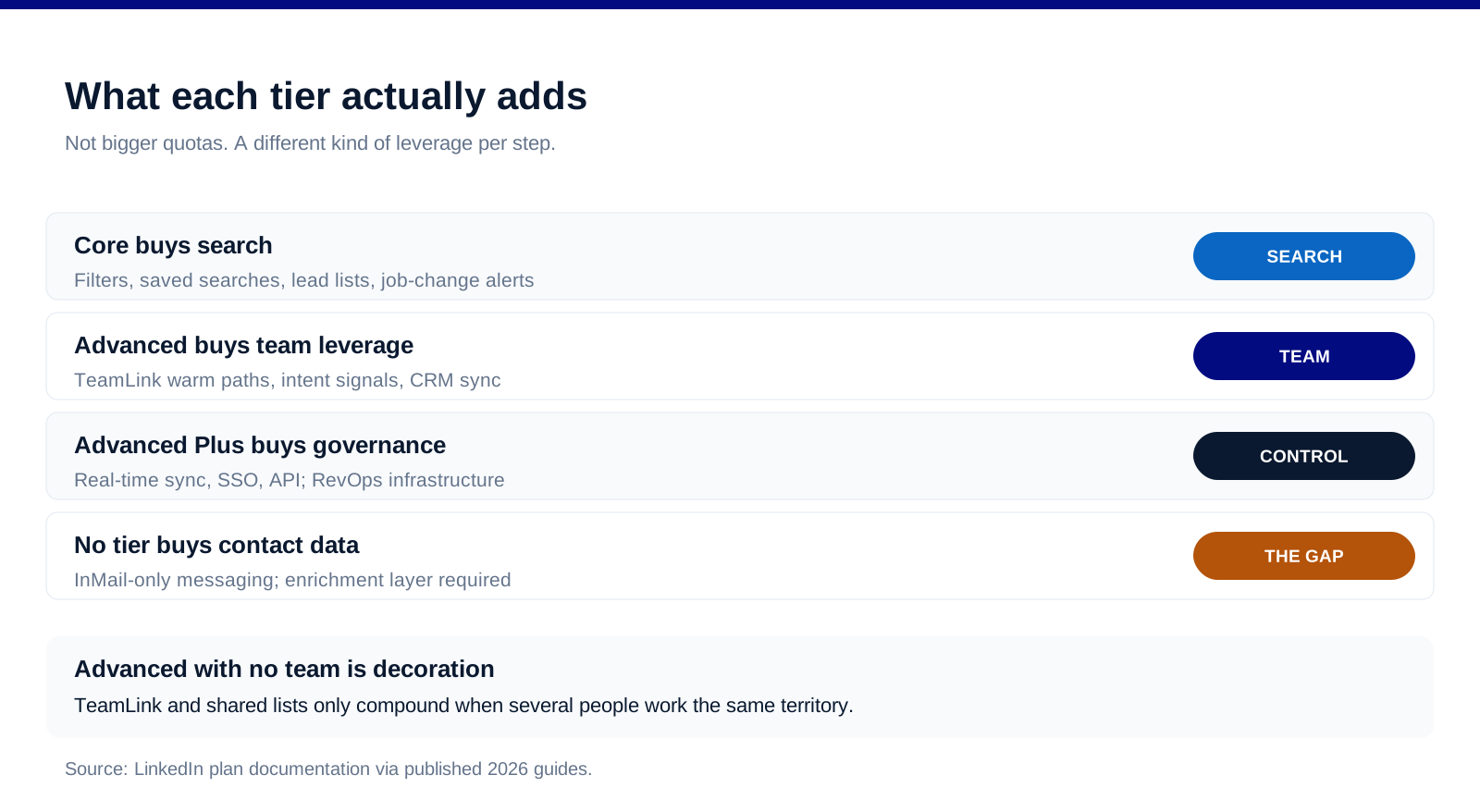
Core buys search. The filters are the product: seniority, function, headcount, geography, technology, posted-content keywords, and the job-change alert that tells you a champion just landed somewhere new. Everything a disciplined prospector needs to build lists worth working, and the list-building rhythm feeds directly into the LinkedIn DM scripts that do the actual outreach.
Advanced buys team leverage. TeamLink answers "who at our company already knows this prospect", which changes cold outreach into warm introduction at scale. Intent signals rank accounts showing buying behavior. CRM sync stops the copy-paste economy. If more than two people prospect the same accounts, this coordination is worth the delta; if not, it is not.
Advanced Plus buys governance. Real-time sync, SSO, and API access matter to RevOps teams running Sales Navigator as infrastructure. Nobody buys it for features; they buy it for control.
What no tier buys: contact data. Sales Navigator will not show emails or phone numbers at any price. The 50 InMail credits are the only native way to message beyond your network, and they cap fast. Every serious deployment pairs it with an enrichment tool, the way we map in our Lusha review, and treats Sales Navigator as the targeting layer, not the contact layer.
The math on when each tier pays
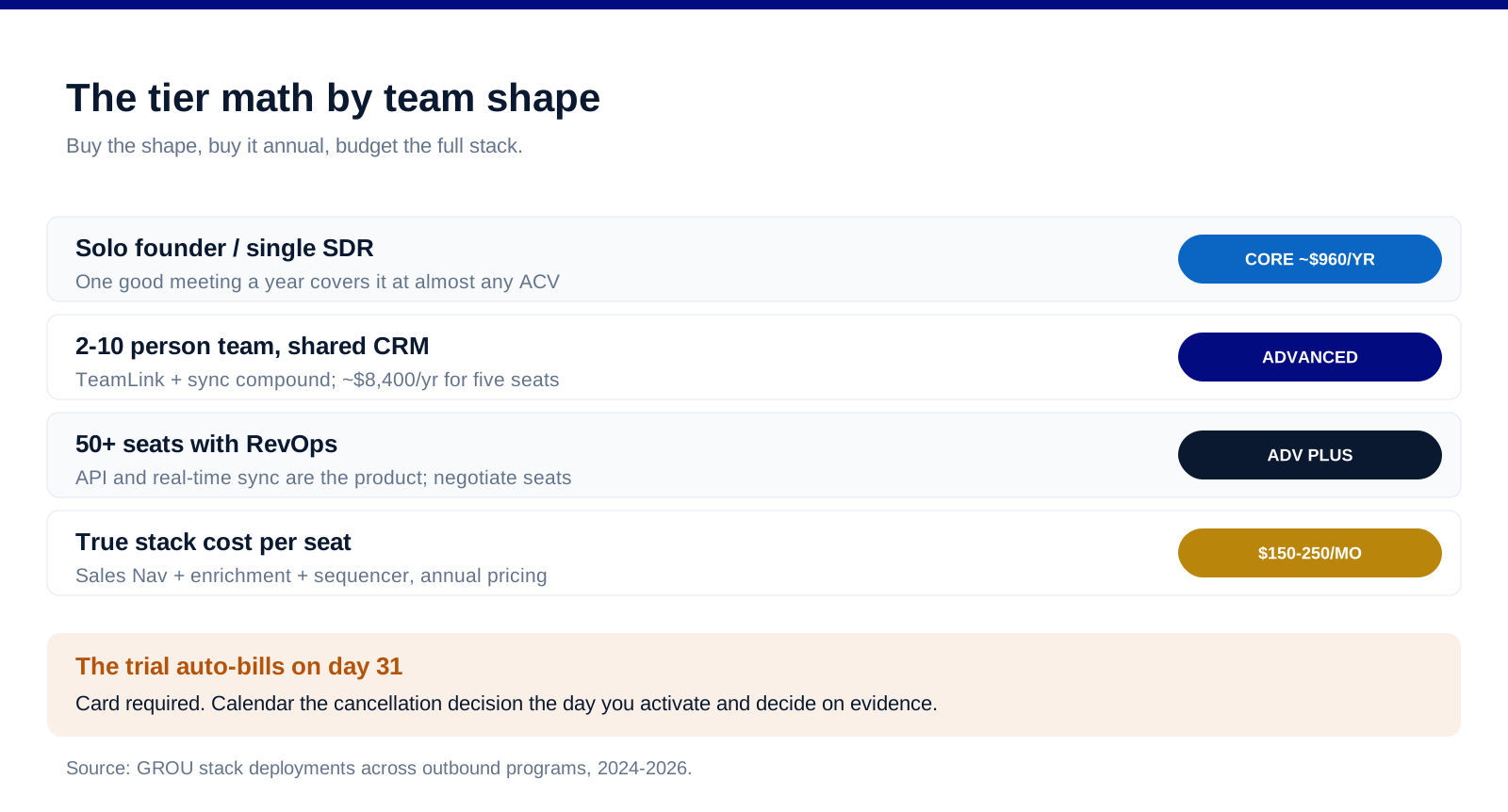
Solo founder or single SDR: Core annual (~$960/year). One good meeting a year covers it in almost any B2B ACV. Skip Advanced until a second prospector joins.
2-10 person sales team on a shared CRM: Advanced annual. TeamLink and CRM sync only compound when several people work the same territory; five seats of Advanced is roughly $8,400 a year, which one incremental closed deal justifies in most mid-market ACVs.
50+ seats with RevOps: Advanced Plus. Negotiate on seat count; the API and real-time sync are the actual product.
Budget the true stack cost. Sales Navigator + enrichment + a sequencer is the real line item: figure roughly $150-250 per seat per month all-in on annual pricing. That stack, pointed at a tight ICP, is what produces the reply rates we run through the full LinkedIn campaign playbook; paying for Sales Navigator and skipping the other two layers is the most common half-investment in B2B.
Trial discipline. The 30-day trial requires a card and auto-bills on day 31. Set the reminder when you activate, run a real list-building sprint inside the window, and decide on evidence.
The mistakes teams make buying Sales Navigator
Mistake 1: buying Advanced for one prospector. TeamLink with no team is a $80/month decoration. Core does the solo job.
Mistake 2: expecting contact data. The no-emails design is deliberate and permanent. Price the enrichment layer into the decision from day one.
Mistake 3: monthly billing out of caution. The ~20% annual discount is the real price; monthly is for validating fit, one quarter at most.
Mistake 4: buying seats before defining the ICP. Sales Navigator amplifies a targeting thesis; it does not create one. Filters pointed at "everyone" produce lists worth nothing.
Mistake 5: letting the trial auto-bill unexamined. LinkedIn counts on it. Calendar the decision date.
FAQ
How much does LinkedIn Sales Navigator cost in 2026?
Core is $99.99/month billed monthly or about $79.99/month annual; Advanced lists at $179.99/month or about $139.99/month annual, with some 2026 sources reporting $149 monthly post-restructure; Advanced Plus is custom, typically from around $1,600 per seat per year.
Is Sales Navigator worth it for B2B prospecting?
Yes, when a defined ICP and an outreach system already exist: the search filters, lead lists, and job-change alerts are the best targeting layer on the market. It is not worth it as a standalone purchase, because it shows no contact data and its InMail allowance caps quickly.
What is the difference between Sales Navigator Core and Advanced?
Advanced adds team features: TeamLink warm-path visibility, buyer intent signals, Smart Links content tracking, shared lists, and CRM sync with Salesforce, HubSpot, and Dynamics. A solo prospector gets almost nothing from the upgrade; a coordinated team gets a lot.
Does Sales Navigator show email addresses or phone numbers?
No, at no tier, by design. You message through InMail credits (50/month on Core) or your existing network, and every serious outbound deployment pairs Sales Navigator with a separate enrichment tool for verified emails and phones.
Is there a free trial for Sales Navigator?
Yes, 30 days of Core, card required, auto-billing on day 31 if you do not cancel. Run a real list-building sprint inside the trial and calendar the cancellation decision the day you activate.
Can I buy Sales Navigator monthly instead of annually?
Core and Advanced both offer monthly billing at roughly a 20-25% premium over the annual rate. Monthly makes sense for a one-quarter validation; annual is the right price for any tool that has earned a place in the stack.
Bottom line
Sales Navigator in 2026 is a targeting engine priced like a data product: Core at ~$960/year annual is one of B2B's clearest solo buys, Advanced earns its delta only when a real team shares territory, and no tier replaces the enrichment layer it deliberately lacks. Buy the tier that matches your team shape, buy it annual, and budget the full stack, because a $960 targeting layer pointed at a sharp ICP outperforms a $8,400 deployment pointed at everyone.
Want the ICP, the lists, and the outreach system built around it? Book a call with GROU. We run LinkedIn-led outbound programs for B2B teams across verticals.
We are GROU, a B2B pipeline agency that runs lead generation, outbound, and LinkedIn content for clients across manufacturing, fintech, iGaming, software, and professional services. Pricing reflects published rates and 2026 analyses cross-checked at publish time; ranges are flagged where sources differ.
Sales Navigator is the most expensive prospecting subscription most B2B teams will ever justify, and the easiest one to buy at the wrong tier. In 2026 the lineup is three plans: Core for individual prospectors, Advanced for teams that want CRM sync and TeamLink, and Advanced Plus for enterprise RevOps. The prices moved in LinkedIn's late-2025 restructure, the annual discount is the real price, and the product still refuses to show you an email address. Here is the whole picture, including the math on when each tier pays.
TL;DR
Sales Navigator Core runs $99.99/month billed monthly or about $79.99/month on annual (~$960/year). Advanced lists at $179.99/month or about $139.99/month annual (~$1,680/year), though some 2026 sources report it at $149 monthly after the late-2025 restructure, so confirm at checkout. Advanced Plus is custom-quoted, typically from around $1,600 per seat per year upward. Core gets you the search engine: 1B+ profiles, 40+ filters, lead lists, 50 InMail credits, job-change alerts. Advanced adds TeamLink, buyer intent signals, Smart Links, and CRM sync. Advanced Plus adds real-time CRM sync, SSO, and API access. The catch every buyer discovers late: Sales Navigator deliberately shows no emails or phone numbers, so budget for an enrichment layer on top. The 30-day free trial auto-bills, so calendar the cancellation date the day you start it.
The 2026 plans and real prices
LinkedIn quotes monthly prices but discounts roughly 20% on annual commitment, which is how most teams actually buy.
Core: $99.99/month, ~$79.99/month annual. The full search product for one seat: unlimited search across 1B+ profiles, 40+ advanced filters, saved searches with alerts, lead and account lists, 50 InMail credits a month, and real-time job-change signals on your saved leads. For a founder or a single SDR, this is 90% of the product's value.
Advanced: $179.99/month, ~$139.99/month annual. Everything in Core plus TeamLink (see whose network already reaches your prospect), buyer intent signals, Smart Links (trackable content that shows who opened what), shared team lists, and bidirectional CRM sync with Salesforce, HubSpot, and Dynamics 365. Several 2026 price guides report Advanced at $149 monthly post-restructure; treat $149-179.99 as the honest monthly range and check the checkout page.
Advanced Plus: custom, typically from ~$1,600/seat/year. Real-time CRM sync, TeamLink Extend across the whole company, SSO, API access, and dedicated support. Priced by conversation with sales, aimed at 50+ seat RevOps deployments.
What each tier actually adds
The tiers are not bigger quotas of the same thing; each adds a different kind of leverage.
Core buys search. The filters are the product: seniority, function, headcount, geography, technology, posted-content keywords, and the job-change alert that tells you a champion just landed somewhere new. Everything a disciplined prospector needs to build lists worth working, and the list-building rhythm feeds directly into the LinkedIn DM scripts that do the actual outreach.
Advanced buys team leverage. TeamLink answers "who at our company already knows this prospect", which changes cold outreach into warm introduction at scale. Intent signals rank accounts showing buying behavior. CRM sync stops the copy-paste economy. If more than two people prospect the same accounts, this coordination is worth the delta; if not, it is not.
Advanced Plus buys governance. Real-time sync, SSO, and API access matter to RevOps teams running Sales Navigator as infrastructure. Nobody buys it for features; they buy it for control.
What no tier buys: contact data. Sales Navigator will not show emails or phone numbers at any price. The 50 InMail credits are the only native way to message beyond your network, and they cap fast. Every serious deployment pairs it with an enrichment tool, the way we map in our Lusha review, and treats Sales Navigator as the targeting layer, not the contact layer.
The math on when each tier pays
Solo founder or single SDR: Core annual (~$960/year). One good meeting a year covers it in almost any B2B ACV. Skip Advanced until a second prospector joins.
2-10 person sales team on a shared CRM: Advanced annual. TeamLink and CRM sync only compound when several people work the same territory; five seats of Advanced is roughly $8,400 a year, which one incremental closed deal justifies in most mid-market ACVs.
50+ seats with RevOps: Advanced Plus. Negotiate on seat count; the API and real-time sync are the actual product.
Budget the true stack cost. Sales Navigator + enrichment + a sequencer is the real line item: figure roughly $150-250 per seat per month all-in on annual pricing. That stack, pointed at a tight ICP, is what produces the reply rates we run through the full LinkedIn campaign playbook; paying for Sales Navigator and skipping the other two layers is the most common half-investment in B2B.
Trial discipline. The 30-day trial requires a card and auto-bills on day 31. Set the reminder when you activate, run a real list-building sprint inside the window, and decide on evidence.
The mistakes teams make buying Sales Navigator
Mistake 1: buying Advanced for one prospector. TeamLink with no team is a $80/month decoration. Core does the solo job.
Mistake 2: expecting contact data. The no-emails design is deliberate and permanent. Price the enrichment layer into the decision from day one.
Mistake 3: monthly billing out of caution. The ~20% annual discount is the real price; monthly is for validating fit, one quarter at most.
Mistake 4: buying seats before defining the ICP. Sales Navigator amplifies a targeting thesis; it does not create one. Filters pointed at "everyone" produce lists worth nothing.
Mistake 5: letting the trial auto-bill unexamined. LinkedIn counts on it. Calendar the decision date.
FAQ
How much does LinkedIn Sales Navigator cost in 2026?
Core is $99.99/month billed monthly or about $79.99/month annual; Advanced lists at $179.99/month or about $139.99/month annual, with some 2026 sources reporting $149 monthly post-restructure; Advanced Plus is custom, typically from around $1,600 per seat per year.
Is Sales Navigator worth it for B2B prospecting?
Yes, when a defined ICP and an outreach system already exist: the search filters, lead lists, and job-change alerts are the best targeting layer on the market. It is not worth it as a standalone purchase, because it shows no contact data and its InMail allowance caps quickly.
What is the difference between Sales Navigator Core and Advanced?
Advanced adds team features: TeamLink warm-path visibility, buyer intent signals, Smart Links content tracking, shared lists, and CRM sync with Salesforce, HubSpot, and Dynamics. A solo prospector gets almost nothing from the upgrade; a coordinated team gets a lot.
Does Sales Navigator show email addresses or phone numbers?
No, at no tier, by design. You message through InMail credits (50/month on Core) or your existing network, and every serious outbound deployment pairs Sales Navigator with a separate enrichment tool for verified emails and phones.
Is there a free trial for Sales Navigator?
Yes, 30 days of Core, card required, auto-billing on day 31 if you do not cancel. Run a real list-building sprint inside the trial and calendar the cancellation decision the day you activate.
Can I buy Sales Navigator monthly instead of annually?
Core and Advanced both offer monthly billing at roughly a 20-25% premium over the annual rate. Monthly makes sense for a one-quarter validation; annual is the right price for any tool that has earned a place in the stack.
Bottom line
Sales Navigator in 2026 is a targeting engine priced like a data product: Core at ~$960/year annual is one of B2B's clearest solo buys, Advanced earns its delta only when a real team shares territory, and no tier replaces the enrichment layer it deliberately lacks. Buy the tier that matches your team shape, buy it annual, and budget the full stack, because a $960 targeting layer pointed at a sharp ICP outperforms a $8,400 deployment pointed at everyone.
Want the ICP, the lists, and the outreach system built around it? Book a call with GROU. We run LinkedIn-led outbound programs for B2B teams across verticals.
We are GROU, a B2B pipeline agency that runs lead generation, outbound, and LinkedIn content for clients across manufacturing, fintech, iGaming, software, and professional services. Pricing reflects published rates and 2026 analyses cross-checked at publish time; ranges are flagged where sources differ.
Sales Navigator is the most expensive prospecting subscription most B2B teams will ever justify, and the easiest one to buy at the wrong tier. In 2026 the lineup is three plans: Core for individual prospectors, Advanced for teams that want CRM sync and TeamLink, and Advanced Plus for enterprise RevOps. The prices moved in LinkedIn's late-2025 restructure, the annual discount is the real price, and the product still refuses to show you an email address. Here is the whole picture, including the math on when each tier pays.
TL;DR
Sales Navigator Core runs $99.99/month billed monthly or about $79.99/month on annual (~$960/year). Advanced lists at $179.99/month or about $139.99/month annual (~$1,680/year), though some 2026 sources report it at $149 monthly after the late-2025 restructure, so confirm at checkout. Advanced Plus is custom-quoted, typically from around $1,600 per seat per year upward. Core gets you the search engine: 1B+ profiles, 40+ filters, lead lists, 50 InMail credits, job-change alerts. Advanced adds TeamLink, buyer intent signals, Smart Links, and CRM sync. Advanced Plus adds real-time CRM sync, SSO, and API access. The catch every buyer discovers late: Sales Navigator deliberately shows no emails or phone numbers, so budget for an enrichment layer on top. The 30-day free trial auto-bills, so calendar the cancellation date the day you start it.
The 2026 plans and real prices
LinkedIn quotes monthly prices but discounts roughly 20% on annual commitment, which is how most teams actually buy.
Core: $99.99/month, ~$79.99/month annual. The full search product for one seat: unlimited search across 1B+ profiles, 40+ advanced filters, saved searches with alerts, lead and account lists, 50 InMail credits a month, and real-time job-change signals on your saved leads. For a founder or a single SDR, this is 90% of the product's value.
Advanced: $179.99/month, ~$139.99/month annual. Everything in Core plus TeamLink (see whose network already reaches your prospect), buyer intent signals, Smart Links (trackable content that shows who opened what), shared team lists, and bidirectional CRM sync with Salesforce, HubSpot, and Dynamics 365. Several 2026 price guides report Advanced at $149 monthly post-restructure; treat $149-179.99 as the honest monthly range and check the checkout page.
Advanced Plus: custom, typically from ~$1,600/seat/year. Real-time CRM sync, TeamLink Extend across the whole company, SSO, API access, and dedicated support. Priced by conversation with sales, aimed at 50+ seat RevOps deployments.
What each tier actually adds
The tiers are not bigger quotas of the same thing; each adds a different kind of leverage.
Core buys search. The filters are the product: seniority, function, headcount, geography, technology, posted-content keywords, and the job-change alert that tells you a champion just landed somewhere new. Everything a disciplined prospector needs to build lists worth working, and the list-building rhythm feeds directly into the LinkedIn DM scripts that do the actual outreach.
Advanced buys team leverage. TeamLink answers "who at our company already knows this prospect", which changes cold outreach into warm introduction at scale. Intent signals rank accounts showing buying behavior. CRM sync stops the copy-paste economy. If more than two people prospect the same accounts, this coordination is worth the delta; if not, it is not.
Advanced Plus buys governance. Real-time sync, SSO, and API access matter to RevOps teams running Sales Navigator as infrastructure. Nobody buys it for features; they buy it for control.
What no tier buys: contact data. Sales Navigator will not show emails or phone numbers at any price. The 50 InMail credits are the only native way to message beyond your network, and they cap fast. Every serious deployment pairs it with an enrichment tool, the way we map in our Lusha review, and treats Sales Navigator as the targeting layer, not the contact layer.
The math on when each tier pays
Solo founder or single SDR: Core annual (~$960/year). One good meeting a year covers it in almost any B2B ACV. Skip Advanced until a second prospector joins.
2-10 person sales team on a shared CRM: Advanced annual. TeamLink and CRM sync only compound when several people work the same territory; five seats of Advanced is roughly $8,400 a year, which one incremental closed deal justifies in most mid-market ACVs.
50+ seats with RevOps: Advanced Plus. Negotiate on seat count; the API and real-time sync are the actual product.
Budget the true stack cost. Sales Navigator + enrichment + a sequencer is the real line item: figure roughly $150-250 per seat per month all-in on annual pricing. That stack, pointed at a tight ICP, is what produces the reply rates we run through the full LinkedIn campaign playbook; paying for Sales Navigator and skipping the other two layers is the most common half-investment in B2B.
Trial discipline. The 30-day trial requires a card and auto-bills on day 31. Set the reminder when you activate, run a real list-building sprint inside the window, and decide on evidence.
The mistakes teams make buying Sales Navigator
Mistake 1: buying Advanced for one prospector. TeamLink with no team is a $80/month decoration. Core does the solo job.
Mistake 2: expecting contact data. The no-emails design is deliberate and permanent. Price the enrichment layer into the decision from day one.
Mistake 3: monthly billing out of caution. The ~20% annual discount is the real price; monthly is for validating fit, one quarter at most.
Mistake 4: buying seats before defining the ICP. Sales Navigator amplifies a targeting thesis; it does not create one. Filters pointed at "everyone" produce lists worth nothing.
Mistake 5: letting the trial auto-bill unexamined. LinkedIn counts on it. Calendar the decision date.
FAQ
How much does LinkedIn Sales Navigator cost in 2026?
Core is $99.99/month billed monthly or about $79.99/month annual; Advanced lists at $179.99/month or about $139.99/month annual, with some 2026 sources reporting $149 monthly post-restructure; Advanced Plus is custom, typically from around $1,600 per seat per year.
Is Sales Navigator worth it for B2B prospecting?
Yes, when a defined ICP and an outreach system already exist: the search filters, lead lists, and job-change alerts are the best targeting layer on the market. It is not worth it as a standalone purchase, because it shows no contact data and its InMail allowance caps quickly.
What is the difference between Sales Navigator Core and Advanced?
Advanced adds team features: TeamLink warm-path visibility, buyer intent signals, Smart Links content tracking, shared lists, and CRM sync with Salesforce, HubSpot, and Dynamics. A solo prospector gets almost nothing from the upgrade; a coordinated team gets a lot.
Does Sales Navigator show email addresses or phone numbers?
No, at no tier, by design. You message through InMail credits (50/month on Core) or your existing network, and every serious outbound deployment pairs Sales Navigator with a separate enrichment tool for verified emails and phones.
Is there a free trial for Sales Navigator?
Yes, 30 days of Core, card required, auto-billing on day 31 if you do not cancel. Run a real list-building sprint inside the trial and calendar the cancellation decision the day you activate.
Can I buy Sales Navigator monthly instead of annually?
Core and Advanced both offer monthly billing at roughly a 20-25% premium over the annual rate. Monthly makes sense for a one-quarter validation; annual is the right price for any tool that has earned a place in the stack.
Bottom line
Sales Navigator in 2026 is a targeting engine priced like a data product: Core at ~$960/year annual is one of B2B's clearest solo buys, Advanced earns its delta only when a real team shares territory, and no tier replaces the enrichment layer it deliberately lacks. Buy the tier that matches your team shape, buy it annual, and budget the full stack, because a $960 targeting layer pointed at a sharp ICP outperforms a $8,400 deployment pointed at everyone.
Want the ICP, the lists, and the outreach system built around it? Book a call with GROU. We run LinkedIn-led outbound programs for B2B teams across verticals.
We are GROU, a B2B pipeline agency that runs lead generation, outbound, and LinkedIn content for clients across manufacturing, fintech, iGaming, software, and professional services. Pricing reflects published rates and 2026 analyses cross-checked at publish time; ranges are flagged where sources differ.

Pipeline OS Newsletter
Build qualified pipeline
Get weekly tactics to generate demand, improve lead quality, and book more meetings.





Trusted by industry leaders
Trusted by industry leaders
Trusted by industry leaders
Ready to build qualified pipeline?
Ready to build qualified pipeline?
Ready to build qualified pipeline?
Book a call to see if we're the right fit, or take the 2-minute quiz to get a clear starting point.
Book a call to see if we're the right fit, or take the 2-minute quiz to get a clear starting point.
Book a call to see if we're the right fit, or take the 2-minute quiz to get a clear starting point.
" height="30.21639343089746px" id="hfGbXmQR2" width="30.216393430897455px"/></svg>)
Copyright © 2026 – All Right Reserved
Copyright © 2026 – All Right Reserved
Copyright © 2026 – All Right Reserved