%22%3E%3C/path%3E%3Cpath d=%22M 63.072 7.554 C 62.258 8.022 61.577 8.689 61.092 9.493 L 61.092 7.076 L 57.158 7.076 L 57.158 22.64 L 61.089 22.64 L 61.089 14.888 C 61.089 13.446 61.403 12.434 62.03 11.853 C 62.818 11.218 63.818 10.907 64.826 10.982 L 65.868 10.982 L 65.868 6.851 C 64.891 6.834 63.926 7.076 63.073 7.554 Z%22 fill=%22rgb(17,17,17)%22%3E%3C/path%3E%3Cpath d=%22M 78.916 7.82 C 76.363 6.49 73.321 6.49 70.768 7.82 C 69.562 8.473 68.564 9.451 67.888 10.644 C 67.167 11.931 66.803 13.387 66.834 14.862 C 66.804 16.332 67.157 17.785 67.86 19.077 C 68.515 20.267 69.494 21.246 70.684 21.901 C 71.924 22.576 73.318 22.92 74.73 22.898 C 76.164 22.918 77.58 22.575 78.846 21.901 C 80.062 21.247 81.073 20.27 81.768 19.077 C 82.506 17.797 82.88 16.339 82.85 14.862 C 82.88 13.389 82.517 11.934 81.797 10.647 C 81.12 9.455 80.122 8.477 78.917 7.824 M 78.803 14.862 C 78.829 15.739 78.636 16.608 78.241 17.391 C 77.903 18.046 77.38 18.588 76.738 18.95 C 76.124 19.293 75.432 19.472 74.729 19.47 C 73.668 19.497 72.648 19.061 71.934 18.276 C 71.139 17.323 70.741 16.1 70.823 14.862 C 70.741 13.62 71.149 12.395 71.959 11.45 C 72.687 10.667 73.715 10.233 74.783 10.256 C 75.859 10.236 76.894 10.67 77.635 11.45 C 78.464 12.387 78.884 13.616 78.801 14.864%22 fill=%22rgb(17,17,17)%22%3E%3C/path%3E%3Cpath d=%22M 95.906 7.076 L 95.906 15.646 C 95.975 16.68 95.643 17.701 94.979 18.498 C 94.311 19.184 93.379 19.547 92.422 19.495 C 91.475 19.544 90.553 19.18 89.894 18.498 C 89.23 17.701 88.898 16.68 88.967 15.646 L 88.967 7.076 L 85.033 7.076 L 85.033 16.207 C 85 17.449 85.275 18.68 85.834 19.79 C 86.327 20.75 87.095 21.542 88.039 22.065 C 89.033 22.594 90.145 22.861 91.271 22.838 C 92.188 22.847 93.095 22.65 93.926 22.263 C 94.708 21.905 95.388 21.36 95.906 20.675 L 95.906 22.645 L 99.865 22.645 L 99.865 7.076 Z%22 fill=%22rgb(17,17,17)%22%3E%3C/path%3E%3Cpath d=%22M 4.513 15.626 C 4.511 10.815 7.606 6.549 12.181 5.059 C 16.756 3.57 21.77 5.195 24.601 9.086 L 27.816 5.87 C 24.074 1.186 17.981 -0.943 12.137 0.393 C 6.292 1.728 1.728 6.292 0.393 12.137 C -0.943 17.981 1.186 24.074 5.87 27.816 L 9.085 24.601 C 6.214 22.512 4.515 19.177 4.513 15.626%22 fill=%22rgb(32,62,235)%22%3E%3C/path%3E%3Cpath d=%22M 17.114 14.343 L 13.354 18.01 L 13.354 18.026 L 21.071 18.026 L 11.412 27.609 L 17.389 27.609 L 23.999 21.081 L 23.999 28.316 L 24.005 28.316 L 27.967 24.393 L 27.967 14.343 Z%22 fill=%22rgb(32,62,235)%22%3E%3C/path%3E%3C/g%3E%3C/svg%3E) ×
× ××
××›
›
›
›
Mortgage company marketing 2026: the pipeline playbook
Mortgage company marketing 2026: the pipeline playbook
Mortgage company marketing 2026: the pipeline playbook
Mortgage company marketing 2026: the pipeline playbook
Mortgage company marketing 2026: the pipeline playbook
Mortgage company marketing 2026: the pipeline playbook

Author
Aljaz Peklaj

Most mortgage company marketing fails for the same reason: teams obsess over lead volume while ignoring the system that turns a borrower from curious to approved to funded. In a market where 65% of prospective homebuyers start their mortgage process online, 81% research lenders online before deciding, and 70% of online mortgage inquiries come from mobile devices (ZipDo), the old branch-first mindset is too slow.
Pipeline beats lead count, because mortgage revenue happens after application, approval, and funding.
Compliance shapes the funnel, RESPA, TILA, TCPA, and Fair Lending are not side issues.
Segmenting by buyer type matters, first-time buyers and refinance customers need different messages.
Measurement has to follow money, not clicks, opens, or form fills.
Retention and referrals compound, if you keep the relationship after the first close.
Table of Contents
The mortgage market has changed and your marketing must adapt
Build a measurement system that tracks funded loans, not clicks
Why most mortgage marketing programs fail
Most mortgage companies don't have a lead problem. They have a conversion system problem. They buy attention, collect names, then hope a loan officer or CRM follow-up sequence does the rest. That's not a marketing strategy, it's a leak.
The real failure is structural
The market now rewards teams that connect search, landing pages, follow-up, and funding in one sequence. ZipDo says 73% of mortgage lenders call digital marketing their most effective lead-generation tool, and 58% say their best leads come from digital channels (ZipDo). That doesn't mean more channels fix the problem, it means the buyer journey now starts online and ends somewhere else.
If your ads drive traffic but your pages don't answer rate, eligibility, or next-step questions, the lead dies in the middle. If your handoff to sales is slow, the lead goes cold. If your follow-up ignores the difference between first-time buyers and refinance customers, the message feels generic and the borrower disappears.
Practical rule: if a borrower can't tell what happens after the click, your marketing isn't ready.
The compliance layer makes this worse. RESPA, TILA, TCPA, and Fair Lending aren't optional guardrails, they shape what you can say, who you can target, and how you can follow up. Generalist B2B tactics break fast here, especially when teams import outbound habits that were built for software, not consumer lending.
A lot of mortgage marketing content still sells “more leads” as the answer. That's lazy. The better question is whether your current funnel can turn a qualified inquiry into a funded loan without compliance friction or sales drop-off. If not, more spend just gives you more waste.
The closest parallel in our own world is pipeline conversion, not lead generation. That's why this GROU article on why leads don't convert maps well as a cautionary read. The same lesson applies here, structure turns attention into pipeline.
The mortgage market has changed and your marketing must adapt
Mortgage company marketing used to depend on volume. Refinancing was easier to sell, inbound intent was plentiful, and a lot of teams got lazy because the market did part of the work for them. That model no longer fits. The buyer pool is smaller, competition is tighter, and borrowers do more homework before your team gets a real shot.
The volume collapse changed the game
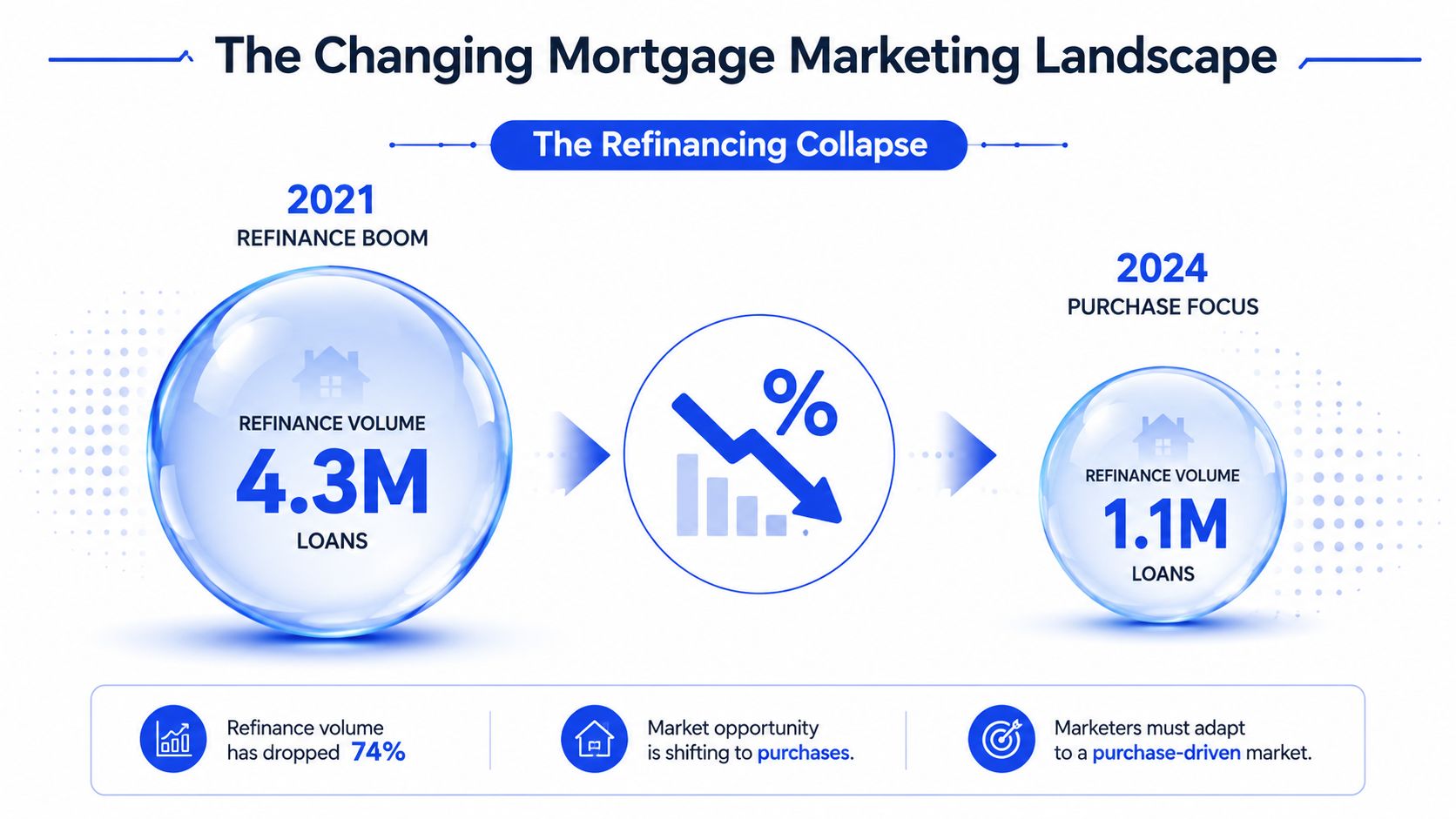
The CFPB reports that U.S. mortgage applications fell by about 4.3 million, or 30.3%, in 2023, while originations fell by 2.7 million, or 32.2% year over year (CFPB). The same report shows a major shift in where loans are being originated. Non-bank mortgage companies now account for 53.3% of all home loans, up from 44.6% in 2018, while bank share fell from 42.5% to 30.1%.
That shift changes the job. The market is smaller, more fragmented, and more aggressive. Mortgage companies are fighting over fewer opportunities, and the firms that win are the ones that move faster, follow up harder, and market with more discipline.
Why speed and trust matter more now
That same market shift explains why speed to lead matters more than broad awareness. When refinancing collapsed by more than 90% from pandemic peaks, the lenders that depended on easy refinance demand lost their cushion. Purchase loans are harder. Borrowers research more, compare more, and often involve more than one decision-maker.
Your marketing has to do more than create interest. It has to create confidence quickly, then carry the borrower through a longer decision cycle without friction. Brand trust, follow-up quality, and lifecycle communication matter because the first lender that feels credible usually gets the conversation.
Borrowers already behave like researchers. ZipDo reports that 81% research lenders online before deciding and 70% of online mortgage inquiries come from mobile devices (ZipDo). That means the lender that wins is usually the one that answers the question clearly, on mobile, and without making the borrower work for the next step.
Use borrower segmentation strategy to separate first-time buyers, move-up buyers, and refinance prospects before you write copy. One message aimed at everyone turns into a message that convinces no one.
Segment your audience before you write a single ad
Mortgage marketing fails when one message tries to serve every borrower. First-time buyers, move-up buyers, and refinance customers are not just different stages, they're different psychologies. If your creative and landing pages don't reflect that, you'll get traffic without trust.
Start with the borrower's state of mind
First-time buyers usually need education, reassurance, and a slower decision path. Refinance customers usually want direct outcome framing, rate context, and fewer steps. Move-up buyers sit somewhere in the middle, because they already understand the process but often have layered timing, family, and home-equity considerations.
The point isn't to invent dozens of micro-segments. It's to stop writing generic mortgage ads that sound like they came from a template. HUD guidance recommends tailoring advertising content, language, media, and distribution to underserved populations, and partnering with trusted local organizations such as churches and nonprofits (HUD). That's not just a compliance note, it's a reminder that trust is contextual.
Practical rule: the more historical distrust or language friction a segment has, the more your message has to sound like it was written for them, not at them.
A better segmentation process starts with two questions. What does this borrower need to believe before they click, and what proof do they need before they submit? If you can't answer that, your ad is too generic.
For a useful mental model on audience structuring, the GROU segmentation glossary is worth a look, even though the mortgage context needs stricter compliance thinking. The core idea still holds, separate audiences by behavior, intent, and friction.

Build the message around the segment
First-time buyer content should explain the path in plain language. Payment calculators, down-payment guidance, and step-by-step process pages belong here because they reduce anxiety. Refinance pages should be more direct, with clear benefit framing and a faster CTA path.
Underserved audiences need a different layer altogether. HUD's guidance points toward culturally relevant messaging, in-language resources, and trusted community partnerships (HUD). That's not a cosmetic fix. It affects who answers the phone, what the landing page says, and which proof signals show up first.
Use this video to pressure-test your segmentation thinking against a practical mortgage audience lens.
If you want the right internal wiring for each audience, align the page, the call-to-action, and the follow-up sequence before you scale spend. That's where qualification starts.
Choose channels based on intent and compliance, not trends
Channel debates waste time when the question is simpler. Mortgage company marketing works when the channel matches intent, audience, and compliance burden. The goal is not to spray the market. The goal is to move the right borrower through a compliant funnel and into an application that can fund.
Use the channel for the job it can actually do
Google Ads is the cleanest way to capture active intent. Independent benchmark data puts Google Ads at a 3.40% conversion rate, $7.84 CPC, and $230.60 CPA for mortgage paid search (Webtonic). Those numbers do not make the channel cheap, they make the economics visible. If your team cannot connect spend to funded loans, the channel is doing too much work for too little return.
Facebook and Instagram fit first-time buyer discovery better than refinance intent. They work when the creative is educational and the audience is still learning what kind of mortgage they need. Direct mail still matters for refinance and existing homeowner outreach, especially when the database is clean and the offer is relevant. Real estate agent partnerships matter because they create transactional context that digital ads rarely generate on their own.
Channel | Intent level | Compliance complexity | Best fit for |
|---|---|---|---|
Google Ads | High | High | Search-driven purchase and refinance demand |
Facebook and Instagram | Medium | Medium | First-time buyers and education-led awareness |
Direct mail | Medium | Medium | Refinance, homeowners, and database reactivation |
Agent partnerships | High | High | Purchase transactions and referral trust |
Email nurture | Medium | High | Existing leads, past clients, and lifecycle follow-up |
SEO | High over time | Medium | Ongoing purchase intent and local visibility |
For email in financial services, the Breaker guide to financial email growth is a useful reference because it treats email as a trust channel, not a blast tool. That is the right mindset for mortgage teams that want responses without creating compliance noise.
Compliance changes the channel mix
TCPA affects phone and text outreach. TILA shapes how you talk about rates and terms. State lending rules and NMLS registration requirements add another layer if your loan officers are the public face of the campaign. Channel choice in mortgage is a legal design decision as much as it is a media decision.
If you want a framework for broader paid media structure, the GROU paid ads channel guide works as a planning model, but mortgage teams need tighter disclosure discipline than most B2B teams ever face. That gap is where generic channel advice falls apart.
Practical rule: if the channel cannot survive compliance review, it does not belong in your acquisition plan.
The strongest mortgage systems combine digital intent capture with relationship infrastructure. Search gets the hand-raise, email and CRM nurture keep the conversation alive, and offline relationships keep your brand inside the deal. A channel list does not do that. A system does.
Build a measurement system that tracks funded loans, not clicks
Clicks are comfort food. They are easy to report, easy to inflate, and almost useless if the borrower drops before funding. Mortgage company marketing needs a measurement model that follows the business outcome, not the prettiest dashboard.
Track the funnel in the order money is made
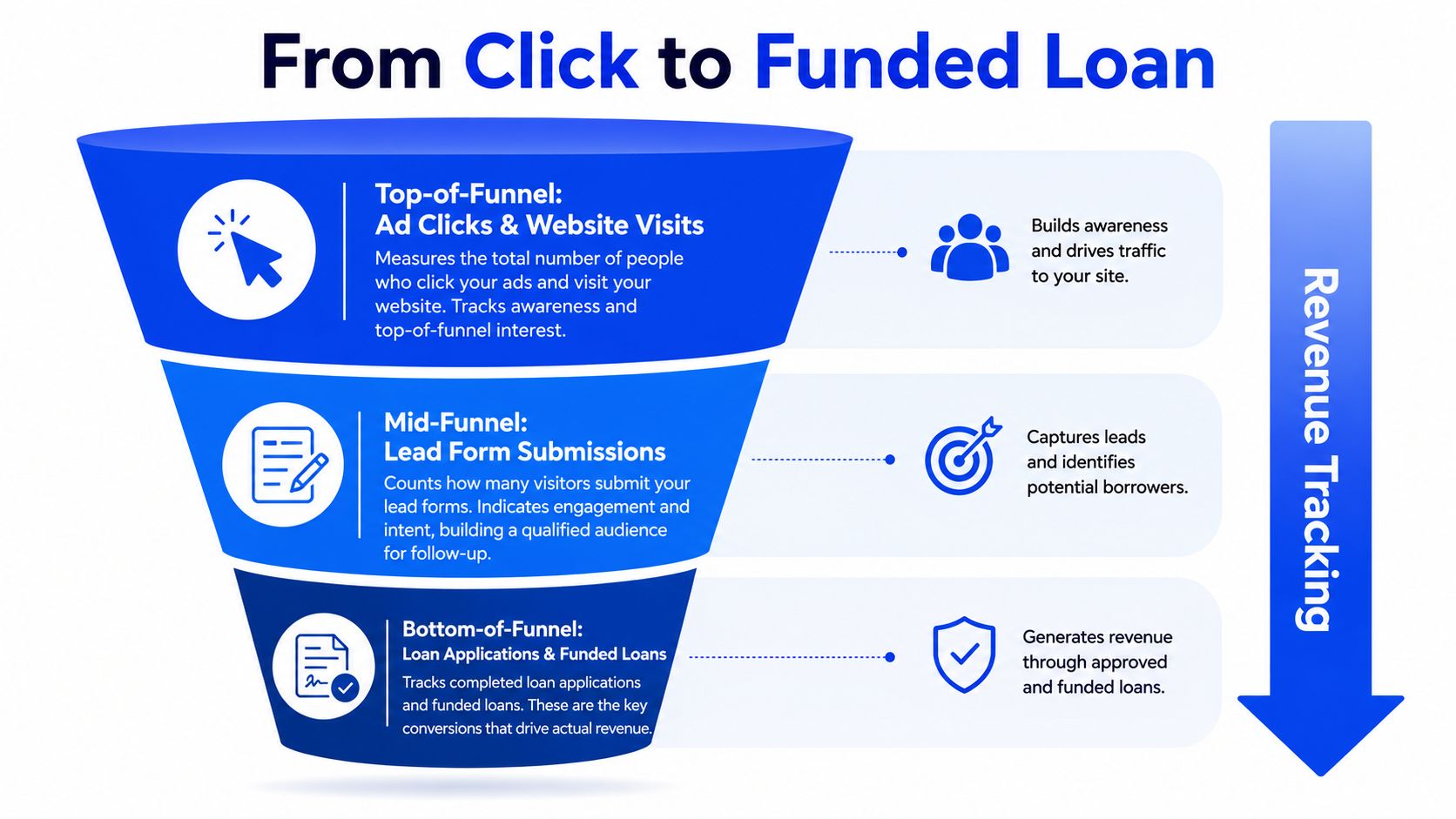
Top-of-funnel metrics matter only if they connect to later stages. Top of Mind recommends tracking contacts added, then email/text engagement, call responses, applications, and finally closed loans and loan value by campaign series, with attention to the message that appears immediately before close. That sequence is the right one.
Use open rates as a rough comparison, but do not let them run the program. Click-throughs are the better intent signal because they show real interaction. A borrower who clicks has done more than glance. A borrower who opens has not committed anything.
Post-approval communication belongs in the same revenue system. The benchmark set cited by Webtonic notes that communication after approval has been associated with lower abandonment, which is a strong reason to treat post-approval messaging as part of revenue operations, not as a nice extra.
Attribute the close, not just the lead
Mortgage cycles are long enough that one-touch attribution lies. A borrower may click an ad, read an email, call a loan officer, pause, then come back through a remarketing touch. The money should be credited to the sequence, not the first click.
That is why multi-touch logic matters. The GROU guide on multi-touch attribution is useful as a general structure, but mortgage teams need to adapt it to applications, approvals, and funding, not meetings booked. If your CRM cannot show campaign series by stage, you are flying blind.
Your measurement stack should answer four questions every week. Which campaigns produced contacts, which produced applications, which produced funded loans, and which messages showed up right before close. Everything else is vanity.
Practical rule: if a campaign cannot show funded-loan impact, reduce its budget until it can.
Retention and referrals compound your marketing investment
Acquisition-only marketing burns cash because it treats every closed loan like the end of the story. In mortgage, the close is a waypoint. A borrower can refinance later, buy again later, or send someone else your way if you stay present and useful.
Post-close communication is revenue work
Retention belongs in the same operating plan as acquisition. Addy groups post-close retention, education-driven content, referral partnerships, paid search, and consistent follow-up after first contact into one mortgage marketing system. That is the right call. Growth comes from keeping relationships active, not from celebrating one campaign spike and moving on.
First-time buyers often become future refinance customers. Refinance customers may need future purchase loans. Real estate agents, financial planners, and past clients all sit inside the referral loop if your process gives them a reason to remember you. Homes for Heroes points to educational videos, blog posts, guest articles, podcasts, social engagement, networking, referral programs, and print and direct mail targeted to a demographic or niche offer as part of that broader motion.
The order matters. Do not send the same newsletter to every contact and call it lifecycle marketing. Send milestone-based communication, then ask for referrals when the relationship has earned it. That keeps the funnel warm without turning your inbox into noise.
Own the relationship infrastructure
BankBound recommends local SEO, search ads, display and social ads, remarketing, email nurture, and loan officer personal networks on LinkedIn, Zillow, Facebook, LoopNet, and Credio, plus individual pages for each lender on the website (BankBound). That structure matters because it routes people to the right person and gives the business cleaner attribution.
Use effective ways to generate mortgage leads as the standard for your front-end capture, then connect it to the follow-up system that turns interest into funded loans. That means one contact path, one owner, and one clear next step for each audience segment. If your CRM can show which campaign series led to applications and funding, you can tell which relationships are producing revenue and which ones are just creating activity.
The practical upside is simple. A borrower who knows you, sees you again, and gets useful follow-up is easier to convert later. A referral partner who gets steady value is more likely to send more business. That is compounding, not campaign noise.
Your 30-day mortgage marketing implementation sprint
If your mortgage marketing is messy, stop buying more ads. Fix the order of operations first. In 30 days, you can audit compliance, segment the audience, clean up the channel mix, and set measurement rules that show which campaigns produce funded loans and which ones only create activity.
Week 1 to week 2
Review every live ad, landing page, and follow-up sequence for RESPA, TILA, TCPA, Fair Lending, and state-specific issues. Then split your audience by loan type and borrower state of mind, not just by geography or source. If you're comparing tools, HubSpot can house lifecycle stages, Apollo and Sales Navigator help with contact intelligence on the B2B side, and mortgage teams often need an email platform that can handle compliance review before launch.
If you need a structure for front-end capture, the Growform mortgage lead generation guide is a useful reference for form design and conversion thinking. Use that lens to judge whether your forms and next steps are reducing friction. For a practical setup path, review how to structure lead generation so your capture, routing, and follow-up logic stay tied together instead of living in separate tools.
Week 3 to week 4
Rebuild one campaign per segment with one clear CTA, one landing page, and one follow-up sequence. Set baseline reporting for contacts added, email and text engagement, call responses, applications, approvals, and funded loans. Make sure the CRM can show campaign series, not just source fields.
Practical rule: if the loan officer can't explain the next step in one sentence, the campaign is too complicated.
Use a simple weekly operating rhythm.
Audit compliance first: Check disclosures, claims, contact methods, and page language before spend goes live.
Map segment by segment: Separate first-time buyers, refinance customers, and move-up buyers in your messaging and routing.
Test one channel at a time: Don't mix new creative, new landing pages, and new follow-up logic in the same launch.
Inspect funded-loan reporting weekly: Track what closed, what stalled, and which campaign series showed up before funding.
Fix the handoff: Make sure loan officers, marketing, and compliance all see the same lead history.
If you need a place to start, review your last 10 campaigns and trace each one from ad to funding. That audit will tell you more than another month of impressions ever will.
Most mortgage company marketing fails for the same reason: teams obsess over lead volume while ignoring the system that turns a borrower from curious to approved to funded. In a market where 65% of prospective homebuyers start their mortgage process online, 81% research lenders online before deciding, and 70% of online mortgage inquiries come from mobile devices (ZipDo), the old branch-first mindset is too slow.
Pipeline beats lead count, because mortgage revenue happens after application, approval, and funding.
Compliance shapes the funnel, RESPA, TILA, TCPA, and Fair Lending are not side issues.
Segmenting by buyer type matters, first-time buyers and refinance customers need different messages.
Measurement has to follow money, not clicks, opens, or form fills.
Retention and referrals compound, if you keep the relationship after the first close.
Table of Contents
The mortgage market has changed and your marketing must adapt
Build a measurement system that tracks funded loans, not clicks
Why most mortgage marketing programs fail
Most mortgage companies don't have a lead problem. They have a conversion system problem. They buy attention, collect names, then hope a loan officer or CRM follow-up sequence does the rest. That's not a marketing strategy, it's a leak.
The real failure is structural
The market now rewards teams that connect search, landing pages, follow-up, and funding in one sequence. ZipDo says 73% of mortgage lenders call digital marketing their most effective lead-generation tool, and 58% say their best leads come from digital channels (ZipDo). That doesn't mean more channels fix the problem, it means the buyer journey now starts online and ends somewhere else.
If your ads drive traffic but your pages don't answer rate, eligibility, or next-step questions, the lead dies in the middle. If your handoff to sales is slow, the lead goes cold. If your follow-up ignores the difference between first-time buyers and refinance customers, the message feels generic and the borrower disappears.
Practical rule: if a borrower can't tell what happens after the click, your marketing isn't ready.
The compliance layer makes this worse. RESPA, TILA, TCPA, and Fair Lending aren't optional guardrails, they shape what you can say, who you can target, and how you can follow up. Generalist B2B tactics break fast here, especially when teams import outbound habits that were built for software, not consumer lending.
A lot of mortgage marketing content still sells “more leads” as the answer. That's lazy. The better question is whether your current funnel can turn a qualified inquiry into a funded loan without compliance friction or sales drop-off. If not, more spend just gives you more waste.
The closest parallel in our own world is pipeline conversion, not lead generation. That's why this GROU article on why leads don't convert maps well as a cautionary read. The same lesson applies here, structure turns attention into pipeline.
The mortgage market has changed and your marketing must adapt
Mortgage company marketing used to depend on volume. Refinancing was easier to sell, inbound intent was plentiful, and a lot of teams got lazy because the market did part of the work for them. That model no longer fits. The buyer pool is smaller, competition is tighter, and borrowers do more homework before your team gets a real shot.
The volume collapse changed the game
The CFPB reports that U.S. mortgage applications fell by about 4.3 million, or 30.3%, in 2023, while originations fell by 2.7 million, or 32.2% year over year (CFPB). The same report shows a major shift in where loans are being originated. Non-bank mortgage companies now account for 53.3% of all home loans, up from 44.6% in 2018, while bank share fell from 42.5% to 30.1%.
That shift changes the job. The market is smaller, more fragmented, and more aggressive. Mortgage companies are fighting over fewer opportunities, and the firms that win are the ones that move faster, follow up harder, and market with more discipline.
Why speed and trust matter more now
That same market shift explains why speed to lead matters more than broad awareness. When refinancing collapsed by more than 90% from pandemic peaks, the lenders that depended on easy refinance demand lost their cushion. Purchase loans are harder. Borrowers research more, compare more, and often involve more than one decision-maker.
Your marketing has to do more than create interest. It has to create confidence quickly, then carry the borrower through a longer decision cycle without friction. Brand trust, follow-up quality, and lifecycle communication matter because the first lender that feels credible usually gets the conversation.
Borrowers already behave like researchers. ZipDo reports that 81% research lenders online before deciding and 70% of online mortgage inquiries come from mobile devices (ZipDo). That means the lender that wins is usually the one that answers the question clearly, on mobile, and without making the borrower work for the next step.
Use borrower segmentation strategy to separate first-time buyers, move-up buyers, and refinance prospects before you write copy. One message aimed at everyone turns into a message that convinces no one.
Segment your audience before you write a single ad
Mortgage marketing fails when one message tries to serve every borrower. First-time buyers, move-up buyers, and refinance customers are not just different stages, they're different psychologies. If your creative and landing pages don't reflect that, you'll get traffic without trust.
Start with the borrower's state of mind
First-time buyers usually need education, reassurance, and a slower decision path. Refinance customers usually want direct outcome framing, rate context, and fewer steps. Move-up buyers sit somewhere in the middle, because they already understand the process but often have layered timing, family, and home-equity considerations.
The point isn't to invent dozens of micro-segments. It's to stop writing generic mortgage ads that sound like they came from a template. HUD guidance recommends tailoring advertising content, language, media, and distribution to underserved populations, and partnering with trusted local organizations such as churches and nonprofits (HUD). That's not just a compliance note, it's a reminder that trust is contextual.
Practical rule: the more historical distrust or language friction a segment has, the more your message has to sound like it was written for them, not at them.
A better segmentation process starts with two questions. What does this borrower need to believe before they click, and what proof do they need before they submit? If you can't answer that, your ad is too generic.
For a useful mental model on audience structuring, the GROU segmentation glossary is worth a look, even though the mortgage context needs stricter compliance thinking. The core idea still holds, separate audiences by behavior, intent, and friction.
Build the message around the segment
First-time buyer content should explain the path in plain language. Payment calculators, down-payment guidance, and step-by-step process pages belong here because they reduce anxiety. Refinance pages should be more direct, with clear benefit framing and a faster CTA path.
Underserved audiences need a different layer altogether. HUD's guidance points toward culturally relevant messaging, in-language resources, and trusted community partnerships (HUD). That's not a cosmetic fix. It affects who answers the phone, what the landing page says, and which proof signals show up first.
Use this video to pressure-test your segmentation thinking against a practical mortgage audience lens.
If you want the right internal wiring for each audience, align the page, the call-to-action, and the follow-up sequence before you scale spend. That's where qualification starts.
Choose channels based on intent and compliance, not trends
Channel debates waste time when the question is simpler. Mortgage company marketing works when the channel matches intent, audience, and compliance burden. The goal is not to spray the market. The goal is to move the right borrower through a compliant funnel and into an application that can fund.
Use the channel for the job it can actually do
Google Ads is the cleanest way to capture active intent. Independent benchmark data puts Google Ads at a 3.40% conversion rate, $7.84 CPC, and $230.60 CPA for mortgage paid search (Webtonic). Those numbers do not make the channel cheap, they make the economics visible. If your team cannot connect spend to funded loans, the channel is doing too much work for too little return.
Facebook and Instagram fit first-time buyer discovery better than refinance intent. They work when the creative is educational and the audience is still learning what kind of mortgage they need. Direct mail still matters for refinance and existing homeowner outreach, especially when the database is clean and the offer is relevant. Real estate agent partnerships matter because they create transactional context that digital ads rarely generate on their own.
Channel | Intent level | Compliance complexity | Best fit for |
|---|---|---|---|
Google Ads | High | High | Search-driven purchase and refinance demand |
Facebook and Instagram | Medium | Medium | First-time buyers and education-led awareness |
Direct mail | Medium | Medium | Refinance, homeowners, and database reactivation |
Agent partnerships | High | High | Purchase transactions and referral trust |
Email nurture | Medium | High | Existing leads, past clients, and lifecycle follow-up |
SEO | High over time | Medium | Ongoing purchase intent and local visibility |
For email in financial services, the Breaker guide to financial email growth is a useful reference because it treats email as a trust channel, not a blast tool. That is the right mindset for mortgage teams that want responses without creating compliance noise.
Compliance changes the channel mix
TCPA affects phone and text outreach. TILA shapes how you talk about rates and terms. State lending rules and NMLS registration requirements add another layer if your loan officers are the public face of the campaign. Channel choice in mortgage is a legal design decision as much as it is a media decision.
If you want a framework for broader paid media structure, the GROU paid ads channel guide works as a planning model, but mortgage teams need tighter disclosure discipline than most B2B teams ever face. That gap is where generic channel advice falls apart.
Practical rule: if the channel cannot survive compliance review, it does not belong in your acquisition plan.
The strongest mortgage systems combine digital intent capture with relationship infrastructure. Search gets the hand-raise, email and CRM nurture keep the conversation alive, and offline relationships keep your brand inside the deal. A channel list does not do that. A system does.
Build a measurement system that tracks funded loans, not clicks
Clicks are comfort food. They are easy to report, easy to inflate, and almost useless if the borrower drops before funding. Mortgage company marketing needs a measurement model that follows the business outcome, not the prettiest dashboard.
Track the funnel in the order money is made
Top-of-funnel metrics matter only if they connect to later stages. Top of Mind recommends tracking contacts added, then email/text engagement, call responses, applications, and finally closed loans and loan value by campaign series, with attention to the message that appears immediately before close. That sequence is the right one.
Use open rates as a rough comparison, but do not let them run the program. Click-throughs are the better intent signal because they show real interaction. A borrower who clicks has done more than glance. A borrower who opens has not committed anything.
Post-approval communication belongs in the same revenue system. The benchmark set cited by Webtonic notes that communication after approval has been associated with lower abandonment, which is a strong reason to treat post-approval messaging as part of revenue operations, not as a nice extra.
Attribute the close, not just the lead
Mortgage cycles are long enough that one-touch attribution lies. A borrower may click an ad, read an email, call a loan officer, pause, then come back through a remarketing touch. The money should be credited to the sequence, not the first click.
That is why multi-touch logic matters. The GROU guide on multi-touch attribution is useful as a general structure, but mortgage teams need to adapt it to applications, approvals, and funding, not meetings booked. If your CRM cannot show campaign series by stage, you are flying blind.
Your measurement stack should answer four questions every week. Which campaigns produced contacts, which produced applications, which produced funded loans, and which messages showed up right before close. Everything else is vanity.
Practical rule: if a campaign cannot show funded-loan impact, reduce its budget until it can.
Retention and referrals compound your marketing investment
Acquisition-only marketing burns cash because it treats every closed loan like the end of the story. In mortgage, the close is a waypoint. A borrower can refinance later, buy again later, or send someone else your way if you stay present and useful.
Post-close communication is revenue work
Retention belongs in the same operating plan as acquisition. Addy groups post-close retention, education-driven content, referral partnerships, paid search, and consistent follow-up after first contact into one mortgage marketing system. That is the right call. Growth comes from keeping relationships active, not from celebrating one campaign spike and moving on.
First-time buyers often become future refinance customers. Refinance customers may need future purchase loans. Real estate agents, financial planners, and past clients all sit inside the referral loop if your process gives them a reason to remember you. Homes for Heroes points to educational videos, blog posts, guest articles, podcasts, social engagement, networking, referral programs, and print and direct mail targeted to a demographic or niche offer as part of that broader motion.
The order matters. Do not send the same newsletter to every contact and call it lifecycle marketing. Send milestone-based communication, then ask for referrals when the relationship has earned it. That keeps the funnel warm without turning your inbox into noise.
Own the relationship infrastructure
BankBound recommends local SEO, search ads, display and social ads, remarketing, email nurture, and loan officer personal networks on LinkedIn, Zillow, Facebook, LoopNet, and Credio, plus individual pages for each lender on the website (BankBound). That structure matters because it routes people to the right person and gives the business cleaner attribution.
Use effective ways to generate mortgage leads as the standard for your front-end capture, then connect it to the follow-up system that turns interest into funded loans. That means one contact path, one owner, and one clear next step for each audience segment. If your CRM can show which campaign series led to applications and funding, you can tell which relationships are producing revenue and which ones are just creating activity.
The practical upside is simple. A borrower who knows you, sees you again, and gets useful follow-up is easier to convert later. A referral partner who gets steady value is more likely to send more business. That is compounding, not campaign noise.
Your 30-day mortgage marketing implementation sprint
If your mortgage marketing is messy, stop buying more ads. Fix the order of operations first. In 30 days, you can audit compliance, segment the audience, clean up the channel mix, and set measurement rules that show which campaigns produce funded loans and which ones only create activity.
Week 1 to week 2
Review every live ad, landing page, and follow-up sequence for RESPA, TILA, TCPA, Fair Lending, and state-specific issues. Then split your audience by loan type and borrower state of mind, not just by geography or source. If you're comparing tools, HubSpot can house lifecycle stages, Apollo and Sales Navigator help with contact intelligence on the B2B side, and mortgage teams often need an email platform that can handle compliance review before launch.
If you need a structure for front-end capture, the Growform mortgage lead generation guide is a useful reference for form design and conversion thinking. Use that lens to judge whether your forms and next steps are reducing friction. For a practical setup path, review how to structure lead generation so your capture, routing, and follow-up logic stay tied together instead of living in separate tools.
Week 3 to week 4
Rebuild one campaign per segment with one clear CTA, one landing page, and one follow-up sequence. Set baseline reporting for contacts added, email and text engagement, call responses, applications, approvals, and funded loans. Make sure the CRM can show campaign series, not just source fields.
Practical rule: if the loan officer can't explain the next step in one sentence, the campaign is too complicated.
Use a simple weekly operating rhythm.
Audit compliance first: Check disclosures, claims, contact methods, and page language before spend goes live.
Map segment by segment: Separate first-time buyers, refinance customers, and move-up buyers in your messaging and routing.
Test one channel at a time: Don't mix new creative, new landing pages, and new follow-up logic in the same launch.
Inspect funded-loan reporting weekly: Track what closed, what stalled, and which campaign series showed up before funding.
Fix the handoff: Make sure loan officers, marketing, and compliance all see the same lead history.
If you need a place to start, review your last 10 campaigns and trace each one from ad to funding. That audit will tell you more than another month of impressions ever will.
Most mortgage company marketing fails for the same reason: teams obsess over lead volume while ignoring the system that turns a borrower from curious to approved to funded. In a market where 65% of prospective homebuyers start their mortgage process online, 81% research lenders online before deciding, and 70% of online mortgage inquiries come from mobile devices (ZipDo), the old branch-first mindset is too slow.
Pipeline beats lead count, because mortgage revenue happens after application, approval, and funding.
Compliance shapes the funnel, RESPA, TILA, TCPA, and Fair Lending are not side issues.
Segmenting by buyer type matters, first-time buyers and refinance customers need different messages.
Measurement has to follow money, not clicks, opens, or form fills.
Retention and referrals compound, if you keep the relationship after the first close.
Table of Contents
The mortgage market has changed and your marketing must adapt
Build a measurement system that tracks funded loans, not clicks
Why most mortgage marketing programs fail
Most mortgage companies don't have a lead problem. They have a conversion system problem. They buy attention, collect names, then hope a loan officer or CRM follow-up sequence does the rest. That's not a marketing strategy, it's a leak.
The real failure is structural
The market now rewards teams that connect search, landing pages, follow-up, and funding in one sequence. ZipDo says 73% of mortgage lenders call digital marketing their most effective lead-generation tool, and 58% say their best leads come from digital channels (ZipDo). That doesn't mean more channels fix the problem, it means the buyer journey now starts online and ends somewhere else.
If your ads drive traffic but your pages don't answer rate, eligibility, or next-step questions, the lead dies in the middle. If your handoff to sales is slow, the lead goes cold. If your follow-up ignores the difference between first-time buyers and refinance customers, the message feels generic and the borrower disappears.
Practical rule: if a borrower can't tell what happens after the click, your marketing isn't ready.
The compliance layer makes this worse. RESPA, TILA, TCPA, and Fair Lending aren't optional guardrails, they shape what you can say, who you can target, and how you can follow up. Generalist B2B tactics break fast here, especially when teams import outbound habits that were built for software, not consumer lending.
A lot of mortgage marketing content still sells “more leads” as the answer. That's lazy. The better question is whether your current funnel can turn a qualified inquiry into a funded loan without compliance friction or sales drop-off. If not, more spend just gives you more waste.
The closest parallel in our own world is pipeline conversion, not lead generation. That's why this GROU article on why leads don't convert maps well as a cautionary read. The same lesson applies here, structure turns attention into pipeline.
The mortgage market has changed and your marketing must adapt
Mortgage company marketing used to depend on volume. Refinancing was easier to sell, inbound intent was plentiful, and a lot of teams got lazy because the market did part of the work for them. That model no longer fits. The buyer pool is smaller, competition is tighter, and borrowers do more homework before your team gets a real shot.
The volume collapse changed the game
The CFPB reports that U.S. mortgage applications fell by about 4.3 million, or 30.3%, in 2023, while originations fell by 2.7 million, or 32.2% year over year (CFPB). The same report shows a major shift in where loans are being originated. Non-bank mortgage companies now account for 53.3% of all home loans, up from 44.6% in 2018, while bank share fell from 42.5% to 30.1%.
That shift changes the job. The market is smaller, more fragmented, and more aggressive. Mortgage companies are fighting over fewer opportunities, and the firms that win are the ones that move faster, follow up harder, and market with more discipline.
Why speed and trust matter more now
That same market shift explains why speed to lead matters more than broad awareness. When refinancing collapsed by more than 90% from pandemic peaks, the lenders that depended on easy refinance demand lost their cushion. Purchase loans are harder. Borrowers research more, compare more, and often involve more than one decision-maker.
Your marketing has to do more than create interest. It has to create confidence quickly, then carry the borrower through a longer decision cycle without friction. Brand trust, follow-up quality, and lifecycle communication matter because the first lender that feels credible usually gets the conversation.
Borrowers already behave like researchers. ZipDo reports that 81% research lenders online before deciding and 70% of online mortgage inquiries come from mobile devices (ZipDo). That means the lender that wins is usually the one that answers the question clearly, on mobile, and without making the borrower work for the next step.
Use borrower segmentation strategy to separate first-time buyers, move-up buyers, and refinance prospects before you write copy. One message aimed at everyone turns into a message that convinces no one.
Segment your audience before you write a single ad
Mortgage marketing fails when one message tries to serve every borrower. First-time buyers, move-up buyers, and refinance customers are not just different stages, they're different psychologies. If your creative and landing pages don't reflect that, you'll get traffic without trust.
Start with the borrower's state of mind
First-time buyers usually need education, reassurance, and a slower decision path. Refinance customers usually want direct outcome framing, rate context, and fewer steps. Move-up buyers sit somewhere in the middle, because they already understand the process but often have layered timing, family, and home-equity considerations.
The point isn't to invent dozens of micro-segments. It's to stop writing generic mortgage ads that sound like they came from a template. HUD guidance recommends tailoring advertising content, language, media, and distribution to underserved populations, and partnering with trusted local organizations such as churches and nonprofits (HUD). That's not just a compliance note, it's a reminder that trust is contextual.
Practical rule: the more historical distrust or language friction a segment has, the more your message has to sound like it was written for them, not at them.
A better segmentation process starts with two questions. What does this borrower need to believe before they click, and what proof do they need before they submit? If you can't answer that, your ad is too generic.
For a useful mental model on audience structuring, the GROU segmentation glossary is worth a look, even though the mortgage context needs stricter compliance thinking. The core idea still holds, separate audiences by behavior, intent, and friction.
Build the message around the segment
First-time buyer content should explain the path in plain language. Payment calculators, down-payment guidance, and step-by-step process pages belong here because they reduce anxiety. Refinance pages should be more direct, with clear benefit framing and a faster CTA path.
Underserved audiences need a different layer altogether. HUD's guidance points toward culturally relevant messaging, in-language resources, and trusted community partnerships (HUD). That's not a cosmetic fix. It affects who answers the phone, what the landing page says, and which proof signals show up first.
Use this video to pressure-test your segmentation thinking against a practical mortgage audience lens.
If you want the right internal wiring for each audience, align the page, the call-to-action, and the follow-up sequence before you scale spend. That's where qualification starts.
Choose channels based on intent and compliance, not trends
Channel debates waste time when the question is simpler. Mortgage company marketing works when the channel matches intent, audience, and compliance burden. The goal is not to spray the market. The goal is to move the right borrower through a compliant funnel and into an application that can fund.
Use the channel for the job it can actually do
Google Ads is the cleanest way to capture active intent. Independent benchmark data puts Google Ads at a 3.40% conversion rate, $7.84 CPC, and $230.60 CPA for mortgage paid search (Webtonic). Those numbers do not make the channel cheap, they make the economics visible. If your team cannot connect spend to funded loans, the channel is doing too much work for too little return.
Facebook and Instagram fit first-time buyer discovery better than refinance intent. They work when the creative is educational and the audience is still learning what kind of mortgage they need. Direct mail still matters for refinance and existing homeowner outreach, especially when the database is clean and the offer is relevant. Real estate agent partnerships matter because they create transactional context that digital ads rarely generate on their own.
Channel | Intent level | Compliance complexity | Best fit for |
|---|---|---|---|
Google Ads | High | High | Search-driven purchase and refinance demand |
Facebook and Instagram | Medium | Medium | First-time buyers and education-led awareness |
Direct mail | Medium | Medium | Refinance, homeowners, and database reactivation |
Agent partnerships | High | High | Purchase transactions and referral trust |
Email nurture | Medium | High | Existing leads, past clients, and lifecycle follow-up |
SEO | High over time | Medium | Ongoing purchase intent and local visibility |
For email in financial services, the Breaker guide to financial email growth is a useful reference because it treats email as a trust channel, not a blast tool. That is the right mindset for mortgage teams that want responses without creating compliance noise.
Compliance changes the channel mix
TCPA affects phone and text outreach. TILA shapes how you talk about rates and terms. State lending rules and NMLS registration requirements add another layer if your loan officers are the public face of the campaign. Channel choice in mortgage is a legal design decision as much as it is a media decision.
If you want a framework for broader paid media structure, the GROU paid ads channel guide works as a planning model, but mortgage teams need tighter disclosure discipline than most B2B teams ever face. That gap is where generic channel advice falls apart.
Practical rule: if the channel cannot survive compliance review, it does not belong in your acquisition plan.
The strongest mortgage systems combine digital intent capture with relationship infrastructure. Search gets the hand-raise, email and CRM nurture keep the conversation alive, and offline relationships keep your brand inside the deal. A channel list does not do that. A system does.
Build a measurement system that tracks funded loans, not clicks
Clicks are comfort food. They are easy to report, easy to inflate, and almost useless if the borrower drops before funding. Mortgage company marketing needs a measurement model that follows the business outcome, not the prettiest dashboard.
Track the funnel in the order money is made
Top-of-funnel metrics matter only if they connect to later stages. Top of Mind recommends tracking contacts added, then email/text engagement, call responses, applications, and finally closed loans and loan value by campaign series, with attention to the message that appears immediately before close. That sequence is the right one.
Use open rates as a rough comparison, but do not let them run the program. Click-throughs are the better intent signal because they show real interaction. A borrower who clicks has done more than glance. A borrower who opens has not committed anything.
Post-approval communication belongs in the same revenue system. The benchmark set cited by Webtonic notes that communication after approval has been associated with lower abandonment, which is a strong reason to treat post-approval messaging as part of revenue operations, not as a nice extra.
Attribute the close, not just the lead
Mortgage cycles are long enough that one-touch attribution lies. A borrower may click an ad, read an email, call a loan officer, pause, then come back through a remarketing touch. The money should be credited to the sequence, not the first click.
That is why multi-touch logic matters. The GROU guide on multi-touch attribution is useful as a general structure, but mortgage teams need to adapt it to applications, approvals, and funding, not meetings booked. If your CRM cannot show campaign series by stage, you are flying blind.
Your measurement stack should answer four questions every week. Which campaigns produced contacts, which produced applications, which produced funded loans, and which messages showed up right before close. Everything else is vanity.
Practical rule: if a campaign cannot show funded-loan impact, reduce its budget until it can.
Retention and referrals compound your marketing investment
Acquisition-only marketing burns cash because it treats every closed loan like the end of the story. In mortgage, the close is a waypoint. A borrower can refinance later, buy again later, or send someone else your way if you stay present and useful.
Post-close communication is revenue work
Retention belongs in the same operating plan as acquisition. Addy groups post-close retention, education-driven content, referral partnerships, paid search, and consistent follow-up after first contact into one mortgage marketing system. That is the right call. Growth comes from keeping relationships active, not from celebrating one campaign spike and moving on.
First-time buyers often become future refinance customers. Refinance customers may need future purchase loans. Real estate agents, financial planners, and past clients all sit inside the referral loop if your process gives them a reason to remember you. Homes for Heroes points to educational videos, blog posts, guest articles, podcasts, social engagement, networking, referral programs, and print and direct mail targeted to a demographic or niche offer as part of that broader motion.
The order matters. Do not send the same newsletter to every contact and call it lifecycle marketing. Send milestone-based communication, then ask for referrals when the relationship has earned it. That keeps the funnel warm without turning your inbox into noise.
Own the relationship infrastructure
BankBound recommends local SEO, search ads, display and social ads, remarketing, email nurture, and loan officer personal networks on LinkedIn, Zillow, Facebook, LoopNet, and Credio, plus individual pages for each lender on the website (BankBound). That structure matters because it routes people to the right person and gives the business cleaner attribution.
Use effective ways to generate mortgage leads as the standard for your front-end capture, then connect it to the follow-up system that turns interest into funded loans. That means one contact path, one owner, and one clear next step for each audience segment. If your CRM can show which campaign series led to applications and funding, you can tell which relationships are producing revenue and which ones are just creating activity.
The practical upside is simple. A borrower who knows you, sees you again, and gets useful follow-up is easier to convert later. A referral partner who gets steady value is more likely to send more business. That is compounding, not campaign noise.
Your 30-day mortgage marketing implementation sprint
If your mortgage marketing is messy, stop buying more ads. Fix the order of operations first. In 30 days, you can audit compliance, segment the audience, clean up the channel mix, and set measurement rules that show which campaigns produce funded loans and which ones only create activity.
Week 1 to week 2
Review every live ad, landing page, and follow-up sequence for RESPA, TILA, TCPA, Fair Lending, and state-specific issues. Then split your audience by loan type and borrower state of mind, not just by geography or source. If you're comparing tools, HubSpot can house lifecycle stages, Apollo and Sales Navigator help with contact intelligence on the B2B side, and mortgage teams often need an email platform that can handle compliance review before launch.
If you need a structure for front-end capture, the Growform mortgage lead generation guide is a useful reference for form design and conversion thinking. Use that lens to judge whether your forms and next steps are reducing friction. For a practical setup path, review how to structure lead generation so your capture, routing, and follow-up logic stay tied together instead of living in separate tools.
Week 3 to week 4
Rebuild one campaign per segment with one clear CTA, one landing page, and one follow-up sequence. Set baseline reporting for contacts added, email and text engagement, call responses, applications, approvals, and funded loans. Make sure the CRM can show campaign series, not just source fields.
Practical rule: if the loan officer can't explain the next step in one sentence, the campaign is too complicated.
Use a simple weekly operating rhythm.
Audit compliance first: Check disclosures, claims, contact methods, and page language before spend goes live.
Map segment by segment: Separate first-time buyers, refinance customers, and move-up buyers in your messaging and routing.
Test one channel at a time: Don't mix new creative, new landing pages, and new follow-up logic in the same launch.
Inspect funded-loan reporting weekly: Track what closed, what stalled, and which campaign series showed up before funding.
Fix the handoff: Make sure loan officers, marketing, and compliance all see the same lead history.
If you need a place to start, review your last 10 campaigns and trace each one from ad to funding. That audit will tell you more than another month of impressions ever will.

Pipeline OS Newsletter
Build qualified pipeline
Get weekly tactics to generate demand, improve lead quality, and book more meetings.







Trusted by industry leaders
Trusted by industry leaders
Trusted by industry leaders
Ready to build qualified pipeline?
Ready to build qualified pipeline?
Ready to build qualified pipeline?
Book a call to see if we're the right fit, or take the 2-minute quiz to get a clear starting point.
Book a call to see if we're the right fit, or take the 2-minute quiz to get a clear starting point.
Book a call to see if we're the right fit, or take the 2-minute quiz to get a clear starting point.
" height="30.21639343089746px" id="hfGbXmQR2" width="30.216393430897455px"/></svg>)
Copyright © 2026 – All Right Reserved
Copyright © 2026 – All Right Reserved
Copyright © 2026 – All Right Reserved