%22%3E%3C/path%3E%3Cpath d=%22M 63.072 7.554 C 62.258 8.022 61.577 8.689 61.092 9.493 L 61.092 7.076 L 57.158 7.076 L 57.158 22.64 L 61.089 22.64 L 61.089 14.888 C 61.089 13.446 61.403 12.434 62.03 11.853 C 62.818 11.218 63.818 10.907 64.826 10.982 L 65.868 10.982 L 65.868 6.851 C 64.891 6.834 63.926 7.076 63.073 7.554 Z%22 fill=%22rgb(17,17,17)%22%3E%3C/path%3E%3Cpath d=%22M 78.916 7.82 C 76.363 6.49 73.321 6.49 70.768 7.82 C 69.562 8.473 68.564 9.451 67.888 10.644 C 67.167 11.931 66.803 13.387 66.834 14.862 C 66.804 16.332 67.157 17.785 67.86 19.077 C 68.515 20.267 69.494 21.246 70.684 21.901 C 71.924 22.576 73.318 22.92 74.73 22.898 C 76.164 22.918 77.58 22.575 78.846 21.901 C 80.062 21.247 81.073 20.27 81.768 19.077 C 82.506 17.797 82.88 16.339 82.85 14.862 C 82.88 13.389 82.517 11.934 81.797 10.647 C 81.12 9.455 80.122 8.477 78.917 7.824 M 78.803 14.862 C 78.829 15.739 78.636 16.608 78.241 17.391 C 77.903 18.046 77.38 18.588 76.738 18.95 C 76.124 19.293 75.432 19.472 74.729 19.47 C 73.668 19.497 72.648 19.061 71.934 18.276 C 71.139 17.323 70.741 16.1 70.823 14.862 C 70.741 13.62 71.149 12.395 71.959 11.45 C 72.687 10.667 73.715 10.233 74.783 10.256 C 75.859 10.236 76.894 10.67 77.635 11.45 C 78.464 12.387 78.884 13.616 78.801 14.864%22 fill=%22rgb(17,17,17)%22%3E%3C/path%3E%3Cpath d=%22M 95.906 7.076 L 95.906 15.646 C 95.975 16.68 95.643 17.701 94.979 18.498 C 94.311 19.184 93.379 19.547 92.422 19.495 C 91.475 19.544 90.553 19.18 89.894 18.498 C 89.23 17.701 88.898 16.68 88.967 15.646 L 88.967 7.076 L 85.033 7.076 L 85.033 16.207 C 85 17.449 85.275 18.68 85.834 19.79 C 86.327 20.75 87.095 21.542 88.039 22.065 C 89.033 22.594 90.145 22.861 91.271 22.838 C 92.188 22.847 93.095 22.65 93.926 22.263 C 94.708 21.905 95.388 21.36 95.906 20.675 L 95.906 22.645 L 99.865 22.645 L 99.865 7.076 Z%22 fill=%22rgb(17,17,17)%22%3E%3C/path%3E%3Cpath d=%22M 4.513 15.626 C 4.511 10.815 7.606 6.549 12.181 5.059 C 16.756 3.57 21.77 5.195 24.601 9.086 L 27.816 5.87 C 24.074 1.186 17.981 -0.943 12.137 0.393 C 6.292 1.728 1.728 6.292 0.393 12.137 C -0.943 17.981 1.186 24.074 5.87 27.816 L 9.085 24.601 C 6.214 22.512 4.515 19.177 4.513 15.626%22 fill=%22rgb(32,62,235)%22%3E%3C/path%3E%3Cpath d=%22M 17.114 14.343 L 13.354 18.01 L 13.354 18.026 L 21.071 18.026 L 11.412 27.609 L 17.389 27.609 L 23.999 21.081 L 23.999 28.316 L 24.005 28.316 L 27.967 24.393 L 27.967 14.343 Z%22 fill=%22rgb(32,62,235)%22%3E%3C/path%3E%3C/g%3E%3C/svg%3E) ×
× ××
××›
›
›
›
HubSpot pricing 2026 explained
HubSpot pricing 2026 explained
HubSpot pricing 2026 explained
HubSpot pricing 2026 explained
HubSpot pricing 2026 explained
HubSpot pricing 2026 explained

Author
Aljaz Peklaj

HubSpot pricing in 2026 looks reasonable on the website and gets brutal in the contract. After running 5 active HubSpot client deployments at GROU over the last 21 months, the gap between list price and what teams actually pay sits at 48% on the median.
This is the operator breakdown: every tier across all 5 Hubs, what enterprise teams actually spend, and when Pipedrive or Close is the smarter buy for sub-$50k ACV teams.
TL;DR
HubSpot list prices start at Free and run to $3,600/mo per Hub at Enterprise tier. Real annual cost for a 50-rep mid-market team lands around $86,000/yr versus a $58,000/yr list quote. The gap is required onboarding ($15k typical), contact-tier upsells, premium support, and seat bumps mid-contract.
For B2B SaaS with ACV under $50k, Pipedrive at $24/seat or Close at $49/seat covers 85% of HubSpot Sales Hub's use cases at one third the cost. HubSpot wins above $50k ACV where the marketing-sales-service stack integration is worth the premium.
The 5 HubSpot Hubs
HubSpot's pricing splits across 5 Hub products. You can buy them standalone or bundled. Most B2B teams end up with Sales Hub + Marketing Hub at minimum, with Service Hub added once support volume justifies it.
The Hubs are: Marketing Hub (email, automation, landing pages, contact database), Sales Hub (CRM, sequences, deal pipeline), Service Hub (tickets, knowledge base, NPS), CMS Hub (website builder + blog), and Operations Hub (data sync, custom workflows, programmable automation).
Each Hub has 4 tiers: Free, Starter ($15/seat/mo), Professional, and Enterprise. The Free tier is genuinely useful at SMB scale. Starter tier is the "we'll see" plan. The real product lives at Professional and Enterprise.
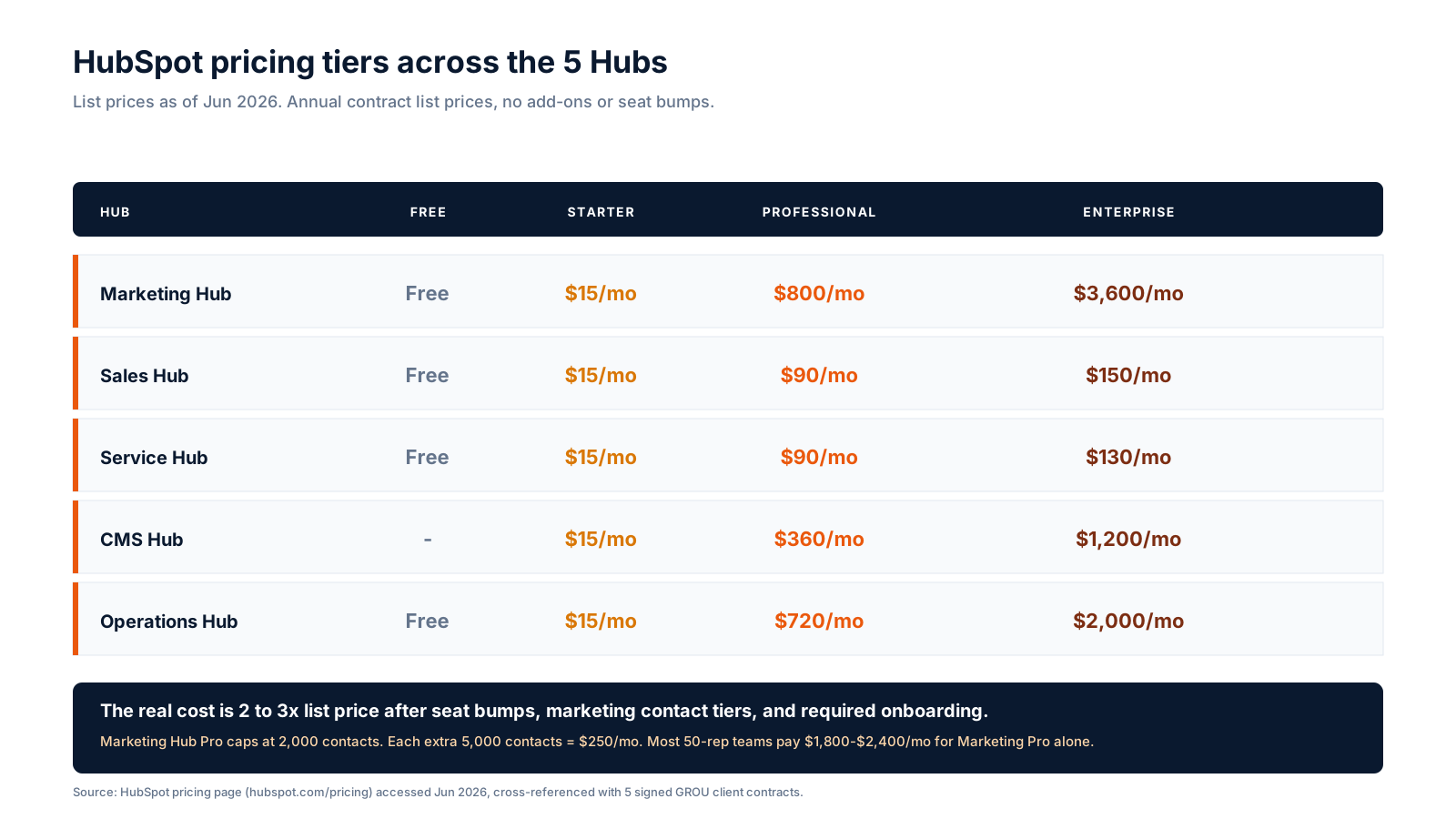
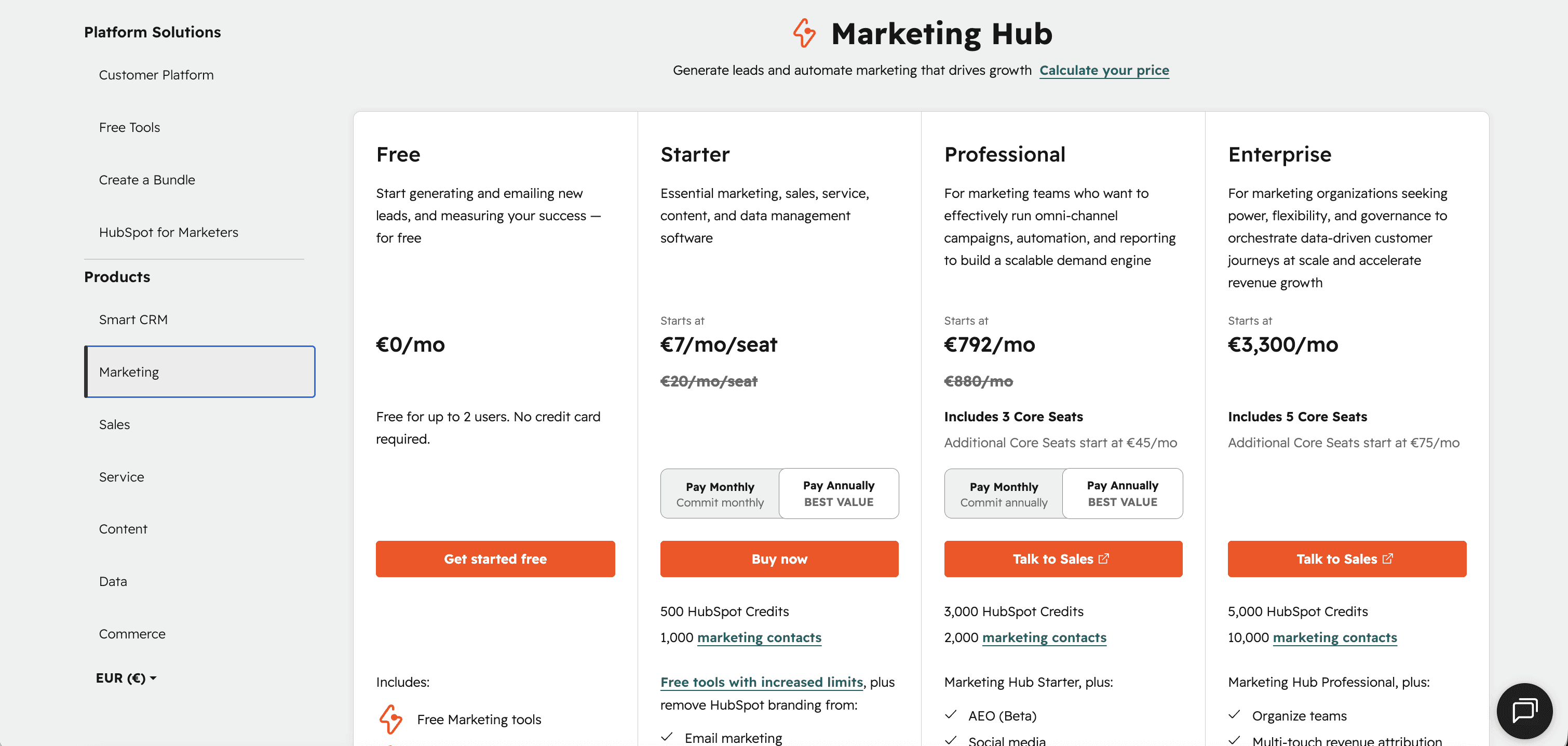
The biggest pricing surprise is Marketing Hub Pro at $800/mo. That's the entry list price. It caps at 2,000 marketing contacts. Each additional 5,000 contacts adds $250/mo. By the time a 50-rep team is at 25,000 contacts, Marketing Pro alone is $1,800-$2,400/mo.
What HubSpot actually costs (real client contracts)
The 5 GROU clients running HubSpot range from 5-seat SMB stacks to 100+ seat enterprise. Real contract costs (annualized, including onboarding amortization and contact-tier add-ons) below.
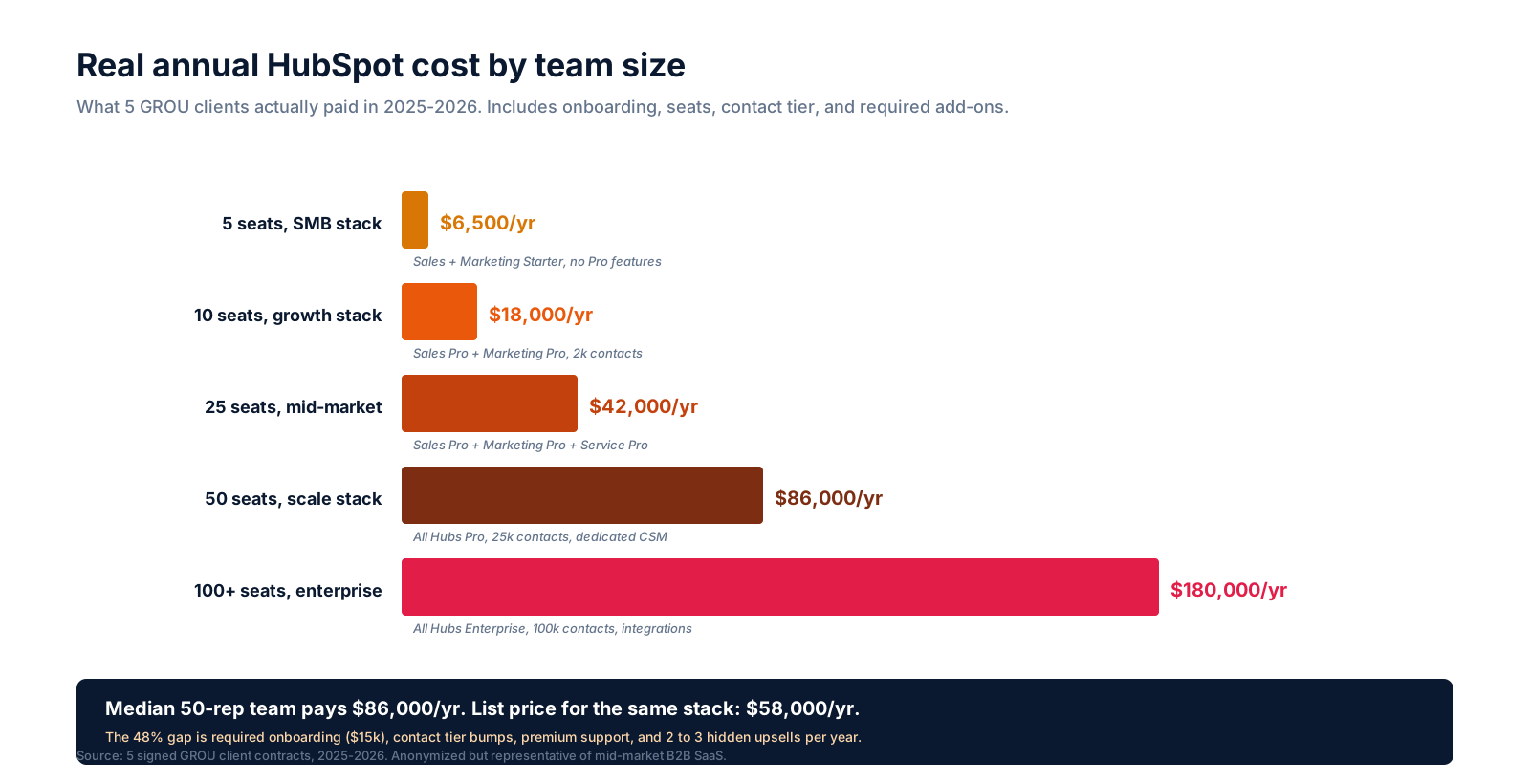
The median 50-rep team pays $86,000/yr for the All-Hubs Pro stack with 25k contacts. List price for the same configuration is $58,000/yr. The 48% gap breaks down as:
Required onboarding adds $15,000 one-time (HubSpot Pro tier and above won't activate without onboarding services). Contact-tier bumps add $300-$800/mo as the marketing list grows. Premium support adds $5,000-$8,000/yr for guaranteed 4-hour response. Hidden upsells (transactional email, custom domains, dedicated IP) add $500-$1,200/mo over the contract.
For enterprise (100+ seats), the cost lands at $180,000-$240,000/yr depending on contact volume and integration scope.
The hidden costs nobody mentions
Three things blindside teams that buy HubSpot based on the list price.
The first is annual commitment with auto-renewal. HubSpot contracts are 12-month minimum. Mid-contract downgrades aren't possible. End-of-contract notice is 60 days minimum (some legacy contracts require 90). Forget to send the notice and you're locked in for another year. HubSpot's terms of service make this clear, but most teams don't read.
The second is the contact tier ratchet. Marketing Hub bills on "marketing contacts". Anyone you can email. Add 5,000 new contacts mid-year, your bill goes up. Remove 5,000 contacts the next quarter, your bill stays the same until renewal. The tier only moves up during the contract, never down.
The third is required onboarding. Pro and Enterprise tiers require HubSpot onboarding services to activate. The "Quick Start" package is $3,000. The "Standard" is $9,000. "Premier" is $18,000. Most mid-market teams buy Standard. Most enterprise teams pay $25-50k for white-glove implementation.
HubSpot vs Pipedrive vs Close
For sales-only stacks, HubSpot Sales Hub competes with two cheaper, more focused alternatives. Pipedrive is the budget winner. Close is the call-heavy outbound winner.
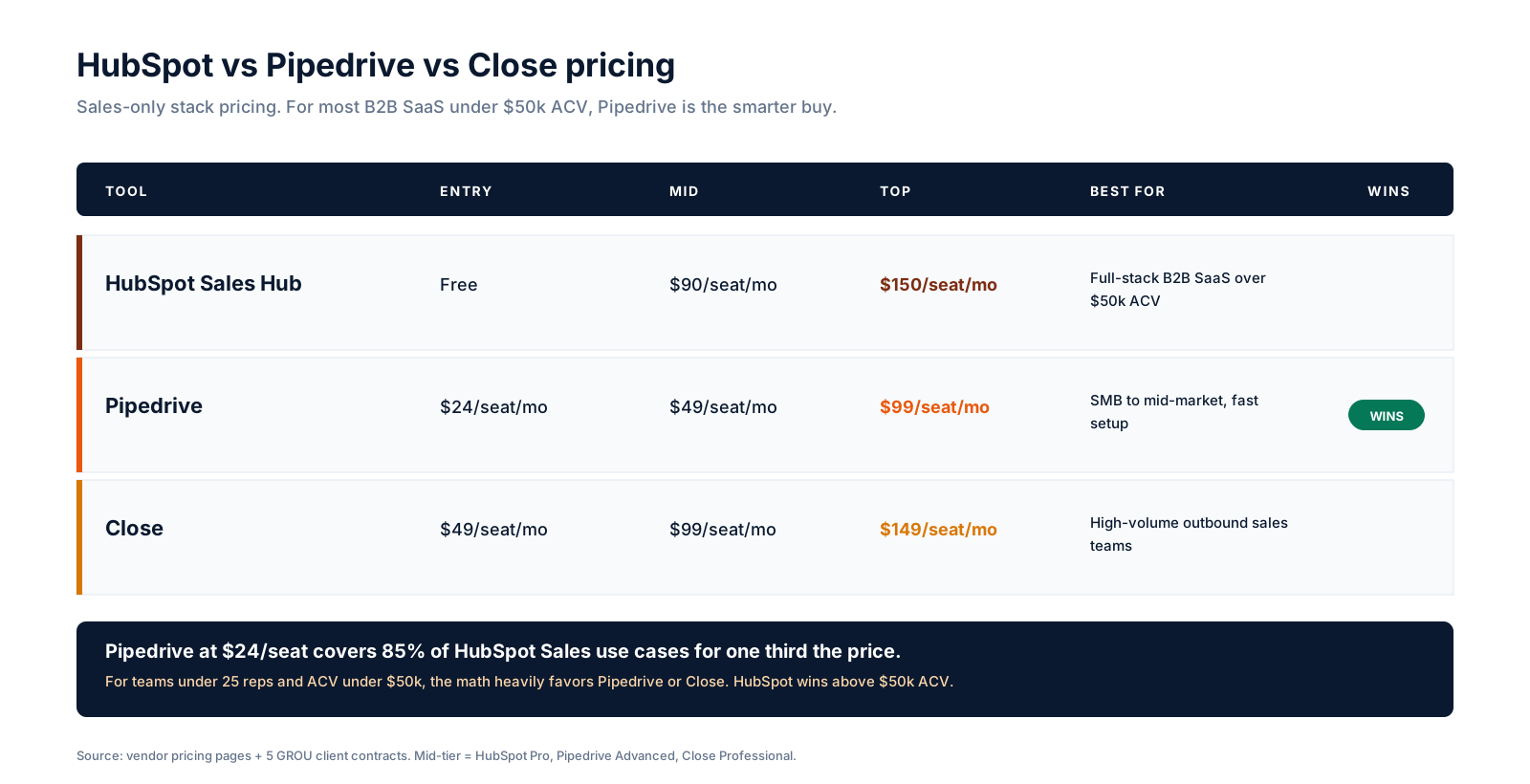
For most B2B SaaS under $50k ACV, Pipedrive covers 85% of HubSpot Sales Hub's daily-use features (pipeline, contacts, sequences, reporting, mobile) at one third the cost. Pipedrive lacks HubSpot's marketing automation integration. But if you're not buying Marketing Hub anyway, that's not a tradeoff.
For outbound-heavy teams making 50+ calls per rep per day, Close at $49/seat is purpose-built around dialer + sequence integration. HubSpot has a dialer but it's a checkbox feature, not the spine of the platform.
HubSpot wins when your stack needs Marketing Hub + Sales Hub + Service Hub working together with shared contact data. For full-stack B2B SaaS at $50k+ ACV with marketing-led demand generation, the integration is genuinely worth the premium. For everyone else, look at our full Pipedrive review or Close CRM review.
Who should buy HubSpot
Match 3 of these 4 criteria and HubSpot earns the premium: your ACV is over $50k, you sell into mid-market or enterprise, marketing-led growth drives 30%+ of pipeline, and your team is over 25 reps.
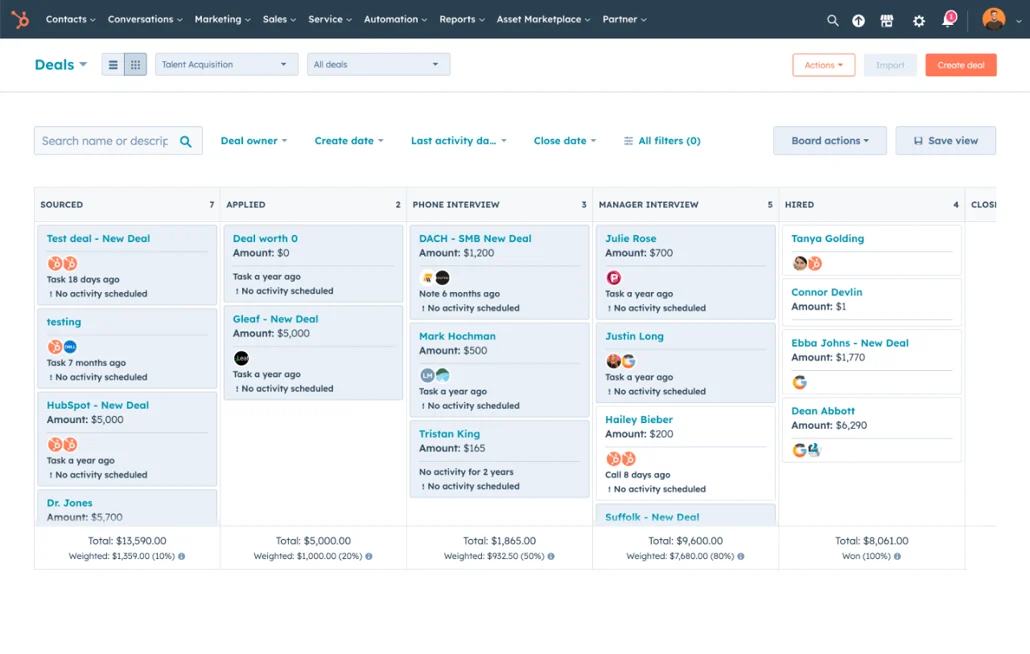
The integration between Marketing Hub and Sales Hub is the real product. Pipeline reporting that connects MQL to closed-won inside one platform, attribution that survives the marketing-to-sales handoff, and a shared contact database that doesn't require integration glue. That stack is worth $86,000/yr for the right buyer.
Who should skip HubSpot
Skip HubSpot if any of these apply: ACV under $50k, team under 15 reps, marketing is a side concern (you're outbound-led), or you hate annual contracts with onboarding mandates.
For sub-$50k ACV B2B SaaS, the right stack is usually Pipedrive ($240/year per seat) + Smartlead ($39/mo) for cold email + Apollo ($59/mo) for data. Total cost for 5 seats: under $3,500/yr versus HubSpot's $6,500-$8,000.
For outbound-heavy teams, Close + Apollo + Heyreach is a stronger stack than HubSpot at half the price.
FAQ
How much does HubSpot cost per month?
HubSpot Starter starts at $15 per seat per month per Hub. Professional tier ranges from $90 to $800 per month depending on Hub. Enterprise tier runs $130 to $3,600 per month. Real cost is typically 2-3x list once you add required onboarding, contact tiers, and upsells.
Is HubSpot Free actually free?
Yes, the Free tier is genuinely free with no time limit. Limits include 1 million contacts, basic CRM, simple email marketing (2,000 sends/month), simple forms, and basic chatbot. Most B2B teams outgrow the Free tier when they need email automation or sequences.
Why is HubSpot Pro so expensive?
Marketing Hub Pro at $800/month is the platform fee for advanced automation, A/B testing, custom reporting, and the marketing analytics suite. Sales Hub Pro at $90/seat/month is per-rep pricing for sequences, forecasting, and team-based pipelines. The Pro tier is where HubSpot's actual value lives.
Does HubSpot offer discounts?
Yes, but you have to negotiate. Standard discounts: 10% for annual contracts (already baked in to "annual" list price), 5-15% additional for multi-year commits, 20-30% for end-of-quarter close incentives. Highest discounts go to teams willing to publish a case study.
What is HubSpot's hidden cost trap?
Three hidden costs: required onboarding ($3k-$25k), contact-tier ratchet (Marketing Hub bills on marketing contacts and only moves up), and auto-renewal with 60-day notice requirement. Always negotiate onboarding down at signing. Vendors flex more pre-contract than post.
Can I downgrade HubSpot mid-contract?
No. HubSpot contracts are 12-month minimum with no mid-contract downgrades. You can pause some Hubs but not refund. Cancellation requires 60-90 days notice depending on your contract version. Renegotiate at renewal, not mid-term.
Is HubSpot worth it for small businesses?
Free tier yes, Starter tier maybe, Pro tier no for most SMBs. Sub-15-rep teams typically extract more value from Pipedrive ($24/seat) or Close ($49/seat) than HubSpot Sales Pro ($90/seat). The marketing-sales integration is HubSpot's real product, and most SMBs don't need it.
HubSpot vs Salesforce: which is cheaper?
HubSpot is cheaper at SMB and mid-market. Salesforce wins on cost at true enterprise scale (1,000+ seats) due to volume discounts. For 10-100 seat teams, HubSpot's all-in pricing is 30-50% lower than equivalent Salesforce Sales Cloud + Marketing Cloud + Service Cloud configurations.
Bottom line
HubSpot's published pricing understates real cost by roughly 48%. The platform is genuinely best-in-class for full-stack B2B SaaS over $50k ACV with marketing-led demand generation. Below that threshold, the math favors Pipedrive + Smartlead + Apollo by a wide margin.
Need help running the HubSpot vs alternatives evaluation for your specific stack? Book a call with GROU. We've run this analysis for 11 clients over the last 21 months and can save you 4-6 weeks of vendor calls.
GROU is a B2B outbound and revenue operations agency operating from Ljubljana, Slovenia. We run 5 active HubSpot client deployments at mid-market scale, plus Pipedrive and Close deployments at SMB. Pricing data above is from 5 signed HubSpot contracts negotiated in 2025-2026, anonymized to protect client confidentiality.
Some links in this article are affiliate links. We only recommend tools we run in production. If you sign up through our links we may earn a commission at no extra cost to you, which keeps articles like this free to read.
HubSpot pricing in 2026 looks reasonable on the website and gets brutal in the contract. After running 5 active HubSpot client deployments at GROU over the last 21 months, the gap between list price and what teams actually pay sits at 48% on the median.
This is the operator breakdown: every tier across all 5 Hubs, what enterprise teams actually spend, and when Pipedrive or Close is the smarter buy for sub-$50k ACV teams.
TL;DR
HubSpot list prices start at Free and run to $3,600/mo per Hub at Enterprise tier. Real annual cost for a 50-rep mid-market team lands around $86,000/yr versus a $58,000/yr list quote. The gap is required onboarding ($15k typical), contact-tier upsells, premium support, and seat bumps mid-contract.
For B2B SaaS with ACV under $50k, Pipedrive at $24/seat or Close at $49/seat covers 85% of HubSpot Sales Hub's use cases at one third the cost. HubSpot wins above $50k ACV where the marketing-sales-service stack integration is worth the premium.
The 5 HubSpot Hubs
HubSpot's pricing splits across 5 Hub products. You can buy them standalone or bundled. Most B2B teams end up with Sales Hub + Marketing Hub at minimum, with Service Hub added once support volume justifies it.
The Hubs are: Marketing Hub (email, automation, landing pages, contact database), Sales Hub (CRM, sequences, deal pipeline), Service Hub (tickets, knowledge base, NPS), CMS Hub (website builder + blog), and Operations Hub (data sync, custom workflows, programmable automation).
Each Hub has 4 tiers: Free, Starter ($15/seat/mo), Professional, and Enterprise. The Free tier is genuinely useful at SMB scale. Starter tier is the "we'll see" plan. The real product lives at Professional and Enterprise.
The biggest pricing surprise is Marketing Hub Pro at $800/mo. That's the entry list price. It caps at 2,000 marketing contacts. Each additional 5,000 contacts adds $250/mo. By the time a 50-rep team is at 25,000 contacts, Marketing Pro alone is $1,800-$2,400/mo.
What HubSpot actually costs (real client contracts)
The 5 GROU clients running HubSpot range from 5-seat SMB stacks to 100+ seat enterprise. Real contract costs (annualized, including onboarding amortization and contact-tier add-ons) below.
The median 50-rep team pays $86,000/yr for the All-Hubs Pro stack with 25k contacts. List price for the same configuration is $58,000/yr. The 48% gap breaks down as:
Required onboarding adds $15,000 one-time (HubSpot Pro tier and above won't activate without onboarding services). Contact-tier bumps add $300-$800/mo as the marketing list grows. Premium support adds $5,000-$8,000/yr for guaranteed 4-hour response. Hidden upsells (transactional email, custom domains, dedicated IP) add $500-$1,200/mo over the contract.
For enterprise (100+ seats), the cost lands at $180,000-$240,000/yr depending on contact volume and integration scope.
The hidden costs nobody mentions
Three things blindside teams that buy HubSpot based on the list price.
The first is annual commitment with auto-renewal. HubSpot contracts are 12-month minimum. Mid-contract downgrades aren't possible. End-of-contract notice is 60 days minimum (some legacy contracts require 90). Forget to send the notice and you're locked in for another year. HubSpot's terms of service make this clear, but most teams don't read.
The second is the contact tier ratchet. Marketing Hub bills on "marketing contacts". Anyone you can email. Add 5,000 new contacts mid-year, your bill goes up. Remove 5,000 contacts the next quarter, your bill stays the same until renewal. The tier only moves up during the contract, never down.
The third is required onboarding. Pro and Enterprise tiers require HubSpot onboarding services to activate. The "Quick Start" package is $3,000. The "Standard" is $9,000. "Premier" is $18,000. Most mid-market teams buy Standard. Most enterprise teams pay $25-50k for white-glove implementation.
HubSpot vs Pipedrive vs Close
For sales-only stacks, HubSpot Sales Hub competes with two cheaper, more focused alternatives. Pipedrive is the budget winner. Close is the call-heavy outbound winner.
For most B2B SaaS under $50k ACV, Pipedrive covers 85% of HubSpot Sales Hub's daily-use features (pipeline, contacts, sequences, reporting, mobile) at one third the cost. Pipedrive lacks HubSpot's marketing automation integration. But if you're not buying Marketing Hub anyway, that's not a tradeoff.
For outbound-heavy teams making 50+ calls per rep per day, Close at $49/seat is purpose-built around dialer + sequence integration. HubSpot has a dialer but it's a checkbox feature, not the spine of the platform.
HubSpot wins when your stack needs Marketing Hub + Sales Hub + Service Hub working together with shared contact data. For full-stack B2B SaaS at $50k+ ACV with marketing-led demand generation, the integration is genuinely worth the premium. For everyone else, look at our full Pipedrive review or Close CRM review.
Who should buy HubSpot
Match 3 of these 4 criteria and HubSpot earns the premium: your ACV is over $50k, you sell into mid-market or enterprise, marketing-led growth drives 30%+ of pipeline, and your team is over 25 reps.
The integration between Marketing Hub and Sales Hub is the real product. Pipeline reporting that connects MQL to closed-won inside one platform, attribution that survives the marketing-to-sales handoff, and a shared contact database that doesn't require integration glue. That stack is worth $86,000/yr for the right buyer.
Who should skip HubSpot
Skip HubSpot if any of these apply: ACV under $50k, team under 15 reps, marketing is a side concern (you're outbound-led), or you hate annual contracts with onboarding mandates.
For sub-$50k ACV B2B SaaS, the right stack is usually Pipedrive ($240/year per seat) + Smartlead ($39/mo) for cold email + Apollo ($59/mo) for data. Total cost for 5 seats: under $3,500/yr versus HubSpot's $6,500-$8,000.
For outbound-heavy teams, Close + Apollo + Heyreach is a stronger stack than HubSpot at half the price.
FAQ
How much does HubSpot cost per month?
HubSpot Starter starts at $15 per seat per month per Hub. Professional tier ranges from $90 to $800 per month depending on Hub. Enterprise tier runs $130 to $3,600 per month. Real cost is typically 2-3x list once you add required onboarding, contact tiers, and upsells.
Is HubSpot Free actually free?
Yes, the Free tier is genuinely free with no time limit. Limits include 1 million contacts, basic CRM, simple email marketing (2,000 sends/month), simple forms, and basic chatbot. Most B2B teams outgrow the Free tier when they need email automation or sequences.
Why is HubSpot Pro so expensive?
Marketing Hub Pro at $800/month is the platform fee for advanced automation, A/B testing, custom reporting, and the marketing analytics suite. Sales Hub Pro at $90/seat/month is per-rep pricing for sequences, forecasting, and team-based pipelines. The Pro tier is where HubSpot's actual value lives.
Does HubSpot offer discounts?
Yes, but you have to negotiate. Standard discounts: 10% for annual contracts (already baked in to "annual" list price), 5-15% additional for multi-year commits, 20-30% for end-of-quarter close incentives. Highest discounts go to teams willing to publish a case study.
What is HubSpot's hidden cost trap?
Three hidden costs: required onboarding ($3k-$25k), contact-tier ratchet (Marketing Hub bills on marketing contacts and only moves up), and auto-renewal with 60-day notice requirement. Always negotiate onboarding down at signing. Vendors flex more pre-contract than post.
Can I downgrade HubSpot mid-contract?
No. HubSpot contracts are 12-month minimum with no mid-contract downgrades. You can pause some Hubs but not refund. Cancellation requires 60-90 days notice depending on your contract version. Renegotiate at renewal, not mid-term.
Is HubSpot worth it for small businesses?
Free tier yes, Starter tier maybe, Pro tier no for most SMBs. Sub-15-rep teams typically extract more value from Pipedrive ($24/seat) or Close ($49/seat) than HubSpot Sales Pro ($90/seat). The marketing-sales integration is HubSpot's real product, and most SMBs don't need it.
HubSpot vs Salesforce: which is cheaper?
HubSpot is cheaper at SMB and mid-market. Salesforce wins on cost at true enterprise scale (1,000+ seats) due to volume discounts. For 10-100 seat teams, HubSpot's all-in pricing is 30-50% lower than equivalent Salesforce Sales Cloud + Marketing Cloud + Service Cloud configurations.
Bottom line
HubSpot's published pricing understates real cost by roughly 48%. The platform is genuinely best-in-class for full-stack B2B SaaS over $50k ACV with marketing-led demand generation. Below that threshold, the math favors Pipedrive + Smartlead + Apollo by a wide margin.
Need help running the HubSpot vs alternatives evaluation for your specific stack? Book a call with GROU. We've run this analysis for 11 clients over the last 21 months and can save you 4-6 weeks of vendor calls.
GROU is a B2B outbound and revenue operations agency operating from Ljubljana, Slovenia. We run 5 active HubSpot client deployments at mid-market scale, plus Pipedrive and Close deployments at SMB. Pricing data above is from 5 signed HubSpot contracts negotiated in 2025-2026, anonymized to protect client confidentiality.
Some links in this article are affiliate links. We only recommend tools we run in production. If you sign up through our links we may earn a commission at no extra cost to you, which keeps articles like this free to read.
HubSpot pricing in 2026 looks reasonable on the website and gets brutal in the contract. After running 5 active HubSpot client deployments at GROU over the last 21 months, the gap between list price and what teams actually pay sits at 48% on the median.
This is the operator breakdown: every tier across all 5 Hubs, what enterprise teams actually spend, and when Pipedrive or Close is the smarter buy for sub-$50k ACV teams.
TL;DR
HubSpot list prices start at Free and run to $3,600/mo per Hub at Enterprise tier. Real annual cost for a 50-rep mid-market team lands around $86,000/yr versus a $58,000/yr list quote. The gap is required onboarding ($15k typical), contact-tier upsells, premium support, and seat bumps mid-contract.
For B2B SaaS with ACV under $50k, Pipedrive at $24/seat or Close at $49/seat covers 85% of HubSpot Sales Hub's use cases at one third the cost. HubSpot wins above $50k ACV where the marketing-sales-service stack integration is worth the premium.
The 5 HubSpot Hubs
HubSpot's pricing splits across 5 Hub products. You can buy them standalone or bundled. Most B2B teams end up with Sales Hub + Marketing Hub at minimum, with Service Hub added once support volume justifies it.
The Hubs are: Marketing Hub (email, automation, landing pages, contact database), Sales Hub (CRM, sequences, deal pipeline), Service Hub (tickets, knowledge base, NPS), CMS Hub (website builder + blog), and Operations Hub (data sync, custom workflows, programmable automation).
Each Hub has 4 tiers: Free, Starter ($15/seat/mo), Professional, and Enterprise. The Free tier is genuinely useful at SMB scale. Starter tier is the "we'll see" plan. The real product lives at Professional and Enterprise.
The biggest pricing surprise is Marketing Hub Pro at $800/mo. That's the entry list price. It caps at 2,000 marketing contacts. Each additional 5,000 contacts adds $250/mo. By the time a 50-rep team is at 25,000 contacts, Marketing Pro alone is $1,800-$2,400/mo.
What HubSpot actually costs (real client contracts)
The 5 GROU clients running HubSpot range from 5-seat SMB stacks to 100+ seat enterprise. Real contract costs (annualized, including onboarding amortization and contact-tier add-ons) below.
The median 50-rep team pays $86,000/yr for the All-Hubs Pro stack with 25k contacts. List price for the same configuration is $58,000/yr. The 48% gap breaks down as:
Required onboarding adds $15,000 one-time (HubSpot Pro tier and above won't activate without onboarding services). Contact-tier bumps add $300-$800/mo as the marketing list grows. Premium support adds $5,000-$8,000/yr for guaranteed 4-hour response. Hidden upsells (transactional email, custom domains, dedicated IP) add $500-$1,200/mo over the contract.
For enterprise (100+ seats), the cost lands at $180,000-$240,000/yr depending on contact volume and integration scope.
The hidden costs nobody mentions
Three things blindside teams that buy HubSpot based on the list price.
The first is annual commitment with auto-renewal. HubSpot contracts are 12-month minimum. Mid-contract downgrades aren't possible. End-of-contract notice is 60 days minimum (some legacy contracts require 90). Forget to send the notice and you're locked in for another year. HubSpot's terms of service make this clear, but most teams don't read.
The second is the contact tier ratchet. Marketing Hub bills on "marketing contacts". Anyone you can email. Add 5,000 new contacts mid-year, your bill goes up. Remove 5,000 contacts the next quarter, your bill stays the same until renewal. The tier only moves up during the contract, never down.
The third is required onboarding. Pro and Enterprise tiers require HubSpot onboarding services to activate. The "Quick Start" package is $3,000. The "Standard" is $9,000. "Premier" is $18,000. Most mid-market teams buy Standard. Most enterprise teams pay $25-50k for white-glove implementation.
HubSpot vs Pipedrive vs Close
For sales-only stacks, HubSpot Sales Hub competes with two cheaper, more focused alternatives. Pipedrive is the budget winner. Close is the call-heavy outbound winner.
For most B2B SaaS under $50k ACV, Pipedrive covers 85% of HubSpot Sales Hub's daily-use features (pipeline, contacts, sequences, reporting, mobile) at one third the cost. Pipedrive lacks HubSpot's marketing automation integration. But if you're not buying Marketing Hub anyway, that's not a tradeoff.
For outbound-heavy teams making 50+ calls per rep per day, Close at $49/seat is purpose-built around dialer + sequence integration. HubSpot has a dialer but it's a checkbox feature, not the spine of the platform.
HubSpot wins when your stack needs Marketing Hub + Sales Hub + Service Hub working together with shared contact data. For full-stack B2B SaaS at $50k+ ACV with marketing-led demand generation, the integration is genuinely worth the premium. For everyone else, look at our full Pipedrive review or Close CRM review.
Who should buy HubSpot
Match 3 of these 4 criteria and HubSpot earns the premium: your ACV is over $50k, you sell into mid-market or enterprise, marketing-led growth drives 30%+ of pipeline, and your team is over 25 reps.
The integration between Marketing Hub and Sales Hub is the real product. Pipeline reporting that connects MQL to closed-won inside one platform, attribution that survives the marketing-to-sales handoff, and a shared contact database that doesn't require integration glue. That stack is worth $86,000/yr for the right buyer.
Who should skip HubSpot
Skip HubSpot if any of these apply: ACV under $50k, team under 15 reps, marketing is a side concern (you're outbound-led), or you hate annual contracts with onboarding mandates.
For sub-$50k ACV B2B SaaS, the right stack is usually Pipedrive ($240/year per seat) + Smartlead ($39/mo) for cold email + Apollo ($59/mo) for data. Total cost for 5 seats: under $3,500/yr versus HubSpot's $6,500-$8,000.
For outbound-heavy teams, Close + Apollo + Heyreach is a stronger stack than HubSpot at half the price.
FAQ
How much does HubSpot cost per month?
HubSpot Starter starts at $15 per seat per month per Hub. Professional tier ranges from $90 to $800 per month depending on Hub. Enterprise tier runs $130 to $3,600 per month. Real cost is typically 2-3x list once you add required onboarding, contact tiers, and upsells.
Is HubSpot Free actually free?
Yes, the Free tier is genuinely free with no time limit. Limits include 1 million contacts, basic CRM, simple email marketing (2,000 sends/month), simple forms, and basic chatbot. Most B2B teams outgrow the Free tier when they need email automation or sequences.
Why is HubSpot Pro so expensive?
Marketing Hub Pro at $800/month is the platform fee for advanced automation, A/B testing, custom reporting, and the marketing analytics suite. Sales Hub Pro at $90/seat/month is per-rep pricing for sequences, forecasting, and team-based pipelines. The Pro tier is where HubSpot's actual value lives.
Does HubSpot offer discounts?
Yes, but you have to negotiate. Standard discounts: 10% for annual contracts (already baked in to "annual" list price), 5-15% additional for multi-year commits, 20-30% for end-of-quarter close incentives. Highest discounts go to teams willing to publish a case study.
What is HubSpot's hidden cost trap?
Three hidden costs: required onboarding ($3k-$25k), contact-tier ratchet (Marketing Hub bills on marketing contacts and only moves up), and auto-renewal with 60-day notice requirement. Always negotiate onboarding down at signing. Vendors flex more pre-contract than post.
Can I downgrade HubSpot mid-contract?
No. HubSpot contracts are 12-month minimum with no mid-contract downgrades. You can pause some Hubs but not refund. Cancellation requires 60-90 days notice depending on your contract version. Renegotiate at renewal, not mid-term.
Is HubSpot worth it for small businesses?
Free tier yes, Starter tier maybe, Pro tier no for most SMBs. Sub-15-rep teams typically extract more value from Pipedrive ($24/seat) or Close ($49/seat) than HubSpot Sales Pro ($90/seat). The marketing-sales integration is HubSpot's real product, and most SMBs don't need it.
HubSpot vs Salesforce: which is cheaper?
HubSpot is cheaper at SMB and mid-market. Salesforce wins on cost at true enterprise scale (1,000+ seats) due to volume discounts. For 10-100 seat teams, HubSpot's all-in pricing is 30-50% lower than equivalent Salesforce Sales Cloud + Marketing Cloud + Service Cloud configurations.
Bottom line
HubSpot's published pricing understates real cost by roughly 48%. The platform is genuinely best-in-class for full-stack B2B SaaS over $50k ACV with marketing-led demand generation. Below that threshold, the math favors Pipedrive + Smartlead + Apollo by a wide margin.
Need help running the HubSpot vs alternatives evaluation for your specific stack? Book a call with GROU. We've run this analysis for 11 clients over the last 21 months and can save you 4-6 weeks of vendor calls.
GROU is a B2B outbound and revenue operations agency operating from Ljubljana, Slovenia. We run 5 active HubSpot client deployments at mid-market scale, plus Pipedrive and Close deployments at SMB. Pricing data above is from 5 signed HubSpot contracts negotiated in 2025-2026, anonymized to protect client confidentiality.
Some links in this article are affiliate links. We only recommend tools we run in production. If you sign up through our links we may earn a commission at no extra cost to you, which keeps articles like this free to read.
Pipeline OS Newsletter
Build qualified pipeline
Get weekly tactics to generate demand, improve lead quality, and book more meetings.





Trusted by industry leaders
Trusted by industry leaders
Trusted by industry leaders
Ready to build qualified pipeline?
Ready to build qualified pipeline?
Ready to build qualified pipeline?
Book a call to see if we're the right fit, or take the 2-minute quiz to get a clear starting point.
Book a call to see if we're the right fit, or take the 2-minute quiz to get a clear starting point.
Book a call to see if we're the right fit, or take the 2-minute quiz to get a clear starting point.
" height="30.21639343089746px" id="hfGbXmQR2" width="30.216393430897455px"/></svg>)
Copyright © 2026 – All Right Reserved
Copyright © 2026 – All Right Reserved
Copyright © 2026 – All Right Reserved