%22%3E%3C/path%3E%3Cpath d=%22M 63.072 7.554 C 62.258 8.022 61.577 8.689 61.092 9.493 L 61.092 7.076 L 57.158 7.076 L 57.158 22.64 L 61.089 22.64 L 61.089 14.888 C 61.089 13.446 61.403 12.434 62.03 11.853 C 62.818 11.218 63.818 10.907 64.826 10.982 L 65.868 10.982 L 65.868 6.851 C 64.891 6.834 63.926 7.076 63.073 7.554 Z%22 fill=%22rgb(17,17,17)%22%3E%3C/path%3E%3Cpath d=%22M 78.916 7.82 C 76.363 6.49 73.321 6.49 70.768 7.82 C 69.562 8.473 68.564 9.451 67.888 10.644 C 67.167 11.931 66.803 13.387 66.834 14.862 C 66.804 16.332 67.157 17.785 67.86 19.077 C 68.515 20.267 69.494 21.246 70.684 21.901 C 71.924 22.576 73.318 22.92 74.73 22.898 C 76.164 22.918 77.58 22.575 78.846 21.901 C 80.062 21.247 81.073 20.27 81.768 19.077 C 82.506 17.797 82.88 16.339 82.85 14.862 C 82.88 13.389 82.517 11.934 81.797 10.647 C 81.12 9.455 80.122 8.477 78.917 7.824 M 78.803 14.862 C 78.829 15.739 78.636 16.608 78.241 17.391 C 77.903 18.046 77.38 18.588 76.738 18.95 C 76.124 19.293 75.432 19.472 74.729 19.47 C 73.668 19.497 72.648 19.061 71.934 18.276 C 71.139 17.323 70.741 16.1 70.823 14.862 C 70.741 13.62 71.149 12.395 71.959 11.45 C 72.687 10.667 73.715 10.233 74.783 10.256 C 75.859 10.236 76.894 10.67 77.635 11.45 C 78.464 12.387 78.884 13.616 78.801 14.864%22 fill=%22rgb(17,17,17)%22%3E%3C/path%3E%3Cpath d=%22M 95.906 7.076 L 95.906 15.646 C 95.975 16.68 95.643 17.701 94.979 18.498 C 94.311 19.184 93.379 19.547 92.422 19.495 C 91.475 19.544 90.553 19.18 89.894 18.498 C 89.23 17.701 88.898 16.68 88.967 15.646 L 88.967 7.076 L 85.033 7.076 L 85.033 16.207 C 85 17.449 85.275 18.68 85.834 19.79 C 86.327 20.75 87.095 21.542 88.039 22.065 C 89.033 22.594 90.145 22.861 91.271 22.838 C 92.188 22.847 93.095 22.65 93.926 22.263 C 94.708 21.905 95.388 21.36 95.906 20.675 L 95.906 22.645 L 99.865 22.645 L 99.865 7.076 Z%22 fill=%22rgb(17,17,17)%22%3E%3C/path%3E%3Cpath d=%22M 4.513 15.626 C 4.511 10.815 7.606 6.549 12.181 5.059 C 16.756 3.57 21.77 5.195 24.601 9.086 L 27.816 5.87 C 24.074 1.186 17.981 -0.943 12.137 0.393 C 6.292 1.728 1.728 6.292 0.393 12.137 C -0.943 17.981 1.186 24.074 5.87 27.816 L 9.085 24.601 C 6.214 22.512 4.515 19.177 4.513 15.626%22 fill=%22rgb(32,62,235)%22%3E%3C/path%3E%3Cpath d=%22M 17.114 14.343 L 13.354 18.01 L 13.354 18.026 L 21.071 18.026 L 11.412 27.609 L 17.389 27.609 L 23.999 21.081 L 23.999 28.316 L 24.005 28.316 L 27.967 24.393 L 27.967 14.343 Z%22 fill=%22rgb(32,62,235)%22%3E%3C/path%3E%3C/g%3E%3C/svg%3E) ×
× ××
××›
›
›
›
Social Media in B2B Marketing: The Operator's Guide
Social Media in B2B Marketing: The Operator's Guide
Social Media in B2B Marketing: The Operator's Guide
Social Media in B2B Marketing: The Operator's Guide
Social Media in B2B Marketing: The Operator's Guide
Social Media in B2B Marketing: The Operator's Guide

Author
Aljaz Peklaj

LinkedIn is where most qualified B2B conversations start, and the gap between that reality and what many teams report is the problem. You can post every day, run ads, and still get replies that never become meetings, because attention isn't the same thing as pipeline.
LinkedIn is the default channel for B2B decision-makers, and the concentration is high enough that ignoring it leaves money on the table.
Long-form analytical posts about real trade-offs outperform tip content because they attract buyers, not casual scrollers.
LinkedIn plus email beats single-channel outreach when the touches are coordinated, timed, and signal-based.
Attribution has to move past likes into CRM source fields, UTMs, sales interviews, and pipeline metrics.
The right mix depends on context, because manufacturing, enterprise, developer audiences, and regulated industries don't all behave the same way.
Table of Contents
Why B2B social media feels broken and what the article covers
Content formats and posting cadence that produce qualified conversations
A 30-day action to turn social into pipeline and how GROU approaches it
Why B2B social media feels broken and what the article covers
You're probably already posting on LinkedIn, maybe sponsoring content, maybe running sequences, and the outcome still feels soft. The feed is active, the dashboards have numbers, and the pipeline is thin or low quality.
The fix is structural, not cosmetic. LinkedIn is the primary engine for qualified B2B conversations, analytical posts beat generic advice, multi-channel sequences beat isolated touches, and attribution has to track influence, not just last click.
When those pieces aren't wired together, social looks busy but behaves like noise. When they are, social becomes a working layer in the revenue system.
The rest of this article stays practical. It focuses on what drives qualified conversations across real B2B programs, where LinkedIn is dominant, where it isn't, and how to prove impact without pretending impressions are revenue.
How LinkedIn became the B2B pipeline default
The shift to LinkedIn wasn't accidental. B2B moved away from broad consumer-style broadcasting and toward a professional network built around job titles, seniority, and company context. That matters because the buying motion is already shaped by who's visible, who's active, and who looks credible in a professional setting.
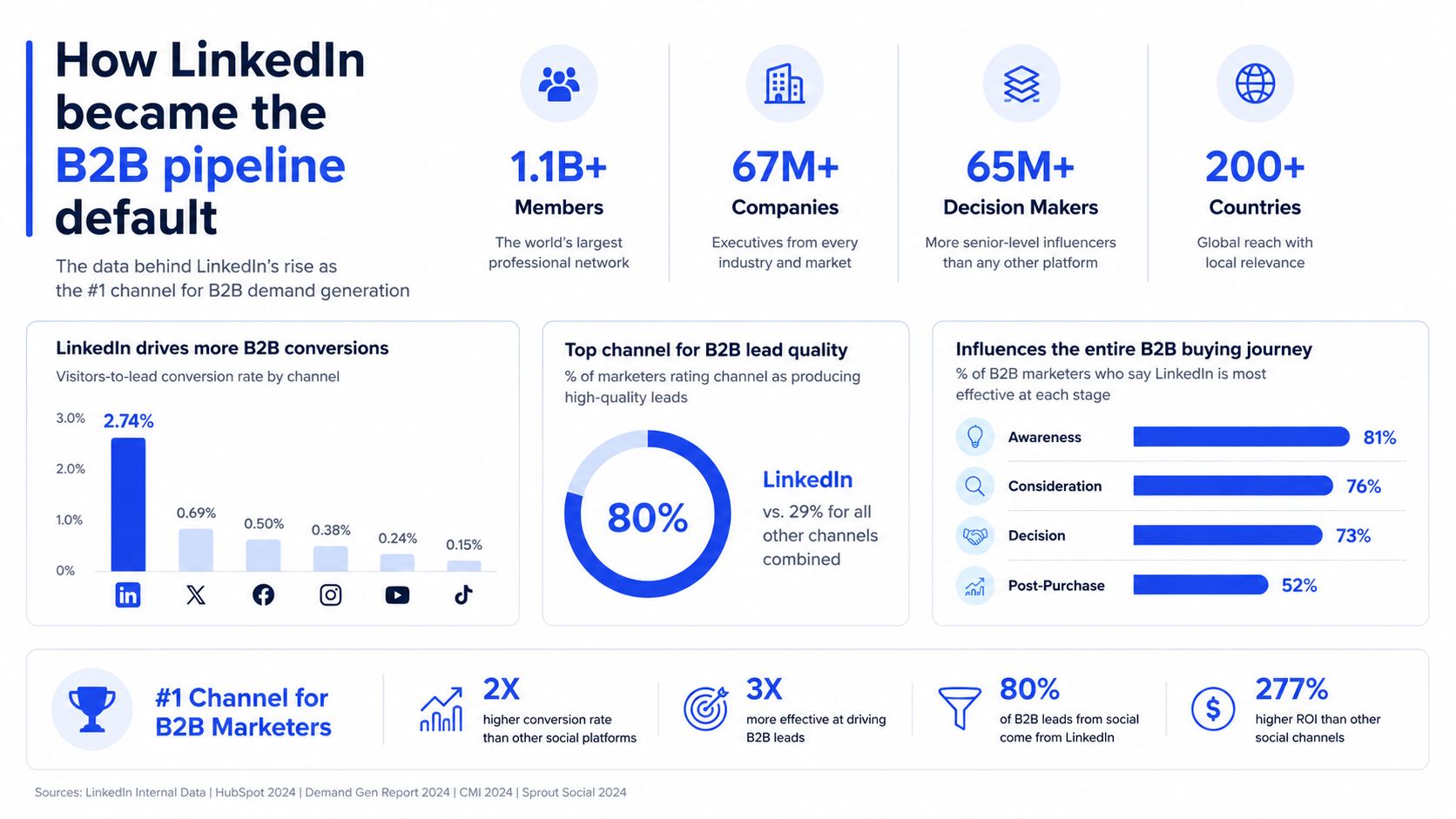
The scale tells the story. Statista reports that 86% of global B2B marketers in 2026 mention LinkedIn as a platform they use, and the same source context says 95% produce social media content while 91% use social media to distribute content. That's no longer experimentation, it's infrastructure, and the milestone is hard to miss for teams that still treat social as optional. Statista's B2B marketer platform data
Why concentration changes the economics
LinkedIn's value isn't just audience size, it's audience concentration. One industry source cites more than 1 billion members, including 65 million decision-makers, which means the platform gives you a dense layer of the exact people B2B teams need to reach. That's why its role in qualified conversation generation is different from consumer social.
The practical advantage is signal density. Role changes, company moves, and content engagement are easier to see there, so outreach timing can be based on observed behavior instead of static list blasts. If you want a clean way to browse verified prospect contacts inside that environment, browse verified prospect contacts is the kind of operational shortcut that fits a LinkedIn-first motion.
Why it became the default for qualified conversations
LinkedIn also works because it combines outbound and inbound in one place. A prospect can see a post, accept a connection, reply to a DM, and later engage with founder content without switching contexts. That multi-touch path is why a LinkedIn lead generation framework matters more than generic “be active on social” advice.
The source data backs the concentration effect. One B2B statistics roundup says LinkedIn drives roughly 60% of B2B leads from social, and another says 70% of B2B marketers use it to engage decision-makers. In other words, LinkedIn isn't one channel among equals for most B2B teams, it's the channel that carries the most weight when the goal is qualified conversation volume. Zipdo's B2B social media statistics
Content formats and posting cadence that produce qualified conversations
The format that keeps creating qualified replies is long-form analytical text posts about decisions and trade-offs. Keep them around 200 to 400 words, centered on one real situation, a clear position, and the reasoning behind it. That structure drives more substantive comments and more direct messages than generic advice because it shows judgment, not just preference.
One decision post that stated the stakes plainly produced 28,400 impressions, 47 meaningful comments, 11 DMs, 3 meetings, and 1 closed deal worth €68k. The lesson is not that every post should chase that same result. It is that specific decision content can move buyers into sales conversations when the argument is concrete enough. GROU's LinkedIn content formats guide
What to post, in what mix
The content mix that works is opinionated, and it still needs balance.
50 to 60% analytical decision posts: Use these for trade-offs, mistakes, and lessons from real work.
20 to 25% case study or outcome posts: These help when you have a clean result worth explaining.
15 to 20% observations or industry commentary: Keep these pointed and tied to what buyers are seeing.
5 to 10% experimental formats: Use these for carousels, video, or polls when there is a reason to test them.
Tip content usually underperforms because it is easy to skim and easy to forget. The contrast with TransClipper's TikTok strategy guide is useful, because short-form platforms reward speed and simplicity, while B2B LinkedIn rewards reasoning and credibility. That difference shapes what gets DMs, not just what gets views.
Practical rule: if a post could be written by any company in your market, it probably will not create qualified conversations.
A better filter is to ask whether the post reveals how a team made a choice, what it gave up, and what changed after the decision. That is the material buyers respond to.
The cadence that preserves quality
For founders and executive presence, the target is 2 to 3 posts per week. For company pages, it is 3 to 5 posts per week. Tuesday through Thursday is the core window, and 8 to 10 AM in the prospect's timezone is the strongest posting window for B2B attention.
That cadence matters because analytical posts need thinking time. If you post daily, quality usually drops and audience fatigue shows up in weaker comments and fewer DMs. A steady schedule beats a busy one.
For teams that want a concrete reference point, the working pattern is simple, Tuesday analytical post, Wednesday case or observation, Thursday analytical post, then stop. That rhythm keeps the content sharp without forcing filler. For format ideas that fit this cadence, review GROU's LinkedIn content formats guide.
Wiring social into outbound sequences that book meetings
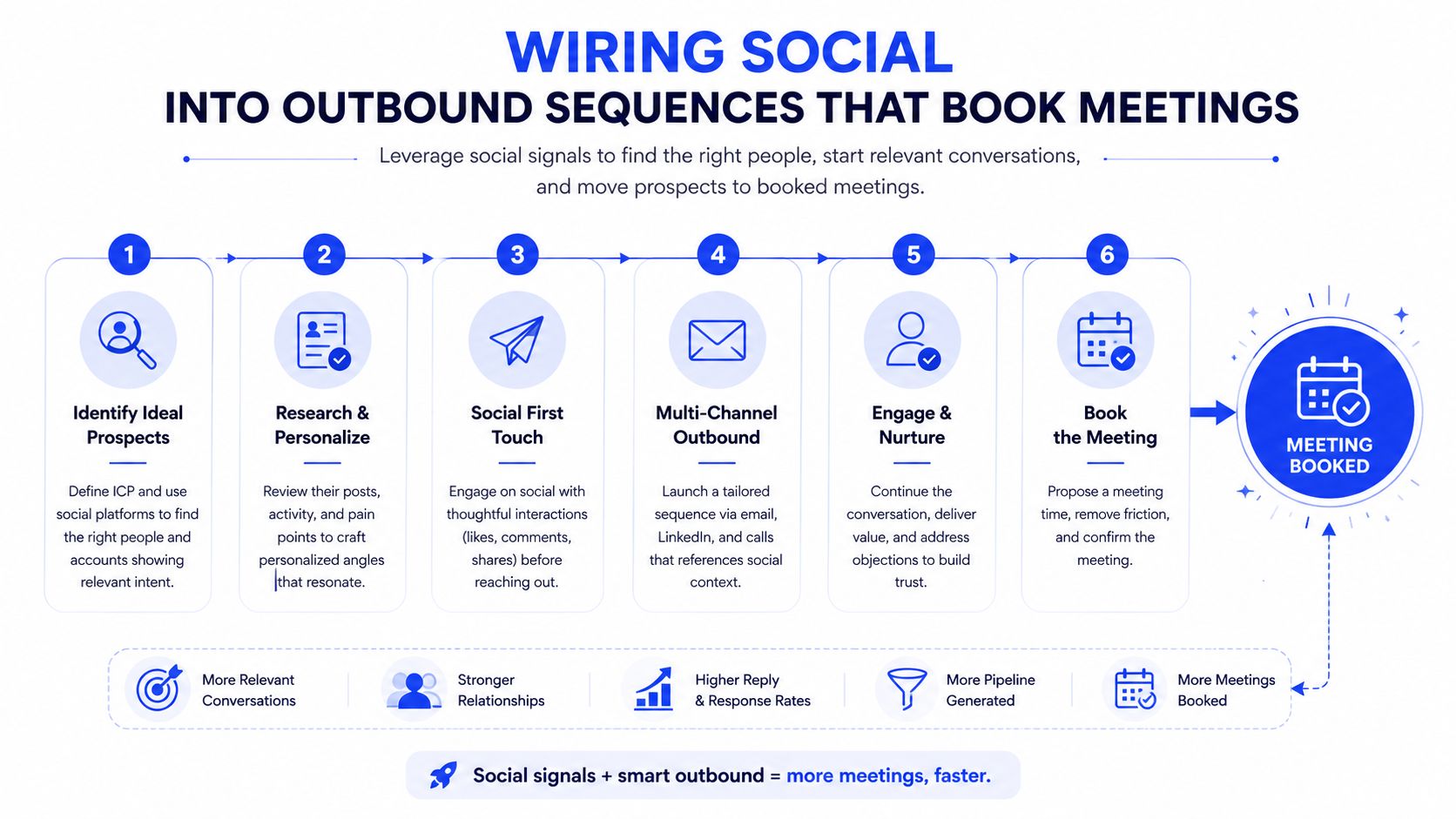
LinkedIn works best when it is part of the outbound motion, not a separate stream. The strongest setup is a 14-day, 5-touch sequence that blends LinkedIn and email, with each touch doing a different job. If the same message shows up everywhere, prospects notice the repetition and the sequence loses force.
The sequence needs a clear signal at the start. A recent post, role change, or company move gives you enough context to open without sounding generic.
The 5-touch structure that holds attention
Day 0, LinkedIn connection request. Keep it to three lines, reference a specific signal, and do not pitch. A recent post, role change, or company move is enough to justify the touch.
Day 2, email touch 1. Use a substantive follow-up that adds value, not a copied connection note. The goal is recognition, not pressure.
Day 4, LinkedIn engagement action. Leave a real comment on the prospect's recent post. It should add context, not promote your services.
Day 6, LinkedIn DM. Keep it brief and reference a different angle from the first two touches. A soft question works better than a closing ask.
Day 9, email touch 2. Bring a different point of view, or a short proof point if it fits. Do not repeat the earlier angle.
Day 14, email touch 3, break-up. Close the loop respectfully and offer a useful alternative, like a resource or a referral suggestion.
The tool stack that supports this is straightforward. Clay handles signal detection, HeyReach runs LinkedIn execution, Lemlist or Instantly handles email, HubSpot holds CRM and reporting, and Slack routes replies fast. A clean workflow beats a complicated one every time.
Why the sequence works better than single-channel outreach
The combined LinkedIn plus email motion typically produces a 12% to 16% reply rate, versus 8% to 12% for email only. The measured pattern also shows 40% to 60% reply rate improvement when clients move from single-channel to integrated multi-channel, with 30% to 50% lower cost per qualified meeting in many cases. GROU's LinkedIn for sales guide
The reason is simple. Different prospects respond to different entry points, and the sequence creates recognition across contexts. A LinkedIn connection, a thoughtful email, and a real comment together feel coordinated, while a repeated template feels automated.
If the prospect sees your name in more than one place, the first reply usually gets easier.
Where LinkedIn compounds beyond the sequence
Three extra motions matter. First, content amplification, where your founder or company content warms the sequence. Second, engagement-based signal detection, where a prospect's comment or view becomes the trigger for outreach. Third, shared audience conversation, where comments and replies create repeated exposure.
That is also why outbound and content should be run as one system. For a practical reference on sequencing LinkedIn activity with sales outreach, GROU's LinkedIn for sales guide covers the mechanics in more detail.
Which channels win in which B2B context
LinkedIn is the primary channel, but it isn't universal. For mid-market B2B SaaS and services, especially when the target is VP-level decision-makers and functions like sales, marketing, operations, and finance, LinkedIn usually carries 55% to 70% of qualified conversations across our portfolio. That concentration is why treating it like “one platform among many” leaves quality on the table.
There are clear exceptions. In manufacturing and industrial, phone often produces more qualified conversations. In large enterprise, referrals and executive conferences can match or beat LinkedIn. In developer and technical audiences, community platforms matter more. In highly regulated industries, compliance changes the mix and forces different outreach rules. A useful segmentation lens for those shifts is covered in Mara's work on AI-driven segmentation insights in email, because the right channel often depends on how narrowly you can segment the buyer.
Reply rate and cost by channel
Channel | Reply rate | Cost per qualified conversation |
|---|---|---|
LinkedIn signal-triggered outreach | 12% to 16% | €200 to €400 |
Email signal-triggered outreach | 8% to 12% | €300 to €500 |
Cold phone in B2B | 3% to 7% meeting conversion | €400 to €700 |
Other channels | Variable, typically lower | Typically higher |
Those numbers don't mean email or phone don't matter. They do mean that LinkedIn usually gives the best base economics when the audience lives there professionally and the signals are visible.
The system that wins most often
For most B2B teams, the working mix is LinkedIn as primary, email as secondary, phone as tertiary in phone-friendly verticals, and a few selected channels for specific personas. That's the structure we see holding up across SaaS, services, and other markets where professional identity is easy to target.
What doesn't work is pretending every channel should carry the same weight. It spreads budget, attention, and messaging too thin. The better choice is to pick the channel that holds the most concentrated decision-maker attention, then support it.
Attribution and KPIs that prove social's pipeline impact
Most social programs stall because teams report likes, impressions, and follower growth while sales asks a different question, where are the qualified conversations? Vanity metrics can make activity look healthy, but they do not show whether social changed pipeline velocity or deal quality.
A better attribution model is layered. UTMs capture trackable clicks, CRM source fields capture self-reported attribution, and sales interview questions surface the dark social paths that never produced a click. That mix matters because social often shapes buyer intent through comments, DMs, and private sharing before any measurable form fill appears. For teams setting this up, a guide to multi-touch attribution models helps separate influence from final touch.
What belongs on the dashboard
Track the metrics tied to revenue motion. CTR, conversion rate, CPL, MQL and SQL quality, pipeline velocity, average deal size influenced by social, and CLV belong on the dashboard because they connect attention to commercial output instead of stopping at vanity.
Paid social needs its own line item. One industry summary for 2025 to 2026 says paid social was the 2nd-highest driver of ROI for B2B marketers in 2024, while another says 78% of B2B marketers use video and 41% say short-form video delivers the highest ROI among video formats. Those signals are useful, but they do not replace organic LinkedIn content or outbound attribution. GTM 8020's B2B social statistics
The rhythm that keeps attribution honest
Weekly, review influence signals. Monthly, formalize attribution in the CRM. Quarterly, examine pipeline impact and deal quality. If social is only reviewed once a quarter, the team forgets what happened and the data gets blurry.
Practical rule: if a metric can't help sales decide who to call next, it probably doesn't belong in the core report.
That is why the cleanest system separates influenced pipeline from last-click pipeline. The first captures reality. The second flatters dashboards.
Pitfalls that quietly kill B2B social programs
The failure modes are predictable. Teams treat every channel as equal, post generic tip content, ignore signals, and then wonder why social doesn't create meetings. The channel isn't broken. The structure is.
One common mistake is using templates that read like they came from any company in the market. Another is overusing engagement bait, which creates comments without buyer intent. Daily posting can also backfire when it lowers content quality and trains the audience to skim past the account.
What usually goes wrong
Treating channels as interchangeable: LinkedIn, email, and phone do different jobs, so equal weighting usually weakens the whole motion.
Copying formula content: Posts built around “X did Y, results were Z” get tired fast when there's no real thinking behind them.
Ignoring signal timing: Static lists age quickly, while role changes, post engagement, and company signals create the best outreach moments.
Sending identical messages across channels: Repetition kills curiosity and makes the sequence feel automated.
Stopping at vanity metrics: Likes don't tell sales who's ready for a meeting, and they don't show whether deal quality improved.
The other hidden problem is cadence pressure. Aggressive outreach can damage sender reputation, and posting too often can flatten the content itself. Both problems look like activity, but neither one creates better qualified conversations.
The diagnostic question is simple. Are your touches helping a buyer reason through a decision, or are they just repeating your message more loudly? If it's the second one, the system needs to change.
A 30-day action to turn social into pipeline and how GROU approaches it
Pick one ICP segment, add a first social touch field to HubSpot, and run a single LinkedIn plus email sequence for 30 days against that segment. Then compare qualified conversations, not impressions, against the previous month. If you need a smaller next step, audit your meeting-held rate this Friday and trace which social touches preceded those meetings. GROU's LinkedIn content service fits naturally into that kind of workflow when founder expertise needs to become a repeatable content engine.
GROU works with 50+ companies across iGaming, SaaS, manufacturing, and professional services, and we usually surface first signals within 30 days through bi-weekly sprints and a shared Slack channel. The operating model is built around one message, one target list, and one reporting line.
The methodology is simple. These recommendations come from observed patterns across client programs, not from a single campaign or vendor case study, and the common thread is always the same, structure turns attention into pipeline.
If you want a LinkedIn-first system that connects content, signal-based outreach, and clean reporting, visit Grou and see how the team structures qualified conversation generation for B2B markets like yours. If you're ready to test this properly, start with your last 10 sequences and map where LinkedIn, email, and attribution broke.
LinkedIn is where most qualified B2B conversations start, and the gap between that reality and what many teams report is the problem. You can post every day, run ads, and still get replies that never become meetings, because attention isn't the same thing as pipeline.
LinkedIn is the default channel for B2B decision-makers, and the concentration is high enough that ignoring it leaves money on the table.
Long-form analytical posts about real trade-offs outperform tip content because they attract buyers, not casual scrollers.
LinkedIn plus email beats single-channel outreach when the touches are coordinated, timed, and signal-based.
Attribution has to move past likes into CRM source fields, UTMs, sales interviews, and pipeline metrics.
The right mix depends on context, because manufacturing, enterprise, developer audiences, and regulated industries don't all behave the same way.
Table of Contents
Why B2B social media feels broken and what the article covers
Content formats and posting cadence that produce qualified conversations
A 30-day action to turn social into pipeline and how GROU approaches it
Why B2B social media feels broken and what the article covers
You're probably already posting on LinkedIn, maybe sponsoring content, maybe running sequences, and the outcome still feels soft. The feed is active, the dashboards have numbers, and the pipeline is thin or low quality.
The fix is structural, not cosmetic. LinkedIn is the primary engine for qualified B2B conversations, analytical posts beat generic advice, multi-channel sequences beat isolated touches, and attribution has to track influence, not just last click.
When those pieces aren't wired together, social looks busy but behaves like noise. When they are, social becomes a working layer in the revenue system.
The rest of this article stays practical. It focuses on what drives qualified conversations across real B2B programs, where LinkedIn is dominant, where it isn't, and how to prove impact without pretending impressions are revenue.
How LinkedIn became the B2B pipeline default
The shift to LinkedIn wasn't accidental. B2B moved away from broad consumer-style broadcasting and toward a professional network built around job titles, seniority, and company context. That matters because the buying motion is already shaped by who's visible, who's active, and who looks credible in a professional setting.
The scale tells the story. Statista reports that 86% of global B2B marketers in 2026 mention LinkedIn as a platform they use, and the same source context says 95% produce social media content while 91% use social media to distribute content. That's no longer experimentation, it's infrastructure, and the milestone is hard to miss for teams that still treat social as optional. Statista's B2B marketer platform data
Why concentration changes the economics
LinkedIn's value isn't just audience size, it's audience concentration. One industry source cites more than 1 billion members, including 65 million decision-makers, which means the platform gives you a dense layer of the exact people B2B teams need to reach. That's why its role in qualified conversation generation is different from consumer social.
The practical advantage is signal density. Role changes, company moves, and content engagement are easier to see there, so outreach timing can be based on observed behavior instead of static list blasts. If you want a clean way to browse verified prospect contacts inside that environment, browse verified prospect contacts is the kind of operational shortcut that fits a LinkedIn-first motion.
Why it became the default for qualified conversations
LinkedIn also works because it combines outbound and inbound in one place. A prospect can see a post, accept a connection, reply to a DM, and later engage with founder content without switching contexts. That multi-touch path is why a LinkedIn lead generation framework matters more than generic “be active on social” advice.
The source data backs the concentration effect. One B2B statistics roundup says LinkedIn drives roughly 60% of B2B leads from social, and another says 70% of B2B marketers use it to engage decision-makers. In other words, LinkedIn isn't one channel among equals for most B2B teams, it's the channel that carries the most weight when the goal is qualified conversation volume. Zipdo's B2B social media statistics
Content formats and posting cadence that produce qualified conversations
The format that keeps creating qualified replies is long-form analytical text posts about decisions and trade-offs. Keep them around 200 to 400 words, centered on one real situation, a clear position, and the reasoning behind it. That structure drives more substantive comments and more direct messages than generic advice because it shows judgment, not just preference.
One decision post that stated the stakes plainly produced 28,400 impressions, 47 meaningful comments, 11 DMs, 3 meetings, and 1 closed deal worth €68k. The lesson is not that every post should chase that same result. It is that specific decision content can move buyers into sales conversations when the argument is concrete enough. GROU's LinkedIn content formats guide
What to post, in what mix
The content mix that works is opinionated, and it still needs balance.
50 to 60% analytical decision posts: Use these for trade-offs, mistakes, and lessons from real work.
20 to 25% case study or outcome posts: These help when you have a clean result worth explaining.
15 to 20% observations or industry commentary: Keep these pointed and tied to what buyers are seeing.
5 to 10% experimental formats: Use these for carousels, video, or polls when there is a reason to test them.
Tip content usually underperforms because it is easy to skim and easy to forget. The contrast with TransClipper's TikTok strategy guide is useful, because short-form platforms reward speed and simplicity, while B2B LinkedIn rewards reasoning and credibility. That difference shapes what gets DMs, not just what gets views.
Practical rule: if a post could be written by any company in your market, it probably will not create qualified conversations.
A better filter is to ask whether the post reveals how a team made a choice, what it gave up, and what changed after the decision. That is the material buyers respond to.
The cadence that preserves quality
For founders and executive presence, the target is 2 to 3 posts per week. For company pages, it is 3 to 5 posts per week. Tuesday through Thursday is the core window, and 8 to 10 AM in the prospect's timezone is the strongest posting window for B2B attention.
That cadence matters because analytical posts need thinking time. If you post daily, quality usually drops and audience fatigue shows up in weaker comments and fewer DMs. A steady schedule beats a busy one.
For teams that want a concrete reference point, the working pattern is simple, Tuesday analytical post, Wednesday case or observation, Thursday analytical post, then stop. That rhythm keeps the content sharp without forcing filler. For format ideas that fit this cadence, review GROU's LinkedIn content formats guide.
Wiring social into outbound sequences that book meetings
LinkedIn works best when it is part of the outbound motion, not a separate stream. The strongest setup is a 14-day, 5-touch sequence that blends LinkedIn and email, with each touch doing a different job. If the same message shows up everywhere, prospects notice the repetition and the sequence loses force.
The sequence needs a clear signal at the start. A recent post, role change, or company move gives you enough context to open without sounding generic.
The 5-touch structure that holds attention
Day 0, LinkedIn connection request. Keep it to three lines, reference a specific signal, and do not pitch. A recent post, role change, or company move is enough to justify the touch.
Day 2, email touch 1. Use a substantive follow-up that adds value, not a copied connection note. The goal is recognition, not pressure.
Day 4, LinkedIn engagement action. Leave a real comment on the prospect's recent post. It should add context, not promote your services.
Day 6, LinkedIn DM. Keep it brief and reference a different angle from the first two touches. A soft question works better than a closing ask.
Day 9, email touch 2. Bring a different point of view, or a short proof point if it fits. Do not repeat the earlier angle.
Day 14, email touch 3, break-up. Close the loop respectfully and offer a useful alternative, like a resource or a referral suggestion.
The tool stack that supports this is straightforward. Clay handles signal detection, HeyReach runs LinkedIn execution, Lemlist or Instantly handles email, HubSpot holds CRM and reporting, and Slack routes replies fast. A clean workflow beats a complicated one every time.
Why the sequence works better than single-channel outreach
The combined LinkedIn plus email motion typically produces a 12% to 16% reply rate, versus 8% to 12% for email only. The measured pattern also shows 40% to 60% reply rate improvement when clients move from single-channel to integrated multi-channel, with 30% to 50% lower cost per qualified meeting in many cases. GROU's LinkedIn for sales guide
The reason is simple. Different prospects respond to different entry points, and the sequence creates recognition across contexts. A LinkedIn connection, a thoughtful email, and a real comment together feel coordinated, while a repeated template feels automated.
If the prospect sees your name in more than one place, the first reply usually gets easier.
Where LinkedIn compounds beyond the sequence
Three extra motions matter. First, content amplification, where your founder or company content warms the sequence. Second, engagement-based signal detection, where a prospect's comment or view becomes the trigger for outreach. Third, shared audience conversation, where comments and replies create repeated exposure.
That is also why outbound and content should be run as one system. For a practical reference on sequencing LinkedIn activity with sales outreach, GROU's LinkedIn for sales guide covers the mechanics in more detail.
Which channels win in which B2B context
LinkedIn is the primary channel, but it isn't universal. For mid-market B2B SaaS and services, especially when the target is VP-level decision-makers and functions like sales, marketing, operations, and finance, LinkedIn usually carries 55% to 70% of qualified conversations across our portfolio. That concentration is why treating it like “one platform among many” leaves quality on the table.
There are clear exceptions. In manufacturing and industrial, phone often produces more qualified conversations. In large enterprise, referrals and executive conferences can match or beat LinkedIn. In developer and technical audiences, community platforms matter more. In highly regulated industries, compliance changes the mix and forces different outreach rules. A useful segmentation lens for those shifts is covered in Mara's work on AI-driven segmentation insights in email, because the right channel often depends on how narrowly you can segment the buyer.
Reply rate and cost by channel
Channel | Reply rate | Cost per qualified conversation |
|---|---|---|
LinkedIn signal-triggered outreach | 12% to 16% | €200 to €400 |
Email signal-triggered outreach | 8% to 12% | €300 to €500 |
Cold phone in B2B | 3% to 7% meeting conversion | €400 to €700 |
Other channels | Variable, typically lower | Typically higher |
Those numbers don't mean email or phone don't matter. They do mean that LinkedIn usually gives the best base economics when the audience lives there professionally and the signals are visible.
The system that wins most often
For most B2B teams, the working mix is LinkedIn as primary, email as secondary, phone as tertiary in phone-friendly verticals, and a few selected channels for specific personas. That's the structure we see holding up across SaaS, services, and other markets where professional identity is easy to target.
What doesn't work is pretending every channel should carry the same weight. It spreads budget, attention, and messaging too thin. The better choice is to pick the channel that holds the most concentrated decision-maker attention, then support it.
Attribution and KPIs that prove social's pipeline impact
Most social programs stall because teams report likes, impressions, and follower growth while sales asks a different question, where are the qualified conversations? Vanity metrics can make activity look healthy, but they do not show whether social changed pipeline velocity or deal quality.
A better attribution model is layered. UTMs capture trackable clicks, CRM source fields capture self-reported attribution, and sales interview questions surface the dark social paths that never produced a click. That mix matters because social often shapes buyer intent through comments, DMs, and private sharing before any measurable form fill appears. For teams setting this up, a guide to multi-touch attribution models helps separate influence from final touch.
What belongs on the dashboard
Track the metrics tied to revenue motion. CTR, conversion rate, CPL, MQL and SQL quality, pipeline velocity, average deal size influenced by social, and CLV belong on the dashboard because they connect attention to commercial output instead of stopping at vanity.
Paid social needs its own line item. One industry summary for 2025 to 2026 says paid social was the 2nd-highest driver of ROI for B2B marketers in 2024, while another says 78% of B2B marketers use video and 41% say short-form video delivers the highest ROI among video formats. Those signals are useful, but they do not replace organic LinkedIn content or outbound attribution. GTM 8020's B2B social statistics
The rhythm that keeps attribution honest
Weekly, review influence signals. Monthly, formalize attribution in the CRM. Quarterly, examine pipeline impact and deal quality. If social is only reviewed once a quarter, the team forgets what happened and the data gets blurry.
Practical rule: if a metric can't help sales decide who to call next, it probably doesn't belong in the core report.
That is why the cleanest system separates influenced pipeline from last-click pipeline. The first captures reality. The second flatters dashboards.
Pitfalls that quietly kill B2B social programs
The failure modes are predictable. Teams treat every channel as equal, post generic tip content, ignore signals, and then wonder why social doesn't create meetings. The channel isn't broken. The structure is.
One common mistake is using templates that read like they came from any company in the market. Another is overusing engagement bait, which creates comments without buyer intent. Daily posting can also backfire when it lowers content quality and trains the audience to skim past the account.
What usually goes wrong
Treating channels as interchangeable: LinkedIn, email, and phone do different jobs, so equal weighting usually weakens the whole motion.
Copying formula content: Posts built around “X did Y, results were Z” get tired fast when there's no real thinking behind them.
Ignoring signal timing: Static lists age quickly, while role changes, post engagement, and company signals create the best outreach moments.
Sending identical messages across channels: Repetition kills curiosity and makes the sequence feel automated.
Stopping at vanity metrics: Likes don't tell sales who's ready for a meeting, and they don't show whether deal quality improved.
The other hidden problem is cadence pressure. Aggressive outreach can damage sender reputation, and posting too often can flatten the content itself. Both problems look like activity, but neither one creates better qualified conversations.
The diagnostic question is simple. Are your touches helping a buyer reason through a decision, or are they just repeating your message more loudly? If it's the second one, the system needs to change.
A 30-day action to turn social into pipeline and how GROU approaches it
Pick one ICP segment, add a first social touch field to HubSpot, and run a single LinkedIn plus email sequence for 30 days against that segment. Then compare qualified conversations, not impressions, against the previous month. If you need a smaller next step, audit your meeting-held rate this Friday and trace which social touches preceded those meetings. GROU's LinkedIn content service fits naturally into that kind of workflow when founder expertise needs to become a repeatable content engine.
GROU works with 50+ companies across iGaming, SaaS, manufacturing, and professional services, and we usually surface first signals within 30 days through bi-weekly sprints and a shared Slack channel. The operating model is built around one message, one target list, and one reporting line.
The methodology is simple. These recommendations come from observed patterns across client programs, not from a single campaign or vendor case study, and the common thread is always the same, structure turns attention into pipeline.
If you want a LinkedIn-first system that connects content, signal-based outreach, and clean reporting, visit Grou and see how the team structures qualified conversation generation for B2B markets like yours. If you're ready to test this properly, start with your last 10 sequences and map where LinkedIn, email, and attribution broke.
LinkedIn is where most qualified B2B conversations start, and the gap between that reality and what many teams report is the problem. You can post every day, run ads, and still get replies that never become meetings, because attention isn't the same thing as pipeline.
LinkedIn is the default channel for B2B decision-makers, and the concentration is high enough that ignoring it leaves money on the table.
Long-form analytical posts about real trade-offs outperform tip content because they attract buyers, not casual scrollers.
LinkedIn plus email beats single-channel outreach when the touches are coordinated, timed, and signal-based.
Attribution has to move past likes into CRM source fields, UTMs, sales interviews, and pipeline metrics.
The right mix depends on context, because manufacturing, enterprise, developer audiences, and regulated industries don't all behave the same way.
Table of Contents
Why B2B social media feels broken and what the article covers
Content formats and posting cadence that produce qualified conversations
A 30-day action to turn social into pipeline and how GROU approaches it
Why B2B social media feels broken and what the article covers
You're probably already posting on LinkedIn, maybe sponsoring content, maybe running sequences, and the outcome still feels soft. The feed is active, the dashboards have numbers, and the pipeline is thin or low quality.
The fix is structural, not cosmetic. LinkedIn is the primary engine for qualified B2B conversations, analytical posts beat generic advice, multi-channel sequences beat isolated touches, and attribution has to track influence, not just last click.
When those pieces aren't wired together, social looks busy but behaves like noise. When they are, social becomes a working layer in the revenue system.
The rest of this article stays practical. It focuses on what drives qualified conversations across real B2B programs, where LinkedIn is dominant, where it isn't, and how to prove impact without pretending impressions are revenue.
How LinkedIn became the B2B pipeline default
The shift to LinkedIn wasn't accidental. B2B moved away from broad consumer-style broadcasting and toward a professional network built around job titles, seniority, and company context. That matters because the buying motion is already shaped by who's visible, who's active, and who looks credible in a professional setting.
The scale tells the story. Statista reports that 86% of global B2B marketers in 2026 mention LinkedIn as a platform they use, and the same source context says 95% produce social media content while 91% use social media to distribute content. That's no longer experimentation, it's infrastructure, and the milestone is hard to miss for teams that still treat social as optional. Statista's B2B marketer platform data
Why concentration changes the economics
LinkedIn's value isn't just audience size, it's audience concentration. One industry source cites more than 1 billion members, including 65 million decision-makers, which means the platform gives you a dense layer of the exact people B2B teams need to reach. That's why its role in qualified conversation generation is different from consumer social.
The practical advantage is signal density. Role changes, company moves, and content engagement are easier to see there, so outreach timing can be based on observed behavior instead of static list blasts. If you want a clean way to browse verified prospect contacts inside that environment, browse verified prospect contacts is the kind of operational shortcut that fits a LinkedIn-first motion.
Why it became the default for qualified conversations
LinkedIn also works because it combines outbound and inbound in one place. A prospect can see a post, accept a connection, reply to a DM, and later engage with founder content without switching contexts. That multi-touch path is why a LinkedIn lead generation framework matters more than generic “be active on social” advice.
The source data backs the concentration effect. One B2B statistics roundup says LinkedIn drives roughly 60% of B2B leads from social, and another says 70% of B2B marketers use it to engage decision-makers. In other words, LinkedIn isn't one channel among equals for most B2B teams, it's the channel that carries the most weight when the goal is qualified conversation volume. Zipdo's B2B social media statistics
Content formats and posting cadence that produce qualified conversations
The format that keeps creating qualified replies is long-form analytical text posts about decisions and trade-offs. Keep them around 200 to 400 words, centered on one real situation, a clear position, and the reasoning behind it. That structure drives more substantive comments and more direct messages than generic advice because it shows judgment, not just preference.
One decision post that stated the stakes plainly produced 28,400 impressions, 47 meaningful comments, 11 DMs, 3 meetings, and 1 closed deal worth €68k. The lesson is not that every post should chase that same result. It is that specific decision content can move buyers into sales conversations when the argument is concrete enough. GROU's LinkedIn content formats guide
What to post, in what mix
The content mix that works is opinionated, and it still needs balance.
50 to 60% analytical decision posts: Use these for trade-offs, mistakes, and lessons from real work.
20 to 25% case study or outcome posts: These help when you have a clean result worth explaining.
15 to 20% observations or industry commentary: Keep these pointed and tied to what buyers are seeing.
5 to 10% experimental formats: Use these for carousels, video, or polls when there is a reason to test them.
Tip content usually underperforms because it is easy to skim and easy to forget. The contrast with TransClipper's TikTok strategy guide is useful, because short-form platforms reward speed and simplicity, while B2B LinkedIn rewards reasoning and credibility. That difference shapes what gets DMs, not just what gets views.
Practical rule: if a post could be written by any company in your market, it probably will not create qualified conversations.
A better filter is to ask whether the post reveals how a team made a choice, what it gave up, and what changed after the decision. That is the material buyers respond to.
The cadence that preserves quality
For founders and executive presence, the target is 2 to 3 posts per week. For company pages, it is 3 to 5 posts per week. Tuesday through Thursday is the core window, and 8 to 10 AM in the prospect's timezone is the strongest posting window for B2B attention.
That cadence matters because analytical posts need thinking time. If you post daily, quality usually drops and audience fatigue shows up in weaker comments and fewer DMs. A steady schedule beats a busy one.
For teams that want a concrete reference point, the working pattern is simple, Tuesday analytical post, Wednesday case or observation, Thursday analytical post, then stop. That rhythm keeps the content sharp without forcing filler. For format ideas that fit this cadence, review GROU's LinkedIn content formats guide.
Wiring social into outbound sequences that book meetings
LinkedIn works best when it is part of the outbound motion, not a separate stream. The strongest setup is a 14-day, 5-touch sequence that blends LinkedIn and email, with each touch doing a different job. If the same message shows up everywhere, prospects notice the repetition and the sequence loses force.
The sequence needs a clear signal at the start. A recent post, role change, or company move gives you enough context to open without sounding generic.
The 5-touch structure that holds attention
Day 0, LinkedIn connection request. Keep it to three lines, reference a specific signal, and do not pitch. A recent post, role change, or company move is enough to justify the touch.
Day 2, email touch 1. Use a substantive follow-up that adds value, not a copied connection note. The goal is recognition, not pressure.
Day 4, LinkedIn engagement action. Leave a real comment on the prospect's recent post. It should add context, not promote your services.
Day 6, LinkedIn DM. Keep it brief and reference a different angle from the first two touches. A soft question works better than a closing ask.
Day 9, email touch 2. Bring a different point of view, or a short proof point if it fits. Do not repeat the earlier angle.
Day 14, email touch 3, break-up. Close the loop respectfully and offer a useful alternative, like a resource or a referral suggestion.
The tool stack that supports this is straightforward. Clay handles signal detection, HeyReach runs LinkedIn execution, Lemlist or Instantly handles email, HubSpot holds CRM and reporting, and Slack routes replies fast. A clean workflow beats a complicated one every time.
Why the sequence works better than single-channel outreach
The combined LinkedIn plus email motion typically produces a 12% to 16% reply rate, versus 8% to 12% for email only. The measured pattern also shows 40% to 60% reply rate improvement when clients move from single-channel to integrated multi-channel, with 30% to 50% lower cost per qualified meeting in many cases. GROU's LinkedIn for sales guide
The reason is simple. Different prospects respond to different entry points, and the sequence creates recognition across contexts. A LinkedIn connection, a thoughtful email, and a real comment together feel coordinated, while a repeated template feels automated.
If the prospect sees your name in more than one place, the first reply usually gets easier.
Where LinkedIn compounds beyond the sequence
Three extra motions matter. First, content amplification, where your founder or company content warms the sequence. Second, engagement-based signal detection, where a prospect's comment or view becomes the trigger for outreach. Third, shared audience conversation, where comments and replies create repeated exposure.
That is also why outbound and content should be run as one system. For a practical reference on sequencing LinkedIn activity with sales outreach, GROU's LinkedIn for sales guide covers the mechanics in more detail.
Which channels win in which B2B context
LinkedIn is the primary channel, but it isn't universal. For mid-market B2B SaaS and services, especially when the target is VP-level decision-makers and functions like sales, marketing, operations, and finance, LinkedIn usually carries 55% to 70% of qualified conversations across our portfolio. That concentration is why treating it like “one platform among many” leaves quality on the table.
There are clear exceptions. In manufacturing and industrial, phone often produces more qualified conversations. In large enterprise, referrals and executive conferences can match or beat LinkedIn. In developer and technical audiences, community platforms matter more. In highly regulated industries, compliance changes the mix and forces different outreach rules. A useful segmentation lens for those shifts is covered in Mara's work on AI-driven segmentation insights in email, because the right channel often depends on how narrowly you can segment the buyer.
Reply rate and cost by channel
Channel | Reply rate | Cost per qualified conversation |
|---|---|---|
LinkedIn signal-triggered outreach | 12% to 16% | €200 to €400 |
Email signal-triggered outreach | 8% to 12% | €300 to €500 |
Cold phone in B2B | 3% to 7% meeting conversion | €400 to €700 |
Other channels | Variable, typically lower | Typically higher |
Those numbers don't mean email or phone don't matter. They do mean that LinkedIn usually gives the best base economics when the audience lives there professionally and the signals are visible.
The system that wins most often
For most B2B teams, the working mix is LinkedIn as primary, email as secondary, phone as tertiary in phone-friendly verticals, and a few selected channels for specific personas. That's the structure we see holding up across SaaS, services, and other markets where professional identity is easy to target.
What doesn't work is pretending every channel should carry the same weight. It spreads budget, attention, and messaging too thin. The better choice is to pick the channel that holds the most concentrated decision-maker attention, then support it.
Attribution and KPIs that prove social's pipeline impact
Most social programs stall because teams report likes, impressions, and follower growth while sales asks a different question, where are the qualified conversations? Vanity metrics can make activity look healthy, but they do not show whether social changed pipeline velocity or deal quality.
A better attribution model is layered. UTMs capture trackable clicks, CRM source fields capture self-reported attribution, and sales interview questions surface the dark social paths that never produced a click. That mix matters because social often shapes buyer intent through comments, DMs, and private sharing before any measurable form fill appears. For teams setting this up, a guide to multi-touch attribution models helps separate influence from final touch.
What belongs on the dashboard
Track the metrics tied to revenue motion. CTR, conversion rate, CPL, MQL and SQL quality, pipeline velocity, average deal size influenced by social, and CLV belong on the dashboard because they connect attention to commercial output instead of stopping at vanity.
Paid social needs its own line item. One industry summary for 2025 to 2026 says paid social was the 2nd-highest driver of ROI for B2B marketers in 2024, while another says 78% of B2B marketers use video and 41% say short-form video delivers the highest ROI among video formats. Those signals are useful, but they do not replace organic LinkedIn content or outbound attribution. GTM 8020's B2B social statistics
The rhythm that keeps attribution honest
Weekly, review influence signals. Monthly, formalize attribution in the CRM. Quarterly, examine pipeline impact and deal quality. If social is only reviewed once a quarter, the team forgets what happened and the data gets blurry.
Practical rule: if a metric can't help sales decide who to call next, it probably doesn't belong in the core report.
That is why the cleanest system separates influenced pipeline from last-click pipeline. The first captures reality. The second flatters dashboards.
Pitfalls that quietly kill B2B social programs
The failure modes are predictable. Teams treat every channel as equal, post generic tip content, ignore signals, and then wonder why social doesn't create meetings. The channel isn't broken. The structure is.
One common mistake is using templates that read like they came from any company in the market. Another is overusing engagement bait, which creates comments without buyer intent. Daily posting can also backfire when it lowers content quality and trains the audience to skim past the account.
What usually goes wrong
Treating channels as interchangeable: LinkedIn, email, and phone do different jobs, so equal weighting usually weakens the whole motion.
Copying formula content: Posts built around “X did Y, results were Z” get tired fast when there's no real thinking behind them.
Ignoring signal timing: Static lists age quickly, while role changes, post engagement, and company signals create the best outreach moments.
Sending identical messages across channels: Repetition kills curiosity and makes the sequence feel automated.
Stopping at vanity metrics: Likes don't tell sales who's ready for a meeting, and they don't show whether deal quality improved.
The other hidden problem is cadence pressure. Aggressive outreach can damage sender reputation, and posting too often can flatten the content itself. Both problems look like activity, but neither one creates better qualified conversations.
The diagnostic question is simple. Are your touches helping a buyer reason through a decision, or are they just repeating your message more loudly? If it's the second one, the system needs to change.
A 30-day action to turn social into pipeline and how GROU approaches it
Pick one ICP segment, add a first social touch field to HubSpot, and run a single LinkedIn plus email sequence for 30 days against that segment. Then compare qualified conversations, not impressions, against the previous month. If you need a smaller next step, audit your meeting-held rate this Friday and trace which social touches preceded those meetings. GROU's LinkedIn content service fits naturally into that kind of workflow when founder expertise needs to become a repeatable content engine.
GROU works with 50+ companies across iGaming, SaaS, manufacturing, and professional services, and we usually surface first signals within 30 days through bi-weekly sprints and a shared Slack channel. The operating model is built around one message, one target list, and one reporting line.
The methodology is simple. These recommendations come from observed patterns across client programs, not from a single campaign or vendor case study, and the common thread is always the same, structure turns attention into pipeline.
If you want a LinkedIn-first system that connects content, signal-based outreach, and clean reporting, visit Grou and see how the team structures qualified conversation generation for B2B markets like yours. If you're ready to test this properly, start with your last 10 sequences and map where LinkedIn, email, and attribution broke.
Pipeline OS Newsletter
Build qualified pipeline
Get weekly tactics to generate demand, improve lead quality, and book more meetings.





Trusted by industry leaders
Trusted by industry leaders
Trusted by industry leaders
Ready to build qualified pipeline?
Ready to build qualified pipeline?
Ready to build qualified pipeline?
Book a call to see if we're the right fit, or take the 2-minute quiz to get a clear starting point.
Book a call to see if we're the right fit, or take the 2-minute quiz to get a clear starting point.
Book a call to see if we're the right fit, or take the 2-minute quiz to get a clear starting point.
" height="30.21639343089746px" id="hfGbXmQR2" width="30.216393430897455px"/></svg>)
Copyright © 2026 – All Right Reserved
Copyright © 2026 – All Right Reserved
Copyright © 2026 – All Right Reserved