%22%3E%3C/path%3E%3Cpath d=%22M 63.072 7.554 C 62.258 8.022 61.577 8.689 61.092 9.493 L 61.092 7.076 L 57.158 7.076 L 57.158 22.64 L 61.089 22.64 L 61.089 14.888 C 61.089 13.446 61.403 12.434 62.03 11.853 C 62.818 11.218 63.818 10.907 64.826 10.982 L 65.868 10.982 L 65.868 6.851 C 64.891 6.834 63.926 7.076 63.073 7.554 Z%22 fill=%22rgb(17,17,17)%22%3E%3C/path%3E%3Cpath d=%22M 78.916 7.82 C 76.363 6.49 73.321 6.49 70.768 7.82 C 69.562 8.473 68.564 9.451 67.888 10.644 C 67.167 11.931 66.803 13.387 66.834 14.862 C 66.804 16.332 67.157 17.785 67.86 19.077 C 68.515 20.267 69.494 21.246 70.684 21.901 C 71.924 22.576 73.318 22.92 74.73 22.898 C 76.164 22.918 77.58 22.575 78.846 21.901 C 80.062 21.247 81.073 20.27 81.768 19.077 C 82.506 17.797 82.88 16.339 82.85 14.862 C 82.88 13.389 82.517 11.934 81.797 10.647 C 81.12 9.455 80.122 8.477 78.917 7.824 M 78.803 14.862 C 78.829 15.739 78.636 16.608 78.241 17.391 C 77.903 18.046 77.38 18.588 76.738 18.95 C 76.124 19.293 75.432 19.472 74.729 19.47 C 73.668 19.497 72.648 19.061 71.934 18.276 C 71.139 17.323 70.741 16.1 70.823 14.862 C 70.741 13.62 71.149 12.395 71.959 11.45 C 72.687 10.667 73.715 10.233 74.783 10.256 C 75.859 10.236 76.894 10.67 77.635 11.45 C 78.464 12.387 78.884 13.616 78.801 14.864%22 fill=%22rgb(17,17,17)%22%3E%3C/path%3E%3Cpath d=%22M 95.906 7.076 L 95.906 15.646 C 95.975 16.68 95.643 17.701 94.979 18.498 C 94.311 19.184 93.379 19.547 92.422 19.495 C 91.475 19.544 90.553 19.18 89.894 18.498 C 89.23 17.701 88.898 16.68 88.967 15.646 L 88.967 7.076 L 85.033 7.076 L 85.033 16.207 C 85 17.449 85.275 18.68 85.834 19.79 C 86.327 20.75 87.095 21.542 88.039 22.065 C 89.033 22.594 90.145 22.861 91.271 22.838 C 92.188 22.847 93.095 22.65 93.926 22.263 C 94.708 21.905 95.388 21.36 95.906 20.675 L 95.906 22.645 L 99.865 22.645 L 99.865 7.076 Z%22 fill=%22rgb(17,17,17)%22%3E%3C/path%3E%3Cpath d=%22M 4.513 15.626 C 4.511 10.815 7.606 6.549 12.181 5.059 C 16.756 3.57 21.77 5.195 24.601 9.086 L 27.816 5.87 C 24.074 1.186 17.981 -0.943 12.137 0.393 C 6.292 1.728 1.728 6.292 0.393 12.137 C -0.943 17.981 1.186 24.074 5.87 27.816 L 9.085 24.601 C 6.214 22.512 4.515 19.177 4.513 15.626%22 fill=%22rgb(32,62,235)%22%3E%3C/path%3E%3Cpath d=%22M 17.114 14.343 L 13.354 18.01 L 13.354 18.026 L 21.071 18.026 L 11.412 27.609 L 17.389 27.609 L 23.999 21.081 L 23.999 28.316 L 24.005 28.316 L 27.967 24.393 L 27.967 14.343 Z%22 fill=%22rgb(32,62,235)%22%3E%3C/path%3E%3C/g%3E%3C/svg%3E) ×
× ××
××›
›
›
›
Channel strategy 2026: the B2B guide to picking channels
Channel strategy 2026: the B2B guide to picking channels
Channel strategy 2026: the B2B guide to picking channels
Channel strategy 2026: the B2B guide to picking channels
Channel strategy 2026: the B2B guide to picking channels
Channel strategy 2026: the B2B guide to picking channels

Author
Aljaz Peklaj

Your LinkedIn ads are generating engagement, sales is sending cold email, the founder is publishing thoughtful posts, and the CRM still can't explain why qualified pipeline isn't growing. Each team can report activity, but nobody can show how one account moved from first exposure to a serious sales conversation.
A working channel strategy fixes the operating model before it adds another channel.
One engine: Direct outreach starts conversations while content, paid media, and events build familiarity around the same message.
One buyer view: Account and contact activity must connect across LinkedIn, email, website behavior, meetings, and CRM stages.
One reporting line: Channels earn credit through qualified pipeline and progression, not isolated clicks or replies.
One feedback loop: Reply quality, objections, and stage conversion determine where the mix changes.
Table of Contents
The problem with disconnected campaigns
Most B2B revenue teams don't have a channel strategy. They have a set of channel owners.
Marketing runs LinkedIn campaigns against one audience. Sales works a different list in Apollo. The founder publishes content for a broad market. Paid media reports leads, sales reports meetings, and RevOps tries to reconcile both after the quarter closes.
That creates high activity with weak conversion. A prospect may see an ad, read a founder post, receive an outbound email, and visit a landing page, yet each interaction sits in a separate system. The account looks cold in one report and active in another.
The practical diagnosis: If every channel has its own target list, message, and success metric, you don't have coordinated demand generation. You have several campaigns competing for partial credit.
The correction is structural. Start with one ICP, one account universe, and one message architecture. Then assign each channel a job in the buying journey.
Direct channels start relevant conversations with named people.
Indirect channels create familiarity and answer early research questions.
Sales activity converts interest into qualification and commercial movement.
RevOps connects the signals to one account record and one pipeline view.
GROU's position is straightforward: structure turns attention into pipeline. That means a post shouldn't exist only to earn engagement, and an outbound sequence shouldn't operate without knowing what the target account has already seen. The system should tell a salesperson which problem the account has shown interest in and which proof point belongs in the next conversation.
The operating model in the rest of this guide is built around four decisions:
Connect the journey: Design channels as linked stages, not independent tactics.
Choose the mix: Match direct and indirect activity to market awareness, buying-group concentration, and trust requirements.
Run the workflow: Use a shared data model, coordinated sequences, and short iteration cycles.
Measure progression: Report qualified pipeline, stage movement, and revenue influence at account level.
Why modern buyers require integrated touchpoints
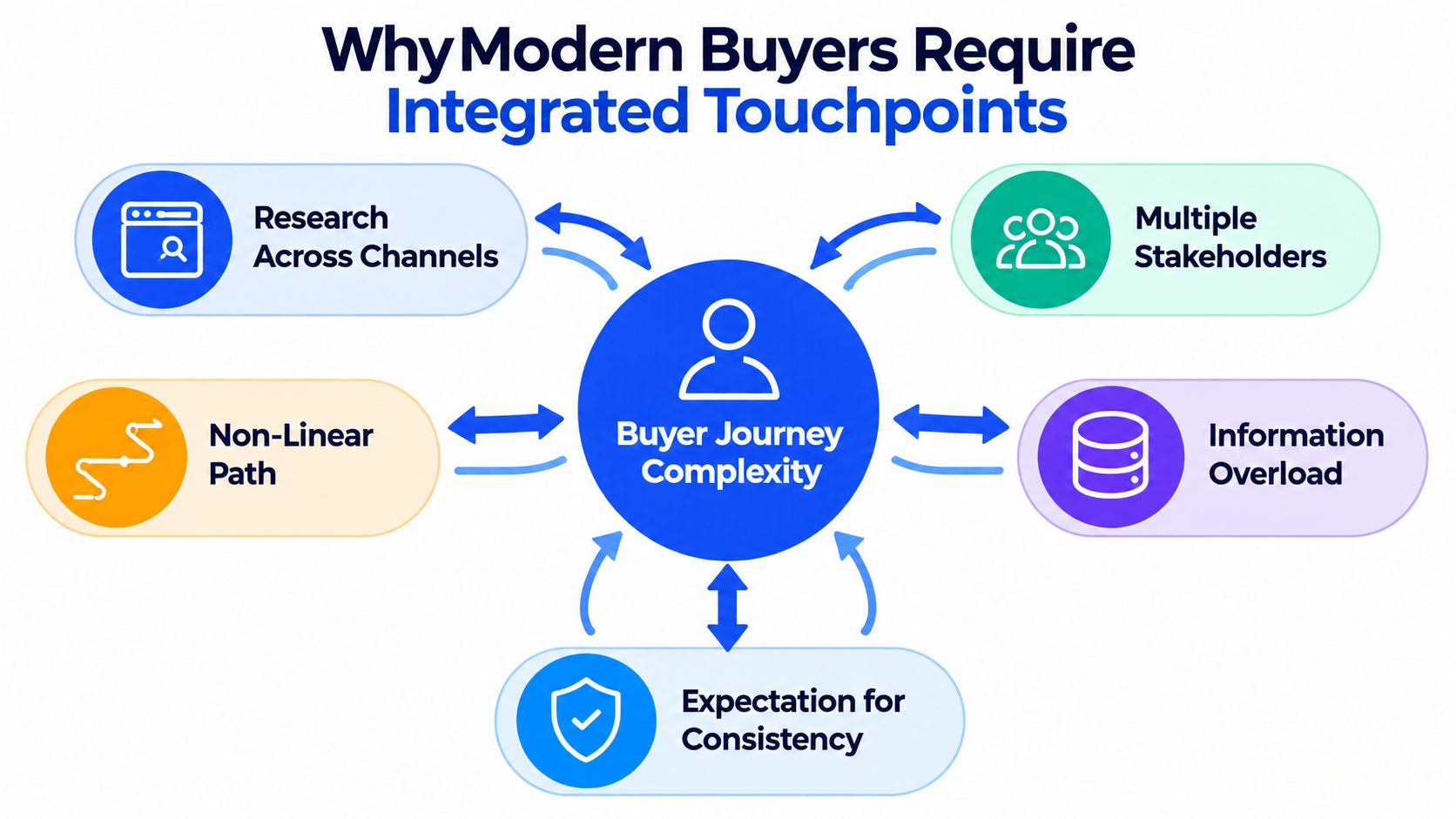
B2B buyers rarely follow the sequence implied by a traditional funnel. They research without speaking to sales, compare vendors with colleagues, read peer commentary, return to a website, and involve sellers only after internal confidence has formed.
McKinsey research covering more than 3,800 B2B buyers found that buyers use an average of 10 or more channels during a purchase, with e-commerce, in-person interaction, and video among the leading channels for perceived effectiveness. The implication for RevOps is direct: every touchpoint needs continuity of message and context. (McKinsey buyer journey research summary)
The account record matters more than the isolated touch
A target account should retain a shared record linking LinkedIn engagement, outbound responses, website activity, meetings, opportunity stage, and revenue outcome. The contact who replies may not be the person who first researched the category, and the person who attends a webinar may not be the economic buyer.
Without identity resolution, teams over-credit the final response-producing touch. LinkedIn content, peer conversations, and self-service research often influence the deal without creating a clean conversion event. A last-touch report then tells sales to repeat whatever happened immediately before the meeting, even when earlier credibility work made the meeting possible.
A practical data model includes:
Canonical IDs: One account ID and one contact ID across the CRM, enrichment tools, ad platforms, and sequencing systems.
Source taxonomy: Consistent campaign, source, medium, and motion values.
Stage events: Defined transitions for engagement, sales acceptance, opportunity creation, and revenue.
Influence fields: Account-level activity that records assisted progression without pretending to assign perfect causality.
Content teams should also review how each asset contributes across the journey, rather than judging every post by direct conversion. A useful guide to measure content across channels can help teams connect distribution, engagement, and commercial context.
The mental model is simple. A channel isn't a destination. It is a stage with a specific job, and the handoff must preserve what the buyer already knows.
Choosing the right mix of direct and indirect channels
The recommendation is to lead with outbound when the market is known and the buying group is concentrated. Use indirect reach first when the category is unfamiliar, the brand lacks trust, or the decision requires extended credibility.
Direct channels, including outbound email and LinkedIn outreach, give you control over who receives the message. Indirect channels, including LinkedIn content, paid ads, newsletters, and events, make the direct message easier to accept because the buyer has more context.
Choose the mix by answering three questions.
How well does the market know you
A recognized vendor can start with named accounts and use content as reinforcement. A company entering a new market needs indirect reach to establish the category, explain the problem, and show evidence before asking for a meeting.
AutoBrief's market entry work in Croatia illustrates the combined approach. Paid ads and outreach drove 19,000+ targeted website visits and 200+ leads, according to GROU's published account. The lesson isn't that every market-entry program should copy that channel count. It is that direct outreach performs differently when supporting media has already created familiarity.
How concentrated is the buying group
A small list of named decision-makers favors direct activity. Sales Navigator can identify relevant executives, Clay can enrich account and role data, and Apollo can support list construction and sequencing.
A broad committee needs more surface area. For T-2, campaigns reached CEOs, COOs, CIOs, and IT decision-makers, while organic content and promoted posts supported trust around the offer. That combination gives sales multiple ways to stay relevant when one stakeholder isn't ready to respond.
How long does trust building take
Credibility-heavy categories such as B2B iGaming, pharma, and legal tech often require indirect activity alongside outreach. Fazi's LinkedIn presence grew to 30,000+ followers and a 15,000-subscriber newsletter, supporting its commercial campaigns. Those figures come from GROU's published context, not a universal benchmark for content programs.
Market condition | Primary channel focus | Supporting channel |
|---|---|---|
Known category, named accounts, urgent pain | Outbound email and LinkedIn outreach | LinkedIn content and retargeting |
New category or unfamiliar brand | Content, paid media, and events | Carefully targeted outbound |
Broad buying committee | Account-based content and paid reach | Multi-threaded sales outreach |
Long trust-building cycle | Thought leadership, newsletters, and peer events | Low-pressure outbound sequences |
The key rule is one message, one target list, and one reporting line. Teams can read more about assigning roles across inbound and outbound in GROU's guide to inbounds and outbounds. The mix should change when evidence changes, not when one channel owner argues for a larger budget.
Operationalizing the sequence and tool stack
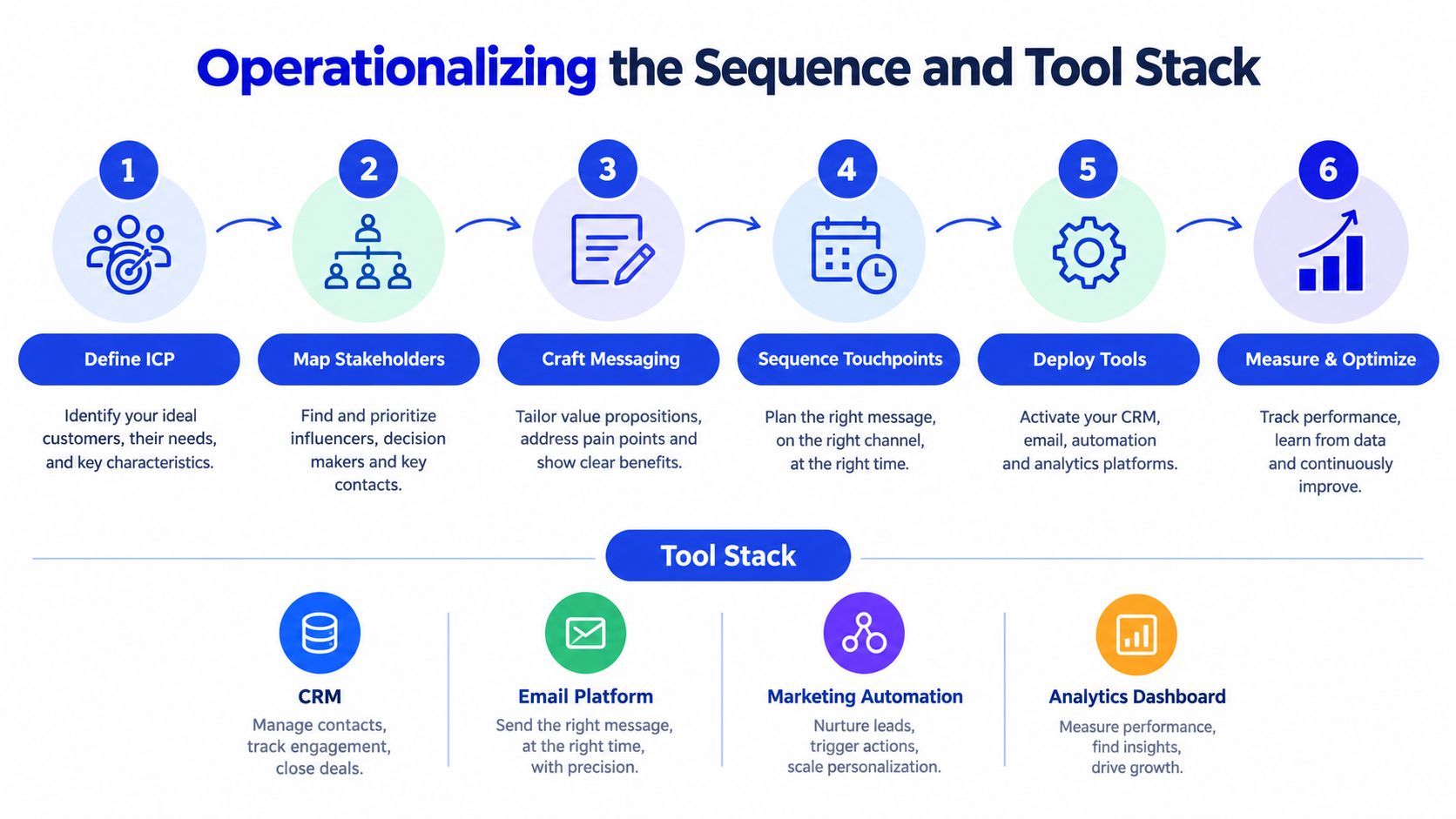
A channel strategy becomes real when a prospect can move through the system without being treated as a new lead at every touch. The workflow below keeps targeting, messaging, delivery, and routing connected.
Start with the account model
Write the ICP as an operating filter, not a positioning paragraph. Define industry, geography, revenue band, technology environment, trigger events, buying roles, disqualifiers, and the pain that creates urgency.
Build the initial account set in Apollo or Sales Navigator. Use Clay to enrich firmographic, technographic, and role data, then route only records that meet the qualification rules into the sequencing layer. If a record lacks the trigger or buying role required for the campaign, keep it out of the first wave.
Build one message architecture
Create a message hierarchy before writing email copy:
Business problem: What changed for the account?
Commercial consequence: What does the problem delay, cost, or expose?
Relevant proof: What evidence makes the claim credible?
Low-friction next step: What conversation can the buyer accept now?
LinkedIn posts, ads, landing pages, and outbound messages should express the same point from different angles. They don't need identical wording. They do need the same promise, audience, and proof.
Sequence the touchpoints
A workable motion might use Clay for enrichment, HeyReach for LinkedIn actions, and Lemlist, Instantly, or Smartlead for email delivery. HubSpot remains the system of record for lifecycle stages, sales acceptance, opportunity status, and reporting.
The exact order depends on the audience, but the logic stays consistent:
Warm the account: Publish relevant content and identify active stakeholders.
Create the trigger: Use a role-specific email or LinkedIn message tied to a real business problem.
Route engagement: Send positive replies, profile visits, and meaningful interactions to the right salesperson.
Continue the context: Give sales the account's prior content and campaign activity before the meeting.
For teams comparing software categories, GROU's overview of lead generation software provides a useful starting point for mapping tools to workflow responsibilities. Broader planning ideas are also covered in these 2026 B2B demand generation strategies, but tool selection should follow the operating model, not replace it.
Run the program in bi-weekly sprints. Review positive replies, objections, no-response patterns, meeting quality, and sales acceptance. Programs can launch within 14 days and show early signal within 30 days, based on GROU's stated operating approach. The sprint exists to create a fast feedback loop, not to produce a polished quarterly report after the market has already rejected the message.
Pivoting the mix based on performance data
The first channel plan is a hypothesis. Your first real replies tell you whether the problem is targeting, message relevance, pain urgency, offer design, or delivery.
Start with the quality of responses, not the open rate. A sequence can produce activity while attracting the wrong roles. Review who replied, which accounts accepted meetings, what objections appeared, and whether sales accepted the conversations.
Read the failure pattern
If replies are scarce across a tightly defined account set, test the message and trigger before adding volume. If replies arrive from the wrong segment, tighten the ICP and exclusion rules. If prospects respond positively but meetings don't hold, inspect the offer, qualification, and routing speed.
The decision tree should look like this:
Low response from the right accounts: Rework the problem framing and proof.
Response from poor-fit accounts: Narrow the list and strengthen disqualifiers.
Interest without meeting acceptance: Reduce friction in the next step and check timing.
Meetings without sales acceptance: Fix qualification before adding another channel.
Strong email response but weak account progression: Add LinkedIn, content, paid reach, or events to support the buying group.
MBF provides a clear example of a channel decision changing after review. Across 24 campaigns, multichannel outreach outperformed email-only activity, which settled the question of whether email alone was enough. The relevant conclusion is not that every team needs every channel. It is that the comparison should be tested against qualified outcomes.
Joan's program produced 489 conversations and 57 interested leads across eight campaigns, with a best reply rate of 30.9%. The data also exposed ICP fit and pain urgency as constraints, so the correct move was to tighten targeting before adding volume.
Revenue teams need a shared view of these signals. GROU's guidance on marketing attribution is useful here because attribution should support decisions, not give every channel a political score. Change the working model when evidence shows a better path to qualified pipeline.
B2B examples of unified channel execution
The strongest channel programs don't treat outbound, paid media, content, and events as competing bets. They give each one a job and judge the full sequence by the quality of commercial progression.
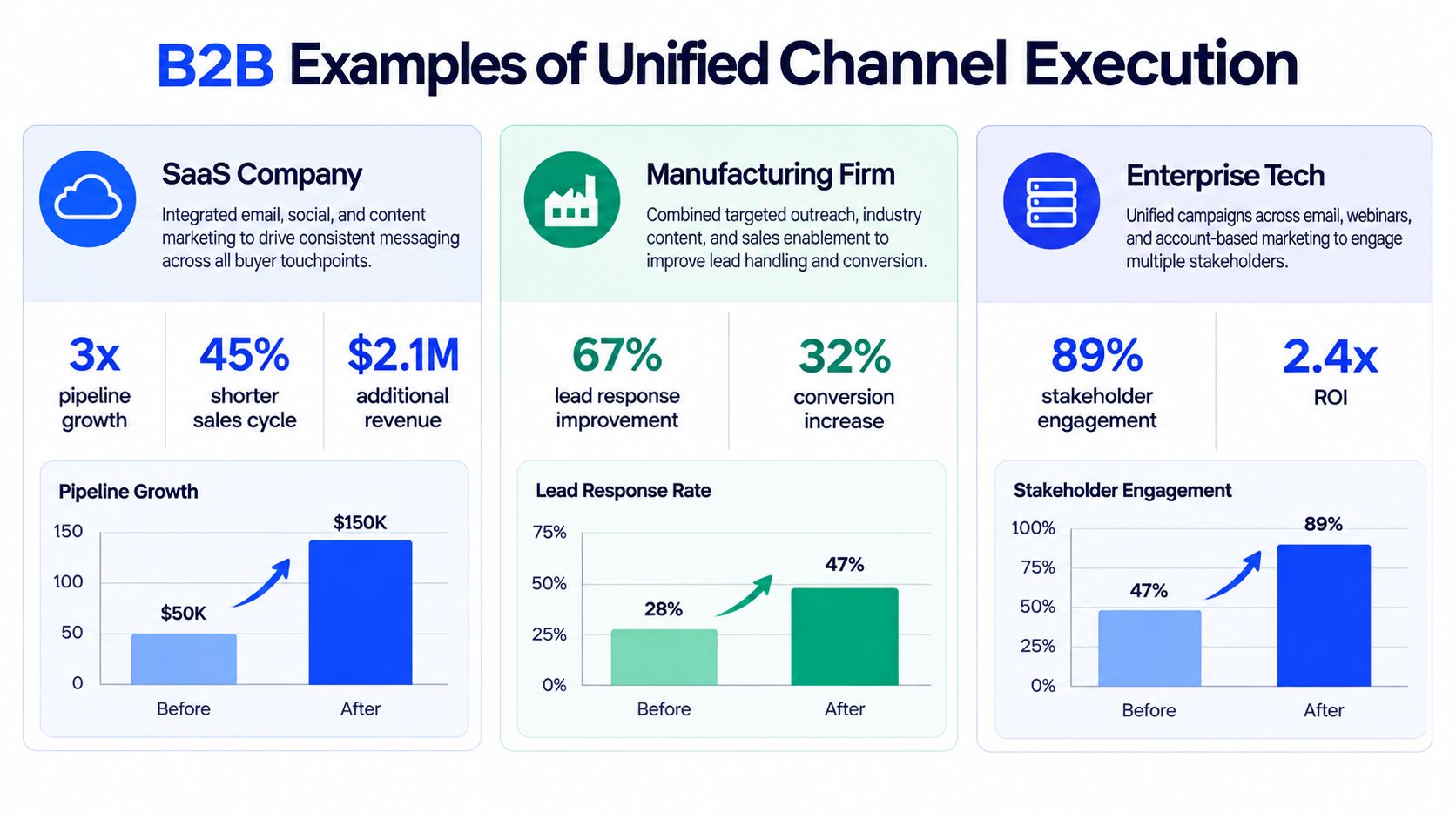
For a B2B SaaS client in an iGaming-adjacent market, connected outbound moved qualified meetings from 3 to 4 per month under founder-led activity to 18 to 22 per month within six months. The program generated €450k in sourced pipeline and 4 closed deals, with an average contract value that paid back the engagement 8x, according to the GROU account context.
Outbound can produce results without paid support when targeting and messaging are precise. For BizIT, email and LinkedIn outbound produced 18 sales meetings, an 11.5% reply rate, and a 60.6% open rate. Those are campaign outcomes, not guarantees. They show why controllability matters: the team can choose the audience, test the message, and inspect replies instead of waiting for impression data.
Paid and lead generation can win on cost per lead when the audience is broad enough and qualification is controlled. Sportradar's campaigns across LinkedIn, Google, Reddit, RichAds, and 6sense delivered 800+ qualified leads across EMEA at €15 per lead, with 80% qualifying as SQLs. The published result is a reminder to connect lead capture with sales definitions, since cheap leads have little value if qualification breaks downstream.
A different motion worked for EY's forensic services. Targeted Slovenian-language LinkedIn and email invitations filled live business breakfasts, producing 104 warm leads across 4 events, a 24.5% reply rate, and a 62.3% LinkedIn acceptance rate. The invitation gave outreach a reason that wasn't a standard meeting request.
Events can create a useful bridge between direct and indirect channels. A peer breakfast supplies context, social proof, and a live setting for conversations that might not begin through email alone. Teams managing this motion need a structured lead data pipeline so invitations, attendance, follow-up, and opportunity progression remain connected.
The highest-value deal in GROU's published experience, a closed deal worth more than $20 million for Isotrack, came from Google Ads, LinkedIn Ads, landing pages, and outreach working together. The specific combination matters less than the operating principle: high-value buying groups often need repeated, coordinated evidence before they engage commercially.
For a deeper look at a combined campaign, review GROU's multi-channel lead generation case study for a sports technology company. The case is useful because it frames the campaign as a connected system instead of assigning every result to one isolated source.
Measuring pipeline instead of vanity metrics
Channel attribution becomes misleading when it asks which source deserves the deal. B2B buying groups create activity across multiple people and systems, while some of their most meaningful research remains anonymous.
Gartner found that 61% of B2B buyers prefer a rep-free buying experience, making account-level progression tracking essential for channels that influence a deal without producing a trackable last-touch conversion. (Gartner's B2B buyer survey)
The measurement model should answer a different question: did coordinated activity move a qualified account forward?
Use one account-level scorecard
Track the progression signals that sales and leadership can act on:
Target-account engagement: Which ICP accounts interacted with content, ads, events, or outbound?
Buying-group coverage: Which relevant roles engaged, and which roles remain absent?
Sales acceptance: Did the seller confirm that the conversation met qualification criteria?
Stage advancement: Did the account move from engagement to meeting, opportunity, and revenue?
Pipeline influence: Which coordinated sequences appeared before opportunity creation or acceleration?
Commercial quality: How did opportunity-to-revenue conversion and sales-cycle movement compare across cohorts?
Keep channel events at their native level, but report the commercial result at account level. LinkedIn may record engagement, the email platform may record a reply, and HubSpot may hold the opportunity. RevOps should connect those records through canonical account and contact IDs.
Don't confuse correlation with causation
An account that uses several channels may already have stronger intent. To test the impact of integration, compare cohorts exposed to coordinated sequences with comparable accounts exposed to isolated activity. Control for segment, deal size, and baseline intent before claiming that one channel caused the improvement.
This approach also protects content from being cut because it doesn't produce a last-touch conversion. A post that helps a hidden stakeholder explain the problem internally may influence revenue without ever generating a form fill.
The practical consequence is covered in GROU's guide to multi-touch attribution. Use attribution to improve sequencing, targeting, and investment decisions. Don't use it to create false precision around a buying process your data can't fully observe.
Implementation checklist and common pitfalls
A unified channel strategy needs a small set of operating controls. Start with the data layer, then enforce message and measurement consistency.
Create one account view: Use a canonical account ID across CRM, enrichment, ads, and sequencing tools.
Share the target list: Marketing and sales should work from the same named-account universe.
Map the buying group: Record roles, engagement, objections, and missing stakeholders.
Coordinate the message: Align ads, posts, landing pages, and outbound around one commercial problem.
Define qualification: Give sales clear rules for accepted meetings, SQLs, and disqualified responses.
Review bi-weekly: Inspect reply quality, meeting-held rate, stage movement, and pipeline influence.
Test before scaling: Change one meaningful variable at a time, then expand what produces qualified progression.
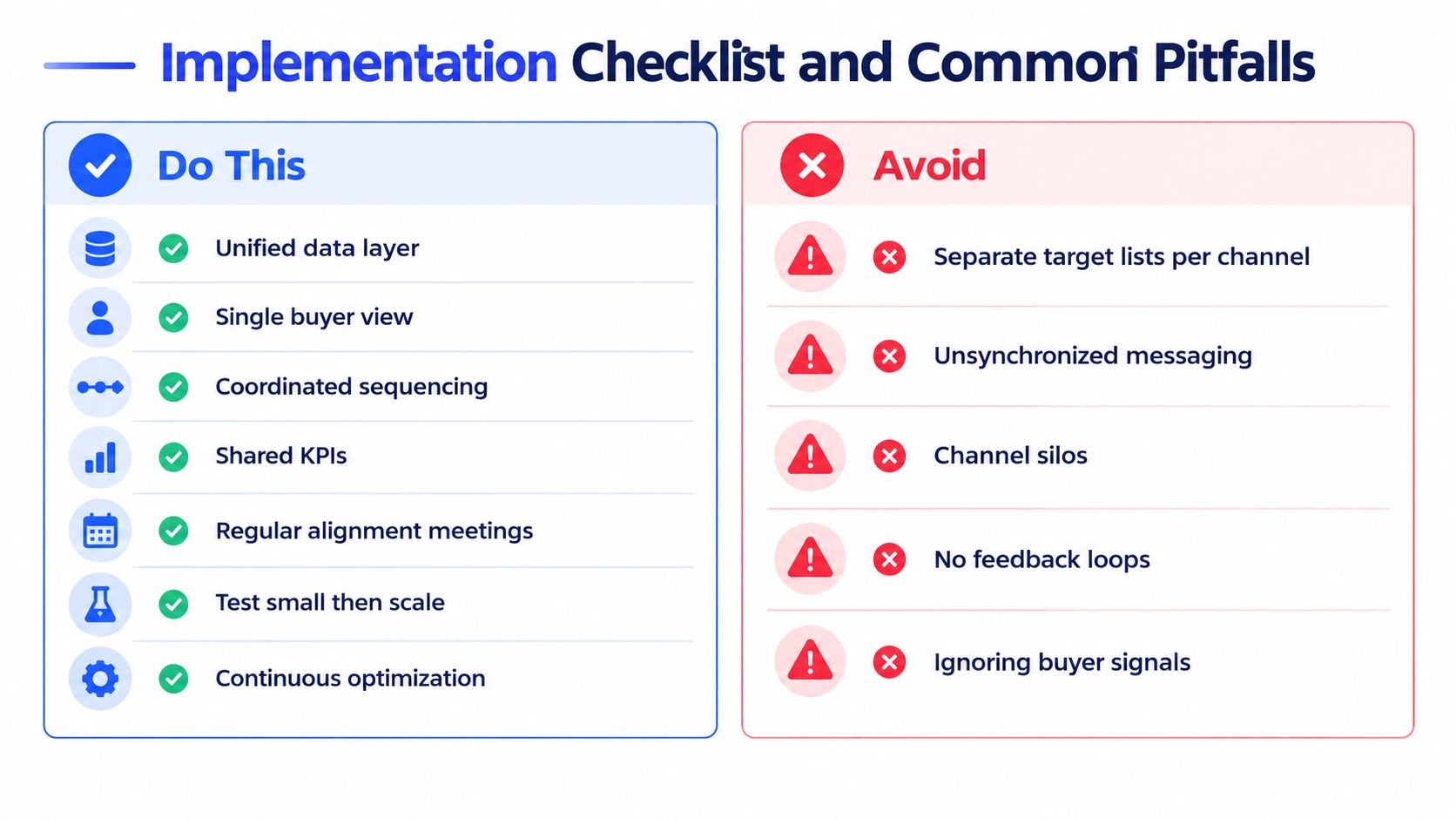
The common failures are predictable: separate target lists, unsynchronized messaging, channel silos, no feedback loop, and success measured by MQL volume instead of SQL conversion. A channel that creates attention but can't pass account and contact signals to sales is media activity, not a pipeline channel.
Audit your CRM this Friday. Confirm that every active campaign maps to one canonical account ID, one ICP segment, one owner, and one pipeline stage. That small check will show whether your current channel strategy is an operating system or merely a collection of reports.
GROU is a global B2B pipeline agency that connects LinkedIn content, lead generation, and outbound for companies across iGaming, SaaS, manufacturing, pharma, and legal tech. Its methodology uses ICP-aligned data, coordinated messaging, bi-weekly sprints, and account-level reporting to turn attention into qualified conversations and revenue.
GROU can map your target segments, messaging angles, and channel roles, then build the connected sequences and reporting layer around them. Visit Grou to review how the team can turn your disconnected campaigns into one pipeline engine.
Your LinkedIn ads are generating engagement, sales is sending cold email, the founder is publishing thoughtful posts, and the CRM still can't explain why qualified pipeline isn't growing. Each team can report activity, but nobody can show how one account moved from first exposure to a serious sales conversation.
A working channel strategy fixes the operating model before it adds another channel.
One engine: Direct outreach starts conversations while content, paid media, and events build familiarity around the same message.
One buyer view: Account and contact activity must connect across LinkedIn, email, website behavior, meetings, and CRM stages.
One reporting line: Channels earn credit through qualified pipeline and progression, not isolated clicks or replies.
One feedback loop: Reply quality, objections, and stage conversion determine where the mix changes.
Table of Contents
The problem with disconnected campaigns
Most B2B revenue teams don't have a channel strategy. They have a set of channel owners.
Marketing runs LinkedIn campaigns against one audience. Sales works a different list in Apollo. The founder publishes content for a broad market. Paid media reports leads, sales reports meetings, and RevOps tries to reconcile both after the quarter closes.
That creates high activity with weak conversion. A prospect may see an ad, read a founder post, receive an outbound email, and visit a landing page, yet each interaction sits in a separate system. The account looks cold in one report and active in another.
The practical diagnosis: If every channel has its own target list, message, and success metric, you don't have coordinated demand generation. You have several campaigns competing for partial credit.
The correction is structural. Start with one ICP, one account universe, and one message architecture. Then assign each channel a job in the buying journey.
Direct channels start relevant conversations with named people.
Indirect channels create familiarity and answer early research questions.
Sales activity converts interest into qualification and commercial movement.
RevOps connects the signals to one account record and one pipeline view.
GROU's position is straightforward: structure turns attention into pipeline. That means a post shouldn't exist only to earn engagement, and an outbound sequence shouldn't operate without knowing what the target account has already seen. The system should tell a salesperson which problem the account has shown interest in and which proof point belongs in the next conversation.
The operating model in the rest of this guide is built around four decisions:
Connect the journey: Design channels as linked stages, not independent tactics.
Choose the mix: Match direct and indirect activity to market awareness, buying-group concentration, and trust requirements.
Run the workflow: Use a shared data model, coordinated sequences, and short iteration cycles.
Measure progression: Report qualified pipeline, stage movement, and revenue influence at account level.
Why modern buyers require integrated touchpoints
B2B buyers rarely follow the sequence implied by a traditional funnel. They research without speaking to sales, compare vendors with colleagues, read peer commentary, return to a website, and involve sellers only after internal confidence has formed.
McKinsey research covering more than 3,800 B2B buyers found that buyers use an average of 10 or more channels during a purchase, with e-commerce, in-person interaction, and video among the leading channels for perceived effectiveness. The implication for RevOps is direct: every touchpoint needs continuity of message and context. (McKinsey buyer journey research summary)
The account record matters more than the isolated touch
A target account should retain a shared record linking LinkedIn engagement, outbound responses, website activity, meetings, opportunity stage, and revenue outcome. The contact who replies may not be the person who first researched the category, and the person who attends a webinar may not be the economic buyer.
Without identity resolution, teams over-credit the final response-producing touch. LinkedIn content, peer conversations, and self-service research often influence the deal without creating a clean conversion event. A last-touch report then tells sales to repeat whatever happened immediately before the meeting, even when earlier credibility work made the meeting possible.
A practical data model includes:
Canonical IDs: One account ID and one contact ID across the CRM, enrichment tools, ad platforms, and sequencing systems.
Source taxonomy: Consistent campaign, source, medium, and motion values.
Stage events: Defined transitions for engagement, sales acceptance, opportunity creation, and revenue.
Influence fields: Account-level activity that records assisted progression without pretending to assign perfect causality.
Content teams should also review how each asset contributes across the journey, rather than judging every post by direct conversion. A useful guide to measure content across channels can help teams connect distribution, engagement, and commercial context.
The mental model is simple. A channel isn't a destination. It is a stage with a specific job, and the handoff must preserve what the buyer already knows.
Choosing the right mix of direct and indirect channels
The recommendation is to lead with outbound when the market is known and the buying group is concentrated. Use indirect reach first when the category is unfamiliar, the brand lacks trust, or the decision requires extended credibility.
Direct channels, including outbound email and LinkedIn outreach, give you control over who receives the message. Indirect channels, including LinkedIn content, paid ads, newsletters, and events, make the direct message easier to accept because the buyer has more context.
Choose the mix by answering three questions.
How well does the market know you
A recognized vendor can start with named accounts and use content as reinforcement. A company entering a new market needs indirect reach to establish the category, explain the problem, and show evidence before asking for a meeting.
AutoBrief's market entry work in Croatia illustrates the combined approach. Paid ads and outreach drove 19,000+ targeted website visits and 200+ leads, according to GROU's published account. The lesson isn't that every market-entry program should copy that channel count. It is that direct outreach performs differently when supporting media has already created familiarity.
How concentrated is the buying group
A small list of named decision-makers favors direct activity. Sales Navigator can identify relevant executives, Clay can enrich account and role data, and Apollo can support list construction and sequencing.
A broad committee needs more surface area. For T-2, campaigns reached CEOs, COOs, CIOs, and IT decision-makers, while organic content and promoted posts supported trust around the offer. That combination gives sales multiple ways to stay relevant when one stakeholder isn't ready to respond.
How long does trust building take
Credibility-heavy categories such as B2B iGaming, pharma, and legal tech often require indirect activity alongside outreach. Fazi's LinkedIn presence grew to 30,000+ followers and a 15,000-subscriber newsletter, supporting its commercial campaigns. Those figures come from GROU's published context, not a universal benchmark for content programs.
Market condition | Primary channel focus | Supporting channel |
|---|---|---|
Known category, named accounts, urgent pain | Outbound email and LinkedIn outreach | LinkedIn content and retargeting |
New category or unfamiliar brand | Content, paid media, and events | Carefully targeted outbound |
Broad buying committee | Account-based content and paid reach | Multi-threaded sales outreach |
Long trust-building cycle | Thought leadership, newsletters, and peer events | Low-pressure outbound sequences |
The key rule is one message, one target list, and one reporting line. Teams can read more about assigning roles across inbound and outbound in GROU's guide to inbounds and outbounds. The mix should change when evidence changes, not when one channel owner argues for a larger budget.
Operationalizing the sequence and tool stack
A channel strategy becomes real when a prospect can move through the system without being treated as a new lead at every touch. The workflow below keeps targeting, messaging, delivery, and routing connected.
Start with the account model
Write the ICP as an operating filter, not a positioning paragraph. Define industry, geography, revenue band, technology environment, trigger events, buying roles, disqualifiers, and the pain that creates urgency.
Build the initial account set in Apollo or Sales Navigator. Use Clay to enrich firmographic, technographic, and role data, then route only records that meet the qualification rules into the sequencing layer. If a record lacks the trigger or buying role required for the campaign, keep it out of the first wave.
Build one message architecture
Create a message hierarchy before writing email copy:
Business problem: What changed for the account?
Commercial consequence: What does the problem delay, cost, or expose?
Relevant proof: What evidence makes the claim credible?
Low-friction next step: What conversation can the buyer accept now?
LinkedIn posts, ads, landing pages, and outbound messages should express the same point from different angles. They don't need identical wording. They do need the same promise, audience, and proof.
Sequence the touchpoints
A workable motion might use Clay for enrichment, HeyReach for LinkedIn actions, and Lemlist, Instantly, or Smartlead for email delivery. HubSpot remains the system of record for lifecycle stages, sales acceptance, opportunity status, and reporting.
The exact order depends on the audience, but the logic stays consistent:
Warm the account: Publish relevant content and identify active stakeholders.
Create the trigger: Use a role-specific email or LinkedIn message tied to a real business problem.
Route engagement: Send positive replies, profile visits, and meaningful interactions to the right salesperson.
Continue the context: Give sales the account's prior content and campaign activity before the meeting.
For teams comparing software categories, GROU's overview of lead generation software provides a useful starting point for mapping tools to workflow responsibilities. Broader planning ideas are also covered in these 2026 B2B demand generation strategies, but tool selection should follow the operating model, not replace it.
Run the program in bi-weekly sprints. Review positive replies, objections, no-response patterns, meeting quality, and sales acceptance. Programs can launch within 14 days and show early signal within 30 days, based on GROU's stated operating approach. The sprint exists to create a fast feedback loop, not to produce a polished quarterly report after the market has already rejected the message.
Pivoting the mix based on performance data
The first channel plan is a hypothesis. Your first real replies tell you whether the problem is targeting, message relevance, pain urgency, offer design, or delivery.
Start with the quality of responses, not the open rate. A sequence can produce activity while attracting the wrong roles. Review who replied, which accounts accepted meetings, what objections appeared, and whether sales accepted the conversations.
Read the failure pattern
If replies are scarce across a tightly defined account set, test the message and trigger before adding volume. If replies arrive from the wrong segment, tighten the ICP and exclusion rules. If prospects respond positively but meetings don't hold, inspect the offer, qualification, and routing speed.
The decision tree should look like this:
Low response from the right accounts: Rework the problem framing and proof.
Response from poor-fit accounts: Narrow the list and strengthen disqualifiers.
Interest without meeting acceptance: Reduce friction in the next step and check timing.
Meetings without sales acceptance: Fix qualification before adding another channel.
Strong email response but weak account progression: Add LinkedIn, content, paid reach, or events to support the buying group.
MBF provides a clear example of a channel decision changing after review. Across 24 campaigns, multichannel outreach outperformed email-only activity, which settled the question of whether email alone was enough. The relevant conclusion is not that every team needs every channel. It is that the comparison should be tested against qualified outcomes.
Joan's program produced 489 conversations and 57 interested leads across eight campaigns, with a best reply rate of 30.9%. The data also exposed ICP fit and pain urgency as constraints, so the correct move was to tighten targeting before adding volume.
Revenue teams need a shared view of these signals. GROU's guidance on marketing attribution is useful here because attribution should support decisions, not give every channel a political score. Change the working model when evidence shows a better path to qualified pipeline.
B2B examples of unified channel execution
The strongest channel programs don't treat outbound, paid media, content, and events as competing bets. They give each one a job and judge the full sequence by the quality of commercial progression.
For a B2B SaaS client in an iGaming-adjacent market, connected outbound moved qualified meetings from 3 to 4 per month under founder-led activity to 18 to 22 per month within six months. The program generated €450k in sourced pipeline and 4 closed deals, with an average contract value that paid back the engagement 8x, according to the GROU account context.
Outbound can produce results without paid support when targeting and messaging are precise. For BizIT, email and LinkedIn outbound produced 18 sales meetings, an 11.5% reply rate, and a 60.6% open rate. Those are campaign outcomes, not guarantees. They show why controllability matters: the team can choose the audience, test the message, and inspect replies instead of waiting for impression data.
Paid and lead generation can win on cost per lead when the audience is broad enough and qualification is controlled. Sportradar's campaigns across LinkedIn, Google, Reddit, RichAds, and 6sense delivered 800+ qualified leads across EMEA at €15 per lead, with 80% qualifying as SQLs. The published result is a reminder to connect lead capture with sales definitions, since cheap leads have little value if qualification breaks downstream.
A different motion worked for EY's forensic services. Targeted Slovenian-language LinkedIn and email invitations filled live business breakfasts, producing 104 warm leads across 4 events, a 24.5% reply rate, and a 62.3% LinkedIn acceptance rate. The invitation gave outreach a reason that wasn't a standard meeting request.
Events can create a useful bridge between direct and indirect channels. A peer breakfast supplies context, social proof, and a live setting for conversations that might not begin through email alone. Teams managing this motion need a structured lead data pipeline so invitations, attendance, follow-up, and opportunity progression remain connected.
The highest-value deal in GROU's published experience, a closed deal worth more than $20 million for Isotrack, came from Google Ads, LinkedIn Ads, landing pages, and outreach working together. The specific combination matters less than the operating principle: high-value buying groups often need repeated, coordinated evidence before they engage commercially.
For a deeper look at a combined campaign, review GROU's multi-channel lead generation case study for a sports technology company. The case is useful because it frames the campaign as a connected system instead of assigning every result to one isolated source.
Measuring pipeline instead of vanity metrics
Channel attribution becomes misleading when it asks which source deserves the deal. B2B buying groups create activity across multiple people and systems, while some of their most meaningful research remains anonymous.
Gartner found that 61% of B2B buyers prefer a rep-free buying experience, making account-level progression tracking essential for channels that influence a deal without producing a trackable last-touch conversion. (Gartner's B2B buyer survey)
The measurement model should answer a different question: did coordinated activity move a qualified account forward?
Use one account-level scorecard
Track the progression signals that sales and leadership can act on:
Target-account engagement: Which ICP accounts interacted with content, ads, events, or outbound?
Buying-group coverage: Which relevant roles engaged, and which roles remain absent?
Sales acceptance: Did the seller confirm that the conversation met qualification criteria?
Stage advancement: Did the account move from engagement to meeting, opportunity, and revenue?
Pipeline influence: Which coordinated sequences appeared before opportunity creation or acceleration?
Commercial quality: How did opportunity-to-revenue conversion and sales-cycle movement compare across cohorts?
Keep channel events at their native level, but report the commercial result at account level. LinkedIn may record engagement, the email platform may record a reply, and HubSpot may hold the opportunity. RevOps should connect those records through canonical account and contact IDs.
Don't confuse correlation with causation
An account that uses several channels may already have stronger intent. To test the impact of integration, compare cohorts exposed to coordinated sequences with comparable accounts exposed to isolated activity. Control for segment, deal size, and baseline intent before claiming that one channel caused the improvement.
This approach also protects content from being cut because it doesn't produce a last-touch conversion. A post that helps a hidden stakeholder explain the problem internally may influence revenue without ever generating a form fill.
The practical consequence is covered in GROU's guide to multi-touch attribution. Use attribution to improve sequencing, targeting, and investment decisions. Don't use it to create false precision around a buying process your data can't fully observe.
Implementation checklist and common pitfalls
A unified channel strategy needs a small set of operating controls. Start with the data layer, then enforce message and measurement consistency.
Create one account view: Use a canonical account ID across CRM, enrichment, ads, and sequencing tools.
Share the target list: Marketing and sales should work from the same named-account universe.
Map the buying group: Record roles, engagement, objections, and missing stakeholders.
Coordinate the message: Align ads, posts, landing pages, and outbound around one commercial problem.
Define qualification: Give sales clear rules for accepted meetings, SQLs, and disqualified responses.
Review bi-weekly: Inspect reply quality, meeting-held rate, stage movement, and pipeline influence.
Test before scaling: Change one meaningful variable at a time, then expand what produces qualified progression.
The common failures are predictable: separate target lists, unsynchronized messaging, channel silos, no feedback loop, and success measured by MQL volume instead of SQL conversion. A channel that creates attention but can't pass account and contact signals to sales is media activity, not a pipeline channel.
Audit your CRM this Friday. Confirm that every active campaign maps to one canonical account ID, one ICP segment, one owner, and one pipeline stage. That small check will show whether your current channel strategy is an operating system or merely a collection of reports.
GROU is a global B2B pipeline agency that connects LinkedIn content, lead generation, and outbound for companies across iGaming, SaaS, manufacturing, pharma, and legal tech. Its methodology uses ICP-aligned data, coordinated messaging, bi-weekly sprints, and account-level reporting to turn attention into qualified conversations and revenue.
GROU can map your target segments, messaging angles, and channel roles, then build the connected sequences and reporting layer around them. Visit Grou to review how the team can turn your disconnected campaigns into one pipeline engine.
Your LinkedIn ads are generating engagement, sales is sending cold email, the founder is publishing thoughtful posts, and the CRM still can't explain why qualified pipeline isn't growing. Each team can report activity, but nobody can show how one account moved from first exposure to a serious sales conversation.
A working channel strategy fixes the operating model before it adds another channel.
One engine: Direct outreach starts conversations while content, paid media, and events build familiarity around the same message.
One buyer view: Account and contact activity must connect across LinkedIn, email, website behavior, meetings, and CRM stages.
One reporting line: Channels earn credit through qualified pipeline and progression, not isolated clicks or replies.
One feedback loop: Reply quality, objections, and stage conversion determine where the mix changes.
Table of Contents
The problem with disconnected campaigns
Most B2B revenue teams don't have a channel strategy. They have a set of channel owners.
Marketing runs LinkedIn campaigns against one audience. Sales works a different list in Apollo. The founder publishes content for a broad market. Paid media reports leads, sales reports meetings, and RevOps tries to reconcile both after the quarter closes.
That creates high activity with weak conversion. A prospect may see an ad, read a founder post, receive an outbound email, and visit a landing page, yet each interaction sits in a separate system. The account looks cold in one report and active in another.
The practical diagnosis: If every channel has its own target list, message, and success metric, you don't have coordinated demand generation. You have several campaigns competing for partial credit.
The correction is structural. Start with one ICP, one account universe, and one message architecture. Then assign each channel a job in the buying journey.
Direct channels start relevant conversations with named people.
Indirect channels create familiarity and answer early research questions.
Sales activity converts interest into qualification and commercial movement.
RevOps connects the signals to one account record and one pipeline view.
GROU's position is straightforward: structure turns attention into pipeline. That means a post shouldn't exist only to earn engagement, and an outbound sequence shouldn't operate without knowing what the target account has already seen. The system should tell a salesperson which problem the account has shown interest in and which proof point belongs in the next conversation.
The operating model in the rest of this guide is built around four decisions:
Connect the journey: Design channels as linked stages, not independent tactics.
Choose the mix: Match direct and indirect activity to market awareness, buying-group concentration, and trust requirements.
Run the workflow: Use a shared data model, coordinated sequences, and short iteration cycles.
Measure progression: Report qualified pipeline, stage movement, and revenue influence at account level.
Why modern buyers require integrated touchpoints
B2B buyers rarely follow the sequence implied by a traditional funnel. They research without speaking to sales, compare vendors with colleagues, read peer commentary, return to a website, and involve sellers only after internal confidence has formed.
McKinsey research covering more than 3,800 B2B buyers found that buyers use an average of 10 or more channels during a purchase, with e-commerce, in-person interaction, and video among the leading channels for perceived effectiveness. The implication for RevOps is direct: every touchpoint needs continuity of message and context. (McKinsey buyer journey research summary)
The account record matters more than the isolated touch
A target account should retain a shared record linking LinkedIn engagement, outbound responses, website activity, meetings, opportunity stage, and revenue outcome. The contact who replies may not be the person who first researched the category, and the person who attends a webinar may not be the economic buyer.
Without identity resolution, teams over-credit the final response-producing touch. LinkedIn content, peer conversations, and self-service research often influence the deal without creating a clean conversion event. A last-touch report then tells sales to repeat whatever happened immediately before the meeting, even when earlier credibility work made the meeting possible.
A practical data model includes:
Canonical IDs: One account ID and one contact ID across the CRM, enrichment tools, ad platforms, and sequencing systems.
Source taxonomy: Consistent campaign, source, medium, and motion values.
Stage events: Defined transitions for engagement, sales acceptance, opportunity creation, and revenue.
Influence fields: Account-level activity that records assisted progression without pretending to assign perfect causality.
Content teams should also review how each asset contributes across the journey, rather than judging every post by direct conversion. A useful guide to measure content across channels can help teams connect distribution, engagement, and commercial context.
The mental model is simple. A channel isn't a destination. It is a stage with a specific job, and the handoff must preserve what the buyer already knows.
Choosing the right mix of direct and indirect channels
The recommendation is to lead with outbound when the market is known and the buying group is concentrated. Use indirect reach first when the category is unfamiliar, the brand lacks trust, or the decision requires extended credibility.
Direct channels, including outbound email and LinkedIn outreach, give you control over who receives the message. Indirect channels, including LinkedIn content, paid ads, newsletters, and events, make the direct message easier to accept because the buyer has more context.
Choose the mix by answering three questions.
How well does the market know you
A recognized vendor can start with named accounts and use content as reinforcement. A company entering a new market needs indirect reach to establish the category, explain the problem, and show evidence before asking for a meeting.
AutoBrief's market entry work in Croatia illustrates the combined approach. Paid ads and outreach drove 19,000+ targeted website visits and 200+ leads, according to GROU's published account. The lesson isn't that every market-entry program should copy that channel count. It is that direct outreach performs differently when supporting media has already created familiarity.
How concentrated is the buying group
A small list of named decision-makers favors direct activity. Sales Navigator can identify relevant executives, Clay can enrich account and role data, and Apollo can support list construction and sequencing.
A broad committee needs more surface area. For T-2, campaigns reached CEOs, COOs, CIOs, and IT decision-makers, while organic content and promoted posts supported trust around the offer. That combination gives sales multiple ways to stay relevant when one stakeholder isn't ready to respond.
How long does trust building take
Credibility-heavy categories such as B2B iGaming, pharma, and legal tech often require indirect activity alongside outreach. Fazi's LinkedIn presence grew to 30,000+ followers and a 15,000-subscriber newsletter, supporting its commercial campaigns. Those figures come from GROU's published context, not a universal benchmark for content programs.
Market condition | Primary channel focus | Supporting channel |
|---|---|---|
Known category, named accounts, urgent pain | Outbound email and LinkedIn outreach | LinkedIn content and retargeting |
New category or unfamiliar brand | Content, paid media, and events | Carefully targeted outbound |
Broad buying committee | Account-based content and paid reach | Multi-threaded sales outreach |
Long trust-building cycle | Thought leadership, newsletters, and peer events | Low-pressure outbound sequences |
The key rule is one message, one target list, and one reporting line. Teams can read more about assigning roles across inbound and outbound in GROU's guide to inbounds and outbounds. The mix should change when evidence changes, not when one channel owner argues for a larger budget.
Operationalizing the sequence and tool stack
A channel strategy becomes real when a prospect can move through the system without being treated as a new lead at every touch. The workflow below keeps targeting, messaging, delivery, and routing connected.
Start with the account model
Write the ICP as an operating filter, not a positioning paragraph. Define industry, geography, revenue band, technology environment, trigger events, buying roles, disqualifiers, and the pain that creates urgency.
Build the initial account set in Apollo or Sales Navigator. Use Clay to enrich firmographic, technographic, and role data, then route only records that meet the qualification rules into the sequencing layer. If a record lacks the trigger or buying role required for the campaign, keep it out of the first wave.
Build one message architecture
Create a message hierarchy before writing email copy:
Business problem: What changed for the account?
Commercial consequence: What does the problem delay, cost, or expose?
Relevant proof: What evidence makes the claim credible?
Low-friction next step: What conversation can the buyer accept now?
LinkedIn posts, ads, landing pages, and outbound messages should express the same point from different angles. They don't need identical wording. They do need the same promise, audience, and proof.
Sequence the touchpoints
A workable motion might use Clay for enrichment, HeyReach for LinkedIn actions, and Lemlist, Instantly, or Smartlead for email delivery. HubSpot remains the system of record for lifecycle stages, sales acceptance, opportunity status, and reporting.
The exact order depends on the audience, but the logic stays consistent:
Warm the account: Publish relevant content and identify active stakeholders.
Create the trigger: Use a role-specific email or LinkedIn message tied to a real business problem.
Route engagement: Send positive replies, profile visits, and meaningful interactions to the right salesperson.
Continue the context: Give sales the account's prior content and campaign activity before the meeting.
For teams comparing software categories, GROU's overview of lead generation software provides a useful starting point for mapping tools to workflow responsibilities. Broader planning ideas are also covered in these 2026 B2B demand generation strategies, but tool selection should follow the operating model, not replace it.
Run the program in bi-weekly sprints. Review positive replies, objections, no-response patterns, meeting quality, and sales acceptance. Programs can launch within 14 days and show early signal within 30 days, based on GROU's stated operating approach. The sprint exists to create a fast feedback loop, not to produce a polished quarterly report after the market has already rejected the message.
Pivoting the mix based on performance data
The first channel plan is a hypothesis. Your first real replies tell you whether the problem is targeting, message relevance, pain urgency, offer design, or delivery.
Start with the quality of responses, not the open rate. A sequence can produce activity while attracting the wrong roles. Review who replied, which accounts accepted meetings, what objections appeared, and whether sales accepted the conversations.
Read the failure pattern
If replies are scarce across a tightly defined account set, test the message and trigger before adding volume. If replies arrive from the wrong segment, tighten the ICP and exclusion rules. If prospects respond positively but meetings don't hold, inspect the offer, qualification, and routing speed.
The decision tree should look like this:
Low response from the right accounts: Rework the problem framing and proof.
Response from poor-fit accounts: Narrow the list and strengthen disqualifiers.
Interest without meeting acceptance: Reduce friction in the next step and check timing.
Meetings without sales acceptance: Fix qualification before adding another channel.
Strong email response but weak account progression: Add LinkedIn, content, paid reach, or events to support the buying group.
MBF provides a clear example of a channel decision changing after review. Across 24 campaigns, multichannel outreach outperformed email-only activity, which settled the question of whether email alone was enough. The relevant conclusion is not that every team needs every channel. It is that the comparison should be tested against qualified outcomes.
Joan's program produced 489 conversations and 57 interested leads across eight campaigns, with a best reply rate of 30.9%. The data also exposed ICP fit and pain urgency as constraints, so the correct move was to tighten targeting before adding volume.
Revenue teams need a shared view of these signals. GROU's guidance on marketing attribution is useful here because attribution should support decisions, not give every channel a political score. Change the working model when evidence shows a better path to qualified pipeline.
B2B examples of unified channel execution
The strongest channel programs don't treat outbound, paid media, content, and events as competing bets. They give each one a job and judge the full sequence by the quality of commercial progression.
For a B2B SaaS client in an iGaming-adjacent market, connected outbound moved qualified meetings from 3 to 4 per month under founder-led activity to 18 to 22 per month within six months. The program generated €450k in sourced pipeline and 4 closed deals, with an average contract value that paid back the engagement 8x, according to the GROU account context.
Outbound can produce results without paid support when targeting and messaging are precise. For BizIT, email and LinkedIn outbound produced 18 sales meetings, an 11.5% reply rate, and a 60.6% open rate. Those are campaign outcomes, not guarantees. They show why controllability matters: the team can choose the audience, test the message, and inspect replies instead of waiting for impression data.
Paid and lead generation can win on cost per lead when the audience is broad enough and qualification is controlled. Sportradar's campaigns across LinkedIn, Google, Reddit, RichAds, and 6sense delivered 800+ qualified leads across EMEA at €15 per lead, with 80% qualifying as SQLs. The published result is a reminder to connect lead capture with sales definitions, since cheap leads have little value if qualification breaks downstream.
A different motion worked for EY's forensic services. Targeted Slovenian-language LinkedIn and email invitations filled live business breakfasts, producing 104 warm leads across 4 events, a 24.5% reply rate, and a 62.3% LinkedIn acceptance rate. The invitation gave outreach a reason that wasn't a standard meeting request.
Events can create a useful bridge between direct and indirect channels. A peer breakfast supplies context, social proof, and a live setting for conversations that might not begin through email alone. Teams managing this motion need a structured lead data pipeline so invitations, attendance, follow-up, and opportunity progression remain connected.
The highest-value deal in GROU's published experience, a closed deal worth more than $20 million for Isotrack, came from Google Ads, LinkedIn Ads, landing pages, and outreach working together. The specific combination matters less than the operating principle: high-value buying groups often need repeated, coordinated evidence before they engage commercially.
For a deeper look at a combined campaign, review GROU's multi-channel lead generation case study for a sports technology company. The case is useful because it frames the campaign as a connected system instead of assigning every result to one isolated source.
Measuring pipeline instead of vanity metrics
Channel attribution becomes misleading when it asks which source deserves the deal. B2B buying groups create activity across multiple people and systems, while some of their most meaningful research remains anonymous.
Gartner found that 61% of B2B buyers prefer a rep-free buying experience, making account-level progression tracking essential for channels that influence a deal without producing a trackable last-touch conversion. (Gartner's B2B buyer survey)
The measurement model should answer a different question: did coordinated activity move a qualified account forward?
Use one account-level scorecard
Track the progression signals that sales and leadership can act on:
Target-account engagement: Which ICP accounts interacted with content, ads, events, or outbound?
Buying-group coverage: Which relevant roles engaged, and which roles remain absent?
Sales acceptance: Did the seller confirm that the conversation met qualification criteria?
Stage advancement: Did the account move from engagement to meeting, opportunity, and revenue?
Pipeline influence: Which coordinated sequences appeared before opportunity creation or acceleration?
Commercial quality: How did opportunity-to-revenue conversion and sales-cycle movement compare across cohorts?
Keep channel events at their native level, but report the commercial result at account level. LinkedIn may record engagement, the email platform may record a reply, and HubSpot may hold the opportunity. RevOps should connect those records through canonical account and contact IDs.
Don't confuse correlation with causation
An account that uses several channels may already have stronger intent. To test the impact of integration, compare cohorts exposed to coordinated sequences with comparable accounts exposed to isolated activity. Control for segment, deal size, and baseline intent before claiming that one channel caused the improvement.
This approach also protects content from being cut because it doesn't produce a last-touch conversion. A post that helps a hidden stakeholder explain the problem internally may influence revenue without ever generating a form fill.
The practical consequence is covered in GROU's guide to multi-touch attribution. Use attribution to improve sequencing, targeting, and investment decisions. Don't use it to create false precision around a buying process your data can't fully observe.
Implementation checklist and common pitfalls
A unified channel strategy needs a small set of operating controls. Start with the data layer, then enforce message and measurement consistency.
Create one account view: Use a canonical account ID across CRM, enrichment, ads, and sequencing tools.
Share the target list: Marketing and sales should work from the same named-account universe.
Map the buying group: Record roles, engagement, objections, and missing stakeholders.
Coordinate the message: Align ads, posts, landing pages, and outbound around one commercial problem.
Define qualification: Give sales clear rules for accepted meetings, SQLs, and disqualified responses.
Review bi-weekly: Inspect reply quality, meeting-held rate, stage movement, and pipeline influence.
Test before scaling: Change one meaningful variable at a time, then expand what produces qualified progression.
The common failures are predictable: separate target lists, unsynchronized messaging, channel silos, no feedback loop, and success measured by MQL volume instead of SQL conversion. A channel that creates attention but can't pass account and contact signals to sales is media activity, not a pipeline channel.
Audit your CRM this Friday. Confirm that every active campaign maps to one canonical account ID, one ICP segment, one owner, and one pipeline stage. That small check will show whether your current channel strategy is an operating system or merely a collection of reports.
GROU is a global B2B pipeline agency that connects LinkedIn content, lead generation, and outbound for companies across iGaming, SaaS, manufacturing, pharma, and legal tech. Its methodology uses ICP-aligned data, coordinated messaging, bi-weekly sprints, and account-level reporting to turn attention into qualified conversations and revenue.
GROU can map your target segments, messaging angles, and channel roles, then build the connected sequences and reporting layer around them. Visit Grou to review how the team can turn your disconnected campaigns into one pipeline engine.
Pipeline OS Newsletter
Build qualified pipeline
Get weekly tactics to generate demand, improve lead quality, and book more meetings.





Trusted by industry leaders
Trusted by industry leaders
Trusted by industry leaders
Ready to build qualified pipeline?
Ready to build qualified pipeline?
Ready to build qualified pipeline?
Book a call to see if we're the right fit, or take the 2-minute quiz to get a clear starting point.
Book a call to see if we're the right fit, or take the 2-minute quiz to get a clear starting point.
Book a call to see if we're the right fit, or take the 2-minute quiz to get a clear starting point.
" height="30.21639343089746px" id="hfGbXmQR2" width="30.216393430897455px"/></svg>)
Copyright © 2026 – All Right Reserved
Copyright © 2026 – All Right Reserved
Copyright © 2026 – All Right Reserved