%22%3E%3C/path%3E%3Cpath d=%22M 63.072 7.554 C 62.258 8.022 61.577 8.689 61.092 9.493 L 61.092 7.076 L 57.158 7.076 L 57.158 22.64 L 61.089 22.64 L 61.089 14.888 C 61.089 13.446 61.403 12.434 62.03 11.853 C 62.818 11.218 63.818 10.907 64.826 10.982 L 65.868 10.982 L 65.868 6.851 C 64.891 6.834 63.926 7.076 63.073 7.554 Z%22 fill=%22rgb(17,17,17)%22%3E%3C/path%3E%3Cpath d=%22M 78.916 7.82 C 76.363 6.49 73.321 6.49 70.768 7.82 C 69.562 8.473 68.564 9.451 67.888 10.644 C 67.167 11.931 66.803 13.387 66.834 14.862 C 66.804 16.332 67.157 17.785 67.86 19.077 C 68.515 20.267 69.494 21.246 70.684 21.901 C 71.924 22.576 73.318 22.92 74.73 22.898 C 76.164 22.918 77.58 22.575 78.846 21.901 C 80.062 21.247 81.073 20.27 81.768 19.077 C 82.506 17.797 82.88 16.339 82.85 14.862 C 82.88 13.389 82.517 11.934 81.797 10.647 C 81.12 9.455 80.122 8.477 78.917 7.824 M 78.803 14.862 C 78.829 15.739 78.636 16.608 78.241 17.391 C 77.903 18.046 77.38 18.588 76.738 18.95 C 76.124 19.293 75.432 19.472 74.729 19.47 C 73.668 19.497 72.648 19.061 71.934 18.276 C 71.139 17.323 70.741 16.1 70.823 14.862 C 70.741 13.62 71.149 12.395 71.959 11.45 C 72.687 10.667 73.715 10.233 74.783 10.256 C 75.859 10.236 76.894 10.67 77.635 11.45 C 78.464 12.387 78.884 13.616 78.801 14.864%22 fill=%22rgb(17,17,17)%22%3E%3C/path%3E%3Cpath d=%22M 95.906 7.076 L 95.906 15.646 C 95.975 16.68 95.643 17.701 94.979 18.498 C 94.311 19.184 93.379 19.547 92.422 19.495 C 91.475 19.544 90.553 19.18 89.894 18.498 C 89.23 17.701 88.898 16.68 88.967 15.646 L 88.967 7.076 L 85.033 7.076 L 85.033 16.207 C 85 17.449 85.275 18.68 85.834 19.79 C 86.327 20.75 87.095 21.542 88.039 22.065 C 89.033 22.594 90.145 22.861 91.271 22.838 C 92.188 22.847 93.095 22.65 93.926 22.263 C 94.708 21.905 95.388 21.36 95.906 20.675 L 95.906 22.645 L 99.865 22.645 L 99.865 7.076 Z%22 fill=%22rgb(17,17,17)%22%3E%3C/path%3E%3Cpath d=%22M 4.513 15.626 C 4.511 10.815 7.606 6.549 12.181 5.059 C 16.756 3.57 21.77 5.195 24.601 9.086 L 27.816 5.87 C 24.074 1.186 17.981 -0.943 12.137 0.393 C 6.292 1.728 1.728 6.292 0.393 12.137 C -0.943 17.981 1.186 24.074 5.87 27.816 L 9.085 24.601 C 6.214 22.512 4.515 19.177 4.513 15.626%22 fill=%22rgb(32,62,235)%22%3E%3C/path%3E%3Cpath d=%22M 17.114 14.343 L 13.354 18.01 L 13.354 18.026 L 21.071 18.026 L 11.412 27.609 L 17.389 27.609 L 23.999 21.081 L 23.999 28.316 L 24.005 28.316 L 27.967 24.393 L 27.967 14.343 Z%22 fill=%22rgb(32,62,235)%22%3E%3C/path%3E%3C/g%3E%3C/svg%3E) ×
× ××
××›
›
›
›
Inbounds and outbounds 2026: which builds pipeline faster?
Inbounds and outbounds 2026: which builds pipeline faster?
Inbounds and outbounds 2026: which builds pipeline faster?
Inbounds and outbounds 2026: which builds pipeline faster?
Inbounds and outbounds 2026: which builds pipeline faster?
Inbounds and outbounds 2026: which builds pipeline faster?

Author
Aljaz Peklaj

Your CRM says marketing sourced the lead. Sales says outbound opened the door. The prospect saw a LinkedIn post, ignored two emails, came back through branded search, then booked a demo, and nobody agrees on who owns the pipeline or why follow-up is slow. That is the core problem with inbounds and outbounds. Not channel choice, structure.
Run one ICP, not two channel-specific versions
Use one message house across content, outbound, and reply handling
Keep one account list with suppression, enrichment, and owner rules
Report on pipeline and conversion by source quality, not activity volume alone
Table of Contents
Why split motions stall pipeline and what a unified system fixes
Running the combined motion from content to sequence to handoff
Reporting attribution and metrics that prove pipeline not activity
Why split motions stall pipeline and what a unified system fixes
Teams don't have an inbound problem or an outbound problem. They have a systems problem.
Marketing runs HubSpot forms, LinkedIn posts, and paid search. Sales runs Apollo exports, Smartlead sequences, and Sales Navigator prospecting. Each side has its own dashboard, its own definitions, and its own idea of who the market is. That split creates duplicate touches, slow follow-up, and fake attribution confidence.
The damage starts in the handoff
A prospect comments on a LinkedIn post, visits the site, downloads a guide, and gets added to an outbound sequence three days later because nobody suppressed engaged accounts. Another lead fills out a demo form Friday afternoon and sits untouched until Monday because routing lives in a workflow nobody has audited in months. Sales calls that a lead quality issue. It isn't. It's ownership failure.
The bigger issue is message drift. Marketing writes broad educational content. SDRs send narrow, pain-led outreach. AEs position the offer differently on calls. Prospects hear three companies instead of one.
Practical rule: if inbound and outbound use different problem statements, you're paying twice to confuse the same market.
This gets expensive in iGaming, SaaS, manufacturing, legal tech, and pharma because the account pools are finite and role-specific. You can't afford overlap, stale lists, or channel conflict when the same buying committee sees every touch.
One engine beats two departments acting politely
The fix is boring, which is why it works. One message. One list. One reporting line.
That means the target account list starts from the same ICP logic whether the contact enters through search, referral, outbound email, or LinkedIn engagement. It means content topics and outbound angles come from the same message house. It means reply handling, qualification, and ownership sit in one workflow.
A lot of teams miss the tooling layer here. If you're auditing where your motion is fragmented, the NotFair tools guide is useful because it forces you to look at the stack as a connected operating system instead of a pile of subscriptions.
The people issue matters too. If marketing owns attention and sales owns meetings, someone still has to own transition speed, list hygiene, and source truth. Otherwise alignment becomes a weekly meeting with no operational authority. That's why the reporting line matters as much as the channels. If this is already a friction point, fix the operating model before adding more campaigns, and tighten sales and marketing alignment around shared pipeline rules.
What a unified system actually changes
When teams combine inbounds and outbounds properly, four things improve fast:
Follow-up speed gets clear: one owner receives, routes, and works engaged demand instead of passing it across teams.
Suppression gets cleaner: engaged accounts, customers, bad fits, and active opportunities stop receiving irrelevant outbound.
Attribution gets more honest: you can see which touches assisted pipeline creation instead of arguing over last touch.
Message quality gets stronger: content, outbound, and calls all repeat the same pain, proof, and commercial angle.
Here's the key recommendation. Stop asking whether inbound or outbound is better. Build one demand engine and assign channel use by buying stage and account signal. Teams that split motions by department usually stall. Teams that unify data, message, and handoff tend to move faster because attention has somewhere structured to go.
How inbounds and outbounds differ and when to use each
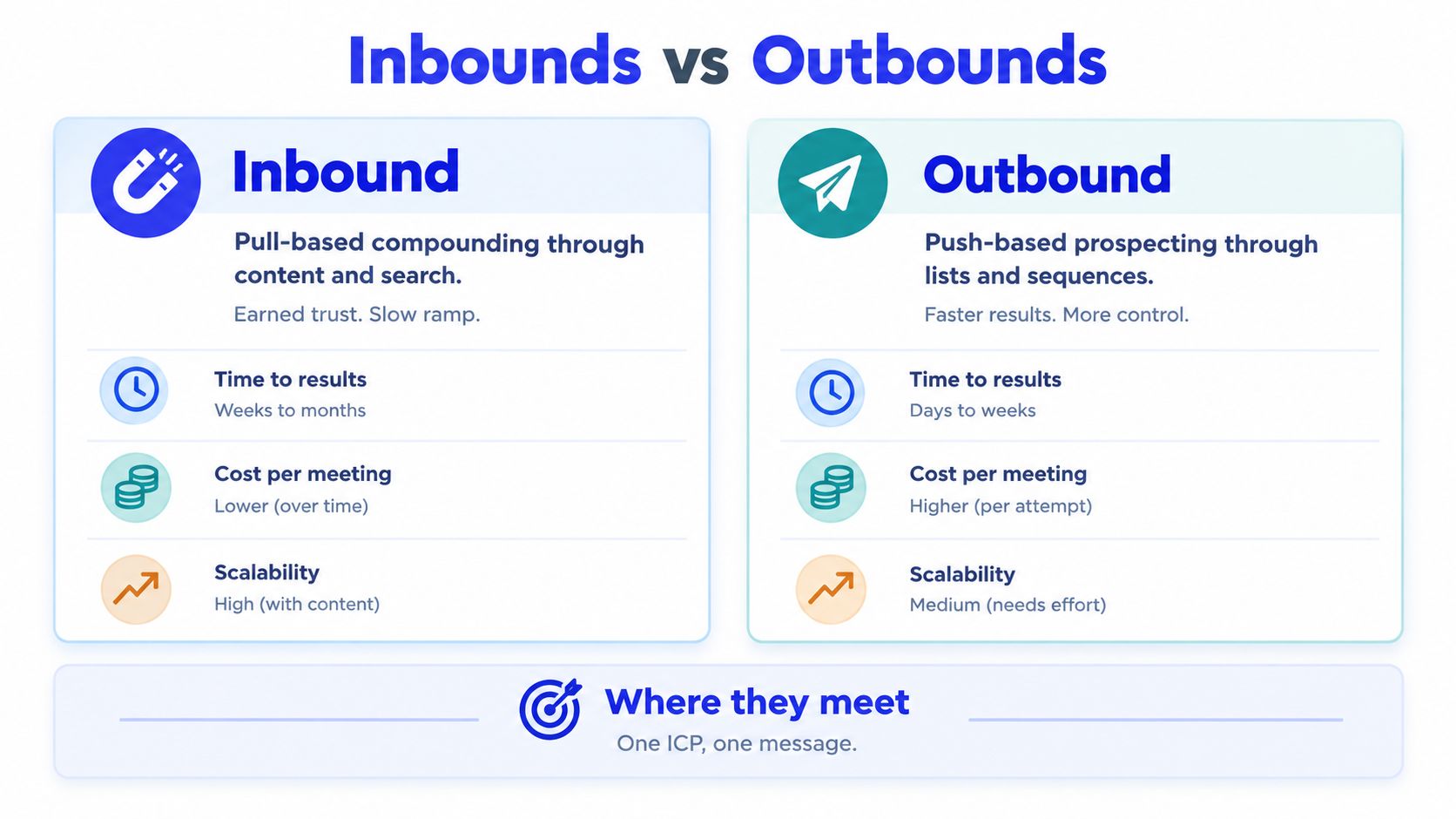
The verdict is simple. Inbound should capture existing demand. Outbound should create and accelerate demand inside named accounts. The strongest system uses both, sequenced by buying stage and signal.
That recommendation holds up because the economics are different. Inbound marketing is widely cited as about 61% to 63% less expensive per lead than outbound, while also generating 54% more leads, and one common comparison shows 14.6% close rate for inbound SEO leads versus 1.7% for outbound leads according to this inbound vs outbound marketing statistics summary.
Inbound wins on intent, not on control
Inbound works when buyers already know they have a problem and are actively evaluating options. They arrive through content, search, referrals, review sites, webinars, or direct response. You don't control when they show up, but you benefit from intent that already exists.
For B2B inbound specifically, lead-to-customer rates tend to sit around 8% to 12% for high-intent channels, with referrals at 10% to 15%, organic search and content at 8% to 12%, webinars and events at 6% to 10%, while LinkedIn and paid social tend to land at 3% to 5% in these B2B conversion rate benchmarks. That spread matters. Not all inbound is equal.
If your current pipeline looks busy but close rates stay weak, the issue is usually source quality. Teams often lump referral traffic, demo requests, paid social leads, and content downloads into one “inbound” bucket. That hides which channels create customers.
Outbound wins on account control, not on default efficiency
Outbound earns its place when you need to choose the account, the persona, and the timing. That matters in enterprise SaaS, regulated pharma workflows, niche manufacturing categories, and legal tech where the total addressable market is narrower and the buying committee is specific.
But broad-list outbound underperforms. Aggregated benchmarks show purchased lists at 0.3% to 0.8% response, basic personalization at 0.8% to 1.5%, light research at 1.5% to 3%, deep personalization at 3% to 5%, and signal-based outreach at 8% to 12% or higher in these cold outbound benchmarks. When teams coordinate email, LinkedIn, and phone, reply rates rise to 12% to 25%, and campaigns using three or more buying signals can reach 20% to 35% response from the same source.
That's the lesson. Copy matters, but targeting and timing matter more.
When outbound feels dead, the cause is usually weak signal selection before it's weak writing.
The right question is stage, not channel loyalty
A lot of bad revenue decisions come from treating inbound and outbound like identities. They're just delivery methods. The better model is stage-based orchestration.
Use inbound first when the buyer is already in market, especially if they've shown direct intent through search, referral, review behavior, or a hand-raise action. Use outbound to accelerate named accounts that match your ICP but haven't raised a hand yet, or to re-engage accounts that touched content without converting.
Current coverage of the category points in the same direction. Strong teams use outbound to accelerate deals that started inbound and warm outbound targets with content. One benchmark says 82% of B2B buyers accept meetings at least sometimes with proactive sellers, and multichannel outreach can outperform single-channel by 40% to 60% on qualified meetings booked, according to this analysis of outbound sales performance.
That's why a clean outbound process still matters even if inbound is healthy. If your team still frames this as a debate, that's the wrong frame. Build around one message and route by signal. If you need a tighter view of outbound's role in that engine, this breakdown of what outbound sales is is a useful reference.
Building one message one list and one source of truth
Most pipeline waste starts before the first touch. It starts in bad segmentation, weak enrichment, and messaging that changes by channel. If you want inbounds and outbounds to work as one engine, the foundation has to be shared.
Start with a tightened ICP
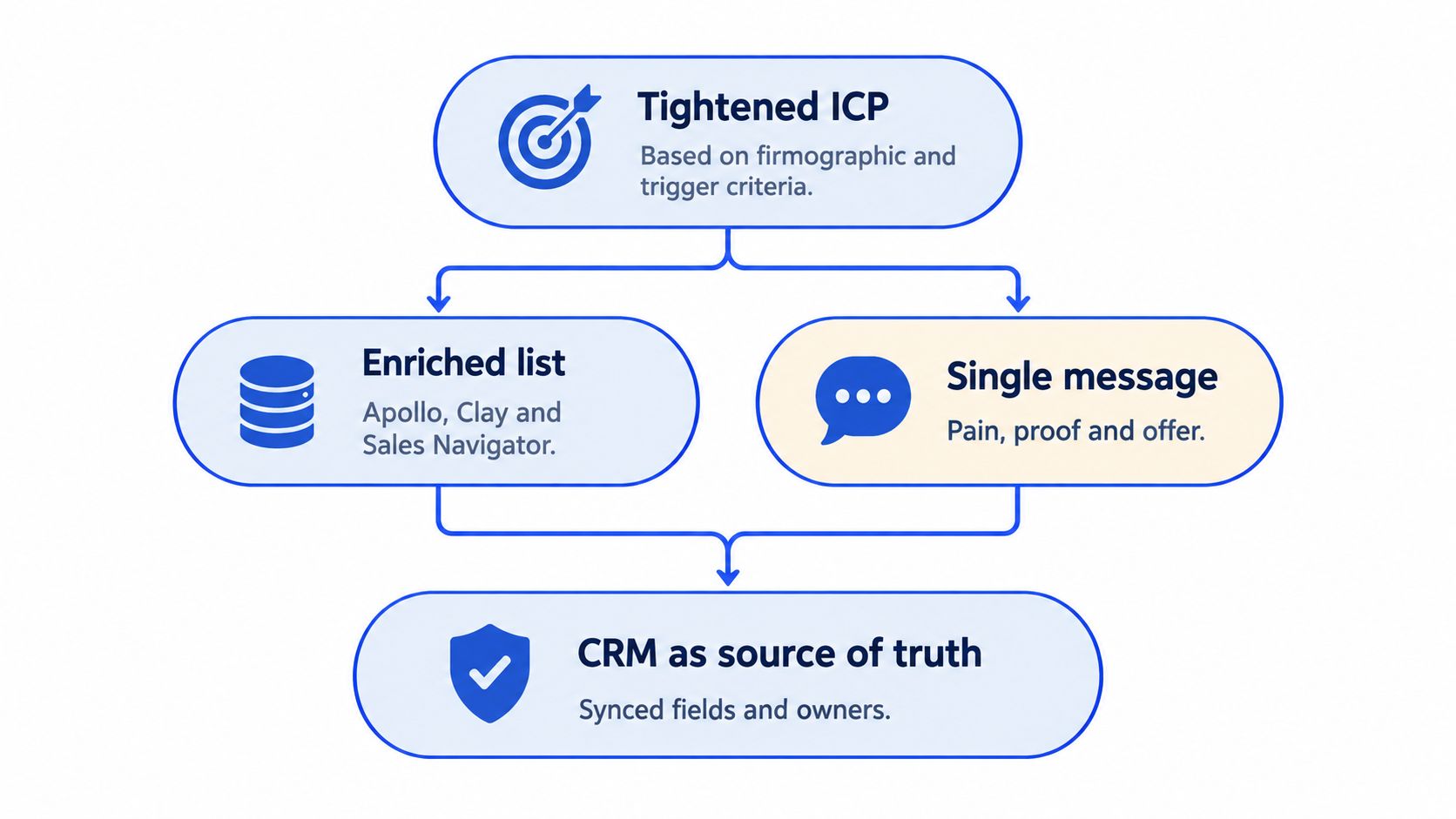
“B2B SaaS” is not an ICP. “Mid-market compliance SaaS selling into heads of operations” still isn't enough. Tighten by firmographic fit, role cluster, operational problem, and trigger.
A usable ICP has two layers:
Static fit: industry, company size, geography if relevant, business model, stack clues, team maturity
Dynamic signal: hiring pattern, funding event, product launch, market entry, leadership change, active category content engagement
In Apollo, pull the base company set. In Sales Navigator, pressure-test role patterns and buying committee titles. In Clay, enrich with custom fields that matter to your offer, such as hiring language, stack data, recent role changes, or category mentions.
The point isn't to collect more data. It's to remove records that sales should never touch.
Build one list, not channel-specific fragments
Teams usually split here. Marketing keeps audience segments in HubSpot. Sales builds outreach lists in Apollo. LinkedIn engagement sits in another tool. Nobody owns suppression across all three.
The fix is one master account and contact table with strict field ownership. Use HubSpot as the source of truth if that's your CRM. Push records into execution tools, never the other way around.
A practical field set looks like this:
Field | Purpose | Owner |
|---|---|---|
Account fit status | Confirms ICP match or mismatch | RevOps |
Primary pain theme | Keeps messaging consistent | Marketing with sales input |
Trigger source | Shows why now | SDR or automation |
Engagement state | Prevents duplicate outreach | RevOps |
Current owner | Stops collision across teams | Sales manager |
Suppression reason | Blocks bad timing or bad fit | RevOps |
If your list discipline is weak, outbound quality falls apart fast and inbound routing gets noisy. This is the same reason organizations struggle with leads and lists. The issue isn't list size. It's list control.
Create one message house for every touch
A unified motion needs one message house that feeds LinkedIn posts, outbound emails, reply scripts, and call openers. Not one sentence. One structure.
Use three parts:
Pain, phrased in the buyer's operating language
Proof, tied to a believable mechanism
Offer, framed as the next step, not a feature dump
For example, if you sell into manufacturing ops leaders, the pain may be handoff delays across distributors, not “inefficient sales processes.” If you sell legal tech, the pain may be intake inconsistency across practice groups, not “manual workflows.” The wording has to match how the buyer describes the problem internally.
A good message house survives format changes. If it only works in a cold email, it isn't stable enough.
This doesn't mean every persona gets the same copy. It means each persona gets a variant built from the same core claim. The operations lead hears process friction. The commercial lead hears revenue leakage. The executive buyer hears pipeline predictability. Same system, different angle.
Define tool roles before the team starts working
Tool sprawl causes as much confusion as channel sprawl. Assign a job to each tool.
Apollo: base prospecting, contact data, sequencing inputs
Clay: enrichment, trigger logic, normalization, list QA
Sales Navigator: role validation, account mapping, manual research
HubSpot: lifecycle stages, ownership, routing, reporting
Lemlist, Instantly, or Smartlead: outbound sending layer
HeyReach: LinkedIn step execution for coordinated sequences
Grou fits into this category as one option for teams that want the list building, LinkedIn content, outbound execution, and routing system managed as a single operating layer rather than split across internal owners and freelancers.
Keep hygiene rules visible
You don't need a long policy doc. You need visible list rules.
Suppress engaged demand: website hand-raisers, active opportunities, current customers, open deals
Suppress bad fit: wrong segment, wrong geography, student emails, agency competitors if excluded
Refresh stale data: rerun enrichment before re-sequencing old accounts
Tag source consistently: referral, organic, webinar, paid search, outbound, LinkedIn engagement, partner
One list, one message, one source of truth sounds simple because it is. What's hard is enforcing it every week. Without that foundation, the execution layer just scales inconsistency.
Running the combined motion from content to sequence to handoff
Monday morning, an AE asks why a target account got both a demo follow-up and a cold outbound sequence in the same week. The answer is usually simple. Content, SDR, and lifecycle routing are running on separate tracks.
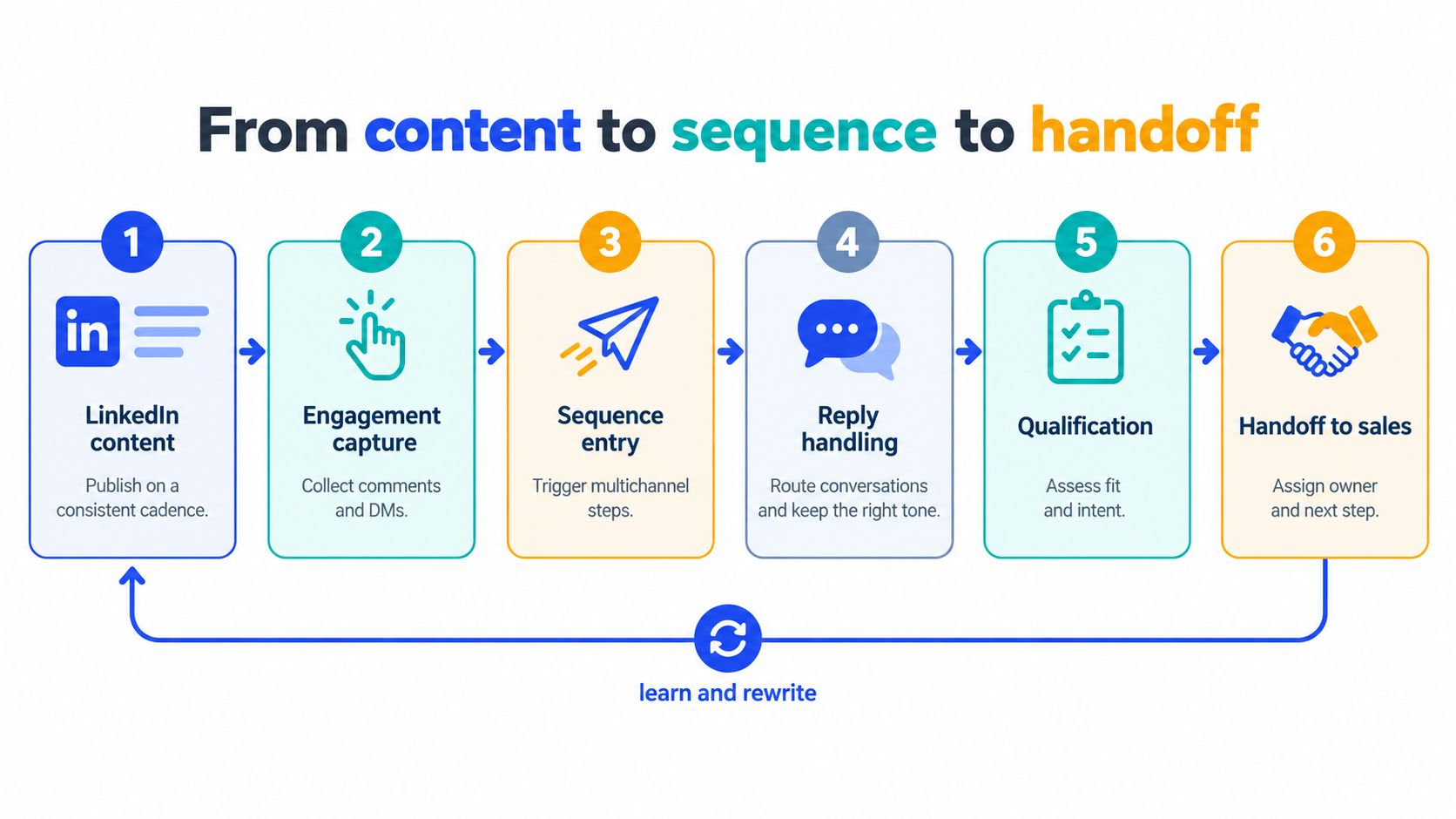
A combined motion fixes that by treating content, outbound, and handoff as one operating system. One message enters through different channels based on buying stage and signal. One list controls who gets what. One routing layer decides whether the next step is nurture, sequence, SDR qualification, or AE follow-up.
Start with content that supports outreach
LinkedIn content should reduce friction inside the sales motion. If outbound replies show category confusion, publish posts that define the problem and name the trigger points. If AEs keep hearing implementation questions, publish proof from customer rollouts, screenshots, or process notes that answer those objections before the next call.
The input source is simple. Pull topics from Gong call clips, SDR reply buckets, lost reasons in HubSpot, and questions that appear in demo forms. Then map those themes into both inbound capture and outbound usage. A practical B2B lead generation system works better when content gives reps assets they can send, cite, and build sequences around.
A documented editorial process helps. A clean content publishing workflow guide is useful because it keeps content tied to distribution, approvals, and actual sales use instead of random posting.
Content should not assume the buyer has read everything. It should give the outbound team a credible reference point when they reach out after a trigger or revisit.
Build multichannel sequences around signal
Email-only outbound is easy to start and weak at scale. Buyers miss messages, ignore unknown senders, and switch channels constantly. Coordinated sequences across email, LinkedIn, and phone create more chances to connect, but only if the message stays consistent across each step.
A practical stack often looks like this:
Smartlead or Instantly for mailbox management and sending control
Lemlist when you want tighter sequence logic and team collaboration
HeyReach for LinkedIn steps that sit alongside email outreach
Apollo for contact sourcing and quick segmentation
HubSpot for stage movement, owner assignment, and reply routing
Analysts at Leadriver reported a 0.45% average reply rate across more than 7.5 million cold emails in 2025, and found that multichannel sequences outperformed single-channel outreach in this state of B2B outbound report. They also noted that poor deliverability and low-quality AI personalization were common causes of weak performance.
That trade-off matters. More channels create more surface area for mistakes. They also create more context when the sequence is built from a real trigger such as a job change, funding event, new market launch, hiring spike, product release, or repeated visits from a named account.
Don't ask SDRs to write from a blank page. Give them signal-based segments, approved variants, and clear switching rules.
Buying stage | Primary motion | Signal to switch | Next play |
|---|---|---|---|
Problem aware but anonymous | Inbound content | Named account engagement or repeat visits | Add to monitored target list and trigger SDR review |
Hand-raiser with direct intent | Inbound follow-up | Form fill, demo request, referral intro | Route to AE or inbound SDR immediately |
ICP account with weak visible intent | Outbound sequence | Trigger event or persona fit with no active hand raise | Start multichannel sequence with pain-led angle |
Engaged outbound prospect | Combined motion | Reply, site revisit, content interaction | Move from sequence to live qualification |
Late-stage account with buying committee complexity | Outbound acceleration with content support | Multi-threading need, stalled deal, added stakeholders | Run targeted outreach to adjacent stakeholders |
A combined demand motion for B2B should look like this in practice:
Route replies fast and qualify with discipline
A lot of teams do the hard part first and the important part last. They spend time earning attention, then let replies sit in personal inboxes, unworked queues, or generic round-robin flows.
For inbound leads, a 2026 benchmark covering 253,817 leads found a median first response time of 42 hours in this lead response time dataset. A separate benchmark summary reported conversion rates are 8x higher when a lead is contacted within 5 minutes versus waiting 6 or more minutes in this lead response benchmark summary.
That means routing logic needs to be explicit. Demo requests, referral intros, and replies with buying language should go straight to the AE or inbound SDR with account context attached. Low-intent content conversions can go to SDR triage, but they still need an owner, an SLA, and a disposition path in HubSpot.
The handoff fields should be standard: source, latest signal, account owner, lifecycle stage, persona, fit score, and last meaningful touch. Without those fields, sales has to reconstruct context from tools that were never designed to be your source of truth.
Use a shared Slack channel across content, SDR, AE, and RevOps. Post qualified replies, bad-fit responses, objection patterns, and sequence failures there. Review it every two weeks. The fastest gains usually come from fixing message mismatch, routing gaps, and qualification drift while the pattern is still visible.
Protect deliverability before scaling sends
If inbox placement is weak, the rest of the system stops working. Sequence copy, signal quality, and SDR effort all get hidden behind technical failure.
One 2026 guide recommends SPF, DKIM, and DMARC alignment, gradual warmup starting at 20 to 30 sends per day, one-click unsubscribe, and immediate hard bounce removal after each cycle in this outbound email deliverability guide. One person should own that checklist, usually RevOps or the outbound manager.
Keep the rules tight:
Warm domains slowly: don't launch full outbound volume from fresh inboxes
Watch reply quality: separate positive, neutral, and negative replies
Kill bad data fast: remove hard bounces and role-account junk from the list quickly
Pause noisy segments: if a segment drives complaints or bad-fit replies, stop it before sender reputation drops
That is the operating loop. Content creates context. Sequences create entry points. Fast routing and clean handoffs turn both inbound and outbound into one pipeline engine instead of two teams competing for credit.
Reporting attribution and metrics that prove pipeline not activity
Most revenue dashboards are too polite. They show email volume, MQL counts, booked meetings, and content output, but they don't tell you whether your demand engine is creating customers or just creating motion.
A useful dashboard for inbounds and outbounds has one rule. Every source is judged by downstream conversion, not top-of-funnel noise. If you want a deeper baseline on the mechanics, this primer on marketing attribution is worth reviewing before you rewrite your dashboard.
Report source quality, not just source volume
Inbound should not sit in one bucket. Outbound shouldn't either.
For inbound, break out referral, organic search, content-driven hand raises, webinars or events, paid search, paid social, and review-driven demand. For outbound, separate signal-based outbound from broad list outbound, and separate multichannel sequences from email-only sends. That lets you see whether the engine is generating high-intent demand or cheap activity.
One benchmark on inbound economics is especially useful here. Inbound captures existing demand at a 14.6% lead-to-customer conversion rate and averages roughly $200 CAC across a 939-company benchmark in this inbound and outbound sales benchmark. That doesn't mean inbound is always cheap. It means inbound tends to be efficient when the buyer is already in market.
Put both motions on one operating dashboard
The dashboard needs shared stages and channel-specific guardrails. A clean weekly review usually includes:
Metric | Why it matters | Motion |
|---|---|---|
Lead to meeting held | Shows whether interest becomes real conversation | Both |
Meeting held to qualified opportunity | Filters out weak discovery volume | Both |
Source to customer conversion | Reveals channel quality | Both |
First response time | Exposes routing failure | Inbound-heavy |
Positive reply quality | Shows whether outbound messaging and targeting fit | Outbound-heavy |
Bounce and complaint watch | Protects deliverability health | Outbound-heavy |
No-show pattern by source | Flags low-intent lead pools | Both |
A lot of teams fool themselves. A paid social campaign can generate names. A broad outbound blast can generate replies. Neither means pipeline is healthy. If meeting-held rate and qualification rate are weak, the source isn't working no matter how good the top-of-funnel chart looks.
The scoreboard should make low-intent volume feel expensive, because it is.
Use one attribution logic and stop the channel fights
Attribution arguments usually happen because teams compare unlike motions with unlike rules. Marketing wants form-fill credit. Sales wants meeting-source credit. Neither model catches assisted influence well on its own.
Use account-level attribution for decision-making, with clear primary source and assisted touch logic. If outbound opened the account and inbound converted the hand raise, record both. If content warmed the persona and the SDR booked the meeting, record both. Budget decisions get better when assists are visible.
The practical test is simple. Can you explain why a channel deserves more budget using customer conversion, qualification rate, and meeting-held rate? If not, the metric belongs in a supporting panel, not in the headline row.
Common pitfalls and your next pipeline audit
The expensive mistakes are predictable.
Teams send AI-written sequences that sound polished but generic, and reply quality drops. They keep adding more contacts when the actual problem is bad ICP control. They celebrate inbound lead volume while demo requests wait in queues. They treat deliverability as a technical side quest. Then they wonder why pipeline feels fragile.
The failure pattern shows up in five places
Weak targeting: broad lists hide inside “scale” language and burn sender reputation.
Slow routing: hand-raisers sit too long, then sales blames lead quality.
Loose qualification: meetings get booked without fit, authority, or clear problem.
Message drift: LinkedIn says one thing, outbound says another, calls say something else.
Split reporting: teams can't tell whether content, outbound, referrals, or paid demand creates customers.
The fix isn't another campaign. It's a tighter operating system.
Run this audit this week
Open your CRM on Friday and pull the last 30 days of meetings from inbound and outbound sources. For each one, add four columns if they don't already exist: first response time, meeting held, qualified opportunity, assisted source.
Then review three things:
Which source created the highest meeting-held rate
Which source created the highest qualified-opportunity rate
Which accounts had both inbound and outbound touches before conversion
That audit will show you where your split motion is leaking. It will also show whether your team has one engine or just two teams generating activity next to each other.
GROU is a global B2B pipeline agency trusted by 50+ companies across iGaming, SaaS, manufacturing, and professional services. The methodology is simple, one message, one list, and one reporting line run in bi-weekly sprints with fast feedback and clear ownership.
If your team is still reporting inbounds and outbounds separately, fix the structure before you buy another tool. Grou builds the connected system, LinkedIn content, list building, outbound execution, and routing rules, so attention turns into qualified pipeline instead of dashboard noise.
Your CRM says marketing sourced the lead. Sales says outbound opened the door. The prospect saw a LinkedIn post, ignored two emails, came back through branded search, then booked a demo, and nobody agrees on who owns the pipeline or why follow-up is slow. That is the core problem with inbounds and outbounds. Not channel choice, structure.
Run one ICP, not two channel-specific versions
Use one message house across content, outbound, and reply handling
Keep one account list with suppression, enrichment, and owner rules
Report on pipeline and conversion by source quality, not activity volume alone
Table of Contents
Why split motions stall pipeline and what a unified system fixes
Running the combined motion from content to sequence to handoff
Reporting attribution and metrics that prove pipeline not activity
Why split motions stall pipeline and what a unified system fixes
Teams don't have an inbound problem or an outbound problem. They have a systems problem.
Marketing runs HubSpot forms, LinkedIn posts, and paid search. Sales runs Apollo exports, Smartlead sequences, and Sales Navigator prospecting. Each side has its own dashboard, its own definitions, and its own idea of who the market is. That split creates duplicate touches, slow follow-up, and fake attribution confidence.
The damage starts in the handoff
A prospect comments on a LinkedIn post, visits the site, downloads a guide, and gets added to an outbound sequence three days later because nobody suppressed engaged accounts. Another lead fills out a demo form Friday afternoon and sits untouched until Monday because routing lives in a workflow nobody has audited in months. Sales calls that a lead quality issue. It isn't. It's ownership failure.
The bigger issue is message drift. Marketing writes broad educational content. SDRs send narrow, pain-led outreach. AEs position the offer differently on calls. Prospects hear three companies instead of one.
Practical rule: if inbound and outbound use different problem statements, you're paying twice to confuse the same market.
This gets expensive in iGaming, SaaS, manufacturing, legal tech, and pharma because the account pools are finite and role-specific. You can't afford overlap, stale lists, or channel conflict when the same buying committee sees every touch.
One engine beats two departments acting politely
The fix is boring, which is why it works. One message. One list. One reporting line.
That means the target account list starts from the same ICP logic whether the contact enters through search, referral, outbound email, or LinkedIn engagement. It means content topics and outbound angles come from the same message house. It means reply handling, qualification, and ownership sit in one workflow.
A lot of teams miss the tooling layer here. If you're auditing where your motion is fragmented, the NotFair tools guide is useful because it forces you to look at the stack as a connected operating system instead of a pile of subscriptions.
The people issue matters too. If marketing owns attention and sales owns meetings, someone still has to own transition speed, list hygiene, and source truth. Otherwise alignment becomes a weekly meeting with no operational authority. That's why the reporting line matters as much as the channels. If this is already a friction point, fix the operating model before adding more campaigns, and tighten sales and marketing alignment around shared pipeline rules.
What a unified system actually changes
When teams combine inbounds and outbounds properly, four things improve fast:
Follow-up speed gets clear: one owner receives, routes, and works engaged demand instead of passing it across teams.
Suppression gets cleaner: engaged accounts, customers, bad fits, and active opportunities stop receiving irrelevant outbound.
Attribution gets more honest: you can see which touches assisted pipeline creation instead of arguing over last touch.
Message quality gets stronger: content, outbound, and calls all repeat the same pain, proof, and commercial angle.
Here's the key recommendation. Stop asking whether inbound or outbound is better. Build one demand engine and assign channel use by buying stage and account signal. Teams that split motions by department usually stall. Teams that unify data, message, and handoff tend to move faster because attention has somewhere structured to go.
How inbounds and outbounds differ and when to use each
The verdict is simple. Inbound should capture existing demand. Outbound should create and accelerate demand inside named accounts. The strongest system uses both, sequenced by buying stage and signal.
That recommendation holds up because the economics are different. Inbound marketing is widely cited as about 61% to 63% less expensive per lead than outbound, while also generating 54% more leads, and one common comparison shows 14.6% close rate for inbound SEO leads versus 1.7% for outbound leads according to this inbound vs outbound marketing statistics summary.
Inbound wins on intent, not on control
Inbound works when buyers already know they have a problem and are actively evaluating options. They arrive through content, search, referrals, review sites, webinars, or direct response. You don't control when they show up, but you benefit from intent that already exists.
For B2B inbound specifically, lead-to-customer rates tend to sit around 8% to 12% for high-intent channels, with referrals at 10% to 15%, organic search and content at 8% to 12%, webinars and events at 6% to 10%, while LinkedIn and paid social tend to land at 3% to 5% in these B2B conversion rate benchmarks. That spread matters. Not all inbound is equal.
If your current pipeline looks busy but close rates stay weak, the issue is usually source quality. Teams often lump referral traffic, demo requests, paid social leads, and content downloads into one “inbound” bucket. That hides which channels create customers.
Outbound wins on account control, not on default efficiency
Outbound earns its place when you need to choose the account, the persona, and the timing. That matters in enterprise SaaS, regulated pharma workflows, niche manufacturing categories, and legal tech where the total addressable market is narrower and the buying committee is specific.
But broad-list outbound underperforms. Aggregated benchmarks show purchased lists at 0.3% to 0.8% response, basic personalization at 0.8% to 1.5%, light research at 1.5% to 3%, deep personalization at 3% to 5%, and signal-based outreach at 8% to 12% or higher in these cold outbound benchmarks. When teams coordinate email, LinkedIn, and phone, reply rates rise to 12% to 25%, and campaigns using three or more buying signals can reach 20% to 35% response from the same source.
That's the lesson. Copy matters, but targeting and timing matter more.
When outbound feels dead, the cause is usually weak signal selection before it's weak writing.
The right question is stage, not channel loyalty
A lot of bad revenue decisions come from treating inbound and outbound like identities. They're just delivery methods. The better model is stage-based orchestration.
Use inbound first when the buyer is already in market, especially if they've shown direct intent through search, referral, review behavior, or a hand-raise action. Use outbound to accelerate named accounts that match your ICP but haven't raised a hand yet, or to re-engage accounts that touched content without converting.
Current coverage of the category points in the same direction. Strong teams use outbound to accelerate deals that started inbound and warm outbound targets with content. One benchmark says 82% of B2B buyers accept meetings at least sometimes with proactive sellers, and multichannel outreach can outperform single-channel by 40% to 60% on qualified meetings booked, according to this analysis of outbound sales performance.
That's why a clean outbound process still matters even if inbound is healthy. If your team still frames this as a debate, that's the wrong frame. Build around one message and route by signal. If you need a tighter view of outbound's role in that engine, this breakdown of what outbound sales is is a useful reference.
Building one message one list and one source of truth
Most pipeline waste starts before the first touch. It starts in bad segmentation, weak enrichment, and messaging that changes by channel. If you want inbounds and outbounds to work as one engine, the foundation has to be shared.
Start with a tightened ICP
“B2B SaaS” is not an ICP. “Mid-market compliance SaaS selling into heads of operations” still isn't enough. Tighten by firmographic fit, role cluster, operational problem, and trigger.
A usable ICP has two layers:
Static fit: industry, company size, geography if relevant, business model, stack clues, team maturity
Dynamic signal: hiring pattern, funding event, product launch, market entry, leadership change, active category content engagement
In Apollo, pull the base company set. In Sales Navigator, pressure-test role patterns and buying committee titles. In Clay, enrich with custom fields that matter to your offer, such as hiring language, stack data, recent role changes, or category mentions.
The point isn't to collect more data. It's to remove records that sales should never touch.
Build one list, not channel-specific fragments
Teams usually split here. Marketing keeps audience segments in HubSpot. Sales builds outreach lists in Apollo. LinkedIn engagement sits in another tool. Nobody owns suppression across all three.
The fix is one master account and contact table with strict field ownership. Use HubSpot as the source of truth if that's your CRM. Push records into execution tools, never the other way around.
A practical field set looks like this:
Field | Purpose | Owner |
|---|---|---|
Account fit status | Confirms ICP match or mismatch | RevOps |
Primary pain theme | Keeps messaging consistent | Marketing with sales input |
Trigger source | Shows why now | SDR or automation |
Engagement state | Prevents duplicate outreach | RevOps |
Current owner | Stops collision across teams | Sales manager |
Suppression reason | Blocks bad timing or bad fit | RevOps |
If your list discipline is weak, outbound quality falls apart fast and inbound routing gets noisy. This is the same reason organizations struggle with leads and lists. The issue isn't list size. It's list control.
Create one message house for every touch
A unified motion needs one message house that feeds LinkedIn posts, outbound emails, reply scripts, and call openers. Not one sentence. One structure.
Use three parts:
Pain, phrased in the buyer's operating language
Proof, tied to a believable mechanism
Offer, framed as the next step, not a feature dump
For example, if you sell into manufacturing ops leaders, the pain may be handoff delays across distributors, not “inefficient sales processes.” If you sell legal tech, the pain may be intake inconsistency across practice groups, not “manual workflows.” The wording has to match how the buyer describes the problem internally.
A good message house survives format changes. If it only works in a cold email, it isn't stable enough.
This doesn't mean every persona gets the same copy. It means each persona gets a variant built from the same core claim. The operations lead hears process friction. The commercial lead hears revenue leakage. The executive buyer hears pipeline predictability. Same system, different angle.
Define tool roles before the team starts working
Tool sprawl causes as much confusion as channel sprawl. Assign a job to each tool.
Apollo: base prospecting, contact data, sequencing inputs
Clay: enrichment, trigger logic, normalization, list QA
Sales Navigator: role validation, account mapping, manual research
HubSpot: lifecycle stages, ownership, routing, reporting
Lemlist, Instantly, or Smartlead: outbound sending layer
HeyReach: LinkedIn step execution for coordinated sequences
Grou fits into this category as one option for teams that want the list building, LinkedIn content, outbound execution, and routing system managed as a single operating layer rather than split across internal owners and freelancers.
Keep hygiene rules visible
You don't need a long policy doc. You need visible list rules.
Suppress engaged demand: website hand-raisers, active opportunities, current customers, open deals
Suppress bad fit: wrong segment, wrong geography, student emails, agency competitors if excluded
Refresh stale data: rerun enrichment before re-sequencing old accounts
Tag source consistently: referral, organic, webinar, paid search, outbound, LinkedIn engagement, partner
One list, one message, one source of truth sounds simple because it is. What's hard is enforcing it every week. Without that foundation, the execution layer just scales inconsistency.
Running the combined motion from content to sequence to handoff
Monday morning, an AE asks why a target account got both a demo follow-up and a cold outbound sequence in the same week. The answer is usually simple. Content, SDR, and lifecycle routing are running on separate tracks.
A combined motion fixes that by treating content, outbound, and handoff as one operating system. One message enters through different channels based on buying stage and signal. One list controls who gets what. One routing layer decides whether the next step is nurture, sequence, SDR qualification, or AE follow-up.
Start with content that supports outreach
LinkedIn content should reduce friction inside the sales motion. If outbound replies show category confusion, publish posts that define the problem and name the trigger points. If AEs keep hearing implementation questions, publish proof from customer rollouts, screenshots, or process notes that answer those objections before the next call.
The input source is simple. Pull topics from Gong call clips, SDR reply buckets, lost reasons in HubSpot, and questions that appear in demo forms. Then map those themes into both inbound capture and outbound usage. A practical B2B lead generation system works better when content gives reps assets they can send, cite, and build sequences around.
A documented editorial process helps. A clean content publishing workflow guide is useful because it keeps content tied to distribution, approvals, and actual sales use instead of random posting.
Content should not assume the buyer has read everything. It should give the outbound team a credible reference point when they reach out after a trigger or revisit.
Build multichannel sequences around signal
Email-only outbound is easy to start and weak at scale. Buyers miss messages, ignore unknown senders, and switch channels constantly. Coordinated sequences across email, LinkedIn, and phone create more chances to connect, but only if the message stays consistent across each step.
A practical stack often looks like this:
Smartlead or Instantly for mailbox management and sending control
Lemlist when you want tighter sequence logic and team collaboration
HeyReach for LinkedIn steps that sit alongside email outreach
Apollo for contact sourcing and quick segmentation
HubSpot for stage movement, owner assignment, and reply routing
Analysts at Leadriver reported a 0.45% average reply rate across more than 7.5 million cold emails in 2025, and found that multichannel sequences outperformed single-channel outreach in this state of B2B outbound report. They also noted that poor deliverability and low-quality AI personalization were common causes of weak performance.
That trade-off matters. More channels create more surface area for mistakes. They also create more context when the sequence is built from a real trigger such as a job change, funding event, new market launch, hiring spike, product release, or repeated visits from a named account.
Don't ask SDRs to write from a blank page. Give them signal-based segments, approved variants, and clear switching rules.
Buying stage | Primary motion | Signal to switch | Next play |
|---|---|---|---|
Problem aware but anonymous | Inbound content | Named account engagement or repeat visits | Add to monitored target list and trigger SDR review |
Hand-raiser with direct intent | Inbound follow-up | Form fill, demo request, referral intro | Route to AE or inbound SDR immediately |
ICP account with weak visible intent | Outbound sequence | Trigger event or persona fit with no active hand raise | Start multichannel sequence with pain-led angle |
Engaged outbound prospect | Combined motion | Reply, site revisit, content interaction | Move from sequence to live qualification |
Late-stage account with buying committee complexity | Outbound acceleration with content support | Multi-threading need, stalled deal, added stakeholders | Run targeted outreach to adjacent stakeholders |
A combined demand motion for B2B should look like this in practice:
Route replies fast and qualify with discipline
A lot of teams do the hard part first and the important part last. They spend time earning attention, then let replies sit in personal inboxes, unworked queues, or generic round-robin flows.
For inbound leads, a 2026 benchmark covering 253,817 leads found a median first response time of 42 hours in this lead response time dataset. A separate benchmark summary reported conversion rates are 8x higher when a lead is contacted within 5 minutes versus waiting 6 or more minutes in this lead response benchmark summary.
That means routing logic needs to be explicit. Demo requests, referral intros, and replies with buying language should go straight to the AE or inbound SDR with account context attached. Low-intent content conversions can go to SDR triage, but they still need an owner, an SLA, and a disposition path in HubSpot.
The handoff fields should be standard: source, latest signal, account owner, lifecycle stage, persona, fit score, and last meaningful touch. Without those fields, sales has to reconstruct context from tools that were never designed to be your source of truth.
Use a shared Slack channel across content, SDR, AE, and RevOps. Post qualified replies, bad-fit responses, objection patterns, and sequence failures there. Review it every two weeks. The fastest gains usually come from fixing message mismatch, routing gaps, and qualification drift while the pattern is still visible.
Protect deliverability before scaling sends
If inbox placement is weak, the rest of the system stops working. Sequence copy, signal quality, and SDR effort all get hidden behind technical failure.
One 2026 guide recommends SPF, DKIM, and DMARC alignment, gradual warmup starting at 20 to 30 sends per day, one-click unsubscribe, and immediate hard bounce removal after each cycle in this outbound email deliverability guide. One person should own that checklist, usually RevOps or the outbound manager.
Keep the rules tight:
Warm domains slowly: don't launch full outbound volume from fresh inboxes
Watch reply quality: separate positive, neutral, and negative replies
Kill bad data fast: remove hard bounces and role-account junk from the list quickly
Pause noisy segments: if a segment drives complaints or bad-fit replies, stop it before sender reputation drops
That is the operating loop. Content creates context. Sequences create entry points. Fast routing and clean handoffs turn both inbound and outbound into one pipeline engine instead of two teams competing for credit.
Reporting attribution and metrics that prove pipeline not activity
Most revenue dashboards are too polite. They show email volume, MQL counts, booked meetings, and content output, but they don't tell you whether your demand engine is creating customers or just creating motion.
A useful dashboard for inbounds and outbounds has one rule. Every source is judged by downstream conversion, not top-of-funnel noise. If you want a deeper baseline on the mechanics, this primer on marketing attribution is worth reviewing before you rewrite your dashboard.
Report source quality, not just source volume
Inbound should not sit in one bucket. Outbound shouldn't either.
For inbound, break out referral, organic search, content-driven hand raises, webinars or events, paid search, paid social, and review-driven demand. For outbound, separate signal-based outbound from broad list outbound, and separate multichannel sequences from email-only sends. That lets you see whether the engine is generating high-intent demand or cheap activity.
One benchmark on inbound economics is especially useful here. Inbound captures existing demand at a 14.6% lead-to-customer conversion rate and averages roughly $200 CAC across a 939-company benchmark in this inbound and outbound sales benchmark. That doesn't mean inbound is always cheap. It means inbound tends to be efficient when the buyer is already in market.
Put both motions on one operating dashboard
The dashboard needs shared stages and channel-specific guardrails. A clean weekly review usually includes:
Metric | Why it matters | Motion |
|---|---|---|
Lead to meeting held | Shows whether interest becomes real conversation | Both |
Meeting held to qualified opportunity | Filters out weak discovery volume | Both |
Source to customer conversion | Reveals channel quality | Both |
First response time | Exposes routing failure | Inbound-heavy |
Positive reply quality | Shows whether outbound messaging and targeting fit | Outbound-heavy |
Bounce and complaint watch | Protects deliverability health | Outbound-heavy |
No-show pattern by source | Flags low-intent lead pools | Both |
A lot of teams fool themselves. A paid social campaign can generate names. A broad outbound blast can generate replies. Neither means pipeline is healthy. If meeting-held rate and qualification rate are weak, the source isn't working no matter how good the top-of-funnel chart looks.
The scoreboard should make low-intent volume feel expensive, because it is.
Use one attribution logic and stop the channel fights
Attribution arguments usually happen because teams compare unlike motions with unlike rules. Marketing wants form-fill credit. Sales wants meeting-source credit. Neither model catches assisted influence well on its own.
Use account-level attribution for decision-making, with clear primary source and assisted touch logic. If outbound opened the account and inbound converted the hand raise, record both. If content warmed the persona and the SDR booked the meeting, record both. Budget decisions get better when assists are visible.
The practical test is simple. Can you explain why a channel deserves more budget using customer conversion, qualification rate, and meeting-held rate? If not, the metric belongs in a supporting panel, not in the headline row.
Common pitfalls and your next pipeline audit
The expensive mistakes are predictable.
Teams send AI-written sequences that sound polished but generic, and reply quality drops. They keep adding more contacts when the actual problem is bad ICP control. They celebrate inbound lead volume while demo requests wait in queues. They treat deliverability as a technical side quest. Then they wonder why pipeline feels fragile.
The failure pattern shows up in five places
Weak targeting: broad lists hide inside “scale” language and burn sender reputation.
Slow routing: hand-raisers sit too long, then sales blames lead quality.
Loose qualification: meetings get booked without fit, authority, or clear problem.
Message drift: LinkedIn says one thing, outbound says another, calls say something else.
Split reporting: teams can't tell whether content, outbound, referrals, or paid demand creates customers.
The fix isn't another campaign. It's a tighter operating system.
Run this audit this week
Open your CRM on Friday and pull the last 30 days of meetings from inbound and outbound sources. For each one, add four columns if they don't already exist: first response time, meeting held, qualified opportunity, assisted source.
Then review three things:
Which source created the highest meeting-held rate
Which source created the highest qualified-opportunity rate
Which accounts had both inbound and outbound touches before conversion
That audit will show you where your split motion is leaking. It will also show whether your team has one engine or just two teams generating activity next to each other.
GROU is a global B2B pipeline agency trusted by 50+ companies across iGaming, SaaS, manufacturing, and professional services. The methodology is simple, one message, one list, and one reporting line run in bi-weekly sprints with fast feedback and clear ownership.
If your team is still reporting inbounds and outbounds separately, fix the structure before you buy another tool. Grou builds the connected system, LinkedIn content, list building, outbound execution, and routing rules, so attention turns into qualified pipeline instead of dashboard noise.
Your CRM says marketing sourced the lead. Sales says outbound opened the door. The prospect saw a LinkedIn post, ignored two emails, came back through branded search, then booked a demo, and nobody agrees on who owns the pipeline or why follow-up is slow. That is the core problem with inbounds and outbounds. Not channel choice, structure.
Run one ICP, not two channel-specific versions
Use one message house across content, outbound, and reply handling
Keep one account list with suppression, enrichment, and owner rules
Report on pipeline and conversion by source quality, not activity volume alone
Table of Contents
Why split motions stall pipeline and what a unified system fixes
Running the combined motion from content to sequence to handoff
Reporting attribution and metrics that prove pipeline not activity
Why split motions stall pipeline and what a unified system fixes
Teams don't have an inbound problem or an outbound problem. They have a systems problem.
Marketing runs HubSpot forms, LinkedIn posts, and paid search. Sales runs Apollo exports, Smartlead sequences, and Sales Navigator prospecting. Each side has its own dashboard, its own definitions, and its own idea of who the market is. That split creates duplicate touches, slow follow-up, and fake attribution confidence.
The damage starts in the handoff
A prospect comments on a LinkedIn post, visits the site, downloads a guide, and gets added to an outbound sequence three days later because nobody suppressed engaged accounts. Another lead fills out a demo form Friday afternoon and sits untouched until Monday because routing lives in a workflow nobody has audited in months. Sales calls that a lead quality issue. It isn't. It's ownership failure.
The bigger issue is message drift. Marketing writes broad educational content. SDRs send narrow, pain-led outreach. AEs position the offer differently on calls. Prospects hear three companies instead of one.
Practical rule: if inbound and outbound use different problem statements, you're paying twice to confuse the same market.
This gets expensive in iGaming, SaaS, manufacturing, legal tech, and pharma because the account pools are finite and role-specific. You can't afford overlap, stale lists, or channel conflict when the same buying committee sees every touch.
One engine beats two departments acting politely
The fix is boring, which is why it works. One message. One list. One reporting line.
That means the target account list starts from the same ICP logic whether the contact enters through search, referral, outbound email, or LinkedIn engagement. It means content topics and outbound angles come from the same message house. It means reply handling, qualification, and ownership sit in one workflow.
A lot of teams miss the tooling layer here. If you're auditing where your motion is fragmented, the NotFair tools guide is useful because it forces you to look at the stack as a connected operating system instead of a pile of subscriptions.
The people issue matters too. If marketing owns attention and sales owns meetings, someone still has to own transition speed, list hygiene, and source truth. Otherwise alignment becomes a weekly meeting with no operational authority. That's why the reporting line matters as much as the channels. If this is already a friction point, fix the operating model before adding more campaigns, and tighten sales and marketing alignment around shared pipeline rules.
What a unified system actually changes
When teams combine inbounds and outbounds properly, four things improve fast:
Follow-up speed gets clear: one owner receives, routes, and works engaged demand instead of passing it across teams.
Suppression gets cleaner: engaged accounts, customers, bad fits, and active opportunities stop receiving irrelevant outbound.
Attribution gets more honest: you can see which touches assisted pipeline creation instead of arguing over last touch.
Message quality gets stronger: content, outbound, and calls all repeat the same pain, proof, and commercial angle.
Here's the key recommendation. Stop asking whether inbound or outbound is better. Build one demand engine and assign channel use by buying stage and account signal. Teams that split motions by department usually stall. Teams that unify data, message, and handoff tend to move faster because attention has somewhere structured to go.
How inbounds and outbounds differ and when to use each
The verdict is simple. Inbound should capture existing demand. Outbound should create and accelerate demand inside named accounts. The strongest system uses both, sequenced by buying stage and signal.
That recommendation holds up because the economics are different. Inbound marketing is widely cited as about 61% to 63% less expensive per lead than outbound, while also generating 54% more leads, and one common comparison shows 14.6% close rate for inbound SEO leads versus 1.7% for outbound leads according to this inbound vs outbound marketing statistics summary.
Inbound wins on intent, not on control
Inbound works when buyers already know they have a problem and are actively evaluating options. They arrive through content, search, referrals, review sites, webinars, or direct response. You don't control when they show up, but you benefit from intent that already exists.
For B2B inbound specifically, lead-to-customer rates tend to sit around 8% to 12% for high-intent channels, with referrals at 10% to 15%, organic search and content at 8% to 12%, webinars and events at 6% to 10%, while LinkedIn and paid social tend to land at 3% to 5% in these B2B conversion rate benchmarks. That spread matters. Not all inbound is equal.
If your current pipeline looks busy but close rates stay weak, the issue is usually source quality. Teams often lump referral traffic, demo requests, paid social leads, and content downloads into one “inbound” bucket. That hides which channels create customers.
Outbound wins on account control, not on default efficiency
Outbound earns its place when you need to choose the account, the persona, and the timing. That matters in enterprise SaaS, regulated pharma workflows, niche manufacturing categories, and legal tech where the total addressable market is narrower and the buying committee is specific.
But broad-list outbound underperforms. Aggregated benchmarks show purchased lists at 0.3% to 0.8% response, basic personalization at 0.8% to 1.5%, light research at 1.5% to 3%, deep personalization at 3% to 5%, and signal-based outreach at 8% to 12% or higher in these cold outbound benchmarks. When teams coordinate email, LinkedIn, and phone, reply rates rise to 12% to 25%, and campaigns using three or more buying signals can reach 20% to 35% response from the same source.
That's the lesson. Copy matters, but targeting and timing matter more.
When outbound feels dead, the cause is usually weak signal selection before it's weak writing.
The right question is stage, not channel loyalty
A lot of bad revenue decisions come from treating inbound and outbound like identities. They're just delivery methods. The better model is stage-based orchestration.
Use inbound first when the buyer is already in market, especially if they've shown direct intent through search, referral, review behavior, or a hand-raise action. Use outbound to accelerate named accounts that match your ICP but haven't raised a hand yet, or to re-engage accounts that touched content without converting.
Current coverage of the category points in the same direction. Strong teams use outbound to accelerate deals that started inbound and warm outbound targets with content. One benchmark says 82% of B2B buyers accept meetings at least sometimes with proactive sellers, and multichannel outreach can outperform single-channel by 40% to 60% on qualified meetings booked, according to this analysis of outbound sales performance.
That's why a clean outbound process still matters even if inbound is healthy. If your team still frames this as a debate, that's the wrong frame. Build around one message and route by signal. If you need a tighter view of outbound's role in that engine, this breakdown of what outbound sales is is a useful reference.
Building one message one list and one source of truth
Most pipeline waste starts before the first touch. It starts in bad segmentation, weak enrichment, and messaging that changes by channel. If you want inbounds and outbounds to work as one engine, the foundation has to be shared.
Start with a tightened ICP
“B2B SaaS” is not an ICP. “Mid-market compliance SaaS selling into heads of operations” still isn't enough. Tighten by firmographic fit, role cluster, operational problem, and trigger.
A usable ICP has two layers:
Static fit: industry, company size, geography if relevant, business model, stack clues, team maturity
Dynamic signal: hiring pattern, funding event, product launch, market entry, leadership change, active category content engagement
In Apollo, pull the base company set. In Sales Navigator, pressure-test role patterns and buying committee titles. In Clay, enrich with custom fields that matter to your offer, such as hiring language, stack data, recent role changes, or category mentions.
The point isn't to collect more data. It's to remove records that sales should never touch.
Build one list, not channel-specific fragments
Teams usually split here. Marketing keeps audience segments in HubSpot. Sales builds outreach lists in Apollo. LinkedIn engagement sits in another tool. Nobody owns suppression across all three.
The fix is one master account and contact table with strict field ownership. Use HubSpot as the source of truth if that's your CRM. Push records into execution tools, never the other way around.
A practical field set looks like this:
Field | Purpose | Owner |
|---|---|---|
Account fit status | Confirms ICP match or mismatch | RevOps |
Primary pain theme | Keeps messaging consistent | Marketing with sales input |
Trigger source | Shows why now | SDR or automation |
Engagement state | Prevents duplicate outreach | RevOps |
Current owner | Stops collision across teams | Sales manager |
Suppression reason | Blocks bad timing or bad fit | RevOps |
If your list discipline is weak, outbound quality falls apart fast and inbound routing gets noisy. This is the same reason organizations struggle with leads and lists. The issue isn't list size. It's list control.
Create one message house for every touch
A unified motion needs one message house that feeds LinkedIn posts, outbound emails, reply scripts, and call openers. Not one sentence. One structure.
Use three parts:
Pain, phrased in the buyer's operating language
Proof, tied to a believable mechanism
Offer, framed as the next step, not a feature dump
For example, if you sell into manufacturing ops leaders, the pain may be handoff delays across distributors, not “inefficient sales processes.” If you sell legal tech, the pain may be intake inconsistency across practice groups, not “manual workflows.” The wording has to match how the buyer describes the problem internally.
A good message house survives format changes. If it only works in a cold email, it isn't stable enough.
This doesn't mean every persona gets the same copy. It means each persona gets a variant built from the same core claim. The operations lead hears process friction. The commercial lead hears revenue leakage. The executive buyer hears pipeline predictability. Same system, different angle.
Define tool roles before the team starts working
Tool sprawl causes as much confusion as channel sprawl. Assign a job to each tool.
Apollo: base prospecting, contact data, sequencing inputs
Clay: enrichment, trigger logic, normalization, list QA
Sales Navigator: role validation, account mapping, manual research
HubSpot: lifecycle stages, ownership, routing, reporting
Lemlist, Instantly, or Smartlead: outbound sending layer
HeyReach: LinkedIn step execution for coordinated sequences
Grou fits into this category as one option for teams that want the list building, LinkedIn content, outbound execution, and routing system managed as a single operating layer rather than split across internal owners and freelancers.
Keep hygiene rules visible
You don't need a long policy doc. You need visible list rules.
Suppress engaged demand: website hand-raisers, active opportunities, current customers, open deals
Suppress bad fit: wrong segment, wrong geography, student emails, agency competitors if excluded
Refresh stale data: rerun enrichment before re-sequencing old accounts
Tag source consistently: referral, organic, webinar, paid search, outbound, LinkedIn engagement, partner
One list, one message, one source of truth sounds simple because it is. What's hard is enforcing it every week. Without that foundation, the execution layer just scales inconsistency.
Running the combined motion from content to sequence to handoff
Monday morning, an AE asks why a target account got both a demo follow-up and a cold outbound sequence in the same week. The answer is usually simple. Content, SDR, and lifecycle routing are running on separate tracks.
A combined motion fixes that by treating content, outbound, and handoff as one operating system. One message enters through different channels based on buying stage and signal. One list controls who gets what. One routing layer decides whether the next step is nurture, sequence, SDR qualification, or AE follow-up.
Start with content that supports outreach
LinkedIn content should reduce friction inside the sales motion. If outbound replies show category confusion, publish posts that define the problem and name the trigger points. If AEs keep hearing implementation questions, publish proof from customer rollouts, screenshots, or process notes that answer those objections before the next call.
The input source is simple. Pull topics from Gong call clips, SDR reply buckets, lost reasons in HubSpot, and questions that appear in demo forms. Then map those themes into both inbound capture and outbound usage. A practical B2B lead generation system works better when content gives reps assets they can send, cite, and build sequences around.
A documented editorial process helps. A clean content publishing workflow guide is useful because it keeps content tied to distribution, approvals, and actual sales use instead of random posting.
Content should not assume the buyer has read everything. It should give the outbound team a credible reference point when they reach out after a trigger or revisit.
Build multichannel sequences around signal
Email-only outbound is easy to start and weak at scale. Buyers miss messages, ignore unknown senders, and switch channels constantly. Coordinated sequences across email, LinkedIn, and phone create more chances to connect, but only if the message stays consistent across each step.
A practical stack often looks like this:
Smartlead or Instantly for mailbox management and sending control
Lemlist when you want tighter sequence logic and team collaboration
HeyReach for LinkedIn steps that sit alongside email outreach
Apollo for contact sourcing and quick segmentation
HubSpot for stage movement, owner assignment, and reply routing
Analysts at Leadriver reported a 0.45% average reply rate across more than 7.5 million cold emails in 2025, and found that multichannel sequences outperformed single-channel outreach in this state of B2B outbound report. They also noted that poor deliverability and low-quality AI personalization were common causes of weak performance.
That trade-off matters. More channels create more surface area for mistakes. They also create more context when the sequence is built from a real trigger such as a job change, funding event, new market launch, hiring spike, product release, or repeated visits from a named account.
Don't ask SDRs to write from a blank page. Give them signal-based segments, approved variants, and clear switching rules.
Buying stage | Primary motion | Signal to switch | Next play |
|---|---|---|---|
Problem aware but anonymous | Inbound content | Named account engagement or repeat visits | Add to monitored target list and trigger SDR review |
Hand-raiser with direct intent | Inbound follow-up | Form fill, demo request, referral intro | Route to AE or inbound SDR immediately |
ICP account with weak visible intent | Outbound sequence | Trigger event or persona fit with no active hand raise | Start multichannel sequence with pain-led angle |
Engaged outbound prospect | Combined motion | Reply, site revisit, content interaction | Move from sequence to live qualification |
Late-stage account with buying committee complexity | Outbound acceleration with content support | Multi-threading need, stalled deal, added stakeholders | Run targeted outreach to adjacent stakeholders |
A combined demand motion for B2B should look like this in practice:
Route replies fast and qualify with discipline
A lot of teams do the hard part first and the important part last. They spend time earning attention, then let replies sit in personal inboxes, unworked queues, or generic round-robin flows.
For inbound leads, a 2026 benchmark covering 253,817 leads found a median first response time of 42 hours in this lead response time dataset. A separate benchmark summary reported conversion rates are 8x higher when a lead is contacted within 5 minutes versus waiting 6 or more minutes in this lead response benchmark summary.
That means routing logic needs to be explicit. Demo requests, referral intros, and replies with buying language should go straight to the AE or inbound SDR with account context attached. Low-intent content conversions can go to SDR triage, but they still need an owner, an SLA, and a disposition path in HubSpot.
The handoff fields should be standard: source, latest signal, account owner, lifecycle stage, persona, fit score, and last meaningful touch. Without those fields, sales has to reconstruct context from tools that were never designed to be your source of truth.
Use a shared Slack channel across content, SDR, AE, and RevOps. Post qualified replies, bad-fit responses, objection patterns, and sequence failures there. Review it every two weeks. The fastest gains usually come from fixing message mismatch, routing gaps, and qualification drift while the pattern is still visible.
Protect deliverability before scaling sends
If inbox placement is weak, the rest of the system stops working. Sequence copy, signal quality, and SDR effort all get hidden behind technical failure.
One 2026 guide recommends SPF, DKIM, and DMARC alignment, gradual warmup starting at 20 to 30 sends per day, one-click unsubscribe, and immediate hard bounce removal after each cycle in this outbound email deliverability guide. One person should own that checklist, usually RevOps or the outbound manager.
Keep the rules tight:
Warm domains slowly: don't launch full outbound volume from fresh inboxes
Watch reply quality: separate positive, neutral, and negative replies
Kill bad data fast: remove hard bounces and role-account junk from the list quickly
Pause noisy segments: if a segment drives complaints or bad-fit replies, stop it before sender reputation drops
That is the operating loop. Content creates context. Sequences create entry points. Fast routing and clean handoffs turn both inbound and outbound into one pipeline engine instead of two teams competing for credit.
Reporting attribution and metrics that prove pipeline not activity
Most revenue dashboards are too polite. They show email volume, MQL counts, booked meetings, and content output, but they don't tell you whether your demand engine is creating customers or just creating motion.
A useful dashboard for inbounds and outbounds has one rule. Every source is judged by downstream conversion, not top-of-funnel noise. If you want a deeper baseline on the mechanics, this primer on marketing attribution is worth reviewing before you rewrite your dashboard.
Report source quality, not just source volume
Inbound should not sit in one bucket. Outbound shouldn't either.
For inbound, break out referral, organic search, content-driven hand raises, webinars or events, paid search, paid social, and review-driven demand. For outbound, separate signal-based outbound from broad list outbound, and separate multichannel sequences from email-only sends. That lets you see whether the engine is generating high-intent demand or cheap activity.
One benchmark on inbound economics is especially useful here. Inbound captures existing demand at a 14.6% lead-to-customer conversion rate and averages roughly $200 CAC across a 939-company benchmark in this inbound and outbound sales benchmark. That doesn't mean inbound is always cheap. It means inbound tends to be efficient when the buyer is already in market.
Put both motions on one operating dashboard
The dashboard needs shared stages and channel-specific guardrails. A clean weekly review usually includes:
Metric | Why it matters | Motion |
|---|---|---|
Lead to meeting held | Shows whether interest becomes real conversation | Both |
Meeting held to qualified opportunity | Filters out weak discovery volume | Both |
Source to customer conversion | Reveals channel quality | Both |
First response time | Exposes routing failure | Inbound-heavy |
Positive reply quality | Shows whether outbound messaging and targeting fit | Outbound-heavy |
Bounce and complaint watch | Protects deliverability health | Outbound-heavy |
No-show pattern by source | Flags low-intent lead pools | Both |
A lot of teams fool themselves. A paid social campaign can generate names. A broad outbound blast can generate replies. Neither means pipeline is healthy. If meeting-held rate and qualification rate are weak, the source isn't working no matter how good the top-of-funnel chart looks.
The scoreboard should make low-intent volume feel expensive, because it is.
Use one attribution logic and stop the channel fights
Attribution arguments usually happen because teams compare unlike motions with unlike rules. Marketing wants form-fill credit. Sales wants meeting-source credit. Neither model catches assisted influence well on its own.
Use account-level attribution for decision-making, with clear primary source and assisted touch logic. If outbound opened the account and inbound converted the hand raise, record both. If content warmed the persona and the SDR booked the meeting, record both. Budget decisions get better when assists are visible.
The practical test is simple. Can you explain why a channel deserves more budget using customer conversion, qualification rate, and meeting-held rate? If not, the metric belongs in a supporting panel, not in the headline row.
Common pitfalls and your next pipeline audit
The expensive mistakes are predictable.
Teams send AI-written sequences that sound polished but generic, and reply quality drops. They keep adding more contacts when the actual problem is bad ICP control. They celebrate inbound lead volume while demo requests wait in queues. They treat deliverability as a technical side quest. Then they wonder why pipeline feels fragile.
The failure pattern shows up in five places
Weak targeting: broad lists hide inside “scale” language and burn sender reputation.
Slow routing: hand-raisers sit too long, then sales blames lead quality.
Loose qualification: meetings get booked without fit, authority, or clear problem.
Message drift: LinkedIn says one thing, outbound says another, calls say something else.
Split reporting: teams can't tell whether content, outbound, referrals, or paid demand creates customers.
The fix isn't another campaign. It's a tighter operating system.
Run this audit this week
Open your CRM on Friday and pull the last 30 days of meetings from inbound and outbound sources. For each one, add four columns if they don't already exist: first response time, meeting held, qualified opportunity, assisted source.
Then review three things:
Which source created the highest meeting-held rate
Which source created the highest qualified-opportunity rate
Which accounts had both inbound and outbound touches before conversion
That audit will show you where your split motion is leaking. It will also show whether your team has one engine or just two teams generating activity next to each other.
GROU is a global B2B pipeline agency trusted by 50+ companies across iGaming, SaaS, manufacturing, and professional services. The methodology is simple, one message, one list, and one reporting line run in bi-weekly sprints with fast feedback and clear ownership.
If your team is still reporting inbounds and outbounds separately, fix the structure before you buy another tool. Grou builds the connected system, LinkedIn content, list building, outbound execution, and routing rules, so attention turns into qualified pipeline instead of dashboard noise.
Pipeline OS Newsletter
Build qualified pipeline
Get weekly tactics to generate demand, improve lead quality, and book more meetings.





Trusted by industry leaders
Trusted by industry leaders
Trusted by industry leaders
Ready to build qualified pipeline?
Ready to build qualified pipeline?
Ready to build qualified pipeline?
Book a call to see if we're the right fit, or take the 2-minute quiz to get a clear starting point.
Book a call to see if we're the right fit, or take the 2-minute quiz to get a clear starting point.
Book a call to see if we're the right fit, or take the 2-minute quiz to get a clear starting point.
" height="30.21639343089746px" id="hfGbXmQR2" width="30.216393430897455px"/></svg>)
Copyright © 2026 – All Right Reserved
Copyright © 2026 – All Right Reserved
Copyright © 2026 – All Right Reserved