%22%3E%3C/path%3E%3Cpath d=%22M 63.072 7.554 C 62.258 8.022 61.577 8.689 61.092 9.493 L 61.092 7.076 L 57.158 7.076 L 57.158 22.64 L 61.089 22.64 L 61.089 14.888 C 61.089 13.446 61.403 12.434 62.03 11.853 C 62.818 11.218 63.818 10.907 64.826 10.982 L 65.868 10.982 L 65.868 6.851 C 64.891 6.834 63.926 7.076 63.073 7.554 Z%22 fill=%22rgb(17,17,17)%22%3E%3C/path%3E%3Cpath d=%22M 78.916 7.82 C 76.363 6.49 73.321 6.49 70.768 7.82 C 69.562 8.473 68.564 9.451 67.888 10.644 C 67.167 11.931 66.803 13.387 66.834 14.862 C 66.804 16.332 67.157 17.785 67.86 19.077 C 68.515 20.267 69.494 21.246 70.684 21.901 C 71.924 22.576 73.318 22.92 74.73 22.898 C 76.164 22.918 77.58 22.575 78.846 21.901 C 80.062 21.247 81.073 20.27 81.768 19.077 C 82.506 17.797 82.88 16.339 82.85 14.862 C 82.88 13.389 82.517 11.934 81.797 10.647 C 81.12 9.455 80.122 8.477 78.917 7.824 M 78.803 14.862 C 78.829 15.739 78.636 16.608 78.241 17.391 C 77.903 18.046 77.38 18.588 76.738 18.95 C 76.124 19.293 75.432 19.472 74.729 19.47 C 73.668 19.497 72.648 19.061 71.934 18.276 C 71.139 17.323 70.741 16.1 70.823 14.862 C 70.741 13.62 71.149 12.395 71.959 11.45 C 72.687 10.667 73.715 10.233 74.783 10.256 C 75.859 10.236 76.894 10.67 77.635 11.45 C 78.464 12.387 78.884 13.616 78.801 14.864%22 fill=%22rgb(17,17,17)%22%3E%3C/path%3E%3Cpath d=%22M 95.906 7.076 L 95.906 15.646 C 95.975 16.68 95.643 17.701 94.979 18.498 C 94.311 19.184 93.379 19.547 92.422 19.495 C 91.475 19.544 90.553 19.18 89.894 18.498 C 89.23 17.701 88.898 16.68 88.967 15.646 L 88.967 7.076 L 85.033 7.076 L 85.033 16.207 C 85 17.449 85.275 18.68 85.834 19.79 C 86.327 20.75 87.095 21.542 88.039 22.065 C 89.033 22.594 90.145 22.861 91.271 22.838 C 92.188 22.847 93.095 22.65 93.926 22.263 C 94.708 21.905 95.388 21.36 95.906 20.675 L 95.906 22.645 L 99.865 22.645 L 99.865 7.076 Z%22 fill=%22rgb(17,17,17)%22%3E%3C/path%3E%3Cpath d=%22M 4.513 15.626 C 4.511 10.815 7.606 6.549 12.181 5.059 C 16.756 3.57 21.77 5.195 24.601 9.086 L 27.816 5.87 C 24.074 1.186 17.981 -0.943 12.137 0.393 C 6.292 1.728 1.728 6.292 0.393 12.137 C -0.943 17.981 1.186 24.074 5.87 27.816 L 9.085 24.601 C 6.214 22.512 4.515 19.177 4.513 15.626%22 fill=%22rgb(32,62,235)%22%3E%3C/path%3E%3Cpath d=%22M 17.114 14.343 L 13.354 18.01 L 13.354 18.026 L 21.071 18.026 L 11.412 27.609 L 17.389 27.609 L 23.999 21.081 L 23.999 28.316 L 24.005 28.316 L 27.967 24.393 L 27.967 14.343 Z%22 fill=%22rgb(32,62,235)%22%3E%3C/path%3E%3C/g%3E%3C/svg%3E) ×
× ××
××›
›
›
›
Sales and Marketing Alignment: A No-BS Operator's Guide
Sales and Marketing Alignment: A No-BS Operator's Guide
Sales and Marketing Alignment: A No-BS Operator's Guide
Sales and Marketing Alignment: A No-BS Operator's Guide
Sales and Marketing Alignment: A No-BS Operator's Guide
Sales and Marketing Alignment: A No-BS Operator's Guide

Author
Aljaz Peklaj

Your sales and marketing teams probably don't need another alignment workshop. They need a shared incentive structure.
Most advice on sales and marketing alignment is soft. More meetings. Better communication. A nicer handoff document. None of that fixes the core problem if marketing is paid in MQLs and sales is paid in closed revenue. That setup guarantees conflict, because each team can hit its goal while the company misses its number.
The fix is operational. Put both teams on the same pipeline target. Define qualification in writing. Force one message across LinkedIn, outbound, and sales calls. Build a reporting system both teams can see without asking.
Table of Contents
Why most sales and marketing alignment advice is wrong
The popular advice says your teams are fighting because they don't communicate well. That's backwards. They don't communicate well because the business gave them conflicting goals.
If marketing gets rewarded for lead volume and sales gets rewarded for closed revenue, you've created two separate businesses. Marketing pushes quantity. Sales filters aggressively. Then leadership calls the tension an alignment issue, when it's really a compensation and measurement issue.
The reason this matters isn't cultural fluff. Organizations with alignment grow about 20% annually, while poorly aligned companies see a 4% revenue decline, and aligned organizations also show 24% faster three-year revenue growth and 27% faster three-year profit growth, according to sales and marketing alignment benchmarks compiled here. That's an operating advantage, not a vibes advantage.
The real problem is structural
Most founders try to patch this with tactics.
They add meetings: Sales complains in real time instead of monthly.
They add dashboards: Each team gets cleaner evidence that the other one is the problem.
They add process: The handoff form gets longer, but the buyer experience stays broken.
None of those fixes the fact that each team is still optimizing for a different win condition. If you want the blame game to stop, stop paying for blame-friendly behavior.
Practical rule: If marketing can declare victory before revenue is visible in pipeline, you don't have sales and marketing alignment. You have departmental self-protection.
This is why lead quality debates drag on forever. Sales is often reacting to conversion pain. Marketing is reacting to target pressure. Both are rational inside the system you've built.
A lot of what founders label as a top-of-funnel problem is in fact a middle-of-funnel design problem. If that's showing up in your business, read why your leads aren't converting and how to fix it. The issue usually isn't volume. It's what happens after attention shows up.
What actually changes behavior
Change one thing first. Give sales and marketing one shared pipeline number.
Not MQLs for one team and bookings for the other. One pipeline target. One definition of qualified opportunity. One review cadence tied to opportunity movement, not activity volume.
Once both teams are measured on the same outcome, the rest gets easier. The messaging discussion gets sharper. Follow-up gets faster. Qualification gets stricter. Complaints get replaced by edits.
The four signals of genuine alignment
Most companies confuse politeness with alignment. The teams get along in meetings, but the buyer still sees mixed messages and the CRM still shows dropped opportunities.
Real sales and marketing alignment is visible in four places. If one is missing, the system isn't aligned yet.
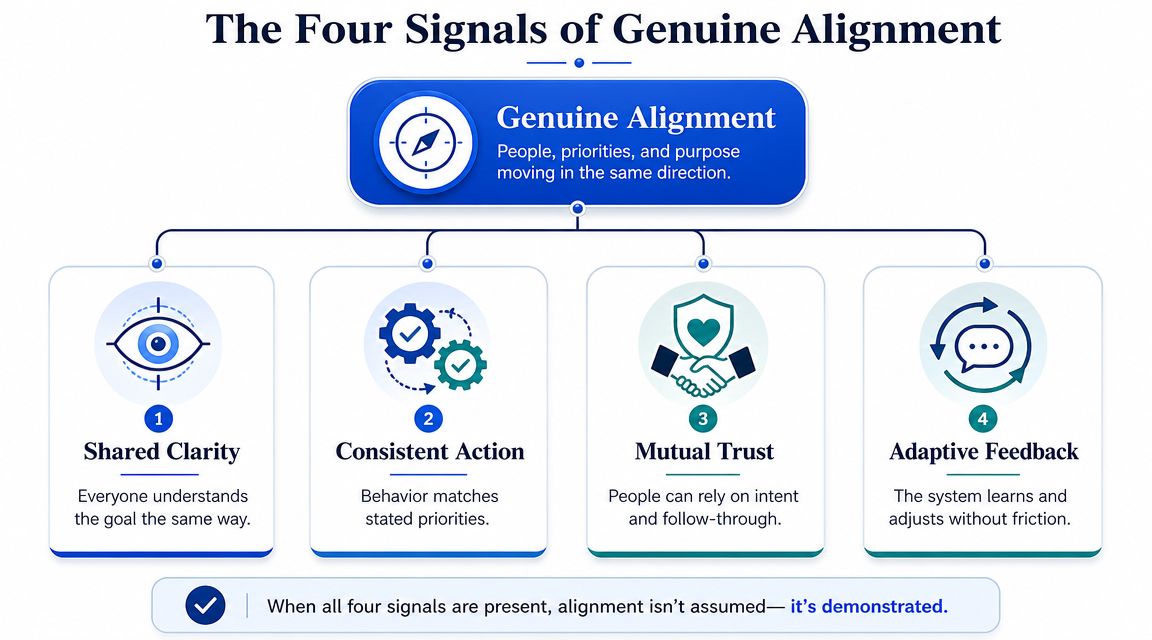
One number beats two dashboards
The first signal is brutal in its simplicity. Both teams own the same pipeline target.
If marketing still reports success with lead volume while sales reports failure on missed quota, you're funding conflict. Shared pipeline responsibility changes the conversation from "how many leads did we generate?" to "which accounts progressed and why?"
A written definition stops the lead-quality war
The second signal is a shared definition of a good opportunity, written down in plain English inside the CRM playbook.
That means firmographic fit, buying context, disqualifiers, route-to-owner rules, and required fields. If sales can reject a lead without selecting a reason, or marketing can send one without meeting the criteria, the argument will keep coming back.
A good starting point is to jointly develop data-driven customer personas so the ICP isn't just a slide in a kickoff deck. It has to survive real calls, real objections, and real deal reviews.
One market message, not channel-specific improvisation
The third signal is message consistency. Your LinkedIn posts, outbound emails, landing pages, and discovery calls should sound like one company.
When they don't, buyers feel the disconnect before your teams do. Marketing talks category story, sales pitches features, SDRs use pain points from six months ago, and nobody understands why meetings stall.
If you're serious about measuring this, track influenced pipeline, not just sourced leads. That's where message consistency starts to show up in actual revenue movement.
Fast feedback is the real operating test
The fourth signal is speed. Feedback should move in days, not quarters.
In 2025 handoff research, only 11% of companies achieved an effective handoff where sales contacted at least 35% of high-intent marketing prospects, and in those aligned companies, marketing involvement boosted pipeline conversion by 65% versus cold outreach. That tells you where the money is. Not in the handoff document itself, but in what happens immediately after intent appears.
The fastest signal loop wins. Sales reports which angle is landing. Marketing shifts content and targeting the same week. Reps get warmer accounts before the cold sequence starts.
If your feedback loop needs a quarterly business review to function, it's already too slow.
The unified pipeline playbook a 5-part framework
Sales and marketing are usually not misaligned because they dislike each other. They are misaligned because one team gets rewarded for volume and the other gets punished for bad volume. Change the incentive system first, then the behavior follows.
A working model starts with one revenue target both teams can influence and neither team can hide from. Use qualified pipeline creation and movement as the shared outcome. Keep the same ICP definition, the same scoring rules, and one CRM process. The shared revenue operating model guidance gives a solid benchmark. Here is the five-part system that forces alignment.
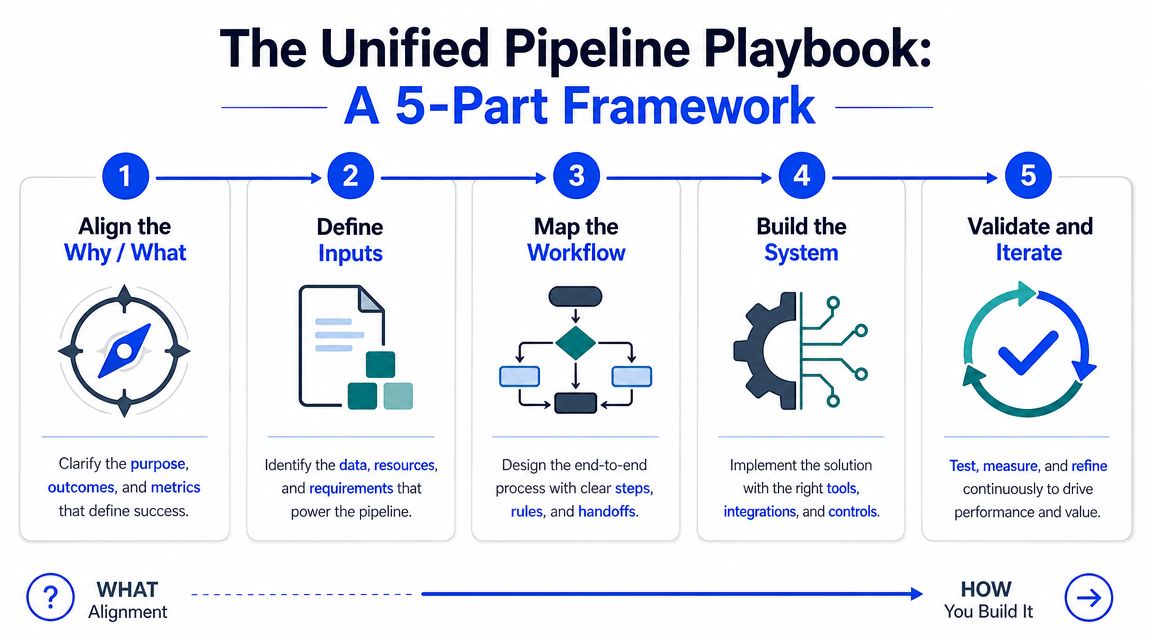
1. Set the single metric mandate
Make one executive call. Marketing is no longer judged by lead count. Sales is no longer allowed to dismiss marketing performance with anecdotes. Both teams own pipeline that reaches qualified stage and keeps moving.
Use four shared measures:
Primary metric: Qualified pipeline created and influenced
Speed metric: Sales cycle length on influenced opportunities
Quality metric: Conversion from first meeting to qualified opportunity
Accountability view: Opportunity outcomes by source, segment, and message angle
If those four numbers are not visible in one dashboard, your reporting setup is broken.
2. Build the shared message map
Revenue teams lose deals when each function tells a different story. Fix it with one message map that governs content, outbound, discovery, and follow-up.
Keep it in a live doc with these fields:
Top buyer pains
Proof points
Objections
Trigger events
Persona-specific language
Approved CTA by funnel stage
For teams that need a practical reference on cross-channel consistency, understanding IMC strategies helps clarify how one message framework stays consistent across touchpoints.
Then put that map into daily execution. Marketing publishes angle-based content. SDRs mirror those angles in Apollo, Lemlist, Instantly, or HeyReach. AEs use the same pains, proof, and objections in live calls. One message system. Multiple channels.
3. Install the weekly operating cadence
Do not start with more meetings. Start with one meeting tied to the shared metric.
Run a weekly 30-minute revenue sync with the same agenda every time:
What moved: New qualified opportunities, stalled deals, closed outcomes
What landed: Message angles, objections, persona responses
What heated up: Accounts showing engagement or repeat activity
What ships next: Next week's campaigns, outbound themes, follow-up plays
Bring records, not opinions. If sales says a segment is weak, show conversion by segment. If marketing says an angle is working, show pipeline created from that angle. The CRM decides, not the loudest person in the room.
A cleaner stage design makes this meeting far more useful. This guide to sales pipeline management is a practical reference for structuring stages and reviews.
Here's a useful walkthrough on the mechanics of alignment in the field:
4. Write the rules of engagement
Organizations often avoid this step because it removes ambiguity. That is exactly why you need it.
Your SLA should define:
Qualification criteria: What must be true before routing
Routing logic: Who gets the account, by territory, segment, or owner
Response timing: How quickly reps must act on active accounts
Disposition rules: Why leads are accepted, recycled, or rejected
Required CRM fields: What must be logged before stage movement
Stop calling it a handoff. There is no handoff in a serious revenue team. Marketing does not finish when a lead appears, and sales does not begin from zero. Both teams own opportunity quality and movement.
5. Create one visible system of record
Use one CRM, one pipeline view, and one reporting layer. HubSpot works well for many mid-market teams because sales and marketing can work inside the same object model. Salesforce works too if RevOps keeps the data model clean and the stage definitions tight.
Connect the rest of the stack around that core:
System | Job in the workflow | Typical tools |
|---|---|---|
CRM | Source of truth for pipeline and stages | HubSpot, Salesforce |
Data and prospecting | Build and enrich ICP account lists | Apollo, Clay, Sales Navigator |
Outbound execution | Run coordinated sequences | Lemlist, Instantly, HeyReach |
Fast feedback | Share objections and hot-account alerts | Slack |
Call insight | Capture buyer language and objections | Gong, Chorus, call recordings |
Transparency comes from system design. If marketing has to ask sales what happened to an account, or sales has to ask marketing whether an account is warm, your operating model still rewards silo behavior.
The alignment scorecard how to measure what matters
Alignment is often measured by activity. Meetings held. Leads passed. Content published. None of that tells you whether the buyer is moving faster or cleaner.
What matters is whether marketing changes pipeline quality and speed. That's the scorecard.
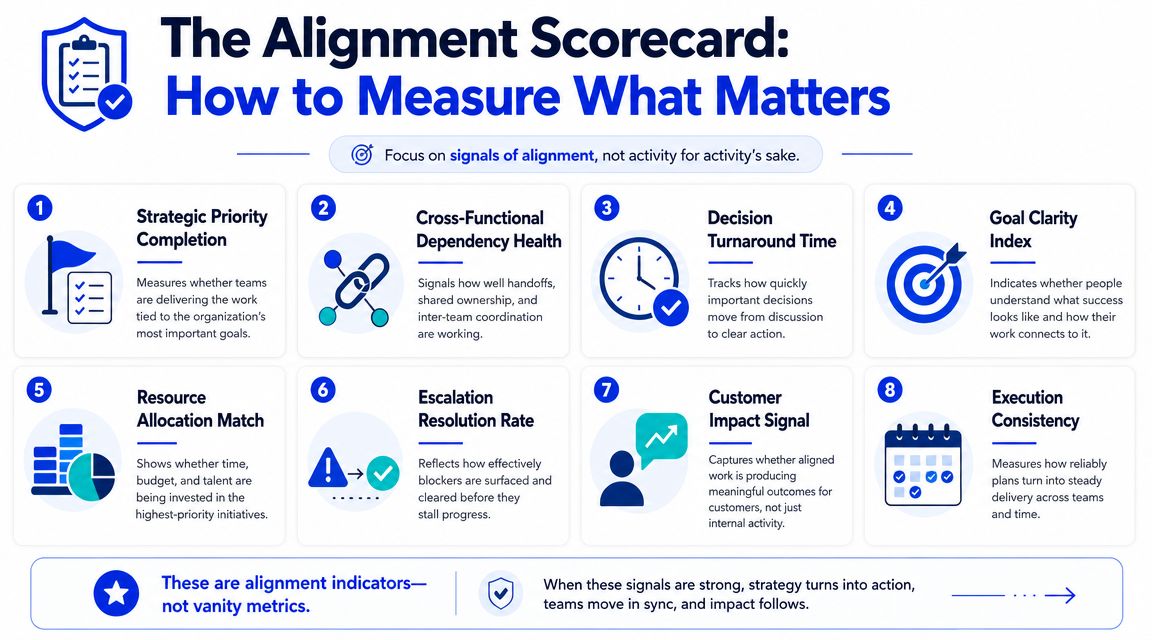
What to track every week
Keep the scorecard tight. Founders don't need a marketing museum.
Track these:
Lead-to-qualified-meeting conversion: Does the front end produce real sales conversations
Qualified opportunity creation: Are accepted meetings turning into pipeline
Sales cycle length on influenced deals: Are warmer buyers moving faster
Pipeline velocity: Is revenue moving through stages with less drag
Sourced versus influenced contribution: Did marketing start the deal, support it, or neither
Rejection reasons: Why did sales push back, in structured categories
For KPI discipline, this reference on lead generation KPIs is useful because it helps strip out vanity metrics that don't survive revenue review.
What proves the system is working
The strongest proof is cycle compression on influenced opportunities. Buyers are doing a large share of their research before they speak to vendors, which weakens the old MQL-to-SQL model and makes behavior-based signals more useful than simple lead-score handoffs, as described in this buyer behavior and influence analysis.
That means your scorecard should answer a hard question. Do accounts that saw content, engaged on LinkedIn, clicked outbound, or revisited the site move better than pure cold accounts?
If yes, the system is working. If no, your teams may be aligned on paper and separate in practice.
Look for movement, not noise. The point of sales and marketing alignment is not cleaner reporting. It's faster, better pipeline from the same target market.
Also, don't obsess over sourced revenue as the only proof. In complex B2B deals, influence matters. A strong content touch before outreach, or engagement that guides rep timing, often changes the outcome even when marketing wasn't first in.
Alignment in practice industry-specific examples
The mechanics stay the same across sectors. The trigger signals, content format, and routing rules do not.
What usually breaks sales and marketing alignment in the field is poor visibility. The biggest gap is often missing data across the buying cycle, and the practical fix is integrating CRM and marketing automation into a single source of truth so both teams can prioritize engaged accounts and diagnose bottlenecks, as explained in this single-source alignment overview.
SaaS
A SaaS team selling into mid-market accounts usually wastes time by treating content and outbound as separate motions.
The cleaner setup is this. Marketing publishes point-of-view LinkedIn content tied to a narrow pain. Sales watches for engagement from target accounts, then starts outreach with that same angle instead of a generic sequence. The rep isn't calling cold. They're calling into context.
In practical terms, your SDR might work from Apollo and Sales Navigator while marketing tracks account engagement in HubSpot. The rule is simple. If an ICP account shows repeated engagement, sales gets the signal and uses the same talk track the buyer already saw.
iGaming
iGaming teams often create a message split between events and digital follow-up. The booth story sounds one way. The email nurture sounds another. Sales then improvises a third version on the call.
Fix it by building one event-centered message map before the show. Sales uses it on the floor. Marketing uses it in follow-up email, paid retargeting, and LinkedIn posts. Reps prioritize accounts that interacted, not everybody who scanned a badge.
If you're looking at examples of how pipeline programs get structured across sectors, our B2B case studies show the kind of operational setups that matter more than channel count.
Manufacturing
Manufacturing sales cycles often involve technical evaluators, commercial stakeholders, and long consideration windows. If marketing is only producing top-of-funnel assets, sales gets stranded in the middle.
Here, alignment means building content sales can use in active deals. Technical one-pagers, process explainers, comparison sheets, and buyer-specific proof points need to sit inside the same system the rep uses. Marketing should hear objections from calls, then update assets fast enough to help the next conversation, not the next quarter.
Professional services
Legal tech, advisory, and specialist professional services usually win on trust and credibility, not raw volume.
That changes the rhythm. Marketing's job is to create authority signals sales can point to in outreach, webinars, expert commentary, founder posts, market notes. Sales then uses those assets to open warmer conversations with senior buyers who don't want a generic pitch.
The shared rule across all four industries is the same. Sales and marketing alignment works when both teams interpret buyer signals the same way and act on them through one system.
Your first 90 days an implementation plan
Don't roll this out as a transformation program. Run it like an operating reset over one quarter.
The point of the first 90 days isn't perfection. It's to replace separate team logic with one revenue motion, then tighten it with real data.
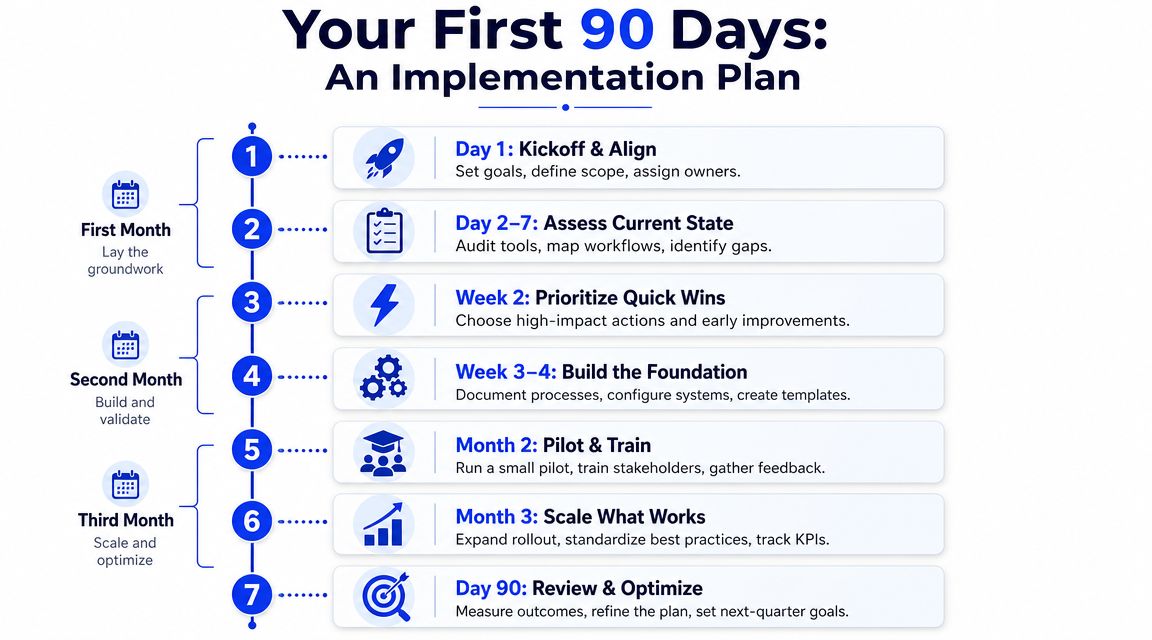
Days 1 to 30
Start with leadership, not tooling.
Set the shared number: Move both teams onto one pipeline target.
Write the qualification draft: Define fit, trigger, disqualifier, and routing rules in plain language.
Audit the stack: Confirm where pipeline lives, where engagement data lives, and where the gaps are.
Create one dashboard: Sales and marketing look at the same pipeline view every week.
Open the fast channel: Set up the shared Slack channel for objections, hot accounts, and message feedback.
This is also the right time to clean up your qualification flow. If your routing rules are fuzzy, use this guide to lead qualification process as a working reference.
Days 31 to 60
Now put the system under pressure.
Launch the weekly sync: Same agenda, same owner, same CRM view every week.
Build the v1 message map: Three pains, three proofs, top objections, and CTA rules by stage.
Run coordinated outreach: Marketing content and sales sequences should use the same core language.
Start call listening: Marketing listens to recorded sales calls every week and edits the message map.
Route warm signals fast: When target accounts engage, reps act before default cold outreach kicks in.
If your team is building organic demand alongside outbound, this guide on how to build your startup's social media engine is a useful companion because it connects content consistency with actual pipeline support.
You don't need more campaigns in month two. You need tighter signal routing and cleaner language.
Days 61 to 90
At this juncture, teams either get serious or drift back to old habits.
Review the first two months of evidence together. Which accounts progressed. Which messages converted to real meetings. Which objections kept showing up. Where sales ignored valid signals. Where marketing pushed weak ones.
Then make the next set of edits:
Tighten the SLA: Remove loopholes and vague criteria
Refine the ICP: Keep what converts, cut what only engages
Update the message map: Replace internal language with buyer language from calls
Adjust the routing: Shorten response gaps around warm activity
Reset ownership if needed: If one team can still win while pipeline loses, the model isn't fixed
At day 90, you should be able to answer three questions without debate.
Are we creating better qualified pipeline?
Are influenced opportunities moving faster than cold ones?
Can both teams see the same truth in the CRM?
If the answer is no to any of the three, don't add another meeting. Fix the system.
If you want help putting this into practice, Grou builds B2B pipeline systems that connect LinkedIn content, outbound, qualification, and reporting into one operating model. The next step is simple. Audit your current setup against the four signals above, then rebuild the metric, SLA, and signal-routing layer first.
Your sales and marketing teams probably don't need another alignment workshop. They need a shared incentive structure.
Most advice on sales and marketing alignment is soft. More meetings. Better communication. A nicer handoff document. None of that fixes the core problem if marketing is paid in MQLs and sales is paid in closed revenue. That setup guarantees conflict, because each team can hit its goal while the company misses its number.
The fix is operational. Put both teams on the same pipeline target. Define qualification in writing. Force one message across LinkedIn, outbound, and sales calls. Build a reporting system both teams can see without asking.
Table of Contents
Why most sales and marketing alignment advice is wrong
The popular advice says your teams are fighting because they don't communicate well. That's backwards. They don't communicate well because the business gave them conflicting goals.
If marketing gets rewarded for lead volume and sales gets rewarded for closed revenue, you've created two separate businesses. Marketing pushes quantity. Sales filters aggressively. Then leadership calls the tension an alignment issue, when it's really a compensation and measurement issue.
The reason this matters isn't cultural fluff. Organizations with alignment grow about 20% annually, while poorly aligned companies see a 4% revenue decline, and aligned organizations also show 24% faster three-year revenue growth and 27% faster three-year profit growth, according to sales and marketing alignment benchmarks compiled here. That's an operating advantage, not a vibes advantage.
The real problem is structural
Most founders try to patch this with tactics.
They add meetings: Sales complains in real time instead of monthly.
They add dashboards: Each team gets cleaner evidence that the other one is the problem.
They add process: The handoff form gets longer, but the buyer experience stays broken.
None of those fixes the fact that each team is still optimizing for a different win condition. If you want the blame game to stop, stop paying for blame-friendly behavior.
Practical rule: If marketing can declare victory before revenue is visible in pipeline, you don't have sales and marketing alignment. You have departmental self-protection.
This is why lead quality debates drag on forever. Sales is often reacting to conversion pain. Marketing is reacting to target pressure. Both are rational inside the system you've built.
A lot of what founders label as a top-of-funnel problem is in fact a middle-of-funnel design problem. If that's showing up in your business, read why your leads aren't converting and how to fix it. The issue usually isn't volume. It's what happens after attention shows up.
What actually changes behavior
Change one thing first. Give sales and marketing one shared pipeline number.
Not MQLs for one team and bookings for the other. One pipeline target. One definition of qualified opportunity. One review cadence tied to opportunity movement, not activity volume.
Once both teams are measured on the same outcome, the rest gets easier. The messaging discussion gets sharper. Follow-up gets faster. Qualification gets stricter. Complaints get replaced by edits.
The four signals of genuine alignment
Most companies confuse politeness with alignment. The teams get along in meetings, but the buyer still sees mixed messages and the CRM still shows dropped opportunities.
Real sales and marketing alignment is visible in four places. If one is missing, the system isn't aligned yet.
One number beats two dashboards
The first signal is brutal in its simplicity. Both teams own the same pipeline target.
If marketing still reports success with lead volume while sales reports failure on missed quota, you're funding conflict. Shared pipeline responsibility changes the conversation from "how many leads did we generate?" to "which accounts progressed and why?"
A written definition stops the lead-quality war
The second signal is a shared definition of a good opportunity, written down in plain English inside the CRM playbook.
That means firmographic fit, buying context, disqualifiers, route-to-owner rules, and required fields. If sales can reject a lead without selecting a reason, or marketing can send one without meeting the criteria, the argument will keep coming back.
A good starting point is to jointly develop data-driven customer personas so the ICP isn't just a slide in a kickoff deck. It has to survive real calls, real objections, and real deal reviews.
One market message, not channel-specific improvisation
The third signal is message consistency. Your LinkedIn posts, outbound emails, landing pages, and discovery calls should sound like one company.
When they don't, buyers feel the disconnect before your teams do. Marketing talks category story, sales pitches features, SDRs use pain points from six months ago, and nobody understands why meetings stall.
If you're serious about measuring this, track influenced pipeline, not just sourced leads. That's where message consistency starts to show up in actual revenue movement.
Fast feedback is the real operating test
The fourth signal is speed. Feedback should move in days, not quarters.
In 2025 handoff research, only 11% of companies achieved an effective handoff where sales contacted at least 35% of high-intent marketing prospects, and in those aligned companies, marketing involvement boosted pipeline conversion by 65% versus cold outreach. That tells you where the money is. Not in the handoff document itself, but in what happens immediately after intent appears.
The fastest signal loop wins. Sales reports which angle is landing. Marketing shifts content and targeting the same week. Reps get warmer accounts before the cold sequence starts.
If your feedback loop needs a quarterly business review to function, it's already too slow.
The unified pipeline playbook a 5-part framework
Sales and marketing are usually not misaligned because they dislike each other. They are misaligned because one team gets rewarded for volume and the other gets punished for bad volume. Change the incentive system first, then the behavior follows.
A working model starts with one revenue target both teams can influence and neither team can hide from. Use qualified pipeline creation and movement as the shared outcome. Keep the same ICP definition, the same scoring rules, and one CRM process. The shared revenue operating model guidance gives a solid benchmark. Here is the five-part system that forces alignment.
1. Set the single metric mandate
Make one executive call. Marketing is no longer judged by lead count. Sales is no longer allowed to dismiss marketing performance with anecdotes. Both teams own pipeline that reaches qualified stage and keeps moving.
Use four shared measures:
Primary metric: Qualified pipeline created and influenced
Speed metric: Sales cycle length on influenced opportunities
Quality metric: Conversion from first meeting to qualified opportunity
Accountability view: Opportunity outcomes by source, segment, and message angle
If those four numbers are not visible in one dashboard, your reporting setup is broken.
2. Build the shared message map
Revenue teams lose deals when each function tells a different story. Fix it with one message map that governs content, outbound, discovery, and follow-up.
Keep it in a live doc with these fields:
Top buyer pains
Proof points
Objections
Trigger events
Persona-specific language
Approved CTA by funnel stage
For teams that need a practical reference on cross-channel consistency, understanding IMC strategies helps clarify how one message framework stays consistent across touchpoints.
Then put that map into daily execution. Marketing publishes angle-based content. SDRs mirror those angles in Apollo, Lemlist, Instantly, or HeyReach. AEs use the same pains, proof, and objections in live calls. One message system. Multiple channels.
3. Install the weekly operating cadence
Do not start with more meetings. Start with one meeting tied to the shared metric.
Run a weekly 30-minute revenue sync with the same agenda every time:
What moved: New qualified opportunities, stalled deals, closed outcomes
What landed: Message angles, objections, persona responses
What heated up: Accounts showing engagement or repeat activity
What ships next: Next week's campaigns, outbound themes, follow-up plays
Bring records, not opinions. If sales says a segment is weak, show conversion by segment. If marketing says an angle is working, show pipeline created from that angle. The CRM decides, not the loudest person in the room.
A cleaner stage design makes this meeting far more useful. This guide to sales pipeline management is a practical reference for structuring stages and reviews.
Here's a useful walkthrough on the mechanics of alignment in the field:
4. Write the rules of engagement
Organizations often avoid this step because it removes ambiguity. That is exactly why you need it.
Your SLA should define:
Qualification criteria: What must be true before routing
Routing logic: Who gets the account, by territory, segment, or owner
Response timing: How quickly reps must act on active accounts
Disposition rules: Why leads are accepted, recycled, or rejected
Required CRM fields: What must be logged before stage movement
Stop calling it a handoff. There is no handoff in a serious revenue team. Marketing does not finish when a lead appears, and sales does not begin from zero. Both teams own opportunity quality and movement.
5. Create one visible system of record
Use one CRM, one pipeline view, and one reporting layer. HubSpot works well for many mid-market teams because sales and marketing can work inside the same object model. Salesforce works too if RevOps keeps the data model clean and the stage definitions tight.
Connect the rest of the stack around that core:
System | Job in the workflow | Typical tools |
|---|---|---|
CRM | Source of truth for pipeline and stages | HubSpot, Salesforce |
Data and prospecting | Build and enrich ICP account lists | Apollo, Clay, Sales Navigator |
Outbound execution | Run coordinated sequences | Lemlist, Instantly, HeyReach |
Fast feedback | Share objections and hot-account alerts | Slack |
Call insight | Capture buyer language and objections | Gong, Chorus, call recordings |
Transparency comes from system design. If marketing has to ask sales what happened to an account, or sales has to ask marketing whether an account is warm, your operating model still rewards silo behavior.
The alignment scorecard how to measure what matters
Alignment is often measured by activity. Meetings held. Leads passed. Content published. None of that tells you whether the buyer is moving faster or cleaner.
What matters is whether marketing changes pipeline quality and speed. That's the scorecard.
What to track every week
Keep the scorecard tight. Founders don't need a marketing museum.
Track these:
Lead-to-qualified-meeting conversion: Does the front end produce real sales conversations
Qualified opportunity creation: Are accepted meetings turning into pipeline
Sales cycle length on influenced deals: Are warmer buyers moving faster
Pipeline velocity: Is revenue moving through stages with less drag
Sourced versus influenced contribution: Did marketing start the deal, support it, or neither
Rejection reasons: Why did sales push back, in structured categories
For KPI discipline, this reference on lead generation KPIs is useful because it helps strip out vanity metrics that don't survive revenue review.
What proves the system is working
The strongest proof is cycle compression on influenced opportunities. Buyers are doing a large share of their research before they speak to vendors, which weakens the old MQL-to-SQL model and makes behavior-based signals more useful than simple lead-score handoffs, as described in this buyer behavior and influence analysis.
That means your scorecard should answer a hard question. Do accounts that saw content, engaged on LinkedIn, clicked outbound, or revisited the site move better than pure cold accounts?
If yes, the system is working. If no, your teams may be aligned on paper and separate in practice.
Look for movement, not noise. The point of sales and marketing alignment is not cleaner reporting. It's faster, better pipeline from the same target market.
Also, don't obsess over sourced revenue as the only proof. In complex B2B deals, influence matters. A strong content touch before outreach, or engagement that guides rep timing, often changes the outcome even when marketing wasn't first in.
Alignment in practice industry-specific examples
The mechanics stay the same across sectors. The trigger signals, content format, and routing rules do not.
What usually breaks sales and marketing alignment in the field is poor visibility. The biggest gap is often missing data across the buying cycle, and the practical fix is integrating CRM and marketing automation into a single source of truth so both teams can prioritize engaged accounts and diagnose bottlenecks, as explained in this single-source alignment overview.
SaaS
A SaaS team selling into mid-market accounts usually wastes time by treating content and outbound as separate motions.
The cleaner setup is this. Marketing publishes point-of-view LinkedIn content tied to a narrow pain. Sales watches for engagement from target accounts, then starts outreach with that same angle instead of a generic sequence. The rep isn't calling cold. They're calling into context.
In practical terms, your SDR might work from Apollo and Sales Navigator while marketing tracks account engagement in HubSpot. The rule is simple. If an ICP account shows repeated engagement, sales gets the signal and uses the same talk track the buyer already saw.
iGaming
iGaming teams often create a message split between events and digital follow-up. The booth story sounds one way. The email nurture sounds another. Sales then improvises a third version on the call.
Fix it by building one event-centered message map before the show. Sales uses it on the floor. Marketing uses it in follow-up email, paid retargeting, and LinkedIn posts. Reps prioritize accounts that interacted, not everybody who scanned a badge.
If you're looking at examples of how pipeline programs get structured across sectors, our B2B case studies show the kind of operational setups that matter more than channel count.
Manufacturing
Manufacturing sales cycles often involve technical evaluators, commercial stakeholders, and long consideration windows. If marketing is only producing top-of-funnel assets, sales gets stranded in the middle.
Here, alignment means building content sales can use in active deals. Technical one-pagers, process explainers, comparison sheets, and buyer-specific proof points need to sit inside the same system the rep uses. Marketing should hear objections from calls, then update assets fast enough to help the next conversation, not the next quarter.
Professional services
Legal tech, advisory, and specialist professional services usually win on trust and credibility, not raw volume.
That changes the rhythm. Marketing's job is to create authority signals sales can point to in outreach, webinars, expert commentary, founder posts, market notes. Sales then uses those assets to open warmer conversations with senior buyers who don't want a generic pitch.
The shared rule across all four industries is the same. Sales and marketing alignment works when both teams interpret buyer signals the same way and act on them through one system.
Your first 90 days an implementation plan
Don't roll this out as a transformation program. Run it like an operating reset over one quarter.
The point of the first 90 days isn't perfection. It's to replace separate team logic with one revenue motion, then tighten it with real data.
Days 1 to 30
Start with leadership, not tooling.
Set the shared number: Move both teams onto one pipeline target.
Write the qualification draft: Define fit, trigger, disqualifier, and routing rules in plain language.
Audit the stack: Confirm where pipeline lives, where engagement data lives, and where the gaps are.
Create one dashboard: Sales and marketing look at the same pipeline view every week.
Open the fast channel: Set up the shared Slack channel for objections, hot accounts, and message feedback.
This is also the right time to clean up your qualification flow. If your routing rules are fuzzy, use this guide to lead qualification process as a working reference.
Days 31 to 60
Now put the system under pressure.
Launch the weekly sync: Same agenda, same owner, same CRM view every week.
Build the v1 message map: Three pains, three proofs, top objections, and CTA rules by stage.
Run coordinated outreach: Marketing content and sales sequences should use the same core language.
Start call listening: Marketing listens to recorded sales calls every week and edits the message map.
Route warm signals fast: When target accounts engage, reps act before default cold outreach kicks in.
If your team is building organic demand alongside outbound, this guide on how to build your startup's social media engine is a useful companion because it connects content consistency with actual pipeline support.
You don't need more campaigns in month two. You need tighter signal routing and cleaner language.
Days 61 to 90
At this juncture, teams either get serious or drift back to old habits.
Review the first two months of evidence together. Which accounts progressed. Which messages converted to real meetings. Which objections kept showing up. Where sales ignored valid signals. Where marketing pushed weak ones.
Then make the next set of edits:
Tighten the SLA: Remove loopholes and vague criteria
Refine the ICP: Keep what converts, cut what only engages
Update the message map: Replace internal language with buyer language from calls
Adjust the routing: Shorten response gaps around warm activity
Reset ownership if needed: If one team can still win while pipeline loses, the model isn't fixed
At day 90, you should be able to answer three questions without debate.
Are we creating better qualified pipeline?
Are influenced opportunities moving faster than cold ones?
Can both teams see the same truth in the CRM?
If the answer is no to any of the three, don't add another meeting. Fix the system.
If you want help putting this into practice, Grou builds B2B pipeline systems that connect LinkedIn content, outbound, qualification, and reporting into one operating model. The next step is simple. Audit your current setup against the four signals above, then rebuild the metric, SLA, and signal-routing layer first.
Your sales and marketing teams probably don't need another alignment workshop. They need a shared incentive structure.
Most advice on sales and marketing alignment is soft. More meetings. Better communication. A nicer handoff document. None of that fixes the core problem if marketing is paid in MQLs and sales is paid in closed revenue. That setup guarantees conflict, because each team can hit its goal while the company misses its number.
The fix is operational. Put both teams on the same pipeline target. Define qualification in writing. Force one message across LinkedIn, outbound, and sales calls. Build a reporting system both teams can see without asking.
Table of Contents
Why most sales and marketing alignment advice is wrong
The popular advice says your teams are fighting because they don't communicate well. That's backwards. They don't communicate well because the business gave them conflicting goals.
If marketing gets rewarded for lead volume and sales gets rewarded for closed revenue, you've created two separate businesses. Marketing pushes quantity. Sales filters aggressively. Then leadership calls the tension an alignment issue, when it's really a compensation and measurement issue.
The reason this matters isn't cultural fluff. Organizations with alignment grow about 20% annually, while poorly aligned companies see a 4% revenue decline, and aligned organizations also show 24% faster three-year revenue growth and 27% faster three-year profit growth, according to sales and marketing alignment benchmarks compiled here. That's an operating advantage, not a vibes advantage.
The real problem is structural
Most founders try to patch this with tactics.
They add meetings: Sales complains in real time instead of monthly.
They add dashboards: Each team gets cleaner evidence that the other one is the problem.
They add process: The handoff form gets longer, but the buyer experience stays broken.
None of those fixes the fact that each team is still optimizing for a different win condition. If you want the blame game to stop, stop paying for blame-friendly behavior.
Practical rule: If marketing can declare victory before revenue is visible in pipeline, you don't have sales and marketing alignment. You have departmental self-protection.
This is why lead quality debates drag on forever. Sales is often reacting to conversion pain. Marketing is reacting to target pressure. Both are rational inside the system you've built.
A lot of what founders label as a top-of-funnel problem is in fact a middle-of-funnel design problem. If that's showing up in your business, read why your leads aren't converting and how to fix it. The issue usually isn't volume. It's what happens after attention shows up.
What actually changes behavior
Change one thing first. Give sales and marketing one shared pipeline number.
Not MQLs for one team and bookings for the other. One pipeline target. One definition of qualified opportunity. One review cadence tied to opportunity movement, not activity volume.
Once both teams are measured on the same outcome, the rest gets easier. The messaging discussion gets sharper. Follow-up gets faster. Qualification gets stricter. Complaints get replaced by edits.
The four signals of genuine alignment
Most companies confuse politeness with alignment. The teams get along in meetings, but the buyer still sees mixed messages and the CRM still shows dropped opportunities.
Real sales and marketing alignment is visible in four places. If one is missing, the system isn't aligned yet.
One number beats two dashboards
The first signal is brutal in its simplicity. Both teams own the same pipeline target.
If marketing still reports success with lead volume while sales reports failure on missed quota, you're funding conflict. Shared pipeline responsibility changes the conversation from "how many leads did we generate?" to "which accounts progressed and why?"
A written definition stops the lead-quality war
The second signal is a shared definition of a good opportunity, written down in plain English inside the CRM playbook.
That means firmographic fit, buying context, disqualifiers, route-to-owner rules, and required fields. If sales can reject a lead without selecting a reason, or marketing can send one without meeting the criteria, the argument will keep coming back.
A good starting point is to jointly develop data-driven customer personas so the ICP isn't just a slide in a kickoff deck. It has to survive real calls, real objections, and real deal reviews.
One market message, not channel-specific improvisation
The third signal is message consistency. Your LinkedIn posts, outbound emails, landing pages, and discovery calls should sound like one company.
When they don't, buyers feel the disconnect before your teams do. Marketing talks category story, sales pitches features, SDRs use pain points from six months ago, and nobody understands why meetings stall.
If you're serious about measuring this, track influenced pipeline, not just sourced leads. That's where message consistency starts to show up in actual revenue movement.
Fast feedback is the real operating test
The fourth signal is speed. Feedback should move in days, not quarters.
In 2025 handoff research, only 11% of companies achieved an effective handoff where sales contacted at least 35% of high-intent marketing prospects, and in those aligned companies, marketing involvement boosted pipeline conversion by 65% versus cold outreach. That tells you where the money is. Not in the handoff document itself, but in what happens immediately after intent appears.
The fastest signal loop wins. Sales reports which angle is landing. Marketing shifts content and targeting the same week. Reps get warmer accounts before the cold sequence starts.
If your feedback loop needs a quarterly business review to function, it's already too slow.
The unified pipeline playbook a 5-part framework
Sales and marketing are usually not misaligned because they dislike each other. They are misaligned because one team gets rewarded for volume and the other gets punished for bad volume. Change the incentive system first, then the behavior follows.
A working model starts with one revenue target both teams can influence and neither team can hide from. Use qualified pipeline creation and movement as the shared outcome. Keep the same ICP definition, the same scoring rules, and one CRM process. The shared revenue operating model guidance gives a solid benchmark. Here is the five-part system that forces alignment.
1. Set the single metric mandate
Make one executive call. Marketing is no longer judged by lead count. Sales is no longer allowed to dismiss marketing performance with anecdotes. Both teams own pipeline that reaches qualified stage and keeps moving.
Use four shared measures:
Primary metric: Qualified pipeline created and influenced
Speed metric: Sales cycle length on influenced opportunities
Quality metric: Conversion from first meeting to qualified opportunity
Accountability view: Opportunity outcomes by source, segment, and message angle
If those four numbers are not visible in one dashboard, your reporting setup is broken.
2. Build the shared message map
Revenue teams lose deals when each function tells a different story. Fix it with one message map that governs content, outbound, discovery, and follow-up.
Keep it in a live doc with these fields:
Top buyer pains
Proof points
Objections
Trigger events
Persona-specific language
Approved CTA by funnel stage
For teams that need a practical reference on cross-channel consistency, understanding IMC strategies helps clarify how one message framework stays consistent across touchpoints.
Then put that map into daily execution. Marketing publishes angle-based content. SDRs mirror those angles in Apollo, Lemlist, Instantly, or HeyReach. AEs use the same pains, proof, and objections in live calls. One message system. Multiple channels.
3. Install the weekly operating cadence
Do not start with more meetings. Start with one meeting tied to the shared metric.
Run a weekly 30-minute revenue sync with the same agenda every time:
What moved: New qualified opportunities, stalled deals, closed outcomes
What landed: Message angles, objections, persona responses
What heated up: Accounts showing engagement or repeat activity
What ships next: Next week's campaigns, outbound themes, follow-up plays
Bring records, not opinions. If sales says a segment is weak, show conversion by segment. If marketing says an angle is working, show pipeline created from that angle. The CRM decides, not the loudest person in the room.
A cleaner stage design makes this meeting far more useful. This guide to sales pipeline management is a practical reference for structuring stages and reviews.
Here's a useful walkthrough on the mechanics of alignment in the field:
4. Write the rules of engagement
Organizations often avoid this step because it removes ambiguity. That is exactly why you need it.
Your SLA should define:
Qualification criteria: What must be true before routing
Routing logic: Who gets the account, by territory, segment, or owner
Response timing: How quickly reps must act on active accounts
Disposition rules: Why leads are accepted, recycled, or rejected
Required CRM fields: What must be logged before stage movement
Stop calling it a handoff. There is no handoff in a serious revenue team. Marketing does not finish when a lead appears, and sales does not begin from zero. Both teams own opportunity quality and movement.
5. Create one visible system of record
Use one CRM, one pipeline view, and one reporting layer. HubSpot works well for many mid-market teams because sales and marketing can work inside the same object model. Salesforce works too if RevOps keeps the data model clean and the stage definitions tight.
Connect the rest of the stack around that core:
System | Job in the workflow | Typical tools |
|---|---|---|
CRM | Source of truth for pipeline and stages | HubSpot, Salesforce |
Data and prospecting | Build and enrich ICP account lists | Apollo, Clay, Sales Navigator |
Outbound execution | Run coordinated sequences | Lemlist, Instantly, HeyReach |
Fast feedback | Share objections and hot-account alerts | Slack |
Call insight | Capture buyer language and objections | Gong, Chorus, call recordings |
Transparency comes from system design. If marketing has to ask sales what happened to an account, or sales has to ask marketing whether an account is warm, your operating model still rewards silo behavior.
The alignment scorecard how to measure what matters
Alignment is often measured by activity. Meetings held. Leads passed. Content published. None of that tells you whether the buyer is moving faster or cleaner.
What matters is whether marketing changes pipeline quality and speed. That's the scorecard.
What to track every week
Keep the scorecard tight. Founders don't need a marketing museum.
Track these:
Lead-to-qualified-meeting conversion: Does the front end produce real sales conversations
Qualified opportunity creation: Are accepted meetings turning into pipeline
Sales cycle length on influenced deals: Are warmer buyers moving faster
Pipeline velocity: Is revenue moving through stages with less drag
Sourced versus influenced contribution: Did marketing start the deal, support it, or neither
Rejection reasons: Why did sales push back, in structured categories
For KPI discipline, this reference on lead generation KPIs is useful because it helps strip out vanity metrics that don't survive revenue review.
What proves the system is working
The strongest proof is cycle compression on influenced opportunities. Buyers are doing a large share of their research before they speak to vendors, which weakens the old MQL-to-SQL model and makes behavior-based signals more useful than simple lead-score handoffs, as described in this buyer behavior and influence analysis.
That means your scorecard should answer a hard question. Do accounts that saw content, engaged on LinkedIn, clicked outbound, or revisited the site move better than pure cold accounts?
If yes, the system is working. If no, your teams may be aligned on paper and separate in practice.
Look for movement, not noise. The point of sales and marketing alignment is not cleaner reporting. It's faster, better pipeline from the same target market.
Also, don't obsess over sourced revenue as the only proof. In complex B2B deals, influence matters. A strong content touch before outreach, or engagement that guides rep timing, often changes the outcome even when marketing wasn't first in.
Alignment in practice industry-specific examples
The mechanics stay the same across sectors. The trigger signals, content format, and routing rules do not.
What usually breaks sales and marketing alignment in the field is poor visibility. The biggest gap is often missing data across the buying cycle, and the practical fix is integrating CRM and marketing automation into a single source of truth so both teams can prioritize engaged accounts and diagnose bottlenecks, as explained in this single-source alignment overview.
SaaS
A SaaS team selling into mid-market accounts usually wastes time by treating content and outbound as separate motions.
The cleaner setup is this. Marketing publishes point-of-view LinkedIn content tied to a narrow pain. Sales watches for engagement from target accounts, then starts outreach with that same angle instead of a generic sequence. The rep isn't calling cold. They're calling into context.
In practical terms, your SDR might work from Apollo and Sales Navigator while marketing tracks account engagement in HubSpot. The rule is simple. If an ICP account shows repeated engagement, sales gets the signal and uses the same talk track the buyer already saw.
iGaming
iGaming teams often create a message split between events and digital follow-up. The booth story sounds one way. The email nurture sounds another. Sales then improvises a third version on the call.
Fix it by building one event-centered message map before the show. Sales uses it on the floor. Marketing uses it in follow-up email, paid retargeting, and LinkedIn posts. Reps prioritize accounts that interacted, not everybody who scanned a badge.
If you're looking at examples of how pipeline programs get structured across sectors, our B2B case studies show the kind of operational setups that matter more than channel count.
Manufacturing
Manufacturing sales cycles often involve technical evaluators, commercial stakeholders, and long consideration windows. If marketing is only producing top-of-funnel assets, sales gets stranded in the middle.
Here, alignment means building content sales can use in active deals. Technical one-pagers, process explainers, comparison sheets, and buyer-specific proof points need to sit inside the same system the rep uses. Marketing should hear objections from calls, then update assets fast enough to help the next conversation, not the next quarter.
Professional services
Legal tech, advisory, and specialist professional services usually win on trust and credibility, not raw volume.
That changes the rhythm. Marketing's job is to create authority signals sales can point to in outreach, webinars, expert commentary, founder posts, market notes. Sales then uses those assets to open warmer conversations with senior buyers who don't want a generic pitch.
The shared rule across all four industries is the same. Sales and marketing alignment works when both teams interpret buyer signals the same way and act on them through one system.
Your first 90 days an implementation plan
Don't roll this out as a transformation program. Run it like an operating reset over one quarter.
The point of the first 90 days isn't perfection. It's to replace separate team logic with one revenue motion, then tighten it with real data.
Days 1 to 30
Start with leadership, not tooling.
Set the shared number: Move both teams onto one pipeline target.
Write the qualification draft: Define fit, trigger, disqualifier, and routing rules in plain language.
Audit the stack: Confirm where pipeline lives, where engagement data lives, and where the gaps are.
Create one dashboard: Sales and marketing look at the same pipeline view every week.
Open the fast channel: Set up the shared Slack channel for objections, hot accounts, and message feedback.
This is also the right time to clean up your qualification flow. If your routing rules are fuzzy, use this guide to lead qualification process as a working reference.
Days 31 to 60
Now put the system under pressure.
Launch the weekly sync: Same agenda, same owner, same CRM view every week.
Build the v1 message map: Three pains, three proofs, top objections, and CTA rules by stage.
Run coordinated outreach: Marketing content and sales sequences should use the same core language.
Start call listening: Marketing listens to recorded sales calls every week and edits the message map.
Route warm signals fast: When target accounts engage, reps act before default cold outreach kicks in.
If your team is building organic demand alongside outbound, this guide on how to build your startup's social media engine is a useful companion because it connects content consistency with actual pipeline support.
You don't need more campaigns in month two. You need tighter signal routing and cleaner language.
Days 61 to 90
At this juncture, teams either get serious or drift back to old habits.
Review the first two months of evidence together. Which accounts progressed. Which messages converted to real meetings. Which objections kept showing up. Where sales ignored valid signals. Where marketing pushed weak ones.
Then make the next set of edits:
Tighten the SLA: Remove loopholes and vague criteria
Refine the ICP: Keep what converts, cut what only engages
Update the message map: Replace internal language with buyer language from calls
Adjust the routing: Shorten response gaps around warm activity
Reset ownership if needed: If one team can still win while pipeline loses, the model isn't fixed
At day 90, you should be able to answer three questions without debate.
Are we creating better qualified pipeline?
Are influenced opportunities moving faster than cold ones?
Can both teams see the same truth in the CRM?
If the answer is no to any of the three, don't add another meeting. Fix the system.
If you want help putting this into practice, Grou builds B2B pipeline systems that connect LinkedIn content, outbound, qualification, and reporting into one operating model. The next step is simple. Audit your current setup against the four signals above, then rebuild the metric, SLA, and signal-routing layer first.
Pipeline OS Newsletter
Build qualified pipeline
Get weekly tactics to generate demand, improve lead quality, and book more meetings.







Trusted by industry leaders
Trusted by industry leaders
Trusted by industry leaders
Ready to build qualified pipeline?
Ready to build qualified pipeline?
Ready to build qualified pipeline?
Book a call to see if we're the right fit, or take the 2-minute quiz to get a clear starting point.
Book a call to see if we're the right fit, or take the 2-minute quiz to get a clear starting point.
Book a call to see if we're the right fit, or take the 2-minute quiz to get a clear starting point.
" height="30.21639343089746px" id="hfGbXmQR2" width="30.216393430897455px"/></svg>)
Copyright © 2026 – All Right Reserved
Copyright © 2026 – All Right Reserved
Copyright © 2026 – All Right Reserved