%22%3E%3C/path%3E%3Cpath d=%22M 63.072 7.554 C 62.258 8.022 61.577 8.689 61.092 9.493 L 61.092 7.076 L 57.158 7.076 L 57.158 22.64 L 61.089 22.64 L 61.089 14.888 C 61.089 13.446 61.403 12.434 62.03 11.853 C 62.818 11.218 63.818 10.907 64.826 10.982 L 65.868 10.982 L 65.868 6.851 C 64.891 6.834 63.926 7.076 63.073 7.554 Z%22 fill=%22rgb(17,17,17)%22%3E%3C/path%3E%3Cpath d=%22M 78.916 7.82 C 76.363 6.49 73.321 6.49 70.768 7.82 C 69.562 8.473 68.564 9.451 67.888 10.644 C 67.167 11.931 66.803 13.387 66.834 14.862 C 66.804 16.332 67.157 17.785 67.86 19.077 C 68.515 20.267 69.494 21.246 70.684 21.901 C 71.924 22.576 73.318 22.92 74.73 22.898 C 76.164 22.918 77.58 22.575 78.846 21.901 C 80.062 21.247 81.073 20.27 81.768 19.077 C 82.506 17.797 82.88 16.339 82.85 14.862 C 82.88 13.389 82.517 11.934 81.797 10.647 C 81.12 9.455 80.122 8.477 78.917 7.824 M 78.803 14.862 C 78.829 15.739 78.636 16.608 78.241 17.391 C 77.903 18.046 77.38 18.588 76.738 18.95 C 76.124 19.293 75.432 19.472 74.729 19.47 C 73.668 19.497 72.648 19.061 71.934 18.276 C 71.139 17.323 70.741 16.1 70.823 14.862 C 70.741 13.62 71.149 12.395 71.959 11.45 C 72.687 10.667 73.715 10.233 74.783 10.256 C 75.859 10.236 76.894 10.67 77.635 11.45 C 78.464 12.387 78.884 13.616 78.801 14.864%22 fill=%22rgb(17,17,17)%22%3E%3C/path%3E%3Cpath d=%22M 95.906 7.076 L 95.906 15.646 C 95.975 16.68 95.643 17.701 94.979 18.498 C 94.311 19.184 93.379 19.547 92.422 19.495 C 91.475 19.544 90.553 19.18 89.894 18.498 C 89.23 17.701 88.898 16.68 88.967 15.646 L 88.967 7.076 L 85.033 7.076 L 85.033 16.207 C 85 17.449 85.275 18.68 85.834 19.79 C 86.327 20.75 87.095 21.542 88.039 22.065 C 89.033 22.594 90.145 22.861 91.271 22.838 C 92.188 22.847 93.095 22.65 93.926 22.263 C 94.708 21.905 95.388 21.36 95.906 20.675 L 95.906 22.645 L 99.865 22.645 L 99.865 7.076 Z%22 fill=%22rgb(17,17,17)%22%3E%3C/path%3E%3Cpath d=%22M 4.513 15.626 C 4.511 10.815 7.606 6.549 12.181 5.059 C 16.756 3.57 21.77 5.195 24.601 9.086 L 27.816 5.87 C 24.074 1.186 17.981 -0.943 12.137 0.393 C 6.292 1.728 1.728 6.292 0.393 12.137 C -0.943 17.981 1.186 24.074 5.87 27.816 L 9.085 24.601 C 6.214 22.512 4.515 19.177 4.513 15.626%22 fill=%22rgb(32,62,235)%22%3E%3C/path%3E%3Cpath d=%22M 17.114 14.343 L 13.354 18.01 L 13.354 18.026 L 21.071 18.026 L 11.412 27.609 L 17.389 27.609 L 23.999 21.081 L 23.999 28.316 L 24.005 28.316 L 27.967 24.393 L 27.967 14.343 Z%22 fill=%22rgb(32,62,235)%22%3E%3C/path%3E%3C/g%3E%3C/svg%3E) ×
× ××
××›
›
›
›
How to choose a marketing consultancy firm in 2026
How to choose a marketing consultancy firm in 2026
How to choose a marketing consultancy firm in 2026
How to choose a marketing consultancy firm in 2026
How to choose a marketing consultancy firm in 2026
How to choose a marketing consultancy firm in 2026

Author
Aljaz Peklaj

You've already got a pipeline problem if you're shopping for a marketing consultancy firm. The issue usually isn't “we need more activity,” it's that the current system isn't producing enough qualified conversations, and the vendor you hire will either fix that or add noise to it.
Choose a consultancy when you need pipeline system design, attribution, and operating discipline, not just more output.
Choose an agency when the system exists and you need tactical execution at speed.
Keep work in-house when the motion is core to revenue and you can own the process long term.
Judge firms on three things, vertical fit, scope honesty, and measurement discipline.
Use one hard question to separate serious operators from cookie-cutter vendors.
Table of Contents
The GROU model in action a unified AI-powered pipeline case study
Your vendor evaluation checklist and the one question to ask
Marketing consultancy vs agency vs in-house the verdict
Hire a marketing consultancy firm when the pipeline system is broken or absent. Hire an agency when the system is already defined and you need hands to run it. Keep core ownership in-house when the motion is central to your company and the leadership team can manage it.
That's the clean verdict. A consultancy designs the machine, an agency keeps the machine moving, and an internal team owns the machine as part of the business. If you confuse those jobs, you end up paying for execution when what you really needed was diagnosis.
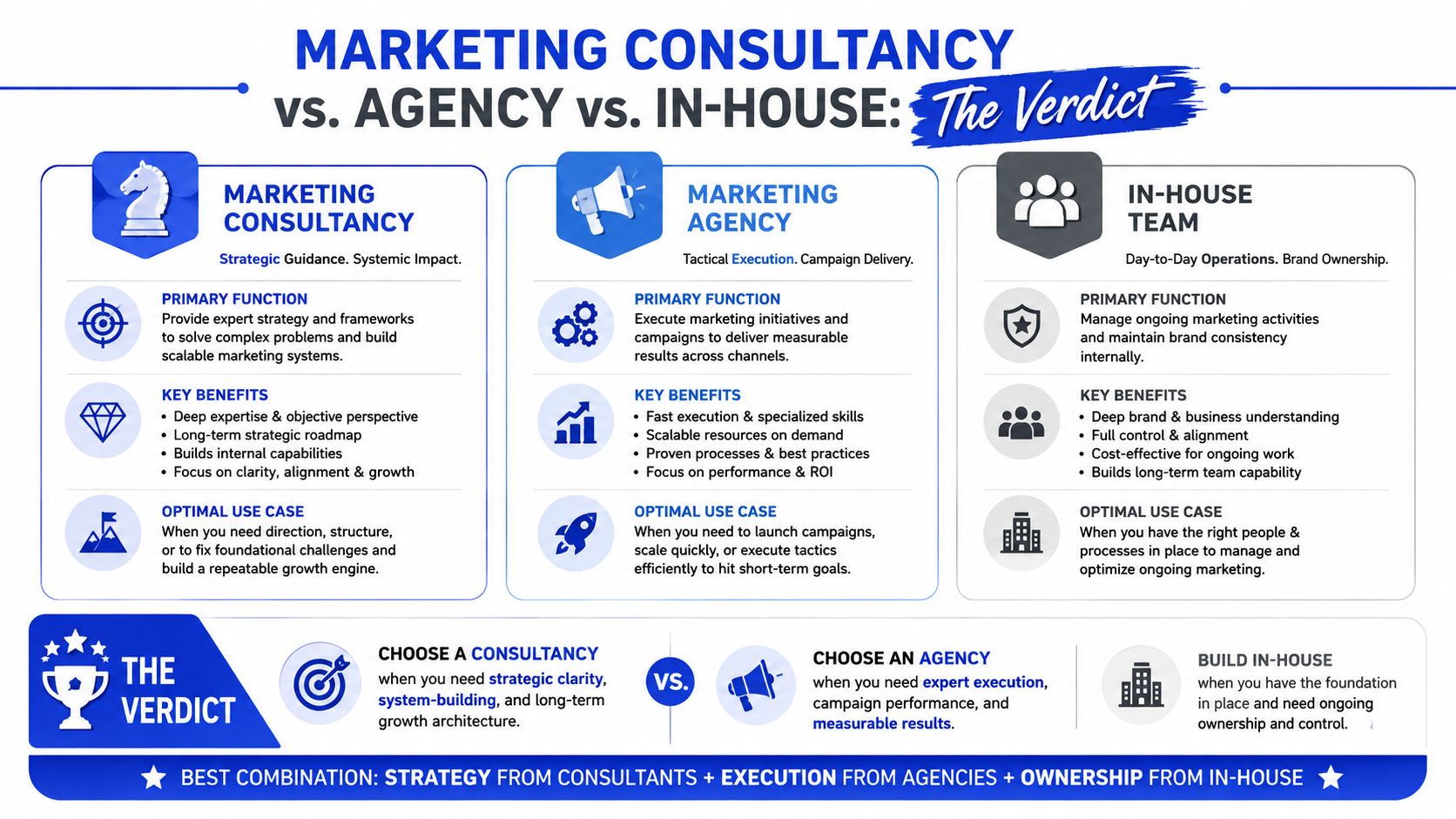
A consultancy is strongest when your problem is structural. That means poor ICP definition, weak routing, broken follow-up, vague attribution, or a content-to-pipeline gap that nobody can explain. In that situation, “more campaigns” is the wrong answer, because the problem is the operating system.
An agency is better when the framework already exists. If your reporting is sound, your target list is clean, and your offer is clear, then tactical execution can matter more than strategic redesign. That's why teams that already know what they want often get more from a specialist execution partner than from a broad advisory shop.
In-house works when the motion is core and repeatable. You need direct control over messaging, timing, and internal coordination, especially if the category is sensitive or the sales cycle is tightly coupled to product and revenue. But in-house teams don't magically create clarity. They inherit whatever system leadership gives them.
For most B2B founders and revenue leaders, the first question isn't “Which vendor is best?” It's “What underlying problem am I solving?” That diagnosis determines whether you need system-building, campaign execution, or internal ownership.
For a separate view on how execution stacks up against service design, see GROU's breakdown of a data-driven digital marketing agency. Ultimately, the decision is whether you need strategy, speed, or stewardship.
The three non-negotiable qualities of a top consultancy
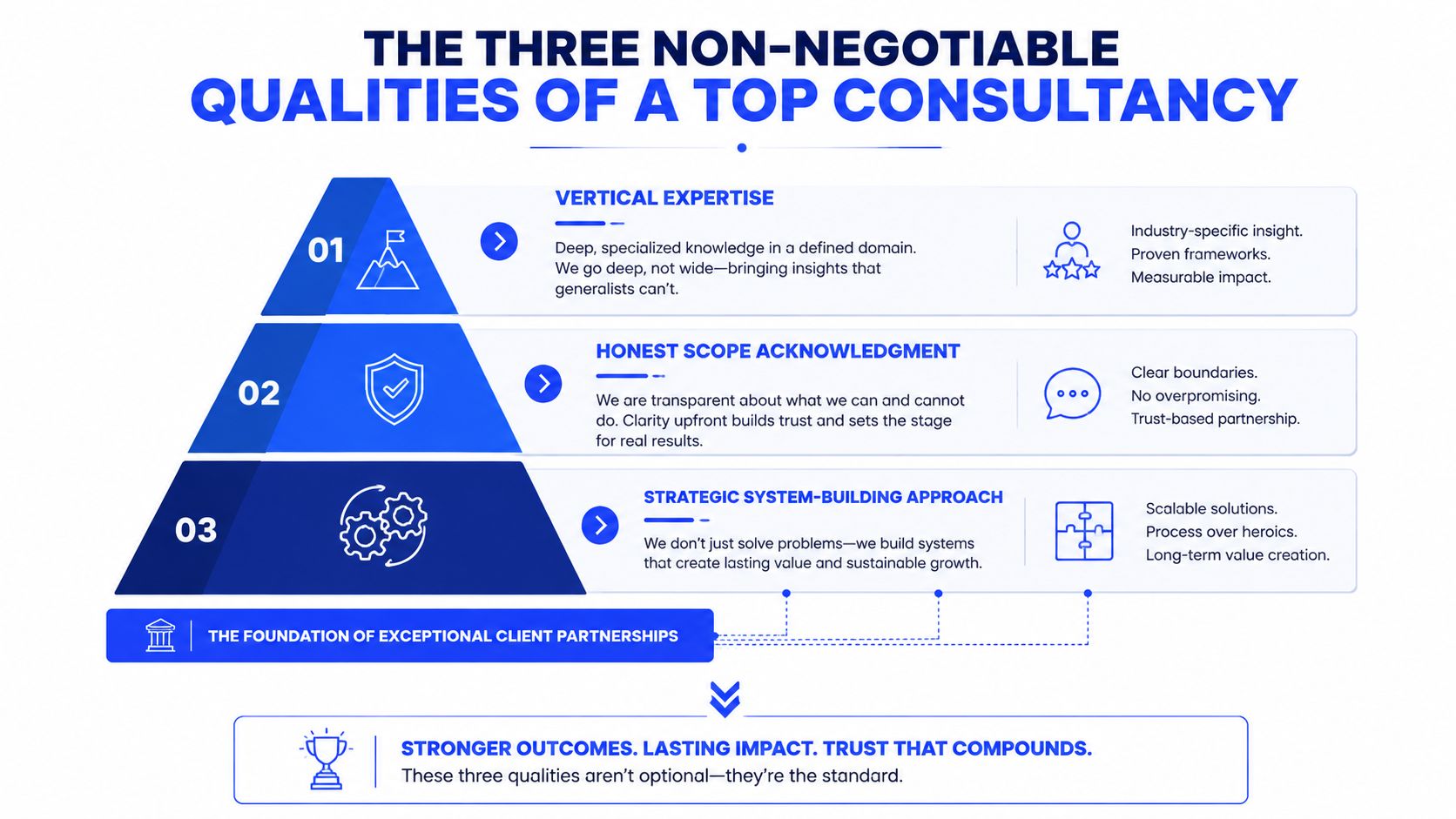
A serious marketing consultancy firm wins on three things, and I'd ignore the rest until these are clean. The three are vertical expertise, honest scope acknowledgment, and measurement discipline. If a firm can't prove all three, it's a risk.
These aren't soft preferences. They're the difference between a partner that fits your market and one that burns months learning it. The global consulting market is large and still growing, with a projected USD 45.52 billion by 2031 from USD 36.65 billion in 2026 (Mordor Intelligence), so buyers have plenty of choice. Plenty of choice also means plenty of weak fit.
Vertical expertise beats generic B2B claims
“B2B experience” is not enough. A firm that knows SaaS demand gen but doesn't understand iGaming timing, legal tech compliance pressure, or manufacturing buyer behavior is not a universal fit. Different verticals move differently, and that changes messaging, list strategy, and conversion logic.
I'd ask for named proof in your exact market, not just adjacent experience. If you're in pharma, SaaS, legal tech, manufacturing, or iGaming, the buyer psychology is different enough that generic templates waste time. Vertical expertise shortens onboarding because the consultancy isn't guessing at the cycle, the stakeholder map, or the risk profile.
Practical rule: if the firm can't explain how your vertical buys, they're not ready to sell into it.
Green flags
Named case studies in your vertical or a close sub-vertical.
Clear language about buyer context, compliance constraints, and sales cycle shape.
Specific examples of what changed in the engagement model because of the market.
Red flags
“We work across all B2B” with no market nuance.
One generic case study format used for every industry.
Positioning that sounds broad but gets vague when you press on details.
Honest scope acknowledgment filters out positioning theater
A focused firm tells you what it does and what it doesn't. That matters because “full-service” often turns into shallow service. If a consultancy claims outbound, SEO, PPC, content, and PR all at the same depth, I assume they're selling breadth because they lack depth.
There's a simple signal here. Firms with 2 to 4 core services are usually clearer about their real strengths. Firms with dozens of service pages often want the sale more than the fit.
The other signal is referral behavior. Good operators know when to say, “That's outside our scope.” That sentence is a green flag, not a weakness.
Green flags
Specific core services with boundaries.
Willingness to refer out for work they don't own.
Scope language that sounds disciplined, not expansive.
Red flags
Full-service marketing as the headline.
50+ service pages that all sound slightly different.
Claims to serve every industry equally well.
Measurement discipline tells you if the work is real
This is the part most buyers underweight. For a marketing consultancy firm, retention and recurring revenue metrics matter, and NetSuite defines retention as [((Total clients at period end - New clients during the period) / Total clients at period start)] × 100 (NetSuite). That framing matters because client continuity and conversion efficiency are operational, not rhetorical.
A mature firm talks about underperformance without dressing it up. It explains attribution, separates vanity metrics from pipeline metrics, and reviews both leading and lagging indicators. If the reporting only looks good, I don't trust it.
Green flags
Underperformance is discussed plainly.
Attribution is explained in writing.
Leading indicators and pipeline outcomes sit in the same report.
Red flags
Only positive metrics appear.
Metric definitions change mid-engagement.
Impressions and opens get treated like revenue signals.
An Emerald study found that 72% of management consulting firms rely primarily on websites and social media, followed by brochures and leaflets at 50% and conference speaking or event participation at 45% (Emerald). That tells you consultancies still lean heavily on owned media and presence. It doesn't tell you they can run your pipeline. Measurement does.
Engagement models decoded which one actually works
Monthly retainer wins. Not because it sounds steady, but because B2B pipeline work compounds, and the relationship has to survive long enough for the system to improve. Project work is too short for that. Pure performance pricing sounds clever, then turns into metric gaming and attribution arguments.
A retainer fits the actual shape of the work. It funds setup, iteration, and cleanup. It also gives both sides enough time to see whether the motion is producing qualified conversations instead of temporary spikes.
Why project work breaks the wrong way
Project-based engagements create completion pressure. The agency wants to finish the deliverable, the client wants the outcome, and those aren't the same thing. You end up with assets, decks, and handoffs when what you needed was an operating loop.
That model is fine for a narrow deliverable, like a one-time audit or a specific campaign build. It's weak for multi-touch outbound, content-led pipeline, and signal-based intake. Those motions need adjustment after launch, not just launch itself.
Project pricing works for a finite output. It works badly for a living system.
If you want a deeper look at the economics behind service delivery, GROU has a useful discussion on outsourcing lead generation. The reason the model matters is simple, the system doesn't get better if nobody stays with it.
Why performance fees sound better than they perform
Performance-based pricing looks aligned on paper. In practice, it often rewards volume over quality. If you pay for meetings, the vendor chases meetings. If you pay for leads, the vendor chases leads. That's the problem.
The stronger the quality requirement, the worse the incentive mismatch gets. A client doesn't want random booked calls, they want qualified conversations that the sales team can work with. That's why performance plans so often end in disputes over attribution, quality, and definitions.
Retainers avoid most of that mess. You still need measurable outcomes, but the commercial structure doesn't force bad behavior. It lets the consultancy build the system, then prove whether the system is producing revenue-relevant movement.
For most B2B teams, that's the only structure that matches the work. A retainer, with clear scope and review cadence, gives you the space to fix the machine instead of just renting hands.
The GROU model in action a unified AI-powered pipeline case study
A B2B SaaS client in revenue operations came to us with a working internal team and weak outbound output. The company had about 65 employees, focused on mid-market accounts, and sold into an average ACV of €42k. Monthly outbound was about 4,500 emails, but the system wasn't producing enough qualified opportunities.
The numbers told the story. Reply rate sat at 4.2%, positive reply rate at 42%, meetings at 6 to 8 per month, and qualified opportunities at 2 to 3 per month. Cost per qualified opportunity was €1,180, and monthly pipeline came in around €125k. Total monthly outbound investment was roughly €18k in loaded costs.
The fix wasn't “more outbound.” It was structure. We moved from static lists to signal-triggered intake, used Clay with waterfall enrichment, added Claygent for qualification validation, launched LinkedIn plus email sequences, and routed replies to AE Slack in under 2 minutes. Reporting ran through HubSpot, so the team could see signal, routing, and outcome in one place.
The improvement showed up fast. By month 6, monthly outbound volume had fallen to about 3,200 contacts, but reply rate rose to 14.2%, positive reply rate to 68%, meetings to 24 to 28 a month, and qualified opportunities to 15 to 18. Cost per qualified opportunity dropped to €340, and pipeline generated monthly reached about €680k.
The primary gain wasn't the headline metric. It was the system behind it. Signal quality improved selection, AI qualification kept bad-fit names out of the sequence, multi-channel cadence raised response quality, and fast routing protected momentum. We also tightened sender reputation so the deliverability problem stopped dragging every campaign down.
If you care about how AI fits into a consultancy without wrecking trust, read GROU's view on AI sales automation. Many firms are using AI now. Very few have boundaries around where judgment stays human.
Many marketing consultancy firms are trying to operationalize AI, but the core issue is accountability, not tools. Research coverage on underserved content gaps points out that buyers want clear boundaries for AI in research, outreach, and reporting (JAM Partnership). That's the right standard. If the workflow can't be explained, audited, and owned, it doesn't belong in a client system.

Your vendor evaluation checklist and the one question to ask
Start with the market fit question. Ask the consultancy to show you a case study from your vertical, not a generic B2B win. Then ask them to explain what changed because of that vertical, buyer behavior, compliance pressure, sales cycle, or channel mix.
Next, test the scope. Ask, “What do you not do?” If the answer sounds defensive or vague, stop there. The firms worth hiring can tell you exactly where they draw the line.
Then test the measurement system. Ask what they report weekly, what they report monthly, and how they handle underperformance. If they can't explain attribution or distinguish activity from pipeline, they're not ready for serious work.
If you want a useful companion resource for this part of the evaluation, DMpro's guide on effective consulting sales strategies is a good reference point for how consultancies should think about selling without turning the process into theater. Good sales starts before the first meeting, because the firm has already shown how it thinks.
You can also compare their positioning against your own list-building and targeting motion. GROU's article on lead generation companies is useful here because it forces a simple question, is the vendor selling output, or is it designing a pipeline system?
Here's the one question that cuts through the noise:
“What client engagement did you fail on in the last 12 months, and what specifically went wrong?”
That question works because real firms have real failures, and cookie-cutter shops hate specificity. A good answer includes the client context, the mistake, the agency's contribution, and the change that came after. A weak answer turns defensive fast.
Use this as a screen, not a conversation starter. If they can't answer it directly, they'll probably hide bad news later too. If they answer it well, they've already told you something important about how they'll report once the work starts.
For a broader operating lens on consultancy selection, the strongest buyers ask one more thing, what would make the firm walk away? That's the sign you're talking to adults, not pitch decks.
Your next step
This Friday, pull the last three proposals you've received from a marketing consultancy firm and score each one against three lines only, vertical expertise, scope honesty, and measurement discipline. Mark each gap in red, then send the team the one question above before any next-round meeting.
If you want a partner that builds pipeline systems instead of adding disconnected tactics, book a call and compare the structure against your current motion. GROU works with B2B teams across markets, and the team builds the pipeline system, not just the activity. Its methodology is one message, one target list, one reporting line, run in short feedback loops with transparent measurement.
Grou helps B2B teams turn outbound, LinkedIn content, and lead generation into one pipeline system. The work is built around fit, speed, and clear attribution, so revenue teams spend less time chasing and more time closing.
You've already got a pipeline problem if you're shopping for a marketing consultancy firm. The issue usually isn't “we need more activity,” it's that the current system isn't producing enough qualified conversations, and the vendor you hire will either fix that or add noise to it.
Choose a consultancy when you need pipeline system design, attribution, and operating discipline, not just more output.
Choose an agency when the system exists and you need tactical execution at speed.
Keep work in-house when the motion is core to revenue and you can own the process long term.
Judge firms on three things, vertical fit, scope honesty, and measurement discipline.
Use one hard question to separate serious operators from cookie-cutter vendors.
Table of Contents
The GROU model in action a unified AI-powered pipeline case study
Your vendor evaluation checklist and the one question to ask
Marketing consultancy vs agency vs in-house the verdict
Hire a marketing consultancy firm when the pipeline system is broken or absent. Hire an agency when the system is already defined and you need hands to run it. Keep core ownership in-house when the motion is central to your company and the leadership team can manage it.
That's the clean verdict. A consultancy designs the machine, an agency keeps the machine moving, and an internal team owns the machine as part of the business. If you confuse those jobs, you end up paying for execution when what you really needed was diagnosis.
A consultancy is strongest when your problem is structural. That means poor ICP definition, weak routing, broken follow-up, vague attribution, or a content-to-pipeline gap that nobody can explain. In that situation, “more campaigns” is the wrong answer, because the problem is the operating system.
An agency is better when the framework already exists. If your reporting is sound, your target list is clean, and your offer is clear, then tactical execution can matter more than strategic redesign. That's why teams that already know what they want often get more from a specialist execution partner than from a broad advisory shop.
In-house works when the motion is core and repeatable. You need direct control over messaging, timing, and internal coordination, especially if the category is sensitive or the sales cycle is tightly coupled to product and revenue. But in-house teams don't magically create clarity. They inherit whatever system leadership gives them.
For most B2B founders and revenue leaders, the first question isn't “Which vendor is best?” It's “What underlying problem am I solving?” That diagnosis determines whether you need system-building, campaign execution, or internal ownership.
For a separate view on how execution stacks up against service design, see GROU's breakdown of a data-driven digital marketing agency. Ultimately, the decision is whether you need strategy, speed, or stewardship.
The three non-negotiable qualities of a top consultancy
A serious marketing consultancy firm wins on three things, and I'd ignore the rest until these are clean. The three are vertical expertise, honest scope acknowledgment, and measurement discipline. If a firm can't prove all three, it's a risk.
These aren't soft preferences. They're the difference between a partner that fits your market and one that burns months learning it. The global consulting market is large and still growing, with a projected USD 45.52 billion by 2031 from USD 36.65 billion in 2026 (Mordor Intelligence), so buyers have plenty of choice. Plenty of choice also means plenty of weak fit.
Vertical expertise beats generic B2B claims
“B2B experience” is not enough. A firm that knows SaaS demand gen but doesn't understand iGaming timing, legal tech compliance pressure, or manufacturing buyer behavior is not a universal fit. Different verticals move differently, and that changes messaging, list strategy, and conversion logic.
I'd ask for named proof in your exact market, not just adjacent experience. If you're in pharma, SaaS, legal tech, manufacturing, or iGaming, the buyer psychology is different enough that generic templates waste time. Vertical expertise shortens onboarding because the consultancy isn't guessing at the cycle, the stakeholder map, or the risk profile.
Practical rule: if the firm can't explain how your vertical buys, they're not ready to sell into it.
Green flags
Named case studies in your vertical or a close sub-vertical.
Clear language about buyer context, compliance constraints, and sales cycle shape.
Specific examples of what changed in the engagement model because of the market.
Red flags
“We work across all B2B” with no market nuance.
One generic case study format used for every industry.
Positioning that sounds broad but gets vague when you press on details.
Honest scope acknowledgment filters out positioning theater
A focused firm tells you what it does and what it doesn't. That matters because “full-service” often turns into shallow service. If a consultancy claims outbound, SEO, PPC, content, and PR all at the same depth, I assume they're selling breadth because they lack depth.
There's a simple signal here. Firms with 2 to 4 core services are usually clearer about their real strengths. Firms with dozens of service pages often want the sale more than the fit.
The other signal is referral behavior. Good operators know when to say, “That's outside our scope.” That sentence is a green flag, not a weakness.
Green flags
Specific core services with boundaries.
Willingness to refer out for work they don't own.
Scope language that sounds disciplined, not expansive.
Red flags
Full-service marketing as the headline.
50+ service pages that all sound slightly different.
Claims to serve every industry equally well.
Measurement discipline tells you if the work is real
This is the part most buyers underweight. For a marketing consultancy firm, retention and recurring revenue metrics matter, and NetSuite defines retention as [((Total clients at period end - New clients during the period) / Total clients at period start)] × 100 (NetSuite). That framing matters because client continuity and conversion efficiency are operational, not rhetorical.
A mature firm talks about underperformance without dressing it up. It explains attribution, separates vanity metrics from pipeline metrics, and reviews both leading and lagging indicators. If the reporting only looks good, I don't trust it.
Green flags
Underperformance is discussed plainly.
Attribution is explained in writing.
Leading indicators and pipeline outcomes sit in the same report.
Red flags
Only positive metrics appear.
Metric definitions change mid-engagement.
Impressions and opens get treated like revenue signals.
An Emerald study found that 72% of management consulting firms rely primarily on websites and social media, followed by brochures and leaflets at 50% and conference speaking or event participation at 45% (Emerald). That tells you consultancies still lean heavily on owned media and presence. It doesn't tell you they can run your pipeline. Measurement does.
Engagement models decoded which one actually works
Monthly retainer wins. Not because it sounds steady, but because B2B pipeline work compounds, and the relationship has to survive long enough for the system to improve. Project work is too short for that. Pure performance pricing sounds clever, then turns into metric gaming and attribution arguments.
A retainer fits the actual shape of the work. It funds setup, iteration, and cleanup. It also gives both sides enough time to see whether the motion is producing qualified conversations instead of temporary spikes.
Why project work breaks the wrong way
Project-based engagements create completion pressure. The agency wants to finish the deliverable, the client wants the outcome, and those aren't the same thing. You end up with assets, decks, and handoffs when what you needed was an operating loop.
That model is fine for a narrow deliverable, like a one-time audit or a specific campaign build. It's weak for multi-touch outbound, content-led pipeline, and signal-based intake. Those motions need adjustment after launch, not just launch itself.
Project pricing works for a finite output. It works badly for a living system.
If you want a deeper look at the economics behind service delivery, GROU has a useful discussion on outsourcing lead generation. The reason the model matters is simple, the system doesn't get better if nobody stays with it.
Why performance fees sound better than they perform
Performance-based pricing looks aligned on paper. In practice, it often rewards volume over quality. If you pay for meetings, the vendor chases meetings. If you pay for leads, the vendor chases leads. That's the problem.
The stronger the quality requirement, the worse the incentive mismatch gets. A client doesn't want random booked calls, they want qualified conversations that the sales team can work with. That's why performance plans so often end in disputes over attribution, quality, and definitions.
Retainers avoid most of that mess. You still need measurable outcomes, but the commercial structure doesn't force bad behavior. It lets the consultancy build the system, then prove whether the system is producing revenue-relevant movement.
For most B2B teams, that's the only structure that matches the work. A retainer, with clear scope and review cadence, gives you the space to fix the machine instead of just renting hands.
The GROU model in action a unified AI-powered pipeline case study
A B2B SaaS client in revenue operations came to us with a working internal team and weak outbound output. The company had about 65 employees, focused on mid-market accounts, and sold into an average ACV of €42k. Monthly outbound was about 4,500 emails, but the system wasn't producing enough qualified opportunities.
The numbers told the story. Reply rate sat at 4.2%, positive reply rate at 42%, meetings at 6 to 8 per month, and qualified opportunities at 2 to 3 per month. Cost per qualified opportunity was €1,180, and monthly pipeline came in around €125k. Total monthly outbound investment was roughly €18k in loaded costs.
The fix wasn't “more outbound.” It was structure. We moved from static lists to signal-triggered intake, used Clay with waterfall enrichment, added Claygent for qualification validation, launched LinkedIn plus email sequences, and routed replies to AE Slack in under 2 minutes. Reporting ran through HubSpot, so the team could see signal, routing, and outcome in one place.
The improvement showed up fast. By month 6, monthly outbound volume had fallen to about 3,200 contacts, but reply rate rose to 14.2%, positive reply rate to 68%, meetings to 24 to 28 a month, and qualified opportunities to 15 to 18. Cost per qualified opportunity dropped to €340, and pipeline generated monthly reached about €680k.
The primary gain wasn't the headline metric. It was the system behind it. Signal quality improved selection, AI qualification kept bad-fit names out of the sequence, multi-channel cadence raised response quality, and fast routing protected momentum. We also tightened sender reputation so the deliverability problem stopped dragging every campaign down.
If you care about how AI fits into a consultancy without wrecking trust, read GROU's view on AI sales automation. Many firms are using AI now. Very few have boundaries around where judgment stays human.
Many marketing consultancy firms are trying to operationalize AI, but the core issue is accountability, not tools. Research coverage on underserved content gaps points out that buyers want clear boundaries for AI in research, outreach, and reporting (JAM Partnership). That's the right standard. If the workflow can't be explained, audited, and owned, it doesn't belong in a client system.
Your vendor evaluation checklist and the one question to ask
Start with the market fit question. Ask the consultancy to show you a case study from your vertical, not a generic B2B win. Then ask them to explain what changed because of that vertical, buyer behavior, compliance pressure, sales cycle, or channel mix.
Next, test the scope. Ask, “What do you not do?” If the answer sounds defensive or vague, stop there. The firms worth hiring can tell you exactly where they draw the line.
Then test the measurement system. Ask what they report weekly, what they report monthly, and how they handle underperformance. If they can't explain attribution or distinguish activity from pipeline, they're not ready for serious work.
If you want a useful companion resource for this part of the evaluation, DMpro's guide on effective consulting sales strategies is a good reference point for how consultancies should think about selling without turning the process into theater. Good sales starts before the first meeting, because the firm has already shown how it thinks.
You can also compare their positioning against your own list-building and targeting motion. GROU's article on lead generation companies is useful here because it forces a simple question, is the vendor selling output, or is it designing a pipeline system?
Here's the one question that cuts through the noise:
“What client engagement did you fail on in the last 12 months, and what specifically went wrong?”
That question works because real firms have real failures, and cookie-cutter shops hate specificity. A good answer includes the client context, the mistake, the agency's contribution, and the change that came after. A weak answer turns defensive fast.
Use this as a screen, not a conversation starter. If they can't answer it directly, they'll probably hide bad news later too. If they answer it well, they've already told you something important about how they'll report once the work starts.
For a broader operating lens on consultancy selection, the strongest buyers ask one more thing, what would make the firm walk away? That's the sign you're talking to adults, not pitch decks.
Your next step
This Friday, pull the last three proposals you've received from a marketing consultancy firm and score each one against three lines only, vertical expertise, scope honesty, and measurement discipline. Mark each gap in red, then send the team the one question above before any next-round meeting.
If you want a partner that builds pipeline systems instead of adding disconnected tactics, book a call and compare the structure against your current motion. GROU works with B2B teams across markets, and the team builds the pipeline system, not just the activity. Its methodology is one message, one target list, one reporting line, run in short feedback loops with transparent measurement.
Grou helps B2B teams turn outbound, LinkedIn content, and lead generation into one pipeline system. The work is built around fit, speed, and clear attribution, so revenue teams spend less time chasing and more time closing.
You've already got a pipeline problem if you're shopping for a marketing consultancy firm. The issue usually isn't “we need more activity,” it's that the current system isn't producing enough qualified conversations, and the vendor you hire will either fix that or add noise to it.
Choose a consultancy when you need pipeline system design, attribution, and operating discipline, not just more output.
Choose an agency when the system exists and you need tactical execution at speed.
Keep work in-house when the motion is core to revenue and you can own the process long term.
Judge firms on three things, vertical fit, scope honesty, and measurement discipline.
Use one hard question to separate serious operators from cookie-cutter vendors.
Table of Contents
The GROU model in action a unified AI-powered pipeline case study
Your vendor evaluation checklist and the one question to ask
Marketing consultancy vs agency vs in-house the verdict
Hire a marketing consultancy firm when the pipeline system is broken or absent. Hire an agency when the system is already defined and you need hands to run it. Keep core ownership in-house when the motion is central to your company and the leadership team can manage it.
That's the clean verdict. A consultancy designs the machine, an agency keeps the machine moving, and an internal team owns the machine as part of the business. If you confuse those jobs, you end up paying for execution when what you really needed was diagnosis.
A consultancy is strongest when your problem is structural. That means poor ICP definition, weak routing, broken follow-up, vague attribution, or a content-to-pipeline gap that nobody can explain. In that situation, “more campaigns” is the wrong answer, because the problem is the operating system.
An agency is better when the framework already exists. If your reporting is sound, your target list is clean, and your offer is clear, then tactical execution can matter more than strategic redesign. That's why teams that already know what they want often get more from a specialist execution partner than from a broad advisory shop.
In-house works when the motion is core and repeatable. You need direct control over messaging, timing, and internal coordination, especially if the category is sensitive or the sales cycle is tightly coupled to product and revenue. But in-house teams don't magically create clarity. They inherit whatever system leadership gives them.
For most B2B founders and revenue leaders, the first question isn't “Which vendor is best?” It's “What underlying problem am I solving?” That diagnosis determines whether you need system-building, campaign execution, or internal ownership.
For a separate view on how execution stacks up against service design, see GROU's breakdown of a data-driven digital marketing agency. Ultimately, the decision is whether you need strategy, speed, or stewardship.
The three non-negotiable qualities of a top consultancy
A serious marketing consultancy firm wins on three things, and I'd ignore the rest until these are clean. The three are vertical expertise, honest scope acknowledgment, and measurement discipline. If a firm can't prove all three, it's a risk.
These aren't soft preferences. They're the difference between a partner that fits your market and one that burns months learning it. The global consulting market is large and still growing, with a projected USD 45.52 billion by 2031 from USD 36.65 billion in 2026 (Mordor Intelligence), so buyers have plenty of choice. Plenty of choice also means plenty of weak fit.
Vertical expertise beats generic B2B claims
“B2B experience” is not enough. A firm that knows SaaS demand gen but doesn't understand iGaming timing, legal tech compliance pressure, or manufacturing buyer behavior is not a universal fit. Different verticals move differently, and that changes messaging, list strategy, and conversion logic.
I'd ask for named proof in your exact market, not just adjacent experience. If you're in pharma, SaaS, legal tech, manufacturing, or iGaming, the buyer psychology is different enough that generic templates waste time. Vertical expertise shortens onboarding because the consultancy isn't guessing at the cycle, the stakeholder map, or the risk profile.
Practical rule: if the firm can't explain how your vertical buys, they're not ready to sell into it.
Green flags
Named case studies in your vertical or a close sub-vertical.
Clear language about buyer context, compliance constraints, and sales cycle shape.
Specific examples of what changed in the engagement model because of the market.
Red flags
“We work across all B2B” with no market nuance.
One generic case study format used for every industry.
Positioning that sounds broad but gets vague when you press on details.
Honest scope acknowledgment filters out positioning theater
A focused firm tells you what it does and what it doesn't. That matters because “full-service” often turns into shallow service. If a consultancy claims outbound, SEO, PPC, content, and PR all at the same depth, I assume they're selling breadth because they lack depth.
There's a simple signal here. Firms with 2 to 4 core services are usually clearer about their real strengths. Firms with dozens of service pages often want the sale more than the fit.
The other signal is referral behavior. Good operators know when to say, “That's outside our scope.” That sentence is a green flag, not a weakness.
Green flags
Specific core services with boundaries.
Willingness to refer out for work they don't own.
Scope language that sounds disciplined, not expansive.
Red flags
Full-service marketing as the headline.
50+ service pages that all sound slightly different.
Claims to serve every industry equally well.
Measurement discipline tells you if the work is real
This is the part most buyers underweight. For a marketing consultancy firm, retention and recurring revenue metrics matter, and NetSuite defines retention as [((Total clients at period end - New clients during the period) / Total clients at period start)] × 100 (NetSuite). That framing matters because client continuity and conversion efficiency are operational, not rhetorical.
A mature firm talks about underperformance without dressing it up. It explains attribution, separates vanity metrics from pipeline metrics, and reviews both leading and lagging indicators. If the reporting only looks good, I don't trust it.
Green flags
Underperformance is discussed plainly.
Attribution is explained in writing.
Leading indicators and pipeline outcomes sit in the same report.
Red flags
Only positive metrics appear.
Metric definitions change mid-engagement.
Impressions and opens get treated like revenue signals.
An Emerald study found that 72% of management consulting firms rely primarily on websites and social media, followed by brochures and leaflets at 50% and conference speaking or event participation at 45% (Emerald). That tells you consultancies still lean heavily on owned media and presence. It doesn't tell you they can run your pipeline. Measurement does.
Engagement models decoded which one actually works
Monthly retainer wins. Not because it sounds steady, but because B2B pipeline work compounds, and the relationship has to survive long enough for the system to improve. Project work is too short for that. Pure performance pricing sounds clever, then turns into metric gaming and attribution arguments.
A retainer fits the actual shape of the work. It funds setup, iteration, and cleanup. It also gives both sides enough time to see whether the motion is producing qualified conversations instead of temporary spikes.
Why project work breaks the wrong way
Project-based engagements create completion pressure. The agency wants to finish the deliverable, the client wants the outcome, and those aren't the same thing. You end up with assets, decks, and handoffs when what you needed was an operating loop.
That model is fine for a narrow deliverable, like a one-time audit or a specific campaign build. It's weak for multi-touch outbound, content-led pipeline, and signal-based intake. Those motions need adjustment after launch, not just launch itself.
Project pricing works for a finite output. It works badly for a living system.
If you want a deeper look at the economics behind service delivery, GROU has a useful discussion on outsourcing lead generation. The reason the model matters is simple, the system doesn't get better if nobody stays with it.
Why performance fees sound better than they perform
Performance-based pricing looks aligned on paper. In practice, it often rewards volume over quality. If you pay for meetings, the vendor chases meetings. If you pay for leads, the vendor chases leads. That's the problem.
The stronger the quality requirement, the worse the incentive mismatch gets. A client doesn't want random booked calls, they want qualified conversations that the sales team can work with. That's why performance plans so often end in disputes over attribution, quality, and definitions.
Retainers avoid most of that mess. You still need measurable outcomes, but the commercial structure doesn't force bad behavior. It lets the consultancy build the system, then prove whether the system is producing revenue-relevant movement.
For most B2B teams, that's the only structure that matches the work. A retainer, with clear scope and review cadence, gives you the space to fix the machine instead of just renting hands.
The GROU model in action a unified AI-powered pipeline case study
A B2B SaaS client in revenue operations came to us with a working internal team and weak outbound output. The company had about 65 employees, focused on mid-market accounts, and sold into an average ACV of €42k. Monthly outbound was about 4,500 emails, but the system wasn't producing enough qualified opportunities.
The numbers told the story. Reply rate sat at 4.2%, positive reply rate at 42%, meetings at 6 to 8 per month, and qualified opportunities at 2 to 3 per month. Cost per qualified opportunity was €1,180, and monthly pipeline came in around €125k. Total monthly outbound investment was roughly €18k in loaded costs.
The fix wasn't “more outbound.” It was structure. We moved from static lists to signal-triggered intake, used Clay with waterfall enrichment, added Claygent for qualification validation, launched LinkedIn plus email sequences, and routed replies to AE Slack in under 2 minutes. Reporting ran through HubSpot, so the team could see signal, routing, and outcome in one place.
The improvement showed up fast. By month 6, monthly outbound volume had fallen to about 3,200 contacts, but reply rate rose to 14.2%, positive reply rate to 68%, meetings to 24 to 28 a month, and qualified opportunities to 15 to 18. Cost per qualified opportunity dropped to €340, and pipeline generated monthly reached about €680k.
The primary gain wasn't the headline metric. It was the system behind it. Signal quality improved selection, AI qualification kept bad-fit names out of the sequence, multi-channel cadence raised response quality, and fast routing protected momentum. We also tightened sender reputation so the deliverability problem stopped dragging every campaign down.
If you care about how AI fits into a consultancy without wrecking trust, read GROU's view on AI sales automation. Many firms are using AI now. Very few have boundaries around where judgment stays human.
Many marketing consultancy firms are trying to operationalize AI, but the core issue is accountability, not tools. Research coverage on underserved content gaps points out that buyers want clear boundaries for AI in research, outreach, and reporting (JAM Partnership). That's the right standard. If the workflow can't be explained, audited, and owned, it doesn't belong in a client system.
Your vendor evaluation checklist and the one question to ask
Start with the market fit question. Ask the consultancy to show you a case study from your vertical, not a generic B2B win. Then ask them to explain what changed because of that vertical, buyer behavior, compliance pressure, sales cycle, or channel mix.
Next, test the scope. Ask, “What do you not do?” If the answer sounds defensive or vague, stop there. The firms worth hiring can tell you exactly where they draw the line.
Then test the measurement system. Ask what they report weekly, what they report monthly, and how they handle underperformance. If they can't explain attribution or distinguish activity from pipeline, they're not ready for serious work.
If you want a useful companion resource for this part of the evaluation, DMpro's guide on effective consulting sales strategies is a good reference point for how consultancies should think about selling without turning the process into theater. Good sales starts before the first meeting, because the firm has already shown how it thinks.
You can also compare their positioning against your own list-building and targeting motion. GROU's article on lead generation companies is useful here because it forces a simple question, is the vendor selling output, or is it designing a pipeline system?
Here's the one question that cuts through the noise:
“What client engagement did you fail on in the last 12 months, and what specifically went wrong?”
That question works because real firms have real failures, and cookie-cutter shops hate specificity. A good answer includes the client context, the mistake, the agency's contribution, and the change that came after. A weak answer turns defensive fast.
Use this as a screen, not a conversation starter. If they can't answer it directly, they'll probably hide bad news later too. If they answer it well, they've already told you something important about how they'll report once the work starts.
For a broader operating lens on consultancy selection, the strongest buyers ask one more thing, what would make the firm walk away? That's the sign you're talking to adults, not pitch decks.
Your next step
This Friday, pull the last three proposals you've received from a marketing consultancy firm and score each one against three lines only, vertical expertise, scope honesty, and measurement discipline. Mark each gap in red, then send the team the one question above before any next-round meeting.
If you want a partner that builds pipeline systems instead of adding disconnected tactics, book a call and compare the structure against your current motion. GROU works with B2B teams across markets, and the team builds the pipeline system, not just the activity. Its methodology is one message, one target list, one reporting line, run in short feedback loops with transparent measurement.
Grou helps B2B teams turn outbound, LinkedIn content, and lead generation into one pipeline system. The work is built around fit, speed, and clear attribution, so revenue teams spend less time chasing and more time closing.
Pipeline OS Newsletter
Build qualified pipeline
Get weekly tactics to generate demand, improve lead quality, and book more meetings.






Trusted by industry leaders
Trusted by industry leaders
Trusted by industry leaders
Ready to build qualified pipeline?
Ready to build qualified pipeline?
Ready to build qualified pipeline?
Book a call to see if we're the right fit, or take the 2-minute quiz to get a clear starting point.
Book a call to see if we're the right fit, or take the 2-minute quiz to get a clear starting point.
Book a call to see if we're the right fit, or take the 2-minute quiz to get a clear starting point.
" height="30.21639343089746px" id="hfGbXmQR2" width="30.216393430897455px"/></svg>)
Copyright © 2026 – All Right Reserved
Copyright © 2026 – All Right Reserved
Copyright © 2026 – All Right Reserved