%22%3E%3C/path%3E%3Cpath d=%22M 63.072 7.554 C 62.258 8.022 61.577 8.689 61.092 9.493 L 61.092 7.076 L 57.158 7.076 L 57.158 22.64 L 61.089 22.64 L 61.089 14.888 C 61.089 13.446 61.403 12.434 62.03 11.853 C 62.818 11.218 63.818 10.907 64.826 10.982 L 65.868 10.982 L 65.868 6.851 C 64.891 6.834 63.926 7.076 63.073 7.554 Z%22 fill=%22rgb(17,17,17)%22%3E%3C/path%3E%3Cpath d=%22M 78.916 7.82 C 76.363 6.49 73.321 6.49 70.768 7.82 C 69.562 8.473 68.564 9.451 67.888 10.644 C 67.167 11.931 66.803 13.387 66.834 14.862 C 66.804 16.332 67.157 17.785 67.86 19.077 C 68.515 20.267 69.494 21.246 70.684 21.901 C 71.924 22.576 73.318 22.92 74.73 22.898 C 76.164 22.918 77.58 22.575 78.846 21.901 C 80.062 21.247 81.073 20.27 81.768 19.077 C 82.506 17.797 82.88 16.339 82.85 14.862 C 82.88 13.389 82.517 11.934 81.797 10.647 C 81.12 9.455 80.122 8.477 78.917 7.824 M 78.803 14.862 C 78.829 15.739 78.636 16.608 78.241 17.391 C 77.903 18.046 77.38 18.588 76.738 18.95 C 76.124 19.293 75.432 19.472 74.729 19.47 C 73.668 19.497 72.648 19.061 71.934 18.276 C 71.139 17.323 70.741 16.1 70.823 14.862 C 70.741 13.62 71.149 12.395 71.959 11.45 C 72.687 10.667 73.715 10.233 74.783 10.256 C 75.859 10.236 76.894 10.67 77.635 11.45 C 78.464 12.387 78.884 13.616 78.801 14.864%22 fill=%22rgb(17,17,17)%22%3E%3C/path%3E%3Cpath d=%22M 95.906 7.076 L 95.906 15.646 C 95.975 16.68 95.643 17.701 94.979 18.498 C 94.311 19.184 93.379 19.547 92.422 19.495 C 91.475 19.544 90.553 19.18 89.894 18.498 C 89.23 17.701 88.898 16.68 88.967 15.646 L 88.967 7.076 L 85.033 7.076 L 85.033 16.207 C 85 17.449 85.275 18.68 85.834 19.79 C 86.327 20.75 87.095 21.542 88.039 22.065 C 89.033 22.594 90.145 22.861 91.271 22.838 C 92.188 22.847 93.095 22.65 93.926 22.263 C 94.708 21.905 95.388 21.36 95.906 20.675 L 95.906 22.645 L 99.865 22.645 L 99.865 7.076 Z%22 fill=%22rgb(17,17,17)%22%3E%3C/path%3E%3Cpath d=%22M 4.513 15.626 C 4.511 10.815 7.606 6.549 12.181 5.059 C 16.756 3.57 21.77 5.195 24.601 9.086 L 27.816 5.87 C 24.074 1.186 17.981 -0.943 12.137 0.393 C 6.292 1.728 1.728 6.292 0.393 12.137 C -0.943 17.981 1.186 24.074 5.87 27.816 L 9.085 24.601 C 6.214 22.512 4.515 19.177 4.513 15.626%22 fill=%22rgb(32,62,235)%22%3E%3C/path%3E%3Cpath d=%22M 17.114 14.343 L 13.354 18.01 L 13.354 18.026 L 21.071 18.026 L 11.412 27.609 L 17.389 27.609 L 23.999 21.081 L 23.999 28.316 L 24.005 28.316 L 27.967 24.393 L 27.967 14.343 Z%22 fill=%22rgb(32,62,235)%22%3E%3C/path%3E%3C/g%3E%3C/svg%3E) ×
× ××
××

LinkedIn about section examples for B2B
A good LinkedIn about section earns the next click. The first two or three lines show before "see more", so they must name who you help and the problem you solve. Below: the structure that works, eight LinkedIn about section examples for B2B founders, sellers and consultants, and a template you can fill in tonight.
TL;DR
Only the opening shows before "see more". LinkedIn truncates the preview at roughly 270 characters, so lead with the buyer and the problem.
Use four parts: hook, proof, how you help, call to action.
Write in first person, in short paragraphs, with plain words your buyers use.
End with one clear next step, not a list of every way to reach you.
The structure of a strong about section

Hook (first 2 to 3 lines). Who you help and the problem, in plain words. This is what shows before "see more".
Proof (1 short paragraph). A result, a number, a credential or a notable client type. No client names unless you have permission.
How you help (2 to 4 lines). What you actually do, and for whom.
Call to action (1 line). One next step: book a call, reply to a post, download a guide.
LinkedIn truncates the about preview at roughly 270 characters, so your hook has to work on its own (GROU LinkedIn profile guide). The full section allows up to 2,600 characters (AuthoredUp).
LinkedIn about section examples
1. Founder, B2B software
Mid-sized manufacturers lose hours every week reconciling production data by hand. I built [Company] to fix that.
Our platform connects machines, ERP and quality data so plant managers see problems before they cost a shift.
I spent 12 years in operations before founding [Company], so I build for the people on the floor.
If downtime is costing you more than it should, send me a message.
2. Agency founder
I help B2B companies in regulated industries book meetings with the right buyers, without spamming them.
My team runs LinkedIn content, outbound and lead generation as one system, so every channel supports the others.
We work with manufacturers, fintechs and professional services firms across Europe.
Want to see how it would work for you? Book a 20-minute call using the link above.
3. Account executive
I help HR leaders hire across Europe without setting up entities in every country.
At [Company], I work with people teams at 50 to 500-person companies who need to hire fast and stay compliant.
Most conversations start with one question: "What would it take to hire in Spain next month?"
Ask me that question. I'll give you a straight answer.
4. SDR
I talk to finance teams every day about one thing: closing the books faster.
At [Company], I connect controllers and CFOs with a platform that cuts month-end close from weeks to days.
If your close still runs on spreadsheets, I'd like to hear how you do it today.
5. Sales leader
I build outbound teams that hit their number in new markets.
Over the past decade I've launched sales teams in five countries, from first hire to a repeatable pipeline.
Today I lead sales EMEA at [Company], where we help manufacturers reduce energy costs.
I write here about hiring, coaching and pipeline. Follow along if that's your world.
6. Marketer
Most B2B content doesn't create pipeline. I focus on the content that does.
I run demand generation at [Company], turning LinkedIn, events and search into meetings for our sales team.
Before this, I built content programmes for logistics and industrial software companies.
I share what works, and what didn't, every week.
7. Consultant
I help B2B software companies raise prices without losing deals.
Most SaaS teams underprice because they've never tested it. I run pricing research and packaging work that gives leadership the confidence to change.
Clients have ranged from seed-stage startups to public companies.
If pricing is on your 2027 plan, let's talk before you set it.
8. Technical founder
Small platform teams shouldn't need a big budget to see what's breaking.
I'm the CTO and co-founder of [Company]. We build observability for teams of two to ten engineers.
Before this I spent eight years in site reliability, so I've been the person paged at 3am.
Happy to talk about monitoring, on-call and building developer tools.
Examples written by GROU as templates. Company names and details are placeholders.
A template you can fill in
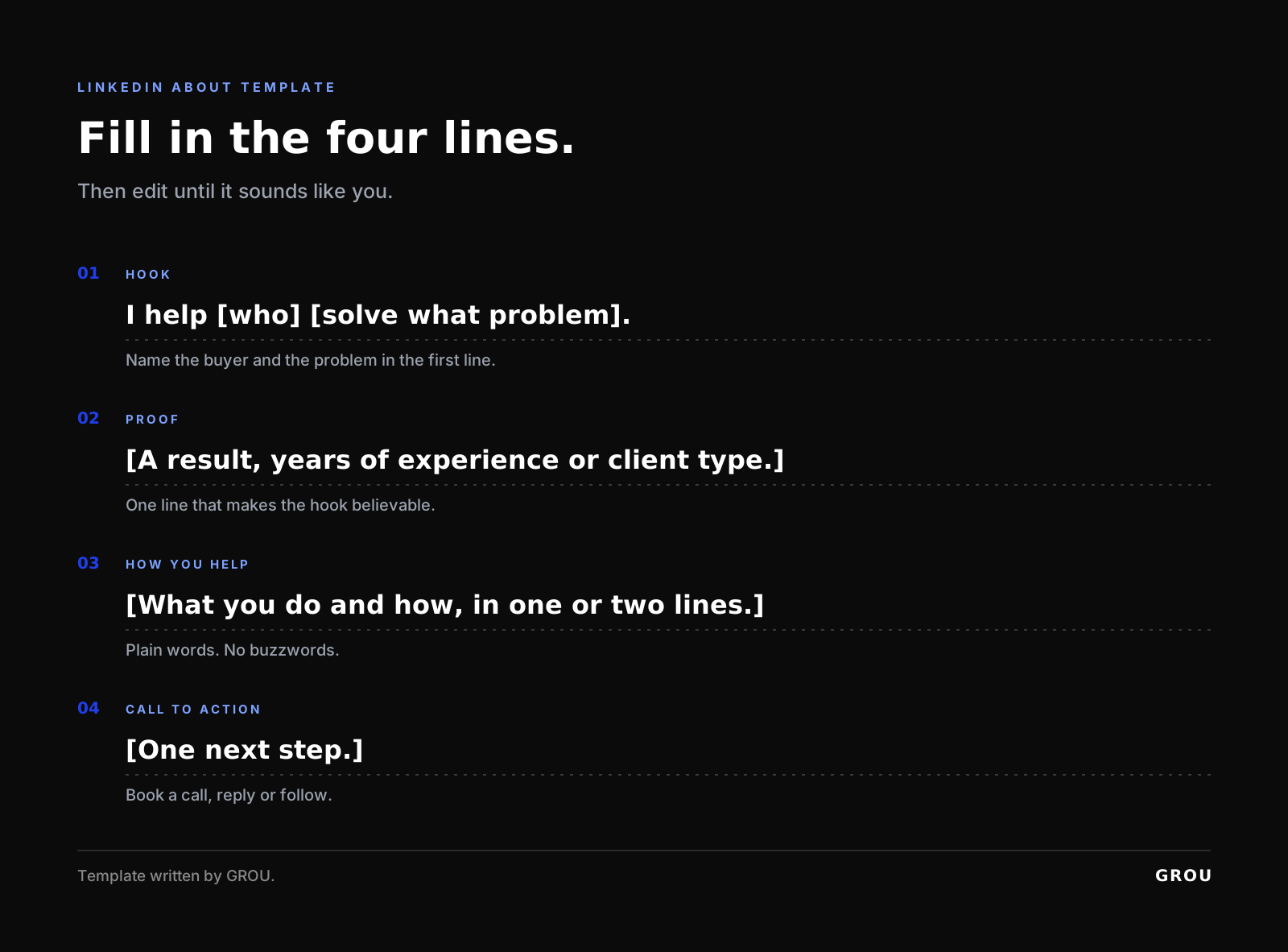
I help [who you help] [solve what problem / reach what outcome].
[One line of proof: a result, years of experience or the type of clients you serve.]
[What you do and how, in one or two lines.]
[One call to action.]
Common mistakes
Starting with your job history. Your experience section already covers it.
Writing in third person. It reads like a press release.
Buzzwords. "Passionate, results-driven leader" tells buyers nothing.
Too many calls to action. Pick one.
No keywords. Use the terms your buyers search, such as your niche and the problems you solve.
Your about section works with your headline. See our LinkedIn headline examples and the LinkedIn personal branding checklist. If you'd like it done for you, our LinkedIn content team rebuilds founder profiles as part of every programme.
FAQ
How long should a LinkedIn about section be?
Long enough to cover a hook, proof, how you help and a call to action, usually 100 to 300 words. The limit is 2,600 characters, but only the opening shows before "see more".
What should the first line of a LinkedIn about section say?
Who you help and the problem you solve. That's what readers see before they decide to click "see more".
Should I write my LinkedIn about section in first or third person?
First person. It's more direct and reads like a conversation rather than a biography.
Should I include keywords in my about section?
Yes. Use the words your buyers search, such as your niche, their job titles and the problems you solve.
Should I add a call to action?
Yes, one. Book a call, send a message or follow for posts. More than one dilutes it.
About this guide
We are GROU, a B2B pipeline agency that runs lead generation, outbound, and LinkedIn content for clients across manufacturing, fintech, iGaming, software, and professional services. The examples in this guide are templates written by our team; company names are placeholders.
Swap in your own buyer, proof and call to action. Copied word for word, a template won't sound like you.
LinkedIn about section examples for B2B
A good LinkedIn about section earns the next click. The first two or three lines show before "see more", so they must name who you help and the problem you solve. Below: the structure that works, eight LinkedIn about section examples for B2B founders, sellers and consultants, and a template you can fill in tonight.
TL;DR
Only the opening shows before "see more". LinkedIn truncates the preview at roughly 270 characters, so lead with the buyer and the problem.
Use four parts: hook, proof, how you help, call to action.
Write in first person, in short paragraphs, with plain words your buyers use.
End with one clear next step, not a list of every way to reach you.
The structure of a strong about section
Hook (first 2 to 3 lines). Who you help and the problem, in plain words. This is what shows before "see more".
Proof (1 short paragraph). A result, a number, a credential or a notable client type. No client names unless you have permission.
How you help (2 to 4 lines). What you actually do, and for whom.
Call to action (1 line). One next step: book a call, reply to a post, download a guide.
LinkedIn truncates the about preview at roughly 270 characters, so your hook has to work on its own (GROU LinkedIn profile guide). The full section allows up to 2,600 characters (AuthoredUp).
LinkedIn about section examples
1. Founder, B2B software
Mid-sized manufacturers lose hours every week reconciling production data by hand. I built [Company] to fix that.
Our platform connects machines, ERP and quality data so plant managers see problems before they cost a shift.
I spent 12 years in operations before founding [Company], so I build for the people on the floor.
If downtime is costing you more than it should, send me a message.
2. Agency founder
I help B2B companies in regulated industries book meetings with the right buyers, without spamming them.
My team runs LinkedIn content, outbound and lead generation as one system, so every channel supports the others.
We work with manufacturers, fintechs and professional services firms across Europe.
Want to see how it would work for you? Book a 20-minute call using the link above.
3. Account executive
I help HR leaders hire across Europe without setting up entities in every country.
At [Company], I work with people teams at 50 to 500-person companies who need to hire fast and stay compliant.
Most conversations start with one question: "What would it take to hire in Spain next month?"
Ask me that question. I'll give you a straight answer.
4. SDR
I talk to finance teams every day about one thing: closing the books faster.
At [Company], I connect controllers and CFOs with a platform that cuts month-end close from weeks to days.
If your close still runs on spreadsheets, I'd like to hear how you do it today.
5. Sales leader
I build outbound teams that hit their number in new markets.
Over the past decade I've launched sales teams in five countries, from first hire to a repeatable pipeline.
Today I lead sales EMEA at [Company], where we help manufacturers reduce energy costs.
I write here about hiring, coaching and pipeline. Follow along if that's your world.
6. Marketer
Most B2B content doesn't create pipeline. I focus on the content that does.
I run demand generation at [Company], turning LinkedIn, events and search into meetings for our sales team.
Before this, I built content programmes for logistics and industrial software companies.
I share what works, and what didn't, every week.
7. Consultant
I help B2B software companies raise prices without losing deals.
Most SaaS teams underprice because they've never tested it. I run pricing research and packaging work that gives leadership the confidence to change.
Clients have ranged from seed-stage startups to public companies.
If pricing is on your 2027 plan, let's talk before you set it.
8. Technical founder
Small platform teams shouldn't need a big budget to see what's breaking.
I'm the CTO and co-founder of [Company]. We build observability for teams of two to ten engineers.
Before this I spent eight years in site reliability, so I've been the person paged at 3am.
Happy to talk about monitoring, on-call and building developer tools.
Examples written by GROU as templates. Company names and details are placeholders.
A template you can fill in
I help [who you help] [solve what problem / reach what outcome].
[One line of proof: a result, years of experience or the type of clients you serve.]
[What you do and how, in one or two lines.]
[One call to action.]
Common mistakes
Starting with your job history. Your experience section already covers it.
Writing in third person. It reads like a press release.
Buzzwords. "Passionate, results-driven leader" tells buyers nothing.
Too many calls to action. Pick one.
No keywords. Use the terms your buyers search, such as your niche and the problems you solve.
Your about section works with your headline. See our LinkedIn headline examples and the LinkedIn personal branding checklist. If you'd like it done for you, our LinkedIn content team rebuilds founder profiles as part of every programme.
FAQ
How long should a LinkedIn about section be?
Long enough to cover a hook, proof, how you help and a call to action, usually 100 to 300 words. The limit is 2,600 characters, but only the opening shows before "see more".
What should the first line of a LinkedIn about section say?
Who you help and the problem you solve. That's what readers see before they decide to click "see more".
Should I write my LinkedIn about section in first or third person?
First person. It's more direct and reads like a conversation rather than a biography.
Should I include keywords in my about section?
Yes. Use the words your buyers search, such as your niche, their job titles and the problems you solve.
Should I add a call to action?
Yes, one. Book a call, send a message or follow for posts. More than one dilutes it.
About this guide
We are GROU, a B2B pipeline agency that runs lead generation, outbound, and LinkedIn content for clients across manufacturing, fintech, iGaming, software, and professional services. The examples in this guide are templates written by our team; company names are placeholders.
Swap in your own buyer, proof and call to action. Copied word for word, a template won't sound like you.
LinkedIn about section examples for B2B
A good LinkedIn about section earns the next click. The first two or three lines show before "see more", so they must name who you help and the problem you solve. Below: the structure that works, eight LinkedIn about section examples for B2B founders, sellers and consultants, and a template you can fill in tonight.
TL;DR
Only the opening shows before "see more". LinkedIn truncates the preview at roughly 270 characters, so lead with the buyer and the problem.
Use four parts: hook, proof, how you help, call to action.
Write in first person, in short paragraphs, with plain words your buyers use.
End with one clear next step, not a list of every way to reach you.
The structure of a strong about section
Hook (first 2 to 3 lines). Who you help and the problem, in plain words. This is what shows before "see more".
Proof (1 short paragraph). A result, a number, a credential or a notable client type. No client names unless you have permission.
How you help (2 to 4 lines). What you actually do, and for whom.
Call to action (1 line). One next step: book a call, reply to a post, download a guide.
LinkedIn truncates the about preview at roughly 270 characters, so your hook has to work on its own (GROU LinkedIn profile guide). The full section allows up to 2,600 characters (AuthoredUp).
LinkedIn about section examples
1. Founder, B2B software
Mid-sized manufacturers lose hours every week reconciling production data by hand. I built [Company] to fix that.
Our platform connects machines, ERP and quality data so plant managers see problems before they cost a shift.
I spent 12 years in operations before founding [Company], so I build for the people on the floor.
If downtime is costing you more than it should, send me a message.
2. Agency founder
I help B2B companies in regulated industries book meetings with the right buyers, without spamming them.
My team runs LinkedIn content, outbound and lead generation as one system, so every channel supports the others.
We work with manufacturers, fintechs and professional services firms across Europe.
Want to see how it would work for you? Book a 20-minute call using the link above.
3. Account executive
I help HR leaders hire across Europe without setting up entities in every country.
At [Company], I work with people teams at 50 to 500-person companies who need to hire fast and stay compliant.
Most conversations start with one question: "What would it take to hire in Spain next month?"
Ask me that question. I'll give you a straight answer.
4. SDR
I talk to finance teams every day about one thing: closing the books faster.
At [Company], I connect controllers and CFOs with a platform that cuts month-end close from weeks to days.
If your close still runs on spreadsheets, I'd like to hear how you do it today.
5. Sales leader
I build outbound teams that hit their number in new markets.
Over the past decade I've launched sales teams in five countries, from first hire to a repeatable pipeline.
Today I lead sales EMEA at [Company], where we help manufacturers reduce energy costs.
I write here about hiring, coaching and pipeline. Follow along if that's your world.
6. Marketer
Most B2B content doesn't create pipeline. I focus on the content that does.
I run demand generation at [Company], turning LinkedIn, events and search into meetings for our sales team.
Before this, I built content programmes for logistics and industrial software companies.
I share what works, and what didn't, every week.
7. Consultant
I help B2B software companies raise prices without losing deals.
Most SaaS teams underprice because they've never tested it. I run pricing research and packaging work that gives leadership the confidence to change.
Clients have ranged from seed-stage startups to public companies.
If pricing is on your 2027 plan, let's talk before you set it.
8. Technical founder
Small platform teams shouldn't need a big budget to see what's breaking.
I'm the CTO and co-founder of [Company]. We build observability for teams of two to ten engineers.
Before this I spent eight years in site reliability, so I've been the person paged at 3am.
Happy to talk about monitoring, on-call and building developer tools.
Examples written by GROU as templates. Company names and details are placeholders.
A template you can fill in
I help [who you help] [solve what problem / reach what outcome].
[One line of proof: a result, years of experience or the type of clients you serve.]
[What you do and how, in one or two lines.]
[One call to action.]
Common mistakes
Starting with your job history. Your experience section already covers it.
Writing in third person. It reads like a press release.
Buzzwords. "Passionate, results-driven leader" tells buyers nothing.
Too many calls to action. Pick one.
No keywords. Use the terms your buyers search, such as your niche and the problems you solve.
Your about section works with your headline. See our LinkedIn headline examples and the LinkedIn personal branding checklist. If you'd like it done for you, our LinkedIn content team rebuilds founder profiles as part of every programme.
FAQ
How long should a LinkedIn about section be?
Long enough to cover a hook, proof, how you help and a call to action, usually 100 to 300 words. The limit is 2,600 characters, but only the opening shows before "see more".
What should the first line of a LinkedIn about section say?
Who you help and the problem you solve. That's what readers see before they decide to click "see more".
Should I write my LinkedIn about section in first or third person?
First person. It's more direct and reads like a conversation rather than a biography.
Should I include keywords in my about section?
Yes. Use the words your buyers search, such as your niche, their job titles and the problems you solve.
Should I add a call to action?
Yes, one. Book a call, send a message or follow for posts. More than one dilutes it.
About this guide
We are GROU, a B2B pipeline agency that runs lead generation, outbound, and LinkedIn content for clients across manufacturing, fintech, iGaming, software, and professional services. The examples in this guide are templates written by our team; company names are placeholders.
Swap in your own buyer, proof and call to action. Copied word for word, a template won't sound like you.
Pipeline OS Newsletter
Build qualified pipeline
Get weekly tactics to generate demand, improve lead quality, and book more meetings.





Trusted by industry leaders
Trusted by industry leaders
Trusted by industry leaders
Ready to build qualified pipeline?
Ready to build qualified pipeline?
Ready to build qualified pipeline?
Book a call to see if we're the right fit, or take the 2-minute quiz to get a clear starting point.
Book a call to see if we're the right fit, or take the 2-minute quiz to get a clear starting point.
Book a call to see if we're the right fit, or take the 2-minute quiz to get a clear starting point.
" height="30.21639343089746px" id="hfGbXmQR2" width="30.216393430897455px"/></svg>)
Copyright © 2026 – All Right Reserved
Copyright © 2026 – All Right Reserved
Copyright © 2026 – All Right Reserved