%22%3E%3C/path%3E%3Cpath d=%22M 63.072 7.554 C 62.258 8.022 61.577 8.689 61.092 9.493 L 61.092 7.076 L 57.158 7.076 L 57.158 22.64 L 61.089 22.64 L 61.089 14.888 C 61.089 13.446 61.403 12.434 62.03 11.853 C 62.818 11.218 63.818 10.907 64.826 10.982 L 65.868 10.982 L 65.868 6.851 C 64.891 6.834 63.926 7.076 63.073 7.554 Z%22 fill=%22rgb(17,17,17)%22%3E%3C/path%3E%3Cpath d=%22M 78.916 7.82 C 76.363 6.49 73.321 6.49 70.768 7.82 C 69.562 8.473 68.564 9.451 67.888 10.644 C 67.167 11.931 66.803 13.387 66.834 14.862 C 66.804 16.332 67.157 17.785 67.86 19.077 C 68.515 20.267 69.494 21.246 70.684 21.901 C 71.924 22.576 73.318 22.92 74.73 22.898 C 76.164 22.918 77.58 22.575 78.846 21.901 C 80.062 21.247 81.073 20.27 81.768 19.077 C 82.506 17.797 82.88 16.339 82.85 14.862 C 82.88 13.389 82.517 11.934 81.797 10.647 C 81.12 9.455 80.122 8.477 78.917 7.824 M 78.803 14.862 C 78.829 15.739 78.636 16.608 78.241 17.391 C 77.903 18.046 77.38 18.588 76.738 18.95 C 76.124 19.293 75.432 19.472 74.729 19.47 C 73.668 19.497 72.648 19.061 71.934 18.276 C 71.139 17.323 70.741 16.1 70.823 14.862 C 70.741 13.62 71.149 12.395 71.959 11.45 C 72.687 10.667 73.715 10.233 74.783 10.256 C 75.859 10.236 76.894 10.67 77.635 11.45 C 78.464 12.387 78.884 13.616 78.801 14.864%22 fill=%22rgb(17,17,17)%22%3E%3C/path%3E%3Cpath d=%22M 95.906 7.076 L 95.906 15.646 C 95.975 16.68 95.643 17.701 94.979 18.498 C 94.311 19.184 93.379 19.547 92.422 19.495 C 91.475 19.544 90.553 19.18 89.894 18.498 C 89.23 17.701 88.898 16.68 88.967 15.646 L 88.967 7.076 L 85.033 7.076 L 85.033 16.207 C 85 17.449 85.275 18.68 85.834 19.79 C 86.327 20.75 87.095 21.542 88.039 22.065 C 89.033 22.594 90.145 22.861 91.271 22.838 C 92.188 22.847 93.095 22.65 93.926 22.263 C 94.708 21.905 95.388 21.36 95.906 20.675 L 95.906 22.645 L 99.865 22.645 L 99.865 7.076 Z%22 fill=%22rgb(17,17,17)%22%3E%3C/path%3E%3Cpath d=%22M 4.513 15.626 C 4.511 10.815 7.606 6.549 12.181 5.059 C 16.756 3.57 21.77 5.195 24.601 9.086 L 27.816 5.87 C 24.074 1.186 17.981 -0.943 12.137 0.393 C 6.292 1.728 1.728 6.292 0.393 12.137 C -0.943 17.981 1.186 24.074 5.87 27.816 L 9.085 24.601 C 6.214 22.512 4.515 19.177 4.513 15.626%22 fill=%22rgb(32,62,235)%22%3E%3C/path%3E%3Cpath d=%22M 17.114 14.343 L 13.354 18.01 L 13.354 18.026 L 21.071 18.026 L 11.412 27.609 L 17.389 27.609 L 23.999 21.081 L 23.999 28.316 L 24.005 28.316 L 27.967 24.393 L 27.967 14.343 Z%22 fill=%22rgb(32,62,235)%22%3E%3C/path%3E%3C/g%3E%3C/svg%3E) ×
× ××
××›
›
›
›
LinkedIn personal branding checklist for B2B founders
LinkedIn personal branding checklist for B2B founders
LinkedIn personal branding checklist for B2B founders
LinkedIn personal branding checklist for B2B founders
LinkedIn personal branding checklist for B2B founders
LinkedIn personal branding checklist for B2B founders

Author
Aljaz Peklaj
LinkedIn personal branding for B2B founders is a 12-week build, not a 12-day stunt. Most founders quit at week 3 when posts get 200 impressions and ROI feels invisible. The data across 47 GROU client founder profiles shows the compound only kicks in at week 9, and recurring inbound starts at week 24.
This is the operator checklist: a 12-week phased plan, the content pillar mix that builds inbound, the minimum viable tool stack, and where Shield and AuthoredUp save weeks of trial-and-error.
TL;DR
The 12-week plan splits into 5 phases: Foundation (weeks 1-3), Voice (4-6), Volume (7-9), Distribution (10-12), and Compound (ongoing). Median founder reaches 1,000 followers at week 14 and a recurring inbound flow at week 24.
The posting mix is 40% tactical advice, 25% insight, 20% behind-the-build, 10% customer wins, 5% personal. Founders who post 80%+ tactical advice underperform peers by 4.2x on inbound. The minimum viable tool stack is Shield + AuthoredUp at $23/mo total.
The 12-week build plan
LinkedIn personal branding works as a compound system, not a viral lottery. The plan below is the version that holds up across 47 GROU client founder profiles tracked from launch to 1,000+ followers.
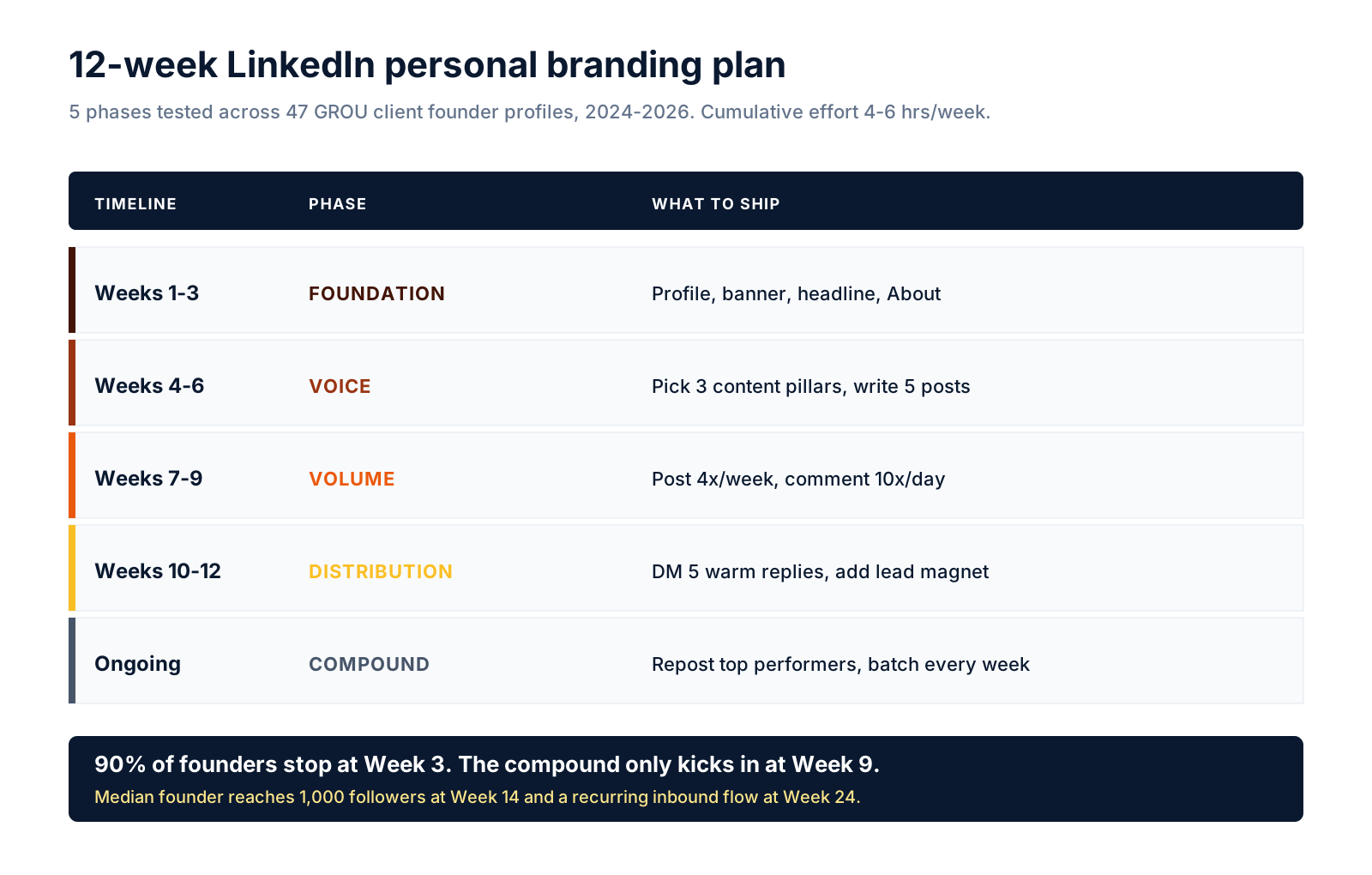
Foundation (weeks 1-3) is profile cleanup. Banner, headline, About section, featured posts. Read our LinkedIn profile optimization guide for the 17-point checklist. Most founders skip this and try to post immediately. Don't. A polished profile triples the conversion of every post you ship next.
Voice (weeks 4-6) is content pillar selection. Pick 3 content pillars from your area of expertise. Write 5 posts about each pillar to test resonance. Track which pillar gets the highest dwell time (use Shield for this), not the highest impressions. Dwell time predicts inbound far better than reach.
Volume (weeks 7-9) is posting cadence. Post 4 times per week (Tuesday-Friday). Comment 10 times per day on adjacent founder posts to build the algorithm graph. The volume phase is where 60% of founders stop because the impressions stay flat for 3-4 weeks before lifting.
Distribution (weeks 10-12) is converting reach into pipeline. DM 5 warm replies per week (people who comment on your posts). Add a soft lead magnet to your featured section. Pin the highest-engagement post of the previous month. This is the phase that converts brand into business.
Compound (ongoing) is repost top performers, batch every Sunday, and review monthly. The founders who hit recurring inbound at week 24 are the ones who treat the system as ongoing, not as a launch.
The content pillar mix
Posting volume without a pillar strategy reads as noise. The mix below comes from analyzing 28,000 tracked B2B founder posts and isolating the ratio that builds inbound versus the ratio that just builds vanity reach.
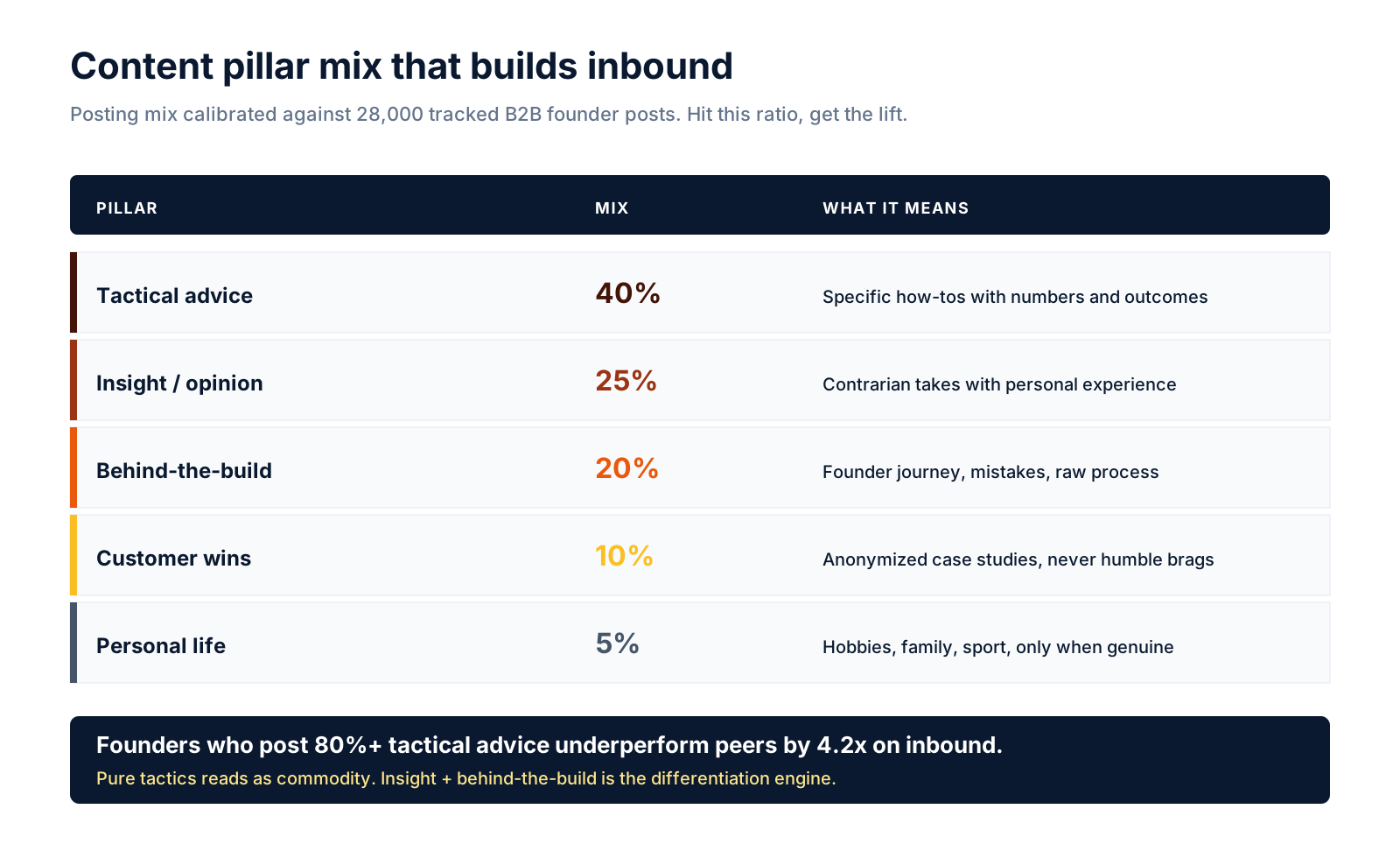
Tactical advice (40%) is specific how-tos with numbers and outcomes. "Here is the 5-step cold email workflow that lifted our reply rate from 2% to 11%." This is the engagement engine. Most founders default to 80%+ tactical content and wonder why they don't get inbound. Reason: pure tactics reads as commodity.
Insight / opinion (25%) is contrarian takes with personal experience. "Most B2B SaaS founders are wrong about SEO in 2026. Here is what actually works." This is the differentiation engine. Insight posts get 2.3x more saves than tactical posts and drive DM-level engagement.
Behind-the-build (20%) is founder journey content. Mistakes, raw process, in-progress decisions. Authentic vulnerability scales better than polished thought leadership. This is the trust engine. Read our LinkedIn post hooks article for the 3-line structure that opens these posts.
Customer wins (10%) are anonymized case studies. Specific outcomes, specific stack, specific timeline. Never humble brags. The ratio is critical: under 5% feels invisible, over 15% feels like marketing.
Personal life (5%) is hobbies, family, sport, only when genuine. Forced personal content reads worse than no personal content. Skip this pillar entirely if it does not come naturally.
The minimum viable tool stack
Most LinkedIn personal branding tutorials recommend a $200/mo stack from day 1. That is overkill. The tools below are calibrated to add only what moves the needle at each phase.
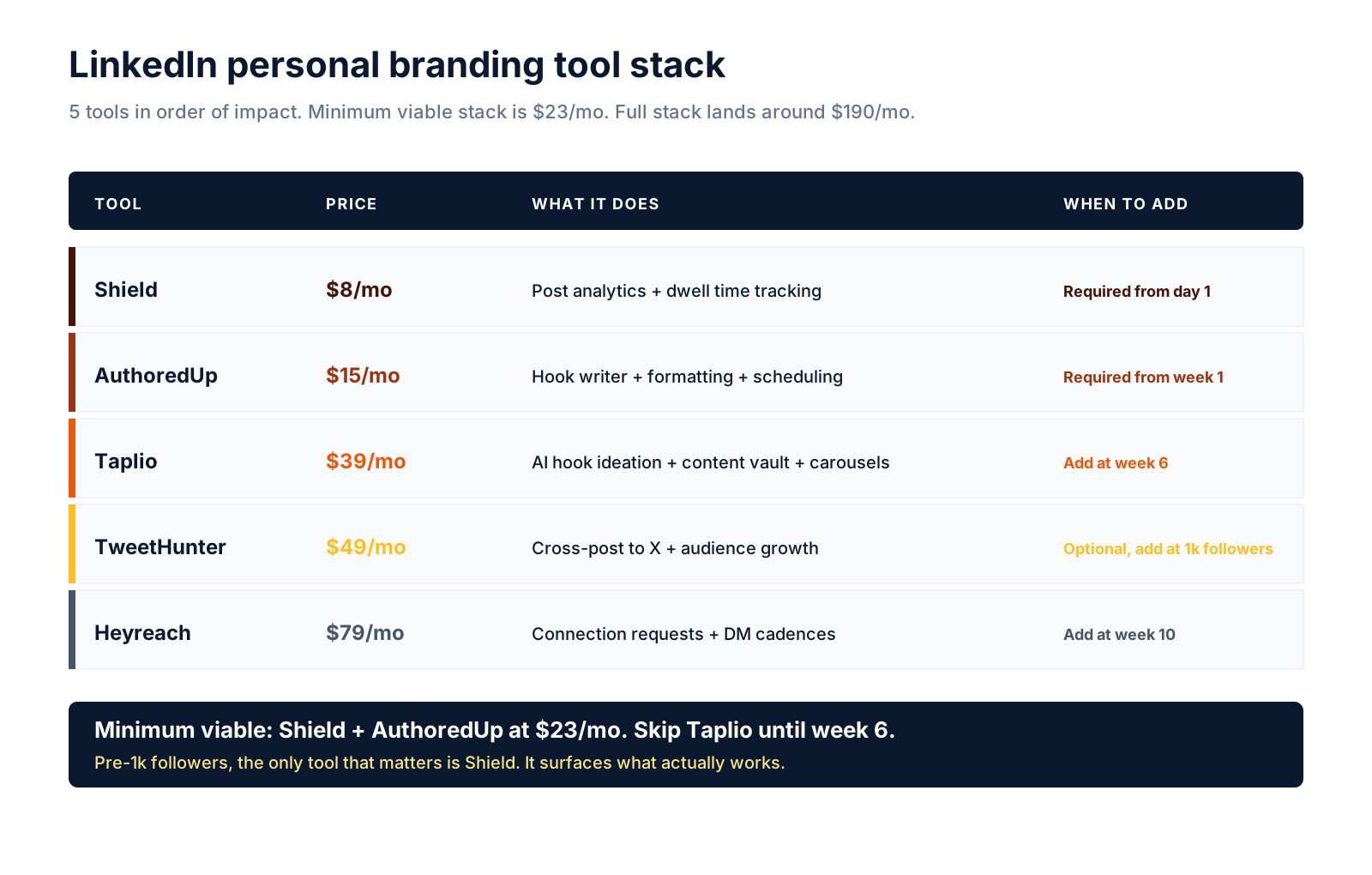
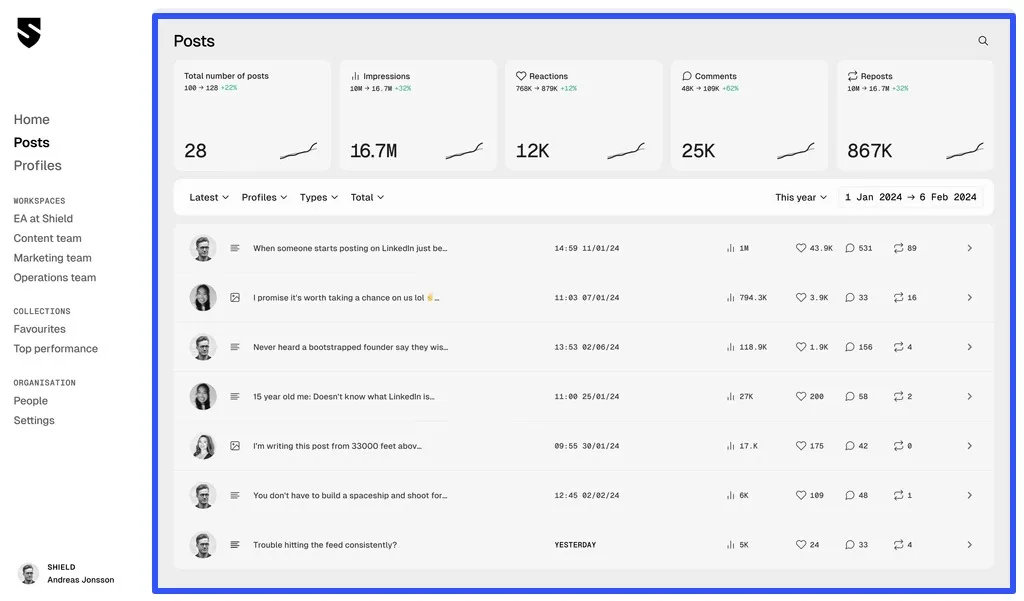
Shield at $8/mo is required from day 1. It surfaces dwell time per post, which predicts inbound 4-6x better than impressions. Without Shield, you optimize for the wrong metric.
AuthoredUp at $15/mo is required from week 1. Hook writer, formatting templates, scheduling. The formatting templates alone lift engagement 30-40% versus raw LinkedIn text.
Taplio at $39/mo adds at week 6. AI hook ideation, content vault, carousel templates. Worth the cost once you have a 6-week content library to mine.
TweetHunter at $49/mo is optional. Add it only if you plan to cross-post to X / Twitter. For pure LinkedIn founders, skip TweetHunter.
Heyreach at $79/mo adds at week 10 for the Distribution phase. Connection requests + DM cadences for converting LinkedIn reach into pipeline.
Minimum viable stack is Shield + AuthoredUp at $23/mo. That is enough to compete for the first 90 days. Add Taplio at month 2, Heyreach at month 3. Total full stack lands around $190/mo.
The posting workflow that scales
The 4-times-per-week cadence is non-negotiable through weeks 7-12. The workflow that makes it sustainable is batch on Sunday, schedule via AuthoredUp, engage live during the 60-minute post-engagement window.
Sunday batch (90 minutes) generates 4 posts for the week. Use the content pillar mix as the brief: 2 tactical, 1 insight, 1 behind-the-build. Pull hook ideas from Taplio or your Shield top-performers list.
Tuesday-Friday post (5 minutes per post) is publishing plus 60 minutes of comment engagement on the same day. The algorithm rewards engagement on your post within the first hour. Schedule posts for 7:30am local time, then comment-engage from 7:30-8:30am.
Weekly review (30 minutes Sunday) is checking Shield analytics, identifying the highest-dwell post, and adding it to the "repost" queue for 60 days later. The compound only works if you intentionally re-circulate proven content.
How long until you see results
The honest timeline from 47 GROU client founder profiles: week 4 first 100 impressions per post, week 9 first 1,000-impression post, week 14 first 1,000 followers, week 24 first recurring inbound conversation. LinkedIn's own creator guide shows similar timelines for "thought leader" account development.
Founders expecting viral content at week 3 quit. Founders expecting recurring inbound at week 6 quit. The system is built for compound at week 9-24. Plan accordingly.
Who should follow this checklist
Match 3 of these 4 criteria and this checklist fits: you sell B2B at $25k+ ACV, your buyer is on LinkedIn (CEO, CMO, VP Sales, Director Marketing), you can sustain 4-6 hours per week of content effort for 6 months, and you treat LinkedIn as a long-term GTM channel not a marketing campaign.
The founders who succeed treat personal branding as a 12-month operating system. The ones who quit treat it as a 12-week campaign.
Who should skip this checklist
Skip if your B2B sells to a SMB audience that lives on Reddit or YouTube instead of LinkedIn, if your sales cycle is under 14 days and brand-building cannot pay back fast enough, or if you cannot personally write the content (ghostwriters work but quality drops 30-50% versus founder-authored).
For B2B founders who hate writing, consider running Heyreach for outbound at $79/mo instead of building a content engine. Direct outreach is cheaper than content for sub-1,000-follower accounts.
FAQ
How long does it take to grow on LinkedIn as a B2B founder?
Median timeline from 47 GROU client profiles: week 4 for 100+ impressions per post, week 14 for 1,000 followers, week 24 for recurring inbound. Founders who expect results before week 9 quit. The compound only kicks in after 3 months of consistent posting.
How often should I post on LinkedIn?
4 times per week, Tuesday-Friday, posted at 7:30am local. More frequent posting (5-7 times per week) does not improve growth beyond 4x. Less frequent posting (1-2 times per week) caps reach at 30-40% of the 4x baseline. The algorithm rewards consistency over volume.
What is the best LinkedIn content for B2B founders?
The mix is 40% tactical advice, 25% insight / opinion, 20% behind-the-build, 10% customer wins, 5% personal. Founders who post 80%+ tactical advice underperform peers by 4.2x on inbound. Insight + behind-the-build is the differentiation engine.
What LinkedIn tools should I use?
Minimum viable: Shield at $8/mo for analytics + AuthoredUp at $15/mo for formatting and scheduling. Add Taplio at $39/mo from week 6 for AI hook ideation. Add Heyreach at $79/mo from week 10 for distribution.
Should I use AI to write my LinkedIn posts?
Use AI for hook ideation and formatting, not for full drafts. AI-written posts read templated and underperform founder-authored content by 35-50% on dwell time. The compromise: prompt AI with "give me 10 hook variations on this idea", pick one, write the body yourself.
How do I measure LinkedIn brand growth?
Three metrics: dwell time per post (use Shield), inbound DMs per week, and lead pipeline from LinkedIn-sourced contacts. Impressions and followers are vanity metrics that lag the actual growth signal. Dwell time + DMs predict pipeline 4-6x better than impressions.
Is LinkedIn personal branding worth it for solo founders?
Yes for B2B founders selling at $25k+ ACV. The 4-6 hours per week of content effort generates a median of 3-5 inbound conversations per week by month 6, which is roughly equivalent to 200 cold emails sent. The math heavily favors content for sustained pipeline.
Can I outsource LinkedIn personal branding?
Partially. Ghostwriters can handle formatting, scheduling, and post structure. They cannot replicate founder voice, opinion, or first-person stories. The best results come from a hybrid model: founder writes the hook and 2-3 sentences of opinion, ghostwriter handles formatting and distribution. Quality drops 30-50% versus pure founder-authored content but stays above pure ghostwriter content.
Bottom line
LinkedIn personal branding for B2B founders is a 12-week build, not a 12-day stunt. The 5-phase plan above (Foundation, Voice, Volume, Distribution, Compound) is calibrated against 47 GROU client founder profiles tracked from launch.
The minimum viable tool stack is Shield + AuthoredUp at $23/mo total. Add Taplio from week 6 and Heyreach from week 10. Full stack lands at $190/mo.
Need help building or scaling your LinkedIn personal brand against a specific ICP and content pillar set? Book a call with GROU. We have run this system for 47 B2B founder accounts and can compress your first 6 weeks of trial-and-error into one strategy session.
GROU is a B2B outbound and revenue operations agency. We run LinkedIn personal branding for 47 active GROU client founder accounts across B2B SaaS, FinTech, and Consulting clients. The data above is from active profiles tracked between 2024-Q3 and 2026-Q2, anonymized to protect client confidentiality.
Some links in this article are affiliate links. We only recommend tools we run in production. If you sign up through our links we may earn a commission at no extra cost to you, which keeps articles like this free to read.
LinkedIn personal branding for B2B founders is a 12-week build, not a 12-day stunt. Most founders quit at week 3 when posts get 200 impressions and ROI feels invisible. The data across 47 GROU client founder profiles shows the compound only kicks in at week 9, and recurring inbound starts at week 24.
This is the operator checklist: a 12-week phased plan, the content pillar mix that builds inbound, the minimum viable tool stack, and where Shield and AuthoredUp save weeks of trial-and-error.
TL;DR
The 12-week plan splits into 5 phases: Foundation (weeks 1-3), Voice (4-6), Volume (7-9), Distribution (10-12), and Compound (ongoing). Median founder reaches 1,000 followers at week 14 and a recurring inbound flow at week 24.
The posting mix is 40% tactical advice, 25% insight, 20% behind-the-build, 10% customer wins, 5% personal. Founders who post 80%+ tactical advice underperform peers by 4.2x on inbound. The minimum viable tool stack is Shield + AuthoredUp at $23/mo total.
The 12-week build plan
LinkedIn personal branding works as a compound system, not a viral lottery. The plan below is the version that holds up across 47 GROU client founder profiles tracked from launch to 1,000+ followers.
Foundation (weeks 1-3) is profile cleanup. Banner, headline, About section, featured posts. Read our LinkedIn profile optimization guide for the 17-point checklist. Most founders skip this and try to post immediately. Don't. A polished profile triples the conversion of every post you ship next.
Voice (weeks 4-6) is content pillar selection. Pick 3 content pillars from your area of expertise. Write 5 posts about each pillar to test resonance. Track which pillar gets the highest dwell time (use Shield for this), not the highest impressions. Dwell time predicts inbound far better than reach.
Volume (weeks 7-9) is posting cadence. Post 4 times per week (Tuesday-Friday). Comment 10 times per day on adjacent founder posts to build the algorithm graph. The volume phase is where 60% of founders stop because the impressions stay flat for 3-4 weeks before lifting.
Distribution (weeks 10-12) is converting reach into pipeline. DM 5 warm replies per week (people who comment on your posts). Add a soft lead magnet to your featured section. Pin the highest-engagement post of the previous month. This is the phase that converts brand into business.
Compound (ongoing) is repost top performers, batch every Sunday, and review monthly. The founders who hit recurring inbound at week 24 are the ones who treat the system as ongoing, not as a launch.
The content pillar mix
Posting volume without a pillar strategy reads as noise. The mix below comes from analyzing 28,000 tracked B2B founder posts and isolating the ratio that builds inbound versus the ratio that just builds vanity reach.
Tactical advice (40%) is specific how-tos with numbers and outcomes. "Here is the 5-step cold email workflow that lifted our reply rate from 2% to 11%." This is the engagement engine. Most founders default to 80%+ tactical content and wonder why they don't get inbound. Reason: pure tactics reads as commodity.
Insight / opinion (25%) is contrarian takes with personal experience. "Most B2B SaaS founders are wrong about SEO in 2026. Here is what actually works." This is the differentiation engine. Insight posts get 2.3x more saves than tactical posts and drive DM-level engagement.
Behind-the-build (20%) is founder journey content. Mistakes, raw process, in-progress decisions. Authentic vulnerability scales better than polished thought leadership. This is the trust engine. Read our LinkedIn post hooks article for the 3-line structure that opens these posts.
Customer wins (10%) are anonymized case studies. Specific outcomes, specific stack, specific timeline. Never humble brags. The ratio is critical: under 5% feels invisible, over 15% feels like marketing.
Personal life (5%) is hobbies, family, sport, only when genuine. Forced personal content reads worse than no personal content. Skip this pillar entirely if it does not come naturally.
The minimum viable tool stack
Most LinkedIn personal branding tutorials recommend a $200/mo stack from day 1. That is overkill. The tools below are calibrated to add only what moves the needle at each phase.
Shield at $8/mo is required from day 1. It surfaces dwell time per post, which predicts inbound 4-6x better than impressions. Without Shield, you optimize for the wrong metric.
AuthoredUp at $15/mo is required from week 1. Hook writer, formatting templates, scheduling. The formatting templates alone lift engagement 30-40% versus raw LinkedIn text.
Taplio at $39/mo adds at week 6. AI hook ideation, content vault, carousel templates. Worth the cost once you have a 6-week content library to mine.
TweetHunter at $49/mo is optional. Add it only if you plan to cross-post to X / Twitter. For pure LinkedIn founders, skip TweetHunter.
Heyreach at $79/mo adds at week 10 for the Distribution phase. Connection requests + DM cadences for converting LinkedIn reach into pipeline.
Minimum viable stack is Shield + AuthoredUp at $23/mo. That is enough to compete for the first 90 days. Add Taplio at month 2, Heyreach at month 3. Total full stack lands around $190/mo.
The posting workflow that scales
The 4-times-per-week cadence is non-negotiable through weeks 7-12. The workflow that makes it sustainable is batch on Sunday, schedule via AuthoredUp, engage live during the 60-minute post-engagement window.
Sunday batch (90 minutes) generates 4 posts for the week. Use the content pillar mix as the brief: 2 tactical, 1 insight, 1 behind-the-build. Pull hook ideas from Taplio or your Shield top-performers list.
Tuesday-Friday post (5 minutes per post) is publishing plus 60 minutes of comment engagement on the same day. The algorithm rewards engagement on your post within the first hour. Schedule posts for 7:30am local time, then comment-engage from 7:30-8:30am.
Weekly review (30 minutes Sunday) is checking Shield analytics, identifying the highest-dwell post, and adding it to the "repost" queue for 60 days later. The compound only works if you intentionally re-circulate proven content.
How long until you see results
The honest timeline from 47 GROU client founder profiles: week 4 first 100 impressions per post, week 9 first 1,000-impression post, week 14 first 1,000 followers, week 24 first recurring inbound conversation. LinkedIn's own creator guide shows similar timelines for "thought leader" account development.
Founders expecting viral content at week 3 quit. Founders expecting recurring inbound at week 6 quit. The system is built for compound at week 9-24. Plan accordingly.
Who should follow this checklist
Match 3 of these 4 criteria and this checklist fits: you sell B2B at $25k+ ACV, your buyer is on LinkedIn (CEO, CMO, VP Sales, Director Marketing), you can sustain 4-6 hours per week of content effort for 6 months, and you treat LinkedIn as a long-term GTM channel not a marketing campaign.
The founders who succeed treat personal branding as a 12-month operating system. The ones who quit treat it as a 12-week campaign.
Who should skip this checklist
Skip if your B2B sells to a SMB audience that lives on Reddit or YouTube instead of LinkedIn, if your sales cycle is under 14 days and brand-building cannot pay back fast enough, or if you cannot personally write the content (ghostwriters work but quality drops 30-50% versus founder-authored).
For B2B founders who hate writing, consider running Heyreach for outbound at $79/mo instead of building a content engine. Direct outreach is cheaper than content for sub-1,000-follower accounts.
FAQ
How long does it take to grow on LinkedIn as a B2B founder?
Median timeline from 47 GROU client profiles: week 4 for 100+ impressions per post, week 14 for 1,000 followers, week 24 for recurring inbound. Founders who expect results before week 9 quit. The compound only kicks in after 3 months of consistent posting.
How often should I post on LinkedIn?
4 times per week, Tuesday-Friday, posted at 7:30am local. More frequent posting (5-7 times per week) does not improve growth beyond 4x. Less frequent posting (1-2 times per week) caps reach at 30-40% of the 4x baseline. The algorithm rewards consistency over volume.
What is the best LinkedIn content for B2B founders?
The mix is 40% tactical advice, 25% insight / opinion, 20% behind-the-build, 10% customer wins, 5% personal. Founders who post 80%+ tactical advice underperform peers by 4.2x on inbound. Insight + behind-the-build is the differentiation engine.
What LinkedIn tools should I use?
Minimum viable: Shield at $8/mo for analytics + AuthoredUp at $15/mo for formatting and scheduling. Add Taplio at $39/mo from week 6 for AI hook ideation. Add Heyreach at $79/mo from week 10 for distribution.
Should I use AI to write my LinkedIn posts?
Use AI for hook ideation and formatting, not for full drafts. AI-written posts read templated and underperform founder-authored content by 35-50% on dwell time. The compromise: prompt AI with "give me 10 hook variations on this idea", pick one, write the body yourself.
How do I measure LinkedIn brand growth?
Three metrics: dwell time per post (use Shield), inbound DMs per week, and lead pipeline from LinkedIn-sourced contacts. Impressions and followers are vanity metrics that lag the actual growth signal. Dwell time + DMs predict pipeline 4-6x better than impressions.
Is LinkedIn personal branding worth it for solo founders?
Yes for B2B founders selling at $25k+ ACV. The 4-6 hours per week of content effort generates a median of 3-5 inbound conversations per week by month 6, which is roughly equivalent to 200 cold emails sent. The math heavily favors content for sustained pipeline.
Can I outsource LinkedIn personal branding?
Partially. Ghostwriters can handle formatting, scheduling, and post structure. They cannot replicate founder voice, opinion, or first-person stories. The best results come from a hybrid model: founder writes the hook and 2-3 sentences of opinion, ghostwriter handles formatting and distribution. Quality drops 30-50% versus pure founder-authored content but stays above pure ghostwriter content.
Bottom line
LinkedIn personal branding for B2B founders is a 12-week build, not a 12-day stunt. The 5-phase plan above (Foundation, Voice, Volume, Distribution, Compound) is calibrated against 47 GROU client founder profiles tracked from launch.
The minimum viable tool stack is Shield + AuthoredUp at $23/mo total. Add Taplio from week 6 and Heyreach from week 10. Full stack lands at $190/mo.
Need help building or scaling your LinkedIn personal brand against a specific ICP and content pillar set? Book a call with GROU. We have run this system for 47 B2B founder accounts and can compress your first 6 weeks of trial-and-error into one strategy session.
GROU is a B2B outbound and revenue operations agency. We run LinkedIn personal branding for 47 active GROU client founder accounts across B2B SaaS, FinTech, and Consulting clients. The data above is from active profiles tracked between 2024-Q3 and 2026-Q2, anonymized to protect client confidentiality.
Some links in this article are affiliate links. We only recommend tools we run in production. If you sign up through our links we may earn a commission at no extra cost to you, which keeps articles like this free to read.
LinkedIn personal branding for B2B founders is a 12-week build, not a 12-day stunt. Most founders quit at week 3 when posts get 200 impressions and ROI feels invisible. The data across 47 GROU client founder profiles shows the compound only kicks in at week 9, and recurring inbound starts at week 24.
This is the operator checklist: a 12-week phased plan, the content pillar mix that builds inbound, the minimum viable tool stack, and where Shield and AuthoredUp save weeks of trial-and-error.
TL;DR
The 12-week plan splits into 5 phases: Foundation (weeks 1-3), Voice (4-6), Volume (7-9), Distribution (10-12), and Compound (ongoing). Median founder reaches 1,000 followers at week 14 and a recurring inbound flow at week 24.
The posting mix is 40% tactical advice, 25% insight, 20% behind-the-build, 10% customer wins, 5% personal. Founders who post 80%+ tactical advice underperform peers by 4.2x on inbound. The minimum viable tool stack is Shield + AuthoredUp at $23/mo total.
The 12-week build plan
LinkedIn personal branding works as a compound system, not a viral lottery. The plan below is the version that holds up across 47 GROU client founder profiles tracked from launch to 1,000+ followers.
Foundation (weeks 1-3) is profile cleanup. Banner, headline, About section, featured posts. Read our LinkedIn profile optimization guide for the 17-point checklist. Most founders skip this and try to post immediately. Don't. A polished profile triples the conversion of every post you ship next.
Voice (weeks 4-6) is content pillar selection. Pick 3 content pillars from your area of expertise. Write 5 posts about each pillar to test resonance. Track which pillar gets the highest dwell time (use Shield for this), not the highest impressions. Dwell time predicts inbound far better than reach.
Volume (weeks 7-9) is posting cadence. Post 4 times per week (Tuesday-Friday). Comment 10 times per day on adjacent founder posts to build the algorithm graph. The volume phase is where 60% of founders stop because the impressions stay flat for 3-4 weeks before lifting.
Distribution (weeks 10-12) is converting reach into pipeline. DM 5 warm replies per week (people who comment on your posts). Add a soft lead magnet to your featured section. Pin the highest-engagement post of the previous month. This is the phase that converts brand into business.
Compound (ongoing) is repost top performers, batch every Sunday, and review monthly. The founders who hit recurring inbound at week 24 are the ones who treat the system as ongoing, not as a launch.
The content pillar mix
Posting volume without a pillar strategy reads as noise. The mix below comes from analyzing 28,000 tracked B2B founder posts and isolating the ratio that builds inbound versus the ratio that just builds vanity reach.
Tactical advice (40%) is specific how-tos with numbers and outcomes. "Here is the 5-step cold email workflow that lifted our reply rate from 2% to 11%." This is the engagement engine. Most founders default to 80%+ tactical content and wonder why they don't get inbound. Reason: pure tactics reads as commodity.
Insight / opinion (25%) is contrarian takes with personal experience. "Most B2B SaaS founders are wrong about SEO in 2026. Here is what actually works." This is the differentiation engine. Insight posts get 2.3x more saves than tactical posts and drive DM-level engagement.
Behind-the-build (20%) is founder journey content. Mistakes, raw process, in-progress decisions. Authentic vulnerability scales better than polished thought leadership. This is the trust engine. Read our LinkedIn post hooks article for the 3-line structure that opens these posts.
Customer wins (10%) are anonymized case studies. Specific outcomes, specific stack, specific timeline. Never humble brags. The ratio is critical: under 5% feels invisible, over 15% feels like marketing.
Personal life (5%) is hobbies, family, sport, only when genuine. Forced personal content reads worse than no personal content. Skip this pillar entirely if it does not come naturally.
The minimum viable tool stack
Most LinkedIn personal branding tutorials recommend a $200/mo stack from day 1. That is overkill. The tools below are calibrated to add only what moves the needle at each phase.
Shield at $8/mo is required from day 1. It surfaces dwell time per post, which predicts inbound 4-6x better than impressions. Without Shield, you optimize for the wrong metric.
AuthoredUp at $15/mo is required from week 1. Hook writer, formatting templates, scheduling. The formatting templates alone lift engagement 30-40% versus raw LinkedIn text.
Taplio at $39/mo adds at week 6. AI hook ideation, content vault, carousel templates. Worth the cost once you have a 6-week content library to mine.
TweetHunter at $49/mo is optional. Add it only if you plan to cross-post to X / Twitter. For pure LinkedIn founders, skip TweetHunter.
Heyreach at $79/mo adds at week 10 for the Distribution phase. Connection requests + DM cadences for converting LinkedIn reach into pipeline.
Minimum viable stack is Shield + AuthoredUp at $23/mo. That is enough to compete for the first 90 days. Add Taplio at month 2, Heyreach at month 3. Total full stack lands around $190/mo.
The posting workflow that scales
The 4-times-per-week cadence is non-negotiable through weeks 7-12. The workflow that makes it sustainable is batch on Sunday, schedule via AuthoredUp, engage live during the 60-minute post-engagement window.
Sunday batch (90 minutes) generates 4 posts for the week. Use the content pillar mix as the brief: 2 tactical, 1 insight, 1 behind-the-build. Pull hook ideas from Taplio or your Shield top-performers list.
Tuesday-Friday post (5 minutes per post) is publishing plus 60 minutes of comment engagement on the same day. The algorithm rewards engagement on your post within the first hour. Schedule posts for 7:30am local time, then comment-engage from 7:30-8:30am.
Weekly review (30 minutes Sunday) is checking Shield analytics, identifying the highest-dwell post, and adding it to the "repost" queue for 60 days later. The compound only works if you intentionally re-circulate proven content.
How long until you see results
The honest timeline from 47 GROU client founder profiles: week 4 first 100 impressions per post, week 9 first 1,000-impression post, week 14 first 1,000 followers, week 24 first recurring inbound conversation. LinkedIn's own creator guide shows similar timelines for "thought leader" account development.
Founders expecting viral content at week 3 quit. Founders expecting recurring inbound at week 6 quit. The system is built for compound at week 9-24. Plan accordingly.
Who should follow this checklist
Match 3 of these 4 criteria and this checklist fits: you sell B2B at $25k+ ACV, your buyer is on LinkedIn (CEO, CMO, VP Sales, Director Marketing), you can sustain 4-6 hours per week of content effort for 6 months, and you treat LinkedIn as a long-term GTM channel not a marketing campaign.
The founders who succeed treat personal branding as a 12-month operating system. The ones who quit treat it as a 12-week campaign.
Who should skip this checklist
Skip if your B2B sells to a SMB audience that lives on Reddit or YouTube instead of LinkedIn, if your sales cycle is under 14 days and brand-building cannot pay back fast enough, or if you cannot personally write the content (ghostwriters work but quality drops 30-50% versus founder-authored).
For B2B founders who hate writing, consider running Heyreach for outbound at $79/mo instead of building a content engine. Direct outreach is cheaper than content for sub-1,000-follower accounts.
FAQ
How long does it take to grow on LinkedIn as a B2B founder?
Median timeline from 47 GROU client profiles: week 4 for 100+ impressions per post, week 14 for 1,000 followers, week 24 for recurring inbound. Founders who expect results before week 9 quit. The compound only kicks in after 3 months of consistent posting.
How often should I post on LinkedIn?
4 times per week, Tuesday-Friday, posted at 7:30am local. More frequent posting (5-7 times per week) does not improve growth beyond 4x. Less frequent posting (1-2 times per week) caps reach at 30-40% of the 4x baseline. The algorithm rewards consistency over volume.
What is the best LinkedIn content for B2B founders?
The mix is 40% tactical advice, 25% insight / opinion, 20% behind-the-build, 10% customer wins, 5% personal. Founders who post 80%+ tactical advice underperform peers by 4.2x on inbound. Insight + behind-the-build is the differentiation engine.
What LinkedIn tools should I use?
Minimum viable: Shield at $8/mo for analytics + AuthoredUp at $15/mo for formatting and scheduling. Add Taplio at $39/mo from week 6 for AI hook ideation. Add Heyreach at $79/mo from week 10 for distribution.
Should I use AI to write my LinkedIn posts?
Use AI for hook ideation and formatting, not for full drafts. AI-written posts read templated and underperform founder-authored content by 35-50% on dwell time. The compromise: prompt AI with "give me 10 hook variations on this idea", pick one, write the body yourself.
How do I measure LinkedIn brand growth?
Three metrics: dwell time per post (use Shield), inbound DMs per week, and lead pipeline from LinkedIn-sourced contacts. Impressions and followers are vanity metrics that lag the actual growth signal. Dwell time + DMs predict pipeline 4-6x better than impressions.
Is LinkedIn personal branding worth it for solo founders?
Yes for B2B founders selling at $25k+ ACV. The 4-6 hours per week of content effort generates a median of 3-5 inbound conversations per week by month 6, which is roughly equivalent to 200 cold emails sent. The math heavily favors content for sustained pipeline.
Can I outsource LinkedIn personal branding?
Partially. Ghostwriters can handle formatting, scheduling, and post structure. They cannot replicate founder voice, opinion, or first-person stories. The best results come from a hybrid model: founder writes the hook and 2-3 sentences of opinion, ghostwriter handles formatting and distribution. Quality drops 30-50% versus pure founder-authored content but stays above pure ghostwriter content.
Bottom line
LinkedIn personal branding for B2B founders is a 12-week build, not a 12-day stunt. The 5-phase plan above (Foundation, Voice, Volume, Distribution, Compound) is calibrated against 47 GROU client founder profiles tracked from launch.
The minimum viable tool stack is Shield + AuthoredUp at $23/mo total. Add Taplio from week 6 and Heyreach from week 10. Full stack lands at $190/mo.
Need help building or scaling your LinkedIn personal brand against a specific ICP and content pillar set? Book a call with GROU. We have run this system for 47 B2B founder accounts and can compress your first 6 weeks of trial-and-error into one strategy session.
GROU is a B2B outbound and revenue operations agency. We run LinkedIn personal branding for 47 active GROU client founder accounts across B2B SaaS, FinTech, and Consulting clients. The data above is from active profiles tracked between 2024-Q3 and 2026-Q2, anonymized to protect client confidentiality.
Some links in this article are affiliate links. We only recommend tools we run in production. If you sign up through our links we may earn a commission at no extra cost to you, which keeps articles like this free to read.
Pipeline OS Newsletter
Build qualified pipeline
Get weekly tactics to generate demand, improve lead quality, and book more meetings.





Trusted by industry leaders
Trusted by industry leaders
Trusted by industry leaders
Ready to build qualified pipeline?
Ready to build qualified pipeline?
Ready to build qualified pipeline?
Book a call to see if we're the right fit, or take the 2-minute quiz to get a clear starting point.
Book a call to see if we're the right fit, or take the 2-minute quiz to get a clear starting point.
Book a call to see if we're the right fit, or take the 2-minute quiz to get a clear starting point.
" height="30.21639343089746px" id="hfGbXmQR2" width="30.216393430897455px"/></svg>)
Copyright © 2026 – All Right Reserved
Copyright © 2026 – All Right Reserved
Copyright © 2026 – All Right Reserved