%22%3E%3C/path%3E%3Cpath d=%22M 63.072 7.554 C 62.258 8.022 61.577 8.689 61.092 9.493 L 61.092 7.076 L 57.158 7.076 L 57.158 22.64 L 61.089 22.64 L 61.089 14.888 C 61.089 13.446 61.403 12.434 62.03 11.853 C 62.818 11.218 63.818 10.907 64.826 10.982 L 65.868 10.982 L 65.868 6.851 C 64.891 6.834 63.926 7.076 63.073 7.554 Z%22 fill=%22rgb(17,17,17)%22%3E%3C/path%3E%3Cpath d=%22M 78.916 7.82 C 76.363 6.49 73.321 6.49 70.768 7.82 C 69.562 8.473 68.564 9.451 67.888 10.644 C 67.167 11.931 66.803 13.387 66.834 14.862 C 66.804 16.332 67.157 17.785 67.86 19.077 C 68.515 20.267 69.494 21.246 70.684 21.901 C 71.924 22.576 73.318 22.92 74.73 22.898 C 76.164 22.918 77.58 22.575 78.846 21.901 C 80.062 21.247 81.073 20.27 81.768 19.077 C 82.506 17.797 82.88 16.339 82.85 14.862 C 82.88 13.389 82.517 11.934 81.797 10.647 C 81.12 9.455 80.122 8.477 78.917 7.824 M 78.803 14.862 C 78.829 15.739 78.636 16.608 78.241 17.391 C 77.903 18.046 77.38 18.588 76.738 18.95 C 76.124 19.293 75.432 19.472 74.729 19.47 C 73.668 19.497 72.648 19.061 71.934 18.276 C 71.139 17.323 70.741 16.1 70.823 14.862 C 70.741 13.62 71.149 12.395 71.959 11.45 C 72.687 10.667 73.715 10.233 74.783 10.256 C 75.859 10.236 76.894 10.67 77.635 11.45 C 78.464 12.387 78.884 13.616 78.801 14.864%22 fill=%22rgb(17,17,17)%22%3E%3C/path%3E%3Cpath d=%22M 95.906 7.076 L 95.906 15.646 C 95.975 16.68 95.643 17.701 94.979 18.498 C 94.311 19.184 93.379 19.547 92.422 19.495 C 91.475 19.544 90.553 19.18 89.894 18.498 C 89.23 17.701 88.898 16.68 88.967 15.646 L 88.967 7.076 L 85.033 7.076 L 85.033 16.207 C 85 17.449 85.275 18.68 85.834 19.79 C 86.327 20.75 87.095 21.542 88.039 22.065 C 89.033 22.594 90.145 22.861 91.271 22.838 C 92.188 22.847 93.095 22.65 93.926 22.263 C 94.708 21.905 95.388 21.36 95.906 20.675 L 95.906 22.645 L 99.865 22.645 L 99.865 7.076 Z%22 fill=%22rgb(17,17,17)%22%3E%3C/path%3E%3Cpath d=%22M 4.513 15.626 C 4.511 10.815 7.606 6.549 12.181 5.059 C 16.756 3.57 21.77 5.195 24.601 9.086 L 27.816 5.87 C 24.074 1.186 17.981 -0.943 12.137 0.393 C 6.292 1.728 1.728 6.292 0.393 12.137 C -0.943 17.981 1.186 24.074 5.87 27.816 L 9.085 24.601 C 6.214 22.512 4.515 19.177 4.513 15.626%22 fill=%22rgb(32,62,235)%22%3E%3C/path%3E%3Cpath d=%22M 17.114 14.343 L 13.354 18.01 L 13.354 18.026 L 21.071 18.026 L 11.412 27.609 L 17.389 27.609 L 23.999 21.081 L 23.999 28.316 L 24.005 28.316 L 27.967 24.393 L 27.967 14.343 Z%22 fill=%22rgb(32,62,235)%22%3E%3C/path%3E%3C/g%3E%3C/svg%3E) ×
× ××
××›
›
›
›
What is outbound sales? How it works for B2B in 2026
What is outbound sales? How it works for B2B in 2026
What is outbound sales? How it works for B2B in 2026
What is outbound sales? How it works for B2B in 2026
What is outbound sales? How it works for B2B in 2026
What is outbound sales? How it works for B2B in 2026

Author
Aljaz Peklaj

Outbound sales is a seller-initiated, multi-touch B2B motion that creates qualified conversations by reaching selected accounts with relevant messages at the right moment. In modern outbound, 196,470 prospects, 443,209 outbound calls, 146,832 emails delivered, and 142,800 LinkedIn tasks produced 39,679 booked meetings and 34,336 held meetings, with 3.36 touches per prospect and a 16.06% meeting conversion rate. State of Outbound 2026 shows the work is already a system, not a single send.
Your pipeline problem is usually subtraction, not effort. The team keeps adding contacts while ignoring fit, timing, and routing.
Outbound beats inbound when demand is missing or account-specific. That's true in new markets, target-account motions, and complex sales cycles.
Replies are cheap. Qualified conversations are what matter. A working system routes, filters, and books fast.
Timing changes the outcome more than raw volume. Signal-led outreach consistently outperforms timer-based sending.
If your team is sending more and converting less, the issue usually isn't activity. It's that the machine is built to spray, not select.
Table of Contents
Why Your Outbound Pipeline Is Not Converting
A sales leader opens the dashboard and sees a familiar mess. The team sent thousands of emails, booked a handful of meetings, and somehow created almost no real pipeline. That usually means the motion is busy, but not directional.
The first leak is list building. Teams keep adding contacts without removing poor-fit accounts, so every new sequence gets diluted before it starts. The second leak is timing, because copy-paste sequences hit accounts with no live trigger and no reason to respond.
The four failures that show up first
Practical rule: if a prospect doesn't fit, doesn't feel the problem, or doesn't get routed fast, the sequence was never really live.
Weak targeting creates low response before a rep even writes the first line. Slow routing kills the few hot replies that do arrive. Measurement then hides the failure, because the dashboard celebrates opens or raw sends instead of qualified meetings and held conversations.
Outbound works better when the team treats it like a subtraction system. You remove bad-fit accounts, remove stale assumptions, and remove delays between signal and response. That's the operating mindset behind a real pipeline engine.
The delivery side matters too. If inboxes, domains, and sending patterns are unhealthy, the rest of the motion becomes unreliable. A practical deliverability checklist belongs in any outbound system, and this email deliverability guide is the kind of operational reference that keeps the channel from breaking under its own weight.
What the dashboard should be telling you
Most failing teams still stop at activity. They report sends, maybe replies, and then wonder why revenue didn't follow. That misses the point, because outbound only pays when the sequence, the list, and the routing all work together.
A better frame is simple. Ask whether your targeting is narrow enough, whether your message matches a visible trigger, and whether a positive reply reaches a human before the buyer cools off. If any one of those is weak, volume just magnifies the flaw.
What Outbound Sales Actually Is
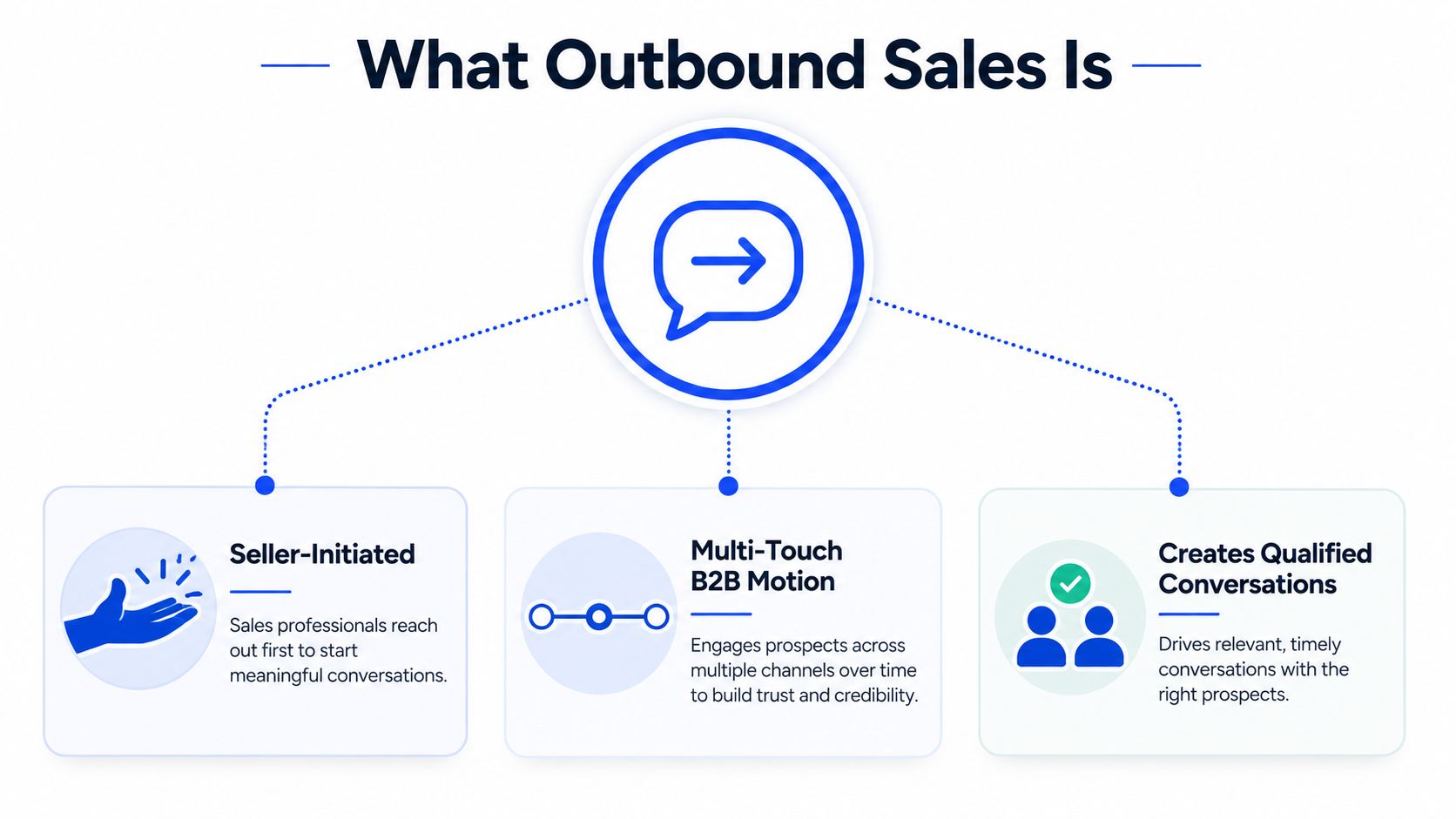
Outbound sales is the work of reaching selected accounts first, then creating a qualified conversation through relevant, timely contact. It isn't a single call or a bulk email blast. It's a structured series of touches that links a real buyer signal to a specific message and a fast handoff.
Outbound sales is like fishing the run. Bad outbound casts a net across the whole ocean and drags for scraps. Good outbound waits where the fish are moving, uses the right bait, and acts when the water says the moment is right.
The three parts that matter
The first part is the right person. That means account fit, contact fit, and enough context to know the buyer can own the problem. The second is the right message, which should speak to a trigger, a pain point, or a change the prospect can recognize.
The third is the right moment. Timing usually comes from signals like hiring, funding, tech changes, or active intent. When the moment is wrong, even a strong message gets ignored.
A perfect message sent to a perfect-fit account at the wrong time still loses. Timing is the multiplier.
Outbound differs from old-school cold calling and mass email. Cold calling is one channel. Mass email is one tactic. Outbound is the system that coordinates channels, sequence order, and response handling so the buyer experience feels relevant instead of random.
For a glossary-style reference on the category, see GROU's outbound glossary. The useful takeaway is simple. When outbound is built around signals, sequencing, and routing, it stops behaving like a volume channel and starts acting like a pipeline engine.
When Outbound Sales Beats Inbound
Outbound and inbound solve different problems, and the mistake is pretending they're interchangeable. Outbound is the right motion when you already know the accounts, the segment, or the market wedge you want, and you can't wait for demand to show up on its own. Inbound is better when the market already knows the problem and content can compound around it.
Outbound vs Inbound when each wins
Dimension | Outbound Sales | Inbound Sales |
|---|---|---|
Control over targeting | High, you choose the account list | Lower, you wait for demand to arrive |
Speed to first conversation | Usually faster when signals are active | Depends on traffic and content momentum |
Best use case | New market entry, named accounts, complex deals | Existing demand, SEO, content-led capture |
Dependence on brand | Lower | Higher |
Role in pipeline | Creates demand where none exists | Captures demand already in motion |
The rule of thumb is straightforward. If you're launching a new product, entering a new vertical, or selling into a named account list, outbound should lead. If the market is already searching and your content is compounding, inbound can carry more of the load.
A hybrid motion is usually the cleanest answer for B2B teams. Demand generation captures existing intent, while a signal-led outbound system creates demand around strategic accounts that haven't raised their hand yet. That matters in iGaming, SaaS, manufacturing, legal tech, and pharma, where account selection and timing can matter more than broad awareness.
Outbound also supports demand generation in specific ways. It can reactivate closed-lost accounts, reopen stalled opportunities, and expand into divisions of current customers. That's especially useful when a sales team needs control, not just traffic.
If you need a quarter-by-quarter decision rule, use this: choose outbound as the primary motion when the list is known, the trigger is visible, and the buyer isn't coming inbound fast enough. Choose inbound as the primary motion when search demand and content already bring in enough qualified interest to fill pipeline.
How the Outbound Engine Works

A working outbound engine has five stages, and each one either sharpens the system or weakens it. The first stage is closed-won analysis. Pull the last ten deals, look for firmographic overlap, and identify the trigger pattern that kept showing up before the win.
The second stage is data infrastructure. Clean CRM records, verified contacts, and enrichment are what make the rest of the motion credible. If your list is incomplete, the sequence will still run, but it'll run on guesswork.
Sequencing is a controlled experiment
The third stage is sequencing. Keep it controlled, not endless. A seven-step, fourteen-day cap is a practical starting point for many teams, with email, LinkedIn, and call coordinated instead of fired in isolation.
Use stop conditions aggressively. If a prospect replies, changes jobs, or shows a clear negative signal, the sequence should stop or branch immediately. Tools like Apollo, Clay, Lemlist, Instantly, Smartlead, HeyReach, HubSpot, and Sales Navigator all matter less than the discipline of the workflow.
For teams comparing tooling, this roundup of best tools for smarter outreach is a useful way to pressure-test the stack before adding another app. The point isn't more software. The point is tighter execution.
The fourth stage is qualification. A response doesn't count unless it clears a real bar, whether you use BANT, MEDDIC, or a lighter custom framework. The fifth stage is routing, where any positive signal reaches a human within two minutes during business hours.
Fast routing matters because a hot reply cools quickly when it sits in an inbox.
A useful internal reference for this workflow is GROU's outbound sales automation guide. Keep the feedback loop closed too, because win data should flow back into targeting and message design, not sit in a report no one reads.
Why Undifferentiated Outbound Keeps Failing
The most common myth is that outbound is dead. What's dead is the bloated version, the one that tries to brute-force attention with generic sends and stale lists. That model keeps failing because it confuses activity with precision.
A second myth is that AI replaces the rep. It doesn't. AI is useful for enrichment, mid-tier personalization, research summaries, and send-time support, but humans still need to own account selection, message strategy, and the conversation when the buyer answers.
Precision beats scale when the list is small enough to matter
A 200-account list built from hiring signals, technology installs, and funding events will usually beat a 5,000-contact cold scrape because it has a reason to exist. The smaller list gets sharper context, better timing, and more relevant messaging. The larger list mostly adds noise.
That's why the best outbound programs often send fewer messages than the mediocre ones they replace. The lift comes from fit and relevance, not from stuffing more names into a sequence. The right segment also makes it easier to keep feedback clean, because you can see which trigger mattered.
AI should sit in the middle of the process, not at the top. It can help draft first-pass personalization and assemble pre-meeting notes, while humans judge whether the account is worth the contact. That split keeps the machine useful without letting it become lazy.
If AI writes the message but humans never edit the target list, you've automated the wrong layer.
The third myth is that more volume fixes weak results. It usually does the opposite. Undifferentiated outbound teaches the market to ignore you faster, while differentiated outbound earns attention because the message matches the moment.
The standard is simple. If your list is sharper, your timing is better, and your routing is faster, outbound doesn't feel dead at all. It starts looking like a disciplined system instead of a noisy channel.
Outbound Sales KPIs That Prove ROI
A serious outbound program needs layered measurement. Leading indicators tell you the machine is healthy before revenue lands. Middle metrics tell you whether real conversations are happening. Lagging metrics prove the motion paid.
The dashboard that keeps you honest
Layer | Metric | Benchmark | Target |
|---|---|---|---|
Leading | Data accuracy rate | Above 90 percent | Keep it above 90 percent |
Leading | Sequence health | Watch step-to-step dropoff | Minimal loss between steps |
Middle | Reply rate | About 3 to 7 percent on cold segments | Improve through targeting and relevance |
Middle | Positive reply rate | Track separately from all replies | Separate interest from objections |
Middle | Meeting set rate | About 0.5 to 1.5 percent on cold segments | Hold a strict qualification bar |
Lagging | Opportunity value | Source by source | Tie to qualified opportunities |
Lagging | Win rate by source | Compare across channels | Let source quality show up |
Lagging | Pipeline velocity | Deals × deal value × conversion ÷ cycle length | Increase qualified flow |
A useful composite is the Sequence Quality Index. Weight positive reply rate, speed to lead, and qualification accuracy against revenue impact, then use that score to compare campaigns. It stops teams from cherry-picking whichever metric looked nice this week.
Reply rate alone is a weak scoreboard. A campaign can attract noise and still look active. That's why the middle layer matters, especially if the team cares about held meetings and pipeline quality rather than vanity replies.
The lead generation KPIs guide is a good companion if your RevOps team needs a cleaner measurement map. The practical version is this, track the fast signals, but steer by the metrics that show qualified pipeline getting created.
Practical rule: if meetings are booking but opportunities aren't forming, the qualification gate is too loose.
A healthy dashboard should connect early signals to closed-won revenue without pretending every reply matters. That's the difference between reporting activity and proving ROI.
What a Qualified Outbound Conversation Looks Like
The cleanest example is a B2B SaaS customer success program. The team started by reverse-engineering closed-won deals from the prior year, then found a clear expansion pattern around accounts that had adopted onboarding playbooks. That pointed them to customer success as the right vertical, not a broad list of SaaS leaders.
They built a 220-account list and validated it against three triggers, active hiring for CS roles, funding published within 90 days, and presence on G2 shortlists. The sequence ran five touches over twelve days, and each touch was based on an observed signal rather than a generic product pitch.
The five touches that created the first conversation
The opener referenced a public artifact tied to the account's actual motion. The follow-up framed a problem question. The third email asked a peer-level question. The fourth used a short Loom tied to the prospect's onboarding page. The fifth was a breakup note.
A qualified meeting only counted if it cleared the routing and qualification gate. A reply reached a human within two minutes during business hours, and the triage tree separated a CS Ops leader, a Head of CS, or a non-buyer in under thirty seconds. That speed kept the first response warm enough to book.
The result was the first qualified conversation inside the first month, which is exactly what a good outbound system should produce when the market is reachable. A useful internal reference for that bar is GROU's qualified meeting glossary.
The important part isn't the email itself. It's the sequence of choices behind it. The list was narrow, the message matched the trigger, and the handoff was fast enough to preserve intent.
That same customer later reached a €68k close in 47 days, but the key lesson is earlier than revenue. Qualified conversations come from validated signals, not from hoping a broad sequence eventually finds interest.
Build a Pipeline System That Compounds
Friday is for the audit. Check list decay, response time by channel, message-market fit, and pipeline velocity by stage. If any of those are slipping, the system needs tightening before the next send.
Monday is for action. Tighten the ICP, rebuild three signal segments, launch one controlled test, and update routing SLAs so replies don't sit. If you need more ideas for the channel mix around that system, WaveGen.ai's lead generation approaches are worth comparing against your current motion.
The compounding loop
Each cycle should feed learning back into targeting and message design. That means the list gets cleaner, the routing gets faster, and the sequence gets more relevant with every pass. Over four to eight weeks, the motion starts to feel less like campaign management and more like an operating system.
GROU sits in that orchestration layer for teams that want LinkedIn content, lead generation, and outbound to behave like one revenue machine instead of disconnected tasks. The methodology is simple, fewer and better-timed touches that reach the right buyer beat high-volume generic sequences.
If outbound still feels noisy, add structure before adding volume. Audit your meeting-held rate this Friday, then rebuild one signal-led sequence on Monday and watch how the pipeline changes.
GROU builds outbound systems that turn targeted accounts into qualified conversations, with LinkedIn content, lead generation, and reply routing working as one pipeline motion. Visit Grou if you want a team that runs the targeting, sequencing, and qualification work with a global delivery model and a clear revenue focus.
Outbound sales is a seller-initiated, multi-touch B2B motion that creates qualified conversations by reaching selected accounts with relevant messages at the right moment. In modern outbound, 196,470 prospects, 443,209 outbound calls, 146,832 emails delivered, and 142,800 LinkedIn tasks produced 39,679 booked meetings and 34,336 held meetings, with 3.36 touches per prospect and a 16.06% meeting conversion rate. State of Outbound 2026 shows the work is already a system, not a single send.
Your pipeline problem is usually subtraction, not effort. The team keeps adding contacts while ignoring fit, timing, and routing.
Outbound beats inbound when demand is missing or account-specific. That's true in new markets, target-account motions, and complex sales cycles.
Replies are cheap. Qualified conversations are what matter. A working system routes, filters, and books fast.
Timing changes the outcome more than raw volume. Signal-led outreach consistently outperforms timer-based sending.
If your team is sending more and converting less, the issue usually isn't activity. It's that the machine is built to spray, not select.
Table of Contents
Why Your Outbound Pipeline Is Not Converting
A sales leader opens the dashboard and sees a familiar mess. The team sent thousands of emails, booked a handful of meetings, and somehow created almost no real pipeline. That usually means the motion is busy, but not directional.
The first leak is list building. Teams keep adding contacts without removing poor-fit accounts, so every new sequence gets diluted before it starts. The second leak is timing, because copy-paste sequences hit accounts with no live trigger and no reason to respond.
The four failures that show up first
Practical rule: if a prospect doesn't fit, doesn't feel the problem, or doesn't get routed fast, the sequence was never really live.
Weak targeting creates low response before a rep even writes the first line. Slow routing kills the few hot replies that do arrive. Measurement then hides the failure, because the dashboard celebrates opens or raw sends instead of qualified meetings and held conversations.
Outbound works better when the team treats it like a subtraction system. You remove bad-fit accounts, remove stale assumptions, and remove delays between signal and response. That's the operating mindset behind a real pipeline engine.
The delivery side matters too. If inboxes, domains, and sending patterns are unhealthy, the rest of the motion becomes unreliable. A practical deliverability checklist belongs in any outbound system, and this email deliverability guide is the kind of operational reference that keeps the channel from breaking under its own weight.
What the dashboard should be telling you
Most failing teams still stop at activity. They report sends, maybe replies, and then wonder why revenue didn't follow. That misses the point, because outbound only pays when the sequence, the list, and the routing all work together.
A better frame is simple. Ask whether your targeting is narrow enough, whether your message matches a visible trigger, and whether a positive reply reaches a human before the buyer cools off. If any one of those is weak, volume just magnifies the flaw.
What Outbound Sales Actually Is
Outbound sales is the work of reaching selected accounts first, then creating a qualified conversation through relevant, timely contact. It isn't a single call or a bulk email blast. It's a structured series of touches that links a real buyer signal to a specific message and a fast handoff.
Outbound sales is like fishing the run. Bad outbound casts a net across the whole ocean and drags for scraps. Good outbound waits where the fish are moving, uses the right bait, and acts when the water says the moment is right.
The three parts that matter
The first part is the right person. That means account fit, contact fit, and enough context to know the buyer can own the problem. The second is the right message, which should speak to a trigger, a pain point, or a change the prospect can recognize.
The third is the right moment. Timing usually comes from signals like hiring, funding, tech changes, or active intent. When the moment is wrong, even a strong message gets ignored.
A perfect message sent to a perfect-fit account at the wrong time still loses. Timing is the multiplier.
Outbound differs from old-school cold calling and mass email. Cold calling is one channel. Mass email is one tactic. Outbound is the system that coordinates channels, sequence order, and response handling so the buyer experience feels relevant instead of random.
For a glossary-style reference on the category, see GROU's outbound glossary. The useful takeaway is simple. When outbound is built around signals, sequencing, and routing, it stops behaving like a volume channel and starts acting like a pipeline engine.
When Outbound Sales Beats Inbound
Outbound and inbound solve different problems, and the mistake is pretending they're interchangeable. Outbound is the right motion when you already know the accounts, the segment, or the market wedge you want, and you can't wait for demand to show up on its own. Inbound is better when the market already knows the problem and content can compound around it.
Outbound vs Inbound when each wins
Dimension | Outbound Sales | Inbound Sales |
|---|---|---|
Control over targeting | High, you choose the account list | Lower, you wait for demand to arrive |
Speed to first conversation | Usually faster when signals are active | Depends on traffic and content momentum |
Best use case | New market entry, named accounts, complex deals | Existing demand, SEO, content-led capture |
Dependence on brand | Lower | Higher |
Role in pipeline | Creates demand where none exists | Captures demand already in motion |
The rule of thumb is straightforward. If you're launching a new product, entering a new vertical, or selling into a named account list, outbound should lead. If the market is already searching and your content is compounding, inbound can carry more of the load.
A hybrid motion is usually the cleanest answer for B2B teams. Demand generation captures existing intent, while a signal-led outbound system creates demand around strategic accounts that haven't raised their hand yet. That matters in iGaming, SaaS, manufacturing, legal tech, and pharma, where account selection and timing can matter more than broad awareness.
Outbound also supports demand generation in specific ways. It can reactivate closed-lost accounts, reopen stalled opportunities, and expand into divisions of current customers. That's especially useful when a sales team needs control, not just traffic.
If you need a quarter-by-quarter decision rule, use this: choose outbound as the primary motion when the list is known, the trigger is visible, and the buyer isn't coming inbound fast enough. Choose inbound as the primary motion when search demand and content already bring in enough qualified interest to fill pipeline.
How the Outbound Engine Works
A working outbound engine has five stages, and each one either sharpens the system or weakens it. The first stage is closed-won analysis. Pull the last ten deals, look for firmographic overlap, and identify the trigger pattern that kept showing up before the win.
The second stage is data infrastructure. Clean CRM records, verified contacts, and enrichment are what make the rest of the motion credible. If your list is incomplete, the sequence will still run, but it'll run on guesswork.
Sequencing is a controlled experiment
The third stage is sequencing. Keep it controlled, not endless. A seven-step, fourteen-day cap is a practical starting point for many teams, with email, LinkedIn, and call coordinated instead of fired in isolation.
Use stop conditions aggressively. If a prospect replies, changes jobs, or shows a clear negative signal, the sequence should stop or branch immediately. Tools like Apollo, Clay, Lemlist, Instantly, Smartlead, HeyReach, HubSpot, and Sales Navigator all matter less than the discipline of the workflow.
For teams comparing tooling, this roundup of best tools for smarter outreach is a useful way to pressure-test the stack before adding another app. The point isn't more software. The point is tighter execution.
The fourth stage is qualification. A response doesn't count unless it clears a real bar, whether you use BANT, MEDDIC, or a lighter custom framework. The fifth stage is routing, where any positive signal reaches a human within two minutes during business hours.
Fast routing matters because a hot reply cools quickly when it sits in an inbox.
A useful internal reference for this workflow is GROU's outbound sales automation guide. Keep the feedback loop closed too, because win data should flow back into targeting and message design, not sit in a report no one reads.
Why Undifferentiated Outbound Keeps Failing
The most common myth is that outbound is dead. What's dead is the bloated version, the one that tries to brute-force attention with generic sends and stale lists. That model keeps failing because it confuses activity with precision.
A second myth is that AI replaces the rep. It doesn't. AI is useful for enrichment, mid-tier personalization, research summaries, and send-time support, but humans still need to own account selection, message strategy, and the conversation when the buyer answers.
Precision beats scale when the list is small enough to matter
A 200-account list built from hiring signals, technology installs, and funding events will usually beat a 5,000-contact cold scrape because it has a reason to exist. The smaller list gets sharper context, better timing, and more relevant messaging. The larger list mostly adds noise.
That's why the best outbound programs often send fewer messages than the mediocre ones they replace. The lift comes from fit and relevance, not from stuffing more names into a sequence. The right segment also makes it easier to keep feedback clean, because you can see which trigger mattered.
AI should sit in the middle of the process, not at the top. It can help draft first-pass personalization and assemble pre-meeting notes, while humans judge whether the account is worth the contact. That split keeps the machine useful without letting it become lazy.
If AI writes the message but humans never edit the target list, you've automated the wrong layer.
The third myth is that more volume fixes weak results. It usually does the opposite. Undifferentiated outbound teaches the market to ignore you faster, while differentiated outbound earns attention because the message matches the moment.
The standard is simple. If your list is sharper, your timing is better, and your routing is faster, outbound doesn't feel dead at all. It starts looking like a disciplined system instead of a noisy channel.
Outbound Sales KPIs That Prove ROI
A serious outbound program needs layered measurement. Leading indicators tell you the machine is healthy before revenue lands. Middle metrics tell you whether real conversations are happening. Lagging metrics prove the motion paid.
The dashboard that keeps you honest
Layer | Metric | Benchmark | Target |
|---|---|---|---|
Leading | Data accuracy rate | Above 90 percent | Keep it above 90 percent |
Leading | Sequence health | Watch step-to-step dropoff | Minimal loss between steps |
Middle | Reply rate | About 3 to 7 percent on cold segments | Improve through targeting and relevance |
Middle | Positive reply rate | Track separately from all replies | Separate interest from objections |
Middle | Meeting set rate | About 0.5 to 1.5 percent on cold segments | Hold a strict qualification bar |
Lagging | Opportunity value | Source by source | Tie to qualified opportunities |
Lagging | Win rate by source | Compare across channels | Let source quality show up |
Lagging | Pipeline velocity | Deals × deal value × conversion ÷ cycle length | Increase qualified flow |
A useful composite is the Sequence Quality Index. Weight positive reply rate, speed to lead, and qualification accuracy against revenue impact, then use that score to compare campaigns. It stops teams from cherry-picking whichever metric looked nice this week.
Reply rate alone is a weak scoreboard. A campaign can attract noise and still look active. That's why the middle layer matters, especially if the team cares about held meetings and pipeline quality rather than vanity replies.
The lead generation KPIs guide is a good companion if your RevOps team needs a cleaner measurement map. The practical version is this, track the fast signals, but steer by the metrics that show qualified pipeline getting created.
Practical rule: if meetings are booking but opportunities aren't forming, the qualification gate is too loose.
A healthy dashboard should connect early signals to closed-won revenue without pretending every reply matters. That's the difference between reporting activity and proving ROI.
What a Qualified Outbound Conversation Looks Like
The cleanest example is a B2B SaaS customer success program. The team started by reverse-engineering closed-won deals from the prior year, then found a clear expansion pattern around accounts that had adopted onboarding playbooks. That pointed them to customer success as the right vertical, not a broad list of SaaS leaders.
They built a 220-account list and validated it against three triggers, active hiring for CS roles, funding published within 90 days, and presence on G2 shortlists. The sequence ran five touches over twelve days, and each touch was based on an observed signal rather than a generic product pitch.
The five touches that created the first conversation
The opener referenced a public artifact tied to the account's actual motion. The follow-up framed a problem question. The third email asked a peer-level question. The fourth used a short Loom tied to the prospect's onboarding page. The fifth was a breakup note.
A qualified meeting only counted if it cleared the routing and qualification gate. A reply reached a human within two minutes during business hours, and the triage tree separated a CS Ops leader, a Head of CS, or a non-buyer in under thirty seconds. That speed kept the first response warm enough to book.
The result was the first qualified conversation inside the first month, which is exactly what a good outbound system should produce when the market is reachable. A useful internal reference for that bar is GROU's qualified meeting glossary.
The important part isn't the email itself. It's the sequence of choices behind it. The list was narrow, the message matched the trigger, and the handoff was fast enough to preserve intent.
That same customer later reached a €68k close in 47 days, but the key lesson is earlier than revenue. Qualified conversations come from validated signals, not from hoping a broad sequence eventually finds interest.
Build a Pipeline System That Compounds
Friday is for the audit. Check list decay, response time by channel, message-market fit, and pipeline velocity by stage. If any of those are slipping, the system needs tightening before the next send.
Monday is for action. Tighten the ICP, rebuild three signal segments, launch one controlled test, and update routing SLAs so replies don't sit. If you need more ideas for the channel mix around that system, WaveGen.ai's lead generation approaches are worth comparing against your current motion.
The compounding loop
Each cycle should feed learning back into targeting and message design. That means the list gets cleaner, the routing gets faster, and the sequence gets more relevant with every pass. Over four to eight weeks, the motion starts to feel less like campaign management and more like an operating system.
GROU sits in that orchestration layer for teams that want LinkedIn content, lead generation, and outbound to behave like one revenue machine instead of disconnected tasks. The methodology is simple, fewer and better-timed touches that reach the right buyer beat high-volume generic sequences.
If outbound still feels noisy, add structure before adding volume. Audit your meeting-held rate this Friday, then rebuild one signal-led sequence on Monday and watch how the pipeline changes.
GROU builds outbound systems that turn targeted accounts into qualified conversations, with LinkedIn content, lead generation, and reply routing working as one pipeline motion. Visit Grou if you want a team that runs the targeting, sequencing, and qualification work with a global delivery model and a clear revenue focus.
Outbound sales is a seller-initiated, multi-touch B2B motion that creates qualified conversations by reaching selected accounts with relevant messages at the right moment. In modern outbound, 196,470 prospects, 443,209 outbound calls, 146,832 emails delivered, and 142,800 LinkedIn tasks produced 39,679 booked meetings and 34,336 held meetings, with 3.36 touches per prospect and a 16.06% meeting conversion rate. State of Outbound 2026 shows the work is already a system, not a single send.
Your pipeline problem is usually subtraction, not effort. The team keeps adding contacts while ignoring fit, timing, and routing.
Outbound beats inbound when demand is missing or account-specific. That's true in new markets, target-account motions, and complex sales cycles.
Replies are cheap. Qualified conversations are what matter. A working system routes, filters, and books fast.
Timing changes the outcome more than raw volume. Signal-led outreach consistently outperforms timer-based sending.
If your team is sending more and converting less, the issue usually isn't activity. It's that the machine is built to spray, not select.
Table of Contents
Why Your Outbound Pipeline Is Not Converting
A sales leader opens the dashboard and sees a familiar mess. The team sent thousands of emails, booked a handful of meetings, and somehow created almost no real pipeline. That usually means the motion is busy, but not directional.
The first leak is list building. Teams keep adding contacts without removing poor-fit accounts, so every new sequence gets diluted before it starts. The second leak is timing, because copy-paste sequences hit accounts with no live trigger and no reason to respond.
The four failures that show up first
Practical rule: if a prospect doesn't fit, doesn't feel the problem, or doesn't get routed fast, the sequence was never really live.
Weak targeting creates low response before a rep even writes the first line. Slow routing kills the few hot replies that do arrive. Measurement then hides the failure, because the dashboard celebrates opens or raw sends instead of qualified meetings and held conversations.
Outbound works better when the team treats it like a subtraction system. You remove bad-fit accounts, remove stale assumptions, and remove delays between signal and response. That's the operating mindset behind a real pipeline engine.
The delivery side matters too. If inboxes, domains, and sending patterns are unhealthy, the rest of the motion becomes unreliable. A practical deliverability checklist belongs in any outbound system, and this email deliverability guide is the kind of operational reference that keeps the channel from breaking under its own weight.
What the dashboard should be telling you
Most failing teams still stop at activity. They report sends, maybe replies, and then wonder why revenue didn't follow. That misses the point, because outbound only pays when the sequence, the list, and the routing all work together.
A better frame is simple. Ask whether your targeting is narrow enough, whether your message matches a visible trigger, and whether a positive reply reaches a human before the buyer cools off. If any one of those is weak, volume just magnifies the flaw.
What Outbound Sales Actually Is
Outbound sales is the work of reaching selected accounts first, then creating a qualified conversation through relevant, timely contact. It isn't a single call or a bulk email blast. It's a structured series of touches that links a real buyer signal to a specific message and a fast handoff.
Outbound sales is like fishing the run. Bad outbound casts a net across the whole ocean and drags for scraps. Good outbound waits where the fish are moving, uses the right bait, and acts when the water says the moment is right.
The three parts that matter
The first part is the right person. That means account fit, contact fit, and enough context to know the buyer can own the problem. The second is the right message, which should speak to a trigger, a pain point, or a change the prospect can recognize.
The third is the right moment. Timing usually comes from signals like hiring, funding, tech changes, or active intent. When the moment is wrong, even a strong message gets ignored.
A perfect message sent to a perfect-fit account at the wrong time still loses. Timing is the multiplier.
Outbound differs from old-school cold calling and mass email. Cold calling is one channel. Mass email is one tactic. Outbound is the system that coordinates channels, sequence order, and response handling so the buyer experience feels relevant instead of random.
For a glossary-style reference on the category, see GROU's outbound glossary. The useful takeaway is simple. When outbound is built around signals, sequencing, and routing, it stops behaving like a volume channel and starts acting like a pipeline engine.
When Outbound Sales Beats Inbound
Outbound and inbound solve different problems, and the mistake is pretending they're interchangeable. Outbound is the right motion when you already know the accounts, the segment, or the market wedge you want, and you can't wait for demand to show up on its own. Inbound is better when the market already knows the problem and content can compound around it.
Outbound vs Inbound when each wins
Dimension | Outbound Sales | Inbound Sales |
|---|---|---|
Control over targeting | High, you choose the account list | Lower, you wait for demand to arrive |
Speed to first conversation | Usually faster when signals are active | Depends on traffic and content momentum |
Best use case | New market entry, named accounts, complex deals | Existing demand, SEO, content-led capture |
Dependence on brand | Lower | Higher |
Role in pipeline | Creates demand where none exists | Captures demand already in motion |
The rule of thumb is straightforward. If you're launching a new product, entering a new vertical, or selling into a named account list, outbound should lead. If the market is already searching and your content is compounding, inbound can carry more of the load.
A hybrid motion is usually the cleanest answer for B2B teams. Demand generation captures existing intent, while a signal-led outbound system creates demand around strategic accounts that haven't raised their hand yet. That matters in iGaming, SaaS, manufacturing, legal tech, and pharma, where account selection and timing can matter more than broad awareness.
Outbound also supports demand generation in specific ways. It can reactivate closed-lost accounts, reopen stalled opportunities, and expand into divisions of current customers. That's especially useful when a sales team needs control, not just traffic.
If you need a quarter-by-quarter decision rule, use this: choose outbound as the primary motion when the list is known, the trigger is visible, and the buyer isn't coming inbound fast enough. Choose inbound as the primary motion when search demand and content already bring in enough qualified interest to fill pipeline.
How the Outbound Engine Works
A working outbound engine has five stages, and each one either sharpens the system or weakens it. The first stage is closed-won analysis. Pull the last ten deals, look for firmographic overlap, and identify the trigger pattern that kept showing up before the win.
The second stage is data infrastructure. Clean CRM records, verified contacts, and enrichment are what make the rest of the motion credible. If your list is incomplete, the sequence will still run, but it'll run on guesswork.
Sequencing is a controlled experiment
The third stage is sequencing. Keep it controlled, not endless. A seven-step, fourteen-day cap is a practical starting point for many teams, with email, LinkedIn, and call coordinated instead of fired in isolation.
Use stop conditions aggressively. If a prospect replies, changes jobs, or shows a clear negative signal, the sequence should stop or branch immediately. Tools like Apollo, Clay, Lemlist, Instantly, Smartlead, HeyReach, HubSpot, and Sales Navigator all matter less than the discipline of the workflow.
For teams comparing tooling, this roundup of best tools for smarter outreach is a useful way to pressure-test the stack before adding another app. The point isn't more software. The point is tighter execution.
The fourth stage is qualification. A response doesn't count unless it clears a real bar, whether you use BANT, MEDDIC, or a lighter custom framework. The fifth stage is routing, where any positive signal reaches a human within two minutes during business hours.
Fast routing matters because a hot reply cools quickly when it sits in an inbox.
A useful internal reference for this workflow is GROU's outbound sales automation guide. Keep the feedback loop closed too, because win data should flow back into targeting and message design, not sit in a report no one reads.
Why Undifferentiated Outbound Keeps Failing
The most common myth is that outbound is dead. What's dead is the bloated version, the one that tries to brute-force attention with generic sends and stale lists. That model keeps failing because it confuses activity with precision.
A second myth is that AI replaces the rep. It doesn't. AI is useful for enrichment, mid-tier personalization, research summaries, and send-time support, but humans still need to own account selection, message strategy, and the conversation when the buyer answers.
Precision beats scale when the list is small enough to matter
A 200-account list built from hiring signals, technology installs, and funding events will usually beat a 5,000-contact cold scrape because it has a reason to exist. The smaller list gets sharper context, better timing, and more relevant messaging. The larger list mostly adds noise.
That's why the best outbound programs often send fewer messages than the mediocre ones they replace. The lift comes from fit and relevance, not from stuffing more names into a sequence. The right segment also makes it easier to keep feedback clean, because you can see which trigger mattered.
AI should sit in the middle of the process, not at the top. It can help draft first-pass personalization and assemble pre-meeting notes, while humans judge whether the account is worth the contact. That split keeps the machine useful without letting it become lazy.
If AI writes the message but humans never edit the target list, you've automated the wrong layer.
The third myth is that more volume fixes weak results. It usually does the opposite. Undifferentiated outbound teaches the market to ignore you faster, while differentiated outbound earns attention because the message matches the moment.
The standard is simple. If your list is sharper, your timing is better, and your routing is faster, outbound doesn't feel dead at all. It starts looking like a disciplined system instead of a noisy channel.
Outbound Sales KPIs That Prove ROI
A serious outbound program needs layered measurement. Leading indicators tell you the machine is healthy before revenue lands. Middle metrics tell you whether real conversations are happening. Lagging metrics prove the motion paid.
The dashboard that keeps you honest
Layer | Metric | Benchmark | Target |
|---|---|---|---|
Leading | Data accuracy rate | Above 90 percent | Keep it above 90 percent |
Leading | Sequence health | Watch step-to-step dropoff | Minimal loss between steps |
Middle | Reply rate | About 3 to 7 percent on cold segments | Improve through targeting and relevance |
Middle | Positive reply rate | Track separately from all replies | Separate interest from objections |
Middle | Meeting set rate | About 0.5 to 1.5 percent on cold segments | Hold a strict qualification bar |
Lagging | Opportunity value | Source by source | Tie to qualified opportunities |
Lagging | Win rate by source | Compare across channels | Let source quality show up |
Lagging | Pipeline velocity | Deals × deal value × conversion ÷ cycle length | Increase qualified flow |
A useful composite is the Sequence Quality Index. Weight positive reply rate, speed to lead, and qualification accuracy against revenue impact, then use that score to compare campaigns. It stops teams from cherry-picking whichever metric looked nice this week.
Reply rate alone is a weak scoreboard. A campaign can attract noise and still look active. That's why the middle layer matters, especially if the team cares about held meetings and pipeline quality rather than vanity replies.
The lead generation KPIs guide is a good companion if your RevOps team needs a cleaner measurement map. The practical version is this, track the fast signals, but steer by the metrics that show qualified pipeline getting created.
Practical rule: if meetings are booking but opportunities aren't forming, the qualification gate is too loose.
A healthy dashboard should connect early signals to closed-won revenue without pretending every reply matters. That's the difference between reporting activity and proving ROI.
What a Qualified Outbound Conversation Looks Like
The cleanest example is a B2B SaaS customer success program. The team started by reverse-engineering closed-won deals from the prior year, then found a clear expansion pattern around accounts that had adopted onboarding playbooks. That pointed them to customer success as the right vertical, not a broad list of SaaS leaders.
They built a 220-account list and validated it against three triggers, active hiring for CS roles, funding published within 90 days, and presence on G2 shortlists. The sequence ran five touches over twelve days, and each touch was based on an observed signal rather than a generic product pitch.
The five touches that created the first conversation
The opener referenced a public artifact tied to the account's actual motion. The follow-up framed a problem question. The third email asked a peer-level question. The fourth used a short Loom tied to the prospect's onboarding page. The fifth was a breakup note.
A qualified meeting only counted if it cleared the routing and qualification gate. A reply reached a human within two minutes during business hours, and the triage tree separated a CS Ops leader, a Head of CS, or a non-buyer in under thirty seconds. That speed kept the first response warm enough to book.
The result was the first qualified conversation inside the first month, which is exactly what a good outbound system should produce when the market is reachable. A useful internal reference for that bar is GROU's qualified meeting glossary.
The important part isn't the email itself. It's the sequence of choices behind it. The list was narrow, the message matched the trigger, and the handoff was fast enough to preserve intent.
That same customer later reached a €68k close in 47 days, but the key lesson is earlier than revenue. Qualified conversations come from validated signals, not from hoping a broad sequence eventually finds interest.
Build a Pipeline System That Compounds
Friday is for the audit. Check list decay, response time by channel, message-market fit, and pipeline velocity by stage. If any of those are slipping, the system needs tightening before the next send.
Monday is for action. Tighten the ICP, rebuild three signal segments, launch one controlled test, and update routing SLAs so replies don't sit. If you need more ideas for the channel mix around that system, WaveGen.ai's lead generation approaches are worth comparing against your current motion.
The compounding loop
Each cycle should feed learning back into targeting and message design. That means the list gets cleaner, the routing gets faster, and the sequence gets more relevant with every pass. Over four to eight weeks, the motion starts to feel less like campaign management and more like an operating system.
GROU sits in that orchestration layer for teams that want LinkedIn content, lead generation, and outbound to behave like one revenue machine instead of disconnected tasks. The methodology is simple, fewer and better-timed touches that reach the right buyer beat high-volume generic sequences.
If outbound still feels noisy, add structure before adding volume. Audit your meeting-held rate this Friday, then rebuild one signal-led sequence on Monday and watch how the pipeline changes.
GROU builds outbound systems that turn targeted accounts into qualified conversations, with LinkedIn content, lead generation, and reply routing working as one pipeline motion. Visit Grou if you want a team that runs the targeting, sequencing, and qualification work with a global delivery model and a clear revenue focus.
Pipeline OS Newsletter
Build qualified pipeline
Get weekly tactics to generate demand, improve lead quality, and book more meetings.






Trusted by industry leaders
Trusted by industry leaders
Trusted by industry leaders
Ready to build qualified pipeline?
Ready to build qualified pipeline?
Ready to build qualified pipeline?
Book a call to see if we're the right fit, or take the 2-minute quiz to get a clear starting point.
Book a call to see if we're the right fit, or take the 2-minute quiz to get a clear starting point.
Book a call to see if we're the right fit, or take the 2-minute quiz to get a clear starting point.
" height="30.21639343089746px" id="hfGbXmQR2" width="30.216393430897455px"/></svg>)
Copyright © 2026 – All Right Reserved
Copyright © 2026 – All Right Reserved
Copyright © 2026 – All Right Reserved