%22%3E%3C/path%3E%3Cpath d=%22M 63.072 7.554 C 62.258 8.022 61.577 8.689 61.092 9.493 L 61.092 7.076 L 57.158 7.076 L 57.158 22.64 L 61.089 22.64 L 61.089 14.888 C 61.089 13.446 61.403 12.434 62.03 11.853 C 62.818 11.218 63.818 10.907 64.826 10.982 L 65.868 10.982 L 65.868 6.851 C 64.891 6.834 63.926 7.076 63.073 7.554 Z%22 fill=%22rgb(17,17,17)%22%3E%3C/path%3E%3Cpath d=%22M 78.916 7.82 C 76.363 6.49 73.321 6.49 70.768 7.82 C 69.562 8.473 68.564 9.451 67.888 10.644 C 67.167 11.931 66.803 13.387 66.834 14.862 C 66.804 16.332 67.157 17.785 67.86 19.077 C 68.515 20.267 69.494 21.246 70.684 21.901 C 71.924 22.576 73.318 22.92 74.73 22.898 C 76.164 22.918 77.58 22.575 78.846 21.901 C 80.062 21.247 81.073 20.27 81.768 19.077 C 82.506 17.797 82.88 16.339 82.85 14.862 C 82.88 13.389 82.517 11.934 81.797 10.647 C 81.12 9.455 80.122 8.477 78.917 7.824 M 78.803 14.862 C 78.829 15.739 78.636 16.608 78.241 17.391 C 77.903 18.046 77.38 18.588 76.738 18.95 C 76.124 19.293 75.432 19.472 74.729 19.47 C 73.668 19.497 72.648 19.061 71.934 18.276 C 71.139 17.323 70.741 16.1 70.823 14.862 C 70.741 13.62 71.149 12.395 71.959 11.45 C 72.687 10.667 73.715 10.233 74.783 10.256 C 75.859 10.236 76.894 10.67 77.635 11.45 C 78.464 12.387 78.884 13.616 78.801 14.864%22 fill=%22rgb(17,17,17)%22%3E%3C/path%3E%3Cpath d=%22M 95.906 7.076 L 95.906 15.646 C 95.975 16.68 95.643 17.701 94.979 18.498 C 94.311 19.184 93.379 19.547 92.422 19.495 C 91.475 19.544 90.553 19.18 89.894 18.498 C 89.23 17.701 88.898 16.68 88.967 15.646 L 88.967 7.076 L 85.033 7.076 L 85.033 16.207 C 85 17.449 85.275 18.68 85.834 19.79 C 86.327 20.75 87.095 21.542 88.039 22.065 C 89.033 22.594 90.145 22.861 91.271 22.838 C 92.188 22.847 93.095 22.65 93.926 22.263 C 94.708 21.905 95.388 21.36 95.906 20.675 L 95.906 22.645 L 99.865 22.645 L 99.865 7.076 Z%22 fill=%22rgb(17,17,17)%22%3E%3C/path%3E%3Cpath d=%22M 4.513 15.626 C 4.511 10.815 7.606 6.549 12.181 5.059 C 16.756 3.57 21.77 5.195 24.601 9.086 L 27.816 5.87 C 24.074 1.186 17.981 -0.943 12.137 0.393 C 6.292 1.728 1.728 6.292 0.393 12.137 C -0.943 17.981 1.186 24.074 5.87 27.816 L 9.085 24.601 C 6.214 22.512 4.515 19.177 4.513 15.626%22 fill=%22rgb(32,62,235)%22%3E%3C/path%3E%3Cpath d=%22M 17.114 14.343 L 13.354 18.01 L 13.354 18.026 L 21.071 18.026 L 11.412 27.609 L 17.389 27.609 L 23.999 21.081 L 23.999 28.316 L 24.005 28.316 L 27.967 24.393 L 27.967 14.343 Z%22 fill=%22rgb(32,62,235)%22%3E%3C/path%3E%3C/g%3E%3C/svg%3E) ×
× ××
××›
›
›
›
Outbound Sales Automation: Build a Predictable B2B Pipeline
Outbound Sales Automation: Build a Predictable B2B Pipeline
Outbound Sales Automation: Build a Predictable B2B Pipeline
Outbound Sales Automation: Build a Predictable B2B Pipeline
Outbound Sales Automation: Build a Predictable B2B Pipeline
Outbound Sales Automation: Build a Predictable B2B Pipeline

Author
Aljaz Peklaj

You already know the symptom set. Apollo is full, HubSpot is logging activity, Lemlist is sending, and reps are busy. But pipeline still feels handmade. Deals sit in proposal with no next step, outbound reply handling is inconsistent, and forecast calls turn into opinion contests.
That's usually not a tooling problem. It's a systems problem. Outbound sales automation only works when it enforces stage movement, response speed, qualification discipline, and clean handoffs. If it just sends more touches, it creates more activity than pipeline.
At the market level, this shift is already clear. Outbound automation has become a mainstream operating model, not a niche tactic, with the sales automation market estimated at $16 billion by 2025 and teams using end-to-end automation frameworks reporting 10–20% revenue growth and 15–30% shorter sales cycles, according to Cirrus Insight's sales automation statistics roundup.
Table of Contents
Your automation tools are working, but your pipeline is not
Most teams don't lack software. They lack rules.
You can buy Apollo for list building, Clay for enrichment, Lemlist or Instantly for outreach, HeyReach for LinkedIn, and HubSpot for CRM control. None of that fixes a pipeline where leads move stages without evidence, reps follow up when they remember, and nobody can explain why one deal stalled while another moved.
Key takeaways
Outbound sales automation is a process control system, not a sequencing feature
Every pipeline stage needs written exit criteria, or automation will push bad deals forward
Fast routing matters, but only if reply handling and ownership are clear
Metrics should focus on stage movement and velocity, not vanity engagement
Human judgment still belongs in complex deals, especially once buying committees form
Practical rule: If a deal has no calendar next step, it is already drifting, even if the CRM says it is active.
A lot of founders and revenue leaders are now exploring adjacent motions like using conversational agents for sales growth. That can help at the top of funnel, but the same rule applies. If the agent feeds an undefined sales process, you just create faster confusion.
The real failure point
The failure point is usually between activity and progression.
A rep sends touches across email and LinkedIn. A prospect replies. A call happens. Then the deal enters a grey zone where there's no written reason to advance, no agreed next step, and no enforcement layer in the CRM. That's where pipeline quality collapses.
This is why strong sales pipeline management matters more than adding another sender or enrichment source. Structure turns attention into pipeline. Without structure, outbound automation just makes the mess happen on schedule.
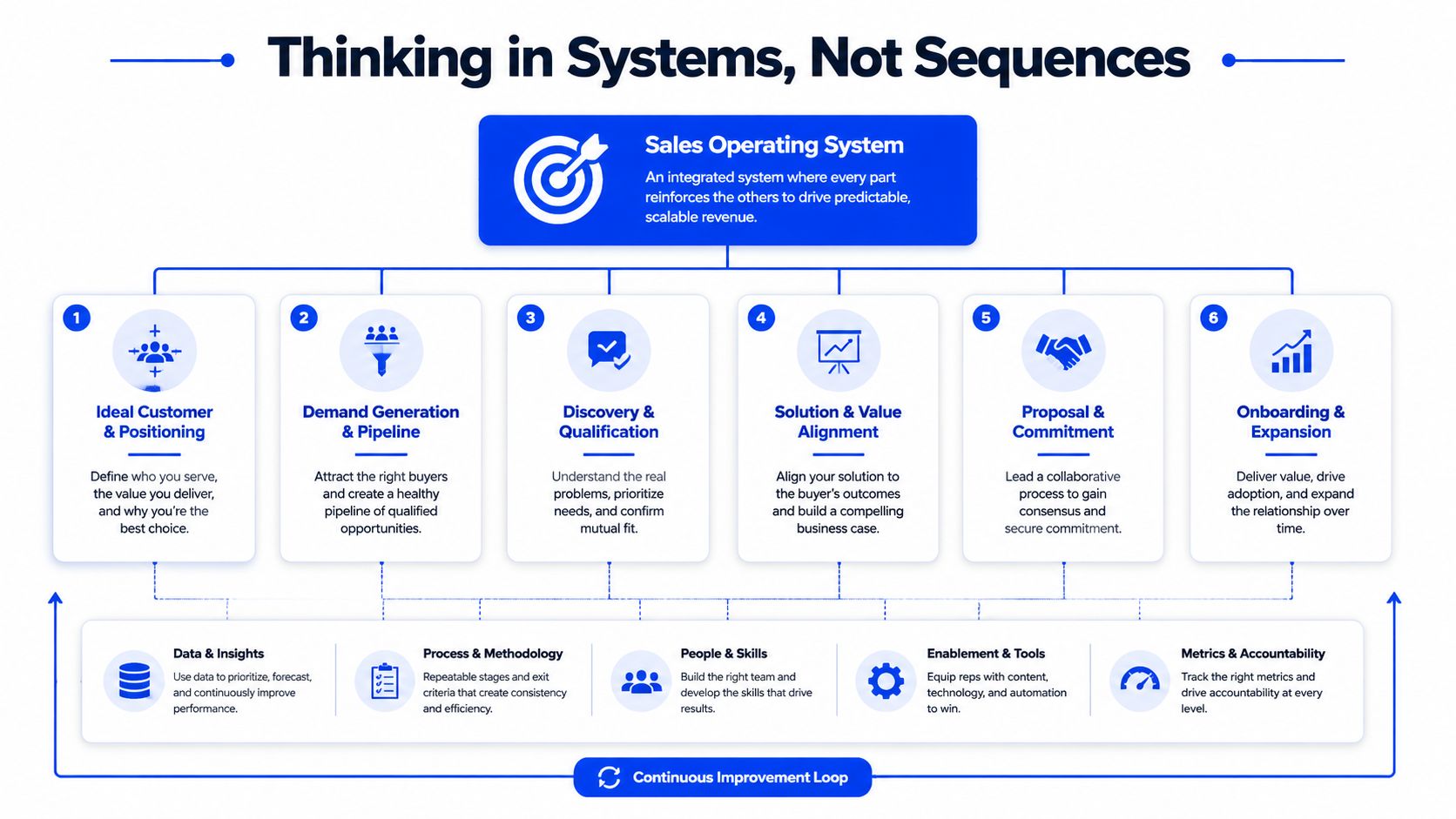
Thinking in systems, not sequences
Teams that get repeatable outbound results don't think in campaigns first. They think in operating rules.
That means the sequence is only one layer inside a broader sales operating system. The sequence creates contact. The system decides whether a lead can enter, move, pause, escalate, or get removed.
The six-stage operating model
The cleanest model I've seen for outbound sales automation is a six-stage pipeline with strict exit gates.
New lead
Source is captured, ICP fit is confirmed, and basic enrichment is complete.
Exit criterion: persona and company match the profile.Contacted
First touch is sent across at least two channels, usually email and LinkedIn.
Exit criterion: the prospect has opened, replied, or engaged in a measurable way.Qualified
Discovery is complete, pain is confirmed, and budget and timeline are within range.
Exit criterion: written notes capture why now, who decides, and what success looks like.Proposal
Custom scope is sent, pricing is presented, and decision criteria are agreed.
Exit criterion: the prospect acknowledges the proposal in writing.Negotiation
Contract is under review, objections are being worked through, and a mutual close plan exists.
Exit criterion: verbal yes and a start date are agreed.Closed
Contract is signed, kickoff is scheduled, and delivery handoff is done.
Exit criterion: invoice is paid.
Why exit criteria matter more than sequence volume
Most outbound stacks fail because the team automates contact before it standardizes progression.
If stage movement depends on rep interpretation, you'll get inflated pipeline, dirty forecasts, and stalled deals hiding in plain sight. A written gate fixes that. It tells the automation layer what to do next, and it tells managers when a deal is real.
Here's the trade-off. Strict stage gates can make your pipeline look smaller at first. That's healthy. A smaller, cleaner pipeline is easier to diagnose, route, and forecast than a bloated one full of maybe deals.
A deal should never move forward because someone “had a good conversation.” It should move because the required evidence exists in writing.
This also changes how you use automation. Instead of asking, “How do we send more?” the better question becomes, “What event should trigger movement, pause, nurture, or escalation?” That's the shift from sequence thinking to system thinking.
The five core components of a modern automation engine
A real automation engine isn't one product. It's a connected stack that moves a lead from target selection to rep handoff without losing context.

A useful way to think about the stack is this. Data picks who enters. Sequencing creates contact. Routing controls speed. Personalization raises relevance. CRM integration preserves truth.
1. Data foundation
Most outbound programs break at this point.
A modern outbound stack is built around targeting, enrichment, scoring, and sequencing, and signal-targeted accounts can convert at 2–4x the rate of cold-targeted accounts according to SyncGTM's guide to outbound sales automation. That tells you where the lift really comes from. Not more volume. Better timing and better fit.
In practice, this means building lists with tools like Sales Navigator, Apollo, and Clay around filters such as industry, employee count, geography, revenue band, and tech stack. Then you layer signals like job changes, funding, hiring surges, or tech adoption before anyone enters a sequence.
If you want a quick view of the tooling space, Grou keeps a workflow automation tools directory that maps this part of the stack alongside adjacent automation categories.
2. Adaptive sequencing
Static drip logic underperforms because it treats silence, curiosity, and active interest the same way.
Better systems run multi-channel plays across email, LinkedIn, and sometimes phone, then change the next action based on what happened. Opened but didn't reply. Connected on LinkedIn but ignored email. Replied with interest. Went dark after a first call. Each path should branch differently.
A practical baseline looks like this:
Situation | What the system should do |
|---|---|
No engagement | Continue sequence with spacing and channel variation |
Open or click | Shift timing, tighten CTA, prioritize rep review |
Any reply | Pause all automation immediately |
Post-call silence | Move into a deal recovery flow, not a prospecting flow |
3. Intelligent routing
Routing decides whether speed turns into revenue.
A lot of teams automate sending but still rely on manual inbox checks or Slack pings for replies. That delay kills momentum. The system should pause sequences on reply, attach the full contact and account context, assign the right owner, and put a follow-up task in front of the rep immediately.
The stack earns its keep by working together. HubSpot, Apollo, Instantly, Clay, and scheduling tools can function in harmony, but only if the ownership rules are explicit. One lead, one owner, one next step.
4. Personalization at scale
Real personalization is not {{first_name}} and “noticed your company is growing.”
Useful personalization comes from enriched fields and account context. Think recent hiring trend, role change, market expansion, a product motion visible on the site, or a specific operating constraint common to the segment. Clay can help assemble those variables. Apollo and Sales Navigator help validate who should receive the message. The writer still has to decide what matters.
Field rule: If a variable doesn't change the reason for outreach, it isn't personalization. It's decoration.
5. Closed-loop integration
If your sequencing tool, CRM, and enrichment layer disagree, your reporting is fiction.
Closed-loop integration means the source of truth lives in the CRM, and every touch, reply, stage change, owner assignment, and meeting outcome syncs back cleanly. HubSpot is often the control layer because it can hold lifecycle logic, stage rules, tasks, notes, and dashboards in one place.
That's also where teams decide whether to build internally or use an external operator. Some run the stack in-house with RevOps and SDR leadership. Others use agencies like Grou to run LinkedIn, targeting, and outbound inside one system while syncing pipeline outcomes back to the CRM. The right choice depends on internal capacity, not preference alone.
A 7-step checklist for implementing your automation system
Most outbound sales automation rollouts fail because teams skip from tool purchase to sequence launch. They don't define the control layer first.

Effective outbound sequences usually involve 5–7 touches over 2–3 weeks across email, LinkedIn, and phone, and automated systems can compress the path from first touch to qualified lead from 30–60 days to 10–20 days in manual-heavy environments, based on Woodpecker's outbound sales automation benchmarks. That only happens when setup is disciplined.
Implementation checklist
Define the six stages and exit criteria
Write the rule for entering and leaving each stage.
Definition of done: every stage has a written gate and every manager uses the same language to inspect it.Choose the core stack and connect it
Pick your CRM, data source, enrichment layer, sequencing tool, and LinkedIn motion. A typical stack is HubSpot + Apollo + Clay + Lemlist or Instantly + Sales Navigator + HeyReach.
Definition of done: one lead record can move from source to owner assignment without manual copying.Build ICP and persona-based lists
Start narrow. Industry, company size, geography, buying role, and exclusion rules should be explicit.
Definition of done: every imported contact can be traced to a list logic you'd defend in a pipeline review.Write baseline multi-channel sequences
Build a standard pattern across email and LinkedIn, then add phone where it fits the motion. Keep the structure stable before you test copy angles.
Definition of done: sequences include first touch, follow-up logic, pause conditions, and a clear CTA.Configure routing and reply handling
Replies should stop automation instantly and assign a human owner fast. Neutral replies should be tagged differently from buying intent.
Definition of done: the team can explain exactly what happens after a positive, negative, unclear, or out-of-office reply.Build the dashboard before scale
Don't wait until launch is messy to decide how success will be measured.
Definition of done: stage conversion, time in stage, source attribution, and forecast views are live.Run a controlled pilot
Start with a small team, one segment, and one sequence family. Watch handoffs, reply quality, and stage progression before rolling out broadly.
Definition of done: you've identified where the system breaks under real usage and fixed it before adding volume.
A lot of teams also tighten qualification at this stage using a documented lead qualification process. That's worth doing before you scale touches, because poor stage 3 qualification creates most of the “mystery stalls” later in the funnel.
Measuring what matters: pipeline velocity, not open rates
Open rates and raw reply rates are useful for diagnosing delivery or copy issues. They are not enough to run the business.
The point of outbound sales automation is not to create more visible activity. It's to move qualified deals through the pipeline faster, with fewer stalls and cleaner forecasting. That's why the center of measurement should be pipeline health.
The dashboard we review every Monday
The six widgets that matter most in HubSpot are:
Pipeline by stage
Total deal value and count in each stage. This shows where volume is collecting.Stage conversion rates
Rolling conversion from one stage to the next. When a handoff or qualification rule breaks, it shows up here first.Average time in stage
Days spent at each stage. This is the most useful widget in the set.Pipeline coverage ratio
Open pipeline against the quarter's target. The practical range many teams use is 3x minimum, 4x ideal.Source attribution
Pipeline split by outbound, LinkedIn, referral, inbound, and other sources.Forecast accuracy
Predicted close versus actual close by rep and by team.
Most stalled deals don't need another follow-up. They need a diagnosis of why the deal was allowed to enter the stage in the first place.
Why time in stage drives decisions
Time in stage surfaces denial faster than almost any other metric.
If a deal sits in proposal for too long, the rep often still believes it is alive. The dashboard is less sentimental. It tells you which stage is accumulating false hope, where your close plan is weak, and which qualification gaps keep repeating.
Speed also matters before the deal even exists. A lead contacted within five minutes can be 9x more likely to convert, and 44% of reps stop after the first conversation, which is exactly why routing and persistence need automation, according to Kixie's sales automation statistics roundup.
If you're trying to turn this into one executive number, the cleanest one is pipeline velocity. It forces the team to look at movement, not just message performance.
Where automation fails and human judgment wins
Automation should handle the process. It should not pretend to handle the relationship.

This matters most once a deal becomes valuable, political, or slow. At that point, the wrong automation doesn't just waste touches. It damages trust.
The five escalation triggers
Any one of these should move a deal into weekly leadership review or a tighter manual process:
Deal size above normal range
If the ACV is materially larger than your baseline, you need more inspection, more multi-threading, and less autopilot.Strategic logo value
Some accounts matter beyond contract value because they affect credibility, partnerships, or future access to a market.Multi-stakeholder buying committee
Once three or more people are actively involved, sequence logic alone isn't enough. You need account strategy.Champion at risk
If the main contact goes quiet, changes roles, or starts sounding uncertain, the deal needs manual intervention fast.Procurement or legal involvement
This is a positive signal, but it changes the motion. The work becomes coordination, not follow-up volume.
UserGems makes the underlying point clearly in its discussion of outbound automation. The critical question is what not to automate. For complex industries and strategic accounts, automation works best for generating qualified conversations, not as a substitute for relationship-building or late-stage objection handling, as noted in UserGems' outbound sales automation article.
A related read on this boundary is Grou's piece on AI sales automation, especially if your team is trying to separate assistive automation from automated decision-making.
Deliverability is an ops problem, not a copy problem
Many outbound teams blame copy when deliverability is the actual bottleneck.
If the list is weak, the domains aren't separated cleanly, the sequence timing is careless, or the sender reputation slips, more automation makes things worse. You can have strong messaging and still disappear into spam or promotions. That's why outbound ops has to treat inbox placement, list hygiene, and sending discipline as first-order concerns.
Here's a practical example of where human judgment still matters after the first automated layer.
When deals stall, the fix is often not “send another nudge.” A better recovery sequence looks like this:
Day 3 value add
Send something useful with no ask, such as a relevant case study, tool, or one-line observation.Day 7 direct question
Ask whether this is still a priority or whether something changed. Honest permission gets better replies than polite chasing.Day 14 breakup email
Close the file unless they reply. This often gets the clearest response.Day 21 multi-threading
If the champion has gone dark, go up or sideways to another stakeholder.Day 30 nurture
Move the account into a slower re-engagement flow.
Operator view: Stalled deals are often a qualification failure wearing a follow-up costume.
Your next step: audit your last five lost deals
Don't start by buying another tool.
Pull the last five deals your team lost, or the five that sat in the pipeline until everyone stopped talking about them. Review each one against the six stages and identify the exact point of failure. Not the story. The stage.
Look for the same patterns every time. Weak “why now.” No documented decision process. No multi-threading plan. Proposal sent before qualification was complete. Champion disappeared and no one changed the motion.
Write down the failure reason for each deal in one line. Then sort those reasons into two buckets. Process gaps and automation gaps. Fix the process gaps first. Automation should enforce a strong sales motion, not compensate for a weak one.
If you want a second set of eyes on that audit, Grou helps B2B teams turn LinkedIn, lead generation, and outbound into one structured pipeline system with shared targeting, clear qualification rules, and reporting tied to revenue stages rather than disconnected campaign activity.
You already know the symptom set. Apollo is full, HubSpot is logging activity, Lemlist is sending, and reps are busy. But pipeline still feels handmade. Deals sit in proposal with no next step, outbound reply handling is inconsistent, and forecast calls turn into opinion contests.
That's usually not a tooling problem. It's a systems problem. Outbound sales automation only works when it enforces stage movement, response speed, qualification discipline, and clean handoffs. If it just sends more touches, it creates more activity than pipeline.
At the market level, this shift is already clear. Outbound automation has become a mainstream operating model, not a niche tactic, with the sales automation market estimated at $16 billion by 2025 and teams using end-to-end automation frameworks reporting 10–20% revenue growth and 15–30% shorter sales cycles, according to Cirrus Insight's sales automation statistics roundup.
Table of Contents
Your automation tools are working, but your pipeline is not
Most teams don't lack software. They lack rules.
You can buy Apollo for list building, Clay for enrichment, Lemlist or Instantly for outreach, HeyReach for LinkedIn, and HubSpot for CRM control. None of that fixes a pipeline where leads move stages without evidence, reps follow up when they remember, and nobody can explain why one deal stalled while another moved.
Key takeaways
Outbound sales automation is a process control system, not a sequencing feature
Every pipeline stage needs written exit criteria, or automation will push bad deals forward
Fast routing matters, but only if reply handling and ownership are clear
Metrics should focus on stage movement and velocity, not vanity engagement
Human judgment still belongs in complex deals, especially once buying committees form
Practical rule: If a deal has no calendar next step, it is already drifting, even if the CRM says it is active.
A lot of founders and revenue leaders are now exploring adjacent motions like using conversational agents for sales growth. That can help at the top of funnel, but the same rule applies. If the agent feeds an undefined sales process, you just create faster confusion.
The real failure point
The failure point is usually between activity and progression.
A rep sends touches across email and LinkedIn. A prospect replies. A call happens. Then the deal enters a grey zone where there's no written reason to advance, no agreed next step, and no enforcement layer in the CRM. That's where pipeline quality collapses.
This is why strong sales pipeline management matters more than adding another sender or enrichment source. Structure turns attention into pipeline. Without structure, outbound automation just makes the mess happen on schedule.
Thinking in systems, not sequences
Teams that get repeatable outbound results don't think in campaigns first. They think in operating rules.
That means the sequence is only one layer inside a broader sales operating system. The sequence creates contact. The system decides whether a lead can enter, move, pause, escalate, or get removed.
The six-stage operating model
The cleanest model I've seen for outbound sales automation is a six-stage pipeline with strict exit gates.
New lead
Source is captured, ICP fit is confirmed, and basic enrichment is complete.
Exit criterion: persona and company match the profile.Contacted
First touch is sent across at least two channels, usually email and LinkedIn.
Exit criterion: the prospect has opened, replied, or engaged in a measurable way.Qualified
Discovery is complete, pain is confirmed, and budget and timeline are within range.
Exit criterion: written notes capture why now, who decides, and what success looks like.Proposal
Custom scope is sent, pricing is presented, and decision criteria are agreed.
Exit criterion: the prospect acknowledges the proposal in writing.Negotiation
Contract is under review, objections are being worked through, and a mutual close plan exists.
Exit criterion: verbal yes and a start date are agreed.Closed
Contract is signed, kickoff is scheduled, and delivery handoff is done.
Exit criterion: invoice is paid.
Why exit criteria matter more than sequence volume
Most outbound stacks fail because the team automates contact before it standardizes progression.
If stage movement depends on rep interpretation, you'll get inflated pipeline, dirty forecasts, and stalled deals hiding in plain sight. A written gate fixes that. It tells the automation layer what to do next, and it tells managers when a deal is real.
Here's the trade-off. Strict stage gates can make your pipeline look smaller at first. That's healthy. A smaller, cleaner pipeline is easier to diagnose, route, and forecast than a bloated one full of maybe deals.
A deal should never move forward because someone “had a good conversation.” It should move because the required evidence exists in writing.
This also changes how you use automation. Instead of asking, “How do we send more?” the better question becomes, “What event should trigger movement, pause, nurture, or escalation?” That's the shift from sequence thinking to system thinking.
The five core components of a modern automation engine
A real automation engine isn't one product. It's a connected stack that moves a lead from target selection to rep handoff without losing context.
A useful way to think about the stack is this. Data picks who enters. Sequencing creates contact. Routing controls speed. Personalization raises relevance. CRM integration preserves truth.
1. Data foundation
Most outbound programs break at this point.
A modern outbound stack is built around targeting, enrichment, scoring, and sequencing, and signal-targeted accounts can convert at 2–4x the rate of cold-targeted accounts according to SyncGTM's guide to outbound sales automation. That tells you where the lift really comes from. Not more volume. Better timing and better fit.
In practice, this means building lists with tools like Sales Navigator, Apollo, and Clay around filters such as industry, employee count, geography, revenue band, and tech stack. Then you layer signals like job changes, funding, hiring surges, or tech adoption before anyone enters a sequence.
If you want a quick view of the tooling space, Grou keeps a workflow automation tools directory that maps this part of the stack alongside adjacent automation categories.
2. Adaptive sequencing
Static drip logic underperforms because it treats silence, curiosity, and active interest the same way.
Better systems run multi-channel plays across email, LinkedIn, and sometimes phone, then change the next action based on what happened. Opened but didn't reply. Connected on LinkedIn but ignored email. Replied with interest. Went dark after a first call. Each path should branch differently.
A practical baseline looks like this:
Situation | What the system should do |
|---|---|
No engagement | Continue sequence with spacing and channel variation |
Open or click | Shift timing, tighten CTA, prioritize rep review |
Any reply | Pause all automation immediately |
Post-call silence | Move into a deal recovery flow, not a prospecting flow |
3. Intelligent routing
Routing decides whether speed turns into revenue.
A lot of teams automate sending but still rely on manual inbox checks or Slack pings for replies. That delay kills momentum. The system should pause sequences on reply, attach the full contact and account context, assign the right owner, and put a follow-up task in front of the rep immediately.
The stack earns its keep by working together. HubSpot, Apollo, Instantly, Clay, and scheduling tools can function in harmony, but only if the ownership rules are explicit. One lead, one owner, one next step.
4. Personalization at scale
Real personalization is not {{first_name}} and “noticed your company is growing.”
Useful personalization comes from enriched fields and account context. Think recent hiring trend, role change, market expansion, a product motion visible on the site, or a specific operating constraint common to the segment. Clay can help assemble those variables. Apollo and Sales Navigator help validate who should receive the message. The writer still has to decide what matters.
Field rule: If a variable doesn't change the reason for outreach, it isn't personalization. It's decoration.
5. Closed-loop integration
If your sequencing tool, CRM, and enrichment layer disagree, your reporting is fiction.
Closed-loop integration means the source of truth lives in the CRM, and every touch, reply, stage change, owner assignment, and meeting outcome syncs back cleanly. HubSpot is often the control layer because it can hold lifecycle logic, stage rules, tasks, notes, and dashboards in one place.
That's also where teams decide whether to build internally or use an external operator. Some run the stack in-house with RevOps and SDR leadership. Others use agencies like Grou to run LinkedIn, targeting, and outbound inside one system while syncing pipeline outcomes back to the CRM. The right choice depends on internal capacity, not preference alone.
A 7-step checklist for implementing your automation system
Most outbound sales automation rollouts fail because teams skip from tool purchase to sequence launch. They don't define the control layer first.
Effective outbound sequences usually involve 5–7 touches over 2–3 weeks across email, LinkedIn, and phone, and automated systems can compress the path from first touch to qualified lead from 30–60 days to 10–20 days in manual-heavy environments, based on Woodpecker's outbound sales automation benchmarks. That only happens when setup is disciplined.
Implementation checklist
Define the six stages and exit criteria
Write the rule for entering and leaving each stage.
Definition of done: every stage has a written gate and every manager uses the same language to inspect it.Choose the core stack and connect it
Pick your CRM, data source, enrichment layer, sequencing tool, and LinkedIn motion. A typical stack is HubSpot + Apollo + Clay + Lemlist or Instantly + Sales Navigator + HeyReach.
Definition of done: one lead record can move from source to owner assignment without manual copying.Build ICP and persona-based lists
Start narrow. Industry, company size, geography, buying role, and exclusion rules should be explicit.
Definition of done: every imported contact can be traced to a list logic you'd defend in a pipeline review.Write baseline multi-channel sequences
Build a standard pattern across email and LinkedIn, then add phone where it fits the motion. Keep the structure stable before you test copy angles.
Definition of done: sequences include first touch, follow-up logic, pause conditions, and a clear CTA.Configure routing and reply handling
Replies should stop automation instantly and assign a human owner fast. Neutral replies should be tagged differently from buying intent.
Definition of done: the team can explain exactly what happens after a positive, negative, unclear, or out-of-office reply.Build the dashboard before scale
Don't wait until launch is messy to decide how success will be measured.
Definition of done: stage conversion, time in stage, source attribution, and forecast views are live.Run a controlled pilot
Start with a small team, one segment, and one sequence family. Watch handoffs, reply quality, and stage progression before rolling out broadly.
Definition of done: you've identified where the system breaks under real usage and fixed it before adding volume.
A lot of teams also tighten qualification at this stage using a documented lead qualification process. That's worth doing before you scale touches, because poor stage 3 qualification creates most of the “mystery stalls” later in the funnel.
Measuring what matters: pipeline velocity, not open rates
Open rates and raw reply rates are useful for diagnosing delivery or copy issues. They are not enough to run the business.
The point of outbound sales automation is not to create more visible activity. It's to move qualified deals through the pipeline faster, with fewer stalls and cleaner forecasting. That's why the center of measurement should be pipeline health.
The dashboard we review every Monday
The six widgets that matter most in HubSpot are:
Pipeline by stage
Total deal value and count in each stage. This shows where volume is collecting.Stage conversion rates
Rolling conversion from one stage to the next. When a handoff or qualification rule breaks, it shows up here first.Average time in stage
Days spent at each stage. This is the most useful widget in the set.Pipeline coverage ratio
Open pipeline against the quarter's target. The practical range many teams use is 3x minimum, 4x ideal.Source attribution
Pipeline split by outbound, LinkedIn, referral, inbound, and other sources.Forecast accuracy
Predicted close versus actual close by rep and by team.
Most stalled deals don't need another follow-up. They need a diagnosis of why the deal was allowed to enter the stage in the first place.
Why time in stage drives decisions
Time in stage surfaces denial faster than almost any other metric.
If a deal sits in proposal for too long, the rep often still believes it is alive. The dashboard is less sentimental. It tells you which stage is accumulating false hope, where your close plan is weak, and which qualification gaps keep repeating.
Speed also matters before the deal even exists. A lead contacted within five minutes can be 9x more likely to convert, and 44% of reps stop after the first conversation, which is exactly why routing and persistence need automation, according to Kixie's sales automation statistics roundup.
If you're trying to turn this into one executive number, the cleanest one is pipeline velocity. It forces the team to look at movement, not just message performance.
Where automation fails and human judgment wins
Automation should handle the process. It should not pretend to handle the relationship.
This matters most once a deal becomes valuable, political, or slow. At that point, the wrong automation doesn't just waste touches. It damages trust.
The five escalation triggers
Any one of these should move a deal into weekly leadership review or a tighter manual process:
Deal size above normal range
If the ACV is materially larger than your baseline, you need more inspection, more multi-threading, and less autopilot.Strategic logo value
Some accounts matter beyond contract value because they affect credibility, partnerships, or future access to a market.Multi-stakeholder buying committee
Once three or more people are actively involved, sequence logic alone isn't enough. You need account strategy.Champion at risk
If the main contact goes quiet, changes roles, or starts sounding uncertain, the deal needs manual intervention fast.Procurement or legal involvement
This is a positive signal, but it changes the motion. The work becomes coordination, not follow-up volume.
UserGems makes the underlying point clearly in its discussion of outbound automation. The critical question is what not to automate. For complex industries and strategic accounts, automation works best for generating qualified conversations, not as a substitute for relationship-building or late-stage objection handling, as noted in UserGems' outbound sales automation article.
A related read on this boundary is Grou's piece on AI sales automation, especially if your team is trying to separate assistive automation from automated decision-making.
Deliverability is an ops problem, not a copy problem
Many outbound teams blame copy when deliverability is the actual bottleneck.
If the list is weak, the domains aren't separated cleanly, the sequence timing is careless, or the sender reputation slips, more automation makes things worse. You can have strong messaging and still disappear into spam or promotions. That's why outbound ops has to treat inbox placement, list hygiene, and sending discipline as first-order concerns.
Here's a practical example of where human judgment still matters after the first automated layer.
When deals stall, the fix is often not “send another nudge.” A better recovery sequence looks like this:
Day 3 value add
Send something useful with no ask, such as a relevant case study, tool, or one-line observation.Day 7 direct question
Ask whether this is still a priority or whether something changed. Honest permission gets better replies than polite chasing.Day 14 breakup email
Close the file unless they reply. This often gets the clearest response.Day 21 multi-threading
If the champion has gone dark, go up or sideways to another stakeholder.Day 30 nurture
Move the account into a slower re-engagement flow.
Operator view: Stalled deals are often a qualification failure wearing a follow-up costume.
Your next step: audit your last five lost deals
Don't start by buying another tool.
Pull the last five deals your team lost, or the five that sat in the pipeline until everyone stopped talking about them. Review each one against the six stages and identify the exact point of failure. Not the story. The stage.
Look for the same patterns every time. Weak “why now.” No documented decision process. No multi-threading plan. Proposal sent before qualification was complete. Champion disappeared and no one changed the motion.
Write down the failure reason for each deal in one line. Then sort those reasons into two buckets. Process gaps and automation gaps. Fix the process gaps first. Automation should enforce a strong sales motion, not compensate for a weak one.
If you want a second set of eyes on that audit, Grou helps B2B teams turn LinkedIn, lead generation, and outbound into one structured pipeline system with shared targeting, clear qualification rules, and reporting tied to revenue stages rather than disconnected campaign activity.
You already know the symptom set. Apollo is full, HubSpot is logging activity, Lemlist is sending, and reps are busy. But pipeline still feels handmade. Deals sit in proposal with no next step, outbound reply handling is inconsistent, and forecast calls turn into opinion contests.
That's usually not a tooling problem. It's a systems problem. Outbound sales automation only works when it enforces stage movement, response speed, qualification discipline, and clean handoffs. If it just sends more touches, it creates more activity than pipeline.
At the market level, this shift is already clear. Outbound automation has become a mainstream operating model, not a niche tactic, with the sales automation market estimated at $16 billion by 2025 and teams using end-to-end automation frameworks reporting 10–20% revenue growth and 15–30% shorter sales cycles, according to Cirrus Insight's sales automation statistics roundup.
Table of Contents
Your automation tools are working, but your pipeline is not
Most teams don't lack software. They lack rules.
You can buy Apollo for list building, Clay for enrichment, Lemlist or Instantly for outreach, HeyReach for LinkedIn, and HubSpot for CRM control. None of that fixes a pipeline where leads move stages without evidence, reps follow up when they remember, and nobody can explain why one deal stalled while another moved.
Key takeaways
Outbound sales automation is a process control system, not a sequencing feature
Every pipeline stage needs written exit criteria, or automation will push bad deals forward
Fast routing matters, but only if reply handling and ownership are clear
Metrics should focus on stage movement and velocity, not vanity engagement
Human judgment still belongs in complex deals, especially once buying committees form
Practical rule: If a deal has no calendar next step, it is already drifting, even if the CRM says it is active.
A lot of founders and revenue leaders are now exploring adjacent motions like using conversational agents for sales growth. That can help at the top of funnel, but the same rule applies. If the agent feeds an undefined sales process, you just create faster confusion.
The real failure point
The failure point is usually between activity and progression.
A rep sends touches across email and LinkedIn. A prospect replies. A call happens. Then the deal enters a grey zone where there's no written reason to advance, no agreed next step, and no enforcement layer in the CRM. That's where pipeline quality collapses.
This is why strong sales pipeline management matters more than adding another sender or enrichment source. Structure turns attention into pipeline. Without structure, outbound automation just makes the mess happen on schedule.
Thinking in systems, not sequences
Teams that get repeatable outbound results don't think in campaigns first. They think in operating rules.
That means the sequence is only one layer inside a broader sales operating system. The sequence creates contact. The system decides whether a lead can enter, move, pause, escalate, or get removed.
The six-stage operating model
The cleanest model I've seen for outbound sales automation is a six-stage pipeline with strict exit gates.
New lead
Source is captured, ICP fit is confirmed, and basic enrichment is complete.
Exit criterion: persona and company match the profile.Contacted
First touch is sent across at least two channels, usually email and LinkedIn.
Exit criterion: the prospect has opened, replied, or engaged in a measurable way.Qualified
Discovery is complete, pain is confirmed, and budget and timeline are within range.
Exit criterion: written notes capture why now, who decides, and what success looks like.Proposal
Custom scope is sent, pricing is presented, and decision criteria are agreed.
Exit criterion: the prospect acknowledges the proposal in writing.Negotiation
Contract is under review, objections are being worked through, and a mutual close plan exists.
Exit criterion: verbal yes and a start date are agreed.Closed
Contract is signed, kickoff is scheduled, and delivery handoff is done.
Exit criterion: invoice is paid.
Why exit criteria matter more than sequence volume
Most outbound stacks fail because the team automates contact before it standardizes progression.
If stage movement depends on rep interpretation, you'll get inflated pipeline, dirty forecasts, and stalled deals hiding in plain sight. A written gate fixes that. It tells the automation layer what to do next, and it tells managers when a deal is real.
Here's the trade-off. Strict stage gates can make your pipeline look smaller at first. That's healthy. A smaller, cleaner pipeline is easier to diagnose, route, and forecast than a bloated one full of maybe deals.
A deal should never move forward because someone “had a good conversation.” It should move because the required evidence exists in writing.
This also changes how you use automation. Instead of asking, “How do we send more?” the better question becomes, “What event should trigger movement, pause, nurture, or escalation?” That's the shift from sequence thinking to system thinking.
The five core components of a modern automation engine
A real automation engine isn't one product. It's a connected stack that moves a lead from target selection to rep handoff without losing context.
A useful way to think about the stack is this. Data picks who enters. Sequencing creates contact. Routing controls speed. Personalization raises relevance. CRM integration preserves truth.
1. Data foundation
Most outbound programs break at this point.
A modern outbound stack is built around targeting, enrichment, scoring, and sequencing, and signal-targeted accounts can convert at 2–4x the rate of cold-targeted accounts according to SyncGTM's guide to outbound sales automation. That tells you where the lift really comes from. Not more volume. Better timing and better fit.
In practice, this means building lists with tools like Sales Navigator, Apollo, and Clay around filters such as industry, employee count, geography, revenue band, and tech stack. Then you layer signals like job changes, funding, hiring surges, or tech adoption before anyone enters a sequence.
If you want a quick view of the tooling space, Grou keeps a workflow automation tools directory that maps this part of the stack alongside adjacent automation categories.
2. Adaptive sequencing
Static drip logic underperforms because it treats silence, curiosity, and active interest the same way.
Better systems run multi-channel plays across email, LinkedIn, and sometimes phone, then change the next action based on what happened. Opened but didn't reply. Connected on LinkedIn but ignored email. Replied with interest. Went dark after a first call. Each path should branch differently.
A practical baseline looks like this:
Situation | What the system should do |
|---|---|
No engagement | Continue sequence with spacing and channel variation |
Open or click | Shift timing, tighten CTA, prioritize rep review |
Any reply | Pause all automation immediately |
Post-call silence | Move into a deal recovery flow, not a prospecting flow |
3. Intelligent routing
Routing decides whether speed turns into revenue.
A lot of teams automate sending but still rely on manual inbox checks or Slack pings for replies. That delay kills momentum. The system should pause sequences on reply, attach the full contact and account context, assign the right owner, and put a follow-up task in front of the rep immediately.
The stack earns its keep by working together. HubSpot, Apollo, Instantly, Clay, and scheduling tools can function in harmony, but only if the ownership rules are explicit. One lead, one owner, one next step.
4. Personalization at scale
Real personalization is not {{first_name}} and “noticed your company is growing.”
Useful personalization comes from enriched fields and account context. Think recent hiring trend, role change, market expansion, a product motion visible on the site, or a specific operating constraint common to the segment. Clay can help assemble those variables. Apollo and Sales Navigator help validate who should receive the message. The writer still has to decide what matters.
Field rule: If a variable doesn't change the reason for outreach, it isn't personalization. It's decoration.
5. Closed-loop integration
If your sequencing tool, CRM, and enrichment layer disagree, your reporting is fiction.
Closed-loop integration means the source of truth lives in the CRM, and every touch, reply, stage change, owner assignment, and meeting outcome syncs back cleanly. HubSpot is often the control layer because it can hold lifecycle logic, stage rules, tasks, notes, and dashboards in one place.
That's also where teams decide whether to build internally or use an external operator. Some run the stack in-house with RevOps and SDR leadership. Others use agencies like Grou to run LinkedIn, targeting, and outbound inside one system while syncing pipeline outcomes back to the CRM. The right choice depends on internal capacity, not preference alone.
A 7-step checklist for implementing your automation system
Most outbound sales automation rollouts fail because teams skip from tool purchase to sequence launch. They don't define the control layer first.
Effective outbound sequences usually involve 5–7 touches over 2–3 weeks across email, LinkedIn, and phone, and automated systems can compress the path from first touch to qualified lead from 30–60 days to 10–20 days in manual-heavy environments, based on Woodpecker's outbound sales automation benchmarks. That only happens when setup is disciplined.
Implementation checklist
Define the six stages and exit criteria
Write the rule for entering and leaving each stage.
Definition of done: every stage has a written gate and every manager uses the same language to inspect it.Choose the core stack and connect it
Pick your CRM, data source, enrichment layer, sequencing tool, and LinkedIn motion. A typical stack is HubSpot + Apollo + Clay + Lemlist or Instantly + Sales Navigator + HeyReach.
Definition of done: one lead record can move from source to owner assignment without manual copying.Build ICP and persona-based lists
Start narrow. Industry, company size, geography, buying role, and exclusion rules should be explicit.
Definition of done: every imported contact can be traced to a list logic you'd defend in a pipeline review.Write baseline multi-channel sequences
Build a standard pattern across email and LinkedIn, then add phone where it fits the motion. Keep the structure stable before you test copy angles.
Definition of done: sequences include first touch, follow-up logic, pause conditions, and a clear CTA.Configure routing and reply handling
Replies should stop automation instantly and assign a human owner fast. Neutral replies should be tagged differently from buying intent.
Definition of done: the team can explain exactly what happens after a positive, negative, unclear, or out-of-office reply.Build the dashboard before scale
Don't wait until launch is messy to decide how success will be measured.
Definition of done: stage conversion, time in stage, source attribution, and forecast views are live.Run a controlled pilot
Start with a small team, one segment, and one sequence family. Watch handoffs, reply quality, and stage progression before rolling out broadly.
Definition of done: you've identified where the system breaks under real usage and fixed it before adding volume.
A lot of teams also tighten qualification at this stage using a documented lead qualification process. That's worth doing before you scale touches, because poor stage 3 qualification creates most of the “mystery stalls” later in the funnel.
Measuring what matters: pipeline velocity, not open rates
Open rates and raw reply rates are useful for diagnosing delivery or copy issues. They are not enough to run the business.
The point of outbound sales automation is not to create more visible activity. It's to move qualified deals through the pipeline faster, with fewer stalls and cleaner forecasting. That's why the center of measurement should be pipeline health.
The dashboard we review every Monday
The six widgets that matter most in HubSpot are:
Pipeline by stage
Total deal value and count in each stage. This shows where volume is collecting.Stage conversion rates
Rolling conversion from one stage to the next. When a handoff or qualification rule breaks, it shows up here first.Average time in stage
Days spent at each stage. This is the most useful widget in the set.Pipeline coverage ratio
Open pipeline against the quarter's target. The practical range many teams use is 3x minimum, 4x ideal.Source attribution
Pipeline split by outbound, LinkedIn, referral, inbound, and other sources.Forecast accuracy
Predicted close versus actual close by rep and by team.
Most stalled deals don't need another follow-up. They need a diagnosis of why the deal was allowed to enter the stage in the first place.
Why time in stage drives decisions
Time in stage surfaces denial faster than almost any other metric.
If a deal sits in proposal for too long, the rep often still believes it is alive. The dashboard is less sentimental. It tells you which stage is accumulating false hope, where your close plan is weak, and which qualification gaps keep repeating.
Speed also matters before the deal even exists. A lead contacted within five minutes can be 9x more likely to convert, and 44% of reps stop after the first conversation, which is exactly why routing and persistence need automation, according to Kixie's sales automation statistics roundup.
If you're trying to turn this into one executive number, the cleanest one is pipeline velocity. It forces the team to look at movement, not just message performance.
Where automation fails and human judgment wins
Automation should handle the process. It should not pretend to handle the relationship.
This matters most once a deal becomes valuable, political, or slow. At that point, the wrong automation doesn't just waste touches. It damages trust.
The five escalation triggers
Any one of these should move a deal into weekly leadership review or a tighter manual process:
Deal size above normal range
If the ACV is materially larger than your baseline, you need more inspection, more multi-threading, and less autopilot.Strategic logo value
Some accounts matter beyond contract value because they affect credibility, partnerships, or future access to a market.Multi-stakeholder buying committee
Once three or more people are actively involved, sequence logic alone isn't enough. You need account strategy.Champion at risk
If the main contact goes quiet, changes roles, or starts sounding uncertain, the deal needs manual intervention fast.Procurement or legal involvement
This is a positive signal, but it changes the motion. The work becomes coordination, not follow-up volume.
UserGems makes the underlying point clearly in its discussion of outbound automation. The critical question is what not to automate. For complex industries and strategic accounts, automation works best for generating qualified conversations, not as a substitute for relationship-building or late-stage objection handling, as noted in UserGems' outbound sales automation article.
A related read on this boundary is Grou's piece on AI sales automation, especially if your team is trying to separate assistive automation from automated decision-making.
Deliverability is an ops problem, not a copy problem
Many outbound teams blame copy when deliverability is the actual bottleneck.
If the list is weak, the domains aren't separated cleanly, the sequence timing is careless, or the sender reputation slips, more automation makes things worse. You can have strong messaging and still disappear into spam or promotions. That's why outbound ops has to treat inbox placement, list hygiene, and sending discipline as first-order concerns.
Here's a practical example of where human judgment still matters after the first automated layer.
When deals stall, the fix is often not “send another nudge.” A better recovery sequence looks like this:
Day 3 value add
Send something useful with no ask, such as a relevant case study, tool, or one-line observation.Day 7 direct question
Ask whether this is still a priority or whether something changed. Honest permission gets better replies than polite chasing.Day 14 breakup email
Close the file unless they reply. This often gets the clearest response.Day 21 multi-threading
If the champion has gone dark, go up or sideways to another stakeholder.Day 30 nurture
Move the account into a slower re-engagement flow.
Operator view: Stalled deals are often a qualification failure wearing a follow-up costume.
Your next step: audit your last five lost deals
Don't start by buying another tool.
Pull the last five deals your team lost, or the five that sat in the pipeline until everyone stopped talking about them. Review each one against the six stages and identify the exact point of failure. Not the story. The stage.
Look for the same patterns every time. Weak “why now.” No documented decision process. No multi-threading plan. Proposal sent before qualification was complete. Champion disappeared and no one changed the motion.
Write down the failure reason for each deal in one line. Then sort those reasons into two buckets. Process gaps and automation gaps. Fix the process gaps first. Automation should enforce a strong sales motion, not compensate for a weak one.
If you want a second set of eyes on that audit, Grou helps B2B teams turn LinkedIn, lead generation, and outbound into one structured pipeline system with shared targeting, clear qualification rules, and reporting tied to revenue stages rather than disconnected campaign activity.
Pipeline OS Newsletter
Build qualified pipeline
Get weekly tactics to generate demand, improve lead quality, and book more meetings.







Trusted by industry leaders
Trusted by industry leaders
Trusted by industry leaders
Ready to build qualified pipeline?
Ready to build qualified pipeline?
Ready to build qualified pipeline?
Book a call to see if we're the right fit, or take the 2-minute quiz to get a clear starting point.
Book a call to see if we're the right fit, or take the 2-minute quiz to get a clear starting point.
Book a call to see if we're the right fit, or take the 2-minute quiz to get a clear starting point.
" height="30.21639343089746px" id="hfGbXmQR2" width="30.216393430897455px"/></svg>)
Copyright © 2026 – All Right Reserved
Copyright © 2026 – All Right Reserved
Copyright © 2026 – All Right Reserved