%22%3E%3C/path%3E%3Cpath d=%22M 63.072 7.554 C 62.258 8.022 61.577 8.689 61.092 9.493 L 61.092 7.076 L 57.158 7.076 L 57.158 22.64 L 61.089 22.64 L 61.089 14.888 C 61.089 13.446 61.403 12.434 62.03 11.853 C 62.818 11.218 63.818 10.907 64.826 10.982 L 65.868 10.982 L 65.868 6.851 C 64.891 6.834 63.926 7.076 63.073 7.554 Z%22 fill=%22rgb(17,17,17)%22%3E%3C/path%3E%3Cpath d=%22M 78.916 7.82 C 76.363 6.49 73.321 6.49 70.768 7.82 C 69.562 8.473 68.564 9.451 67.888 10.644 C 67.167 11.931 66.803 13.387 66.834 14.862 C 66.804 16.332 67.157 17.785 67.86 19.077 C 68.515 20.267 69.494 21.246 70.684 21.901 C 71.924 22.576 73.318 22.92 74.73 22.898 C 76.164 22.918 77.58 22.575 78.846 21.901 C 80.062 21.247 81.073 20.27 81.768 19.077 C 82.506 17.797 82.88 16.339 82.85 14.862 C 82.88 13.389 82.517 11.934 81.797 10.647 C 81.12 9.455 80.122 8.477 78.917 7.824 M 78.803 14.862 C 78.829 15.739 78.636 16.608 78.241 17.391 C 77.903 18.046 77.38 18.588 76.738 18.95 C 76.124 19.293 75.432 19.472 74.729 19.47 C 73.668 19.497 72.648 19.061 71.934 18.276 C 71.139 17.323 70.741 16.1 70.823 14.862 C 70.741 13.62 71.149 12.395 71.959 11.45 C 72.687 10.667 73.715 10.233 74.783 10.256 C 75.859 10.236 76.894 10.67 77.635 11.45 C 78.464 12.387 78.884 13.616 78.801 14.864%22 fill=%22rgb(17,17,17)%22%3E%3C/path%3E%3Cpath d=%22M 95.906 7.076 L 95.906 15.646 C 95.975 16.68 95.643 17.701 94.979 18.498 C 94.311 19.184 93.379 19.547 92.422 19.495 C 91.475 19.544 90.553 19.18 89.894 18.498 C 89.23 17.701 88.898 16.68 88.967 15.646 L 88.967 7.076 L 85.033 7.076 L 85.033 16.207 C 85 17.449 85.275 18.68 85.834 19.79 C 86.327 20.75 87.095 21.542 88.039 22.065 C 89.033 22.594 90.145 22.861 91.271 22.838 C 92.188 22.847 93.095 22.65 93.926 22.263 C 94.708 21.905 95.388 21.36 95.906 20.675 L 95.906 22.645 L 99.865 22.645 L 99.865 7.076 Z%22 fill=%22rgb(17,17,17)%22%3E%3C/path%3E%3Cpath d=%22M 4.513 15.626 C 4.511 10.815 7.606 6.549 12.181 5.059 C 16.756 3.57 21.77 5.195 24.601 9.086 L 27.816 5.87 C 24.074 1.186 17.981 -0.943 12.137 0.393 C 6.292 1.728 1.728 6.292 0.393 12.137 C -0.943 17.981 1.186 24.074 5.87 27.816 L 9.085 24.601 C 6.214 22.512 4.515 19.177 4.513 15.626%22 fill=%22rgb(32,62,235)%22%3E%3C/path%3E%3Cpath d=%22M 17.114 14.343 L 13.354 18.01 L 13.354 18.026 L 21.071 18.026 L 11.412 27.609 L 17.389 27.609 L 23.999 21.081 L 23.999 28.316 L 24.005 28.316 L 27.967 24.393 L 27.967 14.343 Z%22 fill=%22rgb(32,62,235)%22%3E%3C/path%3E%3C/g%3E%3C/svg%3E) ×
× ××
××›
›
›
›
Brevo vs ActiveCampaign 2026
Brevo vs ActiveCampaign 2026
Brevo vs ActiveCampaign 2026
Brevo vs ActiveCampaign 2026
Brevo vs ActiveCampaign 2026
Brevo vs ActiveCampaign 2026

Author
Aljaz Peklaj

These two platforms do broadly the same job and charge for it in opposite ways. Brevo bills you for the emails you send and stores your contacts for nothing. ActiveCampaign bills you for the contacts you store and gives you a fixed multiple of that number in sends. Almost every comparison you will read ignores this and lines up feature checklists instead, which is why so many people pick the wrong one and only find out at renewal.
This is the pricing architecture of each, the arithmetic that tells you which is cheaper for your list, and the cases where the answer is unambiguous.
TL;DR
Brevo charges per email sent. Its free plan stores up to 100,000 contacts and allows 300 sends a day, Starter begins at $9 a month and Standard at $18, and Professional starts at $499. ActiveCampaign charges per contact stored and gives you sends as a multiple of that limit: 10x on Starter and Plus, 12x on Professional and 15x on Enterprise, which works out to ten to fifteen sends per contact per month. Go over and it is $0.005 per extra send, and if overage reaches triple your allowance sending stops until the next month. ActiveCampaign's Starter plan caps at 25,000 contacts, which is a quarter of what Brevo's free plan will store. So the decision is really one question: is your list large and quiet, or small and busy. A B2B company with 60,000 contacts it emails twice a month is dramatically cheaper on Brevo. A company with 5,000 contacts running heavy lifecycle automation is well served by ActiveCampaign's ten-times allowance and gets the better automation builder. ActiveCampaign does not publish its prices on its pricing page, which is worth knowing before you plan around it.
The two billing models
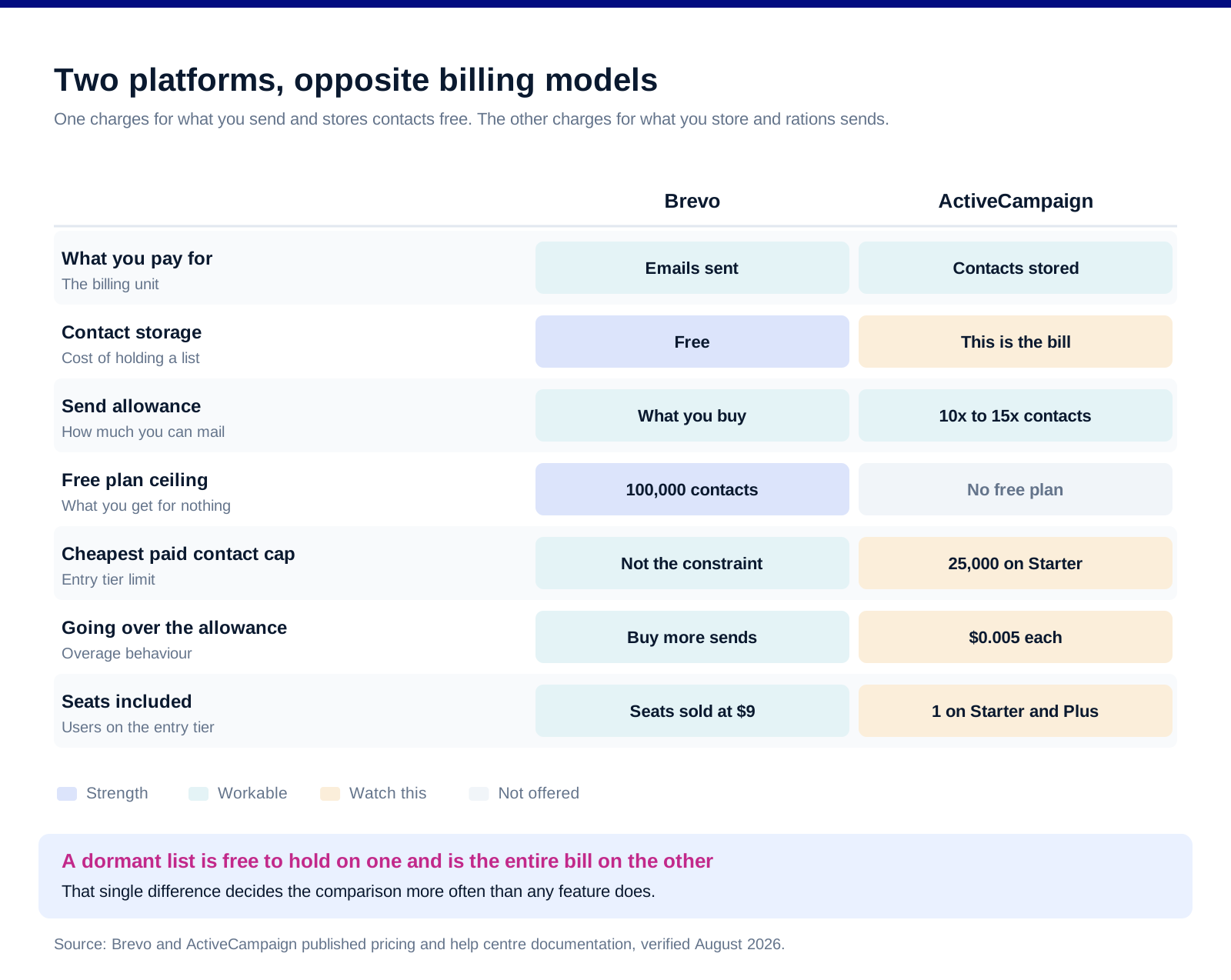
Brevo charges for sends and stores contacts free. Its own documentation is explicit that charges are per email sent rather than per contact. The free plan stores up to 100,000 contacts at 300 sends a day, which is roughly 9,000 a month at no cost. Paid tiers move the monthly send allowance rather than the storage.
ActiveCampaign charges for contacts and rations sends. Your monthly send limit is your contact limit multiplied by a plan factor: 10x on Starter, Lite and Plus, 12x on Professional, 15x on Enterprise. Bundles bought before 3 June 2024 kept higher multipliers of 15x and 20x, so an older account is not comparable to a new quote.
Which means the same list costs wildly different amounts. A dormant list is free to hold on Brevo and is the entire bill on ActiveCampaign. A high-frequency programme is cheap on ActiveCampaign's multiplier and is the entire bill on Brevo.
Overage behaves differently too. ActiveCampaign charges $0.005 per email past your limit and switches sending off entirely if overage reaches three times your allowance. Brevo's model has no equivalent, because sends are what you were buying in the first place.
Seats differ, and it matters more than it looks. ActiveCampaign includes one user on Starter and Plus, three on Professional and five on Enterprise. Brevo sells additional marketing seats at $9 a month each. If several people need access, price the seats before you compare anything else.
What a thousand emails actually costs
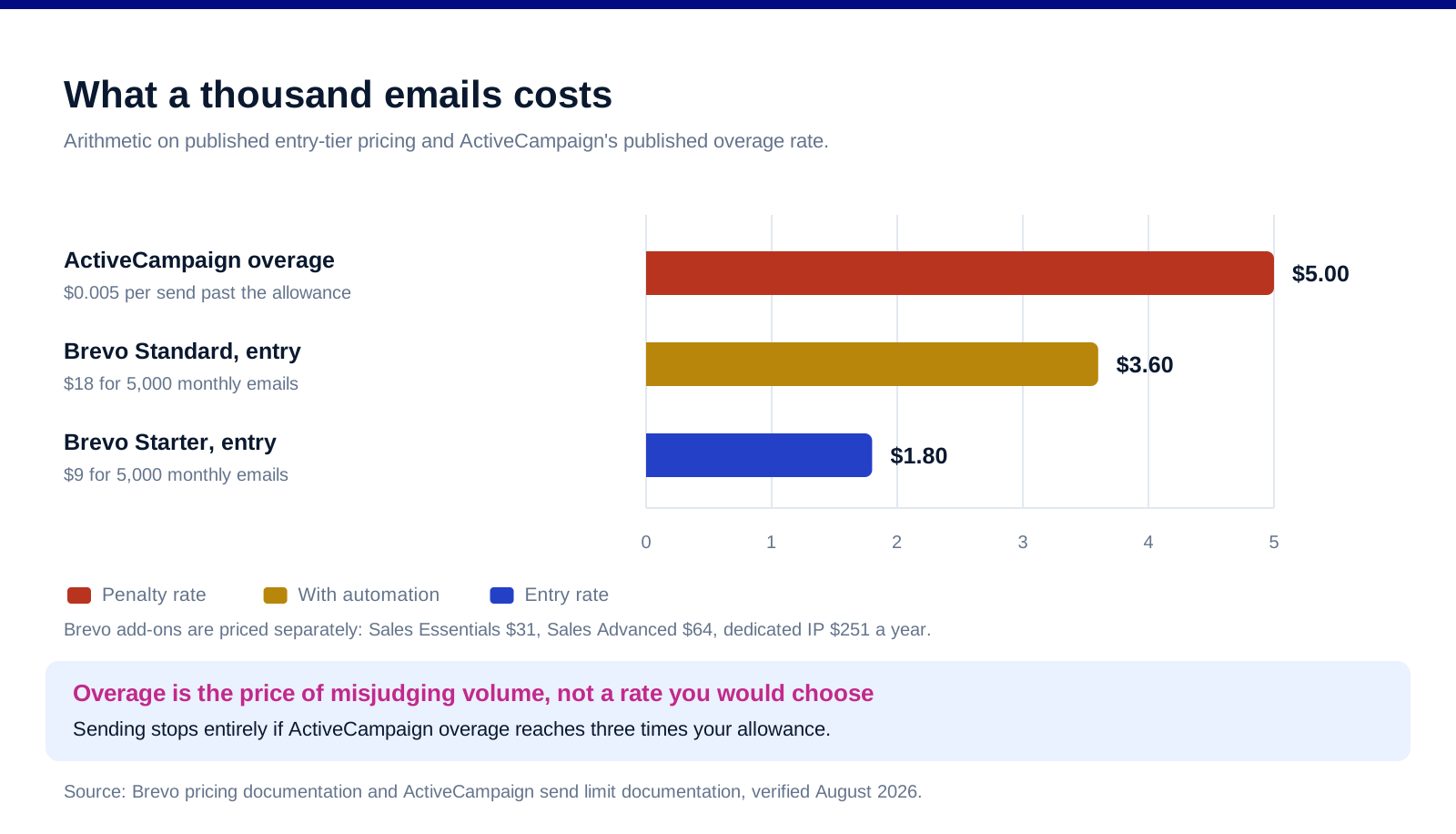
This is arithmetic on published figures, and it is the clearest number in the comparison.
Brevo Starter begins at $9 for 5,000 monthly emails. That is $1.80 per thousand at the entry point. Standard begins at $18 for the same 5,000, so $3.60 per thousand, and buys marketing automation, A/B testing and landing pages.
ActiveCampaign's overage rate is $0.005 per send. That is $5.00 per thousand, roughly two and a half times Brevo's entry rate per email, and it is the price you pay for misjudging your volume rather than a rate you would choose.
Inside the allowance ActiveCampaign is not expensive, it is just fixed. Ten sends per contact per month is generous for most B2B programmes. The trap is not the rate, it is that the allowance is set by a number, your contact count, that has nothing to do with how much you send.
Brevo's add-ons are priced separately and add up. Sales Essentials is $31 a month, Sales Advanced $64, removing the Brevo logo $9, a dedicated IP $251 a year, and SAML SSO $324 a month. Price the ones you actually need into the comparison, because the headline $9 does not include them.
Annual billing on Brevo is 10% off. Modest, and worth taking if you are committing anyway.
Which one fits your list
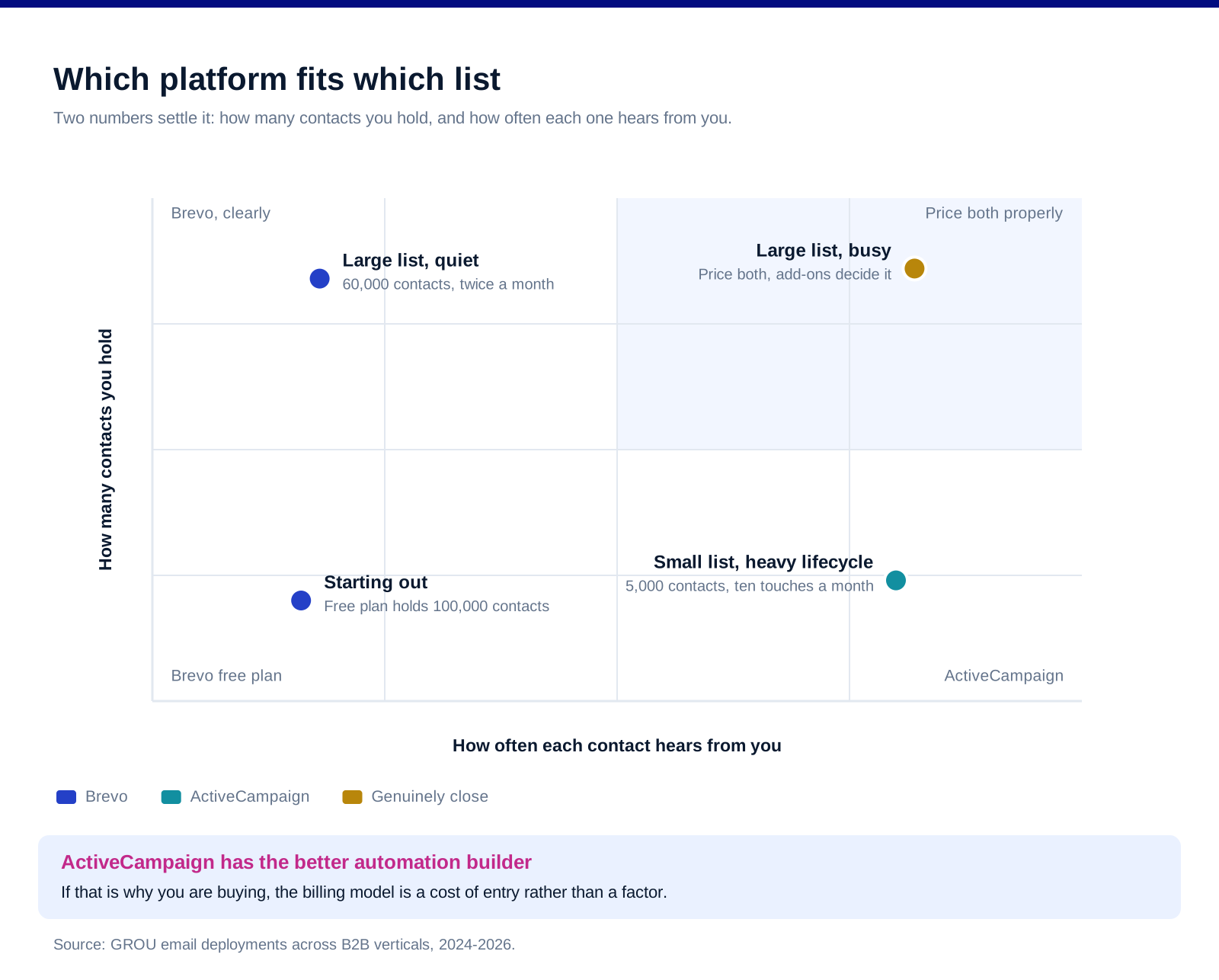
Two numbers settle this: how many contacts you hold, and how many times a month each one hears from you.
Large list, infrequent sends: Brevo, and it is not close. Sixty thousand contacts emailed twice a month is 120,000 sends. On Brevo you are paying for the sends and the storage is free. On ActiveCampaign you are paying to store sixty thousand contacts whether you email them or not, and your 10x allowance of 600,000 sends is five times what you will use.
Small list, heavy automation: ActiveCampaign. Five thousand contacts in a proper lifecycle programme might see ten touches a month, which is exactly the 10x allowance, and the automation builder is the better product. This is the case ActiveCampaign is designed for.
Very large list, very high frequency: price both properly. This is the only genuinely close case, and it is where the add-ons, the seats and the overage risk decide it rather than the headline rate.
Just starting, list under 100,000: Brevo's free plan is unusually generous. Storing 100,000 contacts and sending 9,000 a month for nothing has no equivalent on ActiveCampaign, whose cheapest plan caps at 25,000 contacts.
You need the automation depth: ActiveCampaign, and accept the model. If connected automations, predictive sending and revenue attribution are the reason you are buying, the billing model is a cost of entry rather than a factor. Just size the contact tier honestly, because it is the whole bill.
The things comparisons usually miss
ActiveCampaign does not publish prices on its pricing page. The plan structure, seat counts and send multipliers are all there; the dollar figures render only after you select a contact tier. Whatever number you have seen quoted in a comparison article was either pulled from a specific tier without saying which, or invented.
Brevo's Professional jump is large. Standard starts at $18 and Professional starts at $499. There is a lot of distance between those two, and the features that trigger the jump, including WhatsApp, push, contact scoring and ten included seats, are worth checking against what you actually need.
The pre-June-2024 ActiveCampaign multipliers are still out there. Accounts on older bundles get 15x on Professional and 20x on Enterprise. If someone tells you what they pay and what they send, confirm when they bought before you use their numbers.
Deliverability is not a differentiator between these two. Both are established senders and neither will save a list you built badly. What decides your inbox placement is authentication, list hygiene and complaint rate, which our email deliverability benchmarks covers with the thresholds mailbox providers actually enforce.
Migration cost is real and usually ignored. Automations do not port. Whichever you pick, you are rebuilding the logic by hand, which is a strong argument for getting the model right the first time rather than the feature list.
FAQ
Is Brevo cheaper than ActiveCampaign?
For most B2B senders with a large list and normal send frequency, yes, because Brevo stores contacts for free and charges only for sends while ActiveCampaign charges for every contact stored. The comparison flips when your list is small and you send heavily, since ActiveCampaign's allowance of ten sends per contact per month is generous and its entry tiers are priced against a small contact count.
How does ActiveCampaign calculate email send limits?
Your monthly send limit is your contact limit multiplied by a plan factor: 10x on Starter, Lite and Plus, 12x on Professional and 15x on Enterprise. Bundles purchased before 3 June 2024 kept 15x and 20x on those two tiers. Exceeding the limit costs $0.005 per send, and sending is switched off until the next month if overage reaches three times your allowance.
What does Brevo's free plan include?
Up to 100,000 stored contacts and 300 email sends a day, which is roughly 9,000 a month, with the email builder, templates, basic segmentation, forms and basic reporting. The contact storage is the notable part, because ActiveCampaign's cheapest paid plan caps at 25,000 contacts.
Which has better marketing automation?
ActiveCampaign, clearly, and it is the main reason to accept its billing model. Connected automations, predictive sending and revenue attribution sit above what Brevo offers. Brevo's automation is capable for straightforward lifecycle work and arrives on the Standard tier from $18 a month.
How much does ActiveCampaign cost?
ActiveCampaign does not publish figures on its pricing page; prices appear only once you select a contact tier, and its help centre also directs you back to that page. What is published is the structure: one seat on Starter and Plus, three on Professional, five on Enterprise, with send limits at 10x, 12x and 15x of contact limit. Get a quote at your actual contact count rather than working from a number in a comparison article.
Should you migrate from one to the other?
Only if the billing model is wrong for your usage, rather than because of a feature. Automations do not transfer between platforms, so you are rebuilding the logic by hand either way. Work out your contact count and your monthly sends first, price both against those two numbers, and migrate only if the gap justifies the rebuild.
Bottom line
Answer one question before you look at a single feature: is your list large and quiet, or small and busy. Brevo charges for sends and stores contacts free, which suits a big B2B list you email occasionally, and its free tier holding 100,000 contacts has no counterpart. ActiveCampaign charges for contacts and gives you ten to fifteen sends each, which suits a smaller list in a heavy lifecycle programme and comes with the better automation builder. Price the seats and the add-ons rather than the headline, get an ActiveCampaign quote at your real contact tier because the published page will not give you one, and remember that whichever you leave, the automations do not come with you.
Want the email programme built rather than the platform argued about? Book a call with GROU. We run demand generation and outbound inside B2B revenue engines across verticals.
We are GROU, a B2B pipeline agency that runs lead generation, outbound, and LinkedIn content for clients across manufacturing, fintech, iGaming, software, and professional services. The fit guidance reflects our email deployments between 2024 and 2026, anonymized to protect client confidentiality.
Some links in this article are affiliate. We may earn a small commission at no extra cost to you. We only recommend tools we've deployed for clients.
These two platforms do broadly the same job and charge for it in opposite ways. Brevo bills you for the emails you send and stores your contacts for nothing. ActiveCampaign bills you for the contacts you store and gives you a fixed multiple of that number in sends. Almost every comparison you will read ignores this and lines up feature checklists instead, which is why so many people pick the wrong one and only find out at renewal.
This is the pricing architecture of each, the arithmetic that tells you which is cheaper for your list, and the cases where the answer is unambiguous.
TL;DR
Brevo charges per email sent. Its free plan stores up to 100,000 contacts and allows 300 sends a day, Starter begins at $9 a month and Standard at $18, and Professional starts at $499. ActiveCampaign charges per contact stored and gives you sends as a multiple of that limit: 10x on Starter and Plus, 12x on Professional and 15x on Enterprise, which works out to ten to fifteen sends per contact per month. Go over and it is $0.005 per extra send, and if overage reaches triple your allowance sending stops until the next month. ActiveCampaign's Starter plan caps at 25,000 contacts, which is a quarter of what Brevo's free plan will store. So the decision is really one question: is your list large and quiet, or small and busy. A B2B company with 60,000 contacts it emails twice a month is dramatically cheaper on Brevo. A company with 5,000 contacts running heavy lifecycle automation is well served by ActiveCampaign's ten-times allowance and gets the better automation builder. ActiveCampaign does not publish its prices on its pricing page, which is worth knowing before you plan around it.
The two billing models
Brevo charges for sends and stores contacts free. Its own documentation is explicit that charges are per email sent rather than per contact. The free plan stores up to 100,000 contacts at 300 sends a day, which is roughly 9,000 a month at no cost. Paid tiers move the monthly send allowance rather than the storage.
ActiveCampaign charges for contacts and rations sends. Your monthly send limit is your contact limit multiplied by a plan factor: 10x on Starter, Lite and Plus, 12x on Professional, 15x on Enterprise. Bundles bought before 3 June 2024 kept higher multipliers of 15x and 20x, so an older account is not comparable to a new quote.
Which means the same list costs wildly different amounts. A dormant list is free to hold on Brevo and is the entire bill on ActiveCampaign. A high-frequency programme is cheap on ActiveCampaign's multiplier and is the entire bill on Brevo.
Overage behaves differently too. ActiveCampaign charges $0.005 per email past your limit and switches sending off entirely if overage reaches three times your allowance. Brevo's model has no equivalent, because sends are what you were buying in the first place.
Seats differ, and it matters more than it looks. ActiveCampaign includes one user on Starter and Plus, three on Professional and five on Enterprise. Brevo sells additional marketing seats at $9 a month each. If several people need access, price the seats before you compare anything else.
What a thousand emails actually costs
This is arithmetic on published figures, and it is the clearest number in the comparison.
Brevo Starter begins at $9 for 5,000 monthly emails. That is $1.80 per thousand at the entry point. Standard begins at $18 for the same 5,000, so $3.60 per thousand, and buys marketing automation, A/B testing and landing pages.
ActiveCampaign's overage rate is $0.005 per send. That is $5.00 per thousand, roughly two and a half times Brevo's entry rate per email, and it is the price you pay for misjudging your volume rather than a rate you would choose.
Inside the allowance ActiveCampaign is not expensive, it is just fixed. Ten sends per contact per month is generous for most B2B programmes. The trap is not the rate, it is that the allowance is set by a number, your contact count, that has nothing to do with how much you send.
Brevo's add-ons are priced separately and add up. Sales Essentials is $31 a month, Sales Advanced $64, removing the Brevo logo $9, a dedicated IP $251 a year, and SAML SSO $324 a month. Price the ones you actually need into the comparison, because the headline $9 does not include them.
Annual billing on Brevo is 10% off. Modest, and worth taking if you are committing anyway.
Which one fits your list
Two numbers settle this: how many contacts you hold, and how many times a month each one hears from you.
Large list, infrequent sends: Brevo, and it is not close. Sixty thousand contacts emailed twice a month is 120,000 sends. On Brevo you are paying for the sends and the storage is free. On ActiveCampaign you are paying to store sixty thousand contacts whether you email them or not, and your 10x allowance of 600,000 sends is five times what you will use.
Small list, heavy automation: ActiveCampaign. Five thousand contacts in a proper lifecycle programme might see ten touches a month, which is exactly the 10x allowance, and the automation builder is the better product. This is the case ActiveCampaign is designed for.
Very large list, very high frequency: price both properly. This is the only genuinely close case, and it is where the add-ons, the seats and the overage risk decide it rather than the headline rate.
Just starting, list under 100,000: Brevo's free plan is unusually generous. Storing 100,000 contacts and sending 9,000 a month for nothing has no equivalent on ActiveCampaign, whose cheapest plan caps at 25,000 contacts.
You need the automation depth: ActiveCampaign, and accept the model. If connected automations, predictive sending and revenue attribution are the reason you are buying, the billing model is a cost of entry rather than a factor. Just size the contact tier honestly, because it is the whole bill.
The things comparisons usually miss
ActiveCampaign does not publish prices on its pricing page. The plan structure, seat counts and send multipliers are all there; the dollar figures render only after you select a contact tier. Whatever number you have seen quoted in a comparison article was either pulled from a specific tier without saying which, or invented.
Brevo's Professional jump is large. Standard starts at $18 and Professional starts at $499. There is a lot of distance between those two, and the features that trigger the jump, including WhatsApp, push, contact scoring and ten included seats, are worth checking against what you actually need.
The pre-June-2024 ActiveCampaign multipliers are still out there. Accounts on older bundles get 15x on Professional and 20x on Enterprise. If someone tells you what they pay and what they send, confirm when they bought before you use their numbers.
Deliverability is not a differentiator between these two. Both are established senders and neither will save a list you built badly. What decides your inbox placement is authentication, list hygiene and complaint rate, which our email deliverability benchmarks covers with the thresholds mailbox providers actually enforce.
Migration cost is real and usually ignored. Automations do not port. Whichever you pick, you are rebuilding the logic by hand, which is a strong argument for getting the model right the first time rather than the feature list.
FAQ
Is Brevo cheaper than ActiveCampaign?
For most B2B senders with a large list and normal send frequency, yes, because Brevo stores contacts for free and charges only for sends while ActiveCampaign charges for every contact stored. The comparison flips when your list is small and you send heavily, since ActiveCampaign's allowance of ten sends per contact per month is generous and its entry tiers are priced against a small contact count.
How does ActiveCampaign calculate email send limits?
Your monthly send limit is your contact limit multiplied by a plan factor: 10x on Starter, Lite and Plus, 12x on Professional and 15x on Enterprise. Bundles purchased before 3 June 2024 kept 15x and 20x on those two tiers. Exceeding the limit costs $0.005 per send, and sending is switched off until the next month if overage reaches three times your allowance.
What does Brevo's free plan include?
Up to 100,000 stored contacts and 300 email sends a day, which is roughly 9,000 a month, with the email builder, templates, basic segmentation, forms and basic reporting. The contact storage is the notable part, because ActiveCampaign's cheapest paid plan caps at 25,000 contacts.
Which has better marketing automation?
ActiveCampaign, clearly, and it is the main reason to accept its billing model. Connected automations, predictive sending and revenue attribution sit above what Brevo offers. Brevo's automation is capable for straightforward lifecycle work and arrives on the Standard tier from $18 a month.
How much does ActiveCampaign cost?
ActiveCampaign does not publish figures on its pricing page; prices appear only once you select a contact tier, and its help centre also directs you back to that page. What is published is the structure: one seat on Starter and Plus, three on Professional, five on Enterprise, with send limits at 10x, 12x and 15x of contact limit. Get a quote at your actual contact count rather than working from a number in a comparison article.
Should you migrate from one to the other?
Only if the billing model is wrong for your usage, rather than because of a feature. Automations do not transfer between platforms, so you are rebuilding the logic by hand either way. Work out your contact count and your monthly sends first, price both against those two numbers, and migrate only if the gap justifies the rebuild.
Bottom line
Answer one question before you look at a single feature: is your list large and quiet, or small and busy. Brevo charges for sends and stores contacts free, which suits a big B2B list you email occasionally, and its free tier holding 100,000 contacts has no counterpart. ActiveCampaign charges for contacts and gives you ten to fifteen sends each, which suits a smaller list in a heavy lifecycle programme and comes with the better automation builder. Price the seats and the add-ons rather than the headline, get an ActiveCampaign quote at your real contact tier because the published page will not give you one, and remember that whichever you leave, the automations do not come with you.
Want the email programme built rather than the platform argued about? Book a call with GROU. We run demand generation and outbound inside B2B revenue engines across verticals.
We are GROU, a B2B pipeline agency that runs lead generation, outbound, and LinkedIn content for clients across manufacturing, fintech, iGaming, software, and professional services. The fit guidance reflects our email deployments between 2024 and 2026, anonymized to protect client confidentiality.
Some links in this article are affiliate. We may earn a small commission at no extra cost to you. We only recommend tools we've deployed for clients.
These two platforms do broadly the same job and charge for it in opposite ways. Brevo bills you for the emails you send and stores your contacts for nothing. ActiveCampaign bills you for the contacts you store and gives you a fixed multiple of that number in sends. Almost every comparison you will read ignores this and lines up feature checklists instead, which is why so many people pick the wrong one and only find out at renewal.
This is the pricing architecture of each, the arithmetic that tells you which is cheaper for your list, and the cases where the answer is unambiguous.
TL;DR
Brevo charges per email sent. Its free plan stores up to 100,000 contacts and allows 300 sends a day, Starter begins at $9 a month and Standard at $18, and Professional starts at $499. ActiveCampaign charges per contact stored and gives you sends as a multiple of that limit: 10x on Starter and Plus, 12x on Professional and 15x on Enterprise, which works out to ten to fifteen sends per contact per month. Go over and it is $0.005 per extra send, and if overage reaches triple your allowance sending stops until the next month. ActiveCampaign's Starter plan caps at 25,000 contacts, which is a quarter of what Brevo's free plan will store. So the decision is really one question: is your list large and quiet, or small and busy. A B2B company with 60,000 contacts it emails twice a month is dramatically cheaper on Brevo. A company with 5,000 contacts running heavy lifecycle automation is well served by ActiveCampaign's ten-times allowance and gets the better automation builder. ActiveCampaign does not publish its prices on its pricing page, which is worth knowing before you plan around it.
The two billing models
Brevo charges for sends and stores contacts free. Its own documentation is explicit that charges are per email sent rather than per contact. The free plan stores up to 100,000 contacts at 300 sends a day, which is roughly 9,000 a month at no cost. Paid tiers move the monthly send allowance rather than the storage.
ActiveCampaign charges for contacts and rations sends. Your monthly send limit is your contact limit multiplied by a plan factor: 10x on Starter, Lite and Plus, 12x on Professional, 15x on Enterprise. Bundles bought before 3 June 2024 kept higher multipliers of 15x and 20x, so an older account is not comparable to a new quote.
Which means the same list costs wildly different amounts. A dormant list is free to hold on Brevo and is the entire bill on ActiveCampaign. A high-frequency programme is cheap on ActiveCampaign's multiplier and is the entire bill on Brevo.
Overage behaves differently too. ActiveCampaign charges $0.005 per email past your limit and switches sending off entirely if overage reaches three times your allowance. Brevo's model has no equivalent, because sends are what you were buying in the first place.
Seats differ, and it matters more than it looks. ActiveCampaign includes one user on Starter and Plus, three on Professional and five on Enterprise. Brevo sells additional marketing seats at $9 a month each. If several people need access, price the seats before you compare anything else.
What a thousand emails actually costs
This is arithmetic on published figures, and it is the clearest number in the comparison.
Brevo Starter begins at $9 for 5,000 monthly emails. That is $1.80 per thousand at the entry point. Standard begins at $18 for the same 5,000, so $3.60 per thousand, and buys marketing automation, A/B testing and landing pages.
ActiveCampaign's overage rate is $0.005 per send. That is $5.00 per thousand, roughly two and a half times Brevo's entry rate per email, and it is the price you pay for misjudging your volume rather than a rate you would choose.
Inside the allowance ActiveCampaign is not expensive, it is just fixed. Ten sends per contact per month is generous for most B2B programmes. The trap is not the rate, it is that the allowance is set by a number, your contact count, that has nothing to do with how much you send.
Brevo's add-ons are priced separately and add up. Sales Essentials is $31 a month, Sales Advanced $64, removing the Brevo logo $9, a dedicated IP $251 a year, and SAML SSO $324 a month. Price the ones you actually need into the comparison, because the headline $9 does not include them.
Annual billing on Brevo is 10% off. Modest, and worth taking if you are committing anyway.
Which one fits your list
Two numbers settle this: how many contacts you hold, and how many times a month each one hears from you.
Large list, infrequent sends: Brevo, and it is not close. Sixty thousand contacts emailed twice a month is 120,000 sends. On Brevo you are paying for the sends and the storage is free. On ActiveCampaign you are paying to store sixty thousand contacts whether you email them or not, and your 10x allowance of 600,000 sends is five times what you will use.
Small list, heavy automation: ActiveCampaign. Five thousand contacts in a proper lifecycle programme might see ten touches a month, which is exactly the 10x allowance, and the automation builder is the better product. This is the case ActiveCampaign is designed for.
Very large list, very high frequency: price both properly. This is the only genuinely close case, and it is where the add-ons, the seats and the overage risk decide it rather than the headline rate.
Just starting, list under 100,000: Brevo's free plan is unusually generous. Storing 100,000 contacts and sending 9,000 a month for nothing has no equivalent on ActiveCampaign, whose cheapest plan caps at 25,000 contacts.
You need the automation depth: ActiveCampaign, and accept the model. If connected automations, predictive sending and revenue attribution are the reason you are buying, the billing model is a cost of entry rather than a factor. Just size the contact tier honestly, because it is the whole bill.
The things comparisons usually miss
ActiveCampaign does not publish prices on its pricing page. The plan structure, seat counts and send multipliers are all there; the dollar figures render only after you select a contact tier. Whatever number you have seen quoted in a comparison article was either pulled from a specific tier without saying which, or invented.
Brevo's Professional jump is large. Standard starts at $18 and Professional starts at $499. There is a lot of distance between those two, and the features that trigger the jump, including WhatsApp, push, contact scoring and ten included seats, are worth checking against what you actually need.
The pre-June-2024 ActiveCampaign multipliers are still out there. Accounts on older bundles get 15x on Professional and 20x on Enterprise. If someone tells you what they pay and what they send, confirm when they bought before you use their numbers.
Deliverability is not a differentiator between these two. Both are established senders and neither will save a list you built badly. What decides your inbox placement is authentication, list hygiene and complaint rate, which our email deliverability benchmarks covers with the thresholds mailbox providers actually enforce.
Migration cost is real and usually ignored. Automations do not port. Whichever you pick, you are rebuilding the logic by hand, which is a strong argument for getting the model right the first time rather than the feature list.
FAQ
Is Brevo cheaper than ActiveCampaign?
For most B2B senders with a large list and normal send frequency, yes, because Brevo stores contacts for free and charges only for sends while ActiveCampaign charges for every contact stored. The comparison flips when your list is small and you send heavily, since ActiveCampaign's allowance of ten sends per contact per month is generous and its entry tiers are priced against a small contact count.
How does ActiveCampaign calculate email send limits?
Your monthly send limit is your contact limit multiplied by a plan factor: 10x on Starter, Lite and Plus, 12x on Professional and 15x on Enterprise. Bundles purchased before 3 June 2024 kept 15x and 20x on those two tiers. Exceeding the limit costs $0.005 per send, and sending is switched off until the next month if overage reaches three times your allowance.
What does Brevo's free plan include?
Up to 100,000 stored contacts and 300 email sends a day, which is roughly 9,000 a month, with the email builder, templates, basic segmentation, forms and basic reporting. The contact storage is the notable part, because ActiveCampaign's cheapest paid plan caps at 25,000 contacts.
Which has better marketing automation?
ActiveCampaign, clearly, and it is the main reason to accept its billing model. Connected automations, predictive sending and revenue attribution sit above what Brevo offers. Brevo's automation is capable for straightforward lifecycle work and arrives on the Standard tier from $18 a month.
How much does ActiveCampaign cost?
ActiveCampaign does not publish figures on its pricing page; prices appear only once you select a contact tier, and its help centre also directs you back to that page. What is published is the structure: one seat on Starter and Plus, three on Professional, five on Enterprise, with send limits at 10x, 12x and 15x of contact limit. Get a quote at your actual contact count rather than working from a number in a comparison article.
Should you migrate from one to the other?
Only if the billing model is wrong for your usage, rather than because of a feature. Automations do not transfer between platforms, so you are rebuilding the logic by hand either way. Work out your contact count and your monthly sends first, price both against those two numbers, and migrate only if the gap justifies the rebuild.
Bottom line
Answer one question before you look at a single feature: is your list large and quiet, or small and busy. Brevo charges for sends and stores contacts free, which suits a big B2B list you email occasionally, and its free tier holding 100,000 contacts has no counterpart. ActiveCampaign charges for contacts and gives you ten to fifteen sends each, which suits a smaller list in a heavy lifecycle programme and comes with the better automation builder. Price the seats and the add-ons rather than the headline, get an ActiveCampaign quote at your real contact tier because the published page will not give you one, and remember that whichever you leave, the automations do not come with you.
Want the email programme built rather than the platform argued about? Book a call with GROU. We run demand generation and outbound inside B2B revenue engines across verticals.
We are GROU, a B2B pipeline agency that runs lead generation, outbound, and LinkedIn content for clients across manufacturing, fintech, iGaming, software, and professional services. The fit guidance reflects our email deployments between 2024 and 2026, anonymized to protect client confidentiality.
Some links in this article are affiliate. We may earn a small commission at no extra cost to you. We only recommend tools we've deployed for clients.

Pipeline OS Newsletter
Build qualified pipeline
Get weekly tactics to generate demand, improve lead quality, and book more meetings.





Trusted by industry leaders
Trusted by industry leaders
Trusted by industry leaders
Ready to build qualified pipeline?
Ready to build qualified pipeline?
Ready to build qualified pipeline?
Book a call to see if we're the right fit, or take the 2-minute quiz to get a clear starting point.
Book a call to see if we're the right fit, or take the 2-minute quiz to get a clear starting point.
Book a call to see if we're the right fit, or take the 2-minute quiz to get a clear starting point.
" height="30.21639343089746px" id="hfGbXmQR2" width="30.216393430897455px"/></svg>)
Copyright © 2026 – All Right Reserved
Copyright © 2026 – All Right Reserved
Copyright © 2026 – All Right Reserved