%22%3E%3C/path%3E%3Cpath d=%22M 63.072 7.554 C 62.258 8.022 61.577 8.689 61.092 9.493 L 61.092 7.076 L 57.158 7.076 L 57.158 22.64 L 61.089 22.64 L 61.089 14.888 C 61.089 13.446 61.403 12.434 62.03 11.853 C 62.818 11.218 63.818 10.907 64.826 10.982 L 65.868 10.982 L 65.868 6.851 C 64.891 6.834 63.926 7.076 63.073 7.554 Z%22 fill=%22rgb(17,17,17)%22%3E%3C/path%3E%3Cpath d=%22M 78.916 7.82 C 76.363 6.49 73.321 6.49 70.768 7.82 C 69.562 8.473 68.564 9.451 67.888 10.644 C 67.167 11.931 66.803 13.387 66.834 14.862 C 66.804 16.332 67.157 17.785 67.86 19.077 C 68.515 20.267 69.494 21.246 70.684 21.901 C 71.924 22.576 73.318 22.92 74.73 22.898 C 76.164 22.918 77.58 22.575 78.846 21.901 C 80.062 21.247 81.073 20.27 81.768 19.077 C 82.506 17.797 82.88 16.339 82.85 14.862 C 82.88 13.389 82.517 11.934 81.797 10.647 C 81.12 9.455 80.122 8.477 78.917 7.824 M 78.803 14.862 C 78.829 15.739 78.636 16.608 78.241 17.391 C 77.903 18.046 77.38 18.588 76.738 18.95 C 76.124 19.293 75.432 19.472 74.729 19.47 C 73.668 19.497 72.648 19.061 71.934 18.276 C 71.139 17.323 70.741 16.1 70.823 14.862 C 70.741 13.62 71.149 12.395 71.959 11.45 C 72.687 10.667 73.715 10.233 74.783 10.256 C 75.859 10.236 76.894 10.67 77.635 11.45 C 78.464 12.387 78.884 13.616 78.801 14.864%22 fill=%22rgb(17,17,17)%22%3E%3C/path%3E%3Cpath d=%22M 95.906 7.076 L 95.906 15.646 C 95.975 16.68 95.643 17.701 94.979 18.498 C 94.311 19.184 93.379 19.547 92.422 19.495 C 91.475 19.544 90.553 19.18 89.894 18.498 C 89.23 17.701 88.898 16.68 88.967 15.646 L 88.967 7.076 L 85.033 7.076 L 85.033 16.207 C 85 17.449 85.275 18.68 85.834 19.79 C 86.327 20.75 87.095 21.542 88.039 22.065 C 89.033 22.594 90.145 22.861 91.271 22.838 C 92.188 22.847 93.095 22.65 93.926 22.263 C 94.708 21.905 95.388 21.36 95.906 20.675 L 95.906 22.645 L 99.865 22.645 L 99.865 7.076 Z%22 fill=%22rgb(17,17,17)%22%3E%3C/path%3E%3Cpath d=%22M 4.513 15.626 C 4.511 10.815 7.606 6.549 12.181 5.059 C 16.756 3.57 21.77 5.195 24.601 9.086 L 27.816 5.87 C 24.074 1.186 17.981 -0.943 12.137 0.393 C 6.292 1.728 1.728 6.292 0.393 12.137 C -0.943 17.981 1.186 24.074 5.87 27.816 L 9.085 24.601 C 6.214 22.512 4.515 19.177 4.513 15.626%22 fill=%22rgb(32,62,235)%22%3E%3C/path%3E%3Cpath d=%22M 17.114 14.343 L 13.354 18.01 L 13.354 18.026 L 21.071 18.026 L 11.412 27.609 L 17.389 27.609 L 23.999 21.081 L 23.999 28.316 L 24.005 28.316 L 27.967 24.393 L 27.967 14.343 Z%22 fill=%22rgb(32,62,235)%22%3E%3C/path%3E%3C/g%3E%3C/svg%3E) ×
× ××
××›
›
›
›
Klenty vs Reply.io 2026
Klenty vs Reply.io 2026
Klenty vs Reply.io 2026
Klenty vs Reply.io 2026
Klenty vs Reply.io 2026
Klenty vs Reply.io 2026

Author
Aljaz Peklaj

At one seat these two are the same price. At ten seats, on the cheapest configuration each sells, one costs $50 a month and the other costs $490.
That is not a discount or a promotion. It is a structural difference in how the two entry plans are denominated, and it is the first thing to establish about your own team before you read another word of feature comparison.
TL;DR
Klenty's entry plan is priced per workspace and its higher plans are priced per user. Its published page reads "$50 per month billed annually" for Starter, then "$70 per user/month" for Growth and "$99 per user/month" for Plus. Reply.io is priced per user throughout, and its email plan additionally scales with the size of your contact database, running from $49 to $899 per user per month as active contacts go from 1,000 to 500,000. That produces two findings nobody publishes. First, for an email-only team the gap widens with every seat you add, because one plan multiplies and the other does not. Second, on Reply itself the email-only plan eventually costs more than the multichannel plan, which is $89 to $99 per user per month with unlimited active contacts, so above a certain list size the cheaper-sounding product is the more expensive one. On calling, Klenty bundles minutes into the plan while Reply sells calls as an add-on, which is the other question to settle before comparing anything.
Establish three numbers first
How many seats. This is the variable that decides most of the comparison, because Klenty's entry plan does not multiply by it and Reply's plans do.
How many active contacts. Reply's email pricing is denominated in this. Klenty's Starter states 15,000 monthly contacts and 75,000 monthly emails as its allowance rather than as a price input.
Whether you call. Klenty's Growth and Plus plans include calling minutes. Reply lists SMS and calls as a per-account add-on. If nobody on your team dials, half the pricing difference disappears.
Everything below is these three numbers applied to two published rate cards. We have not run the products side by side and this is not a quality comparison. Our roundup of cold email tools covers the wider field.
Seats: the divergence that compounds
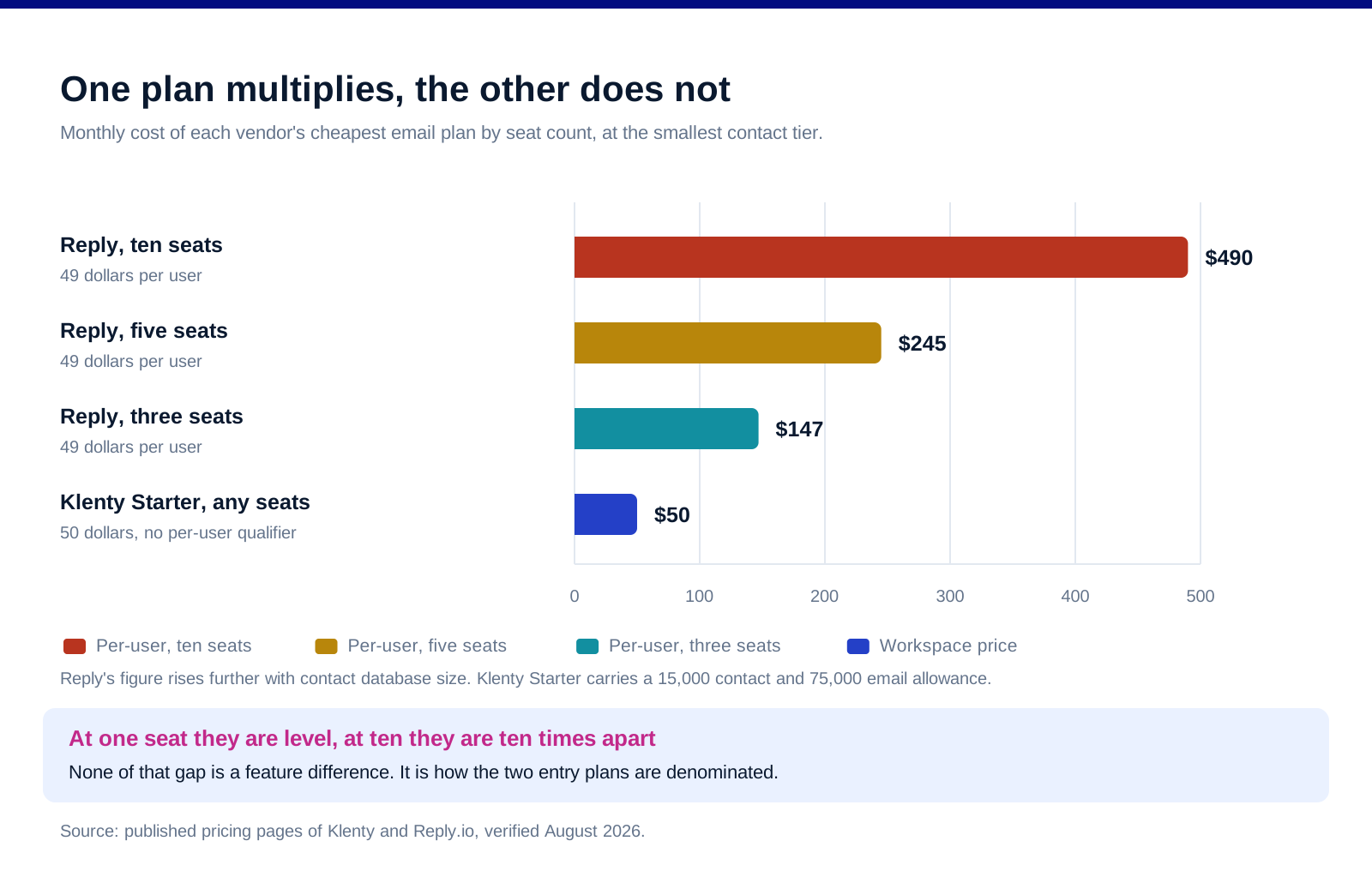
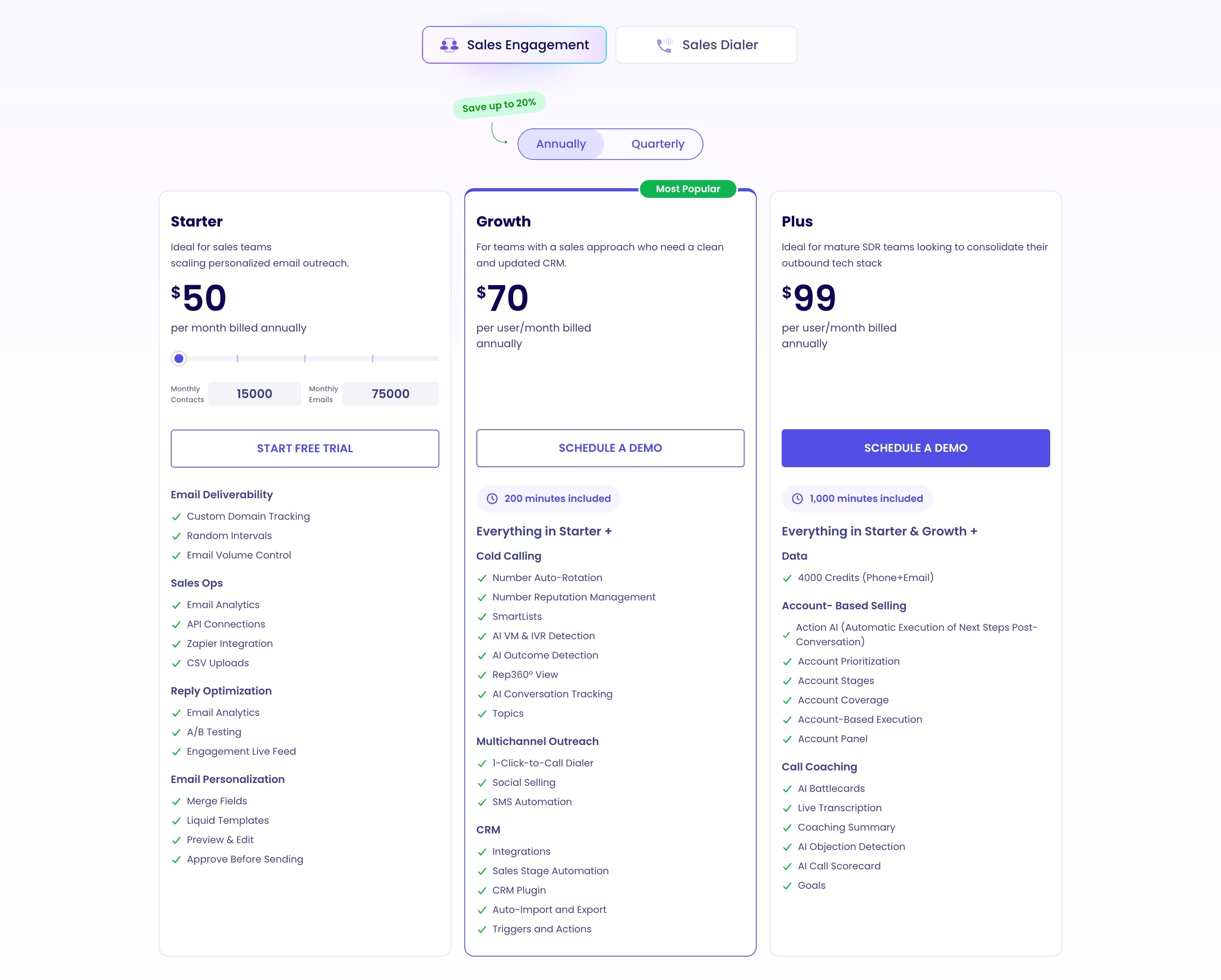
Klenty's Starter reads as a workspace price. Its pricing page states "$50 per month billed annually" with no per-user qualifier, against "$70 per user/month billed annually" for Growth and "$99 per user/month billed annually" for Plus, both of which say per user explicitly. The page carries no minimum seat note.
That asymmetry is worth confirming in writing before you buy on it. A plan whose price does not move with headcount is unusual enough that we would ask the vendor to put it in the contract rather than infer it from a pricing page, and we say so rather than treating it as settled.
Reply's pricing is per user across the board. Its Email Volume plans run "$49-$899/user/month" for "1,000-500,000 active contacts", with unlimited mailboxes, emails and sequences, 50 live data credits a month and email warmup included.
So run it at four sizes. One seat is $50 against $49, effectively identical. Three seats is $50 against $147. Five is $50 against $245. Ten is $50 against $490. Every seat you add widens the gap, and none of that is a feature difference.
Which cuts the other way for a single power user. At one seat with a large database, Reply's entry price is competitive and Klenty's Starter allowance of 15,000 contacts becomes the binding constraint rather than the price.
Reply's email plan can cost more than its multichannel plan
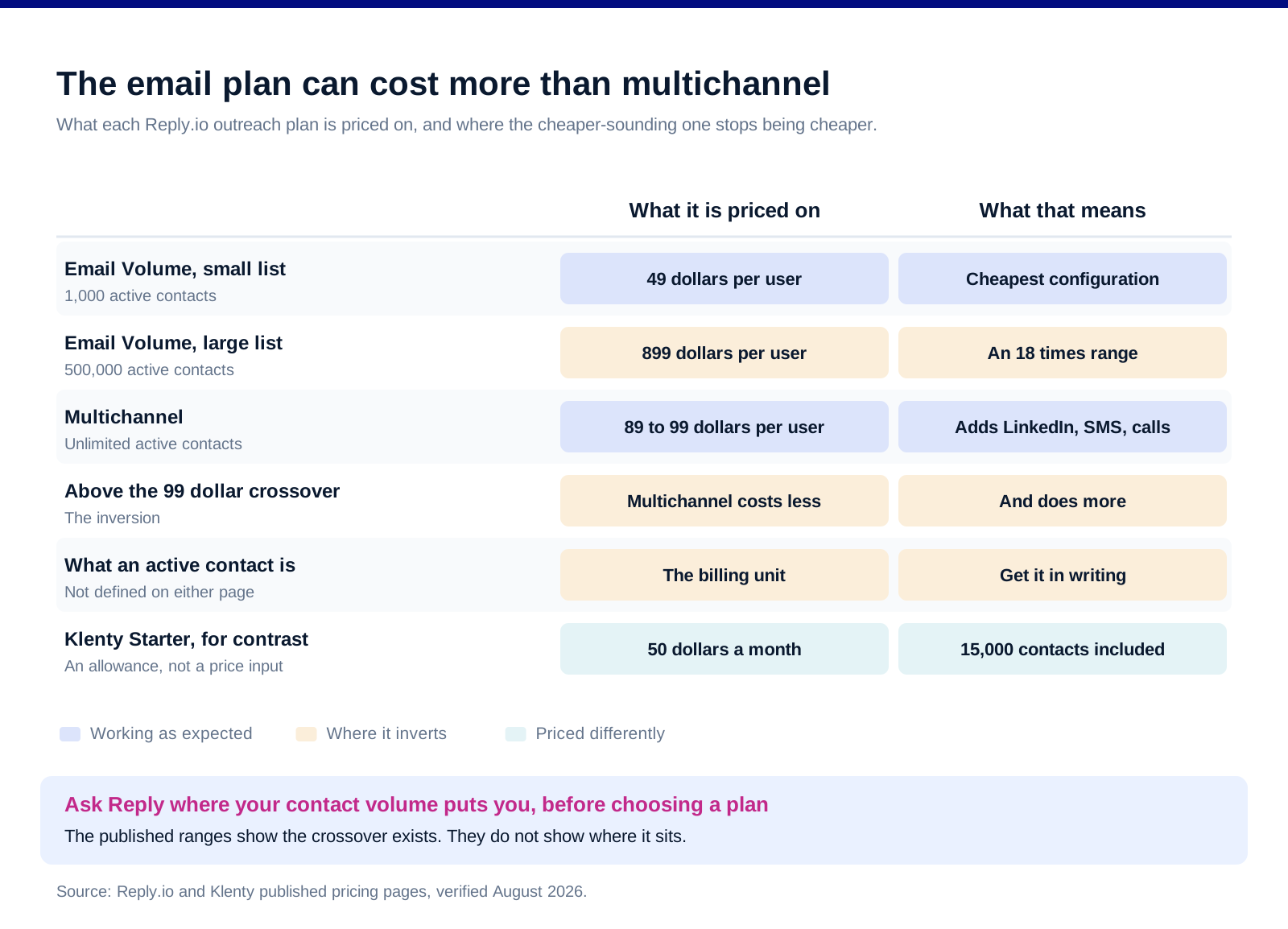
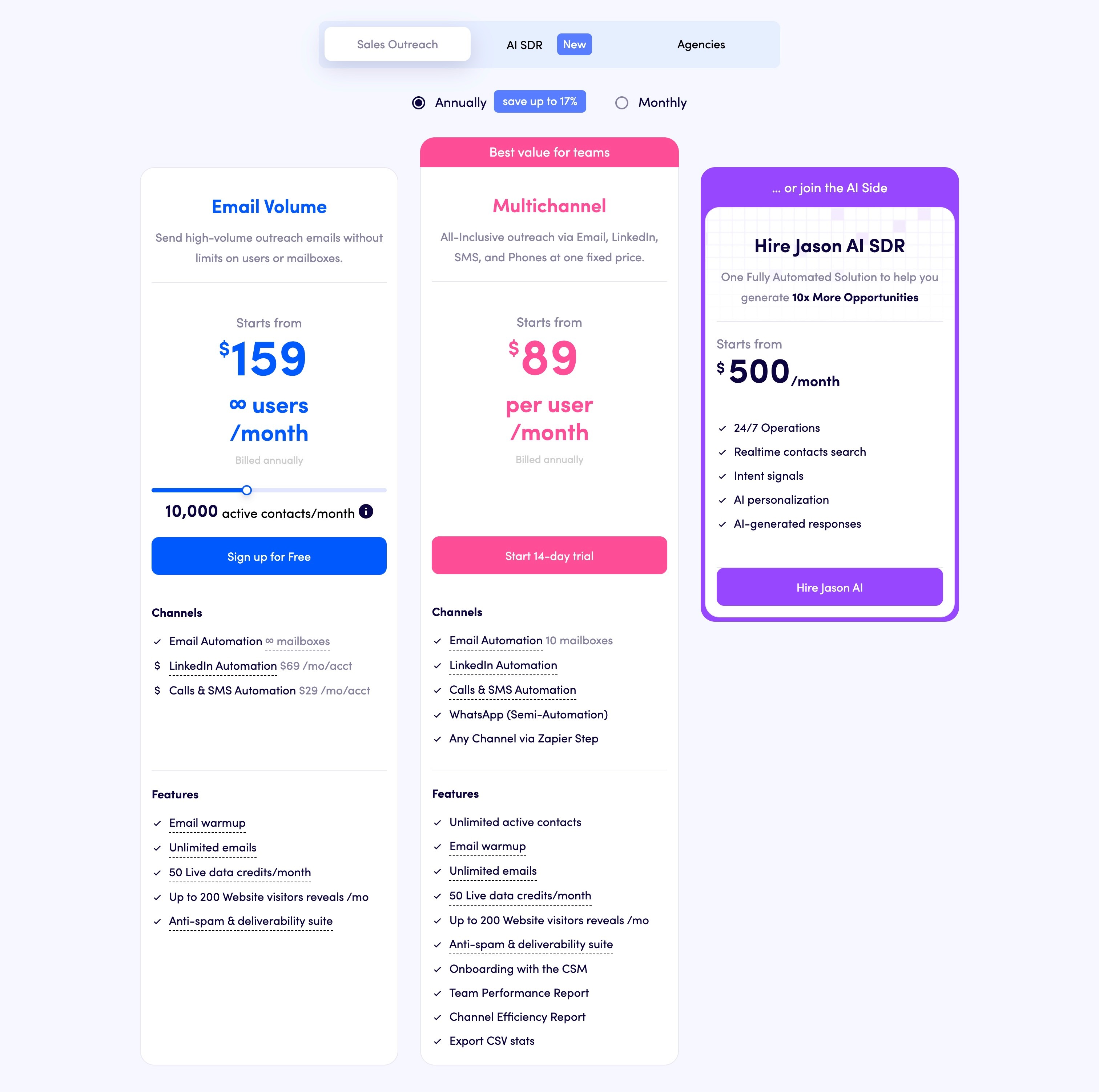
Here is the inversion, straight from the published ranges. Reply's Email Volume plan is "$49-$899/user/month" scaling with active contacts. Its Multichannel plan is "$89-$99/user/month" and is listed with unlimited active contacts, adding LinkedIn automation, SMS and calls, WhatsApp, and 5 to 10 mailboxes per user.
So above the tier where Email Volume passes $99, the multichannel plan costs less and does more. We do not have the tier-by-tier breakpoints, so we will not tell you exactly where that crossover sits. What the published ranges establish is that it exists, and that it is on the wrong side of intuition.
Which makes this the question to ask Reply directly. At my contact volume, what does Email Volume cost per user, and is Multichannel cheaper? A vendor should be able to answer that in one line, and the answer is worth more than any feature table.
The 18 times range is itself the point. The same product at the same seat count runs from $49 to $899 depending on how many contacts sit in your database, which means your bill grows with data you may not be emailing.
And the unit itself is not defined anywhere we could find. Reply prices in active contacts across its outreach plans and again on its AI SDR pricing, where Starter "Starts from $500/month" for 1,000 to 3,000 active contacts, Growth "Starts from $1500/month" for 5,000 to 10,000, and Enterprise is quoted for 25,000 to 50,000. Neither page states what makes a contact active, when one stops being active, or whether an unsubscribed or bounced contact still counts. On a plan denominated in that unit, that is the definition to get in writing.
Calling is bundled on one side and sold on the other
Klenty includes minutes in the plan. Growth at $70 per user carries "200 minutes of calling", a one-click dialer, SMS automation, social selling, AI voicemail and IVR detection. Plus at $99 per user carries "1,000 minutes of calling" and "4,000 credits for phone and email combined", along with call coaching, AI call scoring, live transcription and objection detection.
And sells a heavier dialer separately. The parallel and power dialer is an add-on at "$45/user/month", which is 64 percent of the Growth seat price. If parallel dialing is the reason you are buying, price the add-on as part of the plan rather than as an extra.
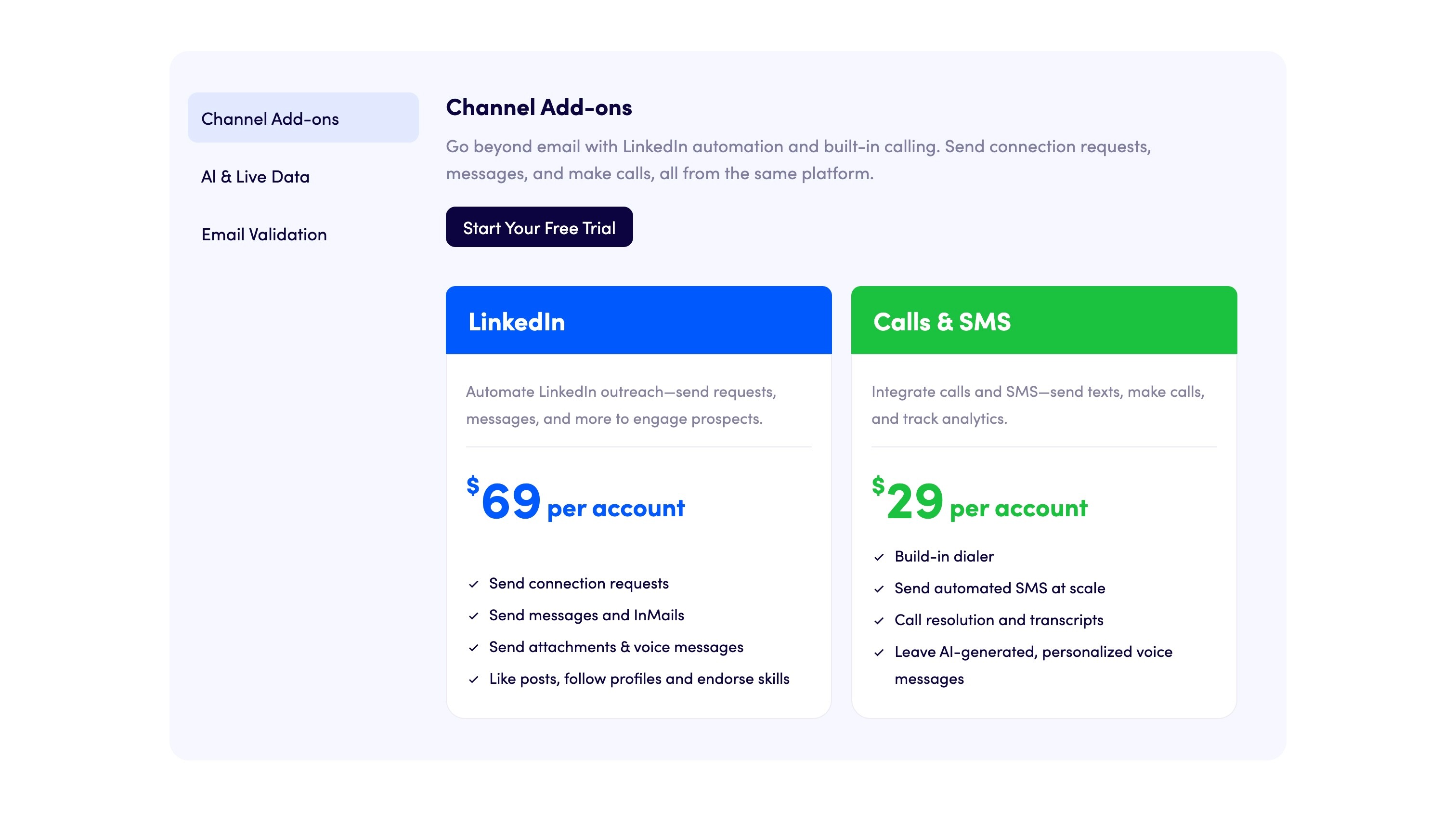
Reply sells calling as an account add-on. Its page lists "LinkedIn: $69/account/month", "SMS/Calls: $29/account/month" and "Email validation: $20+/month", while also describing LinkedIn automation and SMS and calls as included in the Multichannel plan.
That looks like a contradiction and it is the second thing to ask about. Whether Multichannel includes LinkedIn and calling or whether those add-ons apply on top of it changes a five-seat quote by several hundred dollars a month. We could not resolve it from the published page and we are not going to guess.
Neither approach is better in the abstract. Bundled minutes suit a team that dials daily. Per-account add-ons suit a team where two people call and six do not. Our note on cold email benchmarks covers why the published rates for either channel should not drive that decision.
Where each one is the obvious answer
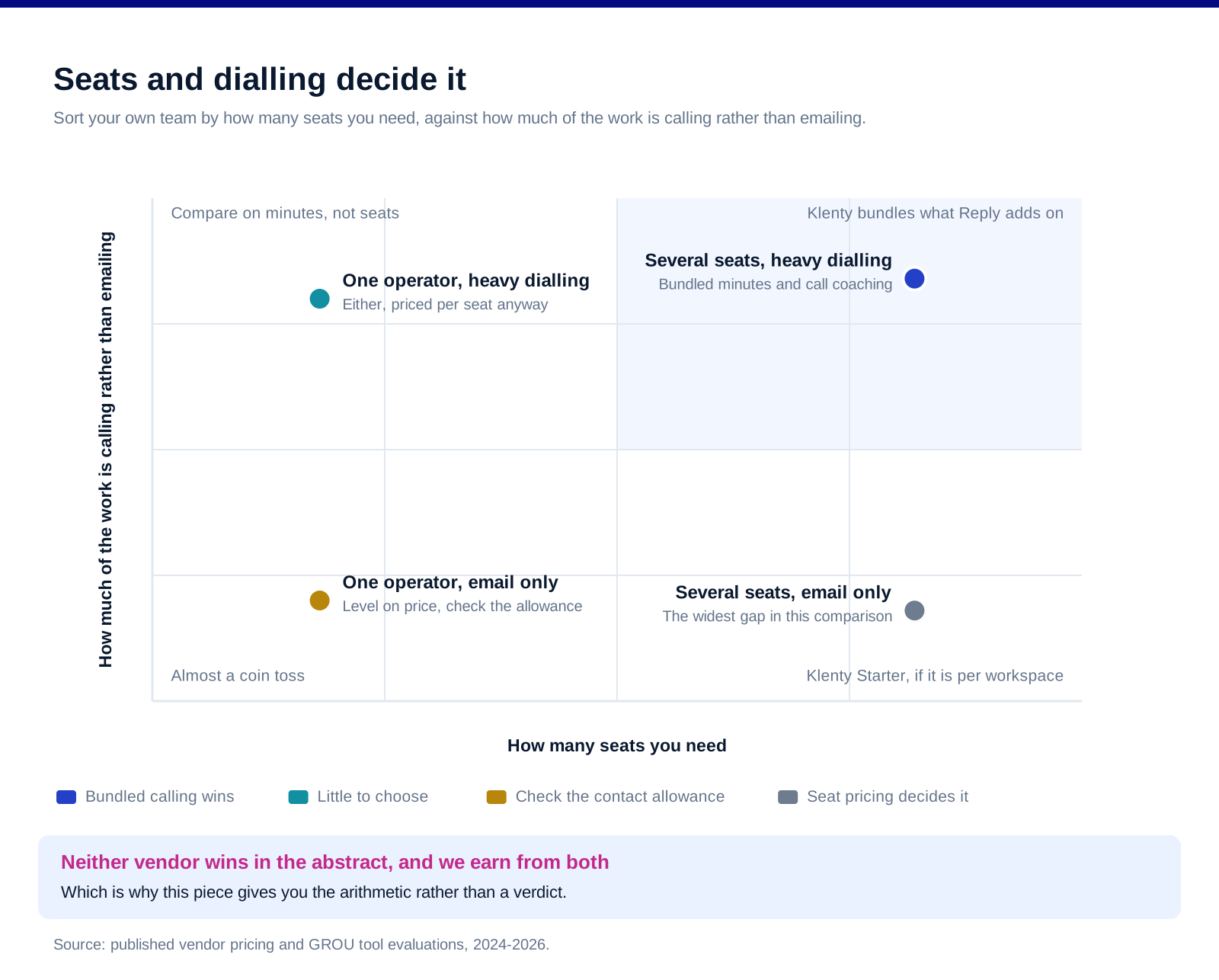
A small team doing email only. Klenty's Starter is hard to argue with at $50 a month for the workspace, provided the 15,000 contact and 75,000 email allowances fit and provided the workspace pricing is confirmed in writing.
A team where most people dial. Klenty's bundled minutes and call coaching stack are built for this, and the AI call scoring and objection detection on Plus have no direct equivalent in Reply's published list.
One operator with a very large database. Reply's per-user pricing costs you nothing extra in seats, and the multichannel plan's unlimited active contacts removes the constraint that would bind you on Klenty's Starter.
A team that wants LinkedIn in the same tool. Reply lists LinkedIn automation on Multichannel and as an add-on; Klenty lists social selling on Growth without naming the networks. Ask both what LinkedIn actually means in their product before deciding.
An agency running many clients. Reply publishes agency plans, from "Agency Core: $210+/month" with multi-workspace structure and unlimited clients and users. Klenty's published page does not carry an agency tier.
What we do not publish here
A winner. We have not run both products on matched lists, domains and offers, and a verdict without that would be a preference dressed as a finding.
Deliverability, reply rate or reliability comparisons. Same reason. Every published figure of that kind in this category comes from one of the vendors or from an affiliate of one.
Reply's tier-by-tier contact breakpoints. The published page gives ranges rather than a table, and the crossover point matters enough that we would rather tell you to ask than estimate it.
Whether Reply's Multichannel plan includes the LinkedIn and calling add-ons. The page describes both as included and as separately priced, we could not resolve it, and it is flagged above as a question for the vendor.
Klenty's AI SDR equivalent. Reply publishes AI SDR plans from "$500-$1,500/month"; Klenty's page does not carry a comparable named product, so there is nothing to compare it against rather than nothing to say.
FAQ
Is Klenty cheaper than Reply.io?
On the cheapest email configuration, it depends almost entirely on seats. Klenty's Starter is published at $50 a month with no per-user qualifier, while Reply's Email Volume starts at $49 per user per month. At one seat they are level. At ten seats that is $50 against $490 before any contact-volume increase on Reply's side.
Why does Reply.io's price range go from $49 to $899?
Because its Email Volume plan is priced by active contacts, from 1,000 up to 500,000. Your bill therefore grows with the size of your database rather than with how much you send, which is worth modelling before you import a large list.
Should you buy Reply's email plan or its multichannel plan?
Ask Reply where the crossover is for your contact volume. The published ranges show Email Volume reaching $899 per user while Multichannel is $89 to $99 with unlimited active contacts, so above a certain list size the multichannel plan is both cheaper and broader.
Which one is better for cold calling?
Klenty bundles calling minutes into its plans, 200 on Growth and 1,000 on Plus, with call coaching and AI call scoring on Plus, and sells a parallel and power dialer at $45 per user per month on top. Reply lists SMS and calls as a $29 per account add-on. Bundled suits a team that dials daily; add-ons suit a team where only some people do.
Do both have a free trial?
Both publish a 14 day free trial. Klenty states no credit card is required.
Which is better for agencies?
Reply publishes agency plans with a multi-workspace structure from $210 a month and unlimited clients and users. Klenty's pricing page does not list an agency tier, which does not mean it has no agency offer, only that it is not published.
Bottom line
Settle three numbers before you look at a feature table: how many seats, how many active contacts, and whether your team calls. Seats decide the entry-level comparison, because Klenty's Starter is published without a per-user qualifier and Reply's plans are per user throughout, so the gap compounds with every hire. Contacts decide the Reply comparison against itself, because its email plan is denominated in database size and can pass the price of its own multichannel plan, which carries unlimited contacts and more channels. Calling decides the rest, because one vendor puts minutes in the plan and the other sells them by the account. Then ask both vendors the two questions we could not answer from their pages: whether the Klenty Starter price really is per workspace, and whether Reply's Multichannel plan includes the LinkedIn and calling add-ons or stacks with them.
Want the outbound run rather than the tools compared? Book a call with GROU. We run lead generation and outbound inside B2B revenue engines across verticals.
We are GROU, a B2B pipeline agency that runs lead generation, outbound, and LinkedIn content for clients across manufacturing, fintech, iGaming, software, and professional services. Both tools in this comparison are affiliate links, Klenty and Reply.io, so we earn either way and have no reason to prefer one. Every price is the published list price taken from each vendor's own pricing page and verified in August 2026. Prices change, so check before you buy.
At one seat these two are the same price. At ten seats, on the cheapest configuration each sells, one costs $50 a month and the other costs $490.
That is not a discount or a promotion. It is a structural difference in how the two entry plans are denominated, and it is the first thing to establish about your own team before you read another word of feature comparison.
TL;DR
Klenty's entry plan is priced per workspace and its higher plans are priced per user. Its published page reads "$50 per month billed annually" for Starter, then "$70 per user/month" for Growth and "$99 per user/month" for Plus. Reply.io is priced per user throughout, and its email plan additionally scales with the size of your contact database, running from $49 to $899 per user per month as active contacts go from 1,000 to 500,000. That produces two findings nobody publishes. First, for an email-only team the gap widens with every seat you add, because one plan multiplies and the other does not. Second, on Reply itself the email-only plan eventually costs more than the multichannel plan, which is $89 to $99 per user per month with unlimited active contacts, so above a certain list size the cheaper-sounding product is the more expensive one. On calling, Klenty bundles minutes into the plan while Reply sells calls as an add-on, which is the other question to settle before comparing anything.
Establish three numbers first
How many seats. This is the variable that decides most of the comparison, because Klenty's entry plan does not multiply by it and Reply's plans do.
How many active contacts. Reply's email pricing is denominated in this. Klenty's Starter states 15,000 monthly contacts and 75,000 monthly emails as its allowance rather than as a price input.
Whether you call. Klenty's Growth and Plus plans include calling minutes. Reply lists SMS and calls as a per-account add-on. If nobody on your team dials, half the pricing difference disappears.
Everything below is these three numbers applied to two published rate cards. We have not run the products side by side and this is not a quality comparison. Our roundup of cold email tools covers the wider field.
Seats: the divergence that compounds
Klenty's Starter reads as a workspace price. Its pricing page states "$50 per month billed annually" with no per-user qualifier, against "$70 per user/month billed annually" for Growth and "$99 per user/month billed annually" for Plus, both of which say per user explicitly. The page carries no minimum seat note.
That asymmetry is worth confirming in writing before you buy on it. A plan whose price does not move with headcount is unusual enough that we would ask the vendor to put it in the contract rather than infer it from a pricing page, and we say so rather than treating it as settled.
Reply's pricing is per user across the board. Its Email Volume plans run "$49-$899/user/month" for "1,000-500,000 active contacts", with unlimited mailboxes, emails and sequences, 50 live data credits a month and email warmup included.
So run it at four sizes. One seat is $50 against $49, effectively identical. Three seats is $50 against $147. Five is $50 against $245. Ten is $50 against $490. Every seat you add widens the gap, and none of that is a feature difference.
Which cuts the other way for a single power user. At one seat with a large database, Reply's entry price is competitive and Klenty's Starter allowance of 15,000 contacts becomes the binding constraint rather than the price.
Reply's email plan can cost more than its multichannel plan
Here is the inversion, straight from the published ranges. Reply's Email Volume plan is "$49-$899/user/month" scaling with active contacts. Its Multichannel plan is "$89-$99/user/month" and is listed with unlimited active contacts, adding LinkedIn automation, SMS and calls, WhatsApp, and 5 to 10 mailboxes per user.
So above the tier where Email Volume passes $99, the multichannel plan costs less and does more. We do not have the tier-by-tier breakpoints, so we will not tell you exactly where that crossover sits. What the published ranges establish is that it exists, and that it is on the wrong side of intuition.
Which makes this the question to ask Reply directly. At my contact volume, what does Email Volume cost per user, and is Multichannel cheaper? A vendor should be able to answer that in one line, and the answer is worth more than any feature table.
The 18 times range is itself the point. The same product at the same seat count runs from $49 to $899 depending on how many contacts sit in your database, which means your bill grows with data you may not be emailing.
And the unit itself is not defined anywhere we could find. Reply prices in active contacts across its outreach plans and again on its AI SDR pricing, where Starter "Starts from $500/month" for 1,000 to 3,000 active contacts, Growth "Starts from $1500/month" for 5,000 to 10,000, and Enterprise is quoted for 25,000 to 50,000. Neither page states what makes a contact active, when one stops being active, or whether an unsubscribed or bounced contact still counts. On a plan denominated in that unit, that is the definition to get in writing.
Calling is bundled on one side and sold on the other
Klenty includes minutes in the plan. Growth at $70 per user carries "200 minutes of calling", a one-click dialer, SMS automation, social selling, AI voicemail and IVR detection. Plus at $99 per user carries "1,000 minutes of calling" and "4,000 credits for phone and email combined", along with call coaching, AI call scoring, live transcription and objection detection.
And sells a heavier dialer separately. The parallel and power dialer is an add-on at "$45/user/month", which is 64 percent of the Growth seat price. If parallel dialing is the reason you are buying, price the add-on as part of the plan rather than as an extra.
Reply sells calling as an account add-on. Its page lists "LinkedIn: $69/account/month", "SMS/Calls: $29/account/month" and "Email validation: $20+/month", while also describing LinkedIn automation and SMS and calls as included in the Multichannel plan.
That looks like a contradiction and it is the second thing to ask about. Whether Multichannel includes LinkedIn and calling or whether those add-ons apply on top of it changes a five-seat quote by several hundred dollars a month. We could not resolve it from the published page and we are not going to guess.
Neither approach is better in the abstract. Bundled minutes suit a team that dials daily. Per-account add-ons suit a team where two people call and six do not. Our note on cold email benchmarks covers why the published rates for either channel should not drive that decision.
Where each one is the obvious answer
A small team doing email only. Klenty's Starter is hard to argue with at $50 a month for the workspace, provided the 15,000 contact and 75,000 email allowances fit and provided the workspace pricing is confirmed in writing.
A team where most people dial. Klenty's bundled minutes and call coaching stack are built for this, and the AI call scoring and objection detection on Plus have no direct equivalent in Reply's published list.
One operator with a very large database. Reply's per-user pricing costs you nothing extra in seats, and the multichannel plan's unlimited active contacts removes the constraint that would bind you on Klenty's Starter.
A team that wants LinkedIn in the same tool. Reply lists LinkedIn automation on Multichannel and as an add-on; Klenty lists social selling on Growth without naming the networks. Ask both what LinkedIn actually means in their product before deciding.
An agency running many clients. Reply publishes agency plans, from "Agency Core: $210+/month" with multi-workspace structure and unlimited clients and users. Klenty's published page does not carry an agency tier.
What we do not publish here
A winner. We have not run both products on matched lists, domains and offers, and a verdict without that would be a preference dressed as a finding.
Deliverability, reply rate or reliability comparisons. Same reason. Every published figure of that kind in this category comes from one of the vendors or from an affiliate of one.
Reply's tier-by-tier contact breakpoints. The published page gives ranges rather than a table, and the crossover point matters enough that we would rather tell you to ask than estimate it.
Whether Reply's Multichannel plan includes the LinkedIn and calling add-ons. The page describes both as included and as separately priced, we could not resolve it, and it is flagged above as a question for the vendor.
Klenty's AI SDR equivalent. Reply publishes AI SDR plans from "$500-$1,500/month"; Klenty's page does not carry a comparable named product, so there is nothing to compare it against rather than nothing to say.
FAQ
Is Klenty cheaper than Reply.io?
On the cheapest email configuration, it depends almost entirely on seats. Klenty's Starter is published at $50 a month with no per-user qualifier, while Reply's Email Volume starts at $49 per user per month. At one seat they are level. At ten seats that is $50 against $490 before any contact-volume increase on Reply's side.
Why does Reply.io's price range go from $49 to $899?
Because its Email Volume plan is priced by active contacts, from 1,000 up to 500,000. Your bill therefore grows with the size of your database rather than with how much you send, which is worth modelling before you import a large list.
Should you buy Reply's email plan or its multichannel plan?
Ask Reply where the crossover is for your contact volume. The published ranges show Email Volume reaching $899 per user while Multichannel is $89 to $99 with unlimited active contacts, so above a certain list size the multichannel plan is both cheaper and broader.
Which one is better for cold calling?
Klenty bundles calling minutes into its plans, 200 on Growth and 1,000 on Plus, with call coaching and AI call scoring on Plus, and sells a parallel and power dialer at $45 per user per month on top. Reply lists SMS and calls as a $29 per account add-on. Bundled suits a team that dials daily; add-ons suit a team where only some people do.
Do both have a free trial?
Both publish a 14 day free trial. Klenty states no credit card is required.
Which is better for agencies?
Reply publishes agency plans with a multi-workspace structure from $210 a month and unlimited clients and users. Klenty's pricing page does not list an agency tier, which does not mean it has no agency offer, only that it is not published.
Bottom line
Settle three numbers before you look at a feature table: how many seats, how many active contacts, and whether your team calls. Seats decide the entry-level comparison, because Klenty's Starter is published without a per-user qualifier and Reply's plans are per user throughout, so the gap compounds with every hire. Contacts decide the Reply comparison against itself, because its email plan is denominated in database size and can pass the price of its own multichannel plan, which carries unlimited contacts and more channels. Calling decides the rest, because one vendor puts minutes in the plan and the other sells them by the account. Then ask both vendors the two questions we could not answer from their pages: whether the Klenty Starter price really is per workspace, and whether Reply's Multichannel plan includes the LinkedIn and calling add-ons or stacks with them.
Want the outbound run rather than the tools compared? Book a call with GROU. We run lead generation and outbound inside B2B revenue engines across verticals.
We are GROU, a B2B pipeline agency that runs lead generation, outbound, and LinkedIn content for clients across manufacturing, fintech, iGaming, software, and professional services. Both tools in this comparison are affiliate links, Klenty and Reply.io, so we earn either way and have no reason to prefer one. Every price is the published list price taken from each vendor's own pricing page and verified in August 2026. Prices change, so check before you buy.
At one seat these two are the same price. At ten seats, on the cheapest configuration each sells, one costs $50 a month and the other costs $490.
That is not a discount or a promotion. It is a structural difference in how the two entry plans are denominated, and it is the first thing to establish about your own team before you read another word of feature comparison.
TL;DR
Klenty's entry plan is priced per workspace and its higher plans are priced per user. Its published page reads "$50 per month billed annually" for Starter, then "$70 per user/month" for Growth and "$99 per user/month" for Plus. Reply.io is priced per user throughout, and its email plan additionally scales with the size of your contact database, running from $49 to $899 per user per month as active contacts go from 1,000 to 500,000. That produces two findings nobody publishes. First, for an email-only team the gap widens with every seat you add, because one plan multiplies and the other does not. Second, on Reply itself the email-only plan eventually costs more than the multichannel plan, which is $89 to $99 per user per month with unlimited active contacts, so above a certain list size the cheaper-sounding product is the more expensive one. On calling, Klenty bundles minutes into the plan while Reply sells calls as an add-on, which is the other question to settle before comparing anything.
Establish three numbers first
How many seats. This is the variable that decides most of the comparison, because Klenty's entry plan does not multiply by it and Reply's plans do.
How many active contacts. Reply's email pricing is denominated in this. Klenty's Starter states 15,000 monthly contacts and 75,000 monthly emails as its allowance rather than as a price input.
Whether you call. Klenty's Growth and Plus plans include calling minutes. Reply lists SMS and calls as a per-account add-on. If nobody on your team dials, half the pricing difference disappears.
Everything below is these three numbers applied to two published rate cards. We have not run the products side by side and this is not a quality comparison. Our roundup of cold email tools covers the wider field.
Seats: the divergence that compounds
Klenty's Starter reads as a workspace price. Its pricing page states "$50 per month billed annually" with no per-user qualifier, against "$70 per user/month billed annually" for Growth and "$99 per user/month billed annually" for Plus, both of which say per user explicitly. The page carries no minimum seat note.
That asymmetry is worth confirming in writing before you buy on it. A plan whose price does not move with headcount is unusual enough that we would ask the vendor to put it in the contract rather than infer it from a pricing page, and we say so rather than treating it as settled.
Reply's pricing is per user across the board. Its Email Volume plans run "$49-$899/user/month" for "1,000-500,000 active contacts", with unlimited mailboxes, emails and sequences, 50 live data credits a month and email warmup included.
So run it at four sizes. One seat is $50 against $49, effectively identical. Three seats is $50 against $147. Five is $50 against $245. Ten is $50 against $490. Every seat you add widens the gap, and none of that is a feature difference.
Which cuts the other way for a single power user. At one seat with a large database, Reply's entry price is competitive and Klenty's Starter allowance of 15,000 contacts becomes the binding constraint rather than the price.
Reply's email plan can cost more than its multichannel plan
Here is the inversion, straight from the published ranges. Reply's Email Volume plan is "$49-$899/user/month" scaling with active contacts. Its Multichannel plan is "$89-$99/user/month" and is listed with unlimited active contacts, adding LinkedIn automation, SMS and calls, WhatsApp, and 5 to 10 mailboxes per user.
So above the tier where Email Volume passes $99, the multichannel plan costs less and does more. We do not have the tier-by-tier breakpoints, so we will not tell you exactly where that crossover sits. What the published ranges establish is that it exists, and that it is on the wrong side of intuition.
Which makes this the question to ask Reply directly. At my contact volume, what does Email Volume cost per user, and is Multichannel cheaper? A vendor should be able to answer that in one line, and the answer is worth more than any feature table.
The 18 times range is itself the point. The same product at the same seat count runs from $49 to $899 depending on how many contacts sit in your database, which means your bill grows with data you may not be emailing.
And the unit itself is not defined anywhere we could find. Reply prices in active contacts across its outreach plans and again on its AI SDR pricing, where Starter "Starts from $500/month" for 1,000 to 3,000 active contacts, Growth "Starts from $1500/month" for 5,000 to 10,000, and Enterprise is quoted for 25,000 to 50,000. Neither page states what makes a contact active, when one stops being active, or whether an unsubscribed or bounced contact still counts. On a plan denominated in that unit, that is the definition to get in writing.
Calling is bundled on one side and sold on the other
Klenty includes minutes in the plan. Growth at $70 per user carries "200 minutes of calling", a one-click dialer, SMS automation, social selling, AI voicemail and IVR detection. Plus at $99 per user carries "1,000 minutes of calling" and "4,000 credits for phone and email combined", along with call coaching, AI call scoring, live transcription and objection detection.
And sells a heavier dialer separately. The parallel and power dialer is an add-on at "$45/user/month", which is 64 percent of the Growth seat price. If parallel dialing is the reason you are buying, price the add-on as part of the plan rather than as an extra.
Reply sells calling as an account add-on. Its page lists "LinkedIn: $69/account/month", "SMS/Calls: $29/account/month" and "Email validation: $20+/month", while also describing LinkedIn automation and SMS and calls as included in the Multichannel plan.
That looks like a contradiction and it is the second thing to ask about. Whether Multichannel includes LinkedIn and calling or whether those add-ons apply on top of it changes a five-seat quote by several hundred dollars a month. We could not resolve it from the published page and we are not going to guess.
Neither approach is better in the abstract. Bundled minutes suit a team that dials daily. Per-account add-ons suit a team where two people call and six do not. Our note on cold email benchmarks covers why the published rates for either channel should not drive that decision.
Where each one is the obvious answer
A small team doing email only. Klenty's Starter is hard to argue with at $50 a month for the workspace, provided the 15,000 contact and 75,000 email allowances fit and provided the workspace pricing is confirmed in writing.
A team where most people dial. Klenty's bundled minutes and call coaching stack are built for this, and the AI call scoring and objection detection on Plus have no direct equivalent in Reply's published list.
One operator with a very large database. Reply's per-user pricing costs you nothing extra in seats, and the multichannel plan's unlimited active contacts removes the constraint that would bind you on Klenty's Starter.
A team that wants LinkedIn in the same tool. Reply lists LinkedIn automation on Multichannel and as an add-on; Klenty lists social selling on Growth without naming the networks. Ask both what LinkedIn actually means in their product before deciding.
An agency running many clients. Reply publishes agency plans, from "Agency Core: $210+/month" with multi-workspace structure and unlimited clients and users. Klenty's published page does not carry an agency tier.
What we do not publish here
A winner. We have not run both products on matched lists, domains and offers, and a verdict without that would be a preference dressed as a finding.
Deliverability, reply rate or reliability comparisons. Same reason. Every published figure of that kind in this category comes from one of the vendors or from an affiliate of one.
Reply's tier-by-tier contact breakpoints. The published page gives ranges rather than a table, and the crossover point matters enough that we would rather tell you to ask than estimate it.
Whether Reply's Multichannel plan includes the LinkedIn and calling add-ons. The page describes both as included and as separately priced, we could not resolve it, and it is flagged above as a question for the vendor.
Klenty's AI SDR equivalent. Reply publishes AI SDR plans from "$500-$1,500/month"; Klenty's page does not carry a comparable named product, so there is nothing to compare it against rather than nothing to say.
FAQ
Is Klenty cheaper than Reply.io?
On the cheapest email configuration, it depends almost entirely on seats. Klenty's Starter is published at $50 a month with no per-user qualifier, while Reply's Email Volume starts at $49 per user per month. At one seat they are level. At ten seats that is $50 against $490 before any contact-volume increase on Reply's side.
Why does Reply.io's price range go from $49 to $899?
Because its Email Volume plan is priced by active contacts, from 1,000 up to 500,000. Your bill therefore grows with the size of your database rather than with how much you send, which is worth modelling before you import a large list.
Should you buy Reply's email plan or its multichannel plan?
Ask Reply where the crossover is for your contact volume. The published ranges show Email Volume reaching $899 per user while Multichannel is $89 to $99 with unlimited active contacts, so above a certain list size the multichannel plan is both cheaper and broader.
Which one is better for cold calling?
Klenty bundles calling minutes into its plans, 200 on Growth and 1,000 on Plus, with call coaching and AI call scoring on Plus, and sells a parallel and power dialer at $45 per user per month on top. Reply lists SMS and calls as a $29 per account add-on. Bundled suits a team that dials daily; add-ons suit a team where only some people do.
Do both have a free trial?
Both publish a 14 day free trial. Klenty states no credit card is required.
Which is better for agencies?
Reply publishes agency plans with a multi-workspace structure from $210 a month and unlimited clients and users. Klenty's pricing page does not list an agency tier, which does not mean it has no agency offer, only that it is not published.
Bottom line
Settle three numbers before you look at a feature table: how many seats, how many active contacts, and whether your team calls. Seats decide the entry-level comparison, because Klenty's Starter is published without a per-user qualifier and Reply's plans are per user throughout, so the gap compounds with every hire. Contacts decide the Reply comparison against itself, because its email plan is denominated in database size and can pass the price of its own multichannel plan, which carries unlimited contacts and more channels. Calling decides the rest, because one vendor puts minutes in the plan and the other sells them by the account. Then ask both vendors the two questions we could not answer from their pages: whether the Klenty Starter price really is per workspace, and whether Reply's Multichannel plan includes the LinkedIn and calling add-ons or stacks with them.
Want the outbound run rather than the tools compared? Book a call with GROU. We run lead generation and outbound inside B2B revenue engines across verticals.
We are GROU, a B2B pipeline agency that runs lead generation, outbound, and LinkedIn content for clients across manufacturing, fintech, iGaming, software, and professional services. Both tools in this comparison are affiliate links, Klenty and Reply.io, so we earn either way and have no reason to prefer one. Every price is the published list price taken from each vendor's own pricing page and verified in August 2026. Prices change, so check before you buy.

Pipeline OS Newsletter
Build qualified pipeline
Get weekly tactics to generate demand, improve lead quality, and book more meetings.







Trusted by industry leaders
Trusted by industry leaders
Trusted by industry leaders
Ready to build qualified pipeline?
Ready to build qualified pipeline?
Ready to build qualified pipeline?
Book a call to see if we're the right fit, or take the 2-minute quiz to get a clear starting point.
Book a call to see if we're the right fit, or take the 2-minute quiz to get a clear starting point.
Book a call to see if we're the right fit, or take the 2-minute quiz to get a clear starting point.
" height="30.21639343089746px" id="hfGbXmQR2" width="30.216393430897455px"/></svg>)
Copyright © 2026 – All Right Reserved
Copyright © 2026 – All Right Reserved
Copyright © 2026 – All Right Reserved