%22%3E%3C/path%3E%3Cpath d=%22M 63.072 7.554 C 62.258 8.022 61.577 8.689 61.092 9.493 L 61.092 7.076 L 57.158 7.076 L 57.158 22.64 L 61.089 22.64 L 61.089 14.888 C 61.089 13.446 61.403 12.434 62.03 11.853 C 62.818 11.218 63.818 10.907 64.826 10.982 L 65.868 10.982 L 65.868 6.851 C 64.891 6.834 63.926 7.076 63.073 7.554 Z%22 fill=%22rgb(17,17,17)%22%3E%3C/path%3E%3Cpath d=%22M 78.916 7.82 C 76.363 6.49 73.321 6.49 70.768 7.82 C 69.562 8.473 68.564 9.451 67.888 10.644 C 67.167 11.931 66.803 13.387 66.834 14.862 C 66.804 16.332 67.157 17.785 67.86 19.077 C 68.515 20.267 69.494 21.246 70.684 21.901 C 71.924 22.576 73.318 22.92 74.73 22.898 C 76.164 22.918 77.58 22.575 78.846 21.901 C 80.062 21.247 81.073 20.27 81.768 19.077 C 82.506 17.797 82.88 16.339 82.85 14.862 C 82.88 13.389 82.517 11.934 81.797 10.647 C 81.12 9.455 80.122 8.477 78.917 7.824 M 78.803 14.862 C 78.829 15.739 78.636 16.608 78.241 17.391 C 77.903 18.046 77.38 18.588 76.738 18.95 C 76.124 19.293 75.432 19.472 74.729 19.47 C 73.668 19.497 72.648 19.061 71.934 18.276 C 71.139 17.323 70.741 16.1 70.823 14.862 C 70.741 13.62 71.149 12.395 71.959 11.45 C 72.687 10.667 73.715 10.233 74.783 10.256 C 75.859 10.236 76.894 10.67 77.635 11.45 C 78.464 12.387 78.884 13.616 78.801 14.864%22 fill=%22rgb(17,17,17)%22%3E%3C/path%3E%3Cpath d=%22M 95.906 7.076 L 95.906 15.646 C 95.975 16.68 95.643 17.701 94.979 18.498 C 94.311 19.184 93.379 19.547 92.422 19.495 C 91.475 19.544 90.553 19.18 89.894 18.498 C 89.23 17.701 88.898 16.68 88.967 15.646 L 88.967 7.076 L 85.033 7.076 L 85.033 16.207 C 85 17.449 85.275 18.68 85.834 19.79 C 86.327 20.75 87.095 21.542 88.039 22.065 C 89.033 22.594 90.145 22.861 91.271 22.838 C 92.188 22.847 93.095 22.65 93.926 22.263 C 94.708 21.905 95.388 21.36 95.906 20.675 L 95.906 22.645 L 99.865 22.645 L 99.865 7.076 Z%22 fill=%22rgb(17,17,17)%22%3E%3C/path%3E%3Cpath d=%22M 4.513 15.626 C 4.511 10.815 7.606 6.549 12.181 5.059 C 16.756 3.57 21.77 5.195 24.601 9.086 L 27.816 5.87 C 24.074 1.186 17.981 -0.943 12.137 0.393 C 6.292 1.728 1.728 6.292 0.393 12.137 C -0.943 17.981 1.186 24.074 5.87 27.816 L 9.085 24.601 C 6.214 22.512 4.515 19.177 4.513 15.626%22 fill=%22rgb(32,62,235)%22%3E%3C/path%3E%3Cpath d=%22M 17.114 14.343 L 13.354 18.01 L 13.354 18.026 L 21.071 18.026 L 11.412 27.609 L 17.389 27.609 L 23.999 21.081 L 23.999 28.316 L 24.005 28.316 L 27.967 24.393 L 27.967 14.343 Z%22 fill=%22rgb(32,62,235)%22%3E%3C/path%3E%3C/g%3E%3C/svg%3E) ×
 ××
›
›
›
›
10 Sales Coaching Tools Ranked for B2B Teams in 2026
10 Sales Coaching Tools Ranked for B2B Teams in 2026
10 Sales Coaching Tools Ranked for B2B Teams in 2026
10 Sales Coaching Tools Ranked for B2B Teams in 2026
10 Sales Coaching Tools Ranked for B2B Teams in 2026
10 Sales Coaching Tools Ranked for B2B Teams in 2026

Author
Aljaz Peklaj

Most coaching problems start before the call. Reps book meetings that never hold, managers review recordings nobody acts on, and pipeline stays thin. Buying more call analysis won't fix poor targeting. Avoma is our #1 pick for most B2B teams, with accessible evaluation, scored calls, and CRM links.
Avoma suits growing teams that need practical call coaching without buying a broad revenue platform.
Gong wins for heavy call volume and managers who coach weekly.
Dialpad Sell fits phone-first inside sales.
The remaining tools address practice, readiness, content, or CRM-embedded programs.
The popular advice is to record everything and let AI find the answers. Start earlier. For LinkedIn and email-led outbound, prospect replies show whether your opener earns interest, your segment fits, and your offer deserves a conversation. Call coaching becomes useful once enough qualified buyers reach calls.
At GROU, we don't use a dedicated coaching platform. We review market feedback with clients every two weeks, connecting messaging changes to reply quality and meetings rather than abstract scores.
Buy against a specific bottleneck. The same discipline applies beyond SaaS: a coaching vendor checklist for RIAs provides an adjacent reference for evaluating coaching support. For B2B revenue teams, the decisive question is whether feedback changes execution on real opportunities.
Table of Contents
1. Avoma
Buy Avoma first if you need recorded-call coaching tied to everyday meeting workflows. It's our default recommendation for growing teams. Skip it if your main problem is getting qualified prospects onto calls, because scoring discovery won't repair weak outbound targeting.
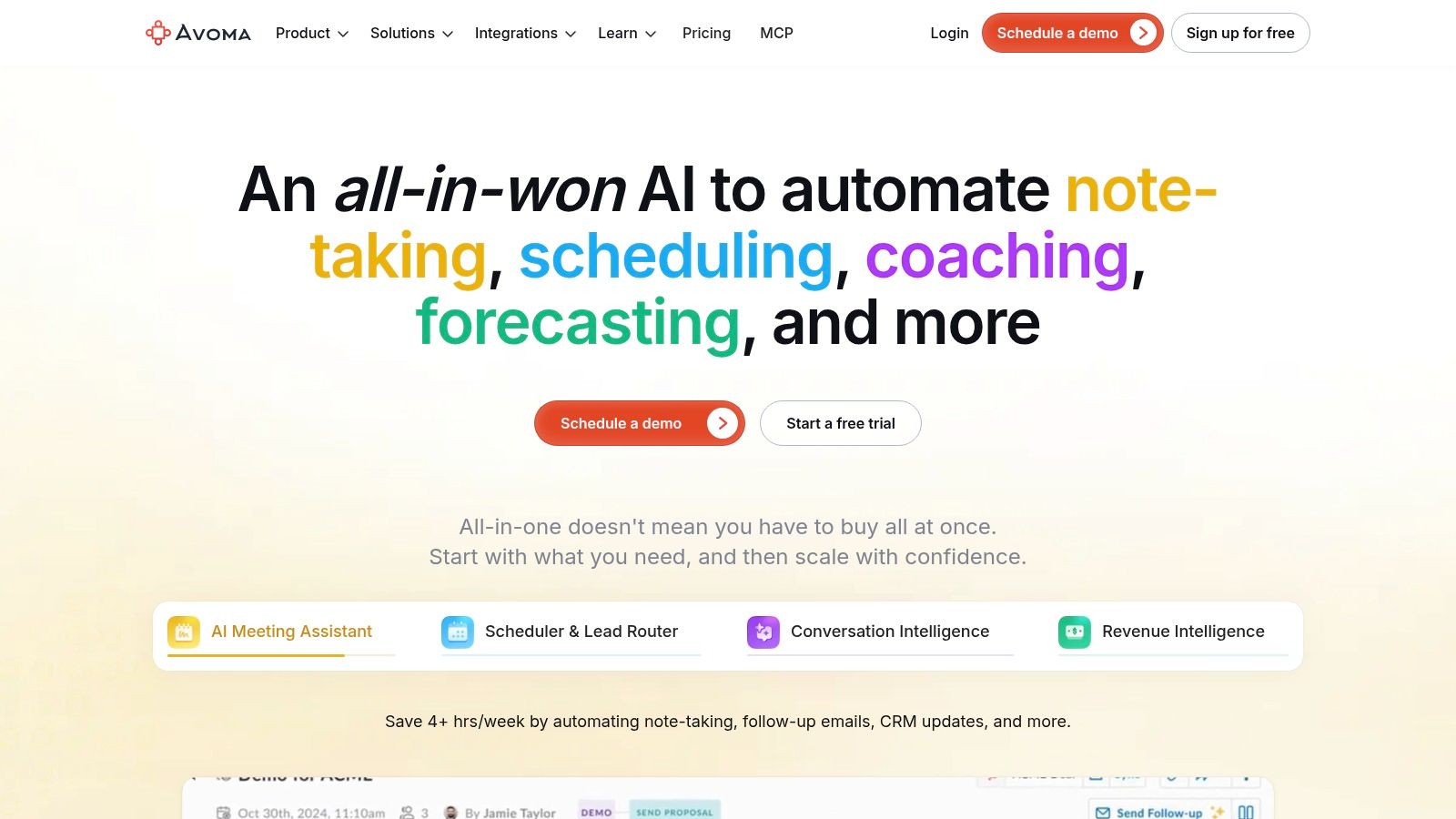
The trade-off is packaging. Meeting notes and transcription don't mean every coaching capability is included; conversation intelligence and call scoring require the relevant add-ons. Most feedback also arrives after the conversation, so managers still need to assign changes and inspect subsequent calls.
Avoma publishes pricing and offers a 14-day trial, making it easier to evaluate against actual calls. Its scorecards support frameworks including MEDDIC, BANT, SPICED, and SPIN, alongside timestamped feedback, playlists, AI summaries, and CRM integrations.
Setup cost and pipeline test
Setup cost is mainly manager attention, plus the subscription and selected add-ons. Connect calendars and your CRM, define observable qualification behaviors, then calibrate scoring against calls your manager has already reviewed.
Keep the rubric narrow. Score problem discovery and an agreed next step before adding every methodology field.
Attach evidence. Put the relevant timestamp beside the coaching action.
Inspect transfer. Check whether the rep applies feedback on later opportunities.
Use our conversation intelligence software comparison if call analysis is the primary purchase. Avoma earns its place when managers turn selected call moments into specific changes, rather than accumulating summaries nobody revisits.
2. Gong
Gong wins when managers have enough buyer conversations to inspect patterns and enough discipline to coach every week. Choose it for a call-heavy B2B operation with complex deals. Skip it when the team needs lightweight recording or still struggles to create qualified meetings.

The trade-off is scope. Gong connects interaction analysis, coaching feedback, scorecards, shared examples, and deal workflows, but quote-based pricing includes user licenses and a platform fee. A small team can end up paying for a revenue platform when its immediate need is narrower.
Setup cost extends beyond procurement. RevOps must connect records and permissions; sales leaders must decide which behaviors deserve inspection. Managers then need protected review time (the part software can't purchase for them).
A call-coaching platform stops paying back when managers stop converting its findings into actions on live opportunities.
A useful workflow is stalled opportunity → relevant call evidence → manager diagnosis → rep action → stage-progression review. Search for missing stakeholder alignment or an unconfirmed next step, rather than treating talk ratios as a complete diagnosis.
In an organizational survey, Integrity Solutions and the Sales Management Association found 12.6% higher sales performance where managers coached at least 9 hours weekly, compared with less than 2.5 hours. That's an association, not proof that software creates the improvement.
Compare Gong alternatives before accepting the broader platform commitment.
3. Dialpad Sell
Pick Dialpad Sell when the phone is your primary selling environment and reps need help during conversations. Its case is strongest for inside-sales teams handling repeated objections. Email-led teams with occasional discovery meetings should skip it.
The trade-off is dependency on the calling workflow and plan tier. Dialpad Sell combines transcription, summaries, dashboards, and live guidance, with published pricing starting at $39 per user per month. Stronger live-coaching and quality-management capabilities require higher-tier plans.
Managers can listen, join, or take over calls. Reps can receive prompts while the buyer is still speaking, which addresses a different problem from reviewing a recording after the opportunity has moved on.
Setup cost and live-call discipline
Setup cost includes phone-system adoption and prompt design, not just seats. Connect Salesforce, HubSpot, or Zoho, then write guidance for objections your buyers raise in practice. Confirm the contracted tier includes the Coaching Hub, scorecards, and other required capabilities.
Use contextual prompts. A manufacturing buyer's implementation concern needs different guidance from a SaaS security objection.
Limit interruptions. Don't flood reps with cards they can't read while listening.
Check independent execution. Review whether reps handle the same objection later without assistance.
Live guidance is useful when a rep knows the process but loses their footing under pressure. It's less useful when the message itself is wrong. Before adding prompts, inspect whether the target account should have received the call at all.
4. Hyperbound
Hyperbound is the practice-first choice for SDR and BDR teams with identifiable conversation gaps. Buy it when new hires need repeated objection handling before speaking to prospects. Skip it if managers can't define what a good response sounds like.
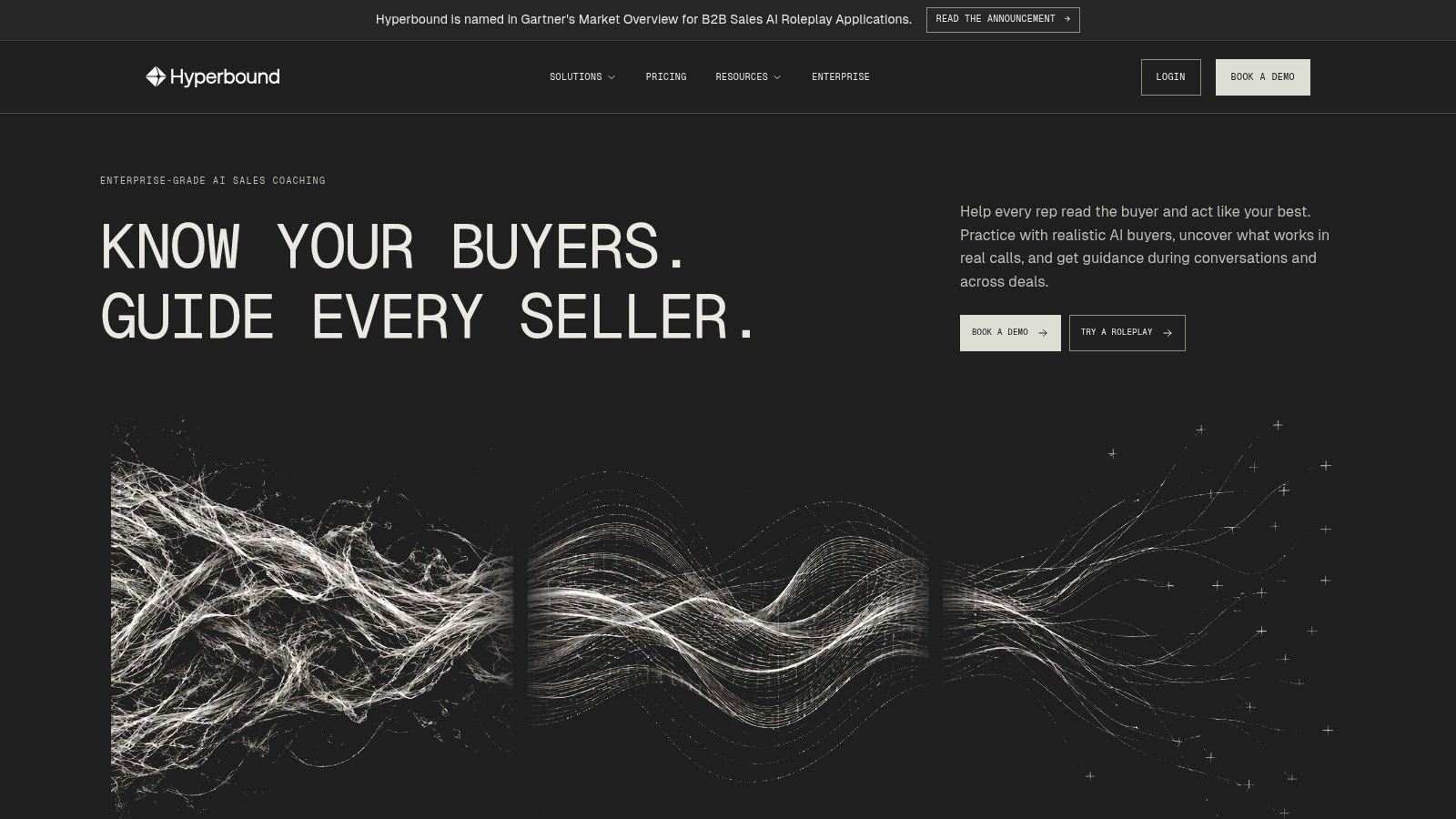
The trade-off is simulation quality. Hyperbound offers customizable AI buyers, methodology-based call scoring, and recommended practice informed by performance gaps. Its integrations include Gong, Salesloft, Salesforce, and HubSpot; pricing requires a team-specific quote, while an interactive demo is available without a credit card.
Setup cost sits in scenario design. Feed practice with actual objections and buying context. A generic reluctant buyer won't prepare a rep for a legal tech evaluation involving procurement, security review, and partners who disagree about changing systems.
Connect rehearsal to buyer evidence
Use the sequence call gap → focused scenario → repeated practice → manager review of a subsequent live conversation. Keep the same scoring criteria across rehearsal and field execution, or improving practice scores won't mean much.
A Journal of Business Research study found that concrete, specific manager coaching supported self-efficacy and willingness to use coaching, while the same approach was less effective when delivered by AI. Keep managers responsible for sensitive feedback and account judgment.
Our sales coaching and training directory helps separate practice tools from call-review platforms. Hyperbound belongs on the shortlist when repetition is the missing input, with human coaching still attached.
5. Mindtickle
Mindtickle is the readiness-program buy. Use it when enablement has to standardize onboarding, practice, and manager coaching across roles or regions. Pass when the actual gap is call search, timestamps, and feedback on one conversation.
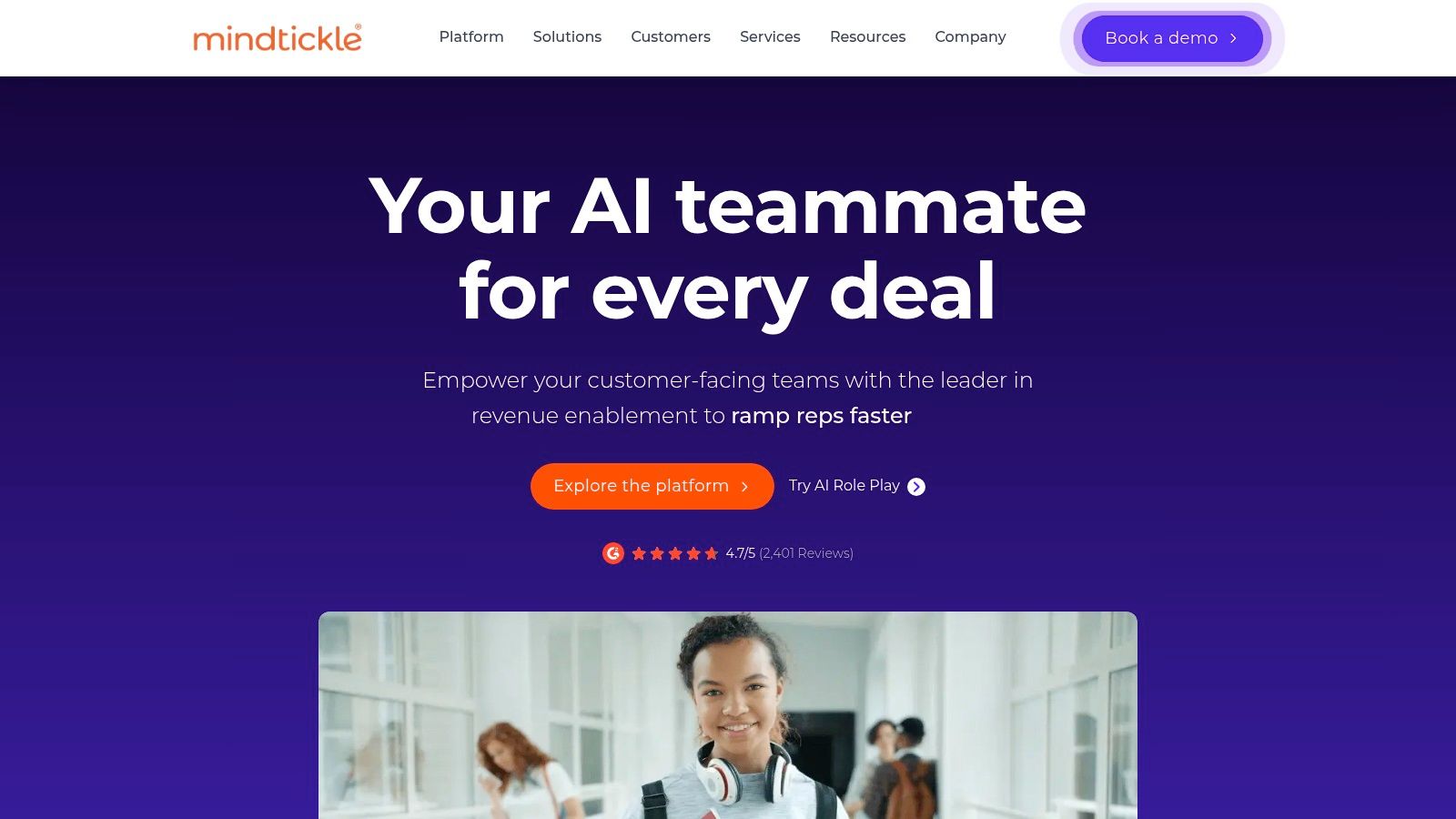
The trade-off is weight. Mindtickle combines coaching templates, call coaching, AI role-play, readiness tracking, and training recommendations, with quote-based pricing and module scope that needs scrutiny. The template library is the usual praise point; treat that as a buying signal, then ask whether coaching changes replies, meetings, and field execution.
Setup cost is program ownership. A named enablement owner has to maintain competencies, approve examples, retire stale modules, and decide which readiness gaps require intervention. Without that owner, managers inherit a library and reps learn to finish modules instead of improving customer conversations.
Build around observable execution
A pharma team should separate product recall from running an approved conversation. An iGaming team should separate market fluency from qualifying a commercially viable account. The coaching unit is the behavior a buyer can hear.
Define the behavior. Replace vague discovery competence with a question asked, a confirmation captured, or a next step secured.
Choose the intervention. Assign practice, peer feedback, or manager coaching according to the gap.
Check field evidence. Compare readiness scores with call execution, reply quality, and meetings created; the platform stops paying back when scores rise and those signals stay flat.
Structured sales coaching programs matter more than feature breadth here. Buy Mindtickle when leadership will run the cadence; choose a narrower tool when managers cannot sustain it.
6. Highspot
Highspot fits teams whose coaching problem is entangled with content and sales guidance. Buy it when reps struggle to select and use approved material during deals. Skip it when you only need call scoring or standalone role-play.

The trade-off is breadth. Highspot connects skill assessments, manager scorecards, AI role-play, and coaching insights with training and content. Pricing requires a sales conversation, and implementation involves more than turning on recording.
Setup cost begins with content governance. Assign owners to approved assets, remove stale material, and map guidance to buyer situations. Then connect coaching to the moment a rep chooses an asset or handles the discussion around it.
Practical rule: If a rep can find the right document but can't explain why the buyer should care, assign conversation practice rather than another content download.
Say a manufacturing rep sends a technical specification after every discovery call. Coach the rep to identify whether the buyer needs engineering validation or a commercial case, then inspect the next step generated by that choice.
The buying question is whether a sales enablement platform solves a connected operational problem. Highspot makes sense when content ownership and coaching ownership can work together (with someone accountable for both). A call-only team should keep the stack smaller.
7. Seismic Learning
Seismic Learning is the better fit when consistent onboarding and certification are the immediate job. Choose it for structured learning that includes practice. Skip it as your primary purchase if managers need to diagnose stalled deals from real conversations.
The trade-off is reporting and category fit. Seismic Learning, formerly Lessonly, supports interactive lessons, learning paths, certifications, role-play activities, coaching plans, and skills assessments. Pricing isn't publicly listed, and role-play performance isn't currently recorded on a learner's report card or lesson overview.
Setup cost is curriculum work. Sales leaders must convert scattered decks and tribal knowledge into lessons people can apply. G2 review summaries commonly highlight ease of use and training workflows, but a usable lesson builder doesn't remove the need for strong instructional content.
Make certification resemble the job
For a legal tech team, build an exercise around a partner questioning adoption risk. Have the rep explain the implementation path and secure an appropriate next step, rather than passing a product-recall quiz.
Lesson evidence. Use approved messaging and realistic account context.
Practice evidence. Require the rep to respond to a buyer objection.
Field evidence. Have a manager inspect the same behavior in a customer conversation.
Keep a separate link between certification and live execution where reporting doesn't cover it. The purchase pays back when training owners maintain the curriculum and managers reinforce it; course completion alone won't establish that reps can qualify or progress an opportunity.
8. Allego
Buy Allego when consolidating enablement functions is a deliberate operating decision. It suits teams that need learning, content, and conversation intelligence together. Skip it if replacing a simple recording tool is the entire business case.

The trade-off is commitment. Allego combines conversation intelligence, coaching recommendations, training reinforcement, content management, digital sales rooms, video selling, and peer learning. Custom pricing depends on seats and contract length, with three-year contracts typical and one- or two-year options available.
Setup cost is migration plus governance. Decide which existing systems will be retired, who owns their replacement workflows, and where customer-facing material will live. Skip that work and consolidation becomes another subscription layered over the old stack.
Prove the connected workflow
Start with a buyer objection found in a real conversation. Use it to assign practice, publish an approved response, and inspect whether the rep handles the issue better on a later deal. That sequence gives the broader platform a job.
Peer video examples earn their place when they show a decision the rep needs to make, not an impressive presentation with no context. Apply the same test to every module in the suite. If a feature never changes what a rep says in front of a buyer, it is shelfware you are paying for.
Every call-coaching platform has a payback ceiling. Coaching on recorded conversations cannot rescue a pipeline built on the wrong prospects. A lean outbound team should treat prospect replies as its fastest coaching signal and fix qualification first, then revisit Allego once a funded consolidation program exists.
9. Second Nature
Second Nature belongs on the shortlist for distributed teams that need repeatable practice and certification. Buy it when managers can't stage every exercise themselves. Skip it when the main need is automatic analysis of real sales calls.
The trade-off is distance from buyer reality. Second Nature provides AI buyer conversations, personalized feedback, scenario creation, localization, and LMS connections through SCORM or LTI. Pricing requires a demo and quote, so assess scenario quality before investing heavily in rollout.
Setup cost is scenario maintenance and assessment calibration. Localization needs more than translated wording. Buyer authority, procurement expectations, and acceptable claims can differ across markets, especially in pharma and other controlled selling environments.
Demand transfer beyond the simulation
Use prospect language from lost deals and qualified replies when constructing exercises. Make the buyer challenge a real assumption, such as whether the implementation effort is justified, rather than cycling through generic objections.
A rep who learns to satisfy the simulation still needs to demonstrate the behavior with a buyer who hasn't read your rubric.
Review feedback with managers before assigning certifications. If the AI rewards fluent delivery while overlooking an unsupported claim, revise the scoring standard before broad use.
Second Nature earns its place when repeated practice relieves a genuine manager-capacity constraint. Keep account strategy and emotionally sensitive performance discussions with a human manager, and validate that practice changes live execution before expanding the program.
10. Salesforce Sales Programs
Choose Salesforce Sales Programs when Salesforce is already where your sellers work and your enablement owner can build CRM-connected programs. Skip it if you need inexpensive call review or your CRM records aren't dependable.

The trade-off is platform commitment and price. Salesforce Sales Programs starts at $100 per user per month, billed annually, requires a Salesforce environment and annual contract, and lists no trial licenses on its pricing page.
Setup cost is administrator capacity plus program design. The product supports in-app coaching, revenue and conversation milestones, automated programs, templates, and enablement analytics. Those capabilities need reliable fields and a clear definition of progress.
Use milestones that reflect buyer movement
A completed seller task isn't sufficient evidence of deal progress. Design programs around observable outcomes, such as confirmed stakeholder involvement or an agreed evaluation step, with supporting activity attached.
CRM foundation. Repair inconsistent stage definitions before automating guidance.
Program ownership. Give sales operations and enablement explicit responsibilities.
Outcome review. Inspect whether completed milestones correspond to better-qualified opportunities.
The attraction is avoiding another destination for reps (provided Salesforce is already their working environment). Embedded guidance can reduce context switching, but it can also formalize a weak process.
Buy after fixing the underlying CRM discipline. For lightweight coaching, Avoma remains the more practical starting point; Salesforce Sales Programs fits organizations ready to maintain a CRM-native enablement system.
Sales coaching tools by published pricing, coaching method, and best fit
Item | Published pricing | Coaching method | Best for |
|---|---|---|---|
Avoma | Public pricing; 14-day trial | Call scorecards, timestamped feedback, and shared call examples | Growing teams coaching from recorded calls |
Gong | Quote-based pricing | Call analysis, scorecards, manager feedback, and progress tracking | B2B teams with frequent sales calls |
Dialpad Sell | Plans start at $39 per user per month | Live call prompts, manager intervention, scorecards, and playbooks | Phone-heavy inside-sales and outbound teams |
Hyperbound | Custom quote | AI buyer role-play linked to real-call performance gaps | SDR and BDR onboarding and ongoing practice |
Mindtickle | Quote-based pricing | Manager-led coaching, AI role-play, and readiness tracking | Organizations running structured coaching programs |
Highspot | Contact sales for pricing | AI skill assessments, role-play, and call- and deal-based coaching insights | Teams connecting coaching with training and sales content |
Seismic Learning | Pricing not publicly listed | Lessons, role-play, coaching plans, and skills assessments | Organizations needing structured training and readiness |
Allego | Custom pricing | Conversation insights, coaching recommendations, and learning reinforcement | Mid-market and enterprise teams consolidating enablement tools |
Second Nature | Demo and quote required | AI sales role-play with personalized feedback and scoring | Large or distributed teams needing scalable practice |
Salesforce Sales Programs | Starts at $100 per user per month, billed annually | In-CRM guidance, milestones, and automated programs | Salesforce-centric teams connecting coaching to CRM workflows |
Choosing a tool that moves pipeline, not just call scores
Avoma is the default buy. Gong is the call-heavy management buy. Dialpad Sell is the phone-first buy. Choose a practice or enablement platform only when that specific constraint is blocking execution. More functionality won't compensate for an undefined coaching job.
Apply these buying checks before signing:
Workflow fit. Test the finalist against your CRM and LMS, including permissions, record matching, and feedback visibility.
Outcome reporting. Connect coaching to qualified meetings, accepted opportunities, and pipeline; keep activity measures separate.
Daily adoption. Have reps complete the actual workflow, not watch an administrator demonstrate it.
There's a genuine execution gap. A Sales Mastery Performance Scorecard analysis covering more than 500 firms found 68% used random or informal coaching. Buying software without assigning a cadence and owner can preserve that informality behind a better dashboard.
For LinkedIn and email-led outbound, inspect prospect replies before call scores. A wrong-person reply points toward targeting. Interest without a booked meeting points toward handoff or qualification. A held meeting without an accepted opportunity calls for closer inspection of fit and discovery.
Use Sales Navigator and Apollo for account selection, Clay for enrichment, then Lemlist, Instantly, or Smartlead for email execution and HeyReach for LinkedIn outreach, according to your operating setup. Carry segment, opener, reply classification, and owner into HubSpot. Don't add every tool; preserve a reporting line across the ones you use.
When follow-up is the constraint, find software for automated sales follow-up before buying more call analysis. Route interested replies to a named person and make the qualification decision visible. Skip gamification that rewards calls made or messages sent, because it encourages volume without proving account fit.
Test coaching with comparable segments and record the behavior you're trying to change. Compare baseline performance with coached execution, accounting for differences in rep experience and opportunity mix. Rising scores without better buyer progression are a reason to revise the intervention, not celebrate adoption.
Start this Friday by pulling your reply-to-meeting rate for the last 30 days, split by opener and segment. Add meeting-held and accepted-opportunity status beside it, then identify whether the next investment belongs in targeting, reply routing, or call coaching.
GROU is a global B2B pipeline agency that connects LinkedIn content, lead generation, and outbound with clients' existing sales teams. We build ICP-aligned lists, apply qualification rules, route replies, and review pipeline quality in biweekly sprints. Visit Grou and take the 2-minute pipeline quiz to identify where your pipeline is breaking before adding another coaching subscription.
Most coaching problems start before the call. Reps book meetings that never hold, managers review recordings nobody acts on, and pipeline stays thin. Buying more call analysis won't fix poor targeting. Avoma is our #1 pick for most B2B teams, with accessible evaluation, scored calls, and CRM links.
Avoma suits growing teams that need practical call coaching without buying a broad revenue platform.
Gong wins for heavy call volume and managers who coach weekly.
Dialpad Sell fits phone-first inside sales.
The remaining tools address practice, readiness, content, or CRM-embedded programs.
The popular advice is to record everything and let AI find the answers. Start earlier. For LinkedIn and email-led outbound, prospect replies show whether your opener earns interest, your segment fits, and your offer deserves a conversation. Call coaching becomes useful once enough qualified buyers reach calls.
At GROU, we don't use a dedicated coaching platform. We review market feedback with clients every two weeks, connecting messaging changes to reply quality and meetings rather than abstract scores.
Buy against a specific bottleneck. The same discipline applies beyond SaaS: a coaching vendor checklist for RIAs provides an adjacent reference for evaluating coaching support. For B2B revenue teams, the decisive question is whether feedback changes execution on real opportunities.
Table of Contents
1. Avoma
Buy Avoma first if you need recorded-call coaching tied to everyday meeting workflows. It's our default recommendation for growing teams. Skip it if your main problem is getting qualified prospects onto calls, because scoring discovery won't repair weak outbound targeting.
The trade-off is packaging. Meeting notes and transcription don't mean every coaching capability is included; conversation intelligence and call scoring require the relevant add-ons. Most feedback also arrives after the conversation, so managers still need to assign changes and inspect subsequent calls.
Avoma publishes pricing and offers a 14-day trial, making it easier to evaluate against actual calls. Its scorecards support frameworks including MEDDIC, BANT, SPICED, and SPIN, alongside timestamped feedback, playlists, AI summaries, and CRM integrations.
Setup cost and pipeline test
Setup cost is mainly manager attention, plus the subscription and selected add-ons. Connect calendars and your CRM, define observable qualification behaviors, then calibrate scoring against calls your manager has already reviewed.
Keep the rubric narrow. Score problem discovery and an agreed next step before adding every methodology field.
Attach evidence. Put the relevant timestamp beside the coaching action.
Inspect transfer. Check whether the rep applies feedback on later opportunities.
Use our conversation intelligence software comparison if call analysis is the primary purchase. Avoma earns its place when managers turn selected call moments into specific changes, rather than accumulating summaries nobody revisits.
2. Gong
Gong wins when managers have enough buyer conversations to inspect patterns and enough discipline to coach every week. Choose it for a call-heavy B2B operation with complex deals. Skip it when the team needs lightweight recording or still struggles to create qualified meetings.
The trade-off is scope. Gong connects interaction analysis, coaching feedback, scorecards, shared examples, and deal workflows, but quote-based pricing includes user licenses and a platform fee. A small team can end up paying for a revenue platform when its immediate need is narrower.
Setup cost extends beyond procurement. RevOps must connect records and permissions; sales leaders must decide which behaviors deserve inspection. Managers then need protected review time (the part software can't purchase for them).
A call-coaching platform stops paying back when managers stop converting its findings into actions on live opportunities.
A useful workflow is stalled opportunity → relevant call evidence → manager diagnosis → rep action → stage-progression review. Search for missing stakeholder alignment or an unconfirmed next step, rather than treating talk ratios as a complete diagnosis.
In an organizational survey, Integrity Solutions and the Sales Management Association found 12.6% higher sales performance where managers coached at least 9 hours weekly, compared with less than 2.5 hours. That's an association, not proof that software creates the improvement.
Compare Gong alternatives before accepting the broader platform commitment.
3. Dialpad Sell
Pick Dialpad Sell when the phone is your primary selling environment and reps need help during conversations. Its case is strongest for inside-sales teams handling repeated objections. Email-led teams with occasional discovery meetings should skip it.
The trade-off is dependency on the calling workflow and plan tier. Dialpad Sell combines transcription, summaries, dashboards, and live guidance, with published pricing starting at $39 per user per month. Stronger live-coaching and quality-management capabilities require higher-tier plans.
Managers can listen, join, or take over calls. Reps can receive prompts while the buyer is still speaking, which addresses a different problem from reviewing a recording after the opportunity has moved on.
Setup cost and live-call discipline
Setup cost includes phone-system adoption and prompt design, not just seats. Connect Salesforce, HubSpot, or Zoho, then write guidance for objections your buyers raise in practice. Confirm the contracted tier includes the Coaching Hub, scorecards, and other required capabilities.
Use contextual prompts. A manufacturing buyer's implementation concern needs different guidance from a SaaS security objection.
Limit interruptions. Don't flood reps with cards they can't read while listening.
Check independent execution. Review whether reps handle the same objection later without assistance.
Live guidance is useful when a rep knows the process but loses their footing under pressure. It's less useful when the message itself is wrong. Before adding prompts, inspect whether the target account should have received the call at all.
4. Hyperbound
Hyperbound is the practice-first choice for SDR and BDR teams with identifiable conversation gaps. Buy it when new hires need repeated objection handling before speaking to prospects. Skip it if managers can't define what a good response sounds like.
The trade-off is simulation quality. Hyperbound offers customizable AI buyers, methodology-based call scoring, and recommended practice informed by performance gaps. Its integrations include Gong, Salesloft, Salesforce, and HubSpot; pricing requires a team-specific quote, while an interactive demo is available without a credit card.
Setup cost sits in scenario design. Feed practice with actual objections and buying context. A generic reluctant buyer won't prepare a rep for a legal tech evaluation involving procurement, security review, and partners who disagree about changing systems.
Connect rehearsal to buyer evidence
Use the sequence call gap → focused scenario → repeated practice → manager review of a subsequent live conversation. Keep the same scoring criteria across rehearsal and field execution, or improving practice scores won't mean much.
A Journal of Business Research study found that concrete, specific manager coaching supported self-efficacy and willingness to use coaching, while the same approach was less effective when delivered by AI. Keep managers responsible for sensitive feedback and account judgment.
Our sales coaching and training directory helps separate practice tools from call-review platforms. Hyperbound belongs on the shortlist when repetition is the missing input, with human coaching still attached.
5. Mindtickle
Mindtickle is the readiness-program buy. Use it when enablement has to standardize onboarding, practice, and manager coaching across roles or regions. Pass when the actual gap is call search, timestamps, and feedback on one conversation.
The trade-off is weight. Mindtickle combines coaching templates, call coaching, AI role-play, readiness tracking, and training recommendations, with quote-based pricing and module scope that needs scrutiny. The template library is the usual praise point; treat that as a buying signal, then ask whether coaching changes replies, meetings, and field execution.
Setup cost is program ownership. A named enablement owner has to maintain competencies, approve examples, retire stale modules, and decide which readiness gaps require intervention. Without that owner, managers inherit a library and reps learn to finish modules instead of improving customer conversations.
Build around observable execution
A pharma team should separate product recall from running an approved conversation. An iGaming team should separate market fluency from qualifying a commercially viable account. The coaching unit is the behavior a buyer can hear.
Define the behavior. Replace vague discovery competence with a question asked, a confirmation captured, or a next step secured.
Choose the intervention. Assign practice, peer feedback, or manager coaching according to the gap.
Check field evidence. Compare readiness scores with call execution, reply quality, and meetings created; the platform stops paying back when scores rise and those signals stay flat.
Structured sales coaching programs matter more than feature breadth here. Buy Mindtickle when leadership will run the cadence; choose a narrower tool when managers cannot sustain it.
6. Highspot
Highspot fits teams whose coaching problem is entangled with content and sales guidance. Buy it when reps struggle to select and use approved material during deals. Skip it when you only need call scoring or standalone role-play.
The trade-off is breadth. Highspot connects skill assessments, manager scorecards, AI role-play, and coaching insights with training and content. Pricing requires a sales conversation, and implementation involves more than turning on recording.
Setup cost begins with content governance. Assign owners to approved assets, remove stale material, and map guidance to buyer situations. Then connect coaching to the moment a rep chooses an asset or handles the discussion around it.
Practical rule: If a rep can find the right document but can't explain why the buyer should care, assign conversation practice rather than another content download.
Say a manufacturing rep sends a technical specification after every discovery call. Coach the rep to identify whether the buyer needs engineering validation or a commercial case, then inspect the next step generated by that choice.
The buying question is whether a sales enablement platform solves a connected operational problem. Highspot makes sense when content ownership and coaching ownership can work together (with someone accountable for both). A call-only team should keep the stack smaller.
7. Seismic Learning
Seismic Learning is the better fit when consistent onboarding and certification are the immediate job. Choose it for structured learning that includes practice. Skip it as your primary purchase if managers need to diagnose stalled deals from real conversations.
The trade-off is reporting and category fit. Seismic Learning, formerly Lessonly, supports interactive lessons, learning paths, certifications, role-play activities, coaching plans, and skills assessments. Pricing isn't publicly listed, and role-play performance isn't currently recorded on a learner's report card or lesson overview.
Setup cost is curriculum work. Sales leaders must convert scattered decks and tribal knowledge into lessons people can apply. G2 review summaries commonly highlight ease of use and training workflows, but a usable lesson builder doesn't remove the need for strong instructional content.
Make certification resemble the job
For a legal tech team, build an exercise around a partner questioning adoption risk. Have the rep explain the implementation path and secure an appropriate next step, rather than passing a product-recall quiz.
Lesson evidence. Use approved messaging and realistic account context.
Practice evidence. Require the rep to respond to a buyer objection.
Field evidence. Have a manager inspect the same behavior in a customer conversation.
Keep a separate link between certification and live execution where reporting doesn't cover it. The purchase pays back when training owners maintain the curriculum and managers reinforce it; course completion alone won't establish that reps can qualify or progress an opportunity.
8. Allego
Buy Allego when consolidating enablement functions is a deliberate operating decision. It suits teams that need learning, content, and conversation intelligence together. Skip it if replacing a simple recording tool is the entire business case.
The trade-off is commitment. Allego combines conversation intelligence, coaching recommendations, training reinforcement, content management, digital sales rooms, video selling, and peer learning. Custom pricing depends on seats and contract length, with three-year contracts typical and one- or two-year options available.
Setup cost is migration plus governance. Decide which existing systems will be retired, who owns their replacement workflows, and where customer-facing material will live. Skip that work and consolidation becomes another subscription layered over the old stack.
Prove the connected workflow
Start with a buyer objection found in a real conversation. Use it to assign practice, publish an approved response, and inspect whether the rep handles the issue better on a later deal. That sequence gives the broader platform a job.
Peer video examples earn their place when they show a decision the rep needs to make, not an impressive presentation with no context. Apply the same test to every module in the suite. If a feature never changes what a rep says in front of a buyer, it is shelfware you are paying for.
Every call-coaching platform has a payback ceiling. Coaching on recorded conversations cannot rescue a pipeline built on the wrong prospects. A lean outbound team should treat prospect replies as its fastest coaching signal and fix qualification first, then revisit Allego once a funded consolidation program exists.
9. Second Nature
Second Nature belongs on the shortlist for distributed teams that need repeatable practice and certification. Buy it when managers can't stage every exercise themselves. Skip it when the main need is automatic analysis of real sales calls.
The trade-off is distance from buyer reality. Second Nature provides AI buyer conversations, personalized feedback, scenario creation, localization, and LMS connections through SCORM or LTI. Pricing requires a demo and quote, so assess scenario quality before investing heavily in rollout.
Setup cost is scenario maintenance and assessment calibration. Localization needs more than translated wording. Buyer authority, procurement expectations, and acceptable claims can differ across markets, especially in pharma and other controlled selling environments.
Demand transfer beyond the simulation
Use prospect language from lost deals and qualified replies when constructing exercises. Make the buyer challenge a real assumption, such as whether the implementation effort is justified, rather than cycling through generic objections.
A rep who learns to satisfy the simulation still needs to demonstrate the behavior with a buyer who hasn't read your rubric.
Review feedback with managers before assigning certifications. If the AI rewards fluent delivery while overlooking an unsupported claim, revise the scoring standard before broad use.
Second Nature earns its place when repeated practice relieves a genuine manager-capacity constraint. Keep account strategy and emotionally sensitive performance discussions with a human manager, and validate that practice changes live execution before expanding the program.
10. Salesforce Sales Programs
Choose Salesforce Sales Programs when Salesforce is already where your sellers work and your enablement owner can build CRM-connected programs. Skip it if you need inexpensive call review or your CRM records aren't dependable.
The trade-off is platform commitment and price. Salesforce Sales Programs starts at $100 per user per month, billed annually, requires a Salesforce environment and annual contract, and lists no trial licenses on its pricing page.
Setup cost is administrator capacity plus program design. The product supports in-app coaching, revenue and conversation milestones, automated programs, templates, and enablement analytics. Those capabilities need reliable fields and a clear definition of progress.
Use milestones that reflect buyer movement
A completed seller task isn't sufficient evidence of deal progress. Design programs around observable outcomes, such as confirmed stakeholder involvement or an agreed evaluation step, with supporting activity attached.
CRM foundation. Repair inconsistent stage definitions before automating guidance.
Program ownership. Give sales operations and enablement explicit responsibilities.
Outcome review. Inspect whether completed milestones correspond to better-qualified opportunities.
The attraction is avoiding another destination for reps (provided Salesforce is already their working environment). Embedded guidance can reduce context switching, but it can also formalize a weak process.
Buy after fixing the underlying CRM discipline. For lightweight coaching, Avoma remains the more practical starting point; Salesforce Sales Programs fits organizations ready to maintain a CRM-native enablement system.
Sales coaching tools by published pricing, coaching method, and best fit
Item | Published pricing | Coaching method | Best for |
|---|---|---|---|
Avoma | Public pricing; 14-day trial | Call scorecards, timestamped feedback, and shared call examples | Growing teams coaching from recorded calls |
Gong | Quote-based pricing | Call analysis, scorecards, manager feedback, and progress tracking | B2B teams with frequent sales calls |
Dialpad Sell | Plans start at $39 per user per month | Live call prompts, manager intervention, scorecards, and playbooks | Phone-heavy inside-sales and outbound teams |
Hyperbound | Custom quote | AI buyer role-play linked to real-call performance gaps | SDR and BDR onboarding and ongoing practice |
Mindtickle | Quote-based pricing | Manager-led coaching, AI role-play, and readiness tracking | Organizations running structured coaching programs |
Highspot | Contact sales for pricing | AI skill assessments, role-play, and call- and deal-based coaching insights | Teams connecting coaching with training and sales content |
Seismic Learning | Pricing not publicly listed | Lessons, role-play, coaching plans, and skills assessments | Organizations needing structured training and readiness |
Allego | Custom pricing | Conversation insights, coaching recommendations, and learning reinforcement | Mid-market and enterprise teams consolidating enablement tools |
Second Nature | Demo and quote required | AI sales role-play with personalized feedback and scoring | Large or distributed teams needing scalable practice |
Salesforce Sales Programs | Starts at $100 per user per month, billed annually | In-CRM guidance, milestones, and automated programs | Salesforce-centric teams connecting coaching to CRM workflows |
Choosing a tool that moves pipeline, not just call scores
Avoma is the default buy. Gong is the call-heavy management buy. Dialpad Sell is the phone-first buy. Choose a practice or enablement platform only when that specific constraint is blocking execution. More functionality won't compensate for an undefined coaching job.
Apply these buying checks before signing:
Workflow fit. Test the finalist against your CRM and LMS, including permissions, record matching, and feedback visibility.
Outcome reporting. Connect coaching to qualified meetings, accepted opportunities, and pipeline; keep activity measures separate.
Daily adoption. Have reps complete the actual workflow, not watch an administrator demonstrate it.
There's a genuine execution gap. A Sales Mastery Performance Scorecard analysis covering more than 500 firms found 68% used random or informal coaching. Buying software without assigning a cadence and owner can preserve that informality behind a better dashboard.
For LinkedIn and email-led outbound, inspect prospect replies before call scores. A wrong-person reply points toward targeting. Interest without a booked meeting points toward handoff or qualification. A held meeting without an accepted opportunity calls for closer inspection of fit and discovery.
Use Sales Navigator and Apollo for account selection, Clay for enrichment, then Lemlist, Instantly, or Smartlead for email execution and HeyReach for LinkedIn outreach, according to your operating setup. Carry segment, opener, reply classification, and owner into HubSpot. Don't add every tool; preserve a reporting line across the ones you use.
When follow-up is the constraint, find software for automated sales follow-up before buying more call analysis. Route interested replies to a named person and make the qualification decision visible. Skip gamification that rewards calls made or messages sent, because it encourages volume without proving account fit.
Test coaching with comparable segments and record the behavior you're trying to change. Compare baseline performance with coached execution, accounting for differences in rep experience and opportunity mix. Rising scores without better buyer progression are a reason to revise the intervention, not celebrate adoption.
Start this Friday by pulling your reply-to-meeting rate for the last 30 days, split by opener and segment. Add meeting-held and accepted-opportunity status beside it, then identify whether the next investment belongs in targeting, reply routing, or call coaching.
GROU is a global B2B pipeline agency that connects LinkedIn content, lead generation, and outbound with clients' existing sales teams. We build ICP-aligned lists, apply qualification rules, route replies, and review pipeline quality in biweekly sprints. Visit Grou and take the 2-minute pipeline quiz to identify where your pipeline is breaking before adding another coaching subscription.
Pipeline OS Newsletter
Build qualified pipeline
Get weekly tactics to generate demand, improve lead quality, and book more meetings.




Trusted by industry leaders
Trusted by industry leaders
Trusted by industry leaders
Ready to build qualified pipeline?
Ready to build qualified pipeline?
Ready to build qualified pipeline?
Book a call to see if we're the right fit, or take the 2-minute quiz to get a clear starting point.
Book a call to see if we're the right fit, or take the 2-minute quiz to get a clear starting point.
Book a call to see if we're the right fit, or take the 2-minute quiz to get a clear starting point.
" height="30.21639343089746px" id="hfGbXmQR2" width="30.216393430897455px"/></svg>)
Copyright © 2026 – All Right Reserved
Copyright © 2026 – All Right Reserved
Copyright © 2026 – All Right Reserved