%22%3E%3C/path%3E%3Cpath d=%22M 63.072 7.554 C 62.258 8.022 61.577 8.689 61.092 9.493 L 61.092 7.076 L 57.158 7.076 L 57.158 22.64 L 61.089 22.64 L 61.089 14.888 C 61.089 13.446 61.403 12.434 62.03 11.853 C 62.818 11.218 63.818 10.907 64.826 10.982 L 65.868 10.982 L 65.868 6.851 C 64.891 6.834 63.926 7.076 63.073 7.554 Z%22 fill=%22rgb(17,17,17)%22%3E%3C/path%3E%3Cpath d=%22M 78.916 7.82 C 76.363 6.49 73.321 6.49 70.768 7.82 C 69.562 8.473 68.564 9.451 67.888 10.644 C 67.167 11.931 66.803 13.387 66.834 14.862 C 66.804 16.332 67.157 17.785 67.86 19.077 C 68.515 20.267 69.494 21.246 70.684 21.901 C 71.924 22.576 73.318 22.92 74.73 22.898 C 76.164 22.918 77.58 22.575 78.846 21.901 C 80.062 21.247 81.073 20.27 81.768 19.077 C 82.506 17.797 82.88 16.339 82.85 14.862 C 82.88 13.389 82.517 11.934 81.797 10.647 C 81.12 9.455 80.122 8.477 78.917 7.824 M 78.803 14.862 C 78.829 15.739 78.636 16.608 78.241 17.391 C 77.903 18.046 77.38 18.588 76.738 18.95 C 76.124 19.293 75.432 19.472 74.729 19.47 C 73.668 19.497 72.648 19.061 71.934 18.276 C 71.139 17.323 70.741 16.1 70.823 14.862 C 70.741 13.62 71.149 12.395 71.959 11.45 C 72.687 10.667 73.715 10.233 74.783 10.256 C 75.859 10.236 76.894 10.67 77.635 11.45 C 78.464 12.387 78.884 13.616 78.801 14.864%22 fill=%22rgb(17,17,17)%22%3E%3C/path%3E%3Cpath d=%22M 95.906 7.076 L 95.906 15.646 C 95.975 16.68 95.643 17.701 94.979 18.498 C 94.311 19.184 93.379 19.547 92.422 19.495 C 91.475 19.544 90.553 19.18 89.894 18.498 C 89.23 17.701 88.898 16.68 88.967 15.646 L 88.967 7.076 L 85.033 7.076 L 85.033 16.207 C 85 17.449 85.275 18.68 85.834 19.79 C 86.327 20.75 87.095 21.542 88.039 22.065 C 89.033 22.594 90.145 22.861 91.271 22.838 C 92.188 22.847 93.095 22.65 93.926 22.263 C 94.708 21.905 95.388 21.36 95.906 20.675 L 95.906 22.645 L 99.865 22.645 L 99.865 7.076 Z%22 fill=%22rgb(17,17,17)%22%3E%3C/path%3E%3Cpath d=%22M 4.513 15.626 C 4.511 10.815 7.606 6.549 12.181 5.059 C 16.756 3.57 21.77 5.195 24.601 9.086 L 27.816 5.87 C 24.074 1.186 17.981 -0.943 12.137 0.393 C 6.292 1.728 1.728 6.292 0.393 12.137 C -0.943 17.981 1.186 24.074 5.87 27.816 L 9.085 24.601 C 6.214 22.512 4.515 19.177 4.513 15.626%22 fill=%22rgb(32,62,235)%22%3E%3C/path%3E%3Cpath d=%22M 17.114 14.343 L 13.354 18.01 L 13.354 18.026 L 21.071 18.026 L 11.412 27.609 L 17.389 27.609 L 23.999 21.081 L 23.999 28.316 L 24.005 28.316 L 27.967 24.393 L 27.967 14.343 Z%22 fill=%22rgb(32,62,235)%22%3E%3C/path%3E%3C/g%3E%3C/svg%3E) ×
× ××
××›
›
›
›
Webinar lead generation for B2B 2026
Webinar lead generation for B2B 2026
Webinar lead generation for B2B 2026
Webinar lead generation for B2B 2026
Webinar lead generation for B2B 2026
Webinar lead generation for B2B 2026

Author
Aljaz Peklaj

Most B2B webinars are content projects wearing a lead generation costume. They get produced, they get attended, a spreadsheet of registrants lands in the CRM, and nobody can say what happened next. The webinars that actually build pipeline are structured differently from the first decision onward: the topic is chosen to qualify, the promotion is engineered for a specific list, and the follow-up is built before the invite goes out.
This playbook covers what the published benchmarks really say about attendance, which parts of the format do the qualifying, and the run plan that turns an event into a pipeline source.
TL;DR
Two platform benchmark reports published attendance rates that differ by nine points, and the gap tells you more than either number does. ON24 reports a 60% registration-to-attendance conversion and an average of 239 attendees per webinar in 2025, while Goldcast, analysing 900 B2B webinars across 100 brands, reports 51% and about 129 attendees. Both are right for their own mix, which means neither is your number until you have run four events. What both agree on is that engagement, not attendance, is the buying signal: ON24 counts over 300 individual interactions per webinar, of which 150 are poll responses and 101 are resource downloads, and reports a 73% rise in demo bookings alongside a 49% increase in call-to-action engagement per attendee. Build the topic so that only your buyer wants it, promote to a list you already own rather than to the open internet, put one qualifying poll in the middle, and route the people who answer it to sales the same day. Goldcast also found that using the word "webinar" in the title was associated with a 50% drop in registration, which is the cheapest test on this list.
The attendance number nobody agrees on
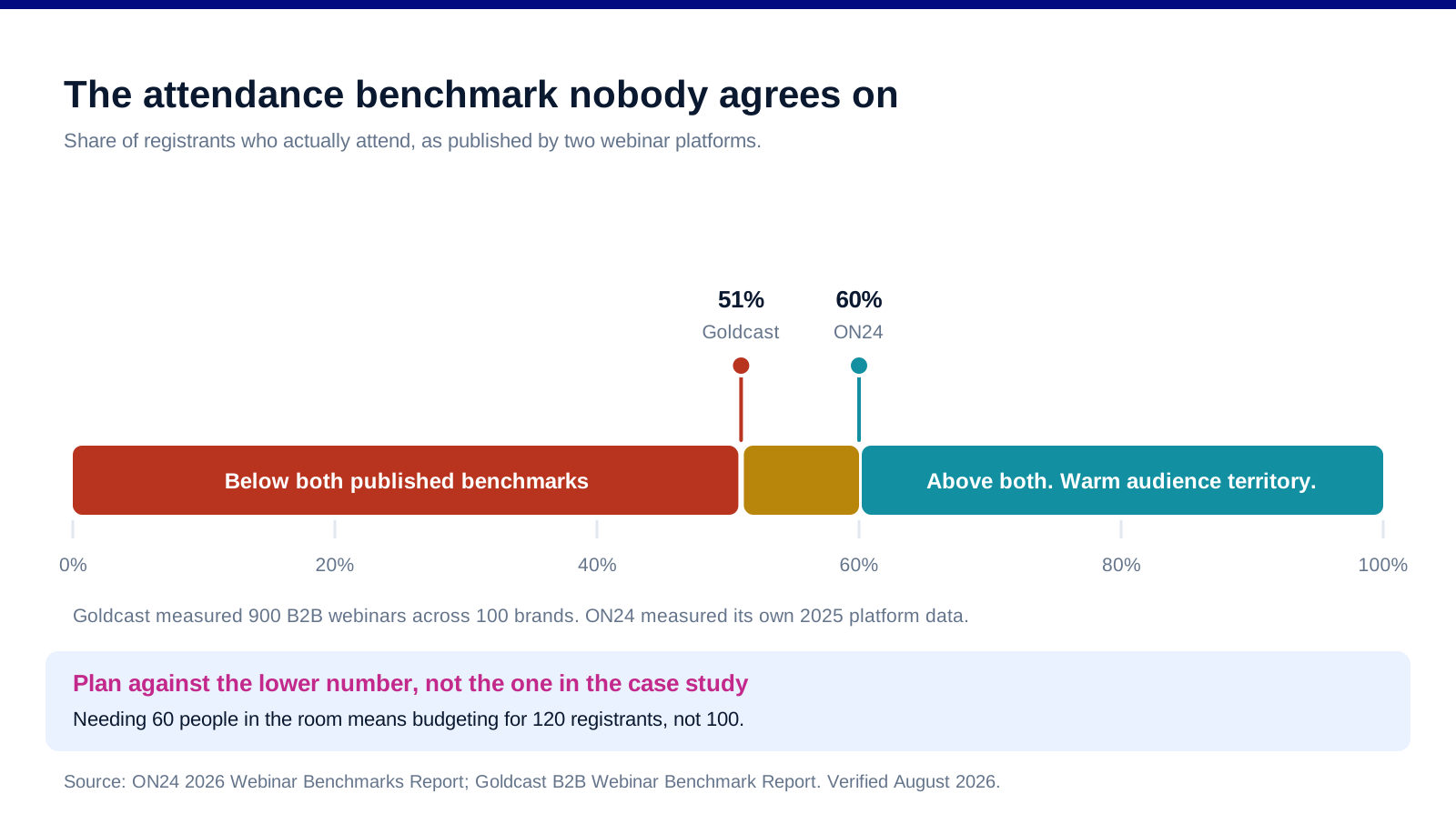
The spread between the two published figures is not a measurement error. ON24's dataset skews toward large enterprise programmes with established audiences and heavy on-demand distribution. Goldcast's skews toward B2B software brands running demand-generation events to colder lists. Your own rate will sit somewhere on that line depending on which of those you resemble.
Plan for the lower number and treat the higher one as a ceiling. If you need 60 people in the room to make an event worth running, budget for 120 registrants at minimum. Teams that plan against the optimistic benchmark end up with a half-empty session and a speaker who sounds like they are presenting to an empty room, which is itself visible to the people who did turn up.
Registration volume is a list problem, not a promotion problem. Goldcast's average of 257 registrants per event comes from brands with existing audiences. If you are starting from a cold list, the registration number is capped by how many relevant people you can reach, and no amount of ad spend fixes a list that does not contain your buyer.
On-demand is not a consolation prize. ON24 reports 67% of attendees watching live and 43% on demand, and it also reports that personalising the on-demand experience lifted attendance from 97 to 125, a 25% increase, with a 118% jump in clicks on personalised calls to action. The recording is a second campaign, not an archive.
What actually qualifies people
![[INSERT CHART 2, webinar-lead-generation-b2b-chart-2-engagement.svg] Alt: Webinar engagement actions per event 2026, poll responses, downloads, certifications, reactions and surveys.](https://framerusercontent.com/images/4iPlKntSzI5XjEwrketF2y4oxzE.svg)
The interaction mix above is the part of the format that does the sales work, and it is why a webinar outperforms a gated PDF on the same topic. Someone who answers a poll about their current setup has told you something a form fill never would.
Polls are the highest-volume signal and the most underused. At 150 poll responses per webinar on average, this is where the qualifying happens. One poll asking which of four situations describes the attendee's current state segments the entire audience in ten seconds, and the answers go straight into the CRM as a field rather than a note.
Resource downloads mark intent depth. 101 downloads per event, and the person who takes the implementation checklist is at a different stage than the person who takes the summary slides. Track which asset, not just whether.
Live chat with sales is the closest thing to a raised hand. ON24 reports a 51% increase in live chat with sales teams and a 4X increase in meeting bookings during the webinar itself. Staffing the chat with someone who can book a call while the session is running converts better than any follow-up sequence, because the interest is at its peak precisely then.
Attendance duration sets the realistic ceiling. Average engagement holds at 49 minutes, which means a 60-minute session loses the room in the last stretch. Put the offer at minute 40, not minute 58.
The run plan
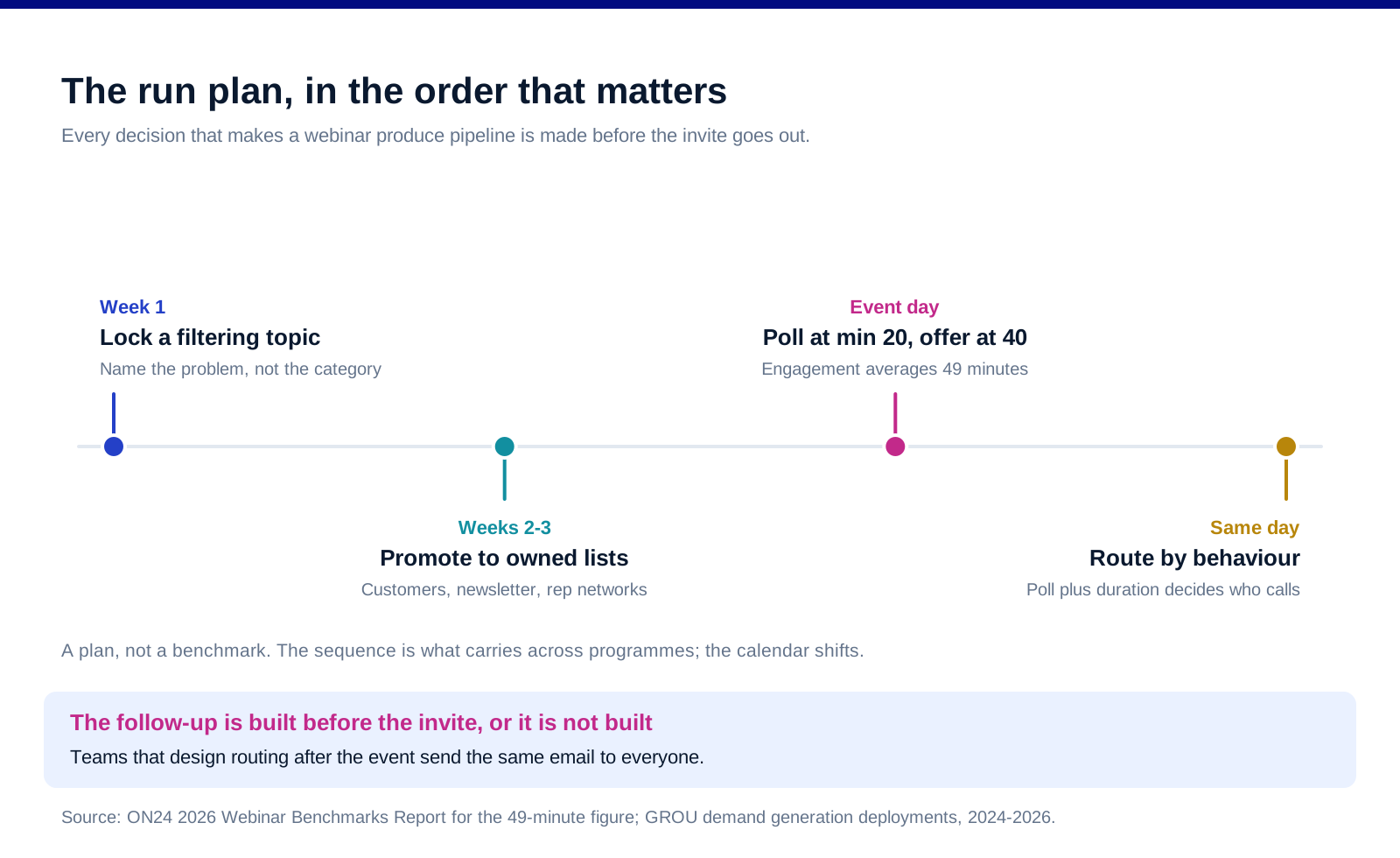
The timeline above is a plan rather than a benchmark, drawn from how we run these for clients. The dates matter less than the order.
Step 1: pick a topic only your buyer wants. The test is whether someone outside your ICP would find the title irrelevant. "How manufacturers handle tariff changes in quoting" filters harder than "The future of manufacturing", and the second one fills the room with people who will never buy. Goldcast's finding that the word "webinar" in a title correlates with a 50% registration drop points the same direction: name the problem, not the format.
Step 2: promote to owned lists first. Your customer list, your newsletter, your sales reps' connections. Paid promotion is for topping up a list that is already producing registrations, not for creating demand from zero.
Step 3: write the qualifying poll before you write the deck. If you know what you want to learn about each attendee, the session gets built around drawing that answer out. Do it the other way round and the poll becomes an engagement gimmick.
Step 4: staff the chat with a person who can book meetings. Not a moderator relaying questions. Someone with a calendar link and permission to use it.
Step 5: route on the same day, segmented by behaviour. Poll answer plus download plus duration gives you three fields to sort on. Attendees who stayed past 40 minutes and answered the poll go to sales. Registrants who never showed go to the recording sequence. Zapier handles the routing when your platform and CRM have no native path.
Step 6: relaunch the recording as its own campaign. New copy, new audience, personalised landing experience. The 25% attendance lift ON24 measured from personalisation applies here, not to the live event.
Choosing a platform without overbuying
The platform decision matters less than teams expect, and most B2B programmes are well served by what they already have. Zoom covers the basics when the event is a conversation rather than a production. Livestorm and Demio sit in the middle for marketing teams who need registration pages, polls and native CRM handoff without a production crew. ON24 and Goldcast are built for programmes running events continuously with engagement scoring feeding directly into pipeline reporting.
The question that decides it is whether your engagement data needs to arrive in the CRM as structured fields. If yes, buy the platform that does it natively rather than reconstructing it from exports every month.
None of these vendors runs an affiliate programme we participate in, so the links above go to their own sites and we earn nothing from them.
Measuring it honestly
Count qualified attendees, not registrants. The registrant number is a marketing metric. The number that predicts pipeline is people who attended, engaged and match the ICP, which is usually a fraction of the headline figure.
Attribute over a quarter, not a week. A webinar attendee who books three weeks later still came from the webinar. Cohort by event, then read pipeline against that cohort at 30, 60 and 90 days.
Track cost per qualified attendee across events. It falls sharply once you have run the same topic three times, because the promotion assets and the deck are already built. Judging event one on its own cost per lead kills programmes that would have worked by event four.
FAQ
What is a good webinar attendance rate for B2B?
Published benchmarks disagree, which is the honest answer. ON24 reports 60% of registrants attending, Goldcast reports 51% across 900 B2B webinars. Plan against the lower figure, measure your own across at least four events, and treat anything above 45% on a cold list as healthy.
How many registrants do you need for a webinar to be worth running?
It depends on ICP density rather than volume. Thirty registrants who all match your buyer profile will produce more pipeline than three hundred who mostly do not. The useful floor is enough qualified attendees to justify the production time, which for most B2B teams is around 20 to 30 people in the room who could actually buy.
Do webinars still generate leads in 2026?
Yes, and the engagement data is why. The format produces qualifying signals that a gated asset cannot: poll answers, questions asked, time watched and live chat with sales. ON24 reports over 300 interactions per webinar and a 73% rise in demo bookings, which is the difference between a lead list and a set of conversations.
How far in advance should you promote a B2B webinar?
Three to four weeks gives enough runway for two or three email touches without the topic going stale, and it leaves room to add paid promotion if registrations run behind. Shorter windows work for existing audiences and events tied to news.
Should you gate the webinar recording?
Gate it for people who did not register, and send it ungated to registrants who did not attend. The second group has already given you their details, and asking again for the same asset is friction that costs you the view.
What should the webinar call to action be?
One offer, placed around minute 40 while attention is still high, that matches the topic. An audit or assessment tied to the problem you just spent forty minutes on converts far better than a generic demo request, because the attendee has just spent forty minutes agreeing they have the problem.
Bottom line
Webinars work as a lead generation channel when the topic filters, the poll qualifies, the chat books and the routing happens the same day. Every one of those is a decision made before the event, not a tactic applied after it. Plan against the lower published attendance benchmark, build the follow-up before the invite, and treat the recording as a second campaign rather than an archive. The teams that get nothing from webinars are almost always running them as content with a registration form attached.
Want a webinar programme built to produce pipeline rather than attendance reports? Book a call with GROU. We run demand generation inside B2B revenue engines across verticals.
We are GROU, a B2B pipeline agency that runs lead generation, outbound, and LinkedIn content for clients across manufacturing, fintech, iGaming, software, and professional services. The run plan and routing logic reflect our demand generation deployments between 2024 and 2026, anonymized to protect client confidentiality.
Some links in this article are affiliate. We may earn a small commission at no extra cost to you. We only recommend tools we've deployed for clients.
Most B2B webinars are content projects wearing a lead generation costume. They get produced, they get attended, a spreadsheet of registrants lands in the CRM, and nobody can say what happened next. The webinars that actually build pipeline are structured differently from the first decision onward: the topic is chosen to qualify, the promotion is engineered for a specific list, and the follow-up is built before the invite goes out.
This playbook covers what the published benchmarks really say about attendance, which parts of the format do the qualifying, and the run plan that turns an event into a pipeline source.
TL;DR
Two platform benchmark reports published attendance rates that differ by nine points, and the gap tells you more than either number does. ON24 reports a 60% registration-to-attendance conversion and an average of 239 attendees per webinar in 2025, while Goldcast, analysing 900 B2B webinars across 100 brands, reports 51% and about 129 attendees. Both are right for their own mix, which means neither is your number until you have run four events. What both agree on is that engagement, not attendance, is the buying signal: ON24 counts over 300 individual interactions per webinar, of which 150 are poll responses and 101 are resource downloads, and reports a 73% rise in demo bookings alongside a 49% increase in call-to-action engagement per attendee. Build the topic so that only your buyer wants it, promote to a list you already own rather than to the open internet, put one qualifying poll in the middle, and route the people who answer it to sales the same day. Goldcast also found that using the word "webinar" in the title was associated with a 50% drop in registration, which is the cheapest test on this list.
The attendance number nobody agrees on
The spread between the two published figures is not a measurement error. ON24's dataset skews toward large enterprise programmes with established audiences and heavy on-demand distribution. Goldcast's skews toward B2B software brands running demand-generation events to colder lists. Your own rate will sit somewhere on that line depending on which of those you resemble.
Plan for the lower number and treat the higher one as a ceiling. If you need 60 people in the room to make an event worth running, budget for 120 registrants at minimum. Teams that plan against the optimistic benchmark end up with a half-empty session and a speaker who sounds like they are presenting to an empty room, which is itself visible to the people who did turn up.
Registration volume is a list problem, not a promotion problem. Goldcast's average of 257 registrants per event comes from brands with existing audiences. If you are starting from a cold list, the registration number is capped by how many relevant people you can reach, and no amount of ad spend fixes a list that does not contain your buyer.
On-demand is not a consolation prize. ON24 reports 67% of attendees watching live and 43% on demand, and it also reports that personalising the on-demand experience lifted attendance from 97 to 125, a 25% increase, with a 118% jump in clicks on personalised calls to action. The recording is a second campaign, not an archive.
What actually qualifies people
The interaction mix above is the part of the format that does the sales work, and it is why a webinar outperforms a gated PDF on the same topic. Someone who answers a poll about their current setup has told you something a form fill never would.
Polls are the highest-volume signal and the most underused. At 150 poll responses per webinar on average, this is where the qualifying happens. One poll asking which of four situations describes the attendee's current state segments the entire audience in ten seconds, and the answers go straight into the CRM as a field rather than a note.
Resource downloads mark intent depth. 101 downloads per event, and the person who takes the implementation checklist is at a different stage than the person who takes the summary slides. Track which asset, not just whether.
Live chat with sales is the closest thing to a raised hand. ON24 reports a 51% increase in live chat with sales teams and a 4X increase in meeting bookings during the webinar itself. Staffing the chat with someone who can book a call while the session is running converts better than any follow-up sequence, because the interest is at its peak precisely then.
Attendance duration sets the realistic ceiling. Average engagement holds at 49 minutes, which means a 60-minute session loses the room in the last stretch. Put the offer at minute 40, not minute 58.
The run plan
The timeline above is a plan rather than a benchmark, drawn from how we run these for clients. The dates matter less than the order.
Step 1: pick a topic only your buyer wants. The test is whether someone outside your ICP would find the title irrelevant. "How manufacturers handle tariff changes in quoting" filters harder than "The future of manufacturing", and the second one fills the room with people who will never buy. Goldcast's finding that the word "webinar" in a title correlates with a 50% registration drop points the same direction: name the problem, not the format.
Step 2: promote to owned lists first. Your customer list, your newsletter, your sales reps' connections. Paid promotion is for topping up a list that is already producing registrations, not for creating demand from zero.
Step 3: write the qualifying poll before you write the deck. If you know what you want to learn about each attendee, the session gets built around drawing that answer out. Do it the other way round and the poll becomes an engagement gimmick.
Step 4: staff the chat with a person who can book meetings. Not a moderator relaying questions. Someone with a calendar link and permission to use it.
Step 5: route on the same day, segmented by behaviour. Poll answer plus download plus duration gives you three fields to sort on. Attendees who stayed past 40 minutes and answered the poll go to sales. Registrants who never showed go to the recording sequence. Zapier handles the routing when your platform and CRM have no native path.
Step 6: relaunch the recording as its own campaign. New copy, new audience, personalised landing experience. The 25% attendance lift ON24 measured from personalisation applies here, not to the live event.
Choosing a platform without overbuying
The platform decision matters less than teams expect, and most B2B programmes are well served by what they already have. Zoom covers the basics when the event is a conversation rather than a production. Livestorm and Demio sit in the middle for marketing teams who need registration pages, polls and native CRM handoff without a production crew. ON24 and Goldcast are built for programmes running events continuously with engagement scoring feeding directly into pipeline reporting.
The question that decides it is whether your engagement data needs to arrive in the CRM as structured fields. If yes, buy the platform that does it natively rather than reconstructing it from exports every month.
None of these vendors runs an affiliate programme we participate in, so the links above go to their own sites and we earn nothing from them.
Measuring it honestly
Count qualified attendees, not registrants. The registrant number is a marketing metric. The number that predicts pipeline is people who attended, engaged and match the ICP, which is usually a fraction of the headline figure.
Attribute over a quarter, not a week. A webinar attendee who books three weeks later still came from the webinar. Cohort by event, then read pipeline against that cohort at 30, 60 and 90 days.
Track cost per qualified attendee across events. It falls sharply once you have run the same topic three times, because the promotion assets and the deck are already built. Judging event one on its own cost per lead kills programmes that would have worked by event four.
FAQ
What is a good webinar attendance rate for B2B?
Published benchmarks disagree, which is the honest answer. ON24 reports 60% of registrants attending, Goldcast reports 51% across 900 B2B webinars. Plan against the lower figure, measure your own across at least four events, and treat anything above 45% on a cold list as healthy.
How many registrants do you need for a webinar to be worth running?
It depends on ICP density rather than volume. Thirty registrants who all match your buyer profile will produce more pipeline than three hundred who mostly do not. The useful floor is enough qualified attendees to justify the production time, which for most B2B teams is around 20 to 30 people in the room who could actually buy.
Do webinars still generate leads in 2026?
Yes, and the engagement data is why. The format produces qualifying signals that a gated asset cannot: poll answers, questions asked, time watched and live chat with sales. ON24 reports over 300 interactions per webinar and a 73% rise in demo bookings, which is the difference between a lead list and a set of conversations.
How far in advance should you promote a B2B webinar?
Three to four weeks gives enough runway for two or three email touches without the topic going stale, and it leaves room to add paid promotion if registrations run behind. Shorter windows work for existing audiences and events tied to news.
Should you gate the webinar recording?
Gate it for people who did not register, and send it ungated to registrants who did not attend. The second group has already given you their details, and asking again for the same asset is friction that costs you the view.
What should the webinar call to action be?
One offer, placed around minute 40 while attention is still high, that matches the topic. An audit or assessment tied to the problem you just spent forty minutes on converts far better than a generic demo request, because the attendee has just spent forty minutes agreeing they have the problem.
Bottom line
Webinars work as a lead generation channel when the topic filters, the poll qualifies, the chat books and the routing happens the same day. Every one of those is a decision made before the event, not a tactic applied after it. Plan against the lower published attendance benchmark, build the follow-up before the invite, and treat the recording as a second campaign rather than an archive. The teams that get nothing from webinars are almost always running them as content with a registration form attached.
Want a webinar programme built to produce pipeline rather than attendance reports? Book a call with GROU. We run demand generation inside B2B revenue engines across verticals.
We are GROU, a B2B pipeline agency that runs lead generation, outbound, and LinkedIn content for clients across manufacturing, fintech, iGaming, software, and professional services. The run plan and routing logic reflect our demand generation deployments between 2024 and 2026, anonymized to protect client confidentiality.
Some links in this article are affiliate. We may earn a small commission at no extra cost to you. We only recommend tools we've deployed for clients.
Most B2B webinars are content projects wearing a lead generation costume. They get produced, they get attended, a spreadsheet of registrants lands in the CRM, and nobody can say what happened next. The webinars that actually build pipeline are structured differently from the first decision onward: the topic is chosen to qualify, the promotion is engineered for a specific list, and the follow-up is built before the invite goes out.
This playbook covers what the published benchmarks really say about attendance, which parts of the format do the qualifying, and the run plan that turns an event into a pipeline source.
TL;DR
Two platform benchmark reports published attendance rates that differ by nine points, and the gap tells you more than either number does. ON24 reports a 60% registration-to-attendance conversion and an average of 239 attendees per webinar in 2025, while Goldcast, analysing 900 B2B webinars across 100 brands, reports 51% and about 129 attendees. Both are right for their own mix, which means neither is your number until you have run four events. What both agree on is that engagement, not attendance, is the buying signal: ON24 counts over 300 individual interactions per webinar, of which 150 are poll responses and 101 are resource downloads, and reports a 73% rise in demo bookings alongside a 49% increase in call-to-action engagement per attendee. Build the topic so that only your buyer wants it, promote to a list you already own rather than to the open internet, put one qualifying poll in the middle, and route the people who answer it to sales the same day. Goldcast also found that using the word "webinar" in the title was associated with a 50% drop in registration, which is the cheapest test on this list.
The attendance number nobody agrees on
The spread between the two published figures is not a measurement error. ON24's dataset skews toward large enterprise programmes with established audiences and heavy on-demand distribution. Goldcast's skews toward B2B software brands running demand-generation events to colder lists. Your own rate will sit somewhere on that line depending on which of those you resemble.
Plan for the lower number and treat the higher one as a ceiling. If you need 60 people in the room to make an event worth running, budget for 120 registrants at minimum. Teams that plan against the optimistic benchmark end up with a half-empty session and a speaker who sounds like they are presenting to an empty room, which is itself visible to the people who did turn up.
Registration volume is a list problem, not a promotion problem. Goldcast's average of 257 registrants per event comes from brands with existing audiences. If you are starting from a cold list, the registration number is capped by how many relevant people you can reach, and no amount of ad spend fixes a list that does not contain your buyer.
On-demand is not a consolation prize. ON24 reports 67% of attendees watching live and 43% on demand, and it also reports that personalising the on-demand experience lifted attendance from 97 to 125, a 25% increase, with a 118% jump in clicks on personalised calls to action. The recording is a second campaign, not an archive.
What actually qualifies people
The interaction mix above is the part of the format that does the sales work, and it is why a webinar outperforms a gated PDF on the same topic. Someone who answers a poll about their current setup has told you something a form fill never would.
Polls are the highest-volume signal and the most underused. At 150 poll responses per webinar on average, this is where the qualifying happens. One poll asking which of four situations describes the attendee's current state segments the entire audience in ten seconds, and the answers go straight into the CRM as a field rather than a note.
Resource downloads mark intent depth. 101 downloads per event, and the person who takes the implementation checklist is at a different stage than the person who takes the summary slides. Track which asset, not just whether.
Live chat with sales is the closest thing to a raised hand. ON24 reports a 51% increase in live chat with sales teams and a 4X increase in meeting bookings during the webinar itself. Staffing the chat with someone who can book a call while the session is running converts better than any follow-up sequence, because the interest is at its peak precisely then.
Attendance duration sets the realistic ceiling. Average engagement holds at 49 minutes, which means a 60-minute session loses the room in the last stretch. Put the offer at minute 40, not minute 58.
The run plan
The timeline above is a plan rather than a benchmark, drawn from how we run these for clients. The dates matter less than the order.
Step 1: pick a topic only your buyer wants. The test is whether someone outside your ICP would find the title irrelevant. "How manufacturers handle tariff changes in quoting" filters harder than "The future of manufacturing", and the second one fills the room with people who will never buy. Goldcast's finding that the word "webinar" in a title correlates with a 50% registration drop points the same direction: name the problem, not the format.
Step 2: promote to owned lists first. Your customer list, your newsletter, your sales reps' connections. Paid promotion is for topping up a list that is already producing registrations, not for creating demand from zero.
Step 3: write the qualifying poll before you write the deck. If you know what you want to learn about each attendee, the session gets built around drawing that answer out. Do it the other way round and the poll becomes an engagement gimmick.
Step 4: staff the chat with a person who can book meetings. Not a moderator relaying questions. Someone with a calendar link and permission to use it.
Step 5: route on the same day, segmented by behaviour. Poll answer plus download plus duration gives you three fields to sort on. Attendees who stayed past 40 minutes and answered the poll go to sales. Registrants who never showed go to the recording sequence. Zapier handles the routing when your platform and CRM have no native path.
Step 6: relaunch the recording as its own campaign. New copy, new audience, personalised landing experience. The 25% attendance lift ON24 measured from personalisation applies here, not to the live event.
Choosing a platform without overbuying
The platform decision matters less than teams expect, and most B2B programmes are well served by what they already have. Zoom covers the basics when the event is a conversation rather than a production. Livestorm and Demio sit in the middle for marketing teams who need registration pages, polls and native CRM handoff without a production crew. ON24 and Goldcast are built for programmes running events continuously with engagement scoring feeding directly into pipeline reporting.
The question that decides it is whether your engagement data needs to arrive in the CRM as structured fields. If yes, buy the platform that does it natively rather than reconstructing it from exports every month.
None of these vendors runs an affiliate programme we participate in, so the links above go to their own sites and we earn nothing from them.
Measuring it honestly
Count qualified attendees, not registrants. The registrant number is a marketing metric. The number that predicts pipeline is people who attended, engaged and match the ICP, which is usually a fraction of the headline figure.
Attribute over a quarter, not a week. A webinar attendee who books three weeks later still came from the webinar. Cohort by event, then read pipeline against that cohort at 30, 60 and 90 days.
Track cost per qualified attendee across events. It falls sharply once you have run the same topic three times, because the promotion assets and the deck are already built. Judging event one on its own cost per lead kills programmes that would have worked by event four.
FAQ
What is a good webinar attendance rate for B2B?
Published benchmarks disagree, which is the honest answer. ON24 reports 60% of registrants attending, Goldcast reports 51% across 900 B2B webinars. Plan against the lower figure, measure your own across at least four events, and treat anything above 45% on a cold list as healthy.
How many registrants do you need for a webinar to be worth running?
It depends on ICP density rather than volume. Thirty registrants who all match your buyer profile will produce more pipeline than three hundred who mostly do not. The useful floor is enough qualified attendees to justify the production time, which for most B2B teams is around 20 to 30 people in the room who could actually buy.
Do webinars still generate leads in 2026?
Yes, and the engagement data is why. The format produces qualifying signals that a gated asset cannot: poll answers, questions asked, time watched and live chat with sales. ON24 reports over 300 interactions per webinar and a 73% rise in demo bookings, which is the difference between a lead list and a set of conversations.
How far in advance should you promote a B2B webinar?
Three to four weeks gives enough runway for two or three email touches without the topic going stale, and it leaves room to add paid promotion if registrations run behind. Shorter windows work for existing audiences and events tied to news.
Should you gate the webinar recording?
Gate it for people who did not register, and send it ungated to registrants who did not attend. The second group has already given you their details, and asking again for the same asset is friction that costs you the view.
What should the webinar call to action be?
One offer, placed around minute 40 while attention is still high, that matches the topic. An audit or assessment tied to the problem you just spent forty minutes on converts far better than a generic demo request, because the attendee has just spent forty minutes agreeing they have the problem.
Bottom line
Webinars work as a lead generation channel when the topic filters, the poll qualifies, the chat books and the routing happens the same day. Every one of those is a decision made before the event, not a tactic applied after it. Plan against the lower published attendance benchmark, build the follow-up before the invite, and treat the recording as a second campaign rather than an archive. The teams that get nothing from webinars are almost always running them as content with a registration form attached.
Want a webinar programme built to produce pipeline rather than attendance reports? Book a call with GROU. We run demand generation inside B2B revenue engines across verticals.
We are GROU, a B2B pipeline agency that runs lead generation, outbound, and LinkedIn content for clients across manufacturing, fintech, iGaming, software, and professional services. The run plan and routing logic reflect our demand generation deployments between 2024 and 2026, anonymized to protect client confidentiality.
Some links in this article are affiliate. We may earn a small commission at no extra cost to you. We only recommend tools we've deployed for clients.
Pipeline OS Newsletter
Build qualified pipeline
Get weekly tactics to generate demand, improve lead quality, and book more meetings.




Trusted by industry leaders
Trusted by industry leaders
Trusted by industry leaders
Ready to build qualified pipeline?
Ready to build qualified pipeline?
Ready to build qualified pipeline?
Book a call to see if we're the right fit, or take the 2-minute quiz to get a clear starting point.
Book a call to see if we're the right fit, or take the 2-minute quiz to get a clear starting point.
Book a call to see if we're the right fit, or take the 2-minute quiz to get a clear starting point.
" height="30.21639343089746px" id="hfGbXmQR2" width="30.216393430897455px"/></svg>)
Copyright © 2026 – All Right Reserved
Copyright © 2026 – All Right Reserved
Copyright © 2026 – All Right Reserved