%22%3E%3C/path%3E%3Cpath d=%22M 63.072 7.554 C 62.258 8.022 61.577 8.689 61.092 9.493 L 61.092 7.076 L 57.158 7.076 L 57.158 22.64 L 61.089 22.64 L 61.089 14.888 C 61.089 13.446 61.403 12.434 62.03 11.853 C 62.818 11.218 63.818 10.907 64.826 10.982 L 65.868 10.982 L 65.868 6.851 C 64.891 6.834 63.926 7.076 63.073 7.554 Z%22 fill=%22rgb(17,17,17)%22%3E%3C/path%3E%3Cpath d=%22M 78.916 7.82 C 76.363 6.49 73.321 6.49 70.768 7.82 C 69.562 8.473 68.564 9.451 67.888 10.644 C 67.167 11.931 66.803 13.387 66.834 14.862 C 66.804 16.332 67.157 17.785 67.86 19.077 C 68.515 20.267 69.494 21.246 70.684 21.901 C 71.924 22.576 73.318 22.92 74.73 22.898 C 76.164 22.918 77.58 22.575 78.846 21.901 C 80.062 21.247 81.073 20.27 81.768 19.077 C 82.506 17.797 82.88 16.339 82.85 14.862 C 82.88 13.389 82.517 11.934 81.797 10.647 C 81.12 9.455 80.122 8.477 78.917 7.824 M 78.803 14.862 C 78.829 15.739 78.636 16.608 78.241 17.391 C 77.903 18.046 77.38 18.588 76.738 18.95 C 76.124 19.293 75.432 19.472 74.729 19.47 C 73.668 19.497 72.648 19.061 71.934 18.276 C 71.139 17.323 70.741 16.1 70.823 14.862 C 70.741 13.62 71.149 12.395 71.959 11.45 C 72.687 10.667 73.715 10.233 74.783 10.256 C 75.859 10.236 76.894 10.67 77.635 11.45 C 78.464 12.387 78.884 13.616 78.801 14.864%22 fill=%22rgb(17,17,17)%22%3E%3C/path%3E%3Cpath d=%22M 95.906 7.076 L 95.906 15.646 C 95.975 16.68 95.643 17.701 94.979 18.498 C 94.311 19.184 93.379 19.547 92.422 19.495 C 91.475 19.544 90.553 19.18 89.894 18.498 C 89.23 17.701 88.898 16.68 88.967 15.646 L 88.967 7.076 L 85.033 7.076 L 85.033 16.207 C 85 17.449 85.275 18.68 85.834 19.79 C 86.327 20.75 87.095 21.542 88.039 22.065 C 89.033 22.594 90.145 22.861 91.271 22.838 C 92.188 22.847 93.095 22.65 93.926 22.263 C 94.708 21.905 95.388 21.36 95.906 20.675 L 95.906 22.645 L 99.865 22.645 L 99.865 7.076 Z%22 fill=%22rgb(17,17,17)%22%3E%3C/path%3E%3Cpath d=%22M 4.513 15.626 C 4.511 10.815 7.606 6.549 12.181 5.059 C 16.756 3.57 21.77 5.195 24.601 9.086 L 27.816 5.87 C 24.074 1.186 17.981 -0.943 12.137 0.393 C 6.292 1.728 1.728 6.292 0.393 12.137 C -0.943 17.981 1.186 24.074 5.87 27.816 L 9.085 24.601 C 6.214 22.512 4.515 19.177 4.513 15.626%22 fill=%22rgb(32,62,235)%22%3E%3C/path%3E%3Cpath d=%22M 17.114 14.343 L 13.354 18.01 L 13.354 18.026 L 21.071 18.026 L 11.412 27.609 L 17.389 27.609 L 23.999 21.081 L 23.999 28.316 L 24.005 28.316 L 27.967 24.393 L 27.967 14.343 Z%22 fill=%22rgb(32,62,235)%22%3E%3C/path%3E%3C/g%3E%3C/svg%3E) ×
× ××
××›
›
›
›
Beehiiv pricing 2026: all 4 plans and real costs
Beehiiv pricing 2026: all 4 plans and real costs
Beehiiv pricing 2026: all 4 plans and real costs
Beehiiv pricing 2026: all 4 plans and real costs
Beehiiv pricing 2026: all 4 plans and real costs
Beehiiv pricing 2026: all 4 plans and real costs

Author
Aljaz Peklaj

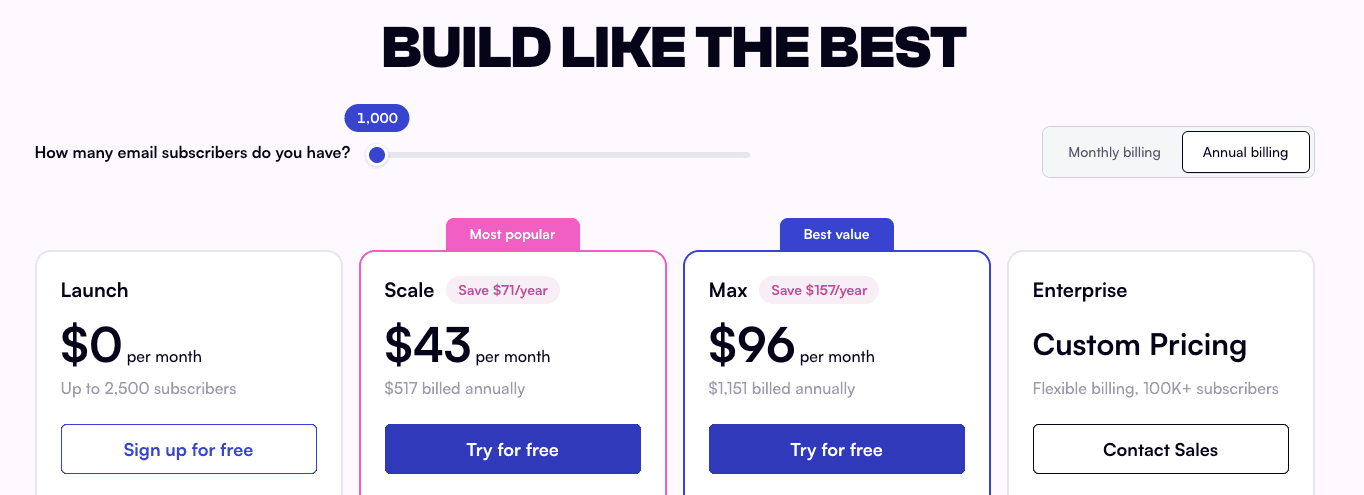
TL;DR: Beehiiv now sells four plans: Free up to 2,500 subscribers, Lite from $49 a month, Pro from $95 a month (both billed yearly at 1,000 subscribers) and custom-priced Enterprise. Lite and Pro prices rise with your list, to $119 and $199 a month at 10,000 subscribers on yearly billing. Every plan includes unlimited email sends, and Beehiiv takes 0% of paid subscription revenue (Stripe fees still apply).
Beehiiv pricing changed in 2026. The Launch, Scale, Grow and Max plans that earlier versions of this guide covered are no longer on Beehiiv's pricing page. The lineup is now Free, Lite, Pro and Enterprise, priced by subscriber count. Below: what each Beehiiv plan costs on monthly and yearly billing, what it includes, and where costs creep in as a newsletter grows.
The 4 Beehiiv plans
Beehiiv splits into 4 plans: Free, Lite, Pro and Enterprise. Subscriber count sets the price on Lite and Pro, and every plan includes unlimited email sends. Prices below are from Beehiiv's pricing page, checked on October 10, 2026. Beehiiv says yearly billing saves up to 20%.
Free ($0, free forever) covers up to 2,500 subscribers with 1 team seat, 1 publication, a 30-day analytics window, landing pages, the recommendation network and API access. Beehiiv branding stays on: removing it needs Pro.
Lite costs $49 a month billed yearly, or $59 billed monthly, at 1,000 subscribers. It rises to $119 ($139 monthly) at 10,000 and $399 ($469 monthly) at its 100,000-subscriber cap. It adds paid subscriptions at a 0% take rate, ad monetization, automations, A/B testing, polls and the beehiiv MCP, with 2 seats and 3 publications.
Pro costs $95 a month billed yearly, or $109 billed monthly, at 1,000 subscribers, then $199 ($239 monthly) at 10,000 and $869 ($999 monthly) at its 250,000-subscriber cap. It removes Beehiiv branding and adds webinars and coaching, advanced analytics, webhooks, dynamic content and 24/7 priority support, with 10 seats and 10 publications.
Enterprise is custom-priced, with SSO and SAML, dedicated IPs, a customer success manager and concierge onboarding.
What Beehiiv costs by subscriber size
Beehiiv's bill is set by plan and list size. Here is the yearly cost at common subscriber counts, worked out from the prices on Beehiiv's pricing page (yearly billing unless noted):
Up to 2,500 subscribers: Free, $0, with Beehiiv branding on.
1,000 subscribers: Lite, $588 a year ($49 x 12), or $708 on monthly billing ($59 x 12).
10,000 subscribers: Lite $1,428 a year ($119 x 12) or Pro $2,388 a year ($199 x 12).
25,000 subscribers: Lite $2,028 a year ($169 x 12) or Pro $3,588 a year ($299 x 12).
100,000 subscribers: Lite $4,788 a year ($399 x 12) or Pro $7,188 a year ($599 x 12).
Above 100,000 subscribers: Pro only, up to $10,428 a year ($869 x 12) at 250,000, then Enterprise.
A 10,000-subscriber newsletter on Lite pays $1,428 a year on yearly billing. The same newsletter on Substack pays no platform fee, but Substack keeps 10% of subscription revenue. Once paid subscription revenue passes $14,280 a year, Lite's flat fee costs less than Substack's cut (10% of $14,280 is $1,428). At 1,000 subscribers the break-even is $5,880 a year. Stripe's card fees apply on both platforms.
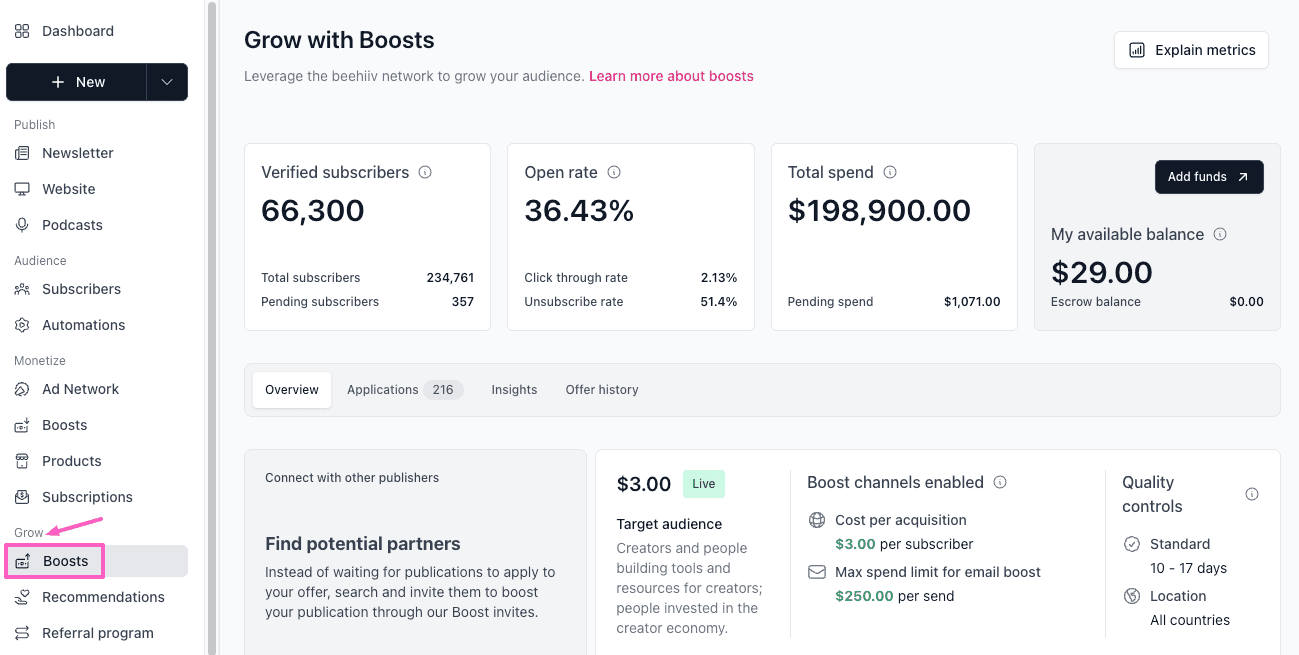
The other reason teams switch is monetization beyond paid subscriptions. Boosts is now called paid recommendations: you get paid when other newsletters recommend you, or pay for verified subscribers yourself, on Lite or Pro, per Beehiiv's recommendations page. Beehiiv's pricing page also shows average ad network earnings by list size: $128 a month at 10,000 subscribers.
The third reason is email automations. Substack does not support sequences. Beehiiv does. For B2B newsletter operators running lead-gen flows or welcome series, this is non-negotiable.
Beehiiv vs Substack vs ConvertKit
Newsletter platform choice in 2026 is a 3-way conversation between Beehiiv, Substack, and ConvertKit (rebranded as Kit). Each wins for a different operator profile.
Beehiiv wins on the monetization stack. Custom domains on every paid plan, paid subscriptions with a 0% take rate, the ad network, paid recommendations and automations all come with Lite at $49/mo billed yearly. This is the right pick for any newsletter that will exceed 10k subscribers with paid-sub or ad revenue ambitions.
Substack wins on time-to-launch and discovery. The platform is opinionated, simpler to set up, and includes a built-in recommendation network that lifts organic subscriber growth 20-40% in the first 6 months. The 10% revenue cut is the price you pay. Substack's own metrics cite over 35 million subscriptions on the platform.
Kit (formerly ConvertKit) wins on funnel integration. If you run paid courses, gated content, or lead magnets, Kit's tagging and segmentation beats Beehiiv. Kit's free plan now covers up to 10,000 subscribers, and at 1,000 subscribers its Creator plan costs $33/mo billed yearly ($390 a year), with Pro at $50/mo for the first year before it renews at the standard rate, per Kit's pricing page.
For B2B newsletter operators, Beehiiv Lite at $49/mo billed yearly is the right buy in almost every case. The exceptions are pure-content writers who value Substack simplicity, or course creators who need Kit's funnel tagging.
The hidden costs nobody mentions
Three costs surprise newsletter operators switching from another platform.
The first is custom domain setup. Custom domains are available on paid plans only, per Beehiiv's domain guide, so a Free publication runs on a beehiiv subdomain. That hurts referral attribution and trust on B2B audiences. Skip the Free plan unless you plan to upgrade to Lite within 30 days.
The second is migration time. Beehiiv's import tool handles Substack and ConvertKit lists at up to 50k subscribers in one pass. Above that, you split into batches. For 6 GROU migrations averaging 12k subscribers each, total switch time ran 3-5 hours including DNS, custom domain, and email-deliverability warm-up.
The third is deliverability re-warm. Switching newsletter platforms changes the sending IP and domain reputation. Even with a clean list, expect 2-3 weeks of slightly lower open rates while inbox providers re-calibrate. Beehiiv's warm-up documentation recommends sending to your top 25% engaged subscribers first for 14 days.
Beehiiv vs ActiveCampaign for B2B newsletter
A separate comparison comes up often: should B2B teams run their newsletter in Beehiiv or in a marketing automation tool like ActiveCampaign?
The split is clear. Beehiiv is purpose-built for the newsletter motion: subscribe, send, monetize, grow. ActiveCampaign, from $15/mo billed annually at 1,000 contacts (see our ActiveCampaign pricing breakdown), is built for marketing automation: scoring, segmentation, multi-channel campaigns, CRM sync.
If your newsletter is a standalone product (content, ads, paid subscriptions), Beehiiv wins. If your newsletter is a top-of-funnel for a B2B SaaS product where you need lead scoring, CRM sync, and multi-step automation, ActiveCampaign wins.
Who should buy Beehiiv
Match 3 of these 4 criteria and Beehiiv is the right buy: you are building a standalone newsletter (not just an email list), your audience will exceed 5,000 subscribers within 12 months, you plan to monetize through paid subs or ad placements, and you want a custom domain and zero platform branding.
For any newsletter that will earn $5,000+/yr from paid subs or ads, Beehiiv Lite on yearly billing ($588/yr at 1,000 subscribers, $1,428/yr at 10,000) keeps all of the subscription revenue, where Substack would keep 10%.
Who should skip Beehiiv
Skip Beehiiv if you run a pure marketing email list with no monetization ambition (ActiveCampaign or Mailchimp wins), if you want the maximum-discovery Substack network for organic growth (the 10% take rate is the cost), or if your audience is under 500 subscribers and you need the simplest possible workflow (Substack wins on time-to-launch).
For B2B SaaS teams with sales cadences and lead-gen flows, run ActiveCampaign for the automation stack and use Beehiiv only if you spin out a standalone newsletter as a separate brand.
FAQ
How much does Beehiiv cost per month?
Beehiiv is free up to 2,500 subscribers. Lite starts at $49 a month billed yearly ($59 monthly) and Pro at $95 a month billed yearly ($109 monthly), both at 1,000 subscribers. At 10,000 subscribers, Lite costs $119 a month and Pro $199 a month on yearly billing. Enterprise is custom-priced.
Is the Beehiiv free plan really free?
Yes. The Free plan is free forever with no credit card, for up to 2,500 subscribers, with unlimited sends, 1 team seat and 1 publication. Beehiiv branding stays on and analytics look back 30 days. Lite and Pro come with a free trial, also without a card.
Beehiiv vs Substack: which is cheaper?
Substack is free to publish on but keeps 10% of paid subscription revenue. Beehiiv charges a plan fee and takes 0%. The break-even is the plan fee times ten: Lite at 1,000 subscribers costs $588 a year billed yearly, so Beehiiv is cheaper once paid revenue passes $5,880 a year; at 10,000 subscribers ($1,428 a year) the line is $14,280. Below that, Substack is cheaper (and simpler to launch).
Does Beehiiv take a cut of paid subscriptions?
No. Beehiiv charges only the platform fee. 100% of paid subscription revenue goes to the newsletter operator (minus Stripe's 2.9% + 30c processing fee). Beehiiv's monetization documentation confirms this. Substack takes 10%. ConvertKit takes 0% on paid plans but charges higher monthly fees.
What happened to Beehiiv Boosts?
Boosts is now called paid recommendations. It sits in Beehiiv's Recommendations hub next to free recommendations: you can get paid when other newsletters recommend you, or pay to grow with verified subscribers, and you are only charged when a subscriber passes verification. Free recommendations work on every plan; paid recommendations need Lite or Pro.
How long does it take to migrate to Beehiiv?
For lists under 50,000 subscribers, the Beehiiv import tool handles the migration in one pass. Typical migration time including DNS, custom domain setup, and deliverability warm-up runs 3-5 hours. Larger lists split into batches.
Does Beehiiv have email sequences and automations?
Yes, from the Lite plan ($49 a month billed yearly at 1,000 subscribers). The Free plan does not include automations. Email sequences include welcome flows, drip campaigns, and segmented sends based on subscriber behavior. Substack does not support sequences, which is the most common migration reason from Substack to Beehiiv.
Is Beehiiv good for B2B SaaS newsletters?
Yes for B2B SaaS teams running newsletters as a standalone audience or content engine. For B2B SaaS teams that need newsletter + CRM sync + lead scoring, ActiveCampaign, from $15/mo billed annually at 1,000 contacts, is a better fit because the marketing automation depth beats Beehiiv. The two tools serve different jobs.
Bottom line
Beehiiv's published pricing is honest. Free covers 2,500 subscribers, Lite starts at $49/mo billed yearly and runs to 100,000 subscribers, and Pro starts at $95/mo and removes Beehiiv branding. Ad earnings and paid recommendations sit on top: Beehiiv's own figure is an average of $128 a month in ad earnings at 10,000 subscribers.
For B2B newsletter operators building a standalone audience or content engine, Beehiiv Lite on yearly billing ($588/yr at 1,000 subscribers, $1,428/yr at 10,000) is the plan to start on. Substack still wins on time-to-launch and discovery. Kit still wins on funnel integration.
Need help evaluating Beehiiv vs Substack vs ConvertKit for your specific newsletter motion? Book a call with GROU. We have migrated 3 GROU client newsletters across these platforms and can compress your evaluation into one session.
About this guide
We are GROU, a B2B pipeline agency that runs lead generation, outbound and LinkedIn content for B2B companies. We run Beehiiv newsletters across 6 active GROU client accounts ranging from founder content to 47,000-subscriber media properties; pricing data above is from Beehiiv's public pricing page, checked on October 10, 2026.
Some links in this article are affiliate. We may earn a small commission at no extra cost to you.
TL;DR: Beehiiv now sells four plans: Free up to 2,500 subscribers, Lite from $49 a month, Pro from $95 a month (both billed yearly at 1,000 subscribers) and custom-priced Enterprise. Lite and Pro prices rise with your list, to $119 and $199 a month at 10,000 subscribers on yearly billing. Every plan includes unlimited email sends, and Beehiiv takes 0% of paid subscription revenue (Stripe fees still apply).
Beehiiv pricing changed in 2026. The Launch, Scale, Grow and Max plans that earlier versions of this guide covered are no longer on Beehiiv's pricing page. The lineup is now Free, Lite, Pro and Enterprise, priced by subscriber count. Below: what each Beehiiv plan costs on monthly and yearly billing, what it includes, and where costs creep in as a newsletter grows.
The 4 Beehiiv plans
Beehiiv splits into 4 plans: Free, Lite, Pro and Enterprise. Subscriber count sets the price on Lite and Pro, and every plan includes unlimited email sends. Prices below are from Beehiiv's pricing page, checked on October 10, 2026. Beehiiv says yearly billing saves up to 20%.
Free ($0, free forever) covers up to 2,500 subscribers with 1 team seat, 1 publication, a 30-day analytics window, landing pages, the recommendation network and API access. Beehiiv branding stays on: removing it needs Pro.
Lite costs $49 a month billed yearly, or $59 billed monthly, at 1,000 subscribers. It rises to $119 ($139 monthly) at 10,000 and $399 ($469 monthly) at its 100,000-subscriber cap. It adds paid subscriptions at a 0% take rate, ad monetization, automations, A/B testing, polls and the beehiiv MCP, with 2 seats and 3 publications.
Pro costs $95 a month billed yearly, or $109 billed monthly, at 1,000 subscribers, then $199 ($239 monthly) at 10,000 and $869 ($999 monthly) at its 250,000-subscriber cap. It removes Beehiiv branding and adds webinars and coaching, advanced analytics, webhooks, dynamic content and 24/7 priority support, with 10 seats and 10 publications.
Enterprise is custom-priced, with SSO and SAML, dedicated IPs, a customer success manager and concierge onboarding.
What Beehiiv costs by subscriber size
Beehiiv's bill is set by plan and list size. Here is the yearly cost at common subscriber counts, worked out from the prices on Beehiiv's pricing page (yearly billing unless noted):
Up to 2,500 subscribers: Free, $0, with Beehiiv branding on.
1,000 subscribers: Lite, $588 a year ($49 x 12), or $708 on monthly billing ($59 x 12).
10,000 subscribers: Lite $1,428 a year ($119 x 12) or Pro $2,388 a year ($199 x 12).
25,000 subscribers: Lite $2,028 a year ($169 x 12) or Pro $3,588 a year ($299 x 12).
100,000 subscribers: Lite $4,788 a year ($399 x 12) or Pro $7,188 a year ($599 x 12).
Above 100,000 subscribers: Pro only, up to $10,428 a year ($869 x 12) at 250,000, then Enterprise.
A 10,000-subscriber newsletter on Lite pays $1,428 a year on yearly billing. The same newsletter on Substack pays no platform fee, but Substack keeps 10% of subscription revenue. Once paid subscription revenue passes $14,280 a year, Lite's flat fee costs less than Substack's cut (10% of $14,280 is $1,428). At 1,000 subscribers the break-even is $5,880 a year. Stripe's card fees apply on both platforms.
The other reason teams switch is monetization beyond paid subscriptions. Boosts is now called paid recommendations: you get paid when other newsletters recommend you, or pay for verified subscribers yourself, on Lite or Pro, per Beehiiv's recommendations page. Beehiiv's pricing page also shows average ad network earnings by list size: $128 a month at 10,000 subscribers.
The third reason is email automations. Substack does not support sequences. Beehiiv does. For B2B newsletter operators running lead-gen flows or welcome series, this is non-negotiable.
Beehiiv vs Substack vs ConvertKit
Newsletter platform choice in 2026 is a 3-way conversation between Beehiiv, Substack, and ConvertKit (rebranded as Kit). Each wins for a different operator profile.
Beehiiv wins on the monetization stack. Custom domains on every paid plan, paid subscriptions with a 0% take rate, the ad network, paid recommendations and automations all come with Lite at $49/mo billed yearly. This is the right pick for any newsletter that will exceed 10k subscribers with paid-sub or ad revenue ambitions.
Substack wins on time-to-launch and discovery. The platform is opinionated, simpler to set up, and includes a built-in recommendation network that lifts organic subscriber growth 20-40% in the first 6 months. The 10% revenue cut is the price you pay. Substack's own metrics cite over 35 million subscriptions on the platform.
Kit (formerly ConvertKit) wins on funnel integration. If you run paid courses, gated content, or lead magnets, Kit's tagging and segmentation beats Beehiiv. Kit's free plan now covers up to 10,000 subscribers, and at 1,000 subscribers its Creator plan costs $33/mo billed yearly ($390 a year), with Pro at $50/mo for the first year before it renews at the standard rate, per Kit's pricing page.
For B2B newsletter operators, Beehiiv Lite at $49/mo billed yearly is the right buy in almost every case. The exceptions are pure-content writers who value Substack simplicity, or course creators who need Kit's funnel tagging.
The hidden costs nobody mentions
Three costs surprise newsletter operators switching from another platform.
The first is custom domain setup. Custom domains are available on paid plans only, per Beehiiv's domain guide, so a Free publication runs on a beehiiv subdomain. That hurts referral attribution and trust on B2B audiences. Skip the Free plan unless you plan to upgrade to Lite within 30 days.
The second is migration time. Beehiiv's import tool handles Substack and ConvertKit lists at up to 50k subscribers in one pass. Above that, you split into batches. For 6 GROU migrations averaging 12k subscribers each, total switch time ran 3-5 hours including DNS, custom domain, and email-deliverability warm-up.
The third is deliverability re-warm. Switching newsletter platforms changes the sending IP and domain reputation. Even with a clean list, expect 2-3 weeks of slightly lower open rates while inbox providers re-calibrate. Beehiiv's warm-up documentation recommends sending to your top 25% engaged subscribers first for 14 days.
Beehiiv vs ActiveCampaign for B2B newsletter
A separate comparison comes up often: should B2B teams run their newsletter in Beehiiv or in a marketing automation tool like ActiveCampaign?
The split is clear. Beehiiv is purpose-built for the newsletter motion: subscribe, send, monetize, grow. ActiveCampaign, from $15/mo billed annually at 1,000 contacts (see our ActiveCampaign pricing breakdown), is built for marketing automation: scoring, segmentation, multi-channel campaigns, CRM sync.
If your newsletter is a standalone product (content, ads, paid subscriptions), Beehiiv wins. If your newsletter is a top-of-funnel for a B2B SaaS product where you need lead scoring, CRM sync, and multi-step automation, ActiveCampaign wins.
Who should buy Beehiiv
Match 3 of these 4 criteria and Beehiiv is the right buy: you are building a standalone newsletter (not just an email list), your audience will exceed 5,000 subscribers within 12 months, you plan to monetize through paid subs or ad placements, and you want a custom domain and zero platform branding.
For any newsletter that will earn $5,000+/yr from paid subs or ads, Beehiiv Lite on yearly billing ($588/yr at 1,000 subscribers, $1,428/yr at 10,000) keeps all of the subscription revenue, where Substack would keep 10%.
Who should skip Beehiiv
Skip Beehiiv if you run a pure marketing email list with no monetization ambition (ActiveCampaign or Mailchimp wins), if you want the maximum-discovery Substack network for organic growth (the 10% take rate is the cost), or if your audience is under 500 subscribers and you need the simplest possible workflow (Substack wins on time-to-launch).
For B2B SaaS teams with sales cadences and lead-gen flows, run ActiveCampaign for the automation stack and use Beehiiv only if you spin out a standalone newsletter as a separate brand.
FAQ
How much does Beehiiv cost per month?
Beehiiv is free up to 2,500 subscribers. Lite starts at $49 a month billed yearly ($59 monthly) and Pro at $95 a month billed yearly ($109 monthly), both at 1,000 subscribers. At 10,000 subscribers, Lite costs $119 a month and Pro $199 a month on yearly billing. Enterprise is custom-priced.
Is the Beehiiv free plan really free?
Yes. The Free plan is free forever with no credit card, for up to 2,500 subscribers, with unlimited sends, 1 team seat and 1 publication. Beehiiv branding stays on and analytics look back 30 days. Lite and Pro come with a free trial, also without a card.
Beehiiv vs Substack: which is cheaper?
Substack is free to publish on but keeps 10% of paid subscription revenue. Beehiiv charges a plan fee and takes 0%. The break-even is the plan fee times ten: Lite at 1,000 subscribers costs $588 a year billed yearly, so Beehiiv is cheaper once paid revenue passes $5,880 a year; at 10,000 subscribers ($1,428 a year) the line is $14,280. Below that, Substack is cheaper (and simpler to launch).
Does Beehiiv take a cut of paid subscriptions?
No. Beehiiv charges only the platform fee. 100% of paid subscription revenue goes to the newsletter operator (minus Stripe's 2.9% + 30c processing fee). Beehiiv's monetization documentation confirms this. Substack takes 10%. ConvertKit takes 0% on paid plans but charges higher monthly fees.
What happened to Beehiiv Boosts?
Boosts is now called paid recommendations. It sits in Beehiiv's Recommendations hub next to free recommendations: you can get paid when other newsletters recommend you, or pay to grow with verified subscribers, and you are only charged when a subscriber passes verification. Free recommendations work on every plan; paid recommendations need Lite or Pro.
How long does it take to migrate to Beehiiv?
For lists under 50,000 subscribers, the Beehiiv import tool handles the migration in one pass. Typical migration time including DNS, custom domain setup, and deliverability warm-up runs 3-5 hours. Larger lists split into batches.
Does Beehiiv have email sequences and automations?
Yes, from the Lite plan ($49 a month billed yearly at 1,000 subscribers). The Free plan does not include automations. Email sequences include welcome flows, drip campaigns, and segmented sends based on subscriber behavior. Substack does not support sequences, which is the most common migration reason from Substack to Beehiiv.
Is Beehiiv good for B2B SaaS newsletters?
Yes for B2B SaaS teams running newsletters as a standalone audience or content engine. For B2B SaaS teams that need newsletter + CRM sync + lead scoring, ActiveCampaign, from $15/mo billed annually at 1,000 contacts, is a better fit because the marketing automation depth beats Beehiiv. The two tools serve different jobs.
Bottom line
Beehiiv's published pricing is honest. Free covers 2,500 subscribers, Lite starts at $49/mo billed yearly and runs to 100,000 subscribers, and Pro starts at $95/mo and removes Beehiiv branding. Ad earnings and paid recommendations sit on top: Beehiiv's own figure is an average of $128 a month in ad earnings at 10,000 subscribers.
For B2B newsletter operators building a standalone audience or content engine, Beehiiv Lite on yearly billing ($588/yr at 1,000 subscribers, $1,428/yr at 10,000) is the plan to start on. Substack still wins on time-to-launch and discovery. Kit still wins on funnel integration.
Need help evaluating Beehiiv vs Substack vs ConvertKit for your specific newsletter motion? Book a call with GROU. We have migrated 3 GROU client newsletters across these platforms and can compress your evaluation into one session.
About this guide
We are GROU, a B2B pipeline agency that runs lead generation, outbound and LinkedIn content for B2B companies. We run Beehiiv newsletters across 6 active GROU client accounts ranging from founder content to 47,000-subscriber media properties; pricing data above is from Beehiiv's public pricing page, checked on October 10, 2026.
Some links in this article are affiliate. We may earn a small commission at no extra cost to you.
TL;DR: Beehiiv now sells four plans: Free up to 2,500 subscribers, Lite from $49 a month, Pro from $95 a month (both billed yearly at 1,000 subscribers) and custom-priced Enterprise. Lite and Pro prices rise with your list, to $119 and $199 a month at 10,000 subscribers on yearly billing. Every plan includes unlimited email sends, and Beehiiv takes 0% of paid subscription revenue (Stripe fees still apply).
Beehiiv pricing changed in 2026. The Launch, Scale, Grow and Max plans that earlier versions of this guide covered are no longer on Beehiiv's pricing page. The lineup is now Free, Lite, Pro and Enterprise, priced by subscriber count. Below: what each Beehiiv plan costs on monthly and yearly billing, what it includes, and where costs creep in as a newsletter grows.
The 4 Beehiiv plans
Beehiiv splits into 4 plans: Free, Lite, Pro and Enterprise. Subscriber count sets the price on Lite and Pro, and every plan includes unlimited email sends. Prices below are from Beehiiv's pricing page, checked on October 10, 2026. Beehiiv says yearly billing saves up to 20%.
Free ($0, free forever) covers up to 2,500 subscribers with 1 team seat, 1 publication, a 30-day analytics window, landing pages, the recommendation network and API access. Beehiiv branding stays on: removing it needs Pro.
Lite costs $49 a month billed yearly, or $59 billed monthly, at 1,000 subscribers. It rises to $119 ($139 monthly) at 10,000 and $399 ($469 monthly) at its 100,000-subscriber cap. It adds paid subscriptions at a 0% take rate, ad monetization, automations, A/B testing, polls and the beehiiv MCP, with 2 seats and 3 publications.
Pro costs $95 a month billed yearly, or $109 billed monthly, at 1,000 subscribers, then $199 ($239 monthly) at 10,000 and $869 ($999 monthly) at its 250,000-subscriber cap. It removes Beehiiv branding and adds webinars and coaching, advanced analytics, webhooks, dynamic content and 24/7 priority support, with 10 seats and 10 publications.
Enterprise is custom-priced, with SSO and SAML, dedicated IPs, a customer success manager and concierge onboarding.
What Beehiiv costs by subscriber size
Beehiiv's bill is set by plan and list size. Here is the yearly cost at common subscriber counts, worked out from the prices on Beehiiv's pricing page (yearly billing unless noted):
Up to 2,500 subscribers: Free, $0, with Beehiiv branding on.
1,000 subscribers: Lite, $588 a year ($49 x 12), or $708 on monthly billing ($59 x 12).
10,000 subscribers: Lite $1,428 a year ($119 x 12) or Pro $2,388 a year ($199 x 12).
25,000 subscribers: Lite $2,028 a year ($169 x 12) or Pro $3,588 a year ($299 x 12).
100,000 subscribers: Lite $4,788 a year ($399 x 12) or Pro $7,188 a year ($599 x 12).
Above 100,000 subscribers: Pro only, up to $10,428 a year ($869 x 12) at 250,000, then Enterprise.
A 10,000-subscriber newsletter on Lite pays $1,428 a year on yearly billing. The same newsletter on Substack pays no platform fee, but Substack keeps 10% of subscription revenue. Once paid subscription revenue passes $14,280 a year, Lite's flat fee costs less than Substack's cut (10% of $14,280 is $1,428). At 1,000 subscribers the break-even is $5,880 a year. Stripe's card fees apply on both platforms.
The other reason teams switch is monetization beyond paid subscriptions. Boosts is now called paid recommendations: you get paid when other newsletters recommend you, or pay for verified subscribers yourself, on Lite or Pro, per Beehiiv's recommendations page. Beehiiv's pricing page also shows average ad network earnings by list size: $128 a month at 10,000 subscribers.
The third reason is email automations. Substack does not support sequences. Beehiiv does. For B2B newsletter operators running lead-gen flows or welcome series, this is non-negotiable.
Beehiiv vs Substack vs ConvertKit
Newsletter platform choice in 2026 is a 3-way conversation between Beehiiv, Substack, and ConvertKit (rebranded as Kit). Each wins for a different operator profile.
Beehiiv wins on the monetization stack. Custom domains on every paid plan, paid subscriptions with a 0% take rate, the ad network, paid recommendations and automations all come with Lite at $49/mo billed yearly. This is the right pick for any newsletter that will exceed 10k subscribers with paid-sub or ad revenue ambitions.
Substack wins on time-to-launch and discovery. The platform is opinionated, simpler to set up, and includes a built-in recommendation network that lifts organic subscriber growth 20-40% in the first 6 months. The 10% revenue cut is the price you pay. Substack's own metrics cite over 35 million subscriptions on the platform.
Kit (formerly ConvertKit) wins on funnel integration. If you run paid courses, gated content, or lead magnets, Kit's tagging and segmentation beats Beehiiv. Kit's free plan now covers up to 10,000 subscribers, and at 1,000 subscribers its Creator plan costs $33/mo billed yearly ($390 a year), with Pro at $50/mo for the first year before it renews at the standard rate, per Kit's pricing page.
For B2B newsletter operators, Beehiiv Lite at $49/mo billed yearly is the right buy in almost every case. The exceptions are pure-content writers who value Substack simplicity, or course creators who need Kit's funnel tagging.
The hidden costs nobody mentions
Three costs surprise newsletter operators switching from another platform.
The first is custom domain setup. Custom domains are available on paid plans only, per Beehiiv's domain guide, so a Free publication runs on a beehiiv subdomain. That hurts referral attribution and trust on B2B audiences. Skip the Free plan unless you plan to upgrade to Lite within 30 days.
The second is migration time. Beehiiv's import tool handles Substack and ConvertKit lists at up to 50k subscribers in one pass. Above that, you split into batches. For 6 GROU migrations averaging 12k subscribers each, total switch time ran 3-5 hours including DNS, custom domain, and email-deliverability warm-up.
The third is deliverability re-warm. Switching newsletter platforms changes the sending IP and domain reputation. Even with a clean list, expect 2-3 weeks of slightly lower open rates while inbox providers re-calibrate. Beehiiv's warm-up documentation recommends sending to your top 25% engaged subscribers first for 14 days.
Beehiiv vs ActiveCampaign for B2B newsletter
A separate comparison comes up often: should B2B teams run their newsletter in Beehiiv or in a marketing automation tool like ActiveCampaign?
The split is clear. Beehiiv is purpose-built for the newsletter motion: subscribe, send, monetize, grow. ActiveCampaign, from $15/mo billed annually at 1,000 contacts (see our ActiveCampaign pricing breakdown), is built for marketing automation: scoring, segmentation, multi-channel campaigns, CRM sync.
If your newsletter is a standalone product (content, ads, paid subscriptions), Beehiiv wins. If your newsletter is a top-of-funnel for a B2B SaaS product where you need lead scoring, CRM sync, and multi-step automation, ActiveCampaign wins.
Who should buy Beehiiv
Match 3 of these 4 criteria and Beehiiv is the right buy: you are building a standalone newsletter (not just an email list), your audience will exceed 5,000 subscribers within 12 months, you plan to monetize through paid subs or ad placements, and you want a custom domain and zero platform branding.
For any newsletter that will earn $5,000+/yr from paid subs or ads, Beehiiv Lite on yearly billing ($588/yr at 1,000 subscribers, $1,428/yr at 10,000) keeps all of the subscription revenue, where Substack would keep 10%.
Who should skip Beehiiv
Skip Beehiiv if you run a pure marketing email list with no monetization ambition (ActiveCampaign or Mailchimp wins), if you want the maximum-discovery Substack network for organic growth (the 10% take rate is the cost), or if your audience is under 500 subscribers and you need the simplest possible workflow (Substack wins on time-to-launch).
For B2B SaaS teams with sales cadences and lead-gen flows, run ActiveCampaign for the automation stack and use Beehiiv only if you spin out a standalone newsletter as a separate brand.
FAQ
How much does Beehiiv cost per month?
Beehiiv is free up to 2,500 subscribers. Lite starts at $49 a month billed yearly ($59 monthly) and Pro at $95 a month billed yearly ($109 monthly), both at 1,000 subscribers. At 10,000 subscribers, Lite costs $119 a month and Pro $199 a month on yearly billing. Enterprise is custom-priced.
Is the Beehiiv free plan really free?
Yes. The Free plan is free forever with no credit card, for up to 2,500 subscribers, with unlimited sends, 1 team seat and 1 publication. Beehiiv branding stays on and analytics look back 30 days. Lite and Pro come with a free trial, also without a card.
Beehiiv vs Substack: which is cheaper?
Substack is free to publish on but keeps 10% of paid subscription revenue. Beehiiv charges a plan fee and takes 0%. The break-even is the plan fee times ten: Lite at 1,000 subscribers costs $588 a year billed yearly, so Beehiiv is cheaper once paid revenue passes $5,880 a year; at 10,000 subscribers ($1,428 a year) the line is $14,280. Below that, Substack is cheaper (and simpler to launch).
Does Beehiiv take a cut of paid subscriptions?
No. Beehiiv charges only the platform fee. 100% of paid subscription revenue goes to the newsletter operator (minus Stripe's 2.9% + 30c processing fee). Beehiiv's monetization documentation confirms this. Substack takes 10%. ConvertKit takes 0% on paid plans but charges higher monthly fees.
What happened to Beehiiv Boosts?
Boosts is now called paid recommendations. It sits in Beehiiv's Recommendations hub next to free recommendations: you can get paid when other newsletters recommend you, or pay to grow with verified subscribers, and you are only charged when a subscriber passes verification. Free recommendations work on every plan; paid recommendations need Lite or Pro.
How long does it take to migrate to Beehiiv?
For lists under 50,000 subscribers, the Beehiiv import tool handles the migration in one pass. Typical migration time including DNS, custom domain setup, and deliverability warm-up runs 3-5 hours. Larger lists split into batches.
Does Beehiiv have email sequences and automations?
Yes, from the Lite plan ($49 a month billed yearly at 1,000 subscribers). The Free plan does not include automations. Email sequences include welcome flows, drip campaigns, and segmented sends based on subscriber behavior. Substack does not support sequences, which is the most common migration reason from Substack to Beehiiv.
Is Beehiiv good for B2B SaaS newsletters?
Yes for B2B SaaS teams running newsletters as a standalone audience or content engine. For B2B SaaS teams that need newsletter + CRM sync + lead scoring, ActiveCampaign, from $15/mo billed annually at 1,000 contacts, is a better fit because the marketing automation depth beats Beehiiv. The two tools serve different jobs.
Bottom line
Beehiiv's published pricing is honest. Free covers 2,500 subscribers, Lite starts at $49/mo billed yearly and runs to 100,000 subscribers, and Pro starts at $95/mo and removes Beehiiv branding. Ad earnings and paid recommendations sit on top: Beehiiv's own figure is an average of $128 a month in ad earnings at 10,000 subscribers.
For B2B newsletter operators building a standalone audience or content engine, Beehiiv Lite on yearly billing ($588/yr at 1,000 subscribers, $1,428/yr at 10,000) is the plan to start on. Substack still wins on time-to-launch and discovery. Kit still wins on funnel integration.
Need help evaluating Beehiiv vs Substack vs ConvertKit for your specific newsletter motion? Book a call with GROU. We have migrated 3 GROU client newsletters across these platforms and can compress your evaluation into one session.
About this guide
We are GROU, a B2B pipeline agency that runs lead generation, outbound and LinkedIn content for B2B companies. We run Beehiiv newsletters across 6 active GROU client accounts ranging from founder content to 47,000-subscriber media properties; pricing data above is from Beehiiv's public pricing page, checked on October 10, 2026.
Some links in this article are affiliate. We may earn a small commission at no extra cost to you.

Pipeline OS Newsletter
Build qualified pipeline
Get weekly tactics to generate demand, improve lead quality, and book more meetings.





Trusted by industry leaders
Trusted by industry leaders
Trusted by industry leaders
Ready to build qualified pipeline?
Ready to build qualified pipeline?
Ready to build qualified pipeline?
Book a call to see if we're the right fit, or take the 2-minute quiz to get a clear starting point.
Book a call to see if we're the right fit, or take the 2-minute quiz to get a clear starting point.
Book a call to see if we're the right fit, or take the 2-minute quiz to get a clear starting point.
" height="30.21639343089746px" id="hfGbXmQR2" width="30.216393430897455px"/></svg>)
Copyright © 2026 – All Right Reserved
Copyright © 2026 – All Right Reserved
Copyright © 2026 – All Right Reserved