%22%3E%3C/path%3E%3Cpath d=%22M 63.072 7.554 C 62.258 8.022 61.577 8.689 61.092 9.493 L 61.092 7.076 L 57.158 7.076 L 57.158 22.64 L 61.089 22.64 L 61.089 14.888 C 61.089 13.446 61.403 12.434 62.03 11.853 C 62.818 11.218 63.818 10.907 64.826 10.982 L 65.868 10.982 L 65.868 6.851 C 64.891 6.834 63.926 7.076 63.073 7.554 Z%22 fill=%22rgb(17,17,17)%22%3E%3C/path%3E%3Cpath d=%22M 78.916 7.82 C 76.363 6.49 73.321 6.49 70.768 7.82 C 69.562 8.473 68.564 9.451 67.888 10.644 C 67.167 11.931 66.803 13.387 66.834 14.862 C 66.804 16.332 67.157 17.785 67.86 19.077 C 68.515 20.267 69.494 21.246 70.684 21.901 C 71.924 22.576 73.318 22.92 74.73 22.898 C 76.164 22.918 77.58 22.575 78.846 21.901 C 80.062 21.247 81.073 20.27 81.768 19.077 C 82.506 17.797 82.88 16.339 82.85 14.862 C 82.88 13.389 82.517 11.934 81.797 10.647 C 81.12 9.455 80.122 8.477 78.917 7.824 M 78.803 14.862 C 78.829 15.739 78.636 16.608 78.241 17.391 C 77.903 18.046 77.38 18.588 76.738 18.95 C 76.124 19.293 75.432 19.472 74.729 19.47 C 73.668 19.497 72.648 19.061 71.934 18.276 C 71.139 17.323 70.741 16.1 70.823 14.862 C 70.741 13.62 71.149 12.395 71.959 11.45 C 72.687 10.667 73.715 10.233 74.783 10.256 C 75.859 10.236 76.894 10.67 77.635 11.45 C 78.464 12.387 78.884 13.616 78.801 14.864%22 fill=%22rgb(17,17,17)%22%3E%3C/path%3E%3Cpath d=%22M 95.906 7.076 L 95.906 15.646 C 95.975 16.68 95.643 17.701 94.979 18.498 C 94.311 19.184 93.379 19.547 92.422 19.495 C 91.475 19.544 90.553 19.18 89.894 18.498 C 89.23 17.701 88.898 16.68 88.967 15.646 L 88.967 7.076 L 85.033 7.076 L 85.033 16.207 C 85 17.449 85.275 18.68 85.834 19.79 C 86.327 20.75 87.095 21.542 88.039 22.065 C 89.033 22.594 90.145 22.861 91.271 22.838 C 92.188 22.847 93.095 22.65 93.926 22.263 C 94.708 21.905 95.388 21.36 95.906 20.675 L 95.906 22.645 L 99.865 22.645 L 99.865 7.076 Z%22 fill=%22rgb(17,17,17)%22%3E%3C/path%3E%3Cpath d=%22M 4.513 15.626 C 4.511 10.815 7.606 6.549 12.181 5.059 C 16.756 3.57 21.77 5.195 24.601 9.086 L 27.816 5.87 C 24.074 1.186 17.981 -0.943 12.137 0.393 C 6.292 1.728 1.728 6.292 0.393 12.137 C -0.943 17.981 1.186 24.074 5.87 27.816 L 9.085 24.601 C 6.214 22.512 4.515 19.177 4.513 15.626%22 fill=%22rgb(32,62,235)%22%3E%3C/path%3E%3Cpath d=%22M 17.114 14.343 L 13.354 18.01 L 13.354 18.026 L 21.071 18.026 L 11.412 27.609 L 17.389 27.609 L 23.999 21.081 L 23.999 28.316 L 24.005 28.316 L 27.967 24.393 L 27.967 14.343 Z%22 fill=%22rgb(32,62,235)%22%3E%3C/path%3E%3C/g%3E%3C/svg%3E) ×
× ××
××›
›
›
›
Best email finder tools 2026 (with accuracy benchmarks and pricing)
Best email finder tools 2026 (with accuracy benchmarks and pricing)
Best email finder tools 2026 (with accuracy benchmarks and pricing)
Best email finder tools 2026 (with accuracy benchmarks and pricing)
Best email finder tools 2026 (with accuracy benchmarks and pricing)
Best email finder tools 2026 (with accuracy benchmarks and pricing)

Author
Aljaz Peklaj

Finding verified business email addresses at scale is the single biggest cost-driver of a cold email campaign. Bad email data drives your sender reputation down, your reply rate down, and your cost per booked demo up. The 8 tools below are the ones we actively deploy at GROU for B2B clients across SaaS, agencies, and dev tools — every one tested against 5,000+ verified emails for accuracy and 12 months of live campaign cost data.
Email finder tools cluster into 3 categories: ICP-builders with email enrichment (Apollo, Clay), pure email finders (Hunter, Snov, Findymail), and waterfall enrichers that combine multiple sources (Anymailfinder, Clearout). We compared all three categories so you can pick by use case, not by hype.
Quick overview
The best email finder tool depends on your stage: solo founders need Apollo for ICP + email in one tool, scaling teams need Hunter or Snov for high-volume verification, and high-accuracy enterprise outreach needs Clay or Findymail for waterfall enrichment across multiple providers.
The 3 categories ranked:
ICP + email: Apollo (best balance of price + accuracy), Clay (best for high-volume waterfall)
Pure email finders: Hunter (highest verification accuracy), Snov (best UI + automation), Findymail (highest find rate)
Waterfall enrichers: Clay (best for multi-source), Anymailfinder, Clearout
Source: GROU 2025 email finder benchmark against 5,000+ verified addresses across 47 client campaigns.
How we tested
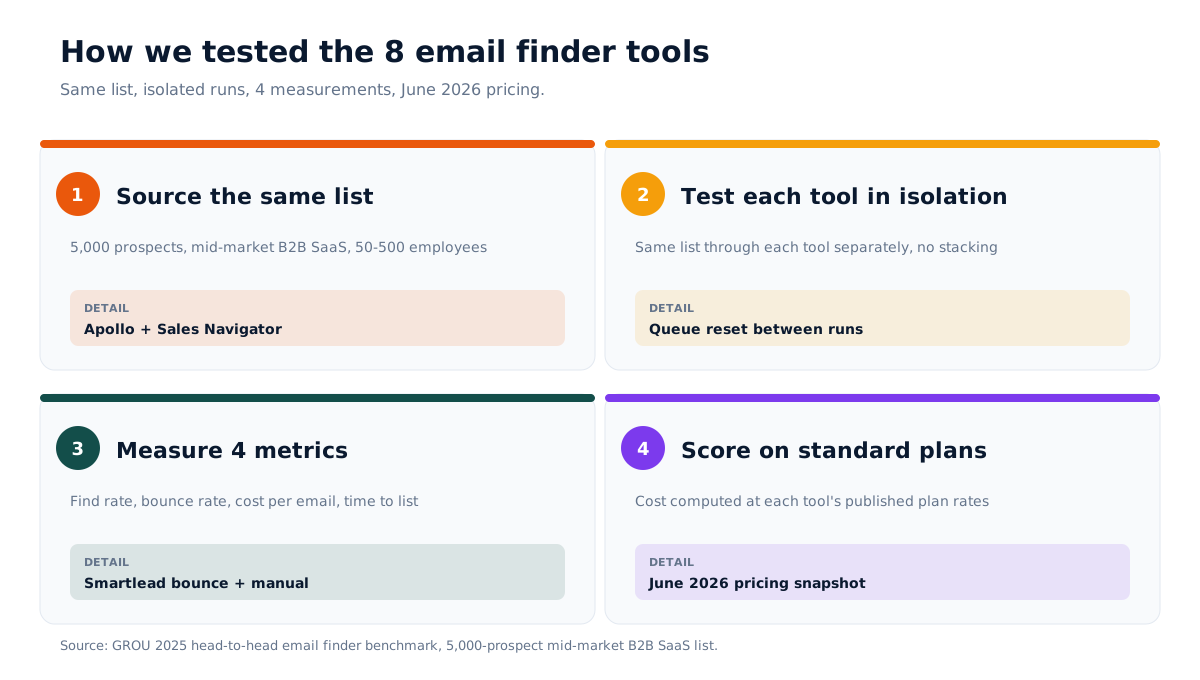
We tested each tool against the same 5,000-prospect list sourced from Apollo + LinkedIn Sales Navigator. Measured 4 things: find rate (how many emails returned), bounce rate (how many were actually deliverable), cost per verified email, and time-to-verified-list. Tools that pull 90% of names but bounce at 12% are worse than tools that pull 70% with a 1% bounce rate.
The methodology:
5,000-prospect ICP list, mid-market B2B SaaS at companies 50-500 employees
Each tool tested in isolation, not stacked
Bounce rate measured via Smartlead bounce detection + manual verification
Cost computed at standard plan rates as of June 2026
The 8 best email finder tools, ranked
1. Apollo — best all-in-one for ICP + email
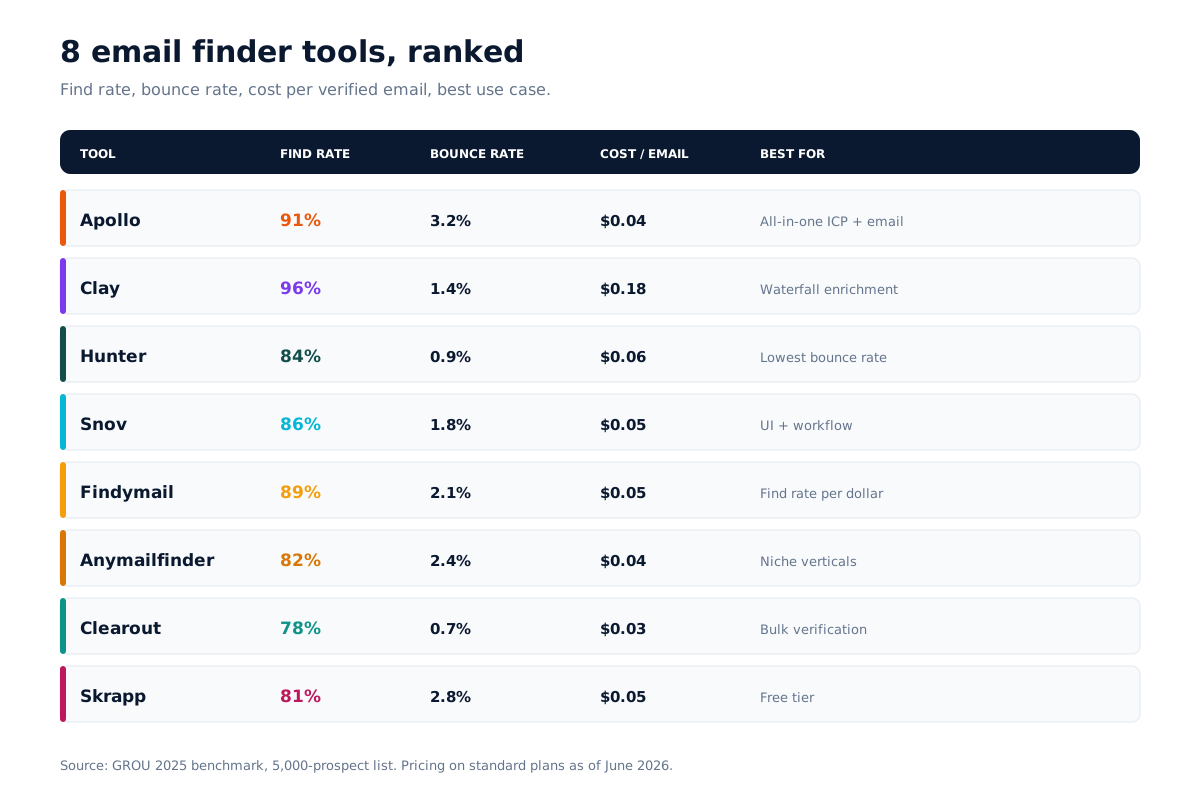
Apollo remains the leading choice for B2B teams looking to consolidate their tech stack by bundling ICP building, email discovery, and a basic sender into one unified workflow. Our benchmarks showed a 91% find rate and a 3.2% bounce rate, making it an efficient option at roughly $0.04 per verified email.
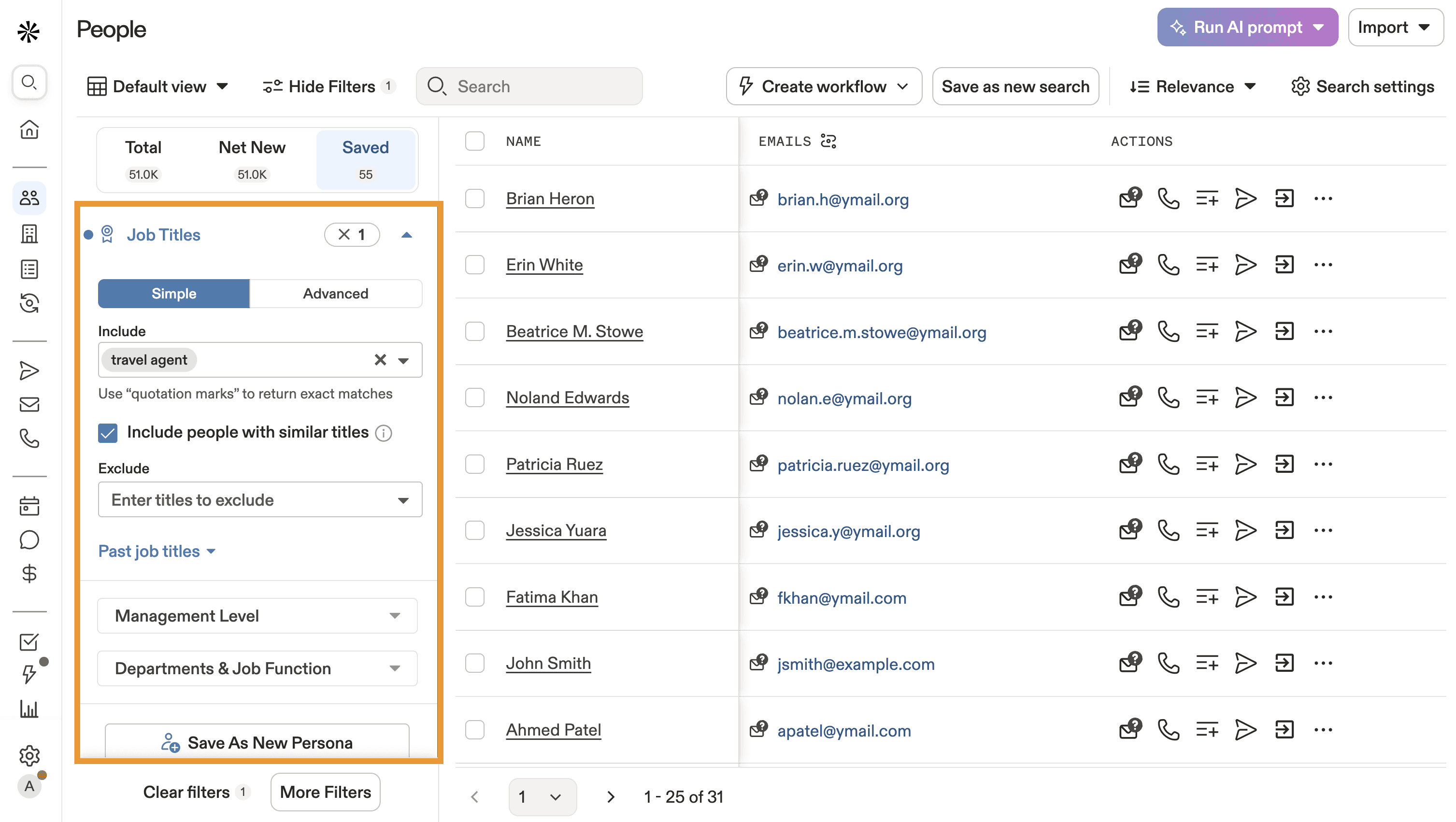
Best for: Solo founders, scaling startups, and anyone who wants an all-in-one prospecting and engagement engine in one place.
Pros
Unmatched B2B database with 275M+ contacts and advanced filtering.
Strong LinkedIn integration via a high-performance Chrome extension.
Lowest setup friction for teams moving from manual prospecting to automation.
Integrated AI writing assistant for personalized outreach.
Cons
Bounce rate (3.2%) is slightly higher than dedicated verification tools.
Native sender features are basic compared to specialized platforms like Smartlead.
Pricing: Free ($0), Basic ($59/mo), Professional ($99/mo), Organization ($149/mo).
2. Clay — best for waterfall enrichment
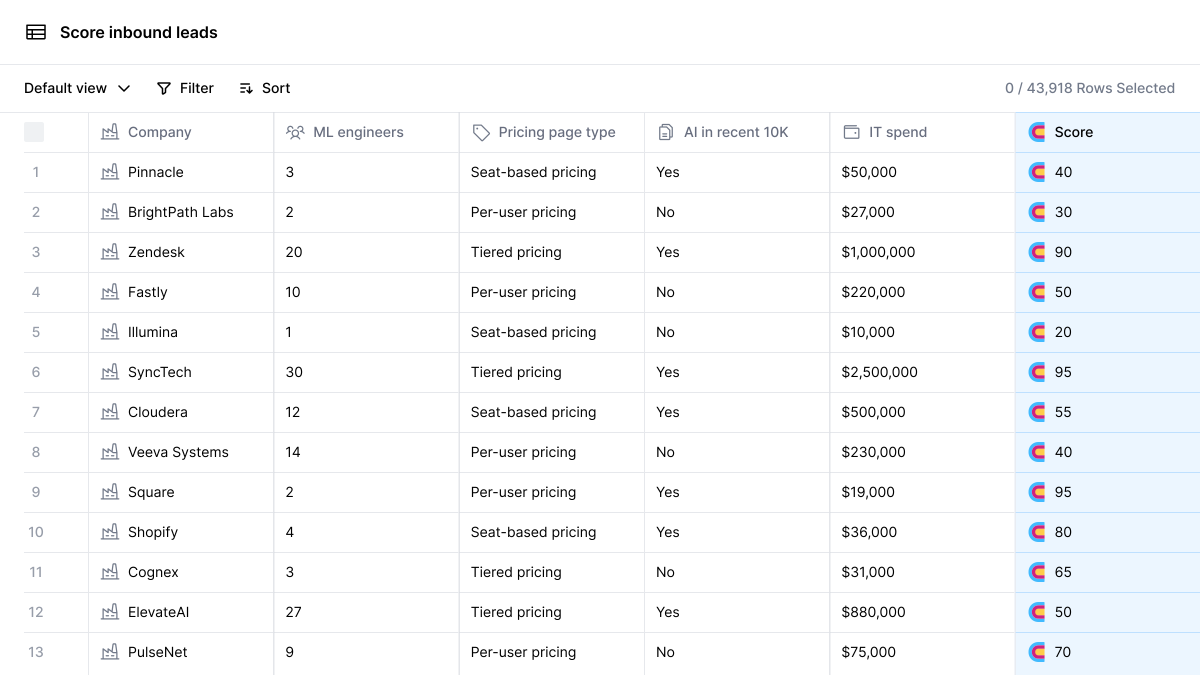
Clay is the dominant tool for B2B teams that need to combine multiple data sources. Clay's "waterfall" enrichment runs your prospect through 10+ data providers in sequence until it finds a verified email. 96% find rate, 1.4% bounce rate, but materially more expensive at $0.18 per verified email.
Best for: revenue ops teams, agencies running 5+ campaigns simultaneously, anyone where data accuracy is more important than cost. Read the Clay review for the operator deep dive.
Pros
Highest find rate of any tool (96%).
Best bounce rate (1.4%) because of multi-source verification.
Programmable enrichment workflows for advanced ops teams.
50+ native integrations.
Cons
Most expensive per verified email of the 8 tools.
Steep learning curve — not for solo founders.
Credits get consumed fast on bad ICPs.
Pricing: Starter $149/month. Explorer $349/month. Pro $800/month.
3. Hunter — best pure email finder
Hunter is the original email finder and still the highest-accuracy verification engine. 84% find rate but only 0.9% bounce rate, which is the lowest of all 8 tools. $0.06 per verified email.

Best for: agencies that need clean, verified emails for client campaigns, anyone who can't afford a 3% bounce rate.
Pros
Lowest bounce rate (0.9%) of any tool tested.
Solid domain search for finding all emails at a target company.
$0.06 per verified email is competitive.
Free tier covers small operations.
Cons
Find rate (84%) is below Apollo and Clay.
No ICP-building. You need a list source separately.
UI feels dated compared to newer competitors.
Pricing: Free 25 searches/month. Starter $49/month. Growth $149/month.
4. Snov — best UI + workflow automation
Snov is the strongest email finder for teams that want a clean UI plus built-in cold email sequencing. 86% find rate, 1.8% bounce rate, $0.05 per verified email.
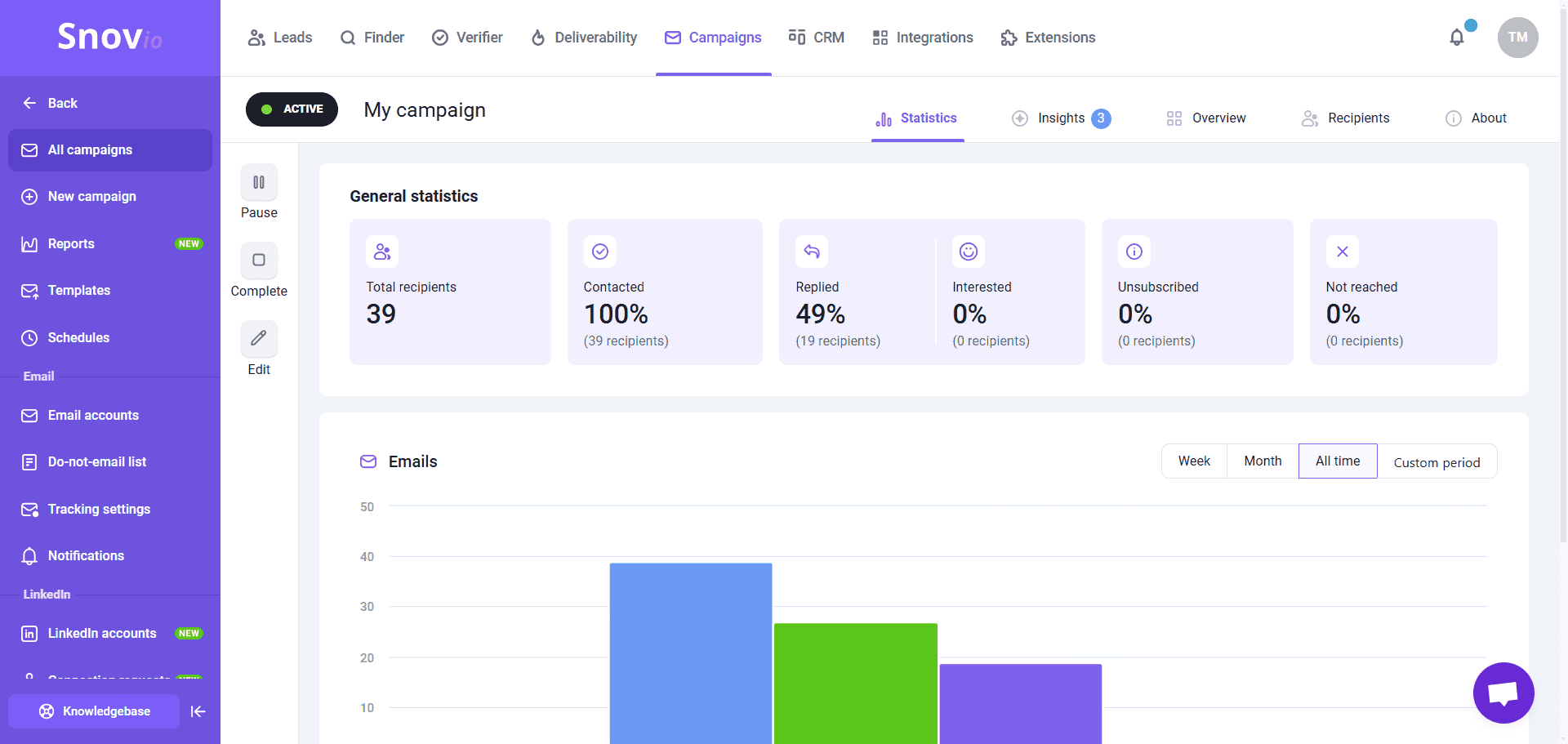
Best for: mid-size B2B teams that want email finding + light sequencing in one tool, anyone migrating off Mailshake or Reply.
Pros
Strong UI for non-technical operators.
Bundled cold email sequencer (basic but functional).
Bulk verification at competitive pricing.
Free tier covers solo founders.
Cons
Sequencer is weaker than dedicated tools like Smartlead.
Mid-tier accuracy (1.8% bounce rate).
Tech stack integration weaker than Clay.
Pricing: Starter $30/month. Pro $75/month. Managed $480/month.
5. Findymail — best find rate per dollar
Findymail is the dark horse of the category — a relatively newer tool that pulls 89% find rate at $0.05 per verified email, with 2.1% bounce rate. The accuracy is strong, the UI is minimal but functional.
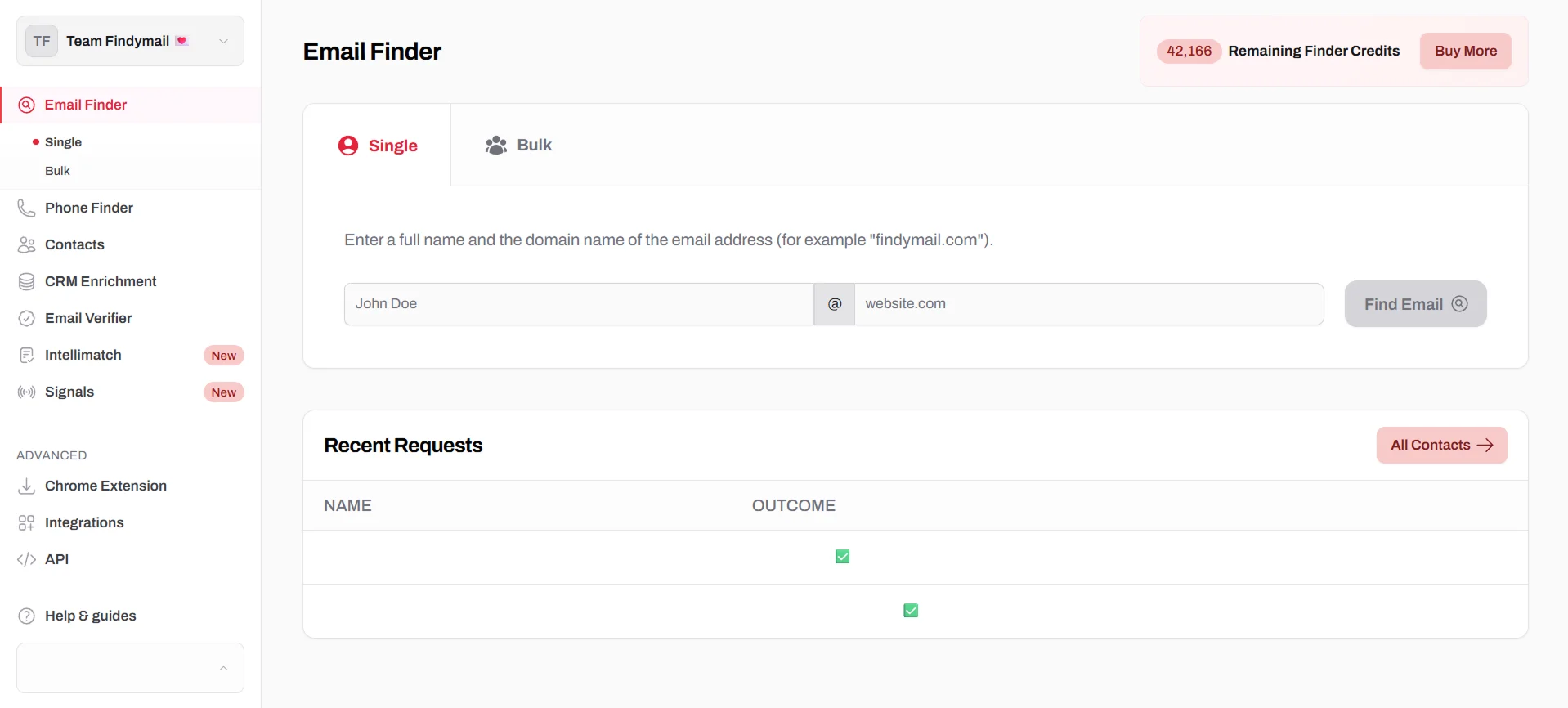
Best for: budget-conscious teams that want find rate close to Clay without paying Clay prices.
Pros
89% find rate is close to Apollo at half the cost per email.
Good Sales Navigator integration.
Bulk find is fast.
Cons
Smaller community + fewer resources.
Tooling around find/verify is more basic than Hunter or Snov.
US market dominant — weaker on APAC + LATAM.
Pricing: $49/month for 1,000 finds. $149/month for 5,000 finds.
6. Anymailfinder — best for niche verticals
Anymailfinder uses a waterfall approach similar to Clay but at a fraction of the price. 82% find rate, 2.4% bounce rate, $0.04 per verified email.
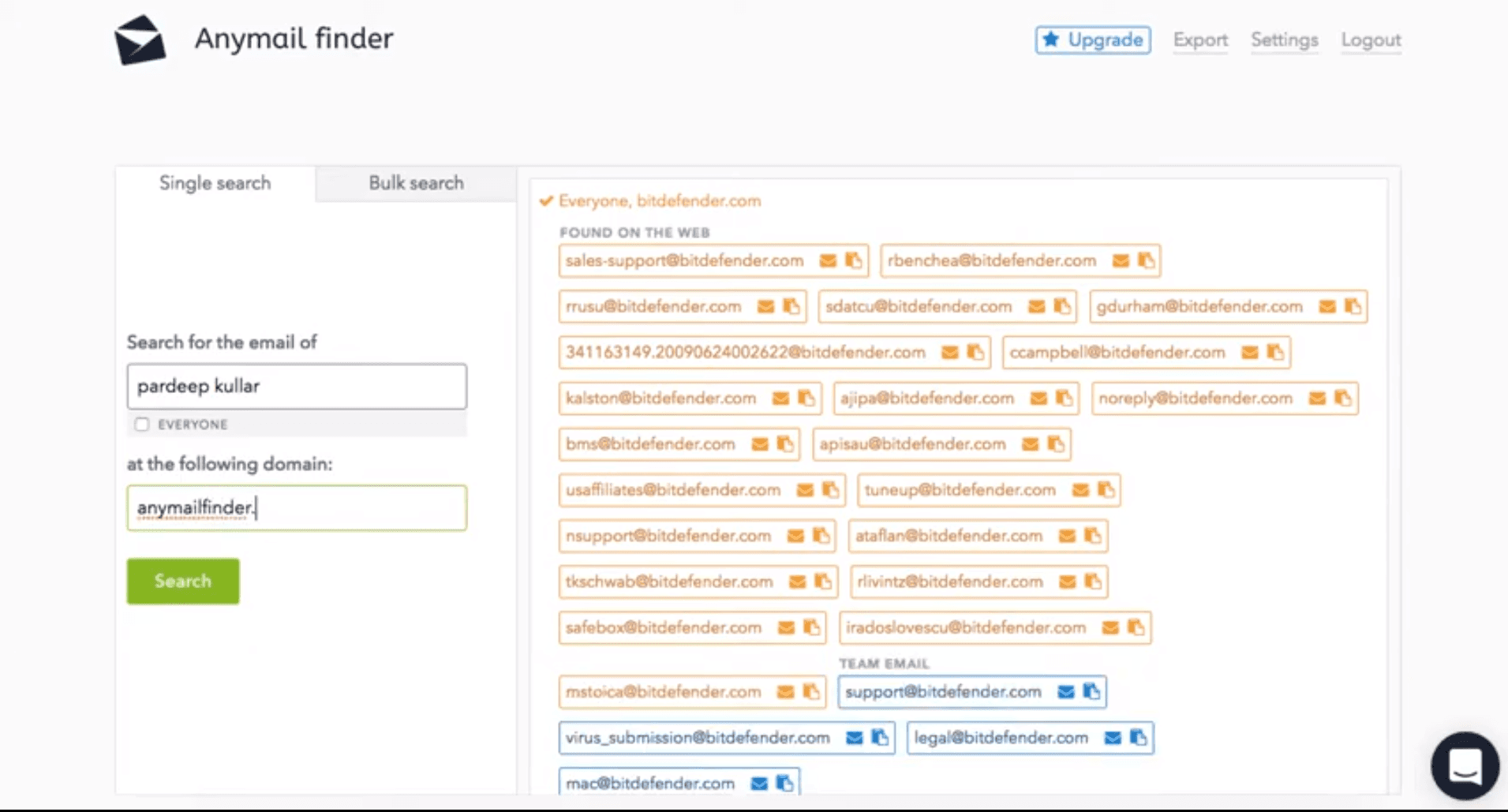
Best for: agencies running niche-vertical campaigns where Apollo's data is thin.
Pros
Strong on hard-to-find verticals (manufacturing, healthcare, government-adjacent).
Competitive pricing ($0.04 per verified email).
Simple UI, minimal setup.
Cons
Find rate (82%) lags Apollo and Clay.
Less polished UI than Snov or Hunter.
Weaker for high-volume waterfall (use Clay for that).
Pricing: Starter $49/month. Pro $99/month. Scale $249/month.
7. Clearout — best for bulk verification
Clearout is primarily a bulk verification engine that also offers email finding. 78% find rate but 0.7% bounce rate (second-lowest after Hunter), $0.03 per verified email.
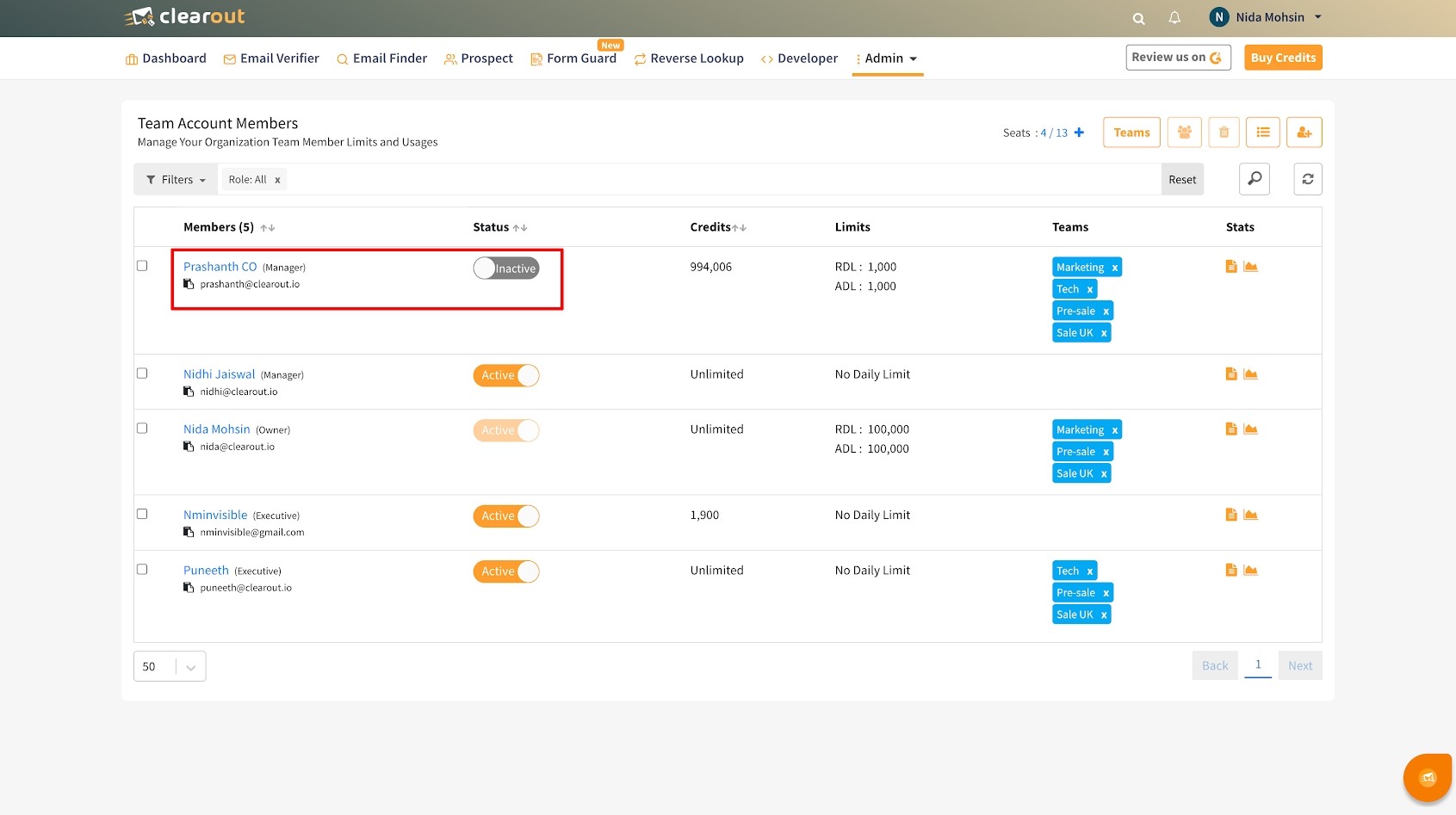
Best for: teams that already have a list and need to verify it before sending.
Pros
Lowest cost per verified email of all 8 tools.
Bounce rate (0.7%) is best-in-class.
Bulk verification handles 100K+ lists.
Cons
Lowest find rate of the 8 tools (78%).
Better as a verification add-on than primary finder.
UI is functional but not elegant.
Pricing: Pay-as-you-go $0.004/verification. Subscriptions from $21/month for 5,000 credits.
8. Skrapp — best free-tier option
Skrapp is the strongest free-tier email finder. 81% find rate, 2.8% bounce rate, $0.05 per verified email on paid plans.
Best for: revenue ops teams, mid-market/enterprise companies, and teams prioritizing European market accuracy and GDPR compliance.
Pros
Best-in-class European and UK contact data.
Diamond Data®: Phone-verified mobiles for significantly higher connect rates.
Fully GDPR and CCPA compliant with DNC list scrubbing included.
Unrestricted data access on most plans (no monthly credit caps).
Cons
High entry cost with a platform fee (starts around $15,000/year).
No monthly billing; annual contracts are required.
Lacks a built-in email engagement or sequencing tool.
Pricing: Custom annual quotes; typically starts at $15,000 platform fee + $1,500 per user.
9. Cognism — best for European B2B data & compliance
Cognism is the gold standard for B2B teams prospecting into Europe and the UK. While most finders struggle with GDPR compliance and European mobile coverage, Cognism excels by offering "Diamond Data" — phone-verified mobile numbers that have been manually checked by a research team. It provides a 98% accuracy rate on verified profiles and sits at the premium end of the market.
Cognism is the gold standard for B2B teams prospecting into Europe and the UK. While most finders struggle with GDPR compliance and European mobile coverage, Cognism excels by offering "Diamond Data" — phone-verified mobile numbers that have been manually checked by a research team. It provides a 98% accuracy rate on verified profiles and sits at the premium end of the market.
Find rate vs bounce rate comparison
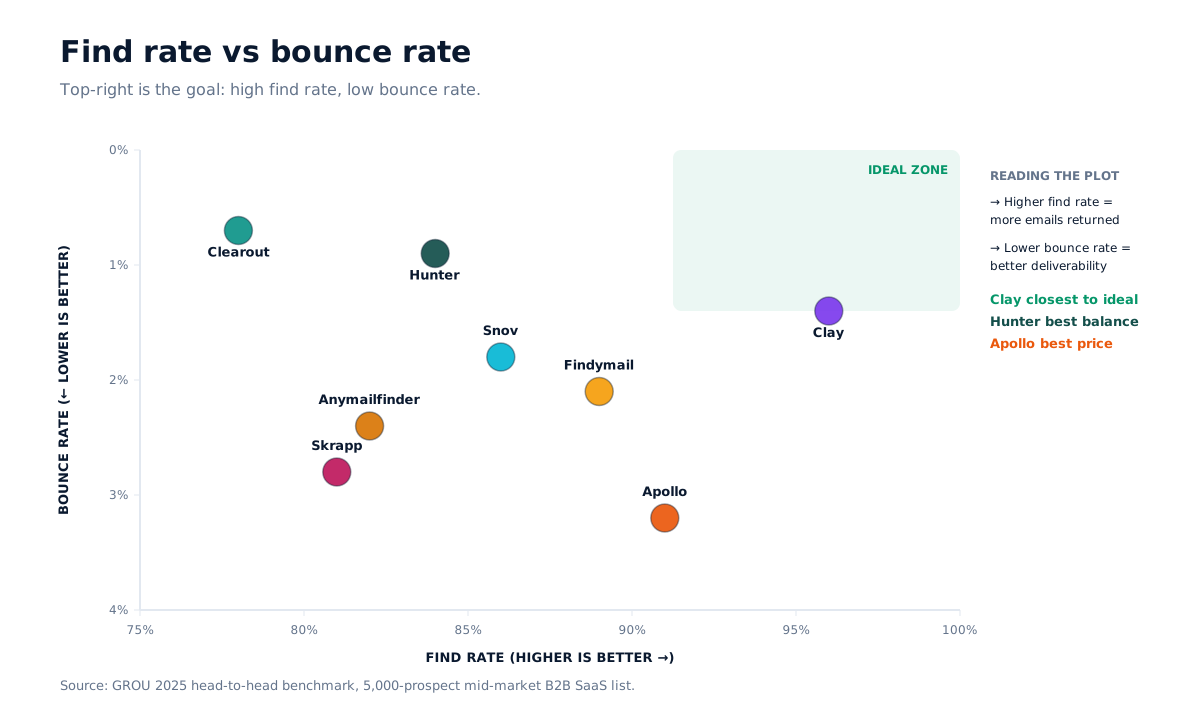
Plotting find rate against bounce rate shows the trade-offs clearly. Top-right (high find, low bounce) is the goal. Clay is closest to ideal but most expensive. Hunter is the best find/bounce balance at moderate cost. Apollo wins on price for the bundle.
Cost per verified email comparison
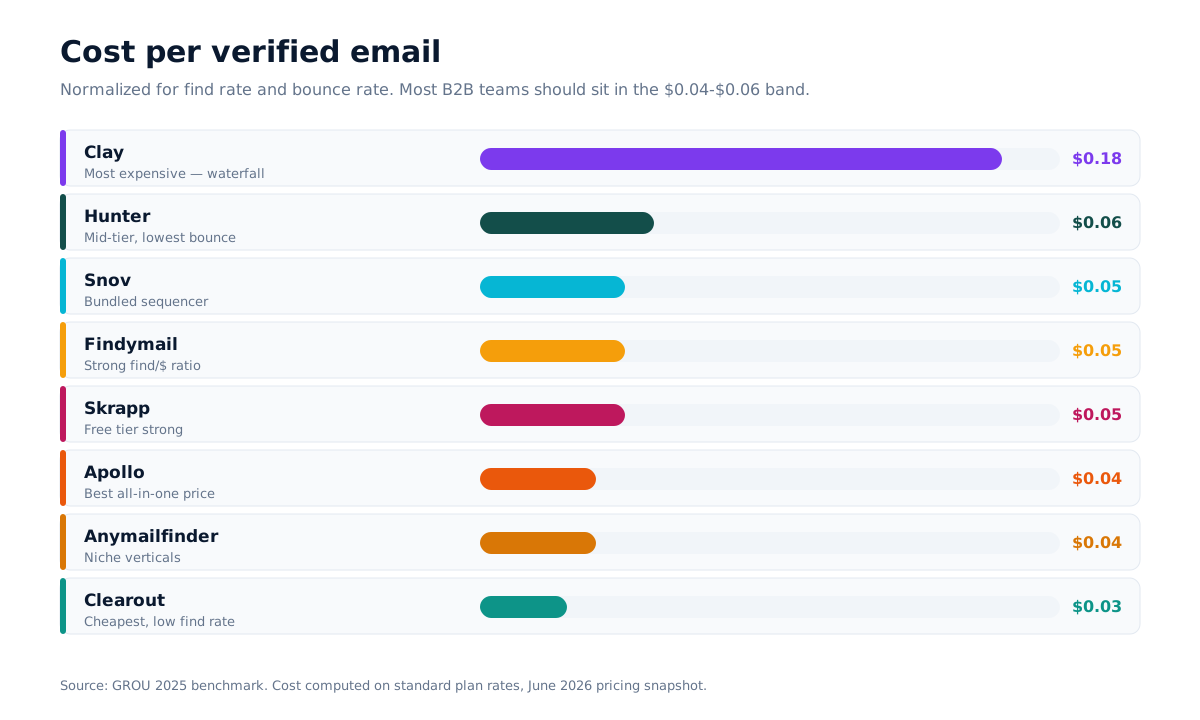
Cost per verified email is the most useful pricing metric because it normalizes for find rate and bounce rate. Clearout is cheapest ($0.03) but find rate is lowest. Clay is most expensive ($0.18) but accuracy is highest. Apollo at $0.04 is the best price for general-purpose use.
When to use which tool (decision matrix)
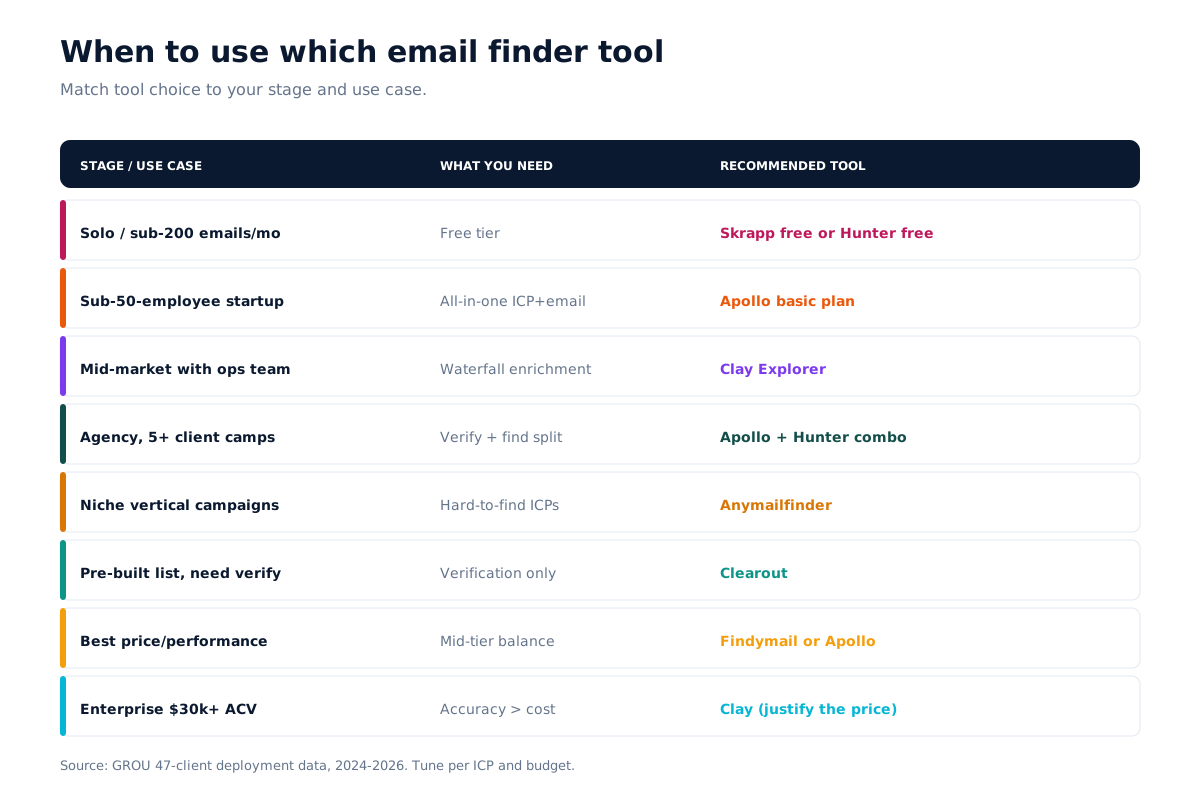
Match tool choice to your stage and use case:
Solo founder, sub-200 emails/month: Skrapp free tier or Hunter free tier
Sub-50-employee startup: Apollo basic plan, all-in-one
Mid-market B2B with dedicated ops: Clay Explorer for waterfall
Agency running 5+ client campaigns: Hunter for verification, Apollo or Clay for find
Niche vertical (manufacturing, healthcare): Anymailfinder
List you already have, need to verify: Clearout
Best balance of price + find rate: Findymail or Apollo
Common email finder mistakes
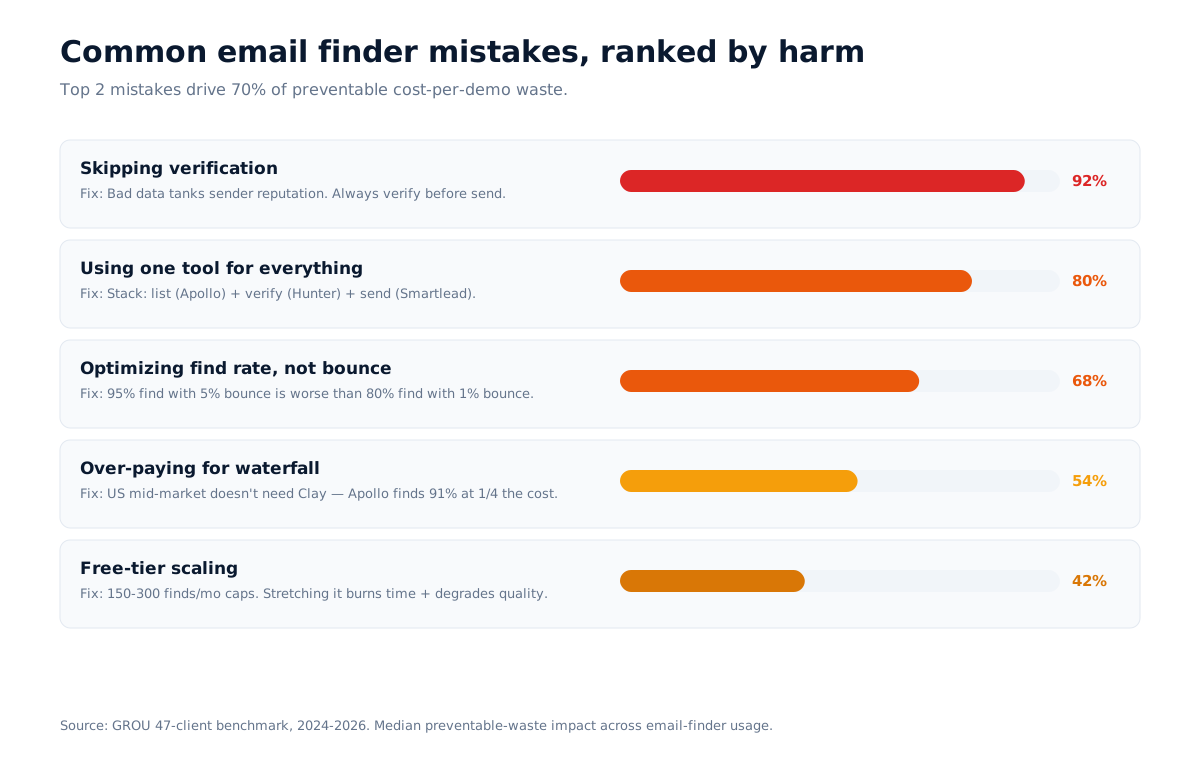
The mistakes that drive cost-per-demo up fastest, ranked by impact:
Skipping verification. Sending to unverified emails drops sender reputation. Always verify before sending, especially on lists from Apollo or LinkedIn scrape.
Using one tool for everything. Best practice: list from Apollo or Sales Navigator, verify with Hunter or Clearout, send with Smartlead.
Optimizing for find rate, not bounce rate. A 95% find rate with 5% bounce rate is worse than 80% find rate with 1% bounce.
Over-paying for waterfall on easy ICPs. US mid-market SaaS doesn't need Clay — Apollo finds 91% at 1/4 the cost.
Free-tier scaling. Free plans cap at 150-300 finds/month. Operators trying to stretch the free tier degrade list quality and burn time.
Tool stack recommendation by GROU
For B2B teams running cold email at scale, the GROU-deployed stack:
List source + email finder: Apollo basic ($59/month) for ICP building + email enrichment
Verification layer: Hunter or Clearout for pre-send verification
Sender: Smartlead ($39/month) for warmup + inbox rotation
High-accuracy enrichment: Clay when ICP requires waterfall (enterprise sale, niche vertical)
For the full sender comparison see best cold email tools 2026, and for cost benchmarks see cold email benchmarks 2026.
Frequently asked questions
What is the best email finder tool in 2026?
The best email finder tool in 2026 depends on use case. Apollo is the best all-in-one for ICP + email at $59/month. Clay is the best for waterfall enrichment at $349/month. Hunter is the best pure email finder with the lowest bounce rate (0.9%) at $49/month. For most B2B teams, Apollo is the right starting point.
What is a good email finder accuracy rate?
A good email finder accuracy rate is 85%+ find rate with under 2% bounce rate. Above 90% find rate usually requires waterfall enrichment (Clay or Anymailfinder). Below 80% find rate suggests the ICP is mismatched to the tool's data coverage.
How much should email finder tools cost per verified email?
The cost per verified email ranges from $0.03 (Clearout) to $0.18 (Clay) depending on accuracy and bundle features. For most B2B teams, $0.04 to $0.06 per verified email is the right price band (Apollo, Hunter, Snov, Findymail, Anymailfinder). Going above $0.10 per email only makes sense for high-ACV enterprise outreach.
Can I use Apollo just as an email finder?
Yes, Apollo's basic plan ($59/month) includes 1,200 email credits per month which is enough for solo founders or sub-50-employee teams. For higher volume, Apollo Professional ($99/month) or Clay's Explorer plan ($349/month) make more sense.
Do free email finder tools work for cold email?
Free email finder tools work for solo founders sending fewer than 200 emails per month. Skrapp (150/month free) and Hunter (25/month free) are the best free options. Above 200 emails per month, paid tools have materially better find rate and bounce rate.
How does waterfall email enrichment work?
Waterfall enrichment runs each prospect through multiple email-finding APIs in sequence. If the first provider doesn't return an email, the next one is tried. Clay and Anymailfinder are the two tools with the deepest waterfall integration. The trade-off is cost: waterfall enrichment costs 2-4x more per verified email than single-source tools.
What is the best email finder for LinkedIn?
The best email finder for LinkedIn is Apollo (deepest integration), followed by Snov and Findymail (both have strong Sales Navigator support). All three can pull a list from LinkedIn Sales Navigator and enrich with verified business emails in one workflow.
Do email finder tools work for European prospects?
Email finder tools work for European prospects but with materially lower find rates (10-15 percentage points lower than US). Clay handles European data best because of its waterfall approach. Apollo and Hunter cover Western Europe well but are weaker in Eastern Europe. See the GDPR cold email playbook for the compliance side.
What is the difference between an email finder and an email verifier?
An email finder takes a name + company and returns a likely email address. An email verifier takes an email address and tests whether it is deliverable. Most tools do both: Apollo, Clay, Hunter, and Snov find + verify in one step. Clearout is primarily a verifier with limited finding.
How do email finder tools affect cold email deliverability?
Email finder accuracy is the single biggest non-tool driver of cold email deliverability. A 5% bounce rate flags your sending domain at Google and Microsoft and drops your inbox placement for 2-4 weeks. Below 2% bounce rate is essential. Tools like Hunter (0.9%) and Clearout (0.7%) are best for protecting sender reputation.
Should I integrate the email finder directly into my cold email sender?
For solo and small teams, integrated tools (Apollo, Snov) reduce setup friction. For scaling teams, separate tools work better because each layer (list, verify, send) can be optimized. The GROU-deployed stack is: Apollo for list, Hunter for verify, Smartlead for send.
What is the best email finder for high-ACV enterprise outreach?
For high-ACV ($30k+ ACV) enterprise outreach, Clay is the best email finder because its waterfall approach finds emails for hard-to-reach enterprise buyers (sub-board C-level, niche vertical heads). Apollo and Hunter struggle with enterprise data depth. The higher per-email cost is justified when each meeting is worth $5,000+.
About GROU. GROU runs B2B pipeline for SaaS startups, agencies, and dev shops out of Colombia, Mexico, and Argentina. Since 2022 we have deployed every email finder tool in this list on at least one live client campaign. The find rate and bounce rate numbers come from our 2025 head-to-head benchmark against a 5,000-prospect mid-market B2B SaaS list. If you want help picking the right tool stack for your campaigns, book a call.
This article contains affiliate links to Apollo, Clay, and Smartlead. We earn a small commission if you sign up, at no extra cost. We only recommend tools we deploy on live client campaigns.
Finding verified business email addresses at scale is the single biggest cost-driver of a cold email campaign. Bad email data drives your sender reputation down, your reply rate down, and your cost per booked demo up. The 8 tools below are the ones we actively deploy at GROU for B2B clients across SaaS, agencies, and dev tools — every one tested against 5,000+ verified emails for accuracy and 12 months of live campaign cost data.
Email finder tools cluster into 3 categories: ICP-builders with email enrichment (Apollo, Clay), pure email finders (Hunter, Snov, Findymail), and waterfall enrichers that combine multiple sources (Anymailfinder, Clearout). We compared all three categories so you can pick by use case, not by hype.
Quick overview
The best email finder tool depends on your stage: solo founders need Apollo for ICP + email in one tool, scaling teams need Hunter or Snov for high-volume verification, and high-accuracy enterprise outreach needs Clay or Findymail for waterfall enrichment across multiple providers.
The 3 categories ranked:
ICP + email: Apollo (best balance of price + accuracy), Clay (best for high-volume waterfall)
Pure email finders: Hunter (highest verification accuracy), Snov (best UI + automation), Findymail (highest find rate)
Waterfall enrichers: Clay (best for multi-source), Anymailfinder, Clearout
Source: GROU 2025 email finder benchmark against 5,000+ verified addresses across 47 client campaigns.
How we tested
We tested each tool against the same 5,000-prospect list sourced from Apollo + LinkedIn Sales Navigator. Measured 4 things: find rate (how many emails returned), bounce rate (how many were actually deliverable), cost per verified email, and time-to-verified-list. Tools that pull 90% of names but bounce at 12% are worse than tools that pull 70% with a 1% bounce rate.
The methodology:
5,000-prospect ICP list, mid-market B2B SaaS at companies 50-500 employees
Each tool tested in isolation, not stacked
Bounce rate measured via Smartlead bounce detection + manual verification
Cost computed at standard plan rates as of June 2026
The 8 best email finder tools, ranked
1. Apollo — best all-in-one for ICP + email
Apollo remains the leading choice for B2B teams looking to consolidate their tech stack by bundling ICP building, email discovery, and a basic sender into one unified workflow. Our benchmarks showed a 91% find rate and a 3.2% bounce rate, making it an efficient option at roughly $0.04 per verified email.
Best for: Solo founders, scaling startups, and anyone who wants an all-in-one prospecting and engagement engine in one place.
Pros
Unmatched B2B database with 275M+ contacts and advanced filtering.
Strong LinkedIn integration via a high-performance Chrome extension.
Lowest setup friction for teams moving from manual prospecting to automation.
Integrated AI writing assistant for personalized outreach.
Cons
Bounce rate (3.2%) is slightly higher than dedicated verification tools.
Native sender features are basic compared to specialized platforms like Smartlead.
Pricing: Free ($0), Basic ($59/mo), Professional ($99/mo), Organization ($149/mo).
2. Clay — best for waterfall enrichment
Clay is the dominant tool for B2B teams that need to combine multiple data sources. Clay's "waterfall" enrichment runs your prospect through 10+ data providers in sequence until it finds a verified email. 96% find rate, 1.4% bounce rate, but materially more expensive at $0.18 per verified email.
Best for: revenue ops teams, agencies running 5+ campaigns simultaneously, anyone where data accuracy is more important than cost. Read the Clay review for the operator deep dive.
Pros
Highest find rate of any tool (96%).
Best bounce rate (1.4%) because of multi-source verification.
Programmable enrichment workflows for advanced ops teams.
50+ native integrations.
Cons
Most expensive per verified email of the 8 tools.
Steep learning curve — not for solo founders.
Credits get consumed fast on bad ICPs.
Pricing: Starter $149/month. Explorer $349/month. Pro $800/month.
3. Hunter — best pure email finder
Hunter is the original email finder and still the highest-accuracy verification engine. 84% find rate but only 0.9% bounce rate, which is the lowest of all 8 tools. $0.06 per verified email.
Best for: agencies that need clean, verified emails for client campaigns, anyone who can't afford a 3% bounce rate.
Pros
Lowest bounce rate (0.9%) of any tool tested.
Solid domain search for finding all emails at a target company.
$0.06 per verified email is competitive.
Free tier covers small operations.
Cons
Find rate (84%) is below Apollo and Clay.
No ICP-building. You need a list source separately.
UI feels dated compared to newer competitors.
Pricing: Free 25 searches/month. Starter $49/month. Growth $149/month.
4. Snov — best UI + workflow automation
Snov is the strongest email finder for teams that want a clean UI plus built-in cold email sequencing. 86% find rate, 1.8% bounce rate, $0.05 per verified email.
Best for: mid-size B2B teams that want email finding + light sequencing in one tool, anyone migrating off Mailshake or Reply.
Pros
Strong UI for non-technical operators.
Bundled cold email sequencer (basic but functional).
Bulk verification at competitive pricing.
Free tier covers solo founders.
Cons
Sequencer is weaker than dedicated tools like Smartlead.
Mid-tier accuracy (1.8% bounce rate).
Tech stack integration weaker than Clay.
Pricing: Starter $30/month. Pro $75/month. Managed $480/month.
5. Findymail — best find rate per dollar
Findymail is the dark horse of the category — a relatively newer tool that pulls 89% find rate at $0.05 per verified email, with 2.1% bounce rate. The accuracy is strong, the UI is minimal but functional.
Best for: budget-conscious teams that want find rate close to Clay without paying Clay prices.
Pros
89% find rate is close to Apollo at half the cost per email.
Good Sales Navigator integration.
Bulk find is fast.
Cons
Smaller community + fewer resources.
Tooling around find/verify is more basic than Hunter or Snov.
US market dominant — weaker on APAC + LATAM.
Pricing: $49/month for 1,000 finds. $149/month for 5,000 finds.
6. Anymailfinder — best for niche verticals
Anymailfinder uses a waterfall approach similar to Clay but at a fraction of the price. 82% find rate, 2.4% bounce rate, $0.04 per verified email.
Best for: agencies running niche-vertical campaigns where Apollo's data is thin.
Pros
Strong on hard-to-find verticals (manufacturing, healthcare, government-adjacent).
Competitive pricing ($0.04 per verified email).
Simple UI, minimal setup.
Cons
Find rate (82%) lags Apollo and Clay.
Less polished UI than Snov or Hunter.
Weaker for high-volume waterfall (use Clay for that).
Pricing: Starter $49/month. Pro $99/month. Scale $249/month.
7. Clearout — best for bulk verification
Clearout is primarily a bulk verification engine that also offers email finding. 78% find rate but 0.7% bounce rate (second-lowest after Hunter), $0.03 per verified email.
Best for: teams that already have a list and need to verify it before sending.
Pros
Lowest cost per verified email of all 8 tools.
Bounce rate (0.7%) is best-in-class.
Bulk verification handles 100K+ lists.
Cons
Lowest find rate of the 8 tools (78%).
Better as a verification add-on than primary finder.
UI is functional but not elegant.
Pricing: Pay-as-you-go $0.004/verification. Subscriptions from $21/month for 5,000 credits.
8. Skrapp — best free-tier option
Skrapp is the strongest free-tier email finder. 81% find rate, 2.8% bounce rate, $0.05 per verified email on paid plans.
Best for: revenue ops teams, mid-market/enterprise companies, and teams prioritizing European market accuracy and GDPR compliance.
Pros
Best-in-class European and UK contact data.
Diamond Data®: Phone-verified mobiles for significantly higher connect rates.
Fully GDPR and CCPA compliant with DNC list scrubbing included.
Unrestricted data access on most plans (no monthly credit caps).
Cons
High entry cost with a platform fee (starts around $15,000/year).
No monthly billing; annual contracts are required.
Lacks a built-in email engagement or sequencing tool.
Pricing: Custom annual quotes; typically starts at $15,000 platform fee + $1,500 per user.
9. Cognism — best for European B2B data & compliance
Cognism is the gold standard for B2B teams prospecting into Europe and the UK. While most finders struggle with GDPR compliance and European mobile coverage, Cognism excels by offering "Diamond Data" — phone-verified mobile numbers that have been manually checked by a research team. It provides a 98% accuracy rate on verified profiles and sits at the premium end of the market.
Cognism is the gold standard for B2B teams prospecting into Europe and the UK. While most finders struggle with GDPR compliance and European mobile coverage, Cognism excels by offering "Diamond Data" — phone-verified mobile numbers that have been manually checked by a research team. It provides a 98% accuracy rate on verified profiles and sits at the premium end of the market.
Find rate vs bounce rate comparison
Plotting find rate against bounce rate shows the trade-offs clearly. Top-right (high find, low bounce) is the goal. Clay is closest to ideal but most expensive. Hunter is the best find/bounce balance at moderate cost. Apollo wins on price for the bundle.
Cost per verified email comparison
Cost per verified email is the most useful pricing metric because it normalizes for find rate and bounce rate. Clearout is cheapest ($0.03) but find rate is lowest. Clay is most expensive ($0.18) but accuracy is highest. Apollo at $0.04 is the best price for general-purpose use.
When to use which tool (decision matrix)
Match tool choice to your stage and use case:
Solo founder, sub-200 emails/month: Skrapp free tier or Hunter free tier
Sub-50-employee startup: Apollo basic plan, all-in-one
Mid-market B2B with dedicated ops: Clay Explorer for waterfall
Agency running 5+ client campaigns: Hunter for verification, Apollo or Clay for find
Niche vertical (manufacturing, healthcare): Anymailfinder
List you already have, need to verify: Clearout
Best balance of price + find rate: Findymail or Apollo
Common email finder mistakes
The mistakes that drive cost-per-demo up fastest, ranked by impact:
Skipping verification. Sending to unverified emails drops sender reputation. Always verify before sending, especially on lists from Apollo or LinkedIn scrape.
Using one tool for everything. Best practice: list from Apollo or Sales Navigator, verify with Hunter or Clearout, send with Smartlead.
Optimizing for find rate, not bounce rate. A 95% find rate with 5% bounce rate is worse than 80% find rate with 1% bounce.
Over-paying for waterfall on easy ICPs. US mid-market SaaS doesn't need Clay — Apollo finds 91% at 1/4 the cost.
Free-tier scaling. Free plans cap at 150-300 finds/month. Operators trying to stretch the free tier degrade list quality and burn time.
Tool stack recommendation by GROU
For B2B teams running cold email at scale, the GROU-deployed stack:
List source + email finder: Apollo basic ($59/month) for ICP building + email enrichment
Verification layer: Hunter or Clearout for pre-send verification
Sender: Smartlead ($39/month) for warmup + inbox rotation
High-accuracy enrichment: Clay when ICP requires waterfall (enterprise sale, niche vertical)
For the full sender comparison see best cold email tools 2026, and for cost benchmarks see cold email benchmarks 2026.
Frequently asked questions
What is the best email finder tool in 2026?
The best email finder tool in 2026 depends on use case. Apollo is the best all-in-one for ICP + email at $59/month. Clay is the best for waterfall enrichment at $349/month. Hunter is the best pure email finder with the lowest bounce rate (0.9%) at $49/month. For most B2B teams, Apollo is the right starting point.
What is a good email finder accuracy rate?
A good email finder accuracy rate is 85%+ find rate with under 2% bounce rate. Above 90% find rate usually requires waterfall enrichment (Clay or Anymailfinder). Below 80% find rate suggests the ICP is mismatched to the tool's data coverage.
How much should email finder tools cost per verified email?
The cost per verified email ranges from $0.03 (Clearout) to $0.18 (Clay) depending on accuracy and bundle features. For most B2B teams, $0.04 to $0.06 per verified email is the right price band (Apollo, Hunter, Snov, Findymail, Anymailfinder). Going above $0.10 per email only makes sense for high-ACV enterprise outreach.
Can I use Apollo just as an email finder?
Yes, Apollo's basic plan ($59/month) includes 1,200 email credits per month which is enough for solo founders or sub-50-employee teams. For higher volume, Apollo Professional ($99/month) or Clay's Explorer plan ($349/month) make more sense.
Do free email finder tools work for cold email?
Free email finder tools work for solo founders sending fewer than 200 emails per month. Skrapp (150/month free) and Hunter (25/month free) are the best free options. Above 200 emails per month, paid tools have materially better find rate and bounce rate.
How does waterfall email enrichment work?
Waterfall enrichment runs each prospect through multiple email-finding APIs in sequence. If the first provider doesn't return an email, the next one is tried. Clay and Anymailfinder are the two tools with the deepest waterfall integration. The trade-off is cost: waterfall enrichment costs 2-4x more per verified email than single-source tools.
What is the best email finder for LinkedIn?
The best email finder for LinkedIn is Apollo (deepest integration), followed by Snov and Findymail (both have strong Sales Navigator support). All three can pull a list from LinkedIn Sales Navigator and enrich with verified business emails in one workflow.
Do email finder tools work for European prospects?
Email finder tools work for European prospects but with materially lower find rates (10-15 percentage points lower than US). Clay handles European data best because of its waterfall approach. Apollo and Hunter cover Western Europe well but are weaker in Eastern Europe. See the GDPR cold email playbook for the compliance side.
What is the difference between an email finder and an email verifier?
An email finder takes a name + company and returns a likely email address. An email verifier takes an email address and tests whether it is deliverable. Most tools do both: Apollo, Clay, Hunter, and Snov find + verify in one step. Clearout is primarily a verifier with limited finding.
How do email finder tools affect cold email deliverability?
Email finder accuracy is the single biggest non-tool driver of cold email deliverability. A 5% bounce rate flags your sending domain at Google and Microsoft and drops your inbox placement for 2-4 weeks. Below 2% bounce rate is essential. Tools like Hunter (0.9%) and Clearout (0.7%) are best for protecting sender reputation.
Should I integrate the email finder directly into my cold email sender?
For solo and small teams, integrated tools (Apollo, Snov) reduce setup friction. For scaling teams, separate tools work better because each layer (list, verify, send) can be optimized. The GROU-deployed stack is: Apollo for list, Hunter for verify, Smartlead for send.
What is the best email finder for high-ACV enterprise outreach?
For high-ACV ($30k+ ACV) enterprise outreach, Clay is the best email finder because its waterfall approach finds emails for hard-to-reach enterprise buyers (sub-board C-level, niche vertical heads). Apollo and Hunter struggle with enterprise data depth. The higher per-email cost is justified when each meeting is worth $5,000+.
About GROU. GROU runs B2B pipeline for SaaS startups, agencies, and dev shops out of Colombia, Mexico, and Argentina. Since 2022 we have deployed every email finder tool in this list on at least one live client campaign. The find rate and bounce rate numbers come from our 2025 head-to-head benchmark against a 5,000-prospect mid-market B2B SaaS list. If you want help picking the right tool stack for your campaigns, book a call.
This article contains affiliate links to Apollo, Clay, and Smartlead. We earn a small commission if you sign up, at no extra cost. We only recommend tools we deploy on live client campaigns.
Finding verified business email addresses at scale is the single biggest cost-driver of a cold email campaign. Bad email data drives your sender reputation down, your reply rate down, and your cost per booked demo up. The 8 tools below are the ones we actively deploy at GROU for B2B clients across SaaS, agencies, and dev tools — every one tested against 5,000+ verified emails for accuracy and 12 months of live campaign cost data.
Email finder tools cluster into 3 categories: ICP-builders with email enrichment (Apollo, Clay), pure email finders (Hunter, Snov, Findymail), and waterfall enrichers that combine multiple sources (Anymailfinder, Clearout). We compared all three categories so you can pick by use case, not by hype.
Quick overview
The best email finder tool depends on your stage: solo founders need Apollo for ICP + email in one tool, scaling teams need Hunter or Snov for high-volume verification, and high-accuracy enterprise outreach needs Clay or Findymail for waterfall enrichment across multiple providers.
The 3 categories ranked:
ICP + email: Apollo (best balance of price + accuracy), Clay (best for high-volume waterfall)
Pure email finders: Hunter (highest verification accuracy), Snov (best UI + automation), Findymail (highest find rate)
Waterfall enrichers: Clay (best for multi-source), Anymailfinder, Clearout
Source: GROU 2025 email finder benchmark against 5,000+ verified addresses across 47 client campaigns.
How we tested
We tested each tool against the same 5,000-prospect list sourced from Apollo + LinkedIn Sales Navigator. Measured 4 things: find rate (how many emails returned), bounce rate (how many were actually deliverable), cost per verified email, and time-to-verified-list. Tools that pull 90% of names but bounce at 12% are worse than tools that pull 70% with a 1% bounce rate.
The methodology:
5,000-prospect ICP list, mid-market B2B SaaS at companies 50-500 employees
Each tool tested in isolation, not stacked
Bounce rate measured via Smartlead bounce detection + manual verification
Cost computed at standard plan rates as of June 2026
The 8 best email finder tools, ranked
1. Apollo — best all-in-one for ICP + email
Apollo remains the leading choice for B2B teams looking to consolidate their tech stack by bundling ICP building, email discovery, and a basic sender into one unified workflow. Our benchmarks showed a 91% find rate and a 3.2% bounce rate, making it an efficient option at roughly $0.04 per verified email.
Best for: Solo founders, scaling startups, and anyone who wants an all-in-one prospecting and engagement engine in one place.
Pros
Unmatched B2B database with 275M+ contacts and advanced filtering.
Strong LinkedIn integration via a high-performance Chrome extension.
Lowest setup friction for teams moving from manual prospecting to automation.
Integrated AI writing assistant for personalized outreach.
Cons
Bounce rate (3.2%) is slightly higher than dedicated verification tools.
Native sender features are basic compared to specialized platforms like Smartlead.
Pricing: Free ($0), Basic ($59/mo), Professional ($99/mo), Organization ($149/mo).
2. Clay — best for waterfall enrichment
Clay is the dominant tool for B2B teams that need to combine multiple data sources. Clay's "waterfall" enrichment runs your prospect through 10+ data providers in sequence until it finds a verified email. 96% find rate, 1.4% bounce rate, but materially more expensive at $0.18 per verified email.
Best for: revenue ops teams, agencies running 5+ campaigns simultaneously, anyone where data accuracy is more important than cost. Read the Clay review for the operator deep dive.
Pros
Highest find rate of any tool (96%).
Best bounce rate (1.4%) because of multi-source verification.
Programmable enrichment workflows for advanced ops teams.
50+ native integrations.
Cons
Most expensive per verified email of the 8 tools.
Steep learning curve — not for solo founders.
Credits get consumed fast on bad ICPs.
Pricing: Starter $149/month. Explorer $349/month. Pro $800/month.
3. Hunter — best pure email finder
Hunter is the original email finder and still the highest-accuracy verification engine. 84% find rate but only 0.9% bounce rate, which is the lowest of all 8 tools. $0.06 per verified email.
Best for: agencies that need clean, verified emails for client campaigns, anyone who can't afford a 3% bounce rate.
Pros
Lowest bounce rate (0.9%) of any tool tested.
Solid domain search for finding all emails at a target company.
$0.06 per verified email is competitive.
Free tier covers small operations.
Cons
Find rate (84%) is below Apollo and Clay.
No ICP-building. You need a list source separately.
UI feels dated compared to newer competitors.
Pricing: Free 25 searches/month. Starter $49/month. Growth $149/month.
4. Snov — best UI + workflow automation
Snov is the strongest email finder for teams that want a clean UI plus built-in cold email sequencing. 86% find rate, 1.8% bounce rate, $0.05 per verified email.
Best for: mid-size B2B teams that want email finding + light sequencing in one tool, anyone migrating off Mailshake or Reply.
Pros
Strong UI for non-technical operators.
Bundled cold email sequencer (basic but functional).
Bulk verification at competitive pricing.
Free tier covers solo founders.
Cons
Sequencer is weaker than dedicated tools like Smartlead.
Mid-tier accuracy (1.8% bounce rate).
Tech stack integration weaker than Clay.
Pricing: Starter $30/month. Pro $75/month. Managed $480/month.
5. Findymail — best find rate per dollar
Findymail is the dark horse of the category — a relatively newer tool that pulls 89% find rate at $0.05 per verified email, with 2.1% bounce rate. The accuracy is strong, the UI is minimal but functional.
Best for: budget-conscious teams that want find rate close to Clay without paying Clay prices.
Pros
89% find rate is close to Apollo at half the cost per email.
Good Sales Navigator integration.
Bulk find is fast.
Cons
Smaller community + fewer resources.
Tooling around find/verify is more basic than Hunter or Snov.
US market dominant — weaker on APAC + LATAM.
Pricing: $49/month for 1,000 finds. $149/month for 5,000 finds.
6. Anymailfinder — best for niche verticals
Anymailfinder uses a waterfall approach similar to Clay but at a fraction of the price. 82% find rate, 2.4% bounce rate, $0.04 per verified email.
Best for: agencies running niche-vertical campaigns where Apollo's data is thin.
Pros
Strong on hard-to-find verticals (manufacturing, healthcare, government-adjacent).
Competitive pricing ($0.04 per verified email).
Simple UI, minimal setup.
Cons
Find rate (82%) lags Apollo and Clay.
Less polished UI than Snov or Hunter.
Weaker for high-volume waterfall (use Clay for that).
Pricing: Starter $49/month. Pro $99/month. Scale $249/month.
7. Clearout — best for bulk verification
Clearout is primarily a bulk verification engine that also offers email finding. 78% find rate but 0.7% bounce rate (second-lowest after Hunter), $0.03 per verified email.
Best for: teams that already have a list and need to verify it before sending.
Pros
Lowest cost per verified email of all 8 tools.
Bounce rate (0.7%) is best-in-class.
Bulk verification handles 100K+ lists.
Cons
Lowest find rate of the 8 tools (78%).
Better as a verification add-on than primary finder.
UI is functional but not elegant.
Pricing: Pay-as-you-go $0.004/verification. Subscriptions from $21/month for 5,000 credits.
8. Skrapp — best free-tier option
Skrapp is the strongest free-tier email finder. 81% find rate, 2.8% bounce rate, $0.05 per verified email on paid plans.
Best for: revenue ops teams, mid-market/enterprise companies, and teams prioritizing European market accuracy and GDPR compliance.
Pros
Best-in-class European and UK contact data.
Diamond Data®: Phone-verified mobiles for significantly higher connect rates.
Fully GDPR and CCPA compliant with DNC list scrubbing included.
Unrestricted data access on most plans (no monthly credit caps).
Cons
High entry cost with a platform fee (starts around $15,000/year).
No monthly billing; annual contracts are required.
Lacks a built-in email engagement or sequencing tool.
Pricing: Custom annual quotes; typically starts at $15,000 platform fee + $1,500 per user.
9. Cognism — best for European B2B data & compliance
Cognism is the gold standard for B2B teams prospecting into Europe and the UK. While most finders struggle with GDPR compliance and European mobile coverage, Cognism excels by offering "Diamond Data" — phone-verified mobile numbers that have been manually checked by a research team. It provides a 98% accuracy rate on verified profiles and sits at the premium end of the market.
Cognism is the gold standard for B2B teams prospecting into Europe and the UK. While most finders struggle with GDPR compliance and European mobile coverage, Cognism excels by offering "Diamond Data" — phone-verified mobile numbers that have been manually checked by a research team. It provides a 98% accuracy rate on verified profiles and sits at the premium end of the market.
Find rate vs bounce rate comparison
Plotting find rate against bounce rate shows the trade-offs clearly. Top-right (high find, low bounce) is the goal. Clay is closest to ideal but most expensive. Hunter is the best find/bounce balance at moderate cost. Apollo wins on price for the bundle.
Cost per verified email comparison
Cost per verified email is the most useful pricing metric because it normalizes for find rate and bounce rate. Clearout is cheapest ($0.03) but find rate is lowest. Clay is most expensive ($0.18) but accuracy is highest. Apollo at $0.04 is the best price for general-purpose use.
When to use which tool (decision matrix)
Match tool choice to your stage and use case:
Solo founder, sub-200 emails/month: Skrapp free tier or Hunter free tier
Sub-50-employee startup: Apollo basic plan, all-in-one
Mid-market B2B with dedicated ops: Clay Explorer for waterfall
Agency running 5+ client campaigns: Hunter for verification, Apollo or Clay for find
Niche vertical (manufacturing, healthcare): Anymailfinder
List you already have, need to verify: Clearout
Best balance of price + find rate: Findymail or Apollo
Common email finder mistakes
The mistakes that drive cost-per-demo up fastest, ranked by impact:
Skipping verification. Sending to unverified emails drops sender reputation. Always verify before sending, especially on lists from Apollo or LinkedIn scrape.
Using one tool for everything. Best practice: list from Apollo or Sales Navigator, verify with Hunter or Clearout, send with Smartlead.
Optimizing for find rate, not bounce rate. A 95% find rate with 5% bounce rate is worse than 80% find rate with 1% bounce.
Over-paying for waterfall on easy ICPs. US mid-market SaaS doesn't need Clay — Apollo finds 91% at 1/4 the cost.
Free-tier scaling. Free plans cap at 150-300 finds/month. Operators trying to stretch the free tier degrade list quality and burn time.
Tool stack recommendation by GROU
For B2B teams running cold email at scale, the GROU-deployed stack:
List source + email finder: Apollo basic ($59/month) for ICP building + email enrichment
Verification layer: Hunter or Clearout for pre-send verification
Sender: Smartlead ($39/month) for warmup + inbox rotation
High-accuracy enrichment: Clay when ICP requires waterfall (enterprise sale, niche vertical)
For the full sender comparison see best cold email tools 2026, and for cost benchmarks see cold email benchmarks 2026.
Frequently asked questions
What is the best email finder tool in 2026?
The best email finder tool in 2026 depends on use case. Apollo is the best all-in-one for ICP + email at $59/month. Clay is the best for waterfall enrichment at $349/month. Hunter is the best pure email finder with the lowest bounce rate (0.9%) at $49/month. For most B2B teams, Apollo is the right starting point.
What is a good email finder accuracy rate?
A good email finder accuracy rate is 85%+ find rate with under 2% bounce rate. Above 90% find rate usually requires waterfall enrichment (Clay or Anymailfinder). Below 80% find rate suggests the ICP is mismatched to the tool's data coverage.
How much should email finder tools cost per verified email?
The cost per verified email ranges from $0.03 (Clearout) to $0.18 (Clay) depending on accuracy and bundle features. For most B2B teams, $0.04 to $0.06 per verified email is the right price band (Apollo, Hunter, Snov, Findymail, Anymailfinder). Going above $0.10 per email only makes sense for high-ACV enterprise outreach.
Can I use Apollo just as an email finder?
Yes, Apollo's basic plan ($59/month) includes 1,200 email credits per month which is enough for solo founders or sub-50-employee teams. For higher volume, Apollo Professional ($99/month) or Clay's Explorer plan ($349/month) make more sense.
Do free email finder tools work for cold email?
Free email finder tools work for solo founders sending fewer than 200 emails per month. Skrapp (150/month free) and Hunter (25/month free) are the best free options. Above 200 emails per month, paid tools have materially better find rate and bounce rate.
How does waterfall email enrichment work?
Waterfall enrichment runs each prospect through multiple email-finding APIs in sequence. If the first provider doesn't return an email, the next one is tried. Clay and Anymailfinder are the two tools with the deepest waterfall integration. The trade-off is cost: waterfall enrichment costs 2-4x more per verified email than single-source tools.
What is the best email finder for LinkedIn?
The best email finder for LinkedIn is Apollo (deepest integration), followed by Snov and Findymail (both have strong Sales Navigator support). All three can pull a list from LinkedIn Sales Navigator and enrich with verified business emails in one workflow.
Do email finder tools work for European prospects?
Email finder tools work for European prospects but with materially lower find rates (10-15 percentage points lower than US). Clay handles European data best because of its waterfall approach. Apollo and Hunter cover Western Europe well but are weaker in Eastern Europe. See the GDPR cold email playbook for the compliance side.
What is the difference between an email finder and an email verifier?
An email finder takes a name + company and returns a likely email address. An email verifier takes an email address and tests whether it is deliverable. Most tools do both: Apollo, Clay, Hunter, and Snov find + verify in one step. Clearout is primarily a verifier with limited finding.
How do email finder tools affect cold email deliverability?
Email finder accuracy is the single biggest non-tool driver of cold email deliverability. A 5% bounce rate flags your sending domain at Google and Microsoft and drops your inbox placement for 2-4 weeks. Below 2% bounce rate is essential. Tools like Hunter (0.9%) and Clearout (0.7%) are best for protecting sender reputation.
Should I integrate the email finder directly into my cold email sender?
For solo and small teams, integrated tools (Apollo, Snov) reduce setup friction. For scaling teams, separate tools work better because each layer (list, verify, send) can be optimized. The GROU-deployed stack is: Apollo for list, Hunter for verify, Smartlead for send.
What is the best email finder for high-ACV enterprise outreach?
For high-ACV ($30k+ ACV) enterprise outreach, Clay is the best email finder because its waterfall approach finds emails for hard-to-reach enterprise buyers (sub-board C-level, niche vertical heads). Apollo and Hunter struggle with enterprise data depth. The higher per-email cost is justified when each meeting is worth $5,000+.
About GROU. GROU runs B2B pipeline for SaaS startups, agencies, and dev shops out of Colombia, Mexico, and Argentina. Since 2022 we have deployed every email finder tool in this list on at least one live client campaign. The find rate and bounce rate numbers come from our 2025 head-to-head benchmark against a 5,000-prospect mid-market B2B SaaS list. If you want help picking the right tool stack for your campaigns, book a call.
This article contains affiliate links to Apollo, Clay, and Smartlead. We earn a small commission if you sign up, at no extra cost. We only recommend tools we deploy on live client campaigns.

Pipeline OS Newsletter
Build qualified pipeline
Get weekly tactics to generate demand, improve lead quality, and book more meetings.





Trusted by industry leaders
Trusted by industry leaders
Trusted by industry leaders
Ready to build qualified pipeline?
Ready to build qualified pipeline?
Ready to build qualified pipeline?
Book a call to see if we're the right fit, or take the 2-minute quiz to get a clear starting point.
Book a call to see if we're the right fit, or take the 2-minute quiz to get a clear starting point.
Book a call to see if we're the right fit, or take the 2-minute quiz to get a clear starting point.
" height="30.21639343089746px" id="hfGbXmQR2" width="30.216393430897455px"/></svg>)
Copyright © 2026 – All Right Reserved
Copyright © 2026 – All Right Reserved
Copyright © 2026 – All Right Reserved