%22%3E%3C/path%3E%3Cpath d=%22M 63.072 7.554 C 62.258 8.022 61.577 8.689 61.092 9.493 L 61.092 7.076 L 57.158 7.076 L 57.158 22.64 L 61.089 22.64 L 61.089 14.888 C 61.089 13.446 61.403 12.434 62.03 11.853 C 62.818 11.218 63.818 10.907 64.826 10.982 L 65.868 10.982 L 65.868 6.851 C 64.891 6.834 63.926 7.076 63.073 7.554 Z%22 fill=%22rgb(17,17,17)%22%3E%3C/path%3E%3Cpath d=%22M 78.916 7.82 C 76.363 6.49 73.321 6.49 70.768 7.82 C 69.562 8.473 68.564 9.451 67.888 10.644 C 67.167 11.931 66.803 13.387 66.834 14.862 C 66.804 16.332 67.157 17.785 67.86 19.077 C 68.515 20.267 69.494 21.246 70.684 21.901 C 71.924 22.576 73.318 22.92 74.73 22.898 C 76.164 22.918 77.58 22.575 78.846 21.901 C 80.062 21.247 81.073 20.27 81.768 19.077 C 82.506 17.797 82.88 16.339 82.85 14.862 C 82.88 13.389 82.517 11.934 81.797 10.647 C 81.12 9.455 80.122 8.477 78.917 7.824 M 78.803 14.862 C 78.829 15.739 78.636 16.608 78.241 17.391 C 77.903 18.046 77.38 18.588 76.738 18.95 C 76.124 19.293 75.432 19.472 74.729 19.47 C 73.668 19.497 72.648 19.061 71.934 18.276 C 71.139 17.323 70.741 16.1 70.823 14.862 C 70.741 13.62 71.149 12.395 71.959 11.45 C 72.687 10.667 73.715 10.233 74.783 10.256 C 75.859 10.236 76.894 10.67 77.635 11.45 C 78.464 12.387 78.884 13.616 78.801 14.864%22 fill=%22rgb(17,17,17)%22%3E%3C/path%3E%3Cpath d=%22M 95.906 7.076 L 95.906 15.646 C 95.975 16.68 95.643 17.701 94.979 18.498 C 94.311 19.184 93.379 19.547 92.422 19.495 C 91.475 19.544 90.553 19.18 89.894 18.498 C 89.23 17.701 88.898 16.68 88.967 15.646 L 88.967 7.076 L 85.033 7.076 L 85.033 16.207 C 85 17.449 85.275 18.68 85.834 19.79 C 86.327 20.75 87.095 21.542 88.039 22.065 C 89.033 22.594 90.145 22.861 91.271 22.838 C 92.188 22.847 93.095 22.65 93.926 22.263 C 94.708 21.905 95.388 21.36 95.906 20.675 L 95.906 22.645 L 99.865 22.645 L 99.865 7.076 Z%22 fill=%22rgb(17,17,17)%22%3E%3C/path%3E%3Cpath d=%22M 4.513 15.626 C 4.511 10.815 7.606 6.549 12.181 5.059 C 16.756 3.57 21.77 5.195 24.601 9.086 L 27.816 5.87 C 24.074 1.186 17.981 -0.943 12.137 0.393 C 6.292 1.728 1.728 6.292 0.393 12.137 C -0.943 17.981 1.186 24.074 5.87 27.816 L 9.085 24.601 C 6.214 22.512 4.515 19.177 4.513 15.626%22 fill=%22rgb(32,62,235)%22%3E%3C/path%3E%3Cpath d=%22M 17.114 14.343 L 13.354 18.01 L 13.354 18.026 L 21.071 18.026 L 11.412 27.609 L 17.389 27.609 L 23.999 21.081 L 23.999 28.316 L 24.005 28.316 L 27.967 24.393 L 27.967 14.343 Z%22 fill=%22rgb(32,62,235)%22%3E%3C/path%3E%3C/g%3E%3C/svg%3E) ×
× ××
××›
›
›
›
Best landing page builders for B2B 2026
Best landing page builders for B2B 2026
Best landing page builders for B2B 2026
Best landing page builders for B2B 2026
Best landing page builders for B2B 2026
Best landing page builders for B2B 2026

Author
Aljaz Peklaj

The price range in this category is not a spread, it is a canyon. Carrd will host a landing page with a working form for nineteen dollars a year. Leadpages starts at nine hundred and forty eight. Systeme will do it for nothing.
Those are not competing products and comparing them on price alone tells you nothing. What decides it is whether you are actually going to test the page, and most B2B teams are not.
TL;DR
Carrd Pro Standard is $19 a year for ten sites with custom domains, SSL and working contact and signup forms, which covers what most B2B campaign pages actually need. Systeme.io has a genuinely usable free plan with 2,000 contacts, three funnels, one custom domain and unlimited email sending, then $17 a month for unlimited funnels and 5,000 contacts. Leadpages Grow is $99 a month, or $79 billed annually at $948 a year, and it buys 500 pages, ten custom domains, five team seats and A/B testing with up to six variants per page. The honest way to choose is to ask what you will do with the page after you publish it. If the answer is nothing, you are buying a testing platform you will not use and Carrd does the same job for a fiftieth of the price. If you genuinely run split tests across a team, Leadpages is the only one of the three built for it. And if your marketing site already runs on Webflow, Framer or WordPress, the fourth option is to build the page there and spend nothing extra.
What each one costs a year
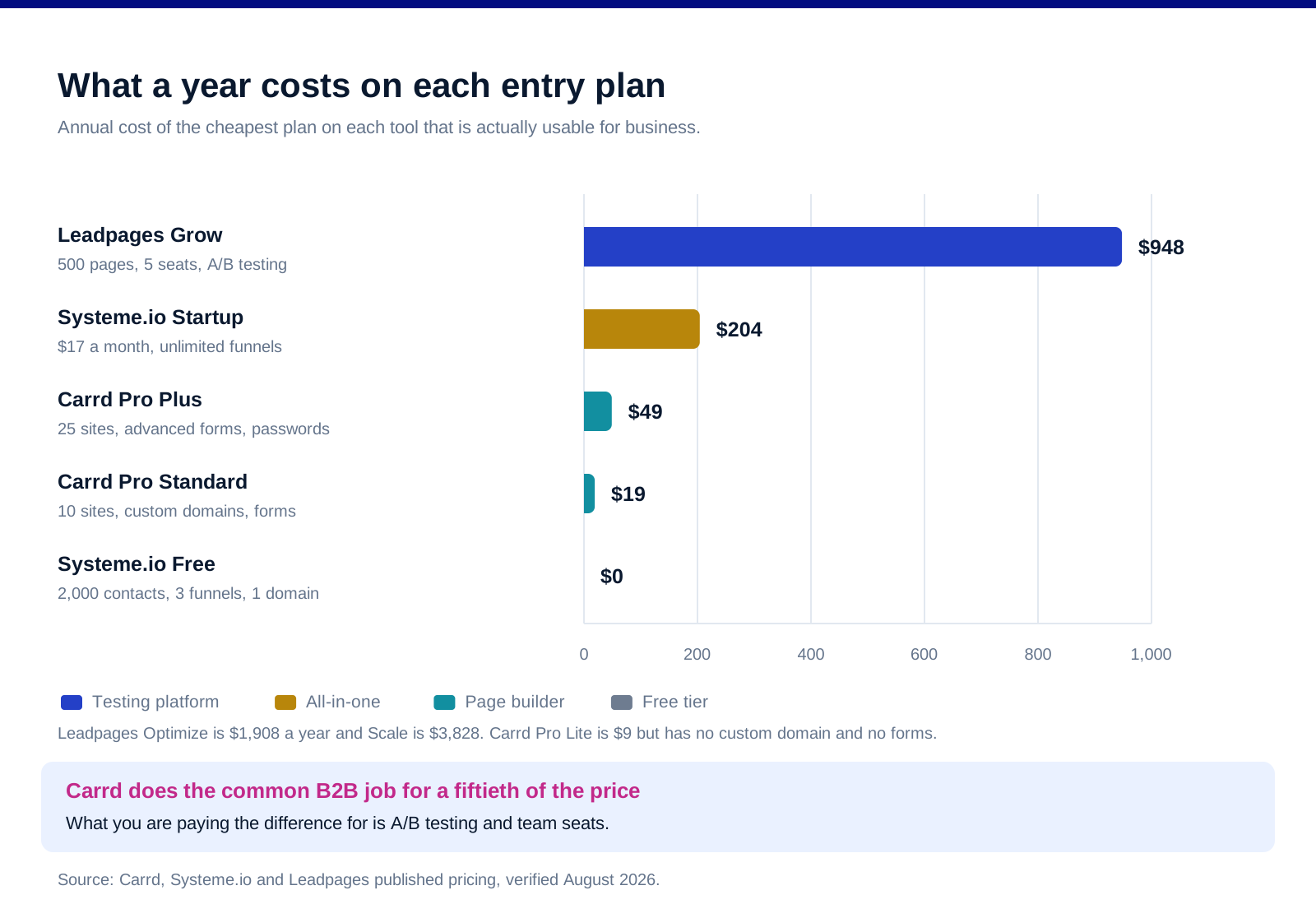
Carrd Pro Standard is $19 a year. Per Carrd's own plan documentation that covers up to ten sites from a single account, custom domains with SSL, fully functional contact and signup forms, and embedded widgets from Stripe, PayPal, Gumroad, Typeform and Facebook.
Carrd Pro Lite is $9 a year and Pro Plus is $49. Lite gives three sites and removes the Carrd branding but has no custom domain and no forms, which makes it too limited for business use. Plus gives 25 sites, advanced forms with custom integrations and payment processing, and password protection.
Systeme.io's free plan is $0 and includes 2,000 contacts, three sales funnels, one course, one blog, one custom domain, one affiliate program, and unlimited emails and file storage, with no card required. Its pricing page puts Startup at $17 a month for 5,000 contacts and unlimited funnels, Webinar at $47 for 10,000 contacts, and Unlimited at $97. Yearly billing gives two months free.
Leadpages Grow is $99 a month, or $948 a year on annual billing, which works out at $79 a month. Its published plan documentation lists up to 500 pages, ten custom domains, 40,000 AI credits a month, A/B testing with up to six variants per page, five team seats, 15GB of storage, three blogs and five active integrations.
Leadpages Optimize is $199 a month, $1,908 a year, adding Smart Traffic to the A/B testing, 1,000 pages, 20 domains, ten seats and 25 integrations. Scale is $399 a month, $3,828 a year, with unlimited pages, auto-optimization across up to 12 variants, 25 seats and 100 integrations.
Leadpages runs a seven-day free trial and requires a card. Systeme's free plan needs no card at all, which is a lower-friction way to evaluate.
What the money actually buys
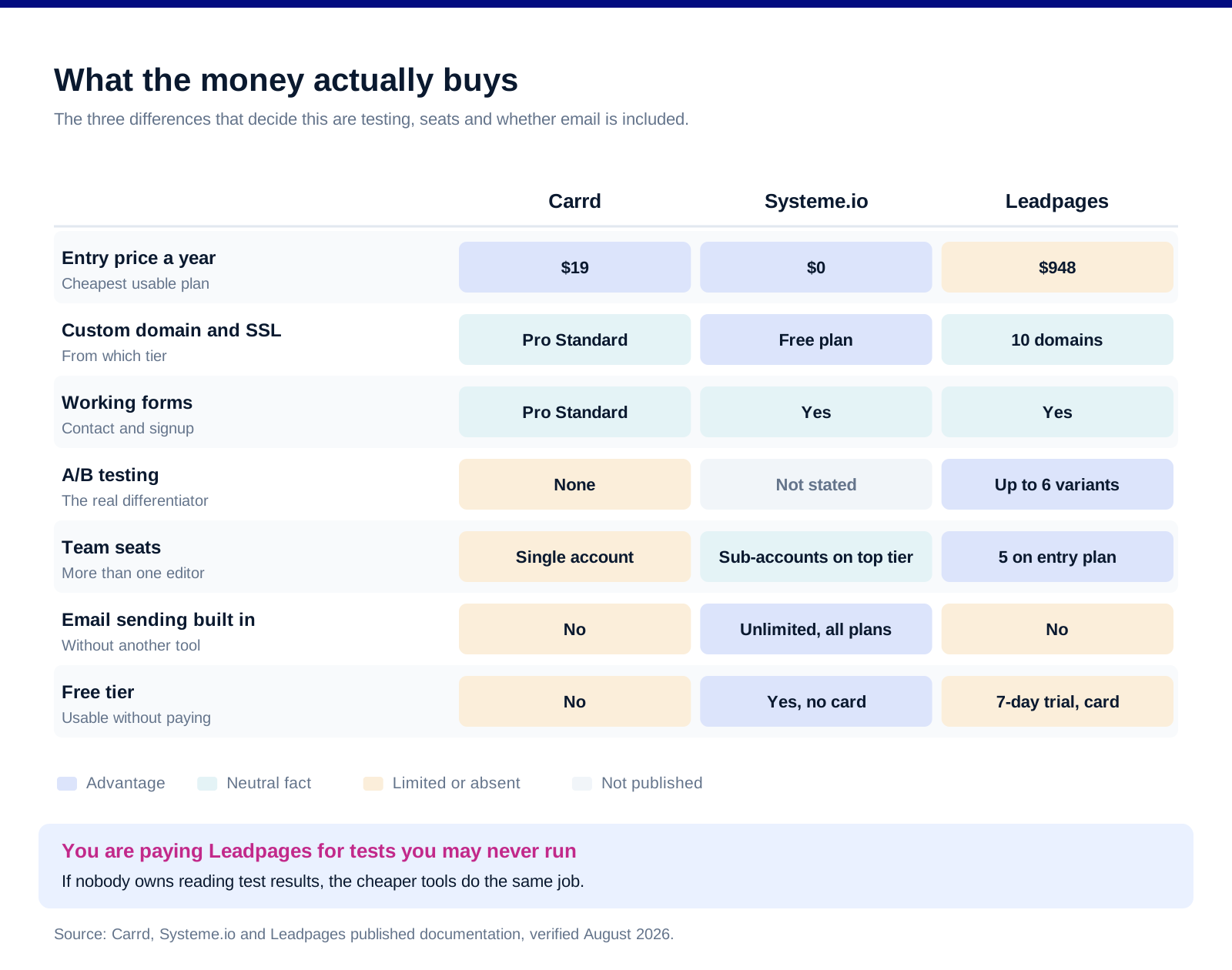
Testing is the whole difference. Carrd has no A/B testing. Systeme's pricing page does not list A/B testing among its plan features, and the product is built around funnels, email and courses. Leadpages puts multivariate testing at the centre of the product and raises the ceiling at every tier, from six variants on Grow to twelve with auto-optimization on Scale. If you are going to run tests, that is what the money is for.
Team seats are the second real difference. Carrd is a single account. Leadpages Grow includes five seats, Optimize ten and Scale twenty five. For a marketing team where more than one person edits pages, that matters more than the page count.
Page limits almost never bind. 500 pages on Leadpages Grow, ten sites on Carrd Pro Standard, 25 on Pro Plus. Very few B2B teams run more than a handful of live landing pages at once, so this is rarely the constraint the pricing table implies it is.
Systeme is the only one that includes email. Unlimited sending on every plan including free, plus contacts, automations, courses and an affiliate programme. That is a different product category wearing the same label, and it is either exactly what you want or completely beside the point.
Nobody here replaces your CRM. Forms post out to something. Work out where the lead lands and how it gets routed before you pick the tool that collects it, because that integration is the part that breaks.
Which one to actually buy
![[INSERT CHART 3, best-landing-page-builders-b2b-chart-3-fit.svg] Alt: Which landing page builder fits which B2B team 2026, mapped by how many pages you run against how much you test and iterate.](https://framerusercontent.com/images/xUrokswr2sXCTyW8crntvVBT2I.svg)
Carrd, for most B2B teams, and it is not close on value. A campaign page, a webinar registration page, a gated asset page. Custom domain, a form that posts where you need it, live in an afternoon, $19 a year. Our webinar lead generation piece describes the kind of page this covers, and paying fifty times more to host it changes nothing about whether it converts.
Leadpages, if you genuinely run split tests with a team. Not if you intend to. If you have a person whose job includes reading test results and shipping the winner, the Grow tier at $948 a year is defensible and the Optimize tier's Smart Traffic is the reason to go up. If nobody owns that, you are renting a lab you never enter.
Systeme.io, if you want the funnel, the email and the hosting in one place. The free plan alone runs a real small programme, and $17 a month for unlimited funnels and 5,000 contacts undercuts every dedicated email tool in the category. The trade is that you are adopting an ecosystem built for course and funnel selling rather than for B2B demand generation.
Your existing website builder, more often than anyone admits. If the marketing site is on Webflow, Framer or WordPress, building the page there costs nothing extra, keeps the design system consistent, and keeps the analytics in one place. The reason people reach for a separate builder is usually that they cannot get a developer's attention, which is an organisational problem rather than a tooling one.
Carrd Pro Lite at $9, for nothing serious. No custom domain and no forms means no business use. Skip it and pay the extra ten dollars.
What none of the pricing pages tell you
A landing page builder does not improve conversion. The offer does, the traffic quality does, the form length does. Switching tools is the most visible thing you can do and usually the least effective.
Form-to-CRM is where the leads get lost. Leadpages counts active integrations by tier, five on Grow rising to 100 on Scale. Carrd posts to whatever endpoint you point it at. Test the whole path, from submit to CRM record to notification, before you run traffic.
Page speed is mostly your images. All three of these produce fast pages if you do not upload a four-megabyte hero image, and none of them save you if you do.
Annual billing is the real discount. Leadpages saves 20% annually, Systeme gives two months free, Carrd is annual by default. If you are keeping the tool a year, take it.
You will build fewer pages than you plan. Every team overestimates this, which is why page-limit tiers rarely earn their upgrade. Buy for the number you built last quarter, not the number on the roadmap. Our programmatic SEO piece covers the one case where page volume genuinely is the constraint, and it is a different problem with different tools.
FAQ
What is the cheapest landing page builder for B2B?
Systeme.io's free plan at $0, which includes 2,000 contacts, three sales funnels, one custom domain and unlimited email sending with no card required. If you want something simpler and more focused, Carrd Pro Standard at $19 a year gives ten sites with custom domains, SSL and working forms, which covers the typical B2B campaign page.
Is Leadpages worth it for B2B?
Only if you run A/B tests. Grow at $948 a year buys 500 pages, five team seats and testing with up to six variants, and Optimize at $1,908 adds Smart Traffic. That is real value for a team that tests. For a company publishing a few pages a year and never revisiting them, it is a large bill for hosting.
Can you use Carrd for business landing pages?
Yes, on Pro Standard or above. Pro Standard at $19 a year adds custom domains with SSL and fully functional contact and signup forms, which is what makes it usable commercially. Pro Lite at $9 has neither, so it is not suitable for business use despite removing the Carrd branding.
Do you need a landing page builder at all?
Often not. If your marketing site runs on Webflow, Framer or WordPress, building the page there costs nothing extra and keeps design and analytics consistent. A dedicated builder earns its place when you need speed independent of a developer, or testing your site platform cannot do.
What is the difference between Systeme.io and Leadpages?
Category, not tier. Systeme is an all-in-one platform bundling funnels, email, courses, blogs and affiliate management, starting free and running to $97 a month. Leadpages is a landing page and conversion tool built around A/B testing, from $99 a month. If you want split testing, Leadpages. If you want one subscription covering email and funnels, Systeme.
How many landing pages does a B2B company actually need?
Fewer than the pricing tiers assume. Most run a handful of live pages at once, typically one per active campaign plus a few evergreen gated assets. Page limits are rarely the binding constraint, so buy on team seats and testing capability instead, which are the limits that actually bite.
Bottom line
Ask what happens to the page after you publish it. If the answer is that it sits there collecting form fills, Carrd Pro Standard at $19 a year does that job and everything above it is overhead. If you want email, funnels and hosting in one bill, Systeme's free plan is the most generous starting point in the category and $17 a month unlocks the rest. And if you have someone who genuinely runs split tests across a team, Leadpages is the only one of the three designed for it and the $948 is buying a capability rather than a page. Check whether your existing site builder does it first, because for a lot of B2B teams the honest answer is that it already does.
Want the campaign built rather than the page tool chosen? Book a call with GROU. We run lead generation and outbound inside B2B revenue engines across verticals.
We are GROU, a B2B pipeline agency that runs lead generation, outbound, and LinkedIn content for clients across manufacturing, fintech, iGaming, software, and professional services. The fit guidance reflects our campaign deployments between 2024 and 2026, anonymized to protect client confidentiality.
Some links in this article are affiliate. We may earn a small commission at no extra cost to you. We only recommend tools we've deployed for clients.
The price range in this category is not a spread, it is a canyon. Carrd will host a landing page with a working form for nineteen dollars a year. Leadpages starts at nine hundred and forty eight. Systeme will do it for nothing.
Those are not competing products and comparing them on price alone tells you nothing. What decides it is whether you are actually going to test the page, and most B2B teams are not.
TL;DR
Carrd Pro Standard is $19 a year for ten sites with custom domains, SSL and working contact and signup forms, which covers what most B2B campaign pages actually need. Systeme.io has a genuinely usable free plan with 2,000 contacts, three funnels, one custom domain and unlimited email sending, then $17 a month for unlimited funnels and 5,000 contacts. Leadpages Grow is $99 a month, or $79 billed annually at $948 a year, and it buys 500 pages, ten custom domains, five team seats and A/B testing with up to six variants per page. The honest way to choose is to ask what you will do with the page after you publish it. If the answer is nothing, you are buying a testing platform you will not use and Carrd does the same job for a fiftieth of the price. If you genuinely run split tests across a team, Leadpages is the only one of the three built for it. And if your marketing site already runs on Webflow, Framer or WordPress, the fourth option is to build the page there and spend nothing extra.
What each one costs a year
Carrd Pro Standard is $19 a year. Per Carrd's own plan documentation that covers up to ten sites from a single account, custom domains with SSL, fully functional contact and signup forms, and embedded widgets from Stripe, PayPal, Gumroad, Typeform and Facebook.
Carrd Pro Lite is $9 a year and Pro Plus is $49. Lite gives three sites and removes the Carrd branding but has no custom domain and no forms, which makes it too limited for business use. Plus gives 25 sites, advanced forms with custom integrations and payment processing, and password protection.
Systeme.io's free plan is $0 and includes 2,000 contacts, three sales funnels, one course, one blog, one custom domain, one affiliate program, and unlimited emails and file storage, with no card required. Its pricing page puts Startup at $17 a month for 5,000 contacts and unlimited funnels, Webinar at $47 for 10,000 contacts, and Unlimited at $97. Yearly billing gives two months free.
Leadpages Grow is $99 a month, or $948 a year on annual billing, which works out at $79 a month. Its published plan documentation lists up to 500 pages, ten custom domains, 40,000 AI credits a month, A/B testing with up to six variants per page, five team seats, 15GB of storage, three blogs and five active integrations.
Leadpages Optimize is $199 a month, $1,908 a year, adding Smart Traffic to the A/B testing, 1,000 pages, 20 domains, ten seats and 25 integrations. Scale is $399 a month, $3,828 a year, with unlimited pages, auto-optimization across up to 12 variants, 25 seats and 100 integrations.
Leadpages runs a seven-day free trial and requires a card. Systeme's free plan needs no card at all, which is a lower-friction way to evaluate.
What the money actually buys
Testing is the whole difference. Carrd has no A/B testing. Systeme's pricing page does not list A/B testing among its plan features, and the product is built around funnels, email and courses. Leadpages puts multivariate testing at the centre of the product and raises the ceiling at every tier, from six variants on Grow to twelve with auto-optimization on Scale. If you are going to run tests, that is what the money is for.
Team seats are the second real difference. Carrd is a single account. Leadpages Grow includes five seats, Optimize ten and Scale twenty five. For a marketing team where more than one person edits pages, that matters more than the page count.
Page limits almost never bind. 500 pages on Leadpages Grow, ten sites on Carrd Pro Standard, 25 on Pro Plus. Very few B2B teams run more than a handful of live landing pages at once, so this is rarely the constraint the pricing table implies it is.
Systeme is the only one that includes email. Unlimited sending on every plan including free, plus contacts, automations, courses and an affiliate programme. That is a different product category wearing the same label, and it is either exactly what you want or completely beside the point.
Nobody here replaces your CRM. Forms post out to something. Work out where the lead lands and how it gets routed before you pick the tool that collects it, because that integration is the part that breaks.
Which one to actually buy
Carrd, for most B2B teams, and it is not close on value. A campaign page, a webinar registration page, a gated asset page. Custom domain, a form that posts where you need it, live in an afternoon, $19 a year. Our webinar lead generation piece describes the kind of page this covers, and paying fifty times more to host it changes nothing about whether it converts.
Leadpages, if you genuinely run split tests with a team. Not if you intend to. If you have a person whose job includes reading test results and shipping the winner, the Grow tier at $948 a year is defensible and the Optimize tier's Smart Traffic is the reason to go up. If nobody owns that, you are renting a lab you never enter.
Systeme.io, if you want the funnel, the email and the hosting in one place. The free plan alone runs a real small programme, and $17 a month for unlimited funnels and 5,000 contacts undercuts every dedicated email tool in the category. The trade is that you are adopting an ecosystem built for course and funnel selling rather than for B2B demand generation.
Your existing website builder, more often than anyone admits. If the marketing site is on Webflow, Framer or WordPress, building the page there costs nothing extra, keeps the design system consistent, and keeps the analytics in one place. The reason people reach for a separate builder is usually that they cannot get a developer's attention, which is an organisational problem rather than a tooling one.
Carrd Pro Lite at $9, for nothing serious. No custom domain and no forms means no business use. Skip it and pay the extra ten dollars.
What none of the pricing pages tell you
A landing page builder does not improve conversion. The offer does, the traffic quality does, the form length does. Switching tools is the most visible thing you can do and usually the least effective.
Form-to-CRM is where the leads get lost. Leadpages counts active integrations by tier, five on Grow rising to 100 on Scale. Carrd posts to whatever endpoint you point it at. Test the whole path, from submit to CRM record to notification, before you run traffic.
Page speed is mostly your images. All three of these produce fast pages if you do not upload a four-megabyte hero image, and none of them save you if you do.
Annual billing is the real discount. Leadpages saves 20% annually, Systeme gives two months free, Carrd is annual by default. If you are keeping the tool a year, take it.
You will build fewer pages than you plan. Every team overestimates this, which is why page-limit tiers rarely earn their upgrade. Buy for the number you built last quarter, not the number on the roadmap. Our programmatic SEO piece covers the one case where page volume genuinely is the constraint, and it is a different problem with different tools.
FAQ
What is the cheapest landing page builder for B2B?
Systeme.io's free plan at $0, which includes 2,000 contacts, three sales funnels, one custom domain and unlimited email sending with no card required. If you want something simpler and more focused, Carrd Pro Standard at $19 a year gives ten sites with custom domains, SSL and working forms, which covers the typical B2B campaign page.
Is Leadpages worth it for B2B?
Only if you run A/B tests. Grow at $948 a year buys 500 pages, five team seats and testing with up to six variants, and Optimize at $1,908 adds Smart Traffic. That is real value for a team that tests. For a company publishing a few pages a year and never revisiting them, it is a large bill for hosting.
Can you use Carrd for business landing pages?
Yes, on Pro Standard or above. Pro Standard at $19 a year adds custom domains with SSL and fully functional contact and signup forms, which is what makes it usable commercially. Pro Lite at $9 has neither, so it is not suitable for business use despite removing the Carrd branding.
Do you need a landing page builder at all?
Often not. If your marketing site runs on Webflow, Framer or WordPress, building the page there costs nothing extra and keeps design and analytics consistent. A dedicated builder earns its place when you need speed independent of a developer, or testing your site platform cannot do.
What is the difference between Systeme.io and Leadpages?
Category, not tier. Systeme is an all-in-one platform bundling funnels, email, courses, blogs and affiliate management, starting free and running to $97 a month. Leadpages is a landing page and conversion tool built around A/B testing, from $99 a month. If you want split testing, Leadpages. If you want one subscription covering email and funnels, Systeme.
How many landing pages does a B2B company actually need?
Fewer than the pricing tiers assume. Most run a handful of live pages at once, typically one per active campaign plus a few evergreen gated assets. Page limits are rarely the binding constraint, so buy on team seats and testing capability instead, which are the limits that actually bite.
Bottom line
Ask what happens to the page after you publish it. If the answer is that it sits there collecting form fills, Carrd Pro Standard at $19 a year does that job and everything above it is overhead. If you want email, funnels and hosting in one bill, Systeme's free plan is the most generous starting point in the category and $17 a month unlocks the rest. And if you have someone who genuinely runs split tests across a team, Leadpages is the only one of the three designed for it and the $948 is buying a capability rather than a page. Check whether your existing site builder does it first, because for a lot of B2B teams the honest answer is that it already does.
Want the campaign built rather than the page tool chosen? Book a call with GROU. We run lead generation and outbound inside B2B revenue engines across verticals.
We are GROU, a B2B pipeline agency that runs lead generation, outbound, and LinkedIn content for clients across manufacturing, fintech, iGaming, software, and professional services. The fit guidance reflects our campaign deployments between 2024 and 2026, anonymized to protect client confidentiality.
Some links in this article are affiliate. We may earn a small commission at no extra cost to you. We only recommend tools we've deployed for clients.
The price range in this category is not a spread, it is a canyon. Carrd will host a landing page with a working form for nineteen dollars a year. Leadpages starts at nine hundred and forty eight. Systeme will do it for nothing.
Those are not competing products and comparing them on price alone tells you nothing. What decides it is whether you are actually going to test the page, and most B2B teams are not.
TL;DR
Carrd Pro Standard is $19 a year for ten sites with custom domains, SSL and working contact and signup forms, which covers what most B2B campaign pages actually need. Systeme.io has a genuinely usable free plan with 2,000 contacts, three funnels, one custom domain and unlimited email sending, then $17 a month for unlimited funnels and 5,000 contacts. Leadpages Grow is $99 a month, or $79 billed annually at $948 a year, and it buys 500 pages, ten custom domains, five team seats and A/B testing with up to six variants per page. The honest way to choose is to ask what you will do with the page after you publish it. If the answer is nothing, you are buying a testing platform you will not use and Carrd does the same job for a fiftieth of the price. If you genuinely run split tests across a team, Leadpages is the only one of the three built for it. And if your marketing site already runs on Webflow, Framer or WordPress, the fourth option is to build the page there and spend nothing extra.
What each one costs a year
Carrd Pro Standard is $19 a year. Per Carrd's own plan documentation that covers up to ten sites from a single account, custom domains with SSL, fully functional contact and signup forms, and embedded widgets from Stripe, PayPal, Gumroad, Typeform and Facebook.
Carrd Pro Lite is $9 a year and Pro Plus is $49. Lite gives three sites and removes the Carrd branding but has no custom domain and no forms, which makes it too limited for business use. Plus gives 25 sites, advanced forms with custom integrations and payment processing, and password protection.
Systeme.io's free plan is $0 and includes 2,000 contacts, three sales funnels, one course, one blog, one custom domain, one affiliate program, and unlimited emails and file storage, with no card required. Its pricing page puts Startup at $17 a month for 5,000 contacts and unlimited funnels, Webinar at $47 for 10,000 contacts, and Unlimited at $97. Yearly billing gives two months free.
Leadpages Grow is $99 a month, or $948 a year on annual billing, which works out at $79 a month. Its published plan documentation lists up to 500 pages, ten custom domains, 40,000 AI credits a month, A/B testing with up to six variants per page, five team seats, 15GB of storage, three blogs and five active integrations.
Leadpages Optimize is $199 a month, $1,908 a year, adding Smart Traffic to the A/B testing, 1,000 pages, 20 domains, ten seats and 25 integrations. Scale is $399 a month, $3,828 a year, with unlimited pages, auto-optimization across up to 12 variants, 25 seats and 100 integrations.
Leadpages runs a seven-day free trial and requires a card. Systeme's free plan needs no card at all, which is a lower-friction way to evaluate.
What the money actually buys
Testing is the whole difference. Carrd has no A/B testing. Systeme's pricing page does not list A/B testing among its plan features, and the product is built around funnels, email and courses. Leadpages puts multivariate testing at the centre of the product and raises the ceiling at every tier, from six variants on Grow to twelve with auto-optimization on Scale. If you are going to run tests, that is what the money is for.
Team seats are the second real difference. Carrd is a single account. Leadpages Grow includes five seats, Optimize ten and Scale twenty five. For a marketing team where more than one person edits pages, that matters more than the page count.
Page limits almost never bind. 500 pages on Leadpages Grow, ten sites on Carrd Pro Standard, 25 on Pro Plus. Very few B2B teams run more than a handful of live landing pages at once, so this is rarely the constraint the pricing table implies it is.
Systeme is the only one that includes email. Unlimited sending on every plan including free, plus contacts, automations, courses and an affiliate programme. That is a different product category wearing the same label, and it is either exactly what you want or completely beside the point.
Nobody here replaces your CRM. Forms post out to something. Work out where the lead lands and how it gets routed before you pick the tool that collects it, because that integration is the part that breaks.
Which one to actually buy
Carrd, for most B2B teams, and it is not close on value. A campaign page, a webinar registration page, a gated asset page. Custom domain, a form that posts where you need it, live in an afternoon, $19 a year. Our webinar lead generation piece describes the kind of page this covers, and paying fifty times more to host it changes nothing about whether it converts.
Leadpages, if you genuinely run split tests with a team. Not if you intend to. If you have a person whose job includes reading test results and shipping the winner, the Grow tier at $948 a year is defensible and the Optimize tier's Smart Traffic is the reason to go up. If nobody owns that, you are renting a lab you never enter.
Systeme.io, if you want the funnel, the email and the hosting in one place. The free plan alone runs a real small programme, and $17 a month for unlimited funnels and 5,000 contacts undercuts every dedicated email tool in the category. The trade is that you are adopting an ecosystem built for course and funnel selling rather than for B2B demand generation.
Your existing website builder, more often than anyone admits. If the marketing site is on Webflow, Framer or WordPress, building the page there costs nothing extra, keeps the design system consistent, and keeps the analytics in one place. The reason people reach for a separate builder is usually that they cannot get a developer's attention, which is an organisational problem rather than a tooling one.
Carrd Pro Lite at $9, for nothing serious. No custom domain and no forms means no business use. Skip it and pay the extra ten dollars.
What none of the pricing pages tell you
A landing page builder does not improve conversion. The offer does, the traffic quality does, the form length does. Switching tools is the most visible thing you can do and usually the least effective.
Form-to-CRM is where the leads get lost. Leadpages counts active integrations by tier, five on Grow rising to 100 on Scale. Carrd posts to whatever endpoint you point it at. Test the whole path, from submit to CRM record to notification, before you run traffic.
Page speed is mostly your images. All three of these produce fast pages if you do not upload a four-megabyte hero image, and none of them save you if you do.
Annual billing is the real discount. Leadpages saves 20% annually, Systeme gives two months free, Carrd is annual by default. If you are keeping the tool a year, take it.
You will build fewer pages than you plan. Every team overestimates this, which is why page-limit tiers rarely earn their upgrade. Buy for the number you built last quarter, not the number on the roadmap. Our programmatic SEO piece covers the one case where page volume genuinely is the constraint, and it is a different problem with different tools.
FAQ
What is the cheapest landing page builder for B2B?
Systeme.io's free plan at $0, which includes 2,000 contacts, three sales funnels, one custom domain and unlimited email sending with no card required. If you want something simpler and more focused, Carrd Pro Standard at $19 a year gives ten sites with custom domains, SSL and working forms, which covers the typical B2B campaign page.
Is Leadpages worth it for B2B?
Only if you run A/B tests. Grow at $948 a year buys 500 pages, five team seats and testing with up to six variants, and Optimize at $1,908 adds Smart Traffic. That is real value for a team that tests. For a company publishing a few pages a year and never revisiting them, it is a large bill for hosting.
Can you use Carrd for business landing pages?
Yes, on Pro Standard or above. Pro Standard at $19 a year adds custom domains with SSL and fully functional contact and signup forms, which is what makes it usable commercially. Pro Lite at $9 has neither, so it is not suitable for business use despite removing the Carrd branding.
Do you need a landing page builder at all?
Often not. If your marketing site runs on Webflow, Framer or WordPress, building the page there costs nothing extra and keeps design and analytics consistent. A dedicated builder earns its place when you need speed independent of a developer, or testing your site platform cannot do.
What is the difference between Systeme.io and Leadpages?
Category, not tier. Systeme is an all-in-one platform bundling funnels, email, courses, blogs and affiliate management, starting free and running to $97 a month. Leadpages is a landing page and conversion tool built around A/B testing, from $99 a month. If you want split testing, Leadpages. If you want one subscription covering email and funnels, Systeme.
How many landing pages does a B2B company actually need?
Fewer than the pricing tiers assume. Most run a handful of live pages at once, typically one per active campaign plus a few evergreen gated assets. Page limits are rarely the binding constraint, so buy on team seats and testing capability instead, which are the limits that actually bite.
Bottom line
Ask what happens to the page after you publish it. If the answer is that it sits there collecting form fills, Carrd Pro Standard at $19 a year does that job and everything above it is overhead. If you want email, funnels and hosting in one bill, Systeme's free plan is the most generous starting point in the category and $17 a month unlocks the rest. And if you have someone who genuinely runs split tests across a team, Leadpages is the only one of the three designed for it and the $948 is buying a capability rather than a page. Check whether your existing site builder does it first, because for a lot of B2B teams the honest answer is that it already does.
Want the campaign built rather than the page tool chosen? Book a call with GROU. We run lead generation and outbound inside B2B revenue engines across verticals.
We are GROU, a B2B pipeline agency that runs lead generation, outbound, and LinkedIn content for clients across manufacturing, fintech, iGaming, software, and professional services. The fit guidance reflects our campaign deployments between 2024 and 2026, anonymized to protect client confidentiality.
Some links in this article are affiliate. We may earn a small commission at no extra cost to you. We only recommend tools we've deployed for clients.

Pipeline OS Newsletter
Build qualified pipeline
Get weekly tactics to generate demand, improve lead quality, and book more meetings.





Trusted by industry leaders
Trusted by industry leaders
Trusted by industry leaders
Ready to build qualified pipeline?
Ready to build qualified pipeline?
Ready to build qualified pipeline?
Book a call to see if we're the right fit, or take the 2-minute quiz to get a clear starting point.
Book a call to see if we're the right fit, or take the 2-minute quiz to get a clear starting point.
Book a call to see if we're the right fit, or take the 2-minute quiz to get a clear starting point.
" height="30.21639343089746px" id="hfGbXmQR2" width="30.216393430897455px"/></svg>)
Copyright © 2026 – All Right Reserved
Copyright © 2026 – All Right Reserved
Copyright © 2026 – All Right Reserved