%22%3E%3C/path%3E%3Cpath d=%22M 63.072 7.554 C 62.258 8.022 61.577 8.689 61.092 9.493 L 61.092 7.076 L 57.158 7.076 L 57.158 22.64 L 61.089 22.64 L 61.089 14.888 C 61.089 13.446 61.403 12.434 62.03 11.853 C 62.818 11.218 63.818 10.907 64.826 10.982 L 65.868 10.982 L 65.868 6.851 C 64.891 6.834 63.926 7.076 63.073 7.554 Z%22 fill=%22rgb(17,17,17)%22%3E%3C/path%3E%3Cpath d=%22M 78.916 7.82 C 76.363 6.49 73.321 6.49 70.768 7.82 C 69.562 8.473 68.564 9.451 67.888 10.644 C 67.167 11.931 66.803 13.387 66.834 14.862 C 66.804 16.332 67.157 17.785 67.86 19.077 C 68.515 20.267 69.494 21.246 70.684 21.901 C 71.924 22.576 73.318 22.92 74.73 22.898 C 76.164 22.918 77.58 22.575 78.846 21.901 C 80.062 21.247 81.073 20.27 81.768 19.077 C 82.506 17.797 82.88 16.339 82.85 14.862 C 82.88 13.389 82.517 11.934 81.797 10.647 C 81.12 9.455 80.122 8.477 78.917 7.824 M 78.803 14.862 C 78.829 15.739 78.636 16.608 78.241 17.391 C 77.903 18.046 77.38 18.588 76.738 18.95 C 76.124 19.293 75.432 19.472 74.729 19.47 C 73.668 19.497 72.648 19.061 71.934 18.276 C 71.139 17.323 70.741 16.1 70.823 14.862 C 70.741 13.62 71.149 12.395 71.959 11.45 C 72.687 10.667 73.715 10.233 74.783 10.256 C 75.859 10.236 76.894 10.67 77.635 11.45 C 78.464 12.387 78.884 13.616 78.801 14.864%22 fill=%22rgb(17,17,17)%22%3E%3C/path%3E%3Cpath d=%22M 95.906 7.076 L 95.906 15.646 C 95.975 16.68 95.643 17.701 94.979 18.498 C 94.311 19.184 93.379 19.547 92.422 19.495 C 91.475 19.544 90.553 19.18 89.894 18.498 C 89.23 17.701 88.898 16.68 88.967 15.646 L 88.967 7.076 L 85.033 7.076 L 85.033 16.207 C 85 17.449 85.275 18.68 85.834 19.79 C 86.327 20.75 87.095 21.542 88.039 22.065 C 89.033 22.594 90.145 22.861 91.271 22.838 C 92.188 22.847 93.095 22.65 93.926 22.263 C 94.708 21.905 95.388 21.36 95.906 20.675 L 95.906 22.645 L 99.865 22.645 L 99.865 7.076 Z%22 fill=%22rgb(17,17,17)%22%3E%3C/path%3E%3Cpath d=%22M 4.513 15.626 C 4.511 10.815 7.606 6.549 12.181 5.059 C 16.756 3.57 21.77 5.195 24.601 9.086 L 27.816 5.87 C 24.074 1.186 17.981 -0.943 12.137 0.393 C 6.292 1.728 1.728 6.292 0.393 12.137 C -0.943 17.981 1.186 24.074 5.87 27.816 L 9.085 24.601 C 6.214 22.512 4.515 19.177 4.513 15.626%22 fill=%22rgb(32,62,235)%22%3E%3C/path%3E%3Cpath d=%22M 17.114 14.343 L 13.354 18.01 L 13.354 18.026 L 21.071 18.026 L 11.412 27.609 L 17.389 27.609 L 23.999 21.081 L 23.999 28.316 L 24.005 28.316 L 27.967 24.393 L 27.967 14.343 Z%22 fill=%22rgb(32,62,235)%22%3E%3C/path%3E%3C/g%3E%3C/svg%3E) ×
× ××
××

Programmatic SEO is the practice of generating hundreds or thousands of pages from a structured dataset and a template, one page per query pattern. Done well it captures long-tail demand no editorial team could ever write by hand. Done badly it is exactly what Google's spam policies now name and penalize. This playbook covers which B2B patterns actually work, the data-first build sequence, the quality bar that separates a page library from a doorway farm, and the numbers to judge it on.
It sits alongside the editorial side of the practice in our B2B content marketing strategy and B2B SEO keyword research framework.
TL;DR
The rule that governs everything: Google's spam policies define scaled content abuse as generating many pages primarily to manipulate rankings rather than help users, explicitly including AI-generated pages that add no value. So the strategy is not "generate more pages", it is "own a dataset nobody else has and publish it one query at a time". The B2B patterns that work: integration pages ("{Tool} + {Your product} integration"), comparison and alternative pages, location or industry variants where the content genuinely differs, template and calculator libraries, and glossary or spec pages. Build data-first: source or assemble a proprietary dataset, validate demand against real search patterns before building anything, ship 20 to 50 pages as a test cohort, measure indexation and engagement, then scale only what earns. Expect 3 to 6 months to meaningful traffic, and treat any page a human would not find useful as a liability rather than an asset.
The patterns that work for B2B
Programmatic works when a real query pattern repeats across a dataset you can legitimately populate. Five hold up in B2B.
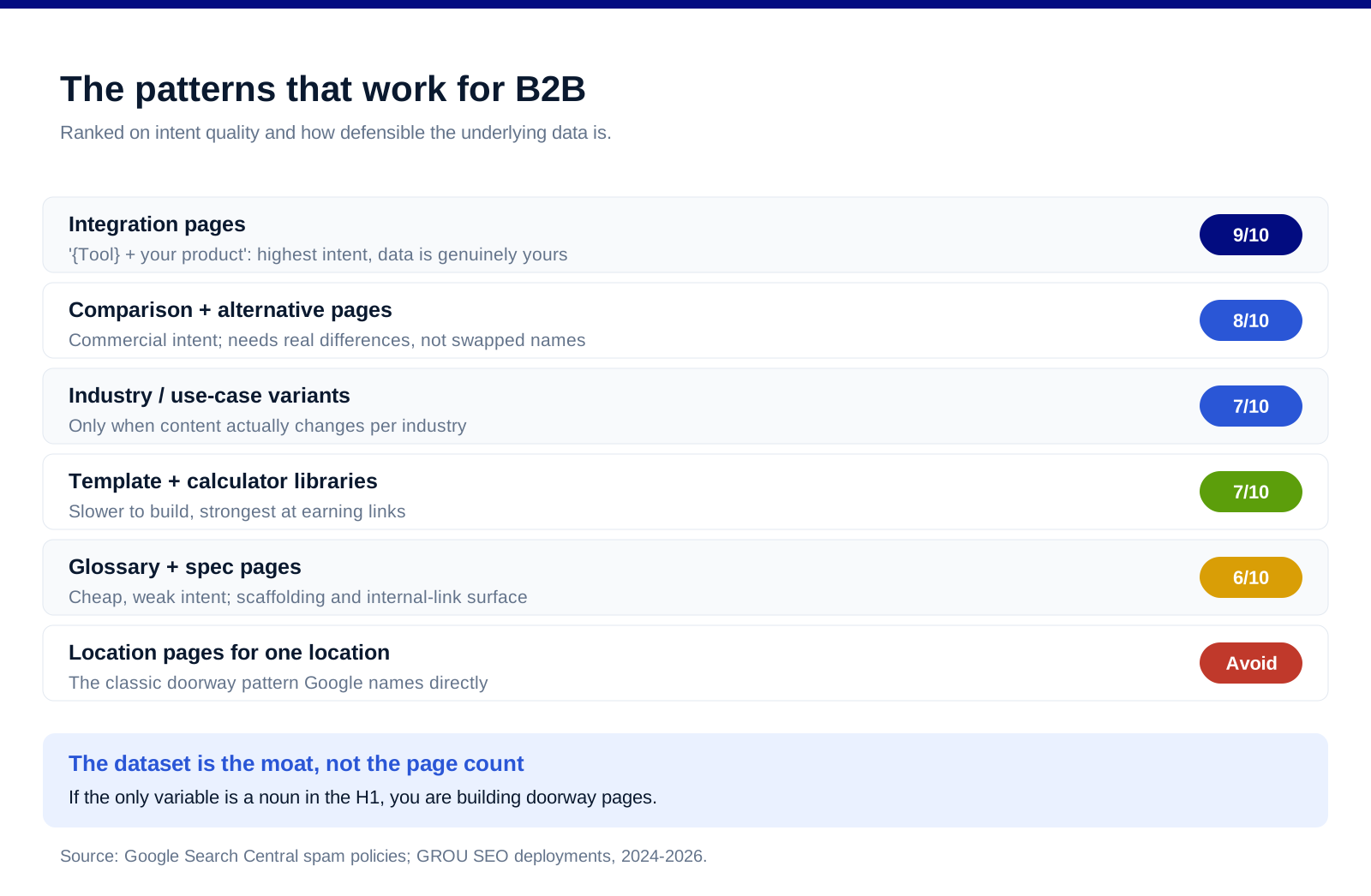
1. Integration pages (9/10). "{Tool} integration with {your product}", one page per tool in your ecosystem. Highest intent on the list, because the searcher already owns one of the two products, and the data (features, setup steps, use cases) is genuinely yours. The pattern that most reliably converts.
2. Comparison and alternative pages (8/10). "{Competitor} alternatives", "{A} vs {B}". Commercial intent, and the same logic that makes our Clay vs Apollo piece work, applied at scale. The constraint is honesty: each page needs real differences, not a template with names swapped.
3. Industry and use-case variants (7/10). "{Product category} for {industry}". Works only when the content actually changes per industry: different compliance notes, different workflows, different proof. If the only variable is a noun in the H1, this becomes doorway pages.
4. Template, tool, and calculator libraries (7/10). One page per template or calculator, each genuinely usable. Slower to build, strongest at earning links, and the assets keep working after the ranking arrives.
5. Glossary and spec pages (6/10). Definitional and specification pages at scale. Cheap to produce, weak commercial intent, useful mainly as topical scaffolding and internal-link surface for the pages that matter.
What no longer works: location pages for a business with one location, thin definition pages spun from a thesaurus, and any set where the differentiating data is a variable rather than a fact.
The build sequence: data first, pages last
The failure mode is building the template before the dataset. Reverse it.
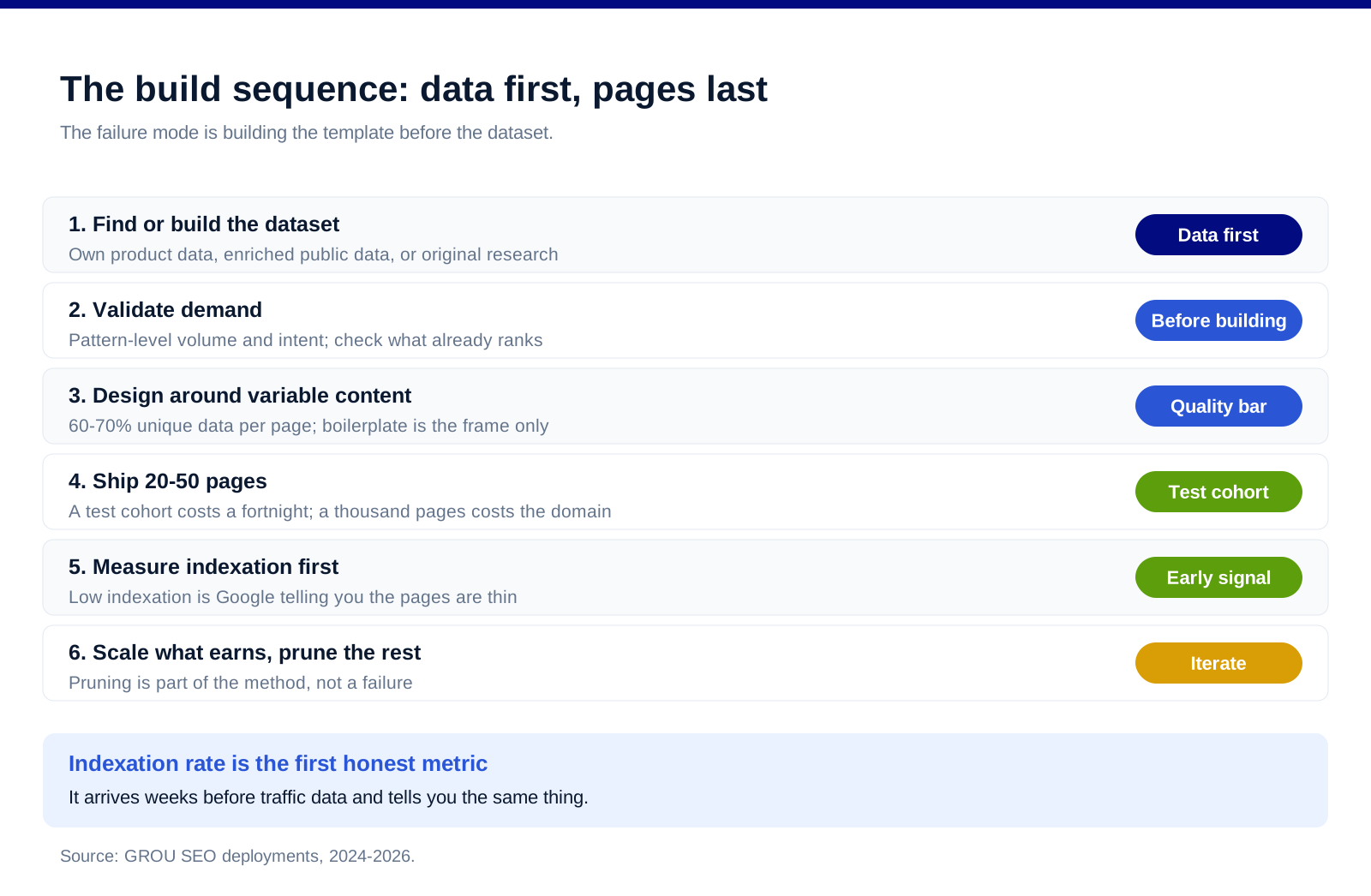
Step 1: find or build the dataset. Your own product data (integrations, features, supported specs), public datasets you can enrich, or original research you commission. If the dataset is scraped from a competitor and lightly reworded, you are building the exact thing Google's policy names.
Step 2: validate demand before building anything. Confirm the query pattern actually has volume and that its search intent matches a page you can serve. Keyword research in Semrush or Ahrefs at the pattern level, and a look at what currently ranks: if page one is dominated by forums and the pattern is informational, a templated commercial page will not win it.
Step 3: design the template around the variable content. The rule of thumb that survives audits: at least 60 to 70% of each page should be unique, data-driven content, with boilerplate as the frame rather than the substance. Every page needs a reason to exist that a human would recognize.
Step 4: ship a test cohort of 20 to 50 pages. Never launch a thousand pages at once. A small cohort tests indexation, quality, and demand assumptions cheaply, and a failed cohort costs a fortnight instead of a domain's reputation.
Step 5: measure indexation before traffic. Watch what percentage of the cohort Google actually indexes, then engagement and rankings. Low indexation is Google telling you the pages are thin, and that signal arrives well before traffic data does.
Step 6: scale what earns, prune what does not. Expand the patterns that index and engage, and delete or consolidate the ones that do not. Pruning is part of the method, not an admission of failure.
The quality bar, and the internal-link layer
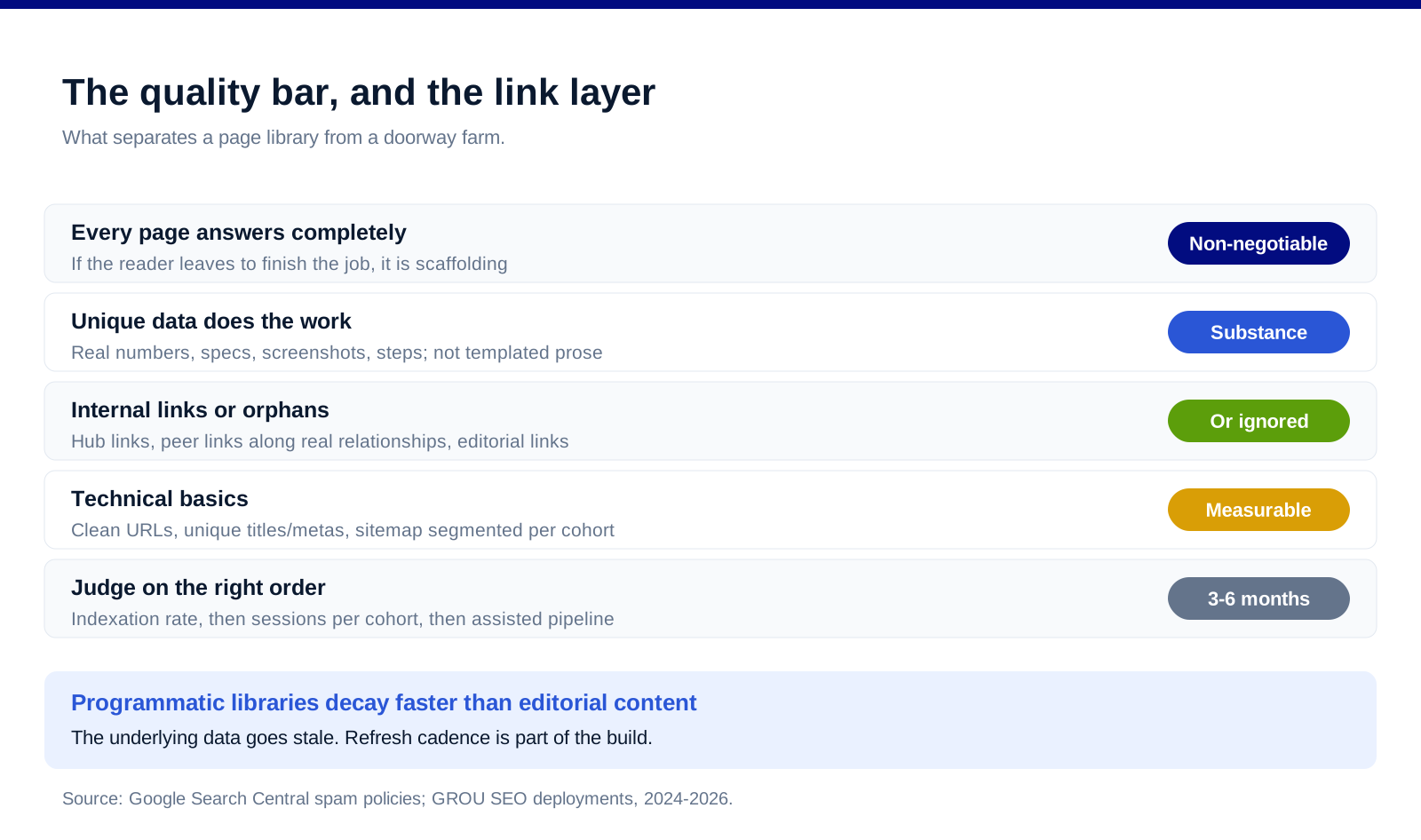
Every page answers a question completely. If the reader has to leave to finish the job, the page is scaffolding, not content. This is the operational version of Google's "helping users" test.
Unique data does the work. Real numbers, real specs, real screenshots, real steps. Templated intros and shared FAQs are fine as framing; they cannot be the substance.
Internal linking is the difference between indexed and ignored. Programmatic pages are orphans by default. Link them from category hubs, from each other along genuine relationships (this integration relates to that one), and from editorial content, following the hub logic in our content cluster guide.
Ship with the technical basics. Clean URL patterns, unique titles and meta descriptions per page, a sitemap segmented by pattern so indexation is measurable per cohort, and canonical discipline where variants overlap.
Judge it on the right numbers. Indexation rate first, then organic sessions per page cohort, then assisted pipeline. The refresh discipline from our SEO content refresh playbook applies here too: programmatic libraries decay faster than editorial content because the underlying data goes stale.
FAQ
What is programmatic SEO?
Generating many pages from a structured dataset and a shared template, one page per repeating query pattern, so a site can serve long-tail demand at a scale editorial writing cannot reach. The output is a page library, not a blog.
Is programmatic SEO against Google's guidelines?
Not inherently. Google's spam policies target scaled content abuse, meaning pages generated primarily to manipulate rankings without adding value for users, including AI-generated pages that do nothing for the reader. Pages built on genuine proprietary data that answer a real question completely sit outside that definition.
How many pages should a programmatic SEO project start with?
Twenty to fifty. A small test cohort validates indexation, quality, and demand at low cost, and gives Google a clean signal before you scale. Launching thousands of pages at once risks the domain on assumptions you have not tested.
What page types work best for B2B programmatic SEO?
Integration pages first, because intent is highest and the data is genuinely yours, then comparison and alternative pages, industry variants where content actually differs, template and calculator libraries, and glossary pages as supporting scaffolding.
How long does programmatic SEO take to work?
Three to six months to meaningful traffic in most B2B categories, with indexation signals arriving in weeks. Watch the indexation rate of each cohort first, because it tells you whether the quality bar is met long before rankings or sessions do.
How much unique content does each programmatic page need?
Enough that a human reader gets a complete answer, which in practice means most of the page is data-driven and specific to that variable, with boilerplate confined to framing. If two pages in the set are interchangeable apart from a name, the set is too thin.
Bottom line
Programmatic SEO in 2026 is a data strategy wearing an SEO costume. Own a dataset worth publishing, validate the query pattern before building the template, ship 20 to 50 pages and read the indexation rate, link the library into the site so it is not orphaned, and prune without sentiment. The teams that treat page count as the goal get caught by the scaled-content policy. The teams that treat the dataset as the moat get a compounding asset.
Want the content engine built around data you already own? Book a call with GROU. We run SEO and content programs inside B2B revenue engines across verticals.
We are GROU, a B2B pipeline agency that runs lead generation, outbound, and LinkedIn content for clients across manufacturing, fintech, iGaming, software, and professional services. The build sequence and quality bar reflect our SEO deployments between 2024 and 2026, anonymized to protect client confidentiality.
Some links in this article are affiliate. We may earn a small commission at no extra cost to you. We only recommend tools we've deployed for clients.
Programmatic SEO is the practice of generating hundreds or thousands of pages from a structured dataset and a template, one page per query pattern. Done well it captures long-tail demand no editorial team could ever write by hand. Done badly it is exactly what Google's spam policies now name and penalize. This playbook covers which B2B patterns actually work, the data-first build sequence, the quality bar that separates a page library from a doorway farm, and the numbers to judge it on.
It sits alongside the editorial side of the practice in our B2B content marketing strategy and B2B SEO keyword research framework.
TL;DR
The rule that governs everything: Google's spam policies define scaled content abuse as generating many pages primarily to manipulate rankings rather than help users, explicitly including AI-generated pages that add no value. So the strategy is not "generate more pages", it is "own a dataset nobody else has and publish it one query at a time". The B2B patterns that work: integration pages ("{Tool} + {Your product} integration"), comparison and alternative pages, location or industry variants where the content genuinely differs, template and calculator libraries, and glossary or spec pages. Build data-first: source or assemble a proprietary dataset, validate demand against real search patterns before building anything, ship 20 to 50 pages as a test cohort, measure indexation and engagement, then scale only what earns. Expect 3 to 6 months to meaningful traffic, and treat any page a human would not find useful as a liability rather than an asset.
The patterns that work for B2B
Programmatic works when a real query pattern repeats across a dataset you can legitimately populate. Five hold up in B2B.
1. Integration pages (9/10). "{Tool} integration with {your product}", one page per tool in your ecosystem. Highest intent on the list, because the searcher already owns one of the two products, and the data (features, setup steps, use cases) is genuinely yours. The pattern that most reliably converts.
2. Comparison and alternative pages (8/10). "{Competitor} alternatives", "{A} vs {B}". Commercial intent, and the same logic that makes our Clay vs Apollo piece work, applied at scale. The constraint is honesty: each page needs real differences, not a template with names swapped.
3. Industry and use-case variants (7/10). "{Product category} for {industry}". Works only when the content actually changes per industry: different compliance notes, different workflows, different proof. If the only variable is a noun in the H1, this becomes doorway pages.
4. Template, tool, and calculator libraries (7/10). One page per template or calculator, each genuinely usable. Slower to build, strongest at earning links, and the assets keep working after the ranking arrives.
5. Glossary and spec pages (6/10). Definitional and specification pages at scale. Cheap to produce, weak commercial intent, useful mainly as topical scaffolding and internal-link surface for the pages that matter.
What no longer works: location pages for a business with one location, thin definition pages spun from a thesaurus, and any set where the differentiating data is a variable rather than a fact.
The build sequence: data first, pages last
The failure mode is building the template before the dataset. Reverse it.
Step 1: find or build the dataset. Your own product data (integrations, features, supported specs), public datasets you can enrich, or original research you commission. If the dataset is scraped from a competitor and lightly reworded, you are building the exact thing Google's policy names.
Step 2: validate demand before building anything. Confirm the query pattern actually has volume and that its search intent matches a page you can serve. Keyword research in Semrush or Ahrefs at the pattern level, and a look at what currently ranks: if page one is dominated by forums and the pattern is informational, a templated commercial page will not win it.
Step 3: design the template around the variable content. The rule of thumb that survives audits: at least 60 to 70% of each page should be unique, data-driven content, with boilerplate as the frame rather than the substance. Every page needs a reason to exist that a human would recognize.
Step 4: ship a test cohort of 20 to 50 pages. Never launch a thousand pages at once. A small cohort tests indexation, quality, and demand assumptions cheaply, and a failed cohort costs a fortnight instead of a domain's reputation.
Step 5: measure indexation before traffic. Watch what percentage of the cohort Google actually indexes, then engagement and rankings. Low indexation is Google telling you the pages are thin, and that signal arrives well before traffic data does.
Step 6: scale what earns, prune what does not. Expand the patterns that index and engage, and delete or consolidate the ones that do not. Pruning is part of the method, not an admission of failure.
The quality bar, and the internal-link layer
Every page answers a question completely. If the reader has to leave to finish the job, the page is scaffolding, not content. This is the operational version of Google's "helping users" test.
Unique data does the work. Real numbers, real specs, real screenshots, real steps. Templated intros and shared FAQs are fine as framing; they cannot be the substance.
Internal linking is the difference between indexed and ignored. Programmatic pages are orphans by default. Link them from category hubs, from each other along genuine relationships (this integration relates to that one), and from editorial content, following the hub logic in our content cluster guide.
Ship with the technical basics. Clean URL patterns, unique titles and meta descriptions per page, a sitemap segmented by pattern so indexation is measurable per cohort, and canonical discipline where variants overlap.
Judge it on the right numbers. Indexation rate first, then organic sessions per page cohort, then assisted pipeline. The refresh discipline from our SEO content refresh playbook applies here too: programmatic libraries decay faster than editorial content because the underlying data goes stale.
FAQ
What is programmatic SEO?
Generating many pages from a structured dataset and a shared template, one page per repeating query pattern, so a site can serve long-tail demand at a scale editorial writing cannot reach. The output is a page library, not a blog.
Is programmatic SEO against Google's guidelines?
Not inherently. Google's spam policies target scaled content abuse, meaning pages generated primarily to manipulate rankings without adding value for users, including AI-generated pages that do nothing for the reader. Pages built on genuine proprietary data that answer a real question completely sit outside that definition.
How many pages should a programmatic SEO project start with?
Twenty to fifty. A small test cohort validates indexation, quality, and demand at low cost, and gives Google a clean signal before you scale. Launching thousands of pages at once risks the domain on assumptions you have not tested.
What page types work best for B2B programmatic SEO?
Integration pages first, because intent is highest and the data is genuinely yours, then comparison and alternative pages, industry variants where content actually differs, template and calculator libraries, and glossary pages as supporting scaffolding.
How long does programmatic SEO take to work?
Three to six months to meaningful traffic in most B2B categories, with indexation signals arriving in weeks. Watch the indexation rate of each cohort first, because it tells you whether the quality bar is met long before rankings or sessions do.
How much unique content does each programmatic page need?
Enough that a human reader gets a complete answer, which in practice means most of the page is data-driven and specific to that variable, with boilerplate confined to framing. If two pages in the set are interchangeable apart from a name, the set is too thin.
Bottom line
Programmatic SEO in 2026 is a data strategy wearing an SEO costume. Own a dataset worth publishing, validate the query pattern before building the template, ship 20 to 50 pages and read the indexation rate, link the library into the site so it is not orphaned, and prune without sentiment. The teams that treat page count as the goal get caught by the scaled-content policy. The teams that treat the dataset as the moat get a compounding asset.
Want the content engine built around data you already own? Book a call with GROU. We run SEO and content programs inside B2B revenue engines across verticals.
We are GROU, a B2B pipeline agency that runs lead generation, outbound, and LinkedIn content for clients across manufacturing, fintech, iGaming, software, and professional services. The build sequence and quality bar reflect our SEO deployments between 2024 and 2026, anonymized to protect client confidentiality.
Some links in this article are affiliate. We may earn a small commission at no extra cost to you. We only recommend tools we've deployed for clients.
Programmatic SEO is the practice of generating hundreds or thousands of pages from a structured dataset and a template, one page per query pattern. Done well it captures long-tail demand no editorial team could ever write by hand. Done badly it is exactly what Google's spam policies now name and penalize. This playbook covers which B2B patterns actually work, the data-first build sequence, the quality bar that separates a page library from a doorway farm, and the numbers to judge it on.
It sits alongside the editorial side of the practice in our B2B content marketing strategy and B2B SEO keyword research framework.
TL;DR
The rule that governs everything: Google's spam policies define scaled content abuse as generating many pages primarily to manipulate rankings rather than help users, explicitly including AI-generated pages that add no value. So the strategy is not "generate more pages", it is "own a dataset nobody else has and publish it one query at a time". The B2B patterns that work: integration pages ("{Tool} + {Your product} integration"), comparison and alternative pages, location or industry variants where the content genuinely differs, template and calculator libraries, and glossary or spec pages. Build data-first: source or assemble a proprietary dataset, validate demand against real search patterns before building anything, ship 20 to 50 pages as a test cohort, measure indexation and engagement, then scale only what earns. Expect 3 to 6 months to meaningful traffic, and treat any page a human would not find useful as a liability rather than an asset.
The patterns that work for B2B
Programmatic works when a real query pattern repeats across a dataset you can legitimately populate. Five hold up in B2B.
1. Integration pages (9/10). "{Tool} integration with {your product}", one page per tool in your ecosystem. Highest intent on the list, because the searcher already owns one of the two products, and the data (features, setup steps, use cases) is genuinely yours. The pattern that most reliably converts.
2. Comparison and alternative pages (8/10). "{Competitor} alternatives", "{A} vs {B}". Commercial intent, and the same logic that makes our Clay vs Apollo piece work, applied at scale. The constraint is honesty: each page needs real differences, not a template with names swapped.
3. Industry and use-case variants (7/10). "{Product category} for {industry}". Works only when the content actually changes per industry: different compliance notes, different workflows, different proof. If the only variable is a noun in the H1, this becomes doorway pages.
4. Template, tool, and calculator libraries (7/10). One page per template or calculator, each genuinely usable. Slower to build, strongest at earning links, and the assets keep working after the ranking arrives.
5. Glossary and spec pages (6/10). Definitional and specification pages at scale. Cheap to produce, weak commercial intent, useful mainly as topical scaffolding and internal-link surface for the pages that matter.
What no longer works: location pages for a business with one location, thin definition pages spun from a thesaurus, and any set where the differentiating data is a variable rather than a fact.
The build sequence: data first, pages last
The failure mode is building the template before the dataset. Reverse it.
Step 1: find or build the dataset. Your own product data (integrations, features, supported specs), public datasets you can enrich, or original research you commission. If the dataset is scraped from a competitor and lightly reworded, you are building the exact thing Google's policy names.
Step 2: validate demand before building anything. Confirm the query pattern actually has volume and that its search intent matches a page you can serve. Keyword research in Semrush or Ahrefs at the pattern level, and a look at what currently ranks: if page one is dominated by forums and the pattern is informational, a templated commercial page will not win it.
Step 3: design the template around the variable content. The rule of thumb that survives audits: at least 60 to 70% of each page should be unique, data-driven content, with boilerplate as the frame rather than the substance. Every page needs a reason to exist that a human would recognize.
Step 4: ship a test cohort of 20 to 50 pages. Never launch a thousand pages at once. A small cohort tests indexation, quality, and demand assumptions cheaply, and a failed cohort costs a fortnight instead of a domain's reputation.
Step 5: measure indexation before traffic. Watch what percentage of the cohort Google actually indexes, then engagement and rankings. Low indexation is Google telling you the pages are thin, and that signal arrives well before traffic data does.
Step 6: scale what earns, prune what does not. Expand the patterns that index and engage, and delete or consolidate the ones that do not. Pruning is part of the method, not an admission of failure.
The quality bar, and the internal-link layer
Every page answers a question completely. If the reader has to leave to finish the job, the page is scaffolding, not content. This is the operational version of Google's "helping users" test.
Unique data does the work. Real numbers, real specs, real screenshots, real steps. Templated intros and shared FAQs are fine as framing; they cannot be the substance.
Internal linking is the difference between indexed and ignored. Programmatic pages are orphans by default. Link them from category hubs, from each other along genuine relationships (this integration relates to that one), and from editorial content, following the hub logic in our content cluster guide.
Ship with the technical basics. Clean URL patterns, unique titles and meta descriptions per page, a sitemap segmented by pattern so indexation is measurable per cohort, and canonical discipline where variants overlap.
Judge it on the right numbers. Indexation rate first, then organic sessions per page cohort, then assisted pipeline. The refresh discipline from our SEO content refresh playbook applies here too: programmatic libraries decay faster than editorial content because the underlying data goes stale.
FAQ
What is programmatic SEO?
Generating many pages from a structured dataset and a shared template, one page per repeating query pattern, so a site can serve long-tail demand at a scale editorial writing cannot reach. The output is a page library, not a blog.
Is programmatic SEO against Google's guidelines?
Not inherently. Google's spam policies target scaled content abuse, meaning pages generated primarily to manipulate rankings without adding value for users, including AI-generated pages that do nothing for the reader. Pages built on genuine proprietary data that answer a real question completely sit outside that definition.
How many pages should a programmatic SEO project start with?
Twenty to fifty. A small test cohort validates indexation, quality, and demand at low cost, and gives Google a clean signal before you scale. Launching thousands of pages at once risks the domain on assumptions you have not tested.
What page types work best for B2B programmatic SEO?
Integration pages first, because intent is highest and the data is genuinely yours, then comparison and alternative pages, industry variants where content actually differs, template and calculator libraries, and glossary pages as supporting scaffolding.
How long does programmatic SEO take to work?
Three to six months to meaningful traffic in most B2B categories, with indexation signals arriving in weeks. Watch the indexation rate of each cohort first, because it tells you whether the quality bar is met long before rankings or sessions do.
How much unique content does each programmatic page need?
Enough that a human reader gets a complete answer, which in practice means most of the page is data-driven and specific to that variable, with boilerplate confined to framing. If two pages in the set are interchangeable apart from a name, the set is too thin.
Bottom line
Programmatic SEO in 2026 is a data strategy wearing an SEO costume. Own a dataset worth publishing, validate the query pattern before building the template, ship 20 to 50 pages and read the indexation rate, link the library into the site so it is not orphaned, and prune without sentiment. The teams that treat page count as the goal get caught by the scaled-content policy. The teams that treat the dataset as the moat get a compounding asset.
Want the content engine built around data you already own? Book a call with GROU. We run SEO and content programs inside B2B revenue engines across verticals.
We are GROU, a B2B pipeline agency that runs lead generation, outbound, and LinkedIn content for clients across manufacturing, fintech, iGaming, software, and professional services. The build sequence and quality bar reflect our SEO deployments between 2024 and 2026, anonymized to protect client confidentiality.
Some links in this article are affiliate. We may earn a small commission at no extra cost to you. We only recommend tools we've deployed for clients.

Pipeline OS Newsletter
Build qualified pipeline
Get weekly tactics to generate demand, improve lead quality, and book more meetings.





Trusted by industry leaders
Trusted by industry leaders
Trusted by industry leaders
Ready to build qualified pipeline?
Ready to build qualified pipeline?
Ready to build qualified pipeline?
Book a call to see if we're the right fit, or take the 2-minute quiz to get a clear starting point.
Book a call to see if we're the right fit, or take the 2-minute quiz to get a clear starting point.
Book a call to see if we're the right fit, or take the 2-minute quiz to get a clear starting point.
" height="30.21639343089746px" id="hfGbXmQR2" width="30.216393430897455px"/></svg>)
Copyright © 2026 – All Right Reserved
Copyright © 2026 – All Right Reserved
Copyright © 2026 – All Right Reserved