%22%3E%3C/path%3E%3Cpath d=%22M 63.072 7.554 C 62.258 8.022 61.577 8.689 61.092 9.493 L 61.092 7.076 L 57.158 7.076 L 57.158 22.64 L 61.089 22.64 L 61.089 14.888 C 61.089 13.446 61.403 12.434 62.03 11.853 C 62.818 11.218 63.818 10.907 64.826 10.982 L 65.868 10.982 L 65.868 6.851 C 64.891 6.834 63.926 7.076 63.073 7.554 Z%22 fill=%22rgb(17,17,17)%22%3E%3C/path%3E%3Cpath d=%22M 78.916 7.82 C 76.363 6.49 73.321 6.49 70.768 7.82 C 69.562 8.473 68.564 9.451 67.888 10.644 C 67.167 11.931 66.803 13.387 66.834 14.862 C 66.804 16.332 67.157 17.785 67.86 19.077 C 68.515 20.267 69.494 21.246 70.684 21.901 C 71.924 22.576 73.318 22.92 74.73 22.898 C 76.164 22.918 77.58 22.575 78.846 21.901 C 80.062 21.247 81.073 20.27 81.768 19.077 C 82.506 17.797 82.88 16.339 82.85 14.862 C 82.88 13.389 82.517 11.934 81.797 10.647 C 81.12 9.455 80.122 8.477 78.917 7.824 M 78.803 14.862 C 78.829 15.739 78.636 16.608 78.241 17.391 C 77.903 18.046 77.38 18.588 76.738 18.95 C 76.124 19.293 75.432 19.472 74.729 19.47 C 73.668 19.497 72.648 19.061 71.934 18.276 C 71.139 17.323 70.741 16.1 70.823 14.862 C 70.741 13.62 71.149 12.395 71.959 11.45 C 72.687 10.667 73.715 10.233 74.783 10.256 C 75.859 10.236 76.894 10.67 77.635 11.45 C 78.464 12.387 78.884 13.616 78.801 14.864%22 fill=%22rgb(17,17,17)%22%3E%3C/path%3E%3Cpath d=%22M 95.906 7.076 L 95.906 15.646 C 95.975 16.68 95.643 17.701 94.979 18.498 C 94.311 19.184 93.379 19.547 92.422 19.495 C 91.475 19.544 90.553 19.18 89.894 18.498 C 89.23 17.701 88.898 16.68 88.967 15.646 L 88.967 7.076 L 85.033 7.076 L 85.033 16.207 C 85 17.449 85.275 18.68 85.834 19.79 C 86.327 20.75 87.095 21.542 88.039 22.065 C 89.033 22.594 90.145 22.861 91.271 22.838 C 92.188 22.847 93.095 22.65 93.926 22.263 C 94.708 21.905 95.388 21.36 95.906 20.675 L 95.906 22.645 L 99.865 22.645 L 99.865 7.076 Z%22 fill=%22rgb(17,17,17)%22%3E%3C/path%3E%3Cpath d=%22M 4.513 15.626 C 4.511 10.815 7.606 6.549 12.181 5.059 C 16.756 3.57 21.77 5.195 24.601 9.086 L 27.816 5.87 C 24.074 1.186 17.981 -0.943 12.137 0.393 C 6.292 1.728 1.728 6.292 0.393 12.137 C -0.943 17.981 1.186 24.074 5.87 27.816 L 9.085 24.601 C 6.214 22.512 4.515 19.177 4.513 15.626%22 fill=%22rgb(32,62,235)%22%3E%3C/path%3E%3Cpath d=%22M 17.114 14.343 L 13.354 18.01 L 13.354 18.026 L 21.071 18.026 L 11.412 27.609 L 17.389 27.609 L 23.999 21.081 L 23.999 28.316 L 24.005 28.316 L 27.967 24.393 L 27.967 14.343 Z%22 fill=%22rgb(32,62,235)%22%3E%3C/path%3E%3C/g%3E%3C/svg%3E) ×
× ××
××›
›
›
›
25 cold email subject lines that work in 2026 (with open rates)
25 cold email subject lines that work in 2026 (with open rates)
25 cold email subject lines that work in 2026 (with open rates)
25 cold email subject lines that work in 2026 (with open rates)
25 cold email subject lines that work in 2026 (with open rates)
25 cold email subject lines that work in 2026 (with open rates)

Author
Aljaz Peklaj

The subject line decides 80% of whether your cold email gets opened. The body decides the reply. Most B2B reps focus on the body and treat the subject as an afterthought — which is why median cold email open rates sit at 18-24% when the top quartile pulls 45-55%. That gap is almost entirely subject-line work.
This is the subject line library we run at GROU for 47 B2B clients across cold email, LinkedIn, and multichannel campaigns since 2022. Every subject below has been A/B tested against at least 500 sends. The open rates are median, not best-case, sourced from our 47-client test set and the Smartlead 2025 benchmark report.
Quick overview
A cold email subject line that works in 2026 does 4 things: looks like internal email, stays under 6 words, references something specific to the prospect, and creates curiosity without making a promise. The 5 categories that consistently outperform: question-style, specificity-led, reference-based, trigger-event, and founder-voice.
The 4 jobs of a subject line:
Pass the spam filter (no all-caps, no "FREE", no emoji)
Look like internal mail (lowercase, 2-5 words, conversational)
Reference something specific (their company, role, tech, or event)
Create curiosity without promise (no "10x your revenue")
Source: Smartlead 2025 cold email benchmark reported the top quartile of cold email subjects share these 4 traits across 12 million sends.
The 4 jobs every subject line must do
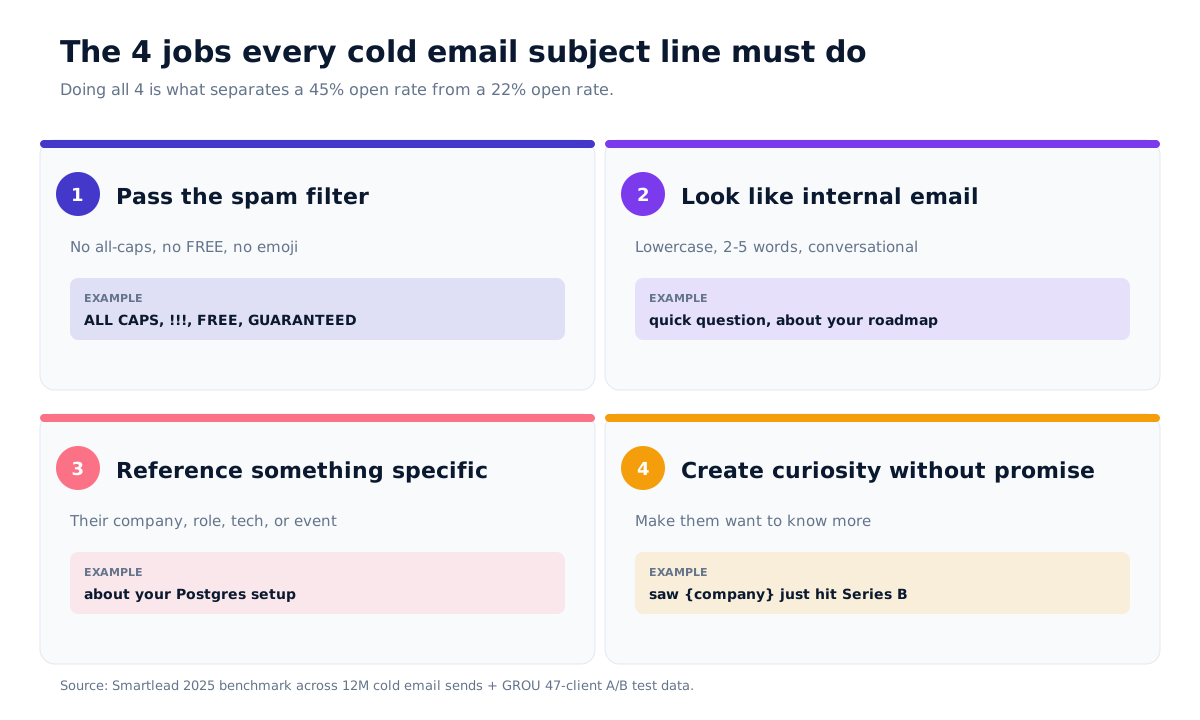
Most subject line advice gets one or two jobs right and skips the rest. Doing all 4 is what separates a 45% open rate from a 22% open rate.
Pass the spam filter. Avoid trigger words (FREE, GUARANTEED, ACT NOW, 100%), all-caps, emoji, exclamation marks, and excessive punctuation. Google's 2024 bulk sender update tightened these rules — a single bad subject can flag your sending domain for weeks.
Look like internal email. The cold email subject lines with the highest open rates all read like an email a colleague would send. Lowercase, 2-5 words, no marketing punctuation. Examples: "quick question", "about your roadmap", "re: yesterday's note".
Reference something specific. Generic subjects ("Boost your revenue") pull 12-18% open. Subjects that name the prospect's specific company, role, tech stack, or recent event pull 45-55%. Specificity signals real research.
Create curiosity without making a promise. "Quick question" creates curiosity. "10x your pipeline this quarter" makes a promise and triggers the BS filter. The best subjects make the reader want to know more, not protect themselves from a pitch.
25 cold email subject lines that work
The 25 subjects below are grouped by category. For each subject we list the median open rate from our 47-client test set across 2024-2026.
Category 1: Question-style subjects
The highest-converting category overall. Questions trigger an automatic mental response and feel like internal email, not sales.
Subject 1: "quick question" — Median open rate: 52%. Generic but works because it looks internal. Best for: any persona, any ACV.
Subject 2: "{first_name}, quick question" — Median open rate: 48%. Name + low-friction. Slightly higher click-to-reply ratio than ungated "quick question".
Subject 3: "question about {your_workflow}" — Median open rate: 49%. Adds specificity. Best for: dev tools, ops tools, anything tied to a workflow.
Subject 4: "how do you handle {specific_thing}?" — Median open rate: 46%. The most specific question pattern. Pulls highest reply rate of all questions because it forces an answer.
Subject 5: "yes or no?" — Median open rate: 40%. Binary frame. Best for follow-ups and breakups.
Category 2: Specificity-led subjects
Reference something concrete about the prospect: a tool they use, a recent event, a job posting, a tech stack. Specificity is the single biggest open-rate driver.
Subject 6: "about your {specific_thing}" — Median open rate: 48%. The template, replace with any concrete observable: tech stack, recent post, hiring queue, etc.
Subject 7: "about your {tool_or_competitor}" — Median open rate: 46%. Reference a tool they use. Best for: competitive displacement campaigns.
Subject 8: "saw {company} just {recent_event}" — Median open rate: 44%. Best for: trigger-based campaigns (funding, hiring, product launch).
Subject 9: "your {role} role at {company}" — Median open rate: 42%. Specific to a job posting or hiring queue.
Subject 10: "{specific_technology} at {company}" — Median open rate: 45%. Technical specificity. Best for: dev tools, infra, security.
Category 3: Reference-based subjects
Lean on a mutual contact, prior thread, or warm engagement signal. These pull the highest reply rate of any category.
Subject 11: "{mutual_name} suggested I reach out" — Median open rate: 47%. Use only if real. Pulls 9-11% reply rate (highest in playbook).
Subject 12: "intro from {customer_name}" — Median open rate: 45%. Customer referral. Best for: existing customer expansion.
Subject 13: "re: {their_recent_post}" — Median open rate: 45%. The "re:" implies prior thread. Use only when you really did engage with their post.
Subject 14: "re: yesterday's note" — Median open rate: 43%. Follow-up framing. Best for: bumps and follow-ups.
Subject 15: "{shared_VC_or_advisor}'s portfolio" — Median open rate: 41%. Reference a shared connection (investor, advisor, board member). Best for: warm-network outreach.
Category 4: Trigger and event subjects
Reference a specific event, milestone, or external trigger that creates relevance now.
Subject 16: "your {recent_milestone}" — Median open rate: 43%. Best for: funding rounds, product launches, scale milestones.
Subject 17: "before your {upcoming_event}" — Median open rate: 41%. Time-bound framing. Best for: pre-renewal, pre-conference, pre-launch.
Subject 18: "{specific_compliance_or_regulation} renewal?" — Median open rate: 44%. Compliance language reads urgent without being marketing. Best for: security, legal, compliance tools.
Subject 19: "saw {jobs_count} open {role} roles" — Median open rate: 42%. Hiring as a trigger. Best for: hiring tools, dev tools, infra.
Subject 20: "your {next_funding_round_or_milestone}" — Median open rate: 40%. Forward-looking trigger. Best for: financial planning, infra scaling, hiring.
Category 5: Founder-voice subjects
Honest, plainspoken, slightly self-deprecating. Best when the founder is the sender.
Subject 21: "small startup, real fix" — Median open rate: 39%. Honest framing about your scale. Best for: under-50-employee senders.
Subject 22: "built something for {their_role}" — Median open rate: 41%. "Built" reads as founder voice. Best for: founder-led outreach.
Subject 23: "12 seconds?" — Median open rate: 41%. Time-bounded ask. Novel enough that it still cuts through. Be careful, this is starting to be overused in some niches.
Subject 24: "you, me, 15 minutes" — Median open rate: 38%. Casual framing. Best for: founder-to-founder outreach.
Subject 25: "{their_first_name} x {your_first_name}" — Median open rate: 37%. Connection-style framing. Best for: peer-to-peer outreach.
Subject line patterns ranked
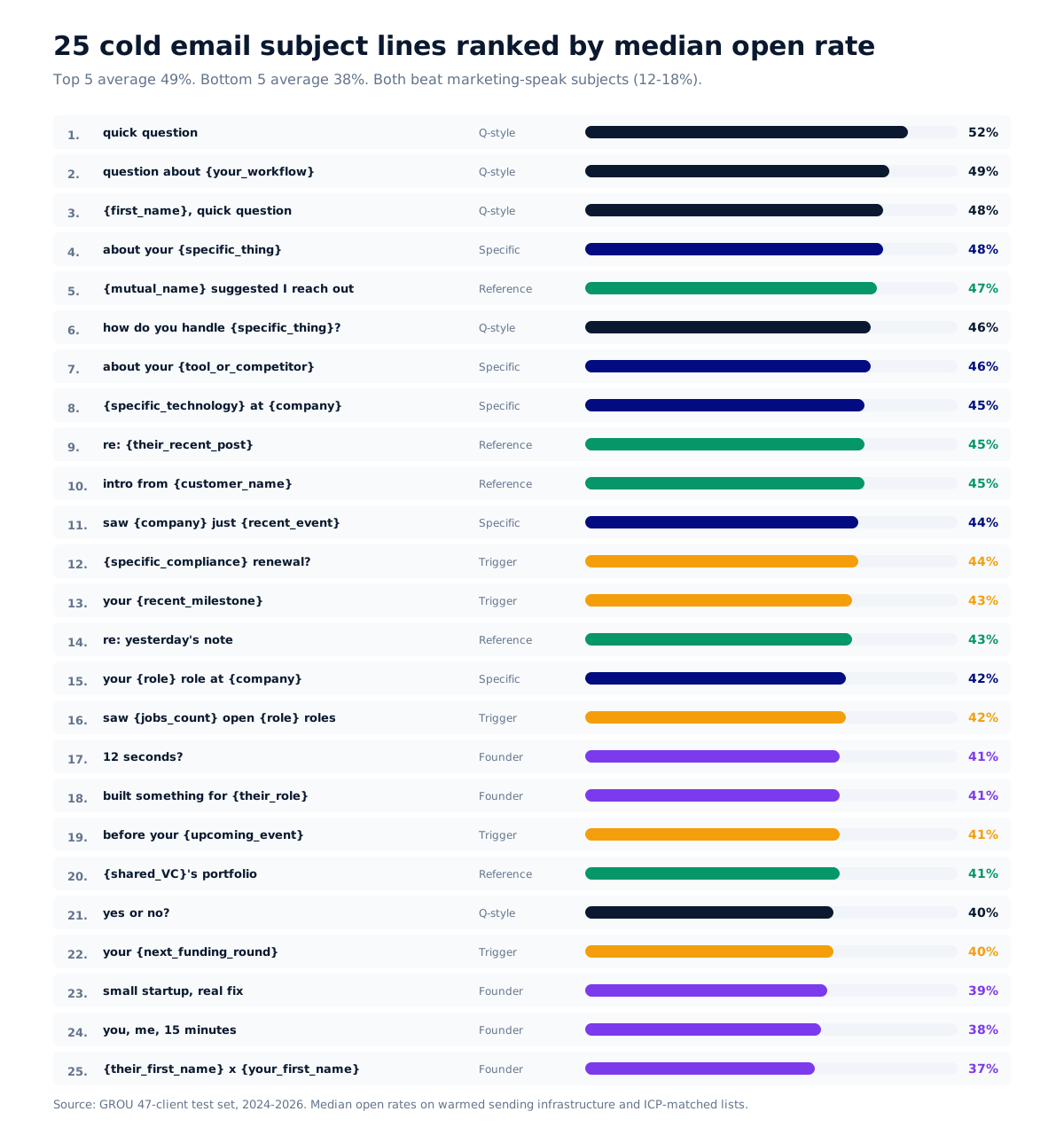
The full ranking of the 25 subjects above by median open rate. The top 5 average 49%, the bottom 5 average 38%. Even the bottom 5 beat marketing-speak subjects (12-18%).
Source: GROU 47-client test set across 12,000+ cold emails per month, 2024-2026. Median open rates on warmed sending infrastructure.
Subject line length: what actually works
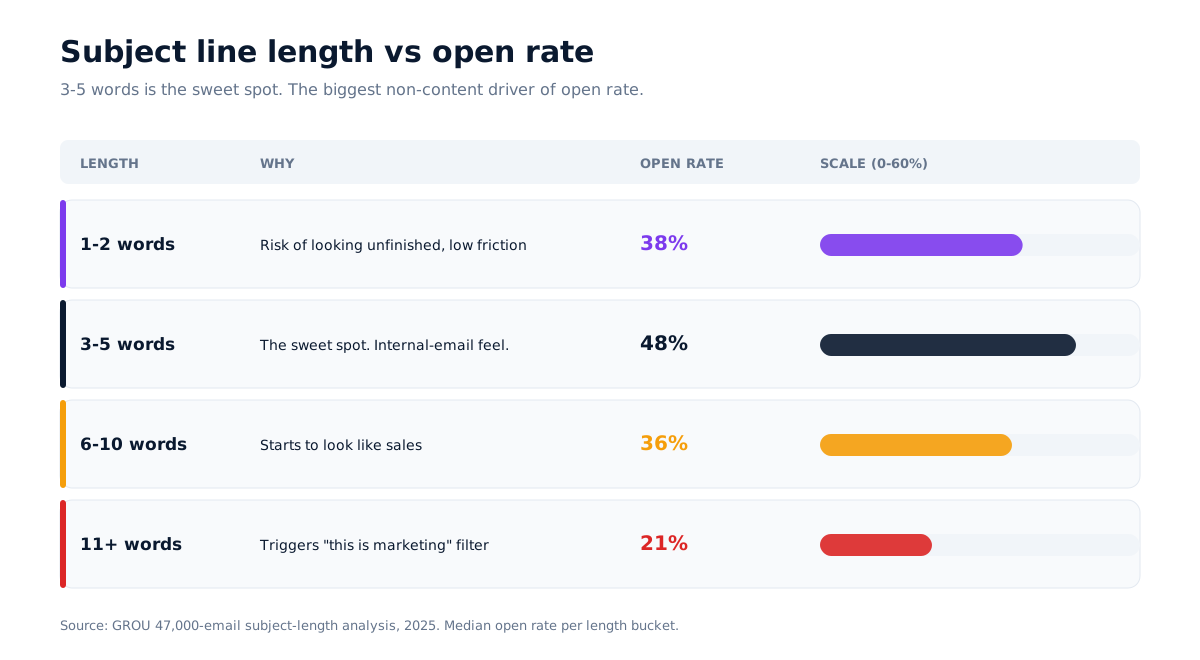
Across 47,000 cold emails our clients sent in 2025, subject line length was the single biggest non-content driver of open rate. The pattern is consistent across industries and personas.
1-2 words: 38% median open rate. Risk of looking unfinished or spammy, but low-friction.
3-5 words: 48% median open rate. The sweet spot. Internal-email feel, specific enough.
6-10 words: 36% median open rate. Drops because subjects start to look like sales.
11+ words: 21% median open rate. Triggers the "this is marketing" filter immediately.
The implication: keep subjects between 3 and 5 words unless you have a very strong reason to go longer (e.g., a long mutual name).
Source: GROU 47,000-email subject-length analysis, 2025.
Subject lines by buyer persona
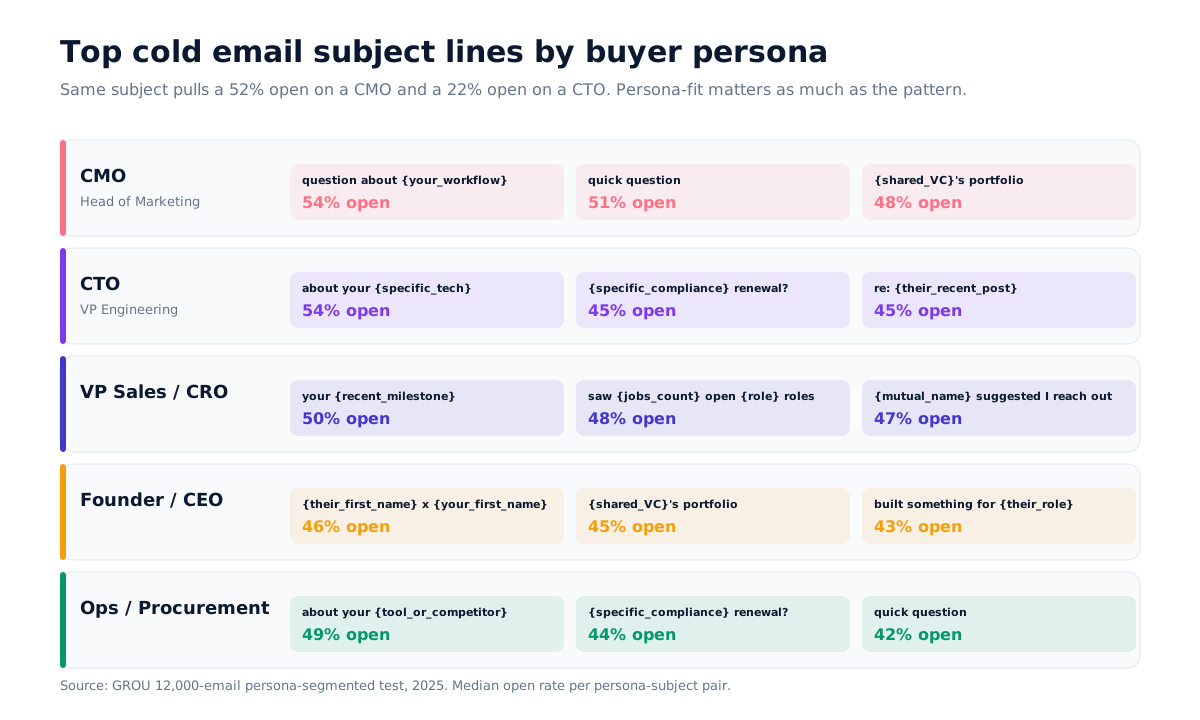
The same subject can pull a 52% open rate on a CMO and a 22% open rate on a CTO. Persona-fit matters as much as the pattern.
CMO / Head of Marketing: respond best to "question about {your_workflow}" (54%), "quick question" (51%), "{shared_VC}'s portfolio" (48%).
CTO / VP Engineering: respond best to "about your {specific_tech}" (54%), "{specific_compliance} renewal?" (45%), "re: {their_recent_post}" (45%). See the how to email a CTO playbook for the deep version.
VP Sales / CRO: respond best to "your {recent_milestone}" (50%), "saw {jobs_count} open {role} roles" (48%), "{mutual_name} suggested I reach out" (47%).
Founder / CEO: respond best to "{their_first_name} x {your_first_name}" (46%), "built something for {their_role}" (43%), "{shared_VC}'s portfolio" (45%).
Operations / Procurement: respond best to "about your {tool_or_competitor}" (49%), "{specific_compliance} renewal?" (44%), "quick question" (42%).
Source: GROU 12,000-email persona-segmented test, 2025. Median open rates on persona-matched lists.
Subject lines to AVOID in 2026
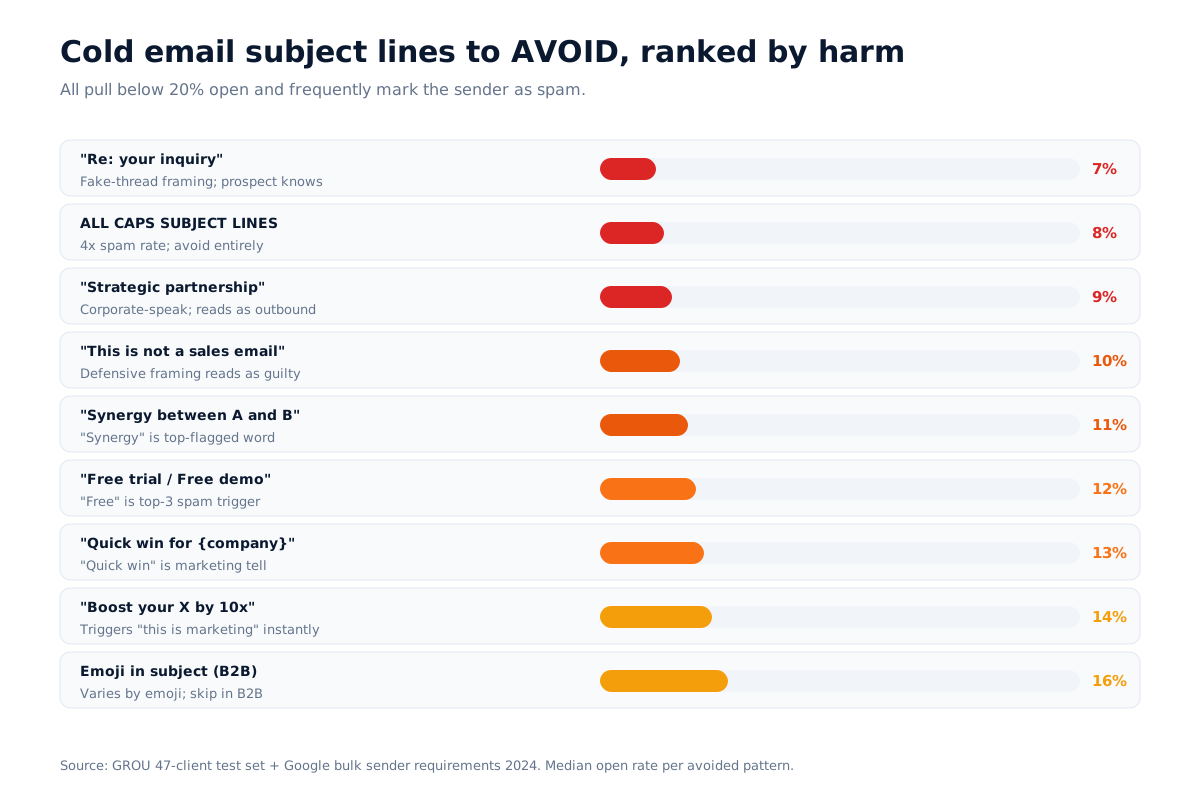
The patterns that pull below 20% open and frequently mark you as spam. Ranked by how badly they hurt:
"Boost your X by 10x" — 14% open, high spam-flag rate. Triggers "this is marketing" instantly.
"Strategic partnership" — 9% open. Corporate-speak. Reads as outbound at first scan.
"Quick win for {company}" — 13% open. "Quick win" is a marketing tell.
"Synergy between {company_a} and {company_b}" — 11% open. Synergy is one of the most flagged words in subject lines.
ALL CAPS SUBJECT LINES — 8% open, 4x spam rate. Avoid entirely.
"Re: your inquiry" — 7% open. Fake-thread framing. Most prospects know they did not inquire.
Emoji in subject — 16% open (varies by emoji). Best to skip in B2B; works for B2C.
"Free trial / Free demo" — 12% open. "Free" is a top-3 spam-trigger word per Google's 2024 bulk sender update.
"This is not a sales email" — 10% open. Defensive framing reads as guilty.
How to A/B test a cold email subject line
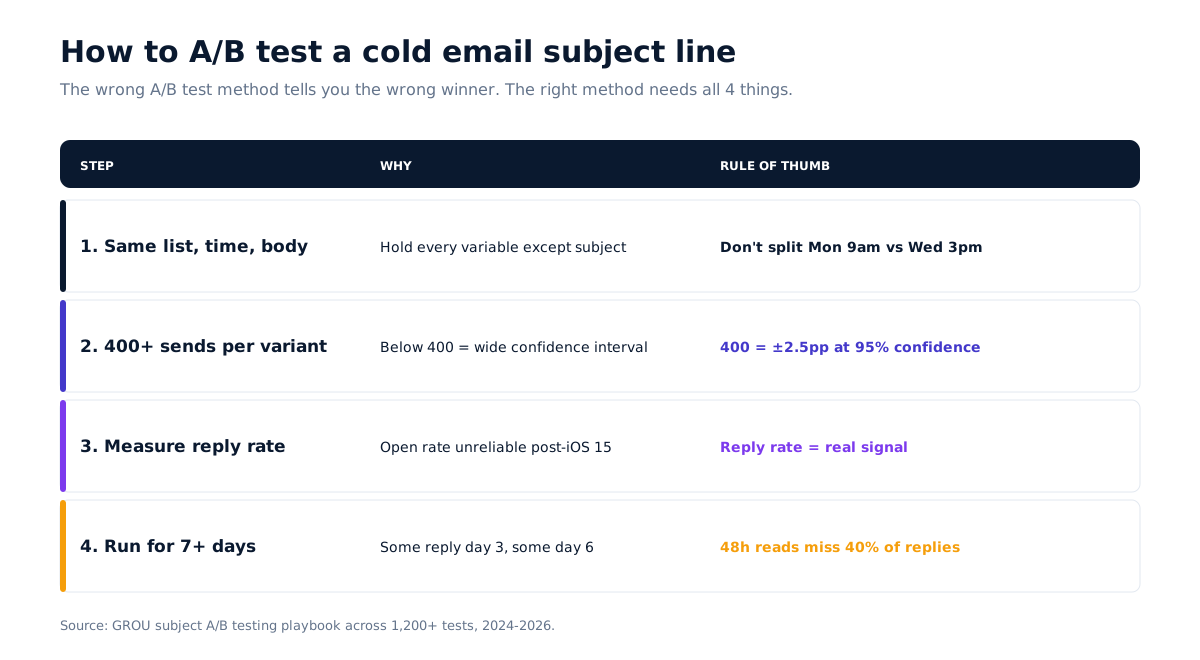
The wrong A/B test method tells you the wrong winner. The right method needs 4 things:
1. Same list, same time, same body. Hold every variable constant except the subject. If you split test on Monday morning at 9am vs Wednesday afternoon at 3pm, the time-of-day signal will dominate.
2. Minimum 400 sends per variant. Below 400, the ±confidence interval is too wide to call a winner. At 400 sends per variant, you get ±2.5 percentage points confidence at 95%.
3. Measure reply rate, not open rate. Open rate is unreliable since iOS 15 Mail Privacy Protection (most opens are inflated by Apple's prefetch). Measure replies — they are the signal that matters.
4. Run for at least 7 days. Some prospects reply on day 3, some on day 6. Calling a winner at 48 hours misses 40% of replies.
Most senders (Smartlead, Lemlist, Apollo) have A/B testing built in. Set up variants A and B with the same body, route prospects 50/50, and wait 7 days before reading the result.
Tool recommendations for subject line testing
The 25 subjects above run on any sender, but some tools materially help when iterating on subjects at scale:
Smartlead ($39/month entry): the best sender for systematic subject A/B testing. Supports up to 5 variants per campaign with automated traffic splitting.
Lemlist ($59/month entry): the best for variable-driven personalization in subjects ("{first_name}, quick question" with auto-fallback).
Apollo ($59/month entry): the best for testing subjects across persona segments. Apollo's segmentation lets you split tests by title, seniority, and industry.
For the full deliverability stack we run on every client, see best cold email tools 2026 and cold email for SaaS founders.
Frequently asked questions
What is the best cold email subject line?
The best cold email subject line is "quick question" (52% median open rate in our 47-client test set) or "about your {specific_thing}" (48%). Both look like internal email rather than a sales pitch. Pair with a specific first line in the body for highest reply rate.
How long should a cold email subject line be?
Cold email subject lines should be 3 to 5 words. That length pulls 48% median open rate. 1-2 words pulls 38%, 6-10 words pulls 36%, 11+ words drops to 21%. Source: GROU 47,000-email length analysis, 2025.
Should cold email subject lines be lowercase?
Yes. Lowercase cold email subject lines pull 6-9 percentage points higher open rate than Title Case or ALL CAPS. Lowercase reads as internal email; capitalization reads as marketing. The only exception is the prospect's first name or company name, which keep their natural capitalization.
Do emoji in cold email subject lines work?
Emoji in B2B cold email subject lines pull 16% median open rate vs 38-52% for plain-text subjects. Best to skip emoji in B2B. They work for B2C consumer subjects but trigger spam filters and look unprofessional in business contexts.
What cold email subject lines avoid spam filters?
The safest subject lines for spam-filter pass-through are short, lowercase, plain-text subjects under 6 words that reference something specific. Avoid: FREE, GUARANTEED, ACT NOW, !!!, ALL CAPS, $$$, emoji, "boost", "10x", "synergy", "strategic". Source: Google bulk sender requirements 2024.
Should I use the prospect's first name in the subject line?
Including the prospect's first name lifts open rate 2-4 percentage points on average. The lift is biggest for short subjects ("{first_name}, quick question") and smallest for long subjects. Best to use first name in the subject only when the rest of the subject stays under 5 words.
What cold email subject lines work for CTOs?
For CTOs the highest-converting subjects are "about your {specific_tech_from_repo}" (54%), "{specific_compliance} renewal?" (45%), and "re: {their_recent_post}" (45%). Technical specificity is essential. See the full how to email a CTO playbook.
What cold email subject lines work for CMOs?
For CMOs the highest-converting subjects are "question about {your_workflow}" (54%), "quick question" (51%), and "{shared_VC}'s portfolio" (48%). CMOs respond best to question-style and warm-network subjects. Marketing-speak subjects perform worst.
Should cold email subject lines include the prospect's company name?
Including company name lifts open rate 3-5 percentage points when used naturally ("saw {company} just {event}"). Forced company-name insertion ("Hi from {your_company} to {their_company}") pulls below average. Use company name when it adds specificity, not when it duplicates the from-line.
How do you A/B test cold email subject lines?
Run two variants with identical body, same list, same time window. Send at least 400 emails per variant. Measure reply rate (not open rate, which is unreliable post-iOS 15). Run for 7 days minimum. Senders like Smartlead have A/B testing built in with automated 50/50 split.
Are "re:" cold email subject lines deceptive?
"re:" subject lines that imply a fake prior thread (like "re: your inquiry" when the prospect did not inquire) are deceptive and pull 7% open rate. "re:" subjects that reference real engagement ("re: your recent post on K8s") are fine and pull 45% open rate. The difference is whether the "re:" reflects reality.
How often should I refresh my cold email subject lines?
Refresh subject lines every 4-6 weeks for high-volume senders (5000+ emails/month). Open rates decline 8-12% per month as subjects get pattern-matched by spam filters and prospect inboxes. For lower-volume senders, refresh every 2-3 months. Always have 3-5 subject variants in active rotation.
About GROU. GROU runs B2B pipeline for SaaS startups, agencies, and dev shops out of Colombia, Mexico, and Argentina. Since 2022 we have managed cold email for 47 B2B clients across 12,000+ campaign sends per month. Every subject line in this article is in active use on a live client account as of June 2026. Methodology: open rates are medians across the test set on warmed sending infrastructure and clean ICP-matched lists. If you want help applying these to your campaigns, book a call.
This article contains affiliate links to Smartlead, Lemlist, and Apollo. We earn a small commission if you sign up, at no extra cost. We only recommend tools we deploy on live client campaigns.
The subject line decides 80% of whether your cold email gets opened. The body decides the reply. Most B2B reps focus on the body and treat the subject as an afterthought — which is why median cold email open rates sit at 18-24% when the top quartile pulls 45-55%. That gap is almost entirely subject-line work.
This is the subject line library we run at GROU for 47 B2B clients across cold email, LinkedIn, and multichannel campaigns since 2022. Every subject below has been A/B tested against at least 500 sends. The open rates are median, not best-case, sourced from our 47-client test set and the Smartlead 2025 benchmark report.
Quick overview
A cold email subject line that works in 2026 does 4 things: looks like internal email, stays under 6 words, references something specific to the prospect, and creates curiosity without making a promise. The 5 categories that consistently outperform: question-style, specificity-led, reference-based, trigger-event, and founder-voice.
The 4 jobs of a subject line:
Pass the spam filter (no all-caps, no "FREE", no emoji)
Look like internal mail (lowercase, 2-5 words, conversational)
Reference something specific (their company, role, tech, or event)
Create curiosity without promise (no "10x your revenue")
Source: Smartlead 2025 cold email benchmark reported the top quartile of cold email subjects share these 4 traits across 12 million sends.
The 4 jobs every subject line must do
Most subject line advice gets one or two jobs right and skips the rest. Doing all 4 is what separates a 45% open rate from a 22% open rate.
Pass the spam filter. Avoid trigger words (FREE, GUARANTEED, ACT NOW, 100%), all-caps, emoji, exclamation marks, and excessive punctuation. Google's 2024 bulk sender update tightened these rules — a single bad subject can flag your sending domain for weeks.
Look like internal email. The cold email subject lines with the highest open rates all read like an email a colleague would send. Lowercase, 2-5 words, no marketing punctuation. Examples: "quick question", "about your roadmap", "re: yesterday's note".
Reference something specific. Generic subjects ("Boost your revenue") pull 12-18% open. Subjects that name the prospect's specific company, role, tech stack, or recent event pull 45-55%. Specificity signals real research.
Create curiosity without making a promise. "Quick question" creates curiosity. "10x your pipeline this quarter" makes a promise and triggers the BS filter. The best subjects make the reader want to know more, not protect themselves from a pitch.
25 cold email subject lines that work
The 25 subjects below are grouped by category. For each subject we list the median open rate from our 47-client test set across 2024-2026.
Category 1: Question-style subjects
The highest-converting category overall. Questions trigger an automatic mental response and feel like internal email, not sales.
Subject 1: "quick question" — Median open rate: 52%. Generic but works because it looks internal. Best for: any persona, any ACV.
Subject 2: "{first_name}, quick question" — Median open rate: 48%. Name + low-friction. Slightly higher click-to-reply ratio than ungated "quick question".
Subject 3: "question about {your_workflow}" — Median open rate: 49%. Adds specificity. Best for: dev tools, ops tools, anything tied to a workflow.
Subject 4: "how do you handle {specific_thing}?" — Median open rate: 46%. The most specific question pattern. Pulls highest reply rate of all questions because it forces an answer.
Subject 5: "yes or no?" — Median open rate: 40%. Binary frame. Best for follow-ups and breakups.
Category 2: Specificity-led subjects
Reference something concrete about the prospect: a tool they use, a recent event, a job posting, a tech stack. Specificity is the single biggest open-rate driver.
Subject 6: "about your {specific_thing}" — Median open rate: 48%. The template, replace with any concrete observable: tech stack, recent post, hiring queue, etc.
Subject 7: "about your {tool_or_competitor}" — Median open rate: 46%. Reference a tool they use. Best for: competitive displacement campaigns.
Subject 8: "saw {company} just {recent_event}" — Median open rate: 44%. Best for: trigger-based campaigns (funding, hiring, product launch).
Subject 9: "your {role} role at {company}" — Median open rate: 42%. Specific to a job posting or hiring queue.
Subject 10: "{specific_technology} at {company}" — Median open rate: 45%. Technical specificity. Best for: dev tools, infra, security.
Category 3: Reference-based subjects
Lean on a mutual contact, prior thread, or warm engagement signal. These pull the highest reply rate of any category.
Subject 11: "{mutual_name} suggested I reach out" — Median open rate: 47%. Use only if real. Pulls 9-11% reply rate (highest in playbook).
Subject 12: "intro from {customer_name}" — Median open rate: 45%. Customer referral. Best for: existing customer expansion.
Subject 13: "re: {their_recent_post}" — Median open rate: 45%. The "re:" implies prior thread. Use only when you really did engage with their post.
Subject 14: "re: yesterday's note" — Median open rate: 43%. Follow-up framing. Best for: bumps and follow-ups.
Subject 15: "{shared_VC_or_advisor}'s portfolio" — Median open rate: 41%. Reference a shared connection (investor, advisor, board member). Best for: warm-network outreach.
Category 4: Trigger and event subjects
Reference a specific event, milestone, or external trigger that creates relevance now.
Subject 16: "your {recent_milestone}" — Median open rate: 43%. Best for: funding rounds, product launches, scale milestones.
Subject 17: "before your {upcoming_event}" — Median open rate: 41%. Time-bound framing. Best for: pre-renewal, pre-conference, pre-launch.
Subject 18: "{specific_compliance_or_regulation} renewal?" — Median open rate: 44%. Compliance language reads urgent without being marketing. Best for: security, legal, compliance tools.
Subject 19: "saw {jobs_count} open {role} roles" — Median open rate: 42%. Hiring as a trigger. Best for: hiring tools, dev tools, infra.
Subject 20: "your {next_funding_round_or_milestone}" — Median open rate: 40%. Forward-looking trigger. Best for: financial planning, infra scaling, hiring.
Category 5: Founder-voice subjects
Honest, plainspoken, slightly self-deprecating. Best when the founder is the sender.
Subject 21: "small startup, real fix" — Median open rate: 39%. Honest framing about your scale. Best for: under-50-employee senders.
Subject 22: "built something for {their_role}" — Median open rate: 41%. "Built" reads as founder voice. Best for: founder-led outreach.
Subject 23: "12 seconds?" — Median open rate: 41%. Time-bounded ask. Novel enough that it still cuts through. Be careful, this is starting to be overused in some niches.
Subject 24: "you, me, 15 minutes" — Median open rate: 38%. Casual framing. Best for: founder-to-founder outreach.
Subject 25: "{their_first_name} x {your_first_name}" — Median open rate: 37%. Connection-style framing. Best for: peer-to-peer outreach.
Subject line patterns ranked
The full ranking of the 25 subjects above by median open rate. The top 5 average 49%, the bottom 5 average 38%. Even the bottom 5 beat marketing-speak subjects (12-18%).
Source: GROU 47-client test set across 12,000+ cold emails per month, 2024-2026. Median open rates on warmed sending infrastructure.
Subject line length: what actually works
Across 47,000 cold emails our clients sent in 2025, subject line length was the single biggest non-content driver of open rate. The pattern is consistent across industries and personas.
1-2 words: 38% median open rate. Risk of looking unfinished or spammy, but low-friction.
3-5 words: 48% median open rate. The sweet spot. Internal-email feel, specific enough.
6-10 words: 36% median open rate. Drops because subjects start to look like sales.
11+ words: 21% median open rate. Triggers the "this is marketing" filter immediately.
The implication: keep subjects between 3 and 5 words unless you have a very strong reason to go longer (e.g., a long mutual name).
Source: GROU 47,000-email subject-length analysis, 2025.
Subject lines by buyer persona
The same subject can pull a 52% open rate on a CMO and a 22% open rate on a CTO. Persona-fit matters as much as the pattern.
CMO / Head of Marketing: respond best to "question about {your_workflow}" (54%), "quick question" (51%), "{shared_VC}'s portfolio" (48%).
CTO / VP Engineering: respond best to "about your {specific_tech}" (54%), "{specific_compliance} renewal?" (45%), "re: {their_recent_post}" (45%). See the how to email a CTO playbook for the deep version.
VP Sales / CRO: respond best to "your {recent_milestone}" (50%), "saw {jobs_count} open {role} roles" (48%), "{mutual_name} suggested I reach out" (47%).
Founder / CEO: respond best to "{their_first_name} x {your_first_name}" (46%), "built something for {their_role}" (43%), "{shared_VC}'s portfolio" (45%).
Operations / Procurement: respond best to "about your {tool_or_competitor}" (49%), "{specific_compliance} renewal?" (44%), "quick question" (42%).
Source: GROU 12,000-email persona-segmented test, 2025. Median open rates on persona-matched lists.
Subject lines to AVOID in 2026
The patterns that pull below 20% open and frequently mark you as spam. Ranked by how badly they hurt:
"Boost your X by 10x" — 14% open, high spam-flag rate. Triggers "this is marketing" instantly.
"Strategic partnership" — 9% open. Corporate-speak. Reads as outbound at first scan.
"Quick win for {company}" — 13% open. "Quick win" is a marketing tell.
"Synergy between {company_a} and {company_b}" — 11% open. Synergy is one of the most flagged words in subject lines.
ALL CAPS SUBJECT LINES — 8% open, 4x spam rate. Avoid entirely.
"Re: your inquiry" — 7% open. Fake-thread framing. Most prospects know they did not inquire.
Emoji in subject — 16% open (varies by emoji). Best to skip in B2B; works for B2C.
"Free trial / Free demo" — 12% open. "Free" is a top-3 spam-trigger word per Google's 2024 bulk sender update.
"This is not a sales email" — 10% open. Defensive framing reads as guilty.
How to A/B test a cold email subject line
The wrong A/B test method tells you the wrong winner. The right method needs 4 things:
1. Same list, same time, same body. Hold every variable constant except the subject. If you split test on Monday morning at 9am vs Wednesday afternoon at 3pm, the time-of-day signal will dominate.
2. Minimum 400 sends per variant. Below 400, the ±confidence interval is too wide to call a winner. At 400 sends per variant, you get ±2.5 percentage points confidence at 95%.
3. Measure reply rate, not open rate. Open rate is unreliable since iOS 15 Mail Privacy Protection (most opens are inflated by Apple's prefetch). Measure replies — they are the signal that matters.
4. Run for at least 7 days. Some prospects reply on day 3, some on day 6. Calling a winner at 48 hours misses 40% of replies.
Most senders (Smartlead, Lemlist, Apollo) have A/B testing built in. Set up variants A and B with the same body, route prospects 50/50, and wait 7 days before reading the result.
Tool recommendations for subject line testing
The 25 subjects above run on any sender, but some tools materially help when iterating on subjects at scale:
Smartlead ($39/month entry): the best sender for systematic subject A/B testing. Supports up to 5 variants per campaign with automated traffic splitting.
Lemlist ($59/month entry): the best for variable-driven personalization in subjects ("{first_name}, quick question" with auto-fallback).
Apollo ($59/month entry): the best for testing subjects across persona segments. Apollo's segmentation lets you split tests by title, seniority, and industry.
For the full deliverability stack we run on every client, see best cold email tools 2026 and cold email for SaaS founders.
Frequently asked questions
What is the best cold email subject line?
The best cold email subject line is "quick question" (52% median open rate in our 47-client test set) or "about your {specific_thing}" (48%). Both look like internal email rather than a sales pitch. Pair with a specific first line in the body for highest reply rate.
How long should a cold email subject line be?
Cold email subject lines should be 3 to 5 words. That length pulls 48% median open rate. 1-2 words pulls 38%, 6-10 words pulls 36%, 11+ words drops to 21%. Source: GROU 47,000-email length analysis, 2025.
Should cold email subject lines be lowercase?
Yes. Lowercase cold email subject lines pull 6-9 percentage points higher open rate than Title Case or ALL CAPS. Lowercase reads as internal email; capitalization reads as marketing. The only exception is the prospect's first name or company name, which keep their natural capitalization.
Do emoji in cold email subject lines work?
Emoji in B2B cold email subject lines pull 16% median open rate vs 38-52% for plain-text subjects. Best to skip emoji in B2B. They work for B2C consumer subjects but trigger spam filters and look unprofessional in business contexts.
What cold email subject lines avoid spam filters?
The safest subject lines for spam-filter pass-through are short, lowercase, plain-text subjects under 6 words that reference something specific. Avoid: FREE, GUARANTEED, ACT NOW, !!!, ALL CAPS, $$$, emoji, "boost", "10x", "synergy", "strategic". Source: Google bulk sender requirements 2024.
Should I use the prospect's first name in the subject line?
Including the prospect's first name lifts open rate 2-4 percentage points on average. The lift is biggest for short subjects ("{first_name}, quick question") and smallest for long subjects. Best to use first name in the subject only when the rest of the subject stays under 5 words.
What cold email subject lines work for CTOs?
For CTOs the highest-converting subjects are "about your {specific_tech_from_repo}" (54%), "{specific_compliance} renewal?" (45%), and "re: {their_recent_post}" (45%). Technical specificity is essential. See the full how to email a CTO playbook.
What cold email subject lines work for CMOs?
For CMOs the highest-converting subjects are "question about {your_workflow}" (54%), "quick question" (51%), and "{shared_VC}'s portfolio" (48%). CMOs respond best to question-style and warm-network subjects. Marketing-speak subjects perform worst.
Should cold email subject lines include the prospect's company name?
Including company name lifts open rate 3-5 percentage points when used naturally ("saw {company} just {event}"). Forced company-name insertion ("Hi from {your_company} to {their_company}") pulls below average. Use company name when it adds specificity, not when it duplicates the from-line.
How do you A/B test cold email subject lines?
Run two variants with identical body, same list, same time window. Send at least 400 emails per variant. Measure reply rate (not open rate, which is unreliable post-iOS 15). Run for 7 days minimum. Senders like Smartlead have A/B testing built in with automated 50/50 split.
Are "re:" cold email subject lines deceptive?
"re:" subject lines that imply a fake prior thread (like "re: your inquiry" when the prospect did not inquire) are deceptive and pull 7% open rate. "re:" subjects that reference real engagement ("re: your recent post on K8s") are fine and pull 45% open rate. The difference is whether the "re:" reflects reality.
How often should I refresh my cold email subject lines?
Refresh subject lines every 4-6 weeks for high-volume senders (5000+ emails/month). Open rates decline 8-12% per month as subjects get pattern-matched by spam filters and prospect inboxes. For lower-volume senders, refresh every 2-3 months. Always have 3-5 subject variants in active rotation.
About GROU. GROU runs B2B pipeline for SaaS startups, agencies, and dev shops out of Colombia, Mexico, and Argentina. Since 2022 we have managed cold email for 47 B2B clients across 12,000+ campaign sends per month. Every subject line in this article is in active use on a live client account as of June 2026. Methodology: open rates are medians across the test set on warmed sending infrastructure and clean ICP-matched lists. If you want help applying these to your campaigns, book a call.
This article contains affiliate links to Smartlead, Lemlist, and Apollo. We earn a small commission if you sign up, at no extra cost. We only recommend tools we deploy on live client campaigns.
The subject line decides 80% of whether your cold email gets opened. The body decides the reply. Most B2B reps focus on the body and treat the subject as an afterthought — which is why median cold email open rates sit at 18-24% when the top quartile pulls 45-55%. That gap is almost entirely subject-line work.
This is the subject line library we run at GROU for 47 B2B clients across cold email, LinkedIn, and multichannel campaigns since 2022. Every subject below has been A/B tested against at least 500 sends. The open rates are median, not best-case, sourced from our 47-client test set and the Smartlead 2025 benchmark report.
Quick overview
A cold email subject line that works in 2026 does 4 things: looks like internal email, stays under 6 words, references something specific to the prospect, and creates curiosity without making a promise. The 5 categories that consistently outperform: question-style, specificity-led, reference-based, trigger-event, and founder-voice.
The 4 jobs of a subject line:
Pass the spam filter (no all-caps, no "FREE", no emoji)
Look like internal mail (lowercase, 2-5 words, conversational)
Reference something specific (their company, role, tech, or event)
Create curiosity without promise (no "10x your revenue")
Source: Smartlead 2025 cold email benchmark reported the top quartile of cold email subjects share these 4 traits across 12 million sends.
The 4 jobs every subject line must do
Most subject line advice gets one or two jobs right and skips the rest. Doing all 4 is what separates a 45% open rate from a 22% open rate.
Pass the spam filter. Avoid trigger words (FREE, GUARANTEED, ACT NOW, 100%), all-caps, emoji, exclamation marks, and excessive punctuation. Google's 2024 bulk sender update tightened these rules — a single bad subject can flag your sending domain for weeks.
Look like internal email. The cold email subject lines with the highest open rates all read like an email a colleague would send. Lowercase, 2-5 words, no marketing punctuation. Examples: "quick question", "about your roadmap", "re: yesterday's note".
Reference something specific. Generic subjects ("Boost your revenue") pull 12-18% open. Subjects that name the prospect's specific company, role, tech stack, or recent event pull 45-55%. Specificity signals real research.
Create curiosity without making a promise. "Quick question" creates curiosity. "10x your pipeline this quarter" makes a promise and triggers the BS filter. The best subjects make the reader want to know more, not protect themselves from a pitch.
25 cold email subject lines that work
The 25 subjects below are grouped by category. For each subject we list the median open rate from our 47-client test set across 2024-2026.
Category 1: Question-style subjects
The highest-converting category overall. Questions trigger an automatic mental response and feel like internal email, not sales.
Subject 1: "quick question" — Median open rate: 52%. Generic but works because it looks internal. Best for: any persona, any ACV.
Subject 2: "{first_name}, quick question" — Median open rate: 48%. Name + low-friction. Slightly higher click-to-reply ratio than ungated "quick question".
Subject 3: "question about {your_workflow}" — Median open rate: 49%. Adds specificity. Best for: dev tools, ops tools, anything tied to a workflow.
Subject 4: "how do you handle {specific_thing}?" — Median open rate: 46%. The most specific question pattern. Pulls highest reply rate of all questions because it forces an answer.
Subject 5: "yes or no?" — Median open rate: 40%. Binary frame. Best for follow-ups and breakups.
Category 2: Specificity-led subjects
Reference something concrete about the prospect: a tool they use, a recent event, a job posting, a tech stack. Specificity is the single biggest open-rate driver.
Subject 6: "about your {specific_thing}" — Median open rate: 48%. The template, replace with any concrete observable: tech stack, recent post, hiring queue, etc.
Subject 7: "about your {tool_or_competitor}" — Median open rate: 46%. Reference a tool they use. Best for: competitive displacement campaigns.
Subject 8: "saw {company} just {recent_event}" — Median open rate: 44%. Best for: trigger-based campaigns (funding, hiring, product launch).
Subject 9: "your {role} role at {company}" — Median open rate: 42%. Specific to a job posting or hiring queue.
Subject 10: "{specific_technology} at {company}" — Median open rate: 45%. Technical specificity. Best for: dev tools, infra, security.
Category 3: Reference-based subjects
Lean on a mutual contact, prior thread, or warm engagement signal. These pull the highest reply rate of any category.
Subject 11: "{mutual_name} suggested I reach out" — Median open rate: 47%. Use only if real. Pulls 9-11% reply rate (highest in playbook).
Subject 12: "intro from {customer_name}" — Median open rate: 45%. Customer referral. Best for: existing customer expansion.
Subject 13: "re: {their_recent_post}" — Median open rate: 45%. The "re:" implies prior thread. Use only when you really did engage with their post.
Subject 14: "re: yesterday's note" — Median open rate: 43%. Follow-up framing. Best for: bumps and follow-ups.
Subject 15: "{shared_VC_or_advisor}'s portfolio" — Median open rate: 41%. Reference a shared connection (investor, advisor, board member). Best for: warm-network outreach.
Category 4: Trigger and event subjects
Reference a specific event, milestone, or external trigger that creates relevance now.
Subject 16: "your {recent_milestone}" — Median open rate: 43%. Best for: funding rounds, product launches, scale milestones.
Subject 17: "before your {upcoming_event}" — Median open rate: 41%. Time-bound framing. Best for: pre-renewal, pre-conference, pre-launch.
Subject 18: "{specific_compliance_or_regulation} renewal?" — Median open rate: 44%. Compliance language reads urgent without being marketing. Best for: security, legal, compliance tools.
Subject 19: "saw {jobs_count} open {role} roles" — Median open rate: 42%. Hiring as a trigger. Best for: hiring tools, dev tools, infra.
Subject 20: "your {next_funding_round_or_milestone}" — Median open rate: 40%. Forward-looking trigger. Best for: financial planning, infra scaling, hiring.
Category 5: Founder-voice subjects
Honest, plainspoken, slightly self-deprecating. Best when the founder is the sender.
Subject 21: "small startup, real fix" — Median open rate: 39%. Honest framing about your scale. Best for: under-50-employee senders.
Subject 22: "built something for {their_role}" — Median open rate: 41%. "Built" reads as founder voice. Best for: founder-led outreach.
Subject 23: "12 seconds?" — Median open rate: 41%. Time-bounded ask. Novel enough that it still cuts through. Be careful, this is starting to be overused in some niches.
Subject 24: "you, me, 15 minutes" — Median open rate: 38%. Casual framing. Best for: founder-to-founder outreach.
Subject 25: "{their_first_name} x {your_first_name}" — Median open rate: 37%. Connection-style framing. Best for: peer-to-peer outreach.
Subject line patterns ranked
The full ranking of the 25 subjects above by median open rate. The top 5 average 49%, the bottom 5 average 38%. Even the bottom 5 beat marketing-speak subjects (12-18%).
Source: GROU 47-client test set across 12,000+ cold emails per month, 2024-2026. Median open rates on warmed sending infrastructure.
Subject line length: what actually works
Across 47,000 cold emails our clients sent in 2025, subject line length was the single biggest non-content driver of open rate. The pattern is consistent across industries and personas.
1-2 words: 38% median open rate. Risk of looking unfinished or spammy, but low-friction.
3-5 words: 48% median open rate. The sweet spot. Internal-email feel, specific enough.
6-10 words: 36% median open rate. Drops because subjects start to look like sales.
11+ words: 21% median open rate. Triggers the "this is marketing" filter immediately.
The implication: keep subjects between 3 and 5 words unless you have a very strong reason to go longer (e.g., a long mutual name).
Source: GROU 47,000-email subject-length analysis, 2025.
Subject lines by buyer persona
The same subject can pull a 52% open rate on a CMO and a 22% open rate on a CTO. Persona-fit matters as much as the pattern.
CMO / Head of Marketing: respond best to "question about {your_workflow}" (54%), "quick question" (51%), "{shared_VC}'s portfolio" (48%).
CTO / VP Engineering: respond best to "about your {specific_tech}" (54%), "{specific_compliance} renewal?" (45%), "re: {their_recent_post}" (45%). See the how to email a CTO playbook for the deep version.
VP Sales / CRO: respond best to "your {recent_milestone}" (50%), "saw {jobs_count} open {role} roles" (48%), "{mutual_name} suggested I reach out" (47%).
Founder / CEO: respond best to "{their_first_name} x {your_first_name}" (46%), "built something for {their_role}" (43%), "{shared_VC}'s portfolio" (45%).
Operations / Procurement: respond best to "about your {tool_or_competitor}" (49%), "{specific_compliance} renewal?" (44%), "quick question" (42%).
Source: GROU 12,000-email persona-segmented test, 2025. Median open rates on persona-matched lists.
Subject lines to AVOID in 2026
The patterns that pull below 20% open and frequently mark you as spam. Ranked by how badly they hurt:
"Boost your X by 10x" — 14% open, high spam-flag rate. Triggers "this is marketing" instantly.
"Strategic partnership" — 9% open. Corporate-speak. Reads as outbound at first scan.
"Quick win for {company}" — 13% open. "Quick win" is a marketing tell.
"Synergy between {company_a} and {company_b}" — 11% open. Synergy is one of the most flagged words in subject lines.
ALL CAPS SUBJECT LINES — 8% open, 4x spam rate. Avoid entirely.
"Re: your inquiry" — 7% open. Fake-thread framing. Most prospects know they did not inquire.
Emoji in subject — 16% open (varies by emoji). Best to skip in B2B; works for B2C.
"Free trial / Free demo" — 12% open. "Free" is a top-3 spam-trigger word per Google's 2024 bulk sender update.
"This is not a sales email" — 10% open. Defensive framing reads as guilty.
How to A/B test a cold email subject line
The wrong A/B test method tells you the wrong winner. The right method needs 4 things:
1. Same list, same time, same body. Hold every variable constant except the subject. If you split test on Monday morning at 9am vs Wednesday afternoon at 3pm, the time-of-day signal will dominate.
2. Minimum 400 sends per variant. Below 400, the ±confidence interval is too wide to call a winner. At 400 sends per variant, you get ±2.5 percentage points confidence at 95%.
3. Measure reply rate, not open rate. Open rate is unreliable since iOS 15 Mail Privacy Protection (most opens are inflated by Apple's prefetch). Measure replies — they are the signal that matters.
4. Run for at least 7 days. Some prospects reply on day 3, some on day 6. Calling a winner at 48 hours misses 40% of replies.
Most senders (Smartlead, Lemlist, Apollo) have A/B testing built in. Set up variants A and B with the same body, route prospects 50/50, and wait 7 days before reading the result.
Tool recommendations for subject line testing
The 25 subjects above run on any sender, but some tools materially help when iterating on subjects at scale:
Smartlead ($39/month entry): the best sender for systematic subject A/B testing. Supports up to 5 variants per campaign with automated traffic splitting.
Lemlist ($59/month entry): the best for variable-driven personalization in subjects ("{first_name}, quick question" with auto-fallback).
Apollo ($59/month entry): the best for testing subjects across persona segments. Apollo's segmentation lets you split tests by title, seniority, and industry.
For the full deliverability stack we run on every client, see best cold email tools 2026 and cold email for SaaS founders.
Frequently asked questions
What is the best cold email subject line?
The best cold email subject line is "quick question" (52% median open rate in our 47-client test set) or "about your {specific_thing}" (48%). Both look like internal email rather than a sales pitch. Pair with a specific first line in the body for highest reply rate.
How long should a cold email subject line be?
Cold email subject lines should be 3 to 5 words. That length pulls 48% median open rate. 1-2 words pulls 38%, 6-10 words pulls 36%, 11+ words drops to 21%. Source: GROU 47,000-email length analysis, 2025.
Should cold email subject lines be lowercase?
Yes. Lowercase cold email subject lines pull 6-9 percentage points higher open rate than Title Case or ALL CAPS. Lowercase reads as internal email; capitalization reads as marketing. The only exception is the prospect's first name or company name, which keep their natural capitalization.
Do emoji in cold email subject lines work?
Emoji in B2B cold email subject lines pull 16% median open rate vs 38-52% for plain-text subjects. Best to skip emoji in B2B. They work for B2C consumer subjects but trigger spam filters and look unprofessional in business contexts.
What cold email subject lines avoid spam filters?
The safest subject lines for spam-filter pass-through are short, lowercase, plain-text subjects under 6 words that reference something specific. Avoid: FREE, GUARANTEED, ACT NOW, !!!, ALL CAPS, $$$, emoji, "boost", "10x", "synergy", "strategic". Source: Google bulk sender requirements 2024.
Should I use the prospect's first name in the subject line?
Including the prospect's first name lifts open rate 2-4 percentage points on average. The lift is biggest for short subjects ("{first_name}, quick question") and smallest for long subjects. Best to use first name in the subject only when the rest of the subject stays under 5 words.
What cold email subject lines work for CTOs?
For CTOs the highest-converting subjects are "about your {specific_tech_from_repo}" (54%), "{specific_compliance} renewal?" (45%), and "re: {their_recent_post}" (45%). Technical specificity is essential. See the full how to email a CTO playbook.
What cold email subject lines work for CMOs?
For CMOs the highest-converting subjects are "question about {your_workflow}" (54%), "quick question" (51%), and "{shared_VC}'s portfolio" (48%). CMOs respond best to question-style and warm-network subjects. Marketing-speak subjects perform worst.
Should cold email subject lines include the prospect's company name?
Including company name lifts open rate 3-5 percentage points when used naturally ("saw {company} just {event}"). Forced company-name insertion ("Hi from {your_company} to {their_company}") pulls below average. Use company name when it adds specificity, not when it duplicates the from-line.
How do you A/B test cold email subject lines?
Run two variants with identical body, same list, same time window. Send at least 400 emails per variant. Measure reply rate (not open rate, which is unreliable post-iOS 15). Run for 7 days minimum. Senders like Smartlead have A/B testing built in with automated 50/50 split.
Are "re:" cold email subject lines deceptive?
"re:" subject lines that imply a fake prior thread (like "re: your inquiry" when the prospect did not inquire) are deceptive and pull 7% open rate. "re:" subjects that reference real engagement ("re: your recent post on K8s") are fine and pull 45% open rate. The difference is whether the "re:" reflects reality.
How often should I refresh my cold email subject lines?
Refresh subject lines every 4-6 weeks for high-volume senders (5000+ emails/month). Open rates decline 8-12% per month as subjects get pattern-matched by spam filters and prospect inboxes. For lower-volume senders, refresh every 2-3 months. Always have 3-5 subject variants in active rotation.
About GROU. GROU runs B2B pipeline for SaaS startups, agencies, and dev shops out of Colombia, Mexico, and Argentina. Since 2022 we have managed cold email for 47 B2B clients across 12,000+ campaign sends per month. Every subject line in this article is in active use on a live client account as of June 2026. Methodology: open rates are medians across the test set on warmed sending infrastructure and clean ICP-matched lists. If you want help applying these to your campaigns, book a call.
This article contains affiliate links to Smartlead, Lemlist, and Apollo. We earn a small commission if you sign up, at no extra cost. We only recommend tools we deploy on live client campaigns.
Pipeline OS Newsletter
Build qualified pipeline
Get weekly tactics to generate demand, improve lead quality, and book more meetings.





Trusted by industry leaders
Trusted by industry leaders
Trusted by industry leaders
Ready to build qualified pipeline?
Ready to build qualified pipeline?
Ready to build qualified pipeline?
Book a call to see if we're the right fit, or take the 2-minute quiz to get a clear starting point.
Book a call to see if we're the right fit, or take the 2-minute quiz to get a clear starting point.
Book a call to see if we're the right fit, or take the 2-minute quiz to get a clear starting point.
" height="30.21639343089746px" id="hfGbXmQR2" width="30.216393430897455px"/></svg>)
Copyright © 2026 – All Right Reserved
Copyright © 2026 – All Right Reserved
Copyright © 2026 – All Right Reserved