%22%3E%3C/path%3E%3Cpath d=%22M 63.072 7.554 C 62.258 8.022 61.577 8.689 61.092 9.493 L 61.092 7.076 L 57.158 7.076 L 57.158 22.64 L 61.089 22.64 L 61.089 14.888 C 61.089 13.446 61.403 12.434 62.03 11.853 C 62.818 11.218 63.818 10.907 64.826 10.982 L 65.868 10.982 L 65.868 6.851 C 64.891 6.834 63.926 7.076 63.073 7.554 Z%22 fill=%22rgb(17,17,17)%22%3E%3C/path%3E%3Cpath d=%22M 78.916 7.82 C 76.363 6.49 73.321 6.49 70.768 7.82 C 69.562 8.473 68.564 9.451 67.888 10.644 C 67.167 11.931 66.803 13.387 66.834 14.862 C 66.804 16.332 67.157 17.785 67.86 19.077 C 68.515 20.267 69.494 21.246 70.684 21.901 C 71.924 22.576 73.318 22.92 74.73 22.898 C 76.164 22.918 77.58 22.575 78.846 21.901 C 80.062 21.247 81.073 20.27 81.768 19.077 C 82.506 17.797 82.88 16.339 82.85 14.862 C 82.88 13.389 82.517 11.934 81.797 10.647 C 81.12 9.455 80.122 8.477 78.917 7.824 M 78.803 14.862 C 78.829 15.739 78.636 16.608 78.241 17.391 C 77.903 18.046 77.38 18.588 76.738 18.95 C 76.124 19.293 75.432 19.472 74.729 19.47 C 73.668 19.497 72.648 19.061 71.934 18.276 C 71.139 17.323 70.741 16.1 70.823 14.862 C 70.741 13.62 71.149 12.395 71.959 11.45 C 72.687 10.667 73.715 10.233 74.783 10.256 C 75.859 10.236 76.894 10.67 77.635 11.45 C 78.464 12.387 78.884 13.616 78.801 14.864%22 fill=%22rgb(17,17,17)%22%3E%3C/path%3E%3Cpath d=%22M 95.906 7.076 L 95.906 15.646 C 95.975 16.68 95.643 17.701 94.979 18.498 C 94.311 19.184 93.379 19.547 92.422 19.495 C 91.475 19.544 90.553 19.18 89.894 18.498 C 89.23 17.701 88.898 16.68 88.967 15.646 L 88.967 7.076 L 85.033 7.076 L 85.033 16.207 C 85 17.449 85.275 18.68 85.834 19.79 C 86.327 20.75 87.095 21.542 88.039 22.065 C 89.033 22.594 90.145 22.861 91.271 22.838 C 92.188 22.847 93.095 22.65 93.926 22.263 C 94.708 21.905 95.388 21.36 95.906 20.675 L 95.906 22.645 L 99.865 22.645 L 99.865 7.076 Z%22 fill=%22rgb(17,17,17)%22%3E%3C/path%3E%3Cpath d=%22M 4.513 15.626 C 4.511 10.815 7.606 6.549 12.181 5.059 C 16.756 3.57 21.77 5.195 24.601 9.086 L 27.816 5.87 C 24.074 1.186 17.981 -0.943 12.137 0.393 C 6.292 1.728 1.728 6.292 0.393 12.137 C -0.943 17.981 1.186 24.074 5.87 27.816 L 9.085 24.601 C 6.214 22.512 4.515 19.177 4.513 15.626%22 fill=%22rgb(32,62,235)%22%3E%3C/path%3E%3Cpath d=%22M 17.114 14.343 L 13.354 18.01 L 13.354 18.026 L 21.071 18.026 L 11.412 27.609 L 17.389 27.609 L 23.999 21.081 L 23.999 28.316 L 24.005 28.316 L 27.967 24.393 L 27.967 14.343 Z%22 fill=%22rgb(32,62,235)%22%3E%3C/path%3E%3C/g%3E%3C/svg%3E) ×
× ××
××›
›
›
›
Cybersecurity lead generation 2026
Cybersecurity lead generation 2026
Cybersecurity lead generation 2026
Cybersecurity lead generation 2026
Cybersecurity lead generation 2026
Cybersecurity lead generation 2026

Author
Aljaz Peklaj

Selling cybersecurity used to mean convincing someone that a risk was real. It does not any more. Since October 2024 a large share of European buyers have had a legal obligation attached to the decision, and the liability for getting it wrong now attaches to a named individual rather than to the company.
That changes who you are selling to, what they need from you, and how long it takes. This is the version of a cybersecurity lead generation playbook that starts from the obligation rather than from the fear.
TL;DR
Two regulatory changes reshaped this market. NIS2 came into force in January 2023 with a transposition deadline of 17 October 2024, covers 18 sectors, applies as a rule to all medium and large companies within them, and introduces liability for senior management personally rather than only for the entity. Penalties run to at least 10 million euros or 2% of worldwide annual turnover for essential entities, and at least 7 million euros or 1.4% for important entities. Separately, the SEC now requires US public companies to file a Form 8-K within four business days of determining a cybersecurity incident is material, and to describe their risk management processes and board oversight annually. The commercial consequence is the same in both cases: your buyer has a personal, documented obligation, so the thing that moves a deal is evidence they can put in front of a regulator, not a feature list. And because NIS2 requires in-scope companies to address risk in their supply chains and supplier relationships, obligations flow downhill to vendors who are not themselves in scope. That inheritance is the single best qualification signal available in this market.
What actually changed for the buyer
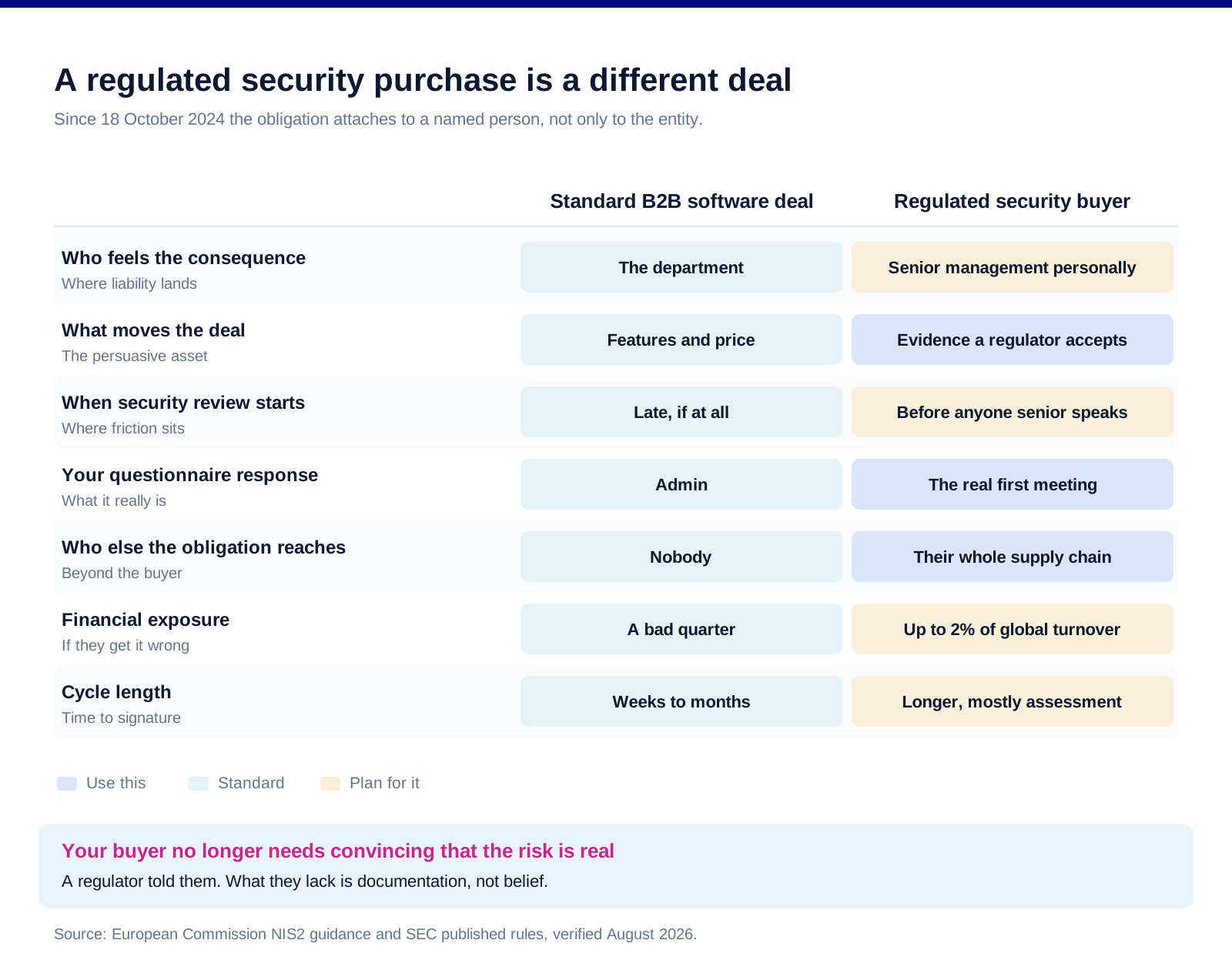
NIS2 covers 18 sectors and catches companies by size, not by choice. The European Commission's NIS2 policy page lists the original six of energy, transport, healthcare, finance, water management and digital infrastructure, plus public electronic communications, digital services, waste management, critical product manufacturing, postal services, public administration and space. As a rule, medium-sized and large entities in those sectors are in scope.
Entities are split into essential and important, with different supervisory regimes. Per the Commission's NIS2 FAQ, that classification decides how closely a company is supervised, which in turn decides how much documentation your buyer needs from you.
The penalties are specific enough to quantify urgency. Essential entities face a maximum of at least 10 million euros or 2% of total worldwide annual turnover for the preceding financial year, whichever is higher. Important entities face at least 7 million euros or 1.4%.
Senior management is personally on the hook. The directive introduces provisions on the liability of natural persons holding senior management positions, and accountability of top management for non-compliance with cybersecurity risk management measures. This is the change that matters most commercially, because it converts a departmental purchase into a personal exposure.
In the US the mechanism is disclosure rather than liability. The SEC's cybersecurity rules require an Item 1.05 Form 8-K generally within four business days of determining that an incident is material, and an annual description under Regulation S-K Item 106 of the processes for assessing, identifying and managing material cybersecurity risks, board oversight of those risks, and management's role and expertise.
Which means the annual report is now a sales document. A company that has to describe its risk management processes and its management's expertise in a public filing has a standing reason to buy things that improve what it can describe.
The supply chain is your qualification engine
NIS2 requires in-scope companies to address cybersecurity risk in their supply chains and supplier relationships. That sentence is the commercial heart of this market. It means the obligation does not stop at the regulated entity.
So your prospect list is not the regulated companies. It is everyone who sells to them. A forty-person software vendor with no direct obligation still gets a security questionnaire because its customer is an essential entity and has to demonstrate it managed supplier risk. That vendor is now a buyer, and it did not know it was one until the questionnaire arrived.
That gives you a qualification question nobody else asks. Not "do you have a security budget" but "who is asking you for evidence, and what have they asked for". A prospect who has just failed a customer's supplier assessment is the most qualified lead in this category, and they rarely appear in any intent dataset.
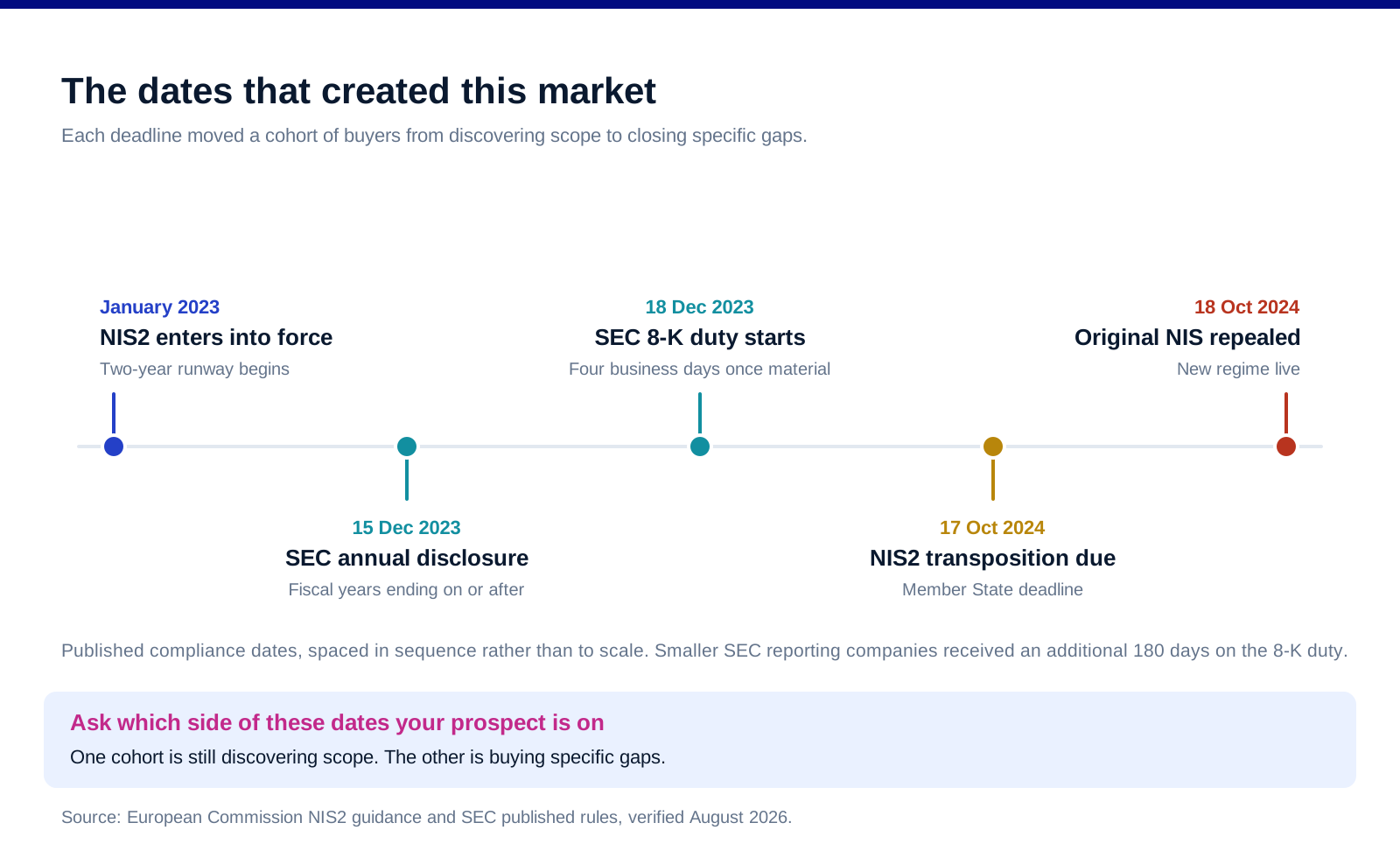
The dates tell you where each cohort is. NIS2 entered into force in January 2023, Member States had until 17 October 2024 to transpose it, and it repealed the original NIS Directive as from 18 October 2024. SEC annual disclosures began with fiscal years ending on or after 15 December 2023, and the 8-K requirement from the later of 90 days after Federal Register publication or 18 December 2023, with smaller reporting companies getting an additional 180 days on the 8-K.
Companies that have been through one cycle behave differently from companies that have not. The first is refining and buying specific gaps. The second is discovering scope and buying assessment. Ask which one you are talking to on the first call, because the offer is different.
How to run the motion
Lead with evidence, not with threat. Your buyer already knows the risk is real; a regulator told them. What they do not have is documentation that survives an audit. An opener that offers a mapping of your capability against a named obligation outperforms one that describes an attack.
Assemble the pack before you start, not after they ask. Certifications, sub-processor list, data residency, incident response times, and where you sit against the obligation your buyer carries. Taking three weeks to produce this answers their real question for them, and the answer is no.
Treat the security questionnaire as the actual first meeting. In most of these deals the questionnaire arrives before anyone senior has spoken to you. How fast and how completely you return it is your first and sometimes only differentiator.
Multi-thread to the person with personal liability. Under NIS2 that is senior management, not the security team. The security team scopes and recommends; the person whose name is attached to the accountability decides how fast.
Expect the quiet period and do not pressure it. The assessment stage is genuinely slow and mostly out of your prospect's hands. Pressure applied during it reads as not understanding their situation, which is the one impression you cannot afford in this market. Our fintech lead generation playbook covers the same two-track structure for financial services under DORA, and the mechanics transfer.
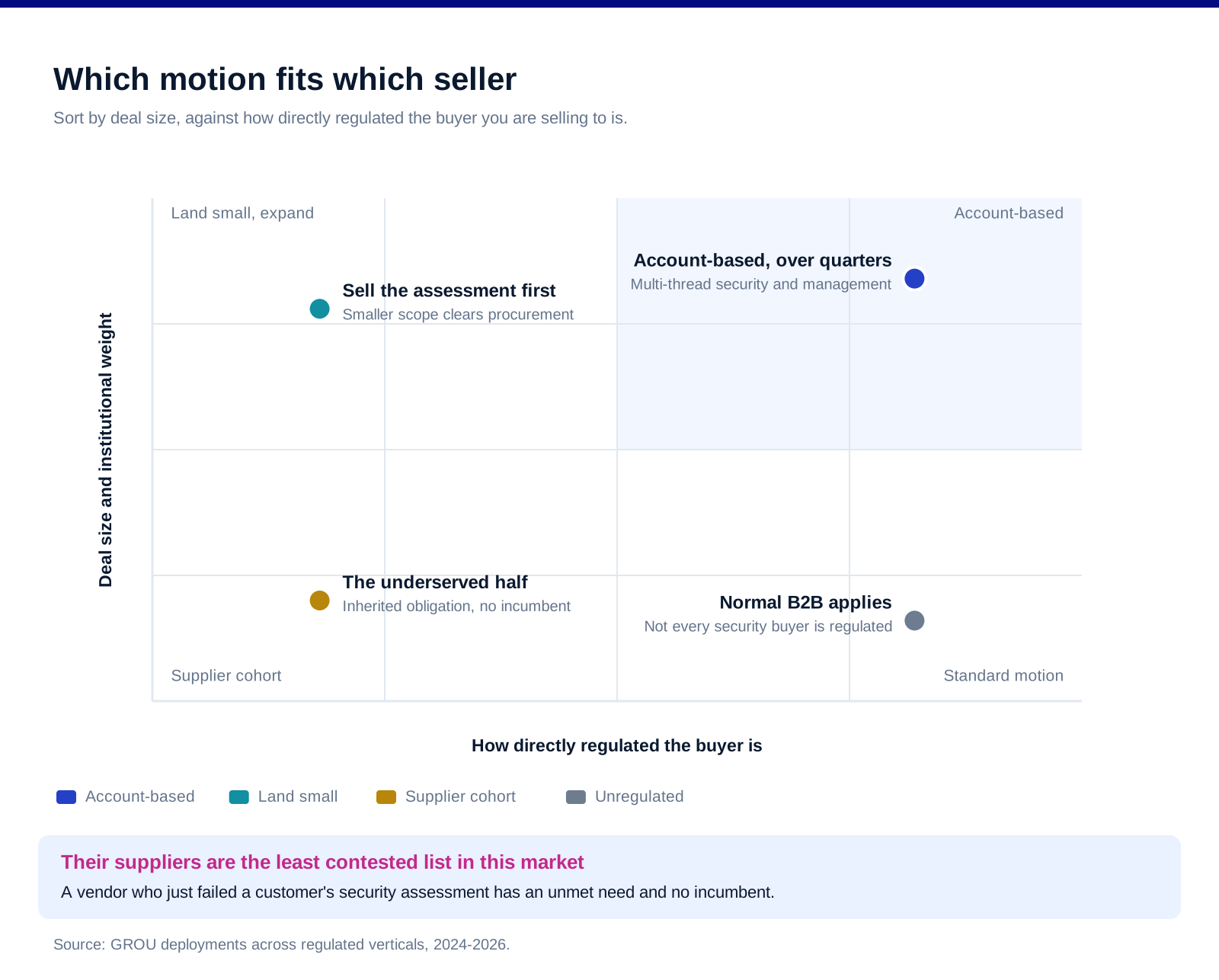
Sell the smaller thing first where the cycle is long. An assessment, a gap analysis, a questionnaire response service. These clear procurement faster and put you inside the account while the larger decision moves.
What no vendor will tell you
Compliance is not security and your buyer knows it. Selling as though a certificate solves the problem insults a technical audience. Selling as though the certificate does not matter ignores their actual constraint. Hold both.
Scope is the buyer's determination, not yours. Whether a given company is an essential entity, an important entity or out of scope is a legal question for them. Telling a prospect they are in scope is a fast way to lose credibility and is not advice you are positioned to give.
Non-EU and non-US regimes are their own conversation. Everything above is the EU directive and the US disclosure rules. The UK and other jurisdictions run different regimes and should not be assumed to follow either.
Nothing here is legal advice and your content should say so. Describing a commercial consequence of a regulation is fine. Telling a reader what their obligations are is not.
The pipeline problem is usually targeting, not messaging. Most cybersecurity sellers we see are talking to security teams at companies that have not yet been asked for anything. The list is the lever.
FAQ
Who is the buyer for cybersecurity in 2026?
Increasingly, whoever carries personal liability rather than whoever runs security. NIS2 introduces provisions on the liability of natural persons in senior management positions and makes top management accountable for non-compliance with cybersecurity risk management measures. The security team still scopes and recommends, but urgency comes from the person whose name is attached.
How does NIS2 create sales opportunities?
Two ways. Directly, because medium and large entities across 18 sectors must implement risk management measures and face penalties of at least 10 million euros or 2% of worldwide turnover for essential entities. Indirectly and more usefully, because in-scope companies must address cybersecurity risk in their supply chains and supplier relationships, which pulls their vendors into buying whether or not those vendors are in scope themselves.
What should a cybersecurity outbound sequence contain?
Evidence rather than threat. A mapping of what you do against a named obligation, your certifications and sub-processor position, and a completed or near-completed security questionnaire offered before it is requested. The sequence should assume the recipient already believes the risk is real and is short of documentation, not of conviction.
How long is a cybersecurity sales cycle?
Longer than an equivalent unregulated deal, and the extra time is assessment rather than decision. We publish no benchmark figure because no credible cross-industry source exists for it and every number in circulation comes from a vendor survey. Plan for a quiet period after the security review starts and resource the assessment rather than the chase.
Does the SEC rule affect companies outside the US?
It applies to registrants filing with the SEC, so a non-US company with US-listed securities can be caught. More relevant for most sellers is the second-order effect: a US public company describing its risk management processes and board oversight in an annual filing has a standing reason to improve what it can describe, and that budget reaches its suppliers.
Should you target regulated companies or their suppliers?
Both, but suppliers are the underserved half. Regulated entities are heavily marketed to and have established vendors. Their suppliers are receiving security questionnaires for the first time, have no incumbent, and are usually small enough to decide quickly. A prospect who has just failed a customer's supplier assessment is the most qualified lead in this market.
Bottom line
Build the list from obligation rather than from firmographics. The regulated entity is the obvious target and the crowded one; the vendor who just received its first security questionnaire because its customer is an essential entity is the one with an unmet need and no incumbent. Lead with the evidence pack rather than the threat, because your buyer's problem is documentation rather than belief. Multi-thread to whoever carries the personal liability, since NIS2 put it on named individuals and that is where urgency lives. And be honest about scope: whether a company is in or out is their legal determination, and the fastest way to lose a technically literate buyer is to answer a question you are not positioned to answer.
Want the pipeline built rather than the market explained? Book a call with GROU. We run lead generation and outbound inside B2B revenue engines across verticals.
We are GROU, a B2B pipeline agency that runs lead generation, outbound, and LinkedIn content for clients across manufacturing, fintech, iGaming, software, and professional services. The sequencing and targeting guidance reflects our deployments across regulated verticals between 2024 and 2026, anonymized to protect client confidentiality.
Selling cybersecurity used to mean convincing someone that a risk was real. It does not any more. Since October 2024 a large share of European buyers have had a legal obligation attached to the decision, and the liability for getting it wrong now attaches to a named individual rather than to the company.
That changes who you are selling to, what they need from you, and how long it takes. This is the version of a cybersecurity lead generation playbook that starts from the obligation rather than from the fear.
TL;DR
Two regulatory changes reshaped this market. NIS2 came into force in January 2023 with a transposition deadline of 17 October 2024, covers 18 sectors, applies as a rule to all medium and large companies within them, and introduces liability for senior management personally rather than only for the entity. Penalties run to at least 10 million euros or 2% of worldwide annual turnover for essential entities, and at least 7 million euros or 1.4% for important entities. Separately, the SEC now requires US public companies to file a Form 8-K within four business days of determining a cybersecurity incident is material, and to describe their risk management processes and board oversight annually. The commercial consequence is the same in both cases: your buyer has a personal, documented obligation, so the thing that moves a deal is evidence they can put in front of a regulator, not a feature list. And because NIS2 requires in-scope companies to address risk in their supply chains and supplier relationships, obligations flow downhill to vendors who are not themselves in scope. That inheritance is the single best qualification signal available in this market.
What actually changed for the buyer
NIS2 covers 18 sectors and catches companies by size, not by choice. The European Commission's NIS2 policy page lists the original six of energy, transport, healthcare, finance, water management and digital infrastructure, plus public electronic communications, digital services, waste management, critical product manufacturing, postal services, public administration and space. As a rule, medium-sized and large entities in those sectors are in scope.
Entities are split into essential and important, with different supervisory regimes. Per the Commission's NIS2 FAQ, that classification decides how closely a company is supervised, which in turn decides how much documentation your buyer needs from you.
The penalties are specific enough to quantify urgency. Essential entities face a maximum of at least 10 million euros or 2% of total worldwide annual turnover for the preceding financial year, whichever is higher. Important entities face at least 7 million euros or 1.4%.
Senior management is personally on the hook. The directive introduces provisions on the liability of natural persons holding senior management positions, and accountability of top management for non-compliance with cybersecurity risk management measures. This is the change that matters most commercially, because it converts a departmental purchase into a personal exposure.
In the US the mechanism is disclosure rather than liability. The SEC's cybersecurity rules require an Item 1.05 Form 8-K generally within four business days of determining that an incident is material, and an annual description under Regulation S-K Item 106 of the processes for assessing, identifying and managing material cybersecurity risks, board oversight of those risks, and management's role and expertise.
Which means the annual report is now a sales document. A company that has to describe its risk management processes and its management's expertise in a public filing has a standing reason to buy things that improve what it can describe.
The supply chain is your qualification engine
NIS2 requires in-scope companies to address cybersecurity risk in their supply chains and supplier relationships. That sentence is the commercial heart of this market. It means the obligation does not stop at the regulated entity.
So your prospect list is not the regulated companies. It is everyone who sells to them. A forty-person software vendor with no direct obligation still gets a security questionnaire because its customer is an essential entity and has to demonstrate it managed supplier risk. That vendor is now a buyer, and it did not know it was one until the questionnaire arrived.
That gives you a qualification question nobody else asks. Not "do you have a security budget" but "who is asking you for evidence, and what have they asked for". A prospect who has just failed a customer's supplier assessment is the most qualified lead in this category, and they rarely appear in any intent dataset.
The dates tell you where each cohort is. NIS2 entered into force in January 2023, Member States had until 17 October 2024 to transpose it, and it repealed the original NIS Directive as from 18 October 2024. SEC annual disclosures began with fiscal years ending on or after 15 December 2023, and the 8-K requirement from the later of 90 days after Federal Register publication or 18 December 2023, with smaller reporting companies getting an additional 180 days on the 8-K.
Companies that have been through one cycle behave differently from companies that have not. The first is refining and buying specific gaps. The second is discovering scope and buying assessment. Ask which one you are talking to on the first call, because the offer is different.
How to run the motion
Lead with evidence, not with threat. Your buyer already knows the risk is real; a regulator told them. What they do not have is documentation that survives an audit. An opener that offers a mapping of your capability against a named obligation outperforms one that describes an attack.
Assemble the pack before you start, not after they ask. Certifications, sub-processor list, data residency, incident response times, and where you sit against the obligation your buyer carries. Taking three weeks to produce this answers their real question for them, and the answer is no.
Treat the security questionnaire as the actual first meeting. In most of these deals the questionnaire arrives before anyone senior has spoken to you. How fast and how completely you return it is your first and sometimes only differentiator.
Multi-thread to the person with personal liability. Under NIS2 that is senior management, not the security team. The security team scopes and recommends; the person whose name is attached to the accountability decides how fast.
Expect the quiet period and do not pressure it. The assessment stage is genuinely slow and mostly out of your prospect's hands. Pressure applied during it reads as not understanding their situation, which is the one impression you cannot afford in this market. Our fintech lead generation playbook covers the same two-track structure for financial services under DORA, and the mechanics transfer.
Sell the smaller thing first where the cycle is long. An assessment, a gap analysis, a questionnaire response service. These clear procurement faster and put you inside the account while the larger decision moves.
What no vendor will tell you
Compliance is not security and your buyer knows it. Selling as though a certificate solves the problem insults a technical audience. Selling as though the certificate does not matter ignores their actual constraint. Hold both.
Scope is the buyer's determination, not yours. Whether a given company is an essential entity, an important entity or out of scope is a legal question for them. Telling a prospect they are in scope is a fast way to lose credibility and is not advice you are positioned to give.
Non-EU and non-US regimes are their own conversation. Everything above is the EU directive and the US disclosure rules. The UK and other jurisdictions run different regimes and should not be assumed to follow either.
Nothing here is legal advice and your content should say so. Describing a commercial consequence of a regulation is fine. Telling a reader what their obligations are is not.
The pipeline problem is usually targeting, not messaging. Most cybersecurity sellers we see are talking to security teams at companies that have not yet been asked for anything. The list is the lever.
FAQ
Who is the buyer for cybersecurity in 2026?
Increasingly, whoever carries personal liability rather than whoever runs security. NIS2 introduces provisions on the liability of natural persons in senior management positions and makes top management accountable for non-compliance with cybersecurity risk management measures. The security team still scopes and recommends, but urgency comes from the person whose name is attached.
How does NIS2 create sales opportunities?
Two ways. Directly, because medium and large entities across 18 sectors must implement risk management measures and face penalties of at least 10 million euros or 2% of worldwide turnover for essential entities. Indirectly and more usefully, because in-scope companies must address cybersecurity risk in their supply chains and supplier relationships, which pulls their vendors into buying whether or not those vendors are in scope themselves.
What should a cybersecurity outbound sequence contain?
Evidence rather than threat. A mapping of what you do against a named obligation, your certifications and sub-processor position, and a completed or near-completed security questionnaire offered before it is requested. The sequence should assume the recipient already believes the risk is real and is short of documentation, not of conviction.
How long is a cybersecurity sales cycle?
Longer than an equivalent unregulated deal, and the extra time is assessment rather than decision. We publish no benchmark figure because no credible cross-industry source exists for it and every number in circulation comes from a vendor survey. Plan for a quiet period after the security review starts and resource the assessment rather than the chase.
Does the SEC rule affect companies outside the US?
It applies to registrants filing with the SEC, so a non-US company with US-listed securities can be caught. More relevant for most sellers is the second-order effect: a US public company describing its risk management processes and board oversight in an annual filing has a standing reason to improve what it can describe, and that budget reaches its suppliers.
Should you target regulated companies or their suppliers?
Both, but suppliers are the underserved half. Regulated entities are heavily marketed to and have established vendors. Their suppliers are receiving security questionnaires for the first time, have no incumbent, and are usually small enough to decide quickly. A prospect who has just failed a customer's supplier assessment is the most qualified lead in this market.
Bottom line
Build the list from obligation rather than from firmographics. The regulated entity is the obvious target and the crowded one; the vendor who just received its first security questionnaire because its customer is an essential entity is the one with an unmet need and no incumbent. Lead with the evidence pack rather than the threat, because your buyer's problem is documentation rather than belief. Multi-thread to whoever carries the personal liability, since NIS2 put it on named individuals and that is where urgency lives. And be honest about scope: whether a company is in or out is their legal determination, and the fastest way to lose a technically literate buyer is to answer a question you are not positioned to answer.
Want the pipeline built rather than the market explained? Book a call with GROU. We run lead generation and outbound inside B2B revenue engines across verticals.
We are GROU, a B2B pipeline agency that runs lead generation, outbound, and LinkedIn content for clients across manufacturing, fintech, iGaming, software, and professional services. The sequencing and targeting guidance reflects our deployments across regulated verticals between 2024 and 2026, anonymized to protect client confidentiality.
Selling cybersecurity used to mean convincing someone that a risk was real. It does not any more. Since October 2024 a large share of European buyers have had a legal obligation attached to the decision, and the liability for getting it wrong now attaches to a named individual rather than to the company.
That changes who you are selling to, what they need from you, and how long it takes. This is the version of a cybersecurity lead generation playbook that starts from the obligation rather than from the fear.
TL;DR
Two regulatory changes reshaped this market. NIS2 came into force in January 2023 with a transposition deadline of 17 October 2024, covers 18 sectors, applies as a rule to all medium and large companies within them, and introduces liability for senior management personally rather than only for the entity. Penalties run to at least 10 million euros or 2% of worldwide annual turnover for essential entities, and at least 7 million euros or 1.4% for important entities. Separately, the SEC now requires US public companies to file a Form 8-K within four business days of determining a cybersecurity incident is material, and to describe their risk management processes and board oversight annually. The commercial consequence is the same in both cases: your buyer has a personal, documented obligation, so the thing that moves a deal is evidence they can put in front of a regulator, not a feature list. And because NIS2 requires in-scope companies to address risk in their supply chains and supplier relationships, obligations flow downhill to vendors who are not themselves in scope. That inheritance is the single best qualification signal available in this market.
What actually changed for the buyer
NIS2 covers 18 sectors and catches companies by size, not by choice. The European Commission's NIS2 policy page lists the original six of energy, transport, healthcare, finance, water management and digital infrastructure, plus public electronic communications, digital services, waste management, critical product manufacturing, postal services, public administration and space. As a rule, medium-sized and large entities in those sectors are in scope.
Entities are split into essential and important, with different supervisory regimes. Per the Commission's NIS2 FAQ, that classification decides how closely a company is supervised, which in turn decides how much documentation your buyer needs from you.
The penalties are specific enough to quantify urgency. Essential entities face a maximum of at least 10 million euros or 2% of total worldwide annual turnover for the preceding financial year, whichever is higher. Important entities face at least 7 million euros or 1.4%.
Senior management is personally on the hook. The directive introduces provisions on the liability of natural persons holding senior management positions, and accountability of top management for non-compliance with cybersecurity risk management measures. This is the change that matters most commercially, because it converts a departmental purchase into a personal exposure.
In the US the mechanism is disclosure rather than liability. The SEC's cybersecurity rules require an Item 1.05 Form 8-K generally within four business days of determining that an incident is material, and an annual description under Regulation S-K Item 106 of the processes for assessing, identifying and managing material cybersecurity risks, board oversight of those risks, and management's role and expertise.
Which means the annual report is now a sales document. A company that has to describe its risk management processes and its management's expertise in a public filing has a standing reason to buy things that improve what it can describe.
The supply chain is your qualification engine
NIS2 requires in-scope companies to address cybersecurity risk in their supply chains and supplier relationships. That sentence is the commercial heart of this market. It means the obligation does not stop at the regulated entity.
So your prospect list is not the regulated companies. It is everyone who sells to them. A forty-person software vendor with no direct obligation still gets a security questionnaire because its customer is an essential entity and has to demonstrate it managed supplier risk. That vendor is now a buyer, and it did not know it was one until the questionnaire arrived.
That gives you a qualification question nobody else asks. Not "do you have a security budget" but "who is asking you for evidence, and what have they asked for". A prospect who has just failed a customer's supplier assessment is the most qualified lead in this category, and they rarely appear in any intent dataset.
The dates tell you where each cohort is. NIS2 entered into force in January 2023, Member States had until 17 October 2024 to transpose it, and it repealed the original NIS Directive as from 18 October 2024. SEC annual disclosures began with fiscal years ending on or after 15 December 2023, and the 8-K requirement from the later of 90 days after Federal Register publication or 18 December 2023, with smaller reporting companies getting an additional 180 days on the 8-K.
Companies that have been through one cycle behave differently from companies that have not. The first is refining and buying specific gaps. The second is discovering scope and buying assessment. Ask which one you are talking to on the first call, because the offer is different.
How to run the motion
Lead with evidence, not with threat. Your buyer already knows the risk is real; a regulator told them. What they do not have is documentation that survives an audit. An opener that offers a mapping of your capability against a named obligation outperforms one that describes an attack.
Assemble the pack before you start, not after they ask. Certifications, sub-processor list, data residency, incident response times, and where you sit against the obligation your buyer carries. Taking three weeks to produce this answers their real question for them, and the answer is no.
Treat the security questionnaire as the actual first meeting. In most of these deals the questionnaire arrives before anyone senior has spoken to you. How fast and how completely you return it is your first and sometimes only differentiator.
Multi-thread to the person with personal liability. Under NIS2 that is senior management, not the security team. The security team scopes and recommends; the person whose name is attached to the accountability decides how fast.
Expect the quiet period and do not pressure it. The assessment stage is genuinely slow and mostly out of your prospect's hands. Pressure applied during it reads as not understanding their situation, which is the one impression you cannot afford in this market. Our fintech lead generation playbook covers the same two-track structure for financial services under DORA, and the mechanics transfer.
Sell the smaller thing first where the cycle is long. An assessment, a gap analysis, a questionnaire response service. These clear procurement faster and put you inside the account while the larger decision moves.
What no vendor will tell you
Compliance is not security and your buyer knows it. Selling as though a certificate solves the problem insults a technical audience. Selling as though the certificate does not matter ignores their actual constraint. Hold both.
Scope is the buyer's determination, not yours. Whether a given company is an essential entity, an important entity or out of scope is a legal question for them. Telling a prospect they are in scope is a fast way to lose credibility and is not advice you are positioned to give.
Non-EU and non-US regimes are their own conversation. Everything above is the EU directive and the US disclosure rules. The UK and other jurisdictions run different regimes and should not be assumed to follow either.
Nothing here is legal advice and your content should say so. Describing a commercial consequence of a regulation is fine. Telling a reader what their obligations are is not.
The pipeline problem is usually targeting, not messaging. Most cybersecurity sellers we see are talking to security teams at companies that have not yet been asked for anything. The list is the lever.
FAQ
Who is the buyer for cybersecurity in 2026?
Increasingly, whoever carries personal liability rather than whoever runs security. NIS2 introduces provisions on the liability of natural persons in senior management positions and makes top management accountable for non-compliance with cybersecurity risk management measures. The security team still scopes and recommends, but urgency comes from the person whose name is attached.
How does NIS2 create sales opportunities?
Two ways. Directly, because medium and large entities across 18 sectors must implement risk management measures and face penalties of at least 10 million euros or 2% of worldwide turnover for essential entities. Indirectly and more usefully, because in-scope companies must address cybersecurity risk in their supply chains and supplier relationships, which pulls their vendors into buying whether or not those vendors are in scope themselves.
What should a cybersecurity outbound sequence contain?
Evidence rather than threat. A mapping of what you do against a named obligation, your certifications and sub-processor position, and a completed or near-completed security questionnaire offered before it is requested. The sequence should assume the recipient already believes the risk is real and is short of documentation, not of conviction.
How long is a cybersecurity sales cycle?
Longer than an equivalent unregulated deal, and the extra time is assessment rather than decision. We publish no benchmark figure because no credible cross-industry source exists for it and every number in circulation comes from a vendor survey. Plan for a quiet period after the security review starts and resource the assessment rather than the chase.
Does the SEC rule affect companies outside the US?
It applies to registrants filing with the SEC, so a non-US company with US-listed securities can be caught. More relevant for most sellers is the second-order effect: a US public company describing its risk management processes and board oversight in an annual filing has a standing reason to improve what it can describe, and that budget reaches its suppliers.
Should you target regulated companies or their suppliers?
Both, but suppliers are the underserved half. Regulated entities are heavily marketed to and have established vendors. Their suppliers are receiving security questionnaires for the first time, have no incumbent, and are usually small enough to decide quickly. A prospect who has just failed a customer's supplier assessment is the most qualified lead in this market.
Bottom line
Build the list from obligation rather than from firmographics. The regulated entity is the obvious target and the crowded one; the vendor who just received its first security questionnaire because its customer is an essential entity is the one with an unmet need and no incumbent. Lead with the evidence pack rather than the threat, because your buyer's problem is documentation rather than belief. Multi-thread to whoever carries the personal liability, since NIS2 put it on named individuals and that is where urgency lives. And be honest about scope: whether a company is in or out is their legal determination, and the fastest way to lose a technically literate buyer is to answer a question you are not positioned to answer.
Want the pipeline built rather than the market explained? Book a call with GROU. We run lead generation and outbound inside B2B revenue engines across verticals.
We are GROU, a B2B pipeline agency that runs lead generation, outbound, and LinkedIn content for clients across manufacturing, fintech, iGaming, software, and professional services. The sequencing and targeting guidance reflects our deployments across regulated verticals between 2024 and 2026, anonymized to protect client confidentiality.
Pipeline OS Newsletter
Build qualified pipeline
Get weekly tactics to generate demand, improve lead quality, and book more meetings.







Trusted by industry leaders
Trusted by industry leaders
Trusted by industry leaders
Ready to build qualified pipeline?
Ready to build qualified pipeline?
Ready to build qualified pipeline?
Book a call to see if we're the right fit, or take the 2-minute quiz to get a clear starting point.
Book a call to see if we're the right fit, or take the 2-minute quiz to get a clear starting point.
Book a call to see if we're the right fit, or take the 2-minute quiz to get a clear starting point.
" height="30.21639343089746px" id="hfGbXmQR2" width="30.216393430897455px"/></svg>)
Copyright © 2026 – All Right Reserved
Copyright © 2026 – All Right Reserved
Copyright © 2026 – All Right Reserved