%22%3E%3C/path%3E%3Cpath d=%22M 63.072 7.554 C 62.258 8.022 61.577 8.689 61.092 9.493 L 61.092 7.076 L 57.158 7.076 L 57.158 22.64 L 61.089 22.64 L 61.089 14.888 C 61.089 13.446 61.403 12.434 62.03 11.853 C 62.818 11.218 63.818 10.907 64.826 10.982 L 65.868 10.982 L 65.868 6.851 C 64.891 6.834 63.926 7.076 63.073 7.554 Z%22 fill=%22rgb(17,17,17)%22%3E%3C/path%3E%3Cpath d=%22M 78.916 7.82 C 76.363 6.49 73.321 6.49 70.768 7.82 C 69.562 8.473 68.564 9.451 67.888 10.644 C 67.167 11.931 66.803 13.387 66.834 14.862 C 66.804 16.332 67.157 17.785 67.86 19.077 C 68.515 20.267 69.494 21.246 70.684 21.901 C 71.924 22.576 73.318 22.92 74.73 22.898 C 76.164 22.918 77.58 22.575 78.846 21.901 C 80.062 21.247 81.073 20.27 81.768 19.077 C 82.506 17.797 82.88 16.339 82.85 14.862 C 82.88 13.389 82.517 11.934 81.797 10.647 C 81.12 9.455 80.122 8.477 78.917 7.824 M 78.803 14.862 C 78.829 15.739 78.636 16.608 78.241 17.391 C 77.903 18.046 77.38 18.588 76.738 18.95 C 76.124 19.293 75.432 19.472 74.729 19.47 C 73.668 19.497 72.648 19.061 71.934 18.276 C 71.139 17.323 70.741 16.1 70.823 14.862 C 70.741 13.62 71.149 12.395 71.959 11.45 C 72.687 10.667 73.715 10.233 74.783 10.256 C 75.859 10.236 76.894 10.67 77.635 11.45 C 78.464 12.387 78.884 13.616 78.801 14.864%22 fill=%22rgb(17,17,17)%22%3E%3C/path%3E%3Cpath d=%22M 95.906 7.076 L 95.906 15.646 C 95.975 16.68 95.643 17.701 94.979 18.498 C 94.311 19.184 93.379 19.547 92.422 19.495 C 91.475 19.544 90.553 19.18 89.894 18.498 C 89.23 17.701 88.898 16.68 88.967 15.646 L 88.967 7.076 L 85.033 7.076 L 85.033 16.207 C 85 17.449 85.275 18.68 85.834 19.79 C 86.327 20.75 87.095 21.542 88.039 22.065 C 89.033 22.594 90.145 22.861 91.271 22.838 C 92.188 22.847 93.095 22.65 93.926 22.263 C 94.708 21.905 95.388 21.36 95.906 20.675 L 95.906 22.645 L 99.865 22.645 L 99.865 7.076 Z%22 fill=%22rgb(17,17,17)%22%3E%3C/path%3E%3Cpath d=%22M 4.513 15.626 C 4.511 10.815 7.606 6.549 12.181 5.059 C 16.756 3.57 21.77 5.195 24.601 9.086 L 27.816 5.87 C 24.074 1.186 17.981 -0.943 12.137 0.393 C 6.292 1.728 1.728 6.292 0.393 12.137 C -0.943 17.981 1.186 24.074 5.87 27.816 L 9.085 24.601 C 6.214 22.512 4.515 19.177 4.513 15.626%22 fill=%22rgb(32,62,235)%22%3E%3C/path%3E%3Cpath d=%22M 17.114 14.343 L 13.354 18.01 L 13.354 18.026 L 21.071 18.026 L 11.412 27.609 L 17.389 27.609 L 23.999 21.081 L 23.999 28.316 L 24.005 28.316 L 27.967 24.393 L 27.967 14.343 Z%22 fill=%22rgb(32,62,235)%22%3E%3C/path%3E%3C/g%3E%3C/svg%3E) ×
 ××
›
›
›
›
8 go-to-market strategy examples from B2B companies
8 go-to-market strategy examples from B2B companies
8 go-to-market strategy examples from B2B companies
8 go-to-market strategy examples from B2B companies
8 go-to-market strategy examples from B2B companies
8 go-to-market strategy examples from B2B companies

Author
Aljaz Peklaj

Adding another channel won't fix a go-to-market plan that stalls before the first reply. If outbound, LinkedIn, and ads run from separate lists with different claims, start with integrated market entry before buying more reach.
Shared targeting: Use one message and one target list across ads and outreach.
Vertical urgency: Tie a narrow ICP to a regulatory trigger.
Relevant timing: Build trigger-based lists, then enrich accounts that fit.
Fast correction: Review replies every two weeks and change the working model when buyers challenge it.
The popular advice is to copy a famous company's channel mix. That misses the operating decisions: who owns the account, what qualifies a conversation, and what happens when the original offer doesn't get a useful response.
A useful go-to-market strategy example exposes those decisions. The eight examples below pair each motion with its launch mechanics, reported numbers from a real market entry, and steps a team can run the same week. AutoBrief's entry into Croatia shows what coordinated execution produced; the rest show motions you can adapt without pretending their economics transfer directly to your business.
Channel selection still matters. But your customer acquisition channels for SaaS need shared targeting and attribution before you can compare their contribution.
At GROU, the operating principle is simple: structure turns attention into pipeline. For founders, marketing leaders, sales heads, and RevOps teams, that means connecting the evidence buyers see with the account records sellers use.
Table of Contents
1. Integrated market entry launch (AutoBrief in Croatia)
AutoBrief, an automotive retail SaaS platform, needed awareness and qualified demand when entering Croatia. Grou ran the entry as one connected motion. An onboarding session mapped the client's ICP, offer, and market, then defined segments, messaging angles, and channels before any campaign work began. LinkedIn and Google Ads supported the market expansion, while lead generation worked the same target accounts instead of running as a separate launch.

The decision worth copying is the sequencing. Paid visibility and outreach reached the same buyers with the same message, so the awareness spend and the outbound conversations reinforced each other rather than competing for attribution.
Run the launch as a shared operating cycle
The launch followed four steps: onboarding workshop → market entry strategy → coordinated LinkedIn and Google Ads with outbound → reviews every two weeks. Each sprint refined targeting and messaging based on what sales converted, so the working model stayed adjustable for the length of the engagement.
For a comparable launch, put the same buyer problem in the ad, the landing page, and the outreach message. In HubSpot, retain the original acquisition source alongside subsequent campaign interactions, so a paid visit followed by an outbound reply doesn't become a misleading single-channel success story.
Early visibility: Track targeted brand visits beside leads for the first 90 days, without equating visits with recognition.
Message correction: Categorize objections before rewriting copy.
Sales feedback: Review accepted leads and disqualification reasons alongside campaign engagement.
AutoBrief CEO Marin Vladović described the contribution directly:
“Grou played an important role in our market entry into Croatia. Their strategic guidance, marketing execution, and responsiveness helped us generate high-quality leads and reach our goals faster.”
This is the first motion I'd recommend for a company entering an unfamiliar market. It connects awareness with conversations while giving the team a practical way to change its assumptions.
2. Vertical-only positioning (Veeva Systems)
Veeva Systems began with a deliberate constraint: serve life sciences buyers. Founded in 2007 by Peter Gassner and Matt Wallach, the company built its initial CRM around that market, then expanded into additional life sciences software while retaining the same buyer base.

The transferable decision is specificity. A pharma buyer evaluating controlled workflows needs different evidence from a general SaaS buyer evaluating team productivity, even when both products contain similar collaboration features.
Build around the event that creates urgency
Say a pharma software vendor targets organizations preparing for an audit. Its sequence should explain the relevant workflow, identify the evidence its product can retain, and offer a discussion with someone who understands implementation constraints.
Use a three-step framework: identify the compliance event → validate the operational pain → match the claim to product evidence. Record the trigger and its origin in Clay or HubSpot before anyone writes personalized outreach.
A pending audit is a reason to investigate fit, not permission to imply that the company has compliance failures. Keep claims narrow, and have a qualified domain expert review content before publishing.
Positioning rule: If your message could be sent unchanged to a law firm and a pharmaceutical manufacturer, your vertical claim probably hasn't reached the workflow.
The trade-off is concentration risk. You'll reject otherwise plausible accounts, and your team will need deeper subject knowledge than a broad horizontal campaign requires.
That constraint is useful when it produces credible references and clearer qualification. Apply the same discipline to positioning for B2B services: define the buyer's operating problem before choosing the language that describes your offer.
3. Inbound flywheel (HubSpot)
HubSpot's free CRM, launched in 2014, illustrates how a product can become an acquisition asset. Founders Brian Halligan and Dharmesh Shah helped popularize inbound marketing, connecting useful content with tools and a CRM-supported sales handoff.
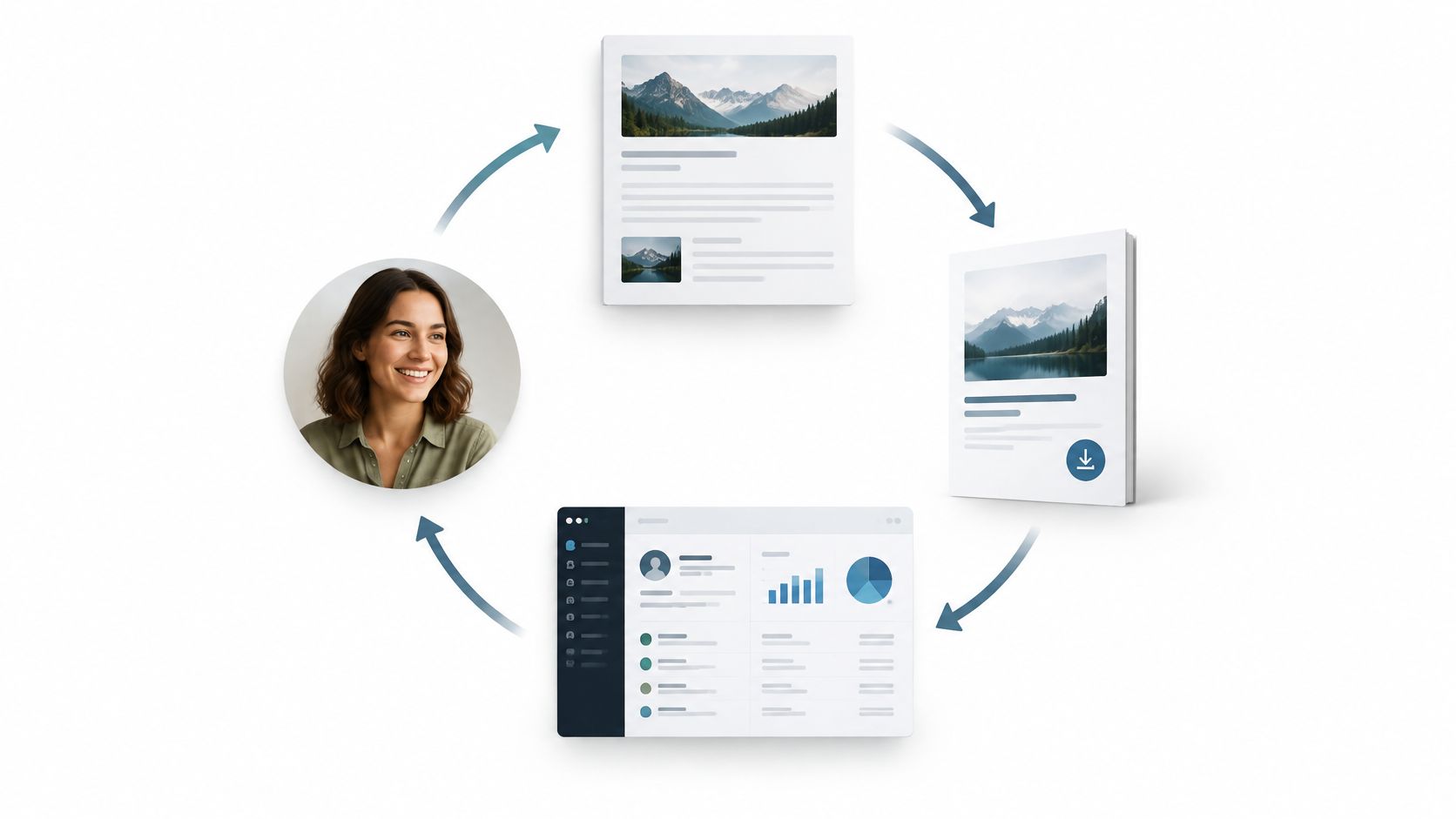
For an established B2B team, the hard part isn't publishing more. It's deciding which buyer behaviors justify a conversation and which indicate that someone found a useful resource.
Connect the resource to a qualified next action
Consider a manufacturing software company offering a production-planning assessment. The assessment should reveal a relevant workflow problem, then save the buyer's responses to a CRM record where the seller can understand the context.
Build a four-stage path: problem-specific article → assessment or free tool → account and behavior qualification → contextual sales follow-up. Treat this as a proposed workflow, not a claim about HubSpot's historical conversion rates.
Content audit: Compare posts by SQL creation and opportunity progression, not sessions alone.
Scoring agreement: Have sales approve the qualification logic before activating automated handoffs.
Record continuity: Store tool submissions, consent, and meaningful usage events against the contact and account.
Content also needs to support independent evaluation. In G2's B2B software buyer reporting, G2's AI buying-journey report found that 29% begin research through large language models more often than Google.
Publish comparison evidence and implementation documentation that buyers can verify (not just another ungated opinion piece). A flywheel marketing system works when each useful interaction supplies context for the next, without forcing every visitor into sales.
4. Conversational marketing (Drift)
A pricing-page visitor asks whether your product supports their integration. Your chat responds with a generic greeting, requests an email address, and leaves the substantive question unanswered. Installing chat hasn't improved that buying experience.
Drift, founded by David Cancel, made conversational marketing a recognizable B2B motion through live chat, chatbot routing, and meeting booking inside the conversation. The approach became a reference point through the late 2010s, replacing some static form handoffs with immediate interaction.

Route the question before requesting the meeting
Use a three-step routing sequence: page intent → account fit → appropriate response. On pricing pages, set an internal response target under five minutes during staffed hours and review actual response time weekly.
That's an operating target, not a promised conversion benchmark. Outside coverage hours, show an honest booking option instead of presenting an unattended inbox as live assistance.
For legal tech, route security and data-handling questions toward approved documentation or a qualified specialist. A salesperson can coordinate the answer without improvising a technical assurance.
Answer the buying question before asking the visitor to accept your sales process.
Keep self-service available. In its 2025 survey, Gartner reported that 61% of B2B buyers preferred an overall representative-free buying experience.
Chat fits when you have meaningful intent and someone equipped to respond. Skip aggressive pop-ups on educational pages if your team can't offer more than another qualification form.
5. Account-based orchestration (Terminus)
Start with the account map, not the email sequence. Terminus, an account-based marketing platform, helped popularize account-based experience, or ABX, by coordinating advertising and sales interactions around named accounts and their buying committees.
The practical distinction is shared coverage. An ad impression to one stakeholder and an email to another are only coordinated when both reinforce a relevant account-level business case.
Map who can approve, block, or implement
For an iGaming platform sale, the commercial sponsor may care about market expansion while technical reviewers examine integration and compliance teams assess risk. Give those stakeholders different evidence without changing the core proposition.
Use Sales Navigator to identify the relevant roles, then assign a single accountable account owner. Enrich appropriate contacts in Apollo or Clay, keeping uncertain role matches out of automated sequences.
Coverage: Record the economic buyer, technical evaluator, and relevant approval roles.
Coordination: Run a proposed window of three to five touches across channels within two weeks.
Review: Pause to inspect replies, objections, and missing stakeholder coverage before extending the sequence.
Gartner's buying-group benchmark describes six to 10 decision-makers, according to the Gartner buyer-enablement document. Use that range for planning, not as a contact quota.
HeyReach can support LinkedIn outreach, while Lemlist can handle email sequencing; neither should become a separate account database. Synchronize reply and meeting status with the CRM before another channel continues touching the same person.
The trade-off is effort per account. These account-based marketing examples are useful when deal value and buying complexity justify deeper coverage, rather than when the team wants a more elaborate label for outbound.
6. Land and expand through self-serve (Atlassian)
Atlassian's bottom-up motion starts with teams using the product. Co-founders Mike Cannon-Brookes and Scott Farquhar built a business where self-serve trials and team tiers can feed larger enterprise relationships as adoption grows.
That motion depends on usable product value before a substantial sales intervention. If implementation requires a long consulting engagement, copying a self-serve signup page won't reproduce the underlying economics.
Route usage signals with enough context
Say a SaaS product spreads from an initial project team into another department. That's a reason to investigate an expansion need, but the account owner still needs to understand whether adoption is productive, permitted, and connected to a broader business case.
Define two or three usage thresholds and route qualifying accounts to an owner within 24 hours. Suitable threshold categories include cross-team adoption, repeated use of a valuable workflow, and demand for centralized administration.
Store those events in HubSpot or Salesforce with their timestamps and account associations. A rep should see what changed before making contact, rather than receiving an unexplained product-qualified flag.
Expansion safeguard: Don't interrupt a successful user just because they crossed a database threshold. Reach out when you can help resolve the next constraint.
Review candidates weekly and distinguish adoption from frustration. Repeated attempts to complete an integration may indicate a support problem, not purchase intent.
For manufacturing software, a second operational team adopting the same workflow could justify an expansion discussion. A burst of logins during training would need different interpretation.
Choose a PLG, sales-led, or hybrid GTM motion around implementation difficulty and buyer risk. I'd favor a hybrid when users can discover value independently but procurement or technical review still requires human support.
7. Marketplace distribution (Salesforce AppExchange)
Salesforce launched AppExchange in 2005, giving third-party application vendors a route to existing Salesforce customers. The strategic attraction is proximity to an installed workflow, not merely another place to publish a listing.
An integration can make a new vendor easier to evaluate. It doesn't remove security review, prove business value, or guarantee that the marketplace will generate demand without additional work.
Treat the listing as a partner-supported launch
Use a four-step launch framework: validate ecosystem fit → document the integration → prepare buyer evidence → coordinate promotion. Before committing, confirm that your ICP uses the host platform and can buy through the proposed commercial route.
For a legal tech vendor selling document workflows to Salesforce users, the listing should show what information moves between systems, who configures it, and what happens when synchronization fails. A polished screenshot won't answer those implementation questions.
Channel fit: Choose the marketplace where your buyers already operate and allocate budget.
Attribution: Maintain marketplace-sourced pipeline separately from marketplace-influenced opportunities.
Partner execution: Agree on a co-marketing calendar before the listing launches.
Integration proof deserves priority. Demandbase's State of the B2B Buyer Report reports that 77% of buyers prioritize integration capabilities over standalone features.
The commercial trade-off is dependency. Marketplace rules, technical review, and partner priorities can affect your launch, so keep a direct route for buyers who need a different purchasing process.
A marketplace is a strong distribution choice when the integration belongs inside the buyer's daily work (and your team can support it). It's a weak choice when marketplace traffic is the only reason for being there.
8. GTM engineering with waterfall enrichment (Clay)
Clay has popularized waterfall enrichment, where a record moves through multiple providers until the workflow returns a required field or suitable contact information. Teams combine that process with signals such as hiring activity or funding news, then send approved records to Instantly or Smartlead.
The critical decision happens before enrichment. Define which accounts qualify and why the signal matters, or you'll spend credits creating a cleaner version of the wrong list.
Build a controlled path from signal to send
For a manufacturing automation vendor, hiring for production systems roles could suggest a project worth investigating. It doesn't establish a budget or buying timeline, so the message should reference the observable event without inventing internal pain.
Use this six-step workflow:
Filter: Apply ICP and exclusion rules before spending enrichment credits.
Validate: Retain the trigger's origin and observation date.
Enrich: Run approved providers in a deliberate order.
Check: Validate the address and resolve duplicate records.
Route: Send approved contacts to Instantly or Smartlead.
Suppress: Stop further outreach when someone replies, books, or opts out.
Keep HubSpot as the master record, with campaign status flowing back from the sending tool. Provider output is an input to qualification, not a substitute for it.
This walkthrough offers a visual reference for the workflow.
Choose waterfall enrichment tools by field coverage, validation controls, and how clearly they expose unresolved records. Stop the workflow when the evidence is insufficient instead of filling missing context with generated assumptions.
Automation makes account research repeatable. The trade-off is that poorly designed rules also repeat mistakes, so inspect rejected records and live replies during each review cycle.
How the eight go-to-market examples compare on motion, best fit, and main risk
Item | Motion | Best for | Main risk |
|---|---|---|---|
Integrated market entry launch (AutoBrief in Croatia) | Coordinate paid ads, outbound, and reporting | Entering a new market with no brand awareness | Requires paid budget and outreach capacity from day one |
Vertical-only positioning (Veeva Systems) | Focus product and messaging on one industry | Buyers with specialized regulatory needs | Market is limited to one industry's budgets |
Inbound flywheel (HubSpot) | Attract and qualify buyers through content and free tools | Building long-term, less paid-dependent acquisition | Meaningful results can take months |
Conversational marketing (Drift) | Use live chat to route high-intent visitors to sales | Converting visitors on pricing, demo, or integration pages | Requires fast, reliable chat coverage |
Account-based orchestration (Terminus) | Coordinate ads, email, and sales around named accounts | High-value deals with multiple stakeholders | High cost and coordination demands per account |
Land and expand through self-serve (Atlassian) | Start teams on free or low-cost plans, then expand with usage | Products that can grow within adopting teams | Most free users may never convert |
Marketplace distribution (Salesforce AppExchange) | Reach customers through a trusted platform marketplace | Products that fit buyers' existing platform workflows | Dependence on platform rules and distribution |
GTM engineering with waterfall enrichment (Clay) | Enrich and prioritize contacts using multiple data sources and triggers | Trigger-based outbound to well-qualified accounts | Data costs, quality, and compliance require oversight |
Audit your last 10 sequences this Friday
Pull your last 10 outbound sequences this Friday and tag each one with its ICP segment, its offer, and the channel that produced the first reply. Any sequence missing a segment or a reply tag goes on Monday's rebuild list, starting with the one that sent the most touches.
Don't change every variable at once. Reconstruct the path from account selection to sales acceptance, then identify the earliest point where the account stopped matching your assumptions.
Separate targeting failures from execution failures
A relevant account that never received the message presents a different problem from a buyer who replied with a clear objection. Before rewriting copy, test email deliverability and inspect authentication, suppression, and sending-domain health.
Next, compare marketing's account list with active sales prospecting. LinkedIn's audience-alignment research reported only 16% overlap between audiences targeted by marketing and sales, a useful warning against treating declared alignment as operational alignment.
Use the audit to assign a specific correction:
Wrong accounts: Rebuild the segment around fit and a credible trigger.
Weak evidence: Replace broad claims with workflow proof and relevant implementation answers.
Broken handoff: Assign an owner and preserve the buyer's original question.
Conflicting channels: Synchronize targeting, status, and suppression before restarting outreach.
Keep first-reply source separate from the interactions that preceded it. Otherwise, the channel that captured the response will receive credit for familiarity another channel helped create.
Change the working model at the next review
Bring sales objections into the review alongside campaign results. A meeting count can look healthy while sellers repeatedly discover missing authority, poor integration fit, or no credible reason to change.
Choose the motion around that diagnosis. Integrated market entry is the starting recommendation when awareness and outbound are disconnected; vertical positioning, self-serve expansion, or marketplace distribution should follow from how the account buys.
GROU has built pipeline programs for more than 50 companies across iGaming, SaaS, manufacturing, and professional services, serving clients in Europe, the UK, the US, and other international markets. Each engagement starts with onboarding to map the ICP, offer, and market before channels go live, then runs in bi-weekly sprints with shared reporting.
Make the next review a decision meeting. By Monday, assign the highest-volume broken sequence an owner, a revised segment, and a documented reason for every account it will reach.
GROU connects LinkedIn content, lead generation, and outbound around a shared target list and reporting system. Visit Grou to book a call, and bring your sequence audit so the team can recommend a starting motion based on your market, offer, and goals.
Adding another channel won't fix a go-to-market plan that stalls before the first reply. If outbound, LinkedIn, and ads run from separate lists with different claims, start with integrated market entry before buying more reach.
Shared targeting: Use one message and one target list across ads and outreach.
Vertical urgency: Tie a narrow ICP to a regulatory trigger.
Relevant timing: Build trigger-based lists, then enrich accounts that fit.
Fast correction: Review replies every two weeks and change the working model when buyers challenge it.
The popular advice is to copy a famous company's channel mix. That misses the operating decisions: who owns the account, what qualifies a conversation, and what happens when the original offer doesn't get a useful response.
A useful go-to-market strategy example exposes those decisions. The eight examples below pair each motion with its launch mechanics, reported numbers from a real market entry, and steps a team can run the same week. AutoBrief's entry into Croatia shows what coordinated execution produced; the rest show motions you can adapt without pretending their economics transfer directly to your business.
Channel selection still matters. But your customer acquisition channels for SaaS need shared targeting and attribution before you can compare their contribution.
At GROU, the operating principle is simple: structure turns attention into pipeline. For founders, marketing leaders, sales heads, and RevOps teams, that means connecting the evidence buyers see with the account records sellers use.
Table of Contents
1. Integrated market entry launch (AutoBrief in Croatia)
AutoBrief, an automotive retail SaaS platform, needed awareness and qualified demand when entering Croatia. Grou ran the entry as one connected motion. An onboarding session mapped the client's ICP, offer, and market, then defined segments, messaging angles, and channels before any campaign work began. LinkedIn and Google Ads supported the market expansion, while lead generation worked the same target accounts instead of running as a separate launch.
The decision worth copying is the sequencing. Paid visibility and outreach reached the same buyers with the same message, so the awareness spend and the outbound conversations reinforced each other rather than competing for attribution.
Run the launch as a shared operating cycle
The launch followed four steps: onboarding workshop → market entry strategy → coordinated LinkedIn and Google Ads with outbound → reviews every two weeks. Each sprint refined targeting and messaging based on what sales converted, so the working model stayed adjustable for the length of the engagement.
For a comparable launch, put the same buyer problem in the ad, the landing page, and the outreach message. In HubSpot, retain the original acquisition source alongside subsequent campaign interactions, so a paid visit followed by an outbound reply doesn't become a misleading single-channel success story.
Early visibility: Track targeted brand visits beside leads for the first 90 days, without equating visits with recognition.
Message correction: Categorize objections before rewriting copy.
Sales feedback: Review accepted leads and disqualification reasons alongside campaign engagement.
AutoBrief CEO Marin Vladović described the contribution directly:
“Grou played an important role in our market entry into Croatia. Their strategic guidance, marketing execution, and responsiveness helped us generate high-quality leads and reach our goals faster.”
This is the first motion I'd recommend for a company entering an unfamiliar market. It connects awareness with conversations while giving the team a practical way to change its assumptions.
2. Vertical-only positioning (Veeva Systems)
Veeva Systems began with a deliberate constraint: serve life sciences buyers. Founded in 2007 by Peter Gassner and Matt Wallach, the company built its initial CRM around that market, then expanded into additional life sciences software while retaining the same buyer base.
The transferable decision is specificity. A pharma buyer evaluating controlled workflows needs different evidence from a general SaaS buyer evaluating team productivity, even when both products contain similar collaboration features.
Build around the event that creates urgency
Say a pharma software vendor targets organizations preparing for an audit. Its sequence should explain the relevant workflow, identify the evidence its product can retain, and offer a discussion with someone who understands implementation constraints.
Use a three-step framework: identify the compliance event → validate the operational pain → match the claim to product evidence. Record the trigger and its origin in Clay or HubSpot before anyone writes personalized outreach.
A pending audit is a reason to investigate fit, not permission to imply that the company has compliance failures. Keep claims narrow, and have a qualified domain expert review content before publishing.
Positioning rule: If your message could be sent unchanged to a law firm and a pharmaceutical manufacturer, your vertical claim probably hasn't reached the workflow.
The trade-off is concentration risk. You'll reject otherwise plausible accounts, and your team will need deeper subject knowledge than a broad horizontal campaign requires.
That constraint is useful when it produces credible references and clearer qualification. Apply the same discipline to positioning for B2B services: define the buyer's operating problem before choosing the language that describes your offer.
3. Inbound flywheel (HubSpot)
HubSpot's free CRM, launched in 2014, illustrates how a product can become an acquisition asset. Founders Brian Halligan and Dharmesh Shah helped popularize inbound marketing, connecting useful content with tools and a CRM-supported sales handoff.
For an established B2B team, the hard part isn't publishing more. It's deciding which buyer behaviors justify a conversation and which indicate that someone found a useful resource.
Connect the resource to a qualified next action
Consider a manufacturing software company offering a production-planning assessment. The assessment should reveal a relevant workflow problem, then save the buyer's responses to a CRM record where the seller can understand the context.
Build a four-stage path: problem-specific article → assessment or free tool → account and behavior qualification → contextual sales follow-up. Treat this as a proposed workflow, not a claim about HubSpot's historical conversion rates.
Content audit: Compare posts by SQL creation and opportunity progression, not sessions alone.
Scoring agreement: Have sales approve the qualification logic before activating automated handoffs.
Record continuity: Store tool submissions, consent, and meaningful usage events against the contact and account.
Content also needs to support independent evaluation. In G2's B2B software buyer reporting, G2's AI buying-journey report found that 29% begin research through large language models more often than Google.
Publish comparison evidence and implementation documentation that buyers can verify (not just another ungated opinion piece). A flywheel marketing system works when each useful interaction supplies context for the next, without forcing every visitor into sales.
4. Conversational marketing (Drift)
A pricing-page visitor asks whether your product supports their integration. Your chat responds with a generic greeting, requests an email address, and leaves the substantive question unanswered. Installing chat hasn't improved that buying experience.
Drift, founded by David Cancel, made conversational marketing a recognizable B2B motion through live chat, chatbot routing, and meeting booking inside the conversation. The approach became a reference point through the late 2010s, replacing some static form handoffs with immediate interaction.
Route the question before requesting the meeting
Use a three-step routing sequence: page intent → account fit → appropriate response. On pricing pages, set an internal response target under five minutes during staffed hours and review actual response time weekly.
That's an operating target, not a promised conversion benchmark. Outside coverage hours, show an honest booking option instead of presenting an unattended inbox as live assistance.
For legal tech, route security and data-handling questions toward approved documentation or a qualified specialist. A salesperson can coordinate the answer without improvising a technical assurance.
Answer the buying question before asking the visitor to accept your sales process.
Keep self-service available. In its 2025 survey, Gartner reported that 61% of B2B buyers preferred an overall representative-free buying experience.
Chat fits when you have meaningful intent and someone equipped to respond. Skip aggressive pop-ups on educational pages if your team can't offer more than another qualification form.
5. Account-based orchestration (Terminus)
Start with the account map, not the email sequence. Terminus, an account-based marketing platform, helped popularize account-based experience, or ABX, by coordinating advertising and sales interactions around named accounts and their buying committees.
The practical distinction is shared coverage. An ad impression to one stakeholder and an email to another are only coordinated when both reinforce a relevant account-level business case.
Map who can approve, block, or implement
For an iGaming platform sale, the commercial sponsor may care about market expansion while technical reviewers examine integration and compliance teams assess risk. Give those stakeholders different evidence without changing the core proposition.
Use Sales Navigator to identify the relevant roles, then assign a single accountable account owner. Enrich appropriate contacts in Apollo or Clay, keeping uncertain role matches out of automated sequences.
Coverage: Record the economic buyer, technical evaluator, and relevant approval roles.
Coordination: Run a proposed window of three to five touches across channels within two weeks.
Review: Pause to inspect replies, objections, and missing stakeholder coverage before extending the sequence.
Gartner's buying-group benchmark describes six to 10 decision-makers, according to the Gartner buyer-enablement document. Use that range for planning, not as a contact quota.
HeyReach can support LinkedIn outreach, while Lemlist can handle email sequencing; neither should become a separate account database. Synchronize reply and meeting status with the CRM before another channel continues touching the same person.
The trade-off is effort per account. These account-based marketing examples are useful when deal value and buying complexity justify deeper coverage, rather than when the team wants a more elaborate label for outbound.
6. Land and expand through self-serve (Atlassian)
Atlassian's bottom-up motion starts with teams using the product. Co-founders Mike Cannon-Brookes and Scott Farquhar built a business where self-serve trials and team tiers can feed larger enterprise relationships as adoption grows.
That motion depends on usable product value before a substantial sales intervention. If implementation requires a long consulting engagement, copying a self-serve signup page won't reproduce the underlying economics.
Route usage signals with enough context
Say a SaaS product spreads from an initial project team into another department. That's a reason to investigate an expansion need, but the account owner still needs to understand whether adoption is productive, permitted, and connected to a broader business case.
Define two or three usage thresholds and route qualifying accounts to an owner within 24 hours. Suitable threshold categories include cross-team adoption, repeated use of a valuable workflow, and demand for centralized administration.
Store those events in HubSpot or Salesforce with their timestamps and account associations. A rep should see what changed before making contact, rather than receiving an unexplained product-qualified flag.
Expansion safeguard: Don't interrupt a successful user just because they crossed a database threshold. Reach out when you can help resolve the next constraint.
Review candidates weekly and distinguish adoption from frustration. Repeated attempts to complete an integration may indicate a support problem, not purchase intent.
For manufacturing software, a second operational team adopting the same workflow could justify an expansion discussion. A burst of logins during training would need different interpretation.
Choose a PLG, sales-led, or hybrid GTM motion around implementation difficulty and buyer risk. I'd favor a hybrid when users can discover value independently but procurement or technical review still requires human support.
7. Marketplace distribution (Salesforce AppExchange)
Salesforce launched AppExchange in 2005, giving third-party application vendors a route to existing Salesforce customers. The strategic attraction is proximity to an installed workflow, not merely another place to publish a listing.
An integration can make a new vendor easier to evaluate. It doesn't remove security review, prove business value, or guarantee that the marketplace will generate demand without additional work.
Treat the listing as a partner-supported launch
Use a four-step launch framework: validate ecosystem fit → document the integration → prepare buyer evidence → coordinate promotion. Before committing, confirm that your ICP uses the host platform and can buy through the proposed commercial route.
For a legal tech vendor selling document workflows to Salesforce users, the listing should show what information moves between systems, who configures it, and what happens when synchronization fails. A polished screenshot won't answer those implementation questions.
Channel fit: Choose the marketplace where your buyers already operate and allocate budget.
Attribution: Maintain marketplace-sourced pipeline separately from marketplace-influenced opportunities.
Partner execution: Agree on a co-marketing calendar before the listing launches.
Integration proof deserves priority. Demandbase's State of the B2B Buyer Report reports that 77% of buyers prioritize integration capabilities over standalone features.
The commercial trade-off is dependency. Marketplace rules, technical review, and partner priorities can affect your launch, so keep a direct route for buyers who need a different purchasing process.
A marketplace is a strong distribution choice when the integration belongs inside the buyer's daily work (and your team can support it). It's a weak choice when marketplace traffic is the only reason for being there.
8. GTM engineering with waterfall enrichment (Clay)
Clay has popularized waterfall enrichment, where a record moves through multiple providers until the workflow returns a required field or suitable contact information. Teams combine that process with signals such as hiring activity or funding news, then send approved records to Instantly or Smartlead.
The critical decision happens before enrichment. Define which accounts qualify and why the signal matters, or you'll spend credits creating a cleaner version of the wrong list.
Build a controlled path from signal to send
For a manufacturing automation vendor, hiring for production systems roles could suggest a project worth investigating. It doesn't establish a budget or buying timeline, so the message should reference the observable event without inventing internal pain.
Use this six-step workflow:
Filter: Apply ICP and exclusion rules before spending enrichment credits.
Validate: Retain the trigger's origin and observation date.
Enrich: Run approved providers in a deliberate order.
Check: Validate the address and resolve duplicate records.
Route: Send approved contacts to Instantly or Smartlead.
Suppress: Stop further outreach when someone replies, books, or opts out.
Keep HubSpot as the master record, with campaign status flowing back from the sending tool. Provider output is an input to qualification, not a substitute for it.
This walkthrough offers a visual reference for the workflow.
Choose waterfall enrichment tools by field coverage, validation controls, and how clearly they expose unresolved records. Stop the workflow when the evidence is insufficient instead of filling missing context with generated assumptions.
Automation makes account research repeatable. The trade-off is that poorly designed rules also repeat mistakes, so inspect rejected records and live replies during each review cycle.
How the eight go-to-market examples compare on motion, best fit, and main risk
Item | Motion | Best for | Main risk |
|---|---|---|---|
Integrated market entry launch (AutoBrief in Croatia) | Coordinate paid ads, outbound, and reporting | Entering a new market with no brand awareness | Requires paid budget and outreach capacity from day one |
Vertical-only positioning (Veeva Systems) | Focus product and messaging on one industry | Buyers with specialized regulatory needs | Market is limited to one industry's budgets |
Inbound flywheel (HubSpot) | Attract and qualify buyers through content and free tools | Building long-term, less paid-dependent acquisition | Meaningful results can take months |
Conversational marketing (Drift) | Use live chat to route high-intent visitors to sales | Converting visitors on pricing, demo, or integration pages | Requires fast, reliable chat coverage |
Account-based orchestration (Terminus) | Coordinate ads, email, and sales around named accounts | High-value deals with multiple stakeholders | High cost and coordination demands per account |
Land and expand through self-serve (Atlassian) | Start teams on free or low-cost plans, then expand with usage | Products that can grow within adopting teams | Most free users may never convert |
Marketplace distribution (Salesforce AppExchange) | Reach customers through a trusted platform marketplace | Products that fit buyers' existing platform workflows | Dependence on platform rules and distribution |
GTM engineering with waterfall enrichment (Clay) | Enrich and prioritize contacts using multiple data sources and triggers | Trigger-based outbound to well-qualified accounts | Data costs, quality, and compliance require oversight |
Audit your last 10 sequences this Friday
Pull your last 10 outbound sequences this Friday and tag each one with its ICP segment, its offer, and the channel that produced the first reply. Any sequence missing a segment or a reply tag goes on Monday's rebuild list, starting with the one that sent the most touches.
Don't change every variable at once. Reconstruct the path from account selection to sales acceptance, then identify the earliest point where the account stopped matching your assumptions.
Separate targeting failures from execution failures
A relevant account that never received the message presents a different problem from a buyer who replied with a clear objection. Before rewriting copy, test email deliverability and inspect authentication, suppression, and sending-domain health.
Next, compare marketing's account list with active sales prospecting. LinkedIn's audience-alignment research reported only 16% overlap between audiences targeted by marketing and sales, a useful warning against treating declared alignment as operational alignment.
Use the audit to assign a specific correction:
Wrong accounts: Rebuild the segment around fit and a credible trigger.
Weak evidence: Replace broad claims with workflow proof and relevant implementation answers.
Broken handoff: Assign an owner and preserve the buyer's original question.
Conflicting channels: Synchronize targeting, status, and suppression before restarting outreach.
Keep first-reply source separate from the interactions that preceded it. Otherwise, the channel that captured the response will receive credit for familiarity another channel helped create.
Change the working model at the next review
Bring sales objections into the review alongside campaign results. A meeting count can look healthy while sellers repeatedly discover missing authority, poor integration fit, or no credible reason to change.
Choose the motion around that diagnosis. Integrated market entry is the starting recommendation when awareness and outbound are disconnected; vertical positioning, self-serve expansion, or marketplace distribution should follow from how the account buys.
GROU has built pipeline programs for more than 50 companies across iGaming, SaaS, manufacturing, and professional services, serving clients in Europe, the UK, the US, and other international markets. Each engagement starts with onboarding to map the ICP, offer, and market before channels go live, then runs in bi-weekly sprints with shared reporting.
Make the next review a decision meeting. By Monday, assign the highest-volume broken sequence an owner, a revised segment, and a documented reason for every account it will reach.
GROU connects LinkedIn content, lead generation, and outbound around a shared target list and reporting system. Visit Grou to book a call, and bring your sequence audit so the team can recommend a starting motion based on your market, offer, and goals.
Pipeline OS Newsletter
Build qualified pipeline
Get weekly tactics to generate demand, improve lead quality, and book more meetings.





Trusted by industry leaders
Trusted by industry leaders
Trusted by industry leaders
Ready to build qualified pipeline?
Ready to build qualified pipeline?
Ready to build qualified pipeline?
Book a call to see if we're the right fit, or take the 2-minute quiz to get a clear starting point.
Book a call to see if we're the right fit, or take the 2-minute quiz to get a clear starting point.
Book a call to see if we're the right fit, or take the 2-minute quiz to get a clear starting point.
" height="30.21639343089746px" id="hfGbXmQR2" width="30.216393430897455px"/></svg>)
Copyright © 2026 – All Right Reserved
Copyright © 2026 – All Right Reserved
Copyright © 2026 – All Right Reserved