%22%3E%3C/path%3E%3Cpath d=%22M 63.072 7.554 C 62.258 8.022 61.577 8.689 61.092 9.493 L 61.092 7.076 L 57.158 7.076 L 57.158 22.64 L 61.089 22.64 L 61.089 14.888 C 61.089 13.446 61.403 12.434 62.03 11.853 C 62.818 11.218 63.818 10.907 64.826 10.982 L 65.868 10.982 L 65.868 6.851 C 64.891 6.834 63.926 7.076 63.073 7.554 Z%22 fill=%22rgb(17,17,17)%22%3E%3C/path%3E%3Cpath d=%22M 78.916 7.82 C 76.363 6.49 73.321 6.49 70.768 7.82 C 69.562 8.473 68.564 9.451 67.888 10.644 C 67.167 11.931 66.803 13.387 66.834 14.862 C 66.804 16.332 67.157 17.785 67.86 19.077 C 68.515 20.267 69.494 21.246 70.684 21.901 C 71.924 22.576 73.318 22.92 74.73 22.898 C 76.164 22.918 77.58 22.575 78.846 21.901 C 80.062 21.247 81.073 20.27 81.768 19.077 C 82.506 17.797 82.88 16.339 82.85 14.862 C 82.88 13.389 82.517 11.934 81.797 10.647 C 81.12 9.455 80.122 8.477 78.917 7.824 M 78.803 14.862 C 78.829 15.739 78.636 16.608 78.241 17.391 C 77.903 18.046 77.38 18.588 76.738 18.95 C 76.124 19.293 75.432 19.472 74.729 19.47 C 73.668 19.497 72.648 19.061 71.934 18.276 C 71.139 17.323 70.741 16.1 70.823 14.862 C 70.741 13.62 71.149 12.395 71.959 11.45 C 72.687 10.667 73.715 10.233 74.783 10.256 C 75.859 10.236 76.894 10.67 77.635 11.45 C 78.464 12.387 78.884 13.616 78.801 14.864%22 fill=%22rgb(17,17,17)%22%3E%3C/path%3E%3Cpath d=%22M 95.906 7.076 L 95.906 15.646 C 95.975 16.68 95.643 17.701 94.979 18.498 C 94.311 19.184 93.379 19.547 92.422 19.495 C 91.475 19.544 90.553 19.18 89.894 18.498 C 89.23 17.701 88.898 16.68 88.967 15.646 L 88.967 7.076 L 85.033 7.076 L 85.033 16.207 C 85 17.449 85.275 18.68 85.834 19.79 C 86.327 20.75 87.095 21.542 88.039 22.065 C 89.033 22.594 90.145 22.861 91.271 22.838 C 92.188 22.847 93.095 22.65 93.926 22.263 C 94.708 21.905 95.388 21.36 95.906 20.675 L 95.906 22.645 L 99.865 22.645 L 99.865 7.076 Z%22 fill=%22rgb(17,17,17)%22%3E%3C/path%3E%3Cpath d=%22M 4.513 15.626 C 4.511 10.815 7.606 6.549 12.181 5.059 C 16.756 3.57 21.77 5.195 24.601 9.086 L 27.816 5.87 C 24.074 1.186 17.981 -0.943 12.137 0.393 C 6.292 1.728 1.728 6.292 0.393 12.137 C -0.943 17.981 1.186 24.074 5.87 27.816 L 9.085 24.601 C 6.214 22.512 4.515 19.177 4.513 15.626%22 fill=%22rgb(32,62,235)%22%3E%3C/path%3E%3Cpath d=%22M 17.114 14.343 L 13.354 18.01 L 13.354 18.026 L 21.071 18.026 L 11.412 27.609 L 17.389 27.609 L 23.999 21.081 L 23.999 28.316 L 24.005 28.316 L 27.967 24.393 L 27.967 14.343 Z%22 fill=%22rgb(32,62,235)%22%3E%3C/path%3E%3C/g%3E%3C/svg%3E) ×
 ××


50 discovery call questions for B2B sales
A good discovery call is the buyer talking and the seller learning. The questions below are grouped by the stage of the call: opening, current situation, problem and impact, goals, decision process, budget and timing, and next steps. Use ten or twelve per call, not all fifty, and follow the answers rather than the list.
TL;DR
Seven groups of questions, in the order a call usually flows.
Ask about impact and cost, not just the problem. That's where urgency comes from.
Map the decision early: who else is involved, and how have they bought before?
End every call with an agreed next step and a date.
How a discovery call flows

1. Opening (1 to 5)
"What made you take this call today?"
"What would make the next 30 minutes useful for you?"
"Before I ask questions, is there anything you want to know about us first?"
"How much time do we have?"
"Who else should I know about who cares about this?"
2. Current situation (6 to 14)
"Walk me through how you handle [process] today."
"Which tools or partners are involved?"
"Who owns it day to day?"
"What's working well that you'd want to keep?"
"How long have you done it this way?"
"What have you tried before?"
"What happened with that?"
"How does this fit into your wider priorities this year?"
"How do you measure success here today?"
3. Problem and impact (15 to 25)
"What's not working as well as you'd like?"
"When did you first notice it?"
"How often does it come up?"
"Who feels it most?"
"What does it cost you, in time, money or missed revenue?"
"What happens if nothing changes in the next six months?"
"How does it affect your own targets?"
"What have you had to work around because of it?"
"Is this the biggest problem, or one of several?"
"Why solve it now rather than next year?"
"On a scale of one to ten, how urgent is this?"
4. Goals (26 to 32)
"If we solved this, what would be different in 90 days?"
"What would success look like in numbers?"
"How would you know it was working?"
"Who would notice first?"
"What would it make possible that isn't possible now?"
"What's the minimum outcome that would make this worthwhile?"
"What would make this a failure?"
5. Decision process (33 to 41)
"How do decisions like this usually get made here?"
"Who else will be involved?"
"Who has the final say?"
"Who might have concerns?"
"What did the last purchase like this look like?"
"Are you looking at other options?"
"What would make you choose one over another?"
"Is there a procurement or security review?"
"Is there anything that could stop this, even if everyone likes it?"
6. Budget and timing (42 to 46)
"Is there budget set aside for this, or does it need to be found?"
"What range were you expecting to invest?"
"When does your budget year start?"
"Is there a date this needs to be in place by?"
"What's driving that date?"
7. Next steps (47 to 50)
"Based on what you've heard, does it make sense to keep talking?"
"What would you need to see next?"
"Who should join the next conversation?"
"Can we put a time in the diary now?"
Questions written by GROU. Adapt the wording to your product and buyer.
How to use these questions

Pick ten or twelve before the call, based on what you already know.
Follow the answer. "Tell me more about that" is often the best next question.
Quantify. Turn "it's slow" into "it takes three days".
Summarise what you heard before proposing a next step.
Take notes in the CRM the same day.
Structured qualification helps organise what you learn. See our lead qualification process guide.
Common mistakes
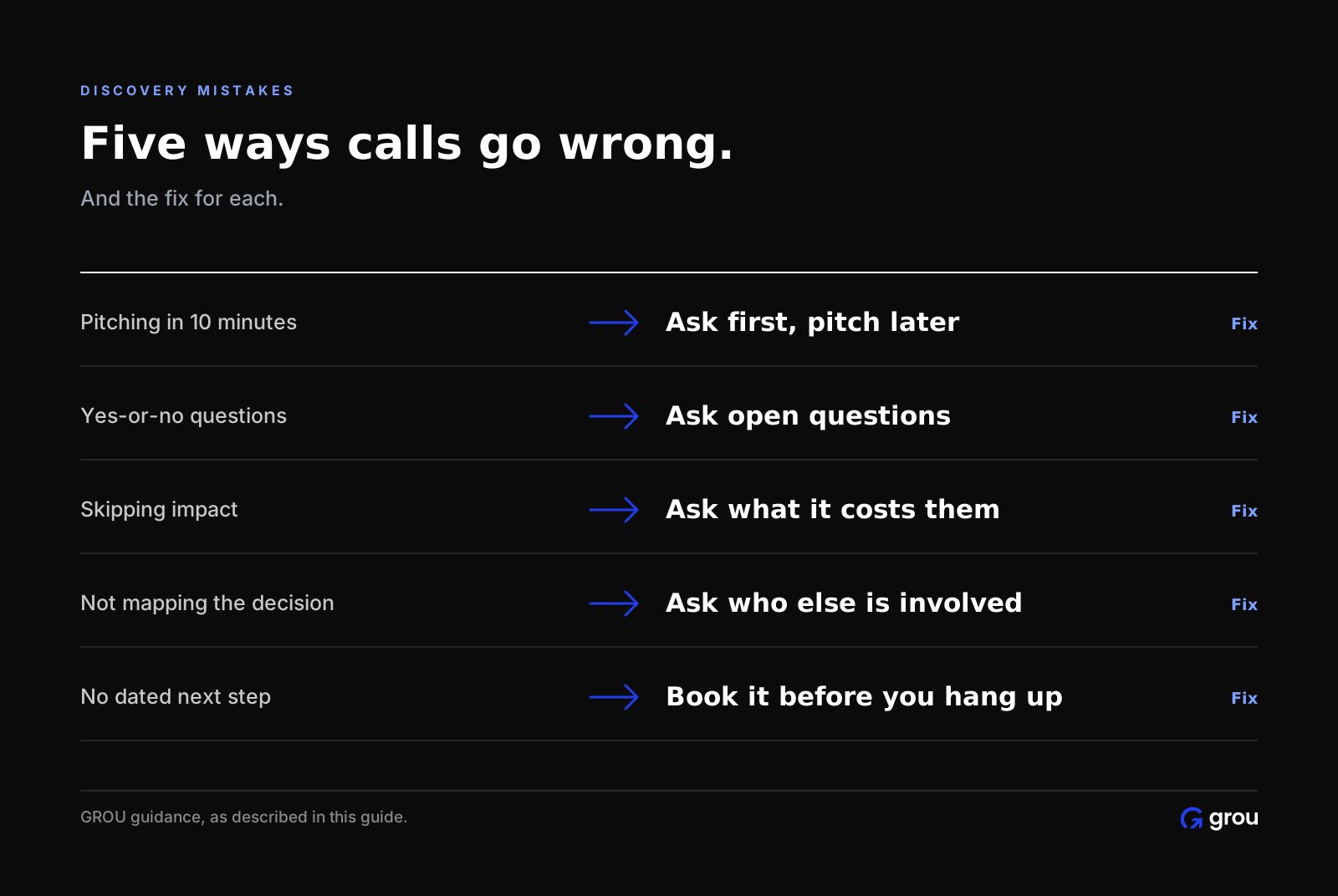
Pitching in the first ten minutes.
Asking yes-or-no questions that end the conversation.
Skipping impact, so there's no urgency.
Not mapping the decision, then losing to a stakeholder you never met.
Ending without a dated next step.
For later stages, see B2B objection handling and sales pipeline stages. AI meeting assistants can capture notes so you can focus on listening; see AI meeting assistants for sales.
FAQ
What are good discovery call questions?
Open questions about the current situation, the problem and its impact, goals, the decision process, budget and timing, and next steps.
How many questions should I ask on a discovery call?
Usually ten to twelve prepared questions, with follow-ups based on the answers.
How long should a discovery call be?
Often 30 to 45 minutes, depending on the deal size and how much you already know.
Should I ask about budget on the first call?
Yes, gently. Ask whether budget exists or needs to be found, and when the budget year starts.
What's the most important discovery question?
Questions about impact, such as "what happens if nothing changes?", because they reveal urgency.
About this guide
We are GROU, a B2B pipeline agency that runs lead generation, outbound, and LinkedIn content for clients across manufacturing, fintech, iGaming, software, and professional services. The questions in this guide are written by our team.
Every buyer is different. Use the list to prepare, then listen.
50 discovery call questions for B2B sales
A good discovery call is the buyer talking and the seller learning. The questions below are grouped by the stage of the call: opening, current situation, problem and impact, goals, decision process, budget and timing, and next steps. Use ten or twelve per call, not all fifty, and follow the answers rather than the list.
TL;DR
Seven groups of questions, in the order a call usually flows.
Ask about impact and cost, not just the problem. That's where urgency comes from.
Map the decision early: who else is involved, and how have they bought before?
End every call with an agreed next step and a date.
How a discovery call flows
1. Opening (1 to 5)
"What made you take this call today?"
"What would make the next 30 minutes useful for you?"
"Before I ask questions, is there anything you want to know about us first?"
"How much time do we have?"
"Who else should I know about who cares about this?"
2. Current situation (6 to 14)
"Walk me through how you handle [process] today."
"Which tools or partners are involved?"
"Who owns it day to day?"
"What's working well that you'd want to keep?"
"How long have you done it this way?"
"What have you tried before?"
"What happened with that?"
"How does this fit into your wider priorities this year?"
"How do you measure success here today?"
3. Problem and impact (15 to 25)
"What's not working as well as you'd like?"
"When did you first notice it?"
"How often does it come up?"
"Who feels it most?"
"What does it cost you, in time, money or missed revenue?"
"What happens if nothing changes in the next six months?"
"How does it affect your own targets?"
"What have you had to work around because of it?"
"Is this the biggest problem, or one of several?"
"Why solve it now rather than next year?"
"On a scale of one to ten, how urgent is this?"
4. Goals (26 to 32)
"If we solved this, what would be different in 90 days?"
"What would success look like in numbers?"
"How would you know it was working?"
"Who would notice first?"
"What would it make possible that isn't possible now?"
"What's the minimum outcome that would make this worthwhile?"
"What would make this a failure?"
5. Decision process (33 to 41)
"How do decisions like this usually get made here?"
"Who else will be involved?"
"Who has the final say?"
"Who might have concerns?"
"What did the last purchase like this look like?"
"Are you looking at other options?"
"What would make you choose one over another?"
"Is there a procurement or security review?"
"Is there anything that could stop this, even if everyone likes it?"
6. Budget and timing (42 to 46)
"Is there budget set aside for this, or does it need to be found?"
"What range were you expecting to invest?"
"When does your budget year start?"
"Is there a date this needs to be in place by?"
"What's driving that date?"
7. Next steps (47 to 50)
"Based on what you've heard, does it make sense to keep talking?"
"What would you need to see next?"
"Who should join the next conversation?"
"Can we put a time in the diary now?"
Questions written by GROU. Adapt the wording to your product and buyer.
How to use these questions
Pick ten or twelve before the call, based on what you already know.
Follow the answer. "Tell me more about that" is often the best next question.
Quantify. Turn "it's slow" into "it takes three days".
Summarise what you heard before proposing a next step.
Take notes in the CRM the same day.
Structured qualification helps organise what you learn. See our lead qualification process guide.
Common mistakes
Pitching in the first ten minutes.
Asking yes-or-no questions that end the conversation.
Skipping impact, so there's no urgency.
Not mapping the decision, then losing to a stakeholder you never met.
Ending without a dated next step.
For later stages, see B2B objection handling and sales pipeline stages. AI meeting assistants can capture notes so you can focus on listening; see AI meeting assistants for sales.
FAQ
What are good discovery call questions?
Open questions about the current situation, the problem and its impact, goals, the decision process, budget and timing, and next steps.
How many questions should I ask on a discovery call?
Usually ten to twelve prepared questions, with follow-ups based on the answers.
How long should a discovery call be?
Often 30 to 45 minutes, depending on the deal size and how much you already know.
Should I ask about budget on the first call?
Yes, gently. Ask whether budget exists or needs to be found, and when the budget year starts.
What's the most important discovery question?
Questions about impact, such as "what happens if nothing changes?", because they reveal urgency.
About this guide
We are GROU, a B2B pipeline agency that runs lead generation, outbound, and LinkedIn content for clients across manufacturing, fintech, iGaming, software, and professional services. The questions in this guide are written by our team.
Every buyer is different. Use the list to prepare, then listen.
Pipeline OS Newsletter
Build qualified pipeline
Get weekly tactics to generate demand, improve lead quality, and book more meetings.





Trusted by industry leaders
Trusted by industry leaders
Trusted by industry leaders
Ready to build qualified pipeline?
Ready to build qualified pipeline?
Ready to build qualified pipeline?
Book a call to see if we're the right fit, or take the 2-minute quiz to get a clear starting point.
Book a call to see if we're the right fit, or take the 2-minute quiz to get a clear starting point.
Book a call to see if we're the right fit, or take the 2-minute quiz to get a clear starting point.
" height="30.21639343089746px" id="hfGbXmQR2" width="30.216393430897455px"/></svg>)
Copyright © 2026 – All Right Reserved
Copyright © 2026 – All Right Reserved
Copyright © 2026 – All Right Reserved