%22%3E%3C/path%3E%3Cpath d=%22M 63.072 7.554 C 62.258 8.022 61.577 8.689 61.092 9.493 L 61.092 7.076 L 57.158 7.076 L 57.158 22.64 L 61.089 22.64 L 61.089 14.888 C 61.089 13.446 61.403 12.434 62.03 11.853 C 62.818 11.218 63.818 10.907 64.826 10.982 L 65.868 10.982 L 65.868 6.851 C 64.891 6.834 63.926 7.076 63.073 7.554 Z%22 fill=%22rgb(17,17,17)%22%3E%3C/path%3E%3Cpath d=%22M 78.916 7.82 C 76.363 6.49 73.321 6.49 70.768 7.82 C 69.562 8.473 68.564 9.451 67.888 10.644 C 67.167 11.931 66.803 13.387 66.834 14.862 C 66.804 16.332 67.157 17.785 67.86 19.077 C 68.515 20.267 69.494 21.246 70.684 21.901 C 71.924 22.576 73.318 22.92 74.73 22.898 C 76.164 22.918 77.58 22.575 78.846 21.901 C 80.062 21.247 81.073 20.27 81.768 19.077 C 82.506 17.797 82.88 16.339 82.85 14.862 C 82.88 13.389 82.517 11.934 81.797 10.647 C 81.12 9.455 80.122 8.477 78.917 7.824 M 78.803 14.862 C 78.829 15.739 78.636 16.608 78.241 17.391 C 77.903 18.046 77.38 18.588 76.738 18.95 C 76.124 19.293 75.432 19.472 74.729 19.47 C 73.668 19.497 72.648 19.061 71.934 18.276 C 71.139 17.323 70.741 16.1 70.823 14.862 C 70.741 13.62 71.149 12.395 71.959 11.45 C 72.687 10.667 73.715 10.233 74.783 10.256 C 75.859 10.236 76.894 10.67 77.635 11.45 C 78.464 12.387 78.884 13.616 78.801 14.864%22 fill=%22rgb(17,17,17)%22%3E%3C/path%3E%3Cpath d=%22M 95.906 7.076 L 95.906 15.646 C 95.975 16.68 95.643 17.701 94.979 18.498 C 94.311 19.184 93.379 19.547 92.422 19.495 C 91.475 19.544 90.553 19.18 89.894 18.498 C 89.23 17.701 88.898 16.68 88.967 15.646 L 88.967 7.076 L 85.033 7.076 L 85.033 16.207 C 85 17.449 85.275 18.68 85.834 19.79 C 86.327 20.75 87.095 21.542 88.039 22.065 C 89.033 22.594 90.145 22.861 91.271 22.838 C 92.188 22.847 93.095 22.65 93.926 22.263 C 94.708 21.905 95.388 21.36 95.906 20.675 L 95.906 22.645 L 99.865 22.645 L 99.865 7.076 Z%22 fill=%22rgb(17,17,17)%22%3E%3C/path%3E%3Cpath d=%22M 4.513 15.626 C 4.511 10.815 7.606 6.549 12.181 5.059 C 16.756 3.57 21.77 5.195 24.601 9.086 L 27.816 5.87 C 24.074 1.186 17.981 -0.943 12.137 0.393 C 6.292 1.728 1.728 6.292 0.393 12.137 C -0.943 17.981 1.186 24.074 5.87 27.816 L 9.085 24.601 C 6.214 22.512 4.515 19.177 4.513 15.626%22 fill=%22rgb(32,62,235)%22%3E%3C/path%3E%3Cpath d=%22M 17.114 14.343 L 13.354 18.01 L 13.354 18.026 L 21.071 18.026 L 11.412 27.609 L 17.389 27.609 L 23.999 21.081 L 23.999 28.316 L 24.005 28.316 L 27.967 24.393 L 27.967 14.343 Z%22 fill=%22rgb(32,62,235)%22%3E%3C/path%3E%3C/g%3E%3C/svg%3E) ×
× ××
××

Almost every objection-handling framework treats an objection as a psychological event. Acknowledge, isolate, reframe, close. It works, sometimes, because a lot of objections really are reflexes.
But some objections are not psychology at all. They are published rules with dates and thresholds attached, and the correct response to those is not a technique. It is a document.
TL;DR
Sort before you respond. A reflex is a reaction to being sold to and it needs a question. A constraint is a fact about the buyer's world and it needs an answer, usually a document. The costly mistake is treating a constraint as a reflex, because reframing a legal obligation reads as either ignorance or contempt and it ends the deal quietly. Several of the objections sellers hear most often are constraints with published rules behind them. "We have to run a tender" has a threshold: EU public procurement rules put works contracts at 5,404,000 euros and supplies and services at 140,000 euros for central government authorities and 216,000 for sub-central ones. "You have to pass our security review" is a legal duty for a large population under NIS2, which member states had until 17 October 2024 to transpose and which covers medium-sized and large entities across 18 sectors. "Our vendor onboarding is heavy" is, for financial entities, DORA, which has applied since 17 January 2025 and requires a policy on contractual arrangements for ICT services supporting critical or important functions. And "we cannot send data outside the EU" has a pre-approved answer in the Commission's standard contractual clauses. Know which is which before you open your mouth.
Sort before you respond
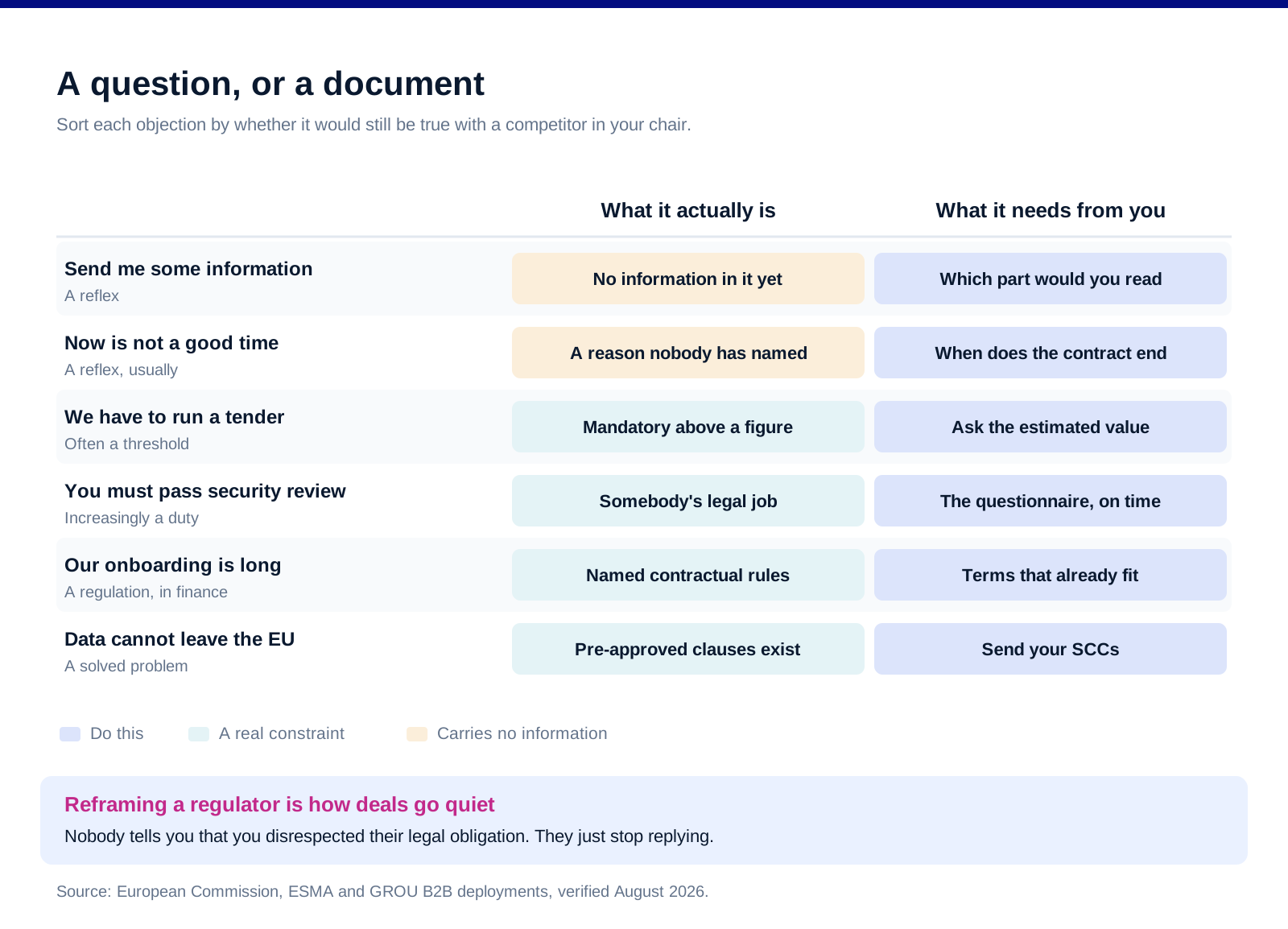
A reflex is about the conversation. "Send me some information." "We are all set." "Not right now." These are responses to being sold to rather than statements about the business, and they carry almost no information until you ask a question.
A constraint is about the buyer's world. A procurement threshold, a security standard, a regulator, a contract that runs until March. These exist whether or not you called, and they do not move because you were persuasive.
The test is simple. Ask yourself whether the objection would still be true if a competitor were sitting in your chair. If yes, it is a constraint. If it only exists because you are the one asking, it is a reflex.
Reflexes need a question, not an answer. Answering a reflex is how you end up handling four objections that were never real, while the actual one stays unsaid.
Constraints need a fact, and usually a document. The security questionnaire, the DPA, the SCCs, the ISO certificate, the reference from a similar regulated buyer.
Getting this backwards is the expensive error. Reframing a legal obligation tells the buyer you either do not know their world or do not respect it. Nobody says that out loud. They just stop replying.
The objections that are actually law
"We have to put this out to tender"
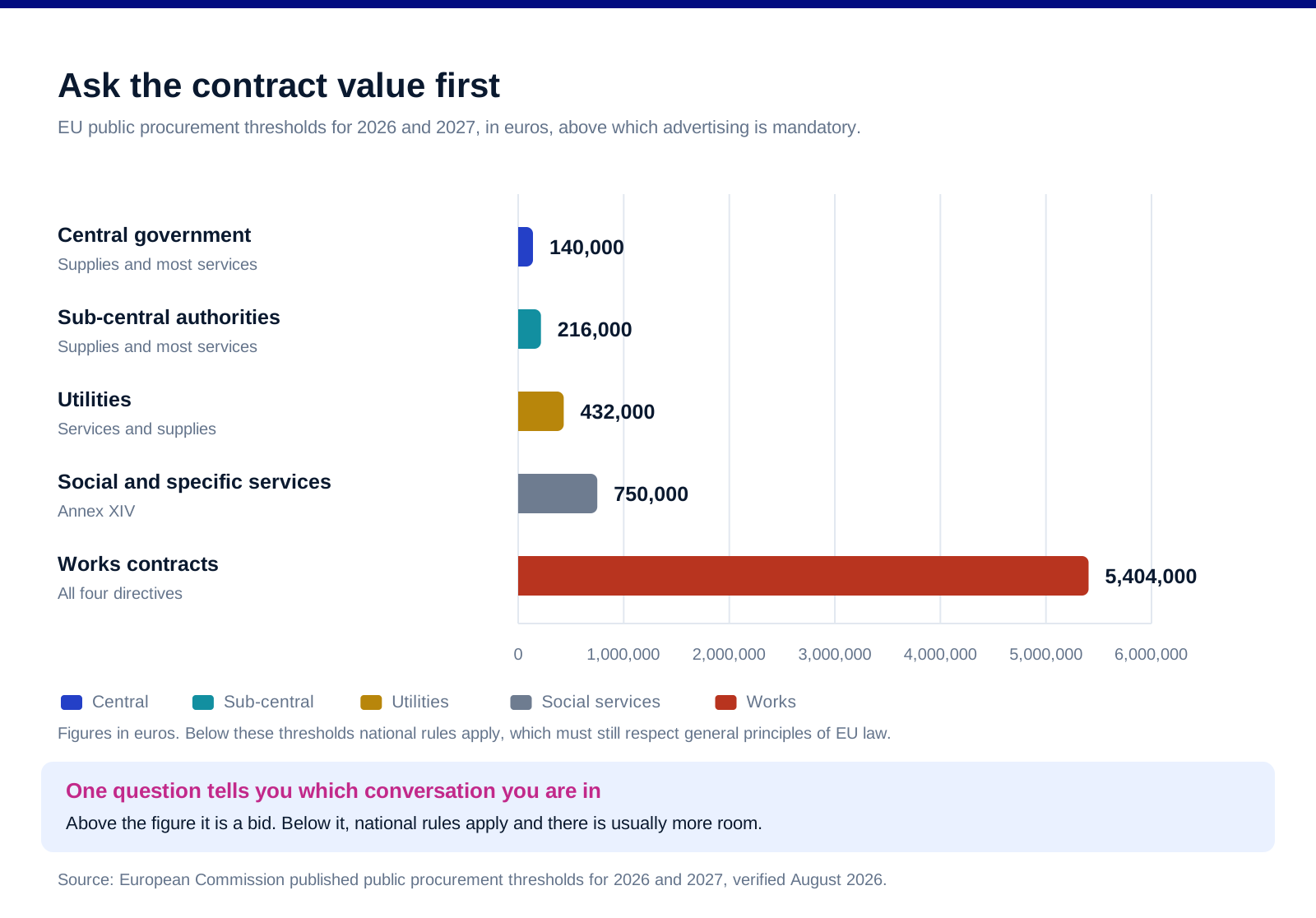
Sometimes a stall. Often a legal fact with a number attached. The European Commission's published thresholds put works contracts at 5,404,000 euros, supplies and other service contracts at 140,000 euros for central government authorities and 216,000 euros for sub-central ones, utilities at 432,000 euros, and social and specific services at 750,000 euros.
The useful move is not to argue. It is to ask what the estimated contract value is, because that single question tells you whether a tender is mandatory or optional, and therefore whether you are having a sales conversation or a bid conversation. Our construction and engineering playbook covers working published procurement data properly.
"You will have to pass our security review"
Not a stalling tactic for a large and growing population. NIS2, Directive 2022/2555, which "Member States had until 17 October 2024 to transpose" into national law, applies to medium-sized and large entities across 18 sectors including energy, transport, healthcare, finance, water, digital infrastructure, waste management, critical product manufacturing, postal and courier services, public administration and space. The Commission describes national strategies as including "policies for supply chain security".
If your buyer sits in one of those sectors, the security review is someone's job rather than an obstacle they invented. Treat the questionnaire as a deliverable with a named owner on your side and a turnaround time, and you will beat competitors who treat it as friction.
"Our vendor onboarding process is very long" (financial services)
For financial entities this usually has a name. DORA, Regulation (EU) 2022/2554, has applied since 17 January 2025 across 21 different types of financial entity. It requires a policy on "contractual arrangements on the use of ICT services supporting critical or important functions provided by ICT third-party service providers", a register of information on standard templates, and assessment obligations when ICT services are subcontracted.
So if you sell software to a bank, insurer or investment firm, the length of their onboarding is not a reflection of their enthusiasm. Asking early whether your service will be classified as supporting a critical or important function is one of the more useful qualifying questions available in that market.
"We cannot send data outside the EU"
This one has a pre-approved answer. The European Commission publishes standard contractual clauses, described as "Model contract clauses...that have been 'pre-approved' by the European Commission", which "can be used as a ground for data transfers from the EU to third countries" for transfers from controllers or processors in the EU or EEA to controllers or processors outside it.
Knowing that the instrument exists, and having your version of it ready to send, converts a hard stop into an administrative step. Nothing here is legal advice and the specifics of any transfer need proper review.
The pattern across all four
Each one has a document that ends the conversation faster than any technique. The estimated value, the completed questionnaire, the DORA-ready contractual terms, the executed SCCs.
And each one is a qualification signal you get for free. A buyer who raises a real constraint early is telling you how they buy, which is more useful than enthusiasm.
The reflexes, and the question for each
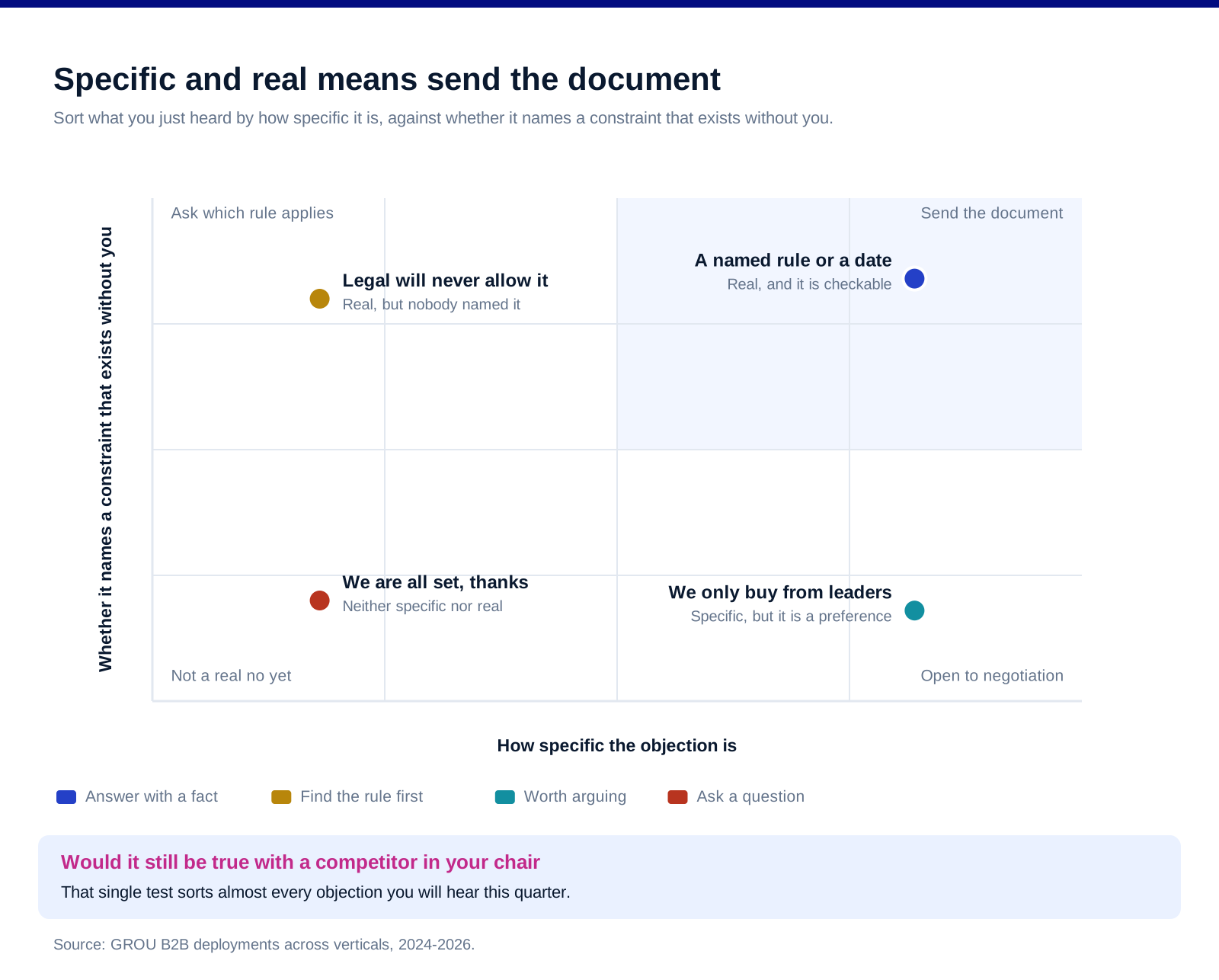
"Send me some information." Ask which part they would want to read first. If they cannot name one, there is no interest yet and the deck will not create it.
"We are already working with someone." Ask when the agreement runs to. Satisfaction is far less predictive than the renewal date, which our logistics playbook covers in a market where that is the whole game.
"It is too expensive." Ask what they are comparing it to. Half the time the comparison is doing nothing, which is a different conversation from a competitor's quote.
"Now is not a good time." Ask what would need to be true for it to be one. A real answer is a constraint you can diarise. No answer is a no.
"I need to talk to the team." Ask who else is involved and what they will want to know. This is the most useful reflex on the list because the answer maps the buying group.
Notice that every response is a question. That is not a trick. It is that a reflex contains no information, so answering it is answering something you have not yet learned.
Timing objections are usually contract objections
"Next quarter" almost never means next quarter. It means there is a reason now is impossible, and the reason is frequently a contract, a budget cycle or an internal project nobody has mentioned.
Ask for the date, not the reason. People will tell you when their agreement ends far more readily than they will tell you why they are hesitating.
Then treat the date as the asset. A prospect with a March renewal in your CRM is worth more than three prospects who said they were interested, and the work between now and March is being the obvious second call rather than sending more sequences.
What never works
Reframing a regulator. If the constraint is law, the only move is to satisfy it.
Arguing with a stated budget. You can ask what the budget covers and who set it, which sometimes reveals it is a placeholder. Telling someone their budget is wrong does not.
Handling four objections in a row. After the second, you are no longer in a conversation. Stop and ask what would make this worth continuing.
Pretending the security questionnaire is unusual. It is not, it is increasingly a legal duty, and the flinch is visible.
What we do not publish here
Objection frequency or win rate benchmarks. Ours come from our own client mix and offers and would not predict yours, and the public figures come from companies selling sales software.
Scripts. A script for a constraint is wrong by definition, and a script for a reflex is worse than the question it replaces.
A ranking of objection-handling frameworks. We have not run a comparable evaluation and would be asserting a preference as a finding.
Legal guidance for your buyer's situation. Everything above is quoted from the publishing institution and linked. What applies to a specific deal depends on facts we do not have.
FAQ
What is the difference between an objection and a constraint?
An objection is a response to being sold to. A constraint is a fact about the buyer's business that exists whether or not you called. The quick test is whether it would still be true if a competitor were in your chair. Constraints need documents. Objections need questions.
How do you handle "we have to run a tender"?
Ask for the estimated contract value first. Above the published EU thresholds, advertising is mandatory rather than discretionary, and the thresholds for 2026 and 2027 are 5,404,000 euros for works, 140,000 for central government supplies and services, 216,000 for sub-central, and 432,000 for utilities. Below them, national rules apply and there is often more room than the buyer implies.
Is a long security review a real objection or a brush-off?
Increasingly real. NIS2 had a transposition deadline of 17 October 2024 and covers medium-sized and large entities across 18 sectors. For financial entities, DORA has applied since 17 January 2025 and imposes specific requirements on contractual arrangements with ICT third-party providers. Treat the questionnaire as a deliverable with an owner and a turnaround.
What do you say to "it is too expensive"?
Ask what they are comparing it to before you say anything about price. If the comparison is a competitor, you are in a value conversation. If it is doing nothing, you are in a business case conversation. Those need different answers and guessing wrong wastes the objection.
How many times should you handle the same objection?
Twice. After the second attempt you are arguing rather than selling. Stop, name it, and ask what would need to change for this to be worth continuing. The answer is either a real constraint you can work with or a polite no you can stop spending time on.
What is the most useful question to ask when someone stalls?
"When does your current agreement end?" It is specific, it is easy to answer, it is not about you, and the answer is the single most predictive thing you can learn about whether this deal is available at all.
Bottom line
Sort first. Ask whether the objection would still be true with a competitor in your chair, and let the answer decide whether you reach for a question or a document. The reflexes are all handled with questions, and the best of them is the renewal date, because it converts a vague stall into a diary entry. The constraints are handled with facts, and a surprising number of them are published: procurement thresholds with exact figures, a cybersecurity directive with a transposition date, a financial regulation with an application date, and a set of pre-approved contract clauses sitting on a Commission website. Sellers who know which is which look like people who understand the buyer's job. Sellers who reframe everything look like people who have read a book about selling.
Want the pipeline built rather than the objections rehearsed? Book a call with GROU. We run lead generation and outbound inside B2B revenue engines across verticals. If the problem is further upstream, our lead qualification piece covers catching this before it becomes an objection.
We are GROU, a B2B pipeline agency that runs lead generation, outbound, and LinkedIn content for clients across manufacturing, fintech, iGaming, software, and professional services. Nothing in this article is legal advice, every threshold and date quoted comes from the European institution that publishes it, and the objection framework reflects our own B2B deployments between 2024 and 2026, anonymized to protect client confidentiality.
Almost every objection-handling framework treats an objection as a psychological event. Acknowledge, isolate, reframe, close. It works, sometimes, because a lot of objections really are reflexes.
But some objections are not psychology at all. They are published rules with dates and thresholds attached, and the correct response to those is not a technique. It is a document.
TL;DR
Sort before you respond. A reflex is a reaction to being sold to and it needs a question. A constraint is a fact about the buyer's world and it needs an answer, usually a document. The costly mistake is treating a constraint as a reflex, because reframing a legal obligation reads as either ignorance or contempt and it ends the deal quietly. Several of the objections sellers hear most often are constraints with published rules behind them. "We have to run a tender" has a threshold: EU public procurement rules put works contracts at 5,404,000 euros and supplies and services at 140,000 euros for central government authorities and 216,000 for sub-central ones. "You have to pass our security review" is a legal duty for a large population under NIS2, which member states had until 17 October 2024 to transpose and which covers medium-sized and large entities across 18 sectors. "Our vendor onboarding is heavy" is, for financial entities, DORA, which has applied since 17 January 2025 and requires a policy on contractual arrangements for ICT services supporting critical or important functions. And "we cannot send data outside the EU" has a pre-approved answer in the Commission's standard contractual clauses. Know which is which before you open your mouth.
Sort before you respond
A reflex is about the conversation. "Send me some information." "We are all set." "Not right now." These are responses to being sold to rather than statements about the business, and they carry almost no information until you ask a question.
A constraint is about the buyer's world. A procurement threshold, a security standard, a regulator, a contract that runs until March. These exist whether or not you called, and they do not move because you were persuasive.
The test is simple. Ask yourself whether the objection would still be true if a competitor were sitting in your chair. If yes, it is a constraint. If it only exists because you are the one asking, it is a reflex.
Reflexes need a question, not an answer. Answering a reflex is how you end up handling four objections that were never real, while the actual one stays unsaid.
Constraints need a fact, and usually a document. The security questionnaire, the DPA, the SCCs, the ISO certificate, the reference from a similar regulated buyer.
Getting this backwards is the expensive error. Reframing a legal obligation tells the buyer you either do not know their world or do not respect it. Nobody says that out loud. They just stop replying.
The objections that are actually law
"We have to put this out to tender"
Sometimes a stall. Often a legal fact with a number attached. The European Commission's published thresholds put works contracts at 5,404,000 euros, supplies and other service contracts at 140,000 euros for central government authorities and 216,000 euros for sub-central ones, utilities at 432,000 euros, and social and specific services at 750,000 euros.
The useful move is not to argue. It is to ask what the estimated contract value is, because that single question tells you whether a tender is mandatory or optional, and therefore whether you are having a sales conversation or a bid conversation. Our construction and engineering playbook covers working published procurement data properly.
"You will have to pass our security review"
Not a stalling tactic for a large and growing population. NIS2, Directive 2022/2555, which "Member States had until 17 October 2024 to transpose" into national law, applies to medium-sized and large entities across 18 sectors including energy, transport, healthcare, finance, water, digital infrastructure, waste management, critical product manufacturing, postal and courier services, public administration and space. The Commission describes national strategies as including "policies for supply chain security".
If your buyer sits in one of those sectors, the security review is someone's job rather than an obstacle they invented. Treat the questionnaire as a deliverable with a named owner on your side and a turnaround time, and you will beat competitors who treat it as friction.
"Our vendor onboarding process is very long" (financial services)
For financial entities this usually has a name. DORA, Regulation (EU) 2022/2554, has applied since 17 January 2025 across 21 different types of financial entity. It requires a policy on "contractual arrangements on the use of ICT services supporting critical or important functions provided by ICT third-party service providers", a register of information on standard templates, and assessment obligations when ICT services are subcontracted.
So if you sell software to a bank, insurer or investment firm, the length of their onboarding is not a reflection of their enthusiasm. Asking early whether your service will be classified as supporting a critical or important function is one of the more useful qualifying questions available in that market.
"We cannot send data outside the EU"
This one has a pre-approved answer. The European Commission publishes standard contractual clauses, described as "Model contract clauses...that have been 'pre-approved' by the European Commission", which "can be used as a ground for data transfers from the EU to third countries" for transfers from controllers or processors in the EU or EEA to controllers or processors outside it.
Knowing that the instrument exists, and having your version of it ready to send, converts a hard stop into an administrative step. Nothing here is legal advice and the specifics of any transfer need proper review.
The pattern across all four
Each one has a document that ends the conversation faster than any technique. The estimated value, the completed questionnaire, the DORA-ready contractual terms, the executed SCCs.
And each one is a qualification signal you get for free. A buyer who raises a real constraint early is telling you how they buy, which is more useful than enthusiasm.
The reflexes, and the question for each
"Send me some information." Ask which part they would want to read first. If they cannot name one, there is no interest yet and the deck will not create it.
"We are already working with someone." Ask when the agreement runs to. Satisfaction is far less predictive than the renewal date, which our logistics playbook covers in a market where that is the whole game.
"It is too expensive." Ask what they are comparing it to. Half the time the comparison is doing nothing, which is a different conversation from a competitor's quote.
"Now is not a good time." Ask what would need to be true for it to be one. A real answer is a constraint you can diarise. No answer is a no.
"I need to talk to the team." Ask who else is involved and what they will want to know. This is the most useful reflex on the list because the answer maps the buying group.
Notice that every response is a question. That is not a trick. It is that a reflex contains no information, so answering it is answering something you have not yet learned.
Timing objections are usually contract objections
"Next quarter" almost never means next quarter. It means there is a reason now is impossible, and the reason is frequently a contract, a budget cycle or an internal project nobody has mentioned.
Ask for the date, not the reason. People will tell you when their agreement ends far more readily than they will tell you why they are hesitating.
Then treat the date as the asset. A prospect with a March renewal in your CRM is worth more than three prospects who said they were interested, and the work between now and March is being the obvious second call rather than sending more sequences.
What never works
Reframing a regulator. If the constraint is law, the only move is to satisfy it.
Arguing with a stated budget. You can ask what the budget covers and who set it, which sometimes reveals it is a placeholder. Telling someone their budget is wrong does not.
Handling four objections in a row. After the second, you are no longer in a conversation. Stop and ask what would make this worth continuing.
Pretending the security questionnaire is unusual. It is not, it is increasingly a legal duty, and the flinch is visible.
What we do not publish here
Objection frequency or win rate benchmarks. Ours come from our own client mix and offers and would not predict yours, and the public figures come from companies selling sales software.
Scripts. A script for a constraint is wrong by definition, and a script for a reflex is worse than the question it replaces.
A ranking of objection-handling frameworks. We have not run a comparable evaluation and would be asserting a preference as a finding.
Legal guidance for your buyer's situation. Everything above is quoted from the publishing institution and linked. What applies to a specific deal depends on facts we do not have.
FAQ
What is the difference between an objection and a constraint?
An objection is a response to being sold to. A constraint is a fact about the buyer's business that exists whether or not you called. The quick test is whether it would still be true if a competitor were in your chair. Constraints need documents. Objections need questions.
How do you handle "we have to run a tender"?
Ask for the estimated contract value first. Above the published EU thresholds, advertising is mandatory rather than discretionary, and the thresholds for 2026 and 2027 are 5,404,000 euros for works, 140,000 for central government supplies and services, 216,000 for sub-central, and 432,000 for utilities. Below them, national rules apply and there is often more room than the buyer implies.
Is a long security review a real objection or a brush-off?
Increasingly real. NIS2 had a transposition deadline of 17 October 2024 and covers medium-sized and large entities across 18 sectors. For financial entities, DORA has applied since 17 January 2025 and imposes specific requirements on contractual arrangements with ICT third-party providers. Treat the questionnaire as a deliverable with an owner and a turnaround.
What do you say to "it is too expensive"?
Ask what they are comparing it to before you say anything about price. If the comparison is a competitor, you are in a value conversation. If it is doing nothing, you are in a business case conversation. Those need different answers and guessing wrong wastes the objection.
How many times should you handle the same objection?
Twice. After the second attempt you are arguing rather than selling. Stop, name it, and ask what would need to change for this to be worth continuing. The answer is either a real constraint you can work with or a polite no you can stop spending time on.
What is the most useful question to ask when someone stalls?
"When does your current agreement end?" It is specific, it is easy to answer, it is not about you, and the answer is the single most predictive thing you can learn about whether this deal is available at all.
Bottom line
Sort first. Ask whether the objection would still be true with a competitor in your chair, and let the answer decide whether you reach for a question or a document. The reflexes are all handled with questions, and the best of them is the renewal date, because it converts a vague stall into a diary entry. The constraints are handled with facts, and a surprising number of them are published: procurement thresholds with exact figures, a cybersecurity directive with a transposition date, a financial regulation with an application date, and a set of pre-approved contract clauses sitting on a Commission website. Sellers who know which is which look like people who understand the buyer's job. Sellers who reframe everything look like people who have read a book about selling.
Want the pipeline built rather than the objections rehearsed? Book a call with GROU. We run lead generation and outbound inside B2B revenue engines across verticals. If the problem is further upstream, our lead qualification piece covers catching this before it becomes an objection.
We are GROU, a B2B pipeline agency that runs lead generation, outbound, and LinkedIn content for clients across manufacturing, fintech, iGaming, software, and professional services. Nothing in this article is legal advice, every threshold and date quoted comes from the European institution that publishes it, and the objection framework reflects our own B2B deployments between 2024 and 2026, anonymized to protect client confidentiality.
Almost every objection-handling framework treats an objection as a psychological event. Acknowledge, isolate, reframe, close. It works, sometimes, because a lot of objections really are reflexes.
But some objections are not psychology at all. They are published rules with dates and thresholds attached, and the correct response to those is not a technique. It is a document.
TL;DR
Sort before you respond. A reflex is a reaction to being sold to and it needs a question. A constraint is a fact about the buyer's world and it needs an answer, usually a document. The costly mistake is treating a constraint as a reflex, because reframing a legal obligation reads as either ignorance or contempt and it ends the deal quietly. Several of the objections sellers hear most often are constraints with published rules behind them. "We have to run a tender" has a threshold: EU public procurement rules put works contracts at 5,404,000 euros and supplies and services at 140,000 euros for central government authorities and 216,000 for sub-central ones. "You have to pass our security review" is a legal duty for a large population under NIS2, which member states had until 17 October 2024 to transpose and which covers medium-sized and large entities across 18 sectors. "Our vendor onboarding is heavy" is, for financial entities, DORA, which has applied since 17 January 2025 and requires a policy on contractual arrangements for ICT services supporting critical or important functions. And "we cannot send data outside the EU" has a pre-approved answer in the Commission's standard contractual clauses. Know which is which before you open your mouth.
Sort before you respond
A reflex is about the conversation. "Send me some information." "We are all set." "Not right now." These are responses to being sold to rather than statements about the business, and they carry almost no information until you ask a question.
A constraint is about the buyer's world. A procurement threshold, a security standard, a regulator, a contract that runs until March. These exist whether or not you called, and they do not move because you were persuasive.
The test is simple. Ask yourself whether the objection would still be true if a competitor were sitting in your chair. If yes, it is a constraint. If it only exists because you are the one asking, it is a reflex.
Reflexes need a question, not an answer. Answering a reflex is how you end up handling four objections that were never real, while the actual one stays unsaid.
Constraints need a fact, and usually a document. The security questionnaire, the DPA, the SCCs, the ISO certificate, the reference from a similar regulated buyer.
Getting this backwards is the expensive error. Reframing a legal obligation tells the buyer you either do not know their world or do not respect it. Nobody says that out loud. They just stop replying.
The objections that are actually law
"We have to put this out to tender"
Sometimes a stall. Often a legal fact with a number attached. The European Commission's published thresholds put works contracts at 5,404,000 euros, supplies and other service contracts at 140,000 euros for central government authorities and 216,000 euros for sub-central ones, utilities at 432,000 euros, and social and specific services at 750,000 euros.
The useful move is not to argue. It is to ask what the estimated contract value is, because that single question tells you whether a tender is mandatory or optional, and therefore whether you are having a sales conversation or a bid conversation. Our construction and engineering playbook covers working published procurement data properly.
"You will have to pass our security review"
Not a stalling tactic for a large and growing population. NIS2, Directive 2022/2555, which "Member States had until 17 October 2024 to transpose" into national law, applies to medium-sized and large entities across 18 sectors including energy, transport, healthcare, finance, water, digital infrastructure, waste management, critical product manufacturing, postal and courier services, public administration and space. The Commission describes national strategies as including "policies for supply chain security".
If your buyer sits in one of those sectors, the security review is someone's job rather than an obstacle they invented. Treat the questionnaire as a deliverable with a named owner on your side and a turnaround time, and you will beat competitors who treat it as friction.
"Our vendor onboarding process is very long" (financial services)
For financial entities this usually has a name. DORA, Regulation (EU) 2022/2554, has applied since 17 January 2025 across 21 different types of financial entity. It requires a policy on "contractual arrangements on the use of ICT services supporting critical or important functions provided by ICT third-party service providers", a register of information on standard templates, and assessment obligations when ICT services are subcontracted.
So if you sell software to a bank, insurer or investment firm, the length of their onboarding is not a reflection of their enthusiasm. Asking early whether your service will be classified as supporting a critical or important function is one of the more useful qualifying questions available in that market.
"We cannot send data outside the EU"
This one has a pre-approved answer. The European Commission publishes standard contractual clauses, described as "Model contract clauses...that have been 'pre-approved' by the European Commission", which "can be used as a ground for data transfers from the EU to third countries" for transfers from controllers or processors in the EU or EEA to controllers or processors outside it.
Knowing that the instrument exists, and having your version of it ready to send, converts a hard stop into an administrative step. Nothing here is legal advice and the specifics of any transfer need proper review.
The pattern across all four
Each one has a document that ends the conversation faster than any technique. The estimated value, the completed questionnaire, the DORA-ready contractual terms, the executed SCCs.
And each one is a qualification signal you get for free. A buyer who raises a real constraint early is telling you how they buy, which is more useful than enthusiasm.
The reflexes, and the question for each
"Send me some information." Ask which part they would want to read first. If they cannot name one, there is no interest yet and the deck will not create it.
"We are already working with someone." Ask when the agreement runs to. Satisfaction is far less predictive than the renewal date, which our logistics playbook covers in a market where that is the whole game.
"It is too expensive." Ask what they are comparing it to. Half the time the comparison is doing nothing, which is a different conversation from a competitor's quote.
"Now is not a good time." Ask what would need to be true for it to be one. A real answer is a constraint you can diarise. No answer is a no.
"I need to talk to the team." Ask who else is involved and what they will want to know. This is the most useful reflex on the list because the answer maps the buying group.
Notice that every response is a question. That is not a trick. It is that a reflex contains no information, so answering it is answering something you have not yet learned.
Timing objections are usually contract objections
"Next quarter" almost never means next quarter. It means there is a reason now is impossible, and the reason is frequently a contract, a budget cycle or an internal project nobody has mentioned.
Ask for the date, not the reason. People will tell you when their agreement ends far more readily than they will tell you why they are hesitating.
Then treat the date as the asset. A prospect with a March renewal in your CRM is worth more than three prospects who said they were interested, and the work between now and March is being the obvious second call rather than sending more sequences.
What never works
Reframing a regulator. If the constraint is law, the only move is to satisfy it.
Arguing with a stated budget. You can ask what the budget covers and who set it, which sometimes reveals it is a placeholder. Telling someone their budget is wrong does not.
Handling four objections in a row. After the second, you are no longer in a conversation. Stop and ask what would make this worth continuing.
Pretending the security questionnaire is unusual. It is not, it is increasingly a legal duty, and the flinch is visible.
What we do not publish here
Objection frequency or win rate benchmarks. Ours come from our own client mix and offers and would not predict yours, and the public figures come from companies selling sales software.
Scripts. A script for a constraint is wrong by definition, and a script for a reflex is worse than the question it replaces.
A ranking of objection-handling frameworks. We have not run a comparable evaluation and would be asserting a preference as a finding.
Legal guidance for your buyer's situation. Everything above is quoted from the publishing institution and linked. What applies to a specific deal depends on facts we do not have.
FAQ
What is the difference between an objection and a constraint?
An objection is a response to being sold to. A constraint is a fact about the buyer's business that exists whether or not you called. The quick test is whether it would still be true if a competitor were in your chair. Constraints need documents. Objections need questions.
How do you handle "we have to run a tender"?
Ask for the estimated contract value first. Above the published EU thresholds, advertising is mandatory rather than discretionary, and the thresholds for 2026 and 2027 are 5,404,000 euros for works, 140,000 for central government supplies and services, 216,000 for sub-central, and 432,000 for utilities. Below them, national rules apply and there is often more room than the buyer implies.
Is a long security review a real objection or a brush-off?
Increasingly real. NIS2 had a transposition deadline of 17 October 2024 and covers medium-sized and large entities across 18 sectors. For financial entities, DORA has applied since 17 January 2025 and imposes specific requirements on contractual arrangements with ICT third-party providers. Treat the questionnaire as a deliverable with an owner and a turnaround.
What do you say to "it is too expensive"?
Ask what they are comparing it to before you say anything about price. If the comparison is a competitor, you are in a value conversation. If it is doing nothing, you are in a business case conversation. Those need different answers and guessing wrong wastes the objection.
How many times should you handle the same objection?
Twice. After the second attempt you are arguing rather than selling. Stop, name it, and ask what would need to change for this to be worth continuing. The answer is either a real constraint you can work with or a polite no you can stop spending time on.
What is the most useful question to ask when someone stalls?
"When does your current agreement end?" It is specific, it is easy to answer, it is not about you, and the answer is the single most predictive thing you can learn about whether this deal is available at all.
Bottom line
Sort first. Ask whether the objection would still be true with a competitor in your chair, and let the answer decide whether you reach for a question or a document. The reflexes are all handled with questions, and the best of them is the renewal date, because it converts a vague stall into a diary entry. The constraints are handled with facts, and a surprising number of them are published: procurement thresholds with exact figures, a cybersecurity directive with a transposition date, a financial regulation with an application date, and a set of pre-approved contract clauses sitting on a Commission website. Sellers who know which is which look like people who understand the buyer's job. Sellers who reframe everything look like people who have read a book about selling.
Want the pipeline built rather than the objections rehearsed? Book a call with GROU. We run lead generation and outbound inside B2B revenue engines across verticals. If the problem is further upstream, our lead qualification piece covers catching this before it becomes an objection.
We are GROU, a B2B pipeline agency that runs lead generation, outbound, and LinkedIn content for clients across manufacturing, fintech, iGaming, software, and professional services. Nothing in this article is legal advice, every threshold and date quoted comes from the European institution that publishes it, and the objection framework reflects our own B2B deployments between 2024 and 2026, anonymized to protect client confidentiality.

Pipeline OS Newsletter
Build qualified pipeline
Get weekly tactics to generate demand, improve lead quality, and book more meetings.





Trusted by industry leaders
Trusted by industry leaders
Trusted by industry leaders
Ready to build qualified pipeline?
Ready to build qualified pipeline?
Ready to build qualified pipeline?
Book a call to see if we're the right fit, or take the 2-minute quiz to get a clear starting point.
Book a call to see if we're the right fit, or take the 2-minute quiz to get a clear starting point.
Book a call to see if we're the right fit, or take the 2-minute quiz to get a clear starting point.
" height="30.21639343089746px" id="hfGbXmQR2" width="30.216393430897455px"/></svg>)
Copyright © 2026 – All Right Reserved
Copyright © 2026 – All Right Reserved
Copyright © 2026 – All Right Reserved