%22%3E%3C/path%3E%3Cpath d=%22M 63.072 7.554 C 62.258 8.022 61.577 8.689 61.092 9.493 L 61.092 7.076 L 57.158 7.076 L 57.158 22.64 L 61.089 22.64 L 61.089 14.888 C 61.089 13.446 61.403 12.434 62.03 11.853 C 62.818 11.218 63.818 10.907 64.826 10.982 L 65.868 10.982 L 65.868 6.851 C 64.891 6.834 63.926 7.076 63.073 7.554 Z%22 fill=%22rgb(17,17,17)%22%3E%3C/path%3E%3Cpath d=%22M 78.916 7.82 C 76.363 6.49 73.321 6.49 70.768 7.82 C 69.562 8.473 68.564 9.451 67.888 10.644 C 67.167 11.931 66.803 13.387 66.834 14.862 C 66.804 16.332 67.157 17.785 67.86 19.077 C 68.515 20.267 69.494 21.246 70.684 21.901 C 71.924 22.576 73.318 22.92 74.73 22.898 C 76.164 22.918 77.58 22.575 78.846 21.901 C 80.062 21.247 81.073 20.27 81.768 19.077 C 82.506 17.797 82.88 16.339 82.85 14.862 C 82.88 13.389 82.517 11.934 81.797 10.647 C 81.12 9.455 80.122 8.477 78.917 7.824 M 78.803 14.862 C 78.829 15.739 78.636 16.608 78.241 17.391 C 77.903 18.046 77.38 18.588 76.738 18.95 C 76.124 19.293 75.432 19.472 74.729 19.47 C 73.668 19.497 72.648 19.061 71.934 18.276 C 71.139 17.323 70.741 16.1 70.823 14.862 C 70.741 13.62 71.149 12.395 71.959 11.45 C 72.687 10.667 73.715 10.233 74.783 10.256 C 75.859 10.236 76.894 10.67 77.635 11.45 C 78.464 12.387 78.884 13.616 78.801 14.864%22 fill=%22rgb(17,17,17)%22%3E%3C/path%3E%3Cpath d=%22M 95.906 7.076 L 95.906 15.646 C 95.975 16.68 95.643 17.701 94.979 18.498 C 94.311 19.184 93.379 19.547 92.422 19.495 C 91.475 19.544 90.553 19.18 89.894 18.498 C 89.23 17.701 88.898 16.68 88.967 15.646 L 88.967 7.076 L 85.033 7.076 L 85.033 16.207 C 85 17.449 85.275 18.68 85.834 19.79 C 86.327 20.75 87.095 21.542 88.039 22.065 C 89.033 22.594 90.145 22.861 91.271 22.838 C 92.188 22.847 93.095 22.65 93.926 22.263 C 94.708 21.905 95.388 21.36 95.906 20.675 L 95.906 22.645 L 99.865 22.645 L 99.865 7.076 Z%22 fill=%22rgb(17,17,17)%22%3E%3C/path%3E%3Cpath d=%22M 4.513 15.626 C 4.511 10.815 7.606 6.549 12.181 5.059 C 16.756 3.57 21.77 5.195 24.601 9.086 L 27.816 5.87 C 24.074 1.186 17.981 -0.943 12.137 0.393 C 6.292 1.728 1.728 6.292 0.393 12.137 C -0.943 17.981 1.186 24.074 5.87 27.816 L 9.085 24.601 C 6.214 22.512 4.515 19.177 4.513 15.626%22 fill=%22rgb(32,62,235)%22%3E%3C/path%3E%3Cpath d=%22M 17.114 14.343 L 13.354 18.01 L 13.354 18.026 L 21.071 18.026 L 11.412 27.609 L 17.389 27.609 L 23.999 21.081 L 23.999 28.316 L 24.005 28.316 L 27.967 24.393 L 27.967 14.343 Z%22 fill=%22rgb(32,62,235)%22%3E%3C/path%3E%3C/g%3E%3C/svg%3E) ×
× ××
××›
›
›
›
Construction and engineering lead generation 2026
Construction and engineering lead generation 2026
Construction and engineering lead generation 2026
Construction and engineering lead generation 2026
Construction and engineering lead generation 2026
Construction and engineering lead generation 2026

Author
Aljaz Peklaj

Most B2B lead generation advice assumes the buyer decides when to buy. In construction and engineering they largely do not. The project decides, the specification decides, and by the time anyone is talking to suppliers the decision has usually already been narrowed by a document written months earlier.
Which makes this one of the few B2B markets where a large share of your pipeline is published before you have made a single call. Above a threshold, European public buyers are legally required to advertise, and that advertising is free to read.
TL;DR
EU public procurement thresholds for 2026 and 2027 put works contracts at 5,404,000 euros, above which the contract must be advertised across the Union. Supplies and services sit far lower, at 140,000 euros for central government authorities and 216,000 for sub-central ones, so most component and engineering-services contracts clear the bar long before the headline works figure does. Those notices are published on TED, and the European Commission puts total EU public procurement at around 2 trillion euros, roughly 13.6% of GDP, across more than 250,000 public authorities. The practical consequence is that your public-sector pipeline is a data problem rather than a prospecting problem, and the highest-value notice type is the one most people ignore: the contract award notice, which tells you who won, at what value, and therefore when it comes up again. On the private side the equivalent lever is specification. If you are not in the specification, you are bidding on price against people who are, and that fight is decided before the tender is issued. Sell to the specifier, not the buyer, and measure your pipeline in projects rather than companies.
The pipeline is published, and most of it goes unread
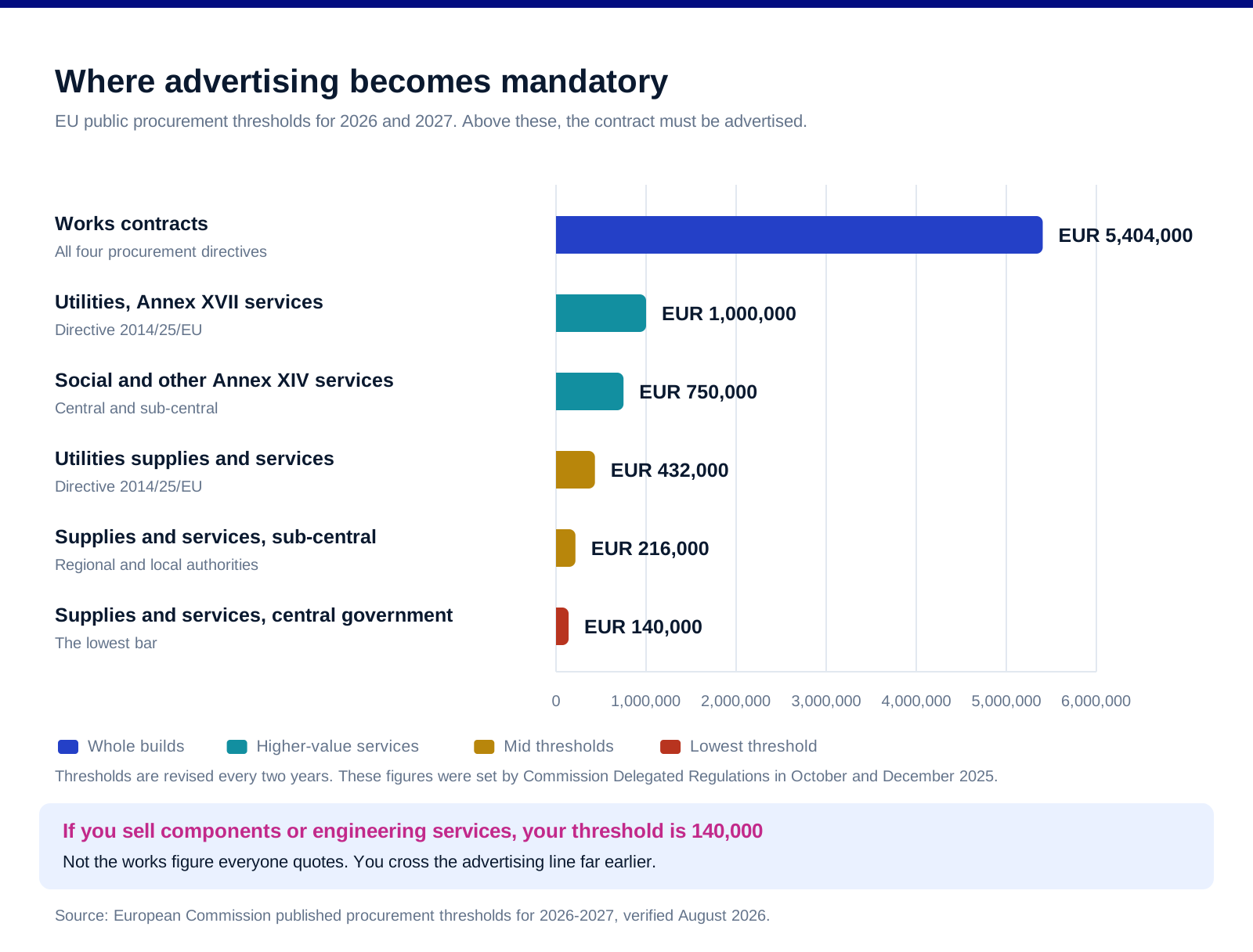
Works contracts must be advertised above 5,404,000 euros. The European Commission's published thresholds set that figure across all four procurement directives for 2026 and 2027, revised every two years.
The threshold that matters for most suppliers is much lower. Supplies and most services are 140,000 euros for central government authorities and 216,000 for sub-central ones. Utilities sit at 432,000. If you sell components, materials, testing, design or engineering services rather than whole builds, you cross the advertising threshold at a fraction of the works figure.
The volume behind that is not marginal. The Commission puts EU public authority spending at around 2 trillion euros, roughly 13.6% of GDP, across more than 250,000 public authorities.
All of it surfaces as notices. TED publishes several notice types depending on the procedure: competition notices telling bidders how the procedure will be carried out, contract award notices announcing the outcome and who signed, plus planning notices, design contests and contract modifications.
The Public Procurement Data Space connects the national portals to TED, launched on 24 September 2024, free of charge, though participation by member states is voluntary and use is not mandatory. That last part matters: coverage is good, not complete, and you should not treat any single source as the whole market.
Contract award notices are the underused half
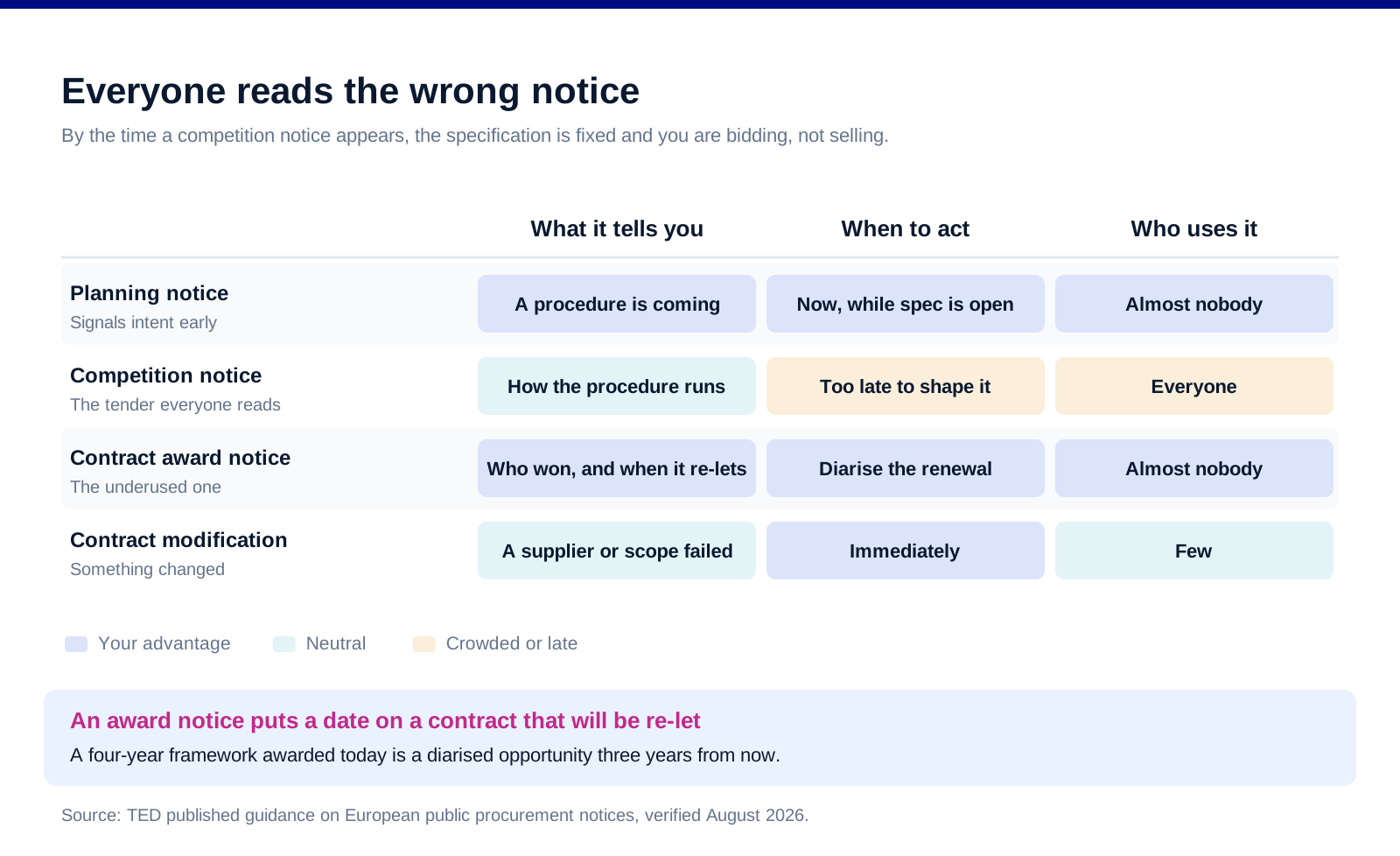
Everyone reads the competition notice, which is the worst time to arrive. By the time a tender is advertised, the requirement is written, the specification is fixed and your ability to influence either is close to zero. You are bidding, not selling.
The award notice is where the intelligence is. It names who won and the outcome of the procedure. Read consistently, it tells you which competitors win which kinds of work, at what scale, with which authorities, and it puts a date on a contract that will eventually be re-let.
That gives you the only reliable advance signal in this market: renewal timing. A framework awarded for four years is a diarised opportunity three years from now, and almost nobody in this category works that list.
Planning notices are the early warning. They exist to signal intent ahead of the procedure, which is precisely the window where a specification can still be influenced. Fewer buyers publish them, so treat them as a bonus rather than a system.
Modifications tell you when something has gone wrong. A contract modification is a supplier who could not deliver to the original scope, an authority whose requirements changed, or both. It is an opening.
Build the list from notices, then enrich it. Our account research workflow covers turning a source like this into something a rep can actually work.
Specification is the private-sector equivalent
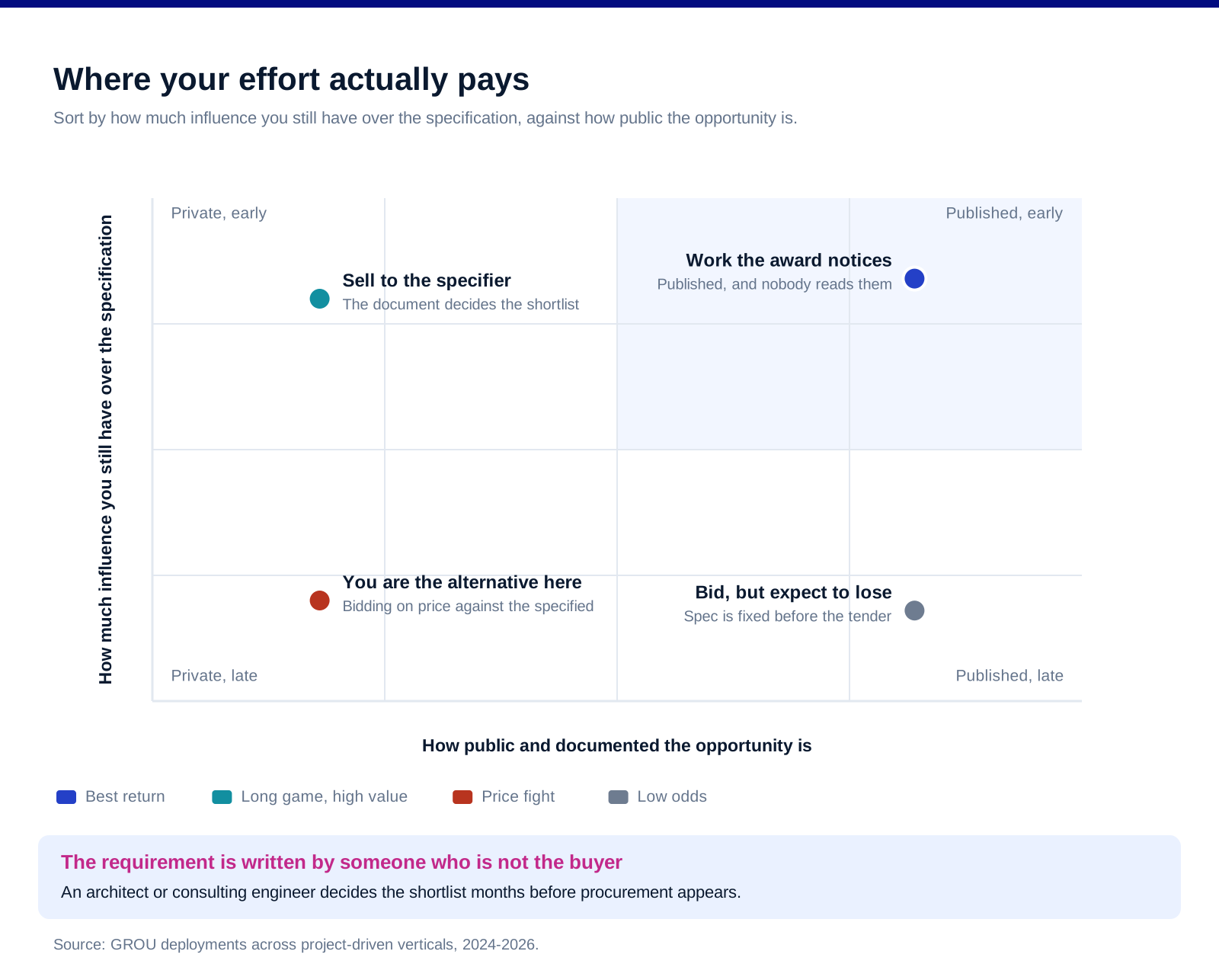
If you are not specified, you are the alternative. In construction and engineering the requirement is usually written by someone who is not the buyer: an architect, a consulting engineer, a main contractor's technical team, a specifier working to a standard. Whoever writes that document decides the shortlist.
So the commercial target and the commercial buyer are different people. The engineer who writes "or equivalent" after a competitor's product has already cost you the deal, and no amount of outreach to procurement will undo it.
That reorders the whole motion. Specifier relationships are a long game with no immediate transaction attached, which is exactly why most sellers under-invest in them and why the ones who do not have durable pipelines.
Technical content is the lead magnet that works here. Detail drawings, calculation tools, BIM objects, compliance documentation, installation specifications. Not thought leadership. The specifier is looking for something they can drop into a document, and whoever makes that easiest gets specified.
Measure in projects, not companies. A single main contractor is not an account; it is a source of many separate project decisions, often made by different people with no shared memory. Our manufacturing lead generation playbook covers the adjacent case where the buying is more centralised, and the contrast is instructive.
Running the motion
Work the notice feed weekly, not when you need pipeline. The list is continuous and the value is in seeing patterns across months rather than reacting to a single tender.
Split your targeting between specifiers and buyers, and message them completely differently. Specifiers want technical adequacy and low effort. Buyers want risk reduction and delivery certainty. The same email to both fails twice.
Get the compliance pack finished before you start. Certifications, test data, insurance, previous project references at comparable scale. In this sector the first qualifying question is whether you are eligible, and being slow to answer it reads as being unable to.
Expect long, discontinuous cycles. A project can go quiet for months for reasons that have nothing to do with you, then move in a week. Pressure applied during the quiet stretch reads as not understanding how projects work.
Do not confuse a framework place with revenue. Winning a place on a framework means you are allowed to compete. The call-off is the sale, and plenty of suppliers celebrate the wrong one.
FAQ
How do you generate leads for a construction company?
Start with published procurement data rather than cold prospecting. Above the EU thresholds, which for 2026 and 2027 are 5,404,000 euros for works and 140,000 or 216,000 euros for supplies and services depending on the authority, contracts must be advertised, so a substantial part of the market is readable. Then work specification relationships on the private side, because the requirement is usually written before any supplier conversation begins.
What is the EU procurement threshold for construction?
For 2026 and 2027, works contracts are 5,404,000 euros across all four procurement directives. Supplies and most services are 140,000 euros for central government authorities and 216,000 for sub-central authorities, with utilities at 432,000. Thresholds are revised every two years, so check the current figures rather than relying on a number you learned previously.
Where do you find construction tenders?
TED publishes notices for procurements above the EU thresholds, including competition notices, contract award notices, planning notices and contract modifications. The Public Procurement Data Space, launched in September 2024, connects national portals to TED and is free to use, though member state participation is voluntary so coverage is not complete.
Why do contract award notices matter for sales?
Because they tell you who won and therefore when the work comes up again. A four-year framework awarded today is a dated opportunity in three years, and almost nobody systematically works that list. Award notices also show which competitors win which kinds of work at which scale, which is competitive intelligence that costs nothing to collect.
How do you sell to specifiers rather than buyers?
Give them something they can put straight into a document. Detail drawings, calculations, BIM objects, compliance data and installation specifications, rather than marketing content. Specifiers are optimising for technical adequacy and low effort, and whoever makes specification easiest tends to get specified. The relationship has no immediate transaction attached, which is why it is under-served.
How long is a construction sales cycle?
Long and discontinuous, driven by project timelines rather than by buyer intent. We publish no benchmark figure because no credible cross-sector source exists and every number in circulation comes from a vendor survey. Plan for extended quiet periods that end abruptly, and resource the waiting rather than trying to compress it.
Bottom line
This is a market where the demand is documented and most sellers still prospect as though it is not. Read the notices, and read the award notices hardest, because they are the only place that reliably tells you when a contract will be back in play. Then accept that on the private side the decision has usually been shaped by a specifier before procurement ever appears, so build for the person writing the document rather than the person signing the order. Count projects rather than accounts, get the compliance pack done before you need it, and treat a framework place as permission to compete rather than as a win.
Want the pipeline built rather than the tender portal watched? Book a call with GROU. We run lead generation and outbound inside B2B revenue engines across verticals.
We are GROU, a B2B pipeline agency that runs lead generation, outbound, and LinkedIn content for clients across manufacturing, fintech, iGaming, software, and professional services. The targeting and sequencing guidance reflects our deployments across project-driven verticals between 2024 and 2026, anonymized to protect client confidentiality.
Most B2B lead generation advice assumes the buyer decides when to buy. In construction and engineering they largely do not. The project decides, the specification decides, and by the time anyone is talking to suppliers the decision has usually already been narrowed by a document written months earlier.
Which makes this one of the few B2B markets where a large share of your pipeline is published before you have made a single call. Above a threshold, European public buyers are legally required to advertise, and that advertising is free to read.
TL;DR
EU public procurement thresholds for 2026 and 2027 put works contracts at 5,404,000 euros, above which the contract must be advertised across the Union. Supplies and services sit far lower, at 140,000 euros for central government authorities and 216,000 for sub-central ones, so most component and engineering-services contracts clear the bar long before the headline works figure does. Those notices are published on TED, and the European Commission puts total EU public procurement at around 2 trillion euros, roughly 13.6% of GDP, across more than 250,000 public authorities. The practical consequence is that your public-sector pipeline is a data problem rather than a prospecting problem, and the highest-value notice type is the one most people ignore: the contract award notice, which tells you who won, at what value, and therefore when it comes up again. On the private side the equivalent lever is specification. If you are not in the specification, you are bidding on price against people who are, and that fight is decided before the tender is issued. Sell to the specifier, not the buyer, and measure your pipeline in projects rather than companies.
The pipeline is published, and most of it goes unread
Works contracts must be advertised above 5,404,000 euros. The European Commission's published thresholds set that figure across all four procurement directives for 2026 and 2027, revised every two years.
The threshold that matters for most suppliers is much lower. Supplies and most services are 140,000 euros for central government authorities and 216,000 for sub-central ones. Utilities sit at 432,000. If you sell components, materials, testing, design or engineering services rather than whole builds, you cross the advertising threshold at a fraction of the works figure.
The volume behind that is not marginal. The Commission puts EU public authority spending at around 2 trillion euros, roughly 13.6% of GDP, across more than 250,000 public authorities.
All of it surfaces as notices. TED publishes several notice types depending on the procedure: competition notices telling bidders how the procedure will be carried out, contract award notices announcing the outcome and who signed, plus planning notices, design contests and contract modifications.
The Public Procurement Data Space connects the national portals to TED, launched on 24 September 2024, free of charge, though participation by member states is voluntary and use is not mandatory. That last part matters: coverage is good, not complete, and you should not treat any single source as the whole market.
Contract award notices are the underused half
Everyone reads the competition notice, which is the worst time to arrive. By the time a tender is advertised, the requirement is written, the specification is fixed and your ability to influence either is close to zero. You are bidding, not selling.
The award notice is where the intelligence is. It names who won and the outcome of the procedure. Read consistently, it tells you which competitors win which kinds of work, at what scale, with which authorities, and it puts a date on a contract that will eventually be re-let.
That gives you the only reliable advance signal in this market: renewal timing. A framework awarded for four years is a diarised opportunity three years from now, and almost nobody in this category works that list.
Planning notices are the early warning. They exist to signal intent ahead of the procedure, which is precisely the window where a specification can still be influenced. Fewer buyers publish them, so treat them as a bonus rather than a system.
Modifications tell you when something has gone wrong. A contract modification is a supplier who could not deliver to the original scope, an authority whose requirements changed, or both. It is an opening.
Build the list from notices, then enrich it. Our account research workflow covers turning a source like this into something a rep can actually work.
Specification is the private-sector equivalent
If you are not specified, you are the alternative. In construction and engineering the requirement is usually written by someone who is not the buyer: an architect, a consulting engineer, a main contractor's technical team, a specifier working to a standard. Whoever writes that document decides the shortlist.
So the commercial target and the commercial buyer are different people. The engineer who writes "or equivalent" after a competitor's product has already cost you the deal, and no amount of outreach to procurement will undo it.
That reorders the whole motion. Specifier relationships are a long game with no immediate transaction attached, which is exactly why most sellers under-invest in them and why the ones who do not have durable pipelines.
Technical content is the lead magnet that works here. Detail drawings, calculation tools, BIM objects, compliance documentation, installation specifications. Not thought leadership. The specifier is looking for something they can drop into a document, and whoever makes that easiest gets specified.
Measure in projects, not companies. A single main contractor is not an account; it is a source of many separate project decisions, often made by different people with no shared memory. Our manufacturing lead generation playbook covers the adjacent case where the buying is more centralised, and the contrast is instructive.
Running the motion
Work the notice feed weekly, not when you need pipeline. The list is continuous and the value is in seeing patterns across months rather than reacting to a single tender.
Split your targeting between specifiers and buyers, and message them completely differently. Specifiers want technical adequacy and low effort. Buyers want risk reduction and delivery certainty. The same email to both fails twice.
Get the compliance pack finished before you start. Certifications, test data, insurance, previous project references at comparable scale. In this sector the first qualifying question is whether you are eligible, and being slow to answer it reads as being unable to.
Expect long, discontinuous cycles. A project can go quiet for months for reasons that have nothing to do with you, then move in a week. Pressure applied during the quiet stretch reads as not understanding how projects work.
Do not confuse a framework place with revenue. Winning a place on a framework means you are allowed to compete. The call-off is the sale, and plenty of suppliers celebrate the wrong one.
FAQ
How do you generate leads for a construction company?
Start with published procurement data rather than cold prospecting. Above the EU thresholds, which for 2026 and 2027 are 5,404,000 euros for works and 140,000 or 216,000 euros for supplies and services depending on the authority, contracts must be advertised, so a substantial part of the market is readable. Then work specification relationships on the private side, because the requirement is usually written before any supplier conversation begins.
What is the EU procurement threshold for construction?
For 2026 and 2027, works contracts are 5,404,000 euros across all four procurement directives. Supplies and most services are 140,000 euros for central government authorities and 216,000 for sub-central authorities, with utilities at 432,000. Thresholds are revised every two years, so check the current figures rather than relying on a number you learned previously.
Where do you find construction tenders?
TED publishes notices for procurements above the EU thresholds, including competition notices, contract award notices, planning notices and contract modifications. The Public Procurement Data Space, launched in September 2024, connects national portals to TED and is free to use, though member state participation is voluntary so coverage is not complete.
Why do contract award notices matter for sales?
Because they tell you who won and therefore when the work comes up again. A four-year framework awarded today is a dated opportunity in three years, and almost nobody systematically works that list. Award notices also show which competitors win which kinds of work at which scale, which is competitive intelligence that costs nothing to collect.
How do you sell to specifiers rather than buyers?
Give them something they can put straight into a document. Detail drawings, calculations, BIM objects, compliance data and installation specifications, rather than marketing content. Specifiers are optimising for technical adequacy and low effort, and whoever makes specification easiest tends to get specified. The relationship has no immediate transaction attached, which is why it is under-served.
How long is a construction sales cycle?
Long and discontinuous, driven by project timelines rather than by buyer intent. We publish no benchmark figure because no credible cross-sector source exists and every number in circulation comes from a vendor survey. Plan for extended quiet periods that end abruptly, and resource the waiting rather than trying to compress it.
Bottom line
This is a market where the demand is documented and most sellers still prospect as though it is not. Read the notices, and read the award notices hardest, because they are the only place that reliably tells you when a contract will be back in play. Then accept that on the private side the decision has usually been shaped by a specifier before procurement ever appears, so build for the person writing the document rather than the person signing the order. Count projects rather than accounts, get the compliance pack done before you need it, and treat a framework place as permission to compete rather than as a win.
Want the pipeline built rather than the tender portal watched? Book a call with GROU. We run lead generation and outbound inside B2B revenue engines across verticals.
We are GROU, a B2B pipeline agency that runs lead generation, outbound, and LinkedIn content for clients across manufacturing, fintech, iGaming, software, and professional services. The targeting and sequencing guidance reflects our deployments across project-driven verticals between 2024 and 2026, anonymized to protect client confidentiality.
Most B2B lead generation advice assumes the buyer decides when to buy. In construction and engineering they largely do not. The project decides, the specification decides, and by the time anyone is talking to suppliers the decision has usually already been narrowed by a document written months earlier.
Which makes this one of the few B2B markets where a large share of your pipeline is published before you have made a single call. Above a threshold, European public buyers are legally required to advertise, and that advertising is free to read.
TL;DR
EU public procurement thresholds for 2026 and 2027 put works contracts at 5,404,000 euros, above which the contract must be advertised across the Union. Supplies and services sit far lower, at 140,000 euros for central government authorities and 216,000 for sub-central ones, so most component and engineering-services contracts clear the bar long before the headline works figure does. Those notices are published on TED, and the European Commission puts total EU public procurement at around 2 trillion euros, roughly 13.6% of GDP, across more than 250,000 public authorities. The practical consequence is that your public-sector pipeline is a data problem rather than a prospecting problem, and the highest-value notice type is the one most people ignore: the contract award notice, which tells you who won, at what value, and therefore when it comes up again. On the private side the equivalent lever is specification. If you are not in the specification, you are bidding on price against people who are, and that fight is decided before the tender is issued. Sell to the specifier, not the buyer, and measure your pipeline in projects rather than companies.
The pipeline is published, and most of it goes unread
Works contracts must be advertised above 5,404,000 euros. The European Commission's published thresholds set that figure across all four procurement directives for 2026 and 2027, revised every two years.
The threshold that matters for most suppliers is much lower. Supplies and most services are 140,000 euros for central government authorities and 216,000 for sub-central ones. Utilities sit at 432,000. If you sell components, materials, testing, design or engineering services rather than whole builds, you cross the advertising threshold at a fraction of the works figure.
The volume behind that is not marginal. The Commission puts EU public authority spending at around 2 trillion euros, roughly 13.6% of GDP, across more than 250,000 public authorities.
All of it surfaces as notices. TED publishes several notice types depending on the procedure: competition notices telling bidders how the procedure will be carried out, contract award notices announcing the outcome and who signed, plus planning notices, design contests and contract modifications.
The Public Procurement Data Space connects the national portals to TED, launched on 24 September 2024, free of charge, though participation by member states is voluntary and use is not mandatory. That last part matters: coverage is good, not complete, and you should not treat any single source as the whole market.
Contract award notices are the underused half
Everyone reads the competition notice, which is the worst time to arrive. By the time a tender is advertised, the requirement is written, the specification is fixed and your ability to influence either is close to zero. You are bidding, not selling.
The award notice is where the intelligence is. It names who won and the outcome of the procedure. Read consistently, it tells you which competitors win which kinds of work, at what scale, with which authorities, and it puts a date on a contract that will eventually be re-let.
That gives you the only reliable advance signal in this market: renewal timing. A framework awarded for four years is a diarised opportunity three years from now, and almost nobody in this category works that list.
Planning notices are the early warning. They exist to signal intent ahead of the procedure, which is precisely the window where a specification can still be influenced. Fewer buyers publish them, so treat them as a bonus rather than a system.
Modifications tell you when something has gone wrong. A contract modification is a supplier who could not deliver to the original scope, an authority whose requirements changed, or both. It is an opening.
Build the list from notices, then enrich it. Our account research workflow covers turning a source like this into something a rep can actually work.
Specification is the private-sector equivalent
If you are not specified, you are the alternative. In construction and engineering the requirement is usually written by someone who is not the buyer: an architect, a consulting engineer, a main contractor's technical team, a specifier working to a standard. Whoever writes that document decides the shortlist.
So the commercial target and the commercial buyer are different people. The engineer who writes "or equivalent" after a competitor's product has already cost you the deal, and no amount of outreach to procurement will undo it.
That reorders the whole motion. Specifier relationships are a long game with no immediate transaction attached, which is exactly why most sellers under-invest in them and why the ones who do not have durable pipelines.
Technical content is the lead magnet that works here. Detail drawings, calculation tools, BIM objects, compliance documentation, installation specifications. Not thought leadership. The specifier is looking for something they can drop into a document, and whoever makes that easiest gets specified.
Measure in projects, not companies. A single main contractor is not an account; it is a source of many separate project decisions, often made by different people with no shared memory. Our manufacturing lead generation playbook covers the adjacent case where the buying is more centralised, and the contrast is instructive.
Running the motion
Work the notice feed weekly, not when you need pipeline. The list is continuous and the value is in seeing patterns across months rather than reacting to a single tender.
Split your targeting between specifiers and buyers, and message them completely differently. Specifiers want technical adequacy and low effort. Buyers want risk reduction and delivery certainty. The same email to both fails twice.
Get the compliance pack finished before you start. Certifications, test data, insurance, previous project references at comparable scale. In this sector the first qualifying question is whether you are eligible, and being slow to answer it reads as being unable to.
Expect long, discontinuous cycles. A project can go quiet for months for reasons that have nothing to do with you, then move in a week. Pressure applied during the quiet stretch reads as not understanding how projects work.
Do not confuse a framework place with revenue. Winning a place on a framework means you are allowed to compete. The call-off is the sale, and plenty of suppliers celebrate the wrong one.
FAQ
How do you generate leads for a construction company?
Start with published procurement data rather than cold prospecting. Above the EU thresholds, which for 2026 and 2027 are 5,404,000 euros for works and 140,000 or 216,000 euros for supplies and services depending on the authority, contracts must be advertised, so a substantial part of the market is readable. Then work specification relationships on the private side, because the requirement is usually written before any supplier conversation begins.
What is the EU procurement threshold for construction?
For 2026 and 2027, works contracts are 5,404,000 euros across all four procurement directives. Supplies and most services are 140,000 euros for central government authorities and 216,000 for sub-central authorities, with utilities at 432,000. Thresholds are revised every two years, so check the current figures rather than relying on a number you learned previously.
Where do you find construction tenders?
TED publishes notices for procurements above the EU thresholds, including competition notices, contract award notices, planning notices and contract modifications. The Public Procurement Data Space, launched in September 2024, connects national portals to TED and is free to use, though member state participation is voluntary so coverage is not complete.
Why do contract award notices matter for sales?
Because they tell you who won and therefore when the work comes up again. A four-year framework awarded today is a dated opportunity in three years, and almost nobody systematically works that list. Award notices also show which competitors win which kinds of work at which scale, which is competitive intelligence that costs nothing to collect.
How do you sell to specifiers rather than buyers?
Give them something they can put straight into a document. Detail drawings, calculations, BIM objects, compliance data and installation specifications, rather than marketing content. Specifiers are optimising for technical adequacy and low effort, and whoever makes specification easiest tends to get specified. The relationship has no immediate transaction attached, which is why it is under-served.
How long is a construction sales cycle?
Long and discontinuous, driven by project timelines rather than by buyer intent. We publish no benchmark figure because no credible cross-sector source exists and every number in circulation comes from a vendor survey. Plan for extended quiet periods that end abruptly, and resource the waiting rather than trying to compress it.
Bottom line
This is a market where the demand is documented and most sellers still prospect as though it is not. Read the notices, and read the award notices hardest, because they are the only place that reliably tells you when a contract will be back in play. Then accept that on the private side the decision has usually been shaped by a specifier before procurement ever appears, so build for the person writing the document rather than the person signing the order. Count projects rather than accounts, get the compliance pack done before you need it, and treat a framework place as permission to compete rather than as a win.
Want the pipeline built rather than the tender portal watched? Book a call with GROU. We run lead generation and outbound inside B2B revenue engines across verticals.
We are GROU, a B2B pipeline agency that runs lead generation, outbound, and LinkedIn content for clients across manufacturing, fintech, iGaming, software, and professional services. The targeting and sequencing guidance reflects our deployments across project-driven verticals between 2024 and 2026, anonymized to protect client confidentiality.

Pipeline OS Newsletter
Build qualified pipeline
Get weekly tactics to generate demand, improve lead quality, and book more meetings.





Trusted by industry leaders
Trusted by industry leaders
Trusted by industry leaders
Ready to build qualified pipeline?
Ready to build qualified pipeline?
Ready to build qualified pipeline?
Book a call to see if we're the right fit, or take the 2-minute quiz to get a clear starting point.
Book a call to see if we're the right fit, or take the 2-minute quiz to get a clear starting point.
Book a call to see if we're the right fit, or take the 2-minute quiz to get a clear starting point.
" height="30.21639343089746px" id="hfGbXmQR2" width="30.216393430897455px"/></svg>)
Copyright © 2026 – All Right Reserved
Copyright © 2026 – All Right Reserved
Copyright © 2026 – All Right Reserved