%22%3E%3C/path%3E%3Cpath d=%22M 63.072 7.554 C 62.258 8.022 61.577 8.689 61.092 9.493 L 61.092 7.076 L 57.158 7.076 L 57.158 22.64 L 61.089 22.64 L 61.089 14.888 C 61.089 13.446 61.403 12.434 62.03 11.853 C 62.818 11.218 63.818 10.907 64.826 10.982 L 65.868 10.982 L 65.868 6.851 C 64.891 6.834 63.926 7.076 63.073 7.554 Z%22 fill=%22rgb(17,17,17)%22%3E%3C/path%3E%3Cpath d=%22M 78.916 7.82 C 76.363 6.49 73.321 6.49 70.768 7.82 C 69.562 8.473 68.564 9.451 67.888 10.644 C 67.167 11.931 66.803 13.387 66.834 14.862 C 66.804 16.332 67.157 17.785 67.86 19.077 C 68.515 20.267 69.494 21.246 70.684 21.901 C 71.924 22.576 73.318 22.92 74.73 22.898 C 76.164 22.918 77.58 22.575 78.846 21.901 C 80.062 21.247 81.073 20.27 81.768 19.077 C 82.506 17.797 82.88 16.339 82.85 14.862 C 82.88 13.389 82.517 11.934 81.797 10.647 C 81.12 9.455 80.122 8.477 78.917 7.824 M 78.803 14.862 C 78.829 15.739 78.636 16.608 78.241 17.391 C 77.903 18.046 77.38 18.588 76.738 18.95 C 76.124 19.293 75.432 19.472 74.729 19.47 C 73.668 19.497 72.648 19.061 71.934 18.276 C 71.139 17.323 70.741 16.1 70.823 14.862 C 70.741 13.62 71.149 12.395 71.959 11.45 C 72.687 10.667 73.715 10.233 74.783 10.256 C 75.859 10.236 76.894 10.67 77.635 11.45 C 78.464 12.387 78.884 13.616 78.801 14.864%22 fill=%22rgb(17,17,17)%22%3E%3C/path%3E%3Cpath d=%22M 95.906 7.076 L 95.906 15.646 C 95.975 16.68 95.643 17.701 94.979 18.498 C 94.311 19.184 93.379 19.547 92.422 19.495 C 91.475 19.544 90.553 19.18 89.894 18.498 C 89.23 17.701 88.898 16.68 88.967 15.646 L 88.967 7.076 L 85.033 7.076 L 85.033 16.207 C 85 17.449 85.275 18.68 85.834 19.79 C 86.327 20.75 87.095 21.542 88.039 22.065 C 89.033 22.594 90.145 22.861 91.271 22.838 C 92.188 22.847 93.095 22.65 93.926 22.263 C 94.708 21.905 95.388 21.36 95.906 20.675 L 95.906 22.645 L 99.865 22.645 L 99.865 7.076 Z%22 fill=%22rgb(17,17,17)%22%3E%3C/path%3E%3Cpath d=%22M 4.513 15.626 C 4.511 10.815 7.606 6.549 12.181 5.059 C 16.756 3.57 21.77 5.195 24.601 9.086 L 27.816 5.87 C 24.074 1.186 17.981 -0.943 12.137 0.393 C 6.292 1.728 1.728 6.292 0.393 12.137 C -0.943 17.981 1.186 24.074 5.87 27.816 L 9.085 24.601 C 6.214 22.512 4.515 19.177 4.513 15.626%22 fill=%22rgb(32,62,235)%22%3E%3C/path%3E%3Cpath d=%22M 17.114 14.343 L 13.354 18.01 L 13.354 18.026 L 21.071 18.026 L 11.412 27.609 L 17.389 27.609 L 23.999 21.081 L 23.999 28.316 L 24.005 28.316 L 27.967 24.393 L 27.967 14.343 Z%22 fill=%22rgb(32,62,235)%22%3E%3C/path%3E%3C/g%3E%3C/svg%3E) ×
× ××
××›
›
›
›
10 product marketing strategies for B2B teams in 2026
10 product marketing strategies for B2B teams in 2026
10 product marketing strategies for B2B teams in 2026
10 product marketing strategies for B2B teams in 2026
10 product marketing strategies for B2B teams in 2026
10 product marketing strategies for B2B teams in 2026

Author
Aljaz Peklaj

Your pipeline looks busy, but the meetings aren't turning into real opportunities. More volume won't fix a weak message, a vague ICP, or a buying group that doesn't trust the sender. Structure turns attention into pipeline, and these product marketing strategies are ranked by qualified pipeline, not by activity.
Run demand generation and outbound together from day one of a market entry.
Anchor outreach to a real event, because invitations get replies that meeting requests don't.
Pair LinkedIn and email with one message and one target list.
Fix ICP fit and pain urgency before adding outreach volume.
Use LinkedIn content to give cold outreach a credible sender.
Table of Contents
3. Pair LinkedIn and email with one message and one target list
5. Use LinkedIn authority content to support commercial campaigns
8. Create category language when existing comparisons are wrong
1. Run demand generation and outbound from day one
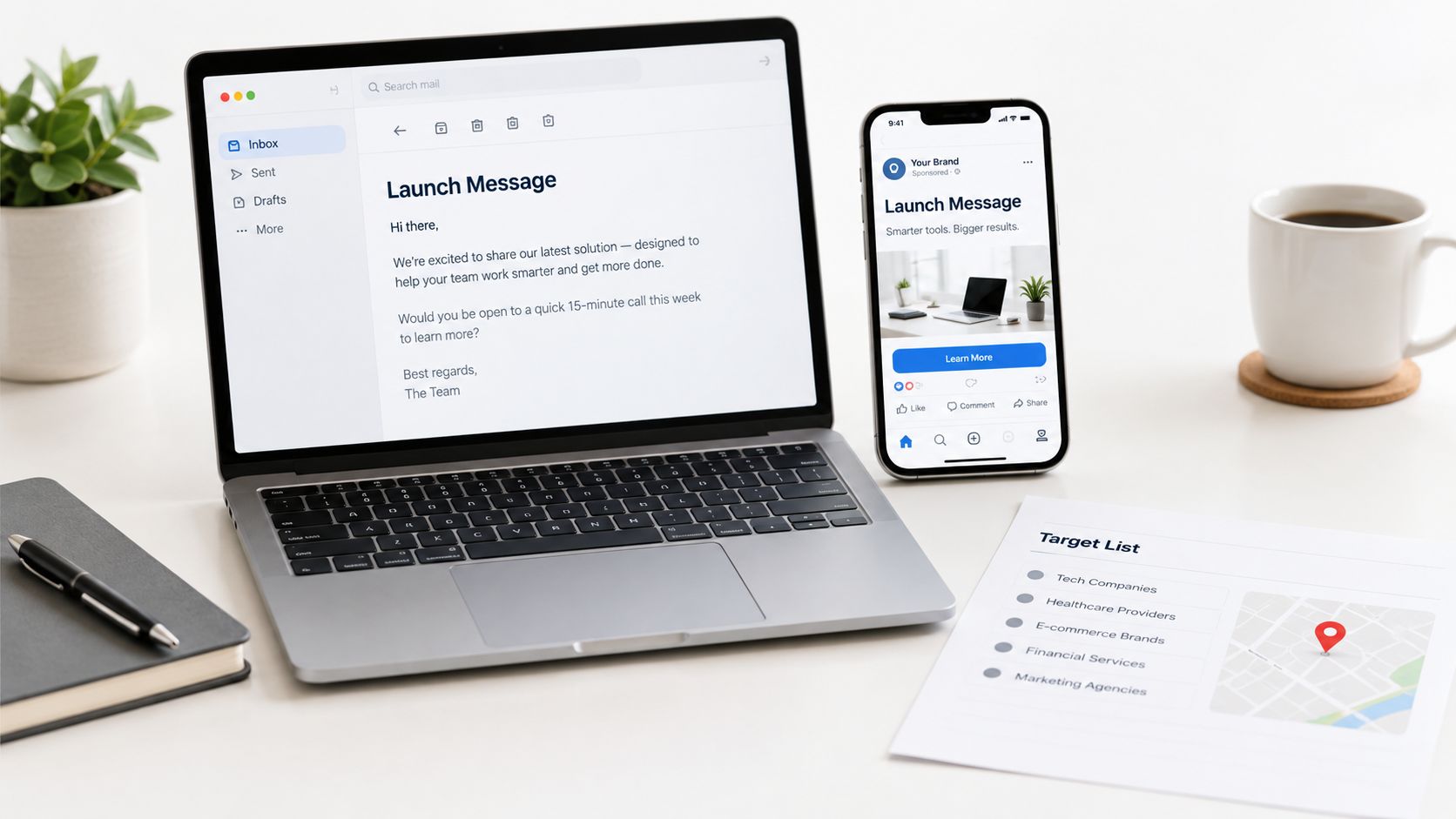
The strongest market-entry motion I've seen is simple. Put paid demand and outbound in the market at the same time, so awareness and outreach reinforce each other instead of taking turns. When ads make the name familiar first, outbound stops feeling cold.
AutoBrief did this in Croatia with paid Facebook and Instagram campaigns plus email outreach to the same audience. That mix produced 200+ leads, 19,000+ targeted website visits, and a 78% open rate on outreach, which is the kind of result you get when the same positioning shows up everywhere, not when teams wait for “awareness” to mature first.
What to do first
Launch ads and outreach in the same week. Use identical positioning in both, then track ad-driven site visits by company domain so your outbound team can reference actual engagement instead of guessing. Review the mix every two weeks and move budget toward the channel that produces qualified meetings, not the one that prints the most clicks.
Practical rule: if the ad copy and the outreach opener can't reuse the same sentence, the positioning isn't ready yet.
The core trade-off is speed versus noise. Running both motions together takes more coordination, but it prevents the dead zone where sales keeps waiting for marketing and marketing keeps waiting for “enough demand.”
For teams planning a launch or entering a new region, start with when to start outbound and make sure the first touch and the first paid impression are saying the same thing.
2. Anchor outreach to a real event
Cold outreach asks for attention with no reason attached. Event-led outreach gives the buyer a reason to reply that doesn't feel like a pitch, and that changes the whole exchange.
The pattern shows up across very different industries. Plastit's five campaigns averaged a 7.9% reply rate, and the trade-show campaign reached 16.0%. Precision Resource combined trade-show sequencing with always-on campaigns across 6 European markets and produced 300+ conversations plus a 20.2% top campaign reply rate. EY's live business breakfast invitations generated 104 warm leads across 4 events, with a 24.5% reply rate and a 62.3% LinkedIn acceptance rate.
A practical event sequence starts before the event, not on the morning of it. Build the target list from exhibitor or speaker lists, then match it against your ICP. The opener should sound like you're already participating, not asking for calendar charity.
Use this line of thinking: “see you at the show” lands better than “can we book a call?”
The trade-off is clear. Event-led outreach gives you relevance, but only if your list is tight. If the event is broad and your targeting is sloppy, you just create a fancier version of the same cold email.
A useful planning reference is this product launch event planning guide, especially if your team needs to turn a show or hosted event into a real commercial sequence.
3. Pair LinkedIn and email with one message and one target list
Senior buyers don't live in one inbox. If you only test intent in email, you'll miss the fact that the same person may need a LinkedIn touch before they'll take the second step seriously.
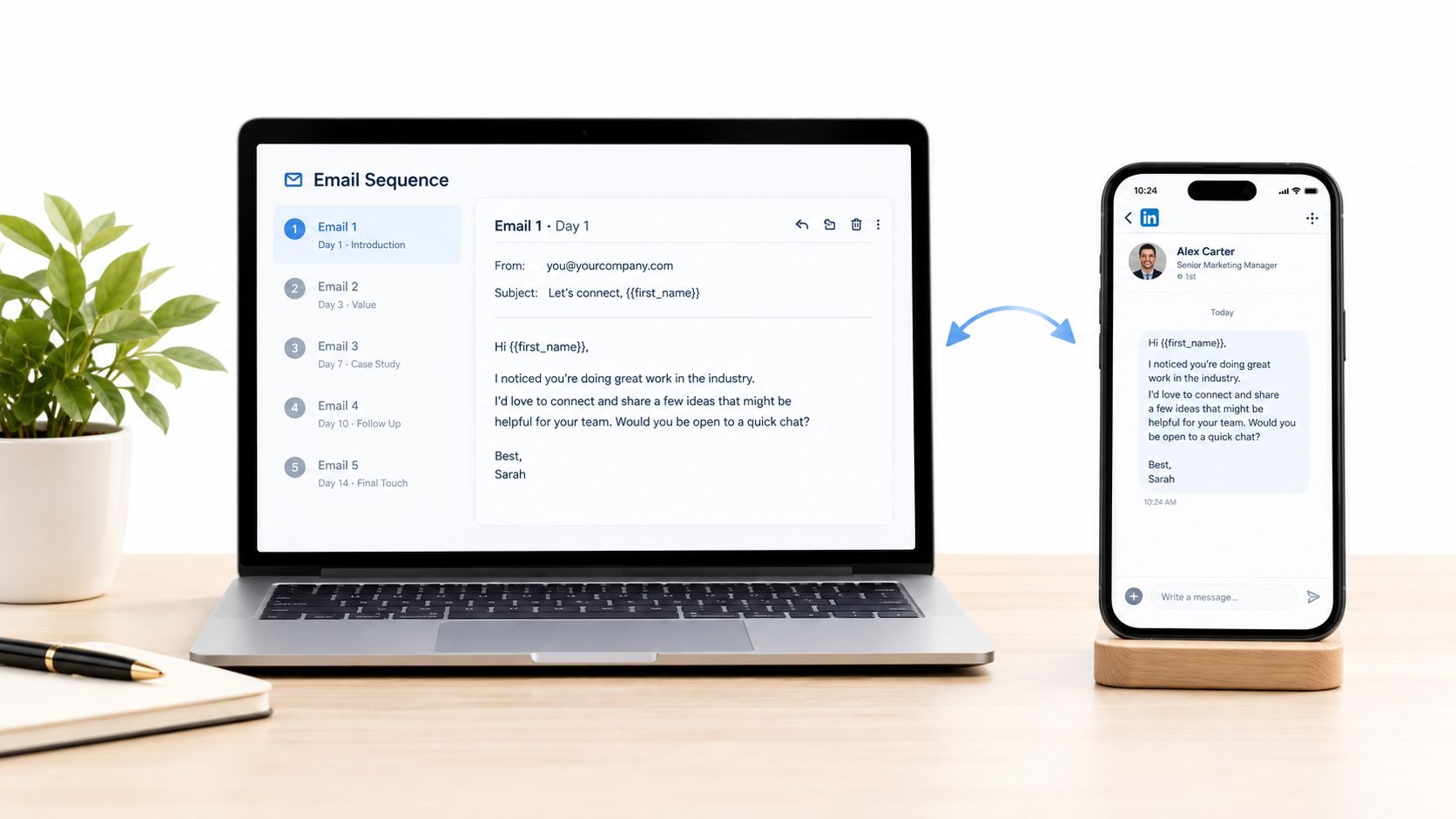
MBF's regional conference program across Croatia, Slovenia, Serbia, and Bosnia and Herzegovina ran 24 campaigns and produced 350 qualified leads and 2,245 conversations. The weak link was email-only outreach. Once LinkedIn and email carried the same message, the second touch felt familiar instead of random.
Sequencing that actually works
Day one should be the LinkedIn connection request. Day two should be the first email, and both should point to the same pain point. Keep the subject line and the LinkedIn opener tied to one problem, not three. That consistency matters more than polish, because the buyer is checking whether you understand their context.
Use multi-channel outreach as a system, not a channel count. Stay within conservative daily invitation and send limits, or account health will become your hidden bottleneck.
The trade-off here is effort. Multichannel sequencing takes more setup, but it usually beats single-thread outreach because each touch gives the next one a little more credibility. For B2B teams selling into manufacturing, SaaS, pharma, legal tech, or iGaming, that extra familiarity is often the difference between a reply and a delete.
4. Tighten ICP fit and pain urgency before adding volume
When replies go up but buying intent stays low, many teams add more volume. That usually creates more conversations that go nowhere. The better move is to tighten the ICP and make the pain sharper before you spend another dollar or send another sequence.
Joan's eight LinkedIn campaigns generated 489 conversations and 57 interested leads. The data showed weak ICP fit and low pain urgency, so the targeting had to be fixed before more volume made the problem bigger.
Start by comparing interested leads to conversations for each segment, not just total replies. Then rewrite the ICP with a named pain and a trigger event before the next campaign launches. If you enrich accounts in Apollo or Clay before they enter the sequence, you give the team a better shot at reaching the people who feel the problem.
Rule of thumb: if the target account has the title but not the trigger, the reply may be polite but it won't be commercial.
A practical way to keep this honest is to read the ICP definition guide before you scale the list. The question isn't whether more people replied. The question is whether more of the right accounts are moving toward a conversation that sales can use.
You can also pressure-test the shape of the list against segmenting 4,000 customer records, especially if your CRM has been treated like a dumping ground for a while. Segmentation is not decoration. It's how you avoid paying for volume that never had a buying reason.
5. Use LinkedIn authority content to support commercial campaigns
In credibility-driven markets, buyers check the sender before they reply. That means your LinkedIn presence isn't just brand polish, it's part of the outbound system. If the profile looks dormant, the sequence inherits the doubt.
Fazi grew its LinkedIn page to 30,000+ followers and built a 15,000-subscriber newsletter that supported commercial campaigns. The point isn't the follower count by itself. The point is that content made the sender verifiable before sales asked for time.

Build authority that helps sales
Write a 90-day content calendar where every post maps to one objection from closed-lost notes. Measure profile visits and connection acceptance from target accounts, not follower count. Then turn the strongest post into the opening line of an outbound sequence, so the same claim appears in public and private.
Use LinkedIn content strategy to keep the cadence steady. A post that explains a painful trade-off, a proof point, or a buying risk does more for pipeline than a generic company update ever will.
The trade-off is obvious. Content takes time before it pays off, but it makes every other motion easier to trust. For founders and heads of marketing in SaaS or iGaming, that trust often shortens the distance between first touch and first real reply.
6. Orchestrate accounts around named buying groups
Account-based marketing works when the buying group is known and concentrated. If the roles are identifiable, broad lead volume is the wrong input. You need role-level coverage, not just more names in a list.
Precision Resource ran campaigns across 6 European markets for a precision metal forming business, which is exactly the kind of environment where account orchestration matters more than raw list size. When the buyer set is focused, the message has to address the economic buyer, the technical evaluator, and the user with equal discipline.
Build the account motion around roles
Define the buying group before the account list. Set rules for who counts as covered, and only move an account to sales once at least two roles have replied. Review account engagement weekly in a shared dashboard so marketing and sales are looking at the same account, not separate activity streams.
The trade-off is control versus scale. Account-based orchestration usually moves slower than broad prospecting, but it gives you more influence in industries where a single champion can't buy alone. That matters in manufacturing, pharma, and legal tech, where committee logic is part of the sale.
A single persona page won't close a buying group. The account needs one narrative, but each role needs a different reason to support it.
7. Use product-led growth with a sales-assist handoff
Product-led growth works when the product shows intent before sales does. The key is to treat usage as a signal, then route the right accounts to a rep before the window closes.
Slack and Dropbox are widely cited for growing through team and referral adoption before enterprise sales existed. Calendly built its growth on a free tier that converted individual users into paid team plans. Those examples show the same pattern: the product creates the first proof, then sales steps in where the usage gets serious.
Practical rule: one activation event is enough if the handoff is fast and the routing rule is clean.
Define one activation event, such as inviting a teammate, and route accounts that hit it within 14 days to an SDR. Connect usage events to contact records in HubSpot so sales sees behavior, not just form fills. Keep a direct sales path for accounts above a seat threshold, because usage alone isn't enough if the deal has multi-seat potential.
The trade-off is visibility. Product-led motions can hide high intent until the team has already gone quiet. That's why the handoff has to be built into the system, not improvised when somebody notices a spike.
8. Create category language when existing comparisons are wrong
When buyers compare you against the wrong tools, every demo starts from the wrong frame. Category creation solves that by naming the problem and the solution in a way that makes your product the reference point.
Salesforce helped popularize the software-free SaaS model in its early positioning. HubSpot's inbound marketing category, set out in the 2009 book Inbound Marketing, grew into a full software market. In both cases, the company didn't just sell features, it changed the language buyers used to evaluate the product.
Use the category in the field
Write the category definition in one sentence and use it in every outbound opener for 90 days. Name the two competitors buyers compare you against, then state where your category diverges. Test the positioning in a LinkedIn post before rewriting the website, because you'll learn faster from comments and replies than from a page draft.
A useful companion reference is product video production, especially if you need the category to be understood quickly in motion and not just in copy.
The trade-off is risk. Category creation can confuse people if the market is too early or the language is too abstract. But for products that don't fit neatly into existing buckets, that risk is often smaller than staying trapped inside someone else's comparison set.
9. Build community-led growth for practitioner audiences
Practitioner communities work because buyers like hearing from peers before they hear from vendors. The community gives them a reason to return, and the trust inside it can become a quiet source of referrals and warm intros.
HubSpot's user community forums have long shown how peer support can feed adoption and referrals. Figma's user community is often cited for how practitioners create content that brings in new users. The pattern is simple. People show up for practical answers, then stay because the community keeps being useful.
Keep the community useful first
Publish a monthly benchmark from anonymized client data so members have a reason to return. Track community-sourced referrals as a separate source in the CRM. Keep promotional posts below one in five, or the group stops feeling like a place worth checking.
The trade-off is patience. Community-led growth isn't fast, and it won't rescue weak targeting. But for RevOps and sales operations audiences, the quality of trust can be better than the quantity of traffic, because members often bring peers who already speak the same operational language.
That's why structure matters here too. If the community is just content distribution with a logo on top, it won't compound.
10. Route replies with speed-to-lead rules
Replies lose intent fast. If someone answers and waits a day, the moment is gone and the buyer has usually moved on. A routing system with clear qualification rules keeps the conversation alive while the interest is still real.
Drift popularized conversational marketing by routing chat replies to sales in real time. Grou builds reply routing with qualification rules so sales spends time closing rather than chasing. That's the difference between a responsive system and a pile of unread intent.
Build the routing logic
Set a response target of one business hour for positive replies. Write the routing outcome into the same CRM field used for pipeline reporting. Review misclassified replies every week and adjust the rules so the system gets better instead of noisier.
Use speed to lead as an operating standard, not a vague promise. If a reply is positive, the handoff should be immediate and contextual. If the reply is negative or ambiguous, the next step should be clear enough that the SDR doesn't have to interpret it twice.
The trade-off is discipline. Fast routing exposes bad process quickly, which can be uncomfortable. But for teams that care about qualified pipeline, that discomfort is useful because it shows where the bottleneck resides.
Top 10 Product Marketing Strategies Compared
Item | 🔄 Implementation complexity | ⚡ Resource requirements | 📊 Expected outcomes | 💡 Ideal use cases | ⭐ Key advantages |
|---|---|---|---|---|---|
Run demand generation and outbound from day one | Medium, coordinate paid social + outbound and biweekly optimization | Paid media budget + SDR/outreach capacity, tracking and attribution tools | Faster brand familiarity, warmer replies, more qualified meetings (messy attribution) | New market or region launches where early awareness helps outreach | Shorter path to qualified conversations; ad data informs outreach |
Event-led outreach anchored to trade shows and hosted events | Medium, event timing, sequencing before/during/after | Access to attendee lists, sequencing resources, event coordination | Wave-driven spikes in replies and warm leads around event dates | When target buyers attend trade shows or client-hosted events | High relevance and reply rates; natural reason to engage |
Multichannel sequencing across LinkedIn and email | Medium, align messages and timing across channels | LinkedIn + email tools, reporting to track channel-level conversations | Higher response vs email-only; clearer channel insights | Senior decision-makers who use multiple channels | Multichannel warms prospects and improves conversion |
ICP fit and pain urgency before outreach volume | Low–Medium, scoring discipline and qualification rules | Data enrichment, segment analysis, reporting to track interest per conversation | Fewer low-intent replies; higher interest per conversation; slower scaling initially | When replies are high but actual buying intent is low | Preserves sender reputation and improves conversion efficiency |
LinkedIn authority content that supports commercial campaigns | Medium–High, consistent editorial output and newsletter management | Content creators, editorial calendar, newsletter tooling | Increased credibility and profile checks; slow, long-term pipeline attribution | Credibility-driven markets and long sales cycles | Builds trust that makes outreach more effective over time |
Account-based orchestration with named buying groups | High, deep account research and multi-thread orchestration | ABM tooling, research resources, sales–marketing alignment | Concentrated pipeline from target accounts; account-level attribution | Enterprise targets or concentrated buying groups with defined roles | Budget focus on closable accounts; aligned reporting and outreach |
Product-led growth with a sales-assist handoff | Medium–High, instrumented product analytics and onboarding flows | Product analytics, onboarding, CRM integration, SDR handoff processes | Lower CAC for signups; qualified leads from usage signals; slower for enterprise deals | B2B SaaS where product can demonstrate value through usage | Sales engages users who have already experienced value; data-driven outreach |
Category creation and positioning | High, sustained education, content and events over time | Significant content, PR, events and brand investment | Long-term shift in evaluation criteria; slow awareness buildup and unclear short-term pipeline | Companies with genuinely new methods that don't fit existing categories | Moves evaluation toward your strengths; reduces price-based comparisons |
Community-led growth for practitioner audiences | Medium, community management and recurring value programming | Community manager, platform (Slack/Discord/LinkedIn), content/events | Slow conversion but steady referrals and peer-driven trust; uncertain pipeline timing | Practitioner-heavy niches (RevOps, product ops, operator communities) | Low-cost trust-building and ongoing referral source |
Conversational speed-to-lead routing | Medium, routing rules, classification and handoff processes | Automation and booking tools, CRM fields, agreed qualification rules | Faster reply-to-meeting times, preserved sequence context, less manual triage | High-reply campaigns where response speed preserves intent | Shortens time to booked meetings and keeps sales focused on closing |
Start with the interested-lead ratio this Friday
Pull the last 30 days of sequence data and divide interested leads by conversations for each segment. If one segment sits well below the others, tighten its ICP before adding a single contact.
Add an interested-leads-per-conversation column to your CRM by Monday, then score your last two campaigns against it.
GROU is a B2B pipeline agency trusted by more than 50 companies across iGaming, SaaS, manufacturing and professional services. GROU runs every program on one message, one target list and one reporting line, reviewed in bi-weekly sprints.
If your pipeline is full of activity but short on qualified conversations, GROU can help you fix the system behind it. Visit Grou to see how one message, one target list, and one reporting line can turn attention into pipeline.
Your pipeline looks busy, but the meetings aren't turning into real opportunities. More volume won't fix a weak message, a vague ICP, or a buying group that doesn't trust the sender. Structure turns attention into pipeline, and these product marketing strategies are ranked by qualified pipeline, not by activity.
Run demand generation and outbound together from day one of a market entry.
Anchor outreach to a real event, because invitations get replies that meeting requests don't.
Pair LinkedIn and email with one message and one target list.
Fix ICP fit and pain urgency before adding outreach volume.
Use LinkedIn content to give cold outreach a credible sender.
Table of Contents
3. Pair LinkedIn and email with one message and one target list
5. Use LinkedIn authority content to support commercial campaigns
8. Create category language when existing comparisons are wrong
1. Run demand generation and outbound from day one
The strongest market-entry motion I've seen is simple. Put paid demand and outbound in the market at the same time, so awareness and outreach reinforce each other instead of taking turns. When ads make the name familiar first, outbound stops feeling cold.
AutoBrief did this in Croatia with paid Facebook and Instagram campaigns plus email outreach to the same audience. That mix produced 200+ leads, 19,000+ targeted website visits, and a 78% open rate on outreach, which is the kind of result you get when the same positioning shows up everywhere, not when teams wait for “awareness” to mature first.
What to do first
Launch ads and outreach in the same week. Use identical positioning in both, then track ad-driven site visits by company domain so your outbound team can reference actual engagement instead of guessing. Review the mix every two weeks and move budget toward the channel that produces qualified meetings, not the one that prints the most clicks.
Practical rule: if the ad copy and the outreach opener can't reuse the same sentence, the positioning isn't ready yet.
The core trade-off is speed versus noise. Running both motions together takes more coordination, but it prevents the dead zone where sales keeps waiting for marketing and marketing keeps waiting for “enough demand.”
For teams planning a launch or entering a new region, start with when to start outbound and make sure the first touch and the first paid impression are saying the same thing.
2. Anchor outreach to a real event
Cold outreach asks for attention with no reason attached. Event-led outreach gives the buyer a reason to reply that doesn't feel like a pitch, and that changes the whole exchange.
The pattern shows up across very different industries. Plastit's five campaigns averaged a 7.9% reply rate, and the trade-show campaign reached 16.0%. Precision Resource combined trade-show sequencing with always-on campaigns across 6 European markets and produced 300+ conversations plus a 20.2% top campaign reply rate. EY's live business breakfast invitations generated 104 warm leads across 4 events, with a 24.5% reply rate and a 62.3% LinkedIn acceptance rate.
A practical event sequence starts before the event, not on the morning of it. Build the target list from exhibitor or speaker lists, then match it against your ICP. The opener should sound like you're already participating, not asking for calendar charity.
Use this line of thinking: “see you at the show” lands better than “can we book a call?”
The trade-off is clear. Event-led outreach gives you relevance, but only if your list is tight. If the event is broad and your targeting is sloppy, you just create a fancier version of the same cold email.
A useful planning reference is this product launch event planning guide, especially if your team needs to turn a show or hosted event into a real commercial sequence.
3. Pair LinkedIn and email with one message and one target list
Senior buyers don't live in one inbox. If you only test intent in email, you'll miss the fact that the same person may need a LinkedIn touch before they'll take the second step seriously.
MBF's regional conference program across Croatia, Slovenia, Serbia, and Bosnia and Herzegovina ran 24 campaigns and produced 350 qualified leads and 2,245 conversations. The weak link was email-only outreach. Once LinkedIn and email carried the same message, the second touch felt familiar instead of random.
Sequencing that actually works
Day one should be the LinkedIn connection request. Day two should be the first email, and both should point to the same pain point. Keep the subject line and the LinkedIn opener tied to one problem, not three. That consistency matters more than polish, because the buyer is checking whether you understand their context.
Use multi-channel outreach as a system, not a channel count. Stay within conservative daily invitation and send limits, or account health will become your hidden bottleneck.
The trade-off here is effort. Multichannel sequencing takes more setup, but it usually beats single-thread outreach because each touch gives the next one a little more credibility. For B2B teams selling into manufacturing, SaaS, pharma, legal tech, or iGaming, that extra familiarity is often the difference between a reply and a delete.
4. Tighten ICP fit and pain urgency before adding volume
When replies go up but buying intent stays low, many teams add more volume. That usually creates more conversations that go nowhere. The better move is to tighten the ICP and make the pain sharper before you spend another dollar or send another sequence.
Joan's eight LinkedIn campaigns generated 489 conversations and 57 interested leads. The data showed weak ICP fit and low pain urgency, so the targeting had to be fixed before more volume made the problem bigger.
Start by comparing interested leads to conversations for each segment, not just total replies. Then rewrite the ICP with a named pain and a trigger event before the next campaign launches. If you enrich accounts in Apollo or Clay before they enter the sequence, you give the team a better shot at reaching the people who feel the problem.
Rule of thumb: if the target account has the title but not the trigger, the reply may be polite but it won't be commercial.
A practical way to keep this honest is to read the ICP definition guide before you scale the list. The question isn't whether more people replied. The question is whether more of the right accounts are moving toward a conversation that sales can use.
You can also pressure-test the shape of the list against segmenting 4,000 customer records, especially if your CRM has been treated like a dumping ground for a while. Segmentation is not decoration. It's how you avoid paying for volume that never had a buying reason.
5. Use LinkedIn authority content to support commercial campaigns
In credibility-driven markets, buyers check the sender before they reply. That means your LinkedIn presence isn't just brand polish, it's part of the outbound system. If the profile looks dormant, the sequence inherits the doubt.
Fazi grew its LinkedIn page to 30,000+ followers and built a 15,000-subscriber newsletter that supported commercial campaigns. The point isn't the follower count by itself. The point is that content made the sender verifiable before sales asked for time.
Build authority that helps sales
Write a 90-day content calendar where every post maps to one objection from closed-lost notes. Measure profile visits and connection acceptance from target accounts, not follower count. Then turn the strongest post into the opening line of an outbound sequence, so the same claim appears in public and private.
Use LinkedIn content strategy to keep the cadence steady. A post that explains a painful trade-off, a proof point, or a buying risk does more for pipeline than a generic company update ever will.
The trade-off is obvious. Content takes time before it pays off, but it makes every other motion easier to trust. For founders and heads of marketing in SaaS or iGaming, that trust often shortens the distance between first touch and first real reply.
6. Orchestrate accounts around named buying groups
Account-based marketing works when the buying group is known and concentrated. If the roles are identifiable, broad lead volume is the wrong input. You need role-level coverage, not just more names in a list.
Precision Resource ran campaigns across 6 European markets for a precision metal forming business, which is exactly the kind of environment where account orchestration matters more than raw list size. When the buyer set is focused, the message has to address the economic buyer, the technical evaluator, and the user with equal discipline.
Build the account motion around roles
Define the buying group before the account list. Set rules for who counts as covered, and only move an account to sales once at least two roles have replied. Review account engagement weekly in a shared dashboard so marketing and sales are looking at the same account, not separate activity streams.
The trade-off is control versus scale. Account-based orchestration usually moves slower than broad prospecting, but it gives you more influence in industries where a single champion can't buy alone. That matters in manufacturing, pharma, and legal tech, where committee logic is part of the sale.
A single persona page won't close a buying group. The account needs one narrative, but each role needs a different reason to support it.
7. Use product-led growth with a sales-assist handoff
Product-led growth works when the product shows intent before sales does. The key is to treat usage as a signal, then route the right accounts to a rep before the window closes.
Slack and Dropbox are widely cited for growing through team and referral adoption before enterprise sales existed. Calendly built its growth on a free tier that converted individual users into paid team plans. Those examples show the same pattern: the product creates the first proof, then sales steps in where the usage gets serious.
Practical rule: one activation event is enough if the handoff is fast and the routing rule is clean.
Define one activation event, such as inviting a teammate, and route accounts that hit it within 14 days to an SDR. Connect usage events to contact records in HubSpot so sales sees behavior, not just form fills. Keep a direct sales path for accounts above a seat threshold, because usage alone isn't enough if the deal has multi-seat potential.
The trade-off is visibility. Product-led motions can hide high intent until the team has already gone quiet. That's why the handoff has to be built into the system, not improvised when somebody notices a spike.
8. Create category language when existing comparisons are wrong
When buyers compare you against the wrong tools, every demo starts from the wrong frame. Category creation solves that by naming the problem and the solution in a way that makes your product the reference point.
Salesforce helped popularize the software-free SaaS model in its early positioning. HubSpot's inbound marketing category, set out in the 2009 book Inbound Marketing, grew into a full software market. In both cases, the company didn't just sell features, it changed the language buyers used to evaluate the product.
Use the category in the field
Write the category definition in one sentence and use it in every outbound opener for 90 days. Name the two competitors buyers compare you against, then state where your category diverges. Test the positioning in a LinkedIn post before rewriting the website, because you'll learn faster from comments and replies than from a page draft.
A useful companion reference is product video production, especially if you need the category to be understood quickly in motion and not just in copy.
The trade-off is risk. Category creation can confuse people if the market is too early or the language is too abstract. But for products that don't fit neatly into existing buckets, that risk is often smaller than staying trapped inside someone else's comparison set.
9. Build community-led growth for practitioner audiences
Practitioner communities work because buyers like hearing from peers before they hear from vendors. The community gives them a reason to return, and the trust inside it can become a quiet source of referrals and warm intros.
HubSpot's user community forums have long shown how peer support can feed adoption and referrals. Figma's user community is often cited for how practitioners create content that brings in new users. The pattern is simple. People show up for practical answers, then stay because the community keeps being useful.
Keep the community useful first
Publish a monthly benchmark from anonymized client data so members have a reason to return. Track community-sourced referrals as a separate source in the CRM. Keep promotional posts below one in five, or the group stops feeling like a place worth checking.
The trade-off is patience. Community-led growth isn't fast, and it won't rescue weak targeting. But for RevOps and sales operations audiences, the quality of trust can be better than the quantity of traffic, because members often bring peers who already speak the same operational language.
That's why structure matters here too. If the community is just content distribution with a logo on top, it won't compound.
10. Route replies with speed-to-lead rules
Replies lose intent fast. If someone answers and waits a day, the moment is gone and the buyer has usually moved on. A routing system with clear qualification rules keeps the conversation alive while the interest is still real.
Drift popularized conversational marketing by routing chat replies to sales in real time. Grou builds reply routing with qualification rules so sales spends time closing rather than chasing. That's the difference between a responsive system and a pile of unread intent.
Build the routing logic
Set a response target of one business hour for positive replies. Write the routing outcome into the same CRM field used for pipeline reporting. Review misclassified replies every week and adjust the rules so the system gets better instead of noisier.
Use speed to lead as an operating standard, not a vague promise. If a reply is positive, the handoff should be immediate and contextual. If the reply is negative or ambiguous, the next step should be clear enough that the SDR doesn't have to interpret it twice.
The trade-off is discipline. Fast routing exposes bad process quickly, which can be uncomfortable. But for teams that care about qualified pipeline, that discomfort is useful because it shows where the bottleneck resides.
Top 10 Product Marketing Strategies Compared
Item | 🔄 Implementation complexity | ⚡ Resource requirements | 📊 Expected outcomes | 💡 Ideal use cases | ⭐ Key advantages |
|---|---|---|---|---|---|
Run demand generation and outbound from day one | Medium, coordinate paid social + outbound and biweekly optimization | Paid media budget + SDR/outreach capacity, tracking and attribution tools | Faster brand familiarity, warmer replies, more qualified meetings (messy attribution) | New market or region launches where early awareness helps outreach | Shorter path to qualified conversations; ad data informs outreach |
Event-led outreach anchored to trade shows and hosted events | Medium, event timing, sequencing before/during/after | Access to attendee lists, sequencing resources, event coordination | Wave-driven spikes in replies and warm leads around event dates | When target buyers attend trade shows or client-hosted events | High relevance and reply rates; natural reason to engage |
Multichannel sequencing across LinkedIn and email | Medium, align messages and timing across channels | LinkedIn + email tools, reporting to track channel-level conversations | Higher response vs email-only; clearer channel insights | Senior decision-makers who use multiple channels | Multichannel warms prospects and improves conversion |
ICP fit and pain urgency before outreach volume | Low–Medium, scoring discipline and qualification rules | Data enrichment, segment analysis, reporting to track interest per conversation | Fewer low-intent replies; higher interest per conversation; slower scaling initially | When replies are high but actual buying intent is low | Preserves sender reputation and improves conversion efficiency |
LinkedIn authority content that supports commercial campaigns | Medium–High, consistent editorial output and newsletter management | Content creators, editorial calendar, newsletter tooling | Increased credibility and profile checks; slow, long-term pipeline attribution | Credibility-driven markets and long sales cycles | Builds trust that makes outreach more effective over time |
Account-based orchestration with named buying groups | High, deep account research and multi-thread orchestration | ABM tooling, research resources, sales–marketing alignment | Concentrated pipeline from target accounts; account-level attribution | Enterprise targets or concentrated buying groups with defined roles | Budget focus on closable accounts; aligned reporting and outreach |
Product-led growth with a sales-assist handoff | Medium–High, instrumented product analytics and onboarding flows | Product analytics, onboarding, CRM integration, SDR handoff processes | Lower CAC for signups; qualified leads from usage signals; slower for enterprise deals | B2B SaaS where product can demonstrate value through usage | Sales engages users who have already experienced value; data-driven outreach |
Category creation and positioning | High, sustained education, content and events over time | Significant content, PR, events and brand investment | Long-term shift in evaluation criteria; slow awareness buildup and unclear short-term pipeline | Companies with genuinely new methods that don't fit existing categories | Moves evaluation toward your strengths; reduces price-based comparisons |
Community-led growth for practitioner audiences | Medium, community management and recurring value programming | Community manager, platform (Slack/Discord/LinkedIn), content/events | Slow conversion but steady referrals and peer-driven trust; uncertain pipeline timing | Practitioner-heavy niches (RevOps, product ops, operator communities) | Low-cost trust-building and ongoing referral source |
Conversational speed-to-lead routing | Medium, routing rules, classification and handoff processes | Automation and booking tools, CRM fields, agreed qualification rules | Faster reply-to-meeting times, preserved sequence context, less manual triage | High-reply campaigns where response speed preserves intent | Shortens time to booked meetings and keeps sales focused on closing |
Start with the interested-lead ratio this Friday
Pull the last 30 days of sequence data and divide interested leads by conversations for each segment. If one segment sits well below the others, tighten its ICP before adding a single contact.
Add an interested-leads-per-conversation column to your CRM by Monday, then score your last two campaigns against it.
GROU is a B2B pipeline agency trusted by more than 50 companies across iGaming, SaaS, manufacturing and professional services. GROU runs every program on one message, one target list and one reporting line, reviewed in bi-weekly sprints.
If your pipeline is full of activity but short on qualified conversations, GROU can help you fix the system behind it. Visit Grou to see how one message, one target list, and one reporting line can turn attention into pipeline.
Your pipeline looks busy, but the meetings aren't turning into real opportunities. More volume won't fix a weak message, a vague ICP, or a buying group that doesn't trust the sender. Structure turns attention into pipeline, and these product marketing strategies are ranked by qualified pipeline, not by activity.
Run demand generation and outbound together from day one of a market entry.
Anchor outreach to a real event, because invitations get replies that meeting requests don't.
Pair LinkedIn and email with one message and one target list.
Fix ICP fit and pain urgency before adding outreach volume.
Use LinkedIn content to give cold outreach a credible sender.
Table of Contents
3. Pair LinkedIn and email with one message and one target list
5. Use LinkedIn authority content to support commercial campaigns
8. Create category language when existing comparisons are wrong
1. Run demand generation and outbound from day one
The strongest market-entry motion I've seen is simple. Put paid demand and outbound in the market at the same time, so awareness and outreach reinforce each other instead of taking turns. When ads make the name familiar first, outbound stops feeling cold.
AutoBrief did this in Croatia with paid Facebook and Instagram campaigns plus email outreach to the same audience. That mix produced 200+ leads, 19,000+ targeted website visits, and a 78% open rate on outreach, which is the kind of result you get when the same positioning shows up everywhere, not when teams wait for “awareness” to mature first.
What to do first
Launch ads and outreach in the same week. Use identical positioning in both, then track ad-driven site visits by company domain so your outbound team can reference actual engagement instead of guessing. Review the mix every two weeks and move budget toward the channel that produces qualified meetings, not the one that prints the most clicks.
Practical rule: if the ad copy and the outreach opener can't reuse the same sentence, the positioning isn't ready yet.
The core trade-off is speed versus noise. Running both motions together takes more coordination, but it prevents the dead zone where sales keeps waiting for marketing and marketing keeps waiting for “enough demand.”
For teams planning a launch or entering a new region, start with when to start outbound and make sure the first touch and the first paid impression are saying the same thing.
2. Anchor outreach to a real event
Cold outreach asks for attention with no reason attached. Event-led outreach gives the buyer a reason to reply that doesn't feel like a pitch, and that changes the whole exchange.
The pattern shows up across very different industries. Plastit's five campaigns averaged a 7.9% reply rate, and the trade-show campaign reached 16.0%. Precision Resource combined trade-show sequencing with always-on campaigns across 6 European markets and produced 300+ conversations plus a 20.2% top campaign reply rate. EY's live business breakfast invitations generated 104 warm leads across 4 events, with a 24.5% reply rate and a 62.3% LinkedIn acceptance rate.
A practical event sequence starts before the event, not on the morning of it. Build the target list from exhibitor or speaker lists, then match it against your ICP. The opener should sound like you're already participating, not asking for calendar charity.
Use this line of thinking: “see you at the show” lands better than “can we book a call?”
The trade-off is clear. Event-led outreach gives you relevance, but only if your list is tight. If the event is broad and your targeting is sloppy, you just create a fancier version of the same cold email.
A useful planning reference is this product launch event planning guide, especially if your team needs to turn a show or hosted event into a real commercial sequence.
3. Pair LinkedIn and email with one message and one target list
Senior buyers don't live in one inbox. If you only test intent in email, you'll miss the fact that the same person may need a LinkedIn touch before they'll take the second step seriously.
MBF's regional conference program across Croatia, Slovenia, Serbia, and Bosnia and Herzegovina ran 24 campaigns and produced 350 qualified leads and 2,245 conversations. The weak link was email-only outreach. Once LinkedIn and email carried the same message, the second touch felt familiar instead of random.
Sequencing that actually works
Day one should be the LinkedIn connection request. Day two should be the first email, and both should point to the same pain point. Keep the subject line and the LinkedIn opener tied to one problem, not three. That consistency matters more than polish, because the buyer is checking whether you understand their context.
Use multi-channel outreach as a system, not a channel count. Stay within conservative daily invitation and send limits, or account health will become your hidden bottleneck.
The trade-off here is effort. Multichannel sequencing takes more setup, but it usually beats single-thread outreach because each touch gives the next one a little more credibility. For B2B teams selling into manufacturing, SaaS, pharma, legal tech, or iGaming, that extra familiarity is often the difference between a reply and a delete.
4. Tighten ICP fit and pain urgency before adding volume
When replies go up but buying intent stays low, many teams add more volume. That usually creates more conversations that go nowhere. The better move is to tighten the ICP and make the pain sharper before you spend another dollar or send another sequence.
Joan's eight LinkedIn campaigns generated 489 conversations and 57 interested leads. The data showed weak ICP fit and low pain urgency, so the targeting had to be fixed before more volume made the problem bigger.
Start by comparing interested leads to conversations for each segment, not just total replies. Then rewrite the ICP with a named pain and a trigger event before the next campaign launches. If you enrich accounts in Apollo or Clay before they enter the sequence, you give the team a better shot at reaching the people who feel the problem.
Rule of thumb: if the target account has the title but not the trigger, the reply may be polite but it won't be commercial.
A practical way to keep this honest is to read the ICP definition guide before you scale the list. The question isn't whether more people replied. The question is whether more of the right accounts are moving toward a conversation that sales can use.
You can also pressure-test the shape of the list against segmenting 4,000 customer records, especially if your CRM has been treated like a dumping ground for a while. Segmentation is not decoration. It's how you avoid paying for volume that never had a buying reason.
5. Use LinkedIn authority content to support commercial campaigns
In credibility-driven markets, buyers check the sender before they reply. That means your LinkedIn presence isn't just brand polish, it's part of the outbound system. If the profile looks dormant, the sequence inherits the doubt.
Fazi grew its LinkedIn page to 30,000+ followers and built a 15,000-subscriber newsletter that supported commercial campaigns. The point isn't the follower count by itself. The point is that content made the sender verifiable before sales asked for time.
Build authority that helps sales
Write a 90-day content calendar where every post maps to one objection from closed-lost notes. Measure profile visits and connection acceptance from target accounts, not follower count. Then turn the strongest post into the opening line of an outbound sequence, so the same claim appears in public and private.
Use LinkedIn content strategy to keep the cadence steady. A post that explains a painful trade-off, a proof point, or a buying risk does more for pipeline than a generic company update ever will.
The trade-off is obvious. Content takes time before it pays off, but it makes every other motion easier to trust. For founders and heads of marketing in SaaS or iGaming, that trust often shortens the distance between first touch and first real reply.
6. Orchestrate accounts around named buying groups
Account-based marketing works when the buying group is known and concentrated. If the roles are identifiable, broad lead volume is the wrong input. You need role-level coverage, not just more names in a list.
Precision Resource ran campaigns across 6 European markets for a precision metal forming business, which is exactly the kind of environment where account orchestration matters more than raw list size. When the buyer set is focused, the message has to address the economic buyer, the technical evaluator, and the user with equal discipline.
Build the account motion around roles
Define the buying group before the account list. Set rules for who counts as covered, and only move an account to sales once at least two roles have replied. Review account engagement weekly in a shared dashboard so marketing and sales are looking at the same account, not separate activity streams.
The trade-off is control versus scale. Account-based orchestration usually moves slower than broad prospecting, but it gives you more influence in industries where a single champion can't buy alone. That matters in manufacturing, pharma, and legal tech, where committee logic is part of the sale.
A single persona page won't close a buying group. The account needs one narrative, but each role needs a different reason to support it.
7. Use product-led growth with a sales-assist handoff
Product-led growth works when the product shows intent before sales does. The key is to treat usage as a signal, then route the right accounts to a rep before the window closes.
Slack and Dropbox are widely cited for growing through team and referral adoption before enterprise sales existed. Calendly built its growth on a free tier that converted individual users into paid team plans. Those examples show the same pattern: the product creates the first proof, then sales steps in where the usage gets serious.
Practical rule: one activation event is enough if the handoff is fast and the routing rule is clean.
Define one activation event, such as inviting a teammate, and route accounts that hit it within 14 days to an SDR. Connect usage events to contact records in HubSpot so sales sees behavior, not just form fills. Keep a direct sales path for accounts above a seat threshold, because usage alone isn't enough if the deal has multi-seat potential.
The trade-off is visibility. Product-led motions can hide high intent until the team has already gone quiet. That's why the handoff has to be built into the system, not improvised when somebody notices a spike.
8. Create category language when existing comparisons are wrong
When buyers compare you against the wrong tools, every demo starts from the wrong frame. Category creation solves that by naming the problem and the solution in a way that makes your product the reference point.
Salesforce helped popularize the software-free SaaS model in its early positioning. HubSpot's inbound marketing category, set out in the 2009 book Inbound Marketing, grew into a full software market. In both cases, the company didn't just sell features, it changed the language buyers used to evaluate the product.
Use the category in the field
Write the category definition in one sentence and use it in every outbound opener for 90 days. Name the two competitors buyers compare you against, then state where your category diverges. Test the positioning in a LinkedIn post before rewriting the website, because you'll learn faster from comments and replies than from a page draft.
A useful companion reference is product video production, especially if you need the category to be understood quickly in motion and not just in copy.
The trade-off is risk. Category creation can confuse people if the market is too early or the language is too abstract. But for products that don't fit neatly into existing buckets, that risk is often smaller than staying trapped inside someone else's comparison set.
9. Build community-led growth for practitioner audiences
Practitioner communities work because buyers like hearing from peers before they hear from vendors. The community gives them a reason to return, and the trust inside it can become a quiet source of referrals and warm intros.
HubSpot's user community forums have long shown how peer support can feed adoption and referrals. Figma's user community is often cited for how practitioners create content that brings in new users. The pattern is simple. People show up for practical answers, then stay because the community keeps being useful.
Keep the community useful first
Publish a monthly benchmark from anonymized client data so members have a reason to return. Track community-sourced referrals as a separate source in the CRM. Keep promotional posts below one in five, or the group stops feeling like a place worth checking.
The trade-off is patience. Community-led growth isn't fast, and it won't rescue weak targeting. But for RevOps and sales operations audiences, the quality of trust can be better than the quantity of traffic, because members often bring peers who already speak the same operational language.
That's why structure matters here too. If the community is just content distribution with a logo on top, it won't compound.
10. Route replies with speed-to-lead rules
Replies lose intent fast. If someone answers and waits a day, the moment is gone and the buyer has usually moved on. A routing system with clear qualification rules keeps the conversation alive while the interest is still real.
Drift popularized conversational marketing by routing chat replies to sales in real time. Grou builds reply routing with qualification rules so sales spends time closing rather than chasing. That's the difference between a responsive system and a pile of unread intent.
Build the routing logic
Set a response target of one business hour for positive replies. Write the routing outcome into the same CRM field used for pipeline reporting. Review misclassified replies every week and adjust the rules so the system gets better instead of noisier.
Use speed to lead as an operating standard, not a vague promise. If a reply is positive, the handoff should be immediate and contextual. If the reply is negative or ambiguous, the next step should be clear enough that the SDR doesn't have to interpret it twice.
The trade-off is discipline. Fast routing exposes bad process quickly, which can be uncomfortable. But for teams that care about qualified pipeline, that discomfort is useful because it shows where the bottleneck resides.
Top 10 Product Marketing Strategies Compared
Item | 🔄 Implementation complexity | ⚡ Resource requirements | 📊 Expected outcomes | 💡 Ideal use cases | ⭐ Key advantages |
|---|---|---|---|---|---|
Run demand generation and outbound from day one | Medium, coordinate paid social + outbound and biweekly optimization | Paid media budget + SDR/outreach capacity, tracking and attribution tools | Faster brand familiarity, warmer replies, more qualified meetings (messy attribution) | New market or region launches where early awareness helps outreach | Shorter path to qualified conversations; ad data informs outreach |
Event-led outreach anchored to trade shows and hosted events | Medium, event timing, sequencing before/during/after | Access to attendee lists, sequencing resources, event coordination | Wave-driven spikes in replies and warm leads around event dates | When target buyers attend trade shows or client-hosted events | High relevance and reply rates; natural reason to engage |
Multichannel sequencing across LinkedIn and email | Medium, align messages and timing across channels | LinkedIn + email tools, reporting to track channel-level conversations | Higher response vs email-only; clearer channel insights | Senior decision-makers who use multiple channels | Multichannel warms prospects and improves conversion |
ICP fit and pain urgency before outreach volume | Low–Medium, scoring discipline and qualification rules | Data enrichment, segment analysis, reporting to track interest per conversation | Fewer low-intent replies; higher interest per conversation; slower scaling initially | When replies are high but actual buying intent is low | Preserves sender reputation and improves conversion efficiency |
LinkedIn authority content that supports commercial campaigns | Medium–High, consistent editorial output and newsletter management | Content creators, editorial calendar, newsletter tooling | Increased credibility and profile checks; slow, long-term pipeline attribution | Credibility-driven markets and long sales cycles | Builds trust that makes outreach more effective over time |
Account-based orchestration with named buying groups | High, deep account research and multi-thread orchestration | ABM tooling, research resources, sales–marketing alignment | Concentrated pipeline from target accounts; account-level attribution | Enterprise targets or concentrated buying groups with defined roles | Budget focus on closable accounts; aligned reporting and outreach |
Product-led growth with a sales-assist handoff | Medium–High, instrumented product analytics and onboarding flows | Product analytics, onboarding, CRM integration, SDR handoff processes | Lower CAC for signups; qualified leads from usage signals; slower for enterprise deals | B2B SaaS where product can demonstrate value through usage | Sales engages users who have already experienced value; data-driven outreach |
Category creation and positioning | High, sustained education, content and events over time | Significant content, PR, events and brand investment | Long-term shift in evaluation criteria; slow awareness buildup and unclear short-term pipeline | Companies with genuinely new methods that don't fit existing categories | Moves evaluation toward your strengths; reduces price-based comparisons |
Community-led growth for practitioner audiences | Medium, community management and recurring value programming | Community manager, platform (Slack/Discord/LinkedIn), content/events | Slow conversion but steady referrals and peer-driven trust; uncertain pipeline timing | Practitioner-heavy niches (RevOps, product ops, operator communities) | Low-cost trust-building and ongoing referral source |
Conversational speed-to-lead routing | Medium, routing rules, classification and handoff processes | Automation and booking tools, CRM fields, agreed qualification rules | Faster reply-to-meeting times, preserved sequence context, less manual triage | High-reply campaigns where response speed preserves intent | Shortens time to booked meetings and keeps sales focused on closing |
Start with the interested-lead ratio this Friday
Pull the last 30 days of sequence data and divide interested leads by conversations for each segment. If one segment sits well below the others, tighten its ICP before adding a single contact.
Add an interested-leads-per-conversation column to your CRM by Monday, then score your last two campaigns against it.
GROU is a B2B pipeline agency trusted by more than 50 companies across iGaming, SaaS, manufacturing and professional services. GROU runs every program on one message, one target list and one reporting line, reviewed in bi-weekly sprints.
If your pipeline is full of activity but short on qualified conversations, GROU can help you fix the system behind it. Visit Grou to see how one message, one target list, and one reporting line can turn attention into pipeline.
Pipeline OS Newsletter
Build qualified pipeline
Get weekly tactics to generate demand, improve lead quality, and book more meetings.





Trusted by industry leaders
Trusted by industry leaders
Trusted by industry leaders
Ready to build qualified pipeline?
Ready to build qualified pipeline?
Ready to build qualified pipeline?
Book a call to see if we're the right fit, or take the 2-minute quiz to get a clear starting point.
Book a call to see if we're the right fit, or take the 2-minute quiz to get a clear starting point.
Book a call to see if we're the right fit, or take the 2-minute quiz to get a clear starting point.
" height="30.21639343089746px" id="hfGbXmQR2" width="30.216393430897455px"/></svg>)
Copyright © 2026 – All Right Reserved
Copyright © 2026 – All Right Reserved
Copyright © 2026 – All Right Reserved