%22%3E%3C/path%3E%3Cpath d=%22M 63.072 7.554 C 62.258 8.022 61.577 8.689 61.092 9.493 L 61.092 7.076 L 57.158 7.076 L 57.158 22.64 L 61.089 22.64 L 61.089 14.888 C 61.089 13.446 61.403 12.434 62.03 11.853 C 62.818 11.218 63.818 10.907 64.826 10.982 L 65.868 10.982 L 65.868 6.851 C 64.891 6.834 63.926 7.076 63.073 7.554 Z%22 fill=%22rgb(17,17,17)%22%3E%3C/path%3E%3Cpath d=%22M 78.916 7.82 C 76.363 6.49 73.321 6.49 70.768 7.82 C 69.562 8.473 68.564 9.451 67.888 10.644 C 67.167 11.931 66.803 13.387 66.834 14.862 C 66.804 16.332 67.157 17.785 67.86 19.077 C 68.515 20.267 69.494 21.246 70.684 21.901 C 71.924 22.576 73.318 22.92 74.73 22.898 C 76.164 22.918 77.58 22.575 78.846 21.901 C 80.062 21.247 81.073 20.27 81.768 19.077 C 82.506 17.797 82.88 16.339 82.85 14.862 C 82.88 13.389 82.517 11.934 81.797 10.647 C 81.12 9.455 80.122 8.477 78.917 7.824 M 78.803 14.862 C 78.829 15.739 78.636 16.608 78.241 17.391 C 77.903 18.046 77.38 18.588 76.738 18.95 C 76.124 19.293 75.432 19.472 74.729 19.47 C 73.668 19.497 72.648 19.061 71.934 18.276 C 71.139 17.323 70.741 16.1 70.823 14.862 C 70.741 13.62 71.149 12.395 71.959 11.45 C 72.687 10.667 73.715 10.233 74.783 10.256 C 75.859 10.236 76.894 10.67 77.635 11.45 C 78.464 12.387 78.884 13.616 78.801 14.864%22 fill=%22rgb(17,17,17)%22%3E%3C/path%3E%3Cpath d=%22M 95.906 7.076 L 95.906 15.646 C 95.975 16.68 95.643 17.701 94.979 18.498 C 94.311 19.184 93.379 19.547 92.422 19.495 C 91.475 19.544 90.553 19.18 89.894 18.498 C 89.23 17.701 88.898 16.68 88.967 15.646 L 88.967 7.076 L 85.033 7.076 L 85.033 16.207 C 85 17.449 85.275 18.68 85.834 19.79 C 86.327 20.75 87.095 21.542 88.039 22.065 C 89.033 22.594 90.145 22.861 91.271 22.838 C 92.188 22.847 93.095 22.65 93.926 22.263 C 94.708 21.905 95.388 21.36 95.906 20.675 L 95.906 22.645 L 99.865 22.645 L 99.865 7.076 Z%22 fill=%22rgb(17,17,17)%22%3E%3C/path%3E%3Cpath d=%22M 4.513 15.626 C 4.511 10.815 7.606 6.549 12.181 5.059 C 16.756 3.57 21.77 5.195 24.601 9.086 L 27.816 5.87 C 24.074 1.186 17.981 -0.943 12.137 0.393 C 6.292 1.728 1.728 6.292 0.393 12.137 C -0.943 17.981 1.186 24.074 5.87 27.816 L 9.085 24.601 C 6.214 22.512 4.515 19.177 4.513 15.626%22 fill=%22rgb(32,62,235)%22%3E%3C/path%3E%3Cpath d=%22M 17.114 14.343 L 13.354 18.01 L 13.354 18.026 L 21.071 18.026 L 11.412 27.609 L 17.389 27.609 L 23.999 21.081 L 23.999 28.316 L 24.005 28.316 L 27.967 24.393 L 27.967 14.343 Z%22 fill=%22rgb(32,62,235)%22%3E%3C/path%3E%3C/g%3E%3C/svg%3E) ×
 ××
›
›
›
›
EdTech lead generation: selling to schools
EdTech lead generation: selling to schools
EdTech lead generation: selling to schools
EdTech lead generation: selling to schools
EdTech lead generation: selling to schools
EdTech lead generation: selling to schools

Author
Aljaz Peklaj

EdTech lead generation: selling to schools
EdTech lead generation is mostly about timing. Most US school districts run on a July 1 to June 30 fiscal year, plan budgets from autumn into early spring and approve them between April and June, so the conversation that wins a summer purchase starts months earlier. The vendors that win reach teachers, curriculum leads, IT and procurement together, prove privacy compliance early and time outreach to the budget calendar.
TL;DR
Most US districts run July to June fiscal years. Planning runs roughly October to February; boards approve budgets April to June.
The US K-12 market includes around 13,000 districts and 130,000 schools.
Decisions are shared: teachers, curriculum leads, IT, finance and the superintendent.
Student data privacy is a gate: FERPA in the US, the GDPR in Europe.
The school budget calendar

School districts typically operate on a fiscal year running from July 1 to June 30 (Monetizely). A typical rhythm (NationGraph):
October to February: budget planning. Administrators identify priorities.
March to June: spring procurement using the current year's budget, and approval of next year's.
July to August: new budgets open, with purchases timed for summer deployment.
Not every state is the same. New York requires a July to June cycle, while Texas lets districts choose between July to June and September to August (NationGraph).
The practical lesson: if you aren't known by late spring, you'll likely wait another year. And the market is large: around 13,000 school districts, 130,000 schools and more than 50 million students (NationGraph).
Who buys EdTech

District purchases require consensus among teachers, IT directors, curriculum specialists and purchasing departments (NationGraph):
Teachers and instructional coaches: champion tools they'll use daily.
Curriculum and instruction leads: check alignment with learning goals.
IT directors: review integration, devices and security.
CFO or business manager: controls budget and spending authority.
Superintendent: approves large, district-wide initiatives.
Where to find schools with a real need
Strategic plans. Many school boards publish multi-year plans naming technology priorities.
Funding. New grants or locally approved bonds create budget for specific projects.
Contract expiries. A district reviewing its current platform is open to alternatives.
Leadership changes. New superintendents and technology directors often review tools.
Higher education and L&D. Universities and corporate learning teams buy on different calendars, often through formal tenders. In the EU, larger public contracts appear on TED.
Privacy: the first gate
Student data is sensitive, and buyers will ask early:
United States: FERPA protects the privacy of student education records (US Department of Education). Many states add their own student privacy laws.
European Union: the GDPR applies, with extra care for children's data.
Have a privacy page, a data processing agreement and clear answers on where data is stored ready before the first meeting.
How to reach education buyers
Teachers first, carefully. Short, useful content about classroom problems builds champions.
Pilots with small cohorts. A three-to-five-teacher pilot in autumn creates evidence for spring budgets.
Peer proof. Districts trust other districts. Case notes from similar schools carry weight.
Conferences. State EdTech conferences concentrate decision-makers.
Our webinar lead generation playbook works well for teacher-facing education.
A 12-month EdTech outreach plan
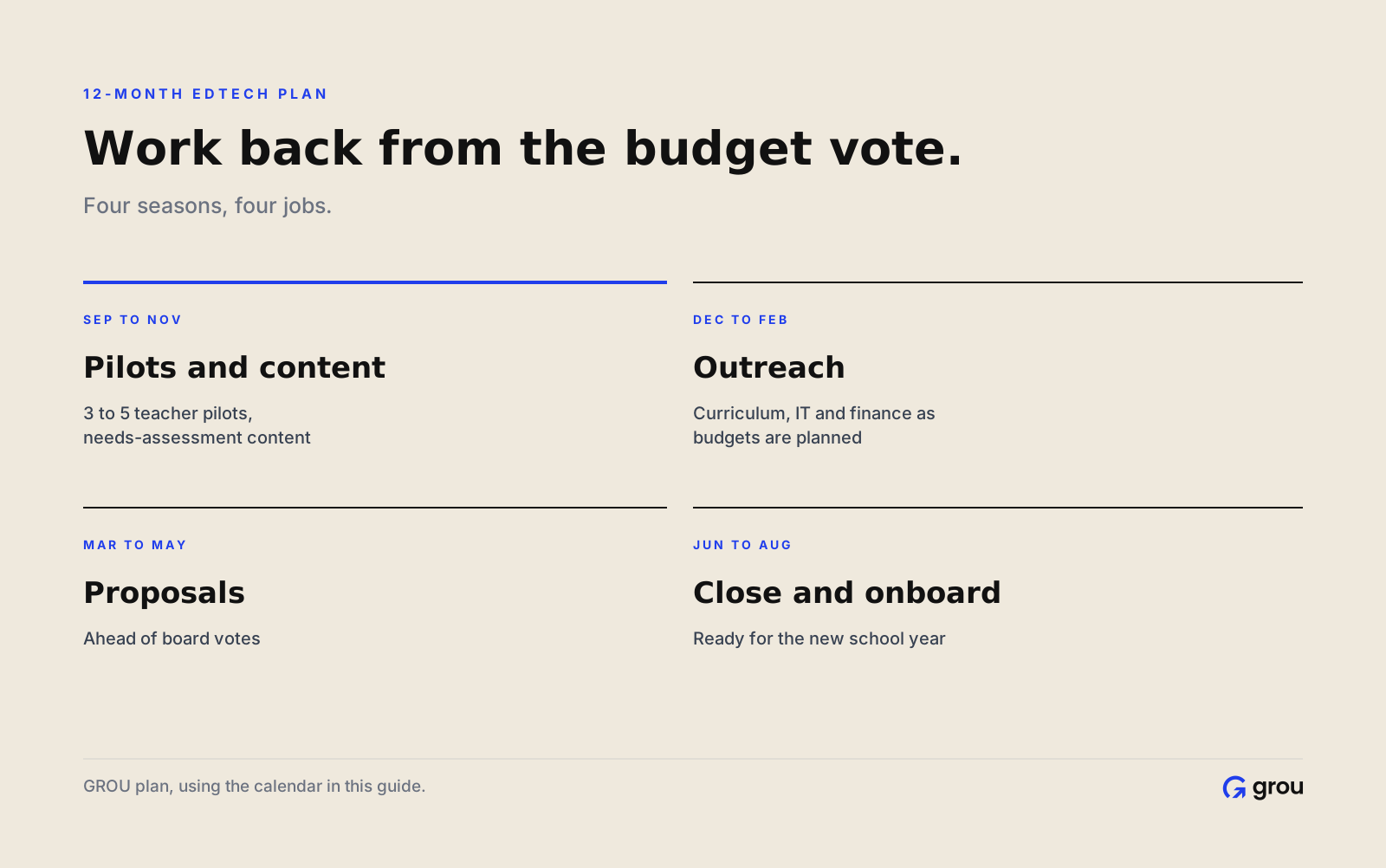
September to November: run pilots and publish needs-assessment content.
December to February: outreach to curriculum, IT and finance as budgets are planned.
March to May: proposals and approvals ahead of board votes.
June to August: close purchases, onboard for the new school year.
For list building, see B2B leads from directories. The account-first approach also works for technology companies selling into other sectors.
FAQ
When do school districts buy EdTech?
Most US districts buy in spring (March to June) using current budgets and in summer (July to August) when new budgets open. Planning starts in autumn.
Who decides on EdTech purchases?
Usually several people: teachers and coaches champion, curriculum and IT review, finance controls budget and the superintendent approves large initiatives.
How long is the EdTech sales cycle?
Often a full budget cycle. If you miss spring planning, the next window can be a year away.
What privacy laws apply to EdTech?
In the US, FERPA and state student privacy laws. In the EU, the GDPR, with extra care for children's data.
How do I get into a school district?
Start with a small teacher pilot, collect evidence, then present to curriculum, IT and finance before spring budget decisions.
About this guide
We are GROU, a B2B pipeline agency that runs lead generation, outbound, and LinkedIn content for clients across manufacturing, fintech, iGaming, software, and professional services. Budget calendar and market details come from the sources linked inline, checked September 2026.
Calendars vary by state and country. Check the fiscal year of each district or institution you target.
EdTech lead generation: selling to schools
EdTech lead generation is mostly about timing. Most US school districts run on a July 1 to June 30 fiscal year, plan budgets from autumn into early spring and approve them between April and June, so the conversation that wins a summer purchase starts months earlier. The vendors that win reach teachers, curriculum leads, IT and procurement together, prove privacy compliance early and time outreach to the budget calendar.
TL;DR
Most US districts run July to June fiscal years. Planning runs roughly October to February; boards approve budgets April to June.
The US K-12 market includes around 13,000 districts and 130,000 schools.
Decisions are shared: teachers, curriculum leads, IT, finance and the superintendent.
Student data privacy is a gate: FERPA in the US, the GDPR in Europe.
The school budget calendar
School districts typically operate on a fiscal year running from July 1 to June 30 (Monetizely). A typical rhythm (NationGraph):
October to February: budget planning. Administrators identify priorities.
March to June: spring procurement using the current year's budget, and approval of next year's.
July to August: new budgets open, with purchases timed for summer deployment.
Not every state is the same. New York requires a July to June cycle, while Texas lets districts choose between July to June and September to August (NationGraph).
The practical lesson: if you aren't known by late spring, you'll likely wait another year. And the market is large: around 13,000 school districts, 130,000 schools and more than 50 million students (NationGraph).
Who buys EdTech
District purchases require consensus among teachers, IT directors, curriculum specialists and purchasing departments (NationGraph):
Teachers and instructional coaches: champion tools they'll use daily.
Curriculum and instruction leads: check alignment with learning goals.
IT directors: review integration, devices and security.
CFO or business manager: controls budget and spending authority.
Superintendent: approves large, district-wide initiatives.
Where to find schools with a real need
Strategic plans. Many school boards publish multi-year plans naming technology priorities.
Funding. New grants or locally approved bonds create budget for specific projects.
Contract expiries. A district reviewing its current platform is open to alternatives.
Leadership changes. New superintendents and technology directors often review tools.
Higher education and L&D. Universities and corporate learning teams buy on different calendars, often through formal tenders. In the EU, larger public contracts appear on TED.
Privacy: the first gate
Student data is sensitive, and buyers will ask early:
United States: FERPA protects the privacy of student education records (US Department of Education). Many states add their own student privacy laws.
European Union: the GDPR applies, with extra care for children's data.
Have a privacy page, a data processing agreement and clear answers on where data is stored ready before the first meeting.
How to reach education buyers
Teachers first, carefully. Short, useful content about classroom problems builds champions.
Pilots with small cohorts. A three-to-five-teacher pilot in autumn creates evidence for spring budgets.
Peer proof. Districts trust other districts. Case notes from similar schools carry weight.
Conferences. State EdTech conferences concentrate decision-makers.
Our webinar lead generation playbook works well for teacher-facing education.
A 12-month EdTech outreach plan
September to November: run pilots and publish needs-assessment content.
December to February: outreach to curriculum, IT and finance as budgets are planned.
March to May: proposals and approvals ahead of board votes.
June to August: close purchases, onboard for the new school year.
For list building, see B2B leads from directories. The account-first approach also works for technology companies selling into other sectors.
FAQ
When do school districts buy EdTech?
Most US districts buy in spring (March to June) using current budgets and in summer (July to August) when new budgets open. Planning starts in autumn.
Who decides on EdTech purchases?
Usually several people: teachers and coaches champion, curriculum and IT review, finance controls budget and the superintendent approves large initiatives.
How long is the EdTech sales cycle?
Often a full budget cycle. If you miss spring planning, the next window can be a year away.
What privacy laws apply to EdTech?
In the US, FERPA and state student privacy laws. In the EU, the GDPR, with extra care for children's data.
How do I get into a school district?
Start with a small teacher pilot, collect evidence, then present to curriculum, IT and finance before spring budget decisions.
About this guide
We are GROU, a B2B pipeline agency that runs lead generation, outbound, and LinkedIn content for clients across manufacturing, fintech, iGaming, software, and professional services. Budget calendar and market details come from the sources linked inline, checked September 2026.
Calendars vary by state and country. Check the fiscal year of each district or institution you target.

Pipeline OS Newsletter
Build qualified pipeline
Get weekly tactics to generate demand, improve lead quality, and book more meetings.





Trusted by industry leaders
Trusted by industry leaders
Trusted by industry leaders
Ready to build qualified pipeline?
Ready to build qualified pipeline?
Ready to build qualified pipeline?
Book a call to see if we're the right fit, or take the 2-minute quiz to get a clear starting point.
Book a call to see if we're the right fit, or take the 2-minute quiz to get a clear starting point.
Book a call to see if we're the right fit, or take the 2-minute quiz to get a clear starting point.
" height="30.21639343089746px" id="hfGbXmQR2" width="30.216393430897455px"/></svg>)
Copyright © 2026 – All Right Reserved
Copyright © 2026 – All Right Reserved
Copyright © 2026 – All Right Reserved