%22%3E%3C/path%3E%3Cpath d=%22M 63.072 7.554 C 62.258 8.022 61.577 8.689 61.092 9.493 L 61.092 7.076 L 57.158 7.076 L 57.158 22.64 L 61.089 22.64 L 61.089 14.888 C 61.089 13.446 61.403 12.434 62.03 11.853 C 62.818 11.218 63.818 10.907 64.826 10.982 L 65.868 10.982 L 65.868 6.851 C 64.891 6.834 63.926 7.076 63.073 7.554 Z%22 fill=%22rgb(17,17,17)%22%3E%3C/path%3E%3Cpath d=%22M 78.916 7.82 C 76.363 6.49 73.321 6.49 70.768 7.82 C 69.562 8.473 68.564 9.451 67.888 10.644 C 67.167 11.931 66.803 13.387 66.834 14.862 C 66.804 16.332 67.157 17.785 67.86 19.077 C 68.515 20.267 69.494 21.246 70.684 21.901 C 71.924 22.576 73.318 22.92 74.73 22.898 C 76.164 22.918 77.58 22.575 78.846 21.901 C 80.062 21.247 81.073 20.27 81.768 19.077 C 82.506 17.797 82.88 16.339 82.85 14.862 C 82.88 13.389 82.517 11.934 81.797 10.647 C 81.12 9.455 80.122 8.477 78.917 7.824 M 78.803 14.862 C 78.829 15.739 78.636 16.608 78.241 17.391 C 77.903 18.046 77.38 18.588 76.738 18.95 C 76.124 19.293 75.432 19.472 74.729 19.47 C 73.668 19.497 72.648 19.061 71.934 18.276 C 71.139 17.323 70.741 16.1 70.823 14.862 C 70.741 13.62 71.149 12.395 71.959 11.45 C 72.687 10.667 73.715 10.233 74.783 10.256 C 75.859 10.236 76.894 10.67 77.635 11.45 C 78.464 12.387 78.884 13.616 78.801 14.864%22 fill=%22rgb(17,17,17)%22%3E%3C/path%3E%3Cpath d=%22M 95.906 7.076 L 95.906 15.646 C 95.975 16.68 95.643 17.701 94.979 18.498 C 94.311 19.184 93.379 19.547 92.422 19.495 C 91.475 19.544 90.553 19.18 89.894 18.498 C 89.23 17.701 88.898 16.68 88.967 15.646 L 88.967 7.076 L 85.033 7.076 L 85.033 16.207 C 85 17.449 85.275 18.68 85.834 19.79 C 86.327 20.75 87.095 21.542 88.039 22.065 C 89.033 22.594 90.145 22.861 91.271 22.838 C 92.188 22.847 93.095 22.65 93.926 22.263 C 94.708 21.905 95.388 21.36 95.906 20.675 L 95.906 22.645 L 99.865 22.645 L 99.865 7.076 Z%22 fill=%22rgb(17,17,17)%22%3E%3C/path%3E%3Cpath d=%22M 4.513 15.626 C 4.511 10.815 7.606 6.549 12.181 5.059 C 16.756 3.57 21.77 5.195 24.601 9.086 L 27.816 5.87 C 24.074 1.186 17.981 -0.943 12.137 0.393 C 6.292 1.728 1.728 6.292 0.393 12.137 C -0.943 17.981 1.186 24.074 5.87 27.816 L 9.085 24.601 C 6.214 22.512 4.515 19.177 4.513 15.626%22 fill=%22rgb(32,62,235)%22%3E%3C/path%3E%3Cpath d=%22M 17.114 14.343 L 13.354 18.01 L 13.354 18.026 L 21.071 18.026 L 11.412 27.609 L 17.389 27.609 L 23.999 21.081 L 23.999 28.316 L 24.005 28.316 L 27.967 24.393 L 27.967 14.343 Z%22 fill=%22rgb(32,62,235)%22%3E%3C/path%3E%3C/g%3E%3C/svg%3E) ×
× ××
××›
›
›
›
Lead generation for technology companies: how to build B2B pipeline in 2026
Lead generation for technology companies: how to build B2B pipeline in 2026
Lead generation for technology companies: how to build B2B pipeline in 2026
Lead generation for technology companies: how to build B2B pipeline in 2026
Lead generation for technology companies: how to build B2B pipeline in 2026
Lead generation for technology companies: how to build B2B pipeline in 2026

Author
Aljaz Peklaj

You already have activity. Sequences are sending, LinkedIn posts are getting some reach, sales is asking for more meetings, and the CRM still can't tell you which attention became pipeline. That's the problem in lead generation for technology companies. Not a lack of tactics, a lack of structure.
Start with ICP precision, because tech companies that define their ICP before campaigns see 30% to 50% higher conversion rates than teams that don't, according to Bookyourdata's lead generation analysis for technology companies.
Pick channels by persona, not by trend. LinkedIn matters, but developers, CTOs, DevOps leaders, and security buyers don't behave the same way.
Write different messages for different technical roles, or your outreach will sound generic to everyone.
Run the system in sprints, where content, signals, outbound, and CRM routing work as one operating model.
Measure pipeline outcomes, because attribution between content and outbound is a common point of failure.
Table of Contents
Build the foundation with a precise ICP and data enrichment
A tech company can spend six weeks writing outbound copy, warming domains, and building sequences, then miss pipeline targets because the list was wrong on day one. The failure shows up later. SDRs get polite replies from people with no project, AEs sit through low-intent demos, and marketing keeps tweaking messaging that was never the core issue.
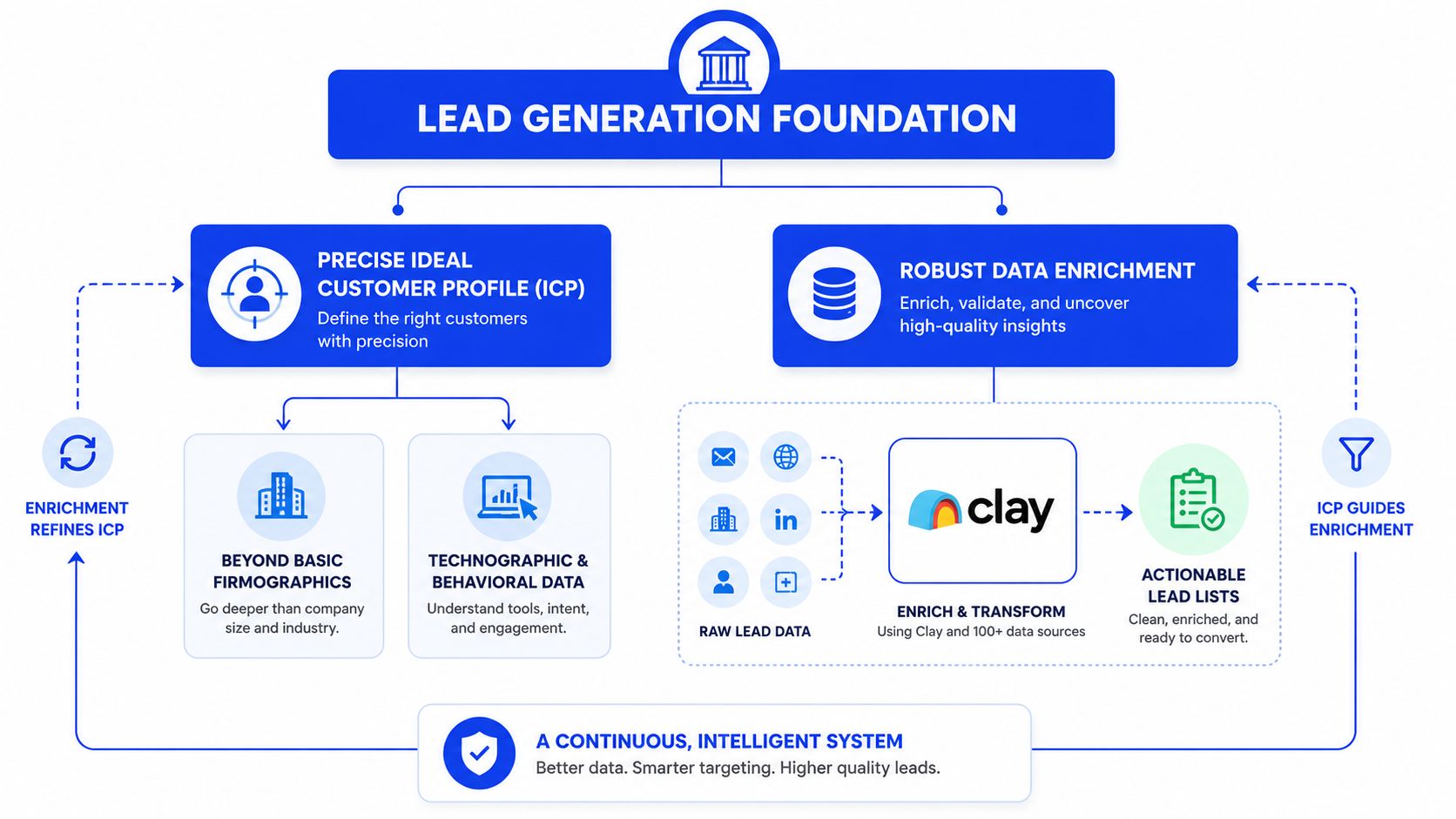
In tech lead generation, structure matters more than volume. Content, outbound, and intent signals only work as a system if they point at the same accounts, the same buying committee, and the same timing window. If ICP definition and enrichment are loose, every downstream channel gets noisier and attribution gets harder to trust.
Define a practical ICP, not a theoretical one
A usable ICP goes past company size, revenue band, and industry tag. Those fields help with list building, but they do not explain whether a platform team will care, whether security reviews will stall the deal, or whether the company has enough operational pain to buy now.
For technology companies, I build ICPs in three layers:
Firmographic fit. Industry, employee range, geography, business model
Technographic fit. Cloud environment, tooling patterns, integration surface, hiring language
Buying readiness. Funding events, active hiring, product launches, public pain points, engagement with relevant technical content
That third layer is where many teams fall short. They define who could buy, then skip the question that creates pipeline. Why now?
A good ICP also excludes aggressively. If the account lacks the stack you support, sells into a market you cannot serve well, or has a buying motion that consistently drags sales cycles past your threshold, cut it early. That discipline improves meeting quality more than another round of subject-line tests.
For a tighter way to document account fit, buying committee roles, and exclusions, use a clear ICP structure for B2B targeting. The point is to force decisions before enrichment starts, not after reps have already worked the list.
Build a five-layer enrichment stack
Once the ICP is defined, enrichment turns a market definition into an executable pipeline engine. This is also where the content-to-outbound attribution gap starts to close. If an account visits a high-intent page, hires for platform engineers, and runs Kubernetes on AWS, that should not live in three disconnected tools. It should shape who enters outreach, what message they get, and which signal gets credit when pipeline moves.
The stack I trust for technical audiences has five layers:
Base firmographics from Apollo or a similar provider
This answers a simple question. Should this account even exist in the pool?Waterfall contact enrichment in Clay
Clay is useful because you can query multiple sources, validate fields, and pass only verified records into outbound. Single-provider enrichment leaves too many gaps and too many bad emails.Tech stack detection from BuiltWith, Wappalyzer, public docs, and engineering footprints
Technical buyers notice fast when outreach ignores their environment. Stack context changes the message from generic pain language to relevant operational detail.Engineering team intelligence from Sales Navigator, GitHub, job posts, and org charts
This helps map the committee correctly. In many tech deals, the user, technical evaluator, security reviewer, and budget owner are different people.Content and signal monitoring
Track blog posts, product launches, docs updates, hiring language, webinar attendance, and high-intent page visits. These signals connect attention to action. They also tell reps why an account is in sequence now, not just why it matches the market.
Some teams need custom collection for signals standard databases miss. If you are building that layer seriously, this piece on orchestrating AI agents for web data is useful because it explains how agent-based collection can support structured enrichment workflows.
Here is the operating model:
Layer | Question it answers | Example tool |
|---|---|---|
Firmographic | Should this account exist in the pool? | Apollo |
Contact | Can we reach the right person? | Clay |
Technographic | Is the offer relevant to their stack? | BuiltWith |
Team intel | Who actually matters internally? | Sales Navigator |
Signals | Why now? | Clay plus public web research |
The common failure mode is over-enrichment on a bad target market. Teams pull thousands of contacts because the workflow runs cleanly in Clay, then hand outbound a larger list with the same weak fit. Good enrichment should reduce the list, sharpen message relevance, and give your team a reason to connect content engagement with outbound timing. If it only increases record count, it is organized waste.
Select channels that match your specific tech buyer
The verdict is simple. Signal-triggered multi-channel outreach, LinkedIn plus email backed by substantive content, is the strongest channel mix for most engineering leaders, technical product managers, and mid-market CTOs. Everything else is secondary to that unless your audience is strongly developer-led or event-driven.
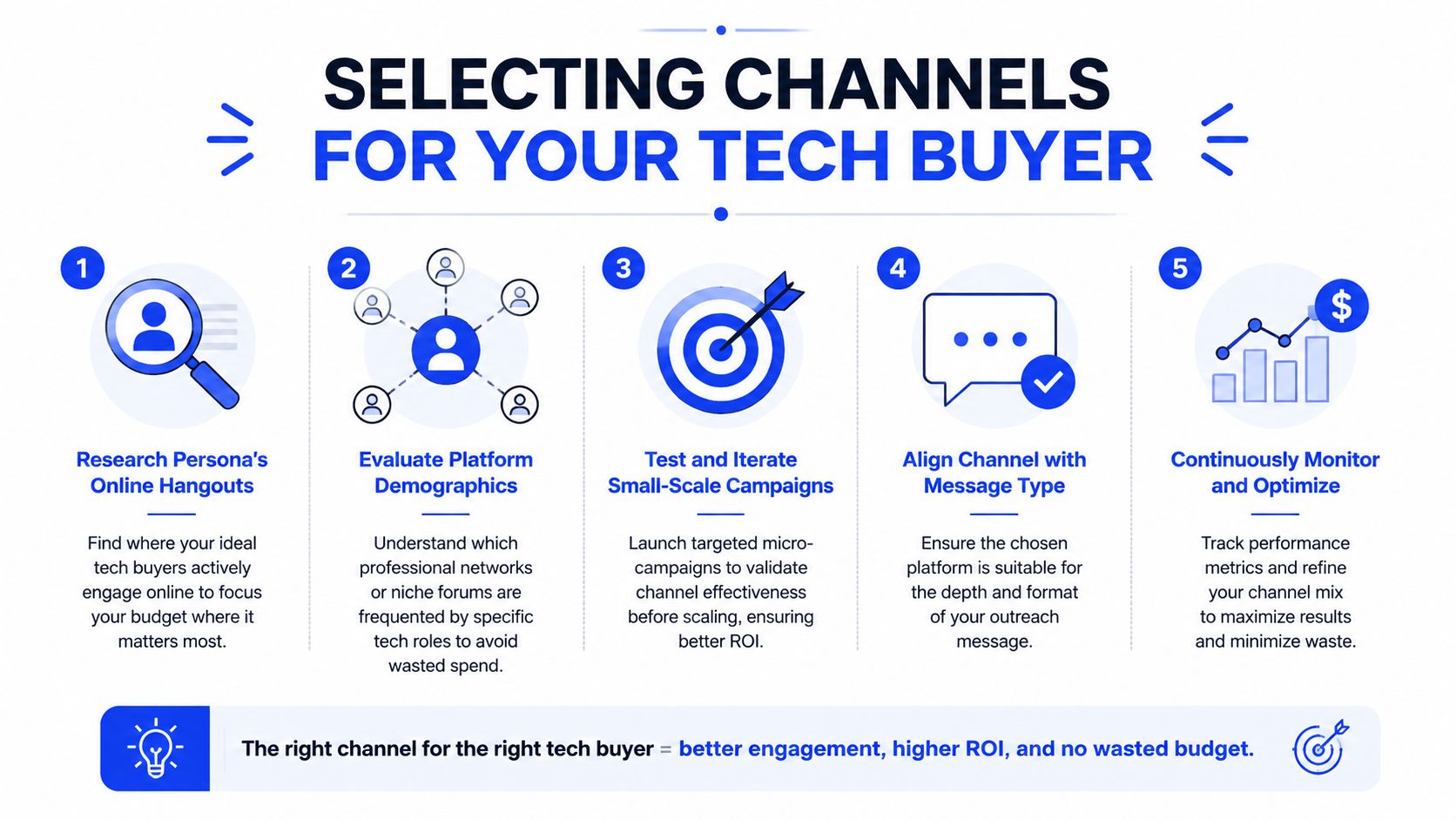
The channel verdict
LinkedIn is the center of gravity for B2B tech outreach. It accounts for 80% of all B2B social media leads, and 94% of B2B marketers use it for sales and lead generation, according to Warmly's B2B lead generation statistics. For teams selling to professional audiences, that matters because buyer identity and context are visible there in a way email alone can't match.
Still, “LinkedIn works” is too shallow. Pure LinkedIn outreach without content support underperforms. Pure email underperforms even more with technical buyers. The stronger system is LinkedIn visibility plus signal-based outreach plus email follow-up.
If you want a deeper view of where LinkedIn fits in a modern outbound system, this breakdown of LinkedIn lead generation workflows is a solid reference.
Where each channel actually fits
Here's the ranking I'd use for most B2B tech teams.
Rank 1, signal-triggered LinkedIn plus email with content support
This is the default for SaaS, legal tech, manufacturing tech, and many iGaming offers selling into managers, directors, and technical executives. The content creates familiarity. The trigger gives timing. The outreach gives direction.Rank 2, community presence and technical content distribution
For developer and DevOps-heavy audiences, this can beat direct outreach on lead quality. Reddit threads, Hacker News, GitHub presence, engineering blogs, and founder distribution matter more than polished outbound.Rank 3, vertical events
Security buyers and some pharma or manufacturing audiences still respond well to event-adjacent outreach. The event isn't the engine by itself. The engine is pre-event mapping, in-event timing, and post-event follow-up.
Tech buyers don't reject outreach because it's outbound. They reject outreach that arrived before credibility did.
Rank 4, pure LinkedIn outreach
This can work, especially when the persona is highly active on the platform. But if there's no content trail, the buyer often checks your profile and stops there.Rank 5, pure email outreach
It's still useful as a support channel. On its own, it's a weak first move for technical audiences that verify sender credibility socially.
There's one more channel detail operators often miss. For enterprise B2B SaaS motions on LinkedIn, a 2 to 4 week warm-up period before direct outreach is the right structure, based on Virtuwise's guidance on B2B SaaS LinkedIn engagement timing. Comment, post, connect, and create recognition first. Cold-starting the sequence too early wastes the channel.
What I wouldn't generally prioritize: Reddit Ads, webinar-heavy lead capture without strong distribution, or expensive LinkedIn Ads to senior technical buyers unless the economics already work elsewhere.
Craft messages that resonate with technical audiences
Generic outreach fails with technical buyers because it collapses different roles into one template. A CTO is not a DevOps engineer with a bigger title. The message structure has to change, not just the wording.
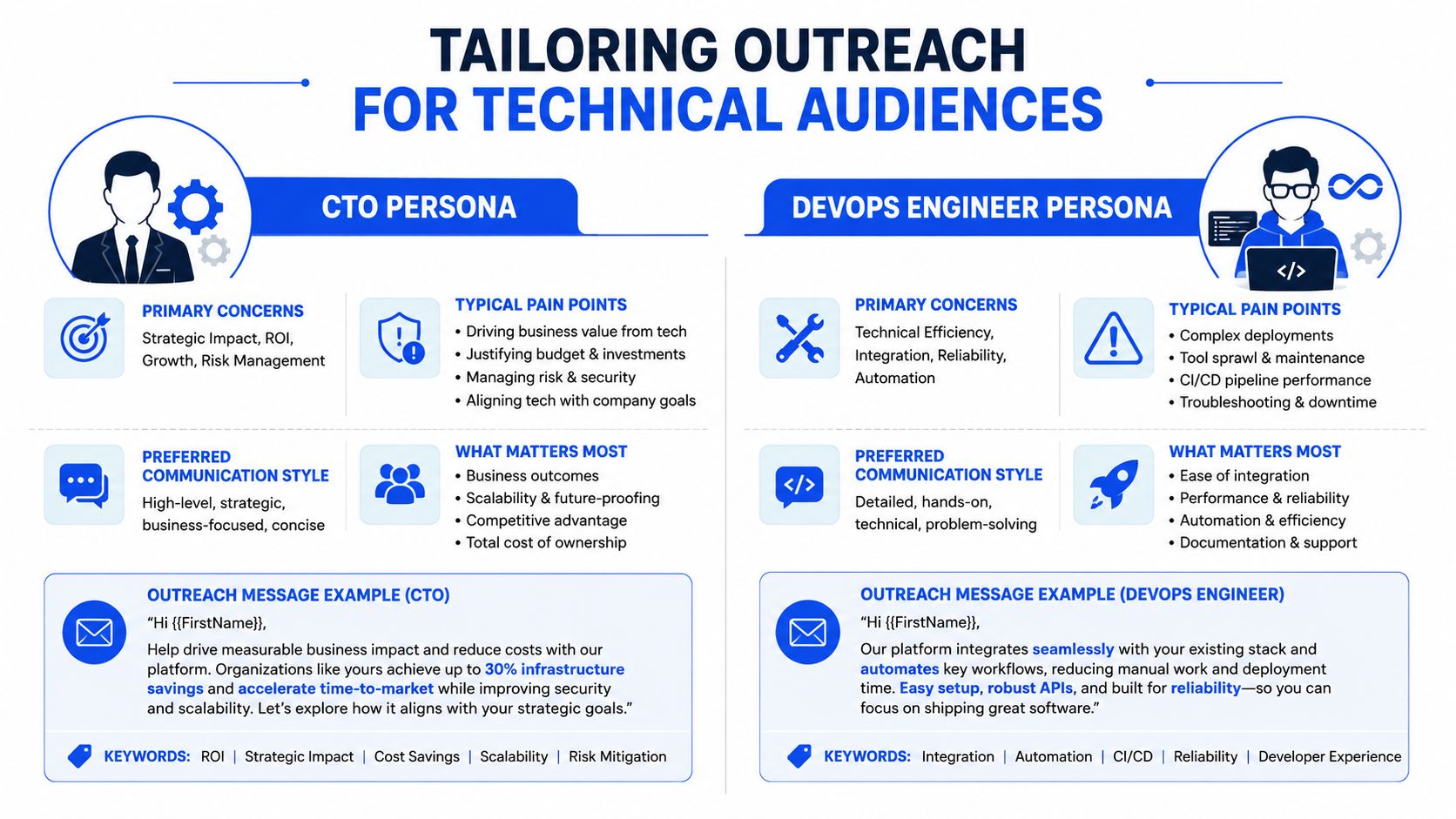
CTO outreach needs strategic framing
CTOs usually respond to strategic context, business constraints, and pattern recognition. They care about engineering productivity, infrastructure cost, hiring drag, delivery risk, and what happens to execution after a company event like funding or expansion.
So the opening should reference something real and business-relevant. Funding. Hiring velocity. A public statement about platform reliability. A product launch. Then tie that trigger to a pattern they'll recognize.
A working structure:
Subject line → business framing tied to a trigger
Opening → observed company event
Problem frame → strategic consequence
CTA → short strategic conversation
Example:
Subject: Engineering productivity post-Series B
Saw your funding announcement last week. Across engineering teams in the year after a major raise, hiring usually exposes whether productivity scales with headcount or stalls under process debt. Worth a short conversation on how teams are handling that transition?
That structure works because it respects their role. It doesn't drag them into product features too early.
If your team needs more examples of this style, this guide to emailing CTOs effectively is useful because it keeps the framing strategic rather than feature-led.
DevOps outreach needs technical specificity
DevOps engineers respond to operational reality. Their inbox filter is different. They care about deployment friction, tool sprawl, observability noise, state management, incident load, and debugging time. Business-pressure language usually hurts more than it helps.
The message should sound like it came from someone who read their technical environment, not someone who swapped job titles in a template.
A better structure:
Subject line → specific tool or technical pattern
Opening → reference to a technical post, repo, talk, or job description
Problem frame → practical issue inside the stack
CTA → offer a short technical look or an async write-up
Example:
Subject: Question on your Terraform module pattern
Read your note on multi-region Terraform setup. The part about avoiding centralized state lock issues stood out. We've seen similar friction in teams managing state isolation across environments. Worth a quick technical look, or would a short write-up be more useful?
That works because the credibility is verifiable. If the prospect can't trace your observation back to something they published or use, the message falls apart.
A side-by-side message structure
Here's the comparison that matters most:
Variable | CTO | DevOps engineer |
|---|---|---|
Trigger | Funding, hiring, org change | Blog post, repo, tool pattern |
Framing | Strategic and business-aware | Technical and hands-on |
Length | Shorter | Can be longer if specific |
CTA | Strategic discussion | Technical review or async note |
Credibility signal | Pattern recognition | Stack accuracy |
A lot of copy frameworks miss this and push one generic cold email formula. That's a bad fit for technical sales. If you want a broad guide to B2B cold outreach, use it for structure, then rewrite heavily for persona reality.
Operator note: Faking technical depth to engineers is worse than writing a simple message. Engineers can tell the difference fast.
The same principle applies across adjacent industries. In legal tech, the equivalent split may be CTO versus security architect. In manufacturing software, it may be VP of operations versus systems engineer. The message changes because the job changes.
Run your engine with structured sprints and workflows
Monday morning, three things hit at once. A target account posts a new engineering job, one of their architects engages with your technical content, and an SDR is still working last week's static list. If those signals live in separate tools and separate teams, attention dies before it becomes pipeline.
That is the core job of the sprint. It gives content, signals, and outreach one operating rhythm, with clear ownership and clean handoffs into the CRM.
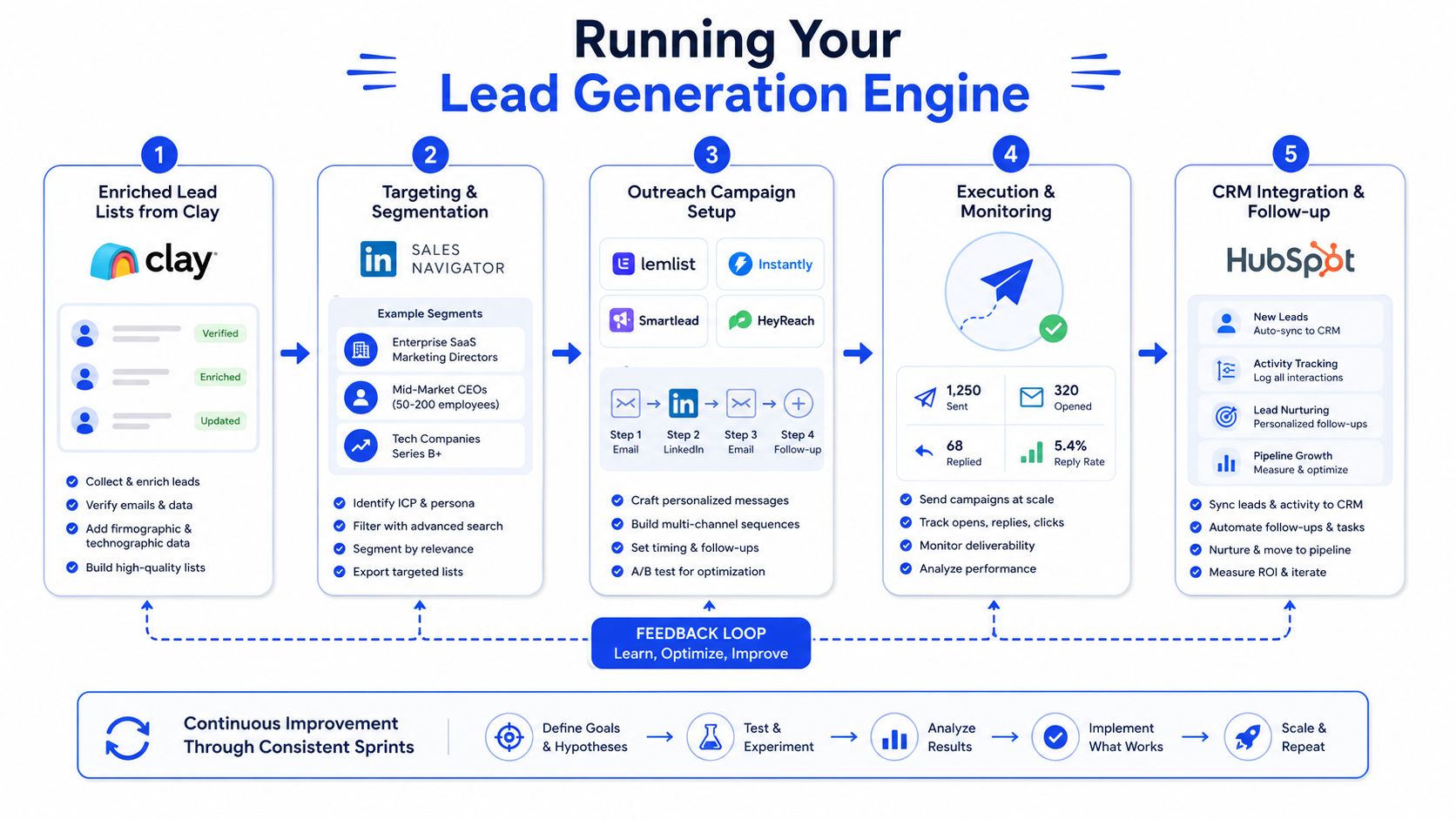
How the sprint engine runs
I prefer a two-week sprint because it is long enough to gather fresh signals and short enough to fix weak messaging before a bad sequence burns through a segment.
Week one is build and prioritize. Clay refreshes enrichment and signal fields. Apollo adds net-new accounts that match the current ICP. Sales Navigator verifies role coverage so the team is not sending CTO messaging to platform engineers. Then sequences get assembled in Instantly, Smartlead, Lemlist, or HeyReach based on channel. HubSpot remains the source of truth for account status, touch history, and routing.
Week two is execution, response handling, and feedback. LinkedIn content keeps running. Outbound goes live against the highest-signal accounts first. Replies route the same day, positive replies to the AE or SDR with context, negative replies to suppression, and no-response contacts stay active unless new behavior changes the angle.
The sprint should produce a few concrete outputs, not just activity:
A ranked account queue based on live signals such as hiring, funding, product launches, content engagement, and stack changes
Persona-specific sequences mapped to role, trigger, and channel
A reply handling workflow with disposition rules, owner assignment, and SLA for follow-up
CRM field discipline so every touch ties back to account, persona, sequence, and originating signal
A feedback loop from meetings booked back into targeting and message revisions
This model succeeds when automation is treated as infrastructure. Clay should update fields and route records. HubSpot should control lifecycle stages and ownership. Sequence tools should send, pause, and log. AI can support research, summarization, and draft variation, but it should not publish or send unreviewed outbound. For teams building that layer more deliberately, this AI-powered marketing strategy framework is a useful planning reference.
Later in the sprint, video can help align the team on execution details and reply handling. This walkthrough is a useful example:
What changed in the developer tooling campaign
A developer tooling SaaS client made this problem obvious. The team had outbound volume, but the queue was built too heavily on static firmographics, company size, headcount, and generic title filters. They were contacting the right category of accounts at the wrong moment.
The fix was operational, not creative. We increased the weight of technical content engagement inside the scoring model and lowered the weight of broad list criteria. If a prospect interacted with relevant engineering content, published about a problem the product solved, or showed a stack pattern that matched the offer, that account moved to the top of the sprint queue. Outreach referenced that exact context, and the SDR could explain why the account was contacted now.
The result was a roughly 130% increase in MQL volume, according to the operating data shared in the campaign brief. More important than the MQL count, the team closed the attribution gap between content and outbound. Content created the attention. Signals identified the timing. Outbound converted that attention into meetings with a reason for the conversation.
That connection is what many lead gen programs miss. The content team reports engagement. The SDR team reports meetings. RevOps tries to stitch the story together after the fact. A single operating motion fixes that. One example is Grou's lead generation system, which combines content, signal-based prospecting, and outbound into one workflow.
The failure mode is easy to spot. Marketing publishes. SDRs sequence. Ops reports last month's meetings. Nobody can show which piece of content created the signal that changed account priority, or why one contact entered outreach while another stayed cold. Once the system is structured around shared signals, queue rules, and CRM discipline, that handoff becomes visible and repeatable.
Measure pipeline outcomes, not just vanity metrics
If your dashboard still starts with lead volume, you're probably measuring effort instead of revenue motion. For lead generation for technology companies, that creates false confidence fast.
The dashboard that matters
The first metric I'd watch is the lead-to-booking ratio. For technology firms, the benchmark to aim for is 15% to 25%, meaning that 15% to 25% of responding leads should convert to booked appointments, according to Apollo's lead generation benchmarks for technology companies.
That metric matters because it catches two different problems. If replies are coming in but bookings stay weak, your qualification or CTA is off. If bookings happen but pipeline doesn't, the issue is downstream, usually in fit, handoff, or discovery quality.
Build the dashboard around stage movement, not just top-of-funnel counts:
Response quality → positive reply, neutral reply, disqualified reply
Booking conversion → responses to booked meetings
Meeting-held rate → booked meetings that occur
Opportunity creation → meetings that convert to real pipeline
Pipeline attribution → account, persona, sequence, and content touchpoints
For teams building their own reporting layer, this guide to lead generation KPIs in B2B systems is a useful reference point.
The attribution gap most teams still ignore
The hardest reporting problem isn't email attribution. It's content-to-outbound attribution.
A lot of teams know a prospect saw the founder on LinkedIn before replying to a cold email. Very few can prove that influence cleanly in the CRM. That gap matters because it hides the value of warming. Most dashboards still force teams to choose one source, when the complete answer is shared influence across content, signal, and direct outreach.
The fix is operational, not theoretical. Add fields for pre-outreach content exposure, first meaningful signal, outbound sequence ID, and reply route. Then force reps to update them while context is still fresh.
If you do one thing this week, add a “pre-outreach content seen” field to your CRM by Monday and require it on every qualified reply.
GROU is a global B2B pipeline agency focused on turning attention into qualified conversations across iGaming, SaaS, manufacturing, legal tech, and pharma. The methodology is simple: one ICP, one signal layer, one outbound system, and one reporting line so content, outreach, and pipeline are measured together.
You already have activity. Sequences are sending, LinkedIn posts are getting some reach, sales is asking for more meetings, and the CRM still can't tell you which attention became pipeline. That's the problem in lead generation for technology companies. Not a lack of tactics, a lack of structure.
Start with ICP precision, because tech companies that define their ICP before campaigns see 30% to 50% higher conversion rates than teams that don't, according to Bookyourdata's lead generation analysis for technology companies.
Pick channels by persona, not by trend. LinkedIn matters, but developers, CTOs, DevOps leaders, and security buyers don't behave the same way.
Write different messages for different technical roles, or your outreach will sound generic to everyone.
Run the system in sprints, where content, signals, outbound, and CRM routing work as one operating model.
Measure pipeline outcomes, because attribution between content and outbound is a common point of failure.
Table of Contents
Build the foundation with a precise ICP and data enrichment
A tech company can spend six weeks writing outbound copy, warming domains, and building sequences, then miss pipeline targets because the list was wrong on day one. The failure shows up later. SDRs get polite replies from people with no project, AEs sit through low-intent demos, and marketing keeps tweaking messaging that was never the core issue.
In tech lead generation, structure matters more than volume. Content, outbound, and intent signals only work as a system if they point at the same accounts, the same buying committee, and the same timing window. If ICP definition and enrichment are loose, every downstream channel gets noisier and attribution gets harder to trust.
Define a practical ICP, not a theoretical one
A usable ICP goes past company size, revenue band, and industry tag. Those fields help with list building, but they do not explain whether a platform team will care, whether security reviews will stall the deal, or whether the company has enough operational pain to buy now.
For technology companies, I build ICPs in three layers:
Firmographic fit. Industry, employee range, geography, business model
Technographic fit. Cloud environment, tooling patterns, integration surface, hiring language
Buying readiness. Funding events, active hiring, product launches, public pain points, engagement with relevant technical content
That third layer is where many teams fall short. They define who could buy, then skip the question that creates pipeline. Why now?
A good ICP also excludes aggressively. If the account lacks the stack you support, sells into a market you cannot serve well, or has a buying motion that consistently drags sales cycles past your threshold, cut it early. That discipline improves meeting quality more than another round of subject-line tests.
For a tighter way to document account fit, buying committee roles, and exclusions, use a clear ICP structure for B2B targeting. The point is to force decisions before enrichment starts, not after reps have already worked the list.
Build a five-layer enrichment stack
Once the ICP is defined, enrichment turns a market definition into an executable pipeline engine. This is also where the content-to-outbound attribution gap starts to close. If an account visits a high-intent page, hires for platform engineers, and runs Kubernetes on AWS, that should not live in three disconnected tools. It should shape who enters outreach, what message they get, and which signal gets credit when pipeline moves.
The stack I trust for technical audiences has five layers:
Base firmographics from Apollo or a similar provider
This answers a simple question. Should this account even exist in the pool?Waterfall contact enrichment in Clay
Clay is useful because you can query multiple sources, validate fields, and pass only verified records into outbound. Single-provider enrichment leaves too many gaps and too many bad emails.Tech stack detection from BuiltWith, Wappalyzer, public docs, and engineering footprints
Technical buyers notice fast when outreach ignores their environment. Stack context changes the message from generic pain language to relevant operational detail.Engineering team intelligence from Sales Navigator, GitHub, job posts, and org charts
This helps map the committee correctly. In many tech deals, the user, technical evaluator, security reviewer, and budget owner are different people.Content and signal monitoring
Track blog posts, product launches, docs updates, hiring language, webinar attendance, and high-intent page visits. These signals connect attention to action. They also tell reps why an account is in sequence now, not just why it matches the market.
Some teams need custom collection for signals standard databases miss. If you are building that layer seriously, this piece on orchestrating AI agents for web data is useful because it explains how agent-based collection can support structured enrichment workflows.
Here is the operating model:
Layer | Question it answers | Example tool |
|---|---|---|
Firmographic | Should this account exist in the pool? | Apollo |
Contact | Can we reach the right person? | Clay |
Technographic | Is the offer relevant to their stack? | BuiltWith |
Team intel | Who actually matters internally? | Sales Navigator |
Signals | Why now? | Clay plus public web research |
The common failure mode is over-enrichment on a bad target market. Teams pull thousands of contacts because the workflow runs cleanly in Clay, then hand outbound a larger list with the same weak fit. Good enrichment should reduce the list, sharpen message relevance, and give your team a reason to connect content engagement with outbound timing. If it only increases record count, it is organized waste.
Select channels that match your specific tech buyer
The verdict is simple. Signal-triggered multi-channel outreach, LinkedIn plus email backed by substantive content, is the strongest channel mix for most engineering leaders, technical product managers, and mid-market CTOs. Everything else is secondary to that unless your audience is strongly developer-led or event-driven.
The channel verdict
LinkedIn is the center of gravity for B2B tech outreach. It accounts for 80% of all B2B social media leads, and 94% of B2B marketers use it for sales and lead generation, according to Warmly's B2B lead generation statistics. For teams selling to professional audiences, that matters because buyer identity and context are visible there in a way email alone can't match.
Still, “LinkedIn works” is too shallow. Pure LinkedIn outreach without content support underperforms. Pure email underperforms even more with technical buyers. The stronger system is LinkedIn visibility plus signal-based outreach plus email follow-up.
If you want a deeper view of where LinkedIn fits in a modern outbound system, this breakdown of LinkedIn lead generation workflows is a solid reference.
Where each channel actually fits
Here's the ranking I'd use for most B2B tech teams.
Rank 1, signal-triggered LinkedIn plus email with content support
This is the default for SaaS, legal tech, manufacturing tech, and many iGaming offers selling into managers, directors, and technical executives. The content creates familiarity. The trigger gives timing. The outreach gives direction.Rank 2, community presence and technical content distribution
For developer and DevOps-heavy audiences, this can beat direct outreach on lead quality. Reddit threads, Hacker News, GitHub presence, engineering blogs, and founder distribution matter more than polished outbound.Rank 3, vertical events
Security buyers and some pharma or manufacturing audiences still respond well to event-adjacent outreach. The event isn't the engine by itself. The engine is pre-event mapping, in-event timing, and post-event follow-up.
Tech buyers don't reject outreach because it's outbound. They reject outreach that arrived before credibility did.
Rank 4, pure LinkedIn outreach
This can work, especially when the persona is highly active on the platform. But if there's no content trail, the buyer often checks your profile and stops there.Rank 5, pure email outreach
It's still useful as a support channel. On its own, it's a weak first move for technical audiences that verify sender credibility socially.
There's one more channel detail operators often miss. For enterprise B2B SaaS motions on LinkedIn, a 2 to 4 week warm-up period before direct outreach is the right structure, based on Virtuwise's guidance on B2B SaaS LinkedIn engagement timing. Comment, post, connect, and create recognition first. Cold-starting the sequence too early wastes the channel.
What I wouldn't generally prioritize: Reddit Ads, webinar-heavy lead capture without strong distribution, or expensive LinkedIn Ads to senior technical buyers unless the economics already work elsewhere.
Craft messages that resonate with technical audiences
Generic outreach fails with technical buyers because it collapses different roles into one template. A CTO is not a DevOps engineer with a bigger title. The message structure has to change, not just the wording.
CTO outreach needs strategic framing
CTOs usually respond to strategic context, business constraints, and pattern recognition. They care about engineering productivity, infrastructure cost, hiring drag, delivery risk, and what happens to execution after a company event like funding or expansion.
So the opening should reference something real and business-relevant. Funding. Hiring velocity. A public statement about platform reliability. A product launch. Then tie that trigger to a pattern they'll recognize.
A working structure:
Subject line → business framing tied to a trigger
Opening → observed company event
Problem frame → strategic consequence
CTA → short strategic conversation
Example:
Subject: Engineering productivity post-Series B
Saw your funding announcement last week. Across engineering teams in the year after a major raise, hiring usually exposes whether productivity scales with headcount or stalls under process debt. Worth a short conversation on how teams are handling that transition?
That structure works because it respects their role. It doesn't drag them into product features too early.
If your team needs more examples of this style, this guide to emailing CTOs effectively is useful because it keeps the framing strategic rather than feature-led.
DevOps outreach needs technical specificity
DevOps engineers respond to operational reality. Their inbox filter is different. They care about deployment friction, tool sprawl, observability noise, state management, incident load, and debugging time. Business-pressure language usually hurts more than it helps.
The message should sound like it came from someone who read their technical environment, not someone who swapped job titles in a template.
A better structure:
Subject line → specific tool or technical pattern
Opening → reference to a technical post, repo, talk, or job description
Problem frame → practical issue inside the stack
CTA → offer a short technical look or an async write-up
Example:
Subject: Question on your Terraform module pattern
Read your note on multi-region Terraform setup. The part about avoiding centralized state lock issues stood out. We've seen similar friction in teams managing state isolation across environments. Worth a quick technical look, or would a short write-up be more useful?
That works because the credibility is verifiable. If the prospect can't trace your observation back to something they published or use, the message falls apart.
A side-by-side message structure
Here's the comparison that matters most:
Variable | CTO | DevOps engineer |
|---|---|---|
Trigger | Funding, hiring, org change | Blog post, repo, tool pattern |
Framing | Strategic and business-aware | Technical and hands-on |
Length | Shorter | Can be longer if specific |
CTA | Strategic discussion | Technical review or async note |
Credibility signal | Pattern recognition | Stack accuracy |
A lot of copy frameworks miss this and push one generic cold email formula. That's a bad fit for technical sales. If you want a broad guide to B2B cold outreach, use it for structure, then rewrite heavily for persona reality.
Operator note: Faking technical depth to engineers is worse than writing a simple message. Engineers can tell the difference fast.
The same principle applies across adjacent industries. In legal tech, the equivalent split may be CTO versus security architect. In manufacturing software, it may be VP of operations versus systems engineer. The message changes because the job changes.
Run your engine with structured sprints and workflows
Monday morning, three things hit at once. A target account posts a new engineering job, one of their architects engages with your technical content, and an SDR is still working last week's static list. If those signals live in separate tools and separate teams, attention dies before it becomes pipeline.
That is the core job of the sprint. It gives content, signals, and outreach one operating rhythm, with clear ownership and clean handoffs into the CRM.
How the sprint engine runs
I prefer a two-week sprint because it is long enough to gather fresh signals and short enough to fix weak messaging before a bad sequence burns through a segment.
Week one is build and prioritize. Clay refreshes enrichment and signal fields. Apollo adds net-new accounts that match the current ICP. Sales Navigator verifies role coverage so the team is not sending CTO messaging to platform engineers. Then sequences get assembled in Instantly, Smartlead, Lemlist, or HeyReach based on channel. HubSpot remains the source of truth for account status, touch history, and routing.
Week two is execution, response handling, and feedback. LinkedIn content keeps running. Outbound goes live against the highest-signal accounts first. Replies route the same day, positive replies to the AE or SDR with context, negative replies to suppression, and no-response contacts stay active unless new behavior changes the angle.
The sprint should produce a few concrete outputs, not just activity:
A ranked account queue based on live signals such as hiring, funding, product launches, content engagement, and stack changes
Persona-specific sequences mapped to role, trigger, and channel
A reply handling workflow with disposition rules, owner assignment, and SLA for follow-up
CRM field discipline so every touch ties back to account, persona, sequence, and originating signal
A feedback loop from meetings booked back into targeting and message revisions
This model succeeds when automation is treated as infrastructure. Clay should update fields and route records. HubSpot should control lifecycle stages and ownership. Sequence tools should send, pause, and log. AI can support research, summarization, and draft variation, but it should not publish or send unreviewed outbound. For teams building that layer more deliberately, this AI-powered marketing strategy framework is a useful planning reference.
Later in the sprint, video can help align the team on execution details and reply handling. This walkthrough is a useful example:
What changed in the developer tooling campaign
A developer tooling SaaS client made this problem obvious. The team had outbound volume, but the queue was built too heavily on static firmographics, company size, headcount, and generic title filters. They were contacting the right category of accounts at the wrong moment.
The fix was operational, not creative. We increased the weight of technical content engagement inside the scoring model and lowered the weight of broad list criteria. If a prospect interacted with relevant engineering content, published about a problem the product solved, or showed a stack pattern that matched the offer, that account moved to the top of the sprint queue. Outreach referenced that exact context, and the SDR could explain why the account was contacted now.
The result was a roughly 130% increase in MQL volume, according to the operating data shared in the campaign brief. More important than the MQL count, the team closed the attribution gap between content and outbound. Content created the attention. Signals identified the timing. Outbound converted that attention into meetings with a reason for the conversation.
That connection is what many lead gen programs miss. The content team reports engagement. The SDR team reports meetings. RevOps tries to stitch the story together after the fact. A single operating motion fixes that. One example is Grou's lead generation system, which combines content, signal-based prospecting, and outbound into one workflow.
The failure mode is easy to spot. Marketing publishes. SDRs sequence. Ops reports last month's meetings. Nobody can show which piece of content created the signal that changed account priority, or why one contact entered outreach while another stayed cold. Once the system is structured around shared signals, queue rules, and CRM discipline, that handoff becomes visible and repeatable.
Measure pipeline outcomes, not just vanity metrics
If your dashboard still starts with lead volume, you're probably measuring effort instead of revenue motion. For lead generation for technology companies, that creates false confidence fast.
The dashboard that matters
The first metric I'd watch is the lead-to-booking ratio. For technology firms, the benchmark to aim for is 15% to 25%, meaning that 15% to 25% of responding leads should convert to booked appointments, according to Apollo's lead generation benchmarks for technology companies.
That metric matters because it catches two different problems. If replies are coming in but bookings stay weak, your qualification or CTA is off. If bookings happen but pipeline doesn't, the issue is downstream, usually in fit, handoff, or discovery quality.
Build the dashboard around stage movement, not just top-of-funnel counts:
Response quality → positive reply, neutral reply, disqualified reply
Booking conversion → responses to booked meetings
Meeting-held rate → booked meetings that occur
Opportunity creation → meetings that convert to real pipeline
Pipeline attribution → account, persona, sequence, and content touchpoints
For teams building their own reporting layer, this guide to lead generation KPIs in B2B systems is a useful reference point.
The attribution gap most teams still ignore
The hardest reporting problem isn't email attribution. It's content-to-outbound attribution.
A lot of teams know a prospect saw the founder on LinkedIn before replying to a cold email. Very few can prove that influence cleanly in the CRM. That gap matters because it hides the value of warming. Most dashboards still force teams to choose one source, when the complete answer is shared influence across content, signal, and direct outreach.
The fix is operational, not theoretical. Add fields for pre-outreach content exposure, first meaningful signal, outbound sequence ID, and reply route. Then force reps to update them while context is still fresh.
If you do one thing this week, add a “pre-outreach content seen” field to your CRM by Monday and require it on every qualified reply.
GROU is a global B2B pipeline agency focused on turning attention into qualified conversations across iGaming, SaaS, manufacturing, legal tech, and pharma. The methodology is simple: one ICP, one signal layer, one outbound system, and one reporting line so content, outreach, and pipeline are measured together.
You already have activity. Sequences are sending, LinkedIn posts are getting some reach, sales is asking for more meetings, and the CRM still can't tell you which attention became pipeline. That's the problem in lead generation for technology companies. Not a lack of tactics, a lack of structure.
Start with ICP precision, because tech companies that define their ICP before campaigns see 30% to 50% higher conversion rates than teams that don't, according to Bookyourdata's lead generation analysis for technology companies.
Pick channels by persona, not by trend. LinkedIn matters, but developers, CTOs, DevOps leaders, and security buyers don't behave the same way.
Write different messages for different technical roles, or your outreach will sound generic to everyone.
Run the system in sprints, where content, signals, outbound, and CRM routing work as one operating model.
Measure pipeline outcomes, because attribution between content and outbound is a common point of failure.
Table of Contents
Build the foundation with a precise ICP and data enrichment
A tech company can spend six weeks writing outbound copy, warming domains, and building sequences, then miss pipeline targets because the list was wrong on day one. The failure shows up later. SDRs get polite replies from people with no project, AEs sit through low-intent demos, and marketing keeps tweaking messaging that was never the core issue.
In tech lead generation, structure matters more than volume. Content, outbound, and intent signals only work as a system if they point at the same accounts, the same buying committee, and the same timing window. If ICP definition and enrichment are loose, every downstream channel gets noisier and attribution gets harder to trust.
Define a practical ICP, not a theoretical one
A usable ICP goes past company size, revenue band, and industry tag. Those fields help with list building, but they do not explain whether a platform team will care, whether security reviews will stall the deal, or whether the company has enough operational pain to buy now.
For technology companies, I build ICPs in three layers:
Firmographic fit. Industry, employee range, geography, business model
Technographic fit. Cloud environment, tooling patterns, integration surface, hiring language
Buying readiness. Funding events, active hiring, product launches, public pain points, engagement with relevant technical content
That third layer is where many teams fall short. They define who could buy, then skip the question that creates pipeline. Why now?
A good ICP also excludes aggressively. If the account lacks the stack you support, sells into a market you cannot serve well, or has a buying motion that consistently drags sales cycles past your threshold, cut it early. That discipline improves meeting quality more than another round of subject-line tests.
For a tighter way to document account fit, buying committee roles, and exclusions, use a clear ICP structure for B2B targeting. The point is to force decisions before enrichment starts, not after reps have already worked the list.
Build a five-layer enrichment stack
Once the ICP is defined, enrichment turns a market definition into an executable pipeline engine. This is also where the content-to-outbound attribution gap starts to close. If an account visits a high-intent page, hires for platform engineers, and runs Kubernetes on AWS, that should not live in three disconnected tools. It should shape who enters outreach, what message they get, and which signal gets credit when pipeline moves.
The stack I trust for technical audiences has five layers:
Base firmographics from Apollo or a similar provider
This answers a simple question. Should this account even exist in the pool?Waterfall contact enrichment in Clay
Clay is useful because you can query multiple sources, validate fields, and pass only verified records into outbound. Single-provider enrichment leaves too many gaps and too many bad emails.Tech stack detection from BuiltWith, Wappalyzer, public docs, and engineering footprints
Technical buyers notice fast when outreach ignores their environment. Stack context changes the message from generic pain language to relevant operational detail.Engineering team intelligence from Sales Navigator, GitHub, job posts, and org charts
This helps map the committee correctly. In many tech deals, the user, technical evaluator, security reviewer, and budget owner are different people.Content and signal monitoring
Track blog posts, product launches, docs updates, hiring language, webinar attendance, and high-intent page visits. These signals connect attention to action. They also tell reps why an account is in sequence now, not just why it matches the market.
Some teams need custom collection for signals standard databases miss. If you are building that layer seriously, this piece on orchestrating AI agents for web data is useful because it explains how agent-based collection can support structured enrichment workflows.
Here is the operating model:
Layer | Question it answers | Example tool |
|---|---|---|
Firmographic | Should this account exist in the pool? | Apollo |
Contact | Can we reach the right person? | Clay |
Technographic | Is the offer relevant to their stack? | BuiltWith |
Team intel | Who actually matters internally? | Sales Navigator |
Signals | Why now? | Clay plus public web research |
The common failure mode is over-enrichment on a bad target market. Teams pull thousands of contacts because the workflow runs cleanly in Clay, then hand outbound a larger list with the same weak fit. Good enrichment should reduce the list, sharpen message relevance, and give your team a reason to connect content engagement with outbound timing. If it only increases record count, it is organized waste.
Select channels that match your specific tech buyer
The verdict is simple. Signal-triggered multi-channel outreach, LinkedIn plus email backed by substantive content, is the strongest channel mix for most engineering leaders, technical product managers, and mid-market CTOs. Everything else is secondary to that unless your audience is strongly developer-led or event-driven.
The channel verdict
LinkedIn is the center of gravity for B2B tech outreach. It accounts for 80% of all B2B social media leads, and 94% of B2B marketers use it for sales and lead generation, according to Warmly's B2B lead generation statistics. For teams selling to professional audiences, that matters because buyer identity and context are visible there in a way email alone can't match.
Still, “LinkedIn works” is too shallow. Pure LinkedIn outreach without content support underperforms. Pure email underperforms even more with technical buyers. The stronger system is LinkedIn visibility plus signal-based outreach plus email follow-up.
If you want a deeper view of where LinkedIn fits in a modern outbound system, this breakdown of LinkedIn lead generation workflows is a solid reference.
Where each channel actually fits
Here's the ranking I'd use for most B2B tech teams.
Rank 1, signal-triggered LinkedIn plus email with content support
This is the default for SaaS, legal tech, manufacturing tech, and many iGaming offers selling into managers, directors, and technical executives. The content creates familiarity. The trigger gives timing. The outreach gives direction.Rank 2, community presence and technical content distribution
For developer and DevOps-heavy audiences, this can beat direct outreach on lead quality. Reddit threads, Hacker News, GitHub presence, engineering blogs, and founder distribution matter more than polished outbound.Rank 3, vertical events
Security buyers and some pharma or manufacturing audiences still respond well to event-adjacent outreach. The event isn't the engine by itself. The engine is pre-event mapping, in-event timing, and post-event follow-up.
Tech buyers don't reject outreach because it's outbound. They reject outreach that arrived before credibility did.
Rank 4, pure LinkedIn outreach
This can work, especially when the persona is highly active on the platform. But if there's no content trail, the buyer often checks your profile and stops there.Rank 5, pure email outreach
It's still useful as a support channel. On its own, it's a weak first move for technical audiences that verify sender credibility socially.
There's one more channel detail operators often miss. For enterprise B2B SaaS motions on LinkedIn, a 2 to 4 week warm-up period before direct outreach is the right structure, based on Virtuwise's guidance on B2B SaaS LinkedIn engagement timing. Comment, post, connect, and create recognition first. Cold-starting the sequence too early wastes the channel.
What I wouldn't generally prioritize: Reddit Ads, webinar-heavy lead capture without strong distribution, or expensive LinkedIn Ads to senior technical buyers unless the economics already work elsewhere.
Craft messages that resonate with technical audiences
Generic outreach fails with technical buyers because it collapses different roles into one template. A CTO is not a DevOps engineer with a bigger title. The message structure has to change, not just the wording.
CTO outreach needs strategic framing
CTOs usually respond to strategic context, business constraints, and pattern recognition. They care about engineering productivity, infrastructure cost, hiring drag, delivery risk, and what happens to execution after a company event like funding or expansion.
So the opening should reference something real and business-relevant. Funding. Hiring velocity. A public statement about platform reliability. A product launch. Then tie that trigger to a pattern they'll recognize.
A working structure:
Subject line → business framing tied to a trigger
Opening → observed company event
Problem frame → strategic consequence
CTA → short strategic conversation
Example:
Subject: Engineering productivity post-Series B
Saw your funding announcement last week. Across engineering teams in the year after a major raise, hiring usually exposes whether productivity scales with headcount or stalls under process debt. Worth a short conversation on how teams are handling that transition?
That structure works because it respects their role. It doesn't drag them into product features too early.
If your team needs more examples of this style, this guide to emailing CTOs effectively is useful because it keeps the framing strategic rather than feature-led.
DevOps outreach needs technical specificity
DevOps engineers respond to operational reality. Their inbox filter is different. They care about deployment friction, tool sprawl, observability noise, state management, incident load, and debugging time. Business-pressure language usually hurts more than it helps.
The message should sound like it came from someone who read their technical environment, not someone who swapped job titles in a template.
A better structure:
Subject line → specific tool or technical pattern
Opening → reference to a technical post, repo, talk, or job description
Problem frame → practical issue inside the stack
CTA → offer a short technical look or an async write-up
Example:
Subject: Question on your Terraform module pattern
Read your note on multi-region Terraform setup. The part about avoiding centralized state lock issues stood out. We've seen similar friction in teams managing state isolation across environments. Worth a quick technical look, or would a short write-up be more useful?
That works because the credibility is verifiable. If the prospect can't trace your observation back to something they published or use, the message falls apart.
A side-by-side message structure
Here's the comparison that matters most:
Variable | CTO | DevOps engineer |
|---|---|---|
Trigger | Funding, hiring, org change | Blog post, repo, tool pattern |
Framing | Strategic and business-aware | Technical and hands-on |
Length | Shorter | Can be longer if specific |
CTA | Strategic discussion | Technical review or async note |
Credibility signal | Pattern recognition | Stack accuracy |
A lot of copy frameworks miss this and push one generic cold email formula. That's a bad fit for technical sales. If you want a broad guide to B2B cold outreach, use it for structure, then rewrite heavily for persona reality.
Operator note: Faking technical depth to engineers is worse than writing a simple message. Engineers can tell the difference fast.
The same principle applies across adjacent industries. In legal tech, the equivalent split may be CTO versus security architect. In manufacturing software, it may be VP of operations versus systems engineer. The message changes because the job changes.
Run your engine with structured sprints and workflows
Monday morning, three things hit at once. A target account posts a new engineering job, one of their architects engages with your technical content, and an SDR is still working last week's static list. If those signals live in separate tools and separate teams, attention dies before it becomes pipeline.
That is the core job of the sprint. It gives content, signals, and outreach one operating rhythm, with clear ownership and clean handoffs into the CRM.
How the sprint engine runs
I prefer a two-week sprint because it is long enough to gather fresh signals and short enough to fix weak messaging before a bad sequence burns through a segment.
Week one is build and prioritize. Clay refreshes enrichment and signal fields. Apollo adds net-new accounts that match the current ICP. Sales Navigator verifies role coverage so the team is not sending CTO messaging to platform engineers. Then sequences get assembled in Instantly, Smartlead, Lemlist, or HeyReach based on channel. HubSpot remains the source of truth for account status, touch history, and routing.
Week two is execution, response handling, and feedback. LinkedIn content keeps running. Outbound goes live against the highest-signal accounts first. Replies route the same day, positive replies to the AE or SDR with context, negative replies to suppression, and no-response contacts stay active unless new behavior changes the angle.
The sprint should produce a few concrete outputs, not just activity:
A ranked account queue based on live signals such as hiring, funding, product launches, content engagement, and stack changes
Persona-specific sequences mapped to role, trigger, and channel
A reply handling workflow with disposition rules, owner assignment, and SLA for follow-up
CRM field discipline so every touch ties back to account, persona, sequence, and originating signal
A feedback loop from meetings booked back into targeting and message revisions
This model succeeds when automation is treated as infrastructure. Clay should update fields and route records. HubSpot should control lifecycle stages and ownership. Sequence tools should send, pause, and log. AI can support research, summarization, and draft variation, but it should not publish or send unreviewed outbound. For teams building that layer more deliberately, this AI-powered marketing strategy framework is a useful planning reference.
Later in the sprint, video can help align the team on execution details and reply handling. This walkthrough is a useful example:
What changed in the developer tooling campaign
A developer tooling SaaS client made this problem obvious. The team had outbound volume, but the queue was built too heavily on static firmographics, company size, headcount, and generic title filters. They were contacting the right category of accounts at the wrong moment.
The fix was operational, not creative. We increased the weight of technical content engagement inside the scoring model and lowered the weight of broad list criteria. If a prospect interacted with relevant engineering content, published about a problem the product solved, or showed a stack pattern that matched the offer, that account moved to the top of the sprint queue. Outreach referenced that exact context, and the SDR could explain why the account was contacted now.
The result was a roughly 130% increase in MQL volume, according to the operating data shared in the campaign brief. More important than the MQL count, the team closed the attribution gap between content and outbound. Content created the attention. Signals identified the timing. Outbound converted that attention into meetings with a reason for the conversation.
That connection is what many lead gen programs miss. The content team reports engagement. The SDR team reports meetings. RevOps tries to stitch the story together after the fact. A single operating motion fixes that. One example is Grou's lead generation system, which combines content, signal-based prospecting, and outbound into one workflow.
The failure mode is easy to spot. Marketing publishes. SDRs sequence. Ops reports last month's meetings. Nobody can show which piece of content created the signal that changed account priority, or why one contact entered outreach while another stayed cold. Once the system is structured around shared signals, queue rules, and CRM discipline, that handoff becomes visible and repeatable.
Measure pipeline outcomes, not just vanity metrics
If your dashboard still starts with lead volume, you're probably measuring effort instead of revenue motion. For lead generation for technology companies, that creates false confidence fast.
The dashboard that matters
The first metric I'd watch is the lead-to-booking ratio. For technology firms, the benchmark to aim for is 15% to 25%, meaning that 15% to 25% of responding leads should convert to booked appointments, according to Apollo's lead generation benchmarks for technology companies.
That metric matters because it catches two different problems. If replies are coming in but bookings stay weak, your qualification or CTA is off. If bookings happen but pipeline doesn't, the issue is downstream, usually in fit, handoff, or discovery quality.
Build the dashboard around stage movement, not just top-of-funnel counts:
Response quality → positive reply, neutral reply, disqualified reply
Booking conversion → responses to booked meetings
Meeting-held rate → booked meetings that occur
Opportunity creation → meetings that convert to real pipeline
Pipeline attribution → account, persona, sequence, and content touchpoints
For teams building their own reporting layer, this guide to lead generation KPIs in B2B systems is a useful reference point.
The attribution gap most teams still ignore
The hardest reporting problem isn't email attribution. It's content-to-outbound attribution.
A lot of teams know a prospect saw the founder on LinkedIn before replying to a cold email. Very few can prove that influence cleanly in the CRM. That gap matters because it hides the value of warming. Most dashboards still force teams to choose one source, when the complete answer is shared influence across content, signal, and direct outreach.
The fix is operational, not theoretical. Add fields for pre-outreach content exposure, first meaningful signal, outbound sequence ID, and reply route. Then force reps to update them while context is still fresh.
If you do one thing this week, add a “pre-outreach content seen” field to your CRM by Monday and require it on every qualified reply.
GROU is a global B2B pipeline agency focused on turning attention into qualified conversations across iGaming, SaaS, manufacturing, legal tech, and pharma. The methodology is simple: one ICP, one signal layer, one outbound system, and one reporting line so content, outreach, and pipeline are measured together.
Pipeline OS Newsletter
Build qualified pipeline
Get weekly tactics to generate demand, improve lead quality, and book more meetings.





Trusted by industry leaders
Trusted by industry leaders
Trusted by industry leaders
Ready to build qualified pipeline?
Ready to build qualified pipeline?
Ready to build qualified pipeline?
Book a call to see if we're the right fit, or take the 2-minute quiz to get a clear starting point.
Book a call to see if we're the right fit, or take the 2-minute quiz to get a clear starting point.
Book a call to see if we're the right fit, or take the 2-minute quiz to get a clear starting point.
" height="30.21639343089746px" id="hfGbXmQR2" width="30.216393430897455px"/></svg>)
Copyright © 2026 – All Right Reserved
Copyright © 2026 – All Right Reserved
Copyright © 2026 – All Right Reserved