%22%3E%3C/path%3E%3Cpath d=%22M 63.072 7.554 C 62.258 8.022 61.577 8.689 61.092 9.493 L 61.092 7.076 L 57.158 7.076 L 57.158 22.64 L 61.089 22.64 L 61.089 14.888 C 61.089 13.446 61.403 12.434 62.03 11.853 C 62.818 11.218 63.818 10.907 64.826 10.982 L 65.868 10.982 L 65.868 6.851 C 64.891 6.834 63.926 7.076 63.073 7.554 Z%22 fill=%22rgb(17,17,17)%22%3E%3C/path%3E%3Cpath d=%22M 78.916 7.82 C 76.363 6.49 73.321 6.49 70.768 7.82 C 69.562 8.473 68.564 9.451 67.888 10.644 C 67.167 11.931 66.803 13.387 66.834 14.862 C 66.804 16.332 67.157 17.785 67.86 19.077 C 68.515 20.267 69.494 21.246 70.684 21.901 C 71.924 22.576 73.318 22.92 74.73 22.898 C 76.164 22.918 77.58 22.575 78.846 21.901 C 80.062 21.247 81.073 20.27 81.768 19.077 C 82.506 17.797 82.88 16.339 82.85 14.862 C 82.88 13.389 82.517 11.934 81.797 10.647 C 81.12 9.455 80.122 8.477 78.917 7.824 M 78.803 14.862 C 78.829 15.739 78.636 16.608 78.241 17.391 C 77.903 18.046 77.38 18.588 76.738 18.95 C 76.124 19.293 75.432 19.472 74.729 19.47 C 73.668 19.497 72.648 19.061 71.934 18.276 C 71.139 17.323 70.741 16.1 70.823 14.862 C 70.741 13.62 71.149 12.395 71.959 11.45 C 72.687 10.667 73.715 10.233 74.783 10.256 C 75.859 10.236 76.894 10.67 77.635 11.45 C 78.464 12.387 78.884 13.616 78.801 14.864%22 fill=%22rgb(17,17,17)%22%3E%3C/path%3E%3Cpath d=%22M 95.906 7.076 L 95.906 15.646 C 95.975 16.68 95.643 17.701 94.979 18.498 C 94.311 19.184 93.379 19.547 92.422 19.495 C 91.475 19.544 90.553 19.18 89.894 18.498 C 89.23 17.701 88.898 16.68 88.967 15.646 L 88.967 7.076 L 85.033 7.076 L 85.033 16.207 C 85 17.449 85.275 18.68 85.834 19.79 C 86.327 20.75 87.095 21.542 88.039 22.065 C 89.033 22.594 90.145 22.861 91.271 22.838 C 92.188 22.847 93.095 22.65 93.926 22.263 C 94.708 21.905 95.388 21.36 95.906 20.675 L 95.906 22.645 L 99.865 22.645 L 99.865 7.076 Z%22 fill=%22rgb(17,17,17)%22%3E%3C/path%3E%3Cpath d=%22M 4.513 15.626 C 4.511 10.815 7.606 6.549 12.181 5.059 C 16.756 3.57 21.77 5.195 24.601 9.086 L 27.816 5.87 C 24.074 1.186 17.981 -0.943 12.137 0.393 C 6.292 1.728 1.728 6.292 0.393 12.137 C -0.943 17.981 1.186 24.074 5.87 27.816 L 9.085 24.601 C 6.214 22.512 4.515 19.177 4.513 15.626%22 fill=%22rgb(32,62,235)%22%3E%3C/path%3E%3Cpath d=%22M 17.114 14.343 L 13.354 18.01 L 13.354 18.026 L 21.071 18.026 L 11.412 27.609 L 17.389 27.609 L 23.999 21.081 L 23.999 28.316 L 24.005 28.316 L 27.967 24.393 L 27.967 14.343 Z%22 fill=%22rgb(32,62,235)%22%3E%3C/path%3E%3C/g%3E%3C/svg%3E) ×
× ××
××›
›
›
›
How to get B2B leads from directories 2026
How to get B2B leads from directories 2026
How to get B2B leads from directories 2026
How to get B2B leads from directories 2026
How to get B2B leads from directories 2026
How to get B2B leads from directories 2026

Author
Aljaz Peklaj

Most companies treat a directory listing as a thing you set up once. You claim the profile, you ask six customers for reviews, you get a badge, and then you go and do something else.
That is the wrong shape. Every major B2B directory prices a review by how recently it was written, and two of them put an explicit clock on it. G2 says a review falls to roughly three percent of its original weight after about three years. Capterra only counts reviews published in the last twenty-four months. Which means a directory listing is not an asset you own. It is a rate you maintain, and the moment you stop, it starts draining.
This is what the three directories that matter for B2B actually measure, what they cost to enter, and how the leads arrive once you are there.
TL;DR
All three directories score you on two axes, and only one of them is reviews. G2 plots Satisfaction against Market Presence, where Market Presence pulls employee and revenue data from ZoomInfo, LinkedIn and Crunchbase plus Moz domain authority and search traffic. Capterra's second dimension is literally search volume and where your domain ranks. Clutch plots Focus against an Ability to Deliver score worth forty points, of which reviews are twenty. So roughly half of your directory placement is a marketing and SEO job rather than a review-collection job, which is the part nobody tells you. The entry thresholds are low and specific: ten in-category reviews on G2, three verified reviews on Clutch, twenty reviews inside twenty-four months on Capterra. And recency is weighted heavily everywhere, so a batch of forty reviews collected in one quarter two years ago is close to worthless today. Run review collection as a permanent monthly habit at a low volume rather than as a campaign, pick the narrowest category you legitimately fit, and expect the leads to arrive as shortlist inclusion and as citations inside AI answers rather than as form fills.
What each directory actually scores you on
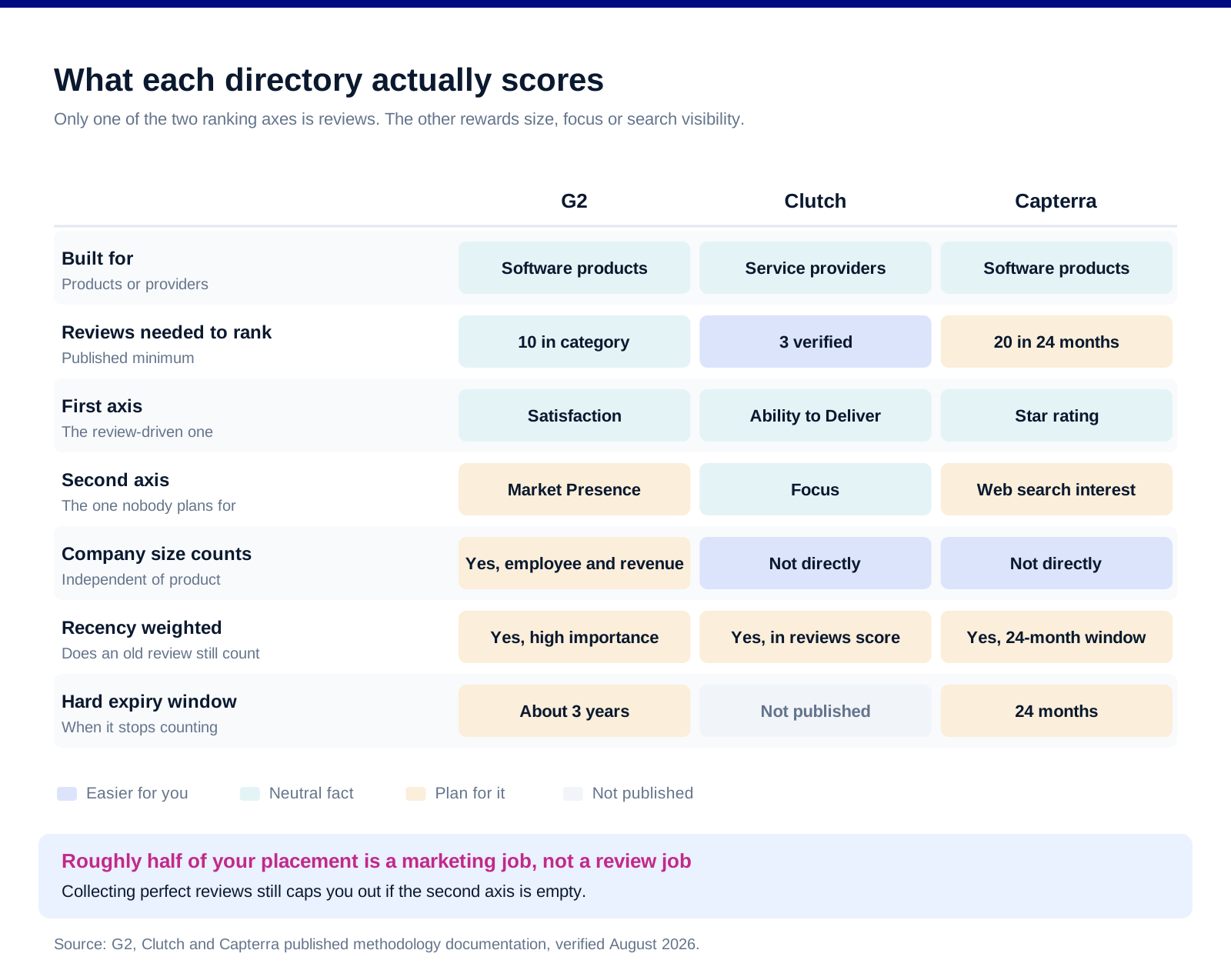
G2 plots Satisfaction against Market Presence. Its published research scoring methodology sets out that Satisfaction is driven by user-reported metrics rated at high importance: ease of use, meets requirements and quality of support. Review volume and review recency are also weighted at high importance. Administrator metrics sit at medium and general metrics at low.
G2's Market Presence axis is not about your product at all. It uses weighted review count by category at high importance, employee and revenue data pulled from ZoomInfo, LinkedIn and Crunchbase at high to medium, and Moz domain authority and search traffic at medium to low. A bigger, better-funded, better-ranked company scores higher on this axis regardless of whether its product is better.
Clutch scores an Ability to Deliver total worth forty points. Its published ranking factors put reviews at twenty of those, clients and experience ten, and market presence ten. Clutch describes the reviews score as the most heavily weighted component and the one with the most impact on rankings.
Clutch's review score is not just a star average. It assesses overall rating, recency and verification status, and it factors in the budget associated with the client in the review. A five-star review from a small engagement does not carry the same weight as a five-star review from a large one.
Clutch's other axis is Focus, meaning specialization. The Leaders Matrix plots Focus horizontally against Ability to Deliver vertically, producing Market Leaders top right, Proven Leaders top left, Niche Leaders bottom right and Emerging Leaders bottom left. A generalist agency is structurally disadvantaged here in a way that has nothing to do with quality of work.
Capterra scores reviews against web search interest. Its published research methodology states that the reviews component uses the overall one-to-five star rating from reviews left in the last twenty-four months. The web search interest component uses average monthly search volume and the position of your domain. Each is scaled to a value between one and fifty, for a combined maximum of one hundred.
So half of Capterra is an SEO outcome. If you have never invested in search, you can collect perfect reviews and still cap out around fifty. That is worth knowing before you brief anyone on a review campaign.
Reviews expire, and that changes the whole job
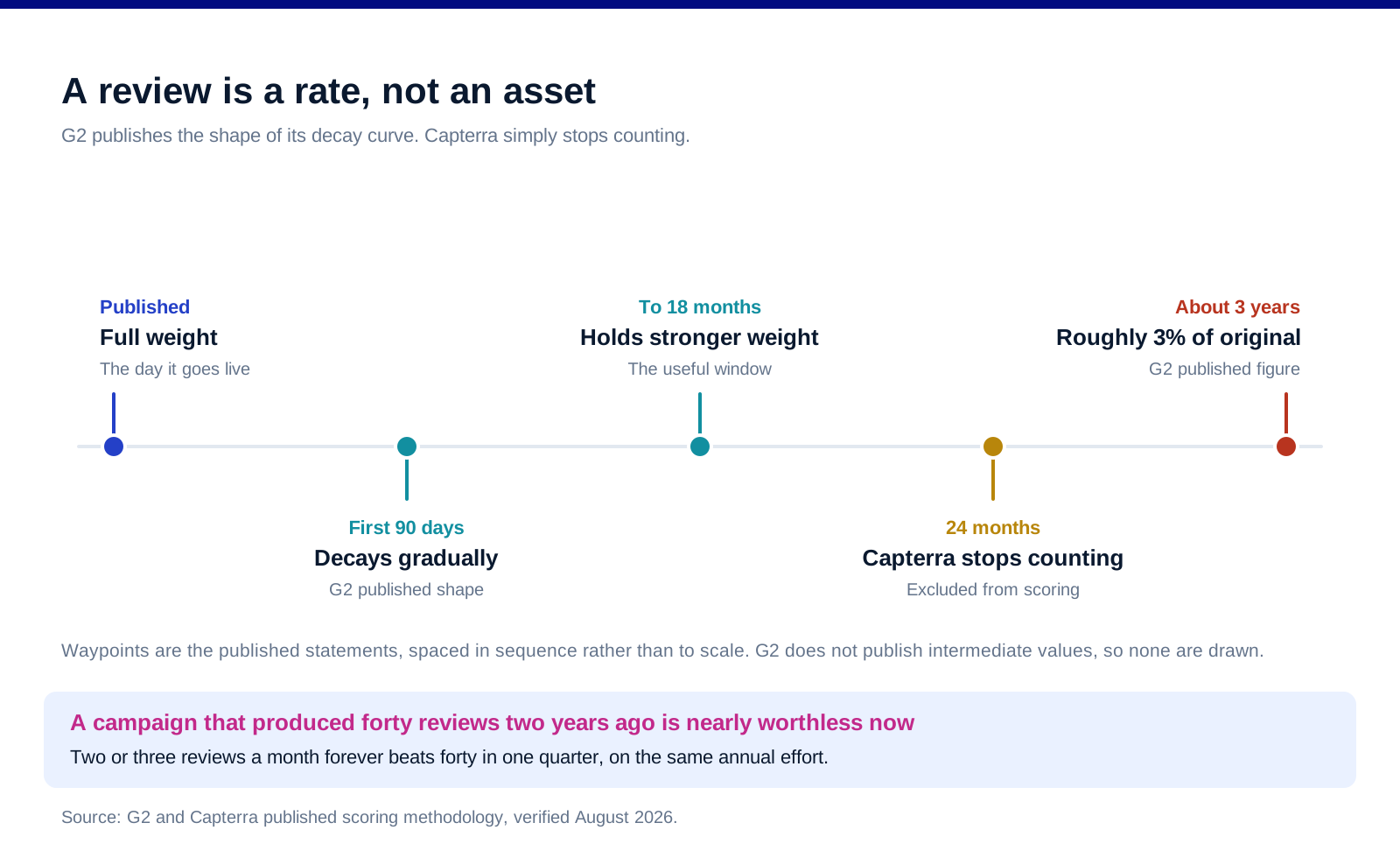
G2 publishes the decay curve, and it is the single most useful fact in this article. In its own documentation, a review decays gradually for the first ninety days, maintains a stronger weight for the first eighteen months, and then the rate of decay accelerates. After about three years, it reaches approximately three percent of its original weight.
Capterra does not decay reviews so much as delete them from the calculation. Its reviews component only counts what was published in the last twenty-four months, and its inclusion threshold requires twenty unique reviews inside that same window. Past that line, a review contributes nothing.
Clutch weights recency inside its most heavily weighted score. It does not publish a curve, so treat the direction as known and the shape as unknown.
The operational consequence is the whole point. A review campaign produces a spike that is worth a lot for a year, still worth something at eighteen months, and worth almost nothing at three. A habit that produces two or three reviews a month forever produces a rolling stock that never falls below the threshold and never ages out. Same annual effort, completely different result.
Which means the right owner is customer success, not marketing. The ask has to be attached to a moment that recurs, such as a successful onboarding, a renewal, a support resolution that went well. Marketing campaigns end. Onboarding does not.
And it means the badge on your website is a lagging indicator. Being in a Grid quadrant today tells a buyer what your last eighteen months looked like. It says nothing about whether you are still collecting.
The entry threshold is lower than most people assume
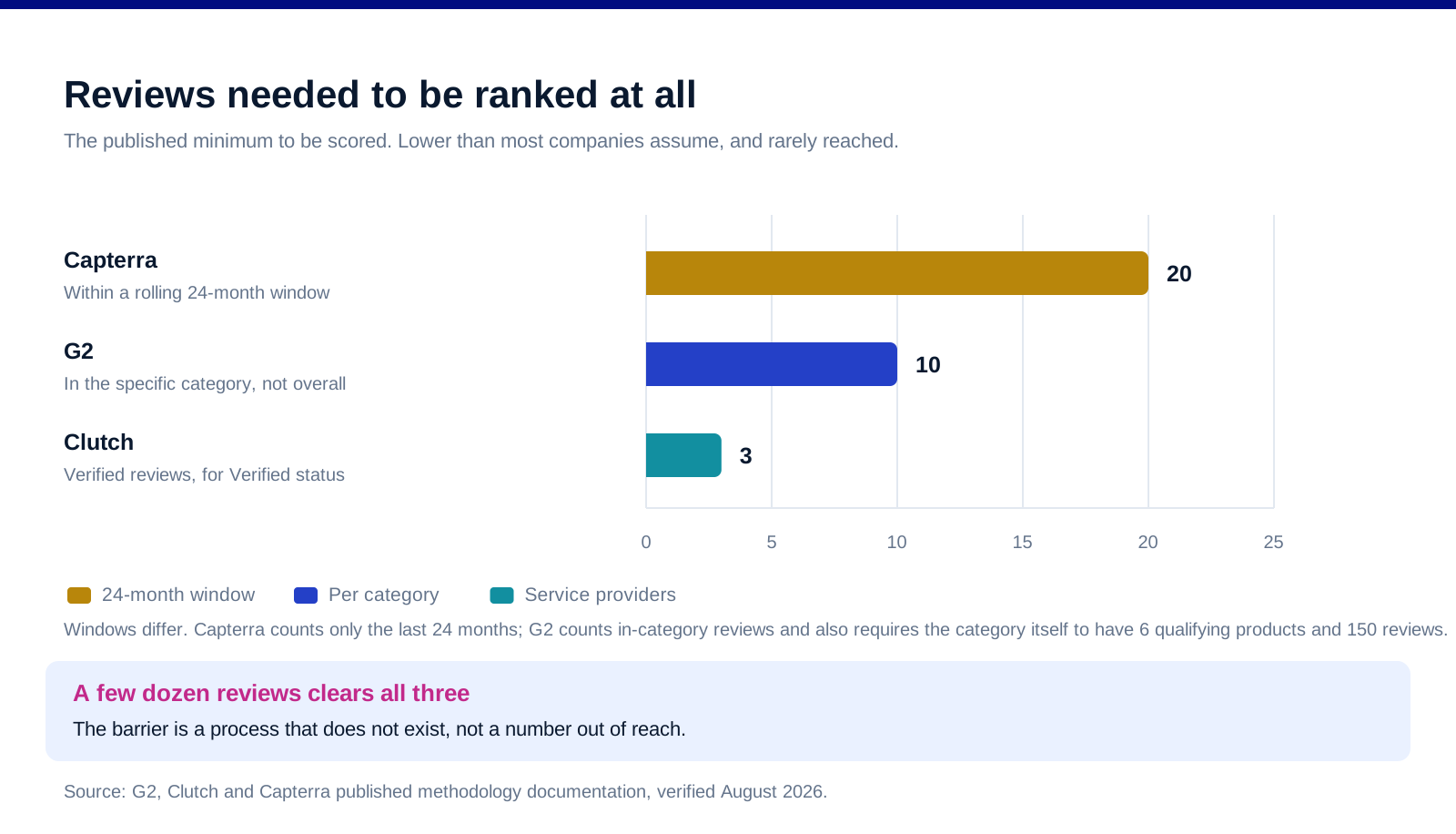
G2 requires at least ten reviews in the corresponding category for a product to appear on a Grid. In the category, not overall, which is a distinction that catches people out.
The category itself also has to qualify. G2 requires a category to contain at least six products with ten or more reviews, and at least one hundred and fifty reviews overall, before a Grid is produced for it. If your niche is too small there is no Grid to be on.
Clutch requires three verified reviews for Verified status, and the same three for Premier Verified alongside additional checks, per its research methodology.
Capterra requires twenty unique product reviews published within twenty-four months of the start of the research process, plus a minimum normalized rating and search interest score, evidence of the required functionality from public sources, service to North American users, and that the product is not a niche solution.
Add those up and the entry price is a few dozen reviews, not hundreds. Most B2B companies could clear all three thresholds inside a quarter and simply have not asked. The barrier is a process that does not exist rather than a number that is out of reach.
Pick the narrowest category you legitimately fit. On G2 this decides which competitors you are ranked against on the Market Presence axis, and that axis rewards company size. In a broad category you lose to funding. In a narrow one you can win on satisfaction. Our lists of the top B2B directories and top SaaS directories are the place to work out which ones your buyers actually use.
How the leads actually arrive
Almost never as a form fill from the directory itself. Directory-sourced pipeline mostly shows up as a shortlist you were included in, and you find out at the demo when someone says they saw you on a Grid. Expect attribution to be poor and do not judge the channel on last-click.
Increasingly, as a citation inside an AI answer. Directory category pages are exactly the sort of structured comparison source that AI answer engines lean on, which makes directory presence a component of the work described in our AI search optimization playbook. This is currently the fastest-moving reason to bother.
As a closing asset in deals you already have. A prospect in a competitive evaluation checking your category page and finding recent, specific, credible reviews is worth more than any single new lead the listing generates.
And as a source of language. Read your competitors' one and two-star reviews. That is the most honest positioning research available to you and it costs nothing.
Do not buy leads from the directories on the assumption that presence and paid placement are the same thing. Ranking is earned through the mechanics above. Paid programmes are a separate purchase and should be evaluated on their own numbers rather than as a shortcut to the ranking.
FAQ
How many reviews do you need to rank on G2?
At least ten reviews in the specific category you want to appear in, not ten overall. The category itself also has to qualify, which requires at least six products with ten or more reviews and at least one hundred and fifty reviews across the category. If your niche is too small, no Grid is produced for it at all.
Do old reviews still count on G2 and Capterra?
Not for long. G2 states that a review decays gradually for the first ninety days, holds a stronger weight for eighteen months, then decays faster, reaching roughly three percent of its original weight after about three years. Capterra's review component only counts reviews published in the last twenty-four months. Old reviews stay visible to buyers but stop carrying ranking weight.
Is Clutch or G2 better for a B2B agency?
Clutch, in most cases. It is built for service providers, its Focus axis rewards specialization, and it needs only three verified reviews to reach Verified status. G2 is built around software products and its Market Presence axis pulls company size and search data, which structurally favours larger vendors regardless of the work.
Can you pay to rank higher on B2B directories?
Ranking positions are driven by the published scoring mechanics, which are review-based and market-presence-based rather than purchased. Paid programmes exist on all three platforms and buy visibility, placement and lead products rather than the ranking itself. Treat them as a media purchase to be judged on its own return, not as a route to the quadrant.
How long does it take to get leads from a directory listing?
Plan on a quarter to clear the entry thresholds and two to three more before shortlist inclusion shows up in conversations. The channel compounds slowly and then decays quickly if you stop, which is the opposite shape to most paid channels and the reason it gets abandoned early.
Who should own directory reviews internally?
Customer success, not marketing. The mechanics reward a steady rate rather than a campaign, so the ask needs to be attached to something that recurs, such as onboarding completion or renewal. A marketing campaign produces a spike that has largely aged out within two years and leaves nothing behind.
Bottom line
Directories are not a listing, they are a subscription you pay in reviews. G2 decays a review to about three percent of its weight in three years and Capterra stops counting it at two, so a quarterly habit that produces a handful of reviews beats an annual campaign that produces forty. Clear the thresholds, which are ten in-category on G2, three on Clutch and twenty within twenty-four months on Capterra, and understand that the second axis on every one of these platforms rewards company size, specialization or search visibility rather than product quality. Then judge the channel on shortlist inclusion and AI citations rather than on form fills, because that is where the value actually shows up.
Want the pipeline built rather than the listings managed? Book a call with GROU. We run lead generation and outbound inside B2B revenue engines across verticals.
We are GROU, a B2B pipeline agency that runs lead generation, outbound, and LinkedIn content for clients across manufacturing, fintech, iGaming, software, and professional services. The operating guidance reflects our deployments between 2024 and 2026, anonymized to protect client confidentiality.
Most companies treat a directory listing as a thing you set up once. You claim the profile, you ask six customers for reviews, you get a badge, and then you go and do something else.
That is the wrong shape. Every major B2B directory prices a review by how recently it was written, and two of them put an explicit clock on it. G2 says a review falls to roughly three percent of its original weight after about three years. Capterra only counts reviews published in the last twenty-four months. Which means a directory listing is not an asset you own. It is a rate you maintain, and the moment you stop, it starts draining.
This is what the three directories that matter for B2B actually measure, what they cost to enter, and how the leads arrive once you are there.
TL;DR
All three directories score you on two axes, and only one of them is reviews. G2 plots Satisfaction against Market Presence, where Market Presence pulls employee and revenue data from ZoomInfo, LinkedIn and Crunchbase plus Moz domain authority and search traffic. Capterra's second dimension is literally search volume and where your domain ranks. Clutch plots Focus against an Ability to Deliver score worth forty points, of which reviews are twenty. So roughly half of your directory placement is a marketing and SEO job rather than a review-collection job, which is the part nobody tells you. The entry thresholds are low and specific: ten in-category reviews on G2, three verified reviews on Clutch, twenty reviews inside twenty-four months on Capterra. And recency is weighted heavily everywhere, so a batch of forty reviews collected in one quarter two years ago is close to worthless today. Run review collection as a permanent monthly habit at a low volume rather than as a campaign, pick the narrowest category you legitimately fit, and expect the leads to arrive as shortlist inclusion and as citations inside AI answers rather than as form fills.
What each directory actually scores you on
G2 plots Satisfaction against Market Presence. Its published research scoring methodology sets out that Satisfaction is driven by user-reported metrics rated at high importance: ease of use, meets requirements and quality of support. Review volume and review recency are also weighted at high importance. Administrator metrics sit at medium and general metrics at low.
G2's Market Presence axis is not about your product at all. It uses weighted review count by category at high importance, employee and revenue data pulled from ZoomInfo, LinkedIn and Crunchbase at high to medium, and Moz domain authority and search traffic at medium to low. A bigger, better-funded, better-ranked company scores higher on this axis regardless of whether its product is better.
Clutch scores an Ability to Deliver total worth forty points. Its published ranking factors put reviews at twenty of those, clients and experience ten, and market presence ten. Clutch describes the reviews score as the most heavily weighted component and the one with the most impact on rankings.
Clutch's review score is not just a star average. It assesses overall rating, recency and verification status, and it factors in the budget associated with the client in the review. A five-star review from a small engagement does not carry the same weight as a five-star review from a large one.
Clutch's other axis is Focus, meaning specialization. The Leaders Matrix plots Focus horizontally against Ability to Deliver vertically, producing Market Leaders top right, Proven Leaders top left, Niche Leaders bottom right and Emerging Leaders bottom left. A generalist agency is structurally disadvantaged here in a way that has nothing to do with quality of work.
Capterra scores reviews against web search interest. Its published research methodology states that the reviews component uses the overall one-to-five star rating from reviews left in the last twenty-four months. The web search interest component uses average monthly search volume and the position of your domain. Each is scaled to a value between one and fifty, for a combined maximum of one hundred.
So half of Capterra is an SEO outcome. If you have never invested in search, you can collect perfect reviews and still cap out around fifty. That is worth knowing before you brief anyone on a review campaign.
Reviews expire, and that changes the whole job
G2 publishes the decay curve, and it is the single most useful fact in this article. In its own documentation, a review decays gradually for the first ninety days, maintains a stronger weight for the first eighteen months, and then the rate of decay accelerates. After about three years, it reaches approximately three percent of its original weight.
Capterra does not decay reviews so much as delete them from the calculation. Its reviews component only counts what was published in the last twenty-four months, and its inclusion threshold requires twenty unique reviews inside that same window. Past that line, a review contributes nothing.
Clutch weights recency inside its most heavily weighted score. It does not publish a curve, so treat the direction as known and the shape as unknown.
The operational consequence is the whole point. A review campaign produces a spike that is worth a lot for a year, still worth something at eighteen months, and worth almost nothing at three. A habit that produces two or three reviews a month forever produces a rolling stock that never falls below the threshold and never ages out. Same annual effort, completely different result.
Which means the right owner is customer success, not marketing. The ask has to be attached to a moment that recurs, such as a successful onboarding, a renewal, a support resolution that went well. Marketing campaigns end. Onboarding does not.
And it means the badge on your website is a lagging indicator. Being in a Grid quadrant today tells a buyer what your last eighteen months looked like. It says nothing about whether you are still collecting.
The entry threshold is lower than most people assume
G2 requires at least ten reviews in the corresponding category for a product to appear on a Grid. In the category, not overall, which is a distinction that catches people out.
The category itself also has to qualify. G2 requires a category to contain at least six products with ten or more reviews, and at least one hundred and fifty reviews overall, before a Grid is produced for it. If your niche is too small there is no Grid to be on.
Clutch requires three verified reviews for Verified status, and the same three for Premier Verified alongside additional checks, per its research methodology.
Capterra requires twenty unique product reviews published within twenty-four months of the start of the research process, plus a minimum normalized rating and search interest score, evidence of the required functionality from public sources, service to North American users, and that the product is not a niche solution.
Add those up and the entry price is a few dozen reviews, not hundreds. Most B2B companies could clear all three thresholds inside a quarter and simply have not asked. The barrier is a process that does not exist rather than a number that is out of reach.
Pick the narrowest category you legitimately fit. On G2 this decides which competitors you are ranked against on the Market Presence axis, and that axis rewards company size. In a broad category you lose to funding. In a narrow one you can win on satisfaction. Our lists of the top B2B directories and top SaaS directories are the place to work out which ones your buyers actually use.
How the leads actually arrive
Almost never as a form fill from the directory itself. Directory-sourced pipeline mostly shows up as a shortlist you were included in, and you find out at the demo when someone says they saw you on a Grid. Expect attribution to be poor and do not judge the channel on last-click.
Increasingly, as a citation inside an AI answer. Directory category pages are exactly the sort of structured comparison source that AI answer engines lean on, which makes directory presence a component of the work described in our AI search optimization playbook. This is currently the fastest-moving reason to bother.
As a closing asset in deals you already have. A prospect in a competitive evaluation checking your category page and finding recent, specific, credible reviews is worth more than any single new lead the listing generates.
And as a source of language. Read your competitors' one and two-star reviews. That is the most honest positioning research available to you and it costs nothing.
Do not buy leads from the directories on the assumption that presence and paid placement are the same thing. Ranking is earned through the mechanics above. Paid programmes are a separate purchase and should be evaluated on their own numbers rather than as a shortcut to the ranking.
FAQ
How many reviews do you need to rank on G2?
At least ten reviews in the specific category you want to appear in, not ten overall. The category itself also has to qualify, which requires at least six products with ten or more reviews and at least one hundred and fifty reviews across the category. If your niche is too small, no Grid is produced for it at all.
Do old reviews still count on G2 and Capterra?
Not for long. G2 states that a review decays gradually for the first ninety days, holds a stronger weight for eighteen months, then decays faster, reaching roughly three percent of its original weight after about three years. Capterra's review component only counts reviews published in the last twenty-four months. Old reviews stay visible to buyers but stop carrying ranking weight.
Is Clutch or G2 better for a B2B agency?
Clutch, in most cases. It is built for service providers, its Focus axis rewards specialization, and it needs only three verified reviews to reach Verified status. G2 is built around software products and its Market Presence axis pulls company size and search data, which structurally favours larger vendors regardless of the work.
Can you pay to rank higher on B2B directories?
Ranking positions are driven by the published scoring mechanics, which are review-based and market-presence-based rather than purchased. Paid programmes exist on all three platforms and buy visibility, placement and lead products rather than the ranking itself. Treat them as a media purchase to be judged on its own return, not as a route to the quadrant.
How long does it take to get leads from a directory listing?
Plan on a quarter to clear the entry thresholds and two to three more before shortlist inclusion shows up in conversations. The channel compounds slowly and then decays quickly if you stop, which is the opposite shape to most paid channels and the reason it gets abandoned early.
Who should own directory reviews internally?
Customer success, not marketing. The mechanics reward a steady rate rather than a campaign, so the ask needs to be attached to something that recurs, such as onboarding completion or renewal. A marketing campaign produces a spike that has largely aged out within two years and leaves nothing behind.
Bottom line
Directories are not a listing, they are a subscription you pay in reviews. G2 decays a review to about three percent of its weight in three years and Capterra stops counting it at two, so a quarterly habit that produces a handful of reviews beats an annual campaign that produces forty. Clear the thresholds, which are ten in-category on G2, three on Clutch and twenty within twenty-four months on Capterra, and understand that the second axis on every one of these platforms rewards company size, specialization or search visibility rather than product quality. Then judge the channel on shortlist inclusion and AI citations rather than on form fills, because that is where the value actually shows up.
Want the pipeline built rather than the listings managed? Book a call with GROU. We run lead generation and outbound inside B2B revenue engines across verticals.
We are GROU, a B2B pipeline agency that runs lead generation, outbound, and LinkedIn content for clients across manufacturing, fintech, iGaming, software, and professional services. The operating guidance reflects our deployments between 2024 and 2026, anonymized to protect client confidentiality.
Most companies treat a directory listing as a thing you set up once. You claim the profile, you ask six customers for reviews, you get a badge, and then you go and do something else.
That is the wrong shape. Every major B2B directory prices a review by how recently it was written, and two of them put an explicit clock on it. G2 says a review falls to roughly three percent of its original weight after about three years. Capterra only counts reviews published in the last twenty-four months. Which means a directory listing is not an asset you own. It is a rate you maintain, and the moment you stop, it starts draining.
This is what the three directories that matter for B2B actually measure, what they cost to enter, and how the leads arrive once you are there.
TL;DR
All three directories score you on two axes, and only one of them is reviews. G2 plots Satisfaction against Market Presence, where Market Presence pulls employee and revenue data from ZoomInfo, LinkedIn and Crunchbase plus Moz domain authority and search traffic. Capterra's second dimension is literally search volume and where your domain ranks. Clutch plots Focus against an Ability to Deliver score worth forty points, of which reviews are twenty. So roughly half of your directory placement is a marketing and SEO job rather than a review-collection job, which is the part nobody tells you. The entry thresholds are low and specific: ten in-category reviews on G2, three verified reviews on Clutch, twenty reviews inside twenty-four months on Capterra. And recency is weighted heavily everywhere, so a batch of forty reviews collected in one quarter two years ago is close to worthless today. Run review collection as a permanent monthly habit at a low volume rather than as a campaign, pick the narrowest category you legitimately fit, and expect the leads to arrive as shortlist inclusion and as citations inside AI answers rather than as form fills.
What each directory actually scores you on
G2 plots Satisfaction against Market Presence. Its published research scoring methodology sets out that Satisfaction is driven by user-reported metrics rated at high importance: ease of use, meets requirements and quality of support. Review volume and review recency are also weighted at high importance. Administrator metrics sit at medium and general metrics at low.
G2's Market Presence axis is not about your product at all. It uses weighted review count by category at high importance, employee and revenue data pulled from ZoomInfo, LinkedIn and Crunchbase at high to medium, and Moz domain authority and search traffic at medium to low. A bigger, better-funded, better-ranked company scores higher on this axis regardless of whether its product is better.
Clutch scores an Ability to Deliver total worth forty points. Its published ranking factors put reviews at twenty of those, clients and experience ten, and market presence ten. Clutch describes the reviews score as the most heavily weighted component and the one with the most impact on rankings.
Clutch's review score is not just a star average. It assesses overall rating, recency and verification status, and it factors in the budget associated with the client in the review. A five-star review from a small engagement does not carry the same weight as a five-star review from a large one.
Clutch's other axis is Focus, meaning specialization. The Leaders Matrix plots Focus horizontally against Ability to Deliver vertically, producing Market Leaders top right, Proven Leaders top left, Niche Leaders bottom right and Emerging Leaders bottom left. A generalist agency is structurally disadvantaged here in a way that has nothing to do with quality of work.
Capterra scores reviews against web search interest. Its published research methodology states that the reviews component uses the overall one-to-five star rating from reviews left in the last twenty-four months. The web search interest component uses average monthly search volume and the position of your domain. Each is scaled to a value between one and fifty, for a combined maximum of one hundred.
So half of Capterra is an SEO outcome. If you have never invested in search, you can collect perfect reviews and still cap out around fifty. That is worth knowing before you brief anyone on a review campaign.
Reviews expire, and that changes the whole job
G2 publishes the decay curve, and it is the single most useful fact in this article. In its own documentation, a review decays gradually for the first ninety days, maintains a stronger weight for the first eighteen months, and then the rate of decay accelerates. After about three years, it reaches approximately three percent of its original weight.
Capterra does not decay reviews so much as delete them from the calculation. Its reviews component only counts what was published in the last twenty-four months, and its inclusion threshold requires twenty unique reviews inside that same window. Past that line, a review contributes nothing.
Clutch weights recency inside its most heavily weighted score. It does not publish a curve, so treat the direction as known and the shape as unknown.
The operational consequence is the whole point. A review campaign produces a spike that is worth a lot for a year, still worth something at eighteen months, and worth almost nothing at three. A habit that produces two or three reviews a month forever produces a rolling stock that never falls below the threshold and never ages out. Same annual effort, completely different result.
Which means the right owner is customer success, not marketing. The ask has to be attached to a moment that recurs, such as a successful onboarding, a renewal, a support resolution that went well. Marketing campaigns end. Onboarding does not.
And it means the badge on your website is a lagging indicator. Being in a Grid quadrant today tells a buyer what your last eighteen months looked like. It says nothing about whether you are still collecting.
The entry threshold is lower than most people assume
G2 requires at least ten reviews in the corresponding category for a product to appear on a Grid. In the category, not overall, which is a distinction that catches people out.
The category itself also has to qualify. G2 requires a category to contain at least six products with ten or more reviews, and at least one hundred and fifty reviews overall, before a Grid is produced for it. If your niche is too small there is no Grid to be on.
Clutch requires three verified reviews for Verified status, and the same three for Premier Verified alongside additional checks, per its research methodology.
Capterra requires twenty unique product reviews published within twenty-four months of the start of the research process, plus a minimum normalized rating and search interest score, evidence of the required functionality from public sources, service to North American users, and that the product is not a niche solution.
Add those up and the entry price is a few dozen reviews, not hundreds. Most B2B companies could clear all three thresholds inside a quarter and simply have not asked. The barrier is a process that does not exist rather than a number that is out of reach.
Pick the narrowest category you legitimately fit. On G2 this decides which competitors you are ranked against on the Market Presence axis, and that axis rewards company size. In a broad category you lose to funding. In a narrow one you can win on satisfaction. Our lists of the top B2B directories and top SaaS directories are the place to work out which ones your buyers actually use.
How the leads actually arrive
Almost never as a form fill from the directory itself. Directory-sourced pipeline mostly shows up as a shortlist you were included in, and you find out at the demo when someone says they saw you on a Grid. Expect attribution to be poor and do not judge the channel on last-click.
Increasingly, as a citation inside an AI answer. Directory category pages are exactly the sort of structured comparison source that AI answer engines lean on, which makes directory presence a component of the work described in our AI search optimization playbook. This is currently the fastest-moving reason to bother.
As a closing asset in deals you already have. A prospect in a competitive evaluation checking your category page and finding recent, specific, credible reviews is worth more than any single new lead the listing generates.
And as a source of language. Read your competitors' one and two-star reviews. That is the most honest positioning research available to you and it costs nothing.
Do not buy leads from the directories on the assumption that presence and paid placement are the same thing. Ranking is earned through the mechanics above. Paid programmes are a separate purchase and should be evaluated on their own numbers rather than as a shortcut to the ranking.
FAQ
How many reviews do you need to rank on G2?
At least ten reviews in the specific category you want to appear in, not ten overall. The category itself also has to qualify, which requires at least six products with ten or more reviews and at least one hundred and fifty reviews across the category. If your niche is too small, no Grid is produced for it at all.
Do old reviews still count on G2 and Capterra?
Not for long. G2 states that a review decays gradually for the first ninety days, holds a stronger weight for eighteen months, then decays faster, reaching roughly three percent of its original weight after about three years. Capterra's review component only counts reviews published in the last twenty-four months. Old reviews stay visible to buyers but stop carrying ranking weight.
Is Clutch or G2 better for a B2B agency?
Clutch, in most cases. It is built for service providers, its Focus axis rewards specialization, and it needs only three verified reviews to reach Verified status. G2 is built around software products and its Market Presence axis pulls company size and search data, which structurally favours larger vendors regardless of the work.
Can you pay to rank higher on B2B directories?
Ranking positions are driven by the published scoring mechanics, which are review-based and market-presence-based rather than purchased. Paid programmes exist on all three platforms and buy visibility, placement and lead products rather than the ranking itself. Treat them as a media purchase to be judged on its own return, not as a route to the quadrant.
How long does it take to get leads from a directory listing?
Plan on a quarter to clear the entry thresholds and two to three more before shortlist inclusion shows up in conversations. The channel compounds slowly and then decays quickly if you stop, which is the opposite shape to most paid channels and the reason it gets abandoned early.
Who should own directory reviews internally?
Customer success, not marketing. The mechanics reward a steady rate rather than a campaign, so the ask needs to be attached to something that recurs, such as onboarding completion or renewal. A marketing campaign produces a spike that has largely aged out within two years and leaves nothing behind.
Bottom line
Directories are not a listing, they are a subscription you pay in reviews. G2 decays a review to about three percent of its weight in three years and Capterra stops counting it at two, so a quarterly habit that produces a handful of reviews beats an annual campaign that produces forty. Clear the thresholds, which are ten in-category on G2, three on Clutch and twenty within twenty-four months on Capterra, and understand that the second axis on every one of these platforms rewards company size, specialization or search visibility rather than product quality. Then judge the channel on shortlist inclusion and AI citations rather than on form fills, because that is where the value actually shows up.
Want the pipeline built rather than the listings managed? Book a call with GROU. We run lead generation and outbound inside B2B revenue engines across verticals.
We are GROU, a B2B pipeline agency that runs lead generation, outbound, and LinkedIn content for clients across manufacturing, fintech, iGaming, software, and professional services. The operating guidance reflects our deployments between 2024 and 2026, anonymized to protect client confidentiality.

Pipeline OS Newsletter
Build qualified pipeline
Get weekly tactics to generate demand, improve lead quality, and book more meetings.





Trusted by industry leaders
Trusted by industry leaders
Trusted by industry leaders
Ready to build qualified pipeline?
Ready to build qualified pipeline?
Ready to build qualified pipeline?
Book a call to see if we're the right fit, or take the 2-minute quiz to get a clear starting point.
Book a call to see if we're the right fit, or take the 2-minute quiz to get a clear starting point.
Book a call to see if we're the right fit, or take the 2-minute quiz to get a clear starting point.
" height="30.21639343089746px" id="hfGbXmQR2" width="30.216393430897455px"/></svg>)
Copyright © 2026 – All Right Reserved
Copyright © 2026 – All Right Reserved
Copyright © 2026 – All Right Reserved