%22%3E%3C/path%3E%3Cpath d=%22M 63.072 7.554 C 62.258 8.022 61.577 8.689 61.092 9.493 L 61.092 7.076 L 57.158 7.076 L 57.158 22.64 L 61.089 22.64 L 61.089 14.888 C 61.089 13.446 61.403 12.434 62.03 11.853 C 62.818 11.218 63.818 10.907 64.826 10.982 L 65.868 10.982 L 65.868 6.851 C 64.891 6.834 63.926 7.076 63.073 7.554 Z%22 fill=%22rgb(17,17,17)%22%3E%3C/path%3E%3Cpath d=%22M 78.916 7.82 C 76.363 6.49 73.321 6.49 70.768 7.82 C 69.562 8.473 68.564 9.451 67.888 10.644 C 67.167 11.931 66.803 13.387 66.834 14.862 C 66.804 16.332 67.157 17.785 67.86 19.077 C 68.515 20.267 69.494 21.246 70.684 21.901 C 71.924 22.576 73.318 22.92 74.73 22.898 C 76.164 22.918 77.58 22.575 78.846 21.901 C 80.062 21.247 81.073 20.27 81.768 19.077 C 82.506 17.797 82.88 16.339 82.85 14.862 C 82.88 13.389 82.517 11.934 81.797 10.647 C 81.12 9.455 80.122 8.477 78.917 7.824 M 78.803 14.862 C 78.829 15.739 78.636 16.608 78.241 17.391 C 77.903 18.046 77.38 18.588 76.738 18.95 C 76.124 19.293 75.432 19.472 74.729 19.47 C 73.668 19.497 72.648 19.061 71.934 18.276 C 71.139 17.323 70.741 16.1 70.823 14.862 C 70.741 13.62 71.149 12.395 71.959 11.45 C 72.687 10.667 73.715 10.233 74.783 10.256 C 75.859 10.236 76.894 10.67 77.635 11.45 C 78.464 12.387 78.884 13.616 78.801 14.864%22 fill=%22rgb(17,17,17)%22%3E%3C/path%3E%3Cpath d=%22M 95.906 7.076 L 95.906 15.646 C 95.975 16.68 95.643 17.701 94.979 18.498 C 94.311 19.184 93.379 19.547 92.422 19.495 C 91.475 19.544 90.553 19.18 89.894 18.498 C 89.23 17.701 88.898 16.68 88.967 15.646 L 88.967 7.076 L 85.033 7.076 L 85.033 16.207 C 85 17.449 85.275 18.68 85.834 19.79 C 86.327 20.75 87.095 21.542 88.039 22.065 C 89.033 22.594 90.145 22.861 91.271 22.838 C 92.188 22.847 93.095 22.65 93.926 22.263 C 94.708 21.905 95.388 21.36 95.906 20.675 L 95.906 22.645 L 99.865 22.645 L 99.865 7.076 Z%22 fill=%22rgb(17,17,17)%22%3E%3C/path%3E%3Cpath d=%22M 4.513 15.626 C 4.511 10.815 7.606 6.549 12.181 5.059 C 16.756 3.57 21.77 5.195 24.601 9.086 L 27.816 5.87 C 24.074 1.186 17.981 -0.943 12.137 0.393 C 6.292 1.728 1.728 6.292 0.393 12.137 C -0.943 17.981 1.186 24.074 5.87 27.816 L 9.085 24.601 C 6.214 22.512 4.515 19.177 4.513 15.626%22 fill=%22rgb(32,62,235)%22%3E%3C/path%3E%3Cpath d=%22M 17.114 14.343 L 13.354 18.01 L 13.354 18.026 L 21.071 18.026 L 11.412 27.609 L 17.389 27.609 L 23.999 21.081 L 23.999 28.316 L 24.005 28.316 L 27.967 24.393 L 27.967 14.343 Z%22 fill=%22rgb(32,62,235)%22%3E%3C/path%3E%3C/g%3E%3C/svg%3E) ×
× ××
××›
›
›
›
10 Instantly Alternatives for B2B Outreach
10 Instantly Alternatives for B2B Outreach
10 Instantly Alternatives for B2B Outreach
10 Instantly Alternatives for B2B Outreach
10 Instantly Alternatives for B2B Outreach
10 Instantly Alternatives for B2B Outreach

Author
Aljaz Peklaj

Smartlead is the strongest direct alternative for high-volume email operations, lemlist is the better fit for native multichannel outreach, and Grou is the better choice when the team needs a full pipeline system instead of another sending layer. If bounces are high or replies are weak, the sender is usually not the problem, the operating system around it is.
Best direct sender swap: Smartlead for mailbox rotation, inbox management, and scale, especially when volume is the main constraint.
Best multichannel fit: lemlist when email, LinkedIn, and calls need to live in one workflow.
Best system choice: Grou when the issue is fragmented targeting, messaging, and routing, not just deliverability.
Deliverability reality: domain setup, warmup patience, list hygiene, and copy discipline matter more than the logo on the sending layer.
Migration priority: preserve domain records, export suppression lists, verify contacts, and warm new infrastructure before you judge results.
The sales engagement market is growing fast, with a projected $9.2B in 2026 and $26.6B by 2033 (market summary). That growth makes sense, because buyers aren't choosing just a sender anymore, they're choosing between email-only sending, multichannel outreach, and data-plus-sequencing systems.
Table of Contents
1. Grou
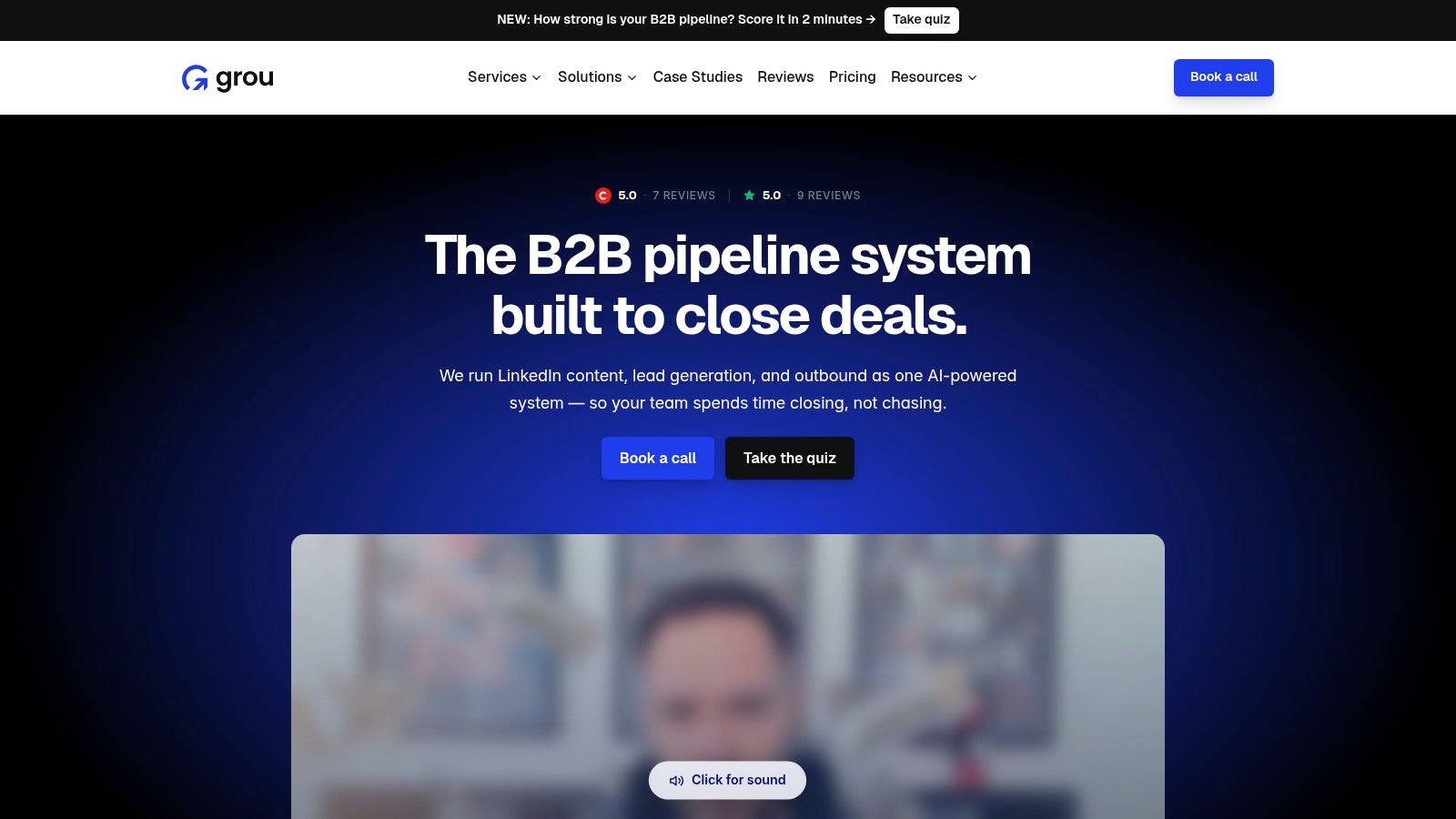
Grou is the right pick when your problem isn't just outbound execution, it's pipeline structure. For teams in iGaming, SaaS, manufacturing, legal tech, and pharma, the value is in one engine that connects ICP building, LinkedIn content, outbound, reply routing, and qualification rules so reps spend time on conversations that can close.
The practical difference is simple. A sender pushes messages. Grou builds the list, shapes the message, routes replies fast, and keeps the reporting line clear enough for RevOps and leadership to trust. That matters when you're under pressure to create qualified meetings, not activity.
Practical rule: if your team keeps blaming the sender, audit the list, trigger, and copy first. The tool is usually carrying the bad process, not causing it.
Grou's workflow is built for speed without turning volume into a religion. The operating model runs in bi-weekly sprints, with a shared Slack channel for feedback, daily iteration, and pipeline reporting that gives first signals within 30 days. It also leans on ICP-aligned list building, LinkedIn content, and outbound as one system, which is why it fits teams that need qualified conversations more than another inbox management layer.
The credibility case is practical, not decorative. Grou works with 50+ companies across iGaming, SaaS, manufacturing, and professional services, and the published outcomes include 350 qualified leads in the Adriatic region, 10x LinkedIn follower growth, and enterprise deals influenced that exceeded $20M. Those are signals that the system is built for commercial outcomes, not just sending activity.
If your team needs fewer disconnected handoffs and more owned pipeline, Grou is the stronger buy.
Pros
One operating system: LinkedIn content, lead gen, outbound, and reply routing live inside one motion.
Fast learning cycle: setup runs in about 14 days, with early signals within 30 days.
Quality-first execution: fit rules keep reps focused on accounts that deserve attention.
Cross-market credibility: active across multiple B2B verticals with public case outcomes.
Cons
Custom engagement: pricing isn't public, so you'll need a discovery conversation.
Requires collaboration: the model works best when your team gives fast feedback.
Website: Grou
2. lemlist
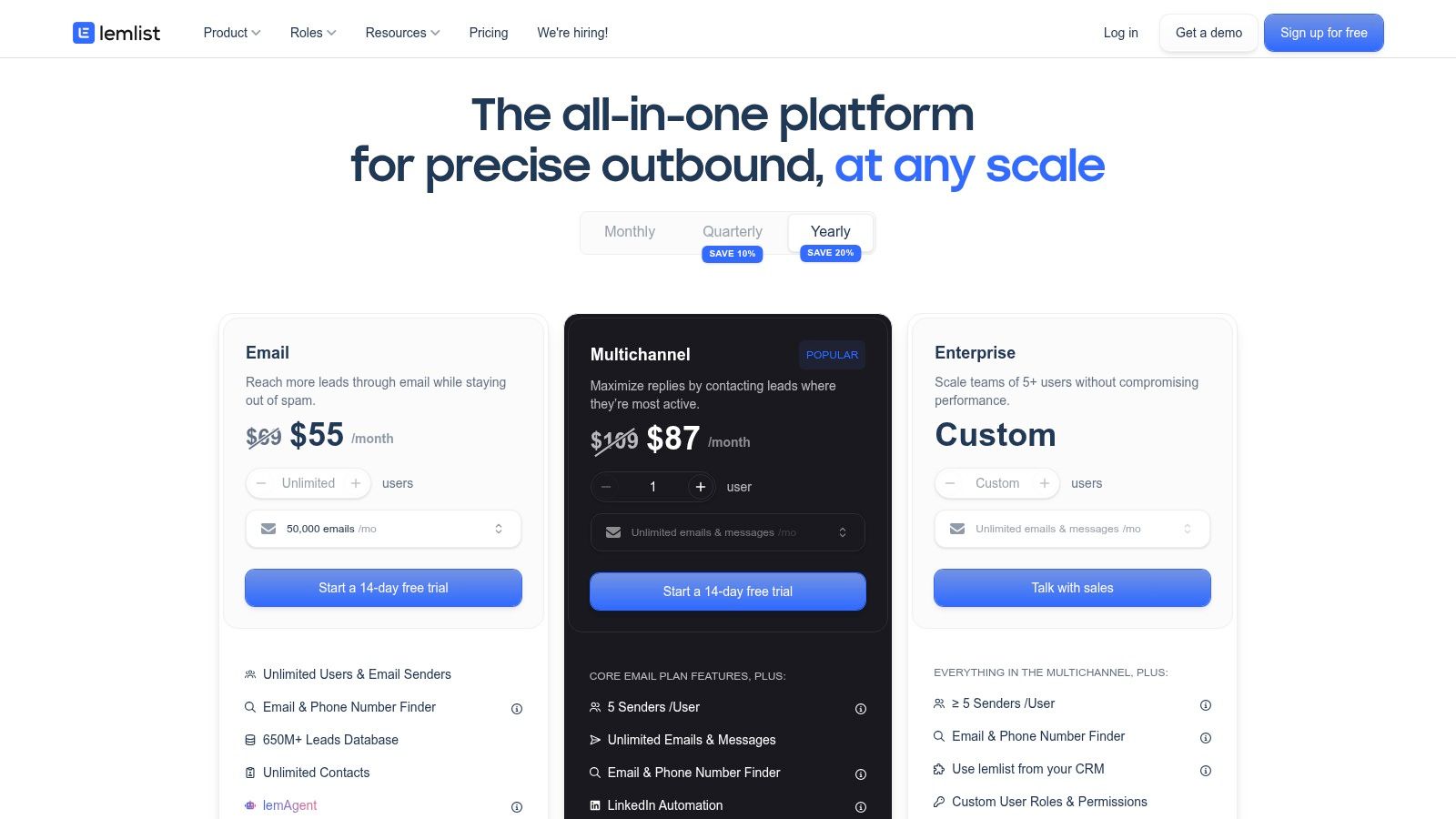
lemlist is the cleanest choice when outreach needs to move across email, LinkedIn, and calls without stitching together a stack of side tools. It's built for teams that want multichannel sequencing and personalisation in one UI, which makes it a stronger fit than a pure sender when the buying motion is already coordinated across channels.
Its lemwarm deliverability layer helps keep inbox health inside the same product, which is useful when your team doesn't want another add-on just to protect sending. The credits model also lets you bundle enrichment, verification, AI writing, and in-app calling, so the platform behaves more like a working outbound system than a basic sequencer.
A lot of teams choose lemlist because the outreach feels more human. Dynamic personalisation, image and video support, and shared team workflows make it easier to run campaigns that don't read like template spam. If you want the best tool for a rep who needs to coordinate touchpoints instead of just sending follow-ups, this is the fit.
For a deeper buyer-vs-buyer breakdown, Grou has a useful Instantly vs lemlist comparison that maps the operating trade-offs clearly.
Pros
True multichannel sequencing: email, LinkedIn, and calls inside one workflow.
Native warmup: delivery controls are part of the product, not a separate add-on.
Clear for SMB and mid-market teams: packaging is easier to understand than a pile of modules.
Cons
Credits can creep cost upward: enrichment, AI, and calling all consume usage.
Heavier users may outgrow the native data layer: some teams still need external enrichment.
Website: lemlist pricing
3. Mailshake
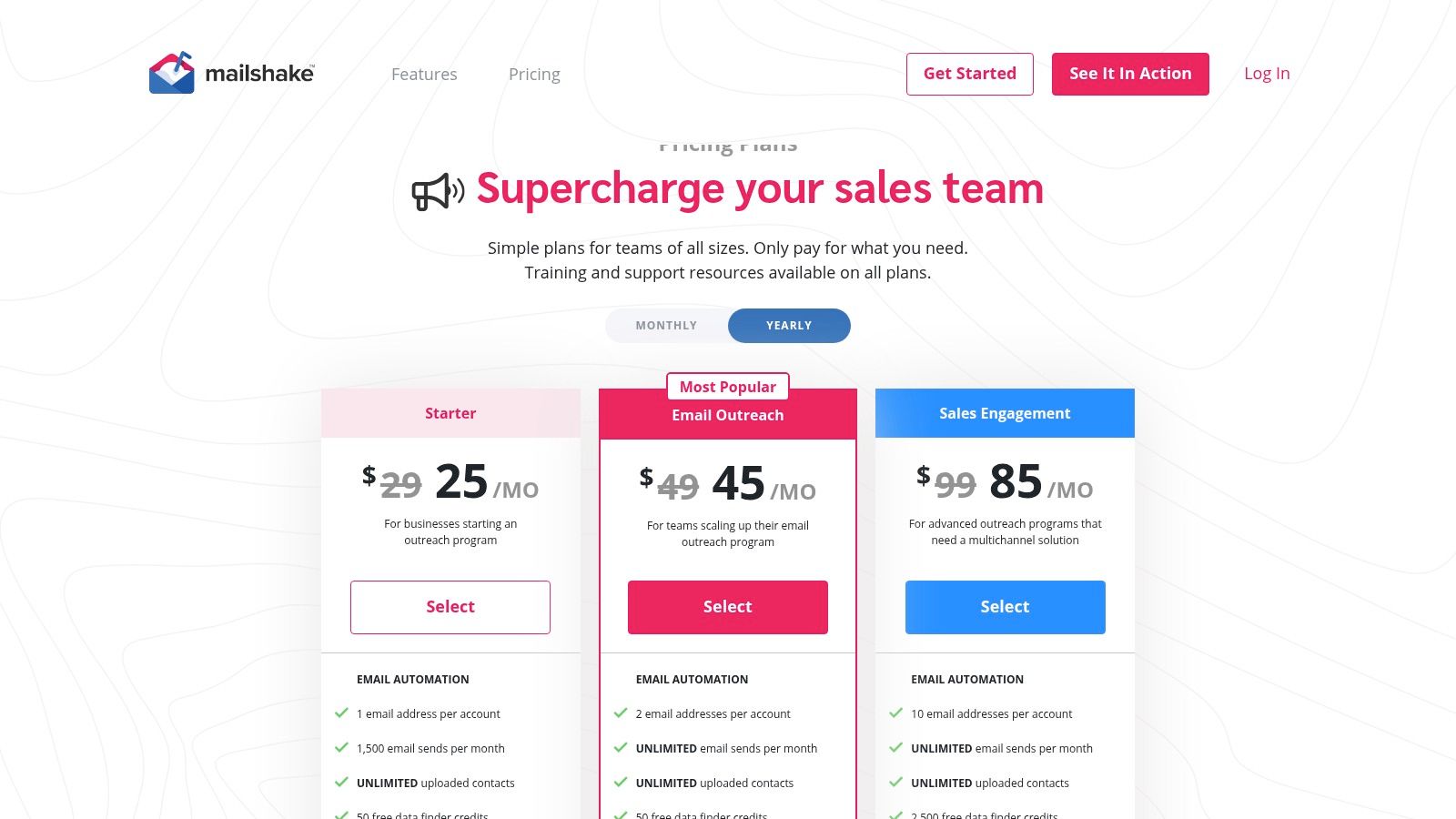
Mailshake makes sense when the team wants email-first outreach and doesn't need a platform to reinvent the whole motion. It's straightforward, easy to learn, and friendly to teams sending through Gmail or Microsoft stacks, which keeps implementation lighter than most multichannel systems.
The trade-off is that Mailshake stays focused. That's useful if your SDRs and founders want to launch quickly, test copy, and keep the workflow simple. It's less useful if your team expects LinkedIn steps, deeper channel coordination, or a large amount of automation around prospecting and enrichment.
That narrow scope is often a feature, not a bug, for lean teams. If the pipeline motion is already clear and the only issue is execution discipline, a simpler sender can be the right call. If the core issue is list quality or account selection, a more integrated system will do more for you.
If you're comparing it with another multichannel platform, Grou has a Mailshake vs lemlist breakdown that's worth reading before you commit to the wrong workflow.
Pros
Fast onboarding: good for teams that want to move quickly.
Solid sequencing basics: follow-ups, A/B testing, and email-first automation are easy to run.
Compatible with common mail stacks: Gmail, Google Workspace, Office 365, Outlook, Exchange, and SMTP/IMAP.
Cons
Weaker on LinkedIn coordination: it's not built for richer multichannel motion.
Add-ons can raise the total cost: dialer and data features change the math.
Website: Mailshake pricing
4. Smartlead
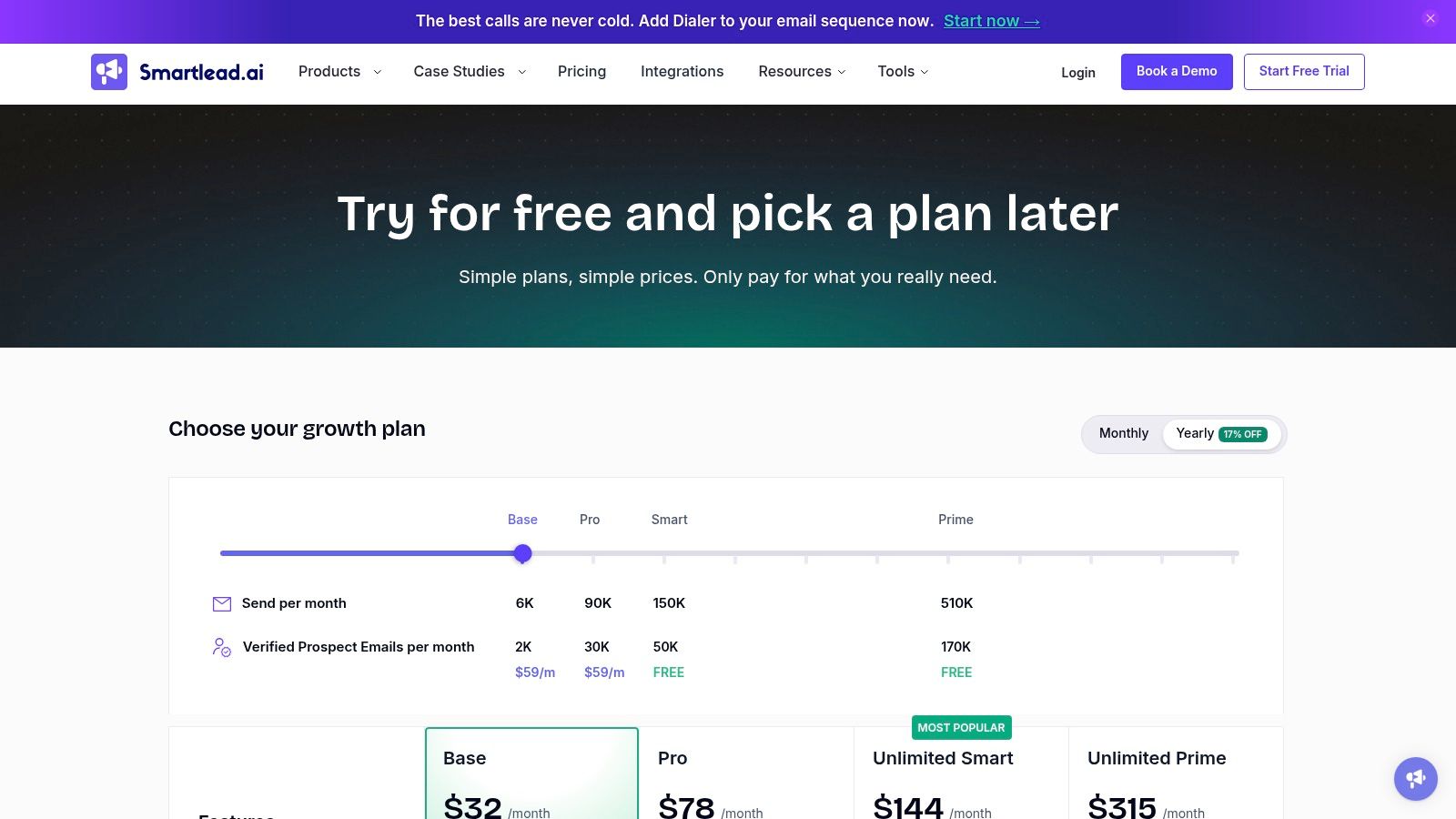
Smartlead is the strongest direct replacement for teams pushing high-volume cold email through many inboxes and domains. It's built around mailbox rotation, campaign load-balancing, warming, throttling, and deliverability controls, which is exactly where a lot of Instantly comparisons end up once the sending layer becomes operationally heavy.
The appeal is infrastructure control. If your team is running many domains and wants stronger separation between accounts, Smartlead is built for that reality. Agency-style workspaces and whitelabel options also make sense if you're managing clients or multiple brand lines at once.
Deliverability discipline matters more than platform branding. A warmed inbox can handle about 100 cold emails per day, but most practitioners still recommend staying under 30 to 50 per mailbox per day to protect reputation (EmailWarmup guidance). That ceiling applies whether you're on Instantly or Smartlead, so the migration only helps if your operating model changes too.
For teams comparing the two senders directly, Grou's Smartlead vs Instantly analysis is the cleanest place to pressure-test the decision.
Pros
Built for scale: strong when you're managing many inboxes and campaigns.
Agency-friendly: client workspaces and whitelabel support are useful in managed programs.
Serious deliverability controls: warming, throttling, and rotation are core to the product.
Cons
More operational complexity: power features add setup work.
Advanced usage can raise cost: credits and higher-tier features change the economics.
Website: Smartlead pricing
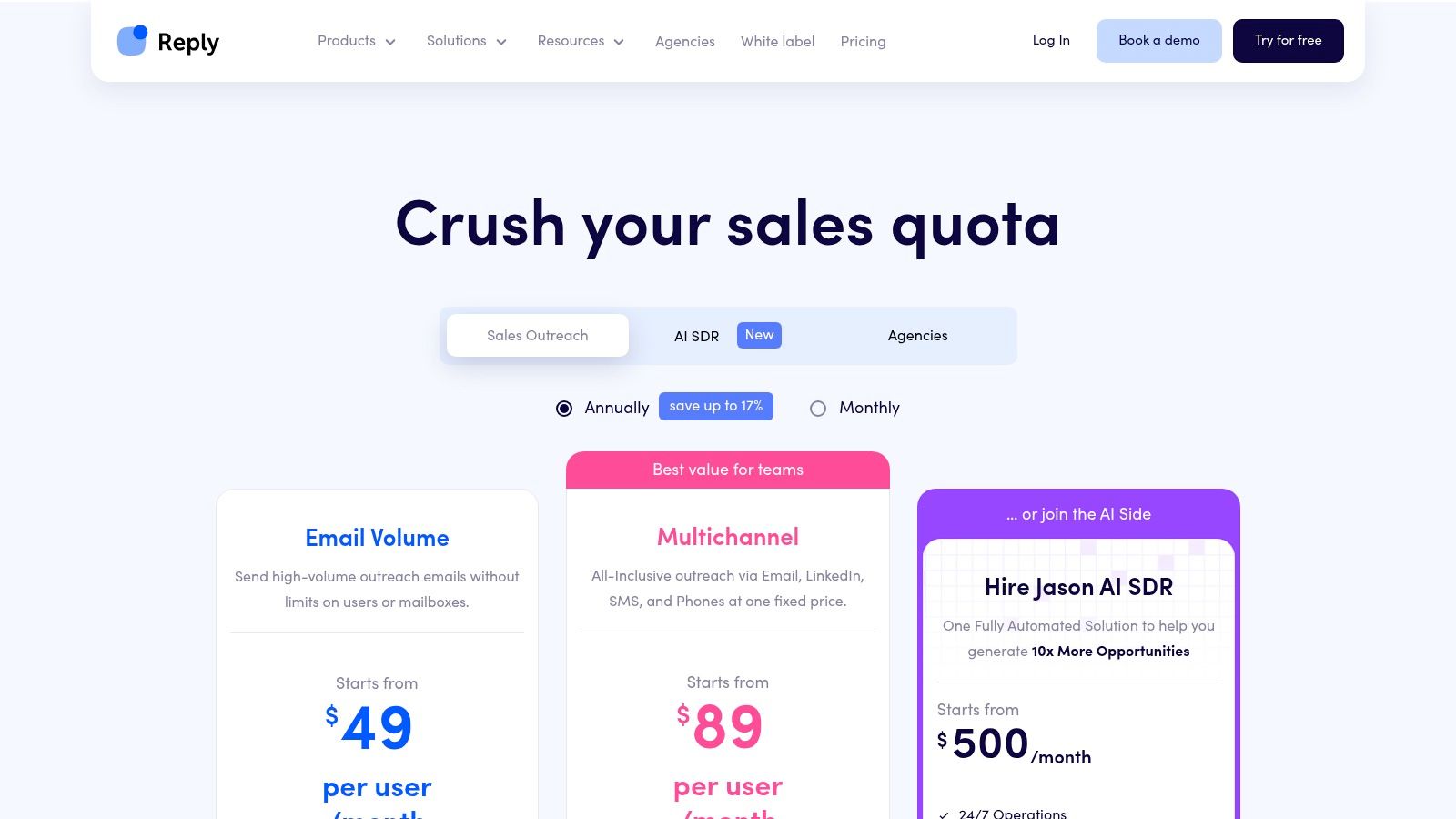
5. Reply.io
Reply.io is the better fit when your team wants email, calls, SMS, and LinkedIn tasks inside one sales engagement layer. It's more expansive than a simple cold email sender, and that matters if your reps need sequencing logic that matches how buyers respond across channels.
The AI SDR layer is useful for teams that need help with research, writing, and prioritization. It doesn't replace a real outbound system, but it does reduce the amount of manual work tied to sequence drafting and task handling. For RevOps, the native CRM integrations and analytics are the part that usually matter most.
Reply.io is not the cheapest path if you keep stacking seats and add-ons. Still, the cost makes sense when the alternative is duct-taping separate tools together just to run basic multichannel motion. If your team is moving beyond pure email and wants one place for response handling and scheduling, it belongs on the shortlist.
Pros
Broad multichannel workflow: email, calls, SMS, and LinkedIn tasks are all covered.
Useful for RevOps: analytics and integrations are mature enough for reporting.
AI support: sequence drafting and prospect prioritization are handled in-platform.
Cons
Pricing rises with seats and extras: the bill can grow fast.
Warmup depends on a partner integration: it's not fully native.
Website: Reply.io pricing
6. Woodpecker
Woodpecker is the email-first answer for teams that care about deliverability hygiene and don't want their tool to overcomplicate the job. It's a long-standing platform, and the product direction is clear, stay focused on reply detection, follow-ups, and straightforward sequencing.
That clarity helps when SDR teams need something dependable rather than flashy. Woodpecker also brings education and resources for safer cold email operations, which is useful for smaller teams that need guardrails. If your workflow is already built around email and your main concern is keeping the sending layer disciplined, it fits.
I'd keep Woodpecker off the table if your reps need deeper LinkedIn and calling workflows. The platform is meant for a narrower motion, and that's exactly why it can work well for some teams. Simple tools win when the operating system around them is already strong.
Pros
Email-centric and easy to understand: the workflow stays tight.
Useful for deliverability hygiene: the product leans into safe sending.
Good value for email-first teams: cost structure is often easier to justify.
Cons
Thin multichannel depth: it's not the tool for coordinated social and calling sequences.
Some pricing details are tier-specific: check the plan pages carefully.
Website: Woodpecker cold email pricing

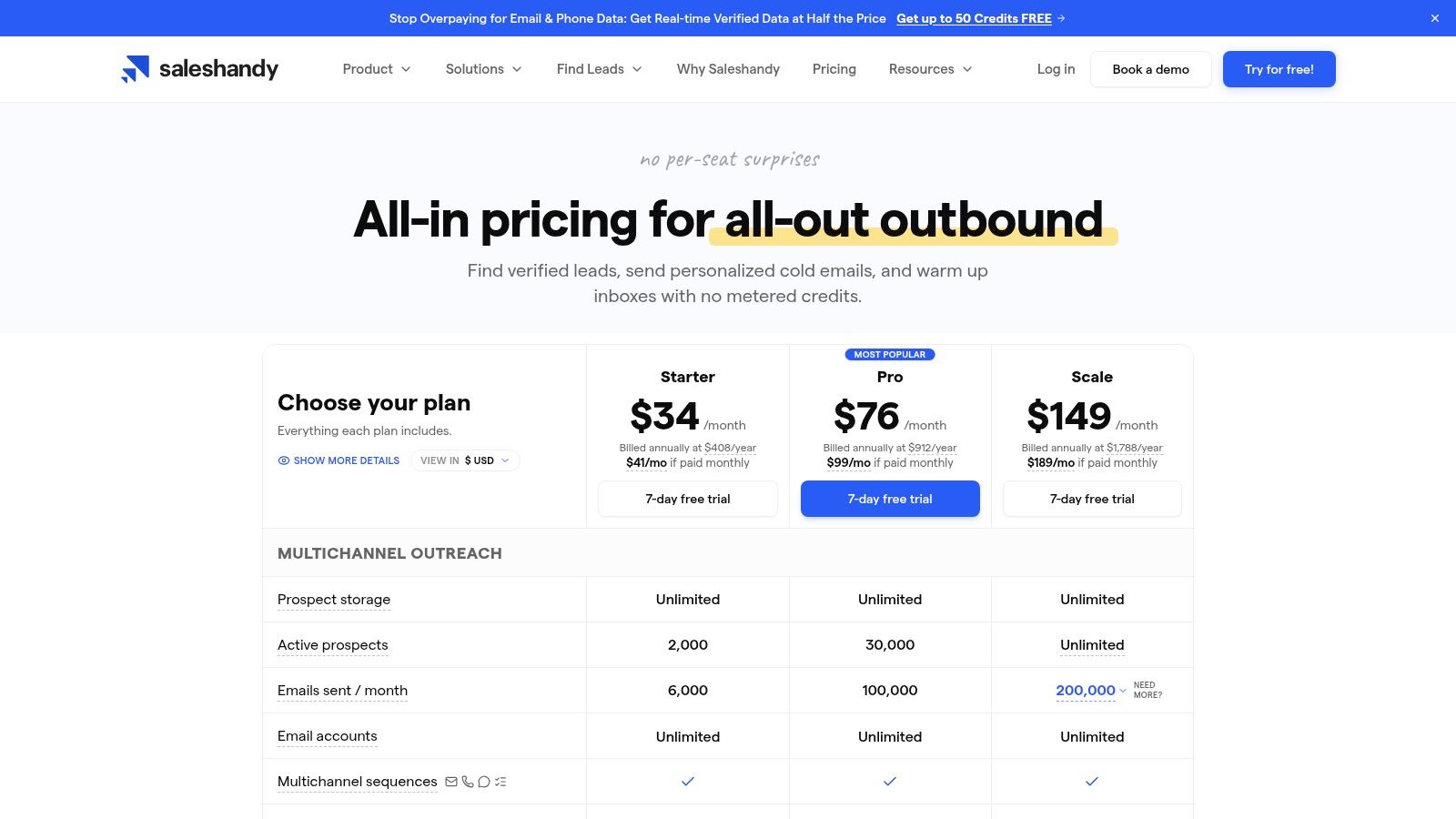
7. Saleshandy
Saleshandy is the better fit when list accuracy and bounce reduction are the main pain points. It combines sequencing with warmup and deliverability controls, but the primary reason teams look at it is the multi-provider email discovery and verification waterfall, which puts more weight on hygiene before sending.
That matters if your current outbound motion is burning through bad contacts. A sender can't save a list that's built poorly, and Saleshandy's structure reflects that reality. The packaging is also easy to understand for agencies and smaller teams that want a cleaner path from prospecting to sending.
The product does stay more email-centered than broader sales engagement platforms. If you need deeper social or calling steps, you'll feel the limits. If you want to keep the workflow tight and reduce bad-address risk, it's a sensible choice.
Pros
Strong hygiene focus: verification is part of the platform logic.
Predictable packaging: easier for teams that want no surprises.
Good for agencies: the setup fits repeatable outbound work.
Cons
Limited native social and calling layers: broader SEPs still go further.
Advanced enrichment may still need another tool: niche ICPs often need external data.
Website: Saleshandy pricing
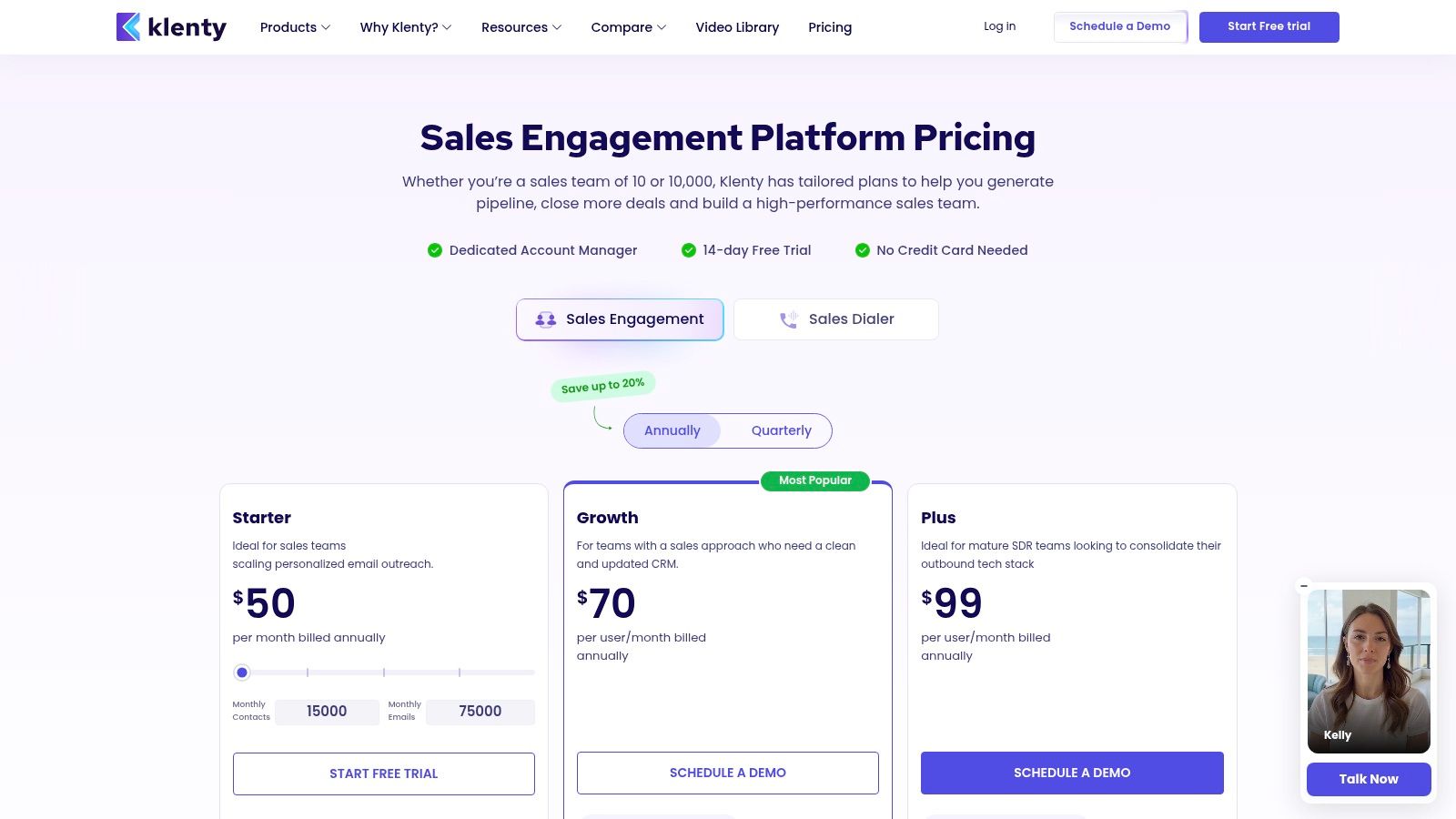
8. Klenty
Klenty is a good middle ground for SDR teams that want a real sales engagement platform without jumping straight into enterprise sprawl. It covers email sequences, tasks, templates, and CRM-connected workflows, which gives you more structure than a basic sender without forcing a huge implementation burden.
This is the right shape for teams that already live in HubSpot, Salesforce, or Pipedrive and need the outbound layer to fit cleanly into that stack. Klenty won't replace a data platform, but it can make cadence execution and team management easier when the pipeline motion is already defined.
If the question is whether to buy a full outbound operating system or a narrow execution tool, Klenty lands in the middle. That makes it useful for some teams and too limited for others. The point is to buy the shape of work you have.
Pros
Easy onboarding for SDR teams: less friction than large SEPs.
Balanced feature set: enough structure without heavy complexity.
CRM-friendly: good for teams already working inside an existing system.
Cons
Less multichannel depth than larger platforms: social and AI layers are lighter.
Some features sit behind higher plans: check what's included before you commit.
Website: Klenty sales engagement pricing
9. Snov.io
Snov.io is the practical choice when you want finding, verifying, and sending in one place. That's a real advantage for SMB teams that don't want to split prospecting across one stack and outreach across another. The platform is useful because it keeps the workflow compact, which helps when the team is small and moving fast.
It's not the strongest answer for deep multichannel execution. If your motion relies heavily on LinkedIn or calling, you'll need something broader. If your main goal is to build lists, verify them, and run cold email from one product, Snov.io is a clean fit.
Grou has a useful email finder tools comparison if your real decision is around data quality rather than sending alone.
Pros
All-in-one data plus sending: prospecting and outreach live together.
Good value for SMB teams: easy to justify when budget matters.
Flexible enough to grow with usage: plans and add-ons scale with demand.
Cons
Database coverage can vary by niche: quality depends on your ICP.
Limited beyond email: it's not built for rich multichannel work.
Website: Snov.io pricing
10. Apollo.io
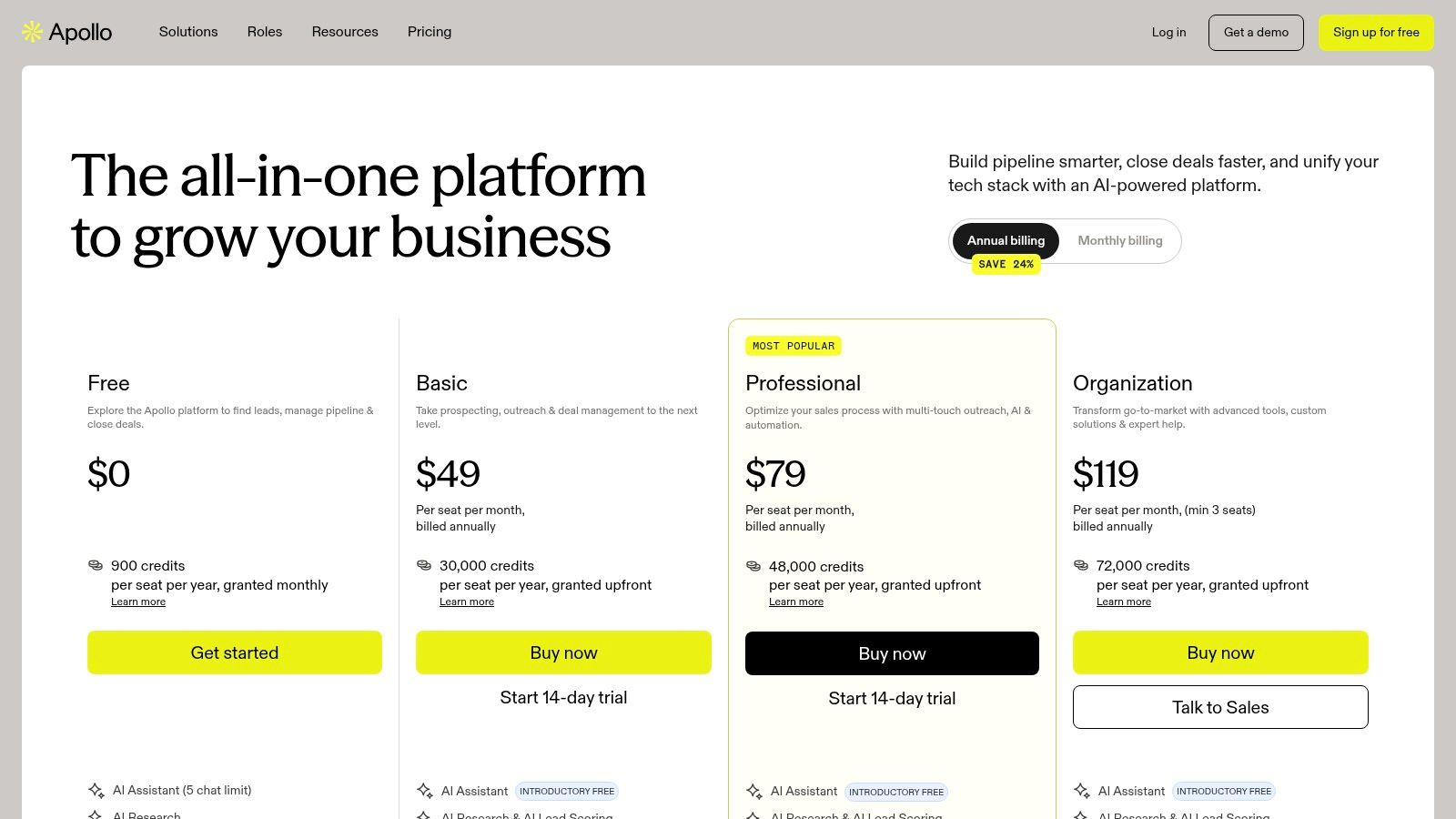
Apollo.io is the strongest choice when the team needs data plus sequencing in the same place and wants to test markets quickly. It gives you a large contact and company database, built-in sequencing, warmup, CRM integrations, and analytics, which makes it useful for early pipeline validation and fast list building.
The distinction between a sender and a system really matters. Apollo is more than an email tool because it gives you the targeting layer too. For teams that need to validate an ICP, launch a new market, or keep prospecting and outreach inside one roof, that matters more than deliverability vanity metrics.
Apollo is not the best answer if you already have elite data and only need a sending engine. It's better when the question is how fast you can go from list to sequence to reply. For many early-stage or expansion-stage teams, that's the bottleneck.
Use Grou's Apollo alternatives guide if you're deciding between a database-first stack and a narrower sender.
Pros
One roof for data and sending: great when you want fewer tools.
Fast market tests: the built-in database speeds up launches.
Useful for ICP validation: targeting and outreach stay connected.
Cons
Sequencer depth is lighter than dedicated SEPs: the tool is broader than it is deep.
Data quality can vary by niche: always verify against your market.
Website: Apollo pricing
Top 10 Instantly Alternatives: Features & Pricing
Solution | Core focus / features | UX & quality (★) | Value & price (💰) | Target (👥) | Unique selling point (✨) |
|---|---|---|---|---|---|
Grou 🏆 | AI‑powered unified engine: LinkedIn + lead gen + outbound; ICP lists; bi‑weekly sprints | ★★★★☆ rapid setup (~14d), signals in 30d | 💰Custom / consultative; high ROI (quality-over-volume) | 👥 RevOps, B2B marketing, SMBs & mid‑market, startups | ✨One message / one list system; Slack collaboration; proven case studies |
lemlist | Multichannel sequencer (email, LinkedIn, calls), deliverability (lemwarm) | ★★★★ easy multichannel UI & personalization | 💰SMB–mid; credit model can add variable cost | 👥 Growth teams, SMB sales teams | ✨Native warmup + visual personalization |
Mailshake | Email‑first sequencing; Gmail/Office365 native; dialer add‑ons | ★★★★ simple onboarding, fast to implement | 💰Budget‑friendly; add‑ons raise total cost | 👥 SDRs, founders, lean teams | ✨Concierge onboarding & deliverability guidance |
Smartlead | High‑volume cold email: mailbox rotation, warming, agency workspaces | ★★★ Powerful scale features; more complex UX | 💰Scale pricing; costs grow with advanced features | 👥 Agencies, high‑volume senders | ✨Mailbox rotation & whitelabel client workspaces |
Reply.io | Multichannel engagement + AI SDR (prospecting, writing, prioritization) | ★★★★ deep automation & integrations | 💰Mid–enterprise; seats/add‑ons increase cost | 👥 RevOps, mid‑market sales teams | ✨AI‑assisted prospecting + mature workflows |
Woodpecker | Email‑centric: reply detection, deliverability hygiene, sequencing | ★★★★ reliable, straightforward for SDRs | 💰Value pricing for email‑first teams | 👥 SDR teams focused on email outreach | ✨Strong deliverability hygiene & reply handling |
Saleshandy | Outreach + warmup with multi‑provider verification & enrichment | ★★★ focused on list hygiene and verification | 💰Predictable credits; agency & team plans | 👥 Teams needing clean lists, agencies | ✨Verification waterfall to reduce bounces |
Klenty | Email cadences, CRM integrations, tasks & reporting for SDRs | ★★★★ easy onboarding; balanced features | 💰Mid; tiered plans (some features gated) | 👥 SDR teams scaling CRM‑connected outreach | ✨CRM‑native cadences and team management |
Snov.io | Prospecting (finder) + verification + campaign builder | ★★★ SMB‑friendly; data coverage varies by niche | 💰Budget‑friendly; flexible add‑ons | 👥 SMBs, startups needing integrated data+send | ✨All‑in‑one finder+verifier+sequencer at low cost |
Apollo.io | Large B2B data platform with built‑in sequencer & warmup | ★★★★ fast market tests; data quality varies | 💰Mid; good value when data + outreach needed | 👥 Revenue teams testing markets and lists | ✨Massive contact database + integrated sequencer |
Choose the system your pipeline actually needs
Keep Instantly when the sending layer is working and the problem is process. Choose Smartlead when you're running high-volume inbox and domain operations and need stronger mailbox management. Choose lemlist or Reply.io when coordinated multichannel execution matters more than a pure sender. Choose Apollo or Snov.io when data and sending belong in the same workflow. Choose Mailshake, Woodpecker, Saleshandy, or Klenty when a narrower email-first motion fits the team better.
Check pricing on the linked plan pages before you buy. The market context here points to tens of euros to low hundreds per month, and plans change often, so current pricing matters more than stale assumptions. The same goes for warmup, credits, and add-ons, which can change the actual cost fast.
If you switch, do it like an operator, not a shopper. Audit bounce sources, preserve domain and inbox records, export suppression lists, verify contacts, map sequence logic, warm the new infrastructure patiently, run a controlled overlap, and judge reply quality and qualified meetings rather than opens. The safest move is usually a process fix, not a logo swap.
Run a hard review on your last 10 sequences this Friday. Record domain setup, list source, trigger, copy, reply quality, and meeting outcome, then decide whether the bottleneck is the sender or the system.
Grou works with 50+ companies across iGaming, SaaS, manufacturing, and professional services, so the team brings real operating context across multiple B2B environments. Its method is ICP-aligned list building, LinkedIn content, outbound, reply routing, bi-weekly sprints, shared Slack feedback, and pipeline reporting.
If your Instantly setup is stuck between weak replies and messy handoffs, Grou can help you build the system around the sender instead of just replacing the sender. Visit Grou to see how one pipeline engine can connect targeting, messaging, and reply routing into a cleaner path to qualified meetings.
Smartlead is the strongest direct alternative for high-volume email operations, lemlist is the better fit for native multichannel outreach, and Grou is the better choice when the team needs a full pipeline system instead of another sending layer. If bounces are high or replies are weak, the sender is usually not the problem, the operating system around it is.
Best direct sender swap: Smartlead for mailbox rotation, inbox management, and scale, especially when volume is the main constraint.
Best multichannel fit: lemlist when email, LinkedIn, and calls need to live in one workflow.
Best system choice: Grou when the issue is fragmented targeting, messaging, and routing, not just deliverability.
Deliverability reality: domain setup, warmup patience, list hygiene, and copy discipline matter more than the logo on the sending layer.
Migration priority: preserve domain records, export suppression lists, verify contacts, and warm new infrastructure before you judge results.
The sales engagement market is growing fast, with a projected $9.2B in 2026 and $26.6B by 2033 (market summary). That growth makes sense, because buyers aren't choosing just a sender anymore, they're choosing between email-only sending, multichannel outreach, and data-plus-sequencing systems.
Table of Contents
1. Grou
Grou is the right pick when your problem isn't just outbound execution, it's pipeline structure. For teams in iGaming, SaaS, manufacturing, legal tech, and pharma, the value is in one engine that connects ICP building, LinkedIn content, outbound, reply routing, and qualification rules so reps spend time on conversations that can close.
The practical difference is simple. A sender pushes messages. Grou builds the list, shapes the message, routes replies fast, and keeps the reporting line clear enough for RevOps and leadership to trust. That matters when you're under pressure to create qualified meetings, not activity.
Practical rule: if your team keeps blaming the sender, audit the list, trigger, and copy first. The tool is usually carrying the bad process, not causing it.
Grou's workflow is built for speed without turning volume into a religion. The operating model runs in bi-weekly sprints, with a shared Slack channel for feedback, daily iteration, and pipeline reporting that gives first signals within 30 days. It also leans on ICP-aligned list building, LinkedIn content, and outbound as one system, which is why it fits teams that need qualified conversations more than another inbox management layer.
The credibility case is practical, not decorative. Grou works with 50+ companies across iGaming, SaaS, manufacturing, and professional services, and the published outcomes include 350 qualified leads in the Adriatic region, 10x LinkedIn follower growth, and enterprise deals influenced that exceeded $20M. Those are signals that the system is built for commercial outcomes, not just sending activity.
If your team needs fewer disconnected handoffs and more owned pipeline, Grou is the stronger buy.
Pros
One operating system: LinkedIn content, lead gen, outbound, and reply routing live inside one motion.
Fast learning cycle: setup runs in about 14 days, with early signals within 30 days.
Quality-first execution: fit rules keep reps focused on accounts that deserve attention.
Cross-market credibility: active across multiple B2B verticals with public case outcomes.
Cons
Custom engagement: pricing isn't public, so you'll need a discovery conversation.
Requires collaboration: the model works best when your team gives fast feedback.
Website: Grou
2. lemlist
lemlist is the cleanest choice when outreach needs to move across email, LinkedIn, and calls without stitching together a stack of side tools. It's built for teams that want multichannel sequencing and personalisation in one UI, which makes it a stronger fit than a pure sender when the buying motion is already coordinated across channels.
Its lemwarm deliverability layer helps keep inbox health inside the same product, which is useful when your team doesn't want another add-on just to protect sending. The credits model also lets you bundle enrichment, verification, AI writing, and in-app calling, so the platform behaves more like a working outbound system than a basic sequencer.
A lot of teams choose lemlist because the outreach feels more human. Dynamic personalisation, image and video support, and shared team workflows make it easier to run campaigns that don't read like template spam. If you want the best tool for a rep who needs to coordinate touchpoints instead of just sending follow-ups, this is the fit.
For a deeper buyer-vs-buyer breakdown, Grou has a useful Instantly vs lemlist comparison that maps the operating trade-offs clearly.
Pros
True multichannel sequencing: email, LinkedIn, and calls inside one workflow.
Native warmup: delivery controls are part of the product, not a separate add-on.
Clear for SMB and mid-market teams: packaging is easier to understand than a pile of modules.
Cons
Credits can creep cost upward: enrichment, AI, and calling all consume usage.
Heavier users may outgrow the native data layer: some teams still need external enrichment.
Website: lemlist pricing
3. Mailshake
Mailshake makes sense when the team wants email-first outreach and doesn't need a platform to reinvent the whole motion. It's straightforward, easy to learn, and friendly to teams sending through Gmail or Microsoft stacks, which keeps implementation lighter than most multichannel systems.
The trade-off is that Mailshake stays focused. That's useful if your SDRs and founders want to launch quickly, test copy, and keep the workflow simple. It's less useful if your team expects LinkedIn steps, deeper channel coordination, or a large amount of automation around prospecting and enrichment.
That narrow scope is often a feature, not a bug, for lean teams. If the pipeline motion is already clear and the only issue is execution discipline, a simpler sender can be the right call. If the core issue is list quality or account selection, a more integrated system will do more for you.
If you're comparing it with another multichannel platform, Grou has a Mailshake vs lemlist breakdown that's worth reading before you commit to the wrong workflow.
Pros
Fast onboarding: good for teams that want to move quickly.
Solid sequencing basics: follow-ups, A/B testing, and email-first automation are easy to run.
Compatible with common mail stacks: Gmail, Google Workspace, Office 365, Outlook, Exchange, and SMTP/IMAP.
Cons
Weaker on LinkedIn coordination: it's not built for richer multichannel motion.
Add-ons can raise the total cost: dialer and data features change the math.
Website: Mailshake pricing
4. Smartlead
Smartlead is the strongest direct replacement for teams pushing high-volume cold email through many inboxes and domains. It's built around mailbox rotation, campaign load-balancing, warming, throttling, and deliverability controls, which is exactly where a lot of Instantly comparisons end up once the sending layer becomes operationally heavy.
The appeal is infrastructure control. If your team is running many domains and wants stronger separation between accounts, Smartlead is built for that reality. Agency-style workspaces and whitelabel options also make sense if you're managing clients or multiple brand lines at once.
Deliverability discipline matters more than platform branding. A warmed inbox can handle about 100 cold emails per day, but most practitioners still recommend staying under 30 to 50 per mailbox per day to protect reputation (EmailWarmup guidance). That ceiling applies whether you're on Instantly or Smartlead, so the migration only helps if your operating model changes too.
For teams comparing the two senders directly, Grou's Smartlead vs Instantly analysis is the cleanest place to pressure-test the decision.
Pros
Built for scale: strong when you're managing many inboxes and campaigns.
Agency-friendly: client workspaces and whitelabel support are useful in managed programs.
Serious deliverability controls: warming, throttling, and rotation are core to the product.
Cons
More operational complexity: power features add setup work.
Advanced usage can raise cost: credits and higher-tier features change the economics.
Website: Smartlead pricing
5. Reply.io
Reply.io is the better fit when your team wants email, calls, SMS, and LinkedIn tasks inside one sales engagement layer. It's more expansive than a simple cold email sender, and that matters if your reps need sequencing logic that matches how buyers respond across channels.
The AI SDR layer is useful for teams that need help with research, writing, and prioritization. It doesn't replace a real outbound system, but it does reduce the amount of manual work tied to sequence drafting and task handling. For RevOps, the native CRM integrations and analytics are the part that usually matter most.
Reply.io is not the cheapest path if you keep stacking seats and add-ons. Still, the cost makes sense when the alternative is duct-taping separate tools together just to run basic multichannel motion. If your team is moving beyond pure email and wants one place for response handling and scheduling, it belongs on the shortlist.
Pros
Broad multichannel workflow: email, calls, SMS, and LinkedIn tasks are all covered.
Useful for RevOps: analytics and integrations are mature enough for reporting.
AI support: sequence drafting and prospect prioritization are handled in-platform.
Cons
Pricing rises with seats and extras: the bill can grow fast.
Warmup depends on a partner integration: it's not fully native.
Website: Reply.io pricing
6. Woodpecker
Woodpecker is the email-first answer for teams that care about deliverability hygiene and don't want their tool to overcomplicate the job. It's a long-standing platform, and the product direction is clear, stay focused on reply detection, follow-ups, and straightforward sequencing.
That clarity helps when SDR teams need something dependable rather than flashy. Woodpecker also brings education and resources for safer cold email operations, which is useful for smaller teams that need guardrails. If your workflow is already built around email and your main concern is keeping the sending layer disciplined, it fits.
I'd keep Woodpecker off the table if your reps need deeper LinkedIn and calling workflows. The platform is meant for a narrower motion, and that's exactly why it can work well for some teams. Simple tools win when the operating system around them is already strong.
Pros
Email-centric and easy to understand: the workflow stays tight.
Useful for deliverability hygiene: the product leans into safe sending.
Good value for email-first teams: cost structure is often easier to justify.
Cons
Thin multichannel depth: it's not the tool for coordinated social and calling sequences.
Some pricing details are tier-specific: check the plan pages carefully.
Website: Woodpecker cold email pricing
7. Saleshandy
Saleshandy is the better fit when list accuracy and bounce reduction are the main pain points. It combines sequencing with warmup and deliverability controls, but the primary reason teams look at it is the multi-provider email discovery and verification waterfall, which puts more weight on hygiene before sending.
That matters if your current outbound motion is burning through bad contacts. A sender can't save a list that's built poorly, and Saleshandy's structure reflects that reality. The packaging is also easy to understand for agencies and smaller teams that want a cleaner path from prospecting to sending.
The product does stay more email-centered than broader sales engagement platforms. If you need deeper social or calling steps, you'll feel the limits. If you want to keep the workflow tight and reduce bad-address risk, it's a sensible choice.
Pros
Strong hygiene focus: verification is part of the platform logic.
Predictable packaging: easier for teams that want no surprises.
Good for agencies: the setup fits repeatable outbound work.
Cons
Limited native social and calling layers: broader SEPs still go further.
Advanced enrichment may still need another tool: niche ICPs often need external data.
Website: Saleshandy pricing
8. Klenty
Klenty is a good middle ground for SDR teams that want a real sales engagement platform without jumping straight into enterprise sprawl. It covers email sequences, tasks, templates, and CRM-connected workflows, which gives you more structure than a basic sender without forcing a huge implementation burden.
This is the right shape for teams that already live in HubSpot, Salesforce, or Pipedrive and need the outbound layer to fit cleanly into that stack. Klenty won't replace a data platform, but it can make cadence execution and team management easier when the pipeline motion is already defined.
If the question is whether to buy a full outbound operating system or a narrow execution tool, Klenty lands in the middle. That makes it useful for some teams and too limited for others. The point is to buy the shape of work you have.
Pros
Easy onboarding for SDR teams: less friction than large SEPs.
Balanced feature set: enough structure without heavy complexity.
CRM-friendly: good for teams already working inside an existing system.
Cons
Less multichannel depth than larger platforms: social and AI layers are lighter.
Some features sit behind higher plans: check what's included before you commit.
Website: Klenty sales engagement pricing
9. Snov.io
Snov.io is the practical choice when you want finding, verifying, and sending in one place. That's a real advantage for SMB teams that don't want to split prospecting across one stack and outreach across another. The platform is useful because it keeps the workflow compact, which helps when the team is small and moving fast.
It's not the strongest answer for deep multichannel execution. If your motion relies heavily on LinkedIn or calling, you'll need something broader. If your main goal is to build lists, verify them, and run cold email from one product, Snov.io is a clean fit.
Grou has a useful email finder tools comparison if your real decision is around data quality rather than sending alone.
Pros
All-in-one data plus sending: prospecting and outreach live together.
Good value for SMB teams: easy to justify when budget matters.
Flexible enough to grow with usage: plans and add-ons scale with demand.
Cons
Database coverage can vary by niche: quality depends on your ICP.
Limited beyond email: it's not built for rich multichannel work.
Website: Snov.io pricing
10. Apollo.io
Apollo.io is the strongest choice when the team needs data plus sequencing in the same place and wants to test markets quickly. It gives you a large contact and company database, built-in sequencing, warmup, CRM integrations, and analytics, which makes it useful for early pipeline validation and fast list building.
The distinction between a sender and a system really matters. Apollo is more than an email tool because it gives you the targeting layer too. For teams that need to validate an ICP, launch a new market, or keep prospecting and outreach inside one roof, that matters more than deliverability vanity metrics.
Apollo is not the best answer if you already have elite data and only need a sending engine. It's better when the question is how fast you can go from list to sequence to reply. For many early-stage or expansion-stage teams, that's the bottleneck.
Use Grou's Apollo alternatives guide if you're deciding between a database-first stack and a narrower sender.
Pros
One roof for data and sending: great when you want fewer tools.
Fast market tests: the built-in database speeds up launches.
Useful for ICP validation: targeting and outreach stay connected.
Cons
Sequencer depth is lighter than dedicated SEPs: the tool is broader than it is deep.
Data quality can vary by niche: always verify against your market.
Website: Apollo pricing
Top 10 Instantly Alternatives: Features & Pricing
Solution | Core focus / features | UX & quality (★) | Value & price (💰) | Target (👥) | Unique selling point (✨) |
|---|---|---|---|---|---|
Grou 🏆 | AI‑powered unified engine: LinkedIn + lead gen + outbound; ICP lists; bi‑weekly sprints | ★★★★☆ rapid setup (~14d), signals in 30d | 💰Custom / consultative; high ROI (quality-over-volume) | 👥 RevOps, B2B marketing, SMBs & mid‑market, startups | ✨One message / one list system; Slack collaboration; proven case studies |
lemlist | Multichannel sequencer (email, LinkedIn, calls), deliverability (lemwarm) | ★★★★ easy multichannel UI & personalization | 💰SMB–mid; credit model can add variable cost | 👥 Growth teams, SMB sales teams | ✨Native warmup + visual personalization |
Mailshake | Email‑first sequencing; Gmail/Office365 native; dialer add‑ons | ★★★★ simple onboarding, fast to implement | 💰Budget‑friendly; add‑ons raise total cost | 👥 SDRs, founders, lean teams | ✨Concierge onboarding & deliverability guidance |
Smartlead | High‑volume cold email: mailbox rotation, warming, agency workspaces | ★★★ Powerful scale features; more complex UX | 💰Scale pricing; costs grow with advanced features | 👥 Agencies, high‑volume senders | ✨Mailbox rotation & whitelabel client workspaces |
Reply.io | Multichannel engagement + AI SDR (prospecting, writing, prioritization) | ★★★★ deep automation & integrations | 💰Mid–enterprise; seats/add‑ons increase cost | 👥 RevOps, mid‑market sales teams | ✨AI‑assisted prospecting + mature workflows |
Woodpecker | Email‑centric: reply detection, deliverability hygiene, sequencing | ★★★★ reliable, straightforward for SDRs | 💰Value pricing for email‑first teams | 👥 SDR teams focused on email outreach | ✨Strong deliverability hygiene & reply handling |
Saleshandy | Outreach + warmup with multi‑provider verification & enrichment | ★★★ focused on list hygiene and verification | 💰Predictable credits; agency & team plans | 👥 Teams needing clean lists, agencies | ✨Verification waterfall to reduce bounces |
Klenty | Email cadences, CRM integrations, tasks & reporting for SDRs | ★★★★ easy onboarding; balanced features | 💰Mid; tiered plans (some features gated) | 👥 SDR teams scaling CRM‑connected outreach | ✨CRM‑native cadences and team management |
Snov.io | Prospecting (finder) + verification + campaign builder | ★★★ SMB‑friendly; data coverage varies by niche | 💰Budget‑friendly; flexible add‑ons | 👥 SMBs, startups needing integrated data+send | ✨All‑in‑one finder+verifier+sequencer at low cost |
Apollo.io | Large B2B data platform with built‑in sequencer & warmup | ★★★★ fast market tests; data quality varies | 💰Mid; good value when data + outreach needed | 👥 Revenue teams testing markets and lists | ✨Massive contact database + integrated sequencer |
Choose the system your pipeline actually needs
Keep Instantly when the sending layer is working and the problem is process. Choose Smartlead when you're running high-volume inbox and domain operations and need stronger mailbox management. Choose lemlist or Reply.io when coordinated multichannel execution matters more than a pure sender. Choose Apollo or Snov.io when data and sending belong in the same workflow. Choose Mailshake, Woodpecker, Saleshandy, or Klenty when a narrower email-first motion fits the team better.
Check pricing on the linked plan pages before you buy. The market context here points to tens of euros to low hundreds per month, and plans change often, so current pricing matters more than stale assumptions. The same goes for warmup, credits, and add-ons, which can change the actual cost fast.
If you switch, do it like an operator, not a shopper. Audit bounce sources, preserve domain and inbox records, export suppression lists, verify contacts, map sequence logic, warm the new infrastructure patiently, run a controlled overlap, and judge reply quality and qualified meetings rather than opens. The safest move is usually a process fix, not a logo swap.
Run a hard review on your last 10 sequences this Friday. Record domain setup, list source, trigger, copy, reply quality, and meeting outcome, then decide whether the bottleneck is the sender or the system.
Grou works with 50+ companies across iGaming, SaaS, manufacturing, and professional services, so the team brings real operating context across multiple B2B environments. Its method is ICP-aligned list building, LinkedIn content, outbound, reply routing, bi-weekly sprints, shared Slack feedback, and pipeline reporting.
If your Instantly setup is stuck between weak replies and messy handoffs, Grou can help you build the system around the sender instead of just replacing the sender. Visit Grou to see how one pipeline engine can connect targeting, messaging, and reply routing into a cleaner path to qualified meetings.
Smartlead is the strongest direct alternative for high-volume email operations, lemlist is the better fit for native multichannel outreach, and Grou is the better choice when the team needs a full pipeline system instead of another sending layer. If bounces are high or replies are weak, the sender is usually not the problem, the operating system around it is.
Best direct sender swap: Smartlead for mailbox rotation, inbox management, and scale, especially when volume is the main constraint.
Best multichannel fit: lemlist when email, LinkedIn, and calls need to live in one workflow.
Best system choice: Grou when the issue is fragmented targeting, messaging, and routing, not just deliverability.
Deliverability reality: domain setup, warmup patience, list hygiene, and copy discipline matter more than the logo on the sending layer.
Migration priority: preserve domain records, export suppression lists, verify contacts, and warm new infrastructure before you judge results.
The sales engagement market is growing fast, with a projected $9.2B in 2026 and $26.6B by 2033 (market summary). That growth makes sense, because buyers aren't choosing just a sender anymore, they're choosing between email-only sending, multichannel outreach, and data-plus-sequencing systems.
Table of Contents
1. Grou
Grou is the right pick when your problem isn't just outbound execution, it's pipeline structure. For teams in iGaming, SaaS, manufacturing, legal tech, and pharma, the value is in one engine that connects ICP building, LinkedIn content, outbound, reply routing, and qualification rules so reps spend time on conversations that can close.
The practical difference is simple. A sender pushes messages. Grou builds the list, shapes the message, routes replies fast, and keeps the reporting line clear enough for RevOps and leadership to trust. That matters when you're under pressure to create qualified meetings, not activity.
Practical rule: if your team keeps blaming the sender, audit the list, trigger, and copy first. The tool is usually carrying the bad process, not causing it.
Grou's workflow is built for speed without turning volume into a religion. The operating model runs in bi-weekly sprints, with a shared Slack channel for feedback, daily iteration, and pipeline reporting that gives first signals within 30 days. It also leans on ICP-aligned list building, LinkedIn content, and outbound as one system, which is why it fits teams that need qualified conversations more than another inbox management layer.
The credibility case is practical, not decorative. Grou works with 50+ companies across iGaming, SaaS, manufacturing, and professional services, and the published outcomes include 350 qualified leads in the Adriatic region, 10x LinkedIn follower growth, and enterprise deals influenced that exceeded $20M. Those are signals that the system is built for commercial outcomes, not just sending activity.
If your team needs fewer disconnected handoffs and more owned pipeline, Grou is the stronger buy.
Pros
One operating system: LinkedIn content, lead gen, outbound, and reply routing live inside one motion.
Fast learning cycle: setup runs in about 14 days, with early signals within 30 days.
Quality-first execution: fit rules keep reps focused on accounts that deserve attention.
Cross-market credibility: active across multiple B2B verticals with public case outcomes.
Cons
Custom engagement: pricing isn't public, so you'll need a discovery conversation.
Requires collaboration: the model works best when your team gives fast feedback.
Website: Grou
2. lemlist
lemlist is the cleanest choice when outreach needs to move across email, LinkedIn, and calls without stitching together a stack of side tools. It's built for teams that want multichannel sequencing and personalisation in one UI, which makes it a stronger fit than a pure sender when the buying motion is already coordinated across channels.
Its lemwarm deliverability layer helps keep inbox health inside the same product, which is useful when your team doesn't want another add-on just to protect sending. The credits model also lets you bundle enrichment, verification, AI writing, and in-app calling, so the platform behaves more like a working outbound system than a basic sequencer.
A lot of teams choose lemlist because the outreach feels more human. Dynamic personalisation, image and video support, and shared team workflows make it easier to run campaigns that don't read like template spam. If you want the best tool for a rep who needs to coordinate touchpoints instead of just sending follow-ups, this is the fit.
For a deeper buyer-vs-buyer breakdown, Grou has a useful Instantly vs lemlist comparison that maps the operating trade-offs clearly.
Pros
True multichannel sequencing: email, LinkedIn, and calls inside one workflow.
Native warmup: delivery controls are part of the product, not a separate add-on.
Clear for SMB and mid-market teams: packaging is easier to understand than a pile of modules.
Cons
Credits can creep cost upward: enrichment, AI, and calling all consume usage.
Heavier users may outgrow the native data layer: some teams still need external enrichment.
Website: lemlist pricing
3. Mailshake
Mailshake makes sense when the team wants email-first outreach and doesn't need a platform to reinvent the whole motion. It's straightforward, easy to learn, and friendly to teams sending through Gmail or Microsoft stacks, which keeps implementation lighter than most multichannel systems.
The trade-off is that Mailshake stays focused. That's useful if your SDRs and founders want to launch quickly, test copy, and keep the workflow simple. It's less useful if your team expects LinkedIn steps, deeper channel coordination, or a large amount of automation around prospecting and enrichment.
That narrow scope is often a feature, not a bug, for lean teams. If the pipeline motion is already clear and the only issue is execution discipline, a simpler sender can be the right call. If the core issue is list quality or account selection, a more integrated system will do more for you.
If you're comparing it with another multichannel platform, Grou has a Mailshake vs lemlist breakdown that's worth reading before you commit to the wrong workflow.
Pros
Fast onboarding: good for teams that want to move quickly.
Solid sequencing basics: follow-ups, A/B testing, and email-first automation are easy to run.
Compatible with common mail stacks: Gmail, Google Workspace, Office 365, Outlook, Exchange, and SMTP/IMAP.
Cons
Weaker on LinkedIn coordination: it's not built for richer multichannel motion.
Add-ons can raise the total cost: dialer and data features change the math.
Website: Mailshake pricing
4. Smartlead
Smartlead is the strongest direct replacement for teams pushing high-volume cold email through many inboxes and domains. It's built around mailbox rotation, campaign load-balancing, warming, throttling, and deliverability controls, which is exactly where a lot of Instantly comparisons end up once the sending layer becomes operationally heavy.
The appeal is infrastructure control. If your team is running many domains and wants stronger separation between accounts, Smartlead is built for that reality. Agency-style workspaces and whitelabel options also make sense if you're managing clients or multiple brand lines at once.
Deliverability discipline matters more than platform branding. A warmed inbox can handle about 100 cold emails per day, but most practitioners still recommend staying under 30 to 50 per mailbox per day to protect reputation (EmailWarmup guidance). That ceiling applies whether you're on Instantly or Smartlead, so the migration only helps if your operating model changes too.
For teams comparing the two senders directly, Grou's Smartlead vs Instantly analysis is the cleanest place to pressure-test the decision.
Pros
Built for scale: strong when you're managing many inboxes and campaigns.
Agency-friendly: client workspaces and whitelabel support are useful in managed programs.
Serious deliverability controls: warming, throttling, and rotation are core to the product.
Cons
More operational complexity: power features add setup work.
Advanced usage can raise cost: credits and higher-tier features change the economics.
Website: Smartlead pricing
5. Reply.io
Reply.io is the better fit when your team wants email, calls, SMS, and LinkedIn tasks inside one sales engagement layer. It's more expansive than a simple cold email sender, and that matters if your reps need sequencing logic that matches how buyers respond across channels.
The AI SDR layer is useful for teams that need help with research, writing, and prioritization. It doesn't replace a real outbound system, but it does reduce the amount of manual work tied to sequence drafting and task handling. For RevOps, the native CRM integrations and analytics are the part that usually matter most.
Reply.io is not the cheapest path if you keep stacking seats and add-ons. Still, the cost makes sense when the alternative is duct-taping separate tools together just to run basic multichannel motion. If your team is moving beyond pure email and wants one place for response handling and scheduling, it belongs on the shortlist.
Pros
Broad multichannel workflow: email, calls, SMS, and LinkedIn tasks are all covered.
Useful for RevOps: analytics and integrations are mature enough for reporting.
AI support: sequence drafting and prospect prioritization are handled in-platform.
Cons
Pricing rises with seats and extras: the bill can grow fast.
Warmup depends on a partner integration: it's not fully native.
Website: Reply.io pricing
6. Woodpecker
Woodpecker is the email-first answer for teams that care about deliverability hygiene and don't want their tool to overcomplicate the job. It's a long-standing platform, and the product direction is clear, stay focused on reply detection, follow-ups, and straightforward sequencing.
That clarity helps when SDR teams need something dependable rather than flashy. Woodpecker also brings education and resources for safer cold email operations, which is useful for smaller teams that need guardrails. If your workflow is already built around email and your main concern is keeping the sending layer disciplined, it fits.
I'd keep Woodpecker off the table if your reps need deeper LinkedIn and calling workflows. The platform is meant for a narrower motion, and that's exactly why it can work well for some teams. Simple tools win when the operating system around them is already strong.
Pros
Email-centric and easy to understand: the workflow stays tight.
Useful for deliverability hygiene: the product leans into safe sending.
Good value for email-first teams: cost structure is often easier to justify.
Cons
Thin multichannel depth: it's not the tool for coordinated social and calling sequences.
Some pricing details are tier-specific: check the plan pages carefully.
Website: Woodpecker cold email pricing
7. Saleshandy
Saleshandy is the better fit when list accuracy and bounce reduction are the main pain points. It combines sequencing with warmup and deliverability controls, but the primary reason teams look at it is the multi-provider email discovery and verification waterfall, which puts more weight on hygiene before sending.
That matters if your current outbound motion is burning through bad contacts. A sender can't save a list that's built poorly, and Saleshandy's structure reflects that reality. The packaging is also easy to understand for agencies and smaller teams that want a cleaner path from prospecting to sending.
The product does stay more email-centered than broader sales engagement platforms. If you need deeper social or calling steps, you'll feel the limits. If you want to keep the workflow tight and reduce bad-address risk, it's a sensible choice.
Pros
Strong hygiene focus: verification is part of the platform logic.
Predictable packaging: easier for teams that want no surprises.
Good for agencies: the setup fits repeatable outbound work.
Cons
Limited native social and calling layers: broader SEPs still go further.
Advanced enrichment may still need another tool: niche ICPs often need external data.
Website: Saleshandy pricing
8. Klenty
Klenty is a good middle ground for SDR teams that want a real sales engagement platform without jumping straight into enterprise sprawl. It covers email sequences, tasks, templates, and CRM-connected workflows, which gives you more structure than a basic sender without forcing a huge implementation burden.
This is the right shape for teams that already live in HubSpot, Salesforce, or Pipedrive and need the outbound layer to fit cleanly into that stack. Klenty won't replace a data platform, but it can make cadence execution and team management easier when the pipeline motion is already defined.
If the question is whether to buy a full outbound operating system or a narrow execution tool, Klenty lands in the middle. That makes it useful for some teams and too limited for others. The point is to buy the shape of work you have.
Pros
Easy onboarding for SDR teams: less friction than large SEPs.
Balanced feature set: enough structure without heavy complexity.
CRM-friendly: good for teams already working inside an existing system.
Cons
Less multichannel depth than larger platforms: social and AI layers are lighter.
Some features sit behind higher plans: check what's included before you commit.
Website: Klenty sales engagement pricing
9. Snov.io
Snov.io is the practical choice when you want finding, verifying, and sending in one place. That's a real advantage for SMB teams that don't want to split prospecting across one stack and outreach across another. The platform is useful because it keeps the workflow compact, which helps when the team is small and moving fast.
It's not the strongest answer for deep multichannel execution. If your motion relies heavily on LinkedIn or calling, you'll need something broader. If your main goal is to build lists, verify them, and run cold email from one product, Snov.io is a clean fit.
Grou has a useful email finder tools comparison if your real decision is around data quality rather than sending alone.
Pros
All-in-one data plus sending: prospecting and outreach live together.
Good value for SMB teams: easy to justify when budget matters.
Flexible enough to grow with usage: plans and add-ons scale with demand.
Cons
Database coverage can vary by niche: quality depends on your ICP.
Limited beyond email: it's not built for rich multichannel work.
Website: Snov.io pricing
10. Apollo.io
Apollo.io is the strongest choice when the team needs data plus sequencing in the same place and wants to test markets quickly. It gives you a large contact and company database, built-in sequencing, warmup, CRM integrations, and analytics, which makes it useful for early pipeline validation and fast list building.
The distinction between a sender and a system really matters. Apollo is more than an email tool because it gives you the targeting layer too. For teams that need to validate an ICP, launch a new market, or keep prospecting and outreach inside one roof, that matters more than deliverability vanity metrics.
Apollo is not the best answer if you already have elite data and only need a sending engine. It's better when the question is how fast you can go from list to sequence to reply. For many early-stage or expansion-stage teams, that's the bottleneck.
Use Grou's Apollo alternatives guide if you're deciding between a database-first stack and a narrower sender.
Pros
One roof for data and sending: great when you want fewer tools.
Fast market tests: the built-in database speeds up launches.
Useful for ICP validation: targeting and outreach stay connected.
Cons
Sequencer depth is lighter than dedicated SEPs: the tool is broader than it is deep.
Data quality can vary by niche: always verify against your market.
Website: Apollo pricing
Top 10 Instantly Alternatives: Features & Pricing
Solution | Core focus / features | UX & quality (★) | Value & price (💰) | Target (👥) | Unique selling point (✨) |
|---|---|---|---|---|---|
Grou 🏆 | AI‑powered unified engine: LinkedIn + lead gen + outbound; ICP lists; bi‑weekly sprints | ★★★★☆ rapid setup (~14d), signals in 30d | 💰Custom / consultative; high ROI (quality-over-volume) | 👥 RevOps, B2B marketing, SMBs & mid‑market, startups | ✨One message / one list system; Slack collaboration; proven case studies |
lemlist | Multichannel sequencer (email, LinkedIn, calls), deliverability (lemwarm) | ★★★★ easy multichannel UI & personalization | 💰SMB–mid; credit model can add variable cost | 👥 Growth teams, SMB sales teams | ✨Native warmup + visual personalization |
Mailshake | Email‑first sequencing; Gmail/Office365 native; dialer add‑ons | ★★★★ simple onboarding, fast to implement | 💰Budget‑friendly; add‑ons raise total cost | 👥 SDRs, founders, lean teams | ✨Concierge onboarding & deliverability guidance |
Smartlead | High‑volume cold email: mailbox rotation, warming, agency workspaces | ★★★ Powerful scale features; more complex UX | 💰Scale pricing; costs grow with advanced features | 👥 Agencies, high‑volume senders | ✨Mailbox rotation & whitelabel client workspaces |
Reply.io | Multichannel engagement + AI SDR (prospecting, writing, prioritization) | ★★★★ deep automation & integrations | 💰Mid–enterprise; seats/add‑ons increase cost | 👥 RevOps, mid‑market sales teams | ✨AI‑assisted prospecting + mature workflows |
Woodpecker | Email‑centric: reply detection, deliverability hygiene, sequencing | ★★★★ reliable, straightforward for SDRs | 💰Value pricing for email‑first teams | 👥 SDR teams focused on email outreach | ✨Strong deliverability hygiene & reply handling |
Saleshandy | Outreach + warmup with multi‑provider verification & enrichment | ★★★ focused on list hygiene and verification | 💰Predictable credits; agency & team plans | 👥 Teams needing clean lists, agencies | ✨Verification waterfall to reduce bounces |
Klenty | Email cadences, CRM integrations, tasks & reporting for SDRs | ★★★★ easy onboarding; balanced features | 💰Mid; tiered plans (some features gated) | 👥 SDR teams scaling CRM‑connected outreach | ✨CRM‑native cadences and team management |
Snov.io | Prospecting (finder) + verification + campaign builder | ★★★ SMB‑friendly; data coverage varies by niche | 💰Budget‑friendly; flexible add‑ons | 👥 SMBs, startups needing integrated data+send | ✨All‑in‑one finder+verifier+sequencer at low cost |
Apollo.io | Large B2B data platform with built‑in sequencer & warmup | ★★★★ fast market tests; data quality varies | 💰Mid; good value when data + outreach needed | 👥 Revenue teams testing markets and lists | ✨Massive contact database + integrated sequencer |
Choose the system your pipeline actually needs
Keep Instantly when the sending layer is working and the problem is process. Choose Smartlead when you're running high-volume inbox and domain operations and need stronger mailbox management. Choose lemlist or Reply.io when coordinated multichannel execution matters more than a pure sender. Choose Apollo or Snov.io when data and sending belong in the same workflow. Choose Mailshake, Woodpecker, Saleshandy, or Klenty when a narrower email-first motion fits the team better.
Check pricing on the linked plan pages before you buy. The market context here points to tens of euros to low hundreds per month, and plans change often, so current pricing matters more than stale assumptions. The same goes for warmup, credits, and add-ons, which can change the actual cost fast.
If you switch, do it like an operator, not a shopper. Audit bounce sources, preserve domain and inbox records, export suppression lists, verify contacts, map sequence logic, warm the new infrastructure patiently, run a controlled overlap, and judge reply quality and qualified meetings rather than opens. The safest move is usually a process fix, not a logo swap.
Run a hard review on your last 10 sequences this Friday. Record domain setup, list source, trigger, copy, reply quality, and meeting outcome, then decide whether the bottleneck is the sender or the system.
Grou works with 50+ companies across iGaming, SaaS, manufacturing, and professional services, so the team brings real operating context across multiple B2B environments. Its method is ICP-aligned list building, LinkedIn content, outbound, reply routing, bi-weekly sprints, shared Slack feedback, and pipeline reporting.
If your Instantly setup is stuck between weak replies and messy handoffs, Grou can help you build the system around the sender instead of just replacing the sender. Visit Grou to see how one pipeline engine can connect targeting, messaging, and reply routing into a cleaner path to qualified meetings.
Pipeline OS Newsletter
Build qualified pipeline
Get weekly tactics to generate demand, improve lead quality, and book more meetings.







Trusted by industry leaders
Trusted by industry leaders
Trusted by industry leaders
Ready to build qualified pipeline?
Ready to build qualified pipeline?
Ready to build qualified pipeline?
Book a call to see if we're the right fit, or take the 2-minute quiz to get a clear starting point.
Book a call to see if we're the right fit, or take the 2-minute quiz to get a clear starting point.
Book a call to see if we're the right fit, or take the 2-minute quiz to get a clear starting point.
" height="30.21639343089746px" id="hfGbXmQR2" width="30.216393430897455px"/></svg>)
Copyright © 2026 – All Right Reserved
Copyright © 2026 – All Right Reserved
Copyright © 2026 – All Right Reserved