%22%3E%3C/path%3E%3Cpath d=%22M 63.072 7.554 C 62.258 8.022 61.577 8.689 61.092 9.493 L 61.092 7.076 L 57.158 7.076 L 57.158 22.64 L 61.089 22.64 L 61.089 14.888 C 61.089 13.446 61.403 12.434 62.03 11.853 C 62.818 11.218 63.818 10.907 64.826 10.982 L 65.868 10.982 L 65.868 6.851 C 64.891 6.834 63.926 7.076 63.073 7.554 Z%22 fill=%22rgb(17,17,17)%22%3E%3C/path%3E%3Cpath d=%22M 78.916 7.82 C 76.363 6.49 73.321 6.49 70.768 7.82 C 69.562 8.473 68.564 9.451 67.888 10.644 C 67.167 11.931 66.803 13.387 66.834 14.862 C 66.804 16.332 67.157 17.785 67.86 19.077 C 68.515 20.267 69.494 21.246 70.684 21.901 C 71.924 22.576 73.318 22.92 74.73 22.898 C 76.164 22.918 77.58 22.575 78.846 21.901 C 80.062 21.247 81.073 20.27 81.768 19.077 C 82.506 17.797 82.88 16.339 82.85 14.862 C 82.88 13.389 82.517 11.934 81.797 10.647 C 81.12 9.455 80.122 8.477 78.917 7.824 M 78.803 14.862 C 78.829 15.739 78.636 16.608 78.241 17.391 C 77.903 18.046 77.38 18.588 76.738 18.95 C 76.124 19.293 75.432 19.472 74.729 19.47 C 73.668 19.497 72.648 19.061 71.934 18.276 C 71.139 17.323 70.741 16.1 70.823 14.862 C 70.741 13.62 71.149 12.395 71.959 11.45 C 72.687 10.667 73.715 10.233 74.783 10.256 C 75.859 10.236 76.894 10.67 77.635 11.45 C 78.464 12.387 78.884 13.616 78.801 14.864%22 fill=%22rgb(17,17,17)%22%3E%3C/path%3E%3Cpath d=%22M 95.906 7.076 L 95.906 15.646 C 95.975 16.68 95.643 17.701 94.979 18.498 C 94.311 19.184 93.379 19.547 92.422 19.495 C 91.475 19.544 90.553 19.18 89.894 18.498 C 89.23 17.701 88.898 16.68 88.967 15.646 L 88.967 7.076 L 85.033 7.076 L 85.033 16.207 C 85 17.449 85.275 18.68 85.834 19.79 C 86.327 20.75 87.095 21.542 88.039 22.065 C 89.033 22.594 90.145 22.861 91.271 22.838 C 92.188 22.847 93.095 22.65 93.926 22.263 C 94.708 21.905 95.388 21.36 95.906 20.675 L 95.906 22.645 L 99.865 22.645 L 99.865 7.076 Z%22 fill=%22rgb(17,17,17)%22%3E%3C/path%3E%3Cpath d=%22M 4.513 15.626 C 4.511 10.815 7.606 6.549 12.181 5.059 C 16.756 3.57 21.77 5.195 24.601 9.086 L 27.816 5.87 C 24.074 1.186 17.981 -0.943 12.137 0.393 C 6.292 1.728 1.728 6.292 0.393 12.137 C -0.943 17.981 1.186 24.074 5.87 27.816 L 9.085 24.601 C 6.214 22.512 4.515 19.177 4.513 15.626%22 fill=%22rgb(32,62,235)%22%3E%3C/path%3E%3Cpath d=%22M 17.114 14.343 L 13.354 18.01 L 13.354 18.026 L 21.071 18.026 L 11.412 27.609 L 17.389 27.609 L 23.999 21.081 L 23.999 28.316 L 24.005 28.316 L 27.967 24.393 L 27.967 14.343 Z%22 fill=%22rgb(32,62,235)%22%3E%3C/path%3E%3C/g%3E%3C/svg%3E) ×
× ××
××›
›
›
›
Newsletter advertising for B2B: playbook 2026
Newsletter advertising for B2B: playbook 2026
Newsletter advertising for B2B: playbook 2026
Newsletter advertising for B2B: playbook 2026
Newsletter advertising for B2B: playbook 2026
Newsletter advertising for B2B: playbook 2026

Author
Aljaz Peklaj

Newsletter sponsorship is the last B2B channel where you can still buy undivided attention, and it is also the channel where two vendors can quote you the same number and mean prices that differ by a factor of three. The reason is that nobody agrees on what the denominator is.
This covers the two ways to buy, the arithmetic that makes quotes comparable, what to measure when the click data is worse than you are used to, and when the whole channel is the wrong call.
TL;DR
There are two ways to buy: an ad network, which places you programmatically across many newsletters, and a direct sponsorship, which you negotiate with one publisher. beehiiv runs the largest network of the two and prices on CPM or CPC, but its CPM is charged per unique open rather than per send, which is the single most important detail in this whole article. A $5 CPM quoted on opens and a $5 CPM quoted on list size are not the same price, and on a newsletter with a 40% open rate they differ by two and a half times. Before comparing anything, convert every quote to cost per thousand people who actually opened, because that is the only denominator that means the same thing everywhere. Networks are fast, cheap and untargeted at the individual-newsletter level; direct sponsorships cost more, take weeks to arrange, and are the only route to a genuinely narrow B2B audience. For most B2B advertisers the honest answer is direct, because the niche newsletter with 4,000 readers who all hold your buyer's job title beats a network placement across 400,000 readers who mostly do not. Measure replies and mentions on sales calls rather than clicks, because newsletter audiences read in the morning, click later from a different device, and break your attribution in ways that make a good placement look like a bad one.
The two ways to buy
![[INSERT CHART 1, newsletter-advertising-b2b-chart-1-routes.svg] Alt: Newsletter ad networks compared with direct sponsorships for B2B 2026 on targeting, price, speed, control and minimums.](https://framerusercontent.com/images/bCY0J83CXXfgPbGcU0tGc3YSRWg.svg)
Ad networks place you programmatically across many newsletters. beehiiv's network prices on CPM or CPC, publishers need to be on its Scale plan or above to carry network ads, and beehiiv does not publish a minimum advertiser spend. Setup is fast and the inventory is broad. What you give up is knowing exactly which newsletters you appear in and, more importantly, whether their readers are your buyers.
Direct sponsorships are negotiated with one publisher. Usually a flat fee for a placement in one or several sends. Slower to arrange, frequently more expensive per reader, and the only way to buy a specific audience. In B2B this is normally the right route, because the value is in the narrowness.
The two are not really competitors. A network is a volume channel with a floor price. A direct sponsorship is an audience purchase. Comparing them on cost per thousand and picking the cheaper one is how B2B advertisers end up with impressive reach and no pipeline, which is the same failure mode that B2B paid ads budget allocation describes on the paid channels.
The denominator problem
This is the part that costs advertisers money, and it is entirely avoidable.
beehiiv's network CPM is charged per unique open. Its own documentation gives the example plainly: at a $5 CPM you pay $5 for every 1,000 unique opens. Not per send, not per subscriber. CPC works the same way on verified unique clicks, and beehiiv's example is a $2 CPC producing a $200 payout on 100 clicks.
Most direct sponsorship quotes are priced against list size. A publisher quoting you a flat fee for a send to 20,000 subscribers is implicitly quoting a CPM on 20,000, whether or not anyone says the word CPM.
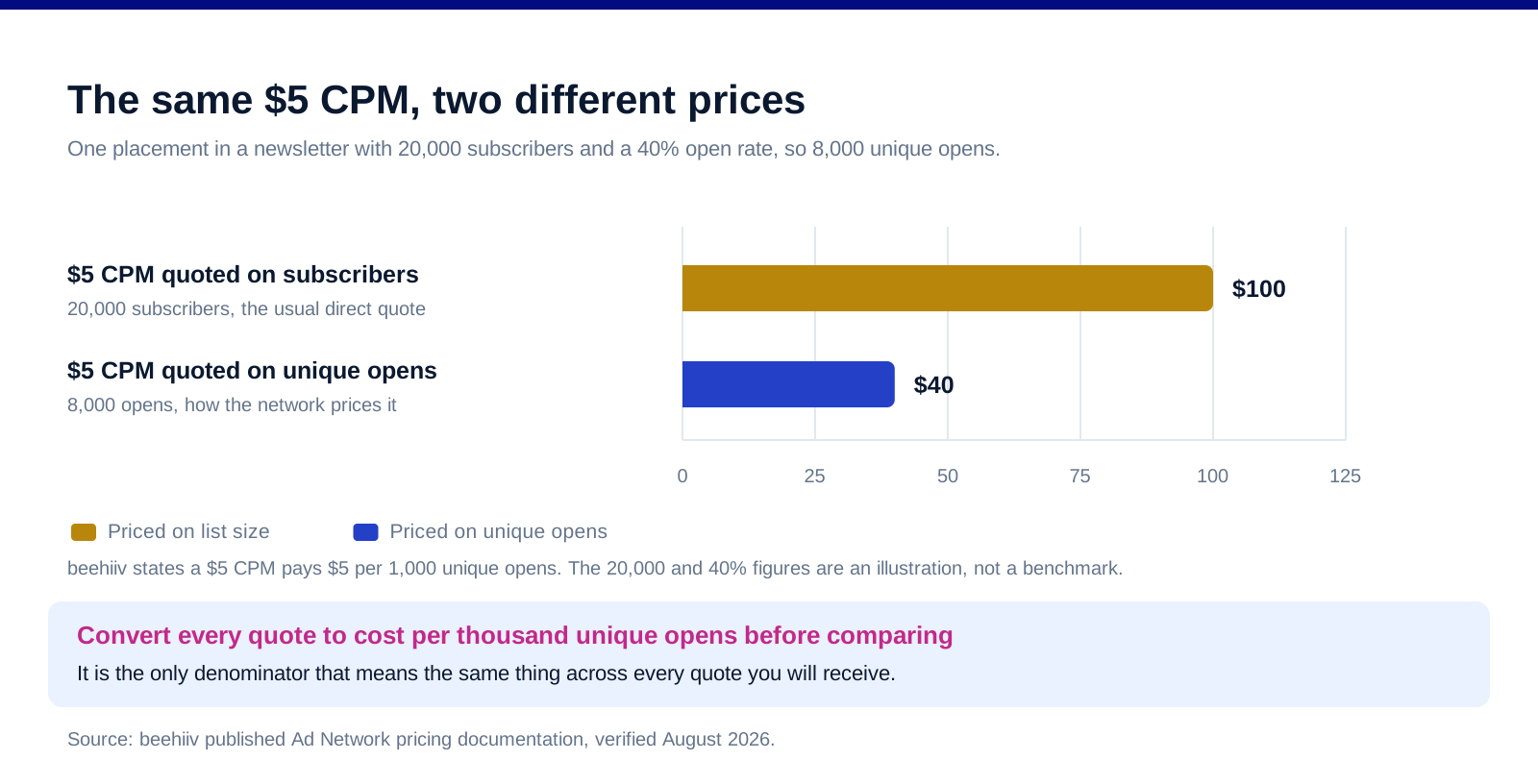
Which means the same number means different things. Take a 20,000-subscriber newsletter with a 40% open rate, so 8,000 unique opens. A $5 CPM quoted on subscribers costs $100. The same $5 CPM quoted on unique opens costs $40. Identical headline rate, two and a half times the difference in price, and nothing in either quote flags it.
Convert everything to cost per thousand opens before you compare. Ask the publisher for the list size and the average open rate on sponsored sends, divide the flat fee by opens, and multiply by a thousand. That number is comparable across every quote you will receive. Publishers who will not give you an open rate are telling you something.
Then sanity-check against relevance. A high cost per thousand opens in a newsletter read exclusively by your buyer is usually a better purchase than a low one in a general business newsletter. The arithmetic makes quotes comparable; it does not make audiences equivalent.
Which route fits you
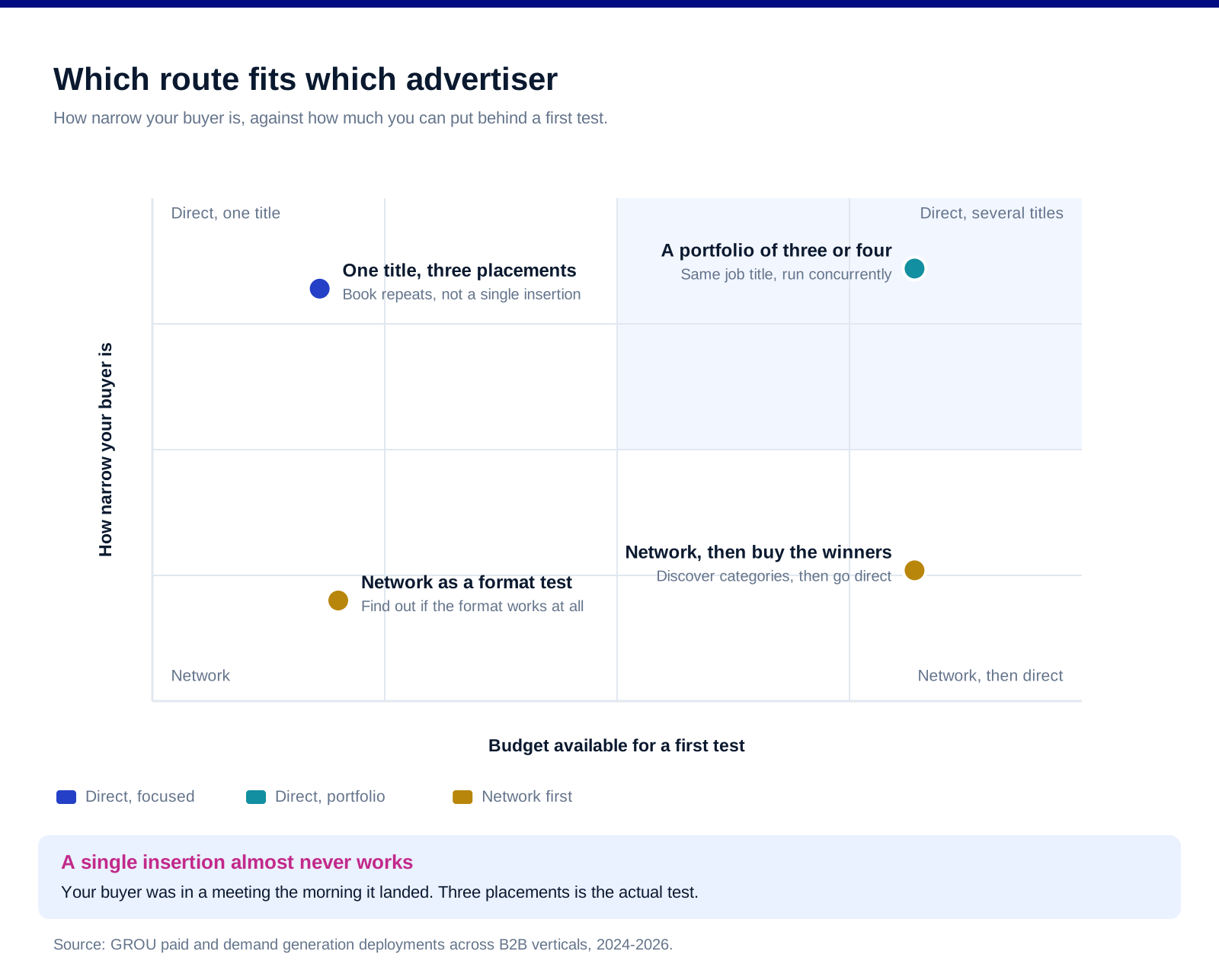
Narrow buyer, small budget: direct, one newsletter, repeatedly. Find the one publication your buyer actually reads and book three placements rather than one. A single insertion in a B2B newsletter almost never works, because your buyer was in a meeting the morning it landed.
Narrow buyer, larger budget: direct across several titles. Build a small portfolio of three or four newsletters that each reach the same job title, and run them concurrently so you can see which audience responds.
Broad buyer, small budget: a network is a reasonable test. If your buyer is any operator at any company, network inventory is a cheap way to find out whether the format works for your offer before you negotiate anything.
Broad buyer, larger budget: network for volume, direct for the best-performing niches. Use the network to discover which categories respond, then buy those directly where the placement can be better than a standard ad unit.
Nobody reads a newsletter about your category: do not force it. Some B2B categories genuinely have no publication. Sponsoring an adjacent one because it is the only option available is how the channel gets written off unfairly.
Writing the placement
Write for someone reading over coffee, not for a landing page. Newsletter readers are in a reading posture rather than a searching one. Copy that opens with a problem they recognise outperforms copy that opens with what you do, and it is not close.
One link, one action. Multiple links in a sponsored slot split the small amount of intent you earned. Pick the single thing you want and remove everything else.
Let the publisher write it, or at least edit it. The reason people opened the newsletter is the writer's voice. An ad that sounds like the newsletter gets read; an ad that sounds like an ad gets scrolled past. Most publishers will write or adapt the copy and it is nearly always better than what you send them.
Send them somewhere that matches the promise. A newsletter reader who clicks a specific claim and lands on a homepage bounces. This is cheap to fix and constantly not fixed.
Do not gate the first thing they see. You bought attention, not a lead. Putting a form in front of the content you advertised converts the click into nothing.
What to measure, and why clicks lie here
Replies and direct traffic matter more than the click count. Newsletter audiences read on a phone in the morning and act on a laptop hours later. The click that shows up in your analytics is a fraction of the response the placement actually produced.
Ask new leads where they heard about you, in a free-text field. Crude, and consistently more accurate than attribution for this channel specifically. If a newsletter name appears in that field, the placement worked regardless of what the click data says.
Watch branded search and direct traffic in the days after a send. A good newsletter placement produces a visible bump in people typing your name, which no click tracker will attribute to it.
Give it three placements before judging. One send tells you almost nothing. The same audience seeing you three times is the actual test, and it is the reason single-insertion buys underperform and then get blamed on the channel.
Judge on cost per qualified conversation. Not cost per click, and definitely not cost per thousand anything. The CPM arithmetic above is for comparing quotes, not for evaluating results.
FAQ
How much does B2B newsletter advertising cost?
It depends entirely on the denominator, which is why quotes look incomparable. beehiiv's network charges CPM per unique open and CPC per verified unique click, with its documentation giving $5 per thousand opens and $2 per click as examples. Direct sponsorships are usually flat fees quoted against list size. Convert every quote to cost per thousand unique opens before comparing anything.
Is a newsletter ad network or a direct sponsorship better for B2B?
Direct, in most B2B cases, because the value in this channel is audience narrowness and a network cannot sell you that. Networks are useful for a fast, cheap test of whether the format works for your offer, and for finding which categories respond before you negotiate directly. If your buyer is a specific job title in a specific industry, go direct.
What is a good CPM for a B2B newsletter?
There is no transferable figure, and any number quoted as a benchmark is being quoted against an unknown denominator. What matters is cost per thousand people who opened, and whether those people are your buyers. A high cost per thousand opens in a newsletter read only by your buyer routinely outperforms a low one in a general audience.
How do you know if a newsletter sponsorship worked?
Ask new leads where they heard about you in a free-text field, watch branded search and direct traffic for a few days after each send, and count mentions on sales calls. Click data understates this channel badly because people read on one device in the morning and act on another later. Judge after three placements, not one.
How many times should you run a newsletter sponsorship?
At least three placements in the same newsletter before you decide. A single insertion reaches only the portion of the audience that opened that specific send and had time to act, which is a small fraction. Most advertisers who conclude newsletter sponsorship does not work tested it once.
Do you need a big budget to advertise in B2B newsletters?
No, and this is one of the channel's advantages. beehiiv does not publish a minimum advertiser spend for its network, and small niche B2B newsletters frequently sell placements for less than a week of paid social. The constraint is usually finding the right publication rather than affording it.
Bottom line
Convert every quote to cost per thousand unique opens before you compare anything, because beehiiv's network prices per open while most direct sponsorships price against list size, and the same headline CPM can mean two and a half times the price. Then ignore the arithmetic and buy the narrowest audience you can find, because in B2B the whole value of this channel is that the wrong people never see it. Book three placements rather than one, let the publisher write the copy, send the click somewhere that matches what you promised, and measure it on replies and free-text attribution rather than on a click count that will systematically understate it.
Want the channel tested properly rather than tried once? Book a call with GROU. We run paid acquisition and demand generation inside B2B revenue engines across verticals.
We are GROU, a B2B pipeline agency that runs lead generation, outbound, and LinkedIn content for clients across manufacturing, fintech, iGaming, software, and professional services. The measurement guidance reflects our paid deployments between 2024 and 2026, anonymized to protect client confidentiality.
Some links in this article are affiliate. We may earn a small commission at no extra cost to you. We only recommend tools we've deployed for clients.
Newsletter sponsorship is the last B2B channel where you can still buy undivided attention, and it is also the channel where two vendors can quote you the same number and mean prices that differ by a factor of three. The reason is that nobody agrees on what the denominator is.
This covers the two ways to buy, the arithmetic that makes quotes comparable, what to measure when the click data is worse than you are used to, and when the whole channel is the wrong call.
TL;DR
There are two ways to buy: an ad network, which places you programmatically across many newsletters, and a direct sponsorship, which you negotiate with one publisher. beehiiv runs the largest network of the two and prices on CPM or CPC, but its CPM is charged per unique open rather than per send, which is the single most important detail in this whole article. A $5 CPM quoted on opens and a $5 CPM quoted on list size are not the same price, and on a newsletter with a 40% open rate they differ by two and a half times. Before comparing anything, convert every quote to cost per thousand people who actually opened, because that is the only denominator that means the same thing everywhere. Networks are fast, cheap and untargeted at the individual-newsletter level; direct sponsorships cost more, take weeks to arrange, and are the only route to a genuinely narrow B2B audience. For most B2B advertisers the honest answer is direct, because the niche newsletter with 4,000 readers who all hold your buyer's job title beats a network placement across 400,000 readers who mostly do not. Measure replies and mentions on sales calls rather than clicks, because newsletter audiences read in the morning, click later from a different device, and break your attribution in ways that make a good placement look like a bad one.
The two ways to buy
Ad networks place you programmatically across many newsletters. beehiiv's network prices on CPM or CPC, publishers need to be on its Scale plan or above to carry network ads, and beehiiv does not publish a minimum advertiser spend. Setup is fast and the inventory is broad. What you give up is knowing exactly which newsletters you appear in and, more importantly, whether their readers are your buyers.
Direct sponsorships are negotiated with one publisher. Usually a flat fee for a placement in one or several sends. Slower to arrange, frequently more expensive per reader, and the only way to buy a specific audience. In B2B this is normally the right route, because the value is in the narrowness.
The two are not really competitors. A network is a volume channel with a floor price. A direct sponsorship is an audience purchase. Comparing them on cost per thousand and picking the cheaper one is how B2B advertisers end up with impressive reach and no pipeline, which is the same failure mode that B2B paid ads budget allocation describes on the paid channels.
The denominator problem
This is the part that costs advertisers money, and it is entirely avoidable.
beehiiv's network CPM is charged per unique open. Its own documentation gives the example plainly: at a $5 CPM you pay $5 for every 1,000 unique opens. Not per send, not per subscriber. CPC works the same way on verified unique clicks, and beehiiv's example is a $2 CPC producing a $200 payout on 100 clicks.
Most direct sponsorship quotes are priced against list size. A publisher quoting you a flat fee for a send to 20,000 subscribers is implicitly quoting a CPM on 20,000, whether or not anyone says the word CPM.
Which means the same number means different things. Take a 20,000-subscriber newsletter with a 40% open rate, so 8,000 unique opens. A $5 CPM quoted on subscribers costs $100. The same $5 CPM quoted on unique opens costs $40. Identical headline rate, two and a half times the difference in price, and nothing in either quote flags it.
Convert everything to cost per thousand opens before you compare. Ask the publisher for the list size and the average open rate on sponsored sends, divide the flat fee by opens, and multiply by a thousand. That number is comparable across every quote you will receive. Publishers who will not give you an open rate are telling you something.
Then sanity-check against relevance. A high cost per thousand opens in a newsletter read exclusively by your buyer is usually a better purchase than a low one in a general business newsletter. The arithmetic makes quotes comparable; it does not make audiences equivalent.
Which route fits you
Narrow buyer, small budget: direct, one newsletter, repeatedly. Find the one publication your buyer actually reads and book three placements rather than one. A single insertion in a B2B newsletter almost never works, because your buyer was in a meeting the morning it landed.
Narrow buyer, larger budget: direct across several titles. Build a small portfolio of three or four newsletters that each reach the same job title, and run them concurrently so you can see which audience responds.
Broad buyer, small budget: a network is a reasonable test. If your buyer is any operator at any company, network inventory is a cheap way to find out whether the format works for your offer before you negotiate anything.
Broad buyer, larger budget: network for volume, direct for the best-performing niches. Use the network to discover which categories respond, then buy those directly where the placement can be better than a standard ad unit.
Nobody reads a newsletter about your category: do not force it. Some B2B categories genuinely have no publication. Sponsoring an adjacent one because it is the only option available is how the channel gets written off unfairly.
Writing the placement
Write for someone reading over coffee, not for a landing page. Newsletter readers are in a reading posture rather than a searching one. Copy that opens with a problem they recognise outperforms copy that opens with what you do, and it is not close.
One link, one action. Multiple links in a sponsored slot split the small amount of intent you earned. Pick the single thing you want and remove everything else.
Let the publisher write it, or at least edit it. The reason people opened the newsletter is the writer's voice. An ad that sounds like the newsletter gets read; an ad that sounds like an ad gets scrolled past. Most publishers will write or adapt the copy and it is nearly always better than what you send them.
Send them somewhere that matches the promise. A newsletter reader who clicks a specific claim and lands on a homepage bounces. This is cheap to fix and constantly not fixed.
Do not gate the first thing they see. You bought attention, not a lead. Putting a form in front of the content you advertised converts the click into nothing.
What to measure, and why clicks lie here
Replies and direct traffic matter more than the click count. Newsletter audiences read on a phone in the morning and act on a laptop hours later. The click that shows up in your analytics is a fraction of the response the placement actually produced.
Ask new leads where they heard about you, in a free-text field. Crude, and consistently more accurate than attribution for this channel specifically. If a newsletter name appears in that field, the placement worked regardless of what the click data says.
Watch branded search and direct traffic in the days after a send. A good newsletter placement produces a visible bump in people typing your name, which no click tracker will attribute to it.
Give it three placements before judging. One send tells you almost nothing. The same audience seeing you three times is the actual test, and it is the reason single-insertion buys underperform and then get blamed on the channel.
Judge on cost per qualified conversation. Not cost per click, and definitely not cost per thousand anything. The CPM arithmetic above is for comparing quotes, not for evaluating results.
FAQ
How much does B2B newsletter advertising cost?
It depends entirely on the denominator, which is why quotes look incomparable. beehiiv's network charges CPM per unique open and CPC per verified unique click, with its documentation giving $5 per thousand opens and $2 per click as examples. Direct sponsorships are usually flat fees quoted against list size. Convert every quote to cost per thousand unique opens before comparing anything.
Is a newsletter ad network or a direct sponsorship better for B2B?
Direct, in most B2B cases, because the value in this channel is audience narrowness and a network cannot sell you that. Networks are useful for a fast, cheap test of whether the format works for your offer, and for finding which categories respond before you negotiate directly. If your buyer is a specific job title in a specific industry, go direct.
What is a good CPM for a B2B newsletter?
There is no transferable figure, and any number quoted as a benchmark is being quoted against an unknown denominator. What matters is cost per thousand people who opened, and whether those people are your buyers. A high cost per thousand opens in a newsletter read only by your buyer routinely outperforms a low one in a general audience.
How do you know if a newsletter sponsorship worked?
Ask new leads where they heard about you in a free-text field, watch branded search and direct traffic for a few days after each send, and count mentions on sales calls. Click data understates this channel badly because people read on one device in the morning and act on another later. Judge after three placements, not one.
How many times should you run a newsletter sponsorship?
At least three placements in the same newsletter before you decide. A single insertion reaches only the portion of the audience that opened that specific send and had time to act, which is a small fraction. Most advertisers who conclude newsletter sponsorship does not work tested it once.
Do you need a big budget to advertise in B2B newsletters?
No, and this is one of the channel's advantages. beehiiv does not publish a minimum advertiser spend for its network, and small niche B2B newsletters frequently sell placements for less than a week of paid social. The constraint is usually finding the right publication rather than affording it.
Bottom line
Convert every quote to cost per thousand unique opens before you compare anything, because beehiiv's network prices per open while most direct sponsorships price against list size, and the same headline CPM can mean two and a half times the price. Then ignore the arithmetic and buy the narrowest audience you can find, because in B2B the whole value of this channel is that the wrong people never see it. Book three placements rather than one, let the publisher write the copy, send the click somewhere that matches what you promised, and measure it on replies and free-text attribution rather than on a click count that will systematically understate it.
Want the channel tested properly rather than tried once? Book a call with GROU. We run paid acquisition and demand generation inside B2B revenue engines across verticals.
We are GROU, a B2B pipeline agency that runs lead generation, outbound, and LinkedIn content for clients across manufacturing, fintech, iGaming, software, and professional services. The measurement guidance reflects our paid deployments between 2024 and 2026, anonymized to protect client confidentiality.
Some links in this article are affiliate. We may earn a small commission at no extra cost to you. We only recommend tools we've deployed for clients.
Newsletter sponsorship is the last B2B channel where you can still buy undivided attention, and it is also the channel where two vendors can quote you the same number and mean prices that differ by a factor of three. The reason is that nobody agrees on what the denominator is.
This covers the two ways to buy, the arithmetic that makes quotes comparable, what to measure when the click data is worse than you are used to, and when the whole channel is the wrong call.
TL;DR
There are two ways to buy: an ad network, which places you programmatically across many newsletters, and a direct sponsorship, which you negotiate with one publisher. beehiiv runs the largest network of the two and prices on CPM or CPC, but its CPM is charged per unique open rather than per send, which is the single most important detail in this whole article. A $5 CPM quoted on opens and a $5 CPM quoted on list size are not the same price, and on a newsletter with a 40% open rate they differ by two and a half times. Before comparing anything, convert every quote to cost per thousand people who actually opened, because that is the only denominator that means the same thing everywhere. Networks are fast, cheap and untargeted at the individual-newsletter level; direct sponsorships cost more, take weeks to arrange, and are the only route to a genuinely narrow B2B audience. For most B2B advertisers the honest answer is direct, because the niche newsletter with 4,000 readers who all hold your buyer's job title beats a network placement across 400,000 readers who mostly do not. Measure replies and mentions on sales calls rather than clicks, because newsletter audiences read in the morning, click later from a different device, and break your attribution in ways that make a good placement look like a bad one.
The two ways to buy
Ad networks place you programmatically across many newsletters. beehiiv's network prices on CPM or CPC, publishers need to be on its Scale plan or above to carry network ads, and beehiiv does not publish a minimum advertiser spend. Setup is fast and the inventory is broad. What you give up is knowing exactly which newsletters you appear in and, more importantly, whether their readers are your buyers.
Direct sponsorships are negotiated with one publisher. Usually a flat fee for a placement in one or several sends. Slower to arrange, frequently more expensive per reader, and the only way to buy a specific audience. In B2B this is normally the right route, because the value is in the narrowness.
The two are not really competitors. A network is a volume channel with a floor price. A direct sponsorship is an audience purchase. Comparing them on cost per thousand and picking the cheaper one is how B2B advertisers end up with impressive reach and no pipeline, which is the same failure mode that B2B paid ads budget allocation describes on the paid channels.
The denominator problem
This is the part that costs advertisers money, and it is entirely avoidable.
beehiiv's network CPM is charged per unique open. Its own documentation gives the example plainly: at a $5 CPM you pay $5 for every 1,000 unique opens. Not per send, not per subscriber. CPC works the same way on verified unique clicks, and beehiiv's example is a $2 CPC producing a $200 payout on 100 clicks.
Most direct sponsorship quotes are priced against list size. A publisher quoting you a flat fee for a send to 20,000 subscribers is implicitly quoting a CPM on 20,000, whether or not anyone says the word CPM.
Which means the same number means different things. Take a 20,000-subscriber newsletter with a 40% open rate, so 8,000 unique opens. A $5 CPM quoted on subscribers costs $100. The same $5 CPM quoted on unique opens costs $40. Identical headline rate, two and a half times the difference in price, and nothing in either quote flags it.
Convert everything to cost per thousand opens before you compare. Ask the publisher for the list size and the average open rate on sponsored sends, divide the flat fee by opens, and multiply by a thousand. That number is comparable across every quote you will receive. Publishers who will not give you an open rate are telling you something.
Then sanity-check against relevance. A high cost per thousand opens in a newsletter read exclusively by your buyer is usually a better purchase than a low one in a general business newsletter. The arithmetic makes quotes comparable; it does not make audiences equivalent.
Which route fits you
Narrow buyer, small budget: direct, one newsletter, repeatedly. Find the one publication your buyer actually reads and book three placements rather than one. A single insertion in a B2B newsletter almost never works, because your buyer was in a meeting the morning it landed.
Narrow buyer, larger budget: direct across several titles. Build a small portfolio of three or four newsletters that each reach the same job title, and run them concurrently so you can see which audience responds.
Broad buyer, small budget: a network is a reasonable test. If your buyer is any operator at any company, network inventory is a cheap way to find out whether the format works for your offer before you negotiate anything.
Broad buyer, larger budget: network for volume, direct for the best-performing niches. Use the network to discover which categories respond, then buy those directly where the placement can be better than a standard ad unit.
Nobody reads a newsletter about your category: do not force it. Some B2B categories genuinely have no publication. Sponsoring an adjacent one because it is the only option available is how the channel gets written off unfairly.
Writing the placement
Write for someone reading over coffee, not for a landing page. Newsletter readers are in a reading posture rather than a searching one. Copy that opens with a problem they recognise outperforms copy that opens with what you do, and it is not close.
One link, one action. Multiple links in a sponsored slot split the small amount of intent you earned. Pick the single thing you want and remove everything else.
Let the publisher write it, or at least edit it. The reason people opened the newsletter is the writer's voice. An ad that sounds like the newsletter gets read; an ad that sounds like an ad gets scrolled past. Most publishers will write or adapt the copy and it is nearly always better than what you send them.
Send them somewhere that matches the promise. A newsletter reader who clicks a specific claim and lands on a homepage bounces. This is cheap to fix and constantly not fixed.
Do not gate the first thing they see. You bought attention, not a lead. Putting a form in front of the content you advertised converts the click into nothing.
What to measure, and why clicks lie here
Replies and direct traffic matter more than the click count. Newsletter audiences read on a phone in the morning and act on a laptop hours later. The click that shows up in your analytics is a fraction of the response the placement actually produced.
Ask new leads where they heard about you, in a free-text field. Crude, and consistently more accurate than attribution for this channel specifically. If a newsletter name appears in that field, the placement worked regardless of what the click data says.
Watch branded search and direct traffic in the days after a send. A good newsletter placement produces a visible bump in people typing your name, which no click tracker will attribute to it.
Give it three placements before judging. One send tells you almost nothing. The same audience seeing you three times is the actual test, and it is the reason single-insertion buys underperform and then get blamed on the channel.
Judge on cost per qualified conversation. Not cost per click, and definitely not cost per thousand anything. The CPM arithmetic above is for comparing quotes, not for evaluating results.
FAQ
How much does B2B newsletter advertising cost?
It depends entirely on the denominator, which is why quotes look incomparable. beehiiv's network charges CPM per unique open and CPC per verified unique click, with its documentation giving $5 per thousand opens and $2 per click as examples. Direct sponsorships are usually flat fees quoted against list size. Convert every quote to cost per thousand unique opens before comparing anything.
Is a newsletter ad network or a direct sponsorship better for B2B?
Direct, in most B2B cases, because the value in this channel is audience narrowness and a network cannot sell you that. Networks are useful for a fast, cheap test of whether the format works for your offer, and for finding which categories respond before you negotiate directly. If your buyer is a specific job title in a specific industry, go direct.
What is a good CPM for a B2B newsletter?
There is no transferable figure, and any number quoted as a benchmark is being quoted against an unknown denominator. What matters is cost per thousand people who opened, and whether those people are your buyers. A high cost per thousand opens in a newsletter read only by your buyer routinely outperforms a low one in a general audience.
How do you know if a newsletter sponsorship worked?
Ask new leads where they heard about you in a free-text field, watch branded search and direct traffic for a few days after each send, and count mentions on sales calls. Click data understates this channel badly because people read on one device in the morning and act on another later. Judge after three placements, not one.
How many times should you run a newsletter sponsorship?
At least three placements in the same newsletter before you decide. A single insertion reaches only the portion of the audience that opened that specific send and had time to act, which is a small fraction. Most advertisers who conclude newsletter sponsorship does not work tested it once.
Do you need a big budget to advertise in B2B newsletters?
No, and this is one of the channel's advantages. beehiiv does not publish a minimum advertiser spend for its network, and small niche B2B newsletters frequently sell placements for less than a week of paid social. The constraint is usually finding the right publication rather than affording it.
Bottom line
Convert every quote to cost per thousand unique opens before you compare anything, because beehiiv's network prices per open while most direct sponsorships price against list size, and the same headline CPM can mean two and a half times the price. Then ignore the arithmetic and buy the narrowest audience you can find, because in B2B the whole value of this channel is that the wrong people never see it. Book three placements rather than one, let the publisher write the copy, send the click somewhere that matches what you promised, and measure it on replies and free-text attribution rather than on a click count that will systematically understate it.
Want the channel tested properly rather than tried once? Book a call with GROU. We run paid acquisition and demand generation inside B2B revenue engines across verticals.
We are GROU, a B2B pipeline agency that runs lead generation, outbound, and LinkedIn content for clients across manufacturing, fintech, iGaming, software, and professional services. The measurement guidance reflects our paid deployments between 2024 and 2026, anonymized to protect client confidentiality.
Some links in this article are affiliate. We may earn a small commission at no extra cost to you. We only recommend tools we've deployed for clients.
Pipeline OS Newsletter
Build qualified pipeline
Get weekly tactics to generate demand, improve lead quality, and book more meetings.





Trusted by industry leaders
Trusted by industry leaders
Trusted by industry leaders
Ready to build qualified pipeline?
Ready to build qualified pipeline?
Ready to build qualified pipeline?
Book a call to see if we're the right fit, or take the 2-minute quiz to get a clear starting point.
Book a call to see if we're the right fit, or take the 2-minute quiz to get a clear starting point.
Book a call to see if we're the right fit, or take the 2-minute quiz to get a clear starting point.
" height="30.21639343089746px" id="hfGbXmQR2" width="30.216393430897455px"/></svg>)
Copyright © 2026 – All Right Reserved
Copyright © 2026 – All Right Reserved
Copyright © 2026 – All Right Reserved