%22%3E%3C/path%3E%3Cpath d=%22M 63.072 7.554 C 62.258 8.022 61.577 8.689 61.092 9.493 L 61.092 7.076 L 57.158 7.076 L 57.158 22.64 L 61.089 22.64 L 61.089 14.888 C 61.089 13.446 61.403 12.434 62.03 11.853 C 62.818 11.218 63.818 10.907 64.826 10.982 L 65.868 10.982 L 65.868 6.851 C 64.891 6.834 63.926 7.076 63.073 7.554 Z%22 fill=%22rgb(17,17,17)%22%3E%3C/path%3E%3Cpath d=%22M 78.916 7.82 C 76.363 6.49 73.321 6.49 70.768 7.82 C 69.562 8.473 68.564 9.451 67.888 10.644 C 67.167 11.931 66.803 13.387 66.834 14.862 C 66.804 16.332 67.157 17.785 67.86 19.077 C 68.515 20.267 69.494 21.246 70.684 21.901 C 71.924 22.576 73.318 22.92 74.73 22.898 C 76.164 22.918 77.58 22.575 78.846 21.901 C 80.062 21.247 81.073 20.27 81.768 19.077 C 82.506 17.797 82.88 16.339 82.85 14.862 C 82.88 13.389 82.517 11.934 81.797 10.647 C 81.12 9.455 80.122 8.477 78.917 7.824 M 78.803 14.862 C 78.829 15.739 78.636 16.608 78.241 17.391 C 77.903 18.046 77.38 18.588 76.738 18.95 C 76.124 19.293 75.432 19.472 74.729 19.47 C 73.668 19.497 72.648 19.061 71.934 18.276 C 71.139 17.323 70.741 16.1 70.823 14.862 C 70.741 13.62 71.149 12.395 71.959 11.45 C 72.687 10.667 73.715 10.233 74.783 10.256 C 75.859 10.236 76.894 10.67 77.635 11.45 C 78.464 12.387 78.884 13.616 78.801 14.864%22 fill=%22rgb(17,17,17)%22%3E%3C/path%3E%3Cpath d=%22M 95.906 7.076 L 95.906 15.646 C 95.975 16.68 95.643 17.701 94.979 18.498 C 94.311 19.184 93.379 19.547 92.422 19.495 C 91.475 19.544 90.553 19.18 89.894 18.498 C 89.23 17.701 88.898 16.68 88.967 15.646 L 88.967 7.076 L 85.033 7.076 L 85.033 16.207 C 85 17.449 85.275 18.68 85.834 19.79 C 86.327 20.75 87.095 21.542 88.039 22.065 C 89.033 22.594 90.145 22.861 91.271 22.838 C 92.188 22.847 93.095 22.65 93.926 22.263 C 94.708 21.905 95.388 21.36 95.906 20.675 L 95.906 22.645 L 99.865 22.645 L 99.865 7.076 Z%22 fill=%22rgb(17,17,17)%22%3E%3C/path%3E%3Cpath d=%22M 4.513 15.626 C 4.511 10.815 7.606 6.549 12.181 5.059 C 16.756 3.57 21.77 5.195 24.601 9.086 L 27.816 5.87 C 24.074 1.186 17.981 -0.943 12.137 0.393 C 6.292 1.728 1.728 6.292 0.393 12.137 C -0.943 17.981 1.186 24.074 5.87 27.816 L 9.085 24.601 C 6.214 22.512 4.515 19.177 4.513 15.626%22 fill=%22rgb(32,62,235)%22%3E%3C/path%3E%3Cpath d=%22M 17.114 14.343 L 13.354 18.01 L 13.354 18.026 L 21.071 18.026 L 11.412 27.609 L 17.389 27.609 L 23.999 21.081 L 23.999 28.316 L 24.005 28.316 L 27.967 24.393 L 27.967 14.343 Z%22 fill=%22rgb(32,62,235)%22%3E%3C/path%3E%3C/g%3E%3C/svg%3E) ×
× ××
××

Eight people, one hour, every week. At the EU average hourly labour cost that room costs about 12,800 euros a year, and most of what happens in it is one person reading out numbers everybody could already see.
The test for a weekly revenue meeting is not whether it was useful. Useful is easy. The test is whether a decision was made that could not have been made by someone reading a document alone. If the answer is no, you did not hold a meeting. You held an expensive read-aloud.
TL;DR
Price the room before you design the agenda. Eurostat puts average hourly labour costs in 2025 at 34.9 euros in the EU and 38.2 in the euro area, so eight people for an hour across 46 working weeks is roughly 12,800 to 14,100 euros a year, and that is a floor, because a room of senior commercial people sits above the whole-economy average. Then cut the two things that consume most of it. First, status: anything that can be read should be read, ideally before, because eight people reading the same update takes minutes rather than hours. Second, the deal-by-deal walk, which reviews deals that need no decision. Replace both with an exception agenda. The useful frame comes from process control: NIST puts it as investigating when "a data point falls outside the control limits", and a weekly meeting that reacts to every wiggle inside the limits is reacting to noise. Sort the agenda by decision required, put the numbers in a document, and end with owners and dates or do not end.
Price the room first
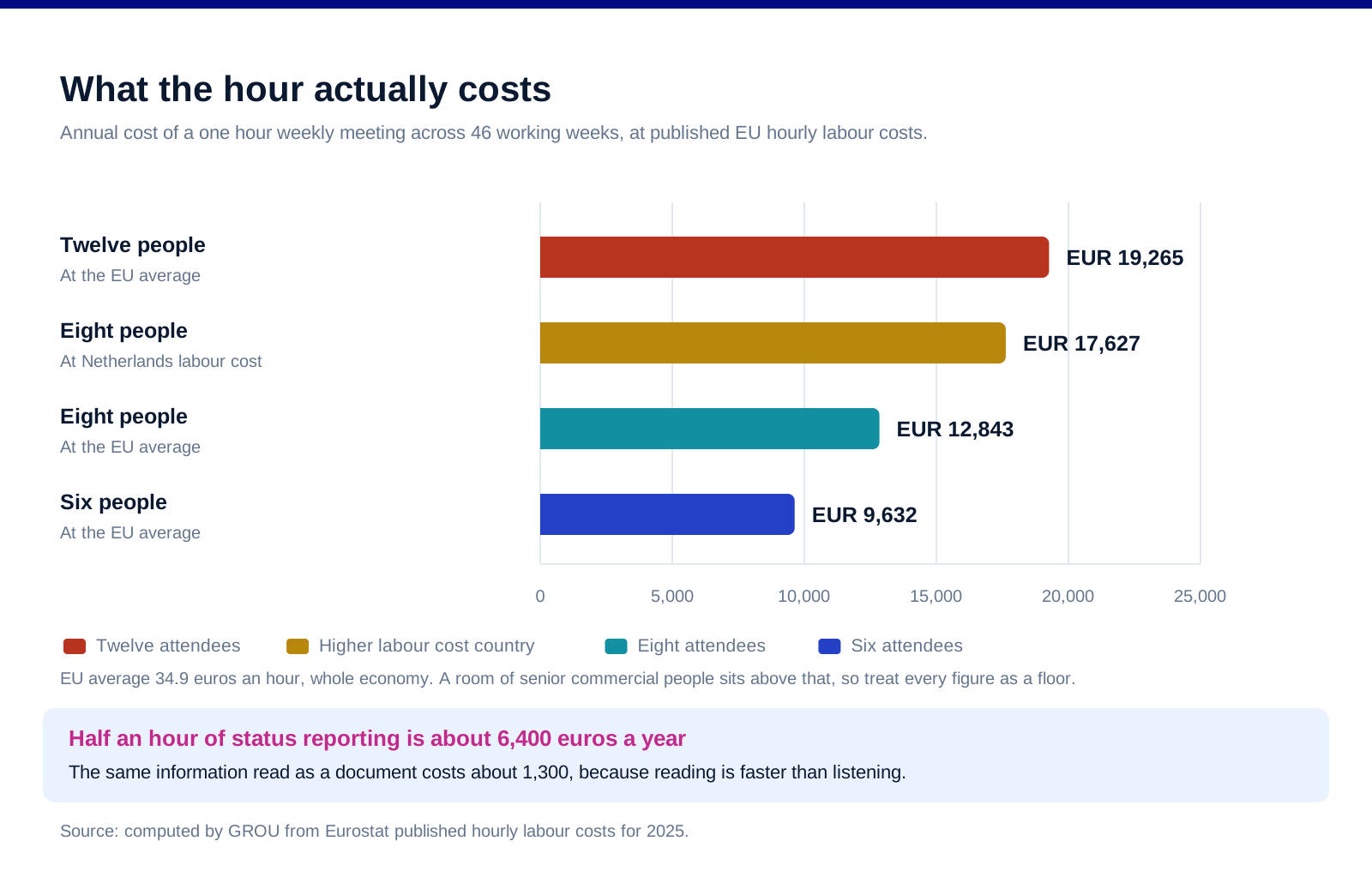
Use a labour cost figure, not a salary figure. Eurostat's estimate covers the whole cost of employing someone rather than their gross pay, which is the number you actually spend. For 2025 it puts the average at "34.9 in the EU and 38.2 in the euro area", ranging from "Bulgaria (12.0)" to "Luxembourg (56.8)".
The gap between the two is about a quarter. Eurostat's breakdown states that in 2025 "the share of non-wage costs in the total labour costs, for the whole economy, was 24.8% in the EU against 25.6% in the euro area", covering employers' social contributions, training and other expenditure. Divide a salary by 2,080 hours and you have understated the cost of the room by roughly a third.
Now run it on your room. Six people for an hour a week across 46 weeks is 276 person-hours, or about 9,600 euros a year at the EU average. Eight people is 368 hours and roughly 12,800 euros. Twelve people is 552 hours and about 19,300 euros.
Treat all three as floors. The whole-economy average includes every sector, and a room containing a CRO, a head of marketing and four senior sellers is well above it. In the Netherlands, at 47.9 euros, the eight-person version is closer to 17,600.
Then price the part that is not a decision. If half the hour is status reporting, that is 184 person-hours a year, about 6,400 euros at the EU average, spent transmitting information that eight people could each have absorbed in six minutes of reading. The same information as a document costs about 1,300.
None of this is an argument for cancelling the meeting. It is an argument for spending the hour on the thing that actually needs eight people in one place, which is deciding something.
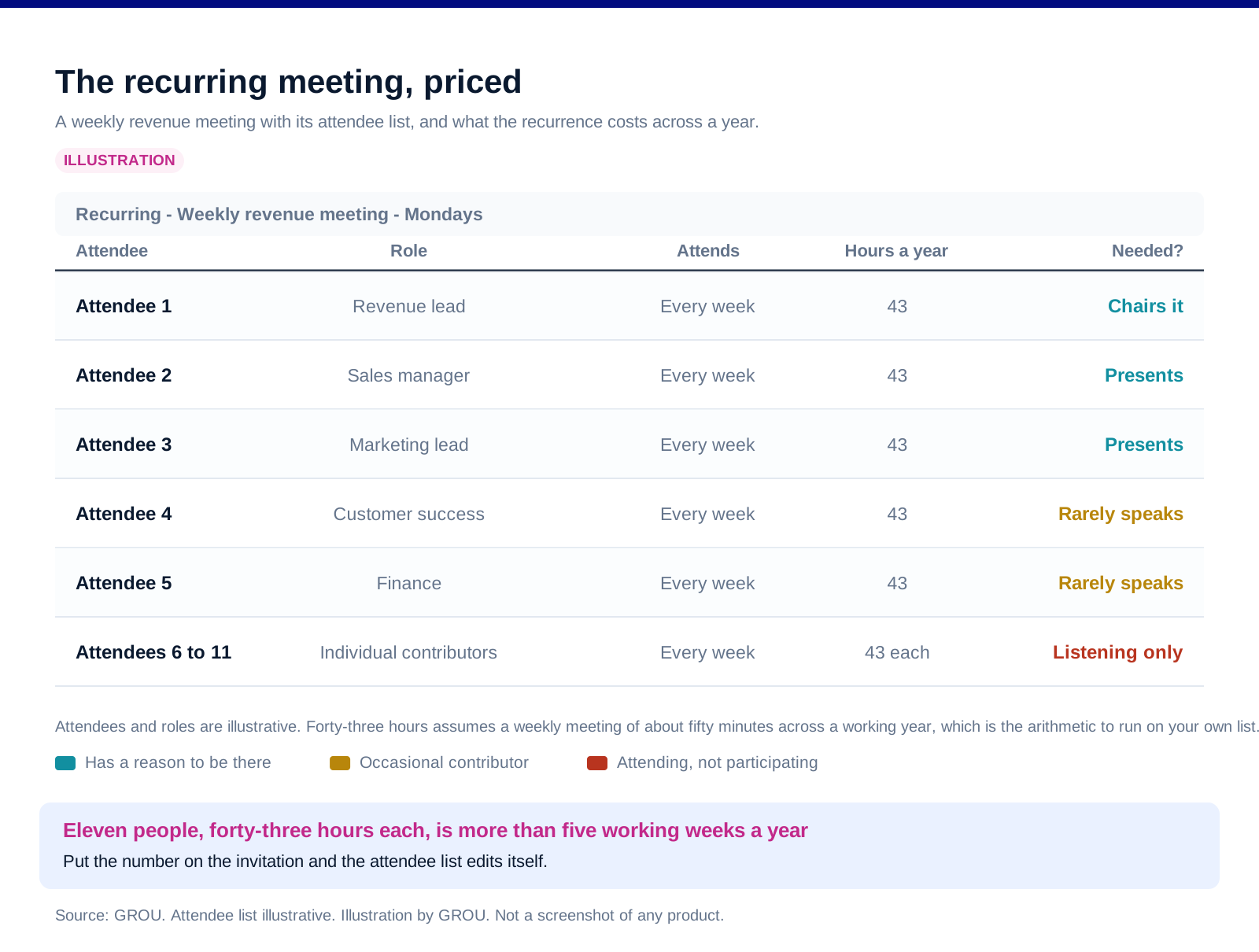
Status is a document, not an agenda item
Write the numbers down and circulate them before. Pipeline created, pipeline closed, coverage, what moved and what did not. If it can be read, it should be read.
If nobody reads it, read it in the room in silence. Five minutes at the top, everyone reading the same page, is still faster than one person narrating it and it produces better questions because everyone has seen the whole thing rather than the part being described.
Never start the meeting with the number. The number is the output of everything you are about to discuss, so opening with it turns the rest of the hour into justification.
Ban the deal-by-deal walk. Reviewing every open opportunity in sequence is how a full hour disappears on deals nobody had a question about. The deals that need discussion are a small subset and they should be nominated in advance.
And separate the pipeline review from the forecast call. They have different attendees, different questions and different failure modes, and combining them means the urgent forecast always eats the important pipeline conversation.
Build the agenda from exceptions
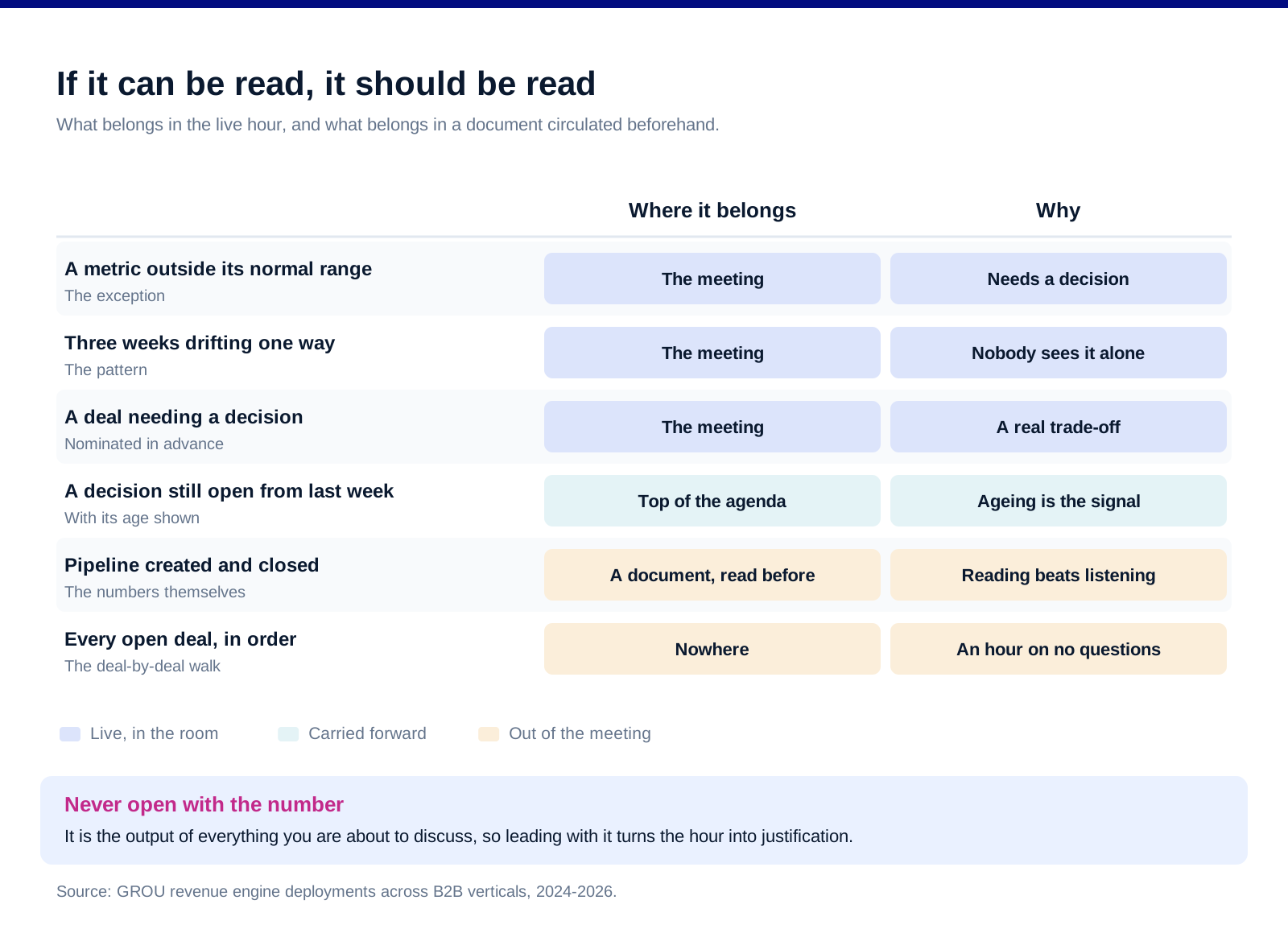
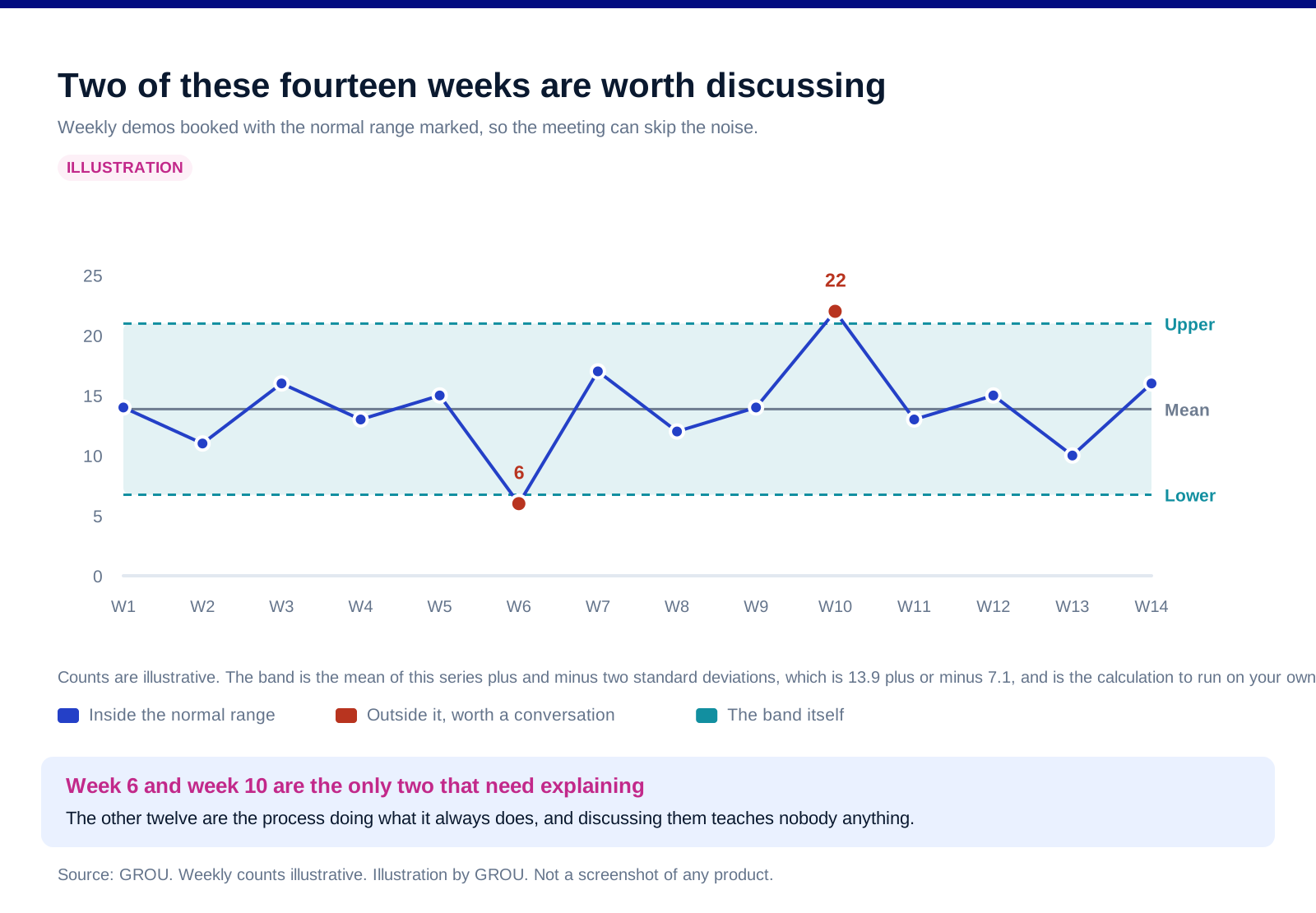
Borrow the discipline from process control. NIST's handbook describes the rule for a control chart plainly: "If a data point falls outside the control limits, we assume that the process is probably out of control and that an investigation is warranted to find and eliminate the cause or causes."
The corollary is the useful part. Points inside the limits are normal variation. A weekly meeting that treats every fall in demos booked as a problem to be solved is investigating noise, and the investigations themselves consume the time that a genuine exception would need.
NIST also notes the pattern rule, that even inside the limits a sustained run above or below the centre line merits attention, and that a process is in control when "all points are between the control limits and they form a random pattern." Three consecutive weeks below the line is a signal. One week below it is a Tuesday.
So set your own limits before the meeting needs them. Look at the last twenty weeks of your key inputs, work out the normal range, and write it down. Then the agenda writes itself: what fell outside, and what has been drifting.
Which leaves an agenda with four items. Exceptions outside the range. Sustained drifts inside it. Deals nominated because a specific decision is needed. Decisions carried over from last week that are still open.
The parts that actually need people in a room
A decision with a real trade-off. Discount approval, a resource reallocation, whether to walk away from a deal that is consuming a quarter of someone's week. These need the people who can say yes, and they benefit from disagreement in the room.
A cross-functional unblock. Sales needs something from product, marketing needs a decision from sales. These take four minutes live and four days over email, which is the entire justification for a synchronous meeting.
A pattern nobody owns yet. Three reps hitting the same objection is a message and offer problem, not three coaching problems, and it takes a room to notice because each individual has only their own instance. Our objection handling piece covers what to do once you have seen it.
Bad news, early. A meeting whose culture punishes the first person to say a deal has gone quiet is a meeting that will find out in week eleven. This is a facilitation job rather than an agenda item and it is the single highest-value thing the chair does.
And nothing else. Recognition, announcements, process reminders and training all have cheaper channels, and putting them here is how the hour became an hour in the first place.
End with owners and dates or do not end
![[INSERT CHART 3, weekly-revenue-meeting-chart-3-signals.svg] Alt: How to tell whether a weekly revenue meeting is working in 2026, and which symptoms point to which fix.](https://framerusercontent.com/images/lx0XXcWpWJxLjZoPrz5jbPTOIY.svg)
Every item closes one of three ways. A decision with an owner and a date, an explicit decision to defer with a trigger for revisiting, or a note that this was information and needed no decision. That third category is the diagnostic: if most items land there, the meeting should be a document.
Write decisions where the work happens. In the CRM or the shared doc, not in someone's notes. A decision recorded only in minutes is a decision that gets remade.
Carry open decisions to the top of next week's agenda. Visibly, with the age shown. A decision that has been open for four weeks either does not matter or is stuck on someone, and both are worth surfacing.
Review the meeting itself once a quarter. Count what fraction of items produced a decision. If it is below half, cut the attendee list before you cut the agenda, because most of the cost is the room rather than the hour.
And be willing to cancel it in a quiet week. A meeting that runs whether or not there is anything to decide teaches everyone that the slot matters more than the content. Our pipeline coverage piece covers the number the meeting is usually about.
What we do not publish here
A recommended attendee list or meeting length. Both depend on how many decisions you actually make, which is the argument of the article rather than an input to it.
Benchmarks for pipeline created, coverage or win rate. Ours come from a specific set of clients, markets and deal sizes.
A meeting template you can copy. The four-item structure above is the shape. The content is your exceptions, which are yours.
A claim that better meetings improve revenue. We have not tested that. The claim we will make is narrower: a meeting that produces no decisions is a cost with no output, and that is arithmetic rather than opinion.
Any recommendation on meeting software or AI notetakers. We have not run a comparison, and a notetaker joining a call has its own consent questions that belong in your own policy rather than in a listicle.
FAQ
What should be on a weekly revenue meeting agenda?
Four things: metrics that fell outside their normal range, metrics that have been drifting inside it, specific deals nominated in advance because a decision is needed, and decisions still open from last week. Everything else, including the numbers themselves, belongs in a document read beforehand.
How long should a weekly revenue meeting be?
As long as the decisions take, which is usually shorter than the slot. The more useful discipline is to price the room first: eight people for an hour across a working year is roughly 12,800 euros at the EU average hourly labour cost, which is a real budget line nobody has approved.
Should you review every deal in the weekly meeting?
No. The deal-by-deal walk is the most reliable way to spend an hour on deals nobody had a question about. Nominate the deals that need a decision in advance, and leave the rest in the pipeline report.
Who should attend the weekly revenue meeting?
The people who can decide the things on the agenda, and nobody else. Most of the cost of a meeting is the attendee list rather than the duration, so cutting the list is the cheapest improvement available.
How do you stop the meeting turning into status reporting?
Circulate the numbers beforehand and start the meeting from questions rather than from the number. If nobody reads them, read them in silence in the room for five minutes, which is still faster than narrating them and produces better questions.
How do you know whether the meeting is working?
Count the proportion of agenda items that ended with a decision, an owner and a date. If it is below half, the meeting is a document with catering.
Bottom line
Work out what the room costs before you touch the agenda, because 12,800 euros a year is a budget line that would attract scrutiny anywhere else in the business. Then take the two biggest consumers of the hour out of it: move the numbers into a document that gets read beforehand, and stop walking through deals nobody has a question about. Build what remains from exceptions, using a normal range you set in advance so that the meeting reacts to signals rather than to noise, and reserve the live time for decisions with real trade-offs, cross-functional unblocks, patterns nobody owns yet, and bad news arriving early. Close every item with an owner and a date, carry the open ones forward where everyone can see their age, and if a quiet week produces nothing to decide, cancel it and prove the meeting is about the content.
Want the pipeline built rather than reviewed? Book a call with GROU. We run lead generation and outbound inside B2B revenue engines across verticals.
We are GROU, a B2B pipeline agency that runs lead generation, outbound, and LinkedIn content for clients across manufacturing, fintech, iGaming, software, and professional services. The meeting cost figures are our own arithmetic on Eurostat's published labour cost estimates, shown with their inputs so you can run them on your own room.
Eight people, one hour, every week. At the EU average hourly labour cost that room costs about 12,800 euros a year, and most of what happens in it is one person reading out numbers everybody could already see.
The test for a weekly revenue meeting is not whether it was useful. Useful is easy. The test is whether a decision was made that could not have been made by someone reading a document alone. If the answer is no, you did not hold a meeting. You held an expensive read-aloud.
TL;DR
Price the room before you design the agenda. Eurostat puts average hourly labour costs in 2025 at 34.9 euros in the EU and 38.2 in the euro area, so eight people for an hour across 46 working weeks is roughly 12,800 to 14,100 euros a year, and that is a floor, because a room of senior commercial people sits above the whole-economy average. Then cut the two things that consume most of it. First, status: anything that can be read should be read, ideally before, because eight people reading the same update takes minutes rather than hours. Second, the deal-by-deal walk, which reviews deals that need no decision. Replace both with an exception agenda. The useful frame comes from process control: NIST puts it as investigating when "a data point falls outside the control limits", and a weekly meeting that reacts to every wiggle inside the limits is reacting to noise. Sort the agenda by decision required, put the numbers in a document, and end with owners and dates or do not end.
Price the room first
Use a labour cost figure, not a salary figure. Eurostat's estimate covers the whole cost of employing someone rather than their gross pay, which is the number you actually spend. For 2025 it puts the average at "34.9 in the EU and 38.2 in the euro area", ranging from "Bulgaria (12.0)" to "Luxembourg (56.8)".
The gap between the two is about a quarter. Eurostat's breakdown states that in 2025 "the share of non-wage costs in the total labour costs, for the whole economy, was 24.8% in the EU against 25.6% in the euro area", covering employers' social contributions, training and other expenditure. Divide a salary by 2,080 hours and you have understated the cost of the room by roughly a third.
Now run it on your room. Six people for an hour a week across 46 weeks is 276 person-hours, or about 9,600 euros a year at the EU average. Eight people is 368 hours and roughly 12,800 euros. Twelve people is 552 hours and about 19,300 euros.
Treat all three as floors. The whole-economy average includes every sector, and a room containing a CRO, a head of marketing and four senior sellers is well above it. In the Netherlands, at 47.9 euros, the eight-person version is closer to 17,600.
Then price the part that is not a decision. If half the hour is status reporting, that is 184 person-hours a year, about 6,400 euros at the EU average, spent transmitting information that eight people could each have absorbed in six minutes of reading. The same information as a document costs about 1,300.
None of this is an argument for cancelling the meeting. It is an argument for spending the hour on the thing that actually needs eight people in one place, which is deciding something.
Status is a document, not an agenda item
Write the numbers down and circulate them before. Pipeline created, pipeline closed, coverage, what moved and what did not. If it can be read, it should be read.
If nobody reads it, read it in the room in silence. Five minutes at the top, everyone reading the same page, is still faster than one person narrating it and it produces better questions because everyone has seen the whole thing rather than the part being described.
Never start the meeting with the number. The number is the output of everything you are about to discuss, so opening with it turns the rest of the hour into justification.
Ban the deal-by-deal walk. Reviewing every open opportunity in sequence is how a full hour disappears on deals nobody had a question about. The deals that need discussion are a small subset and they should be nominated in advance.
And separate the pipeline review from the forecast call. They have different attendees, different questions and different failure modes, and combining them means the urgent forecast always eats the important pipeline conversation.
Build the agenda from exceptions
Borrow the discipline from process control. NIST's handbook describes the rule for a control chart plainly: "If a data point falls outside the control limits, we assume that the process is probably out of control and that an investigation is warranted to find and eliminate the cause or causes."
The corollary is the useful part. Points inside the limits are normal variation. A weekly meeting that treats every fall in demos booked as a problem to be solved is investigating noise, and the investigations themselves consume the time that a genuine exception would need.
NIST also notes the pattern rule, that even inside the limits a sustained run above or below the centre line merits attention, and that a process is in control when "all points are between the control limits and they form a random pattern." Three consecutive weeks below the line is a signal. One week below it is a Tuesday.
So set your own limits before the meeting needs them. Look at the last twenty weeks of your key inputs, work out the normal range, and write it down. Then the agenda writes itself: what fell outside, and what has been drifting.
Which leaves an agenda with four items. Exceptions outside the range. Sustained drifts inside it. Deals nominated because a specific decision is needed. Decisions carried over from last week that are still open.
The parts that actually need people in a room
A decision with a real trade-off. Discount approval, a resource reallocation, whether to walk away from a deal that is consuming a quarter of someone's week. These need the people who can say yes, and they benefit from disagreement in the room.
A cross-functional unblock. Sales needs something from product, marketing needs a decision from sales. These take four minutes live and four days over email, which is the entire justification for a synchronous meeting.
A pattern nobody owns yet. Three reps hitting the same objection is a message and offer problem, not three coaching problems, and it takes a room to notice because each individual has only their own instance. Our objection handling piece covers what to do once you have seen it.
Bad news, early. A meeting whose culture punishes the first person to say a deal has gone quiet is a meeting that will find out in week eleven. This is a facilitation job rather than an agenda item and it is the single highest-value thing the chair does.
And nothing else. Recognition, announcements, process reminders and training all have cheaper channels, and putting them here is how the hour became an hour in the first place.
End with owners and dates or do not end
Every item closes one of three ways. A decision with an owner and a date, an explicit decision to defer with a trigger for revisiting, or a note that this was information and needed no decision. That third category is the diagnostic: if most items land there, the meeting should be a document.
Write decisions where the work happens. In the CRM or the shared doc, not in someone's notes. A decision recorded only in minutes is a decision that gets remade.
Carry open decisions to the top of next week's agenda. Visibly, with the age shown. A decision that has been open for four weeks either does not matter or is stuck on someone, and both are worth surfacing.
Review the meeting itself once a quarter. Count what fraction of items produced a decision. If it is below half, cut the attendee list before you cut the agenda, because most of the cost is the room rather than the hour.
And be willing to cancel it in a quiet week. A meeting that runs whether or not there is anything to decide teaches everyone that the slot matters more than the content. Our pipeline coverage piece covers the number the meeting is usually about.
What we do not publish here
A recommended attendee list or meeting length. Both depend on how many decisions you actually make, which is the argument of the article rather than an input to it.
Benchmarks for pipeline created, coverage or win rate. Ours come from a specific set of clients, markets and deal sizes.
A meeting template you can copy. The four-item structure above is the shape. The content is your exceptions, which are yours.
A claim that better meetings improve revenue. We have not tested that. The claim we will make is narrower: a meeting that produces no decisions is a cost with no output, and that is arithmetic rather than opinion.
Any recommendation on meeting software or AI notetakers. We have not run a comparison, and a notetaker joining a call has its own consent questions that belong in your own policy rather than in a listicle.
FAQ
What should be on a weekly revenue meeting agenda?
Four things: metrics that fell outside their normal range, metrics that have been drifting inside it, specific deals nominated in advance because a decision is needed, and decisions still open from last week. Everything else, including the numbers themselves, belongs in a document read beforehand.
How long should a weekly revenue meeting be?
As long as the decisions take, which is usually shorter than the slot. The more useful discipline is to price the room first: eight people for an hour across a working year is roughly 12,800 euros at the EU average hourly labour cost, which is a real budget line nobody has approved.
Should you review every deal in the weekly meeting?
No. The deal-by-deal walk is the most reliable way to spend an hour on deals nobody had a question about. Nominate the deals that need a decision in advance, and leave the rest in the pipeline report.
Who should attend the weekly revenue meeting?
The people who can decide the things on the agenda, and nobody else. Most of the cost of a meeting is the attendee list rather than the duration, so cutting the list is the cheapest improvement available.
How do you stop the meeting turning into status reporting?
Circulate the numbers beforehand and start the meeting from questions rather than from the number. If nobody reads them, read them in silence in the room for five minutes, which is still faster than narrating them and produces better questions.
How do you know whether the meeting is working?
Count the proportion of agenda items that ended with a decision, an owner and a date. If it is below half, the meeting is a document with catering.
Bottom line
Work out what the room costs before you touch the agenda, because 12,800 euros a year is a budget line that would attract scrutiny anywhere else in the business. Then take the two biggest consumers of the hour out of it: move the numbers into a document that gets read beforehand, and stop walking through deals nobody has a question about. Build what remains from exceptions, using a normal range you set in advance so that the meeting reacts to signals rather than to noise, and reserve the live time for decisions with real trade-offs, cross-functional unblocks, patterns nobody owns yet, and bad news arriving early. Close every item with an owner and a date, carry the open ones forward where everyone can see their age, and if a quiet week produces nothing to decide, cancel it and prove the meeting is about the content.
Want the pipeline built rather than reviewed? Book a call with GROU. We run lead generation and outbound inside B2B revenue engines across verticals.
We are GROU, a B2B pipeline agency that runs lead generation, outbound, and LinkedIn content for clients across manufacturing, fintech, iGaming, software, and professional services. The meeting cost figures are our own arithmetic on Eurostat's published labour cost estimates, shown with their inputs so you can run them on your own room.
Eight people, one hour, every week. At the EU average hourly labour cost that room costs about 12,800 euros a year, and most of what happens in it is one person reading out numbers everybody could already see.
The test for a weekly revenue meeting is not whether it was useful. Useful is easy. The test is whether a decision was made that could not have been made by someone reading a document alone. If the answer is no, you did not hold a meeting. You held an expensive read-aloud.
TL;DR
Price the room before you design the agenda. Eurostat puts average hourly labour costs in 2025 at 34.9 euros in the EU and 38.2 in the euro area, so eight people for an hour across 46 working weeks is roughly 12,800 to 14,100 euros a year, and that is a floor, because a room of senior commercial people sits above the whole-economy average. Then cut the two things that consume most of it. First, status: anything that can be read should be read, ideally before, because eight people reading the same update takes minutes rather than hours. Second, the deal-by-deal walk, which reviews deals that need no decision. Replace both with an exception agenda. The useful frame comes from process control: NIST puts it as investigating when "a data point falls outside the control limits", and a weekly meeting that reacts to every wiggle inside the limits is reacting to noise. Sort the agenda by decision required, put the numbers in a document, and end with owners and dates or do not end.
Price the room first
Use a labour cost figure, not a salary figure. Eurostat's estimate covers the whole cost of employing someone rather than their gross pay, which is the number you actually spend. For 2025 it puts the average at "34.9 in the EU and 38.2 in the euro area", ranging from "Bulgaria (12.0)" to "Luxembourg (56.8)".
The gap between the two is about a quarter. Eurostat's breakdown states that in 2025 "the share of non-wage costs in the total labour costs, for the whole economy, was 24.8% in the EU against 25.6% in the euro area", covering employers' social contributions, training and other expenditure. Divide a salary by 2,080 hours and you have understated the cost of the room by roughly a third.
Now run it on your room. Six people for an hour a week across 46 weeks is 276 person-hours, or about 9,600 euros a year at the EU average. Eight people is 368 hours and roughly 12,800 euros. Twelve people is 552 hours and about 19,300 euros.
Treat all three as floors. The whole-economy average includes every sector, and a room containing a CRO, a head of marketing and four senior sellers is well above it. In the Netherlands, at 47.9 euros, the eight-person version is closer to 17,600.
Then price the part that is not a decision. If half the hour is status reporting, that is 184 person-hours a year, about 6,400 euros at the EU average, spent transmitting information that eight people could each have absorbed in six minutes of reading. The same information as a document costs about 1,300.
None of this is an argument for cancelling the meeting. It is an argument for spending the hour on the thing that actually needs eight people in one place, which is deciding something.
Status is a document, not an agenda item
Write the numbers down and circulate them before. Pipeline created, pipeline closed, coverage, what moved and what did not. If it can be read, it should be read.
If nobody reads it, read it in the room in silence. Five minutes at the top, everyone reading the same page, is still faster than one person narrating it and it produces better questions because everyone has seen the whole thing rather than the part being described.
Never start the meeting with the number. The number is the output of everything you are about to discuss, so opening with it turns the rest of the hour into justification.
Ban the deal-by-deal walk. Reviewing every open opportunity in sequence is how a full hour disappears on deals nobody had a question about. The deals that need discussion are a small subset and they should be nominated in advance.
And separate the pipeline review from the forecast call. They have different attendees, different questions and different failure modes, and combining them means the urgent forecast always eats the important pipeline conversation.
Build the agenda from exceptions
Borrow the discipline from process control. NIST's handbook describes the rule for a control chart plainly: "If a data point falls outside the control limits, we assume that the process is probably out of control and that an investigation is warranted to find and eliminate the cause or causes."
The corollary is the useful part. Points inside the limits are normal variation. A weekly meeting that treats every fall in demos booked as a problem to be solved is investigating noise, and the investigations themselves consume the time that a genuine exception would need.
NIST also notes the pattern rule, that even inside the limits a sustained run above or below the centre line merits attention, and that a process is in control when "all points are between the control limits and they form a random pattern." Three consecutive weeks below the line is a signal. One week below it is a Tuesday.
So set your own limits before the meeting needs them. Look at the last twenty weeks of your key inputs, work out the normal range, and write it down. Then the agenda writes itself: what fell outside, and what has been drifting.
Which leaves an agenda with four items. Exceptions outside the range. Sustained drifts inside it. Deals nominated because a specific decision is needed. Decisions carried over from last week that are still open.
The parts that actually need people in a room
A decision with a real trade-off. Discount approval, a resource reallocation, whether to walk away from a deal that is consuming a quarter of someone's week. These need the people who can say yes, and they benefit from disagreement in the room.
A cross-functional unblock. Sales needs something from product, marketing needs a decision from sales. These take four minutes live and four days over email, which is the entire justification for a synchronous meeting.
A pattern nobody owns yet. Three reps hitting the same objection is a message and offer problem, not three coaching problems, and it takes a room to notice because each individual has only their own instance. Our objection handling piece covers what to do once you have seen it.
Bad news, early. A meeting whose culture punishes the first person to say a deal has gone quiet is a meeting that will find out in week eleven. This is a facilitation job rather than an agenda item and it is the single highest-value thing the chair does.
And nothing else. Recognition, announcements, process reminders and training all have cheaper channels, and putting them here is how the hour became an hour in the first place.
End with owners and dates or do not end
Every item closes one of three ways. A decision with an owner and a date, an explicit decision to defer with a trigger for revisiting, or a note that this was information and needed no decision. That third category is the diagnostic: if most items land there, the meeting should be a document.
Write decisions where the work happens. In the CRM or the shared doc, not in someone's notes. A decision recorded only in minutes is a decision that gets remade.
Carry open decisions to the top of next week's agenda. Visibly, with the age shown. A decision that has been open for four weeks either does not matter or is stuck on someone, and both are worth surfacing.
Review the meeting itself once a quarter. Count what fraction of items produced a decision. If it is below half, cut the attendee list before you cut the agenda, because most of the cost is the room rather than the hour.
And be willing to cancel it in a quiet week. A meeting that runs whether or not there is anything to decide teaches everyone that the slot matters more than the content. Our pipeline coverage piece covers the number the meeting is usually about.
What we do not publish here
A recommended attendee list or meeting length. Both depend on how many decisions you actually make, which is the argument of the article rather than an input to it.
Benchmarks for pipeline created, coverage or win rate. Ours come from a specific set of clients, markets and deal sizes.
A meeting template you can copy. The four-item structure above is the shape. The content is your exceptions, which are yours.
A claim that better meetings improve revenue. We have not tested that. The claim we will make is narrower: a meeting that produces no decisions is a cost with no output, and that is arithmetic rather than opinion.
Any recommendation on meeting software or AI notetakers. We have not run a comparison, and a notetaker joining a call has its own consent questions that belong in your own policy rather than in a listicle.
FAQ
What should be on a weekly revenue meeting agenda?
Four things: metrics that fell outside their normal range, metrics that have been drifting inside it, specific deals nominated in advance because a decision is needed, and decisions still open from last week. Everything else, including the numbers themselves, belongs in a document read beforehand.
How long should a weekly revenue meeting be?
As long as the decisions take, which is usually shorter than the slot. The more useful discipline is to price the room first: eight people for an hour across a working year is roughly 12,800 euros at the EU average hourly labour cost, which is a real budget line nobody has approved.
Should you review every deal in the weekly meeting?
No. The deal-by-deal walk is the most reliable way to spend an hour on deals nobody had a question about. Nominate the deals that need a decision in advance, and leave the rest in the pipeline report.
Who should attend the weekly revenue meeting?
The people who can decide the things on the agenda, and nobody else. Most of the cost of a meeting is the attendee list rather than the duration, so cutting the list is the cheapest improvement available.
How do you stop the meeting turning into status reporting?
Circulate the numbers beforehand and start the meeting from questions rather than from the number. If nobody reads them, read them in silence in the room for five minutes, which is still faster than narrating them and produces better questions.
How do you know whether the meeting is working?
Count the proportion of agenda items that ended with a decision, an owner and a date. If it is below half, the meeting is a document with catering.
Bottom line
Work out what the room costs before you touch the agenda, because 12,800 euros a year is a budget line that would attract scrutiny anywhere else in the business. Then take the two biggest consumers of the hour out of it: move the numbers into a document that gets read beforehand, and stop walking through deals nobody has a question about. Build what remains from exceptions, using a normal range you set in advance so that the meeting reacts to signals rather than to noise, and reserve the live time for decisions with real trade-offs, cross-functional unblocks, patterns nobody owns yet, and bad news arriving early. Close every item with an owner and a date, carry the open ones forward where everyone can see their age, and if a quiet week produces nothing to decide, cancel it and prove the meeting is about the content.
Want the pipeline built rather than reviewed? Book a call with GROU. We run lead generation and outbound inside B2B revenue engines across verticals.
We are GROU, a B2B pipeline agency that runs lead generation, outbound, and LinkedIn content for clients across manufacturing, fintech, iGaming, software, and professional services. The meeting cost figures are our own arithmetic on Eurostat's published labour cost estimates, shown with their inputs so you can run them on your own room.

Pipeline OS Newsletter
Build qualified pipeline
Get weekly tactics to generate demand, improve lead quality, and book more meetings.







Trusted by industry leaders
Trusted by industry leaders
Trusted by industry leaders
Ready to build qualified pipeline?
Ready to build qualified pipeline?
Ready to build qualified pipeline?
Book a call to see if we're the right fit, or take the 2-minute quiz to get a clear starting point.
Book a call to see if we're the right fit, or take the 2-minute quiz to get a clear starting point.
Book a call to see if we're the right fit, or take the 2-minute quiz to get a clear starting point.
" height="30.21639343089746px" id="hfGbXmQR2" width="30.216393430897455px"/></svg>)
Copyright © 2026 – All Right Reserved
Copyright © 2026 – All Right Reserved
Copyright © 2026 – All Right Reserved