%22%3E%3C/path%3E%3Cpath d=%22M 63.072 7.554 C 62.258 8.022 61.577 8.689 61.092 9.493 L 61.092 7.076 L 57.158 7.076 L 57.158 22.64 L 61.089 22.64 L 61.089 14.888 C 61.089 13.446 61.403 12.434 62.03 11.853 C 62.818 11.218 63.818 10.907 64.826 10.982 L 65.868 10.982 L 65.868 6.851 C 64.891 6.834 63.926 7.076 63.073 7.554 Z%22 fill=%22rgb(17,17,17)%22%3E%3C/path%3E%3Cpath d=%22M 78.916 7.82 C 76.363 6.49 73.321 6.49 70.768 7.82 C 69.562 8.473 68.564 9.451 67.888 10.644 C 67.167 11.931 66.803 13.387 66.834 14.862 C 66.804 16.332 67.157 17.785 67.86 19.077 C 68.515 20.267 69.494 21.246 70.684 21.901 C 71.924 22.576 73.318 22.92 74.73 22.898 C 76.164 22.918 77.58 22.575 78.846 21.901 C 80.062 21.247 81.073 20.27 81.768 19.077 C 82.506 17.797 82.88 16.339 82.85 14.862 C 82.88 13.389 82.517 11.934 81.797 10.647 C 81.12 9.455 80.122 8.477 78.917 7.824 M 78.803 14.862 C 78.829 15.739 78.636 16.608 78.241 17.391 C 77.903 18.046 77.38 18.588 76.738 18.95 C 76.124 19.293 75.432 19.472 74.729 19.47 C 73.668 19.497 72.648 19.061 71.934 18.276 C 71.139 17.323 70.741 16.1 70.823 14.862 C 70.741 13.62 71.149 12.395 71.959 11.45 C 72.687 10.667 73.715 10.233 74.783 10.256 C 75.859 10.236 76.894 10.67 77.635 11.45 C 78.464 12.387 78.884 13.616 78.801 14.864%22 fill=%22rgb(17,17,17)%22%3E%3C/path%3E%3Cpath d=%22M 95.906 7.076 L 95.906 15.646 C 95.975 16.68 95.643 17.701 94.979 18.498 C 94.311 19.184 93.379 19.547 92.422 19.495 C 91.475 19.544 90.553 19.18 89.894 18.498 C 89.23 17.701 88.898 16.68 88.967 15.646 L 88.967 7.076 L 85.033 7.076 L 85.033 16.207 C 85 17.449 85.275 18.68 85.834 19.79 C 86.327 20.75 87.095 21.542 88.039 22.065 C 89.033 22.594 90.145 22.861 91.271 22.838 C 92.188 22.847 93.095 22.65 93.926 22.263 C 94.708 21.905 95.388 21.36 95.906 20.675 L 95.906 22.645 L 99.865 22.645 L 99.865 7.076 Z%22 fill=%22rgb(17,17,17)%22%3E%3C/path%3E%3Cpath d=%22M 4.513 15.626 C 4.511 10.815 7.606 6.549 12.181 5.059 C 16.756 3.57 21.77 5.195 24.601 9.086 L 27.816 5.87 C 24.074 1.186 17.981 -0.943 12.137 0.393 C 6.292 1.728 1.728 6.292 0.393 12.137 C -0.943 17.981 1.186 24.074 5.87 27.816 L 9.085 24.601 C 6.214 22.512 4.515 19.177 4.513 15.626%22 fill=%22rgb(32,62,235)%22%3E%3C/path%3E%3Cpath d=%22M 17.114 14.343 L 13.354 18.01 L 13.354 18.026 L 21.071 18.026 L 11.412 27.609 L 17.389 27.609 L 23.999 21.081 L 23.999 28.316 L 24.005 28.316 L 27.967 24.393 L 27.967 14.343 Z%22 fill=%22rgb(32,62,235)%22%3E%3C/path%3E%3C/g%3E%3C/svg%3E) ×
× ××
××›
›
›
›
Autonomous marketing in 2026: a 30-min setup playbook
Autonomous marketing in 2026: a 30-min setup playbook
Autonomous marketing in 2026: a 30-min setup playbook
Autonomous marketing in 2026: a 30-min setup playbook
Autonomous marketing in 2026: a 30-min setup playbook
Autonomous marketing in 2026: a 30-min setup playbook

Author
Aljaz Peklaj
TL;DR
Autonomous marketing is the shift from marketers operating campaigns to marketers briefing AI Agents that build, send and optimise campaigns on their own. The market is moving fast: marketing automation is projected to reach $15.7B by 2027, 68 percent of top-performing marketing teams already rely on automation, and teams that ship mature programmes are recovering an average of 13 hours per week per marketer.
ActiveCampaign is currently the most opinionated SMB-priced platform in this category. Active Intelligence pairs six AI Agents (AI Campaign Builder, AI Automation Builder, Predictive Sending, AI-Suggested Segments, AI Brand Kit, Business Goals) with a real automation engine. In November 2025 it became the first marketing platform with native Anthropic Claude integration. If you are an SMB or agency operator who wants autonomous marketing without a $100k platform fee, this is the entry point.
What is autonomous marketing
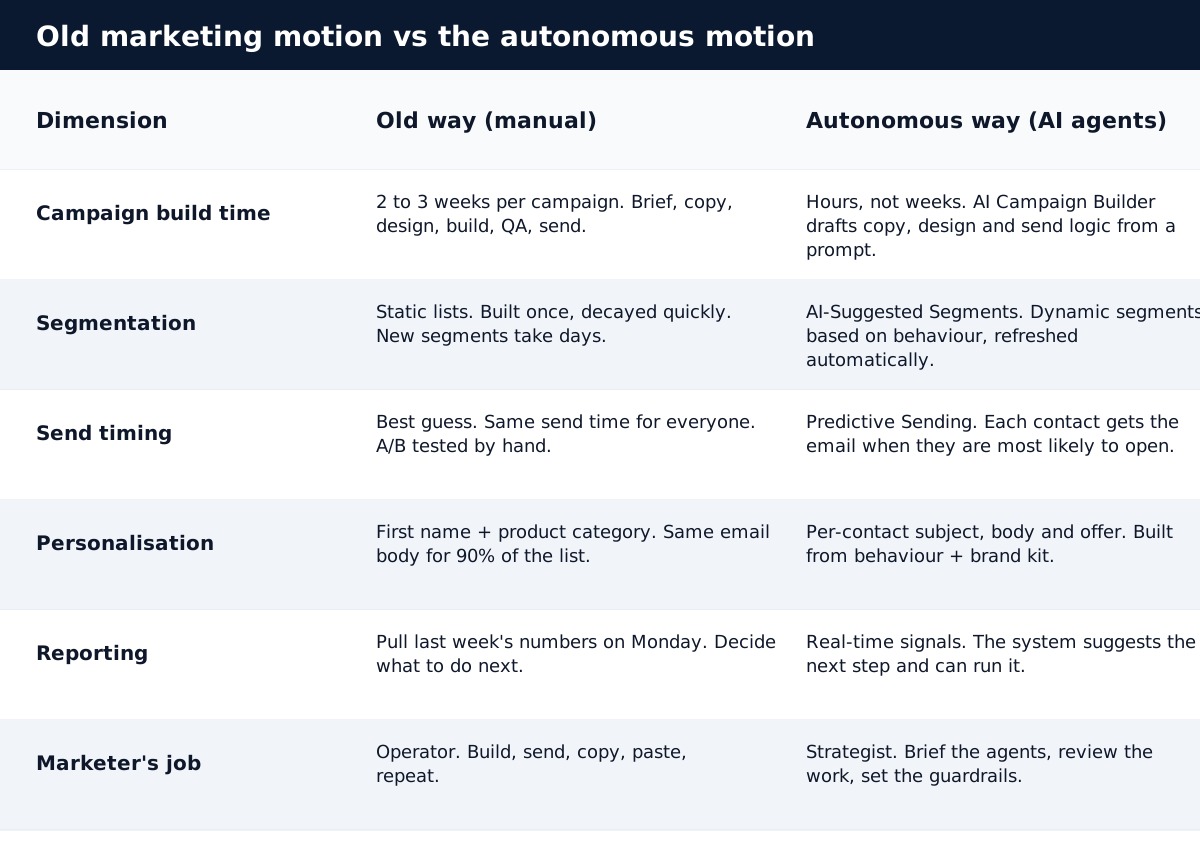
Autonomous marketing is a workflow change, not just a feature change. In the old motion, a marketer picks a campaign, drafts the copy, builds the email, sets the audience, picks a send time, and waits for last week's report to make next week's decision. Every step is human. Most of the work is mechanical.
In the autonomous motion, the marketer briefs an AI Agent with the business goal (such as "win back lapsed customers from Q4" or "convert free trial users on day 7"). The agent drafts the copy from your brand kit, builds the automation, picks the segment, chooses each contact's optimal send time, and reports back on what worked. The marketer reviews, adjusts the guardrails, and signs off.
The shift is from operator to strategist. You stop building campaigns and start briefing them. The platform absorbs the production work.
Table of contents
Why trust this guide
TL;DR
What is autonomous marketing
Why your team should care in 2026
The three pillars of Active Intelligence
The six ActiveCampaign AI Agents to know
Business impact benchmarks
How to set up your first AI Agent in 30 minutes
Common mistakes operators make
Where this fits in a modern marketing stack
FAQ
Bottom line
Why your team should care in 2026
Three things are happening in parallel, and they compound:
Marketing teams are getting smaller. Headcount is being cut across SMB and mid-market, but pipeline targets are not.
Buyers expect personalised, real-time touches. Generic batch-and-blast email opens are down 30 to 40 percent across most categories vs 2022.
AI Agents can finally do production work, not just suggest copy. Until 2024, "AI in marketing" mostly meant subject line testing and copy variants. In 2025 and 2026, agents can build a full multi-step automation from a prompt.
The bottom-line stat we point to in client meetings: 451 percent increase in qualified leads has been reported by marketing teams running mature automation programmes (industry benchmark, marketing automation studies 2024 to 2025). That is not a copy uplift. That is a pipeline outcome.
For SMB owners, this means you can run a marketing programme that punches above your headcount. For agencies, this means you can deliver senior-strategist output at junior-staff cost. For e-commerce operators, this means lifecycle email stops being a backlog item.
The three pillars of Active Intelligence
ActiveCampaign organises its autonomous marketing into three pillars:
1. Imagine, autonomous execution. The AI Agents that actually build and run campaigns. AI Campaign Builder, AI Automation Builder, and Business Goals live here. You describe the outcome, the agents propose the work.
2. Activate, predictive intelligence. The layer that decides who to send to and when. AI-Suggested Segments find audiences you have not built yet. Predictive Sending picks the optimal send time per contact. This is where the algorithmic gains compound.
3. Validate, scalable personalisation. The layer that keeps everything on brand and on tone. AI Brand Kit stores your voice, colours, logo, and tone rules. Every AI-generated asset across Imagine and Activate runs through it, so the output sounds like you, not like a generic AI.
The three pillars matter because they map to the three failure modes of "just adding AI" to a marketing team. Without Imagine, you still build everything by hand. Without Activate, you blast the wrong audience at the wrong time. Without Validate, the AI output sounds off-brand and you stop using it after the second campaign.
The six ActiveCampaign AI Agents to know
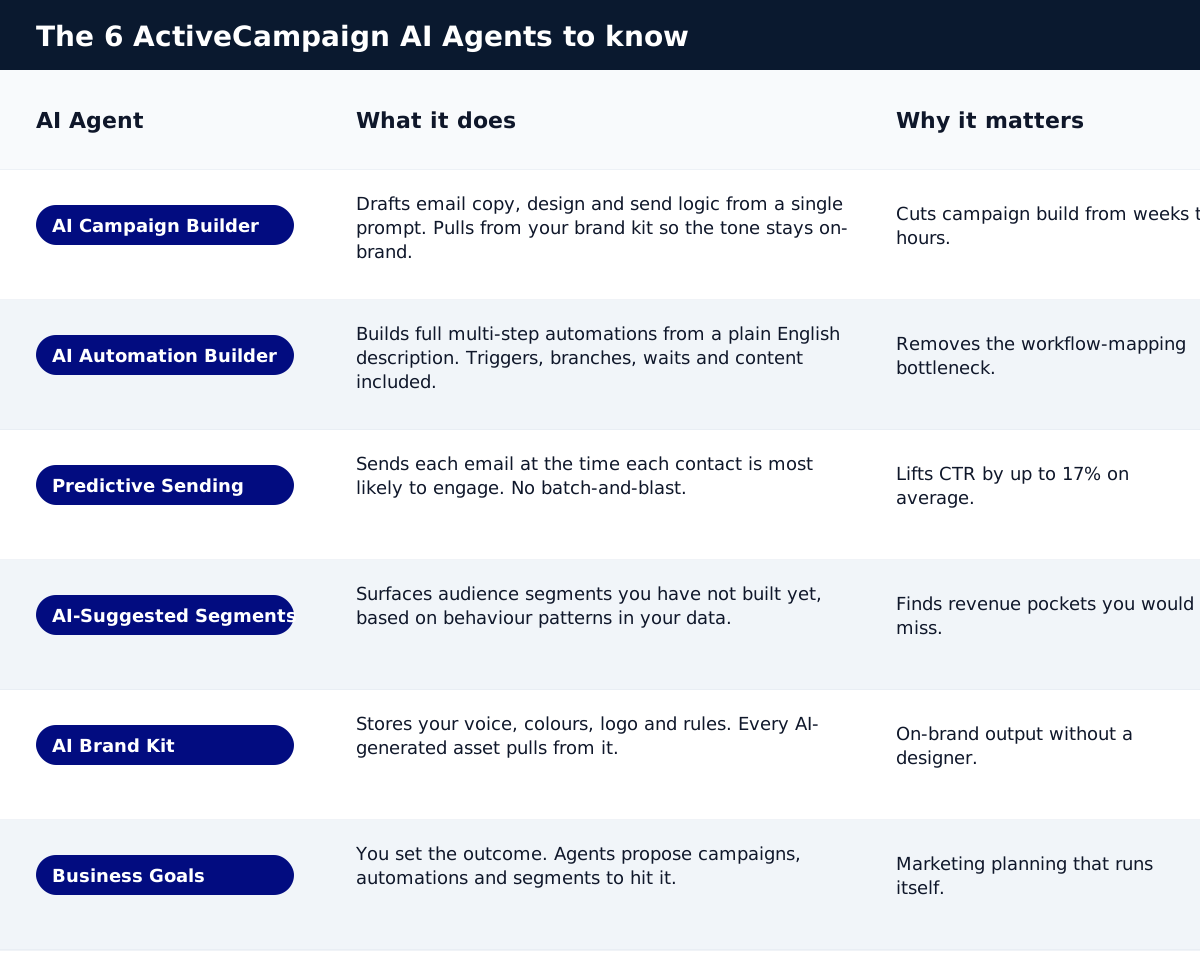
If you are evaluating ActiveCampaign for an autonomous marketing programme, these are the six agents to focus on. We rank them in the order we typically deploy them for clients:
AI Brand Kit first. Everything downstream pulls from this. Skip it and your AI-generated copy sounds generic.
AI Campaign Builder next. Fastest win. Cuts campaign build time from weeks to hours on day one.
Predictive Sending third. Switch every recurring broadcast to predictive send. The 17 percent average CTR lift compounds over months.
AI-Suggested Segments fourth. Once you have 60 to 90 days of behavioural data, start mining the suggested segments.
AI Automation Builder fifth. Reserve for multi-step lifecycle journeys (welcome, onboarding, post-purchase). Higher stakes, longer review cycles.
Business Goals last. This is the strategist-level agent. Brief it with quarterly outcomes once the rest of the stack is humming.
Business impact benchmarks
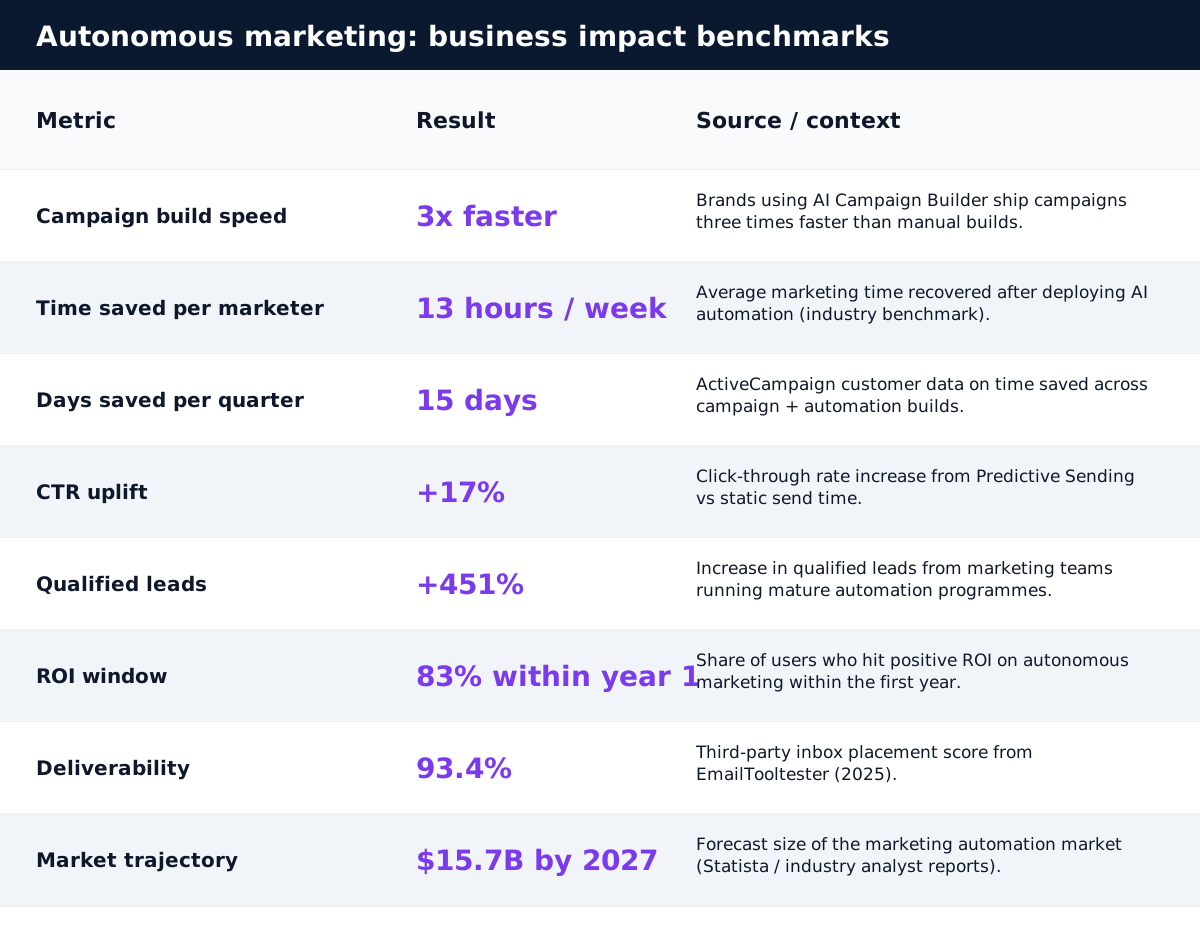
A few of these need context.
The 3x faster build figure is on campaign construction time only. End-to-end shipping speed (brief, review, approve, send) usually lands at 2 to 2.5x in our client work, because the human review step does not get faster.
The 13 hours per week per marketer figure is the industry benchmark across mature programmes. Early-stage rollouts see 4 to 6 hours per week. The big gains start in month 3 to 4 once the brand kit and templates are tuned.
The 17 percent CTR uplift from Predictive Sending is an average. Categories with highly variable engagement windows (e-commerce, B2C subscriptions) see 25 to 30 percent. Tightly business-hours-driven B2B sees 8 to 12 percent. Either way, it is free uplift.
The 93.4 percent deliverability score is from EmailTooltester's 2025 study. Worth checking before you commit, because deliverability is the silent killer of automation programmes.
How to set up your first AI Agent in 30 minutes
This is the playbook we run with new clients on ActiveCampaign. The goal is one shipped autonomous campaign by end of day one.
Step 1: Build the AI Brand Kit (10 minutes). Upload your logo. Set your primary and secondary colours. Paste your voice and tone guidelines. Add 3 to 5 example emails written in your brand voice. The agent uses these to calibrate.
Step 2: Pick the first use case (5 minutes). We recommend a re-engagement campaign on lapsed contacts (90 days no open). Low risk, clear audience, easy to measure.
Step 3: Brief the AI Campaign Builder (5 minutes). Type the prompt: "Re-engage subscribers who have not opened an email in 90 days. Tone: warm but direct. Offer: 20 percent off their next order. Two-email sequence, 5 days apart."
Step 4: Review the draft (5 minutes). The agent returns subject lines, body copy, design, send logic. Read it like an editor, not a writer. Fix anything that sounds off-brand. Cut anything that overpromises.
Step 5: Enable Predictive Sending and ship (5 minutes). Flip the predictive send toggle. Confirm the audience size. Send to a 10 percent test segment. If open rates land within target, push to the full segment 24 hours later.
That is the loop. Most of the time savings come from removing the build-design-QA steps, not from removing the strategy step. The strategy step is where you still earn your salary.
Common mistakes operators make
Treating AI Agents as text generators. They are workflow builders. If you only use the AI Campaign Builder to draft subject lines, you are leaving 80 percent of the value on the table.
Skipping the brand kit. Without it, the AI output drifts toward generic SaaS-speak within 3 to 4 campaigns and your team stops trusting the system. Build the brand kit before campaign one.
Trying to automate strategy. Business Goals is powerful, but it is not a strategy tool. It executes against the goals you set. Garbage goal in, garbage campaign out.
Ignoring deliverability. Adding AI does not fix a damaged sender reputation. If your domain is hot, fix the warm-up and authentication (SPF, DKIM, DMARC) before you scale automation volume.
Over-personalising. Just because you can insert per-contact dynamic content does not mean every email needs eight merge tags. The 17 percent CTR uplift from Predictive Sending alone beats most heavy personalisation tactics.
Not reviewing the AI output. Every AI Agent will occasionally produce something off-brand, off-tone, or factually wrong. The human review step is non-negotiable. Treat agents as a senior associate, not a senior partner.
Where this fits in a modern marketing stack
Autonomous marketing does not replace your whole stack. It replaces the production middle. A reasonable 2026 stack looks like:
CRM: HubSpot, Salesforce, or Pipedrive for sales pipeline data.
Marketing automation + AI Agents: ActiveCampaign for SMB / mid-market, HubSpot Marketing Hub for teams already on HubSpot CRM and willing to pay 5 to 10x for it.
Analytics: GA4 plus Segment or RudderStack for event tracking.
Content + ad creative: A mix of in-house and AI-assisted tools (Claude, ChatGPT, Midjourney).
Pipeline + lead gen layer: Outbound and inbound systems that feed contacts in. We cover this on GROU's services pages.
The autonomous marketing platform sits in the middle. Contacts come in from one side. Pipeline goes out the other. The agents handle what used to be 60 to 70 percent of a marketing team's weekly hours.
What customers are seeing in production
Three short references from public ActiveCampaign customer cases:
Kommunicate reported 66 percent revenue growth after deploying ActiveCampaign automation across their lifecycle email programme.
Motrain moved their conversion rate from 10 percent to over 20 percent using automated multi-step journeys.
INFINITUS scaled their marketing programme without growing the team, by handing production work to AI Agents.
These are vendor-published references, so treat the exact numbers as best-case. The directional point holds: teams that adopt the autonomous workflow ship more campaigns with the same headcount.
FAQ
Is autonomous marketing the same as marketing automation?
No. Marketing automation is the trigger-based workflow engine that has existed since the early 2000s. Autonomous marketing adds AI Agents that build the workflows, write the copy, pick the audience, and decide the send time. Automation does what you tell it. Autonomous marketing decides what to do.
Do I need to be technical to brief an AI Agent?
No. The agents in ActiveCampaign take plain English prompts. The skill that matters is brief writing: clear goal, clear audience, clear tone. The same skill that makes you good at briefing a junior marketer makes you good at briefing an agent.
What about deliverability if AI is sending more emails?
The volume risk is real, which is why we always recommend turning on Predictive Sending early. Smarter send times mean fewer wasted sends to disengaged contacts, which protects your sender reputation. Combined with proper SPF / DKIM / DMARC, deliverability stays north of 90 percent for most senders.
How does ActiveCampaign's AI compare to HubSpot Breeze?
HubSpot Breeze is a set of AI assistants: it suggests, it drafts, it summarises. ActiveCampaign Active Intelligence is a set of AI Agents: it builds, it sends, it segments. The pricing gap is also material. Breeze is bundled into HubSpot Marketing Hub Professional at $890 per month minimum. ActiveCampaign Pro starts at $79 per month with AI Agents included. For most SMB and mid-market teams, the cost-to-capability ratio favours ActiveCampaign by a wide margin.
Will AI Agents replace my marketing team?
Not the strategists. Yes, partially, the production roles. Teams running mature autonomous programmes typically shift one or two production-heavy roles into strategy, brief-writing, and analytics, rather than backfill them. If your team is 90 percent production today, expect role compression. If your team is 50 percent strategy already, expect productivity gains.
Is the Anthropic Claude integration material?
It is, mostly because of writing quality. ActiveCampaign became the first marketing platform to ship native Claude integration in November 2025. In our client work, Claude-generated email copy on ActiveCampaign sounds noticeably more natural than copy from earlier model generations. It is not a category-defining feature on its own, but it is a quality lift you feel by campaign three or four.
What is the ROI window?
Industry benchmarks suggest 83 percent of teams hit positive ROI on autonomous marketing within the first year. Our own client data is consistent with that. The fastest payback comes from re-engagement and lifecycle email programmes. The slowest comes from net-new acquisition campaigns where you also need a working ad strategy.
Can I start small?
Yes, and you should. Pick one use case (re-engagement, abandoned cart, welcome sequence). Ship one autonomous campaign. Measure. Add the next agent. The 30-minute setup playbook above is built for exactly this.
Bottom line
Autonomous marketing is not a 2030 problem. It is a 2026 decision. The teams that adopt it now will compound a 13-hour-per-week productivity gain across 50 weeks per marketer. The teams that wait will spend the same period running production by hand and falling behind on personalisation, send timing, and segment depth.
If you are an SMB or mid-market operator, ActiveCampaign's Active Intelligence is currently the most cost-effective entry point. Six AI Agents, real automation depth, sub-$100-per-month starting price, and the first native Anthropic Claude integration in the category.
If you want a partner to help you brief the agents, build the brand kit, and ship the first autonomous campaign in week one, book a working session with GROU. We have shipped this programme for clients across SaaS, fintech, manufacturing, and professional services. We can do the same for you.
→ Try ActiveCampaign free for 14 days. No credit card required.
TL;DR
Autonomous marketing is the shift from marketers operating campaigns to marketers briefing AI Agents that build, send and optimise campaigns on their own. The market is moving fast: marketing automation is projected to reach $15.7B by 2027, 68 percent of top-performing marketing teams already rely on automation, and teams that ship mature programmes are recovering an average of 13 hours per week per marketer.
ActiveCampaign is currently the most opinionated SMB-priced platform in this category. Active Intelligence pairs six AI Agents (AI Campaign Builder, AI Automation Builder, Predictive Sending, AI-Suggested Segments, AI Brand Kit, Business Goals) with a real automation engine. In November 2025 it became the first marketing platform with native Anthropic Claude integration. If you are an SMB or agency operator who wants autonomous marketing without a $100k platform fee, this is the entry point.
What is autonomous marketing
Autonomous marketing is a workflow change, not just a feature change. In the old motion, a marketer picks a campaign, drafts the copy, builds the email, sets the audience, picks a send time, and waits for last week's report to make next week's decision. Every step is human. Most of the work is mechanical.
In the autonomous motion, the marketer briefs an AI Agent with the business goal (such as "win back lapsed customers from Q4" or "convert free trial users on day 7"). The agent drafts the copy from your brand kit, builds the automation, picks the segment, chooses each contact's optimal send time, and reports back on what worked. The marketer reviews, adjusts the guardrails, and signs off.
The shift is from operator to strategist. You stop building campaigns and start briefing them. The platform absorbs the production work.
Table of contents
Why trust this guide
TL;DR
What is autonomous marketing
Why your team should care in 2026
The three pillars of Active Intelligence
The six ActiveCampaign AI Agents to know
Business impact benchmarks
How to set up your first AI Agent in 30 minutes
Common mistakes operators make
Where this fits in a modern marketing stack
FAQ
Bottom line
Why your team should care in 2026
Three things are happening in parallel, and they compound:
Marketing teams are getting smaller. Headcount is being cut across SMB and mid-market, but pipeline targets are not.
Buyers expect personalised, real-time touches. Generic batch-and-blast email opens are down 30 to 40 percent across most categories vs 2022.
AI Agents can finally do production work, not just suggest copy. Until 2024, "AI in marketing" mostly meant subject line testing and copy variants. In 2025 and 2026, agents can build a full multi-step automation from a prompt.
The bottom-line stat we point to in client meetings: 451 percent increase in qualified leads has been reported by marketing teams running mature automation programmes (industry benchmark, marketing automation studies 2024 to 2025). That is not a copy uplift. That is a pipeline outcome.
For SMB owners, this means you can run a marketing programme that punches above your headcount. For agencies, this means you can deliver senior-strategist output at junior-staff cost. For e-commerce operators, this means lifecycle email stops being a backlog item.
The three pillars of Active Intelligence
ActiveCampaign organises its autonomous marketing into three pillars:
1. Imagine, autonomous execution. The AI Agents that actually build and run campaigns. AI Campaign Builder, AI Automation Builder, and Business Goals live here. You describe the outcome, the agents propose the work.
2. Activate, predictive intelligence. The layer that decides who to send to and when. AI-Suggested Segments find audiences you have not built yet. Predictive Sending picks the optimal send time per contact. This is where the algorithmic gains compound.
3. Validate, scalable personalisation. The layer that keeps everything on brand and on tone. AI Brand Kit stores your voice, colours, logo, and tone rules. Every AI-generated asset across Imagine and Activate runs through it, so the output sounds like you, not like a generic AI.
The three pillars matter because they map to the three failure modes of "just adding AI" to a marketing team. Without Imagine, you still build everything by hand. Without Activate, you blast the wrong audience at the wrong time. Without Validate, the AI output sounds off-brand and you stop using it after the second campaign.
The six ActiveCampaign AI Agents to know
If you are evaluating ActiveCampaign for an autonomous marketing programme, these are the six agents to focus on. We rank them in the order we typically deploy them for clients:
AI Brand Kit first. Everything downstream pulls from this. Skip it and your AI-generated copy sounds generic.
AI Campaign Builder next. Fastest win. Cuts campaign build time from weeks to hours on day one.
Predictive Sending third. Switch every recurring broadcast to predictive send. The 17 percent average CTR lift compounds over months.
AI-Suggested Segments fourth. Once you have 60 to 90 days of behavioural data, start mining the suggested segments.
AI Automation Builder fifth. Reserve for multi-step lifecycle journeys (welcome, onboarding, post-purchase). Higher stakes, longer review cycles.
Business Goals last. This is the strategist-level agent. Brief it with quarterly outcomes once the rest of the stack is humming.
Business impact benchmarks
A few of these need context.
The 3x faster build figure is on campaign construction time only. End-to-end shipping speed (brief, review, approve, send) usually lands at 2 to 2.5x in our client work, because the human review step does not get faster.
The 13 hours per week per marketer figure is the industry benchmark across mature programmes. Early-stage rollouts see 4 to 6 hours per week. The big gains start in month 3 to 4 once the brand kit and templates are tuned.
The 17 percent CTR uplift from Predictive Sending is an average. Categories with highly variable engagement windows (e-commerce, B2C subscriptions) see 25 to 30 percent. Tightly business-hours-driven B2B sees 8 to 12 percent. Either way, it is free uplift.
The 93.4 percent deliverability score is from EmailTooltester's 2025 study. Worth checking before you commit, because deliverability is the silent killer of automation programmes.
How to set up your first AI Agent in 30 minutes
This is the playbook we run with new clients on ActiveCampaign. The goal is one shipped autonomous campaign by end of day one.
Step 1: Build the AI Brand Kit (10 minutes). Upload your logo. Set your primary and secondary colours. Paste your voice and tone guidelines. Add 3 to 5 example emails written in your brand voice. The agent uses these to calibrate.
Step 2: Pick the first use case (5 minutes). We recommend a re-engagement campaign on lapsed contacts (90 days no open). Low risk, clear audience, easy to measure.
Step 3: Brief the AI Campaign Builder (5 minutes). Type the prompt: "Re-engage subscribers who have not opened an email in 90 days. Tone: warm but direct. Offer: 20 percent off their next order. Two-email sequence, 5 days apart."
Step 4: Review the draft (5 minutes). The agent returns subject lines, body copy, design, send logic. Read it like an editor, not a writer. Fix anything that sounds off-brand. Cut anything that overpromises.
Step 5: Enable Predictive Sending and ship (5 minutes). Flip the predictive send toggle. Confirm the audience size. Send to a 10 percent test segment. If open rates land within target, push to the full segment 24 hours later.
That is the loop. Most of the time savings come from removing the build-design-QA steps, not from removing the strategy step. The strategy step is where you still earn your salary.
Common mistakes operators make
Treating AI Agents as text generators. They are workflow builders. If you only use the AI Campaign Builder to draft subject lines, you are leaving 80 percent of the value on the table.
Skipping the brand kit. Without it, the AI output drifts toward generic SaaS-speak within 3 to 4 campaigns and your team stops trusting the system. Build the brand kit before campaign one.
Trying to automate strategy. Business Goals is powerful, but it is not a strategy tool. It executes against the goals you set. Garbage goal in, garbage campaign out.
Ignoring deliverability. Adding AI does not fix a damaged sender reputation. If your domain is hot, fix the warm-up and authentication (SPF, DKIM, DMARC) before you scale automation volume.
Over-personalising. Just because you can insert per-contact dynamic content does not mean every email needs eight merge tags. The 17 percent CTR uplift from Predictive Sending alone beats most heavy personalisation tactics.
Not reviewing the AI output. Every AI Agent will occasionally produce something off-brand, off-tone, or factually wrong. The human review step is non-negotiable. Treat agents as a senior associate, not a senior partner.
Where this fits in a modern marketing stack
Autonomous marketing does not replace your whole stack. It replaces the production middle. A reasonable 2026 stack looks like:
CRM: HubSpot, Salesforce, or Pipedrive for sales pipeline data.
Marketing automation + AI Agents: ActiveCampaign for SMB / mid-market, HubSpot Marketing Hub for teams already on HubSpot CRM and willing to pay 5 to 10x for it.
Analytics: GA4 plus Segment or RudderStack for event tracking.
Content + ad creative: A mix of in-house and AI-assisted tools (Claude, ChatGPT, Midjourney).
Pipeline + lead gen layer: Outbound and inbound systems that feed contacts in. We cover this on GROU's services pages.
The autonomous marketing platform sits in the middle. Contacts come in from one side. Pipeline goes out the other. The agents handle what used to be 60 to 70 percent of a marketing team's weekly hours.
What customers are seeing in production
Three short references from public ActiveCampaign customer cases:
Kommunicate reported 66 percent revenue growth after deploying ActiveCampaign automation across their lifecycle email programme.
Motrain moved their conversion rate from 10 percent to over 20 percent using automated multi-step journeys.
INFINITUS scaled their marketing programme without growing the team, by handing production work to AI Agents.
These are vendor-published references, so treat the exact numbers as best-case. The directional point holds: teams that adopt the autonomous workflow ship more campaigns with the same headcount.
FAQ
Is autonomous marketing the same as marketing automation?
No. Marketing automation is the trigger-based workflow engine that has existed since the early 2000s. Autonomous marketing adds AI Agents that build the workflows, write the copy, pick the audience, and decide the send time. Automation does what you tell it. Autonomous marketing decides what to do.
Do I need to be technical to brief an AI Agent?
No. The agents in ActiveCampaign take plain English prompts. The skill that matters is brief writing: clear goal, clear audience, clear tone. The same skill that makes you good at briefing a junior marketer makes you good at briefing an agent.
What about deliverability if AI is sending more emails?
The volume risk is real, which is why we always recommend turning on Predictive Sending early. Smarter send times mean fewer wasted sends to disengaged contacts, which protects your sender reputation. Combined with proper SPF / DKIM / DMARC, deliverability stays north of 90 percent for most senders.
How does ActiveCampaign's AI compare to HubSpot Breeze?
HubSpot Breeze is a set of AI assistants: it suggests, it drafts, it summarises. ActiveCampaign Active Intelligence is a set of AI Agents: it builds, it sends, it segments. The pricing gap is also material. Breeze is bundled into HubSpot Marketing Hub Professional at $890 per month minimum. ActiveCampaign Pro starts at $79 per month with AI Agents included. For most SMB and mid-market teams, the cost-to-capability ratio favours ActiveCampaign by a wide margin.
Will AI Agents replace my marketing team?
Not the strategists. Yes, partially, the production roles. Teams running mature autonomous programmes typically shift one or two production-heavy roles into strategy, brief-writing, and analytics, rather than backfill them. If your team is 90 percent production today, expect role compression. If your team is 50 percent strategy already, expect productivity gains.
Is the Anthropic Claude integration material?
It is, mostly because of writing quality. ActiveCampaign became the first marketing platform to ship native Claude integration in November 2025. In our client work, Claude-generated email copy on ActiveCampaign sounds noticeably more natural than copy from earlier model generations. It is not a category-defining feature on its own, but it is a quality lift you feel by campaign three or four.
What is the ROI window?
Industry benchmarks suggest 83 percent of teams hit positive ROI on autonomous marketing within the first year. Our own client data is consistent with that. The fastest payback comes from re-engagement and lifecycle email programmes. The slowest comes from net-new acquisition campaigns where you also need a working ad strategy.
Can I start small?
Yes, and you should. Pick one use case (re-engagement, abandoned cart, welcome sequence). Ship one autonomous campaign. Measure. Add the next agent. The 30-minute setup playbook above is built for exactly this.
Bottom line
Autonomous marketing is not a 2030 problem. It is a 2026 decision. The teams that adopt it now will compound a 13-hour-per-week productivity gain across 50 weeks per marketer. The teams that wait will spend the same period running production by hand and falling behind on personalisation, send timing, and segment depth.
If you are an SMB or mid-market operator, ActiveCampaign's Active Intelligence is currently the most cost-effective entry point. Six AI Agents, real automation depth, sub-$100-per-month starting price, and the first native Anthropic Claude integration in the category.
If you want a partner to help you brief the agents, build the brand kit, and ship the first autonomous campaign in week one, book a working session with GROU. We have shipped this programme for clients across SaaS, fintech, manufacturing, and professional services. We can do the same for you.
→ Try ActiveCampaign free for 14 days. No credit card required.
TL;DR
Autonomous marketing is the shift from marketers operating campaigns to marketers briefing AI Agents that build, send and optimise campaigns on their own. The market is moving fast: marketing automation is projected to reach $15.7B by 2027, 68 percent of top-performing marketing teams already rely on automation, and teams that ship mature programmes are recovering an average of 13 hours per week per marketer.
ActiveCampaign is currently the most opinionated SMB-priced platform in this category. Active Intelligence pairs six AI Agents (AI Campaign Builder, AI Automation Builder, Predictive Sending, AI-Suggested Segments, AI Brand Kit, Business Goals) with a real automation engine. In November 2025 it became the first marketing platform with native Anthropic Claude integration. If you are an SMB or agency operator who wants autonomous marketing without a $100k platform fee, this is the entry point.
What is autonomous marketing
Autonomous marketing is a workflow change, not just a feature change. In the old motion, a marketer picks a campaign, drafts the copy, builds the email, sets the audience, picks a send time, and waits for last week's report to make next week's decision. Every step is human. Most of the work is mechanical.
In the autonomous motion, the marketer briefs an AI Agent with the business goal (such as "win back lapsed customers from Q4" or "convert free trial users on day 7"). The agent drafts the copy from your brand kit, builds the automation, picks the segment, chooses each contact's optimal send time, and reports back on what worked. The marketer reviews, adjusts the guardrails, and signs off.
The shift is from operator to strategist. You stop building campaigns and start briefing them. The platform absorbs the production work.
Table of contents
Why trust this guide
TL;DR
What is autonomous marketing
Why your team should care in 2026
The three pillars of Active Intelligence
The six ActiveCampaign AI Agents to know
Business impact benchmarks
How to set up your first AI Agent in 30 minutes
Common mistakes operators make
Where this fits in a modern marketing stack
FAQ
Bottom line
Why your team should care in 2026
Three things are happening in parallel, and they compound:
Marketing teams are getting smaller. Headcount is being cut across SMB and mid-market, but pipeline targets are not.
Buyers expect personalised, real-time touches. Generic batch-and-blast email opens are down 30 to 40 percent across most categories vs 2022.
AI Agents can finally do production work, not just suggest copy. Until 2024, "AI in marketing" mostly meant subject line testing and copy variants. In 2025 and 2026, agents can build a full multi-step automation from a prompt.
The bottom-line stat we point to in client meetings: 451 percent increase in qualified leads has been reported by marketing teams running mature automation programmes (industry benchmark, marketing automation studies 2024 to 2025). That is not a copy uplift. That is a pipeline outcome.
For SMB owners, this means you can run a marketing programme that punches above your headcount. For agencies, this means you can deliver senior-strategist output at junior-staff cost. For e-commerce operators, this means lifecycle email stops being a backlog item.
The three pillars of Active Intelligence
ActiveCampaign organises its autonomous marketing into three pillars:
1. Imagine, autonomous execution. The AI Agents that actually build and run campaigns. AI Campaign Builder, AI Automation Builder, and Business Goals live here. You describe the outcome, the agents propose the work.
2. Activate, predictive intelligence. The layer that decides who to send to and when. AI-Suggested Segments find audiences you have not built yet. Predictive Sending picks the optimal send time per contact. This is where the algorithmic gains compound.
3. Validate, scalable personalisation. The layer that keeps everything on brand and on tone. AI Brand Kit stores your voice, colours, logo, and tone rules. Every AI-generated asset across Imagine and Activate runs through it, so the output sounds like you, not like a generic AI.
The three pillars matter because they map to the three failure modes of "just adding AI" to a marketing team. Without Imagine, you still build everything by hand. Without Activate, you blast the wrong audience at the wrong time. Without Validate, the AI output sounds off-brand and you stop using it after the second campaign.
The six ActiveCampaign AI Agents to know
If you are evaluating ActiveCampaign for an autonomous marketing programme, these are the six agents to focus on. We rank them in the order we typically deploy them for clients:
AI Brand Kit first. Everything downstream pulls from this. Skip it and your AI-generated copy sounds generic.
AI Campaign Builder next. Fastest win. Cuts campaign build time from weeks to hours on day one.
Predictive Sending third. Switch every recurring broadcast to predictive send. The 17 percent average CTR lift compounds over months.
AI-Suggested Segments fourth. Once you have 60 to 90 days of behavioural data, start mining the suggested segments.
AI Automation Builder fifth. Reserve for multi-step lifecycle journeys (welcome, onboarding, post-purchase). Higher stakes, longer review cycles.
Business Goals last. This is the strategist-level agent. Brief it with quarterly outcomes once the rest of the stack is humming.
Business impact benchmarks
A few of these need context.
The 3x faster build figure is on campaign construction time only. End-to-end shipping speed (brief, review, approve, send) usually lands at 2 to 2.5x in our client work, because the human review step does not get faster.
The 13 hours per week per marketer figure is the industry benchmark across mature programmes. Early-stage rollouts see 4 to 6 hours per week. The big gains start in month 3 to 4 once the brand kit and templates are tuned.
The 17 percent CTR uplift from Predictive Sending is an average. Categories with highly variable engagement windows (e-commerce, B2C subscriptions) see 25 to 30 percent. Tightly business-hours-driven B2B sees 8 to 12 percent. Either way, it is free uplift.
The 93.4 percent deliverability score is from EmailTooltester's 2025 study. Worth checking before you commit, because deliverability is the silent killer of automation programmes.
How to set up your first AI Agent in 30 minutes
This is the playbook we run with new clients on ActiveCampaign. The goal is one shipped autonomous campaign by end of day one.
Step 1: Build the AI Brand Kit (10 minutes). Upload your logo. Set your primary and secondary colours. Paste your voice and tone guidelines. Add 3 to 5 example emails written in your brand voice. The agent uses these to calibrate.
Step 2: Pick the first use case (5 minutes). We recommend a re-engagement campaign on lapsed contacts (90 days no open). Low risk, clear audience, easy to measure.
Step 3: Brief the AI Campaign Builder (5 minutes). Type the prompt: "Re-engage subscribers who have not opened an email in 90 days. Tone: warm but direct. Offer: 20 percent off their next order. Two-email sequence, 5 days apart."
Step 4: Review the draft (5 minutes). The agent returns subject lines, body copy, design, send logic. Read it like an editor, not a writer. Fix anything that sounds off-brand. Cut anything that overpromises.
Step 5: Enable Predictive Sending and ship (5 minutes). Flip the predictive send toggle. Confirm the audience size. Send to a 10 percent test segment. If open rates land within target, push to the full segment 24 hours later.
That is the loop. Most of the time savings come from removing the build-design-QA steps, not from removing the strategy step. The strategy step is where you still earn your salary.
Common mistakes operators make
Treating AI Agents as text generators. They are workflow builders. If you only use the AI Campaign Builder to draft subject lines, you are leaving 80 percent of the value on the table.
Skipping the brand kit. Without it, the AI output drifts toward generic SaaS-speak within 3 to 4 campaigns and your team stops trusting the system. Build the brand kit before campaign one.
Trying to automate strategy. Business Goals is powerful, but it is not a strategy tool. It executes against the goals you set. Garbage goal in, garbage campaign out.
Ignoring deliverability. Adding AI does not fix a damaged sender reputation. If your domain is hot, fix the warm-up and authentication (SPF, DKIM, DMARC) before you scale automation volume.
Over-personalising. Just because you can insert per-contact dynamic content does not mean every email needs eight merge tags. The 17 percent CTR uplift from Predictive Sending alone beats most heavy personalisation tactics.
Not reviewing the AI output. Every AI Agent will occasionally produce something off-brand, off-tone, or factually wrong. The human review step is non-negotiable. Treat agents as a senior associate, not a senior partner.
Where this fits in a modern marketing stack
Autonomous marketing does not replace your whole stack. It replaces the production middle. A reasonable 2026 stack looks like:
CRM: HubSpot, Salesforce, or Pipedrive for sales pipeline data.
Marketing automation + AI Agents: ActiveCampaign for SMB / mid-market, HubSpot Marketing Hub for teams already on HubSpot CRM and willing to pay 5 to 10x for it.
Analytics: GA4 plus Segment or RudderStack for event tracking.
Content + ad creative: A mix of in-house and AI-assisted tools (Claude, ChatGPT, Midjourney).
Pipeline + lead gen layer: Outbound and inbound systems that feed contacts in. We cover this on GROU's services pages.
The autonomous marketing platform sits in the middle. Contacts come in from one side. Pipeline goes out the other. The agents handle what used to be 60 to 70 percent of a marketing team's weekly hours.
What customers are seeing in production
Three short references from public ActiveCampaign customer cases:
Kommunicate reported 66 percent revenue growth after deploying ActiveCampaign automation across their lifecycle email programme.
Motrain moved their conversion rate from 10 percent to over 20 percent using automated multi-step journeys.
INFINITUS scaled their marketing programme without growing the team, by handing production work to AI Agents.
These are vendor-published references, so treat the exact numbers as best-case. The directional point holds: teams that adopt the autonomous workflow ship more campaigns with the same headcount.
FAQ
Is autonomous marketing the same as marketing automation?
No. Marketing automation is the trigger-based workflow engine that has existed since the early 2000s. Autonomous marketing adds AI Agents that build the workflows, write the copy, pick the audience, and decide the send time. Automation does what you tell it. Autonomous marketing decides what to do.
Do I need to be technical to brief an AI Agent?
No. The agents in ActiveCampaign take plain English prompts. The skill that matters is brief writing: clear goal, clear audience, clear tone. The same skill that makes you good at briefing a junior marketer makes you good at briefing an agent.
What about deliverability if AI is sending more emails?
The volume risk is real, which is why we always recommend turning on Predictive Sending early. Smarter send times mean fewer wasted sends to disengaged contacts, which protects your sender reputation. Combined with proper SPF / DKIM / DMARC, deliverability stays north of 90 percent for most senders.
How does ActiveCampaign's AI compare to HubSpot Breeze?
HubSpot Breeze is a set of AI assistants: it suggests, it drafts, it summarises. ActiveCampaign Active Intelligence is a set of AI Agents: it builds, it sends, it segments. The pricing gap is also material. Breeze is bundled into HubSpot Marketing Hub Professional at $890 per month minimum. ActiveCampaign Pro starts at $79 per month with AI Agents included. For most SMB and mid-market teams, the cost-to-capability ratio favours ActiveCampaign by a wide margin.
Will AI Agents replace my marketing team?
Not the strategists. Yes, partially, the production roles. Teams running mature autonomous programmes typically shift one or two production-heavy roles into strategy, brief-writing, and analytics, rather than backfill them. If your team is 90 percent production today, expect role compression. If your team is 50 percent strategy already, expect productivity gains.
Is the Anthropic Claude integration material?
It is, mostly because of writing quality. ActiveCampaign became the first marketing platform to ship native Claude integration in November 2025. In our client work, Claude-generated email copy on ActiveCampaign sounds noticeably more natural than copy from earlier model generations. It is not a category-defining feature on its own, but it is a quality lift you feel by campaign three or four.
What is the ROI window?
Industry benchmarks suggest 83 percent of teams hit positive ROI on autonomous marketing within the first year. Our own client data is consistent with that. The fastest payback comes from re-engagement and lifecycle email programmes. The slowest comes from net-new acquisition campaigns where you also need a working ad strategy.
Can I start small?
Yes, and you should. Pick one use case (re-engagement, abandoned cart, welcome sequence). Ship one autonomous campaign. Measure. Add the next agent. The 30-minute setup playbook above is built for exactly this.
Bottom line
Autonomous marketing is not a 2030 problem. It is a 2026 decision. The teams that adopt it now will compound a 13-hour-per-week productivity gain across 50 weeks per marketer. The teams that wait will spend the same period running production by hand and falling behind on personalisation, send timing, and segment depth.
If you are an SMB or mid-market operator, ActiveCampaign's Active Intelligence is currently the most cost-effective entry point. Six AI Agents, real automation depth, sub-$100-per-month starting price, and the first native Anthropic Claude integration in the category.
If you want a partner to help you brief the agents, build the brand kit, and ship the first autonomous campaign in week one, book a working session with GROU. We have shipped this programme for clients across SaaS, fintech, manufacturing, and professional services. We can do the same for you.
→ Try ActiveCampaign free for 14 days. No credit card required.
Pipeline OS Newsletter
Build qualified pipeline
Get weekly tactics to generate demand, improve lead quality, and book more meetings.







Trusted by industry leaders
Trusted by industry leaders
Trusted by industry leaders
Ready to build qualified pipeline?
Ready to build qualified pipeline?
Ready to build qualified pipeline?
Book a call to see if we're the right fit, or take the 2-minute quiz to get a clear starting point.
Book a call to see if we're the right fit, or take the 2-minute quiz to get a clear starting point.
Book a call to see if we're the right fit, or take the 2-minute quiz to get a clear starting point.
" height="30.21639343089746px" id="hfGbXmQR2" width="30.216393430897455px"/></svg>)
Copyright © 2026 – All Right Reserved
Copyright © 2026 – All Right Reserved
Copyright © 2026 – All Right Reserved