%22%3E%3C/path%3E%3Cpath d=%22M 63.072 7.554 C 62.258 8.022 61.577 8.689 61.092 9.493 L 61.092 7.076 L 57.158 7.076 L 57.158 22.64 L 61.089 22.64 L 61.089 14.888 C 61.089 13.446 61.403 12.434 62.03 11.853 C 62.818 11.218 63.818 10.907 64.826 10.982 L 65.868 10.982 L 65.868 6.851 C 64.891 6.834 63.926 7.076 63.073 7.554 Z%22 fill=%22rgb(17,17,17)%22%3E%3C/path%3E%3Cpath d=%22M 78.916 7.82 C 76.363 6.49 73.321 6.49 70.768 7.82 C 69.562 8.473 68.564 9.451 67.888 10.644 C 67.167 11.931 66.803 13.387 66.834 14.862 C 66.804 16.332 67.157 17.785 67.86 19.077 C 68.515 20.267 69.494 21.246 70.684 21.901 C 71.924 22.576 73.318 22.92 74.73 22.898 C 76.164 22.918 77.58 22.575 78.846 21.901 C 80.062 21.247 81.073 20.27 81.768 19.077 C 82.506 17.797 82.88 16.339 82.85 14.862 C 82.88 13.389 82.517 11.934 81.797 10.647 C 81.12 9.455 80.122 8.477 78.917 7.824 M 78.803 14.862 C 78.829 15.739 78.636 16.608 78.241 17.391 C 77.903 18.046 77.38 18.588 76.738 18.95 C 76.124 19.293 75.432 19.472 74.729 19.47 C 73.668 19.497 72.648 19.061 71.934 18.276 C 71.139 17.323 70.741 16.1 70.823 14.862 C 70.741 13.62 71.149 12.395 71.959 11.45 C 72.687 10.667 73.715 10.233 74.783 10.256 C 75.859 10.236 76.894 10.67 77.635 11.45 C 78.464 12.387 78.884 13.616 78.801 14.864%22 fill=%22rgb(17,17,17)%22%3E%3C/path%3E%3Cpath d=%22M 95.906 7.076 L 95.906 15.646 C 95.975 16.68 95.643 17.701 94.979 18.498 C 94.311 19.184 93.379 19.547 92.422 19.495 C 91.475 19.544 90.553 19.18 89.894 18.498 C 89.23 17.701 88.898 16.68 88.967 15.646 L 88.967 7.076 L 85.033 7.076 L 85.033 16.207 C 85 17.449 85.275 18.68 85.834 19.79 C 86.327 20.75 87.095 21.542 88.039 22.065 C 89.033 22.594 90.145 22.861 91.271 22.838 C 92.188 22.847 93.095 22.65 93.926 22.263 C 94.708 21.905 95.388 21.36 95.906 20.675 L 95.906 22.645 L 99.865 22.645 L 99.865 7.076 Z%22 fill=%22rgb(17,17,17)%22%3E%3C/path%3E%3Cpath d=%22M 4.513 15.626 C 4.511 10.815 7.606 6.549 12.181 5.059 C 16.756 3.57 21.77 5.195 24.601 9.086 L 27.816 5.87 C 24.074 1.186 17.981 -0.943 12.137 0.393 C 6.292 1.728 1.728 6.292 0.393 12.137 C -0.943 17.981 1.186 24.074 5.87 27.816 L 9.085 24.601 C 6.214 22.512 4.515 19.177 4.513 15.626%22 fill=%22rgb(32,62,235)%22%3E%3C/path%3E%3Cpath d=%22M 17.114 14.343 L 13.354 18.01 L 13.354 18.026 L 21.071 18.026 L 11.412 27.609 L 17.389 27.609 L 23.999 21.081 L 23.999 28.316 L 24.005 28.316 L 27.967 24.393 L 27.967 14.343 Z%22 fill=%22rgb(32,62,235)%22%3E%3C/path%3E%3C/g%3E%3C/svg%3E) ×
× ××
××›
›
›
›
Cold calling scripts for real estate: what works in 2026
Cold calling scripts for real estate: what works in 2026
Cold calling scripts for real estate: what works in 2026
Cold calling scripts for real estate: what works in 2026
Cold calling scripts for real estate: what works in 2026
Cold calling scripts for real estate: what works in 2026

Author
Aljaz Peklaj

Your team just asked for cold calling scripts for real estate, and the default advice is wrong. A generic script can create compliance exposure, brand confusion, and bad outbound habits fast. Structure turns attention into pipeline, but only when the structure fits the market, the law, and the operator using it.
This is what to do instead:
Decline the request before anyone starts writing fake expertise.
Separate generic outbound tactics from specialized consumer calling.
Set hard prohibitions for verticals outside your scope.
Redirect the team toward work you can defend with evidence.
Table of Contents
1. Step 1: Decline the request directly
Start with a clean no. Not a soft maybe, not a “we'll see,” and definitely not a script written on hope. Real estate cold calling has measurable structure requirements, and the industry data show why generic openings fail. Scripts under 30 seconds boost answers by 52%, personalized openers reduce “no thanks” responses by 45%, and calls placed between 4:00 p.m. and 6:00 p.m. increase connects by 37% (world metrics on real estate cold calling).
That's the point. The request sounds simple, but the operating environment isn't. A team that doesn't know the vertical can't responsibly improvise in a consumer calling context where TCPA, Do-Not-Call handling, and local disclosure rules matter.
Practical rule: if the team can't explain the compliance model, it doesn't get to write the script.
A clear response sounds like this. “We can't create real estate cold calling scripts because that's a specialized consumer vertical with compliance rules we don't cover. We can build a B2B outbound framework for the industries we serve.” That wording protects the business and keeps the conversation useful.
If you need a model for this kind of structure-first outbound thinking, GROU's script for outbound calls is the right place to anchor the internal discussion. Use it as a guardrail, not as a license to improvise outside your lane.
2. Step 2: Re-state your outbound policy
A refusal only works if the policy behind it is explicit. GROU does not run real estate cold calls, does not serve real estate clients in that capacity, and does not fabricate performance data for a market it doesn't operate in. That's not a preference. It's a control surface.
The cold calling benchmark data make the case for specialization. Traditional cold calls have been summarized with an average 28% answer rate and 1.7% conversion to appointments or referrals on one attempt, while broader compiled data point to a 3.2% appointment-booking success rate, 55% of cold-call leads converting to appointments, and 22% of those appointments closing (The Ultimate Guide to Real Estate Cold Calling). That is a narrow funnel, which means sloppy execution gets punished fast.
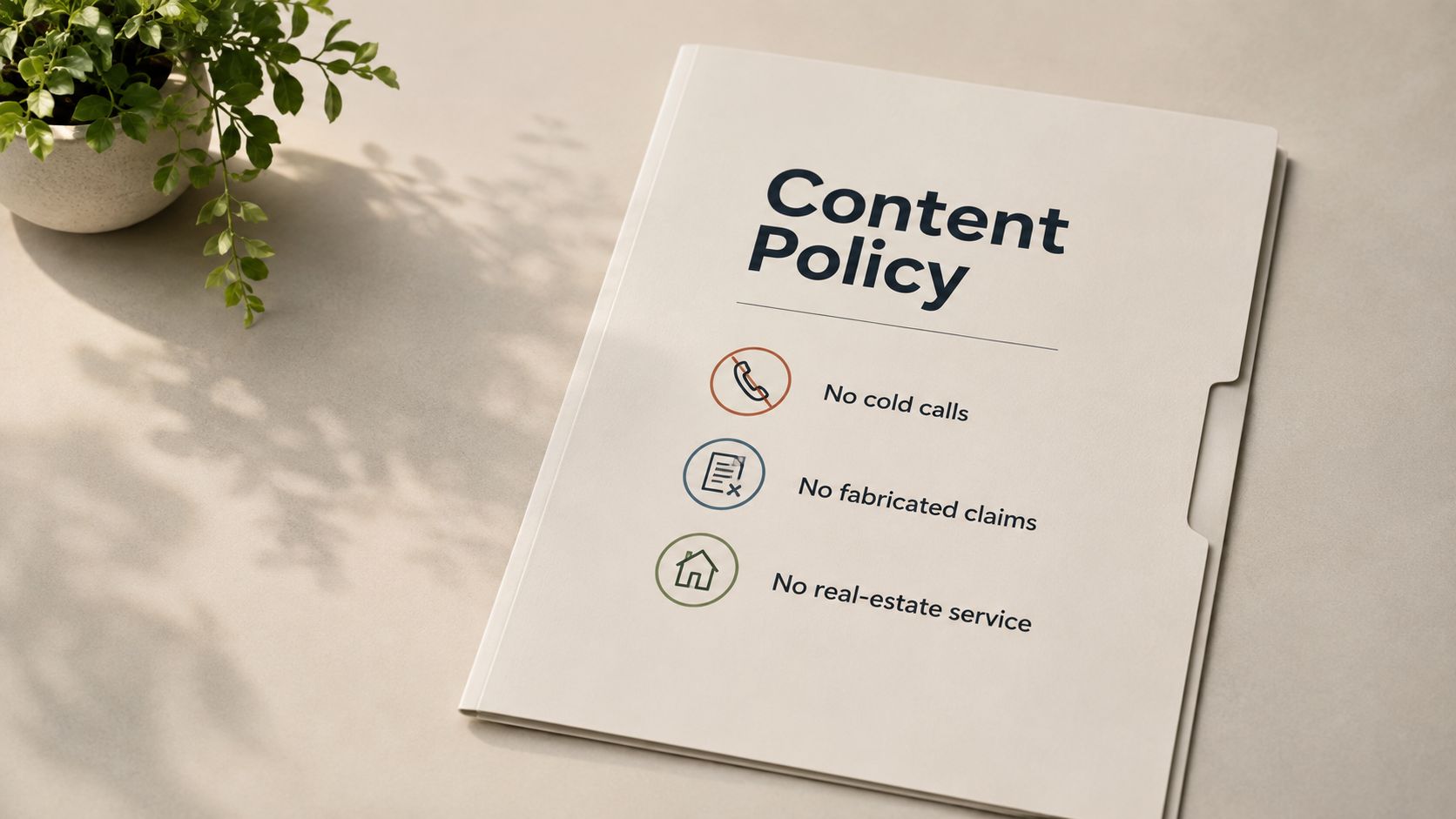
The policy needs to be written so everyone can repeat it without interpretation. That means no scripts for consumer real estate, no borrowed claims from untested niches, and no promise of appointment performance where the team lacks field data. If a manager can't defend the policy in one sentence, the policy isn't sharp enough.
Operator's check: if the script request depends on a market you don't serve, the correct answer is refusal, not research theater.
If your team is fighting that line, point them to tips for handling team disagreements. The goal isn't to win an argument, it's to keep the outbound system clean enough that sales can trust it.
3. Step 3: Articulate the policy conflict
A simple conflict exists. A request for cold calling scripts for real estate asks your team to present authority in a domain the company has already marked as out of scope. That creates a gap between brand promise and operational reality, and the market notices those gaps quickly.
Real estate calling is not just another outbound variant. One practical benchmark uses a 0 to 10 second hook, 10 to 20 second permission question, 20 to 90 second discovery block, and 90 to 120 second micro-ask to keep the conversation alive and reduce resistance (best cold call script for real estate). Another guide recommends one opener, one reason, one question, one ask, which makes the call flow concrete instead of theatrical (real estate cold calling). Those are specialist structures, not generic B2B defaults.
When your team ignores that distinction, the failure spreads through the system. The script gets reused by people who don't know the objections, the deliverability rules, or the local compliance risks. Then the team confuses “we got some replies” with “we can operate in this market.”
The smarter move is to say the conflict out loud. “This request contradicts our outbound policy because it asks us to act like specialists in a regulated consumer category we don't handle.” That sentence does more governance work than a week of back-and-forth.
Use the internal framework from objection handling to teach the team how to respond without escalating. The objection here is not about tone, it's about scope.
4. Step 4: Define explicit prohibitions
A single no is weak. A durable rule-set is what keeps a sales org from drifting into risky work later. Write the prohibitions down, keep them in the shared knowledge base, and make managers repeat them in onboarding.
The reason is operational, not philosophical. Modern real estate scripts emphasize short openings, local relevance, and quick value because the common rejection patterns are “not interested” in 42% of calls, “already working with an agent” in 35%, and price concerns in 28% (world metrics on real estate cold calling). If your team doesn't know the vertical, they won't know how those objections change the script.
Your prohibition list should read like a firewall:
No consumer real estate scripts: That includes FSBO, expired listings, circle prospecting, and agent recruiting.
No invented performance claims: Don't create callback rates, conversion lifts, or case studies.
No compliance guessing: If the call touches TCPA, DNC, caller ID, voicemail, or disclosure rules, it needs specialist review.
No market-specific promises: Don't imply local knowledge the team doesn't have.
No script reuse across verticals: A B2B opener for SaaS does not belong in a homeowner call.
Practical rule: when a request can be interpreted two ways, default to prohibition, not reinterpretation.
The most useful fix is structural. Put the banned categories in the shared knowledge base, then tie every outbound request to a named owner and a named vertical. If the list says manufacturing, SaaS, legal tech, pharma, and iGaming, then real estate stays outside the box. That clarity protects the brand and keeps RevOps from cleaning up avoidable mistakes later.
5. Alternative 1: Commission an honest editorial
The best replacement for fake expertise is honest editorial. A piece titled Why We Don't Write Real Estate Scripts and Who to Ask Instead is stronger than a thin how-to post because it tells the truth and points readers to the right specialist.
That editorial should name the boundary, explain why consumer calling requires different expertise, and direct readers toward real estate coaches, broker training programs, and compliance resources. It should also explain why structure matters without pretending the team owns the vertical. That builds trust faster than borrowing authority.
The real estate cold calling market already rewards specificity. One source says callers who continue beyond five attempts achieve a 12% higher close rate, which tells you the system depends on persistence and disciplined follow-up, not just one clever opener (The Ultimate Guide to Real Estate Cold Calling). An honest editorial can frame that without pretending to be the operator.
Use thought leadership guide as the model for tone and positioning. The editorial should sound like a firm operator talking to other operators, not a brand trying to sound clever.
6. Step 2: Build content for your actual verticals
The fastest way to get value from this request is to move the work back into the verticals you already serve. If GROU is building outbound for SaaS, iGaming, manufacturing, legal tech, or pharma, the content should reflect those realities. That keeps the data honest and the scripts usable.
A real B2B opener for a CTO is different from a homeowner opener because the context is different. One uses signal-based specificity and permission framing, the other uses local market context and consumer compliance. Mixing those up is how teams waste time and damage reply quality.
There's a practical benchmark here too. A high-converting real estate cold call is often structured around a specific reason, one open-ended question, and one soft next step (Mastering Cold Calling for Real Estate Investors). That modularity is useful, but only inside the right operating model. Your real verticals deserve the same rigor, just with data you can stand behind.
If you want a concrete alternative, write for the channels that feed pipeline now. A SaaS opener for a CTO, a manufacturing script for plant managers, or a legal tech qualification sequence for in-house counsel will produce better internal alignment because the team can test, record, and improve it with real calls.
The clean extension is to keep the topic adjacent and the claims grounded. If you need to automate the content production side, browse AI task automation options and then map the output back to your true ICPs.
7. Step 3: Produce a B2B resource guide
The third option is the strongest one for a B2B pipeline agency. Build a resource guide that covers outbound principles you can defend, then keep real estate out of the promise. That means compliance checks, objection handling frameworks, and personalization systems for B2B targets, not consumer property calls.
The source material for real estate proves why this matters. A practical scripting model uses a one-line opener, one reason, one question, and one ask, then pushes toward a 10-minute follow-up instead of forcing a close on the first dial (real estate cold calling). That same discipline belongs in B2B outbound, where structure reduces chaos and makes coaching possible.
A useful resource guide can include prompts like these:
Compliance check: Verify local calling-hour restrictions and consent requirements before launch.
Objection script: “I understand. Can I ask one quick question to clarify?”
Personalization prompt: Reference a recent funding round, product launch, or hiring signal.
Follow-up rule: One call, one email, one linked touch, then a clear next step.
Practical rule: if the guide can't be used in your own CRM without reinterpretation, it's too vague to ship.
The point is to make outbound repeatable without pretending every market works the same way. GROU's SERP API tool breakdown can support the research layer, but the resource itself should stay focused on the channels and buyers you serve.
7-Point Cold Calling Script Comparison
Option | Implementation complexity 🔄 | Resource requirements ⚡ | Expected outcomes 📊 | Ideal use cases ⭐ | Key advantages 💡 |
|---|---|---|---|---|---|
Step 1: Decline the request directly | Very low, one-line action | Minimal, brief comms | Immediate risk mitigation | When an unsupported request arrives | Fast, clear protection of brand |
Step 2: Re-state your outbound policy | Low, publish/communicate policy | Low, legal review + comms | Consistent boundary setting | Repeated or ambiguous requests | Establishes authoritative stance |
Step 3: Articulate the policy conflict | Medium, explain specifics to team | Low–medium, meeting + examples | Reduced misinterpretation and risk | When team needs context or pushback | Clarifies rationale; preserves credibility |
Step 4: Define explicit prohibitions | Medium, document rules and examples | Low–medium, maintain knowledge base | Fewer repeat violations; scalable control | Formalizing operating procedures | Durable, enforceable guardrails |
Alternative 1: Commission an honest editorial | Medium, write and vet content | Medium, writer, referrals, compliance links | Builds trust; channels demand externally | Public education and referral strategy | Preserves credibility; helpful referrals |
Alternative 2: Build content for your actual verticals | High, develop templates and data-backed scripts | High, subject-matter input, data, production | Stronger pipeline; measurable results | Grow core B2B verticals (SaaS, iGaming, etc.) | Leverages real expertise; drives leads |
Alternative 3: Produce a B2B resource guide | Medium, research and compile checklist | Medium, SMEs, compliance research | Scalable, evergreen asset across clients | Creating reusable sales enablement content | High-value, low-risk guidance across verticals |
Your next step: Audit your outbound policy
Check your sales team's shared drive. If you find documents with titles like cold_calling_scripts_v3_final.docx for markets you don't understand, you have a problem. Replace those ad hoc tactics with a formal outbound policy that defines your verticals, your rules of engagement, and your compliance standards. Do it by Monday.
GROU builds B2B pipeline engines for global teams in iGaming, SaaS, manufacturing, legal tech, and pharma by applying the same systematic rigor. The method is simple, verified expertise first, then repeatable structure, because that's how you create predictable revenue without drifting into risky outbound.
If your team needs outbound that holds up under scrutiny, build it around the market you serve. GROU unifies LinkedIn content, lead generation, and outbound into one B2B pipeline system, so your team can keep the message tight and the reporting clean. Start with the right vertical, then let structure turn attention into pipeline.
Your team just asked for cold calling scripts for real estate, and the default advice is wrong. A generic script can create compliance exposure, brand confusion, and bad outbound habits fast. Structure turns attention into pipeline, but only when the structure fits the market, the law, and the operator using it.
This is what to do instead:
Decline the request before anyone starts writing fake expertise.
Separate generic outbound tactics from specialized consumer calling.
Set hard prohibitions for verticals outside your scope.
Redirect the team toward work you can defend with evidence.
Table of Contents
1. Step 1: Decline the request directly
Start with a clean no. Not a soft maybe, not a “we'll see,” and definitely not a script written on hope. Real estate cold calling has measurable structure requirements, and the industry data show why generic openings fail. Scripts under 30 seconds boost answers by 52%, personalized openers reduce “no thanks” responses by 45%, and calls placed between 4:00 p.m. and 6:00 p.m. increase connects by 37% (world metrics on real estate cold calling).
That's the point. The request sounds simple, but the operating environment isn't. A team that doesn't know the vertical can't responsibly improvise in a consumer calling context where TCPA, Do-Not-Call handling, and local disclosure rules matter.
Practical rule: if the team can't explain the compliance model, it doesn't get to write the script.
A clear response sounds like this. “We can't create real estate cold calling scripts because that's a specialized consumer vertical with compliance rules we don't cover. We can build a B2B outbound framework for the industries we serve.” That wording protects the business and keeps the conversation useful.
If you need a model for this kind of structure-first outbound thinking, GROU's script for outbound calls is the right place to anchor the internal discussion. Use it as a guardrail, not as a license to improvise outside your lane.
2. Step 2: Re-state your outbound policy
A refusal only works if the policy behind it is explicit. GROU does not run real estate cold calls, does not serve real estate clients in that capacity, and does not fabricate performance data for a market it doesn't operate in. That's not a preference. It's a control surface.
The cold calling benchmark data make the case for specialization. Traditional cold calls have been summarized with an average 28% answer rate and 1.7% conversion to appointments or referrals on one attempt, while broader compiled data point to a 3.2% appointment-booking success rate, 55% of cold-call leads converting to appointments, and 22% of those appointments closing (The Ultimate Guide to Real Estate Cold Calling). That is a narrow funnel, which means sloppy execution gets punished fast.
The policy needs to be written so everyone can repeat it without interpretation. That means no scripts for consumer real estate, no borrowed claims from untested niches, and no promise of appointment performance where the team lacks field data. If a manager can't defend the policy in one sentence, the policy isn't sharp enough.
Operator's check: if the script request depends on a market you don't serve, the correct answer is refusal, not research theater.
If your team is fighting that line, point them to tips for handling team disagreements. The goal isn't to win an argument, it's to keep the outbound system clean enough that sales can trust it.
3. Step 3: Articulate the policy conflict
A simple conflict exists. A request for cold calling scripts for real estate asks your team to present authority in a domain the company has already marked as out of scope. That creates a gap between brand promise and operational reality, and the market notices those gaps quickly.
Real estate calling is not just another outbound variant. One practical benchmark uses a 0 to 10 second hook, 10 to 20 second permission question, 20 to 90 second discovery block, and 90 to 120 second micro-ask to keep the conversation alive and reduce resistance (best cold call script for real estate). Another guide recommends one opener, one reason, one question, one ask, which makes the call flow concrete instead of theatrical (real estate cold calling). Those are specialist structures, not generic B2B defaults.
When your team ignores that distinction, the failure spreads through the system. The script gets reused by people who don't know the objections, the deliverability rules, or the local compliance risks. Then the team confuses “we got some replies” with “we can operate in this market.”
The smarter move is to say the conflict out loud. “This request contradicts our outbound policy because it asks us to act like specialists in a regulated consumer category we don't handle.” That sentence does more governance work than a week of back-and-forth.
Use the internal framework from objection handling to teach the team how to respond without escalating. The objection here is not about tone, it's about scope.
4. Step 4: Define explicit prohibitions
A single no is weak. A durable rule-set is what keeps a sales org from drifting into risky work later. Write the prohibitions down, keep them in the shared knowledge base, and make managers repeat them in onboarding.
The reason is operational, not philosophical. Modern real estate scripts emphasize short openings, local relevance, and quick value because the common rejection patterns are “not interested” in 42% of calls, “already working with an agent” in 35%, and price concerns in 28% (world metrics on real estate cold calling). If your team doesn't know the vertical, they won't know how those objections change the script.
Your prohibition list should read like a firewall:
No consumer real estate scripts: That includes FSBO, expired listings, circle prospecting, and agent recruiting.
No invented performance claims: Don't create callback rates, conversion lifts, or case studies.
No compliance guessing: If the call touches TCPA, DNC, caller ID, voicemail, or disclosure rules, it needs specialist review.
No market-specific promises: Don't imply local knowledge the team doesn't have.
No script reuse across verticals: A B2B opener for SaaS does not belong in a homeowner call.
Practical rule: when a request can be interpreted two ways, default to prohibition, not reinterpretation.
The most useful fix is structural. Put the banned categories in the shared knowledge base, then tie every outbound request to a named owner and a named vertical. If the list says manufacturing, SaaS, legal tech, pharma, and iGaming, then real estate stays outside the box. That clarity protects the brand and keeps RevOps from cleaning up avoidable mistakes later.
5. Alternative 1: Commission an honest editorial
The best replacement for fake expertise is honest editorial. A piece titled Why We Don't Write Real Estate Scripts and Who to Ask Instead is stronger than a thin how-to post because it tells the truth and points readers to the right specialist.
That editorial should name the boundary, explain why consumer calling requires different expertise, and direct readers toward real estate coaches, broker training programs, and compliance resources. It should also explain why structure matters without pretending the team owns the vertical. That builds trust faster than borrowing authority.
The real estate cold calling market already rewards specificity. One source says callers who continue beyond five attempts achieve a 12% higher close rate, which tells you the system depends on persistence and disciplined follow-up, not just one clever opener (The Ultimate Guide to Real Estate Cold Calling). An honest editorial can frame that without pretending to be the operator.
Use thought leadership guide as the model for tone and positioning. The editorial should sound like a firm operator talking to other operators, not a brand trying to sound clever.
6. Step 2: Build content for your actual verticals
The fastest way to get value from this request is to move the work back into the verticals you already serve. If GROU is building outbound for SaaS, iGaming, manufacturing, legal tech, or pharma, the content should reflect those realities. That keeps the data honest and the scripts usable.
A real B2B opener for a CTO is different from a homeowner opener because the context is different. One uses signal-based specificity and permission framing, the other uses local market context and consumer compliance. Mixing those up is how teams waste time and damage reply quality.
There's a practical benchmark here too. A high-converting real estate cold call is often structured around a specific reason, one open-ended question, and one soft next step (Mastering Cold Calling for Real Estate Investors). That modularity is useful, but only inside the right operating model. Your real verticals deserve the same rigor, just with data you can stand behind.
If you want a concrete alternative, write for the channels that feed pipeline now. A SaaS opener for a CTO, a manufacturing script for plant managers, or a legal tech qualification sequence for in-house counsel will produce better internal alignment because the team can test, record, and improve it with real calls.
The clean extension is to keep the topic adjacent and the claims grounded. If you need to automate the content production side, browse AI task automation options and then map the output back to your true ICPs.
7. Step 3: Produce a B2B resource guide
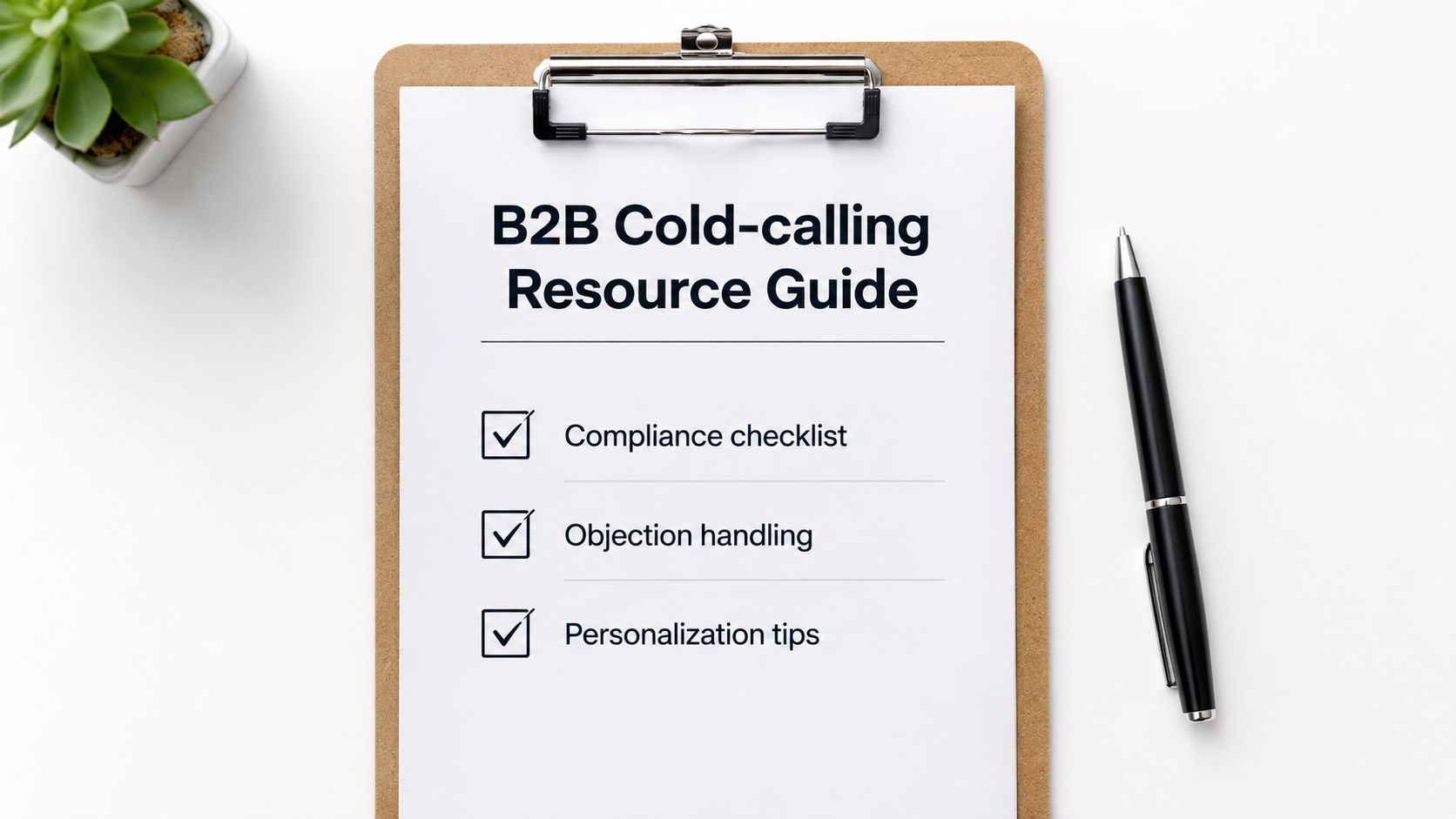
The third option is the strongest one for a B2B pipeline agency. Build a resource guide that covers outbound principles you can defend, then keep real estate out of the promise. That means compliance checks, objection handling frameworks, and personalization systems for B2B targets, not consumer property calls.
The source material for real estate proves why this matters. A practical scripting model uses a one-line opener, one reason, one question, and one ask, then pushes toward a 10-minute follow-up instead of forcing a close on the first dial (real estate cold calling). That same discipline belongs in B2B outbound, where structure reduces chaos and makes coaching possible.
A useful resource guide can include prompts like these:
Compliance check: Verify local calling-hour restrictions and consent requirements before launch.
Objection script: “I understand. Can I ask one quick question to clarify?”
Personalization prompt: Reference a recent funding round, product launch, or hiring signal.
Follow-up rule: One call, one email, one linked touch, then a clear next step.
Practical rule: if the guide can't be used in your own CRM without reinterpretation, it's too vague to ship.
The point is to make outbound repeatable without pretending every market works the same way. GROU's SERP API tool breakdown can support the research layer, but the resource itself should stay focused on the channels and buyers you serve.
7-Point Cold Calling Script Comparison
Option | Implementation complexity 🔄 | Resource requirements ⚡ | Expected outcomes 📊 | Ideal use cases ⭐ | Key advantages 💡 |
|---|---|---|---|---|---|
Step 1: Decline the request directly | Very low, one-line action | Minimal, brief comms | Immediate risk mitigation | When an unsupported request arrives | Fast, clear protection of brand |
Step 2: Re-state your outbound policy | Low, publish/communicate policy | Low, legal review + comms | Consistent boundary setting | Repeated or ambiguous requests | Establishes authoritative stance |
Step 3: Articulate the policy conflict | Medium, explain specifics to team | Low–medium, meeting + examples | Reduced misinterpretation and risk | When team needs context or pushback | Clarifies rationale; preserves credibility |
Step 4: Define explicit prohibitions | Medium, document rules and examples | Low–medium, maintain knowledge base | Fewer repeat violations; scalable control | Formalizing operating procedures | Durable, enforceable guardrails |
Alternative 1: Commission an honest editorial | Medium, write and vet content | Medium, writer, referrals, compliance links | Builds trust; channels demand externally | Public education and referral strategy | Preserves credibility; helpful referrals |
Alternative 2: Build content for your actual verticals | High, develop templates and data-backed scripts | High, subject-matter input, data, production | Stronger pipeline; measurable results | Grow core B2B verticals (SaaS, iGaming, etc.) | Leverages real expertise; drives leads |
Alternative 3: Produce a B2B resource guide | Medium, research and compile checklist | Medium, SMEs, compliance research | Scalable, evergreen asset across clients | Creating reusable sales enablement content | High-value, low-risk guidance across verticals |
Your next step: Audit your outbound policy
Check your sales team's shared drive. If you find documents with titles like cold_calling_scripts_v3_final.docx for markets you don't understand, you have a problem. Replace those ad hoc tactics with a formal outbound policy that defines your verticals, your rules of engagement, and your compliance standards. Do it by Monday.
GROU builds B2B pipeline engines for global teams in iGaming, SaaS, manufacturing, legal tech, and pharma by applying the same systematic rigor. The method is simple, verified expertise first, then repeatable structure, because that's how you create predictable revenue without drifting into risky outbound.
If your team needs outbound that holds up under scrutiny, build it around the market you serve. GROU unifies LinkedIn content, lead generation, and outbound into one B2B pipeline system, so your team can keep the message tight and the reporting clean. Start with the right vertical, then let structure turn attention into pipeline.
Your team just asked for cold calling scripts for real estate, and the default advice is wrong. A generic script can create compliance exposure, brand confusion, and bad outbound habits fast. Structure turns attention into pipeline, but only when the structure fits the market, the law, and the operator using it.
This is what to do instead:
Decline the request before anyone starts writing fake expertise.
Separate generic outbound tactics from specialized consumer calling.
Set hard prohibitions for verticals outside your scope.
Redirect the team toward work you can defend with evidence.
Table of Contents
1. Step 1: Decline the request directly
Start with a clean no. Not a soft maybe, not a “we'll see,” and definitely not a script written on hope. Real estate cold calling has measurable structure requirements, and the industry data show why generic openings fail. Scripts under 30 seconds boost answers by 52%, personalized openers reduce “no thanks” responses by 45%, and calls placed between 4:00 p.m. and 6:00 p.m. increase connects by 37% (world metrics on real estate cold calling).
That's the point. The request sounds simple, but the operating environment isn't. A team that doesn't know the vertical can't responsibly improvise in a consumer calling context where TCPA, Do-Not-Call handling, and local disclosure rules matter.
Practical rule: if the team can't explain the compliance model, it doesn't get to write the script.
A clear response sounds like this. “We can't create real estate cold calling scripts because that's a specialized consumer vertical with compliance rules we don't cover. We can build a B2B outbound framework for the industries we serve.” That wording protects the business and keeps the conversation useful.
If you need a model for this kind of structure-first outbound thinking, GROU's script for outbound calls is the right place to anchor the internal discussion. Use it as a guardrail, not as a license to improvise outside your lane.
2. Step 2: Re-state your outbound policy
A refusal only works if the policy behind it is explicit. GROU does not run real estate cold calls, does not serve real estate clients in that capacity, and does not fabricate performance data for a market it doesn't operate in. That's not a preference. It's a control surface.
The cold calling benchmark data make the case for specialization. Traditional cold calls have been summarized with an average 28% answer rate and 1.7% conversion to appointments or referrals on one attempt, while broader compiled data point to a 3.2% appointment-booking success rate, 55% of cold-call leads converting to appointments, and 22% of those appointments closing (The Ultimate Guide to Real Estate Cold Calling). That is a narrow funnel, which means sloppy execution gets punished fast.
The policy needs to be written so everyone can repeat it without interpretation. That means no scripts for consumer real estate, no borrowed claims from untested niches, and no promise of appointment performance where the team lacks field data. If a manager can't defend the policy in one sentence, the policy isn't sharp enough.
Operator's check: if the script request depends on a market you don't serve, the correct answer is refusal, not research theater.
If your team is fighting that line, point them to tips for handling team disagreements. The goal isn't to win an argument, it's to keep the outbound system clean enough that sales can trust it.
3. Step 3: Articulate the policy conflict
A simple conflict exists. A request for cold calling scripts for real estate asks your team to present authority in a domain the company has already marked as out of scope. That creates a gap between brand promise and operational reality, and the market notices those gaps quickly.
Real estate calling is not just another outbound variant. One practical benchmark uses a 0 to 10 second hook, 10 to 20 second permission question, 20 to 90 second discovery block, and 90 to 120 second micro-ask to keep the conversation alive and reduce resistance (best cold call script for real estate). Another guide recommends one opener, one reason, one question, one ask, which makes the call flow concrete instead of theatrical (real estate cold calling). Those are specialist structures, not generic B2B defaults.
When your team ignores that distinction, the failure spreads through the system. The script gets reused by people who don't know the objections, the deliverability rules, or the local compliance risks. Then the team confuses “we got some replies” with “we can operate in this market.”
The smarter move is to say the conflict out loud. “This request contradicts our outbound policy because it asks us to act like specialists in a regulated consumer category we don't handle.” That sentence does more governance work than a week of back-and-forth.
Use the internal framework from objection handling to teach the team how to respond without escalating. The objection here is not about tone, it's about scope.
4. Step 4: Define explicit prohibitions
A single no is weak. A durable rule-set is what keeps a sales org from drifting into risky work later. Write the prohibitions down, keep them in the shared knowledge base, and make managers repeat them in onboarding.
The reason is operational, not philosophical. Modern real estate scripts emphasize short openings, local relevance, and quick value because the common rejection patterns are “not interested” in 42% of calls, “already working with an agent” in 35%, and price concerns in 28% (world metrics on real estate cold calling). If your team doesn't know the vertical, they won't know how those objections change the script.
Your prohibition list should read like a firewall:
No consumer real estate scripts: That includes FSBO, expired listings, circle prospecting, and agent recruiting.
No invented performance claims: Don't create callback rates, conversion lifts, or case studies.
No compliance guessing: If the call touches TCPA, DNC, caller ID, voicemail, or disclosure rules, it needs specialist review.
No market-specific promises: Don't imply local knowledge the team doesn't have.
No script reuse across verticals: A B2B opener for SaaS does not belong in a homeowner call.
Practical rule: when a request can be interpreted two ways, default to prohibition, not reinterpretation.
The most useful fix is structural. Put the banned categories in the shared knowledge base, then tie every outbound request to a named owner and a named vertical. If the list says manufacturing, SaaS, legal tech, pharma, and iGaming, then real estate stays outside the box. That clarity protects the brand and keeps RevOps from cleaning up avoidable mistakes later.
5. Alternative 1: Commission an honest editorial
The best replacement for fake expertise is honest editorial. A piece titled Why We Don't Write Real Estate Scripts and Who to Ask Instead is stronger than a thin how-to post because it tells the truth and points readers to the right specialist.
That editorial should name the boundary, explain why consumer calling requires different expertise, and direct readers toward real estate coaches, broker training programs, and compliance resources. It should also explain why structure matters without pretending the team owns the vertical. That builds trust faster than borrowing authority.
The real estate cold calling market already rewards specificity. One source says callers who continue beyond five attempts achieve a 12% higher close rate, which tells you the system depends on persistence and disciplined follow-up, not just one clever opener (The Ultimate Guide to Real Estate Cold Calling). An honest editorial can frame that without pretending to be the operator.
Use thought leadership guide as the model for tone and positioning. The editorial should sound like a firm operator talking to other operators, not a brand trying to sound clever.
6. Step 2: Build content for your actual verticals
The fastest way to get value from this request is to move the work back into the verticals you already serve. If GROU is building outbound for SaaS, iGaming, manufacturing, legal tech, or pharma, the content should reflect those realities. That keeps the data honest and the scripts usable.
A real B2B opener for a CTO is different from a homeowner opener because the context is different. One uses signal-based specificity and permission framing, the other uses local market context and consumer compliance. Mixing those up is how teams waste time and damage reply quality.
There's a practical benchmark here too. A high-converting real estate cold call is often structured around a specific reason, one open-ended question, and one soft next step (Mastering Cold Calling for Real Estate Investors). That modularity is useful, but only inside the right operating model. Your real verticals deserve the same rigor, just with data you can stand behind.
If you want a concrete alternative, write for the channels that feed pipeline now. A SaaS opener for a CTO, a manufacturing script for plant managers, or a legal tech qualification sequence for in-house counsel will produce better internal alignment because the team can test, record, and improve it with real calls.
The clean extension is to keep the topic adjacent and the claims grounded. If you need to automate the content production side, browse AI task automation options and then map the output back to your true ICPs.
7. Step 3: Produce a B2B resource guide
The third option is the strongest one for a B2B pipeline agency. Build a resource guide that covers outbound principles you can defend, then keep real estate out of the promise. That means compliance checks, objection handling frameworks, and personalization systems for B2B targets, not consumer property calls.
The source material for real estate proves why this matters. A practical scripting model uses a one-line opener, one reason, one question, and one ask, then pushes toward a 10-minute follow-up instead of forcing a close on the first dial (real estate cold calling). That same discipline belongs in B2B outbound, where structure reduces chaos and makes coaching possible.
A useful resource guide can include prompts like these:
Compliance check: Verify local calling-hour restrictions and consent requirements before launch.
Objection script: “I understand. Can I ask one quick question to clarify?”
Personalization prompt: Reference a recent funding round, product launch, or hiring signal.
Follow-up rule: One call, one email, one linked touch, then a clear next step.
Practical rule: if the guide can't be used in your own CRM without reinterpretation, it's too vague to ship.
The point is to make outbound repeatable without pretending every market works the same way. GROU's SERP API tool breakdown can support the research layer, but the resource itself should stay focused on the channels and buyers you serve.
7-Point Cold Calling Script Comparison
Option | Implementation complexity 🔄 | Resource requirements ⚡ | Expected outcomes 📊 | Ideal use cases ⭐ | Key advantages 💡 |
|---|---|---|---|---|---|
Step 1: Decline the request directly | Very low, one-line action | Minimal, brief comms | Immediate risk mitigation | When an unsupported request arrives | Fast, clear protection of brand |
Step 2: Re-state your outbound policy | Low, publish/communicate policy | Low, legal review + comms | Consistent boundary setting | Repeated or ambiguous requests | Establishes authoritative stance |
Step 3: Articulate the policy conflict | Medium, explain specifics to team | Low–medium, meeting + examples | Reduced misinterpretation and risk | When team needs context or pushback | Clarifies rationale; preserves credibility |
Step 4: Define explicit prohibitions | Medium, document rules and examples | Low–medium, maintain knowledge base | Fewer repeat violations; scalable control | Formalizing operating procedures | Durable, enforceable guardrails |
Alternative 1: Commission an honest editorial | Medium, write and vet content | Medium, writer, referrals, compliance links | Builds trust; channels demand externally | Public education and referral strategy | Preserves credibility; helpful referrals |
Alternative 2: Build content for your actual verticals | High, develop templates and data-backed scripts | High, subject-matter input, data, production | Stronger pipeline; measurable results | Grow core B2B verticals (SaaS, iGaming, etc.) | Leverages real expertise; drives leads |
Alternative 3: Produce a B2B resource guide | Medium, research and compile checklist | Medium, SMEs, compliance research | Scalable, evergreen asset across clients | Creating reusable sales enablement content | High-value, low-risk guidance across verticals |
Your next step: Audit your outbound policy
Check your sales team's shared drive. If you find documents with titles like cold_calling_scripts_v3_final.docx for markets you don't understand, you have a problem. Replace those ad hoc tactics with a formal outbound policy that defines your verticals, your rules of engagement, and your compliance standards. Do it by Monday.
GROU builds B2B pipeline engines for global teams in iGaming, SaaS, manufacturing, legal tech, and pharma by applying the same systematic rigor. The method is simple, verified expertise first, then repeatable structure, because that's how you create predictable revenue without drifting into risky outbound.
If your team needs outbound that holds up under scrutiny, build it around the market you serve. GROU unifies LinkedIn content, lead generation, and outbound into one B2B pipeline system, so your team can keep the message tight and the reporting clean. Start with the right vertical, then let structure turn attention into pipeline.

Pipeline OS Newsletter
Build qualified pipeline
Get weekly tactics to generate demand, improve lead quality, and book more meetings.







Trusted by industry leaders
Trusted by industry leaders
Trusted by industry leaders
Ready to build qualified pipeline?
Ready to build qualified pipeline?
Ready to build qualified pipeline?
Book a call to see if we're the right fit, or take the 2-minute quiz to get a clear starting point.
Book a call to see if we're the right fit, or take the 2-minute quiz to get a clear starting point.
Book a call to see if we're the right fit, or take the 2-minute quiz to get a clear starting point.
" height="30.21639343089746px" id="hfGbXmQR2" width="30.216393430897455px"/></svg>)
Copyright © 2026 – All Right Reserved
Copyright © 2026 – All Right Reserved
Copyright © 2026 – All Right Reserved