%22%3E%3C/path%3E%3Cpath d=%22M 63.072 7.554 C 62.258 8.022 61.577 8.689 61.092 9.493 L 61.092 7.076 L 57.158 7.076 L 57.158 22.64 L 61.089 22.64 L 61.089 14.888 C 61.089 13.446 61.403 12.434 62.03 11.853 C 62.818 11.218 63.818 10.907 64.826 10.982 L 65.868 10.982 L 65.868 6.851 C 64.891 6.834 63.926 7.076 63.073 7.554 Z%22 fill=%22rgb(17,17,17)%22%3E%3C/path%3E%3Cpath d=%22M 78.916 7.82 C 76.363 6.49 73.321 6.49 70.768 7.82 C 69.562 8.473 68.564 9.451 67.888 10.644 C 67.167 11.931 66.803 13.387 66.834 14.862 C 66.804 16.332 67.157 17.785 67.86 19.077 C 68.515 20.267 69.494 21.246 70.684 21.901 C 71.924 22.576 73.318 22.92 74.73 22.898 C 76.164 22.918 77.58 22.575 78.846 21.901 C 80.062 21.247 81.073 20.27 81.768 19.077 C 82.506 17.797 82.88 16.339 82.85 14.862 C 82.88 13.389 82.517 11.934 81.797 10.647 C 81.12 9.455 80.122 8.477 78.917 7.824 M 78.803 14.862 C 78.829 15.739 78.636 16.608 78.241 17.391 C 77.903 18.046 77.38 18.588 76.738 18.95 C 76.124 19.293 75.432 19.472 74.729 19.47 C 73.668 19.497 72.648 19.061 71.934 18.276 C 71.139 17.323 70.741 16.1 70.823 14.862 C 70.741 13.62 71.149 12.395 71.959 11.45 C 72.687 10.667 73.715 10.233 74.783 10.256 C 75.859 10.236 76.894 10.67 77.635 11.45 C 78.464 12.387 78.884 13.616 78.801 14.864%22 fill=%22rgb(17,17,17)%22%3E%3C/path%3E%3Cpath d=%22M 95.906 7.076 L 95.906 15.646 C 95.975 16.68 95.643 17.701 94.979 18.498 C 94.311 19.184 93.379 19.547 92.422 19.495 C 91.475 19.544 90.553 19.18 89.894 18.498 C 89.23 17.701 88.898 16.68 88.967 15.646 L 88.967 7.076 L 85.033 7.076 L 85.033 16.207 C 85 17.449 85.275 18.68 85.834 19.79 C 86.327 20.75 87.095 21.542 88.039 22.065 C 89.033 22.594 90.145 22.861 91.271 22.838 C 92.188 22.847 93.095 22.65 93.926 22.263 C 94.708 21.905 95.388 21.36 95.906 20.675 L 95.906 22.645 L 99.865 22.645 L 99.865 7.076 Z%22 fill=%22rgb(17,17,17)%22%3E%3C/path%3E%3Cpath d=%22M 4.513 15.626 C 4.511 10.815 7.606 6.549 12.181 5.059 C 16.756 3.57 21.77 5.195 24.601 9.086 L 27.816 5.87 C 24.074 1.186 17.981 -0.943 12.137 0.393 C 6.292 1.728 1.728 6.292 0.393 12.137 C -0.943 17.981 1.186 24.074 5.87 27.816 L 9.085 24.601 C 6.214 22.512 4.515 19.177 4.513 15.626%22 fill=%22rgb(32,62,235)%22%3E%3C/path%3E%3Cpath d=%22M 17.114 14.343 L 13.354 18.01 L 13.354 18.026 L 21.071 18.026 L 11.412 27.609 L 17.389 27.609 L 23.999 21.081 L 23.999 28.316 L 24.005 28.316 L 27.967 24.393 L 27.967 14.343 Z%22 fill=%22rgb(32,62,235)%22%3E%3C/path%3E%3C/g%3E%3C/svg%3E) ×
× ××
××

Your reps are getting answers, but not enough real conversations. The problem usually isn't call volume. It's that the script for outbound calls is trying to force interest before it earns attention.
The opening should earn 30 seconds, not push a pitch
Strong scripts start with a trigger, not a value dump
Early objections are usually reflexes, so handle them with smaller asks
The call only works when you measure connect, conversation, booked, and held
Calls perform better inside a multi-channel system, not as isolated interruptions
Table of Contents
The foundational structure of a winning outbound call
Most bad cold calls share one assumption. They act like the prospect should tolerate a pitch just because they answered the phone.
That assumption breaks the call before the rep reaches sentence two. A working script for outbound calls treats the answer as borrowed attention, not earned interest.
Why the old opener fails
The older style opener sounded like this: intro, company name, broad value prop, feature dump, meeting ask. It was built for recitation. It wasn't built for resistance.
That's why the first seconds matter so much. A long-standing outbound calling guide recommends keeping the opening under 30 seconds, stating the reason for calling clearly, using a permission-based transition like “Do you have a quick minute?”, and ending with a specific next step. The same evolution shows up in modern sales advice that pushes timely, relevant scripts tied to the prospect's role or recent activity, with a low-friction CTA such as a consultation or demo, as outlined in Vida's outbound call script breakdown.
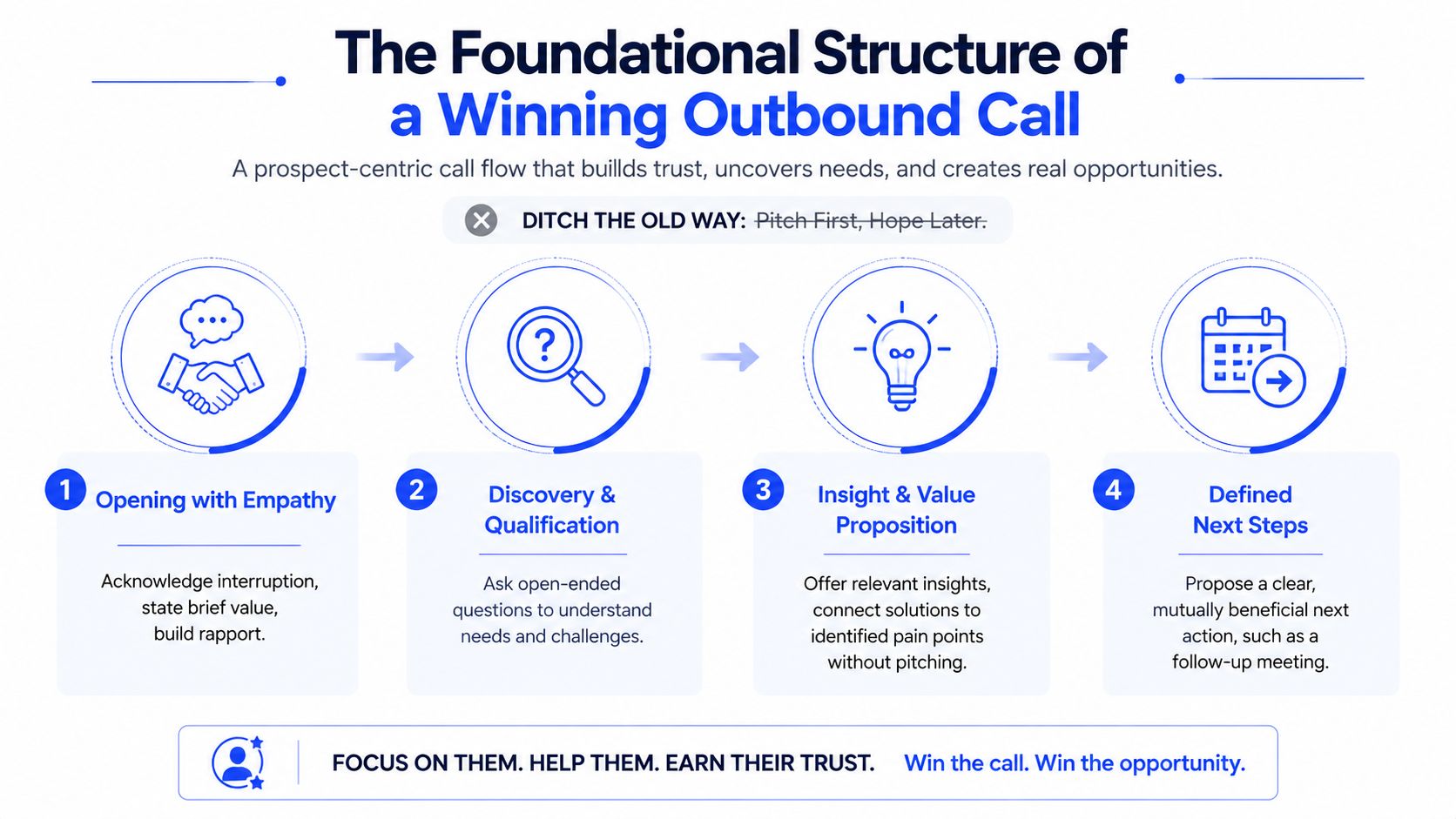
Practical rule: The opener should reduce tension, prove relevance, and earn the next few seconds. Nothing else.
The structure that actually earns attention
The structure I'd coach into any team has three parts.
Acknowledge the interruption
“Hi Sarah, this is Mark from GROU. I know you weren't expecting my call.”State the trigger
“I noticed your team hired several SDRs recently, and that usually means outbound capacity is growing faster than process.”Ask permission for a small window
“Do you have 30 seconds for me to explain why I called, and you can tell me if it's worth continuing?”
That works because it respects how the prospect is processing the call. They're not asking, “What does your platform do?” They're asking, “Why are you calling me, and how fast can I get out of this if it's irrelevant?”
A few lines to keep and a few to drop:
Keep | Drop |
|---|---|
“I know you weren't expecting my call” | “How are you today?” |
“Do you have 30 seconds?” | “Did I catch you at a bad time?” |
Trigger tied to role or activity | Generic category-based pitch |
“You can tell me if it's worth continuing” | “I'll be brief, I promise” |
For teams building phone into a wider outbound motion, GROU's outbound service is one example of how this gets operationalized, with scripts tied to list quality, message sequencing, and qualification rules instead of left as stand-alone call notes.
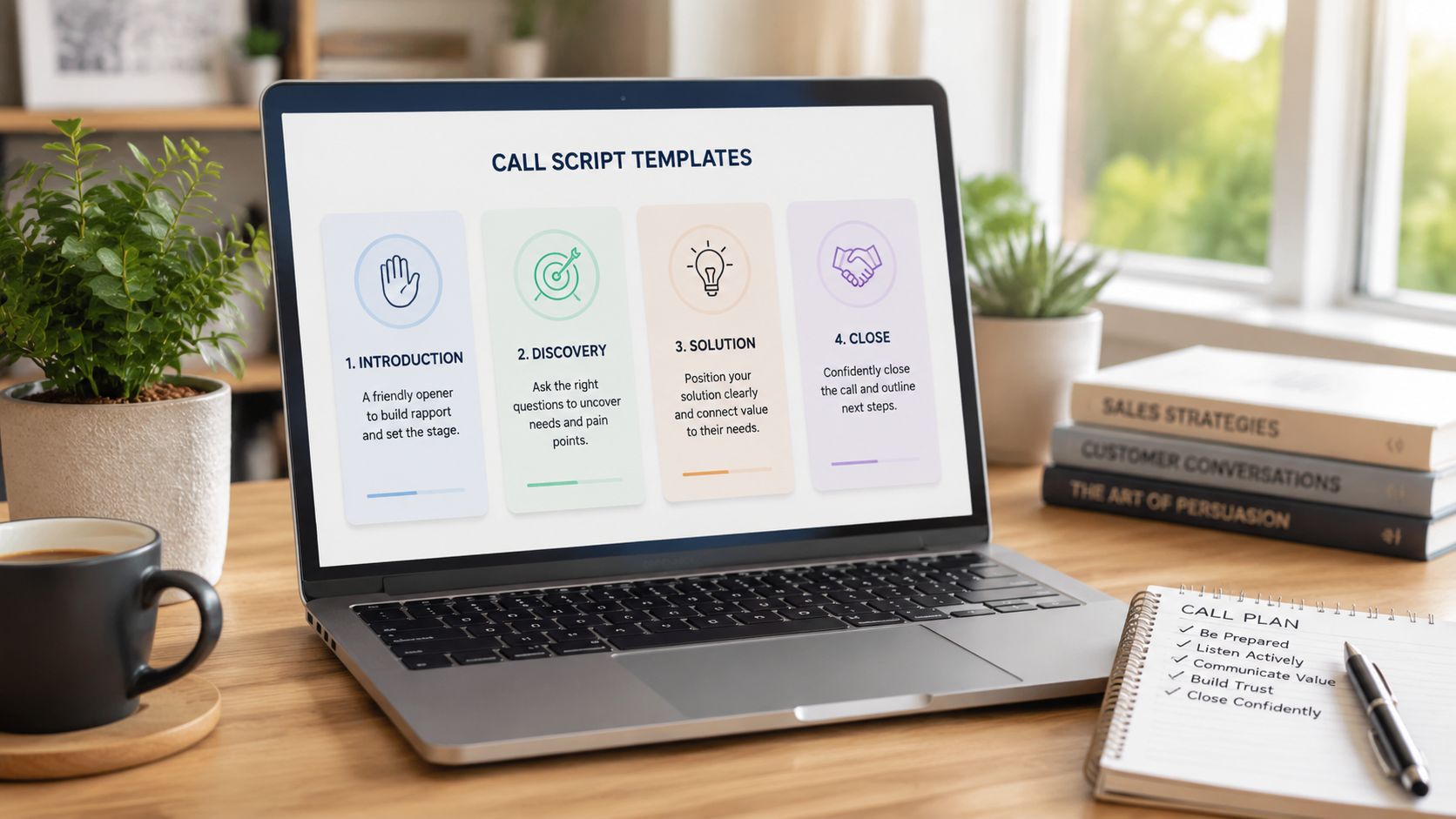
Four ready-to-use outbound call script templates
Templates help when they preserve structure. They hurt when reps read them like stage directions.
The point isn't to memorize these. The point is to internalize the sequence. Permission, trigger, pattern, question, next step.
Template 1 for cold outreach to an ICP account
This is the strongest default.
“Hi [Name], this is [Your Name] from [Company]. I know you weren't expecting my call. Do you have 30 seconds for me to explain why I'm calling, and you can tell me if it's worth continuing?”
If they say yes:
“Quick context. I noticed your team brought on several SDRs recently. When we see that pattern, it usually means pipeline coverage is becoming a management problem before it becomes a rep problem. Wanted to ask what's actually happening on your end with outbound right now. Is now a good time for two quick questions, or would later this week be better?”
This script works because the trigger carries the call. Replace hiring with a real buying signal. In manufacturing, that might be expansion activity or an ERP change. In legal tech, it might be lateral hires or new market coverage. In SaaS, it could be SDR growth, a new VP Sales, or product launch activity.
Template 2 for a warm follow-up after LinkedIn activity
The structure is the same, but you can move faster because the call isn't fully cold.
“Hi [Name], [Your Name] here from [Company]. We connected on LinkedIn a few days ago after your post on outbound attribution. I'm calling because a lot of teams say the same thing publicly, but the real friction is inside routing and follow-up. Worth 30 seconds to tell you why I reached out?”
If they stay with you:
“You mentioned scaling outbound without losing relevance. Curious what's actually happening on your end with reply handling and meeting qualification.”
That's usually better than pretending the LinkedIn touch created a relationship. It didn't. It created context.
Template 3 for a direct demo-booking attempt
Use this only when the category is already familiar and the trigger is strong.
“Hi [Name], this is [Your Name] from [Company]. I'm calling because your team has been expanding into outbound, and we work with teams that need that motion to produce qualified meetings, not just activity. Do you have 30 seconds so I can tell you why this may be relevant?”
Then:
“If what I'm describing is close to what you're dealing with, would it make sense to book a short working session next week?”
Notice what's missing. No feature walkthrough. No product tour by phone. Just enough clarity to earn the calendar.
Template 4 for a complex enterprise opener
Enterprise calls need more restraint, not more jargon.
“Hi [Name], [Your Name] calling from [Company]. I know this is unexpected. The reason for the call is that I noticed a combination of regional expansion and leadership changes across your commercial team. When those happen together, outbound usually gets fragmented across markets. Do you have 30 seconds for context, and then you can decide whether to keep going?”
Then:
“I'm not calling to pitch software on a cold call. I'm trying to understand whether your team is seeing different outbound performance by region, and whether that's become a planning issue.”
Good enterprise openers sound like informed observation, not a canned escalation.
One operational note matters here. If you're calling across markets, the same wording won't always be usable. Public script advice often ignores consent language, do-not-call rules, and jurisdiction-specific constraints. In practice, outbound teams need regional script variants for the U.S., UK, Canada, and other markets, because telemarketing and consent rules differ materially, as noted in CallHub's outbound sales script article. If your team also owns meeting creation, this B2B appointment setting guide is a useful companion to script design because it connects the phone opener to the actual scheduling motion.
How to handle the first 30-second objections
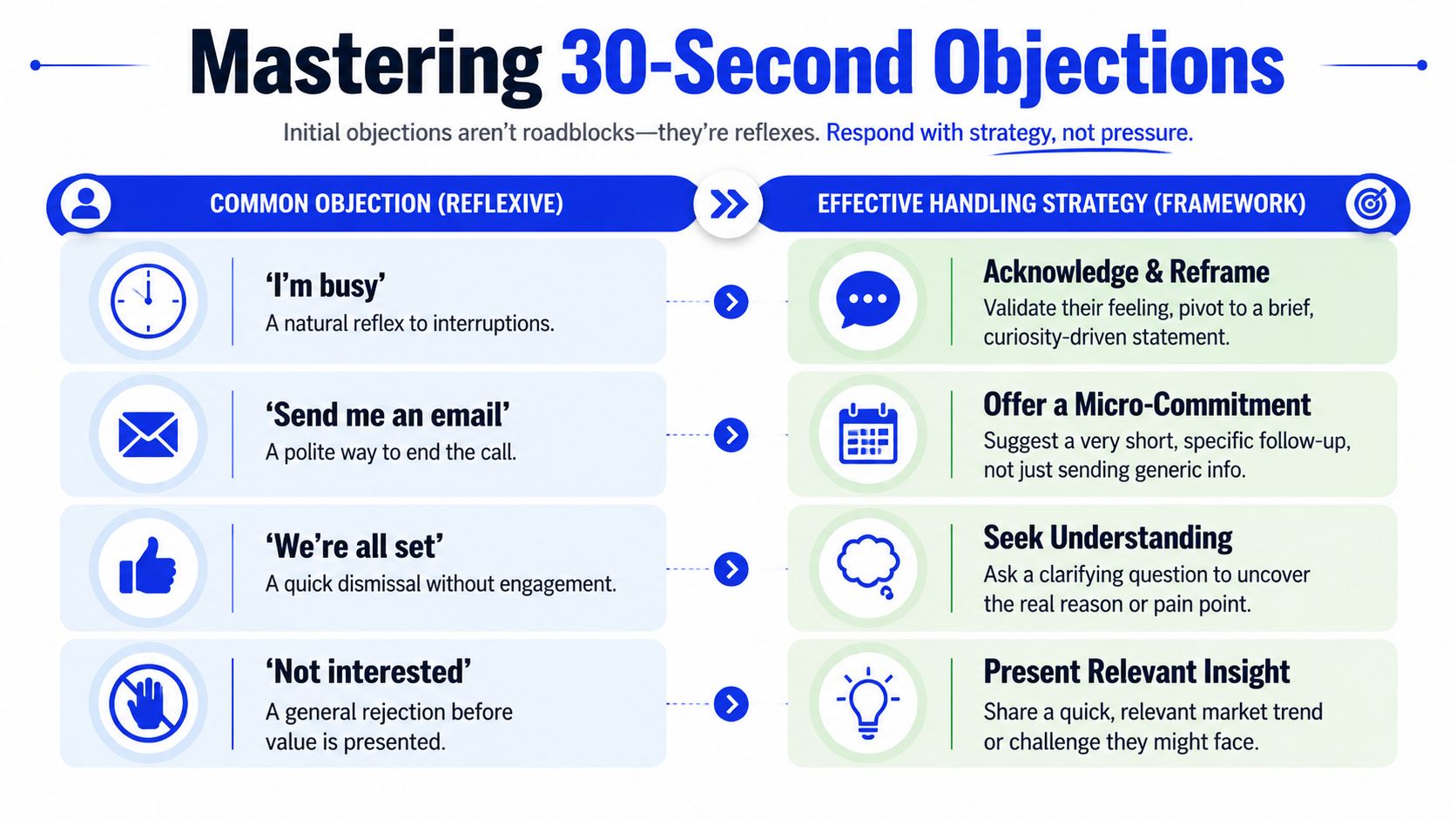
The first objection usually isn't a real objection. It's the prospect reaching for the fastest available exit.
Treat it like a reflex, not a debate. If your rep starts defending the offer, they've already lost the frame.
Use the acknowledge re-ask easy-out framework
The structure is simple.
Acknowledge the reaction → show you heard them without pushing back
Re-ask with a smaller commitment → if 30 seconds failed, ask for 20
Give an easy out → make it safe for them to say no cleanly
That approach fits what the market is telling us. Cold calling is still hard operationally, with 63% of sales reps saying it's the worst part of the job, and 87% of prospects saying salespeople don't understand their needs, according to Close's cold calling statistics. The same source says asking “How have you been?” can increase success rate by 6.6 times, and using “we” more than “I” can double success rate. The underlying lesson isn't “copy these exact words.” It's that wording, empathy, and conversational framing change outcomes.
If you want more examples of how to structure these moments without sounding rehearsed, this how to overcome sales objections guide is worth reading alongside your call reviews.
Four objection responses that keep the call alive
“I'm not interested.”
Try: “Totally fair, you don't know what this is about yet. Can I take 20 seconds to tell you why I called, and you can tell me if it's relevant?”
“Now's not a good time.”
Try: “Of course. I'd rather not catch you mid-something. Is later today better, or sometime tomorrow?”
“We're not looking for this.”
Try: “I appreciate that. Many organizations aren't actively looking when we call. The reason I reached out is [trigger]. Worth 20 seconds to share it, or should I save my breath?”
“How did you get my number?”
Try: “Fair question. I found it through [accurate source, such as LinkedIn or your company site]. I called because of [specific trigger]. Want to hear it, or should I take you off my list?”
What not to do:
Common mistake | Better move |
|---|---|
Argue with the objection | Validate and shrink the ask |
Read an objection script word for word | Use the structure, then speak naturally |
Push through repeated no's | End the call professionally |
Hide the data source | Be direct about where the number came from |
For teams training new reps, this cold call glossary entry is useful because it gives everyone the same language for call stages, common outcomes, and coaching notes.
The one question that creates real dialogue
Once you've earned the first minute, there's one job left. Get the prospect talking about their real situation before the call collapses into a polite brush-off.
The question I'd bet on is this:
What's actually happening on your end with [specific pain area]?
Why this question works better than standard discovery
It works because it sounds like curiosity, not qualification theater.
“Tell me about your business” is too broad. “What are your biggest challenges?” sounds like every sales training script the prospect has heard before. “Are you the decision-maker?” moves the call into procurement mode before there's any reason to stay.
This one does something different:
It's specific because it names a pain area
It's personal because it says “on your end”
It assumes reality because something is already happening
It invites narrative instead of a yes or no answer
That matters in a channel where attention is brutally short. One sales-calling guide cites research that the average cold call lasts only 83 seconds, and also points toward trigger-based, context-aware calling rather than generic interruption, in CloudTalk's sales call script guide. You don't have time for a long runway question.
What good answers actually give you
A useful answer to that question often gives you half the qualification picture in one minute.
Ask, “What's happening on your end with SDR ramp?” and you may hear that three reps are new, the manager is rewriting sequences, and meetings are soft in one region. Ask, “What's happening on your end with pipeline quality?” and you may uncover channel conflict, poor routing, or a board-level pressure point.
That's why this question beats checklist discovery on a cold call. It surfaces pain, timing, and internal dynamics in the prospect's language.
A short comparison makes the point clearer:
Weak question | What it produces |
|---|---|
“What are your biggest challenges?” | Generic answers |
“Do you have budget?” | Defensiveness |
“Are you the decision-maker?” | Guarded positioning |
“What's actually happening on your end with outbound quality?” | Real operational detail |
The follow-up is just as important. Don't stack five questions. Pick one thread and go deeper.
When the prospect gives you a real answer, your next move is to stay with their wording. Don't snap back to your script.
Measuring and A/B testing your scripts for pipeline
A script isn't copy. It's a testable operating input.
That's the shift many teams miss. They coach calls as if the script lives in a doc, when the actual script lives in the funnel data and the recordings.
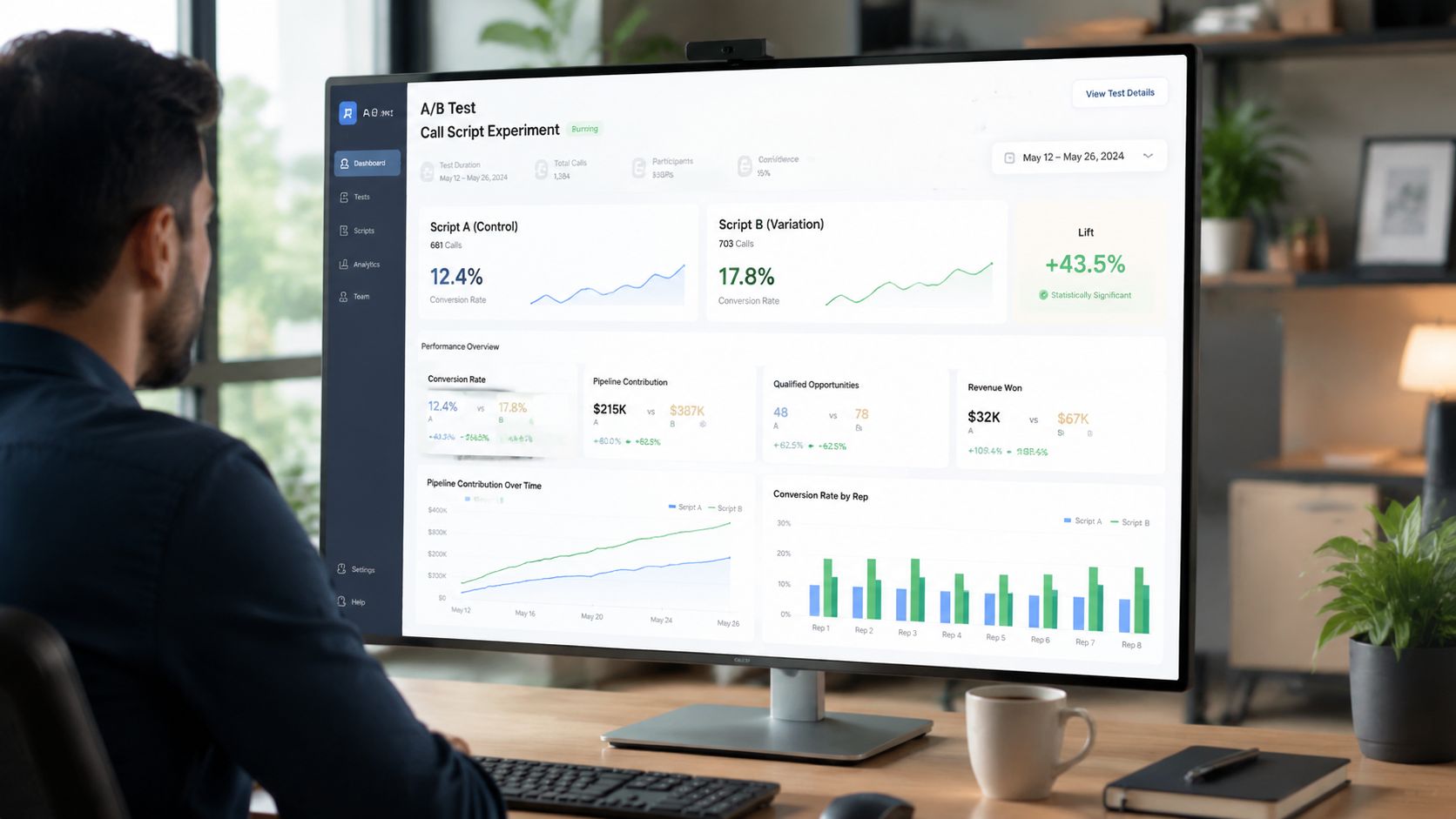
Cold calling is highly sensitive to execution quality. One analysis of 200K+ calls reported an average success rate of 2.7% and top performers at 11.3%, while another source cited 2–3% average, 5–8% good, and 8–15% excellent. The same research recommends tracking more than close rate, including connect, conversation, meeting, and pipeline created, and says ongoing training can lift conversion by 38%, according to Scrap's cold calling success rate analysis.
Track the call like a funnel
If you only track meetings booked, you won't know what broke.
Use a simple funnel:
Connect rate → did a human answer
Conversation rate → did the opener earn real dialogue
Meeting-booked rate → did the call create a next step
Meeting-held rate → did that next step survive until attendance
Pipeline created → did the meeting turn into qualified revenue motion
Apollo, HubSpot, and Sales Navigator can all support parts of this. The core issue isn't tool access. It's whether your dispositions match the stages you care about.
For teams reviewing calls, transcripts speed up coaching. If you need a clean process for capturing and reviewing conversations, this guide for phone call transcription is a practical reference.
How to run a clean test
Don't test five things at once. Pick one variable.
Good tests for a script for outbound calls include:
Test variable | Version A | Version B |
|---|---|---|
Opening ask | “Do you have 30 seconds?” | “Can I take 30 seconds?” |
Trigger framing | Hiring-based | Intent-based |
First question | “Worth 2 quick questions?” | “Worth 5 more minutes?” |
Meeting ask | Working session | Demo |
Keep the list segment stable. Keep the rep set stable if possible. Review recordings weekly, not quarterly.
A useful working session on call testing often starts with examples, so this video is a solid prompt for manager reviews:
If your team doesn't already formalize script experiments, define one owner and one reporting line. This A/B test glossary entry gives a straightforward baseline for setting up test discipline inside sales workflows.
Integrating calls into a multi-channel outbound sequence
A cold call lands better when it doesn't feel random. That means the phone should show up after context has already been created elsewhere.
The pattern I prefer is simple. Research the trigger in Clay or Sales Navigator. Start light with LinkedIn or email. Call when the context is fresh enough that the reason for outreach still feels current.
A practical sequence that makes calls feel timely
One workable structure looks like this:
Day 1 → identify the trigger in Clay, enrich the account, write the reason for contact
Day 1 → send a short email tied to that trigger
Day 2 → LinkedIn visit or connection request through HeyReach
Day 3 → call with the same trigger language, not a new story
Day 5 → follow-up email referencing the call and one observation
Day 7 → second call only if the account still fits and the signal still matters
The mistake is treating channels like independent tactics. If the email says one thing, LinkedIn says another, and the rep calls with a third angle, the buyer experiences noise, not relevance.
The phone works best as the sharpest touch in the sequence, not the first random interruption.
Where the tech stack actually helps
Use tools for consistency, not for hiding weak thinking.
Clay helps with trigger collection. Sales Navigator helps with role and org changes. Lemlist, Instantly, or Smartlead handle the outbound email layer. HeyReach can support LinkedIn steps. HubSpot should hold the sequence history so the caller can see what the prospect already saw before the call starts.
Grou is one option in this category for teams that want LinkedIn content, lead generation, and outbound managed as one system rather than split across separate vendors. That matters when the call script needs to match the same account list, same message, and same qualification rules.
If your team is still treating the phone as a stand-alone channel, move to a documented multi-channel outreach system so each call inherits context from the touches around it.
Your next step to improve outbound calls
Don't rewrite your whole script this week. Audit what already produced conversations.
Pull the last 20 qualified meetings your team booked from outbound calls. For each one, log two things only. The exact opening line used, and the trigger that made the call relevant. You'll see very quickly whether your reps are winning on wording, on targeting, or on timing.
Then compare those calls against the structure above. Did the rep acknowledge the interruption. Did they use a real trigger. Did they ask for a small commitment instead of a meeting too early. That audit will tell you where the break is.
If your team also handles service or support calls, some of the discipline around clarity and call outcomes in SnapDial's FCR tips is worth borrowing. Different context, same lesson. Structure improves call quality.
Run that audit by Friday. Don't look for the perfect line. Look for the repeatable pattern.
GROU helps B2B teams build pipeline by connecting outbound calls, email, LinkedIn, and qualification into one system instead of separate channel experiments. The methodology is simple, structure turns attention into pipeline through tight targeting, trigger-based messaging, and weekly iteration against real conversion points.
Your reps are getting answers, but not enough real conversations. The problem usually isn't call volume. It's that the script for outbound calls is trying to force interest before it earns attention.
The opening should earn 30 seconds, not push a pitch
Strong scripts start with a trigger, not a value dump
Early objections are usually reflexes, so handle them with smaller asks
The call only works when you measure connect, conversation, booked, and held
Calls perform better inside a multi-channel system, not as isolated interruptions
Table of Contents
The foundational structure of a winning outbound call
Most bad cold calls share one assumption. They act like the prospect should tolerate a pitch just because they answered the phone.
That assumption breaks the call before the rep reaches sentence two. A working script for outbound calls treats the answer as borrowed attention, not earned interest.
Why the old opener fails
The older style opener sounded like this: intro, company name, broad value prop, feature dump, meeting ask. It was built for recitation. It wasn't built for resistance.
That's why the first seconds matter so much. A long-standing outbound calling guide recommends keeping the opening under 30 seconds, stating the reason for calling clearly, using a permission-based transition like “Do you have a quick minute?”, and ending with a specific next step. The same evolution shows up in modern sales advice that pushes timely, relevant scripts tied to the prospect's role or recent activity, with a low-friction CTA such as a consultation or demo, as outlined in Vida's outbound call script breakdown.
Practical rule: The opener should reduce tension, prove relevance, and earn the next few seconds. Nothing else.
The structure that actually earns attention
The structure I'd coach into any team has three parts.
Acknowledge the interruption
“Hi Sarah, this is Mark from GROU. I know you weren't expecting my call.”State the trigger
“I noticed your team hired several SDRs recently, and that usually means outbound capacity is growing faster than process.”Ask permission for a small window
“Do you have 30 seconds for me to explain why I called, and you can tell me if it's worth continuing?”
That works because it respects how the prospect is processing the call. They're not asking, “What does your platform do?” They're asking, “Why are you calling me, and how fast can I get out of this if it's irrelevant?”
A few lines to keep and a few to drop:
Keep | Drop |
|---|---|
“I know you weren't expecting my call” | “How are you today?” |
“Do you have 30 seconds?” | “Did I catch you at a bad time?” |
Trigger tied to role or activity | Generic category-based pitch |
“You can tell me if it's worth continuing” | “I'll be brief, I promise” |
For teams building phone into a wider outbound motion, GROU's outbound service is one example of how this gets operationalized, with scripts tied to list quality, message sequencing, and qualification rules instead of left as stand-alone call notes.
Four ready-to-use outbound call script templates
Templates help when they preserve structure. They hurt when reps read them like stage directions.
The point isn't to memorize these. The point is to internalize the sequence. Permission, trigger, pattern, question, next step.
Template 1 for cold outreach to an ICP account
This is the strongest default.
“Hi [Name], this is [Your Name] from [Company]. I know you weren't expecting my call. Do you have 30 seconds for me to explain why I'm calling, and you can tell me if it's worth continuing?”
If they say yes:
“Quick context. I noticed your team brought on several SDRs recently. When we see that pattern, it usually means pipeline coverage is becoming a management problem before it becomes a rep problem. Wanted to ask what's actually happening on your end with outbound right now. Is now a good time for two quick questions, or would later this week be better?”
This script works because the trigger carries the call. Replace hiring with a real buying signal. In manufacturing, that might be expansion activity or an ERP change. In legal tech, it might be lateral hires or new market coverage. In SaaS, it could be SDR growth, a new VP Sales, or product launch activity.
Template 2 for a warm follow-up after LinkedIn activity
The structure is the same, but you can move faster because the call isn't fully cold.
“Hi [Name], [Your Name] here from [Company]. We connected on LinkedIn a few days ago after your post on outbound attribution. I'm calling because a lot of teams say the same thing publicly, but the real friction is inside routing and follow-up. Worth 30 seconds to tell you why I reached out?”
If they stay with you:
“You mentioned scaling outbound without losing relevance. Curious what's actually happening on your end with reply handling and meeting qualification.”
That's usually better than pretending the LinkedIn touch created a relationship. It didn't. It created context.
Template 3 for a direct demo-booking attempt
Use this only when the category is already familiar and the trigger is strong.
“Hi [Name], this is [Your Name] from [Company]. I'm calling because your team has been expanding into outbound, and we work with teams that need that motion to produce qualified meetings, not just activity. Do you have 30 seconds so I can tell you why this may be relevant?”
Then:
“If what I'm describing is close to what you're dealing with, would it make sense to book a short working session next week?”
Notice what's missing. No feature walkthrough. No product tour by phone. Just enough clarity to earn the calendar.
Template 4 for a complex enterprise opener
Enterprise calls need more restraint, not more jargon.
“Hi [Name], [Your Name] calling from [Company]. I know this is unexpected. The reason for the call is that I noticed a combination of regional expansion and leadership changes across your commercial team. When those happen together, outbound usually gets fragmented across markets. Do you have 30 seconds for context, and then you can decide whether to keep going?”
Then:
“I'm not calling to pitch software on a cold call. I'm trying to understand whether your team is seeing different outbound performance by region, and whether that's become a planning issue.”
Good enterprise openers sound like informed observation, not a canned escalation.
One operational note matters here. If you're calling across markets, the same wording won't always be usable. Public script advice often ignores consent language, do-not-call rules, and jurisdiction-specific constraints. In practice, outbound teams need regional script variants for the U.S., UK, Canada, and other markets, because telemarketing and consent rules differ materially, as noted in CallHub's outbound sales script article. If your team also owns meeting creation, this B2B appointment setting guide is a useful companion to script design because it connects the phone opener to the actual scheduling motion.
How to handle the first 30-second objections
The first objection usually isn't a real objection. It's the prospect reaching for the fastest available exit.
Treat it like a reflex, not a debate. If your rep starts defending the offer, they've already lost the frame.
Use the acknowledge re-ask easy-out framework
The structure is simple.
Acknowledge the reaction → show you heard them without pushing back
Re-ask with a smaller commitment → if 30 seconds failed, ask for 20
Give an easy out → make it safe for them to say no cleanly
That approach fits what the market is telling us. Cold calling is still hard operationally, with 63% of sales reps saying it's the worst part of the job, and 87% of prospects saying salespeople don't understand their needs, according to Close's cold calling statistics. The same source says asking “How have you been?” can increase success rate by 6.6 times, and using “we” more than “I” can double success rate. The underlying lesson isn't “copy these exact words.” It's that wording, empathy, and conversational framing change outcomes.
If you want more examples of how to structure these moments without sounding rehearsed, this how to overcome sales objections guide is worth reading alongside your call reviews.
Four objection responses that keep the call alive
“I'm not interested.”
Try: “Totally fair, you don't know what this is about yet. Can I take 20 seconds to tell you why I called, and you can tell me if it's relevant?”
“Now's not a good time.”
Try: “Of course. I'd rather not catch you mid-something. Is later today better, or sometime tomorrow?”
“We're not looking for this.”
Try: “I appreciate that. Many organizations aren't actively looking when we call. The reason I reached out is [trigger]. Worth 20 seconds to share it, or should I save my breath?”
“How did you get my number?”
Try: “Fair question. I found it through [accurate source, such as LinkedIn or your company site]. I called because of [specific trigger]. Want to hear it, or should I take you off my list?”
What not to do:
Common mistake | Better move |
|---|---|
Argue with the objection | Validate and shrink the ask |
Read an objection script word for word | Use the structure, then speak naturally |
Push through repeated no's | End the call professionally |
Hide the data source | Be direct about where the number came from |
For teams training new reps, this cold call glossary entry is useful because it gives everyone the same language for call stages, common outcomes, and coaching notes.
The one question that creates real dialogue
Once you've earned the first minute, there's one job left. Get the prospect talking about their real situation before the call collapses into a polite brush-off.
The question I'd bet on is this:
What's actually happening on your end with [specific pain area]?
Why this question works better than standard discovery
It works because it sounds like curiosity, not qualification theater.
“Tell me about your business” is too broad. “What are your biggest challenges?” sounds like every sales training script the prospect has heard before. “Are you the decision-maker?” moves the call into procurement mode before there's any reason to stay.
This one does something different:
It's specific because it names a pain area
It's personal because it says “on your end”
It assumes reality because something is already happening
It invites narrative instead of a yes or no answer
That matters in a channel where attention is brutally short. One sales-calling guide cites research that the average cold call lasts only 83 seconds, and also points toward trigger-based, context-aware calling rather than generic interruption, in CloudTalk's sales call script guide. You don't have time for a long runway question.
What good answers actually give you
A useful answer to that question often gives you half the qualification picture in one minute.
Ask, “What's happening on your end with SDR ramp?” and you may hear that three reps are new, the manager is rewriting sequences, and meetings are soft in one region. Ask, “What's happening on your end with pipeline quality?” and you may uncover channel conflict, poor routing, or a board-level pressure point.
That's why this question beats checklist discovery on a cold call. It surfaces pain, timing, and internal dynamics in the prospect's language.
A short comparison makes the point clearer:
Weak question | What it produces |
|---|---|
“What are your biggest challenges?” | Generic answers |
“Do you have budget?” | Defensiveness |
“Are you the decision-maker?” | Guarded positioning |
“What's actually happening on your end with outbound quality?” | Real operational detail |
The follow-up is just as important. Don't stack five questions. Pick one thread and go deeper.
When the prospect gives you a real answer, your next move is to stay with their wording. Don't snap back to your script.
Measuring and A/B testing your scripts for pipeline
A script isn't copy. It's a testable operating input.
That's the shift many teams miss. They coach calls as if the script lives in a doc, when the actual script lives in the funnel data and the recordings.
Cold calling is highly sensitive to execution quality. One analysis of 200K+ calls reported an average success rate of 2.7% and top performers at 11.3%, while another source cited 2–3% average, 5–8% good, and 8–15% excellent. The same research recommends tracking more than close rate, including connect, conversation, meeting, and pipeline created, and says ongoing training can lift conversion by 38%, according to Scrap's cold calling success rate analysis.
Track the call like a funnel
If you only track meetings booked, you won't know what broke.
Use a simple funnel:
Connect rate → did a human answer
Conversation rate → did the opener earn real dialogue
Meeting-booked rate → did the call create a next step
Meeting-held rate → did that next step survive until attendance
Pipeline created → did the meeting turn into qualified revenue motion
Apollo, HubSpot, and Sales Navigator can all support parts of this. The core issue isn't tool access. It's whether your dispositions match the stages you care about.
For teams reviewing calls, transcripts speed up coaching. If you need a clean process for capturing and reviewing conversations, this guide for phone call transcription is a practical reference.
How to run a clean test
Don't test five things at once. Pick one variable.
Good tests for a script for outbound calls include:
Test variable | Version A | Version B |
|---|---|---|
Opening ask | “Do you have 30 seconds?” | “Can I take 30 seconds?” |
Trigger framing | Hiring-based | Intent-based |
First question | “Worth 2 quick questions?” | “Worth 5 more minutes?” |
Meeting ask | Working session | Demo |
Keep the list segment stable. Keep the rep set stable if possible. Review recordings weekly, not quarterly.
A useful working session on call testing often starts with examples, so this video is a solid prompt for manager reviews:
If your team doesn't already formalize script experiments, define one owner and one reporting line. This A/B test glossary entry gives a straightforward baseline for setting up test discipline inside sales workflows.
Integrating calls into a multi-channel outbound sequence
A cold call lands better when it doesn't feel random. That means the phone should show up after context has already been created elsewhere.
The pattern I prefer is simple. Research the trigger in Clay or Sales Navigator. Start light with LinkedIn or email. Call when the context is fresh enough that the reason for outreach still feels current.
A practical sequence that makes calls feel timely
One workable structure looks like this:
Day 1 → identify the trigger in Clay, enrich the account, write the reason for contact
Day 1 → send a short email tied to that trigger
Day 2 → LinkedIn visit or connection request through HeyReach
Day 3 → call with the same trigger language, not a new story
Day 5 → follow-up email referencing the call and one observation
Day 7 → second call only if the account still fits and the signal still matters
The mistake is treating channels like independent tactics. If the email says one thing, LinkedIn says another, and the rep calls with a third angle, the buyer experiences noise, not relevance.
The phone works best as the sharpest touch in the sequence, not the first random interruption.
Where the tech stack actually helps
Use tools for consistency, not for hiding weak thinking.
Clay helps with trigger collection. Sales Navigator helps with role and org changes. Lemlist, Instantly, or Smartlead handle the outbound email layer. HeyReach can support LinkedIn steps. HubSpot should hold the sequence history so the caller can see what the prospect already saw before the call starts.
Grou is one option in this category for teams that want LinkedIn content, lead generation, and outbound managed as one system rather than split across separate vendors. That matters when the call script needs to match the same account list, same message, and same qualification rules.
If your team is still treating the phone as a stand-alone channel, move to a documented multi-channel outreach system so each call inherits context from the touches around it.
Your next step to improve outbound calls
Don't rewrite your whole script this week. Audit what already produced conversations.
Pull the last 20 qualified meetings your team booked from outbound calls. For each one, log two things only. The exact opening line used, and the trigger that made the call relevant. You'll see very quickly whether your reps are winning on wording, on targeting, or on timing.
Then compare those calls against the structure above. Did the rep acknowledge the interruption. Did they use a real trigger. Did they ask for a small commitment instead of a meeting too early. That audit will tell you where the break is.
If your team also handles service or support calls, some of the discipline around clarity and call outcomes in SnapDial's FCR tips is worth borrowing. Different context, same lesson. Structure improves call quality.
Run that audit by Friday. Don't look for the perfect line. Look for the repeatable pattern.
GROU helps B2B teams build pipeline by connecting outbound calls, email, LinkedIn, and qualification into one system instead of separate channel experiments. The methodology is simple, structure turns attention into pipeline through tight targeting, trigger-based messaging, and weekly iteration against real conversion points.
Your reps are getting answers, but not enough real conversations. The problem usually isn't call volume. It's that the script for outbound calls is trying to force interest before it earns attention.
The opening should earn 30 seconds, not push a pitch
Strong scripts start with a trigger, not a value dump
Early objections are usually reflexes, so handle them with smaller asks
The call only works when you measure connect, conversation, booked, and held
Calls perform better inside a multi-channel system, not as isolated interruptions
Table of Contents
The foundational structure of a winning outbound call
Most bad cold calls share one assumption. They act like the prospect should tolerate a pitch just because they answered the phone.
That assumption breaks the call before the rep reaches sentence two. A working script for outbound calls treats the answer as borrowed attention, not earned interest.
Why the old opener fails
The older style opener sounded like this: intro, company name, broad value prop, feature dump, meeting ask. It was built for recitation. It wasn't built for resistance.
That's why the first seconds matter so much. A long-standing outbound calling guide recommends keeping the opening under 30 seconds, stating the reason for calling clearly, using a permission-based transition like “Do you have a quick minute?”, and ending with a specific next step. The same evolution shows up in modern sales advice that pushes timely, relevant scripts tied to the prospect's role or recent activity, with a low-friction CTA such as a consultation or demo, as outlined in Vida's outbound call script breakdown.
Practical rule: The opener should reduce tension, prove relevance, and earn the next few seconds. Nothing else.
The structure that actually earns attention
The structure I'd coach into any team has three parts.
Acknowledge the interruption
“Hi Sarah, this is Mark from GROU. I know you weren't expecting my call.”State the trigger
“I noticed your team hired several SDRs recently, and that usually means outbound capacity is growing faster than process.”Ask permission for a small window
“Do you have 30 seconds for me to explain why I called, and you can tell me if it's worth continuing?”
That works because it respects how the prospect is processing the call. They're not asking, “What does your platform do?” They're asking, “Why are you calling me, and how fast can I get out of this if it's irrelevant?”
A few lines to keep and a few to drop:
Keep | Drop |
|---|---|
“I know you weren't expecting my call” | “How are you today?” |
“Do you have 30 seconds?” | “Did I catch you at a bad time?” |
Trigger tied to role or activity | Generic category-based pitch |
“You can tell me if it's worth continuing” | “I'll be brief, I promise” |
For teams building phone into a wider outbound motion, GROU's outbound service is one example of how this gets operationalized, with scripts tied to list quality, message sequencing, and qualification rules instead of left as stand-alone call notes.
Four ready-to-use outbound call script templates
Templates help when they preserve structure. They hurt when reps read them like stage directions.
The point isn't to memorize these. The point is to internalize the sequence. Permission, trigger, pattern, question, next step.
Template 1 for cold outreach to an ICP account
This is the strongest default.
“Hi [Name], this is [Your Name] from [Company]. I know you weren't expecting my call. Do you have 30 seconds for me to explain why I'm calling, and you can tell me if it's worth continuing?”
If they say yes:
“Quick context. I noticed your team brought on several SDRs recently. When we see that pattern, it usually means pipeline coverage is becoming a management problem before it becomes a rep problem. Wanted to ask what's actually happening on your end with outbound right now. Is now a good time for two quick questions, or would later this week be better?”
This script works because the trigger carries the call. Replace hiring with a real buying signal. In manufacturing, that might be expansion activity or an ERP change. In legal tech, it might be lateral hires or new market coverage. In SaaS, it could be SDR growth, a new VP Sales, or product launch activity.
Template 2 for a warm follow-up after LinkedIn activity
The structure is the same, but you can move faster because the call isn't fully cold.
“Hi [Name], [Your Name] here from [Company]. We connected on LinkedIn a few days ago after your post on outbound attribution. I'm calling because a lot of teams say the same thing publicly, but the real friction is inside routing and follow-up. Worth 30 seconds to tell you why I reached out?”
If they stay with you:
“You mentioned scaling outbound without losing relevance. Curious what's actually happening on your end with reply handling and meeting qualification.”
That's usually better than pretending the LinkedIn touch created a relationship. It didn't. It created context.
Template 3 for a direct demo-booking attempt
Use this only when the category is already familiar and the trigger is strong.
“Hi [Name], this is [Your Name] from [Company]. I'm calling because your team has been expanding into outbound, and we work with teams that need that motion to produce qualified meetings, not just activity. Do you have 30 seconds so I can tell you why this may be relevant?”
Then:
“If what I'm describing is close to what you're dealing with, would it make sense to book a short working session next week?”
Notice what's missing. No feature walkthrough. No product tour by phone. Just enough clarity to earn the calendar.
Template 4 for a complex enterprise opener
Enterprise calls need more restraint, not more jargon.
“Hi [Name], [Your Name] calling from [Company]. I know this is unexpected. The reason for the call is that I noticed a combination of regional expansion and leadership changes across your commercial team. When those happen together, outbound usually gets fragmented across markets. Do you have 30 seconds for context, and then you can decide whether to keep going?”
Then:
“I'm not calling to pitch software on a cold call. I'm trying to understand whether your team is seeing different outbound performance by region, and whether that's become a planning issue.”
Good enterprise openers sound like informed observation, not a canned escalation.
One operational note matters here. If you're calling across markets, the same wording won't always be usable. Public script advice often ignores consent language, do-not-call rules, and jurisdiction-specific constraints. In practice, outbound teams need regional script variants for the U.S., UK, Canada, and other markets, because telemarketing and consent rules differ materially, as noted in CallHub's outbound sales script article. If your team also owns meeting creation, this B2B appointment setting guide is a useful companion to script design because it connects the phone opener to the actual scheduling motion.
How to handle the first 30-second objections
The first objection usually isn't a real objection. It's the prospect reaching for the fastest available exit.
Treat it like a reflex, not a debate. If your rep starts defending the offer, they've already lost the frame.
Use the acknowledge re-ask easy-out framework
The structure is simple.
Acknowledge the reaction → show you heard them without pushing back
Re-ask with a smaller commitment → if 30 seconds failed, ask for 20
Give an easy out → make it safe for them to say no cleanly
That approach fits what the market is telling us. Cold calling is still hard operationally, with 63% of sales reps saying it's the worst part of the job, and 87% of prospects saying salespeople don't understand their needs, according to Close's cold calling statistics. The same source says asking “How have you been?” can increase success rate by 6.6 times, and using “we” more than “I” can double success rate. The underlying lesson isn't “copy these exact words.” It's that wording, empathy, and conversational framing change outcomes.
If you want more examples of how to structure these moments without sounding rehearsed, this how to overcome sales objections guide is worth reading alongside your call reviews.
Four objection responses that keep the call alive
“I'm not interested.”
Try: “Totally fair, you don't know what this is about yet. Can I take 20 seconds to tell you why I called, and you can tell me if it's relevant?”
“Now's not a good time.”
Try: “Of course. I'd rather not catch you mid-something. Is later today better, or sometime tomorrow?”
“We're not looking for this.”
Try: “I appreciate that. Many organizations aren't actively looking when we call. The reason I reached out is [trigger]. Worth 20 seconds to share it, or should I save my breath?”
“How did you get my number?”
Try: “Fair question. I found it through [accurate source, such as LinkedIn or your company site]. I called because of [specific trigger]. Want to hear it, or should I take you off my list?”
What not to do:
Common mistake | Better move |
|---|---|
Argue with the objection | Validate and shrink the ask |
Read an objection script word for word | Use the structure, then speak naturally |
Push through repeated no's | End the call professionally |
Hide the data source | Be direct about where the number came from |
For teams training new reps, this cold call glossary entry is useful because it gives everyone the same language for call stages, common outcomes, and coaching notes.
The one question that creates real dialogue
Once you've earned the first minute, there's one job left. Get the prospect talking about their real situation before the call collapses into a polite brush-off.
The question I'd bet on is this:
What's actually happening on your end with [specific pain area]?
Why this question works better than standard discovery
It works because it sounds like curiosity, not qualification theater.
“Tell me about your business” is too broad. “What are your biggest challenges?” sounds like every sales training script the prospect has heard before. “Are you the decision-maker?” moves the call into procurement mode before there's any reason to stay.
This one does something different:
It's specific because it names a pain area
It's personal because it says “on your end”
It assumes reality because something is already happening
It invites narrative instead of a yes or no answer
That matters in a channel where attention is brutally short. One sales-calling guide cites research that the average cold call lasts only 83 seconds, and also points toward trigger-based, context-aware calling rather than generic interruption, in CloudTalk's sales call script guide. You don't have time for a long runway question.
What good answers actually give you
A useful answer to that question often gives you half the qualification picture in one minute.
Ask, “What's happening on your end with SDR ramp?” and you may hear that three reps are new, the manager is rewriting sequences, and meetings are soft in one region. Ask, “What's happening on your end with pipeline quality?” and you may uncover channel conflict, poor routing, or a board-level pressure point.
That's why this question beats checklist discovery on a cold call. It surfaces pain, timing, and internal dynamics in the prospect's language.
A short comparison makes the point clearer:
Weak question | What it produces |
|---|---|
“What are your biggest challenges?” | Generic answers |
“Do you have budget?” | Defensiveness |
“Are you the decision-maker?” | Guarded positioning |
“What's actually happening on your end with outbound quality?” | Real operational detail |
The follow-up is just as important. Don't stack five questions. Pick one thread and go deeper.
When the prospect gives you a real answer, your next move is to stay with their wording. Don't snap back to your script.
Measuring and A/B testing your scripts for pipeline
A script isn't copy. It's a testable operating input.
That's the shift many teams miss. They coach calls as if the script lives in a doc, when the actual script lives in the funnel data and the recordings.
Cold calling is highly sensitive to execution quality. One analysis of 200K+ calls reported an average success rate of 2.7% and top performers at 11.3%, while another source cited 2–3% average, 5–8% good, and 8–15% excellent. The same research recommends tracking more than close rate, including connect, conversation, meeting, and pipeline created, and says ongoing training can lift conversion by 38%, according to Scrap's cold calling success rate analysis.
Track the call like a funnel
If you only track meetings booked, you won't know what broke.
Use a simple funnel:
Connect rate → did a human answer
Conversation rate → did the opener earn real dialogue
Meeting-booked rate → did the call create a next step
Meeting-held rate → did that next step survive until attendance
Pipeline created → did the meeting turn into qualified revenue motion
Apollo, HubSpot, and Sales Navigator can all support parts of this. The core issue isn't tool access. It's whether your dispositions match the stages you care about.
For teams reviewing calls, transcripts speed up coaching. If you need a clean process for capturing and reviewing conversations, this guide for phone call transcription is a practical reference.
How to run a clean test
Don't test five things at once. Pick one variable.
Good tests for a script for outbound calls include:
Test variable | Version A | Version B |
|---|---|---|
Opening ask | “Do you have 30 seconds?” | “Can I take 30 seconds?” |
Trigger framing | Hiring-based | Intent-based |
First question | “Worth 2 quick questions?” | “Worth 5 more minutes?” |
Meeting ask | Working session | Demo |
Keep the list segment stable. Keep the rep set stable if possible. Review recordings weekly, not quarterly.
A useful working session on call testing often starts with examples, so this video is a solid prompt for manager reviews:
If your team doesn't already formalize script experiments, define one owner and one reporting line. This A/B test glossary entry gives a straightforward baseline for setting up test discipline inside sales workflows.
Integrating calls into a multi-channel outbound sequence
A cold call lands better when it doesn't feel random. That means the phone should show up after context has already been created elsewhere.
The pattern I prefer is simple. Research the trigger in Clay or Sales Navigator. Start light with LinkedIn or email. Call when the context is fresh enough that the reason for outreach still feels current.
A practical sequence that makes calls feel timely
One workable structure looks like this:
Day 1 → identify the trigger in Clay, enrich the account, write the reason for contact
Day 1 → send a short email tied to that trigger
Day 2 → LinkedIn visit or connection request through HeyReach
Day 3 → call with the same trigger language, not a new story
Day 5 → follow-up email referencing the call and one observation
Day 7 → second call only if the account still fits and the signal still matters
The mistake is treating channels like independent tactics. If the email says one thing, LinkedIn says another, and the rep calls with a third angle, the buyer experiences noise, not relevance.
The phone works best as the sharpest touch in the sequence, not the first random interruption.
Where the tech stack actually helps
Use tools for consistency, not for hiding weak thinking.
Clay helps with trigger collection. Sales Navigator helps with role and org changes. Lemlist, Instantly, or Smartlead handle the outbound email layer. HeyReach can support LinkedIn steps. HubSpot should hold the sequence history so the caller can see what the prospect already saw before the call starts.
Grou is one option in this category for teams that want LinkedIn content, lead generation, and outbound managed as one system rather than split across separate vendors. That matters when the call script needs to match the same account list, same message, and same qualification rules.
If your team is still treating the phone as a stand-alone channel, move to a documented multi-channel outreach system so each call inherits context from the touches around it.
Your next step to improve outbound calls
Don't rewrite your whole script this week. Audit what already produced conversations.
Pull the last 20 qualified meetings your team booked from outbound calls. For each one, log two things only. The exact opening line used, and the trigger that made the call relevant. You'll see very quickly whether your reps are winning on wording, on targeting, or on timing.
Then compare those calls against the structure above. Did the rep acknowledge the interruption. Did they use a real trigger. Did they ask for a small commitment instead of a meeting too early. That audit will tell you where the break is.
If your team also handles service or support calls, some of the discipline around clarity and call outcomes in SnapDial's FCR tips is worth borrowing. Different context, same lesson. Structure improves call quality.
Run that audit by Friday. Don't look for the perfect line. Look for the repeatable pattern.
GROU helps B2B teams build pipeline by connecting outbound calls, email, LinkedIn, and qualification into one system instead of separate channel experiments. The methodology is simple, structure turns attention into pipeline through tight targeting, trigger-based messaging, and weekly iteration against real conversion points.
Pipeline OS Newsletter
Build qualified pipeline
Get weekly tactics to generate demand, improve lead quality, and book more meetings.





Trusted by industry leaders
Trusted by industry leaders
Trusted by industry leaders
Ready to build qualified pipeline?
Ready to build qualified pipeline?
Ready to build qualified pipeline?
Book a call to see if we're the right fit, or take the 2-minute quiz to get a clear starting point.
Book a call to see if we're the right fit, or take the 2-minute quiz to get a clear starting point.
Book a call to see if we're the right fit, or take the 2-minute quiz to get a clear starting point.
" height="30.21639343089746px" id="hfGbXmQR2" width="30.216393430897455px"/></svg>)
Copyright © 2026 – All Right Reserved
Copyright © 2026 – All Right Reserved
Copyright © 2026 – All Right Reserved