%22%3E%3C/path%3E%3Cpath d=%22M 63.072 7.554 C 62.258 8.022 61.577 8.689 61.092 9.493 L 61.092 7.076 L 57.158 7.076 L 57.158 22.64 L 61.089 22.64 L 61.089 14.888 C 61.089 13.446 61.403 12.434 62.03 11.853 C 62.818 11.218 63.818 10.907 64.826 10.982 L 65.868 10.982 L 65.868 6.851 C 64.891 6.834 63.926 7.076 63.073 7.554 Z%22 fill=%22rgb(17,17,17)%22%3E%3C/path%3E%3Cpath d=%22M 78.916 7.82 C 76.363 6.49 73.321 6.49 70.768 7.82 C 69.562 8.473 68.564 9.451 67.888 10.644 C 67.167 11.931 66.803 13.387 66.834 14.862 C 66.804 16.332 67.157 17.785 67.86 19.077 C 68.515 20.267 69.494 21.246 70.684 21.901 C 71.924 22.576 73.318 22.92 74.73 22.898 C 76.164 22.918 77.58 22.575 78.846 21.901 C 80.062 21.247 81.073 20.27 81.768 19.077 C 82.506 17.797 82.88 16.339 82.85 14.862 C 82.88 13.389 82.517 11.934 81.797 10.647 C 81.12 9.455 80.122 8.477 78.917 7.824 M 78.803 14.862 C 78.829 15.739 78.636 16.608 78.241 17.391 C 77.903 18.046 77.38 18.588 76.738 18.95 C 76.124 19.293 75.432 19.472 74.729 19.47 C 73.668 19.497 72.648 19.061 71.934 18.276 C 71.139 17.323 70.741 16.1 70.823 14.862 C 70.741 13.62 71.149 12.395 71.959 11.45 C 72.687 10.667 73.715 10.233 74.783 10.256 C 75.859 10.236 76.894 10.67 77.635 11.45 C 78.464 12.387 78.884 13.616 78.801 14.864%22 fill=%22rgb(17,17,17)%22%3E%3C/path%3E%3Cpath d=%22M 95.906 7.076 L 95.906 15.646 C 95.975 16.68 95.643 17.701 94.979 18.498 C 94.311 19.184 93.379 19.547 92.422 19.495 C 91.475 19.544 90.553 19.18 89.894 18.498 C 89.23 17.701 88.898 16.68 88.967 15.646 L 88.967 7.076 L 85.033 7.076 L 85.033 16.207 C 85 17.449 85.275 18.68 85.834 19.79 C 86.327 20.75 87.095 21.542 88.039 22.065 C 89.033 22.594 90.145 22.861 91.271 22.838 C 92.188 22.847 93.095 22.65 93.926 22.263 C 94.708 21.905 95.388 21.36 95.906 20.675 L 95.906 22.645 L 99.865 22.645 L 99.865 7.076 Z%22 fill=%22rgb(17,17,17)%22%3E%3C/path%3E%3Cpath d=%22M 4.513 15.626 C 4.511 10.815 7.606 6.549 12.181 5.059 C 16.756 3.57 21.77 5.195 24.601 9.086 L 27.816 5.87 C 24.074 1.186 17.981 -0.943 12.137 0.393 C 6.292 1.728 1.728 6.292 0.393 12.137 C -0.943 17.981 1.186 24.074 5.87 27.816 L 9.085 24.601 C 6.214 22.512 4.515 19.177 4.513 15.626%22 fill=%22rgb(32,62,235)%22%3E%3C/path%3E%3Cpath d=%22M 17.114 14.343 L 13.354 18.01 L 13.354 18.026 L 21.071 18.026 L 11.412 27.609 L 17.389 27.609 L 23.999 21.081 L 23.999 28.316 L 24.005 28.316 L 27.967 24.393 L 27.967 14.343 Z%22 fill=%22rgb(32,62,235)%22%3E%3C/path%3E%3C/g%3E%3C/svg%3E) ×
× ××
××›
›
›
›
GetResponse vs Brevo 2026
GetResponse vs Brevo 2026
GetResponse vs Brevo 2026
GetResponse vs Brevo 2026
GetResponse vs Brevo 2026
GetResponse vs Brevo 2026

Author
Aljaz Peklaj

One of these charges you for the people on your list. The other charges you for the emails you send. Everything else in this comparison is a detail hanging off that one difference.
It shows up most clearly in what each one gives away free. Brevo will store a hundred thousand contacts for nothing and ration you to three hundred sends a day. GetResponse sells unlimited messages and rations the contacts. Each vendor is generous with exactly the thing the other one meters.
TL;DR
GetResponse prices on list size. Its help centre states billing is set by "the peak number of active subscribers during the billing month and the total number of contacts added within that billing month", with published tiers at 1k, 2.5k, 5k, 10k, 25k, 50k and 100k, and an entry price of "$19 per month for unlimited messages to up to 1,000 subscribers". Brevo prices on sends. Its free plan allows 300 email sends per day while storing up to 100,000 contacts, and its paid tiers are denominated in monthly email volume, from a Starter plan beginning at $9 for 5,000 to 100,000 monthly sends up to a Professional plan beginning at $499 for 150,000 to 10 million. Three things follow. If you hold a large list and mail it rarely, Brevo's model is built for you and GetResponse's is not. If you hold a small list and mail it constantly, GetResponse's unlimited messages is the better shape. And GetResponse's counting rules are stricter than "how many contacts do I have", which is the part of this comparison most worth reading twice before you buy.
The one difference that generates the others
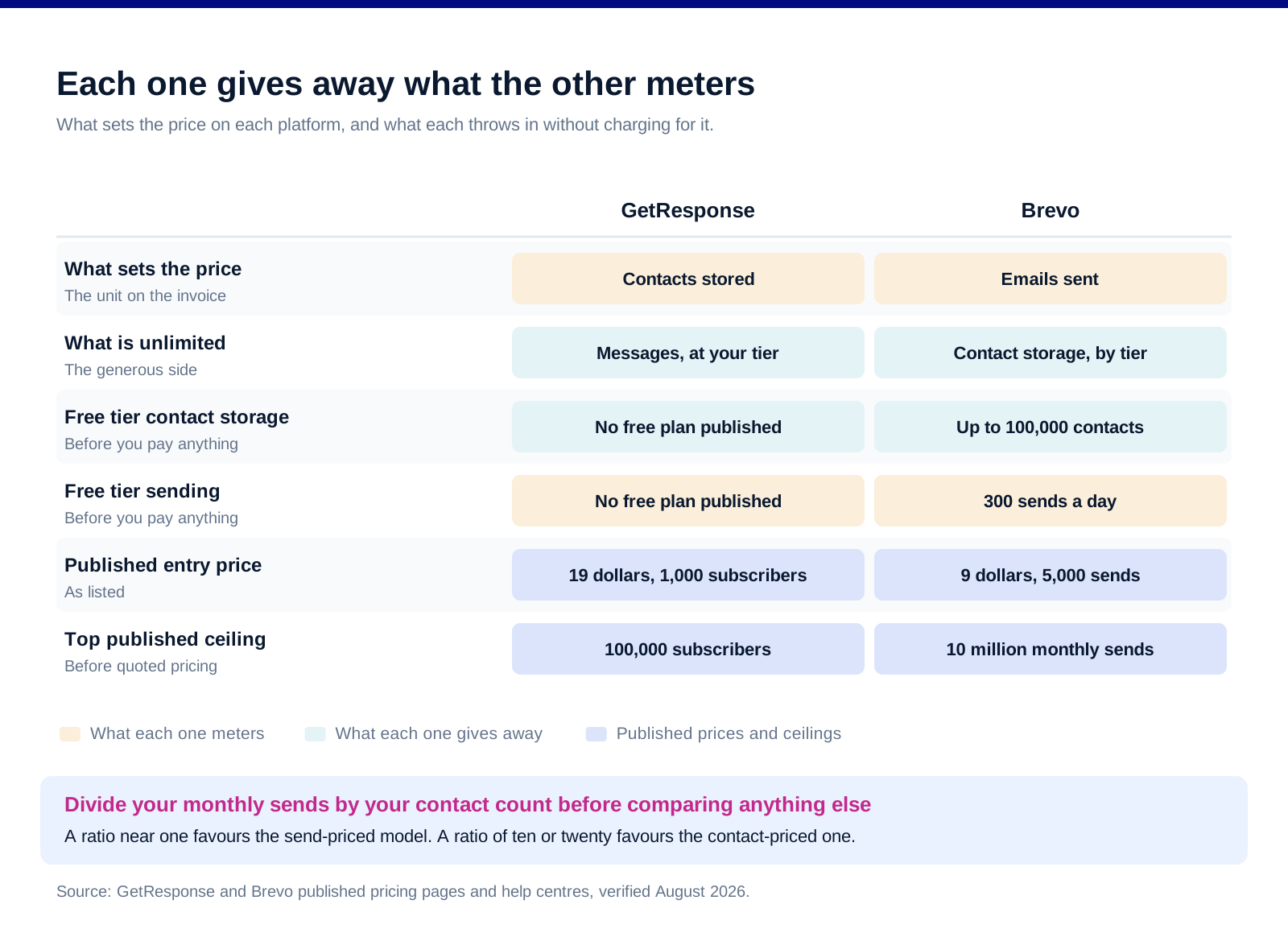
GetResponse meters people. Its pricing page publishes Starter at $19 a month, Marketer at $59 and Creator at $69, with an Enterprise tier quoted, and its help centre confirms the entry price covers "unlimited messages to up to 1,000 subscribers". Annual billing is stated to save 18 percent, with a further 10 percent for completing the Get Started Checklist and up to 50 percent for nonprofits.
Brevo meters messages. Its plans are denominated in monthly email sends, with contact storage attached to the tier rather than driving it. Starter runs from $9 covering 5,000 to 100,000 monthly sends with contact limits of 500 to 500,000, Standard from $18 covering 5,000 to 500,000 sends, and Professional from $499 covering 150,000 to 10 million sends with up to 2 million contacts. Enterprise is quoted and described as unlimited contact storage.
Which means the free plans are mirror images. Brevo's free plan stores up to 100,000 contacts, the same ceiling as GetResponse's highest published tier, while capping you at 300 email sends per day with up to 1,000 more held in a retry queue. Emails on it "always include the Sent with Brevo sticker", automations accept up to 2,000 unique contacts, and it is single user with a maximum of 50 open deals and one pipeline.
So work out your ratio before you compare anything else. Divide the emails you expect to send in a month by the number of contacts you expect to hold. A ratio near one, meaning you mail the whole list once a month, favours the send-priced model. A ratio of ten or twenty, meaning you mail constantly, favours the contact-priced one. Our note on Brevo pricing goes deeper on that side of the ladder.
![[INSERT FIGURE 1, getresponse-vs-brevo-figure-1-getresponse-ladder.svg] Alt: GetResponse's published subscriber tiers in 2026, the ladder that sets the price with messages unlimited.](https://framerusercontent.com/images/MmJMdC0SyqZtdQiDjZ8cE94Kxm0.jpg)
GetResponse counts contacts more strictly than you would
Billing is set by two numbers, not one. GetResponse's help centre states it is "determined by the peak number of active subscribers during the billing month and the total number of contacts added within that billing month". Those can differ substantially for anyone importing and cleaning lists.
The same person can count more than once. The page states that "Each GetResponse list is treated independently. This means that if an email address is assigned to multiple lists, it counts as multiple contacts." If you segment by running separate lists rather than by tagging inside one, that architecture decision has a price attached.
And removing someone does not remove the charge. The help centre says "You pay for all subscribers added during the billing month, regardless of what happens to them afterward", which covers contacts who unsubscribe or are deleted inside the same cycle.
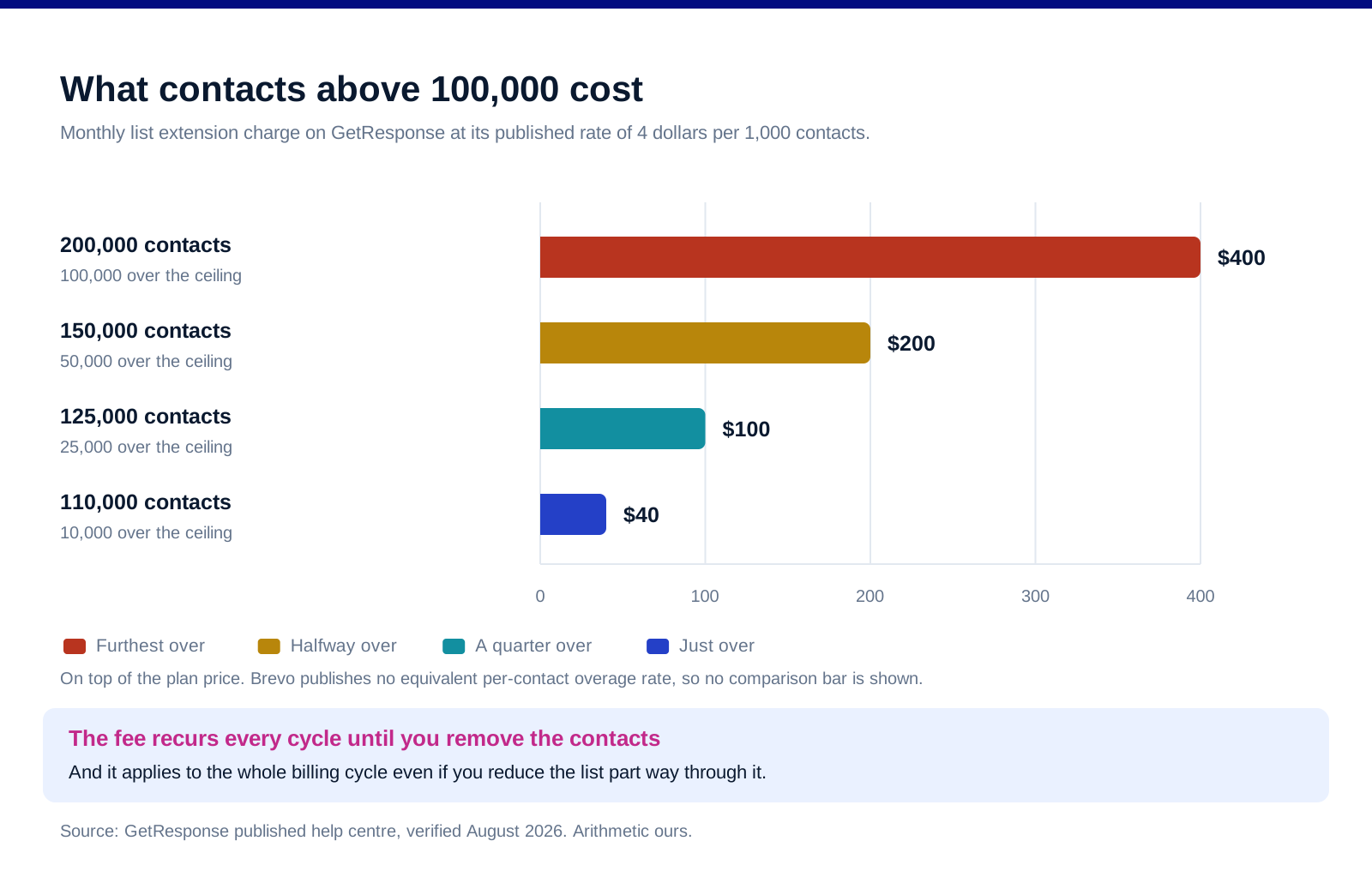
Going over is not a one-off. GetResponse applies a list extension fee equal to the difference between your plan's price and the plan matching your actual list size. Its help centre states "This is not a one-time fee, which means that we'll continue to charge you at the end of each billing cycle until you remove excess contacts", and that "the fee is applicable for the whole billing cycle, even if you reduce the number of contacts during the month period".
Above 100,000 there is a published unit rate. The page gives "$4.00 for every 1,000 contacts you start adding". At 110,000 contacts that is an extra $40 a month, at 150,000 an extra $200, and at 200,000 an extra $400, on top of the plan.
None of this makes GetResponse a bad product, and we earn from it either way. It makes it a product whose bill you should model on your actual list behaviour rather than on the number in your CRM today. Our GetResponse review covers the product itself rather than the meter.
![[INSERT FIGURE 2, getresponse-vs-brevo-figure-2-brevo-selector.svg] Alt: Brevo's published plans in 2026, priced on monthly sends with contact storage attached to each tier.](https://framerusercontent.com/images/6Fr43n5covG43WGfwfTftkhnrFk.jpg)
What each free tier is really for
Brevo's free plan is a storage offer with a throttle. A hundred thousand contacts at no cost is unusual, and 300 sends a day is the price of it. For a company migrating a large historical list while it decides what to do, that combination is genuinely useful. For anyone with a live campaign schedule it is a trial, not a plan.
And the sticker matters more than it sounds. Brevo states the free plan's emails always carry the Sent with Brevo sticker and that it cannot be removed there. On Starter it can, via a stated add-on of $9 a month, which is worth adding to the Starter price before comparing.
GetResponse does not publish a free plan on the page we read. It publishes trials against each paid tier instead, which is a different offer and a shorter one.
So the free tiers answer different questions. Brevo's answers "can I hold my data here", GetResponse's answers "can I run my campaigns here". Neither answers the other.
Which one fits which shape
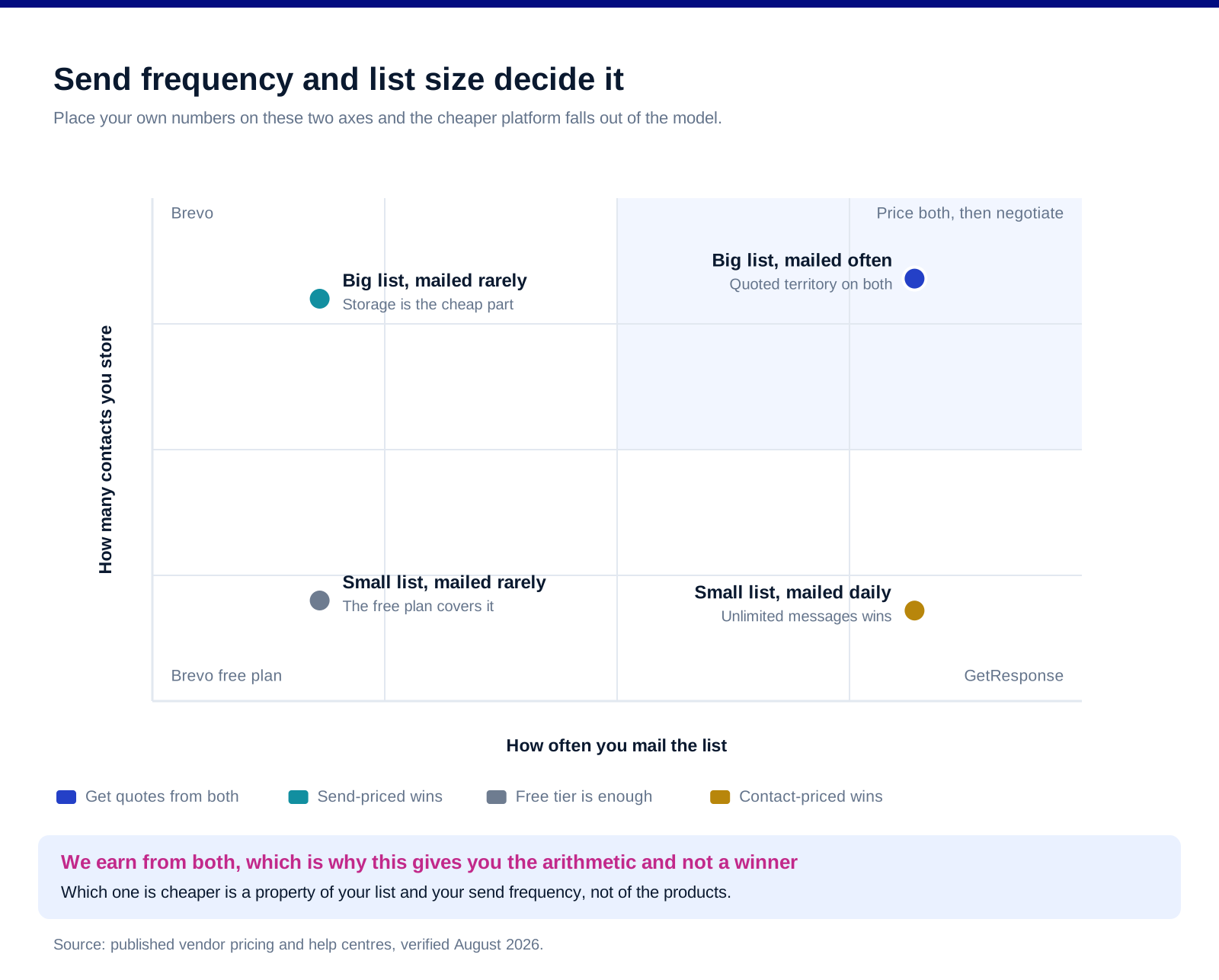
A large list mailed occasionally. Brevo, clearly. You are paying for the thing you actually consume, and storage is the part it is generous with.
A small list mailed constantly. GetResponse, on the strength of unlimited messages at the published subscriber tier. A daily sender at 1,000 contacts is the exact shape its entry plan is built around.
A list that grows in bursts through imports. Model GetResponse carefully first. Peak subscribers plus contacts added during the month, with no credit for contacts removed inside the cycle, is the rule that surprises people, and imports are where it bites.
Heavy segmentation into separate lists. Same warning. On GetResponse, tag inside one list rather than duplicating people across several, or accept that the duplicates are billable.
Above 100,000 contacts and sending at volume. You are into quoted territory on both sides. Get both quotes, put them side by side on your own numbers, and treat the published rate cards as an opening position rather than an answer. Our note on email deliverability covers the questions that matter more than price at that size.
What we do not publish here
GetResponse's per-tier prices above the entry level. Its help centre lists the tiers at 1k through 100k and its pricing page carries a selector we could not read tier by tier, so we give the published entry price and the tier list and decline to estimate the ladder.
Brevo's per-tier prices between the published floors. The plans are given as ranges starting at $9, $18 and $499, and the intermediate steps are not something we are going to interpolate.
A deliverability comparison. We have not run both on matched lists, domains and sending patterns, and every published figure of that kind in this category comes from a vendor or an affiliate of one.
A winner. These two are priced on different units, so which is cheaper is a property of your list and your send frequency rather than of the products. The arithmetic above is the answer, and it has your numbers in it, not ours.
Feature-by-feature scoring. Both cover the email marketing basics, both have grown sideways into CRM and automation, and a feature table would obscure the pricing difference that actually decides this.
FAQ
Is GetResponse or Brevo cheaper?
It depends entirely on your ratio of sends to contacts. GetResponse prices by list size, from $19 a month for unlimited messages to 1,000 subscribers. Brevo prices by monthly email volume, from $9 on Starter. Mail a large list rarely and Brevo wins. Mail a small list constantly and GetResponse's unlimited messages wins.
How does GetResponse count contacts for billing?
By the peak number of active subscribers in the billing month and the total number of contacts added during it. An address on three lists counts three times, and you pay for contacts added even if they unsubscribe or are deleted before the month ends. That is stricter than most buyers assume from the phrase list size.
What happens if you go over your GetResponse list limit?
A list extension fee applies, equal to the difference between your plan price and the plan that fits your actual list. It recurs each billing cycle until you remove the excess contacts, and applies to the whole cycle even if you reduce mid-month. Above 100,000 contacts the published rate is $4.00 per 1,000.
How good is Brevo's free plan?
Unusually generous on storage and unusually tight on throughput: up to 100,000 contacts, but 300 email sends a day, with up to 1,000 more held in a retry queue. Emails carry a Sent with Brevo sticker that cannot be removed on the free plan, automations take up to 2,000 unique contacts, and it is single user.
Does Brevo charge for contacts at all?
Contact limits are attached to the plan rather than driving the price. Starter and Standard state limits of 500 to 500,000 depending on the send tier, Professional states up to 2 million, and Enterprise is described as unlimited contact storage. The number you are buying is the send volume.
Which should you pick for a list you segment heavily?
Check how you segment before deciding. On GetResponse, splitting people across separate lists duplicates them for billing, so tag inside one list instead. On Brevo, segmentation does not move the meter, because the meter is counting sends.
Bottom line
Work out two numbers and the decision makes itself: how many contacts you will hold, and how many emails you will send them in a month. GetResponse charges for the first and gives you the second without limit at your tier. Brevo charges for the second and treats the first as an allowance attached to it. A large list mailed once a month is a Brevo shape. A small list mailed daily is a GetResponse shape. Then read GetResponse's counting rules properly before you commit, because peak subscribers plus contacts added, with duplicates across lists counted separately and no credit for removals inside the cycle, is a materially different bill from the number sitting in your CRM. And if you are above a hundred thousand contacts, stop reading rate cards and get both quotes, because that is quoted territory on both sides and the published prices stop being the answer.
Want the pipeline built rather than the email tool chosen? Book a call with GROU. We run lead generation and outbound inside B2B revenue engines across verticals.
We are GROU, a B2B pipeline agency that runs lead generation, outbound, and LinkedIn content for clients across manufacturing, fintech, iGaming, software, and professional services. Both tools in this comparison are affiliate links, GetResponse and Brevo, so we earn either way and have no reason to prefer one. Every price and rule quoted is taken from each vendor's own pricing page or help centre and verified in August 2026. Prices and terms change, so check before you buy.
One of these charges you for the people on your list. The other charges you for the emails you send. Everything else in this comparison is a detail hanging off that one difference.
It shows up most clearly in what each one gives away free. Brevo will store a hundred thousand contacts for nothing and ration you to three hundred sends a day. GetResponse sells unlimited messages and rations the contacts. Each vendor is generous with exactly the thing the other one meters.
TL;DR
GetResponse prices on list size. Its help centre states billing is set by "the peak number of active subscribers during the billing month and the total number of contacts added within that billing month", with published tiers at 1k, 2.5k, 5k, 10k, 25k, 50k and 100k, and an entry price of "$19 per month for unlimited messages to up to 1,000 subscribers". Brevo prices on sends. Its free plan allows 300 email sends per day while storing up to 100,000 contacts, and its paid tiers are denominated in monthly email volume, from a Starter plan beginning at $9 for 5,000 to 100,000 monthly sends up to a Professional plan beginning at $499 for 150,000 to 10 million. Three things follow. If you hold a large list and mail it rarely, Brevo's model is built for you and GetResponse's is not. If you hold a small list and mail it constantly, GetResponse's unlimited messages is the better shape. And GetResponse's counting rules are stricter than "how many contacts do I have", which is the part of this comparison most worth reading twice before you buy.
The one difference that generates the others
GetResponse meters people. Its pricing page publishes Starter at $19 a month, Marketer at $59 and Creator at $69, with an Enterprise tier quoted, and its help centre confirms the entry price covers "unlimited messages to up to 1,000 subscribers". Annual billing is stated to save 18 percent, with a further 10 percent for completing the Get Started Checklist and up to 50 percent for nonprofits.
Brevo meters messages. Its plans are denominated in monthly email sends, with contact storage attached to the tier rather than driving it. Starter runs from $9 covering 5,000 to 100,000 monthly sends with contact limits of 500 to 500,000, Standard from $18 covering 5,000 to 500,000 sends, and Professional from $499 covering 150,000 to 10 million sends with up to 2 million contacts. Enterprise is quoted and described as unlimited contact storage.
Which means the free plans are mirror images. Brevo's free plan stores up to 100,000 contacts, the same ceiling as GetResponse's highest published tier, while capping you at 300 email sends per day with up to 1,000 more held in a retry queue. Emails on it "always include the Sent with Brevo sticker", automations accept up to 2,000 unique contacts, and it is single user with a maximum of 50 open deals and one pipeline.
So work out your ratio before you compare anything else. Divide the emails you expect to send in a month by the number of contacts you expect to hold. A ratio near one, meaning you mail the whole list once a month, favours the send-priced model. A ratio of ten or twenty, meaning you mail constantly, favours the contact-priced one. Our note on Brevo pricing goes deeper on that side of the ladder.
GetResponse counts contacts more strictly than you would
Billing is set by two numbers, not one. GetResponse's help centre states it is "determined by the peak number of active subscribers during the billing month and the total number of contacts added within that billing month". Those can differ substantially for anyone importing and cleaning lists.
The same person can count more than once. The page states that "Each GetResponse list is treated independently. This means that if an email address is assigned to multiple lists, it counts as multiple contacts." If you segment by running separate lists rather than by tagging inside one, that architecture decision has a price attached.
And removing someone does not remove the charge. The help centre says "You pay for all subscribers added during the billing month, regardless of what happens to them afterward", which covers contacts who unsubscribe or are deleted inside the same cycle.
Going over is not a one-off. GetResponse applies a list extension fee equal to the difference between your plan's price and the plan matching your actual list size. Its help centre states "This is not a one-time fee, which means that we'll continue to charge you at the end of each billing cycle until you remove excess contacts", and that "the fee is applicable for the whole billing cycle, even if you reduce the number of contacts during the month period".
Above 100,000 there is a published unit rate. The page gives "$4.00 for every 1,000 contacts you start adding". At 110,000 contacts that is an extra $40 a month, at 150,000 an extra $200, and at 200,000 an extra $400, on top of the plan.
None of this makes GetResponse a bad product, and we earn from it either way. It makes it a product whose bill you should model on your actual list behaviour rather than on the number in your CRM today. Our GetResponse review covers the product itself rather than the meter.
What each free tier is really for
Brevo's free plan is a storage offer with a throttle. A hundred thousand contacts at no cost is unusual, and 300 sends a day is the price of it. For a company migrating a large historical list while it decides what to do, that combination is genuinely useful. For anyone with a live campaign schedule it is a trial, not a plan.
And the sticker matters more than it sounds. Brevo states the free plan's emails always carry the Sent with Brevo sticker and that it cannot be removed there. On Starter it can, via a stated add-on of $9 a month, which is worth adding to the Starter price before comparing.
GetResponse does not publish a free plan on the page we read. It publishes trials against each paid tier instead, which is a different offer and a shorter one.
So the free tiers answer different questions. Brevo's answers "can I hold my data here", GetResponse's answers "can I run my campaigns here". Neither answers the other.
Which one fits which shape
A large list mailed occasionally. Brevo, clearly. You are paying for the thing you actually consume, and storage is the part it is generous with.
A small list mailed constantly. GetResponse, on the strength of unlimited messages at the published subscriber tier. A daily sender at 1,000 contacts is the exact shape its entry plan is built around.
A list that grows in bursts through imports. Model GetResponse carefully first. Peak subscribers plus contacts added during the month, with no credit for contacts removed inside the cycle, is the rule that surprises people, and imports are where it bites.
Heavy segmentation into separate lists. Same warning. On GetResponse, tag inside one list rather than duplicating people across several, or accept that the duplicates are billable.
Above 100,000 contacts and sending at volume. You are into quoted territory on both sides. Get both quotes, put them side by side on your own numbers, and treat the published rate cards as an opening position rather than an answer. Our note on email deliverability covers the questions that matter more than price at that size.
What we do not publish here
GetResponse's per-tier prices above the entry level. Its help centre lists the tiers at 1k through 100k and its pricing page carries a selector we could not read tier by tier, so we give the published entry price and the tier list and decline to estimate the ladder.
Brevo's per-tier prices between the published floors. The plans are given as ranges starting at $9, $18 and $499, and the intermediate steps are not something we are going to interpolate.
A deliverability comparison. We have not run both on matched lists, domains and sending patterns, and every published figure of that kind in this category comes from a vendor or an affiliate of one.
A winner. These two are priced on different units, so which is cheaper is a property of your list and your send frequency rather than of the products. The arithmetic above is the answer, and it has your numbers in it, not ours.
Feature-by-feature scoring. Both cover the email marketing basics, both have grown sideways into CRM and automation, and a feature table would obscure the pricing difference that actually decides this.
FAQ
Is GetResponse or Brevo cheaper?
It depends entirely on your ratio of sends to contacts. GetResponse prices by list size, from $19 a month for unlimited messages to 1,000 subscribers. Brevo prices by monthly email volume, from $9 on Starter. Mail a large list rarely and Brevo wins. Mail a small list constantly and GetResponse's unlimited messages wins.
How does GetResponse count contacts for billing?
By the peak number of active subscribers in the billing month and the total number of contacts added during it. An address on three lists counts three times, and you pay for contacts added even if they unsubscribe or are deleted before the month ends. That is stricter than most buyers assume from the phrase list size.
What happens if you go over your GetResponse list limit?
A list extension fee applies, equal to the difference between your plan price and the plan that fits your actual list. It recurs each billing cycle until you remove the excess contacts, and applies to the whole cycle even if you reduce mid-month. Above 100,000 contacts the published rate is $4.00 per 1,000.
How good is Brevo's free plan?
Unusually generous on storage and unusually tight on throughput: up to 100,000 contacts, but 300 email sends a day, with up to 1,000 more held in a retry queue. Emails carry a Sent with Brevo sticker that cannot be removed on the free plan, automations take up to 2,000 unique contacts, and it is single user.
Does Brevo charge for contacts at all?
Contact limits are attached to the plan rather than driving the price. Starter and Standard state limits of 500 to 500,000 depending on the send tier, Professional states up to 2 million, and Enterprise is described as unlimited contact storage. The number you are buying is the send volume.
Which should you pick for a list you segment heavily?
Check how you segment before deciding. On GetResponse, splitting people across separate lists duplicates them for billing, so tag inside one list instead. On Brevo, segmentation does not move the meter, because the meter is counting sends.
Bottom line
Work out two numbers and the decision makes itself: how many contacts you will hold, and how many emails you will send them in a month. GetResponse charges for the first and gives you the second without limit at your tier. Brevo charges for the second and treats the first as an allowance attached to it. A large list mailed once a month is a Brevo shape. A small list mailed daily is a GetResponse shape. Then read GetResponse's counting rules properly before you commit, because peak subscribers plus contacts added, with duplicates across lists counted separately and no credit for removals inside the cycle, is a materially different bill from the number sitting in your CRM. And if you are above a hundred thousand contacts, stop reading rate cards and get both quotes, because that is quoted territory on both sides and the published prices stop being the answer.
Want the pipeline built rather than the email tool chosen? Book a call with GROU. We run lead generation and outbound inside B2B revenue engines across verticals.
We are GROU, a B2B pipeline agency that runs lead generation, outbound, and LinkedIn content for clients across manufacturing, fintech, iGaming, software, and professional services. Both tools in this comparison are affiliate links, GetResponse and Brevo, so we earn either way and have no reason to prefer one. Every price and rule quoted is taken from each vendor's own pricing page or help centre and verified in August 2026. Prices and terms change, so check before you buy.
One of these charges you for the people on your list. The other charges you for the emails you send. Everything else in this comparison is a detail hanging off that one difference.
It shows up most clearly in what each one gives away free. Brevo will store a hundred thousand contacts for nothing and ration you to three hundred sends a day. GetResponse sells unlimited messages and rations the contacts. Each vendor is generous with exactly the thing the other one meters.
TL;DR
GetResponse prices on list size. Its help centre states billing is set by "the peak number of active subscribers during the billing month and the total number of contacts added within that billing month", with published tiers at 1k, 2.5k, 5k, 10k, 25k, 50k and 100k, and an entry price of "$19 per month for unlimited messages to up to 1,000 subscribers". Brevo prices on sends. Its free plan allows 300 email sends per day while storing up to 100,000 contacts, and its paid tiers are denominated in monthly email volume, from a Starter plan beginning at $9 for 5,000 to 100,000 monthly sends up to a Professional plan beginning at $499 for 150,000 to 10 million. Three things follow. If you hold a large list and mail it rarely, Brevo's model is built for you and GetResponse's is not. If you hold a small list and mail it constantly, GetResponse's unlimited messages is the better shape. And GetResponse's counting rules are stricter than "how many contacts do I have", which is the part of this comparison most worth reading twice before you buy.
The one difference that generates the others
GetResponse meters people. Its pricing page publishes Starter at $19 a month, Marketer at $59 and Creator at $69, with an Enterprise tier quoted, and its help centre confirms the entry price covers "unlimited messages to up to 1,000 subscribers". Annual billing is stated to save 18 percent, with a further 10 percent for completing the Get Started Checklist and up to 50 percent for nonprofits.
Brevo meters messages. Its plans are denominated in monthly email sends, with contact storage attached to the tier rather than driving it. Starter runs from $9 covering 5,000 to 100,000 monthly sends with contact limits of 500 to 500,000, Standard from $18 covering 5,000 to 500,000 sends, and Professional from $499 covering 150,000 to 10 million sends with up to 2 million contacts. Enterprise is quoted and described as unlimited contact storage.
Which means the free plans are mirror images. Brevo's free plan stores up to 100,000 contacts, the same ceiling as GetResponse's highest published tier, while capping you at 300 email sends per day with up to 1,000 more held in a retry queue. Emails on it "always include the Sent with Brevo sticker", automations accept up to 2,000 unique contacts, and it is single user with a maximum of 50 open deals and one pipeline.
So work out your ratio before you compare anything else. Divide the emails you expect to send in a month by the number of contacts you expect to hold. A ratio near one, meaning you mail the whole list once a month, favours the send-priced model. A ratio of ten or twenty, meaning you mail constantly, favours the contact-priced one. Our note on Brevo pricing goes deeper on that side of the ladder.
GetResponse counts contacts more strictly than you would
Billing is set by two numbers, not one. GetResponse's help centre states it is "determined by the peak number of active subscribers during the billing month and the total number of contacts added within that billing month". Those can differ substantially for anyone importing and cleaning lists.
The same person can count more than once. The page states that "Each GetResponse list is treated independently. This means that if an email address is assigned to multiple lists, it counts as multiple contacts." If you segment by running separate lists rather than by tagging inside one, that architecture decision has a price attached.
And removing someone does not remove the charge. The help centre says "You pay for all subscribers added during the billing month, regardless of what happens to them afterward", which covers contacts who unsubscribe or are deleted inside the same cycle.
Going over is not a one-off. GetResponse applies a list extension fee equal to the difference between your plan's price and the plan matching your actual list size. Its help centre states "This is not a one-time fee, which means that we'll continue to charge you at the end of each billing cycle until you remove excess contacts", and that "the fee is applicable for the whole billing cycle, even if you reduce the number of contacts during the month period".
Above 100,000 there is a published unit rate. The page gives "$4.00 for every 1,000 contacts you start adding". At 110,000 contacts that is an extra $40 a month, at 150,000 an extra $200, and at 200,000 an extra $400, on top of the plan.
None of this makes GetResponse a bad product, and we earn from it either way. It makes it a product whose bill you should model on your actual list behaviour rather than on the number in your CRM today. Our GetResponse review covers the product itself rather than the meter.
What each free tier is really for
Brevo's free plan is a storage offer with a throttle. A hundred thousand contacts at no cost is unusual, and 300 sends a day is the price of it. For a company migrating a large historical list while it decides what to do, that combination is genuinely useful. For anyone with a live campaign schedule it is a trial, not a plan.
And the sticker matters more than it sounds. Brevo states the free plan's emails always carry the Sent with Brevo sticker and that it cannot be removed there. On Starter it can, via a stated add-on of $9 a month, which is worth adding to the Starter price before comparing.
GetResponse does not publish a free plan on the page we read. It publishes trials against each paid tier instead, which is a different offer and a shorter one.
So the free tiers answer different questions. Brevo's answers "can I hold my data here", GetResponse's answers "can I run my campaigns here". Neither answers the other.
Which one fits which shape
A large list mailed occasionally. Brevo, clearly. You are paying for the thing you actually consume, and storage is the part it is generous with.
A small list mailed constantly. GetResponse, on the strength of unlimited messages at the published subscriber tier. A daily sender at 1,000 contacts is the exact shape its entry plan is built around.
A list that grows in bursts through imports. Model GetResponse carefully first. Peak subscribers plus contacts added during the month, with no credit for contacts removed inside the cycle, is the rule that surprises people, and imports are where it bites.
Heavy segmentation into separate lists. Same warning. On GetResponse, tag inside one list rather than duplicating people across several, or accept that the duplicates are billable.
Above 100,000 contacts and sending at volume. You are into quoted territory on both sides. Get both quotes, put them side by side on your own numbers, and treat the published rate cards as an opening position rather than an answer. Our note on email deliverability covers the questions that matter more than price at that size.
What we do not publish here
GetResponse's per-tier prices above the entry level. Its help centre lists the tiers at 1k through 100k and its pricing page carries a selector we could not read tier by tier, so we give the published entry price and the tier list and decline to estimate the ladder.
Brevo's per-tier prices between the published floors. The plans are given as ranges starting at $9, $18 and $499, and the intermediate steps are not something we are going to interpolate.
A deliverability comparison. We have not run both on matched lists, domains and sending patterns, and every published figure of that kind in this category comes from a vendor or an affiliate of one.
A winner. These two are priced on different units, so which is cheaper is a property of your list and your send frequency rather than of the products. The arithmetic above is the answer, and it has your numbers in it, not ours.
Feature-by-feature scoring. Both cover the email marketing basics, both have grown sideways into CRM and automation, and a feature table would obscure the pricing difference that actually decides this.
FAQ
Is GetResponse or Brevo cheaper?
It depends entirely on your ratio of sends to contacts. GetResponse prices by list size, from $19 a month for unlimited messages to 1,000 subscribers. Brevo prices by monthly email volume, from $9 on Starter. Mail a large list rarely and Brevo wins. Mail a small list constantly and GetResponse's unlimited messages wins.
How does GetResponse count contacts for billing?
By the peak number of active subscribers in the billing month and the total number of contacts added during it. An address on three lists counts three times, and you pay for contacts added even if they unsubscribe or are deleted before the month ends. That is stricter than most buyers assume from the phrase list size.
What happens if you go over your GetResponse list limit?
A list extension fee applies, equal to the difference between your plan price and the plan that fits your actual list. It recurs each billing cycle until you remove the excess contacts, and applies to the whole cycle even if you reduce mid-month. Above 100,000 contacts the published rate is $4.00 per 1,000.
How good is Brevo's free plan?
Unusually generous on storage and unusually tight on throughput: up to 100,000 contacts, but 300 email sends a day, with up to 1,000 more held in a retry queue. Emails carry a Sent with Brevo sticker that cannot be removed on the free plan, automations take up to 2,000 unique contacts, and it is single user.
Does Brevo charge for contacts at all?
Contact limits are attached to the plan rather than driving the price. Starter and Standard state limits of 500 to 500,000 depending on the send tier, Professional states up to 2 million, and Enterprise is described as unlimited contact storage. The number you are buying is the send volume.
Which should you pick for a list you segment heavily?
Check how you segment before deciding. On GetResponse, splitting people across separate lists duplicates them for billing, so tag inside one list instead. On Brevo, segmentation does not move the meter, because the meter is counting sends.
Bottom line
Work out two numbers and the decision makes itself: how many contacts you will hold, and how many emails you will send them in a month. GetResponse charges for the first and gives you the second without limit at your tier. Brevo charges for the second and treats the first as an allowance attached to it. A large list mailed once a month is a Brevo shape. A small list mailed daily is a GetResponse shape. Then read GetResponse's counting rules properly before you commit, because peak subscribers plus contacts added, with duplicates across lists counted separately and no credit for removals inside the cycle, is a materially different bill from the number sitting in your CRM. And if you are above a hundred thousand contacts, stop reading rate cards and get both quotes, because that is quoted territory on both sides and the published prices stop being the answer.
Want the pipeline built rather than the email tool chosen? Book a call with GROU. We run lead generation and outbound inside B2B revenue engines across verticals.
We are GROU, a B2B pipeline agency that runs lead generation, outbound, and LinkedIn content for clients across manufacturing, fintech, iGaming, software, and professional services. Both tools in this comparison are affiliate links, GetResponse and Brevo, so we earn either way and have no reason to prefer one. Every price and rule quoted is taken from each vendor's own pricing page or help centre and verified in August 2026. Prices and terms change, so check before you buy.

Pipeline OS Newsletter
Build qualified pipeline
Get weekly tactics to generate demand, improve lead quality, and book more meetings.





Trusted by industry leaders
Trusted by industry leaders
Trusted by industry leaders
Ready to build qualified pipeline?
Ready to build qualified pipeline?
Ready to build qualified pipeline?
Book a call to see if we're the right fit, or take the 2-minute quiz to get a clear starting point.
Book a call to see if we're the right fit, or take the 2-minute quiz to get a clear starting point.
Book a call to see if we're the right fit, or take the 2-minute quiz to get a clear starting point.
" height="30.21639343089746px" id="hfGbXmQR2" width="30.216393430897455px"/></svg>)
Copyright © 2026 – All Right Reserved
Copyright © 2026 – All Right Reserved
Copyright © 2026 – All Right Reserved