%22%3E%3C/path%3E%3Cpath d=%22M 63.072 7.554 C 62.258 8.022 61.577 8.689 61.092 9.493 L 61.092 7.076 L 57.158 7.076 L 57.158 22.64 L 61.089 22.64 L 61.089 14.888 C 61.089 13.446 61.403 12.434 62.03 11.853 C 62.818 11.218 63.818 10.907 64.826 10.982 L 65.868 10.982 L 65.868 6.851 C 64.891 6.834 63.926 7.076 63.073 7.554 Z%22 fill=%22rgb(17,17,17)%22%3E%3C/path%3E%3Cpath d=%22M 78.916 7.82 C 76.363 6.49 73.321 6.49 70.768 7.82 C 69.562 8.473 68.564 9.451 67.888 10.644 C 67.167 11.931 66.803 13.387 66.834 14.862 C 66.804 16.332 67.157 17.785 67.86 19.077 C 68.515 20.267 69.494 21.246 70.684 21.901 C 71.924 22.576 73.318 22.92 74.73 22.898 C 76.164 22.918 77.58 22.575 78.846 21.901 C 80.062 21.247 81.073 20.27 81.768 19.077 C 82.506 17.797 82.88 16.339 82.85 14.862 C 82.88 13.389 82.517 11.934 81.797 10.647 C 81.12 9.455 80.122 8.477 78.917 7.824 M 78.803 14.862 C 78.829 15.739 78.636 16.608 78.241 17.391 C 77.903 18.046 77.38 18.588 76.738 18.95 C 76.124 19.293 75.432 19.472 74.729 19.47 C 73.668 19.497 72.648 19.061 71.934 18.276 C 71.139 17.323 70.741 16.1 70.823 14.862 C 70.741 13.62 71.149 12.395 71.959 11.45 C 72.687 10.667 73.715 10.233 74.783 10.256 C 75.859 10.236 76.894 10.67 77.635 11.45 C 78.464 12.387 78.884 13.616 78.801 14.864%22 fill=%22rgb(17,17,17)%22%3E%3C/path%3E%3Cpath d=%22M 95.906 7.076 L 95.906 15.646 C 95.975 16.68 95.643 17.701 94.979 18.498 C 94.311 19.184 93.379 19.547 92.422 19.495 C 91.475 19.544 90.553 19.18 89.894 18.498 C 89.23 17.701 88.898 16.68 88.967 15.646 L 88.967 7.076 L 85.033 7.076 L 85.033 16.207 C 85 17.449 85.275 18.68 85.834 19.79 C 86.327 20.75 87.095 21.542 88.039 22.065 C 89.033 22.594 90.145 22.861 91.271 22.838 C 92.188 22.847 93.095 22.65 93.926 22.263 C 94.708 21.905 95.388 21.36 95.906 20.675 L 95.906 22.645 L 99.865 22.645 L 99.865 7.076 Z%22 fill=%22rgb(17,17,17)%22%3E%3C/path%3E%3Cpath d=%22M 4.513 15.626 C 4.511 10.815 7.606 6.549 12.181 5.059 C 16.756 3.57 21.77 5.195 24.601 9.086 L 27.816 5.87 C 24.074 1.186 17.981 -0.943 12.137 0.393 C 6.292 1.728 1.728 6.292 0.393 12.137 C -0.943 17.981 1.186 24.074 5.87 27.816 L 9.085 24.601 C 6.214 22.512 4.515 19.177 4.513 15.626%22 fill=%22rgb(32,62,235)%22%3E%3C/path%3E%3Cpath d=%22M 17.114 14.343 L 13.354 18.01 L 13.354 18.026 L 21.071 18.026 L 11.412 27.609 L 17.389 27.609 L 23.999 21.081 L 23.999 28.316 L 24.005 28.316 L 27.967 24.393 L 27.967 14.343 Z%22 fill=%22rgb(32,62,235)%22%3E%3C/path%3E%3C/g%3E%3C/svg%3E) ×
× ××
××›
›
›
›
How to get listed on Capterra 2026
How to get listed on Capterra 2026
How to get listed on Capterra 2026
How to get listed on Capterra 2026
How to get listed on Capterra 2026
How to get listed on Capterra 2026

Author
Aljaz Peklaj

Getting listed on Capterra takes an afternoon. Getting anywhere useful from the listing takes twenty reviews, and almost nothing written about this distinguishes between the two.
There is also a fact that most of the published advice predates: Capterra no longer belongs to Gartner. It belongs to G2, the competitor it spent a decade being compared against, and the vendor terms you agree to when you claim a profile now name G2 as an operating entity.
TL;DR
The listing itself is the easy part and the part that changes nothing on its own. What decides whether buyers see you is the Capterra Shortlist, and Capterra publishes its threshold: a product needs "at least 20 unique product reviews published on Capterra within 24 months of the start of the research process for a given report" to be considered. Each Shortlist carries no fewer than 5 and up to 25 products, scored on Ratings and Popularity, each weighted and scaled to a value between 1 and 50, with Capterra stating that products are included and scored independently of any relationship it has with vendors. Popularity draws on average monthly search volume and search results positioning as well as review volume and recency, which means your own SEO feeds your directory placement. On the ownership change, G2 announced on 29 January 2026 that it would acquire Capterra, Software Advice and GetApp from Gartner, expected to close in Q1 2026, and Gartner separately confirmed it had entered a definitive agreement to divest the Digital Markets business. Vendors can solicit reviews and offer nominal incentives, but the incentive cannot be contingent on a positive rating and you cannot cherry-pick who you ask. Plan for a review programme, not a listing.
The listing is the easy part
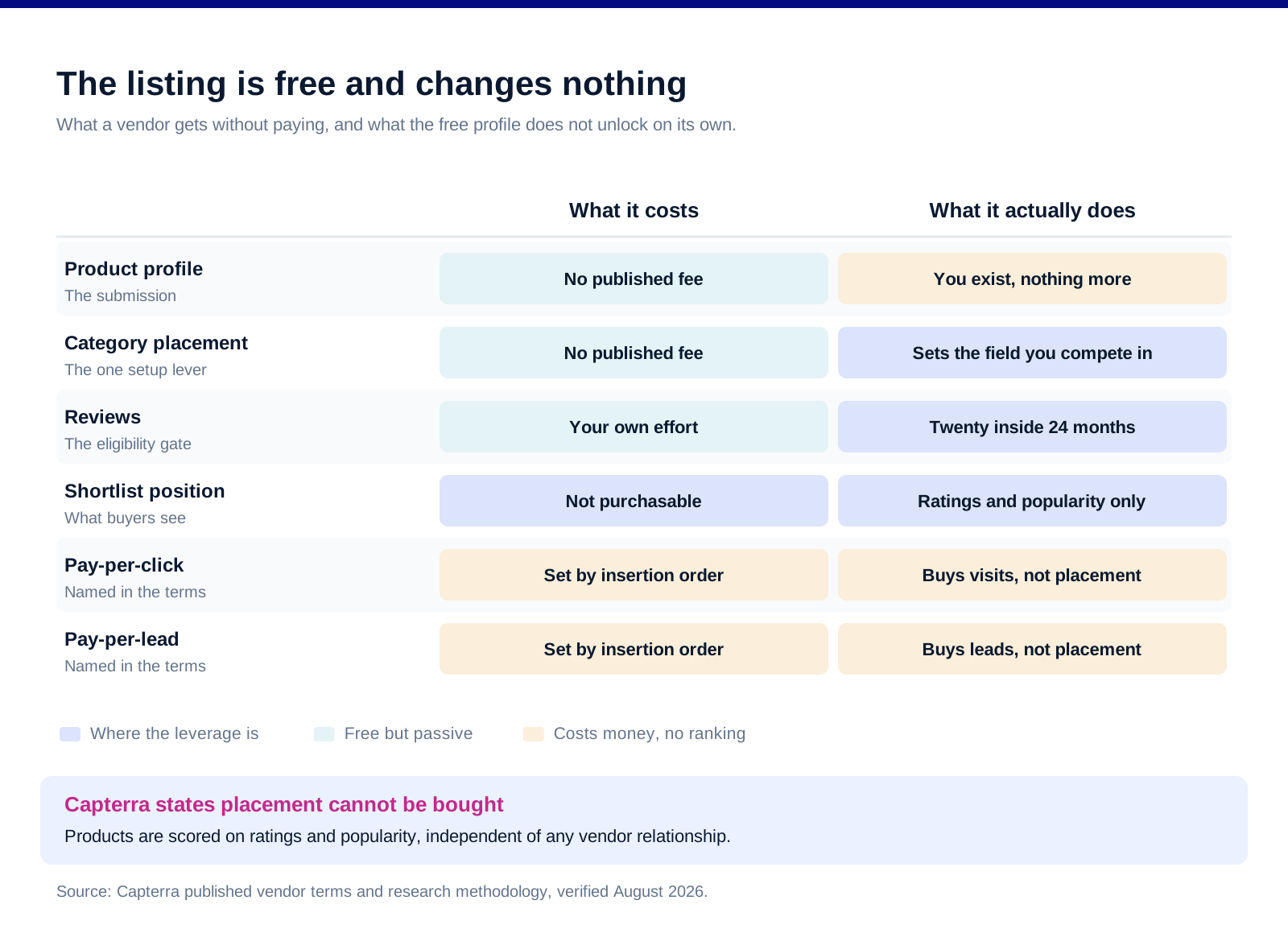
A profile costs nothing and does very little by itself. You submit the product, it gets categorised, and it exists. Capterra states it has "carefully verified over 2 million user-generated reviews" across "more than 45,000 software products in more than 1,200 software categories", which is the real context for a new listing: you are joining a very crowded shelf.
Category choice is the one setup decision that compounds. A product sitting in a category with fewer competitors clears the Shortlist threshold against a smaller field. This is the closest thing to a lever you control at listing time, and it is worth more thought than the description copy.
Your profile copy is not what ranks you. The scoring inputs Capterra publishes are ratings and popularity, not how well you wrote the feature list. Write the copy so a buyer can self-qualify, then stop optimising it.
Reviews are published across more than one site. Capterra's community guidelines require that review solicitation tells people their review may be published on Capterra, Software Advice, GetApp and partner sites. One review programme feeds three directories, which changes the return on the effort.
Paid placement exists and is quoted, not listed. The general vendor terms reference Pay-Per-Click and Pay-Per-Lead services with fees set by "insertion order (or similar transacting document)". There is no published rate card, so anyone quoting you a cost per click for this network is quoting their own experience rather than a list price.
Capterra now belongs to G2
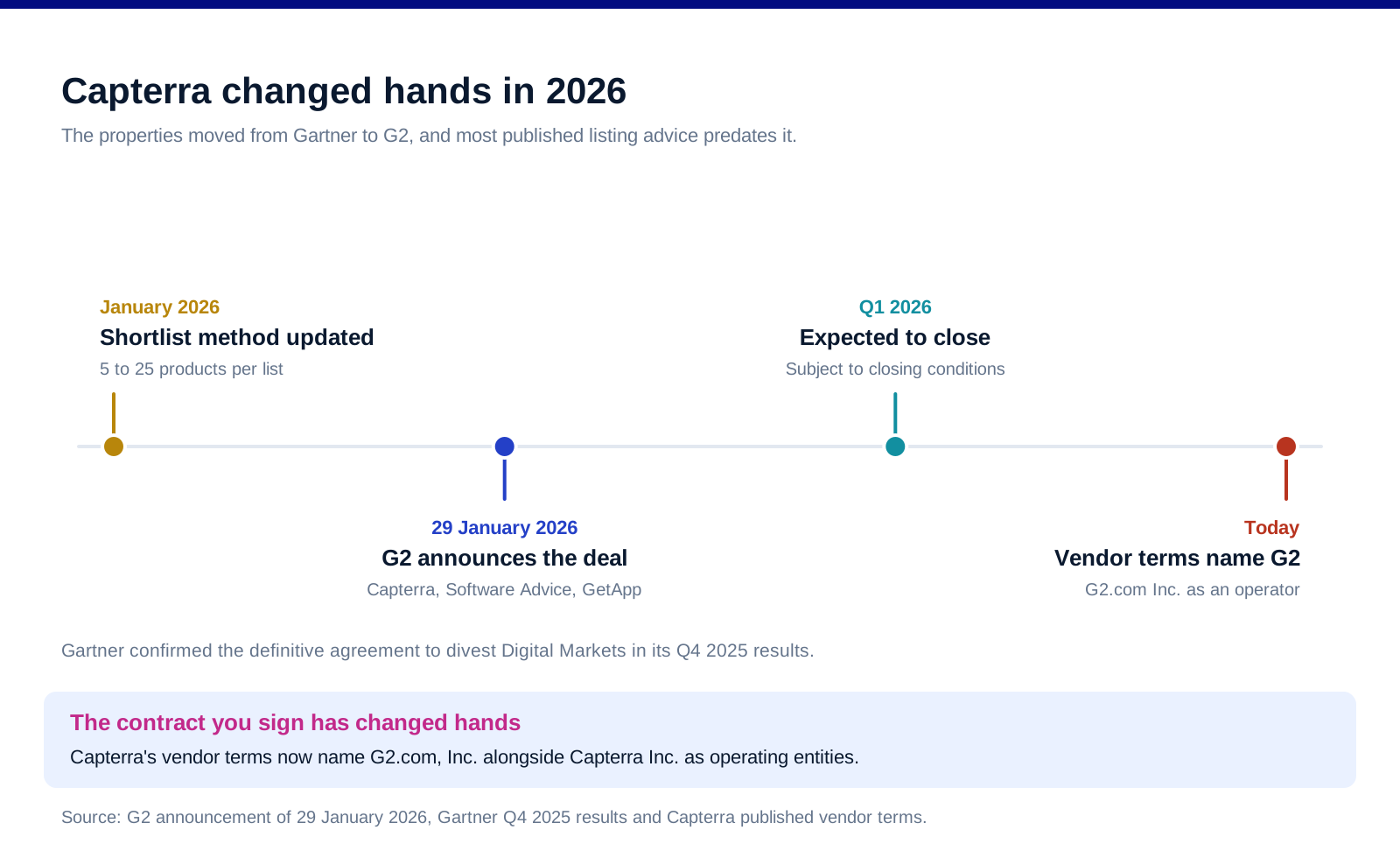
The announcement is dated. G2 announced on 29 January 2026 that it would acquire Capterra, Software Advice and GetApp from Gartner, with the transaction "expected to close in Q1 2026, subject to customary closing conditions".
Gartner confirmed the other side of it. Gartner's fourth quarter 2025 results state that it "entered into a definitive agreement to divest the Digital Markets business".
The vendor terms already reflect it. Capterra's general vendor terms now name "G2.com, Inc. (G2 Digital Markets Site, for example)" alongside "Capterra Inc." as operating entities. That is the practical confirmation for a vendor: the contract you agree to has changed hands, whatever the branding on the page still says.
The combined scale figures come from G2, so treat them as claims. The announcement cites "6 million verified, trusted customer reviews", "200+ million annual software buyers globally across our properties", "10,000+ software vendors" and "2,000+ software and service categories". Those are the acquirer's numbers about its own transaction, not audited figures, and we publish them as such.
What this means for you is narrower than the headlines suggest. The Shortlist methodology, the review rules and the free listing all still work the way Capterra publishes them. What has changed is who you are ultimately contracting with, and the likelihood that a review programme aimed at one network now covers more surface than it used to. If you are also weighing G2 itself, that is a separate exercise and our G2 listing guide covers it.
Twenty reviews in twenty-four months
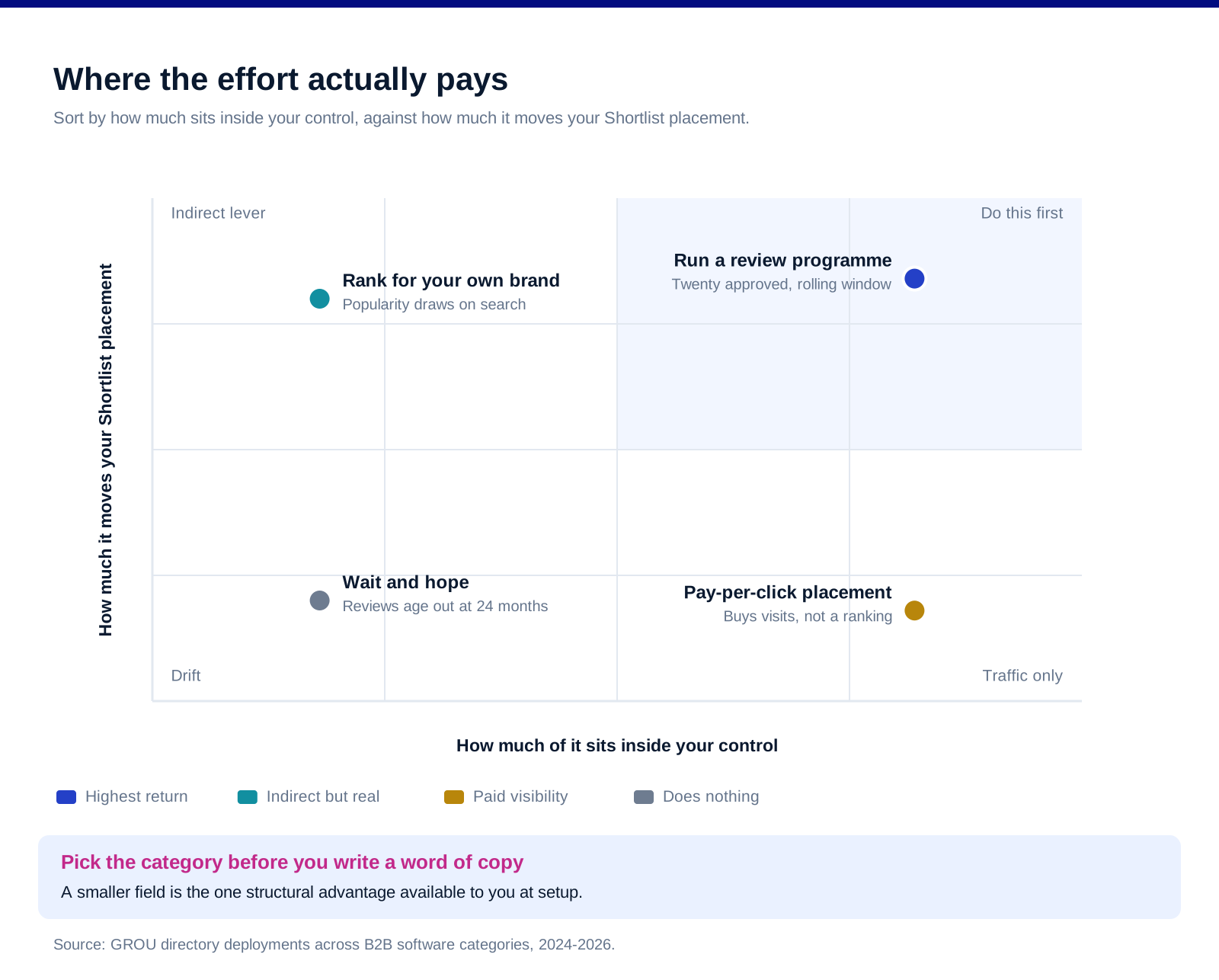
This is the number that decides everything. Capterra's published methodology requires a product to "Have at least 20 unique product reviews published on Capterra within 24 months of the start of the research process for a given report" to be eligible for a Shortlist.
The 24 month window is a treadmill, not a finish line. Reviews age out. A product that hit 20 reviews two years ago and stopped asking has an eligibility problem it will not notice until it drops off a Shortlist.
Scoring runs on two axes. Capterra states that "Each score (Ratings and Popularity) is weighted and scaled to a value between 1-50", with ratings drawn from user ratings over the past 24 months and popularity drawn from average monthly search volume and search results page positioning alongside review volume and recency.
Popularity is partly your own SEO. Search volume for your brand and where you rank for it feed the popularity score. That is an unusual and underappreciated coupling: the work you do to rank your own site also moves your position inside the directory.
Shortlists are small. Capterra states that each one "may include up to 25 products, but no fewer than 5, depending on the number of top-scoring products in a category", under the methodology current from January 2026. In a thin category, 5 places is the whole prize.
Capterra states paid placement does not buy a Shortlist spot. Its methodology says products are "represented, included, and/or scored solely based on user ratings and popularity data and independent of any relationship that Capterra has with vendors". You can buy traffic on this network. On Capterra's own account, you cannot buy the ranking.
Collecting reviews without breaking the rules
You can ask, and you can incentivise, within limits. Capterra's community guidelines permit vendors to offer "nominal incentives to encourage reviews, in compliance with applicable laws". The incentive is paid on approval regardless of the rating submitted.
The disclosure is not optional. Your outreach has to state that incentives are not contingent on submitting a positive review, and that the review may be published on Capterra, Software Advice, GetApp and partner sites. Getting this wrong is the most common way a review programme gets reviews rejected in bulk.
You cannot cherry-pick who you ask. The guidelines require soliciting "in a fair and unbiased manner" from a broad user base rather than selectively targeting users by expected sentiment. Emailing only your promoters is a rule violation, not a clever tactic.
You cannot review your own product, or a competitor's. Vendors are barred from submitting reviews for their own product directly or indirectly, from commissioning fake reviews, and from using third parties to generate them. Employees, government workers and anyone on a sanctions list cannot receive the incentive.
Verification is real and it will catch shortcuts. Capterra states its moderating team uses manual checks and enrichment services to confirm each reviewer is a genuine person, plus technology checks for AI-generated and plagiarised content, and that suspicious reviews trigger a request for additional proof of product use before publication.
Which makes timing the whole game. Twenty approved reviews, from a broad and fairly solicited base, inside a rolling 24 month window. Ask at the moment of value, not at renewal. Our directories playbook covers how this fits alongside the other listing surfaces.
What nobody publishes
No cost per click. Fees are set by insertion order. Any number you read elsewhere is one vendor's invoice, not a rate.
No traffic figure for your category. Capterra publishes network-level claims, not category-level ones. What a listing in your specific category is worth is not knowable in advance from published material.
No conversion benchmark that we would repeat. Every directory conversion rate in circulation comes from a source with an interest in the number.
No timeline for the G2 integration. The announcement describes intent. What the properties look like in a year is not published, and we are not going to speculate about it in a piece you might read six months from now.
FAQ
Is it free to list your software on Capterra?
Yes, creating a product listing does not carry a published fee. Paid options exist separately as Pay-Per-Click and Pay-Per-Lead services under Capterra's general vendor terms, with fees set by insertion order rather than a public rate card. The free listing is the entry point; it is the reviews that determine whether the listing does anything.
How many reviews do you need on Capterra?
At least 20 unique product reviews published on Capterra within 24 months of the start of the research process for a given report, which is the eligibility threshold Capterra publishes for its Shortlist. Because the window rolls, the requirement is continuous rather than a one-time target, and a product that stops collecting reviews eventually falls back out of eligibility.
Who owns Capterra now?
G2 announced on 29 January 2026 that it would acquire Capterra, Software Advice and GetApp from Gartner, with the transaction expected to close in the first quarter of 2026, and Gartner confirmed it had entered a definitive agreement to divest the Digital Markets business. Capterra's general vendor terms now name G2.com, Inc. alongside Capterra Inc. as operating entities.
Can you pay to rank higher on Capterra?
Capterra's published methodology says products are represented, included and scored solely on user ratings and popularity data, and independently of any relationship Capterra has with vendors. Paid placement buys visibility through Pay-Per-Click and Pay-Per-Lead products, which is a different thing from a Shortlist position. On Capterra's own account, the ranking is not for sale.
Can you offer customers an incentive for a Capterra review?
Yes, nominal incentives are permitted in compliance with applicable laws, but the incentive must be paid regardless of the rating and your outreach must say so explicitly. You must also disclose that the review may be published on Capterra, Software Advice, GetApp and partner sites, solicit fairly from a broad user base rather than selecting for likely promoters, and never offer the incentive to your own employees.
How long does it take to get listed on Capterra?
The submission itself is short, but the listing is not the milestone that matters. Plan against the 20 review threshold instead, because a product with a live profile and four reviews is invisible in exactly the same way a product with no profile is. For most teams the binding constraint is how quickly they can ask a broad enough group of customers, not how quickly Capterra approves the profile.
Bottom line
Treat the listing as administration and the reviews as the project. Twenty approved reviews inside a rolling 24 month window is the published gate, the Shortlist behind it holds between 5 and 25 products, and half the scoring is popularity that your own search presence feeds. Pick the category deliberately, because a smaller field is the one structural advantage available to you at setup. Ask broadly and disclose properly, since the rules on incentives are permissive enough that there is no reason to break them and the verification is thorough enough that breaking them gets caught. And note who you are now contracting with: the properties moved from Gartner to G2 in 2026, the vendor terms already name G2, and a review programme aimed at this network now reaches further than the advice written before that.
Want the directory presence built rather than researched? Book a call with GROU. We run lead generation and outbound inside B2B revenue engines across verticals.
We are GROU, a B2B pipeline agency that runs lead generation, outbound, and LinkedIn content for clients across manufacturing, fintech, iGaming, software, and professional services. The listing and review guidance reflects our deployments across B2B software categories between 2024 and 2026, anonymized to protect client confidentiality.
Getting listed on Capterra takes an afternoon. Getting anywhere useful from the listing takes twenty reviews, and almost nothing written about this distinguishes between the two.
There is also a fact that most of the published advice predates: Capterra no longer belongs to Gartner. It belongs to G2, the competitor it spent a decade being compared against, and the vendor terms you agree to when you claim a profile now name G2 as an operating entity.
TL;DR
The listing itself is the easy part and the part that changes nothing on its own. What decides whether buyers see you is the Capterra Shortlist, and Capterra publishes its threshold: a product needs "at least 20 unique product reviews published on Capterra within 24 months of the start of the research process for a given report" to be considered. Each Shortlist carries no fewer than 5 and up to 25 products, scored on Ratings and Popularity, each weighted and scaled to a value between 1 and 50, with Capterra stating that products are included and scored independently of any relationship it has with vendors. Popularity draws on average monthly search volume and search results positioning as well as review volume and recency, which means your own SEO feeds your directory placement. On the ownership change, G2 announced on 29 January 2026 that it would acquire Capterra, Software Advice and GetApp from Gartner, expected to close in Q1 2026, and Gartner separately confirmed it had entered a definitive agreement to divest the Digital Markets business. Vendors can solicit reviews and offer nominal incentives, but the incentive cannot be contingent on a positive rating and you cannot cherry-pick who you ask. Plan for a review programme, not a listing.
The listing is the easy part
A profile costs nothing and does very little by itself. You submit the product, it gets categorised, and it exists. Capterra states it has "carefully verified over 2 million user-generated reviews" across "more than 45,000 software products in more than 1,200 software categories", which is the real context for a new listing: you are joining a very crowded shelf.
Category choice is the one setup decision that compounds. A product sitting in a category with fewer competitors clears the Shortlist threshold against a smaller field. This is the closest thing to a lever you control at listing time, and it is worth more thought than the description copy.
Your profile copy is not what ranks you. The scoring inputs Capterra publishes are ratings and popularity, not how well you wrote the feature list. Write the copy so a buyer can self-qualify, then stop optimising it.
Reviews are published across more than one site. Capterra's community guidelines require that review solicitation tells people their review may be published on Capterra, Software Advice, GetApp and partner sites. One review programme feeds three directories, which changes the return on the effort.
Paid placement exists and is quoted, not listed. The general vendor terms reference Pay-Per-Click and Pay-Per-Lead services with fees set by "insertion order (or similar transacting document)". There is no published rate card, so anyone quoting you a cost per click for this network is quoting their own experience rather than a list price.
Capterra now belongs to G2
The announcement is dated. G2 announced on 29 January 2026 that it would acquire Capterra, Software Advice and GetApp from Gartner, with the transaction "expected to close in Q1 2026, subject to customary closing conditions".
Gartner confirmed the other side of it. Gartner's fourth quarter 2025 results state that it "entered into a definitive agreement to divest the Digital Markets business".
The vendor terms already reflect it. Capterra's general vendor terms now name "G2.com, Inc. (G2 Digital Markets Site, for example)" alongside "Capterra Inc." as operating entities. That is the practical confirmation for a vendor: the contract you agree to has changed hands, whatever the branding on the page still says.
The combined scale figures come from G2, so treat them as claims. The announcement cites "6 million verified, trusted customer reviews", "200+ million annual software buyers globally across our properties", "10,000+ software vendors" and "2,000+ software and service categories". Those are the acquirer's numbers about its own transaction, not audited figures, and we publish them as such.
What this means for you is narrower than the headlines suggest. The Shortlist methodology, the review rules and the free listing all still work the way Capterra publishes them. What has changed is who you are ultimately contracting with, and the likelihood that a review programme aimed at one network now covers more surface than it used to. If you are also weighing G2 itself, that is a separate exercise and our G2 listing guide covers it.
Twenty reviews in twenty-four months
This is the number that decides everything. Capterra's published methodology requires a product to "Have at least 20 unique product reviews published on Capterra within 24 months of the start of the research process for a given report" to be eligible for a Shortlist.
The 24 month window is a treadmill, not a finish line. Reviews age out. A product that hit 20 reviews two years ago and stopped asking has an eligibility problem it will not notice until it drops off a Shortlist.
Scoring runs on two axes. Capterra states that "Each score (Ratings and Popularity) is weighted and scaled to a value between 1-50", with ratings drawn from user ratings over the past 24 months and popularity drawn from average monthly search volume and search results page positioning alongside review volume and recency.
Popularity is partly your own SEO. Search volume for your brand and where you rank for it feed the popularity score. That is an unusual and underappreciated coupling: the work you do to rank your own site also moves your position inside the directory.
Shortlists are small. Capterra states that each one "may include up to 25 products, but no fewer than 5, depending on the number of top-scoring products in a category", under the methodology current from January 2026. In a thin category, 5 places is the whole prize.
Capterra states paid placement does not buy a Shortlist spot. Its methodology says products are "represented, included, and/or scored solely based on user ratings and popularity data and independent of any relationship that Capterra has with vendors". You can buy traffic on this network. On Capterra's own account, you cannot buy the ranking.
Collecting reviews without breaking the rules
You can ask, and you can incentivise, within limits. Capterra's community guidelines permit vendors to offer "nominal incentives to encourage reviews, in compliance with applicable laws". The incentive is paid on approval regardless of the rating submitted.
The disclosure is not optional. Your outreach has to state that incentives are not contingent on submitting a positive review, and that the review may be published on Capterra, Software Advice, GetApp and partner sites. Getting this wrong is the most common way a review programme gets reviews rejected in bulk.
You cannot cherry-pick who you ask. The guidelines require soliciting "in a fair and unbiased manner" from a broad user base rather than selectively targeting users by expected sentiment. Emailing only your promoters is a rule violation, not a clever tactic.
You cannot review your own product, or a competitor's. Vendors are barred from submitting reviews for their own product directly or indirectly, from commissioning fake reviews, and from using third parties to generate them. Employees, government workers and anyone on a sanctions list cannot receive the incentive.
Verification is real and it will catch shortcuts. Capterra states its moderating team uses manual checks and enrichment services to confirm each reviewer is a genuine person, plus technology checks for AI-generated and plagiarised content, and that suspicious reviews trigger a request for additional proof of product use before publication.
Which makes timing the whole game. Twenty approved reviews, from a broad and fairly solicited base, inside a rolling 24 month window. Ask at the moment of value, not at renewal. Our directories playbook covers how this fits alongside the other listing surfaces.
What nobody publishes
No cost per click. Fees are set by insertion order. Any number you read elsewhere is one vendor's invoice, not a rate.
No traffic figure for your category. Capterra publishes network-level claims, not category-level ones. What a listing in your specific category is worth is not knowable in advance from published material.
No conversion benchmark that we would repeat. Every directory conversion rate in circulation comes from a source with an interest in the number.
No timeline for the G2 integration. The announcement describes intent. What the properties look like in a year is not published, and we are not going to speculate about it in a piece you might read six months from now.
FAQ
Is it free to list your software on Capterra?
Yes, creating a product listing does not carry a published fee. Paid options exist separately as Pay-Per-Click and Pay-Per-Lead services under Capterra's general vendor terms, with fees set by insertion order rather than a public rate card. The free listing is the entry point; it is the reviews that determine whether the listing does anything.
How many reviews do you need on Capterra?
At least 20 unique product reviews published on Capterra within 24 months of the start of the research process for a given report, which is the eligibility threshold Capterra publishes for its Shortlist. Because the window rolls, the requirement is continuous rather than a one-time target, and a product that stops collecting reviews eventually falls back out of eligibility.
Who owns Capterra now?
G2 announced on 29 January 2026 that it would acquire Capterra, Software Advice and GetApp from Gartner, with the transaction expected to close in the first quarter of 2026, and Gartner confirmed it had entered a definitive agreement to divest the Digital Markets business. Capterra's general vendor terms now name G2.com, Inc. alongside Capterra Inc. as operating entities.
Can you pay to rank higher on Capterra?
Capterra's published methodology says products are represented, included and scored solely on user ratings and popularity data, and independently of any relationship Capterra has with vendors. Paid placement buys visibility through Pay-Per-Click and Pay-Per-Lead products, which is a different thing from a Shortlist position. On Capterra's own account, the ranking is not for sale.
Can you offer customers an incentive for a Capterra review?
Yes, nominal incentives are permitted in compliance with applicable laws, but the incentive must be paid regardless of the rating and your outreach must say so explicitly. You must also disclose that the review may be published on Capterra, Software Advice, GetApp and partner sites, solicit fairly from a broad user base rather than selecting for likely promoters, and never offer the incentive to your own employees.
How long does it take to get listed on Capterra?
The submission itself is short, but the listing is not the milestone that matters. Plan against the 20 review threshold instead, because a product with a live profile and four reviews is invisible in exactly the same way a product with no profile is. For most teams the binding constraint is how quickly they can ask a broad enough group of customers, not how quickly Capterra approves the profile.
Bottom line
Treat the listing as administration and the reviews as the project. Twenty approved reviews inside a rolling 24 month window is the published gate, the Shortlist behind it holds between 5 and 25 products, and half the scoring is popularity that your own search presence feeds. Pick the category deliberately, because a smaller field is the one structural advantage available to you at setup. Ask broadly and disclose properly, since the rules on incentives are permissive enough that there is no reason to break them and the verification is thorough enough that breaking them gets caught. And note who you are now contracting with: the properties moved from Gartner to G2 in 2026, the vendor terms already name G2, and a review programme aimed at this network now reaches further than the advice written before that.
Want the directory presence built rather than researched? Book a call with GROU. We run lead generation and outbound inside B2B revenue engines across verticals.
We are GROU, a B2B pipeline agency that runs lead generation, outbound, and LinkedIn content for clients across manufacturing, fintech, iGaming, software, and professional services. The listing and review guidance reflects our deployments across B2B software categories between 2024 and 2026, anonymized to protect client confidentiality.
Getting listed on Capterra takes an afternoon. Getting anywhere useful from the listing takes twenty reviews, and almost nothing written about this distinguishes between the two.
There is also a fact that most of the published advice predates: Capterra no longer belongs to Gartner. It belongs to G2, the competitor it spent a decade being compared against, and the vendor terms you agree to when you claim a profile now name G2 as an operating entity.
TL;DR
The listing itself is the easy part and the part that changes nothing on its own. What decides whether buyers see you is the Capterra Shortlist, and Capterra publishes its threshold: a product needs "at least 20 unique product reviews published on Capterra within 24 months of the start of the research process for a given report" to be considered. Each Shortlist carries no fewer than 5 and up to 25 products, scored on Ratings and Popularity, each weighted and scaled to a value between 1 and 50, with Capterra stating that products are included and scored independently of any relationship it has with vendors. Popularity draws on average monthly search volume and search results positioning as well as review volume and recency, which means your own SEO feeds your directory placement. On the ownership change, G2 announced on 29 January 2026 that it would acquire Capterra, Software Advice and GetApp from Gartner, expected to close in Q1 2026, and Gartner separately confirmed it had entered a definitive agreement to divest the Digital Markets business. Vendors can solicit reviews and offer nominal incentives, but the incentive cannot be contingent on a positive rating and you cannot cherry-pick who you ask. Plan for a review programme, not a listing.
The listing is the easy part
A profile costs nothing and does very little by itself. You submit the product, it gets categorised, and it exists. Capterra states it has "carefully verified over 2 million user-generated reviews" across "more than 45,000 software products in more than 1,200 software categories", which is the real context for a new listing: you are joining a very crowded shelf.
Category choice is the one setup decision that compounds. A product sitting in a category with fewer competitors clears the Shortlist threshold against a smaller field. This is the closest thing to a lever you control at listing time, and it is worth more thought than the description copy.
Your profile copy is not what ranks you. The scoring inputs Capterra publishes are ratings and popularity, not how well you wrote the feature list. Write the copy so a buyer can self-qualify, then stop optimising it.
Reviews are published across more than one site. Capterra's community guidelines require that review solicitation tells people their review may be published on Capterra, Software Advice, GetApp and partner sites. One review programme feeds three directories, which changes the return on the effort.
Paid placement exists and is quoted, not listed. The general vendor terms reference Pay-Per-Click and Pay-Per-Lead services with fees set by "insertion order (or similar transacting document)". There is no published rate card, so anyone quoting you a cost per click for this network is quoting their own experience rather than a list price.
Capterra now belongs to G2
The announcement is dated. G2 announced on 29 January 2026 that it would acquire Capterra, Software Advice and GetApp from Gartner, with the transaction "expected to close in Q1 2026, subject to customary closing conditions".
Gartner confirmed the other side of it. Gartner's fourth quarter 2025 results state that it "entered into a definitive agreement to divest the Digital Markets business".
The vendor terms already reflect it. Capterra's general vendor terms now name "G2.com, Inc. (G2 Digital Markets Site, for example)" alongside "Capterra Inc." as operating entities. That is the practical confirmation for a vendor: the contract you agree to has changed hands, whatever the branding on the page still says.
The combined scale figures come from G2, so treat them as claims. The announcement cites "6 million verified, trusted customer reviews", "200+ million annual software buyers globally across our properties", "10,000+ software vendors" and "2,000+ software and service categories". Those are the acquirer's numbers about its own transaction, not audited figures, and we publish them as such.
What this means for you is narrower than the headlines suggest. The Shortlist methodology, the review rules and the free listing all still work the way Capterra publishes them. What has changed is who you are ultimately contracting with, and the likelihood that a review programme aimed at one network now covers more surface than it used to. If you are also weighing G2 itself, that is a separate exercise and our G2 listing guide covers it.
Twenty reviews in twenty-four months
This is the number that decides everything. Capterra's published methodology requires a product to "Have at least 20 unique product reviews published on Capterra within 24 months of the start of the research process for a given report" to be eligible for a Shortlist.
The 24 month window is a treadmill, not a finish line. Reviews age out. A product that hit 20 reviews two years ago and stopped asking has an eligibility problem it will not notice until it drops off a Shortlist.
Scoring runs on two axes. Capterra states that "Each score (Ratings and Popularity) is weighted and scaled to a value between 1-50", with ratings drawn from user ratings over the past 24 months and popularity drawn from average monthly search volume and search results page positioning alongside review volume and recency.
Popularity is partly your own SEO. Search volume for your brand and where you rank for it feed the popularity score. That is an unusual and underappreciated coupling: the work you do to rank your own site also moves your position inside the directory.
Shortlists are small. Capterra states that each one "may include up to 25 products, but no fewer than 5, depending on the number of top-scoring products in a category", under the methodology current from January 2026. In a thin category, 5 places is the whole prize.
Capterra states paid placement does not buy a Shortlist spot. Its methodology says products are "represented, included, and/or scored solely based on user ratings and popularity data and independent of any relationship that Capterra has with vendors". You can buy traffic on this network. On Capterra's own account, you cannot buy the ranking.
Collecting reviews without breaking the rules
You can ask, and you can incentivise, within limits. Capterra's community guidelines permit vendors to offer "nominal incentives to encourage reviews, in compliance with applicable laws". The incentive is paid on approval regardless of the rating submitted.
The disclosure is not optional. Your outreach has to state that incentives are not contingent on submitting a positive review, and that the review may be published on Capterra, Software Advice, GetApp and partner sites. Getting this wrong is the most common way a review programme gets reviews rejected in bulk.
You cannot cherry-pick who you ask. The guidelines require soliciting "in a fair and unbiased manner" from a broad user base rather than selectively targeting users by expected sentiment. Emailing only your promoters is a rule violation, not a clever tactic.
You cannot review your own product, or a competitor's. Vendors are barred from submitting reviews for their own product directly or indirectly, from commissioning fake reviews, and from using third parties to generate them. Employees, government workers and anyone on a sanctions list cannot receive the incentive.
Verification is real and it will catch shortcuts. Capterra states its moderating team uses manual checks and enrichment services to confirm each reviewer is a genuine person, plus technology checks for AI-generated and plagiarised content, and that suspicious reviews trigger a request for additional proof of product use before publication.
Which makes timing the whole game. Twenty approved reviews, from a broad and fairly solicited base, inside a rolling 24 month window. Ask at the moment of value, not at renewal. Our directories playbook covers how this fits alongside the other listing surfaces.
What nobody publishes
No cost per click. Fees are set by insertion order. Any number you read elsewhere is one vendor's invoice, not a rate.
No traffic figure for your category. Capterra publishes network-level claims, not category-level ones. What a listing in your specific category is worth is not knowable in advance from published material.
No conversion benchmark that we would repeat. Every directory conversion rate in circulation comes from a source with an interest in the number.
No timeline for the G2 integration. The announcement describes intent. What the properties look like in a year is not published, and we are not going to speculate about it in a piece you might read six months from now.
FAQ
Is it free to list your software on Capterra?
Yes, creating a product listing does not carry a published fee. Paid options exist separately as Pay-Per-Click and Pay-Per-Lead services under Capterra's general vendor terms, with fees set by insertion order rather than a public rate card. The free listing is the entry point; it is the reviews that determine whether the listing does anything.
How many reviews do you need on Capterra?
At least 20 unique product reviews published on Capterra within 24 months of the start of the research process for a given report, which is the eligibility threshold Capterra publishes for its Shortlist. Because the window rolls, the requirement is continuous rather than a one-time target, and a product that stops collecting reviews eventually falls back out of eligibility.
Who owns Capterra now?
G2 announced on 29 January 2026 that it would acquire Capterra, Software Advice and GetApp from Gartner, with the transaction expected to close in the first quarter of 2026, and Gartner confirmed it had entered a definitive agreement to divest the Digital Markets business. Capterra's general vendor terms now name G2.com, Inc. alongside Capterra Inc. as operating entities.
Can you pay to rank higher on Capterra?
Capterra's published methodology says products are represented, included and scored solely on user ratings and popularity data, and independently of any relationship Capterra has with vendors. Paid placement buys visibility through Pay-Per-Click and Pay-Per-Lead products, which is a different thing from a Shortlist position. On Capterra's own account, the ranking is not for sale.
Can you offer customers an incentive for a Capterra review?
Yes, nominal incentives are permitted in compliance with applicable laws, but the incentive must be paid regardless of the rating and your outreach must say so explicitly. You must also disclose that the review may be published on Capterra, Software Advice, GetApp and partner sites, solicit fairly from a broad user base rather than selecting for likely promoters, and never offer the incentive to your own employees.
How long does it take to get listed on Capterra?
The submission itself is short, but the listing is not the milestone that matters. Plan against the 20 review threshold instead, because a product with a live profile and four reviews is invisible in exactly the same way a product with no profile is. For most teams the binding constraint is how quickly they can ask a broad enough group of customers, not how quickly Capterra approves the profile.
Bottom line
Treat the listing as administration and the reviews as the project. Twenty approved reviews inside a rolling 24 month window is the published gate, the Shortlist behind it holds between 5 and 25 products, and half the scoring is popularity that your own search presence feeds. Pick the category deliberately, because a smaller field is the one structural advantage available to you at setup. Ask broadly and disclose properly, since the rules on incentives are permissive enough that there is no reason to break them and the verification is thorough enough that breaking them gets caught. And note who you are now contracting with: the properties moved from Gartner to G2 in 2026, the vendor terms already name G2, and a review programme aimed at this network now reaches further than the advice written before that.
Want the directory presence built rather than researched? Book a call with GROU. We run lead generation and outbound inside B2B revenue engines across verticals.
We are GROU, a B2B pipeline agency that runs lead generation, outbound, and LinkedIn content for clients across manufacturing, fintech, iGaming, software, and professional services. The listing and review guidance reflects our deployments across B2B software categories between 2024 and 2026, anonymized to protect client confidentiality.
Pipeline OS Newsletter
Build qualified pipeline
Get weekly tactics to generate demand, improve lead quality, and book more meetings.




Trusted by industry leaders
Trusted by industry leaders
Trusted by industry leaders
Ready to build qualified pipeline?
Ready to build qualified pipeline?
Ready to build qualified pipeline?
Book a call to see if we're the right fit, or take the 2-minute quiz to get a clear starting point.
Book a call to see if we're the right fit, or take the 2-minute quiz to get a clear starting point.
Book a call to see if we're the right fit, or take the 2-minute quiz to get a clear starting point.
" height="30.21639343089746px" id="hfGbXmQR2" width="30.216393430897455px"/></svg>)
Copyright © 2026 – All Right Reserved
Copyright © 2026 – All Right Reserved
Copyright © 2026 – All Right Reserved