%22%3E%3C/path%3E%3Cpath d=%22M 63.072 7.554 C 62.258 8.022 61.577 8.689 61.092 9.493 L 61.092 7.076 L 57.158 7.076 L 57.158 22.64 L 61.089 22.64 L 61.089 14.888 C 61.089 13.446 61.403 12.434 62.03 11.853 C 62.818 11.218 63.818 10.907 64.826 10.982 L 65.868 10.982 L 65.868 6.851 C 64.891 6.834 63.926 7.076 63.073 7.554 Z%22 fill=%22rgb(17,17,17)%22%3E%3C/path%3E%3Cpath d=%22M 78.916 7.82 C 76.363 6.49 73.321 6.49 70.768 7.82 C 69.562 8.473 68.564 9.451 67.888 10.644 C 67.167 11.931 66.803 13.387 66.834 14.862 C 66.804 16.332 67.157 17.785 67.86 19.077 C 68.515 20.267 69.494 21.246 70.684 21.901 C 71.924 22.576 73.318 22.92 74.73 22.898 C 76.164 22.918 77.58 22.575 78.846 21.901 C 80.062 21.247 81.073 20.27 81.768 19.077 C 82.506 17.797 82.88 16.339 82.85 14.862 C 82.88 13.389 82.517 11.934 81.797 10.647 C 81.12 9.455 80.122 8.477 78.917 7.824 M 78.803 14.862 C 78.829 15.739 78.636 16.608 78.241 17.391 C 77.903 18.046 77.38 18.588 76.738 18.95 C 76.124 19.293 75.432 19.472 74.729 19.47 C 73.668 19.497 72.648 19.061 71.934 18.276 C 71.139 17.323 70.741 16.1 70.823 14.862 C 70.741 13.62 71.149 12.395 71.959 11.45 C 72.687 10.667 73.715 10.233 74.783 10.256 C 75.859 10.236 76.894 10.67 77.635 11.45 C 78.464 12.387 78.884 13.616 78.801 14.864%22 fill=%22rgb(17,17,17)%22%3E%3C/path%3E%3Cpath d=%22M 95.906 7.076 L 95.906 15.646 C 95.975 16.68 95.643 17.701 94.979 18.498 C 94.311 19.184 93.379 19.547 92.422 19.495 C 91.475 19.544 90.553 19.18 89.894 18.498 C 89.23 17.701 88.898 16.68 88.967 15.646 L 88.967 7.076 L 85.033 7.076 L 85.033 16.207 C 85 17.449 85.275 18.68 85.834 19.79 C 86.327 20.75 87.095 21.542 88.039 22.065 C 89.033 22.594 90.145 22.861 91.271 22.838 C 92.188 22.847 93.095 22.65 93.926 22.263 C 94.708 21.905 95.388 21.36 95.906 20.675 L 95.906 22.645 L 99.865 22.645 L 99.865 7.076 Z%22 fill=%22rgb(17,17,17)%22%3E%3C/path%3E%3Cpath d=%22M 4.513 15.626 C 4.511 10.815 7.606 6.549 12.181 5.059 C 16.756 3.57 21.77 5.195 24.601 9.086 L 27.816 5.87 C 24.074 1.186 17.981 -0.943 12.137 0.393 C 6.292 1.728 1.728 6.292 0.393 12.137 C -0.943 17.981 1.186 24.074 5.87 27.816 L 9.085 24.601 C 6.214 22.512 4.515 19.177 4.513 15.626%22 fill=%22rgb(32,62,235)%22%3E%3C/path%3E%3Cpath d=%22M 17.114 14.343 L 13.354 18.01 L 13.354 18.026 L 21.071 18.026 L 11.412 27.609 L 17.389 27.609 L 23.999 21.081 L 23.999 28.316 L 24.005 28.316 L 27.967 24.393 L 27.967 14.343 Z%22 fill=%22rgb(32,62,235)%22%3E%3C/path%3E%3C/g%3E%3C/svg%3E) ×
× ××
××›
›
›
›
How to get listed on G2 2026
How to get listed on G2 2026
How to get listed on G2 2026
How to get listed on G2 2026
How to get listed on G2 2026
How to get listed on G2 2026

Author
Aljaz Peklaj

Getting listed on G2 takes an afternoon. Claim the profile, fill in the fields, pick your categories, done.
Then nothing happens, because being listed and being visible are different problems, and the second one is governed by numbers G2 publishes and almost nobody reads.
TL;DR
Three published numbers decide whether your listing is visible. A product needs "at least 10 reviews in the corresponding category" to qualify for inclusion in a Grid report. The category itself needs "at least six products with 10+ reviews, and 150+ reviews overall" before a Grid exists at all, which means you can be doing everything right in a category too small to be reported on. And reviews decay on a published curve: G2 states a review "decays gradually for the first 90 days and maintains a stronger weight for the first 18 months, after which the rate of decay accelerates", and that "After about three years, the review reaches approximately 3% of its original weight." The other half of your Grid position is Market Presence, and most of its inputs are not reviews at all: employee counts from ZoomInfo, LinkedIn and Crunchbase, revenue data, Moz authority scores, search volume, traffic data from Similarweb, Crunchbase rank and the year you were founded. Reviews from anyone with a business relationship that could create bias, a reseller for example, "can share insight, but their reviews do not count toward scoring". And since 29 January 2026 the competitive landscape is one company: G2 agreed to acquire Capterra, Software Advice and GetApp from Gartner.
Getting listed is the easy part
Claim or create the profile. A profile may already exist because a user created it. Claiming an existing one is faster than building a new one and inherits whatever reviews are already there.
Pick categories deliberately, not exhaustively. This is the decision that matters most and the one most vendors make carelessly, for reasons that become clear in the next section.
Fill in everything, because the profile is a landing page. Screenshots, feature lists, pricing if you publish it, integrations, media. Buyers read the profile, and an empty one reads as an abandoned product.
Then stop, and go and read the scoring rules. Everything above is table stakes and none of it moves your position. What follows does.
The two numbers that decide whether you appear
![[INSERT CHART 1, how-to-get-listed-on-g2-chart-1-thresholds.svg] Alt: The published G2 review thresholds in 2026 that a product and a category must clear before a Grid report exists.](https://framerusercontent.com/images/iedBxgCCUMxuzS0yw4kOaQI0M.svg)
Your product needs ten reviews in the category. G2's scoring methodology documentation states that "To qualify for inclusion, a product or service must have at least 10 reviews in the corresponding category." Ten is achievable in a few weeks with a deliberate ask.
In the category, not in total. This is the part that catches people. Fifty reviews spread across six categories can leave you below the threshold in every one of them. Ten reviews concentrated in one category puts you on that Grid.
The category itself has to be big enough to have a Grid at all. The same documentation states that "For a software or service category to be eligible for a Grid report, it must have at least six products with 10+ reviews, and 150+ reviews overall."
Which is a constraint you do not control. If you have picked a niche category with four competitors and eighty reviews between them, there is no Grid, and no amount of review collection on your side creates one. That is not a reason to avoid the category, but it is a reason to know before you build a quarter of activity around appearing on a report that does not exist.
So the category decision is a real strategic choice. A large category with a Grid, where you will rank mid-table, versus a small category where you may be the obvious leader but where nobody publishes a leaderboard. Our Capterra listing guide covers the same tension on the other platforms, and our Clutch piece covers the services-side equivalent.
Concentrate first, then expand. Get past ten in your primary category before you spread anything into a second one.
Reviews decay, and G2 publishes the curve
Recency is scored explicitly. The documentation states plainly that "Because recent reviews are more relevant to buyers, older reviews are weighted less."
And the shape of that is published, which is unusual. A review "decays gradually for the first 90 days and maintains a stronger weight for the first 18 months, after which the rate of decay accelerates. After about three years, the review reaches approximately 3% of its original weight."
Read that last number again. A review you worked hard for in 2023 is contributing roughly three percent of what it originally did. Your review count on the page has not moved. Your score has.
Which kills the campaign model. The standard approach is a review drive at launch or before a funding round, then silence. Under a published decay curve that produces a profile that looks healthy and scores worse every quarter.
Run it as a rolling process instead. A small, sustainable number every month beats a large number once, and the eighteen month plateau tells you roughly how long each batch is doing real work before it starts falling away quickly.
Attach the ask to a moment. Onboarding completion, a support ticket resolved well, a renewal. The same timing logic that governs referrals applies here, and our referral programme piece covers why a request after a delivered result outperforms a quarterly reminder.
Half the placement is not about reviews at all
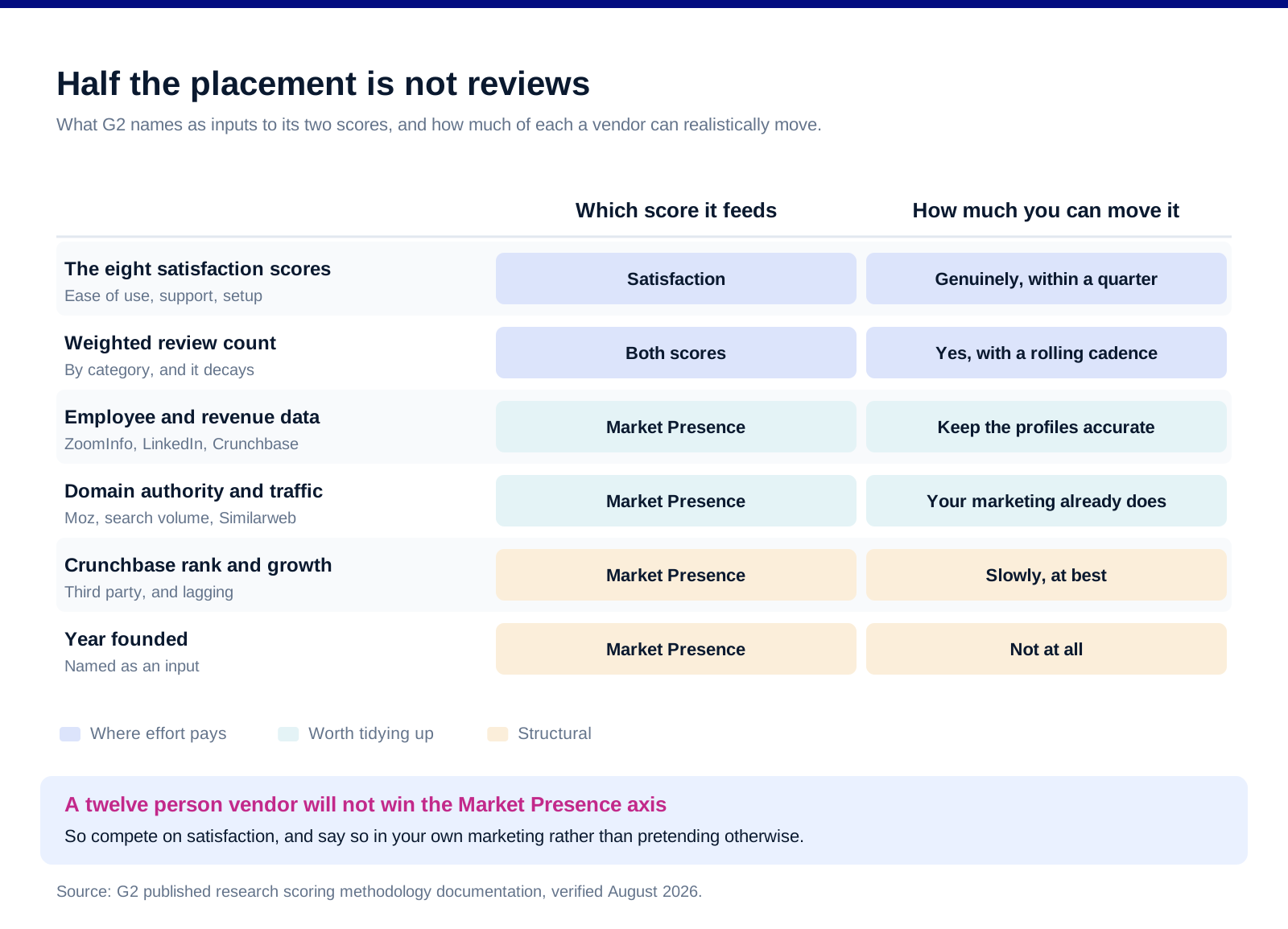
Market Presence is its own score with its own inputs. G2's documentation lists weighted review count by category, employee counts drawn from ZoomInfo, LinkedIn and Crunchbase, revenue data from ZoomInfo, web presence metrics including Moz authority scores, search volume and traffic data from Similarweb, and growth and influence metrics including Crunchbase rank, vendor employee growth and year founded.
Some of that you cannot change at all. Year founded is not a lever. Employee count is a lever with a two year lag and a payroll attached.
Some of it is your marketing programme wearing a different hat. Domain authority, search volume for your brand and organic traffic are all things you were presumably already working on, and they feed a software directory ranking. Our Similarweb review covers what that traffic estimate actually measures, which is worth knowing given it is an input here.
Keep the third party sources accurate. If ZoomInfo, LinkedIn and Crunchbase disagree about your headcount, that disagreement is feeding a score. Cleaning up those profiles is unglamorous, cheap and nobody does it.
And accept the structural limit. A twelve person vendor with outstanding satisfaction scores will not out-position a thousand person incumbent on the Market Presence axis. You compete on the satisfaction axis, and you say so in your own marketing rather than pretending the other axis is winnable.
Satisfaction is where the effort pays. The documentation lists the components: user-focused scores including Ease of Use, Meets Requirements and Quality of Support; admin-focused scores including Ease of Admin, Ease of Setup and Ease of Doing Business With; and general scores including Likelihood to Recommend and Direction of Product. Those are eight specific things, and support quality and ease of setup are the two most people can genuinely move inside a quarter.
The rules people get wrong
Reviewers authenticate, and a human reads every review. G2 states that "Reviewers must sign in with a business email, LinkedIn account, or personal Gmail account", that "Every review is reviewed by a member of G2's moderation team", and that "Each G2 review is checked by a human". Reviewers can also upload screenshots as validation.
Reseller and partner reviews do not score. This is the one that wastes the most effort. G2 states that reviewers "who have a business relationship with a vendor (or their competitor) that could create bias (such as a reseller) can share insight, but their reviews do not count toward scoring." Your channel partners can write you a lovely review that moves nothing.
Do not attach a reward to a positive rating. The FTC's Rule on the Use of Consumer Reviews and Testimonials, in effect since 21 October 2024, covers buying positive reviews, and separately requires insiders including employees, managers, officers and their relatives to disclose the relationship clearly, conspicuously and unavoidably. Asking a customer for an honest review is a different thing. This is not legal advice.
And keep the badge on your site, not the rating in your schema. Google's review snippet documentation states "Don't aggregate reviews or ratings from other websites", and pages where the reviewed entity controls the reviews about itself are not eligible for star features regardless.
What changed in 2026
![[INSERT CHART 3, how-to-get-listed-on-g2-chart-3-effort.svg] Alt: Where a software vendor should spend effort on G2 in 2026, mapped by control against how much it moves placement.](https://framerusercontent.com/images/Loz8BNILQFAYzkVG6iPQnJaVJQ8.svg)
The directory landscape consolidated. On 29 January 2026 G2 announced it "has formally agreed to acquire the software discovery and recommendation platforms Capterra, Software Advice, and GetApp from Gartner", describing the combined network as reaching "200+ million annual software buyers" with "nearly 6 million verified customer reviews".
Which changes how you should think about spreading effort. The old advice was to hedge across independent directories. Four of the largest are now under one owner, and while the platforms have their own listings and their own mechanics, the strategic diversification argument is weaker than it was.
It does not change the mechanics on any individual platform. The thresholds, the decay curve and the scoring inputs described above are G2's published rules and are what you work against today.
Treat it as a reason to do one platform properly. Concentrated effort on the platform where your buyers actually shortlist beats thin presence across four, and that was arguably true before the deal.
What we do not publish here
Any lead volume, click or conversion figure from a G2 listing. Ours would come from a specific set of categories and offers. The public ones are published by the platform or by people selling profile management.
A recommended number of reviews beyond the published threshold. Ten is the documented qualification bar. Anything above that is a competitive question that depends on your category, and a number here would be invented.
The cost of G2's paid tiers. Not published in the material we could read, and it varies by category and package.
How the two axes are weighted against each other. G2 documents the inputs to each score. It does not publish the formula that combines them into a position, and we are not going to reverse engineer one.
Whether any specific vendor deserves its placement. Not knowable from outside.
FAQ
How many reviews do you need to be listed on G2?
None to have a profile. Ten in a specific category to qualify for inclusion in that category's Grid report, per G2's published documentation. Separately, the category itself needs at least six products with 10 or more reviews and 150 or more reviews overall before a Grid report exists at all.
Do old G2 reviews still count?
Much less than new ones. G2 publishes the decay curve: gradual for the first 90 days, a stronger weight held for the first 18 months, then accelerating decay, reaching approximately 3% of original weight after about three years. A rolling monthly cadence beats a single campaign for exactly this reason.
Can partners or resellers leave you reviews?
They can write them, but G2 states that reviewers with a business relationship that could create bias, such as a reseller, "can share insight, but their reviews do not count toward scoring". If your review programme is aimed at your channel, it is producing content rather than score.
Why is a competitor ranked above us with worse reviews?
Because satisfaction is only one axis. Market Presence draws on employee counts from ZoomInfo, LinkedIn and Crunchbase, revenue data, Moz authority, search volume, Similarweb traffic, Crunchbase rank and year founded. A larger, older, better known company has a structural advantage there that review quality does not offset.
Should you list in as many categories as possible?
No. The threshold is ten reviews per category, so spreading thin can leave you unqualified everywhere. Concentrate until you clear ten in your primary category, then expand deliberately.
Does G2 still matter now that it owns Capterra, Software Advice and GetApp?
The acquisition was announced on 29 January 2026 and consolidates four large discovery platforms under one owner reaching, by G2's account, more than 200 million annual software buyers. For a vendor the practical consequence is less about whether it matters and more about doing one platform properly rather than four thinly.
Bottom line
Being listed is administrative and being visible is arithmetic. Clear ten reviews in one category before you touch a second, because the threshold is per category and thin coverage qualifies you nowhere. Set a monthly review cadence rather than a campaign, because G2 publishes a decay curve that reduces a three year old review to roughly three percent of its original weight and your score falls quietly while your review count does not. Accept that the Market Presence axis is largely structural, tidy up the third party data that feeds it, and compete where you can actually win, which is the eight named satisfaction components and particularly support quality and ease of setup. Then leave your rating on G2 rather than rebuilding it in your own structured data, because that is the one item on this list that can cost you something.
Want the pipeline built rather than the profile tuned? Book a call with GROU. We run lead generation and outbound inside B2B revenue engines across verticals. If directories are a real channel for you, our leads from directories piece and our directory roundup cover working them properly.
We are GROU, a B2B pipeline agency that runs lead generation, outbound, and LinkedIn content for clients across manufacturing, fintech, iGaming, software, and professional services. Nothing in this article is legal advice, and every threshold, scoring input and quotation comes from G2's own published documentation or from the regulator page linked beside it.
Getting listed on G2 takes an afternoon. Claim the profile, fill in the fields, pick your categories, done.
Then nothing happens, because being listed and being visible are different problems, and the second one is governed by numbers G2 publishes and almost nobody reads.
TL;DR
Three published numbers decide whether your listing is visible. A product needs "at least 10 reviews in the corresponding category" to qualify for inclusion in a Grid report. The category itself needs "at least six products with 10+ reviews, and 150+ reviews overall" before a Grid exists at all, which means you can be doing everything right in a category too small to be reported on. And reviews decay on a published curve: G2 states a review "decays gradually for the first 90 days and maintains a stronger weight for the first 18 months, after which the rate of decay accelerates", and that "After about three years, the review reaches approximately 3% of its original weight." The other half of your Grid position is Market Presence, and most of its inputs are not reviews at all: employee counts from ZoomInfo, LinkedIn and Crunchbase, revenue data, Moz authority scores, search volume, traffic data from Similarweb, Crunchbase rank and the year you were founded. Reviews from anyone with a business relationship that could create bias, a reseller for example, "can share insight, but their reviews do not count toward scoring". And since 29 January 2026 the competitive landscape is one company: G2 agreed to acquire Capterra, Software Advice and GetApp from Gartner.
Getting listed is the easy part
Claim or create the profile. A profile may already exist because a user created it. Claiming an existing one is faster than building a new one and inherits whatever reviews are already there.
Pick categories deliberately, not exhaustively. This is the decision that matters most and the one most vendors make carelessly, for reasons that become clear in the next section.
Fill in everything, because the profile is a landing page. Screenshots, feature lists, pricing if you publish it, integrations, media. Buyers read the profile, and an empty one reads as an abandoned product.
Then stop, and go and read the scoring rules. Everything above is table stakes and none of it moves your position. What follows does.
The two numbers that decide whether you appear
Your product needs ten reviews in the category. G2's scoring methodology documentation states that "To qualify for inclusion, a product or service must have at least 10 reviews in the corresponding category." Ten is achievable in a few weeks with a deliberate ask.
In the category, not in total. This is the part that catches people. Fifty reviews spread across six categories can leave you below the threshold in every one of them. Ten reviews concentrated in one category puts you on that Grid.
The category itself has to be big enough to have a Grid at all. The same documentation states that "For a software or service category to be eligible for a Grid report, it must have at least six products with 10+ reviews, and 150+ reviews overall."
Which is a constraint you do not control. If you have picked a niche category with four competitors and eighty reviews between them, there is no Grid, and no amount of review collection on your side creates one. That is not a reason to avoid the category, but it is a reason to know before you build a quarter of activity around appearing on a report that does not exist.
So the category decision is a real strategic choice. A large category with a Grid, where you will rank mid-table, versus a small category where you may be the obvious leader but where nobody publishes a leaderboard. Our Capterra listing guide covers the same tension on the other platforms, and our Clutch piece covers the services-side equivalent.
Concentrate first, then expand. Get past ten in your primary category before you spread anything into a second one.
Reviews decay, and G2 publishes the curve
Recency is scored explicitly. The documentation states plainly that "Because recent reviews are more relevant to buyers, older reviews are weighted less."
And the shape of that is published, which is unusual. A review "decays gradually for the first 90 days and maintains a stronger weight for the first 18 months, after which the rate of decay accelerates. After about three years, the review reaches approximately 3% of its original weight."
Read that last number again. A review you worked hard for in 2023 is contributing roughly three percent of what it originally did. Your review count on the page has not moved. Your score has.
Which kills the campaign model. The standard approach is a review drive at launch or before a funding round, then silence. Under a published decay curve that produces a profile that looks healthy and scores worse every quarter.
Run it as a rolling process instead. A small, sustainable number every month beats a large number once, and the eighteen month plateau tells you roughly how long each batch is doing real work before it starts falling away quickly.
Attach the ask to a moment. Onboarding completion, a support ticket resolved well, a renewal. The same timing logic that governs referrals applies here, and our referral programme piece covers why a request after a delivered result outperforms a quarterly reminder.
Half the placement is not about reviews at all
Market Presence is its own score with its own inputs. G2's documentation lists weighted review count by category, employee counts drawn from ZoomInfo, LinkedIn and Crunchbase, revenue data from ZoomInfo, web presence metrics including Moz authority scores, search volume and traffic data from Similarweb, and growth and influence metrics including Crunchbase rank, vendor employee growth and year founded.
Some of that you cannot change at all. Year founded is not a lever. Employee count is a lever with a two year lag and a payroll attached.
Some of it is your marketing programme wearing a different hat. Domain authority, search volume for your brand and organic traffic are all things you were presumably already working on, and they feed a software directory ranking. Our Similarweb review covers what that traffic estimate actually measures, which is worth knowing given it is an input here.
Keep the third party sources accurate. If ZoomInfo, LinkedIn and Crunchbase disagree about your headcount, that disagreement is feeding a score. Cleaning up those profiles is unglamorous, cheap and nobody does it.
And accept the structural limit. A twelve person vendor with outstanding satisfaction scores will not out-position a thousand person incumbent on the Market Presence axis. You compete on the satisfaction axis, and you say so in your own marketing rather than pretending the other axis is winnable.
Satisfaction is where the effort pays. The documentation lists the components: user-focused scores including Ease of Use, Meets Requirements and Quality of Support; admin-focused scores including Ease of Admin, Ease of Setup and Ease of Doing Business With; and general scores including Likelihood to Recommend and Direction of Product. Those are eight specific things, and support quality and ease of setup are the two most people can genuinely move inside a quarter.
The rules people get wrong
Reviewers authenticate, and a human reads every review. G2 states that "Reviewers must sign in with a business email, LinkedIn account, or personal Gmail account", that "Every review is reviewed by a member of G2's moderation team", and that "Each G2 review is checked by a human". Reviewers can also upload screenshots as validation.
Reseller and partner reviews do not score. This is the one that wastes the most effort. G2 states that reviewers "who have a business relationship with a vendor (or their competitor) that could create bias (such as a reseller) can share insight, but their reviews do not count toward scoring." Your channel partners can write you a lovely review that moves nothing.
Do not attach a reward to a positive rating. The FTC's Rule on the Use of Consumer Reviews and Testimonials, in effect since 21 October 2024, covers buying positive reviews, and separately requires insiders including employees, managers, officers and their relatives to disclose the relationship clearly, conspicuously and unavoidably. Asking a customer for an honest review is a different thing. This is not legal advice.
And keep the badge on your site, not the rating in your schema. Google's review snippet documentation states "Don't aggregate reviews or ratings from other websites", and pages where the reviewed entity controls the reviews about itself are not eligible for star features regardless.
What changed in 2026
The directory landscape consolidated. On 29 January 2026 G2 announced it "has formally agreed to acquire the software discovery and recommendation platforms Capterra, Software Advice, and GetApp from Gartner", describing the combined network as reaching "200+ million annual software buyers" with "nearly 6 million verified customer reviews".
Which changes how you should think about spreading effort. The old advice was to hedge across independent directories. Four of the largest are now under one owner, and while the platforms have their own listings and their own mechanics, the strategic diversification argument is weaker than it was.
It does not change the mechanics on any individual platform. The thresholds, the decay curve and the scoring inputs described above are G2's published rules and are what you work against today.
Treat it as a reason to do one platform properly. Concentrated effort on the platform where your buyers actually shortlist beats thin presence across four, and that was arguably true before the deal.
What we do not publish here
Any lead volume, click or conversion figure from a G2 listing. Ours would come from a specific set of categories and offers. The public ones are published by the platform or by people selling profile management.
A recommended number of reviews beyond the published threshold. Ten is the documented qualification bar. Anything above that is a competitive question that depends on your category, and a number here would be invented.
The cost of G2's paid tiers. Not published in the material we could read, and it varies by category and package.
How the two axes are weighted against each other. G2 documents the inputs to each score. It does not publish the formula that combines them into a position, and we are not going to reverse engineer one.
Whether any specific vendor deserves its placement. Not knowable from outside.
FAQ
How many reviews do you need to be listed on G2?
None to have a profile. Ten in a specific category to qualify for inclusion in that category's Grid report, per G2's published documentation. Separately, the category itself needs at least six products with 10 or more reviews and 150 or more reviews overall before a Grid report exists at all.
Do old G2 reviews still count?
Much less than new ones. G2 publishes the decay curve: gradual for the first 90 days, a stronger weight held for the first 18 months, then accelerating decay, reaching approximately 3% of original weight after about three years. A rolling monthly cadence beats a single campaign for exactly this reason.
Can partners or resellers leave you reviews?
They can write them, but G2 states that reviewers with a business relationship that could create bias, such as a reseller, "can share insight, but their reviews do not count toward scoring". If your review programme is aimed at your channel, it is producing content rather than score.
Why is a competitor ranked above us with worse reviews?
Because satisfaction is only one axis. Market Presence draws on employee counts from ZoomInfo, LinkedIn and Crunchbase, revenue data, Moz authority, search volume, Similarweb traffic, Crunchbase rank and year founded. A larger, older, better known company has a structural advantage there that review quality does not offset.
Should you list in as many categories as possible?
No. The threshold is ten reviews per category, so spreading thin can leave you unqualified everywhere. Concentrate until you clear ten in your primary category, then expand deliberately.
Does G2 still matter now that it owns Capterra, Software Advice and GetApp?
The acquisition was announced on 29 January 2026 and consolidates four large discovery platforms under one owner reaching, by G2's account, more than 200 million annual software buyers. For a vendor the practical consequence is less about whether it matters and more about doing one platform properly rather than four thinly.
Bottom line
Being listed is administrative and being visible is arithmetic. Clear ten reviews in one category before you touch a second, because the threshold is per category and thin coverage qualifies you nowhere. Set a monthly review cadence rather than a campaign, because G2 publishes a decay curve that reduces a three year old review to roughly three percent of its original weight and your score falls quietly while your review count does not. Accept that the Market Presence axis is largely structural, tidy up the third party data that feeds it, and compete where you can actually win, which is the eight named satisfaction components and particularly support quality and ease of setup. Then leave your rating on G2 rather than rebuilding it in your own structured data, because that is the one item on this list that can cost you something.
Want the pipeline built rather than the profile tuned? Book a call with GROU. We run lead generation and outbound inside B2B revenue engines across verticals. If directories are a real channel for you, our leads from directories piece and our directory roundup cover working them properly.
We are GROU, a B2B pipeline agency that runs lead generation, outbound, and LinkedIn content for clients across manufacturing, fintech, iGaming, software, and professional services. Nothing in this article is legal advice, and every threshold, scoring input and quotation comes from G2's own published documentation or from the regulator page linked beside it.
Getting listed on G2 takes an afternoon. Claim the profile, fill in the fields, pick your categories, done.
Then nothing happens, because being listed and being visible are different problems, and the second one is governed by numbers G2 publishes and almost nobody reads.
TL;DR
Three published numbers decide whether your listing is visible. A product needs "at least 10 reviews in the corresponding category" to qualify for inclusion in a Grid report. The category itself needs "at least six products with 10+ reviews, and 150+ reviews overall" before a Grid exists at all, which means you can be doing everything right in a category too small to be reported on. And reviews decay on a published curve: G2 states a review "decays gradually for the first 90 days and maintains a stronger weight for the first 18 months, after which the rate of decay accelerates", and that "After about three years, the review reaches approximately 3% of its original weight." The other half of your Grid position is Market Presence, and most of its inputs are not reviews at all: employee counts from ZoomInfo, LinkedIn and Crunchbase, revenue data, Moz authority scores, search volume, traffic data from Similarweb, Crunchbase rank and the year you were founded. Reviews from anyone with a business relationship that could create bias, a reseller for example, "can share insight, but their reviews do not count toward scoring". And since 29 January 2026 the competitive landscape is one company: G2 agreed to acquire Capterra, Software Advice and GetApp from Gartner.
Getting listed is the easy part
Claim or create the profile. A profile may already exist because a user created it. Claiming an existing one is faster than building a new one and inherits whatever reviews are already there.
Pick categories deliberately, not exhaustively. This is the decision that matters most and the one most vendors make carelessly, for reasons that become clear in the next section.
Fill in everything, because the profile is a landing page. Screenshots, feature lists, pricing if you publish it, integrations, media. Buyers read the profile, and an empty one reads as an abandoned product.
Then stop, and go and read the scoring rules. Everything above is table stakes and none of it moves your position. What follows does.
The two numbers that decide whether you appear
Your product needs ten reviews in the category. G2's scoring methodology documentation states that "To qualify for inclusion, a product or service must have at least 10 reviews in the corresponding category." Ten is achievable in a few weeks with a deliberate ask.
In the category, not in total. This is the part that catches people. Fifty reviews spread across six categories can leave you below the threshold in every one of them. Ten reviews concentrated in one category puts you on that Grid.
The category itself has to be big enough to have a Grid at all. The same documentation states that "For a software or service category to be eligible for a Grid report, it must have at least six products with 10+ reviews, and 150+ reviews overall."
Which is a constraint you do not control. If you have picked a niche category with four competitors and eighty reviews between them, there is no Grid, and no amount of review collection on your side creates one. That is not a reason to avoid the category, but it is a reason to know before you build a quarter of activity around appearing on a report that does not exist.
So the category decision is a real strategic choice. A large category with a Grid, where you will rank mid-table, versus a small category where you may be the obvious leader but where nobody publishes a leaderboard. Our Capterra listing guide covers the same tension on the other platforms, and our Clutch piece covers the services-side equivalent.
Concentrate first, then expand. Get past ten in your primary category before you spread anything into a second one.
Reviews decay, and G2 publishes the curve
Recency is scored explicitly. The documentation states plainly that "Because recent reviews are more relevant to buyers, older reviews are weighted less."
And the shape of that is published, which is unusual. A review "decays gradually for the first 90 days and maintains a stronger weight for the first 18 months, after which the rate of decay accelerates. After about three years, the review reaches approximately 3% of its original weight."
Read that last number again. A review you worked hard for in 2023 is contributing roughly three percent of what it originally did. Your review count on the page has not moved. Your score has.
Which kills the campaign model. The standard approach is a review drive at launch or before a funding round, then silence. Under a published decay curve that produces a profile that looks healthy and scores worse every quarter.
Run it as a rolling process instead. A small, sustainable number every month beats a large number once, and the eighteen month plateau tells you roughly how long each batch is doing real work before it starts falling away quickly.
Attach the ask to a moment. Onboarding completion, a support ticket resolved well, a renewal. The same timing logic that governs referrals applies here, and our referral programme piece covers why a request after a delivered result outperforms a quarterly reminder.
Half the placement is not about reviews at all
Market Presence is its own score with its own inputs. G2's documentation lists weighted review count by category, employee counts drawn from ZoomInfo, LinkedIn and Crunchbase, revenue data from ZoomInfo, web presence metrics including Moz authority scores, search volume and traffic data from Similarweb, and growth and influence metrics including Crunchbase rank, vendor employee growth and year founded.
Some of that you cannot change at all. Year founded is not a lever. Employee count is a lever with a two year lag and a payroll attached.
Some of it is your marketing programme wearing a different hat. Domain authority, search volume for your brand and organic traffic are all things you were presumably already working on, and they feed a software directory ranking. Our Similarweb review covers what that traffic estimate actually measures, which is worth knowing given it is an input here.
Keep the third party sources accurate. If ZoomInfo, LinkedIn and Crunchbase disagree about your headcount, that disagreement is feeding a score. Cleaning up those profiles is unglamorous, cheap and nobody does it.
And accept the structural limit. A twelve person vendor with outstanding satisfaction scores will not out-position a thousand person incumbent on the Market Presence axis. You compete on the satisfaction axis, and you say so in your own marketing rather than pretending the other axis is winnable.
Satisfaction is where the effort pays. The documentation lists the components: user-focused scores including Ease of Use, Meets Requirements and Quality of Support; admin-focused scores including Ease of Admin, Ease of Setup and Ease of Doing Business With; and general scores including Likelihood to Recommend and Direction of Product. Those are eight specific things, and support quality and ease of setup are the two most people can genuinely move inside a quarter.
The rules people get wrong
Reviewers authenticate, and a human reads every review. G2 states that "Reviewers must sign in with a business email, LinkedIn account, or personal Gmail account", that "Every review is reviewed by a member of G2's moderation team", and that "Each G2 review is checked by a human". Reviewers can also upload screenshots as validation.
Reseller and partner reviews do not score. This is the one that wastes the most effort. G2 states that reviewers "who have a business relationship with a vendor (or their competitor) that could create bias (such as a reseller) can share insight, but their reviews do not count toward scoring." Your channel partners can write you a lovely review that moves nothing.
Do not attach a reward to a positive rating. The FTC's Rule on the Use of Consumer Reviews and Testimonials, in effect since 21 October 2024, covers buying positive reviews, and separately requires insiders including employees, managers, officers and their relatives to disclose the relationship clearly, conspicuously and unavoidably. Asking a customer for an honest review is a different thing. This is not legal advice.
And keep the badge on your site, not the rating in your schema. Google's review snippet documentation states "Don't aggregate reviews or ratings from other websites", and pages where the reviewed entity controls the reviews about itself are not eligible for star features regardless.
What changed in 2026
The directory landscape consolidated. On 29 January 2026 G2 announced it "has formally agreed to acquire the software discovery and recommendation platforms Capterra, Software Advice, and GetApp from Gartner", describing the combined network as reaching "200+ million annual software buyers" with "nearly 6 million verified customer reviews".
Which changes how you should think about spreading effort. The old advice was to hedge across independent directories. Four of the largest are now under one owner, and while the platforms have their own listings and their own mechanics, the strategic diversification argument is weaker than it was.
It does not change the mechanics on any individual platform. The thresholds, the decay curve and the scoring inputs described above are G2's published rules and are what you work against today.
Treat it as a reason to do one platform properly. Concentrated effort on the platform where your buyers actually shortlist beats thin presence across four, and that was arguably true before the deal.
What we do not publish here
Any lead volume, click or conversion figure from a G2 listing. Ours would come from a specific set of categories and offers. The public ones are published by the platform or by people selling profile management.
A recommended number of reviews beyond the published threshold. Ten is the documented qualification bar. Anything above that is a competitive question that depends on your category, and a number here would be invented.
The cost of G2's paid tiers. Not published in the material we could read, and it varies by category and package.
How the two axes are weighted against each other. G2 documents the inputs to each score. It does not publish the formula that combines them into a position, and we are not going to reverse engineer one.
Whether any specific vendor deserves its placement. Not knowable from outside.
FAQ
How many reviews do you need to be listed on G2?
None to have a profile. Ten in a specific category to qualify for inclusion in that category's Grid report, per G2's published documentation. Separately, the category itself needs at least six products with 10 or more reviews and 150 or more reviews overall before a Grid report exists at all.
Do old G2 reviews still count?
Much less than new ones. G2 publishes the decay curve: gradual for the first 90 days, a stronger weight held for the first 18 months, then accelerating decay, reaching approximately 3% of original weight after about three years. A rolling monthly cadence beats a single campaign for exactly this reason.
Can partners or resellers leave you reviews?
They can write them, but G2 states that reviewers with a business relationship that could create bias, such as a reseller, "can share insight, but their reviews do not count toward scoring". If your review programme is aimed at your channel, it is producing content rather than score.
Why is a competitor ranked above us with worse reviews?
Because satisfaction is only one axis. Market Presence draws on employee counts from ZoomInfo, LinkedIn and Crunchbase, revenue data, Moz authority, search volume, Similarweb traffic, Crunchbase rank and year founded. A larger, older, better known company has a structural advantage there that review quality does not offset.
Should you list in as many categories as possible?
No. The threshold is ten reviews per category, so spreading thin can leave you unqualified everywhere. Concentrate until you clear ten in your primary category, then expand deliberately.
Does G2 still matter now that it owns Capterra, Software Advice and GetApp?
The acquisition was announced on 29 January 2026 and consolidates four large discovery platforms under one owner reaching, by G2's account, more than 200 million annual software buyers. For a vendor the practical consequence is less about whether it matters and more about doing one platform properly rather than four thinly.
Bottom line
Being listed is administrative and being visible is arithmetic. Clear ten reviews in one category before you touch a second, because the threshold is per category and thin coverage qualifies you nowhere. Set a monthly review cadence rather than a campaign, because G2 publishes a decay curve that reduces a three year old review to roughly three percent of its original weight and your score falls quietly while your review count does not. Accept that the Market Presence axis is largely structural, tidy up the third party data that feeds it, and compete where you can actually win, which is the eight named satisfaction components and particularly support quality and ease of setup. Then leave your rating on G2 rather than rebuilding it in your own structured data, because that is the one item on this list that can cost you something.
Want the pipeline built rather than the profile tuned? Book a call with GROU. We run lead generation and outbound inside B2B revenue engines across verticals. If directories are a real channel for you, our leads from directories piece and our directory roundup cover working them properly.
We are GROU, a B2B pipeline agency that runs lead generation, outbound, and LinkedIn content for clients across manufacturing, fintech, iGaming, software, and professional services. Nothing in this article is legal advice, and every threshold, scoring input and quotation comes from G2's own published documentation or from the regulator page linked beside it.

Pipeline OS Newsletter
Build qualified pipeline
Get weekly tactics to generate demand, improve lead quality, and book more meetings.





Trusted by industry leaders
Trusted by industry leaders
Trusted by industry leaders
Ready to build qualified pipeline?
Ready to build qualified pipeline?
Ready to build qualified pipeline?
Book a call to see if we're the right fit, or take the 2-minute quiz to get a clear starting point.
Book a call to see if we're the right fit, or take the 2-minute quiz to get a clear starting point.
Book a call to see if we're the right fit, or take the 2-minute quiz to get a clear starting point.
" height="30.21639343089746px" id="hfGbXmQR2" width="30.216393430897455px"/></svg>)
Copyright © 2026 – All Right Reserved
Copyright © 2026 – All Right Reserved
Copyright © 2026 – All Right Reserved