%22%3E%3C/path%3E%3Cpath d=%22M 63.072 7.554 C 62.258 8.022 61.577 8.689 61.092 9.493 L 61.092 7.076 L 57.158 7.076 L 57.158 22.64 L 61.089 22.64 L 61.089 14.888 C 61.089 13.446 61.403 12.434 62.03 11.853 C 62.818 11.218 63.818 10.907 64.826 10.982 L 65.868 10.982 L 65.868 6.851 C 64.891 6.834 63.926 7.076 63.073 7.554 Z%22 fill=%22rgb(17,17,17)%22%3E%3C/path%3E%3Cpath d=%22M 78.916 7.82 C 76.363 6.49 73.321 6.49 70.768 7.82 C 69.562 8.473 68.564 9.451 67.888 10.644 C 67.167 11.931 66.803 13.387 66.834 14.862 C 66.804 16.332 67.157 17.785 67.86 19.077 C 68.515 20.267 69.494 21.246 70.684 21.901 C 71.924 22.576 73.318 22.92 74.73 22.898 C 76.164 22.918 77.58 22.575 78.846 21.901 C 80.062 21.247 81.073 20.27 81.768 19.077 C 82.506 17.797 82.88 16.339 82.85 14.862 C 82.88 13.389 82.517 11.934 81.797 10.647 C 81.12 9.455 80.122 8.477 78.917 7.824 M 78.803 14.862 C 78.829 15.739 78.636 16.608 78.241 17.391 C 77.903 18.046 77.38 18.588 76.738 18.95 C 76.124 19.293 75.432 19.472 74.729 19.47 C 73.668 19.497 72.648 19.061 71.934 18.276 C 71.139 17.323 70.741 16.1 70.823 14.862 C 70.741 13.62 71.149 12.395 71.959 11.45 C 72.687 10.667 73.715 10.233 74.783 10.256 C 75.859 10.236 76.894 10.67 77.635 11.45 C 78.464 12.387 78.884 13.616 78.801 14.864%22 fill=%22rgb(17,17,17)%22%3E%3C/path%3E%3Cpath d=%22M 95.906 7.076 L 95.906 15.646 C 95.975 16.68 95.643 17.701 94.979 18.498 C 94.311 19.184 93.379 19.547 92.422 19.495 C 91.475 19.544 90.553 19.18 89.894 18.498 C 89.23 17.701 88.898 16.68 88.967 15.646 L 88.967 7.076 L 85.033 7.076 L 85.033 16.207 C 85 17.449 85.275 18.68 85.834 19.79 C 86.327 20.75 87.095 21.542 88.039 22.065 C 89.033 22.594 90.145 22.861 91.271 22.838 C 92.188 22.847 93.095 22.65 93.926 22.263 C 94.708 21.905 95.388 21.36 95.906 20.675 L 95.906 22.645 L 99.865 22.645 L 99.865 7.076 Z%22 fill=%22rgb(17,17,17)%22%3E%3C/path%3E%3Cpath d=%22M 4.513 15.626 C 4.511 10.815 7.606 6.549 12.181 5.059 C 16.756 3.57 21.77 5.195 24.601 9.086 L 27.816 5.87 C 24.074 1.186 17.981 -0.943 12.137 0.393 C 6.292 1.728 1.728 6.292 0.393 12.137 C -0.943 17.981 1.186 24.074 5.87 27.816 L 9.085 24.601 C 6.214 22.512 4.515 19.177 4.513 15.626%22 fill=%22rgb(32,62,235)%22%3E%3C/path%3E%3Cpath d=%22M 17.114 14.343 L 13.354 18.01 L 13.354 18.026 L 21.071 18.026 L 11.412 27.609 L 17.389 27.609 L 23.999 21.081 L 23.999 28.316 L 24.005 28.316 L 27.967 24.393 L 27.967 14.343 Z%22 fill=%22rgb(32,62,235)%22%3E%3C/path%3E%3C/g%3E%3C/svg%3E) ×
× ××
××›
›
›
›
Relevance AI pricing 2026
Relevance AI pricing 2026
Relevance AI pricing 2026
Relevance AI pricing 2026
Relevance AI pricing 2026
Relevance AI pricing 2026

Author
Aljaz Peklaj

Relevance AI does not publish its plan prices. You can find the tier names, you can find the top-up rates, you can find a detailed explanation of how the meter works, but the actual monthly figure for Pro or Team renders only once you are inside the product.
That is worth saying up front rather than burying, because it changes what this article can usefully be. What Relevance AI does publish, in unusual detail, is the mechanic. And the mechanic is the part that decides your bill.
TL;DR
Relevance AI splits billing into two separate meters. Actions are units of work: every time a tool runs it counts as one action, and that is true whether the tool sends a single email or executes a complex multi-step workflow. Vendor credits are the underlying AI and tool costs, passed through at what the company states is exact cost with no markup. Published top-up rates are $80 per 1,000 actions and $20 per 10,000 vendor credits. Plan tiers are Free, Pro, Team and Enterprise, and the prices for those are not published anywhere we could read first-hand. Two rules matter more than the rates: unused vendor credits roll over indefinitely while your subscription is active, and purchased action top-ups roll over indefinitely too, though plan-included actions reset monthly. Annual billing carries a 10% discount and releases twelve months of credits upfront. The single biggest lever on your bill is not the plan you pick, it is how you build: because an action is priced per tool run rather than per unit of work, consolidating five small tools into one larger one cuts that portion of your bill by roughly eighty percent for identical output.
The two meters
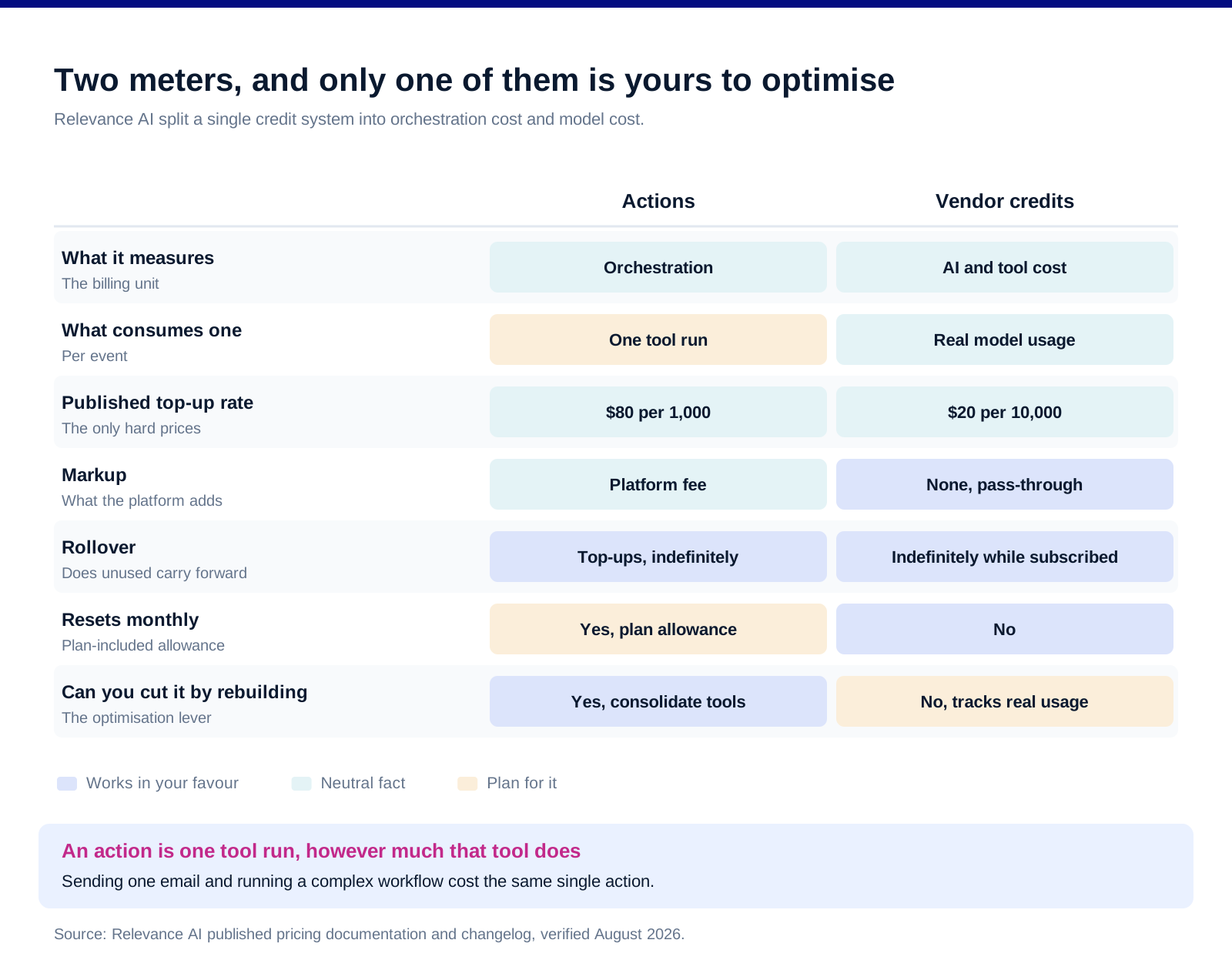
Actions are units of work performed by an agent. Relevance AI's pricing documentation states it plainly: each time a tool runs, it counts as an action, whether it is a simple task like sending one email or a complex workflow.
Vendor credits are the cost of the model and the tools. The company states it passes through exact costs with no markup, which is unusual in this category and is the reason the two meters exist separately at all.
The split was deliberate and recent. Founder Jacky Koh described the problem in the company's own explanation of the change: under a single unified credit system, the simple question of how many credits a workflow would use had become a source of friction. Splitting orchestration cost from model cost makes both legible.
Published top-up rates are $80 per 1,000 actions and $20 per 10,000 vendor credits. That works out at eight cents per action and a fifth of a cent per vendor credit. Those are the only hard prices published anywhere on the domain.
Rollover is the genuinely good part. Vendor credits roll over indefinitely while you are subscribed on a paid plan. Purchased action top-ups also roll over indefinitely. Only the actions included with your plan reset monthly. Under the previous unified system, unused credits expired.
Annual billing takes 10% off and releases twelve months of credits upfront, with longer validity on purchased top-ups, per the company's annual plans announcement.
Tiers are Free, Pro, Team and Enterprise. The new model went live on 8 September 2025, new free users moved to it the same day, existing free users on 15 September 2025, and existing paid subscribers from 1 December 2025.
How you build decides what you pay
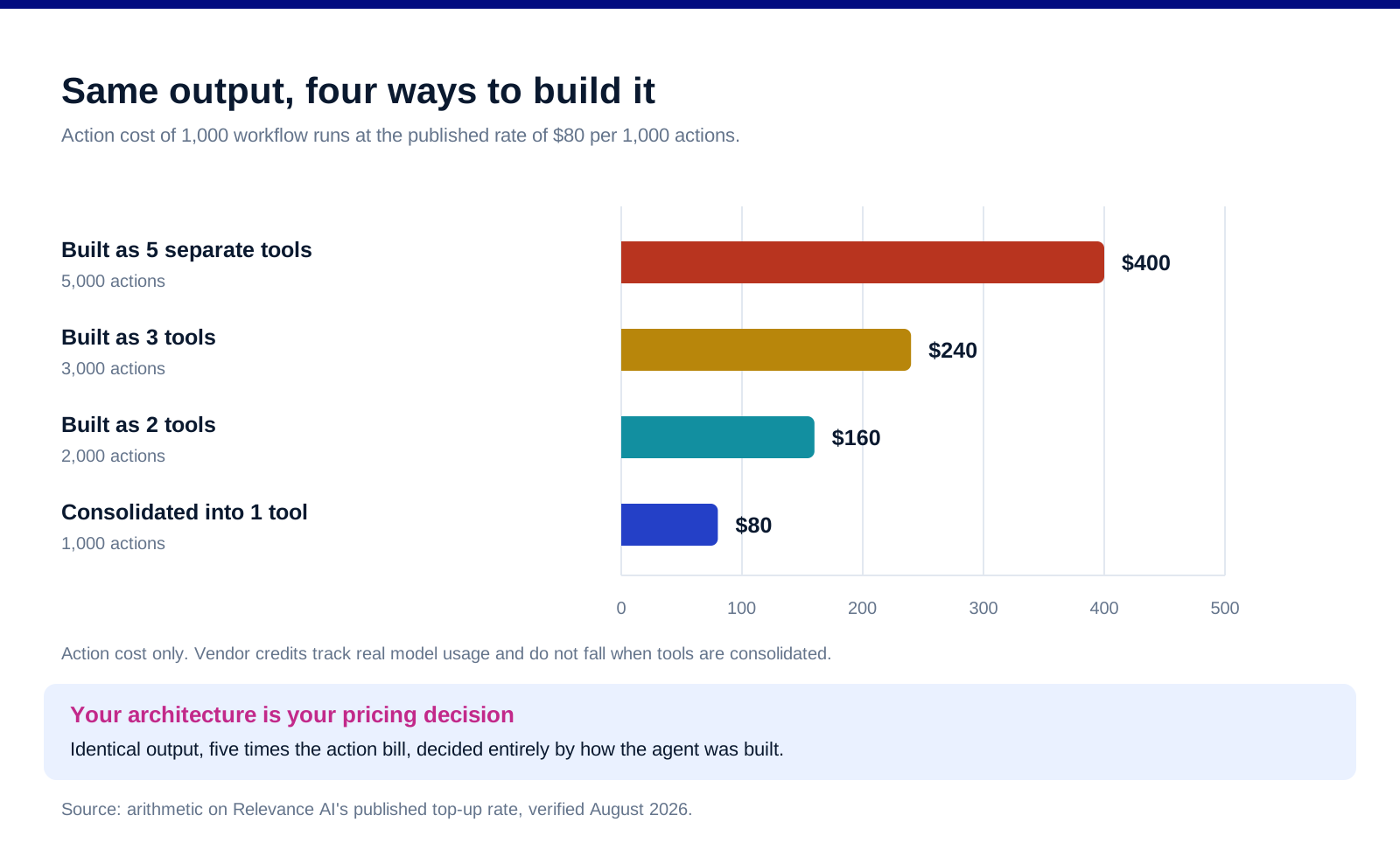
This is the part that actually matters, and it follows directly from the definition. An action is one tool run. It is not one email, one record, one API call or one minute of compute. A tool that does one trivial thing burns exactly the same action as a tool that does twelve things.
So run the arithmetic on the published rate. At $80 per 1,000 actions, a thousand workflow runs built as five separate tool steps costs 5,000 actions, or $400. The same thousand runs consolidated into three tools costs $240. Built as a single tool, $80. Identical output, five times the difference.
That is arithmetic on Relevance AI's own published top-up rate, not a benchmark, and your plan-included actions come off the top before top-ups apply. But the ratio holds regardless of which tier you are on, because the ratio is a property of how you built the agent.
The obvious optimisation is therefore structural, not commercial. Before upgrading a plan, count the tool steps in your highest-volume agent and ask which of them exist because the work genuinely needed separating and which exist because it was tidier to build that way.
Vendor credits do not behave this way. They track real model and tool consumption, so consolidating tools does not reduce them. If your workload is inference-heavy, most of your bill sits in the meter you cannot optimise by refactoring, and the pass-through pricing is doing you a favour.
Evaluations count too. Relevance AI states that evals account for one action per run across every check type, so a heavily instrumented agent carries a measurable action overhead on top of the work itself.
Who the model suits
![SCREENSHOT NEEDED: Relevance AI, an agent's tool step list showing how many tools a single workflow calls]](https://framerusercontent.com/images/5giu8hignPfQA1X6Ajr9o9OThGU.png)
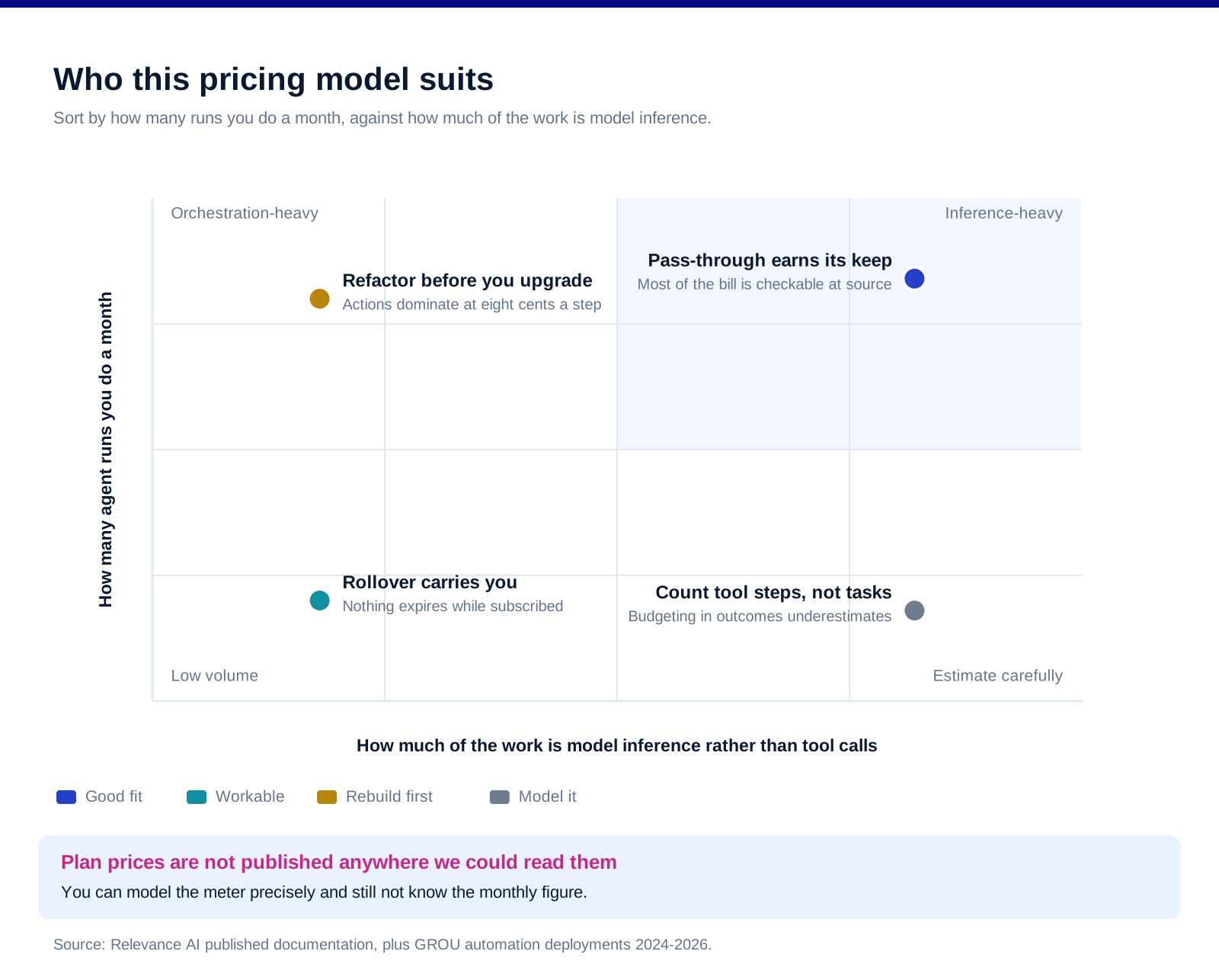
High volume, inference-heavy work: this pricing is genuinely good. Pass-through model costs with no markup means you pay what the provider charges, and at scale that is a meaningful difference from platforms that mark up inference. Check the underlying model rates yourself and you can predict most of your bill.
High volume, orchestration-heavy work: refactor before you buy. If your agents call many small tools and do little inference, actions dominate and you are paying eight cents a step. That is the case where consolidating tools pays for itself immediately.
Low volume, exploratory work: the free tier and rollover carry you further than expected. Because purchased credits and top-ups do not expire, irregular usage is not punished the way it is on platforms with monthly use-it-or-lose-it allowances.
Anyone who needs to forecast before committing: expect a sales conversation. With plan prices unpublished, you cannot build a budget from the website. That is a real difference in how you buy and it is worth knowing before you start an evaluation.
Anyone comparing this to a workflow automation tool: the meters are not comparable. Our RevOps tech stack piece covers how Zapier meters tasks, where filters and paths are free and only actions count. The logic is different enough that a like-for-like cost comparison needs the same workload modelled on both.
What the pricing page does not tell you
Plan prices are not published. We looked at the pricing page, the pricing documentation, the changelog and the company's own blog post about the pricing change. Tier names appear everywhere; monthly figures appear nowhere readable. Ask for them directly rather than assuming a number from a comparison site.
Pass-through is a claim you can verify. Because vendor credits are stated to carry no markup, the underlying model provider's published rates are your check. That is a rare position to be in and worth using.
The unit is the tool run, not the outcome. Every estimate you build should count tool steps, not tasks, leads or emails. Teams that budget in outcomes consistently underestimate.
Rollover only holds while you are subscribed. Vendor credits roll over indefinitely while a paid subscription is active. That qualifier is doing work.
No tool here replaces judgement about what to automate. An agent that runs a bad process faster produces bad output at eight cents a step.
FAQ
How much does Relevance AI cost in 2026?
Plan prices for Pro and Team are not published on Relevance AI's website, its documentation, its changelog or its blog. What is published is the top-up pricing: $80 per 1,000 actions and $20 per 10,000 vendor credits, with a 10% discount on annual billing. Tier names are Free, Pro, Team and Enterprise, and you will need to go through the product or sales to get the monthly figure.
What is the difference between actions and vendor credits?
Actions are units of orchestration: one action per tool run, regardless of how much that tool does. Vendor credits are the underlying AI model and tool costs, which Relevance AI states it passes through at exact cost with no markup. They are metered separately so you can see what is platform cost and what is model cost.
Do Relevance AI credits expire?
Vendor credits roll over indefinitely while your subscription on a paid plan is active, and purchased action top-ups roll over indefinitely as well. Only the actions included with your plan reset monthly. This is a change from the previous unified credit system, under which unused credits expired.
How do you reduce a Relevance AI bill?
Consolidate tool steps. Because an action is charged per tool run rather than per unit of work, a workflow built as five tools costs five actions where the same work built as one tool costs one. At the published rate that is the difference between $400 and $80 per thousand runs. Vendor credits cannot be reduced this way because they track real model consumption.
Is Relevance AI's annual plan worth it?
The discount is 10%, which is modest by category standards, but annual billing also releases twelve months of credits upfront and extends the validity of purchased top-ups. Combined with indefinite rollover, that makes annual meaningfully better for teams with uneven month-to-month usage, rather than just cheaper.
What counts as one action?
One tool run. Relevance AI's documentation states that each time a tool runs it counts as an action, whether that is sending a single email or executing a complex workflow. Evaluations also count, at one action per run across every check type, so instrumentation carries its own overhead.
Bottom line
Judge this one on the meter rather than the rate card, partly because the meter is well documented and partly because the rate card is not published. Two things follow from that. Vendor credits at pass-through with no markup means the model portion of your bill is predictable and checkable against the provider's own rates, which is a good position for an inference-heavy workload. And actions priced per tool run rather than per unit of work means your architecture is your pricing decision: the same output built as one tool instead of five costs a fifth as much. Work out your tool-step count before you talk to anyone about a plan, because that number will tell you more about your bill than the tier will.
Want the agent workflows built rather than the platform evaluated? Book a call with GROU. We run lead generation and outbound inside B2B revenue engines across verticals.
We are GROU, a B2B pipeline agency that runs lead generation, outbound, and LinkedIn content for clients across manufacturing, fintech, iGaming, software, and professional services. The cost guidance reflects our automation deployments between 2024 and 2026, anonymized to protect client confidentiality.
Some links in this article are affiliate. We may earn a small commission at no extra cost to you. We only recommend tools we've deployed for clients.
Relevance AI does not publish its plan prices. You can find the tier names, you can find the top-up rates, you can find a detailed explanation of how the meter works, but the actual monthly figure for Pro or Team renders only once you are inside the product.
That is worth saying up front rather than burying, because it changes what this article can usefully be. What Relevance AI does publish, in unusual detail, is the mechanic. And the mechanic is the part that decides your bill.
TL;DR
Relevance AI splits billing into two separate meters. Actions are units of work: every time a tool runs it counts as one action, and that is true whether the tool sends a single email or executes a complex multi-step workflow. Vendor credits are the underlying AI and tool costs, passed through at what the company states is exact cost with no markup. Published top-up rates are $80 per 1,000 actions and $20 per 10,000 vendor credits. Plan tiers are Free, Pro, Team and Enterprise, and the prices for those are not published anywhere we could read first-hand. Two rules matter more than the rates: unused vendor credits roll over indefinitely while your subscription is active, and purchased action top-ups roll over indefinitely too, though plan-included actions reset monthly. Annual billing carries a 10% discount and releases twelve months of credits upfront. The single biggest lever on your bill is not the plan you pick, it is how you build: because an action is priced per tool run rather than per unit of work, consolidating five small tools into one larger one cuts that portion of your bill by roughly eighty percent for identical output.
The two meters
Actions are units of work performed by an agent. Relevance AI's pricing documentation states it plainly: each time a tool runs, it counts as an action, whether it is a simple task like sending one email or a complex workflow.
Vendor credits are the cost of the model and the tools. The company states it passes through exact costs with no markup, which is unusual in this category and is the reason the two meters exist separately at all.
The split was deliberate and recent. Founder Jacky Koh described the problem in the company's own explanation of the change: under a single unified credit system, the simple question of how many credits a workflow would use had become a source of friction. Splitting orchestration cost from model cost makes both legible.
Published top-up rates are $80 per 1,000 actions and $20 per 10,000 vendor credits. That works out at eight cents per action and a fifth of a cent per vendor credit. Those are the only hard prices published anywhere on the domain.
Rollover is the genuinely good part. Vendor credits roll over indefinitely while you are subscribed on a paid plan. Purchased action top-ups also roll over indefinitely. Only the actions included with your plan reset monthly. Under the previous unified system, unused credits expired.
Annual billing takes 10% off and releases twelve months of credits upfront, with longer validity on purchased top-ups, per the company's annual plans announcement.
Tiers are Free, Pro, Team and Enterprise. The new model went live on 8 September 2025, new free users moved to it the same day, existing free users on 15 September 2025, and existing paid subscribers from 1 December 2025.
How you build decides what you pay
This is the part that actually matters, and it follows directly from the definition. An action is one tool run. It is not one email, one record, one API call or one minute of compute. A tool that does one trivial thing burns exactly the same action as a tool that does twelve things.
So run the arithmetic on the published rate. At $80 per 1,000 actions, a thousand workflow runs built as five separate tool steps costs 5,000 actions, or $400. The same thousand runs consolidated into three tools costs $240. Built as a single tool, $80. Identical output, five times the difference.
That is arithmetic on Relevance AI's own published top-up rate, not a benchmark, and your plan-included actions come off the top before top-ups apply. But the ratio holds regardless of which tier you are on, because the ratio is a property of how you built the agent.
The obvious optimisation is therefore structural, not commercial. Before upgrading a plan, count the tool steps in your highest-volume agent and ask which of them exist because the work genuinely needed separating and which exist because it was tidier to build that way.
Vendor credits do not behave this way. They track real model and tool consumption, so consolidating tools does not reduce them. If your workload is inference-heavy, most of your bill sits in the meter you cannot optimise by refactoring, and the pass-through pricing is doing you a favour.
Evaluations count too. Relevance AI states that evals account for one action per run across every check type, so a heavily instrumented agent carries a measurable action overhead on top of the work itself.
Who the model suits
High volume, inference-heavy work: this pricing is genuinely good. Pass-through model costs with no markup means you pay what the provider charges, and at scale that is a meaningful difference from platforms that mark up inference. Check the underlying model rates yourself and you can predict most of your bill.
High volume, orchestration-heavy work: refactor before you buy. If your agents call many small tools and do little inference, actions dominate and you are paying eight cents a step. That is the case where consolidating tools pays for itself immediately.
Low volume, exploratory work: the free tier and rollover carry you further than expected. Because purchased credits and top-ups do not expire, irregular usage is not punished the way it is on platforms with monthly use-it-or-lose-it allowances.
Anyone who needs to forecast before committing: expect a sales conversation. With plan prices unpublished, you cannot build a budget from the website. That is a real difference in how you buy and it is worth knowing before you start an evaluation.
Anyone comparing this to a workflow automation tool: the meters are not comparable. Our RevOps tech stack piece covers how Zapier meters tasks, where filters and paths are free and only actions count. The logic is different enough that a like-for-like cost comparison needs the same workload modelled on both.
What the pricing page does not tell you
Plan prices are not published. We looked at the pricing page, the pricing documentation, the changelog and the company's own blog post about the pricing change. Tier names appear everywhere; monthly figures appear nowhere readable. Ask for them directly rather than assuming a number from a comparison site.
Pass-through is a claim you can verify. Because vendor credits are stated to carry no markup, the underlying model provider's published rates are your check. That is a rare position to be in and worth using.
The unit is the tool run, not the outcome. Every estimate you build should count tool steps, not tasks, leads or emails. Teams that budget in outcomes consistently underestimate.
Rollover only holds while you are subscribed. Vendor credits roll over indefinitely while a paid subscription is active. That qualifier is doing work.
No tool here replaces judgement about what to automate. An agent that runs a bad process faster produces bad output at eight cents a step.
FAQ
How much does Relevance AI cost in 2026?
Plan prices for Pro and Team are not published on Relevance AI's website, its documentation, its changelog or its blog. What is published is the top-up pricing: $80 per 1,000 actions and $20 per 10,000 vendor credits, with a 10% discount on annual billing. Tier names are Free, Pro, Team and Enterprise, and you will need to go through the product or sales to get the monthly figure.
What is the difference between actions and vendor credits?
Actions are units of orchestration: one action per tool run, regardless of how much that tool does. Vendor credits are the underlying AI model and tool costs, which Relevance AI states it passes through at exact cost with no markup. They are metered separately so you can see what is platform cost and what is model cost.
Do Relevance AI credits expire?
Vendor credits roll over indefinitely while your subscription on a paid plan is active, and purchased action top-ups roll over indefinitely as well. Only the actions included with your plan reset monthly. This is a change from the previous unified credit system, under which unused credits expired.
How do you reduce a Relevance AI bill?
Consolidate tool steps. Because an action is charged per tool run rather than per unit of work, a workflow built as five tools costs five actions where the same work built as one tool costs one. At the published rate that is the difference between $400 and $80 per thousand runs. Vendor credits cannot be reduced this way because they track real model consumption.
Is Relevance AI's annual plan worth it?
The discount is 10%, which is modest by category standards, but annual billing also releases twelve months of credits upfront and extends the validity of purchased top-ups. Combined with indefinite rollover, that makes annual meaningfully better for teams with uneven month-to-month usage, rather than just cheaper.
What counts as one action?
One tool run. Relevance AI's documentation states that each time a tool runs it counts as an action, whether that is sending a single email or executing a complex workflow. Evaluations also count, at one action per run across every check type, so instrumentation carries its own overhead.
Bottom line
Judge this one on the meter rather than the rate card, partly because the meter is well documented and partly because the rate card is not published. Two things follow from that. Vendor credits at pass-through with no markup means the model portion of your bill is predictable and checkable against the provider's own rates, which is a good position for an inference-heavy workload. And actions priced per tool run rather than per unit of work means your architecture is your pricing decision: the same output built as one tool instead of five costs a fifth as much. Work out your tool-step count before you talk to anyone about a plan, because that number will tell you more about your bill than the tier will.
Want the agent workflows built rather than the platform evaluated? Book a call with GROU. We run lead generation and outbound inside B2B revenue engines across verticals.
We are GROU, a B2B pipeline agency that runs lead generation, outbound, and LinkedIn content for clients across manufacturing, fintech, iGaming, software, and professional services. The cost guidance reflects our automation deployments between 2024 and 2026, anonymized to protect client confidentiality.
Some links in this article are affiliate. We may earn a small commission at no extra cost to you. We only recommend tools we've deployed for clients.
Relevance AI does not publish its plan prices. You can find the tier names, you can find the top-up rates, you can find a detailed explanation of how the meter works, but the actual monthly figure for Pro or Team renders only once you are inside the product.
That is worth saying up front rather than burying, because it changes what this article can usefully be. What Relevance AI does publish, in unusual detail, is the mechanic. And the mechanic is the part that decides your bill.
TL;DR
Relevance AI splits billing into two separate meters. Actions are units of work: every time a tool runs it counts as one action, and that is true whether the tool sends a single email or executes a complex multi-step workflow. Vendor credits are the underlying AI and tool costs, passed through at what the company states is exact cost with no markup. Published top-up rates are $80 per 1,000 actions and $20 per 10,000 vendor credits. Plan tiers are Free, Pro, Team and Enterprise, and the prices for those are not published anywhere we could read first-hand. Two rules matter more than the rates: unused vendor credits roll over indefinitely while your subscription is active, and purchased action top-ups roll over indefinitely too, though plan-included actions reset monthly. Annual billing carries a 10% discount and releases twelve months of credits upfront. The single biggest lever on your bill is not the plan you pick, it is how you build: because an action is priced per tool run rather than per unit of work, consolidating five small tools into one larger one cuts that portion of your bill by roughly eighty percent for identical output.
The two meters
Actions are units of work performed by an agent. Relevance AI's pricing documentation states it plainly: each time a tool runs, it counts as an action, whether it is a simple task like sending one email or a complex workflow.
Vendor credits are the cost of the model and the tools. The company states it passes through exact costs with no markup, which is unusual in this category and is the reason the two meters exist separately at all.
The split was deliberate and recent. Founder Jacky Koh described the problem in the company's own explanation of the change: under a single unified credit system, the simple question of how many credits a workflow would use had become a source of friction. Splitting orchestration cost from model cost makes both legible.
Published top-up rates are $80 per 1,000 actions and $20 per 10,000 vendor credits. That works out at eight cents per action and a fifth of a cent per vendor credit. Those are the only hard prices published anywhere on the domain.
Rollover is the genuinely good part. Vendor credits roll over indefinitely while you are subscribed on a paid plan. Purchased action top-ups also roll over indefinitely. Only the actions included with your plan reset monthly. Under the previous unified system, unused credits expired.
Annual billing takes 10% off and releases twelve months of credits upfront, with longer validity on purchased top-ups, per the company's annual plans announcement.
Tiers are Free, Pro, Team and Enterprise. The new model went live on 8 September 2025, new free users moved to it the same day, existing free users on 15 September 2025, and existing paid subscribers from 1 December 2025.
How you build decides what you pay
This is the part that actually matters, and it follows directly from the definition. An action is one tool run. It is not one email, one record, one API call or one minute of compute. A tool that does one trivial thing burns exactly the same action as a tool that does twelve things.
So run the arithmetic on the published rate. At $80 per 1,000 actions, a thousand workflow runs built as five separate tool steps costs 5,000 actions, or $400. The same thousand runs consolidated into three tools costs $240. Built as a single tool, $80. Identical output, five times the difference.
That is arithmetic on Relevance AI's own published top-up rate, not a benchmark, and your plan-included actions come off the top before top-ups apply. But the ratio holds regardless of which tier you are on, because the ratio is a property of how you built the agent.
The obvious optimisation is therefore structural, not commercial. Before upgrading a plan, count the tool steps in your highest-volume agent and ask which of them exist because the work genuinely needed separating and which exist because it was tidier to build that way.
Vendor credits do not behave this way. They track real model and tool consumption, so consolidating tools does not reduce them. If your workload is inference-heavy, most of your bill sits in the meter you cannot optimise by refactoring, and the pass-through pricing is doing you a favour.
Evaluations count too. Relevance AI states that evals account for one action per run across every check type, so a heavily instrumented agent carries a measurable action overhead on top of the work itself.
Who the model suits
High volume, inference-heavy work: this pricing is genuinely good. Pass-through model costs with no markup means you pay what the provider charges, and at scale that is a meaningful difference from platforms that mark up inference. Check the underlying model rates yourself and you can predict most of your bill.
High volume, orchestration-heavy work: refactor before you buy. If your agents call many small tools and do little inference, actions dominate and you are paying eight cents a step. That is the case where consolidating tools pays for itself immediately.
Low volume, exploratory work: the free tier and rollover carry you further than expected. Because purchased credits and top-ups do not expire, irregular usage is not punished the way it is on platforms with monthly use-it-or-lose-it allowances.
Anyone who needs to forecast before committing: expect a sales conversation. With plan prices unpublished, you cannot build a budget from the website. That is a real difference in how you buy and it is worth knowing before you start an evaluation.
Anyone comparing this to a workflow automation tool: the meters are not comparable. Our RevOps tech stack piece covers how Zapier meters tasks, where filters and paths are free and only actions count. The logic is different enough that a like-for-like cost comparison needs the same workload modelled on both.
What the pricing page does not tell you
Plan prices are not published. We looked at the pricing page, the pricing documentation, the changelog and the company's own blog post about the pricing change. Tier names appear everywhere; monthly figures appear nowhere readable. Ask for them directly rather than assuming a number from a comparison site.
Pass-through is a claim you can verify. Because vendor credits are stated to carry no markup, the underlying model provider's published rates are your check. That is a rare position to be in and worth using.
The unit is the tool run, not the outcome. Every estimate you build should count tool steps, not tasks, leads or emails. Teams that budget in outcomes consistently underestimate.
Rollover only holds while you are subscribed. Vendor credits roll over indefinitely while a paid subscription is active. That qualifier is doing work.
No tool here replaces judgement about what to automate. An agent that runs a bad process faster produces bad output at eight cents a step.
FAQ
How much does Relevance AI cost in 2026?
Plan prices for Pro and Team are not published on Relevance AI's website, its documentation, its changelog or its blog. What is published is the top-up pricing: $80 per 1,000 actions and $20 per 10,000 vendor credits, with a 10% discount on annual billing. Tier names are Free, Pro, Team and Enterprise, and you will need to go through the product or sales to get the monthly figure.
What is the difference between actions and vendor credits?
Actions are units of orchestration: one action per tool run, regardless of how much that tool does. Vendor credits are the underlying AI model and tool costs, which Relevance AI states it passes through at exact cost with no markup. They are metered separately so you can see what is platform cost and what is model cost.
Do Relevance AI credits expire?
Vendor credits roll over indefinitely while your subscription on a paid plan is active, and purchased action top-ups roll over indefinitely as well. Only the actions included with your plan reset monthly. This is a change from the previous unified credit system, under which unused credits expired.
How do you reduce a Relevance AI bill?
Consolidate tool steps. Because an action is charged per tool run rather than per unit of work, a workflow built as five tools costs five actions where the same work built as one tool costs one. At the published rate that is the difference between $400 and $80 per thousand runs. Vendor credits cannot be reduced this way because they track real model consumption.
Is Relevance AI's annual plan worth it?
The discount is 10%, which is modest by category standards, but annual billing also releases twelve months of credits upfront and extends the validity of purchased top-ups. Combined with indefinite rollover, that makes annual meaningfully better for teams with uneven month-to-month usage, rather than just cheaper.
What counts as one action?
One tool run. Relevance AI's documentation states that each time a tool runs it counts as an action, whether that is sending a single email or executing a complex workflow. Evaluations also count, at one action per run across every check type, so instrumentation carries its own overhead.
Bottom line
Judge this one on the meter rather than the rate card, partly because the meter is well documented and partly because the rate card is not published. Two things follow from that. Vendor credits at pass-through with no markup means the model portion of your bill is predictable and checkable against the provider's own rates, which is a good position for an inference-heavy workload. And actions priced per tool run rather than per unit of work means your architecture is your pricing decision: the same output built as one tool instead of five costs a fifth as much. Work out your tool-step count before you talk to anyone about a plan, because that number will tell you more about your bill than the tier will.
Want the agent workflows built rather than the platform evaluated? Book a call with GROU. We run lead generation and outbound inside B2B revenue engines across verticals.
We are GROU, a B2B pipeline agency that runs lead generation, outbound, and LinkedIn content for clients across manufacturing, fintech, iGaming, software, and professional services. The cost guidance reflects our automation deployments between 2024 and 2026, anonymized to protect client confidentiality.
Some links in this article are affiliate. We may earn a small commission at no extra cost to you. We only recommend tools we've deployed for clients.

Pipeline OS Newsletter
Build qualified pipeline
Get weekly tactics to generate demand, improve lead quality, and book more meetings.





Trusted by industry leaders
Trusted by industry leaders
Trusted by industry leaders
Ready to build qualified pipeline?
Ready to build qualified pipeline?
Ready to build qualified pipeline?
Book a call to see if we're the right fit, or take the 2-minute quiz to get a clear starting point.
Book a call to see if we're the right fit, or take the 2-minute quiz to get a clear starting point.
Book a call to see if we're the right fit, or take the 2-minute quiz to get a clear starting point.
" height="30.21639343089746px" id="hfGbXmQR2" width="30.216393430897455px"/></svg>)
Copyright © 2026 – All Right Reserved
Copyright © 2026 – All Right Reserved
Copyright © 2026 – All Right Reserved