NEW WEBINAR: Learn how to fill your B2B webinar seatsHow to fill your B2B webinar seatsSave your seat
%22%3E%3C/path%3E%3Cpath d=%22M 63.072 7.554 C 62.258 8.022 61.577 8.689 61.092 9.493 L 61.092 7.076 L 57.158 7.076 L 57.158 22.64 L 61.089 22.64 L 61.089 14.888 C 61.089 13.446 61.403 12.434 62.03 11.853 C 62.818 11.218 63.818 10.907 64.826 10.982 L 65.868 10.982 L 65.868 6.851 C 64.891 6.834 63.926 7.076 63.073 7.554 Z%22 fill=%22rgb(17,17,17)%22%3E%3C/path%3E%3Cpath d=%22M 78.916 7.82 C 76.363 6.49 73.321 6.49 70.768 7.82 C 69.562 8.473 68.564 9.451 67.888 10.644 C 67.167 11.931 66.803 13.387 66.834 14.862 C 66.804 16.332 67.157 17.785 67.86 19.077 C 68.515 20.267 69.494 21.246 70.684 21.901 C 71.924 22.576 73.318 22.92 74.73 22.898 C 76.164 22.918 77.58 22.575 78.846 21.901 C 80.062 21.247 81.073 20.27 81.768 19.077 C 82.506 17.797 82.88 16.339 82.85 14.862 C 82.88 13.389 82.517 11.934 81.797 10.647 C 81.12 9.455 80.122 8.477 78.917 7.824 M 78.803 14.862 C 78.829 15.739 78.636 16.608 78.241 17.391 C 77.903 18.046 77.38 18.588 76.738 18.95 C 76.124 19.293 75.432 19.472 74.729 19.47 C 73.668 19.497 72.648 19.061 71.934 18.276 C 71.139 17.323 70.741 16.1 70.823 14.862 C 70.741 13.62 71.149 12.395 71.959 11.45 C 72.687 10.667 73.715 10.233 74.783 10.256 C 75.859 10.236 76.894 10.67 77.635 11.45 C 78.464 12.387 78.884 13.616 78.801 14.864%22 fill=%22rgb(17,17,17)%22%3E%3C/path%3E%3Cpath d=%22M 95.906 7.076 L 95.906 15.646 C 95.975 16.68 95.643 17.701 94.979 18.498 C 94.311 19.184 93.379 19.547 92.422 19.495 C 91.475 19.544 90.553 19.18 89.894 18.498 C 89.23 17.701 88.898 16.68 88.967 15.646 L 88.967 7.076 L 85.033 7.076 L 85.033 16.207 C 85 17.449 85.275 18.68 85.834 19.79 C 86.327 20.75 87.095 21.542 88.039 22.065 C 89.033 22.594 90.145 22.861 91.271 22.838 C 92.188 22.847 93.095 22.65 93.926 22.263 C 94.708 21.905 95.388 21.36 95.906 20.675 L 95.906 22.645 L 99.865 22.645 L 99.865 7.076 Z%22 fill=%22rgb(17,17,17)%22%3E%3C/path%3E%3Cpath d=%22M 4.513 15.626 C 4.511 10.815 7.606 6.549 12.181 5.059 C 16.756 3.57 21.77 5.195 24.601 9.086 L 27.816 5.87 C 24.074 1.186 17.981 -0.943 12.137 0.393 C 6.292 1.728 1.728 6.292 0.393 12.137 C -0.943 17.981 1.186 24.074 5.87 27.816 L 9.085 24.601 C 6.214 22.512 4.515 19.177 4.513 15.626%22 fill=%22rgb(32,62,235)%22%3E%3C/path%3E%3Cpath d=%22M 17.114 14.343 L 13.354 18.01 L 13.354 18.026 L 21.071 18.026 L 11.412 27.609 L 17.389 27.609 L 23.999 21.081 L 23.999 28.316 L 24.005 28.316 L 27.967 24.393 L 27.967 14.343 Z%22 fill=%22rgb(32,62,235)%22%3E%3C/path%3E%3C/g%3E%3C/svg%3E) ×
×
NEW WEBINAR: Learn how to fill your B2B webinar seatsHow to fill your B2B webinar seatsSave your seat
×NEW WEBINAR: Learn how to fill your B2B webinar seatsHow to fill your B2B webinar seatsSave your seat
×›
›
›
›
Sales team coaching: a playbook for B2B revenue teams
Sales team coaching: a playbook for B2B revenue teams
Sales team coaching: a playbook for B2B revenue teams
Sales team coaching: a playbook for B2B revenue teams
Sales team coaching: a playbook for B2B revenue teams
Sales team coaching: a playbook for B2B revenue teams

Author
Aljaz Peklaj

Your reps are busy, your managers are busy, and coaching gets treated like cleanup work after pipeline review. That's why most sales team coaching fails. It happens in fragments, usually after a bad call, a missed target, or a rep complaint. Nothing compounds because nothing is designed to.
The fix isn't another coaching template. It's an operating system. If you run outbound in Apollo, route replies in HubSpot, track LinkedIn activity in Sales Navigator, and push campaigns through bi-weekly sprint cycles, your coaching has to match that level of structure. Otherwise the team gets process in one part of the business and improvisation in the part that decides whether pipeline turns into revenue.
Table of Contents
Key takeaways
Your sales coaching is failing because it's an action, not a system
Random coaching creates random performance
Start with a baseline, not a pep talk
Design your coaching cadence and operating rhythm
Use three coaching formats, not one
Run the 60-second cold opener drill
How to run a coaching session that actually changes behavior
Fix the early pitch with call structure
Coach multi-channel qualification as one conversation
The 3-tier system for measuring coaching impact
Track the right metrics for the rep's stage
Use rolling windows and review the middle of the team
Enabling managers and integrating your tech stack
Managers are the system
Use tools as evidence, not as a substitute
Your first move is to listen, not talk
Do this this week
Key takeaways
Ad-hoc coaching is worse than no coaching because it creates conflicting advice and random standards.
Start with observation, not feedback. Run a 60-minute baseline session, then shadow calls before you teach.
Put coaching on a cadence with separate formats for call reviews, deal reviews, and skill drills.
Measure coaching in stages. Early reps need activity metrics, developing reps need outcome metrics, mature reps need quality metrics.
Train managers to coach from evidence using call recordings, CRM data, and a shared rubric, not gut feel.
Your sales coaching is failing because it's an action, not a system
Most coaching inside revenue teams isn't coaching. It's commentary. A manager hears one bad call, drops one piece of advice in Slack, adds a note during forecast, then moves on. The rep gets a stream of reactions, not a development path.
That pattern is expensive. The impact of sales coaching on quota attainment has dropped from 53% in 2012 to 16% in 2024, while teams where reps receive weekly coaching reach 76% quota attainment, according to Kixie's sales coaching data. The gap isn't belief. It's execution.
Random coaching creates random performance
When coaching is ad-hoc, three things happen fast:
Standards drift. One manager tells reps to push harder on the opener. Another tells them to slow down and build rapport.
The loudest problem wins. Teams coach whatever feels painful this week instead of what moves conversion.
Reps perform for the meeting. They optimize for sounding coachable in a one-on-one instead of changing behavior on live calls.
Practical rule: If coaching isn't on the calendar with a repeatable format, it isn't a system. It's manager intent.
That's why I'd tie coaching to the same discipline you use for scorecards and sprint reviews. If you already run OKRs and continuous feedback strategies, apply that same operating logic to rep development. Sales team coaching should have a cadence, clear observations, and follow-through, not just good intentions.
You also need one source of truth for how your team sells. If you don't already have a documented structure, build one. A practical starting point is a working sales playbook that defines call expectations, qualification rules, and stage behavior.
Start with a baseline, not a pep talk
The first session with a rep should be diagnostic. Not motivational. Not corrective.
Run a 60-minute baseline session and cover exactly four areas:
Actual sales experience
Ask what they've really sold, to whom, in which motion, with which tools. CV bullets don't tell you whether they can handle outbound, discovery, or follow-up discipline.Natural communication style
Some reps are sharp live on calls. Others are stronger in written follow-up and async selling. Don't coach personality out of them. Coach from the strength.Pipeline mindset
Find out whether they think in activities or outcomes. A rep obsessed with dials but blind to meetings held will fill the CRM and still miss pipeline quality.Self-assessed gaps
Ask where they think they're weak. Reps who can identify their own misses usually improve faster because they can process feedback without getting defensive.
Then do the part most managers skip. Shadow 5 to 10 calls without intervening. No fixes yet. No note dump. Just observation.
You can't coach what you haven't observed. The fastest way to lose a rep is to correct a version of them that only exists in your head.
Design your coaching cadence and operating rhythm
A coaching system should look like a reporting system. It needs fixed formats, fixed inputs, and a fixed rhythm. If your team already works in weekly standups and bi-weekly outbound sprints, coaching should sit inside that motion instead of competing with it.
The mistake is running every coaching interaction as a one-on-one talk. That blurs tactical feedback, strategic judgment, and skill building into one messy meeting. Split them.
Use three coaching formats, not one
Structured coaching paired with training is 4x more effective than training alone, but only 26% of sales reps receive weekly one-on-one coaching, and teams lose 70% of training information within one week when reinforcement is weak, according to Challenger's coaching analysis. That's your case for cadence.
Use three session types:
Call review
Tactical. Review one or two recordings from HubSpot, Gong, or your dialer. Focus on observable moments, opener quality, question selection, objection handling, and close discipline.Deal review
Strategic. Inspect active opportunities. Ask what's been confirmed, what's assumed, who owns next step, and what evidence supports stage progression.Skill drill Repetitive practice. It's how behavior changes. Run role-plays, opener drills, objection drills, or qualification routing scenarios until the rep can perform under pressure.
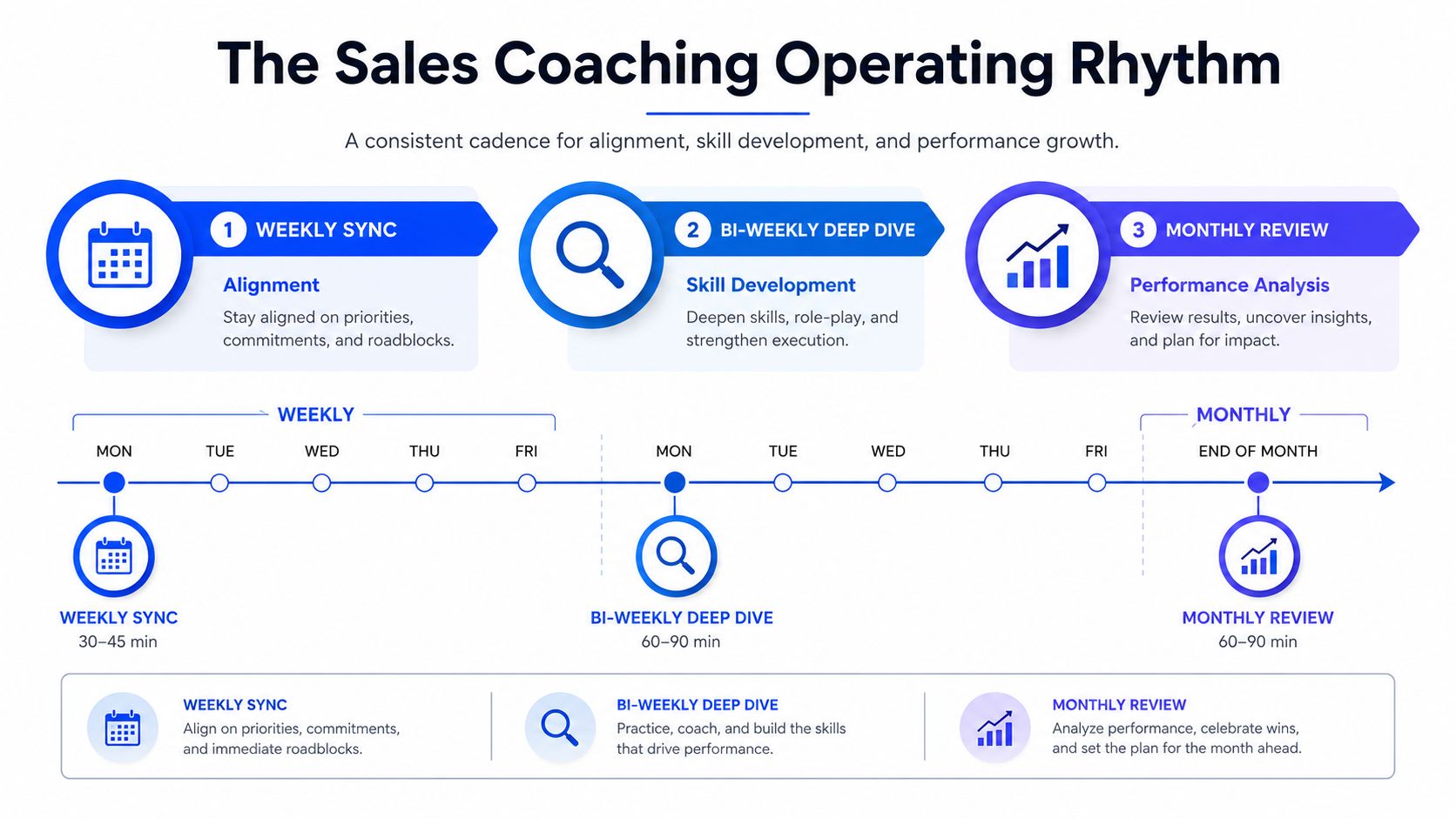
A workable rhythm for most B2B teams looks like this:
Weekly → one call review per rep
Bi-weekly → one skill drill session, usually in small groups
Monthly → one deeper deal review tied to pipeline quality and forecast movement
If you need a cleaner way to line this up with your management meetings, use a defined reporting cadence so coaching isn't constantly bumped by urgent pipeline noise.
Run the 60-second cold opener drill
This is still one of the fastest ways to improve prospecting behavior because it exposes hesitation, script dependency, and weak value framing in under a minute.
Here's the drill:
Set the scenario
You play a buyer in the rep's ICP. Use a real segment, not a generic persona. SaaS founder, iGaming commercial lead, manufacturing sales director, legal tech operations head, whatever fits the rep's patch.Set the clock
The rep has 60 seconds to earn the next part of the conversation. Cut them off at the mark.Make it realistic
Respond like a busy prospect. Push back. Interrupt. Say you already work with someone. Say you're not the right person. Stay hard to impress.Ban script reading
They can prepare structure, not recite copy. If they sound like they're reading from Apollo notes, restart.Review immediately
Ask four questions → what did the prospect hear in the first seconds, did the rep earn the next part of the call, where did they become robotic, what single phrase helped or hurt most.Repeat fast
Run it again, sharper. Then again. Five to ten rounds works because repetition burns off self-consciousness.
Confidence doesn't come from reading a script more times. It comes from failing safely, adjusting, and hearing yourself get better.
Use this in teams running outbound through Apollo, Instantly, Lemlist, or HeyReach. The opener still decides whether a reply becomes a meeting or dies in the first sentence.
How to run a coaching session that actually changes behavior
Most reps don't have a motivation problem. They have a structure problem. They know the offer, get nervous, then pitch too early because talking feels safer than diagnosing.
That habit kills calls and it also wrecks reply handling in multi-channel outbound. A rep gets a fast response from Lemlist or HeyReach, sees interest, and jumps into explanation mode before qualification is clear.

Fix the early pitch with call structure
I'd coach one recurring framework until the team can run it under pressure. Four phases, same order, no shortcuts.
Hook and purpose
Keep it to 60 seconds maximum. No product dump. The rep's job is to earn permission for the next question.Discovery
Spend 5 to 10 minutes asking open questions. The rep should be listening for operational pain, urgency, current process, and consequences. They should not be forcing the deck into the conversation.Mirror back the pain
Have the rep restate what they heard in specific language. Not broad summaries. Exact friction, exact stakes, exact delay or blocker.Targeted offer
Only now should they describe the offer, and only against the problem the buyer already confirmed.
Coaching sessions usually fail when managers explain the framework once, the rep nods, and everyone moves on. That's not coaching. Coaching means role-playing until the rep stops breaking sequence.
A simple session format works well:
Start with one recording where the rep pitched too early
Pause at the miss and ask what they were trying to achieve
Replay the moment using the four-phase structure
Run two live role-plays on the same scenario
End with one behavior commitment for the next block of calls
Advice rarely fixes a bad habit. Repetition with a better structure does.
If you want a quick walkthrough format for live coaching and rep development, this video is a useful companion during manager training:
Coach multi-channel qualification as one conversation
Modern outbound isn't one channel. It's LinkedIn touches, email replies, profile views, follow-up nudges, and calendar friction all happening at once. If your reps qualify each channel separately, you create routing chaos.
A projected 2025 Gartner report says 68% of B2B revenue teams using multi-channel outbound see 25% pipeline leakage from poor qualification routing, and structured coaching can reduce that leakage by 40% when reps are trained on unified rules and shared feedback loops, as summarized in Sandler's coaching article.
That's why I'd coach qualification as one conversation across channels:
Use one qualification rule set across LinkedIn, email, and call replies
Route fast replies into one queue inside HubSpot or your CRM, not separate inbox habits
Teach reps to identify signal first → fit, urgency, role, and buying context
Review edge cases in Slack so the whole team sees how routing decisions get made
If your team needs a stronger tool layer for role-play, call review, and manager feedback workflows, a curated view of sales coaching and training tools helps you compare what belongs in the stack and what's just more software.
The 3-tier system for measuring coaching impact
If your only measure of coaching is whether a rep “sounds better,” you're guessing. Good sales team coaching uses evidence, and the evidence should change as the rep matures.
Early reps need proof that habits are forming. Mid-stage reps need proof that activity turns into pipeline. Mature reps need proof that pipeline turns into efficient revenue. Don't use one scoreboard for all three.
Track the right metrics for the rep's stage
Organizations that use technology to analyze sales calls are 46% more likely to see reps hit quota, and leaders who focus coaching on the middle 66% of performers get better ROI than teams that obsess only over top and bottom reps, according to Learn to Win's sales coaching methodology.
Use a simple progression model.
Phase | Focus | Primary KPIs to track |
|---|---|---|
Weeks 1 to 4 | Activity | Calls completed per day → connect rate → sequences written and sent → time spent in CRM vs time spent selling |
Weeks 5 to 12 | Outcome | Reply rate on outbound → meetings booked per week → show rate → discovery-to-proposal conversion |
Weeks 13 onward | Quality | Average deal size → win rate → sales cycle length → forecast accuracy |
Your KPI definitions should be locked before you start coaching against them. If one manager counts a booked meeting as success and another only counts a held meeting, you'll create fake improvement.
Use rolling windows and review the middle of the team
The single metric I trust most in developing teams is meetings held divided by meetings booked. It punishes junk pipeline and exposes reps who book low-quality conversations just to look productive.
A few operating rules matter here:
Use rolling 30-day windows
Weekly snapshots create noise. Sales is too volatile for single-week judgment.Score call quality monthly
Review three recordings per rep against the same rubric → opening, discovery, objection handling, close.Coach the middle of the team hardest
Top reps often self-correct. Bottom reps may have fit issues. The middle usually gives you the cleanest return on manager time.
The middle of the team is where most coaching ROI sits. That group has enough skill to apply feedback and enough inconsistency to benefit from structure.
A rep can look strong on activity and still be weak on quality. Another can book fewer meetings but hold more of them because qualification is better. That's why you need all three layers. Activity tells you what they did. Outcome tells you whether it converted. Quality tells you why.
Enabling managers and integrating your tech stack
A coaching system scales through managers or it doesn't scale at all. Plenty of teams buy more software when the actual problem is that frontline leaders were never taught how to observe, diagnose, and correct behavior.
That's backwards. If your managers are still acting like senior reps with direct reports, no stack will fix sales team coaching.
Managers are the system
Formal, systematic coaching programs produce 28% higher win rates and 353% ROI for every dollar invested in training, according to Revenue Architects' sales coaching research. That's the business case for manager enablement.
Train managers on three things only at first:
Observation discipline
They need to know how to watch a call without interrupting and how to identify one behavior that matters.Rubric-based feedback
Every manager should score the same dimensions the same way. Opening, discovery, objection handling, next-step control.Actionable follow-through
Each session ends with one behavior to practice, one place to apply it, and one date to review it again.
If you use onboarding or manager certification resources, material on LMS structure and enablement from AONMeetings is useful for thinking through how process and reinforcement should be documented, especially when you're training multiple team leads at once.
Use tools as evidence, not as a substitute
Use the stack to support judgment, not replace it.
Here's a practical split:
HubSpot for call recording, note capture, and stage movement
Gong or a similar conversation tool for pattern spotting and clip review
Apollo for sequence output and contact-level outbound behavior
Clay for account context before role-play and qualification drills
Sales Navigator for buyer context, trigger review, and persona prep
That stack gives managers evidence. It does not do the coaching.
A good rule is simple. No manager should walk into a coaching session with only dashboard screenshots. They should bring one recording, one CRM view, one pattern they observed, and one correction they want the rep to rehearse. If you're building this at leadership level, a role-specific structure for sales leaders helps define who owns coaching, scorecards, and reinforcement across the team.
Your first move is to listen, not talk
Don't start by rewriting scripts. Don't start by buying another platform. Don't start by announcing a coaching initiative to the team.
Start by listening.
Do this this week
Book two 60-minute baseline sessions. One with your strongest rep. One with a struggling rep. Use the same four-part agenda from earlier → actual experience, communication style, pipeline mindset, self-assessed gaps.
Set one rule for yourself. You are not allowed to coach in those meetings. No corrections. No advice. No “what I would do.”
Then shadow calls. Just observe. Listen to how each rep opens, how quickly they pitch, how they qualify, and how they handle silence. The gap between what you assumed and what you hear is where your real coaching system starts.
Your first useful coaching insight usually arrives before you say a word. It shows up when a rep does exactly what they always do, and you finally take the time to notice it.
If you do only that this week, you'll already be ahead of most sales orgs. They talk about coaching. You'll be building one.
If you want help turning this into a working operating rhythm, Grou helps B2B revenue teams build structured pipeline systems where messaging, outbound, qualification, and reporting run on one line. That same discipline is what makes coaching stick.
Your reps are busy, your managers are busy, and coaching gets treated like cleanup work after pipeline review. That's why most sales team coaching fails. It happens in fragments, usually after a bad call, a missed target, or a rep complaint. Nothing compounds because nothing is designed to.
The fix isn't another coaching template. It's an operating system. If you run outbound in Apollo, route replies in HubSpot, track LinkedIn activity in Sales Navigator, and push campaigns through bi-weekly sprint cycles, your coaching has to match that level of structure. Otherwise the team gets process in one part of the business and improvisation in the part that decides whether pipeline turns into revenue.
Table of Contents
Key takeaways
Your sales coaching is failing because it's an action, not a system
Random coaching creates random performance
Start with a baseline, not a pep talk
Design your coaching cadence and operating rhythm
Use three coaching formats, not one
Run the 60-second cold opener drill
How to run a coaching session that actually changes behavior
Fix the early pitch with call structure
Coach multi-channel qualification as one conversation
The 3-tier system for measuring coaching impact
Track the right metrics for the rep's stage
Use rolling windows and review the middle of the team
Enabling managers and integrating your tech stack
Managers are the system
Use tools as evidence, not as a substitute
Your first move is to listen, not talk
Do this this week
Key takeaways
Ad-hoc coaching is worse than no coaching because it creates conflicting advice and random standards.
Start with observation, not feedback. Run a 60-minute baseline session, then shadow calls before you teach.
Put coaching on a cadence with separate formats for call reviews, deal reviews, and skill drills.
Measure coaching in stages. Early reps need activity metrics, developing reps need outcome metrics, mature reps need quality metrics.
Train managers to coach from evidence using call recordings, CRM data, and a shared rubric, not gut feel.
Your sales coaching is failing because it's an action, not a system
Most coaching inside revenue teams isn't coaching. It's commentary. A manager hears one bad call, drops one piece of advice in Slack, adds a note during forecast, then moves on. The rep gets a stream of reactions, not a development path.
That pattern is expensive. The impact of sales coaching on quota attainment has dropped from 53% in 2012 to 16% in 2024, while teams where reps receive weekly coaching reach 76% quota attainment, according to Kixie's sales coaching data. The gap isn't belief. It's execution.
Random coaching creates random performance
When coaching is ad-hoc, three things happen fast:
Standards drift. One manager tells reps to push harder on the opener. Another tells them to slow down and build rapport.
The loudest problem wins. Teams coach whatever feels painful this week instead of what moves conversion.
Reps perform for the meeting. They optimize for sounding coachable in a one-on-one instead of changing behavior on live calls.
Practical rule: If coaching isn't on the calendar with a repeatable format, it isn't a system. It's manager intent.
That's why I'd tie coaching to the same discipline you use for scorecards and sprint reviews. If you already run OKRs and continuous feedback strategies, apply that same operating logic to rep development. Sales team coaching should have a cadence, clear observations, and follow-through, not just good intentions.
You also need one source of truth for how your team sells. If you don't already have a documented structure, build one. A practical starting point is a working sales playbook that defines call expectations, qualification rules, and stage behavior.
Start with a baseline, not a pep talk
The first session with a rep should be diagnostic. Not motivational. Not corrective.
Run a 60-minute baseline session and cover exactly four areas:
Actual sales experience
Ask what they've really sold, to whom, in which motion, with which tools. CV bullets don't tell you whether they can handle outbound, discovery, or follow-up discipline.Natural communication style
Some reps are sharp live on calls. Others are stronger in written follow-up and async selling. Don't coach personality out of them. Coach from the strength.Pipeline mindset
Find out whether they think in activities or outcomes. A rep obsessed with dials but blind to meetings held will fill the CRM and still miss pipeline quality.Self-assessed gaps
Ask where they think they're weak. Reps who can identify their own misses usually improve faster because they can process feedback without getting defensive.
Then do the part most managers skip. Shadow 5 to 10 calls without intervening. No fixes yet. No note dump. Just observation.
You can't coach what you haven't observed. The fastest way to lose a rep is to correct a version of them that only exists in your head.
Design your coaching cadence and operating rhythm
A coaching system should look like a reporting system. It needs fixed formats, fixed inputs, and a fixed rhythm. If your team already works in weekly standups and bi-weekly outbound sprints, coaching should sit inside that motion instead of competing with it.
The mistake is running every coaching interaction as a one-on-one talk. That blurs tactical feedback, strategic judgment, and skill building into one messy meeting. Split them.
Use three coaching formats, not one
Structured coaching paired with training is 4x more effective than training alone, but only 26% of sales reps receive weekly one-on-one coaching, and teams lose 70% of training information within one week when reinforcement is weak, according to Challenger's coaching analysis. That's your case for cadence.
Use three session types:
Call review
Tactical. Review one or two recordings from HubSpot, Gong, or your dialer. Focus on observable moments, opener quality, question selection, objection handling, and close discipline.Deal review
Strategic. Inspect active opportunities. Ask what's been confirmed, what's assumed, who owns next step, and what evidence supports stage progression.Skill drill Repetitive practice. It's how behavior changes. Run role-plays, opener drills, objection drills, or qualification routing scenarios until the rep can perform under pressure.
A workable rhythm for most B2B teams looks like this:
Weekly → one call review per rep
Bi-weekly → one skill drill session, usually in small groups
Monthly → one deeper deal review tied to pipeline quality and forecast movement
If you need a cleaner way to line this up with your management meetings, use a defined reporting cadence so coaching isn't constantly bumped by urgent pipeline noise.
Run the 60-second cold opener drill
This is still one of the fastest ways to improve prospecting behavior because it exposes hesitation, script dependency, and weak value framing in under a minute.
Here's the drill:
Set the scenario
You play a buyer in the rep's ICP. Use a real segment, not a generic persona. SaaS founder, iGaming commercial lead, manufacturing sales director, legal tech operations head, whatever fits the rep's patch.Set the clock
The rep has 60 seconds to earn the next part of the conversation. Cut them off at the mark.Make it realistic
Respond like a busy prospect. Push back. Interrupt. Say you already work with someone. Say you're not the right person. Stay hard to impress.Ban script reading
They can prepare structure, not recite copy. If they sound like they're reading from Apollo notes, restart.Review immediately
Ask four questions → what did the prospect hear in the first seconds, did the rep earn the next part of the call, where did they become robotic, what single phrase helped or hurt most.Repeat fast
Run it again, sharper. Then again. Five to ten rounds works because repetition burns off self-consciousness.
Confidence doesn't come from reading a script more times. It comes from failing safely, adjusting, and hearing yourself get better.
Use this in teams running outbound through Apollo, Instantly, Lemlist, or HeyReach. The opener still decides whether a reply becomes a meeting or dies in the first sentence.
How to run a coaching session that actually changes behavior
Most reps don't have a motivation problem. They have a structure problem. They know the offer, get nervous, then pitch too early because talking feels safer than diagnosing.
That habit kills calls and it also wrecks reply handling in multi-channel outbound. A rep gets a fast response from Lemlist or HeyReach, sees interest, and jumps into explanation mode before qualification is clear.
Fix the early pitch with call structure
I'd coach one recurring framework until the team can run it under pressure. Four phases, same order, no shortcuts.
Hook and purpose
Keep it to 60 seconds maximum. No product dump. The rep's job is to earn permission for the next question.Discovery
Spend 5 to 10 minutes asking open questions. The rep should be listening for operational pain, urgency, current process, and consequences. They should not be forcing the deck into the conversation.Mirror back the pain
Have the rep restate what they heard in specific language. Not broad summaries. Exact friction, exact stakes, exact delay or blocker.Targeted offer
Only now should they describe the offer, and only against the problem the buyer already confirmed.
Coaching sessions usually fail when managers explain the framework once, the rep nods, and everyone moves on. That's not coaching. Coaching means role-playing until the rep stops breaking sequence.
A simple session format works well:
Start with one recording where the rep pitched too early
Pause at the miss and ask what they were trying to achieve
Replay the moment using the four-phase structure
Run two live role-plays on the same scenario
End with one behavior commitment for the next block of calls
Advice rarely fixes a bad habit. Repetition with a better structure does.
If you want a quick walkthrough format for live coaching and rep development, this video is a useful companion during manager training:
Coach multi-channel qualification as one conversation
Modern outbound isn't one channel. It's LinkedIn touches, email replies, profile views, follow-up nudges, and calendar friction all happening at once. If your reps qualify each channel separately, you create routing chaos.
A projected 2025 Gartner report says 68% of B2B revenue teams using multi-channel outbound see 25% pipeline leakage from poor qualification routing, and structured coaching can reduce that leakage by 40% when reps are trained on unified rules and shared feedback loops, as summarized in Sandler's coaching article.
That's why I'd coach qualification as one conversation across channels:
Use one qualification rule set across LinkedIn, email, and call replies
Route fast replies into one queue inside HubSpot or your CRM, not separate inbox habits
Teach reps to identify signal first → fit, urgency, role, and buying context
Review edge cases in Slack so the whole team sees how routing decisions get made
If your team needs a stronger tool layer for role-play, call review, and manager feedback workflows, a curated view of sales coaching and training tools helps you compare what belongs in the stack and what's just more software.
The 3-tier system for measuring coaching impact
If your only measure of coaching is whether a rep “sounds better,” you're guessing. Good sales team coaching uses evidence, and the evidence should change as the rep matures.
Early reps need proof that habits are forming. Mid-stage reps need proof that activity turns into pipeline. Mature reps need proof that pipeline turns into efficient revenue. Don't use one scoreboard for all three.
Track the right metrics for the rep's stage
Organizations that use technology to analyze sales calls are 46% more likely to see reps hit quota, and leaders who focus coaching on the middle 66% of performers get better ROI than teams that obsess only over top and bottom reps, according to Learn to Win's sales coaching methodology.
Use a simple progression model.
Phase | Focus | Primary KPIs to track |
|---|---|---|
Weeks 1 to 4 | Activity | Calls completed per day → connect rate → sequences written and sent → time spent in CRM vs time spent selling |
Weeks 5 to 12 | Outcome | Reply rate on outbound → meetings booked per week → show rate → discovery-to-proposal conversion |
Weeks 13 onward | Quality | Average deal size → win rate → sales cycle length → forecast accuracy |
Your KPI definitions should be locked before you start coaching against them. If one manager counts a booked meeting as success and another only counts a held meeting, you'll create fake improvement.
Use rolling windows and review the middle of the team
The single metric I trust most in developing teams is meetings held divided by meetings booked. It punishes junk pipeline and exposes reps who book low-quality conversations just to look productive.
A few operating rules matter here:
Use rolling 30-day windows
Weekly snapshots create noise. Sales is too volatile for single-week judgment.Score call quality monthly
Review three recordings per rep against the same rubric → opening, discovery, objection handling, close.Coach the middle of the team hardest
Top reps often self-correct. Bottom reps may have fit issues. The middle usually gives you the cleanest return on manager time.
The middle of the team is where most coaching ROI sits. That group has enough skill to apply feedback and enough inconsistency to benefit from structure.
A rep can look strong on activity and still be weak on quality. Another can book fewer meetings but hold more of them because qualification is better. That's why you need all three layers. Activity tells you what they did. Outcome tells you whether it converted. Quality tells you why.
Enabling managers and integrating your tech stack
A coaching system scales through managers or it doesn't scale at all. Plenty of teams buy more software when the actual problem is that frontline leaders were never taught how to observe, diagnose, and correct behavior.
That's backwards. If your managers are still acting like senior reps with direct reports, no stack will fix sales team coaching.
Managers are the system
Formal, systematic coaching programs produce 28% higher win rates and 353% ROI for every dollar invested in training, according to Revenue Architects' sales coaching research. That's the business case for manager enablement.
Train managers on three things only at first:
Observation discipline
They need to know how to watch a call without interrupting and how to identify one behavior that matters.Rubric-based feedback
Every manager should score the same dimensions the same way. Opening, discovery, objection handling, next-step control.Actionable follow-through
Each session ends with one behavior to practice, one place to apply it, and one date to review it again.
If you use onboarding or manager certification resources, material on LMS structure and enablement from AONMeetings is useful for thinking through how process and reinforcement should be documented, especially when you're training multiple team leads at once.
Use tools as evidence, not as a substitute
Use the stack to support judgment, not replace it.
Here's a practical split:
HubSpot for call recording, note capture, and stage movement
Gong or a similar conversation tool for pattern spotting and clip review
Apollo for sequence output and contact-level outbound behavior
Clay for account context before role-play and qualification drills
Sales Navigator for buyer context, trigger review, and persona prep
That stack gives managers evidence. It does not do the coaching.
A good rule is simple. No manager should walk into a coaching session with only dashboard screenshots. They should bring one recording, one CRM view, one pattern they observed, and one correction they want the rep to rehearse. If you're building this at leadership level, a role-specific structure for sales leaders helps define who owns coaching, scorecards, and reinforcement across the team.
Your first move is to listen, not talk
Don't start by rewriting scripts. Don't start by buying another platform. Don't start by announcing a coaching initiative to the team.
Start by listening.
Do this this week
Book two 60-minute baseline sessions. One with your strongest rep. One with a struggling rep. Use the same four-part agenda from earlier → actual experience, communication style, pipeline mindset, self-assessed gaps.
Set one rule for yourself. You are not allowed to coach in those meetings. No corrections. No advice. No “what I would do.”
Then shadow calls. Just observe. Listen to how each rep opens, how quickly they pitch, how they qualify, and how they handle silence. The gap between what you assumed and what you hear is where your real coaching system starts.
Your first useful coaching insight usually arrives before you say a word. It shows up when a rep does exactly what they always do, and you finally take the time to notice it.
If you do only that this week, you'll already be ahead of most sales orgs. They talk about coaching. You'll be building one.
If you want help turning this into a working operating rhythm, Grou helps B2B revenue teams build structured pipeline systems where messaging, outbound, qualification, and reporting run on one line. That same discipline is what makes coaching stick.
Your reps are busy, your managers are busy, and coaching gets treated like cleanup work after pipeline review. That's why most sales team coaching fails. It happens in fragments, usually after a bad call, a missed target, or a rep complaint. Nothing compounds because nothing is designed to.
The fix isn't another coaching template. It's an operating system. If you run outbound in Apollo, route replies in HubSpot, track LinkedIn activity in Sales Navigator, and push campaigns through bi-weekly sprint cycles, your coaching has to match that level of structure. Otherwise the team gets process in one part of the business and improvisation in the part that decides whether pipeline turns into revenue.
Table of Contents
Key takeaways
Your sales coaching is failing because it's an action, not a system
Random coaching creates random performance
Start with a baseline, not a pep talk
Design your coaching cadence and operating rhythm
Use three coaching formats, not one
Run the 60-second cold opener drill
How to run a coaching session that actually changes behavior
Fix the early pitch with call structure
Coach multi-channel qualification as one conversation
The 3-tier system for measuring coaching impact
Track the right metrics for the rep's stage
Use rolling windows and review the middle of the team
Enabling managers and integrating your tech stack
Managers are the system
Use tools as evidence, not as a substitute
Your first move is to listen, not talk
Do this this week
Key takeaways
Ad-hoc coaching is worse than no coaching because it creates conflicting advice and random standards.
Start with observation, not feedback. Run a 60-minute baseline session, then shadow calls before you teach.
Put coaching on a cadence with separate formats for call reviews, deal reviews, and skill drills.
Measure coaching in stages. Early reps need activity metrics, developing reps need outcome metrics, mature reps need quality metrics.
Train managers to coach from evidence using call recordings, CRM data, and a shared rubric, not gut feel.
Your sales coaching is failing because it's an action, not a system
Most coaching inside revenue teams isn't coaching. It's commentary. A manager hears one bad call, drops one piece of advice in Slack, adds a note during forecast, then moves on. The rep gets a stream of reactions, not a development path.
That pattern is expensive. The impact of sales coaching on quota attainment has dropped from 53% in 2012 to 16% in 2024, while teams where reps receive weekly coaching reach 76% quota attainment, according to Kixie's sales coaching data. The gap isn't belief. It's execution.
Random coaching creates random performance
When coaching is ad-hoc, three things happen fast:
Standards drift. One manager tells reps to push harder on the opener. Another tells them to slow down and build rapport.
The loudest problem wins. Teams coach whatever feels painful this week instead of what moves conversion.
Reps perform for the meeting. They optimize for sounding coachable in a one-on-one instead of changing behavior on live calls.
Practical rule: If coaching isn't on the calendar with a repeatable format, it isn't a system. It's manager intent.
That's why I'd tie coaching to the same discipline you use for scorecards and sprint reviews. If you already run OKRs and continuous feedback strategies, apply that same operating logic to rep development. Sales team coaching should have a cadence, clear observations, and follow-through, not just good intentions.
You also need one source of truth for how your team sells. If you don't already have a documented structure, build one. A practical starting point is a working sales playbook that defines call expectations, qualification rules, and stage behavior.
Start with a baseline, not a pep talk
The first session with a rep should be diagnostic. Not motivational. Not corrective.
Run a 60-minute baseline session and cover exactly four areas:
Actual sales experience
Ask what they've really sold, to whom, in which motion, with which tools. CV bullets don't tell you whether they can handle outbound, discovery, or follow-up discipline.Natural communication style
Some reps are sharp live on calls. Others are stronger in written follow-up and async selling. Don't coach personality out of them. Coach from the strength.Pipeline mindset
Find out whether they think in activities or outcomes. A rep obsessed with dials but blind to meetings held will fill the CRM and still miss pipeline quality.Self-assessed gaps
Ask where they think they're weak. Reps who can identify their own misses usually improve faster because they can process feedback without getting defensive.
Then do the part most managers skip. Shadow 5 to 10 calls without intervening. No fixes yet. No note dump. Just observation.
You can't coach what you haven't observed. The fastest way to lose a rep is to correct a version of them that only exists in your head.
Design your coaching cadence and operating rhythm
A coaching system should look like a reporting system. It needs fixed formats, fixed inputs, and a fixed rhythm. If your team already works in weekly standups and bi-weekly outbound sprints, coaching should sit inside that motion instead of competing with it.
The mistake is running every coaching interaction as a one-on-one talk. That blurs tactical feedback, strategic judgment, and skill building into one messy meeting. Split them.
Use three coaching formats, not one
Structured coaching paired with training is 4x more effective than training alone, but only 26% of sales reps receive weekly one-on-one coaching, and teams lose 70% of training information within one week when reinforcement is weak, according to Challenger's coaching analysis. That's your case for cadence.
Use three session types:
Call review
Tactical. Review one or two recordings from HubSpot, Gong, or your dialer. Focus on observable moments, opener quality, question selection, objection handling, and close discipline.Deal review
Strategic. Inspect active opportunities. Ask what's been confirmed, what's assumed, who owns next step, and what evidence supports stage progression.Skill drill Repetitive practice. It's how behavior changes. Run role-plays, opener drills, objection drills, or qualification routing scenarios until the rep can perform under pressure.
A workable rhythm for most B2B teams looks like this:
Weekly → one call review per rep
Bi-weekly → one skill drill session, usually in small groups
Monthly → one deeper deal review tied to pipeline quality and forecast movement
If you need a cleaner way to line this up with your management meetings, use a defined reporting cadence so coaching isn't constantly bumped by urgent pipeline noise.
Run the 60-second cold opener drill
This is still one of the fastest ways to improve prospecting behavior because it exposes hesitation, script dependency, and weak value framing in under a minute.
Here's the drill:
Set the scenario
You play a buyer in the rep's ICP. Use a real segment, not a generic persona. SaaS founder, iGaming commercial lead, manufacturing sales director, legal tech operations head, whatever fits the rep's patch.Set the clock
The rep has 60 seconds to earn the next part of the conversation. Cut them off at the mark.Make it realistic
Respond like a busy prospect. Push back. Interrupt. Say you already work with someone. Say you're not the right person. Stay hard to impress.Ban script reading
They can prepare structure, not recite copy. If they sound like they're reading from Apollo notes, restart.Review immediately
Ask four questions → what did the prospect hear in the first seconds, did the rep earn the next part of the call, where did they become robotic, what single phrase helped or hurt most.Repeat fast
Run it again, sharper. Then again. Five to ten rounds works because repetition burns off self-consciousness.
Confidence doesn't come from reading a script more times. It comes from failing safely, adjusting, and hearing yourself get better.
Use this in teams running outbound through Apollo, Instantly, Lemlist, or HeyReach. The opener still decides whether a reply becomes a meeting or dies in the first sentence.
How to run a coaching session that actually changes behavior
Most reps don't have a motivation problem. They have a structure problem. They know the offer, get nervous, then pitch too early because talking feels safer than diagnosing.
That habit kills calls and it also wrecks reply handling in multi-channel outbound. A rep gets a fast response from Lemlist or HeyReach, sees interest, and jumps into explanation mode before qualification is clear.
Fix the early pitch with call structure
I'd coach one recurring framework until the team can run it under pressure. Four phases, same order, no shortcuts.
Hook and purpose
Keep it to 60 seconds maximum. No product dump. The rep's job is to earn permission for the next question.Discovery
Spend 5 to 10 minutes asking open questions. The rep should be listening for operational pain, urgency, current process, and consequences. They should not be forcing the deck into the conversation.Mirror back the pain
Have the rep restate what they heard in specific language. Not broad summaries. Exact friction, exact stakes, exact delay or blocker.Targeted offer
Only now should they describe the offer, and only against the problem the buyer already confirmed.
Coaching sessions usually fail when managers explain the framework once, the rep nods, and everyone moves on. That's not coaching. Coaching means role-playing until the rep stops breaking sequence.
A simple session format works well:
Start with one recording where the rep pitched too early
Pause at the miss and ask what they were trying to achieve
Replay the moment using the four-phase structure
Run two live role-plays on the same scenario
End with one behavior commitment for the next block of calls
Advice rarely fixes a bad habit. Repetition with a better structure does.
If you want a quick walkthrough format for live coaching and rep development, this video is a useful companion during manager training:
Coach multi-channel qualification as one conversation
Modern outbound isn't one channel. It's LinkedIn touches, email replies, profile views, follow-up nudges, and calendar friction all happening at once. If your reps qualify each channel separately, you create routing chaos.
A projected 2025 Gartner report says 68% of B2B revenue teams using multi-channel outbound see 25% pipeline leakage from poor qualification routing, and structured coaching can reduce that leakage by 40% when reps are trained on unified rules and shared feedback loops, as summarized in Sandler's coaching article.
That's why I'd coach qualification as one conversation across channels:
Use one qualification rule set across LinkedIn, email, and call replies
Route fast replies into one queue inside HubSpot or your CRM, not separate inbox habits
Teach reps to identify signal first → fit, urgency, role, and buying context
Review edge cases in Slack so the whole team sees how routing decisions get made
If your team needs a stronger tool layer for role-play, call review, and manager feedback workflows, a curated view of sales coaching and training tools helps you compare what belongs in the stack and what's just more software.
The 3-tier system for measuring coaching impact
If your only measure of coaching is whether a rep “sounds better,” you're guessing. Good sales team coaching uses evidence, and the evidence should change as the rep matures.
Early reps need proof that habits are forming. Mid-stage reps need proof that activity turns into pipeline. Mature reps need proof that pipeline turns into efficient revenue. Don't use one scoreboard for all three.
Track the right metrics for the rep's stage
Organizations that use technology to analyze sales calls are 46% more likely to see reps hit quota, and leaders who focus coaching on the middle 66% of performers get better ROI than teams that obsess only over top and bottom reps, according to Learn to Win's sales coaching methodology.
Use a simple progression model.
Phase | Focus | Primary KPIs to track |
|---|---|---|
Weeks 1 to 4 | Activity | Calls completed per day → connect rate → sequences written and sent → time spent in CRM vs time spent selling |
Weeks 5 to 12 | Outcome | Reply rate on outbound → meetings booked per week → show rate → discovery-to-proposal conversion |
Weeks 13 onward | Quality | Average deal size → win rate → sales cycle length → forecast accuracy |
Your KPI definitions should be locked before you start coaching against them. If one manager counts a booked meeting as success and another only counts a held meeting, you'll create fake improvement.
Use rolling windows and review the middle of the team
The single metric I trust most in developing teams is meetings held divided by meetings booked. It punishes junk pipeline and exposes reps who book low-quality conversations just to look productive.
A few operating rules matter here:
Use rolling 30-day windows
Weekly snapshots create noise. Sales is too volatile for single-week judgment.Score call quality monthly
Review three recordings per rep against the same rubric → opening, discovery, objection handling, close.Coach the middle of the team hardest
Top reps often self-correct. Bottom reps may have fit issues. The middle usually gives you the cleanest return on manager time.
The middle of the team is where most coaching ROI sits. That group has enough skill to apply feedback and enough inconsistency to benefit from structure.
A rep can look strong on activity and still be weak on quality. Another can book fewer meetings but hold more of them because qualification is better. That's why you need all three layers. Activity tells you what they did. Outcome tells you whether it converted. Quality tells you why.
Enabling managers and integrating your tech stack
A coaching system scales through managers or it doesn't scale at all. Plenty of teams buy more software when the actual problem is that frontline leaders were never taught how to observe, diagnose, and correct behavior.
That's backwards. If your managers are still acting like senior reps with direct reports, no stack will fix sales team coaching.
Managers are the system
Formal, systematic coaching programs produce 28% higher win rates and 353% ROI for every dollar invested in training, according to Revenue Architects' sales coaching research. That's the business case for manager enablement.
Train managers on three things only at first:
Observation discipline
They need to know how to watch a call without interrupting and how to identify one behavior that matters.Rubric-based feedback
Every manager should score the same dimensions the same way. Opening, discovery, objection handling, next-step control.Actionable follow-through
Each session ends with one behavior to practice, one place to apply it, and one date to review it again.
If you use onboarding or manager certification resources, material on LMS structure and enablement from AONMeetings is useful for thinking through how process and reinforcement should be documented, especially when you're training multiple team leads at once.
Use tools as evidence, not as a substitute
Use the stack to support judgment, not replace it.
Here's a practical split:
HubSpot for call recording, note capture, and stage movement
Gong or a similar conversation tool for pattern spotting and clip review
Apollo for sequence output and contact-level outbound behavior
Clay for account context before role-play and qualification drills
Sales Navigator for buyer context, trigger review, and persona prep
That stack gives managers evidence. It does not do the coaching.
A good rule is simple. No manager should walk into a coaching session with only dashboard screenshots. They should bring one recording, one CRM view, one pattern they observed, and one correction they want the rep to rehearse. If you're building this at leadership level, a role-specific structure for sales leaders helps define who owns coaching, scorecards, and reinforcement across the team.
Your first move is to listen, not talk
Don't start by rewriting scripts. Don't start by buying another platform. Don't start by announcing a coaching initiative to the team.
Start by listening.
Do this this week
Book two 60-minute baseline sessions. One with your strongest rep. One with a struggling rep. Use the same four-part agenda from earlier → actual experience, communication style, pipeline mindset, self-assessed gaps.
Set one rule for yourself. You are not allowed to coach in those meetings. No corrections. No advice. No “what I would do.”
Then shadow calls. Just observe. Listen to how each rep opens, how quickly they pitch, how they qualify, and how they handle silence. The gap between what you assumed and what you hear is where your real coaching system starts.
Your first useful coaching insight usually arrives before you say a word. It shows up when a rep does exactly what they always do, and you finally take the time to notice it.
If you do only that this week, you'll already be ahead of most sales orgs. They talk about coaching. You'll be building one.
If you want help turning this into a working operating rhythm, Grou helps B2B revenue teams build structured pipeline systems where messaging, outbound, qualification, and reporting run on one line. That same discipline is what makes coaching stick.
Pipeline OS Newsletter
Build qualified pipeline
Get weekly tactics to generate demand, improve lead quality, and book more meetings.





Trusted by industry leaders
Trusted by industry leaders
Trusted by industry leaders
Ready to build qualified pipeline?
Ready to build qualified pipeline?
Ready to build qualified pipeline?
Book a call to see if we're the right fit, or take the 2-minute quiz to get a clear starting point.
Book a call to see if we're the right fit, or take the 2-minute quiz to get a clear starting point.
Book a call to see if we're the right fit, or take the 2-minute quiz to get a clear starting point.
" height="30.21639343089746px" id="hfGbXmQR2" width="30.216393430897455px"/></svg>)
Copyright © 2026 – All Right Reserved
Copyright © 2026 – All Right Reserved
Copyright © 2026 – All Right Reserved