%22%3E%3C/path%3E%3Cpath d=%22M 63.072 7.554 C 62.258 8.022 61.577 8.689 61.092 9.493 L 61.092 7.076 L 57.158 7.076 L 57.158 22.64 L 61.089 22.64 L 61.089 14.888 C 61.089 13.446 61.403 12.434 62.03 11.853 C 62.818 11.218 63.818 10.907 64.826 10.982 L 65.868 10.982 L 65.868 6.851 C 64.891 6.834 63.926 7.076 63.073 7.554 Z%22 fill=%22rgb(17,17,17)%22%3E%3C/path%3E%3Cpath d=%22M 78.916 7.82 C 76.363 6.49 73.321 6.49 70.768 7.82 C 69.562 8.473 68.564 9.451 67.888 10.644 C 67.167 11.931 66.803 13.387 66.834 14.862 C 66.804 16.332 67.157 17.785 67.86 19.077 C 68.515 20.267 69.494 21.246 70.684 21.901 C 71.924 22.576 73.318 22.92 74.73 22.898 C 76.164 22.918 77.58 22.575 78.846 21.901 C 80.062 21.247 81.073 20.27 81.768 19.077 C 82.506 17.797 82.88 16.339 82.85 14.862 C 82.88 13.389 82.517 11.934 81.797 10.647 C 81.12 9.455 80.122 8.477 78.917 7.824 M 78.803 14.862 C 78.829 15.739 78.636 16.608 78.241 17.391 C 77.903 18.046 77.38 18.588 76.738 18.95 C 76.124 19.293 75.432 19.472 74.729 19.47 C 73.668 19.497 72.648 19.061 71.934 18.276 C 71.139 17.323 70.741 16.1 70.823 14.862 C 70.741 13.62 71.149 12.395 71.959 11.45 C 72.687 10.667 73.715 10.233 74.783 10.256 C 75.859 10.236 76.894 10.67 77.635 11.45 C 78.464 12.387 78.884 13.616 78.801 14.864%22 fill=%22rgb(17,17,17)%22%3E%3C/path%3E%3Cpath d=%22M 95.906 7.076 L 95.906 15.646 C 95.975 16.68 95.643 17.701 94.979 18.498 C 94.311 19.184 93.379 19.547 92.422 19.495 C 91.475 19.544 90.553 19.18 89.894 18.498 C 89.23 17.701 88.898 16.68 88.967 15.646 L 88.967 7.076 L 85.033 7.076 L 85.033 16.207 C 85 17.449 85.275 18.68 85.834 19.79 C 86.327 20.75 87.095 21.542 88.039 22.065 C 89.033 22.594 90.145 22.861 91.271 22.838 C 92.188 22.847 93.095 22.65 93.926 22.263 C 94.708 21.905 95.388 21.36 95.906 20.675 L 95.906 22.645 L 99.865 22.645 L 99.865 7.076 Z%22 fill=%22rgb(17,17,17)%22%3E%3C/path%3E%3Cpath d=%22M 4.513 15.626 C 4.511 10.815 7.606 6.549 12.181 5.059 C 16.756 3.57 21.77 5.195 24.601 9.086 L 27.816 5.87 C 24.074 1.186 17.981 -0.943 12.137 0.393 C 6.292 1.728 1.728 6.292 0.393 12.137 C -0.943 17.981 1.186 24.074 5.87 27.816 L 9.085 24.601 C 6.214 22.512 4.515 19.177 4.513 15.626%22 fill=%22rgb(32,62,235)%22%3E%3C/path%3E%3Cpath d=%22M 17.114 14.343 L 13.354 18.01 L 13.354 18.026 L 21.071 18.026 L 11.412 27.609 L 17.389 27.609 L 23.999 21.081 L 23.999 28.316 L 24.005 28.316 L 27.967 24.393 L 27.967 14.343 Z%22 fill=%22rgb(32,62,235)%22%3E%3C/path%3E%3C/g%3E%3C/svg%3E) ×
× ××
××›
›
›
›
What is lead qualification? How it works for B2B in 2026
What is lead qualification? How it works for B2B in 2026
What is lead qualification? How it works for B2B in 2026
What is lead qualification? How it works for B2B in 2026
What is lead qualification? How it works for B2B in 2026
What is lead qualification? How it works for B2B in 2026

Author
Aljaz Peklaj

Your pipeline's getting noisier, not cleaner. MQL volume is up, SQL conversion is flat, and the forecast is wobbling because too many leads are getting routed by habit instead of evidence. That's not a top-of-funnel problem, it's a qualification problem.
Lead qualification is a routing decision, not a checklist ritual.
Fit, intent, and timing should decide who gets an AE, who gets nurture, and who gets dropped.
Speed-to-lead is part of qualification, because slow follow-up changes outcomes fast.
BANT still works as a first gate, but only when you pair it with scoring and CRM routing.
Friday audits expose the leak, if you score the last 90 days.
Table of Contents
Qualification criteria, scoring math, and routing thresholds
Lead qualification examples for SaaS, iGaming, and manufacturing
Why speed to lead is a qualification variable, not a courtesy
Building a unified qualification engine with LinkedIn, enrichment, and outbound
The pipeline problem you are trying to fix this quarter
You don't need another theory of demand. You need a cleaner way to stop good-looking leads from slipping into the wrong queue while forecast coverage gets more fragile every week. The core issue is simple, too many teams treat qualification as a rep judgment call when it should be a routing rule.
That's why this piece focuses on the working parts:
A practical definition of lead qualification for B2B operators.
A side-by-side verdict on BANT, MEDDIC, CHAMP, and lead scoring.
A scoring model you can copy into HubSpot or Salesforce.
Examples from SaaS, iGaming, and manufacturing.
A Friday audit that shows where the leak is.
The point is structure. If your system can't tell the difference between fit, intent, and urgency, it's not qualifying leads. It's collecting them. For a broader lead generation context, Grou's guide on lead generation strategy and execution is the right companion read.
What lead qualification means in a B2B funnel
A lead is qualified when your team can route it with confidence, not when it just looks active. The right test is simple: does this contact match your ICP, show intent, and need follow-up at the right speed? If the answer is yes, sales gets it. If not, marketing keeps nurturing it or the record gets suppressed until the data improves.
Qualification matters because the funnel leaks early. Benchmark data puts B2B conversion at 2.3% of website visitors into leads (source), 31% of leads into MQLs (source), 13% of MQLs into SQLs (source), and only 22% to 30% of opportunities into customers (source). That is a routing problem and a reporting problem. If the same lead can sit in three queues with three owners, your system is broken.
Practical rule: if you cannot assign the lead cleanly, it is not qualified.
The fix is not a longer script. Static BANT questions miss the point because modern B2B buying is usually a sequence, not a single form fill. Use buyer journey mapping to line up the lead's stage with the next action, then use unified fit, intent, and timing data to decide routing. That is how strong teams replace guesswork with a repeatable rule set.
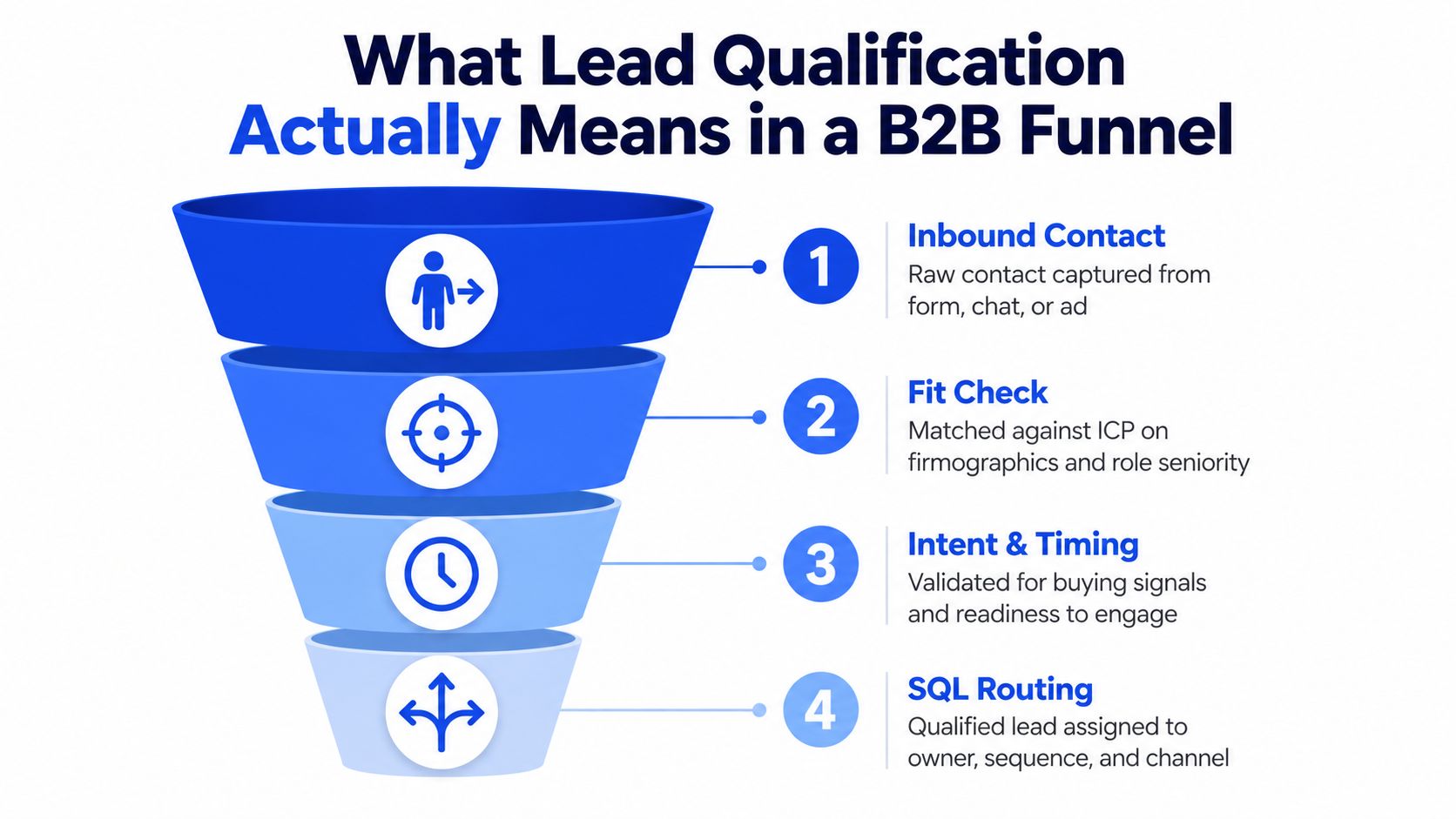
What good qualification checks for
Good qualification checks whether the buying group has a real problem and a reason to move now. It looks at the company, the contact, and the moment together. Separate those inputs and you get noisy handoffs, not better pipeline.
Grou's qualification logic follows that same operator view. It checks ICP match, persona match, trigger signal, engagement weight, pain confirmation, authority, budget signal, and timeline. Keep buyer journey mapping tied to that logic, because the journey tells you when a lead should move and the qualification rule tells you where it should go.
The common trap is mistaking activity for readiness. A download is not intent. A reply is not budget. A contact form is not a sales handoff unless the rest of the record supports it.
BANT, MEDDIC, CHAMP, and lead scoring compared
BANT wins for first-touch gating on high-volume inbound. MEDDIC wins when the deal is complex and multi-threaded. CHAMP is good when the buyer leads with pain. Lead scoring is the layer that makes all three usable at scale. For inbound SaaS and iGaming, I'd use BANT plus lead scoring as the default because it gives you a quick commercial gate and a behavioral weight model that static questions miss.
Framework | Core criteria | Best-fit motion | Main weakness | When to use |
|---|---|---|---|---|
BANT | Budget, Authority, Need, Timeline | High-volume inbound, mid-market qualification | Too rigid if used alone | First-touch triage |
MEDDIC | Metrics, Economic Buyer, Decision Criteria, Decision Process, Identify Pain, Champion, Competition | Complex enterprise deals | Slower, heavier, better late in cycle | Second-call and deal validation |
CHAMP | Challenges, Authority, Money, Prioritization | Inbound with clear pain signals | Can underweight timing nuance | Discovery when pain is clear |
Lead Scoring | Weighted fit and behavior model | Any motion with enough volume | Weak without clean routing rules | Always, if CRM discipline exists |
The useful thing about this comparison is that each framework answers a different question. BANT tells you whether to spend time now. MEDDIC tells you whether a deal can survive scrutiny. CHAMP tells you whether the pain is real. Lead scoring tells you whether the contact deserves human attention first.
Operator rule: don't pick one framework and worship it. Pick the one that matches the sales motion, then force the CRM to apply it the same way every time.
Why I'd default to BANT plus scoring
BANT is fast, which matters when the queue is full. Lead scoring catches the things BANT scripts miss, such as repeat pricing-page visits, ad clicks, or engagement from the right seniority level. That combination is why static checklists break down in real pipelines, while a simple score keeps the process measurable.
For a practical model of that weighting logic, Grou's lead scoring model glossary is worth aligning with your CRM fields. MEDDIC and CHAMP still matter, but they belong deeper in the cycle, after the lead has earned a second conversation.
Qualification criteria, scoring math, and routing thresholds
Start with three criteria families. Firmographic fit covers industry, headcount, revenue, and geography. Behavioral intent covers pricing page visits, repeat demo requests, content downloads, and ad clicks. Engagement depth covers reply sentiment, meeting show rate, and stakeholder count.
Score eight variables on a 0 to 3 scale, for a total of 24 points. A 16-of-24 threshold should flag an SQL. That gives you a simple decision rule that can live inside HubSpot or Salesforce without turning into a rep-by-rep debate.
The scoring matrix I'd actually use
Variable | Weight (0-3) | What scores a 3 | What scores a 0 |
|---|---|---|---|
Industry fit | 0-3 | Matches ICP exactly | Outside target market |
Company size | 0-3 | Inside ideal range | Clear mismatch |
Geography | 0-3 | Serviceable market | Unserviceable market |
Role seniority | 0-3 | Buyer or strong influencer | No buying relevance |
Pricing engagement | 0-3 | Multiple visits, recent | None |
Demo intent | 0-3 | Repeated request or booked meeting | No signal |
Reply quality | 0-3 | Specific, commercial response | No reply or junk |
Stakeholder depth | 0-3 | Multiple relevant contacts | Solo contact only |
A second routing rule should sit above the score. Tier 1 means at least 5 of 8 on firmographics plus any two intent signals, then the lead goes to a senior AE within 30 minutes. Everything below that should recycle to nurture on a 14-day re-score trigger.
Don't overweight company size and ignore buying authority. That mistake creates pretty dashboards and bad handoffs. A large account with no power to buy is still a weak lead.
Disqualification should be a logged outcome, not a waste bin. If the lead misses the bar, store the reason code and let the routing logic learn from it next month.
Lead qualification examples for SaaS, iGaming, and manufacturing
A SaaS example makes the logic obvious. An inbound lead from a 400-person fintech downloads the pricing page twice in 48 hours and replies to a cold email with a specific integration question. That integration need flips the lead from MQL to SQL, and it routes to a senior AE within 20 minutes. If the lead had no integration pain or no access to the buyer, it stays out of the active queue.
An iGaming example looks different, but the decision logic is the same. You're outbound to a licensed operator in LATAM, and the qualifying question is the current payment provider. The signal that flips the lead is an open hiring post for a payments lead, which tells you the topic is active inside the account. That lead should route to the payments pod, not a generalist SDR.
A manufacturing lead usually needs more context before sales time is justified. A plant operations VP attends a webinar on downtime reduction, and the qualifying question is the number of plants. The data point that flips it is a recent capex announcement, which makes the case for an enterprise AE with a custom ROI model. If there's no plant footprint or no real expansion signal, it never leaves nurture.
The pattern matters more than the industry. Qualification is the routing decision that protects AE time and keeps bad-fit leads from polluting your pipeline. If you can't name the disqualifier, you're not qualifying. You're hoping.
Why speed to lead is a qualification variable, not a courtesy
A lead that sits for an hour is already changing shape. Analysts at Aloware found that leads contacted within 5 minutes are far more likely to qualify, and that response speed drops qualification sharply once the delay stretches into hours. Landbase reports the same pattern: teams that answer fast qualify more often, and a long wait kills the opportunity.
Put speed in the scoring model. Subtract 1 point after 30 minutes, subtract 2 after 4 hours, and disqualify after 24 hours unless a re-engagement rule applies. That is a routing problem, not a motivation problem. Slow follow-up means the queue is wrong, the staffing is wrong, or both.
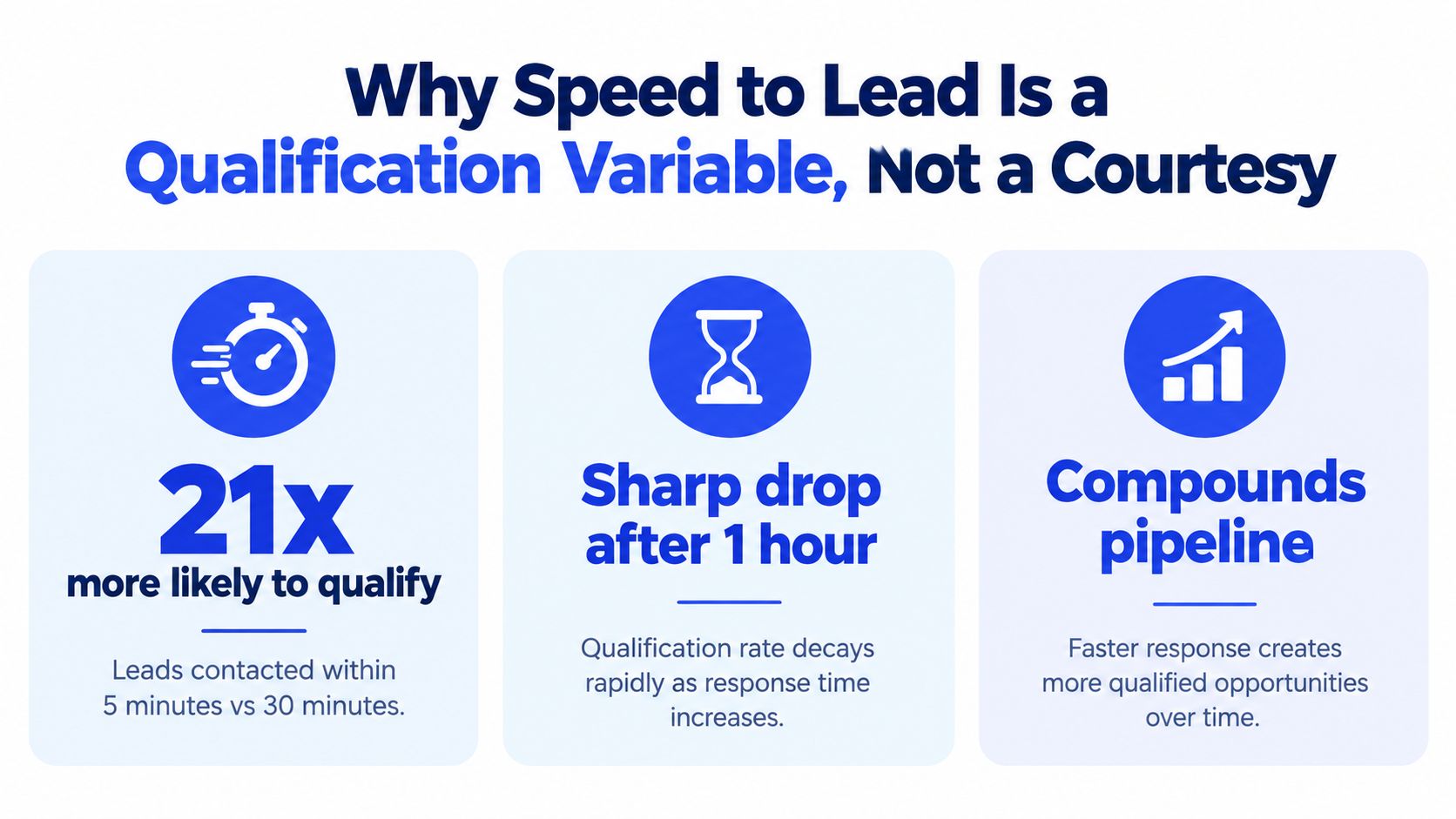
Use a hard SLA. Tier 1 leads should trigger an immediate alert to a senior AE, with automatic fallback to a junior rep at 15 minutes and nurture recycling at 60 minutes. Anything slower turns a live lead into dead weight before the first conversation starts. The cleanest teams track this in their speed-to-lead workflow and hold routing owners accountable for it.
Building a unified qualification engine with LinkedIn, enrichment, and outbound
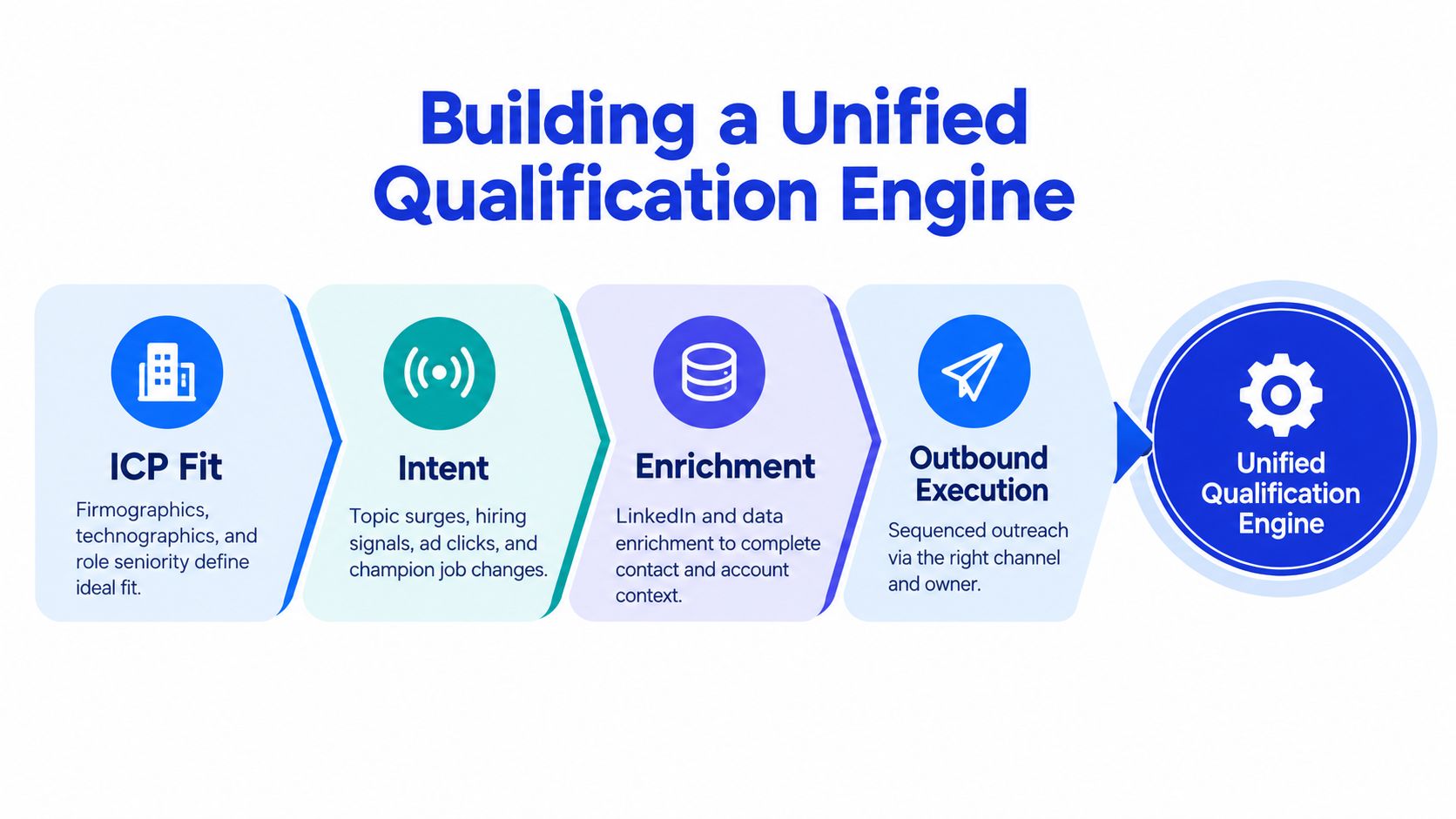
A qualification engine only works when four signals land in one record. ICP fit defines the account shape. Intent shows whether the buying group is active. Speed-to-lead timestamps show whether the lead is still warm. Enrichment resolution shows whether the contact data is complete enough to route without errors.
That is the model Grou builds around. LinkedIn activity, profile views, post engagement, and connection acceptance on a target list feed the record. Enrichment fills the missing fields. Outbound then uses the same record to send the right sequence, while the CRM writes back every response so scoring, routing, and reporting stay aligned.
How the loop works
ICP fit: firmographics, technographics, role seniority.
Intent: topic surges, hiring signals, ad clicks, champion job changes.
Enrichment: enrichment completes the account and contact record.
Outbound execution: the sequencer sends the message and logs the response.
The weak point is data handoff. If LinkedIn, enrichment, outbound, and CRM each keep their own version of the lead, the AE works stale records, marketing reads noisy dashboards, and RevOps spends time cleaning up mismatched fields.
Speed belongs in the same model. If a lead goes cold after 30 minutes, route it differently. If it sits for 24 hours, recycle it. Use your speed-to-lead workflow as a model variable, not a courtesy task.
The failure mode is usually enrichment resolution, not intent. A bad match on company, role, or domain sends the lead to the wrong owner, the wrong sequence, or no sequence at all. The important metric is funnel-wide reporting consistency, not any single conversion rate.
Your Friday audit and what to do with the results
Pull the last 90 days of MQLs from your CRM and score them against the 16 of 24 framework. Split them into Tier 1, Tier 2, and Disqualified. Then check three numbers: average minutes from form fill to first touch, the percentage of Tier 1 leads that reached a discovery call, and the percentage of disqualified leads that were sent back to nurture instead of deleted.
Use these operating targets:
Average first touch: under 5 minutes.
Tier 1 to discovery: 60%+.
Disqualified recycled to nurture: 100%.
Each number points to a different failure mode. Slow first touch means the routing or staffing model is broken. Weak Tier 1 conversion means ICP or intent scoring is too loose. Deleted disqualified leads mean you're losing remarketing data and future context.
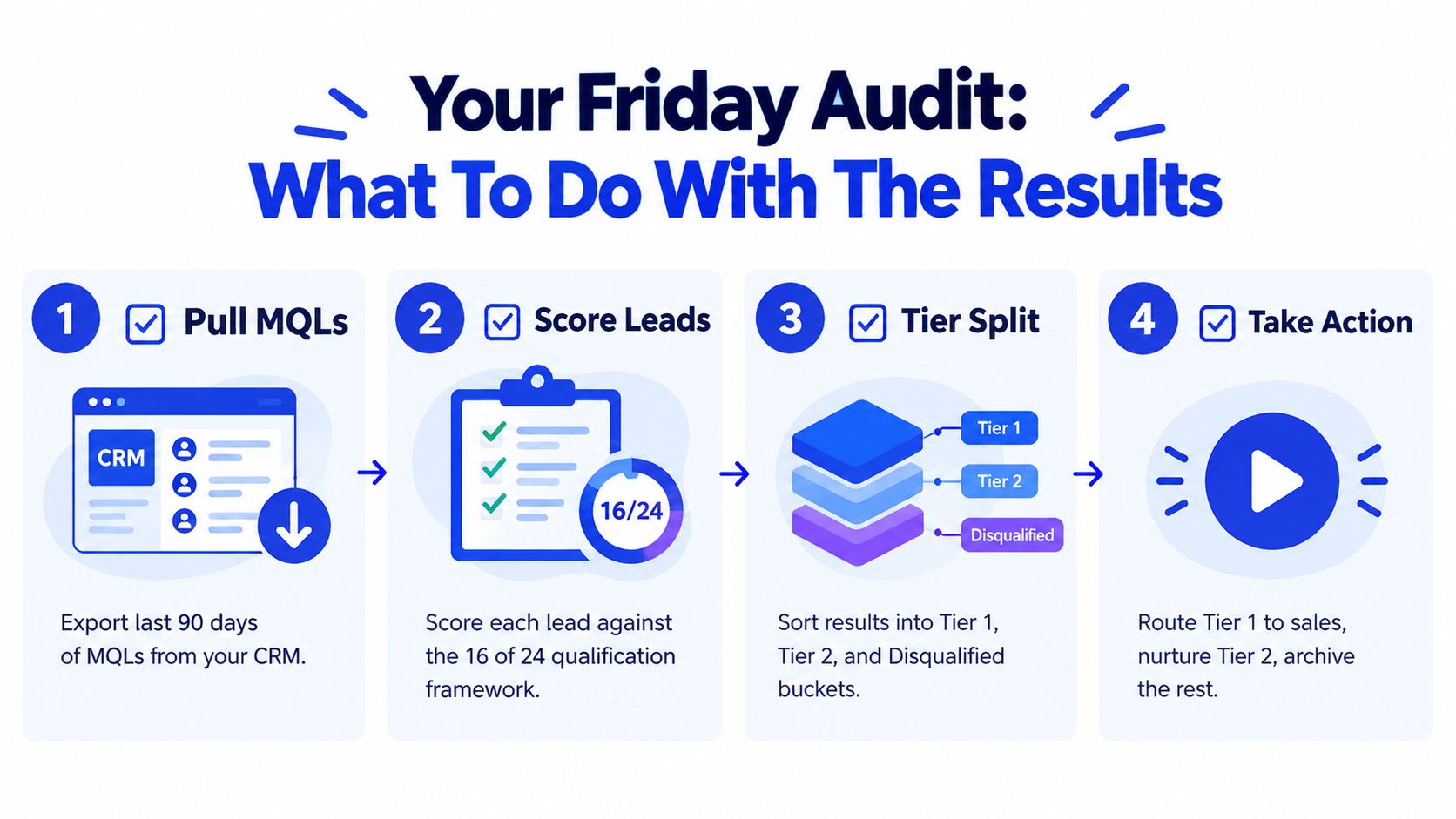
If speed is the gap, fix routing and staffing. If Tier 1 conversion is the gap, tighten ICP and intent scoring. If nurture flow is broken, rebuild the disqualification branch before you add another lead source.
GROU helps B2B teams build one pipeline system across LinkedIn content, lead generation, enrichment, and outbound, with qualification rules that keep sales focused on the right conversations. The method is simple, one target list, one message, one reporting line, with qualification built into the workflow from the start.
Run the last-90-day audit this Friday, then change the routing rules before Monday. If you want the same system pressure-tested across your stack, visit Grou and map your qualification logic against the leads already in your CRM.
Your pipeline's getting noisier, not cleaner. MQL volume is up, SQL conversion is flat, and the forecast is wobbling because too many leads are getting routed by habit instead of evidence. That's not a top-of-funnel problem, it's a qualification problem.
Lead qualification is a routing decision, not a checklist ritual.
Fit, intent, and timing should decide who gets an AE, who gets nurture, and who gets dropped.
Speed-to-lead is part of qualification, because slow follow-up changes outcomes fast.
BANT still works as a first gate, but only when you pair it with scoring and CRM routing.
Friday audits expose the leak, if you score the last 90 days.
Table of Contents
Qualification criteria, scoring math, and routing thresholds
Lead qualification examples for SaaS, iGaming, and manufacturing
Why speed to lead is a qualification variable, not a courtesy
Building a unified qualification engine with LinkedIn, enrichment, and outbound
The pipeline problem you are trying to fix this quarter
You don't need another theory of demand. You need a cleaner way to stop good-looking leads from slipping into the wrong queue while forecast coverage gets more fragile every week. The core issue is simple, too many teams treat qualification as a rep judgment call when it should be a routing rule.
That's why this piece focuses on the working parts:
A practical definition of lead qualification for B2B operators.
A side-by-side verdict on BANT, MEDDIC, CHAMP, and lead scoring.
A scoring model you can copy into HubSpot or Salesforce.
Examples from SaaS, iGaming, and manufacturing.
A Friday audit that shows where the leak is.
The point is structure. If your system can't tell the difference between fit, intent, and urgency, it's not qualifying leads. It's collecting them. For a broader lead generation context, Grou's guide on lead generation strategy and execution is the right companion read.
What lead qualification means in a B2B funnel
A lead is qualified when your team can route it with confidence, not when it just looks active. The right test is simple: does this contact match your ICP, show intent, and need follow-up at the right speed? If the answer is yes, sales gets it. If not, marketing keeps nurturing it or the record gets suppressed until the data improves.
Qualification matters because the funnel leaks early. Benchmark data puts B2B conversion at 2.3% of website visitors into leads (source), 31% of leads into MQLs (source), 13% of MQLs into SQLs (source), and only 22% to 30% of opportunities into customers (source). That is a routing problem and a reporting problem. If the same lead can sit in three queues with three owners, your system is broken.
Practical rule: if you cannot assign the lead cleanly, it is not qualified.
The fix is not a longer script. Static BANT questions miss the point because modern B2B buying is usually a sequence, not a single form fill. Use buyer journey mapping to line up the lead's stage with the next action, then use unified fit, intent, and timing data to decide routing. That is how strong teams replace guesswork with a repeatable rule set.
What good qualification checks for
Good qualification checks whether the buying group has a real problem and a reason to move now. It looks at the company, the contact, and the moment together. Separate those inputs and you get noisy handoffs, not better pipeline.
Grou's qualification logic follows that same operator view. It checks ICP match, persona match, trigger signal, engagement weight, pain confirmation, authority, budget signal, and timeline. Keep buyer journey mapping tied to that logic, because the journey tells you when a lead should move and the qualification rule tells you where it should go.
The common trap is mistaking activity for readiness. A download is not intent. A reply is not budget. A contact form is not a sales handoff unless the rest of the record supports it.
BANT, MEDDIC, CHAMP, and lead scoring compared
BANT wins for first-touch gating on high-volume inbound. MEDDIC wins when the deal is complex and multi-threaded. CHAMP is good when the buyer leads with pain. Lead scoring is the layer that makes all three usable at scale. For inbound SaaS and iGaming, I'd use BANT plus lead scoring as the default because it gives you a quick commercial gate and a behavioral weight model that static questions miss.
Framework | Core criteria | Best-fit motion | Main weakness | When to use |
|---|---|---|---|---|
BANT | Budget, Authority, Need, Timeline | High-volume inbound, mid-market qualification | Too rigid if used alone | First-touch triage |
MEDDIC | Metrics, Economic Buyer, Decision Criteria, Decision Process, Identify Pain, Champion, Competition | Complex enterprise deals | Slower, heavier, better late in cycle | Second-call and deal validation |
CHAMP | Challenges, Authority, Money, Prioritization | Inbound with clear pain signals | Can underweight timing nuance | Discovery when pain is clear |
Lead Scoring | Weighted fit and behavior model | Any motion with enough volume | Weak without clean routing rules | Always, if CRM discipline exists |
The useful thing about this comparison is that each framework answers a different question. BANT tells you whether to spend time now. MEDDIC tells you whether a deal can survive scrutiny. CHAMP tells you whether the pain is real. Lead scoring tells you whether the contact deserves human attention first.
Operator rule: don't pick one framework and worship it. Pick the one that matches the sales motion, then force the CRM to apply it the same way every time.
Why I'd default to BANT plus scoring
BANT is fast, which matters when the queue is full. Lead scoring catches the things BANT scripts miss, such as repeat pricing-page visits, ad clicks, or engagement from the right seniority level. That combination is why static checklists break down in real pipelines, while a simple score keeps the process measurable.
For a practical model of that weighting logic, Grou's lead scoring model glossary is worth aligning with your CRM fields. MEDDIC and CHAMP still matter, but they belong deeper in the cycle, after the lead has earned a second conversation.
Qualification criteria, scoring math, and routing thresholds
Start with three criteria families. Firmographic fit covers industry, headcount, revenue, and geography. Behavioral intent covers pricing page visits, repeat demo requests, content downloads, and ad clicks. Engagement depth covers reply sentiment, meeting show rate, and stakeholder count.
Score eight variables on a 0 to 3 scale, for a total of 24 points. A 16-of-24 threshold should flag an SQL. That gives you a simple decision rule that can live inside HubSpot or Salesforce without turning into a rep-by-rep debate.
The scoring matrix I'd actually use
Variable | Weight (0-3) | What scores a 3 | What scores a 0 |
|---|---|---|---|
Industry fit | 0-3 | Matches ICP exactly | Outside target market |
Company size | 0-3 | Inside ideal range | Clear mismatch |
Geography | 0-3 | Serviceable market | Unserviceable market |
Role seniority | 0-3 | Buyer or strong influencer | No buying relevance |
Pricing engagement | 0-3 | Multiple visits, recent | None |
Demo intent | 0-3 | Repeated request or booked meeting | No signal |
Reply quality | 0-3 | Specific, commercial response | No reply or junk |
Stakeholder depth | 0-3 | Multiple relevant contacts | Solo contact only |
A second routing rule should sit above the score. Tier 1 means at least 5 of 8 on firmographics plus any two intent signals, then the lead goes to a senior AE within 30 minutes. Everything below that should recycle to nurture on a 14-day re-score trigger.
Don't overweight company size and ignore buying authority. That mistake creates pretty dashboards and bad handoffs. A large account with no power to buy is still a weak lead.
Disqualification should be a logged outcome, not a waste bin. If the lead misses the bar, store the reason code and let the routing logic learn from it next month.
Lead qualification examples for SaaS, iGaming, and manufacturing
A SaaS example makes the logic obvious. An inbound lead from a 400-person fintech downloads the pricing page twice in 48 hours and replies to a cold email with a specific integration question. That integration need flips the lead from MQL to SQL, and it routes to a senior AE within 20 minutes. If the lead had no integration pain or no access to the buyer, it stays out of the active queue.
An iGaming example looks different, but the decision logic is the same. You're outbound to a licensed operator in LATAM, and the qualifying question is the current payment provider. The signal that flips the lead is an open hiring post for a payments lead, which tells you the topic is active inside the account. That lead should route to the payments pod, not a generalist SDR.
A manufacturing lead usually needs more context before sales time is justified. A plant operations VP attends a webinar on downtime reduction, and the qualifying question is the number of plants. The data point that flips it is a recent capex announcement, which makes the case for an enterprise AE with a custom ROI model. If there's no plant footprint or no real expansion signal, it never leaves nurture.
The pattern matters more than the industry. Qualification is the routing decision that protects AE time and keeps bad-fit leads from polluting your pipeline. If you can't name the disqualifier, you're not qualifying. You're hoping.
Why speed to lead is a qualification variable, not a courtesy
A lead that sits for an hour is already changing shape. Analysts at Aloware found that leads contacted within 5 minutes are far more likely to qualify, and that response speed drops qualification sharply once the delay stretches into hours. Landbase reports the same pattern: teams that answer fast qualify more often, and a long wait kills the opportunity.
Put speed in the scoring model. Subtract 1 point after 30 minutes, subtract 2 after 4 hours, and disqualify after 24 hours unless a re-engagement rule applies. That is a routing problem, not a motivation problem. Slow follow-up means the queue is wrong, the staffing is wrong, or both.
Use a hard SLA. Tier 1 leads should trigger an immediate alert to a senior AE, with automatic fallback to a junior rep at 15 minutes and nurture recycling at 60 minutes. Anything slower turns a live lead into dead weight before the first conversation starts. The cleanest teams track this in their speed-to-lead workflow and hold routing owners accountable for it.
Building a unified qualification engine with LinkedIn, enrichment, and outbound
A qualification engine only works when four signals land in one record. ICP fit defines the account shape. Intent shows whether the buying group is active. Speed-to-lead timestamps show whether the lead is still warm. Enrichment resolution shows whether the contact data is complete enough to route without errors.
That is the model Grou builds around. LinkedIn activity, profile views, post engagement, and connection acceptance on a target list feed the record. Enrichment fills the missing fields. Outbound then uses the same record to send the right sequence, while the CRM writes back every response so scoring, routing, and reporting stay aligned.
How the loop works
ICP fit: firmographics, technographics, role seniority.
Intent: topic surges, hiring signals, ad clicks, champion job changes.
Enrichment: enrichment completes the account and contact record.
Outbound execution: the sequencer sends the message and logs the response.
The weak point is data handoff. If LinkedIn, enrichment, outbound, and CRM each keep their own version of the lead, the AE works stale records, marketing reads noisy dashboards, and RevOps spends time cleaning up mismatched fields.
Speed belongs in the same model. If a lead goes cold after 30 minutes, route it differently. If it sits for 24 hours, recycle it. Use your speed-to-lead workflow as a model variable, not a courtesy task.
The failure mode is usually enrichment resolution, not intent. A bad match on company, role, or domain sends the lead to the wrong owner, the wrong sequence, or no sequence at all. The important metric is funnel-wide reporting consistency, not any single conversion rate.
Your Friday audit and what to do with the results
Pull the last 90 days of MQLs from your CRM and score them against the 16 of 24 framework. Split them into Tier 1, Tier 2, and Disqualified. Then check three numbers: average minutes from form fill to first touch, the percentage of Tier 1 leads that reached a discovery call, and the percentage of disqualified leads that were sent back to nurture instead of deleted.
Use these operating targets:
Average first touch: under 5 minutes.
Tier 1 to discovery: 60%+.
Disqualified recycled to nurture: 100%.
Each number points to a different failure mode. Slow first touch means the routing or staffing model is broken. Weak Tier 1 conversion means ICP or intent scoring is too loose. Deleted disqualified leads mean you're losing remarketing data and future context.
If speed is the gap, fix routing and staffing. If Tier 1 conversion is the gap, tighten ICP and intent scoring. If nurture flow is broken, rebuild the disqualification branch before you add another lead source.
GROU helps B2B teams build one pipeline system across LinkedIn content, lead generation, enrichment, and outbound, with qualification rules that keep sales focused on the right conversations. The method is simple, one target list, one message, one reporting line, with qualification built into the workflow from the start.
Run the last-90-day audit this Friday, then change the routing rules before Monday. If you want the same system pressure-tested across your stack, visit Grou and map your qualification logic against the leads already in your CRM.
Your pipeline's getting noisier, not cleaner. MQL volume is up, SQL conversion is flat, and the forecast is wobbling because too many leads are getting routed by habit instead of evidence. That's not a top-of-funnel problem, it's a qualification problem.
Lead qualification is a routing decision, not a checklist ritual.
Fit, intent, and timing should decide who gets an AE, who gets nurture, and who gets dropped.
Speed-to-lead is part of qualification, because slow follow-up changes outcomes fast.
BANT still works as a first gate, but only when you pair it with scoring and CRM routing.
Friday audits expose the leak, if you score the last 90 days.
Table of Contents
Qualification criteria, scoring math, and routing thresholds
Lead qualification examples for SaaS, iGaming, and manufacturing
Why speed to lead is a qualification variable, not a courtesy
Building a unified qualification engine with LinkedIn, enrichment, and outbound
The pipeline problem you are trying to fix this quarter
You don't need another theory of demand. You need a cleaner way to stop good-looking leads from slipping into the wrong queue while forecast coverage gets more fragile every week. The core issue is simple, too many teams treat qualification as a rep judgment call when it should be a routing rule.
That's why this piece focuses on the working parts:
A practical definition of lead qualification for B2B operators.
A side-by-side verdict on BANT, MEDDIC, CHAMP, and lead scoring.
A scoring model you can copy into HubSpot or Salesforce.
Examples from SaaS, iGaming, and manufacturing.
A Friday audit that shows where the leak is.
The point is structure. If your system can't tell the difference between fit, intent, and urgency, it's not qualifying leads. It's collecting them. For a broader lead generation context, Grou's guide on lead generation strategy and execution is the right companion read.
What lead qualification means in a B2B funnel
A lead is qualified when your team can route it with confidence, not when it just looks active. The right test is simple: does this contact match your ICP, show intent, and need follow-up at the right speed? If the answer is yes, sales gets it. If not, marketing keeps nurturing it or the record gets suppressed until the data improves.
Qualification matters because the funnel leaks early. Benchmark data puts B2B conversion at 2.3% of website visitors into leads (source), 31% of leads into MQLs (source), 13% of MQLs into SQLs (source), and only 22% to 30% of opportunities into customers (source). That is a routing problem and a reporting problem. If the same lead can sit in three queues with three owners, your system is broken.
Practical rule: if you cannot assign the lead cleanly, it is not qualified.
The fix is not a longer script. Static BANT questions miss the point because modern B2B buying is usually a sequence, not a single form fill. Use buyer journey mapping to line up the lead's stage with the next action, then use unified fit, intent, and timing data to decide routing. That is how strong teams replace guesswork with a repeatable rule set.
What good qualification checks for
Good qualification checks whether the buying group has a real problem and a reason to move now. It looks at the company, the contact, and the moment together. Separate those inputs and you get noisy handoffs, not better pipeline.
Grou's qualification logic follows that same operator view. It checks ICP match, persona match, trigger signal, engagement weight, pain confirmation, authority, budget signal, and timeline. Keep buyer journey mapping tied to that logic, because the journey tells you when a lead should move and the qualification rule tells you where it should go.
The common trap is mistaking activity for readiness. A download is not intent. A reply is not budget. A contact form is not a sales handoff unless the rest of the record supports it.
BANT, MEDDIC, CHAMP, and lead scoring compared
BANT wins for first-touch gating on high-volume inbound. MEDDIC wins when the deal is complex and multi-threaded. CHAMP is good when the buyer leads with pain. Lead scoring is the layer that makes all three usable at scale. For inbound SaaS and iGaming, I'd use BANT plus lead scoring as the default because it gives you a quick commercial gate and a behavioral weight model that static questions miss.
Framework | Core criteria | Best-fit motion | Main weakness | When to use |
|---|---|---|---|---|
BANT | Budget, Authority, Need, Timeline | High-volume inbound, mid-market qualification | Too rigid if used alone | First-touch triage |
MEDDIC | Metrics, Economic Buyer, Decision Criteria, Decision Process, Identify Pain, Champion, Competition | Complex enterprise deals | Slower, heavier, better late in cycle | Second-call and deal validation |
CHAMP | Challenges, Authority, Money, Prioritization | Inbound with clear pain signals | Can underweight timing nuance | Discovery when pain is clear |
Lead Scoring | Weighted fit and behavior model | Any motion with enough volume | Weak without clean routing rules | Always, if CRM discipline exists |
The useful thing about this comparison is that each framework answers a different question. BANT tells you whether to spend time now. MEDDIC tells you whether a deal can survive scrutiny. CHAMP tells you whether the pain is real. Lead scoring tells you whether the contact deserves human attention first.
Operator rule: don't pick one framework and worship it. Pick the one that matches the sales motion, then force the CRM to apply it the same way every time.
Why I'd default to BANT plus scoring
BANT is fast, which matters when the queue is full. Lead scoring catches the things BANT scripts miss, such as repeat pricing-page visits, ad clicks, or engagement from the right seniority level. That combination is why static checklists break down in real pipelines, while a simple score keeps the process measurable.
For a practical model of that weighting logic, Grou's lead scoring model glossary is worth aligning with your CRM fields. MEDDIC and CHAMP still matter, but they belong deeper in the cycle, after the lead has earned a second conversation.
Qualification criteria, scoring math, and routing thresholds
Start with three criteria families. Firmographic fit covers industry, headcount, revenue, and geography. Behavioral intent covers pricing page visits, repeat demo requests, content downloads, and ad clicks. Engagement depth covers reply sentiment, meeting show rate, and stakeholder count.
Score eight variables on a 0 to 3 scale, for a total of 24 points. A 16-of-24 threshold should flag an SQL. That gives you a simple decision rule that can live inside HubSpot or Salesforce without turning into a rep-by-rep debate.
The scoring matrix I'd actually use
Variable | Weight (0-3) | What scores a 3 | What scores a 0 |
|---|---|---|---|
Industry fit | 0-3 | Matches ICP exactly | Outside target market |
Company size | 0-3 | Inside ideal range | Clear mismatch |
Geography | 0-3 | Serviceable market | Unserviceable market |
Role seniority | 0-3 | Buyer or strong influencer | No buying relevance |
Pricing engagement | 0-3 | Multiple visits, recent | None |
Demo intent | 0-3 | Repeated request or booked meeting | No signal |
Reply quality | 0-3 | Specific, commercial response | No reply or junk |
Stakeholder depth | 0-3 | Multiple relevant contacts | Solo contact only |
A second routing rule should sit above the score. Tier 1 means at least 5 of 8 on firmographics plus any two intent signals, then the lead goes to a senior AE within 30 minutes. Everything below that should recycle to nurture on a 14-day re-score trigger.
Don't overweight company size and ignore buying authority. That mistake creates pretty dashboards and bad handoffs. A large account with no power to buy is still a weak lead.
Disqualification should be a logged outcome, not a waste bin. If the lead misses the bar, store the reason code and let the routing logic learn from it next month.
Lead qualification examples for SaaS, iGaming, and manufacturing
A SaaS example makes the logic obvious. An inbound lead from a 400-person fintech downloads the pricing page twice in 48 hours and replies to a cold email with a specific integration question. That integration need flips the lead from MQL to SQL, and it routes to a senior AE within 20 minutes. If the lead had no integration pain or no access to the buyer, it stays out of the active queue.
An iGaming example looks different, but the decision logic is the same. You're outbound to a licensed operator in LATAM, and the qualifying question is the current payment provider. The signal that flips the lead is an open hiring post for a payments lead, which tells you the topic is active inside the account. That lead should route to the payments pod, not a generalist SDR.
A manufacturing lead usually needs more context before sales time is justified. A plant operations VP attends a webinar on downtime reduction, and the qualifying question is the number of plants. The data point that flips it is a recent capex announcement, which makes the case for an enterprise AE with a custom ROI model. If there's no plant footprint or no real expansion signal, it never leaves nurture.
The pattern matters more than the industry. Qualification is the routing decision that protects AE time and keeps bad-fit leads from polluting your pipeline. If you can't name the disqualifier, you're not qualifying. You're hoping.
Why speed to lead is a qualification variable, not a courtesy
A lead that sits for an hour is already changing shape. Analysts at Aloware found that leads contacted within 5 minutes are far more likely to qualify, and that response speed drops qualification sharply once the delay stretches into hours. Landbase reports the same pattern: teams that answer fast qualify more often, and a long wait kills the opportunity.
Put speed in the scoring model. Subtract 1 point after 30 minutes, subtract 2 after 4 hours, and disqualify after 24 hours unless a re-engagement rule applies. That is a routing problem, not a motivation problem. Slow follow-up means the queue is wrong, the staffing is wrong, or both.
Use a hard SLA. Tier 1 leads should trigger an immediate alert to a senior AE, with automatic fallback to a junior rep at 15 minutes and nurture recycling at 60 minutes. Anything slower turns a live lead into dead weight before the first conversation starts. The cleanest teams track this in their speed-to-lead workflow and hold routing owners accountable for it.
Building a unified qualification engine with LinkedIn, enrichment, and outbound
A qualification engine only works when four signals land in one record. ICP fit defines the account shape. Intent shows whether the buying group is active. Speed-to-lead timestamps show whether the lead is still warm. Enrichment resolution shows whether the contact data is complete enough to route without errors.
That is the model Grou builds around. LinkedIn activity, profile views, post engagement, and connection acceptance on a target list feed the record. Enrichment fills the missing fields. Outbound then uses the same record to send the right sequence, while the CRM writes back every response so scoring, routing, and reporting stay aligned.
How the loop works
ICP fit: firmographics, technographics, role seniority.
Intent: topic surges, hiring signals, ad clicks, champion job changes.
Enrichment: enrichment completes the account and contact record.
Outbound execution: the sequencer sends the message and logs the response.
The weak point is data handoff. If LinkedIn, enrichment, outbound, and CRM each keep their own version of the lead, the AE works stale records, marketing reads noisy dashboards, and RevOps spends time cleaning up mismatched fields.
Speed belongs in the same model. If a lead goes cold after 30 minutes, route it differently. If it sits for 24 hours, recycle it. Use your speed-to-lead workflow as a model variable, not a courtesy task.
The failure mode is usually enrichment resolution, not intent. A bad match on company, role, or domain sends the lead to the wrong owner, the wrong sequence, or no sequence at all. The important metric is funnel-wide reporting consistency, not any single conversion rate.
Your Friday audit and what to do with the results
Pull the last 90 days of MQLs from your CRM and score them against the 16 of 24 framework. Split them into Tier 1, Tier 2, and Disqualified. Then check three numbers: average minutes from form fill to first touch, the percentage of Tier 1 leads that reached a discovery call, and the percentage of disqualified leads that were sent back to nurture instead of deleted.
Use these operating targets:
Average first touch: under 5 minutes.
Tier 1 to discovery: 60%+.
Disqualified recycled to nurture: 100%.
Each number points to a different failure mode. Slow first touch means the routing or staffing model is broken. Weak Tier 1 conversion means ICP or intent scoring is too loose. Deleted disqualified leads mean you're losing remarketing data and future context.
If speed is the gap, fix routing and staffing. If Tier 1 conversion is the gap, tighten ICP and intent scoring. If nurture flow is broken, rebuild the disqualification branch before you add another lead source.
GROU helps B2B teams build one pipeline system across LinkedIn content, lead generation, enrichment, and outbound, with qualification rules that keep sales focused on the right conversations. The method is simple, one target list, one message, one reporting line, with qualification built into the workflow from the start.
Run the last-90-day audit this Friday, then change the routing rules before Monday. If you want the same system pressure-tested across your stack, visit Grou and map your qualification logic against the leads already in your CRM.
Pipeline OS Newsletter
Build qualified pipeline
Get weekly tactics to generate demand, improve lead quality, and book more meetings.







Trusted by industry leaders
Trusted by industry leaders
Trusted by industry leaders
Ready to build qualified pipeline?
Ready to build qualified pipeline?
Ready to build qualified pipeline?
Book a call to see if we're the right fit, or take the 2-minute quiz to get a clear starting point.
Book a call to see if we're the right fit, or take the 2-minute quiz to get a clear starting point.
Book a call to see if we're the right fit, or take the 2-minute quiz to get a clear starting point.
" height="30.21639343089746px" id="hfGbXmQR2" width="30.216393430897455px"/></svg>)
Copyright © 2026 – All Right Reserved
Copyright © 2026 – All Right Reserved
Copyright © 2026 – All Right Reserved