%22%3E%3C/path%3E%3Cpath d=%22M 63.072 7.554 C 62.258 8.022 61.577 8.689 61.092 9.493 L 61.092 7.076 L 57.158 7.076 L 57.158 22.64 L 61.089 22.64 L 61.089 14.888 C 61.089 13.446 61.403 12.434 62.03 11.853 C 62.818 11.218 63.818 10.907 64.826 10.982 L 65.868 10.982 L 65.868 6.851 C 64.891 6.834 63.926 7.076 63.073 7.554 Z%22 fill=%22rgb(17,17,17)%22%3E%3C/path%3E%3Cpath d=%22M 78.916 7.82 C 76.363 6.49 73.321 6.49 70.768 7.82 C 69.562 8.473 68.564 9.451 67.888 10.644 C 67.167 11.931 66.803 13.387 66.834 14.862 C 66.804 16.332 67.157 17.785 67.86 19.077 C 68.515 20.267 69.494 21.246 70.684 21.901 C 71.924 22.576 73.318 22.92 74.73 22.898 C 76.164 22.918 77.58 22.575 78.846 21.901 C 80.062 21.247 81.073 20.27 81.768 19.077 C 82.506 17.797 82.88 16.339 82.85 14.862 C 82.88 13.389 82.517 11.934 81.797 10.647 C 81.12 9.455 80.122 8.477 78.917 7.824 M 78.803 14.862 C 78.829 15.739 78.636 16.608 78.241 17.391 C 77.903 18.046 77.38 18.588 76.738 18.95 C 76.124 19.293 75.432 19.472 74.729 19.47 C 73.668 19.497 72.648 19.061 71.934 18.276 C 71.139 17.323 70.741 16.1 70.823 14.862 C 70.741 13.62 71.149 12.395 71.959 11.45 C 72.687 10.667 73.715 10.233 74.783 10.256 C 75.859 10.236 76.894 10.67 77.635 11.45 C 78.464 12.387 78.884 13.616 78.801 14.864%22 fill=%22rgb(17,17,17)%22%3E%3C/path%3E%3Cpath d=%22M 95.906 7.076 L 95.906 15.646 C 95.975 16.68 95.643 17.701 94.979 18.498 C 94.311 19.184 93.379 19.547 92.422 19.495 C 91.475 19.544 90.553 19.18 89.894 18.498 C 89.23 17.701 88.898 16.68 88.967 15.646 L 88.967 7.076 L 85.033 7.076 L 85.033 16.207 C 85 17.449 85.275 18.68 85.834 19.79 C 86.327 20.75 87.095 21.542 88.039 22.065 C 89.033 22.594 90.145 22.861 91.271 22.838 C 92.188 22.847 93.095 22.65 93.926 22.263 C 94.708 21.905 95.388 21.36 95.906 20.675 L 95.906 22.645 L 99.865 22.645 L 99.865 7.076 Z%22 fill=%22rgb(17,17,17)%22%3E%3C/path%3E%3Cpath d=%22M 4.513 15.626 C 4.511 10.815 7.606 6.549 12.181 5.059 C 16.756 3.57 21.77 5.195 24.601 9.086 L 27.816 5.87 C 24.074 1.186 17.981 -0.943 12.137 0.393 C 6.292 1.728 1.728 6.292 0.393 12.137 C -0.943 17.981 1.186 24.074 5.87 27.816 L 9.085 24.601 C 6.214 22.512 4.515 19.177 4.513 15.626%22 fill=%22rgb(32,62,235)%22%3E%3C/path%3E%3Cpath d=%22M 17.114 14.343 L 13.354 18.01 L 13.354 18.026 L 21.071 18.026 L 11.412 27.609 L 17.389 27.609 L 23.999 21.081 L 23.999 28.316 L 24.005 28.316 L 27.967 24.393 L 27.967 14.343 Z%22 fill=%22rgb(32,62,235)%22%3E%3C/path%3E%3C/g%3E%3C/svg%3E) ×
× ××
××›
›
›
›
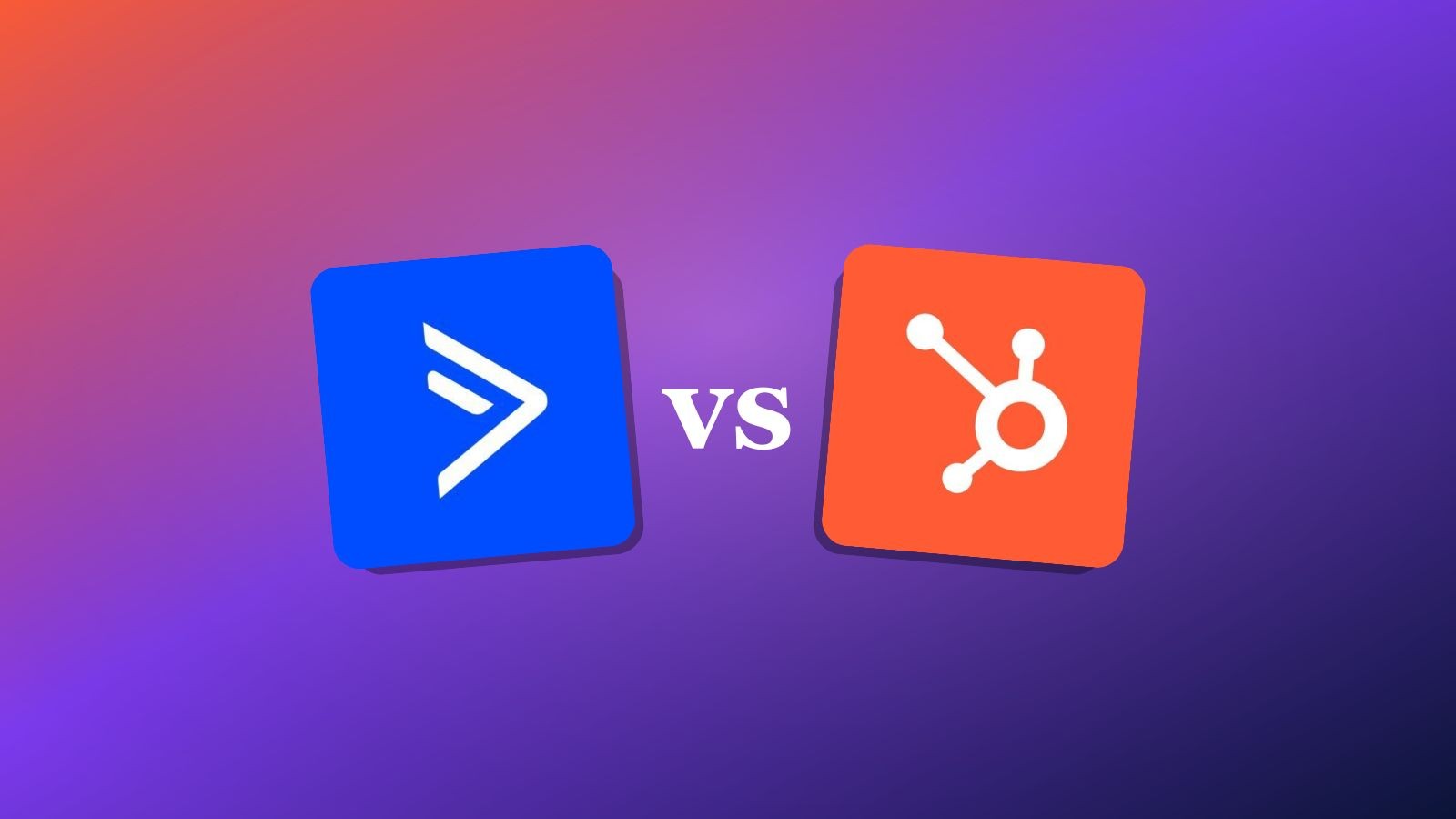
ActiveCampaign vs HubSpot 2026: price, automation, CRM
ActiveCampaign vs HubSpot 2026: price, automation, CRM
ActiveCampaign vs HubSpot 2026: price, automation, CRM
ActiveCampaign vs HubSpot 2026: price, automation, CRM
ActiveCampaign vs HubSpot 2026: price, automation, CRM
ActiveCampaign vs HubSpot 2026: price, automation, CRM

Author
Aljaz Peklaj
TL;DR
ActiveCampaign wins for any SMB that needs serious marketing automation and the AI Agents but cannot justify HubSpot Professional's $890 per month minimum. HubSpot wins for mid-market teams that need a unified CRM, marketing, sales, and service hub under one login and have the budget to support it. The cost gap is the headline: at 10,000 contacts, ActiveCampaign Plus runs $2,268 per year billed annually while HubSpot Marketing Hub Professional runs $16,680 per year before its one-time $3,000 onboarding fee, roughly 86 percent less on ActiveCampaign for comparable marketing automation depth. We use HubSpot as our agency CRM, but for clients deploying from scratch on a tight budget, ActiveCampaign is consistently the better recommendation.
ActiveCampaign vs HubSpot comes down to what you pay for marketing automation and how much CRM you need around it. ActiveCampaign prices by contact count, from $15 a month for 1,000 contacts billed annually, with marketing automation on every plan. This comparison puts it next to HubSpot Marketing Hub on cost at 1,000 to 25,000 contacts, automation depth, AI features, CRM, onboarding and the dealbreakers on each side.
Score breakdown at a glance

Third-party signals: ActiveCampaign on G2 rating around 4.5 / 5 across 13,000 plus reviews. HubSpot Marketing Hub on G2 rating around 4.4 / 5 across 12,000 plus reviews. Both are highly rated, but the qualitative comments diverge sharply on price.
Table of contents
Quick comparison
The case for ActiveCampaign
The case for HubSpot
How much does each cost?
Which has deeper marketing automation?
How do the AI features compare?
Which has better CRM and revenue ops?
Which is easier to onboard and use?
When to pick ActiveCampaign
When to pick HubSpot
Honest dealbreakers
Alternatives worth considering
FAQ
Bottom line
Quick comparison

The case for ActiveCampaign
ActiveCampaign's wedge is enterprise-grade marketing automation at SMB pricing. The platform centres on three pillars: a real automation builder with 900-plus templates available from the Plus tier, Active Intelligence with AI Agents that execute autonomously rather than just suggesting copy, and a CRM that is good enough for most SMB sales motions without the bolt-on cost of a separate tool.
The Active Intelligence layer matters most for 2026 buyers. Type a goal such as "win back lapsed customers," and an AI Agent builds the segmentation, drafts the email sequence, sets the send timing, and routes replies back to the CRM. HubSpot Breeze AI does parts of this, but as a set of assistants rather than autonomous workflows.
The pricing is where ActiveCampaign closes the gap on HubSpot. ActiveCampaign Pro at $79 per month for 1,000 contacts delivers automation depth that HubSpot only unlocks at the Professional tier ($890 per month for 2,000 contacts). For SMB teams, that 11x cost gap is not a rounding error. It is the difference between marketing being a line item and marketing being a business decision that requires board approval.
→ Best for: B2B SMBs running automation-heavy nurture or sales sequences, growth stage SaaS, agencies running outbound for multiple clients, any team that needs sophisticated automation without HubSpot's enterprise pricing.
The case for HubSpot
We need to be fair here, especially because GROU uses HubSpot ourselves. HubSpot is genuinely best in class at a few things ActiveCampaign cannot match.
The free CRM tier is the most generous in the category. Up to 1 million contacts at $0, with usable contact records, deal pipelines, task management, and email tracking. This alone is worth signing up for any team starting from scratch.
HubSpot's reporting and revenue attribution are deeper than ActiveCampaign's. Multi-touch attribution, custom dashboards, and revenue analytics that connect marketing spend to closed-won deals. For mid-market teams running paid acquisition at scale, this matters.
The ecosystem is unmatched. HubSpot App Marketplace has 1,500-plus native integrations, HubSpot Academy has the most comprehensive free education in the category, and the partner network means you can hire a HubSpot specialist almost anywhere.
The Marketing Hub Pro tier ($890 per month) bundles marketing, basic CRM, and reporting in a way ActiveCampaign cannot natively. For teams running full revenue operations across marketing, sales, and customer success, the consolidation argument is real.
→ Best for: Mid-market teams (50 plus employees), companies running paid acquisition at scale needing deep attribution, teams with marketing + sales + service all in one stack, anyone who can absorb the $890 per month minimum for Pro.
How much does each cost?
Side-by-side breakdown of base pricing. For live pricing, check ActiveCampaign and HubSpot Marketing Hub directly.
ActiveCampaign pricing

ActiveCampaign prices by contact count, and the prices on its pricing page are billed annually. The Plus plan starts at $49 per month for 1,000 contacts and reaches $189 per month at 10,000 contacts. Pro starts at $79 per month for 1,000 contacts ($99 if billed monthly) and costs $375 per month at 10,000 contacts. Starter and Plus include Active Intelligence with limits; Pro removes them. Every tier and contact count is broken down in our ActiveCampaign pricing guide.
HubSpot Marketing Hub pricing

HubSpot Marketing Hub starts at $20 per seat per month for the Starter plan, which gives you basic email and 1,000 contacts but no real automation. Real automation (workflows, branching, scoring) requires the Professional plan at $890 per month minimum, which includes 3 seats and 2,000 contacts. Exceeding the contact tier auto-bumps you to the next tier (a 2,001 contact account jumps to the 5,000 contact tier, adding roughly $250 per month). The onboarding fee is $3,000 for Pro and $7,000 for Enterprise, charged once upfront.
Annual cost for real marketing automation

Annual cost of ActiveCampaign Plus (billed annually) and HubSpot Marketing Hub Professional at four contact counts, excluding HubSpot’s one-time onboarding fee.
This is the table that decides the platform choice for most SMBs. At every size from 1,000 to 25,000 contacts, ActiveCampaign Plus is roughly 82 to 95 percent cheaper than HubSpot Marketing Hub Professional for comparable automation depth, before HubSpot's $3,000 onboarding fee. At 10,000 contacts, the difference is $14,412 per year. At 25,000 contacts, the difference is $20,712 per year. ActiveCampaign figures are from its pricing page; HubSpot figures are from the HubSpot product and services catalog.
Where HubSpot can be cost-competitive:
You are using the free CRM tier only. HubSpot wins; ActiveCampaign does not have a free CRM tier.
You need full revenue ops across marketing, sales, and service in one platform. HubSpot's Suite pricing at scale is closer to comparable. ActiveCampaign requires Pro for the AI Agents, plus may need a separate sales tool.
You will use the deep attribution and reporting. HubSpot's Pro reporting is genuinely worth the premium if your team will use it.
For most SMB marketing teams running automated nurture, lead scoring, and email workflows, the value gap is hard to justify. ActiveCampaign delivers 80 to 90 percent of HubSpot's marketing automation at 10 to 15 percent of the cost.
Want to know what activity volume your revenue target actually requires before you spec a marketing automation platform? Run our free Reverse Pipeline Calculator or take the Pipeline Score Quiz.
Which has deeper marketing automation?
Roughly tied at the top, with HubSpot edging ahead on enterprise complexity.
HubSpot Pro and Enterprise have the deepest marketing automation in the category, no contest. Workflows, branching, lead scoring, custom properties, conditional logic, behavioural triggers, and integration with the rest of the HubSpot stack. For a 50-plus rep team running ABM at scale with custom Salesforce objects feeding HubSpot, no other platform comes close on raw capability.
ActiveCampaign Plus is roughly 80 to 90 percent of HubSpot Pro's automation depth at a tenth of the price. The 900-plus pre-built automation recipes accelerate setup. The visual builder is just as flexible for most SMB use cases. The branching logic supports the same conditional paths.
The honest answer: for 90 percent of SMB use cases, ActiveCampaign's automation is more than enough. For enterprise teams with dedicated marketing ops headcount and complex custom-object dependencies, HubSpot wins.
How do the AI features compare?
ActiveCampaign is the only one running fully autonomous AI workflows.
HubSpot has Breeze AI, a set of assistants that draft copy, suggest workflow improvements, and surface insights. Useful, well integrated into the HubSpot UI, and free across paid tiers.
ActiveCampaign's Active Intelligence goes further. The AI Agents take a campaign goal, build the segmentation, draft the content variants, set the send timing, run the branching logic, and route replies. You set the goal. The platform executes the entire workflow.
For an SMB marketing team running multiple campaigns without hiring more marketers, this is the single most practical AI feature in either platform.
Which has better CRM and revenue ops?
HubSpot, by a clear margin.
HubSpot's CRM is the most mature in the category. The free tier alone (1 million contacts, full pipeline management) is best in class. Sales Hub Pro adds sequences, predictive lead scoring, and call tracking. Service Hub adds ticketing and customer feedback. The three together form a coherent revenue operating system.
ActiveCampaign has a real CRM with pipelines, deals, tasks, and contact timelines. Good enough for most SMB sales motions. Not deep enough for a 50-plus rep enterprise sales org with custom forecasting and territory management.
We use HubSpot as our agency CRM today for exactly these reasons. The depth matters once you outgrow the basics.
Which is easier to onboard and use?
ActiveCampaign is especially for the cost-conscious.
ActiveCampaign has a steeper learning curve than Mailchimp but a gentler one than HubSpot. The automation builder, segmentation, and email designer are tightly designed and most teams are productive within a week.
HubSpot's UI is polished, but the platform is genuinely big. New users routinely need 4 to 8 weeks of onboarding to use Marketing Hub Pro effectively. The $3,000 to $7,000 onboarding fee is mandatory at the Professional and Enterprise tiers and exists because HubSpot itself acknowledges the platform is complex to deploy well.
For a 5-person marketing team standing up automation this quarter, ActiveCampaign is the faster path to first value.
When to pick ActiveCampaign
You are an SMB or growth stage team and want real marketing automation at SMB pricing
Your sending volume is 1,000 to 25,000 contacts, and HubSpot Pro feels like over-buying
You want the AI Agents to do actual workflow execution, not just content suggestions
You will not use HubSpot's full revenue ops stack (marketing + sales + service in one)
You want to avoid mandatory onboarding fees and 12-month minimum contracts
You need a working CRM, but do not need the deepest CRM in the category
Start the 14-day free trial of ActiveCampaign with no credit card
When to pick HubSpot
You are a mid-market team running full revenue ops (marketing + sales + service)
You will use the deep multi-touch attribution and revenue reporting
Your sales org has 25-plus reps with custom forecasting needs
You need the deepest CRM in the category
Your budget can absorb $890 per month minimum, plus onboarding fees
You value ecosystem maturity (1,500 plus integrations, HubSpot Academy, partner network)
Honest dealbreakers
ActiveCampaign dealbreakers
The CRM is good, but not as polished as HubSpot for complex sales orgs. A 50-rep enterprise sales motion will outgrow it.
Reporting and attribution are weaker than HubSpot Pro. If multi-touch attribution drives your marketing decisions, this matters.
The ecosystem is smaller. 950 plus integrations is a lot, but HubSpot's 1,500 plus marketplace is more mature.
No free CRM tier. If you want the CRM only, HubSpot wins.
HubSpot dealbreakers
Pricing scales aggressively. $890 per month minimum for Marketing Hub Pro, then auto-bumps at contact tier breakpoints (every 5,000 contacts adds roughly $250 per month).
Mandatory onboarding fees ($3,000 to $7,000) are a hidden cost most comparison articles skip.
12-month minimum contracts at Pro and Enterprise. No monthly opt-out.
Total cost of ownership at scale is brutal. A 25,000 contact Marketing Hub Pro deployment is $25,380 per year before the $3,000 onboarding fee.
The "free CRM forever" gravity. Once you commit to HubSpot, you tend to absorb more of the platform than you originally needed. We have watched clients add Sales Hub, Service Hub, and CMS Hub at $2,000 plus per month total.
Alternatives worth considering
Salesforce + Pardot: best for enterprise teams already on Salesforce. More expensive than HubSpot, with deeper customization.
Klaviyo: best for pure e-commerce teams (Shopify, WooCommerce). Limited beyond e-commerce.
Marketo: best for large enterprise marketing teams with dedicated ops headcount. Comparable depth to HubSpot Enterprise, often higher cost.
Mailchimp: best for absolute beginners running newsletters. See our ActiveCampaign vs Mailchimp comparison for the full picture.
FAQ
Is ActiveCampaign worth it over HubSpot's free CRM?
If your entire need is "store contacts and track deals," stay on HubSpot's free CRM. The moment you need marketing automation, email sending, or AI workflows beyond Breeze, the math flips to ActiveCampaign because HubSpot's automation requires the $890 per month Marketing Hub Pro tier, and ActiveCampaign starts at $15.
Can I migrate from HubSpot to ActiveCampaign without losing data?
Yes. ActiveCampaign has a free migration service. Contacts, lists, automations, custom fields, and historical email sends transfer. Plan for 2 to 4 weeks of dual-running if your HubSpot deployment is complex (custom objects, integrations).
What is the difference between ActiveCampaign Active Intelligence and HubSpot Breeze AI?
Both add AI capabilities. Breeze AI is a set of assistants integrated into the HubSpot UI (copy suggester, workflow optimizer, content drafter). Active Intelligence includes AI Agents that execute end-to-end campaign workflows autonomously rather than suggesting steps. For SMB teams that want AI to do the work, Active Intelligence is more advanced.
Is the cost difference really that big?
Roughly, yes. At 10,000 contacts, ActiveCampaign Plus costs $2,268 per year billed annually ($189 per month). HubSpot Marketing Hub Professional costs $16,680 per year: the $890 per month base with 2,000 contacts, plus two 5,000-contact packs at $250 per month each. That is about 86 percent less on ActiveCampaign, before HubSpot's one-time $3,000 onboarding fee. The gap narrows if you use HubSpot's free CRM tier as your main use, but for marketing automation specifically, the gap is real.
Does HubSpot ever beat ActiveCampaign on price?
The free CRM tier is genuinely free. If your need is "CRM only, no marketing automation," HubSpot wins. The moment you need automation, ActiveCampaign is cheaper at every tier.
What about the HubSpot onboarding fee?
$3,000 mandatory for Professional, $7,000 mandatory for Enterprise. ActiveCampaign has no mandatory onboarding fees at any tier. Worth factoring into the year-one total cost calculation.
Which one is better for a 10-person marketing team?
If the team's primary work is marketing automation, ActiveCampaign Pro ($375 per month at 10,000 contacts billed annually, 3 users included, extra users on top) is a fraction of HubSpot Pro ($890 plus seat upgrades). If the team includes sales ops, customer success, and content management all needing the same tool, HubSpot's Suite consolidates better.
Bottom line
ActiveCampaign and HubSpot are not direct competitors anymore. HubSpot is the unified revenue operating system for mid-market and enterprise teams that can absorb $890 per month minimums and want marketing, sales, and service in one stack. ActiveCampaign is the SMB-first marketing automation platform that delivers most of HubSpot's marketing depth at 10 to 15 percent of the cost.
For most readers of this blog, B2B operators, SMB marketers, agency clients running automation-heavy campaigns, ActiveCampaign is the right call. The 14-day free trial is enough to validate the automation builder, drop in your first AI Agent, and confirm the platform clicks for your team before committing a dollar.
If you are evaluating HubSpot Marketing Hub Pro and balking at the $890 per month minimum, start the ActiveCampaign trial here. No credit card required.
If you would rather have an operator build the funnel for you, including the email automation and the CRM integration, run our reverse pipeline calculator, take the pipeline score quiz, or book a 30-minute call and we will walk through whether build-or-hire makes sense for your team.
About this comparison
We are GROU, a B2B pipeline agency that runs lead generation, outbound and LinkedIn content for B2B companies. We use HubSpot as our agency CRM, and this comparison combines both vendors' published pricing pages with live G2 review data, refreshed quarterly.
Some links in this article are affiliate. We may earn a small commission at no extra cost to you.
About the author
Aljaz Peklaj is the founder of GROU, a B2B pipeline agency running LinkedIn content, lead generation, and outbound for clients across manufacturing, fintech, iGaming, software, and professional services.
Connect on LinkedIn: linkedin.com/in/aljazpeklaj
Read more: grouglobal.com/blog
Book a 30-minute pipeline call
TL;DR
ActiveCampaign wins for any SMB that needs serious marketing automation and the AI Agents but cannot justify HubSpot Professional's $890 per month minimum. HubSpot wins for mid-market teams that need a unified CRM, marketing, sales, and service hub under one login and have the budget to support it. The cost gap is the headline: at 10,000 contacts, ActiveCampaign Plus runs $2,268 per year billed annually while HubSpot Marketing Hub Professional runs $16,680 per year before its one-time $3,000 onboarding fee, roughly 86 percent less on ActiveCampaign for comparable marketing automation depth. We use HubSpot as our agency CRM, but for clients deploying from scratch on a tight budget, ActiveCampaign is consistently the better recommendation.
ActiveCampaign vs HubSpot comes down to what you pay for marketing automation and how much CRM you need around it. ActiveCampaign prices by contact count, from $15 a month for 1,000 contacts billed annually, with marketing automation on every plan. This comparison puts it next to HubSpot Marketing Hub on cost at 1,000 to 25,000 contacts, automation depth, AI features, CRM, onboarding and the dealbreakers on each side.
Score breakdown at a glance
Third-party signals: ActiveCampaign on G2 rating around 4.5 / 5 across 13,000 plus reviews. HubSpot Marketing Hub on G2 rating around 4.4 / 5 across 12,000 plus reviews. Both are highly rated, but the qualitative comments diverge sharply on price.
Table of contents
Quick comparison
The case for ActiveCampaign
The case for HubSpot
How much does each cost?
Which has deeper marketing automation?
How do the AI features compare?
Which has better CRM and revenue ops?
Which is easier to onboard and use?
When to pick ActiveCampaign
When to pick HubSpot
Honest dealbreakers
Alternatives worth considering
FAQ
Bottom line
Quick comparison
The case for ActiveCampaign
ActiveCampaign's wedge is enterprise-grade marketing automation at SMB pricing. The platform centres on three pillars: a real automation builder with 900-plus templates available from the Plus tier, Active Intelligence with AI Agents that execute autonomously rather than just suggesting copy, and a CRM that is good enough for most SMB sales motions without the bolt-on cost of a separate tool.
The Active Intelligence layer matters most for 2026 buyers. Type a goal such as "win back lapsed customers," and an AI Agent builds the segmentation, drafts the email sequence, sets the send timing, and routes replies back to the CRM. HubSpot Breeze AI does parts of this, but as a set of assistants rather than autonomous workflows.
The pricing is where ActiveCampaign closes the gap on HubSpot. ActiveCampaign Pro at $79 per month for 1,000 contacts delivers automation depth that HubSpot only unlocks at the Professional tier ($890 per month for 2,000 contacts). For SMB teams, that 11x cost gap is not a rounding error. It is the difference between marketing being a line item and marketing being a business decision that requires board approval.
→ Best for: B2B SMBs running automation-heavy nurture or sales sequences, growth stage SaaS, agencies running outbound for multiple clients, any team that needs sophisticated automation without HubSpot's enterprise pricing.
The case for HubSpot
We need to be fair here, especially because GROU uses HubSpot ourselves. HubSpot is genuinely best in class at a few things ActiveCampaign cannot match.
The free CRM tier is the most generous in the category. Up to 1 million contacts at $0, with usable contact records, deal pipelines, task management, and email tracking. This alone is worth signing up for any team starting from scratch.
HubSpot's reporting and revenue attribution are deeper than ActiveCampaign's. Multi-touch attribution, custom dashboards, and revenue analytics that connect marketing spend to closed-won deals. For mid-market teams running paid acquisition at scale, this matters.
The ecosystem is unmatched. HubSpot App Marketplace has 1,500-plus native integrations, HubSpot Academy has the most comprehensive free education in the category, and the partner network means you can hire a HubSpot specialist almost anywhere.
The Marketing Hub Pro tier ($890 per month) bundles marketing, basic CRM, and reporting in a way ActiveCampaign cannot natively. For teams running full revenue operations across marketing, sales, and customer success, the consolidation argument is real.
→ Best for: Mid-market teams (50 plus employees), companies running paid acquisition at scale needing deep attribution, teams with marketing + sales + service all in one stack, anyone who can absorb the $890 per month minimum for Pro.
How much does each cost?
Side-by-side breakdown of base pricing. For live pricing, check ActiveCampaign and HubSpot Marketing Hub directly.
ActiveCampaign pricing
ActiveCampaign prices by contact count, and the prices on its pricing page are billed annually. The Plus plan starts at $49 per month for 1,000 contacts and reaches $189 per month at 10,000 contacts. Pro starts at $79 per month for 1,000 contacts ($99 if billed monthly) and costs $375 per month at 10,000 contacts. Starter and Plus include Active Intelligence with limits; Pro removes them. Every tier and contact count is broken down in our ActiveCampaign pricing guide.
HubSpot Marketing Hub pricing
HubSpot Marketing Hub starts at $20 per seat per month for the Starter plan, which gives you basic email and 1,000 contacts but no real automation. Real automation (workflows, branching, scoring) requires the Professional plan at $890 per month minimum, which includes 3 seats and 2,000 contacts. Exceeding the contact tier auto-bumps you to the next tier (a 2,001 contact account jumps to the 5,000 contact tier, adding roughly $250 per month). The onboarding fee is $3,000 for Pro and $7,000 for Enterprise, charged once upfront.
Annual cost for real marketing automation
Annual cost of ActiveCampaign Plus (billed annually) and HubSpot Marketing Hub Professional at four contact counts, excluding HubSpot’s one-time onboarding fee.
This is the table that decides the platform choice for most SMBs. At every size from 1,000 to 25,000 contacts, ActiveCampaign Plus is roughly 82 to 95 percent cheaper than HubSpot Marketing Hub Professional for comparable automation depth, before HubSpot's $3,000 onboarding fee. At 10,000 contacts, the difference is $14,412 per year. At 25,000 contacts, the difference is $20,712 per year. ActiveCampaign figures are from its pricing page; HubSpot figures are from the HubSpot product and services catalog.
Where HubSpot can be cost-competitive:
You are using the free CRM tier only. HubSpot wins; ActiveCampaign does not have a free CRM tier.
You need full revenue ops across marketing, sales, and service in one platform. HubSpot's Suite pricing at scale is closer to comparable. ActiveCampaign requires Pro for the AI Agents, plus may need a separate sales tool.
You will use the deep attribution and reporting. HubSpot's Pro reporting is genuinely worth the premium if your team will use it.
For most SMB marketing teams running automated nurture, lead scoring, and email workflows, the value gap is hard to justify. ActiveCampaign delivers 80 to 90 percent of HubSpot's marketing automation at 10 to 15 percent of the cost.
Want to know what activity volume your revenue target actually requires before you spec a marketing automation platform? Run our free Reverse Pipeline Calculator or take the Pipeline Score Quiz.
Which has deeper marketing automation?
Roughly tied at the top, with HubSpot edging ahead on enterprise complexity.
HubSpot Pro and Enterprise have the deepest marketing automation in the category, no contest. Workflows, branching, lead scoring, custom properties, conditional logic, behavioural triggers, and integration with the rest of the HubSpot stack. For a 50-plus rep team running ABM at scale with custom Salesforce objects feeding HubSpot, no other platform comes close on raw capability.
ActiveCampaign Plus is roughly 80 to 90 percent of HubSpot Pro's automation depth at a tenth of the price. The 900-plus pre-built automation recipes accelerate setup. The visual builder is just as flexible for most SMB use cases. The branching logic supports the same conditional paths.
The honest answer: for 90 percent of SMB use cases, ActiveCampaign's automation is more than enough. For enterprise teams with dedicated marketing ops headcount and complex custom-object dependencies, HubSpot wins.
How do the AI features compare?
ActiveCampaign is the only one running fully autonomous AI workflows.
HubSpot has Breeze AI, a set of assistants that draft copy, suggest workflow improvements, and surface insights. Useful, well integrated into the HubSpot UI, and free across paid tiers.
ActiveCampaign's Active Intelligence goes further. The AI Agents take a campaign goal, build the segmentation, draft the content variants, set the send timing, run the branching logic, and route replies. You set the goal. The platform executes the entire workflow.
For an SMB marketing team running multiple campaigns without hiring more marketers, this is the single most practical AI feature in either platform.
Which has better CRM and revenue ops?
HubSpot, by a clear margin.
HubSpot's CRM is the most mature in the category. The free tier alone (1 million contacts, full pipeline management) is best in class. Sales Hub Pro adds sequences, predictive lead scoring, and call tracking. Service Hub adds ticketing and customer feedback. The three together form a coherent revenue operating system.
ActiveCampaign has a real CRM with pipelines, deals, tasks, and contact timelines. Good enough for most SMB sales motions. Not deep enough for a 50-plus rep enterprise sales org with custom forecasting and territory management.
We use HubSpot as our agency CRM today for exactly these reasons. The depth matters once you outgrow the basics.
Which is easier to onboard and use?
ActiveCampaign is especially for the cost-conscious.
ActiveCampaign has a steeper learning curve than Mailchimp but a gentler one than HubSpot. The automation builder, segmentation, and email designer are tightly designed and most teams are productive within a week.
HubSpot's UI is polished, but the platform is genuinely big. New users routinely need 4 to 8 weeks of onboarding to use Marketing Hub Pro effectively. The $3,000 to $7,000 onboarding fee is mandatory at the Professional and Enterprise tiers and exists because HubSpot itself acknowledges the platform is complex to deploy well.
For a 5-person marketing team standing up automation this quarter, ActiveCampaign is the faster path to first value.
When to pick ActiveCampaign
You are an SMB or growth stage team and want real marketing automation at SMB pricing
Your sending volume is 1,000 to 25,000 contacts, and HubSpot Pro feels like over-buying
You want the AI Agents to do actual workflow execution, not just content suggestions
You will not use HubSpot's full revenue ops stack (marketing + sales + service in one)
You want to avoid mandatory onboarding fees and 12-month minimum contracts
You need a working CRM, but do not need the deepest CRM in the category
Start the 14-day free trial of ActiveCampaign with no credit card
When to pick HubSpot
You are a mid-market team running full revenue ops (marketing + sales + service)
You will use the deep multi-touch attribution and revenue reporting
Your sales org has 25-plus reps with custom forecasting needs
You need the deepest CRM in the category
Your budget can absorb $890 per month minimum, plus onboarding fees
You value ecosystem maturity (1,500 plus integrations, HubSpot Academy, partner network)
Honest dealbreakers
ActiveCampaign dealbreakers
The CRM is good, but not as polished as HubSpot for complex sales orgs. A 50-rep enterprise sales motion will outgrow it.
Reporting and attribution are weaker than HubSpot Pro. If multi-touch attribution drives your marketing decisions, this matters.
The ecosystem is smaller. 950 plus integrations is a lot, but HubSpot's 1,500 plus marketplace is more mature.
No free CRM tier. If you want the CRM only, HubSpot wins.
HubSpot dealbreakers
Pricing scales aggressively. $890 per month minimum for Marketing Hub Pro, then auto-bumps at contact tier breakpoints (every 5,000 contacts adds roughly $250 per month).
Mandatory onboarding fees ($3,000 to $7,000) are a hidden cost most comparison articles skip.
12-month minimum contracts at Pro and Enterprise. No monthly opt-out.
Total cost of ownership at scale is brutal. A 25,000 contact Marketing Hub Pro deployment is $25,380 per year before the $3,000 onboarding fee.
The "free CRM forever" gravity. Once you commit to HubSpot, you tend to absorb more of the platform than you originally needed. We have watched clients add Sales Hub, Service Hub, and CMS Hub at $2,000 plus per month total.
Alternatives worth considering
Salesforce + Pardot: best for enterprise teams already on Salesforce. More expensive than HubSpot, with deeper customization.
Klaviyo: best for pure e-commerce teams (Shopify, WooCommerce). Limited beyond e-commerce.
Marketo: best for large enterprise marketing teams with dedicated ops headcount. Comparable depth to HubSpot Enterprise, often higher cost.
Mailchimp: best for absolute beginners running newsletters. See our ActiveCampaign vs Mailchimp comparison for the full picture.
FAQ
Is ActiveCampaign worth it over HubSpot's free CRM?
If your entire need is "store contacts and track deals," stay on HubSpot's free CRM. The moment you need marketing automation, email sending, or AI workflows beyond Breeze, the math flips to ActiveCampaign because HubSpot's automation requires the $890 per month Marketing Hub Pro tier, and ActiveCampaign starts at $15.
Can I migrate from HubSpot to ActiveCampaign without losing data?
Yes. ActiveCampaign has a free migration service. Contacts, lists, automations, custom fields, and historical email sends transfer. Plan for 2 to 4 weeks of dual-running if your HubSpot deployment is complex (custom objects, integrations).
What is the difference between ActiveCampaign Active Intelligence and HubSpot Breeze AI?
Both add AI capabilities. Breeze AI is a set of assistants integrated into the HubSpot UI (copy suggester, workflow optimizer, content drafter). Active Intelligence includes AI Agents that execute end-to-end campaign workflows autonomously rather than suggesting steps. For SMB teams that want AI to do the work, Active Intelligence is more advanced.
Is the cost difference really that big?
Roughly, yes. At 10,000 contacts, ActiveCampaign Plus costs $2,268 per year billed annually ($189 per month). HubSpot Marketing Hub Professional costs $16,680 per year: the $890 per month base with 2,000 contacts, plus two 5,000-contact packs at $250 per month each. That is about 86 percent less on ActiveCampaign, before HubSpot's one-time $3,000 onboarding fee. The gap narrows if you use HubSpot's free CRM tier as your main use, but for marketing automation specifically, the gap is real.
Does HubSpot ever beat ActiveCampaign on price?
The free CRM tier is genuinely free. If your need is "CRM only, no marketing automation," HubSpot wins. The moment you need automation, ActiveCampaign is cheaper at every tier.
What about the HubSpot onboarding fee?
$3,000 mandatory for Professional, $7,000 mandatory for Enterprise. ActiveCampaign has no mandatory onboarding fees at any tier. Worth factoring into the year-one total cost calculation.
Which one is better for a 10-person marketing team?
If the team's primary work is marketing automation, ActiveCampaign Pro ($375 per month at 10,000 contacts billed annually, 3 users included, extra users on top) is a fraction of HubSpot Pro ($890 plus seat upgrades). If the team includes sales ops, customer success, and content management all needing the same tool, HubSpot's Suite consolidates better.
Bottom line
ActiveCampaign and HubSpot are not direct competitors anymore. HubSpot is the unified revenue operating system for mid-market and enterprise teams that can absorb $890 per month minimums and want marketing, sales, and service in one stack. ActiveCampaign is the SMB-first marketing automation platform that delivers most of HubSpot's marketing depth at 10 to 15 percent of the cost.
For most readers of this blog, B2B operators, SMB marketers, agency clients running automation-heavy campaigns, ActiveCampaign is the right call. The 14-day free trial is enough to validate the automation builder, drop in your first AI Agent, and confirm the platform clicks for your team before committing a dollar.
If you are evaluating HubSpot Marketing Hub Pro and balking at the $890 per month minimum, start the ActiveCampaign trial here. No credit card required.
If you would rather have an operator build the funnel for you, including the email automation and the CRM integration, run our reverse pipeline calculator, take the pipeline score quiz, or book a 30-minute call and we will walk through whether build-or-hire makes sense for your team.
About this comparison
We are GROU, a B2B pipeline agency that runs lead generation, outbound and LinkedIn content for B2B companies. We use HubSpot as our agency CRM, and this comparison combines both vendors' published pricing pages with live G2 review data, refreshed quarterly.
Some links in this article are affiliate. We may earn a small commission at no extra cost to you.
About the author
Aljaz Peklaj is the founder of GROU, a B2B pipeline agency running LinkedIn content, lead generation, and outbound for clients across manufacturing, fintech, iGaming, software, and professional services.
Connect on LinkedIn: linkedin.com/in/aljazpeklaj
Read more: grouglobal.com/blog
Book a 30-minute pipeline call
TL;DR
ActiveCampaign wins for any SMB that needs serious marketing automation and the AI Agents but cannot justify HubSpot Professional's $890 per month minimum. HubSpot wins for mid-market teams that need a unified CRM, marketing, sales, and service hub under one login and have the budget to support it. The cost gap is the headline: at 10,000 contacts, ActiveCampaign Plus runs $2,268 per year billed annually while HubSpot Marketing Hub Professional runs $16,680 per year before its one-time $3,000 onboarding fee, roughly 86 percent less on ActiveCampaign for comparable marketing automation depth. We use HubSpot as our agency CRM, but for clients deploying from scratch on a tight budget, ActiveCampaign is consistently the better recommendation.
ActiveCampaign vs HubSpot comes down to what you pay for marketing automation and how much CRM you need around it. ActiveCampaign prices by contact count, from $15 a month for 1,000 contacts billed annually, with marketing automation on every plan. This comparison puts it next to HubSpot Marketing Hub on cost at 1,000 to 25,000 contacts, automation depth, AI features, CRM, onboarding and the dealbreakers on each side.
Score breakdown at a glance
Third-party signals: ActiveCampaign on G2 rating around 4.5 / 5 across 13,000 plus reviews. HubSpot Marketing Hub on G2 rating around 4.4 / 5 across 12,000 plus reviews. Both are highly rated, but the qualitative comments diverge sharply on price.
Table of contents
Quick comparison
The case for ActiveCampaign
The case for HubSpot
How much does each cost?
Which has deeper marketing automation?
How do the AI features compare?
Which has better CRM and revenue ops?
Which is easier to onboard and use?
When to pick ActiveCampaign
When to pick HubSpot
Honest dealbreakers
Alternatives worth considering
FAQ
Bottom line
Quick comparison
The case for ActiveCampaign
ActiveCampaign's wedge is enterprise-grade marketing automation at SMB pricing. The platform centres on three pillars: a real automation builder with 900-plus templates available from the Plus tier, Active Intelligence with AI Agents that execute autonomously rather than just suggesting copy, and a CRM that is good enough for most SMB sales motions without the bolt-on cost of a separate tool.
The Active Intelligence layer matters most for 2026 buyers. Type a goal such as "win back lapsed customers," and an AI Agent builds the segmentation, drafts the email sequence, sets the send timing, and routes replies back to the CRM. HubSpot Breeze AI does parts of this, but as a set of assistants rather than autonomous workflows.
The pricing is where ActiveCampaign closes the gap on HubSpot. ActiveCampaign Pro at $79 per month for 1,000 contacts delivers automation depth that HubSpot only unlocks at the Professional tier ($890 per month for 2,000 contacts). For SMB teams, that 11x cost gap is not a rounding error. It is the difference between marketing being a line item and marketing being a business decision that requires board approval.
→ Best for: B2B SMBs running automation-heavy nurture or sales sequences, growth stage SaaS, agencies running outbound for multiple clients, any team that needs sophisticated automation without HubSpot's enterprise pricing.
The case for HubSpot
We need to be fair here, especially because GROU uses HubSpot ourselves. HubSpot is genuinely best in class at a few things ActiveCampaign cannot match.
The free CRM tier is the most generous in the category. Up to 1 million contacts at $0, with usable contact records, deal pipelines, task management, and email tracking. This alone is worth signing up for any team starting from scratch.
HubSpot's reporting and revenue attribution are deeper than ActiveCampaign's. Multi-touch attribution, custom dashboards, and revenue analytics that connect marketing spend to closed-won deals. For mid-market teams running paid acquisition at scale, this matters.
The ecosystem is unmatched. HubSpot App Marketplace has 1,500-plus native integrations, HubSpot Academy has the most comprehensive free education in the category, and the partner network means you can hire a HubSpot specialist almost anywhere.
The Marketing Hub Pro tier ($890 per month) bundles marketing, basic CRM, and reporting in a way ActiveCampaign cannot natively. For teams running full revenue operations across marketing, sales, and customer success, the consolidation argument is real.
→ Best for: Mid-market teams (50 plus employees), companies running paid acquisition at scale needing deep attribution, teams with marketing + sales + service all in one stack, anyone who can absorb the $890 per month minimum for Pro.
How much does each cost?
Side-by-side breakdown of base pricing. For live pricing, check ActiveCampaign and HubSpot Marketing Hub directly.
ActiveCampaign pricing
ActiveCampaign prices by contact count, and the prices on its pricing page are billed annually. The Plus plan starts at $49 per month for 1,000 contacts and reaches $189 per month at 10,000 contacts. Pro starts at $79 per month for 1,000 contacts ($99 if billed monthly) and costs $375 per month at 10,000 contacts. Starter and Plus include Active Intelligence with limits; Pro removes them. Every tier and contact count is broken down in our ActiveCampaign pricing guide.
HubSpot Marketing Hub pricing
HubSpot Marketing Hub starts at $20 per seat per month for the Starter plan, which gives you basic email and 1,000 contacts but no real automation. Real automation (workflows, branching, scoring) requires the Professional plan at $890 per month minimum, which includes 3 seats and 2,000 contacts. Exceeding the contact tier auto-bumps you to the next tier (a 2,001 contact account jumps to the 5,000 contact tier, adding roughly $250 per month). The onboarding fee is $3,000 for Pro and $7,000 for Enterprise, charged once upfront.
Annual cost for real marketing automation
Annual cost of ActiveCampaign Plus (billed annually) and HubSpot Marketing Hub Professional at four contact counts, excluding HubSpot’s one-time onboarding fee.
This is the table that decides the platform choice for most SMBs. At every size from 1,000 to 25,000 contacts, ActiveCampaign Plus is roughly 82 to 95 percent cheaper than HubSpot Marketing Hub Professional for comparable automation depth, before HubSpot's $3,000 onboarding fee. At 10,000 contacts, the difference is $14,412 per year. At 25,000 contacts, the difference is $20,712 per year. ActiveCampaign figures are from its pricing page; HubSpot figures are from the HubSpot product and services catalog.
Where HubSpot can be cost-competitive:
You are using the free CRM tier only. HubSpot wins; ActiveCampaign does not have a free CRM tier.
You need full revenue ops across marketing, sales, and service in one platform. HubSpot's Suite pricing at scale is closer to comparable. ActiveCampaign requires Pro for the AI Agents, plus may need a separate sales tool.
You will use the deep attribution and reporting. HubSpot's Pro reporting is genuinely worth the premium if your team will use it.
For most SMB marketing teams running automated nurture, lead scoring, and email workflows, the value gap is hard to justify. ActiveCampaign delivers 80 to 90 percent of HubSpot's marketing automation at 10 to 15 percent of the cost.
Want to know what activity volume your revenue target actually requires before you spec a marketing automation platform? Run our free Reverse Pipeline Calculator or take the Pipeline Score Quiz.
Which has deeper marketing automation?
Roughly tied at the top, with HubSpot edging ahead on enterprise complexity.
HubSpot Pro and Enterprise have the deepest marketing automation in the category, no contest. Workflows, branching, lead scoring, custom properties, conditional logic, behavioural triggers, and integration with the rest of the HubSpot stack. For a 50-plus rep team running ABM at scale with custom Salesforce objects feeding HubSpot, no other platform comes close on raw capability.
ActiveCampaign Plus is roughly 80 to 90 percent of HubSpot Pro's automation depth at a tenth of the price. The 900-plus pre-built automation recipes accelerate setup. The visual builder is just as flexible for most SMB use cases. The branching logic supports the same conditional paths.
The honest answer: for 90 percent of SMB use cases, ActiveCampaign's automation is more than enough. For enterprise teams with dedicated marketing ops headcount and complex custom-object dependencies, HubSpot wins.
How do the AI features compare?
ActiveCampaign is the only one running fully autonomous AI workflows.
HubSpot has Breeze AI, a set of assistants that draft copy, suggest workflow improvements, and surface insights. Useful, well integrated into the HubSpot UI, and free across paid tiers.
ActiveCampaign's Active Intelligence goes further. The AI Agents take a campaign goal, build the segmentation, draft the content variants, set the send timing, run the branching logic, and route replies. You set the goal. The platform executes the entire workflow.
For an SMB marketing team running multiple campaigns without hiring more marketers, this is the single most practical AI feature in either platform.
Which has better CRM and revenue ops?
HubSpot, by a clear margin.
HubSpot's CRM is the most mature in the category. The free tier alone (1 million contacts, full pipeline management) is best in class. Sales Hub Pro adds sequences, predictive lead scoring, and call tracking. Service Hub adds ticketing and customer feedback. The three together form a coherent revenue operating system.
ActiveCampaign has a real CRM with pipelines, deals, tasks, and contact timelines. Good enough for most SMB sales motions. Not deep enough for a 50-plus rep enterprise sales org with custom forecasting and territory management.
We use HubSpot as our agency CRM today for exactly these reasons. The depth matters once you outgrow the basics.
Which is easier to onboard and use?
ActiveCampaign is especially for the cost-conscious.
ActiveCampaign has a steeper learning curve than Mailchimp but a gentler one than HubSpot. The automation builder, segmentation, and email designer are tightly designed and most teams are productive within a week.
HubSpot's UI is polished, but the platform is genuinely big. New users routinely need 4 to 8 weeks of onboarding to use Marketing Hub Pro effectively. The $3,000 to $7,000 onboarding fee is mandatory at the Professional and Enterprise tiers and exists because HubSpot itself acknowledges the platform is complex to deploy well.
For a 5-person marketing team standing up automation this quarter, ActiveCampaign is the faster path to first value.
When to pick ActiveCampaign
You are an SMB or growth stage team and want real marketing automation at SMB pricing
Your sending volume is 1,000 to 25,000 contacts, and HubSpot Pro feels like over-buying
You want the AI Agents to do actual workflow execution, not just content suggestions
You will not use HubSpot's full revenue ops stack (marketing + sales + service in one)
You want to avoid mandatory onboarding fees and 12-month minimum contracts
You need a working CRM, but do not need the deepest CRM in the category
Start the 14-day free trial of ActiveCampaign with no credit card
When to pick HubSpot
You are a mid-market team running full revenue ops (marketing + sales + service)
You will use the deep multi-touch attribution and revenue reporting
Your sales org has 25-plus reps with custom forecasting needs
You need the deepest CRM in the category
Your budget can absorb $890 per month minimum, plus onboarding fees
You value ecosystem maturity (1,500 plus integrations, HubSpot Academy, partner network)
Honest dealbreakers
ActiveCampaign dealbreakers
The CRM is good, but not as polished as HubSpot for complex sales orgs. A 50-rep enterprise sales motion will outgrow it.
Reporting and attribution are weaker than HubSpot Pro. If multi-touch attribution drives your marketing decisions, this matters.
The ecosystem is smaller. 950 plus integrations is a lot, but HubSpot's 1,500 plus marketplace is more mature.
No free CRM tier. If you want the CRM only, HubSpot wins.
HubSpot dealbreakers
Pricing scales aggressively. $890 per month minimum for Marketing Hub Pro, then auto-bumps at contact tier breakpoints (every 5,000 contacts adds roughly $250 per month).
Mandatory onboarding fees ($3,000 to $7,000) are a hidden cost most comparison articles skip.
12-month minimum contracts at Pro and Enterprise. No monthly opt-out.
Total cost of ownership at scale is brutal. A 25,000 contact Marketing Hub Pro deployment is $25,380 per year before the $3,000 onboarding fee.
The "free CRM forever" gravity. Once you commit to HubSpot, you tend to absorb more of the platform than you originally needed. We have watched clients add Sales Hub, Service Hub, and CMS Hub at $2,000 plus per month total.
Alternatives worth considering
Salesforce + Pardot: best for enterprise teams already on Salesforce. More expensive than HubSpot, with deeper customization.
Klaviyo: best for pure e-commerce teams (Shopify, WooCommerce). Limited beyond e-commerce.
Marketo: best for large enterprise marketing teams with dedicated ops headcount. Comparable depth to HubSpot Enterprise, often higher cost.
Mailchimp: best for absolute beginners running newsletters. See our ActiveCampaign vs Mailchimp comparison for the full picture.
FAQ
Is ActiveCampaign worth it over HubSpot's free CRM?
If your entire need is "store contacts and track deals," stay on HubSpot's free CRM. The moment you need marketing automation, email sending, or AI workflows beyond Breeze, the math flips to ActiveCampaign because HubSpot's automation requires the $890 per month Marketing Hub Pro tier, and ActiveCampaign starts at $15.
Can I migrate from HubSpot to ActiveCampaign without losing data?
Yes. ActiveCampaign has a free migration service. Contacts, lists, automations, custom fields, and historical email sends transfer. Plan for 2 to 4 weeks of dual-running if your HubSpot deployment is complex (custom objects, integrations).
What is the difference between ActiveCampaign Active Intelligence and HubSpot Breeze AI?
Both add AI capabilities. Breeze AI is a set of assistants integrated into the HubSpot UI (copy suggester, workflow optimizer, content drafter). Active Intelligence includes AI Agents that execute end-to-end campaign workflows autonomously rather than suggesting steps. For SMB teams that want AI to do the work, Active Intelligence is more advanced.
Is the cost difference really that big?
Roughly, yes. At 10,000 contacts, ActiveCampaign Plus costs $2,268 per year billed annually ($189 per month). HubSpot Marketing Hub Professional costs $16,680 per year: the $890 per month base with 2,000 contacts, plus two 5,000-contact packs at $250 per month each. That is about 86 percent less on ActiveCampaign, before HubSpot's one-time $3,000 onboarding fee. The gap narrows if you use HubSpot's free CRM tier as your main use, but for marketing automation specifically, the gap is real.
Does HubSpot ever beat ActiveCampaign on price?
The free CRM tier is genuinely free. If your need is "CRM only, no marketing automation," HubSpot wins. The moment you need automation, ActiveCampaign is cheaper at every tier.
What about the HubSpot onboarding fee?
$3,000 mandatory for Professional, $7,000 mandatory for Enterprise. ActiveCampaign has no mandatory onboarding fees at any tier. Worth factoring into the year-one total cost calculation.
Which one is better for a 10-person marketing team?
If the team's primary work is marketing automation, ActiveCampaign Pro ($375 per month at 10,000 contacts billed annually, 3 users included, extra users on top) is a fraction of HubSpot Pro ($890 plus seat upgrades). If the team includes sales ops, customer success, and content management all needing the same tool, HubSpot's Suite consolidates better.
Bottom line
ActiveCampaign and HubSpot are not direct competitors anymore. HubSpot is the unified revenue operating system for mid-market and enterprise teams that can absorb $890 per month minimums and want marketing, sales, and service in one stack. ActiveCampaign is the SMB-first marketing automation platform that delivers most of HubSpot's marketing depth at 10 to 15 percent of the cost.
For most readers of this blog, B2B operators, SMB marketers, agency clients running automation-heavy campaigns, ActiveCampaign is the right call. The 14-day free trial is enough to validate the automation builder, drop in your first AI Agent, and confirm the platform clicks for your team before committing a dollar.
If you are evaluating HubSpot Marketing Hub Pro and balking at the $890 per month minimum, start the ActiveCampaign trial here. No credit card required.
If you would rather have an operator build the funnel for you, including the email automation and the CRM integration, run our reverse pipeline calculator, take the pipeline score quiz, or book a 30-minute call and we will walk through whether build-or-hire makes sense for your team.
About this comparison
We are GROU, a B2B pipeline agency that runs lead generation, outbound and LinkedIn content for B2B companies. We use HubSpot as our agency CRM, and this comparison combines both vendors' published pricing pages with live G2 review data, refreshed quarterly.
Some links in this article are affiliate. We may earn a small commission at no extra cost to you.
About the author
Aljaz Peklaj is the founder of GROU, a B2B pipeline agency running LinkedIn content, lead generation, and outbound for clients across manufacturing, fintech, iGaming, software, and professional services.
Connect on LinkedIn: linkedin.com/in/aljazpeklaj
Read more: grouglobal.com/blog
Book a 30-minute pipeline call
Pipeline OS Newsletter
Build qualified pipeline
Get weekly tactics to generate demand, improve lead quality, and book more meetings.




Trusted by industry leaders
Trusted by industry leaders
Trusted by industry leaders
Ready to build qualified pipeline?
Ready to build qualified pipeline?
Ready to build qualified pipeline?
Book a call to see if we're the right fit, or take the 2-minute quiz to get a clear starting point.
Book a call to see if we're the right fit, or take the 2-minute quiz to get a clear starting point.
Book a call to see if we're the right fit, or take the 2-minute quiz to get a clear starting point.
" height="30.21639343089746px" id="hfGbXmQR2" width="30.216393430897455px"/></svg>)
Copyright © 2026 – All Right Reserved
Copyright © 2026 – All Right Reserved
Copyright © 2026 – All Right Reserved