%22%3E%3C/path%3E%3Cpath d=%22M 63.072 7.554 C 62.258 8.022 61.577 8.689 61.092 9.493 L 61.092 7.076 L 57.158 7.076 L 57.158 22.64 L 61.089 22.64 L 61.089 14.888 C 61.089 13.446 61.403 12.434 62.03 11.853 C 62.818 11.218 63.818 10.907 64.826 10.982 L 65.868 10.982 L 65.868 6.851 C 64.891 6.834 63.926 7.076 63.073 7.554 Z%22 fill=%22rgb(17,17,17)%22%3E%3C/path%3E%3Cpath d=%22M 78.916 7.82 C 76.363 6.49 73.321 6.49 70.768 7.82 C 69.562 8.473 68.564 9.451 67.888 10.644 C 67.167 11.931 66.803 13.387 66.834 14.862 C 66.804 16.332 67.157 17.785 67.86 19.077 C 68.515 20.267 69.494 21.246 70.684 21.901 C 71.924 22.576 73.318 22.92 74.73 22.898 C 76.164 22.918 77.58 22.575 78.846 21.901 C 80.062 21.247 81.073 20.27 81.768 19.077 C 82.506 17.797 82.88 16.339 82.85 14.862 C 82.88 13.389 82.517 11.934 81.797 10.647 C 81.12 9.455 80.122 8.477 78.917 7.824 M 78.803 14.862 C 78.829 15.739 78.636 16.608 78.241 17.391 C 77.903 18.046 77.38 18.588 76.738 18.95 C 76.124 19.293 75.432 19.472 74.729 19.47 C 73.668 19.497 72.648 19.061 71.934 18.276 C 71.139 17.323 70.741 16.1 70.823 14.862 C 70.741 13.62 71.149 12.395 71.959 11.45 C 72.687 10.667 73.715 10.233 74.783 10.256 C 75.859 10.236 76.894 10.67 77.635 11.45 C 78.464 12.387 78.884 13.616 78.801 14.864%22 fill=%22rgb(17,17,17)%22%3E%3C/path%3E%3Cpath d=%22M 95.906 7.076 L 95.906 15.646 C 95.975 16.68 95.643 17.701 94.979 18.498 C 94.311 19.184 93.379 19.547 92.422 19.495 C 91.475 19.544 90.553 19.18 89.894 18.498 C 89.23 17.701 88.898 16.68 88.967 15.646 L 88.967 7.076 L 85.033 7.076 L 85.033 16.207 C 85 17.449 85.275 18.68 85.834 19.79 C 86.327 20.75 87.095 21.542 88.039 22.065 C 89.033 22.594 90.145 22.861 91.271 22.838 C 92.188 22.847 93.095 22.65 93.926 22.263 C 94.708 21.905 95.388 21.36 95.906 20.675 L 95.906 22.645 L 99.865 22.645 L 99.865 7.076 Z%22 fill=%22rgb(17,17,17)%22%3E%3C/path%3E%3Cpath d=%22M 4.513 15.626 C 4.511 10.815 7.606 6.549 12.181 5.059 C 16.756 3.57 21.77 5.195 24.601 9.086 L 27.816 5.87 C 24.074 1.186 17.981 -0.943 12.137 0.393 C 6.292 1.728 1.728 6.292 0.393 12.137 C -0.943 17.981 1.186 24.074 5.87 27.816 L 9.085 24.601 C 6.214 22.512 4.515 19.177 4.513 15.626%22 fill=%22rgb(32,62,235)%22%3E%3C/path%3E%3Cpath d=%22M 17.114 14.343 L 13.354 18.01 L 13.354 18.026 L 21.071 18.026 L 11.412 27.609 L 17.389 27.609 L 23.999 21.081 L 23.999 28.316 L 24.005 28.316 L 27.967 24.393 L 27.967 14.343 Z%22 fill=%22rgb(32,62,235)%22%3E%3C/path%3E%3C/g%3E%3C/svg%3E) ×
 ××
›
›
›
›
Appointment setting and lead generation: the B2B system
Appointment setting and lead generation: the B2B system
Appointment setting and lead generation: the B2B system
Appointment setting and lead generation: the B2B system
Appointment setting and lead generation: the B2B system
Appointment setting and lead generation: the B2B system

Author
Aljaz Peklaj

Adding a calendar link to every cold email can fill your sales team's week with the wrong people. If replies and form fills are rising but revenue isn't, more names won't fix the handoff.
One list: Keep targeting consistent across channels.
One message: Connect outreach to a specific operational problem.
Four touches: Follow up deliberately, then stop.
Qualification before booking: Offer time only after the reply proves fit.
Held meetings: Count qualified conversations that happened.
Table of Contents
Qualified meetings are the only result that counts
A full calendar can still hide a weak pipeline. A prospect may accept an invitation despite having no current problem, no fit with the target account, or no influence on a decision. The call then spends time finding out what qualification should have established before booking.
Lead generation and appointment setting work best as one engine. The target list and message stay consistent; the reply determines whether a prospect is a fit for a conversation. Grou's work with BizIT helped secure 18 sales meetings.
What each stage is allowed to mean
Stage | What it is | Number to report | Pass rule |
|---|---|---|---|
Fit lead | Contact on a verified ICP list | List size and bounce rate | Role, account, and email match the written fit rules |
Reply | Any human response | Reply rate by touch | Stop the sequence when they answer |
Positive reply | Pain, interest, or a real question | Positive reply rate | Assign an owner to respond promptly |
Qualified meeting | A current problem, with someone who can influence a decision | Fit rate | Confirm fit before offering a time |
Held meeting | The prospect attended | Show rate and meetings held | Count only meetings that happened |
Keep these stages separate in your CRM. A request for information remains a positive reply until fit is established. An unsubscribe can count as a response for reply reporting, but never as commercial interest.
Reply volume alone can mislead. A campaign may prompt many responses but few qualified conversations; another may get fewer replies and more useful discussions with accounts sales can pursue.
Counting rule: A booked meeting that does not happen is still a booking, not a delivered sales conversation.
Give sales a usable handoff
For SaaS teams developing their acquisition approach, FOMOchat's guide to build a SaaS lead generation engine offers a related perspective. Apply consistent fit criteria whether a conversation starts through content, outbound, or an inbound request.
A held meeting is not revenue. Track opportunity progression and closed business separately, while measuring appointment setting by the outcome it can directly influence: a qualified meeting that took place.
On Friday, review held meetings alongside their recorded fit reasons. If the CRM entry cannot show why the prospect qualified, sales cannot reliably judge the handoff.
Six steps from ICP workshop to launch
GROU starts every engagement with an onboarding session to map the client's ICP, offer, and market. We define segments, messaging angles, and channels before building anything. That order prevents the familiar problem of buying a database and then inventing reasons its contacts might fit.
Use the workflow below as a launch gate, not a collection of tasks people can complete independently.

Agree the account and the offer
1. Run the onboarding workshop. Write the ICP, offer, and markets, followed by a sentence defining a qualified meeting. Our ICP framework helps turn broad market descriptions into usable selection rules.
Include disqualifiers: wrong seniority, no route to a budget owner, or a problem that isn't current. The output should let someone reject an account without asking the founder. The usual miss is starting list building while these decisions are still verbal.
2. Build and verify the target list. Pull accounts in Apollo or Clay, check titles in Sales Navigator, and verify each email before it becomes eligible to send. Maintain one account list feeding both channels, with fields for market, role, trigger, and relationship status.
Map two or three relevant roles per account as a starting workflow. A SaaS deal may involve revenue, security, and finance; pharma, manufacturing, legal tech, and iGaming may require procurement, regulatory input, or a technical owner. Don't assume the most senior title is the best entry point.
LinkedIn's Decision Makers Insights Report analyzed more than 1.7 million key decision makers, examining technology buyers by factors including seniority, company size, and role. Use that account-and-role perspective to avoid treating a buying group as a single contact.
Launch with ownership already assigned
3. Launch inside 14 days. Put the same message live across email and LinkedIn. Waiting for a perfect landing page delays feedback on the question that matters first: does this segment recognize the problem?
This is a launch target, not permission to bypass verification or sender checks. Keep the offer stable across channels while adapting the wording to the format.
4. Run the four-touch sequence. Approve the complete sequence before sending the cold open. Each follow-up needs a job; the common miss is adding another email because the team hasn't agreed when to stop.
5. Route positive replies before booking. Assign a named person and a backup. Qualification belongs in the conversation, not in a calendar invitation that sales reads moments before the call.
6. Review with the client every two weeks. Change targeting or the messaging angle, rather than both in the same test. If deliverability is broken, repair that first or the comparison won't tell you anything useful.
Give each tool a defined job
HubSpot holds the record. HeyReach runs LinkedIn activity, while Lemlist, Instantly, or Smartlead handles email sequencing. Configure reply detection and suppression so the tools respect the same conversation status (test that behavior before launch).
GROU runs LinkedIn content, lead generation, and outbound as one connected system with one message, one target list, and one reporting line. Separate tools are fine; separate definitions of success aren't.
The launch checklist is short: fit rules written → list verified → both channels live → reply owner named. Don't send until every item has an owner who can confirm it's ready.
The four-touch sequence over 14 days
Plan four touches over 14 days, then stop. Around 60% of replies in GROU campaigns arrive on the second, third, or fourth touch, so stopping after the cold open misses most conversations. Our stopping rule avoids extending the sequence into additional emails as complaints begin to threaten sender reputation.
Four touches across email and LinkedIn
Touch | When | Job of the message | Leave out |
|---|---|---|---|
Email 1 | Day 1 | One question about a specific pain | Calendar link, deck, product tour |
Email 2 | Day 4 | Short bump of the same question | A new pitch |
Email 3 | Day 8 | One proof point tied to their role | A second unrelated offer |
Email 4 | Day 14 | Yes-or-no: close it, or take a short call | A fifth version of touch 1 |
LinkedIn connect | Day 1 | Connection request, no pitch | A meeting ask in the note |
LinkedIn note 1 | Day after accept | Same pain question as email 1 | A calendar link |
LinkedIn follow-ups | Several days apart, then stop | Short context, then the same yes-or-no | Daily nudges past four touches |
These are coordinated channel paths, not permission to send duplicate messages whenever both tools have capacity. If someone is already discussing the issue on LinkedIn, don't keep emailing them as though they haven't answered.
Use the outreach sequence planner to map the timing and purpose before loading either platform. Review the combined experience from the prospect's side, including what happens when they accept a connection request late.
Ask a question they can answer
A generic introduction makes the prospect do the work of finding relevance. The acceptable version names a recognizable operational symptom and asks for context.
Open | Copy |
|---|---|
Bad | Hi {first_name}, we help B2B teams grow pipeline. Worth a look? {calendar link} |
Acceptable | Hi {first_name}, when a deal sits in proposal for two weeks, what usually breaks first on your side? |
The acceptable version still needs account fit. Don't send a proposal-stage question to someone who doesn't own a sales process just because their title sounds commercial.
For the value-add touch, use a verified case outcome relevant to that person's responsibility. If you lack suitable proof, offer a concrete diagnostic observation instead. An unrelated success story adds length without helping the prospect judge whether a conversation is worthwhile.
Every later touch should contribute context. Repeating the original pitch with a different greeting doesn't earn another interruption.
Don't turn a benchmark into an email quota
RAIN Group's sales prospecting benchmark reports approximately eight touchpoints before an initial meeting or comparable conversion. Treat that as context for the wider buyer path, including content, calls, and outreach, rather than a license to send eight cold emails.
This plan still stops at four cold touches. A buyer may encounter useful content or return later without needing another automated nudge today.
Lemlist, Instantly, or Smartlead must halt when someone replies. Connect HeyReach responses to the same suppression workflow, and test cross-channel behavior rather than assuming the integration handles it. A person who answered shouldn't receive the final close-out message.
Route replies and qualify before you book
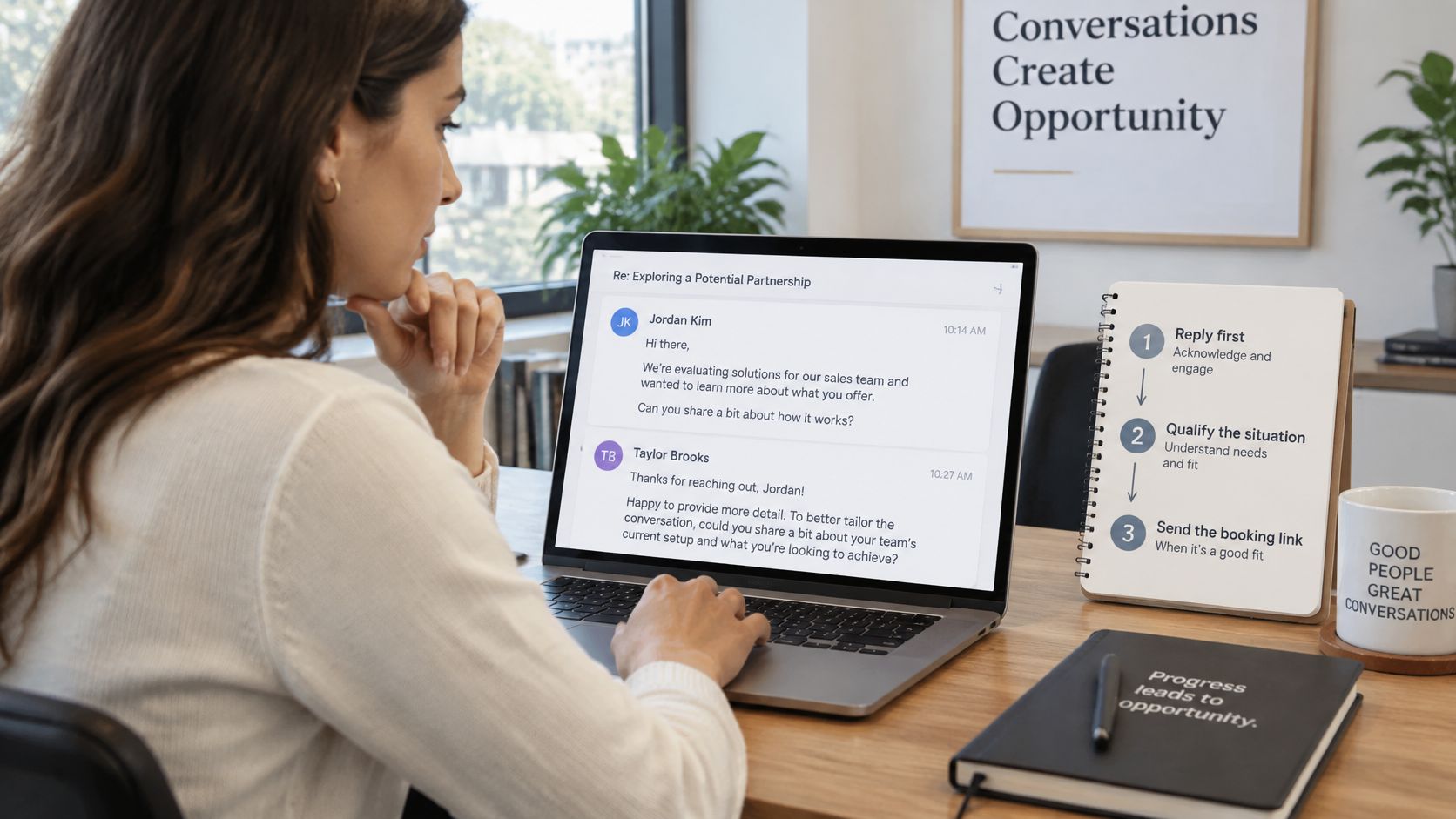
No calendar link in the first email. The link goes out after the prospect has explained enough about their situation to establish fit. That adds a short exchange, but it saves the seller from discovering an obvious mismatch during the meeting.
The handoff needs a human owner, even when tools classify the reply.
Make the same-day handoff explicit
Send every positive reply to the named owner immediately, using the shared Slack channel if that's where the team works. Record the assignment in HubSpot as well. A Slack notification without CRM ownership leaves the next person guessing whether anyone answered.
Set the operational expectation as same-day human handling, with immediate attention during covered hours. Track elapsed hours to the first human reply, including after-hours arrivals, so business-hours reporting doesn't hide delays.
Qualification requires four checks:
Real problem: The prospect describes an issue, rather than general curiosity.
Current relevance: There's a reason to discuss it now.
Decision influence: The contact can shape the evaluation or bring in someone who can.
Meeting outcome: Both sides understand what the call should establish.
Use the lead qualification process to make those checks consistent across setters. If a check fails, log the reason and choose nurture, referral, or disqualification instead of sending an invitation.
Keep the exchange short
Use this four-line reply pattern across the conversation. Ask the qualification questions first, then offer times after the answers establish fit.
Thanks, that helps. The manual handoff you described sounds like the issue to examine.
Is it affecting an active project, or are you researching options for later?
Who else would need to assess a change to that workflow?
Would Tuesday morning or Thursday afternoon work to map the handoff and decide whether there's a fit?
Don't send that as an interrogation when the prospect has already supplied the answers. Reflect what they said, ask only for missing context, and write the outcome into the invitation (the seller shouldn't have to reconstruct the thread).
For teams evaluating automation around this handoff, Voicedial.ai's guide to streamline lead qualification and scheduling provides useful process context. Keep the acceptance decision tied to your written fit rules, regardless of which tool assists.
This video provides another format for reviewing the appointment-setting workflow with the team.
Preserve the boundary with closing
GROU uses clear fit rules to protect sellers from wrong-fit conversations. We can generate and qualify leads and book meetings alongside an existing sales team, while the client's sellers run the calls and close deals.
Helena Mis Smalc, Co-Founder @ BizIT, described the collaboration directly: “They were reliable, responsive, and fast to understand what we needed from the start.”
Expand stakeholder coverage once the first contact's fit is clear. One interested person is a useful signal; the seller still needs a credible route through the buying group before treating the account as a progressing opportunity.
Sprint reports that separate noise from pipeline
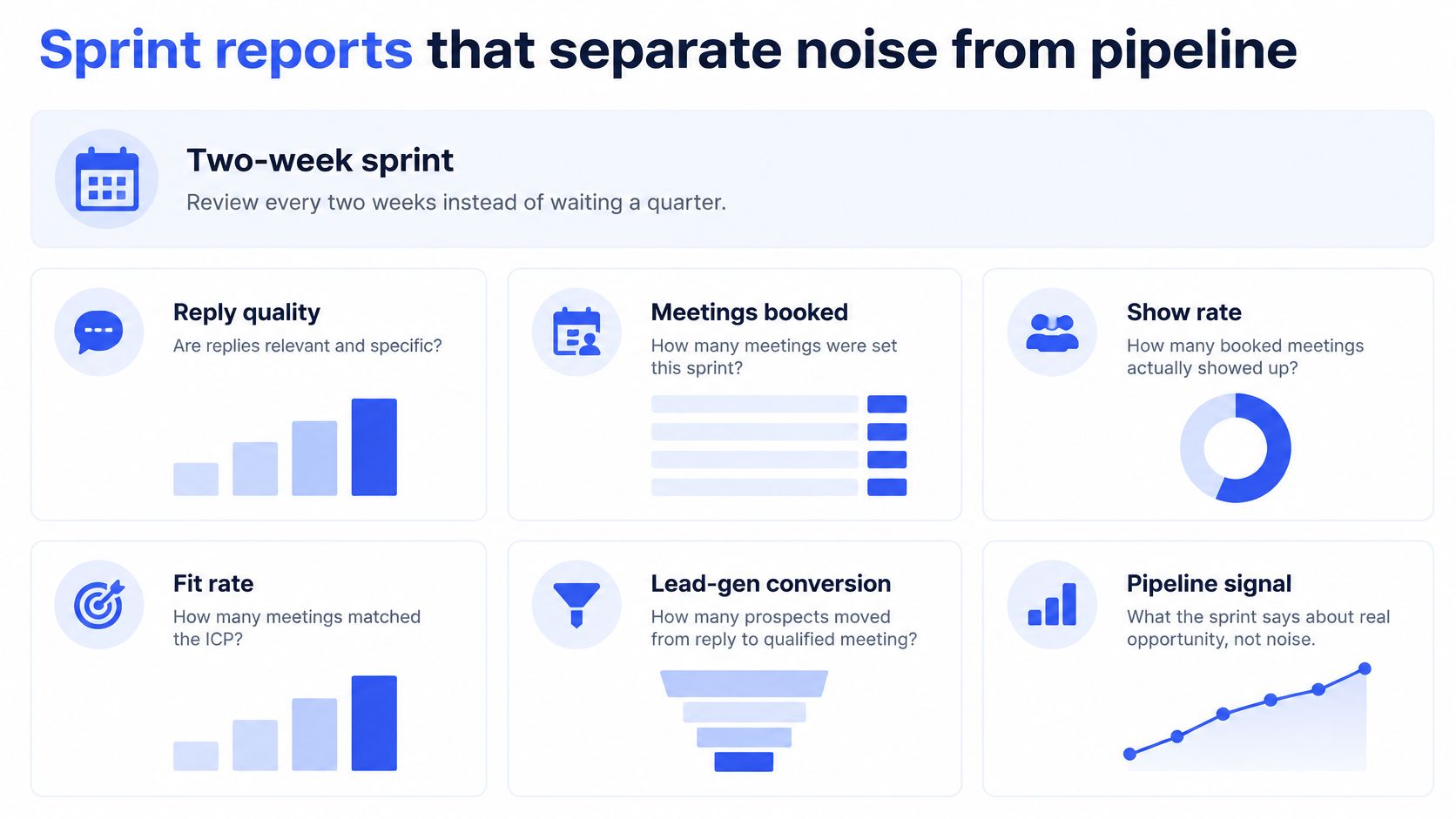
Use a two-week sprint as the review unit. Waiting until quarter-end to discover that the wrong people are replying gives the team too much time to repeat a targeting mistake.
GROU's client sprint report covers six lines. Each should answer a decision question, not just display activity.
Reply quality: Are people describing relevant problems or sending polite dismissals?
Meetings booked: How many invitations were accepted?
Show rate: Which qualified bookings happened?
Fit rate: Did the conversations meet the written acceptance rules?
Lead-gen conversion: How many engaged prospects became qualified meetings?
LinkedIn engagement: Are target profiles interacting, or are unrelated audiences producing the activity?
Use explicit denominators in your lead generation KPI reporting. Label whether fit rate measures booked meetings or held meetings, and don't mix cohorts when calculating show rate.
The reporting view should make those distinctions visible.
Diagnose before changing copy
Weak show rate and weak fit rate warrant an inspection of pre-booking qualification. Weak replies with healthy sender signals suggest testing the segment or angle. Rising complaints require a sending pause and an infrastructure review before another copy experiment.
Google's email sender guidelines, effective February 1, 2024, require SPF or DKIM, valid forward and reverse DNS, and user-reported spam below 0.3% for email sent to personal Gmail accounts. Google recommends staying below 0.1%.
For senders delivering more than 5,000 messages per day to Gmail accounts, those guidelines also require SPF, DKIM, and DMARC, sender-domain alignment with SPF or DKIM, and one-click unsubscribe for marketing and promotional messages. Bulk senders above 0.3% became ineligible for mitigation beginning in June 2024.
Google's Postmaster Tools documentation says correctly configured DKIM and DMARC typically achieve 95% or higher success rates, while SPF can run lower when third-party services send on the organization's behalf. Read those infrastructure signals beside qualified replies by domain and segment.
Diagnosis thresholds for the six-line sprint report
Signal | Threshold | Action when it fails |
|---|---|---|
Spam rate in Postmaster Tools | Stay below Google's recommended level; pause before the hard limit | Stop sending and fix the list or domain before rewriting copy |
DKIM and DMARC pass rate | Meet Google's correctly configured success benchmark | Repair authentication before testing new copy |
SPF pass rate | Explain any lower performance from third-party sending | Audit each sending service on the domain |
Reply rate by segment | Compare with that segment's prior sprint and reply quality | Change the angle or the segment, not the domain |
Show rate on qualified meetings | Meet the agreed cohort baseline; investigate any decline | Tighten the fit checks before the calendar link goes out |
GROU's Plastit campaign reached hardware buyers across Europe, generating 97 leads with a 7.9% reply rate. Precision Resource's outbound engine covered six markets, with a 20.2% top campaign reply rate. These are case-specific sanity checks, not interchangeable targets for your market.
Diagnostic discipline: Don't change a healthy domain because the offer is weak. Don't rewrite the offer to compensate for broken authentication.
Open rate alone won't settle either question. Review authentication, spam complaints, completed unsubscribes, and qualified replies before deciding what to change.
If content supports outbound, organize your weekly publishing schedule around the same buyer problems. Keep publishing activity separate from pipeline credit unless you can connect the engagement to an account and its progression.
Audit your meeting-held rate this Friday
Before Friday, export your last 10 sequences and last 10 positive replies. Treat this as an operational inspection, not a statistically representative performance study. You're looking for broken handoffs you can correct before the next send.
Add the missing evidence
Add these CRM columns if they're missing:
Reply touch number: Which message prompted the response?
Hours to human answer: How long did the prospect wait after replying?
Fit reason before invite: Was the qualification rationale recorded before booking?
Open the original threads rather than trusting the lifecycle stage. Check whether the recorded reason identifies a current problem and decision influence, or merely says interested.
If email one still carries a calendar link, remove it from the next send. If more than half of held meetings lack a fit note, pause booking from the first positive reply and require the qualification checks before offering time.
Finish with a report sales can trust
If show rate is unknown, you're still reporting bookings without confirming delivery. Add a held-status column by Monday, distinguish cancellations from no-shows, and keep rescheduled meetings attached to their original record so they aren't counted twice.
Don't add another channel until Friday's columns exist. A wider campaign creates more handoffs to manage; it won't repair missing ownership or an undefined acceptance rule.
GROU is a global B2B pipeline agency trusted by more than 50 companies across iGaming, SaaS, manufacturing, and professional services. Our methodology is one list, one message, and one reporting line across LinkedIn, lead generation, and outbound, run in biweekly sprints with the client's sellers on the calls.
Bring your Friday audit to Grou and book a call for a direct recommendation based on your market, offer, and goals. If you need a starting point first, take our 2-minute quiz to identify where your appointment setting and lead generation system needs attention.
Adding a calendar link to every cold email can fill your sales team's week with the wrong people. If replies and form fills are rising but revenue isn't, more names won't fix the handoff.
One list: Keep targeting consistent across channels.
One message: Connect outreach to a specific operational problem.
Four touches: Follow up deliberately, then stop.
Qualification before booking: Offer time only after the reply proves fit.
Held meetings: Count qualified conversations that happened.
Table of Contents
Qualified meetings are the only result that counts
A full calendar can still hide a weak pipeline. A prospect may accept an invitation despite having no current problem, no fit with the target account, or no influence on a decision. The call then spends time finding out what qualification should have established before booking.
Lead generation and appointment setting work best as one engine. The target list and message stay consistent; the reply determines whether a prospect is a fit for a conversation. Grou's work with BizIT helped secure 18 sales meetings.
What each stage is allowed to mean
Stage | What it is | Number to report | Pass rule |
|---|---|---|---|
Fit lead | Contact on a verified ICP list | List size and bounce rate | Role, account, and email match the written fit rules |
Reply | Any human response | Reply rate by touch | Stop the sequence when they answer |
Positive reply | Pain, interest, or a real question | Positive reply rate | Assign an owner to respond promptly |
Qualified meeting | A current problem, with someone who can influence a decision | Fit rate | Confirm fit before offering a time |
Held meeting | The prospect attended | Show rate and meetings held | Count only meetings that happened |
Keep these stages separate in your CRM. A request for information remains a positive reply until fit is established. An unsubscribe can count as a response for reply reporting, but never as commercial interest.
Reply volume alone can mislead. A campaign may prompt many responses but few qualified conversations; another may get fewer replies and more useful discussions with accounts sales can pursue.
Counting rule: A booked meeting that does not happen is still a booking, not a delivered sales conversation.
Give sales a usable handoff
For SaaS teams developing their acquisition approach, FOMOchat's guide to build a SaaS lead generation engine offers a related perspective. Apply consistent fit criteria whether a conversation starts through content, outbound, or an inbound request.
A held meeting is not revenue. Track opportunity progression and closed business separately, while measuring appointment setting by the outcome it can directly influence: a qualified meeting that took place.
On Friday, review held meetings alongside their recorded fit reasons. If the CRM entry cannot show why the prospect qualified, sales cannot reliably judge the handoff.
Six steps from ICP workshop to launch
GROU starts every engagement with an onboarding session to map the client's ICP, offer, and market. We define segments, messaging angles, and channels before building anything. That order prevents the familiar problem of buying a database and then inventing reasons its contacts might fit.
Use the workflow below as a launch gate, not a collection of tasks people can complete independently.
Agree the account and the offer
1. Run the onboarding workshop. Write the ICP, offer, and markets, followed by a sentence defining a qualified meeting. Our ICP framework helps turn broad market descriptions into usable selection rules.
Include disqualifiers: wrong seniority, no route to a budget owner, or a problem that isn't current. The output should let someone reject an account without asking the founder. The usual miss is starting list building while these decisions are still verbal.
2. Build and verify the target list. Pull accounts in Apollo or Clay, check titles in Sales Navigator, and verify each email before it becomes eligible to send. Maintain one account list feeding both channels, with fields for market, role, trigger, and relationship status.
Map two or three relevant roles per account as a starting workflow. A SaaS deal may involve revenue, security, and finance; pharma, manufacturing, legal tech, and iGaming may require procurement, regulatory input, or a technical owner. Don't assume the most senior title is the best entry point.
LinkedIn's Decision Makers Insights Report analyzed more than 1.7 million key decision makers, examining technology buyers by factors including seniority, company size, and role. Use that account-and-role perspective to avoid treating a buying group as a single contact.
Launch with ownership already assigned
3. Launch inside 14 days. Put the same message live across email and LinkedIn. Waiting for a perfect landing page delays feedback on the question that matters first: does this segment recognize the problem?
This is a launch target, not permission to bypass verification or sender checks. Keep the offer stable across channels while adapting the wording to the format.
4. Run the four-touch sequence. Approve the complete sequence before sending the cold open. Each follow-up needs a job; the common miss is adding another email because the team hasn't agreed when to stop.
5. Route positive replies before booking. Assign a named person and a backup. Qualification belongs in the conversation, not in a calendar invitation that sales reads moments before the call.
6. Review with the client every two weeks. Change targeting or the messaging angle, rather than both in the same test. If deliverability is broken, repair that first or the comparison won't tell you anything useful.
Give each tool a defined job
HubSpot holds the record. HeyReach runs LinkedIn activity, while Lemlist, Instantly, or Smartlead handles email sequencing. Configure reply detection and suppression so the tools respect the same conversation status (test that behavior before launch).
GROU runs LinkedIn content, lead generation, and outbound as one connected system with one message, one target list, and one reporting line. Separate tools are fine; separate definitions of success aren't.
The launch checklist is short: fit rules written → list verified → both channels live → reply owner named. Don't send until every item has an owner who can confirm it's ready.
The four-touch sequence over 14 days
Plan four touches over 14 days, then stop. Around 60% of replies in GROU campaigns arrive on the second, third, or fourth touch, so stopping after the cold open misses most conversations. Our stopping rule avoids extending the sequence into additional emails as complaints begin to threaten sender reputation.
Four touches across email and LinkedIn
Touch | When | Job of the message | Leave out |
|---|---|---|---|
Email 1 | Day 1 | One question about a specific pain | Calendar link, deck, product tour |
Email 2 | Day 4 | Short bump of the same question | A new pitch |
Email 3 | Day 8 | One proof point tied to their role | A second unrelated offer |
Email 4 | Day 14 | Yes-or-no: close it, or take a short call | A fifth version of touch 1 |
LinkedIn connect | Day 1 | Connection request, no pitch | A meeting ask in the note |
LinkedIn note 1 | Day after accept | Same pain question as email 1 | A calendar link |
LinkedIn follow-ups | Several days apart, then stop | Short context, then the same yes-or-no | Daily nudges past four touches |
These are coordinated channel paths, not permission to send duplicate messages whenever both tools have capacity. If someone is already discussing the issue on LinkedIn, don't keep emailing them as though they haven't answered.
Use the outreach sequence planner to map the timing and purpose before loading either platform. Review the combined experience from the prospect's side, including what happens when they accept a connection request late.
Ask a question they can answer
A generic introduction makes the prospect do the work of finding relevance. The acceptable version names a recognizable operational symptom and asks for context.
Open | Copy |
|---|---|
Bad | Hi {first_name}, we help B2B teams grow pipeline. Worth a look? {calendar link} |
Acceptable | Hi {first_name}, when a deal sits in proposal for two weeks, what usually breaks first on your side? |
The acceptable version still needs account fit. Don't send a proposal-stage question to someone who doesn't own a sales process just because their title sounds commercial.
For the value-add touch, use a verified case outcome relevant to that person's responsibility. If you lack suitable proof, offer a concrete diagnostic observation instead. An unrelated success story adds length without helping the prospect judge whether a conversation is worthwhile.
Every later touch should contribute context. Repeating the original pitch with a different greeting doesn't earn another interruption.
Don't turn a benchmark into an email quota
RAIN Group's sales prospecting benchmark reports approximately eight touchpoints before an initial meeting or comparable conversion. Treat that as context for the wider buyer path, including content, calls, and outreach, rather than a license to send eight cold emails.
This plan still stops at four cold touches. A buyer may encounter useful content or return later without needing another automated nudge today.
Lemlist, Instantly, or Smartlead must halt when someone replies. Connect HeyReach responses to the same suppression workflow, and test cross-channel behavior rather than assuming the integration handles it. A person who answered shouldn't receive the final close-out message.
Route replies and qualify before you book
No calendar link in the first email. The link goes out after the prospect has explained enough about their situation to establish fit. That adds a short exchange, but it saves the seller from discovering an obvious mismatch during the meeting.
The handoff needs a human owner, even when tools classify the reply.
Make the same-day handoff explicit
Send every positive reply to the named owner immediately, using the shared Slack channel if that's where the team works. Record the assignment in HubSpot as well. A Slack notification without CRM ownership leaves the next person guessing whether anyone answered.
Set the operational expectation as same-day human handling, with immediate attention during covered hours. Track elapsed hours to the first human reply, including after-hours arrivals, so business-hours reporting doesn't hide delays.
Qualification requires four checks:
Real problem: The prospect describes an issue, rather than general curiosity.
Current relevance: There's a reason to discuss it now.
Decision influence: The contact can shape the evaluation or bring in someone who can.
Meeting outcome: Both sides understand what the call should establish.
Use the lead qualification process to make those checks consistent across setters. If a check fails, log the reason and choose nurture, referral, or disqualification instead of sending an invitation.
Keep the exchange short
Use this four-line reply pattern across the conversation. Ask the qualification questions first, then offer times after the answers establish fit.
Thanks, that helps. The manual handoff you described sounds like the issue to examine.
Is it affecting an active project, or are you researching options for later?
Who else would need to assess a change to that workflow?
Would Tuesday morning or Thursday afternoon work to map the handoff and decide whether there's a fit?
Don't send that as an interrogation when the prospect has already supplied the answers. Reflect what they said, ask only for missing context, and write the outcome into the invitation (the seller shouldn't have to reconstruct the thread).
For teams evaluating automation around this handoff, Voicedial.ai's guide to streamline lead qualification and scheduling provides useful process context. Keep the acceptance decision tied to your written fit rules, regardless of which tool assists.
This video provides another format for reviewing the appointment-setting workflow with the team.
Preserve the boundary with closing
GROU uses clear fit rules to protect sellers from wrong-fit conversations. We can generate and qualify leads and book meetings alongside an existing sales team, while the client's sellers run the calls and close deals.
Helena Mis Smalc, Co-Founder @ BizIT, described the collaboration directly: “They were reliable, responsive, and fast to understand what we needed from the start.”
Expand stakeholder coverage once the first contact's fit is clear. One interested person is a useful signal; the seller still needs a credible route through the buying group before treating the account as a progressing opportunity.
Sprint reports that separate noise from pipeline
Use a two-week sprint as the review unit. Waiting until quarter-end to discover that the wrong people are replying gives the team too much time to repeat a targeting mistake.
GROU's client sprint report covers six lines. Each should answer a decision question, not just display activity.
Reply quality: Are people describing relevant problems or sending polite dismissals?
Meetings booked: How many invitations were accepted?
Show rate: Which qualified bookings happened?
Fit rate: Did the conversations meet the written acceptance rules?
Lead-gen conversion: How many engaged prospects became qualified meetings?
LinkedIn engagement: Are target profiles interacting, or are unrelated audiences producing the activity?
Use explicit denominators in your lead generation KPI reporting. Label whether fit rate measures booked meetings or held meetings, and don't mix cohorts when calculating show rate.
The reporting view should make those distinctions visible.
Diagnose before changing copy
Weak show rate and weak fit rate warrant an inspection of pre-booking qualification. Weak replies with healthy sender signals suggest testing the segment or angle. Rising complaints require a sending pause and an infrastructure review before another copy experiment.
Google's email sender guidelines, effective February 1, 2024, require SPF or DKIM, valid forward and reverse DNS, and user-reported spam below 0.3% for email sent to personal Gmail accounts. Google recommends staying below 0.1%.
For senders delivering more than 5,000 messages per day to Gmail accounts, those guidelines also require SPF, DKIM, and DMARC, sender-domain alignment with SPF or DKIM, and one-click unsubscribe for marketing and promotional messages. Bulk senders above 0.3% became ineligible for mitigation beginning in June 2024.
Google's Postmaster Tools documentation says correctly configured DKIM and DMARC typically achieve 95% or higher success rates, while SPF can run lower when third-party services send on the organization's behalf. Read those infrastructure signals beside qualified replies by domain and segment.
Diagnosis thresholds for the six-line sprint report
Signal | Threshold | Action when it fails |
|---|---|---|
Spam rate in Postmaster Tools | Stay below Google's recommended level; pause before the hard limit | Stop sending and fix the list or domain before rewriting copy |
DKIM and DMARC pass rate | Meet Google's correctly configured success benchmark | Repair authentication before testing new copy |
SPF pass rate | Explain any lower performance from third-party sending | Audit each sending service on the domain |
Reply rate by segment | Compare with that segment's prior sprint and reply quality | Change the angle or the segment, not the domain |
Show rate on qualified meetings | Meet the agreed cohort baseline; investigate any decline | Tighten the fit checks before the calendar link goes out |
GROU's Plastit campaign reached hardware buyers across Europe, generating 97 leads with a 7.9% reply rate. Precision Resource's outbound engine covered six markets, with a 20.2% top campaign reply rate. These are case-specific sanity checks, not interchangeable targets for your market.
Diagnostic discipline: Don't change a healthy domain because the offer is weak. Don't rewrite the offer to compensate for broken authentication.
Open rate alone won't settle either question. Review authentication, spam complaints, completed unsubscribes, and qualified replies before deciding what to change.
If content supports outbound, organize your weekly publishing schedule around the same buyer problems. Keep publishing activity separate from pipeline credit unless you can connect the engagement to an account and its progression.
Audit your meeting-held rate this Friday
Before Friday, export your last 10 sequences and last 10 positive replies. Treat this as an operational inspection, not a statistically representative performance study. You're looking for broken handoffs you can correct before the next send.
Add the missing evidence
Add these CRM columns if they're missing:
Reply touch number: Which message prompted the response?
Hours to human answer: How long did the prospect wait after replying?
Fit reason before invite: Was the qualification rationale recorded before booking?
Open the original threads rather than trusting the lifecycle stage. Check whether the recorded reason identifies a current problem and decision influence, or merely says interested.
If email one still carries a calendar link, remove it from the next send. If more than half of held meetings lack a fit note, pause booking from the first positive reply and require the qualification checks before offering time.
Finish with a report sales can trust
If show rate is unknown, you're still reporting bookings without confirming delivery. Add a held-status column by Monday, distinguish cancellations from no-shows, and keep rescheduled meetings attached to their original record so they aren't counted twice.
Don't add another channel until Friday's columns exist. A wider campaign creates more handoffs to manage; it won't repair missing ownership or an undefined acceptance rule.
GROU is a global B2B pipeline agency trusted by more than 50 companies across iGaming, SaaS, manufacturing, and professional services. Our methodology is one list, one message, and one reporting line across LinkedIn, lead generation, and outbound, run in biweekly sprints with the client's sellers on the calls.
Bring your Friday audit to Grou and book a call for a direct recommendation based on your market, offer, and goals. If you need a starting point first, take our 2-minute quiz to identify where your appointment setting and lead generation system needs attention.
Pipeline OS Newsletter
Build qualified pipeline
Get weekly tactics to generate demand, improve lead quality, and book more meetings.





Trusted by industry leaders
Trusted by industry leaders
Trusted by industry leaders
Ready to build qualified pipeline?
Ready to build qualified pipeline?
Ready to build qualified pipeline?
Book a call to see if we're the right fit, or take the 2-minute quiz to get a clear starting point.
Book a call to see if we're the right fit, or take the 2-minute quiz to get a clear starting point.
Book a call to see if we're the right fit, or take the 2-minute quiz to get a clear starting point.
" height="30.21639343089746px" id="hfGbXmQR2" width="30.216393430897455px"/></svg>)
Copyright © 2026 – All Right Reserved
Copyright © 2026 – All Right Reserved
Copyright © 2026 – All Right Reserved