%22%3E%3C/path%3E%3Cpath d=%22M 63.072 7.554 C 62.258 8.022 61.577 8.689 61.092 9.493 L 61.092 7.076 L 57.158 7.076 L 57.158 22.64 L 61.089 22.64 L 61.089 14.888 C 61.089 13.446 61.403 12.434 62.03 11.853 C 62.818 11.218 63.818 10.907 64.826 10.982 L 65.868 10.982 L 65.868 6.851 C 64.891 6.834 63.926 7.076 63.073 7.554 Z%22 fill=%22rgb(17,17,17)%22%3E%3C/path%3E%3Cpath d=%22M 78.916 7.82 C 76.363 6.49 73.321 6.49 70.768 7.82 C 69.562 8.473 68.564 9.451 67.888 10.644 C 67.167 11.931 66.803 13.387 66.834 14.862 C 66.804 16.332 67.157 17.785 67.86 19.077 C 68.515 20.267 69.494 21.246 70.684 21.901 C 71.924 22.576 73.318 22.92 74.73 22.898 C 76.164 22.918 77.58 22.575 78.846 21.901 C 80.062 21.247 81.073 20.27 81.768 19.077 C 82.506 17.797 82.88 16.339 82.85 14.862 C 82.88 13.389 82.517 11.934 81.797 10.647 C 81.12 9.455 80.122 8.477 78.917 7.824 M 78.803 14.862 C 78.829 15.739 78.636 16.608 78.241 17.391 C 77.903 18.046 77.38 18.588 76.738 18.95 C 76.124 19.293 75.432 19.472 74.729 19.47 C 73.668 19.497 72.648 19.061 71.934 18.276 C 71.139 17.323 70.741 16.1 70.823 14.862 C 70.741 13.62 71.149 12.395 71.959 11.45 C 72.687 10.667 73.715 10.233 74.783 10.256 C 75.859 10.236 76.894 10.67 77.635 11.45 C 78.464 12.387 78.884 13.616 78.801 14.864%22 fill=%22rgb(17,17,17)%22%3E%3C/path%3E%3Cpath d=%22M 95.906 7.076 L 95.906 15.646 C 95.975 16.68 95.643 17.701 94.979 18.498 C 94.311 19.184 93.379 19.547 92.422 19.495 C 91.475 19.544 90.553 19.18 89.894 18.498 C 89.23 17.701 88.898 16.68 88.967 15.646 L 88.967 7.076 L 85.033 7.076 L 85.033 16.207 C 85 17.449 85.275 18.68 85.834 19.79 C 86.327 20.75 87.095 21.542 88.039 22.065 C 89.033 22.594 90.145 22.861 91.271 22.838 C 92.188 22.847 93.095 22.65 93.926 22.263 C 94.708 21.905 95.388 21.36 95.906 20.675 L 95.906 22.645 L 99.865 22.645 L 99.865 7.076 Z%22 fill=%22rgb(17,17,17)%22%3E%3C/path%3E%3Cpath d=%22M 4.513 15.626 C 4.511 10.815 7.606 6.549 12.181 5.059 C 16.756 3.57 21.77 5.195 24.601 9.086 L 27.816 5.87 C 24.074 1.186 17.981 -0.943 12.137 0.393 C 6.292 1.728 1.728 6.292 0.393 12.137 C -0.943 17.981 1.186 24.074 5.87 27.816 L 9.085 24.601 C 6.214 22.512 4.515 19.177 4.513 15.626%22 fill=%22rgb(32,62,235)%22%3E%3C/path%3E%3Cpath d=%22M 17.114 14.343 L 13.354 18.01 L 13.354 18.026 L 21.071 18.026 L 11.412 27.609 L 17.389 27.609 L 23.999 21.081 L 23.999 28.316 L 24.005 28.316 L 27.967 24.393 L 27.967 14.343 Z%22 fill=%22rgb(32,62,235)%22%3E%3C/path%3E%3C/g%3E%3C/svg%3E) ×
× ××
××

You don't have a pipeline problem because reps aren't working hard enough. You have one because activity is scattered across broad lists, disconnected LinkedIn posts, generic sequences, and handoffs nobody owns, so sales gets motion without enough qualified conversations.
The #1 system is a structured account-based motion with one ICP-aligned list, useful content, sequenced outbound, clear routing, and one reporting line.
Intent-triggered outreach belongs inside that system, because timing changes reply quality faster than prettier copy does.
Reply routing should treat responses as signals, not as permission to send another generic follow-up.
Buying-committee coverage matters once the account list and ICP are tight, not before.
Measurement should run at the account level, from target account to closed revenue, or the team ends up guessing.
That's the structure-turns-attention-into-pipeline angle GROU uses across iGaming, SaaS, manufacturing, legal tech, and pharma. The best b2b sales strategies don't chase every hand raised. They create a system where the right accounts see the right message, at the right moment, and every response lands somewhere useful.
Table of Contents
2. Account-based marketing with sequenced outbound motion in launch mode
4. Outbound sequences with sequential reply routing in operation
6. LinkedIn content with embedded call-to-action routing in practice
9. Warm-list prospecting through strategic partnerships and referral systems
1. Account-based marketing with sequenced outbound motion
This is the #1 pick because it gives sales one operating system instead of five disconnected tactics. A strong account-based motion starts with one ICP-aligned target list, then layers thought leadership, email, and LinkedIn around the same accounts and the same buying roles. That's the cleanest way to make structure turn attention into pipeline.
LinkedIn's buyer report says buyers often evaluate only 2 to 5 vendors on average, and 78% select products they had heard of before research even began LinkedIn B2B buyer report. That's why broad prospecting breaks down. The shortlist is often shaped before direct sales contact, so your list quality and early credibility do the heavy lifting.
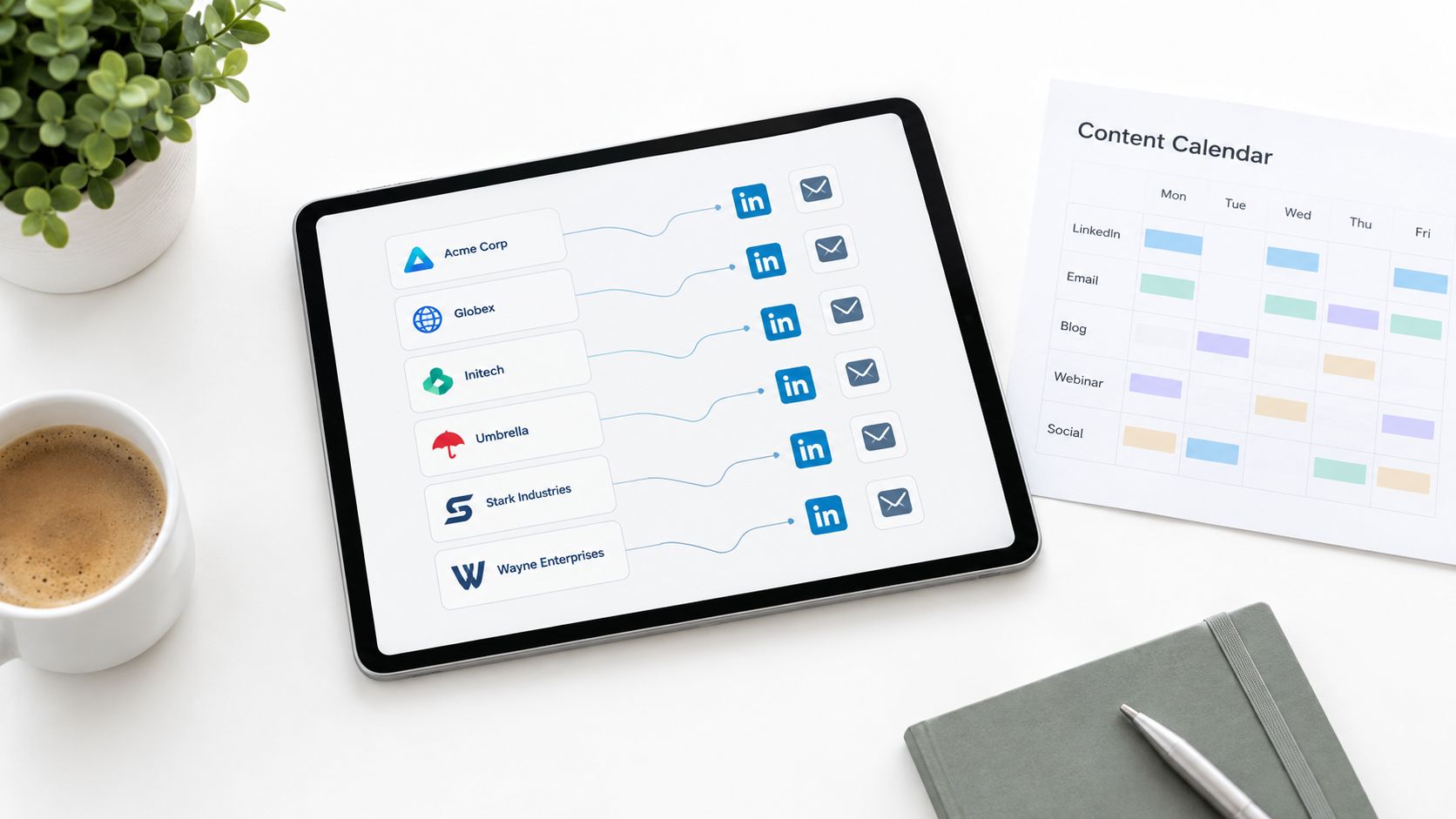
What the system looks like in practice
A real deployment usually means 50 to 200 named accounts, 3 to 5 decision-maker personas per account, and an 8 to 12 week sequencing window with LinkedIn touchpoints woven between email sends. The goal isn't raw volume. The goal is controlled coverage across the buying group.
Practical rule: build the account list before you write the copy. If list quality is weak, every later step gets expensive.
That matters in SaaS, legal tech, manufacturing, iGaming, and pharma for different reasons. SaaS and legal tech often need multi-stakeholder consensus. Manufacturing needs credibility with operations and finance. iGaming and pharma need tighter risk framing, sharper proof, and more respect for internal review cycles.
GROU's method fits here because one message, one list, and one reporting line reduce noise. If marketing builds context and sales only works warm accounts, the team stops chasing cold motion that never had a real chance.
For a deeper structure reference, see GROU's account-based marketing guide.
2. Account-based marketing with sequenced outbound motion in launch mode
The launch sequence is straightforward, but the discipline is where the team fails. Start with the ICP, then define the account universe, map 3 to 5 personas, enrich records, plan bi-weekly content, launch coordinated touches, route replies, and review meeting-held rate by account. That's the order. If you reverse it, the machine gets noisy fast.
A SaaS company targeting 100 legal-tech firms published 8 posts on contract-compliance automation over 12 weeks, ran parallel email sequences to GCs and ops leads, and closed 3 deals worth $180K ARR in 90 days. A manufacturing B2B team targeting 60 mid-market supply-chain companies ran a 4-post LinkedIn series on inventory optimization, paired it with a 10-touch outbound sequence, and generated 22 qualified meetings and 5 pilots. An iGaming operator entering a regulated market used an 80-account list of compliance officers and VPs of operations, then layered a 6-week LinkedIn drip on regulatory risk and outbound sequences that produced 14 first meetings and 2 partnerships.
Build the launch in the right order
List first: spend serious time on account quality, because it determines everything else.
Rotate content weekly: even small lists go stale when the same post lands for weeks in a row.
Set routing rules before launch: define what counts as positive, what gets a call within 24 hours, and what recycles.
Track account-level meeting-held rate: leads generated can look fine while the account is dead.
Refresh every 90 days: remove accounts with no opens after three touches and add accounts with recent hiring or funding signals.
The supplied examples show why bi-weekly sprints work well. They keep list work, content, outbound, feedback, and reporting inside one rhythm instead of letting each function drift. That's exactly where GROU tends to help, because the team keeps the account list, LinkedIn content, outbound, and feedback loop in sync.
For a related launch reference, see GROU's account-based marketing examples.
3. Outbound sequences with sequential reply routing
A sequence should not be a one-size-fits-all drip that keeps sending the same follow-up after every reply. It should behave like a routing system. Once someone responds, the sequence's job changes from outreach to classification, then classification to the right next action.
The branching model works best as an 8 to 12 touch, 6-week structure with 3 to 4 reply paths. Interested replies go to sales the same day. Objections enter an objection-specific branch. Silence recycles into nurture. That's cleaner than a single 5-email cadence when the list is warm and the team can keep CRM discipline tight.
LinkedIn sales research says only 4% of B2B buyers had a favorable impression of a salesperson who reached out cold, while 87% viewed a salesperson favorably when introduced through their professional network LinkedIn sales research. That's why the sequence can't rely on raw persistence. It needs context, timing, and a clear reaction path.
Practical rule: if a reply arrives, the sequence is over. Routing starts.
Why branching beats a flat cadence
A flat cadence assumes every reply means the same thing. It doesn't. Some prospects are interested but early. Some have budget objections. Some want to revisit next quarter. If the system treats all of them the same, sales wastes time and looks sloppy.
That's especially visible in SaaS and legal tech, where objections often cluster around timing, legal review, or stakeholder alignment. Manufacturing teams see more operational objections. Pharma buyers often care about process fit and compliance. A routing system lets you separate those paths instead of jamming them into one follow-up.
For sequencing structure and automation context, see GROU's outbound sales automation guide and Cold Email Sequence Structure.
4. Outbound sequences with sequential reply routing in operation
Start with a narrow list, then build the routing. A practical rollout uses a 50-person list before any move to 500. The point is to see the reply patterns first, then branch the sequence around them. Keep emails 3 to 5 days apart, and use LinkedIn for context, not as the main offer.
One SaaS accounting tool ran a 12-touch sequence across 800 mid-market finance teams and saw a 28% reply rate, a 6% positive intent rate equal to 51 qualified leads, plus 2 closed deals at $45K ARR each. A B2B legal-tech platform targeting 600 in-house counsel routed “no budget this quarter” replies into a Q2 nurture branch and generated 8 SQL per 100 touches compared with 2 per 100 on the control sequence. A manufacturing equipment supplier used a 10-touch sequence with LinkedIn interleaving to 400 operations directors and logged a 31% reply rate. Reply routing also cut manual follow-up by 15 hours per week.
The workflow is simple to run, but the handoff rules need discipline.
Tool stack that matches the workflow
Clay for enrichment and record cleanup.
Apollo for list building and basic automation.
Lemlist for personalization.
Instantly or Smartlead for sequence infrastructure.
HubSpot for routing and CRM visibility.
Sales Navigator for LinkedIn context.
Build and test for 2 to 3 weeks, then watch the signal for 6 to 8 weeks. That window is enough to see whether the routing logic holds and whether the ICP is tight enough to keep attention on qualified pipeline. It is not enough time to rescue a weak list with more sends.
Track reply rate by touch number, not only by sequence average. Touch 1 may pull more responses than touch 5, and late-touch weakness usually points to targeting, not copy. In SaaS, legal tech, manufacturing, pharma, and iGaming, the same rule applies. Better account selection produces cleaner replies, and cleaner replies feed the routing system that supports multi-threading, referrals, paid retargeting, and the rest of the operating system.
5. LinkedIn content with embedded call-to-action routing
LinkedIn content becomes useful when it feeds the account motion, not when it sits next to it as a separate brand exercise. The practical model is simple. Publish content tied to a specific CTA, assign an engagement tag, and create a follow-up window. Then move comments and profile engagement into CRM and outbound within 48 hours.
LinkedIn remains a core B2B channel. One 2026 benchmark summary says 93% of B2B marketers use LinkedIn, 40% rank it as the most effective channel for quality leads, and 75% to 85% of B2B social leads originate from LinkedIn LinkedIn benchmark summary. That doesn't mean every post is pipeline. It means the channel matters enough that your routing rules need to be tight.
Content that supports the account motion
Rotate four themes, pain-point, case-study, product-feature, and industry-news. Keep the cadence at 2 posts per week. Use the posts to create angles for email and handles for objections later in the sequence. If someone comments on a compliance post, that's a signal for compliance messaging, not a reason to send the same generic sequence.
Pharma teams can use content to address process risk and adoption. Legal tech teams can use it for contract review and governance. Manufacturing teams can speak to operational friction. SaaS teams can use customer workflow and integration topics. iGaming teams can focus on regulation, acquisition, and retention without sounding like a promo feed.
For a content system reference, see GROU's LinkedIn content strategy guide.
6. LinkedIn content with embedded call-to-action routing in practice
Treat LinkedIn as the front end of the revenue system, not a side channel. The person posting should be the operator buyers want to hear from, usually a founder or head of sales, because their voice carries context that a company page usually misses. Batch-write 4 to 6 weeks of posts, publish on a fixed schedule, and assign each post one clear next step.
The best use of this motion is account routing. A post should give sales a reason to tag a commenter, check profile activity, and move that contact into a follow-up window tied to the right account. If the post is about compliance, the follow-up should not be a generic nurture line. It should match the pain the prospect already signaled.
A SaaS compliance platform posting 2 times per week on new compliance requirements and audit workflows generated 180 total engagements over an 8-week run. Of those engagers, 22 became SQL when contacted within 48 hours, and 3 closed into customers for $90K ARR total. An iGaming player-acquisition agency used weekly posts on acquisition ROI and retention tactics, grew from 800 to 12,000 followers in 12 months, and saw direct LinkedIn engagement drive 40% of qualified meetings in months 6 to 12. A manufacturing supply-chain software company posted twice weekly on demand forecasting and inventory automation, built a niche logistics reputation, and ended up with 5 inbound conversations per week from engaged commenters.
That pattern works because the content is specific enough to route.
The operating rules
Ask one specific question. “What's your biggest bottleneck in X?” gets more usable replies than a broad prompt.
Respond within 24 hours. Fast replies keep the thread active and make the signal easier to work.
Move comments into CRM. Clay can enrich commenters, then HubSpot or Pipedrive can route them.
Use Sales Navigator for account context. Likes alone do not tell you which account deserves follow-up.
Track engagement to pipeline. Impressions matter less than meetings, SQL, and closed business.
The stronger version of this tactic fits the same operating system used for intent, multi-threading, referrals, and retargeting. On one side, LinkedIn creates attention. On the other, routing turns that attention into qualified pipeline. That matters in SaaS, iGaming, manufacturing, legal tech, and pharma, where the message has to match the account before anyone books a meeting.
7. Intent-based prospecting with buying-signal monitoring
Intent belongs inside the core account system, but only when the team can act fast. The signal itself isn't the win. The win is outbound launched within 24 to 48 hours while the context is still fresh. If the team is slow, the advantage disappears.
A B2B legal-tech SaaS team monitored 300 mid-market law firms for GC hiring events and deployed outbound within 24 hours of the LinkedIn signal. The result was a 54% reply rate and 2.3 SQL per 10 outbound, compared with 0.6 on a cold list, and 6 customers closed in 6 months. A manufacturing software team tracked 400 supply-chain companies for “supply chain director” job posts on LinkedIn and Indeed, hit a 38% positive reply rate, a 12% SQL rate, and 4 closed deals at $120K ARR each. An iGaming compliance-tech vendor used 6sense to identify 45 gaming operators researching compliance software, then moved the same week, leading to 19 demos and 2 signed contracts.
Start cheap, then buy tools
Start with free or low-cost signals first. LinkedIn job changes, LinkedIn group membership, and news alerts can tell you a lot before you buy an intent platform subscription. That matters because a slow team wastes the signal and a bloated stack often hides the bottleneck.
Practical rule: build templates for your three most common signals, new hire, company news, and technology replacement. Copy consistency plus signal relevance tends to win faster than generic personalization.
Track signal-to-reply time and signal-to-SQL time separately. Some signals are hot, like a new hire in your buyer role. Others are warm, like company news. Use those differences to decide where speed matters most and where a slower nurture is fine.
For a glossary-style reference on signals, see GROU's intent signal guide.
8. Multi-threaded outbound to buying committees
Multi-threading only works after ICP quality and account selection are already tight. Weak-fit accounts just create extra noise. On a strong-fit account, committee mapping shortens the path to consensus and keeps the pipeline focused on one buying group instead of one distracted contact.
The operating model is simple. The economic buyer gets ROI and cost framing. The user buyer gets workflow and adoption framing. The technical buyer gets architecture and integration framing. The champion gets internal momentum and proof they can forward.
A SaaS contract-management platform ran multi-threaded outreach to 50 mid-market legal departments across GC, operations manager, procurement lead, and CFO. 19 of 50 accounts generated at least one qualified conversation, 7 moved to demo, and 2 closed at $180K ARR each. A manufacturing ERP company targeted 60 companies with sequences to plant manager, operations director, CFO, and IT director, and 28% of accounts had multiple personas reply positively. An iGaming compliance platform used a 40-account motion across compliance officer, VP operations, legal director, and CTO, and 26 accounts engaged with multiple personas while 4 became customers.
The practical workflow is a 5-step loop. Identify the account. Map the committee. Send persona-specific messages tied to one use case. Stagger sends by 2 hours so replies do not collide. Review which role engaged first, then adjust the next touch.
Guardrails that keep the system usable
Start with 40 to 50 accounts: don't jump to 200 before the system works.
Keep account-level consistency: all personas should reference the same customer name, ROI metric, and use case.
Stagger sends by 2 hours: same day, not same second, avoids awkward overlap.
Track reply rate by persona: economic buyers and technical buyers behave differently.
Find the champion early: one internal ally can carry more weight than three lukewarm contacts.
HubSpot or Pipedrive can handle routing, Apollo or Clay can handle list work, Instantly or Smartlead can handle delivery, and Sales Navigator adds context. In iGaming, that stack helps compliance and operations contacts stay aligned. In SaaS, it keeps product and finance on the same thread. In manufacturing, it helps plant and IT speak to the same rollout. In legal tech and pharma, it reduces the chance that one receptive contact gets stranded without the rest of the committee.
9. Warm-list prospecting through strategic partnerships and referral systems
Referrals work best as part of the same pipeline system, not as a side channel. They sit after ICP quality, account selection, and routing are already clear, because partner trust only helps when the offer is relevant and the handoff is clean. Partner fit matters more than partner audience size.
A SaaS contract-management platform built partnerships with 6 legal-document providers and 4 compliance platforms. Each partner referred 15 to 25 qualified companies per quarter, which generated 80 to 100 referrals annually with a 40% conversion rate to customers. A manufacturing scheduling software company partnered with 8 ERP and supply-chain companies, used warm introductions into enterprise accounts already inside those ecosystems, and closed 5 customers at $200K+ ARR each. An iGaming payment processor set up referral partnerships with 12 player-acquisition agencies and 5 risk-management platforms, producing 60 to 80 referrals per quarter, a 35% SQL rate, and 8 to 12 closed customers per quarter.
How to make referrals flow consistently
Start with overlapping customer lists: exact-fit accounts beat broad partner reach.
Write a one-page referral brief: define the ideal customer, the pain point, and the intro path.
Give partners a clear trade-off: some want revenue share, others want free accounts or co-marketing.
Score every partner separately: five strong intros matter more than thirty weak ones.
Review quarterly: check quality, momentum, and the next partner expansion.
The setup cost is real. An 8 to 12 week onboarding window is normal, and meaningful flow usually shows up over 16 to 20 weeks. That works when the relationship can support the delay and the accounts are worth the wait. It fails when the team wants fast volume or the partner list is built for reach instead of relevance.
10. Paid-media retargeting with landing-page sequencing
Retargeting should support the pipeline system, not replace it. It works best after ICP, content, and account list work are already in place. The job is to move a known audience through a sequence, brand awareness, problem validation, solution framing, and proof, across LinkedIn, Google, and Facebook.
The legal-tech example is the cleanest illustration. A SaaS legal-tech company had 8,000 monthly website visitors, and 5% converted to demo request on the first visit. Retargeting ads then reached 7,600 non-converted visitors across 4 sequential landing pages. 2.8% of retargeted users converted to lead, which generated 213 additional leads at $22 CAC versus $68 CAC on a cold audience. That's a useful support layer, but only because traffic and measurement were already healthy.
The media reference for this motion is here, the embedded walkthrough on sequential retargeting and landing-page flow.
Where retargeting fits and where it doesn't
If your first-party audience is messy, pixels are broken, or landing pages are thin, retargeting just burns budget. Creative fatigue also arrives fast when the same audience sees the same message too often. Frequency control and landing-page quality matter more than flashy ad copy.
Manufacturing teams can use Google Search retargeting to bring back site visitors who already showed fit. Legal tech can move from problem validation to proof. SaaS teams can use sequential pages to match the buyer's stage. The logic stays the same, the proof changes by segment.
11. Measurement and tooling for a single pipeline system
One pipeline system needs one reporting line. Start with target account, then engaged account, positive reply, qualified meeting, meeting held, SQL, opportunity, and closed revenue. If the team reports only at the lead level, account work gets distorted and sales-marketing alignment stays fuzzy.
HubSpot should act as the system of record. Sales Navigator supports account and persona research. Apollo and Clay handle list building and enrichment. Lemlist handles personalization. Instantly and Smartlead run sequences. HeyReach supports LinkedIn outreach. Slack gives the team fast feedback and routing. To find the right automation tool, match it to the handoff points you run, not the features list on a pricing page.
LinkedIn's social-selling benchmark says 78% of salespeople who social-sell outperform peers who do not LinkedIn social-selling benchmark. That does not mean the tool is magic. It means a measured system with fast feedback tends to beat disconnected activity.
The weekly operating rhythm
Monday: audit the last 10 sequences.
Tuesday: tighten qualification fields.
Wednesday: reconcile marketing and sales stages.
Thursday: inspect routing and response time.
Friday: review account-level pipeline.
Track meeting-held rate, positive reply rate, signal-to-reply time, signal-to-SQL time, persona performance, account engagement, opportunity creation, and closed revenue. The team should know which accounts are moving and why.
The decisive test is whether the dashboard tells you what to do next.
That is why GROU's bi-weekly sprint model works for this motion. First signals can show up within 30 days, but only if the list, content, routing, and reporting line are already connected.
11-Point B2B Sales Strategy Comparison
Strategy | Implementation Complexity 🔄 | Resource Requirements ⚡ | Expected Outcomes ⭐📊 | Ideal Use Cases 💡 | Key Advantages ⭐ |
|---|---|---|---|---|---|
Account-based marketing with sequenced outbound motion, overview | 🔄🔄🔄 High, ICP, research, coordinated content & sales | ⚡ High, list enrichment, content cadence, sales discipline | ⭐⭐⭐⭐ Predictable pipeline; higher conversion; 30–60 day feedback window 📊 | B2B SaaS, legal-tech, manufacturing, iGaming, pharma targeting 50–200 accounts | Single-target list + unified feedback loop; tight sales-marketing alignment |
Account-based marketing, examples & implementation | 🔄🔄 Medium‑high, practical setup and playbook | ⚡ Medium, 4–6 week setup, bi‑weekly sprints, enrichment tools | ⭐⭐⭐ Predictable early signals by 8–12 weeks; example deal wins shown 📊 | Teams launching ABM pilots or scaling ABM across industries | Actionable launch plan, case snapshots, refresh & routing guidance |
Outbound sequences with sequential reply routing, overview | 🔄🔄🔄 High, branching logic and CRM discipline | ⚡ Medium, warm lists, tooling, tagging and routing rules | ⭐⭐⭐⭐ Higher reply rates; faster sales triage; data-rich objections 📊 | Teams with warm lists and reliable ops able to tag & route replies | Reply-as-data model; objection handling and persona branching |
Outbound sequences, examples & operations | 🔄🔄 Medium, build/test then scale with instrumentation | ⚡ Medium, sequence infra, enrichment, CRM, 2–3 week test | ⭐⭐⭐ Measurable reply/SQL lift in 6–8 weeks; operational metrics 📊 | Teams testing sequences on 50→500 lists before scaling | Practical tool mapping, spacing rules, sample performance benchmarks |
LinkedIn content with embedded CTA routing, overview | 🔄🔄 Medium, consistent content calendar & routing | ⚡ Low‑Medium, writing cadence, CRM capture, enrichment | ⭐⭐⭐ Builds credibility; engagement-to-pipeline in 8–12 weeks 📊 | Niche verticals and ABM motions where social proof matters | Organic credibility, comment-based qualification, repurposing into outbound |
LinkedIn content, examples & tips | 🔄🔄 Low‑Medium, set calendar, batch-write content | ⚡ Low, one face, batch writing, quick follow-up (24–48h) | ⭐⭐⭐ Case examples show SQLs from engaged commenters 📊 | Teams that can commit a person to thought leadership | Face-led reach, quick commenter enrichment, concrete CTA tactics |
Intent-based prospecting with buying-signal monitoring | 🔄🔄 Medium, signal sources + rapid-response ops | ⚡ Variable, low-cost manual signals to $10k–$50k platforms | ⭐⭐⭐⭐ Very high reply/conversion when executed within 24–48h 📊 | Teams that can act fast on job changes, funding, tech signals | Time-sensitive outreach to accounts already evaluating; high efficiency |
Multi-threaded outbound to buying committees | 🔄🔄🔄 Very high, mapping 3–4 personas per account | ⚡ High, enrichment for many contacts, coordination tools | ⭐⭐⭐⭐ Shorter cycles; higher close rates when committee engaged 📊 | Enterprise/complex B2B deals with multiple decision-makers | Deal security, parallel objection resolution, accelerated velocity |
Warm-list prospecting via partnerships & referrals | 🔄🔄 Medium, partner identification and onboarding | ⚡ Medium, relationship management, partner incentives | ⭐⭐⭐⭐⭐ Very high conversion; lower CAC over time; steady inbound 📊 | Companies able to invest time in partner ecosystems | Trust transfer via warm intros; scalable inbound once established |
Paid-media retargeting with landing-page sequencing | 🔄🔄 Medium, creative sequencing + landing pages | ⚡ High, ad spend, creative refresh, tracking pixels | ⭐⭐⭐ Improved conversion vs cold ads; CAC improves with optimization 📊 | Organizations with existing traffic and clean measurement | Sequential messaging across platforms; maps first-party audiences |
Measurement and tooling for a single pipeline system | 🔄🔄 Medium, unify reporting, qualification rules, cadence | ⚡ Medium, CRM, enrichment, sequence tools, weekly reviews | ⭐⭐⭐⭐ Predictable pipeline dashboards; faster feedback loops 📊 | Teams consolidating sales & marketing systems for ABM | Single account-level source of truth; regular audit cadence |
Turn the system on this week
Pick 50 target accounts before anything else. Document the ICP fields, the buying-committee fields, and the one reporting line that carries an account from target to closed revenue. Then tag the last 10 sequences by reply type, positive, objection, no fit, or silence, and review meeting-held rate by account before the next pipeline meeting.
Friday, run this prompt on your last 10 sequences. Classify every reply as positive, objection, no fit, or silence. Monday, create the missing routing rule, then make sure every new reply has one clear path instead of landing in a shared inbox graveyard.
If your team needs a structure that connects LinkedIn content, outbound, reply routing, and reporting into one pipeline system, GROU is built for that. It's trusted by 50+ companies across iGaming, SaaS, manufacturing, and professional services, and it has driven outcomes including 350 qualified leads in the Adriatic region, 10x LinkedIn follower growth, and enterprise deals exceeding $20M. GROU works through unified ICP-aligned lists, LinkedIn content, outbound sequences, fast reply routing, bi-weekly sprints, shared Slack feedback, and pipeline dashboards.
If you want one team to connect your ICP, LinkedIn content, outbound, and routing into a single pipeline system, visit Grou. We build the list, the messaging, and the reporting line so your sales team spends more time in qualified conversations and less time chasing fragmented activity.
You don't have a pipeline problem because reps aren't working hard enough. You have one because activity is scattered across broad lists, disconnected LinkedIn posts, generic sequences, and handoffs nobody owns, so sales gets motion without enough qualified conversations.
The #1 system is a structured account-based motion with one ICP-aligned list, useful content, sequenced outbound, clear routing, and one reporting line.
Intent-triggered outreach belongs inside that system, because timing changes reply quality faster than prettier copy does.
Reply routing should treat responses as signals, not as permission to send another generic follow-up.
Buying-committee coverage matters once the account list and ICP are tight, not before.
Measurement should run at the account level, from target account to closed revenue, or the team ends up guessing.
That's the structure-turns-attention-into-pipeline angle GROU uses across iGaming, SaaS, manufacturing, legal tech, and pharma. The best b2b sales strategies don't chase every hand raised. They create a system where the right accounts see the right message, at the right moment, and every response lands somewhere useful.
Table of Contents
2. Account-based marketing with sequenced outbound motion in launch mode
4. Outbound sequences with sequential reply routing in operation
6. LinkedIn content with embedded call-to-action routing in practice
9. Warm-list prospecting through strategic partnerships and referral systems
1. Account-based marketing with sequenced outbound motion
This is the #1 pick because it gives sales one operating system instead of five disconnected tactics. A strong account-based motion starts with one ICP-aligned target list, then layers thought leadership, email, and LinkedIn around the same accounts and the same buying roles. That's the cleanest way to make structure turn attention into pipeline.
LinkedIn's buyer report says buyers often evaluate only 2 to 5 vendors on average, and 78% select products they had heard of before research even began LinkedIn B2B buyer report. That's why broad prospecting breaks down. The shortlist is often shaped before direct sales contact, so your list quality and early credibility do the heavy lifting.
What the system looks like in practice
A real deployment usually means 50 to 200 named accounts, 3 to 5 decision-maker personas per account, and an 8 to 12 week sequencing window with LinkedIn touchpoints woven between email sends. The goal isn't raw volume. The goal is controlled coverage across the buying group.
Practical rule: build the account list before you write the copy. If list quality is weak, every later step gets expensive.
That matters in SaaS, legal tech, manufacturing, iGaming, and pharma for different reasons. SaaS and legal tech often need multi-stakeholder consensus. Manufacturing needs credibility with operations and finance. iGaming and pharma need tighter risk framing, sharper proof, and more respect for internal review cycles.
GROU's method fits here because one message, one list, and one reporting line reduce noise. If marketing builds context and sales only works warm accounts, the team stops chasing cold motion that never had a real chance.
For a deeper structure reference, see GROU's account-based marketing guide.
2. Account-based marketing with sequenced outbound motion in launch mode
The launch sequence is straightforward, but the discipline is where the team fails. Start with the ICP, then define the account universe, map 3 to 5 personas, enrich records, plan bi-weekly content, launch coordinated touches, route replies, and review meeting-held rate by account. That's the order. If you reverse it, the machine gets noisy fast.
A SaaS company targeting 100 legal-tech firms published 8 posts on contract-compliance automation over 12 weeks, ran parallel email sequences to GCs and ops leads, and closed 3 deals worth $180K ARR in 90 days. A manufacturing B2B team targeting 60 mid-market supply-chain companies ran a 4-post LinkedIn series on inventory optimization, paired it with a 10-touch outbound sequence, and generated 22 qualified meetings and 5 pilots. An iGaming operator entering a regulated market used an 80-account list of compliance officers and VPs of operations, then layered a 6-week LinkedIn drip on regulatory risk and outbound sequences that produced 14 first meetings and 2 partnerships.
Build the launch in the right order
List first: spend serious time on account quality, because it determines everything else.
Rotate content weekly: even small lists go stale when the same post lands for weeks in a row.
Set routing rules before launch: define what counts as positive, what gets a call within 24 hours, and what recycles.
Track account-level meeting-held rate: leads generated can look fine while the account is dead.
Refresh every 90 days: remove accounts with no opens after three touches and add accounts with recent hiring or funding signals.
The supplied examples show why bi-weekly sprints work well. They keep list work, content, outbound, feedback, and reporting inside one rhythm instead of letting each function drift. That's exactly where GROU tends to help, because the team keeps the account list, LinkedIn content, outbound, and feedback loop in sync.
For a related launch reference, see GROU's account-based marketing examples.
3. Outbound sequences with sequential reply routing
A sequence should not be a one-size-fits-all drip that keeps sending the same follow-up after every reply. It should behave like a routing system. Once someone responds, the sequence's job changes from outreach to classification, then classification to the right next action.
The branching model works best as an 8 to 12 touch, 6-week structure with 3 to 4 reply paths. Interested replies go to sales the same day. Objections enter an objection-specific branch. Silence recycles into nurture. That's cleaner than a single 5-email cadence when the list is warm and the team can keep CRM discipline tight.
LinkedIn sales research says only 4% of B2B buyers had a favorable impression of a salesperson who reached out cold, while 87% viewed a salesperson favorably when introduced through their professional network LinkedIn sales research. That's why the sequence can't rely on raw persistence. It needs context, timing, and a clear reaction path.
Practical rule: if a reply arrives, the sequence is over. Routing starts.
Why branching beats a flat cadence
A flat cadence assumes every reply means the same thing. It doesn't. Some prospects are interested but early. Some have budget objections. Some want to revisit next quarter. If the system treats all of them the same, sales wastes time and looks sloppy.
That's especially visible in SaaS and legal tech, where objections often cluster around timing, legal review, or stakeholder alignment. Manufacturing teams see more operational objections. Pharma buyers often care about process fit and compliance. A routing system lets you separate those paths instead of jamming them into one follow-up.
For sequencing structure and automation context, see GROU's outbound sales automation guide and Cold Email Sequence Structure.
4. Outbound sequences with sequential reply routing in operation
Start with a narrow list, then build the routing. A practical rollout uses a 50-person list before any move to 500. The point is to see the reply patterns first, then branch the sequence around them. Keep emails 3 to 5 days apart, and use LinkedIn for context, not as the main offer.
One SaaS accounting tool ran a 12-touch sequence across 800 mid-market finance teams and saw a 28% reply rate, a 6% positive intent rate equal to 51 qualified leads, plus 2 closed deals at $45K ARR each. A B2B legal-tech platform targeting 600 in-house counsel routed “no budget this quarter” replies into a Q2 nurture branch and generated 8 SQL per 100 touches compared with 2 per 100 on the control sequence. A manufacturing equipment supplier used a 10-touch sequence with LinkedIn interleaving to 400 operations directors and logged a 31% reply rate. Reply routing also cut manual follow-up by 15 hours per week.
The workflow is simple to run, but the handoff rules need discipline.
Tool stack that matches the workflow
Clay for enrichment and record cleanup.
Apollo for list building and basic automation.
Lemlist for personalization.
Instantly or Smartlead for sequence infrastructure.
HubSpot for routing and CRM visibility.
Sales Navigator for LinkedIn context.
Build and test for 2 to 3 weeks, then watch the signal for 6 to 8 weeks. That window is enough to see whether the routing logic holds and whether the ICP is tight enough to keep attention on qualified pipeline. It is not enough time to rescue a weak list with more sends.
Track reply rate by touch number, not only by sequence average. Touch 1 may pull more responses than touch 5, and late-touch weakness usually points to targeting, not copy. In SaaS, legal tech, manufacturing, pharma, and iGaming, the same rule applies. Better account selection produces cleaner replies, and cleaner replies feed the routing system that supports multi-threading, referrals, paid retargeting, and the rest of the operating system.
5. LinkedIn content with embedded call-to-action routing
LinkedIn content becomes useful when it feeds the account motion, not when it sits next to it as a separate brand exercise. The practical model is simple. Publish content tied to a specific CTA, assign an engagement tag, and create a follow-up window. Then move comments and profile engagement into CRM and outbound within 48 hours.
LinkedIn remains a core B2B channel. One 2026 benchmark summary says 93% of B2B marketers use LinkedIn, 40% rank it as the most effective channel for quality leads, and 75% to 85% of B2B social leads originate from LinkedIn LinkedIn benchmark summary. That doesn't mean every post is pipeline. It means the channel matters enough that your routing rules need to be tight.
Content that supports the account motion
Rotate four themes, pain-point, case-study, product-feature, and industry-news. Keep the cadence at 2 posts per week. Use the posts to create angles for email and handles for objections later in the sequence. If someone comments on a compliance post, that's a signal for compliance messaging, not a reason to send the same generic sequence.
Pharma teams can use content to address process risk and adoption. Legal tech teams can use it for contract review and governance. Manufacturing teams can speak to operational friction. SaaS teams can use customer workflow and integration topics. iGaming teams can focus on regulation, acquisition, and retention without sounding like a promo feed.
For a content system reference, see GROU's LinkedIn content strategy guide.
6. LinkedIn content with embedded call-to-action routing in practice
Treat LinkedIn as the front end of the revenue system, not a side channel. The person posting should be the operator buyers want to hear from, usually a founder or head of sales, because their voice carries context that a company page usually misses. Batch-write 4 to 6 weeks of posts, publish on a fixed schedule, and assign each post one clear next step.
The best use of this motion is account routing. A post should give sales a reason to tag a commenter, check profile activity, and move that contact into a follow-up window tied to the right account. If the post is about compliance, the follow-up should not be a generic nurture line. It should match the pain the prospect already signaled.
A SaaS compliance platform posting 2 times per week on new compliance requirements and audit workflows generated 180 total engagements over an 8-week run. Of those engagers, 22 became SQL when contacted within 48 hours, and 3 closed into customers for $90K ARR total. An iGaming player-acquisition agency used weekly posts on acquisition ROI and retention tactics, grew from 800 to 12,000 followers in 12 months, and saw direct LinkedIn engagement drive 40% of qualified meetings in months 6 to 12. A manufacturing supply-chain software company posted twice weekly on demand forecasting and inventory automation, built a niche logistics reputation, and ended up with 5 inbound conversations per week from engaged commenters.
That pattern works because the content is specific enough to route.
The operating rules
Ask one specific question. “What's your biggest bottleneck in X?” gets more usable replies than a broad prompt.
Respond within 24 hours. Fast replies keep the thread active and make the signal easier to work.
Move comments into CRM. Clay can enrich commenters, then HubSpot or Pipedrive can route them.
Use Sales Navigator for account context. Likes alone do not tell you which account deserves follow-up.
Track engagement to pipeline. Impressions matter less than meetings, SQL, and closed business.
The stronger version of this tactic fits the same operating system used for intent, multi-threading, referrals, and retargeting. On one side, LinkedIn creates attention. On the other, routing turns that attention into qualified pipeline. That matters in SaaS, iGaming, manufacturing, legal tech, and pharma, where the message has to match the account before anyone books a meeting.
7. Intent-based prospecting with buying-signal monitoring
Intent belongs inside the core account system, but only when the team can act fast. The signal itself isn't the win. The win is outbound launched within 24 to 48 hours while the context is still fresh. If the team is slow, the advantage disappears.
A B2B legal-tech SaaS team monitored 300 mid-market law firms for GC hiring events and deployed outbound within 24 hours of the LinkedIn signal. The result was a 54% reply rate and 2.3 SQL per 10 outbound, compared with 0.6 on a cold list, and 6 customers closed in 6 months. A manufacturing software team tracked 400 supply-chain companies for “supply chain director” job posts on LinkedIn and Indeed, hit a 38% positive reply rate, a 12% SQL rate, and 4 closed deals at $120K ARR each. An iGaming compliance-tech vendor used 6sense to identify 45 gaming operators researching compliance software, then moved the same week, leading to 19 demos and 2 signed contracts.
Start cheap, then buy tools
Start with free or low-cost signals first. LinkedIn job changes, LinkedIn group membership, and news alerts can tell you a lot before you buy an intent platform subscription. That matters because a slow team wastes the signal and a bloated stack often hides the bottleneck.
Practical rule: build templates for your three most common signals, new hire, company news, and technology replacement. Copy consistency plus signal relevance tends to win faster than generic personalization.
Track signal-to-reply time and signal-to-SQL time separately. Some signals are hot, like a new hire in your buyer role. Others are warm, like company news. Use those differences to decide where speed matters most and where a slower nurture is fine.
For a glossary-style reference on signals, see GROU's intent signal guide.
8. Multi-threaded outbound to buying committees
Multi-threading only works after ICP quality and account selection are already tight. Weak-fit accounts just create extra noise. On a strong-fit account, committee mapping shortens the path to consensus and keeps the pipeline focused on one buying group instead of one distracted contact.
The operating model is simple. The economic buyer gets ROI and cost framing. The user buyer gets workflow and adoption framing. The technical buyer gets architecture and integration framing. The champion gets internal momentum and proof they can forward.
A SaaS contract-management platform ran multi-threaded outreach to 50 mid-market legal departments across GC, operations manager, procurement lead, and CFO. 19 of 50 accounts generated at least one qualified conversation, 7 moved to demo, and 2 closed at $180K ARR each. A manufacturing ERP company targeted 60 companies with sequences to plant manager, operations director, CFO, and IT director, and 28% of accounts had multiple personas reply positively. An iGaming compliance platform used a 40-account motion across compliance officer, VP operations, legal director, and CTO, and 26 accounts engaged with multiple personas while 4 became customers.
The practical workflow is a 5-step loop. Identify the account. Map the committee. Send persona-specific messages tied to one use case. Stagger sends by 2 hours so replies do not collide. Review which role engaged first, then adjust the next touch.
Guardrails that keep the system usable
Start with 40 to 50 accounts: don't jump to 200 before the system works.
Keep account-level consistency: all personas should reference the same customer name, ROI metric, and use case.
Stagger sends by 2 hours: same day, not same second, avoids awkward overlap.
Track reply rate by persona: economic buyers and technical buyers behave differently.
Find the champion early: one internal ally can carry more weight than three lukewarm contacts.
HubSpot or Pipedrive can handle routing, Apollo or Clay can handle list work, Instantly or Smartlead can handle delivery, and Sales Navigator adds context. In iGaming, that stack helps compliance and operations contacts stay aligned. In SaaS, it keeps product and finance on the same thread. In manufacturing, it helps plant and IT speak to the same rollout. In legal tech and pharma, it reduces the chance that one receptive contact gets stranded without the rest of the committee.
9. Warm-list prospecting through strategic partnerships and referral systems
Referrals work best as part of the same pipeline system, not as a side channel. They sit after ICP quality, account selection, and routing are already clear, because partner trust only helps when the offer is relevant and the handoff is clean. Partner fit matters more than partner audience size.
A SaaS contract-management platform built partnerships with 6 legal-document providers and 4 compliance platforms. Each partner referred 15 to 25 qualified companies per quarter, which generated 80 to 100 referrals annually with a 40% conversion rate to customers. A manufacturing scheduling software company partnered with 8 ERP and supply-chain companies, used warm introductions into enterprise accounts already inside those ecosystems, and closed 5 customers at $200K+ ARR each. An iGaming payment processor set up referral partnerships with 12 player-acquisition agencies and 5 risk-management platforms, producing 60 to 80 referrals per quarter, a 35% SQL rate, and 8 to 12 closed customers per quarter.
How to make referrals flow consistently
Start with overlapping customer lists: exact-fit accounts beat broad partner reach.
Write a one-page referral brief: define the ideal customer, the pain point, and the intro path.
Give partners a clear trade-off: some want revenue share, others want free accounts or co-marketing.
Score every partner separately: five strong intros matter more than thirty weak ones.
Review quarterly: check quality, momentum, and the next partner expansion.
The setup cost is real. An 8 to 12 week onboarding window is normal, and meaningful flow usually shows up over 16 to 20 weeks. That works when the relationship can support the delay and the accounts are worth the wait. It fails when the team wants fast volume or the partner list is built for reach instead of relevance.
10. Paid-media retargeting with landing-page sequencing
Retargeting should support the pipeline system, not replace it. It works best after ICP, content, and account list work are already in place. The job is to move a known audience through a sequence, brand awareness, problem validation, solution framing, and proof, across LinkedIn, Google, and Facebook.
The legal-tech example is the cleanest illustration. A SaaS legal-tech company had 8,000 monthly website visitors, and 5% converted to demo request on the first visit. Retargeting ads then reached 7,600 non-converted visitors across 4 sequential landing pages. 2.8% of retargeted users converted to lead, which generated 213 additional leads at $22 CAC versus $68 CAC on a cold audience. That's a useful support layer, but only because traffic and measurement were already healthy.
The media reference for this motion is here, the embedded walkthrough on sequential retargeting and landing-page flow.
Where retargeting fits and where it doesn't
If your first-party audience is messy, pixels are broken, or landing pages are thin, retargeting just burns budget. Creative fatigue also arrives fast when the same audience sees the same message too often. Frequency control and landing-page quality matter more than flashy ad copy.
Manufacturing teams can use Google Search retargeting to bring back site visitors who already showed fit. Legal tech can move from problem validation to proof. SaaS teams can use sequential pages to match the buyer's stage. The logic stays the same, the proof changes by segment.
11. Measurement and tooling for a single pipeline system
One pipeline system needs one reporting line. Start with target account, then engaged account, positive reply, qualified meeting, meeting held, SQL, opportunity, and closed revenue. If the team reports only at the lead level, account work gets distorted and sales-marketing alignment stays fuzzy.
HubSpot should act as the system of record. Sales Navigator supports account and persona research. Apollo and Clay handle list building and enrichment. Lemlist handles personalization. Instantly and Smartlead run sequences. HeyReach supports LinkedIn outreach. Slack gives the team fast feedback and routing. To find the right automation tool, match it to the handoff points you run, not the features list on a pricing page.
LinkedIn's social-selling benchmark says 78% of salespeople who social-sell outperform peers who do not LinkedIn social-selling benchmark. That does not mean the tool is magic. It means a measured system with fast feedback tends to beat disconnected activity.
The weekly operating rhythm
Monday: audit the last 10 sequences.
Tuesday: tighten qualification fields.
Wednesday: reconcile marketing and sales stages.
Thursday: inspect routing and response time.
Friday: review account-level pipeline.
Track meeting-held rate, positive reply rate, signal-to-reply time, signal-to-SQL time, persona performance, account engagement, opportunity creation, and closed revenue. The team should know which accounts are moving and why.
The decisive test is whether the dashboard tells you what to do next.
That is why GROU's bi-weekly sprint model works for this motion. First signals can show up within 30 days, but only if the list, content, routing, and reporting line are already connected.
11-Point B2B Sales Strategy Comparison
Strategy | Implementation Complexity 🔄 | Resource Requirements ⚡ | Expected Outcomes ⭐📊 | Ideal Use Cases 💡 | Key Advantages ⭐ |
|---|---|---|---|---|---|
Account-based marketing with sequenced outbound motion, overview | 🔄🔄🔄 High, ICP, research, coordinated content & sales | ⚡ High, list enrichment, content cadence, sales discipline | ⭐⭐⭐⭐ Predictable pipeline; higher conversion; 30–60 day feedback window 📊 | B2B SaaS, legal-tech, manufacturing, iGaming, pharma targeting 50–200 accounts | Single-target list + unified feedback loop; tight sales-marketing alignment |
Account-based marketing, examples & implementation | 🔄🔄 Medium‑high, practical setup and playbook | ⚡ Medium, 4–6 week setup, bi‑weekly sprints, enrichment tools | ⭐⭐⭐ Predictable early signals by 8–12 weeks; example deal wins shown 📊 | Teams launching ABM pilots or scaling ABM across industries | Actionable launch plan, case snapshots, refresh & routing guidance |
Outbound sequences with sequential reply routing, overview | 🔄🔄🔄 High, branching logic and CRM discipline | ⚡ Medium, warm lists, tooling, tagging and routing rules | ⭐⭐⭐⭐ Higher reply rates; faster sales triage; data-rich objections 📊 | Teams with warm lists and reliable ops able to tag & route replies | Reply-as-data model; objection handling and persona branching |
Outbound sequences, examples & operations | 🔄🔄 Medium, build/test then scale with instrumentation | ⚡ Medium, sequence infra, enrichment, CRM, 2–3 week test | ⭐⭐⭐ Measurable reply/SQL lift in 6–8 weeks; operational metrics 📊 | Teams testing sequences on 50→500 lists before scaling | Practical tool mapping, spacing rules, sample performance benchmarks |
LinkedIn content with embedded CTA routing, overview | 🔄🔄 Medium, consistent content calendar & routing | ⚡ Low‑Medium, writing cadence, CRM capture, enrichment | ⭐⭐⭐ Builds credibility; engagement-to-pipeline in 8–12 weeks 📊 | Niche verticals and ABM motions where social proof matters | Organic credibility, comment-based qualification, repurposing into outbound |
LinkedIn content, examples & tips | 🔄🔄 Low‑Medium, set calendar, batch-write content | ⚡ Low, one face, batch writing, quick follow-up (24–48h) | ⭐⭐⭐ Case examples show SQLs from engaged commenters 📊 | Teams that can commit a person to thought leadership | Face-led reach, quick commenter enrichment, concrete CTA tactics |
Intent-based prospecting with buying-signal monitoring | 🔄🔄 Medium, signal sources + rapid-response ops | ⚡ Variable, low-cost manual signals to $10k–$50k platforms | ⭐⭐⭐⭐ Very high reply/conversion when executed within 24–48h 📊 | Teams that can act fast on job changes, funding, tech signals | Time-sensitive outreach to accounts already evaluating; high efficiency |
Multi-threaded outbound to buying committees | 🔄🔄🔄 Very high, mapping 3–4 personas per account | ⚡ High, enrichment for many contacts, coordination tools | ⭐⭐⭐⭐ Shorter cycles; higher close rates when committee engaged 📊 | Enterprise/complex B2B deals with multiple decision-makers | Deal security, parallel objection resolution, accelerated velocity |
Warm-list prospecting via partnerships & referrals | 🔄🔄 Medium, partner identification and onboarding | ⚡ Medium, relationship management, partner incentives | ⭐⭐⭐⭐⭐ Very high conversion; lower CAC over time; steady inbound 📊 | Companies able to invest time in partner ecosystems | Trust transfer via warm intros; scalable inbound once established |
Paid-media retargeting with landing-page sequencing | 🔄🔄 Medium, creative sequencing + landing pages | ⚡ High, ad spend, creative refresh, tracking pixels | ⭐⭐⭐ Improved conversion vs cold ads; CAC improves with optimization 📊 | Organizations with existing traffic and clean measurement | Sequential messaging across platforms; maps first-party audiences |
Measurement and tooling for a single pipeline system | 🔄🔄 Medium, unify reporting, qualification rules, cadence | ⚡ Medium, CRM, enrichment, sequence tools, weekly reviews | ⭐⭐⭐⭐ Predictable pipeline dashboards; faster feedback loops 📊 | Teams consolidating sales & marketing systems for ABM | Single account-level source of truth; regular audit cadence |
Turn the system on this week
Pick 50 target accounts before anything else. Document the ICP fields, the buying-committee fields, and the one reporting line that carries an account from target to closed revenue. Then tag the last 10 sequences by reply type, positive, objection, no fit, or silence, and review meeting-held rate by account before the next pipeline meeting.
Friday, run this prompt on your last 10 sequences. Classify every reply as positive, objection, no fit, or silence. Monday, create the missing routing rule, then make sure every new reply has one clear path instead of landing in a shared inbox graveyard.
If your team needs a structure that connects LinkedIn content, outbound, reply routing, and reporting into one pipeline system, GROU is built for that. It's trusted by 50+ companies across iGaming, SaaS, manufacturing, and professional services, and it has driven outcomes including 350 qualified leads in the Adriatic region, 10x LinkedIn follower growth, and enterprise deals exceeding $20M. GROU works through unified ICP-aligned lists, LinkedIn content, outbound sequences, fast reply routing, bi-weekly sprints, shared Slack feedback, and pipeline dashboards.
If you want one team to connect your ICP, LinkedIn content, outbound, and routing into a single pipeline system, visit Grou. We build the list, the messaging, and the reporting line so your sales team spends more time in qualified conversations and less time chasing fragmented activity.
You don't have a pipeline problem because reps aren't working hard enough. You have one because activity is scattered across broad lists, disconnected LinkedIn posts, generic sequences, and handoffs nobody owns, so sales gets motion without enough qualified conversations.
The #1 system is a structured account-based motion with one ICP-aligned list, useful content, sequenced outbound, clear routing, and one reporting line.
Intent-triggered outreach belongs inside that system, because timing changes reply quality faster than prettier copy does.
Reply routing should treat responses as signals, not as permission to send another generic follow-up.
Buying-committee coverage matters once the account list and ICP are tight, not before.
Measurement should run at the account level, from target account to closed revenue, or the team ends up guessing.
That's the structure-turns-attention-into-pipeline angle GROU uses across iGaming, SaaS, manufacturing, legal tech, and pharma. The best b2b sales strategies don't chase every hand raised. They create a system where the right accounts see the right message, at the right moment, and every response lands somewhere useful.
Table of Contents
2. Account-based marketing with sequenced outbound motion in launch mode
4. Outbound sequences with sequential reply routing in operation
6. LinkedIn content with embedded call-to-action routing in practice
9. Warm-list prospecting through strategic partnerships and referral systems
1. Account-based marketing with sequenced outbound motion
This is the #1 pick because it gives sales one operating system instead of five disconnected tactics. A strong account-based motion starts with one ICP-aligned target list, then layers thought leadership, email, and LinkedIn around the same accounts and the same buying roles. That's the cleanest way to make structure turn attention into pipeline.
LinkedIn's buyer report says buyers often evaluate only 2 to 5 vendors on average, and 78% select products they had heard of before research even began LinkedIn B2B buyer report. That's why broad prospecting breaks down. The shortlist is often shaped before direct sales contact, so your list quality and early credibility do the heavy lifting.
What the system looks like in practice
A real deployment usually means 50 to 200 named accounts, 3 to 5 decision-maker personas per account, and an 8 to 12 week sequencing window with LinkedIn touchpoints woven between email sends. The goal isn't raw volume. The goal is controlled coverage across the buying group.
Practical rule: build the account list before you write the copy. If list quality is weak, every later step gets expensive.
That matters in SaaS, legal tech, manufacturing, iGaming, and pharma for different reasons. SaaS and legal tech often need multi-stakeholder consensus. Manufacturing needs credibility with operations and finance. iGaming and pharma need tighter risk framing, sharper proof, and more respect for internal review cycles.
GROU's method fits here because one message, one list, and one reporting line reduce noise. If marketing builds context and sales only works warm accounts, the team stops chasing cold motion that never had a real chance.
For a deeper structure reference, see GROU's account-based marketing guide.
2. Account-based marketing with sequenced outbound motion in launch mode
The launch sequence is straightforward, but the discipline is where the team fails. Start with the ICP, then define the account universe, map 3 to 5 personas, enrich records, plan bi-weekly content, launch coordinated touches, route replies, and review meeting-held rate by account. That's the order. If you reverse it, the machine gets noisy fast.
A SaaS company targeting 100 legal-tech firms published 8 posts on contract-compliance automation over 12 weeks, ran parallel email sequences to GCs and ops leads, and closed 3 deals worth $180K ARR in 90 days. A manufacturing B2B team targeting 60 mid-market supply-chain companies ran a 4-post LinkedIn series on inventory optimization, paired it with a 10-touch outbound sequence, and generated 22 qualified meetings and 5 pilots. An iGaming operator entering a regulated market used an 80-account list of compliance officers and VPs of operations, then layered a 6-week LinkedIn drip on regulatory risk and outbound sequences that produced 14 first meetings and 2 partnerships.
Build the launch in the right order
List first: spend serious time on account quality, because it determines everything else.
Rotate content weekly: even small lists go stale when the same post lands for weeks in a row.
Set routing rules before launch: define what counts as positive, what gets a call within 24 hours, and what recycles.
Track account-level meeting-held rate: leads generated can look fine while the account is dead.
Refresh every 90 days: remove accounts with no opens after three touches and add accounts with recent hiring or funding signals.
The supplied examples show why bi-weekly sprints work well. They keep list work, content, outbound, feedback, and reporting inside one rhythm instead of letting each function drift. That's exactly where GROU tends to help, because the team keeps the account list, LinkedIn content, outbound, and feedback loop in sync.
For a related launch reference, see GROU's account-based marketing examples.
3. Outbound sequences with sequential reply routing
A sequence should not be a one-size-fits-all drip that keeps sending the same follow-up after every reply. It should behave like a routing system. Once someone responds, the sequence's job changes from outreach to classification, then classification to the right next action.
The branching model works best as an 8 to 12 touch, 6-week structure with 3 to 4 reply paths. Interested replies go to sales the same day. Objections enter an objection-specific branch. Silence recycles into nurture. That's cleaner than a single 5-email cadence when the list is warm and the team can keep CRM discipline tight.
LinkedIn sales research says only 4% of B2B buyers had a favorable impression of a salesperson who reached out cold, while 87% viewed a salesperson favorably when introduced through their professional network LinkedIn sales research. That's why the sequence can't rely on raw persistence. It needs context, timing, and a clear reaction path.
Practical rule: if a reply arrives, the sequence is over. Routing starts.
Why branching beats a flat cadence
A flat cadence assumes every reply means the same thing. It doesn't. Some prospects are interested but early. Some have budget objections. Some want to revisit next quarter. If the system treats all of them the same, sales wastes time and looks sloppy.
That's especially visible in SaaS and legal tech, where objections often cluster around timing, legal review, or stakeholder alignment. Manufacturing teams see more operational objections. Pharma buyers often care about process fit and compliance. A routing system lets you separate those paths instead of jamming them into one follow-up.
For sequencing structure and automation context, see GROU's outbound sales automation guide and Cold Email Sequence Structure.
4. Outbound sequences with sequential reply routing in operation
Start with a narrow list, then build the routing. A practical rollout uses a 50-person list before any move to 500. The point is to see the reply patterns first, then branch the sequence around them. Keep emails 3 to 5 days apart, and use LinkedIn for context, not as the main offer.
One SaaS accounting tool ran a 12-touch sequence across 800 mid-market finance teams and saw a 28% reply rate, a 6% positive intent rate equal to 51 qualified leads, plus 2 closed deals at $45K ARR each. A B2B legal-tech platform targeting 600 in-house counsel routed “no budget this quarter” replies into a Q2 nurture branch and generated 8 SQL per 100 touches compared with 2 per 100 on the control sequence. A manufacturing equipment supplier used a 10-touch sequence with LinkedIn interleaving to 400 operations directors and logged a 31% reply rate. Reply routing also cut manual follow-up by 15 hours per week.
The workflow is simple to run, but the handoff rules need discipline.
Tool stack that matches the workflow
Clay for enrichment and record cleanup.
Apollo for list building and basic automation.
Lemlist for personalization.
Instantly or Smartlead for sequence infrastructure.
HubSpot for routing and CRM visibility.
Sales Navigator for LinkedIn context.
Build and test for 2 to 3 weeks, then watch the signal for 6 to 8 weeks. That window is enough to see whether the routing logic holds and whether the ICP is tight enough to keep attention on qualified pipeline. It is not enough time to rescue a weak list with more sends.
Track reply rate by touch number, not only by sequence average. Touch 1 may pull more responses than touch 5, and late-touch weakness usually points to targeting, not copy. In SaaS, legal tech, manufacturing, pharma, and iGaming, the same rule applies. Better account selection produces cleaner replies, and cleaner replies feed the routing system that supports multi-threading, referrals, paid retargeting, and the rest of the operating system.
5. LinkedIn content with embedded call-to-action routing
LinkedIn content becomes useful when it feeds the account motion, not when it sits next to it as a separate brand exercise. The practical model is simple. Publish content tied to a specific CTA, assign an engagement tag, and create a follow-up window. Then move comments and profile engagement into CRM and outbound within 48 hours.
LinkedIn remains a core B2B channel. One 2026 benchmark summary says 93% of B2B marketers use LinkedIn, 40% rank it as the most effective channel for quality leads, and 75% to 85% of B2B social leads originate from LinkedIn LinkedIn benchmark summary. That doesn't mean every post is pipeline. It means the channel matters enough that your routing rules need to be tight.
Content that supports the account motion
Rotate four themes, pain-point, case-study, product-feature, and industry-news. Keep the cadence at 2 posts per week. Use the posts to create angles for email and handles for objections later in the sequence. If someone comments on a compliance post, that's a signal for compliance messaging, not a reason to send the same generic sequence.
Pharma teams can use content to address process risk and adoption. Legal tech teams can use it for contract review and governance. Manufacturing teams can speak to operational friction. SaaS teams can use customer workflow and integration topics. iGaming teams can focus on regulation, acquisition, and retention without sounding like a promo feed.
For a content system reference, see GROU's LinkedIn content strategy guide.
6. LinkedIn content with embedded call-to-action routing in practice
Treat LinkedIn as the front end of the revenue system, not a side channel. The person posting should be the operator buyers want to hear from, usually a founder or head of sales, because their voice carries context that a company page usually misses. Batch-write 4 to 6 weeks of posts, publish on a fixed schedule, and assign each post one clear next step.
The best use of this motion is account routing. A post should give sales a reason to tag a commenter, check profile activity, and move that contact into a follow-up window tied to the right account. If the post is about compliance, the follow-up should not be a generic nurture line. It should match the pain the prospect already signaled.
A SaaS compliance platform posting 2 times per week on new compliance requirements and audit workflows generated 180 total engagements over an 8-week run. Of those engagers, 22 became SQL when contacted within 48 hours, and 3 closed into customers for $90K ARR total. An iGaming player-acquisition agency used weekly posts on acquisition ROI and retention tactics, grew from 800 to 12,000 followers in 12 months, and saw direct LinkedIn engagement drive 40% of qualified meetings in months 6 to 12. A manufacturing supply-chain software company posted twice weekly on demand forecasting and inventory automation, built a niche logistics reputation, and ended up with 5 inbound conversations per week from engaged commenters.
That pattern works because the content is specific enough to route.
The operating rules
Ask one specific question. “What's your biggest bottleneck in X?” gets more usable replies than a broad prompt.
Respond within 24 hours. Fast replies keep the thread active and make the signal easier to work.
Move comments into CRM. Clay can enrich commenters, then HubSpot or Pipedrive can route them.
Use Sales Navigator for account context. Likes alone do not tell you which account deserves follow-up.
Track engagement to pipeline. Impressions matter less than meetings, SQL, and closed business.
The stronger version of this tactic fits the same operating system used for intent, multi-threading, referrals, and retargeting. On one side, LinkedIn creates attention. On the other, routing turns that attention into qualified pipeline. That matters in SaaS, iGaming, manufacturing, legal tech, and pharma, where the message has to match the account before anyone books a meeting.
7. Intent-based prospecting with buying-signal monitoring
Intent belongs inside the core account system, but only when the team can act fast. The signal itself isn't the win. The win is outbound launched within 24 to 48 hours while the context is still fresh. If the team is slow, the advantage disappears.
A B2B legal-tech SaaS team monitored 300 mid-market law firms for GC hiring events and deployed outbound within 24 hours of the LinkedIn signal. The result was a 54% reply rate and 2.3 SQL per 10 outbound, compared with 0.6 on a cold list, and 6 customers closed in 6 months. A manufacturing software team tracked 400 supply-chain companies for “supply chain director” job posts on LinkedIn and Indeed, hit a 38% positive reply rate, a 12% SQL rate, and 4 closed deals at $120K ARR each. An iGaming compliance-tech vendor used 6sense to identify 45 gaming operators researching compliance software, then moved the same week, leading to 19 demos and 2 signed contracts.
Start cheap, then buy tools
Start with free or low-cost signals first. LinkedIn job changes, LinkedIn group membership, and news alerts can tell you a lot before you buy an intent platform subscription. That matters because a slow team wastes the signal and a bloated stack often hides the bottleneck.
Practical rule: build templates for your three most common signals, new hire, company news, and technology replacement. Copy consistency plus signal relevance tends to win faster than generic personalization.
Track signal-to-reply time and signal-to-SQL time separately. Some signals are hot, like a new hire in your buyer role. Others are warm, like company news. Use those differences to decide where speed matters most and where a slower nurture is fine.
For a glossary-style reference on signals, see GROU's intent signal guide.
8. Multi-threaded outbound to buying committees
Multi-threading only works after ICP quality and account selection are already tight. Weak-fit accounts just create extra noise. On a strong-fit account, committee mapping shortens the path to consensus and keeps the pipeline focused on one buying group instead of one distracted contact.
The operating model is simple. The economic buyer gets ROI and cost framing. The user buyer gets workflow and adoption framing. The technical buyer gets architecture and integration framing. The champion gets internal momentum and proof they can forward.
A SaaS contract-management platform ran multi-threaded outreach to 50 mid-market legal departments across GC, operations manager, procurement lead, and CFO. 19 of 50 accounts generated at least one qualified conversation, 7 moved to demo, and 2 closed at $180K ARR each. A manufacturing ERP company targeted 60 companies with sequences to plant manager, operations director, CFO, and IT director, and 28% of accounts had multiple personas reply positively. An iGaming compliance platform used a 40-account motion across compliance officer, VP operations, legal director, and CTO, and 26 accounts engaged with multiple personas while 4 became customers.
The practical workflow is a 5-step loop. Identify the account. Map the committee. Send persona-specific messages tied to one use case. Stagger sends by 2 hours so replies do not collide. Review which role engaged first, then adjust the next touch.
Guardrails that keep the system usable
Start with 40 to 50 accounts: don't jump to 200 before the system works.
Keep account-level consistency: all personas should reference the same customer name, ROI metric, and use case.
Stagger sends by 2 hours: same day, not same second, avoids awkward overlap.
Track reply rate by persona: economic buyers and technical buyers behave differently.
Find the champion early: one internal ally can carry more weight than three lukewarm contacts.
HubSpot or Pipedrive can handle routing, Apollo or Clay can handle list work, Instantly or Smartlead can handle delivery, and Sales Navigator adds context. In iGaming, that stack helps compliance and operations contacts stay aligned. In SaaS, it keeps product and finance on the same thread. In manufacturing, it helps plant and IT speak to the same rollout. In legal tech and pharma, it reduces the chance that one receptive contact gets stranded without the rest of the committee.
9. Warm-list prospecting through strategic partnerships and referral systems
Referrals work best as part of the same pipeline system, not as a side channel. They sit after ICP quality, account selection, and routing are already clear, because partner trust only helps when the offer is relevant and the handoff is clean. Partner fit matters more than partner audience size.
A SaaS contract-management platform built partnerships with 6 legal-document providers and 4 compliance platforms. Each partner referred 15 to 25 qualified companies per quarter, which generated 80 to 100 referrals annually with a 40% conversion rate to customers. A manufacturing scheduling software company partnered with 8 ERP and supply-chain companies, used warm introductions into enterprise accounts already inside those ecosystems, and closed 5 customers at $200K+ ARR each. An iGaming payment processor set up referral partnerships with 12 player-acquisition agencies and 5 risk-management platforms, producing 60 to 80 referrals per quarter, a 35% SQL rate, and 8 to 12 closed customers per quarter.
How to make referrals flow consistently
Start with overlapping customer lists: exact-fit accounts beat broad partner reach.
Write a one-page referral brief: define the ideal customer, the pain point, and the intro path.
Give partners a clear trade-off: some want revenue share, others want free accounts or co-marketing.
Score every partner separately: five strong intros matter more than thirty weak ones.
Review quarterly: check quality, momentum, and the next partner expansion.
The setup cost is real. An 8 to 12 week onboarding window is normal, and meaningful flow usually shows up over 16 to 20 weeks. That works when the relationship can support the delay and the accounts are worth the wait. It fails when the team wants fast volume or the partner list is built for reach instead of relevance.
10. Paid-media retargeting with landing-page sequencing
Retargeting should support the pipeline system, not replace it. It works best after ICP, content, and account list work are already in place. The job is to move a known audience through a sequence, brand awareness, problem validation, solution framing, and proof, across LinkedIn, Google, and Facebook.
The legal-tech example is the cleanest illustration. A SaaS legal-tech company had 8,000 monthly website visitors, and 5% converted to demo request on the first visit. Retargeting ads then reached 7,600 non-converted visitors across 4 sequential landing pages. 2.8% of retargeted users converted to lead, which generated 213 additional leads at $22 CAC versus $68 CAC on a cold audience. That's a useful support layer, but only because traffic and measurement were already healthy.
The media reference for this motion is here, the embedded walkthrough on sequential retargeting and landing-page flow.
Where retargeting fits and where it doesn't
If your first-party audience is messy, pixels are broken, or landing pages are thin, retargeting just burns budget. Creative fatigue also arrives fast when the same audience sees the same message too often. Frequency control and landing-page quality matter more than flashy ad copy.
Manufacturing teams can use Google Search retargeting to bring back site visitors who already showed fit. Legal tech can move from problem validation to proof. SaaS teams can use sequential pages to match the buyer's stage. The logic stays the same, the proof changes by segment.
11. Measurement and tooling for a single pipeline system
One pipeline system needs one reporting line. Start with target account, then engaged account, positive reply, qualified meeting, meeting held, SQL, opportunity, and closed revenue. If the team reports only at the lead level, account work gets distorted and sales-marketing alignment stays fuzzy.
HubSpot should act as the system of record. Sales Navigator supports account and persona research. Apollo and Clay handle list building and enrichment. Lemlist handles personalization. Instantly and Smartlead run sequences. HeyReach supports LinkedIn outreach. Slack gives the team fast feedback and routing. To find the right automation tool, match it to the handoff points you run, not the features list on a pricing page.
LinkedIn's social-selling benchmark says 78% of salespeople who social-sell outperform peers who do not LinkedIn social-selling benchmark. That does not mean the tool is magic. It means a measured system with fast feedback tends to beat disconnected activity.
The weekly operating rhythm
Monday: audit the last 10 sequences.
Tuesday: tighten qualification fields.
Wednesday: reconcile marketing and sales stages.
Thursday: inspect routing and response time.
Friday: review account-level pipeline.
Track meeting-held rate, positive reply rate, signal-to-reply time, signal-to-SQL time, persona performance, account engagement, opportunity creation, and closed revenue. The team should know which accounts are moving and why.
The decisive test is whether the dashboard tells you what to do next.
That is why GROU's bi-weekly sprint model works for this motion. First signals can show up within 30 days, but only if the list, content, routing, and reporting line are already connected.
11-Point B2B Sales Strategy Comparison
Strategy | Implementation Complexity 🔄 | Resource Requirements ⚡ | Expected Outcomes ⭐📊 | Ideal Use Cases 💡 | Key Advantages ⭐ |
|---|---|---|---|---|---|
Account-based marketing with sequenced outbound motion, overview | 🔄🔄🔄 High, ICP, research, coordinated content & sales | ⚡ High, list enrichment, content cadence, sales discipline | ⭐⭐⭐⭐ Predictable pipeline; higher conversion; 30–60 day feedback window 📊 | B2B SaaS, legal-tech, manufacturing, iGaming, pharma targeting 50–200 accounts | Single-target list + unified feedback loop; tight sales-marketing alignment |
Account-based marketing, examples & implementation | 🔄🔄 Medium‑high, practical setup and playbook | ⚡ Medium, 4–6 week setup, bi‑weekly sprints, enrichment tools | ⭐⭐⭐ Predictable early signals by 8–12 weeks; example deal wins shown 📊 | Teams launching ABM pilots or scaling ABM across industries | Actionable launch plan, case snapshots, refresh & routing guidance |
Outbound sequences with sequential reply routing, overview | 🔄🔄🔄 High, branching logic and CRM discipline | ⚡ Medium, warm lists, tooling, tagging and routing rules | ⭐⭐⭐⭐ Higher reply rates; faster sales triage; data-rich objections 📊 | Teams with warm lists and reliable ops able to tag & route replies | Reply-as-data model; objection handling and persona branching |
Outbound sequences, examples & operations | 🔄🔄 Medium, build/test then scale with instrumentation | ⚡ Medium, sequence infra, enrichment, CRM, 2–3 week test | ⭐⭐⭐ Measurable reply/SQL lift in 6–8 weeks; operational metrics 📊 | Teams testing sequences on 50→500 lists before scaling | Practical tool mapping, spacing rules, sample performance benchmarks |
LinkedIn content with embedded CTA routing, overview | 🔄🔄 Medium, consistent content calendar & routing | ⚡ Low‑Medium, writing cadence, CRM capture, enrichment | ⭐⭐⭐ Builds credibility; engagement-to-pipeline in 8–12 weeks 📊 | Niche verticals and ABM motions where social proof matters | Organic credibility, comment-based qualification, repurposing into outbound |
LinkedIn content, examples & tips | 🔄🔄 Low‑Medium, set calendar, batch-write content | ⚡ Low, one face, batch writing, quick follow-up (24–48h) | ⭐⭐⭐ Case examples show SQLs from engaged commenters 📊 | Teams that can commit a person to thought leadership | Face-led reach, quick commenter enrichment, concrete CTA tactics |
Intent-based prospecting with buying-signal monitoring | 🔄🔄 Medium, signal sources + rapid-response ops | ⚡ Variable, low-cost manual signals to $10k–$50k platforms | ⭐⭐⭐⭐ Very high reply/conversion when executed within 24–48h 📊 | Teams that can act fast on job changes, funding, tech signals | Time-sensitive outreach to accounts already evaluating; high efficiency |
Multi-threaded outbound to buying committees | 🔄🔄🔄 Very high, mapping 3–4 personas per account | ⚡ High, enrichment for many contacts, coordination tools | ⭐⭐⭐⭐ Shorter cycles; higher close rates when committee engaged 📊 | Enterprise/complex B2B deals with multiple decision-makers | Deal security, parallel objection resolution, accelerated velocity |
Warm-list prospecting via partnerships & referrals | 🔄🔄 Medium, partner identification and onboarding | ⚡ Medium, relationship management, partner incentives | ⭐⭐⭐⭐⭐ Very high conversion; lower CAC over time; steady inbound 📊 | Companies able to invest time in partner ecosystems | Trust transfer via warm intros; scalable inbound once established |
Paid-media retargeting with landing-page sequencing | 🔄🔄 Medium, creative sequencing + landing pages | ⚡ High, ad spend, creative refresh, tracking pixels | ⭐⭐⭐ Improved conversion vs cold ads; CAC improves with optimization 📊 | Organizations with existing traffic and clean measurement | Sequential messaging across platforms; maps first-party audiences |
Measurement and tooling for a single pipeline system | 🔄🔄 Medium, unify reporting, qualification rules, cadence | ⚡ Medium, CRM, enrichment, sequence tools, weekly reviews | ⭐⭐⭐⭐ Predictable pipeline dashboards; faster feedback loops 📊 | Teams consolidating sales & marketing systems for ABM | Single account-level source of truth; regular audit cadence |
Turn the system on this week
Pick 50 target accounts before anything else. Document the ICP fields, the buying-committee fields, and the one reporting line that carries an account from target to closed revenue. Then tag the last 10 sequences by reply type, positive, objection, no fit, or silence, and review meeting-held rate by account before the next pipeline meeting.
Friday, run this prompt on your last 10 sequences. Classify every reply as positive, objection, no fit, or silence. Monday, create the missing routing rule, then make sure every new reply has one clear path instead of landing in a shared inbox graveyard.
If your team needs a structure that connects LinkedIn content, outbound, reply routing, and reporting into one pipeline system, GROU is built for that. It's trusted by 50+ companies across iGaming, SaaS, manufacturing, and professional services, and it has driven outcomes including 350 qualified leads in the Adriatic region, 10x LinkedIn follower growth, and enterprise deals exceeding $20M. GROU works through unified ICP-aligned lists, LinkedIn content, outbound sequences, fast reply routing, bi-weekly sprints, shared Slack feedback, and pipeline dashboards.
If you want one team to connect your ICP, LinkedIn content, outbound, and routing into a single pipeline system, visit Grou. We build the list, the messaging, and the reporting line so your sales team spends more time in qualified conversations and less time chasing fragmented activity.

Pipeline OS Newsletter
Build qualified pipeline
Get weekly tactics to generate demand, improve lead quality, and book more meetings.







Trusted by industry leaders
Trusted by industry leaders
Trusted by industry leaders
Ready to build qualified pipeline?
Ready to build qualified pipeline?
Ready to build qualified pipeline?
Book a call to see if we're the right fit, or take the 2-minute quiz to get a clear starting point.
Book a call to see if we're the right fit, or take the 2-minute quiz to get a clear starting point.
Book a call to see if we're the right fit, or take the 2-minute quiz to get a clear starting point.
" height="30.21639343089746px" id="hfGbXmQR2" width="30.216393430897455px"/></svg>)
Copyright © 2026 – All Right Reserved
Copyright © 2026 – All Right Reserved
Copyright © 2026 – All Right Reserved