%22%3E%3C/path%3E%3Cpath d=%22M 63.072 7.554 C 62.258 8.022 61.577 8.689 61.092 9.493 L 61.092 7.076 L 57.158 7.076 L 57.158 22.64 L 61.089 22.64 L 61.089 14.888 C 61.089 13.446 61.403 12.434 62.03 11.853 C 62.818 11.218 63.818 10.907 64.826 10.982 L 65.868 10.982 L 65.868 6.851 C 64.891 6.834 63.926 7.076 63.073 7.554 Z%22 fill=%22rgb(17,17,17)%22%3E%3C/path%3E%3Cpath d=%22M 78.916 7.82 C 76.363 6.49 73.321 6.49 70.768 7.82 C 69.562 8.473 68.564 9.451 67.888 10.644 C 67.167 11.931 66.803 13.387 66.834 14.862 C 66.804 16.332 67.157 17.785 67.86 19.077 C 68.515 20.267 69.494 21.246 70.684 21.901 C 71.924 22.576 73.318 22.92 74.73 22.898 C 76.164 22.918 77.58 22.575 78.846 21.901 C 80.062 21.247 81.073 20.27 81.768 19.077 C 82.506 17.797 82.88 16.339 82.85 14.862 C 82.88 13.389 82.517 11.934 81.797 10.647 C 81.12 9.455 80.122 8.477 78.917 7.824 M 78.803 14.862 C 78.829 15.739 78.636 16.608 78.241 17.391 C 77.903 18.046 77.38 18.588 76.738 18.95 C 76.124 19.293 75.432 19.472 74.729 19.47 C 73.668 19.497 72.648 19.061 71.934 18.276 C 71.139 17.323 70.741 16.1 70.823 14.862 C 70.741 13.62 71.149 12.395 71.959 11.45 C 72.687 10.667 73.715 10.233 74.783 10.256 C 75.859 10.236 76.894 10.67 77.635 11.45 C 78.464 12.387 78.884 13.616 78.801 14.864%22 fill=%22rgb(17,17,17)%22%3E%3C/path%3E%3Cpath d=%22M 95.906 7.076 L 95.906 15.646 C 95.975 16.68 95.643 17.701 94.979 18.498 C 94.311 19.184 93.379 19.547 92.422 19.495 C 91.475 19.544 90.553 19.18 89.894 18.498 C 89.23 17.701 88.898 16.68 88.967 15.646 L 88.967 7.076 L 85.033 7.076 L 85.033 16.207 C 85 17.449 85.275 18.68 85.834 19.79 C 86.327 20.75 87.095 21.542 88.039 22.065 C 89.033 22.594 90.145 22.861 91.271 22.838 C 92.188 22.847 93.095 22.65 93.926 22.263 C 94.708 21.905 95.388 21.36 95.906 20.675 L 95.906 22.645 L 99.865 22.645 L 99.865 7.076 Z%22 fill=%22rgb(17,17,17)%22%3E%3C/path%3E%3Cpath d=%22M 4.513 15.626 C 4.511 10.815 7.606 6.549 12.181 5.059 C 16.756 3.57 21.77 5.195 24.601 9.086 L 27.816 5.87 C 24.074 1.186 17.981 -0.943 12.137 0.393 C 6.292 1.728 1.728 6.292 0.393 12.137 C -0.943 17.981 1.186 24.074 5.87 27.816 L 9.085 24.601 C 6.214 22.512 4.515 19.177 4.513 15.626%22 fill=%22rgb(32,62,235)%22%3E%3C/path%3E%3Cpath d=%22M 17.114 14.343 L 13.354 18.01 L 13.354 18.026 L 21.071 18.026 L 11.412 27.609 L 17.389 27.609 L 23.999 21.081 L 23.999 28.316 L 24.005 28.316 L 27.967 24.393 L 27.967 14.343 Z%22 fill=%22rgb(32,62,235)%22%3E%3C/path%3E%3C/g%3E%3C/svg%3E) ×
× ××
××

Most B2B launches fail in a way nobody records. The feature ships, the announcement goes out, a handful of customers notice, and six months later the company is still explaining what it does to prospects who should already know. Nothing went visibly wrong. The launch simply had no theory of who was supposed to change their behaviour and why.
This playbook covers how to size a launch honestly, the sequence that gets sales ready before customers hear anything, who owns which workstream, and how to tell within thirty days whether it worked.
TL;DR
Not every release deserves a launch, and treating them all the same is why launch fatigue sets in and why the one that mattered got ignored. Tier every release before you plan anything: a tier 1 launch changes the category conversation and earns a full campaign, tier 2 changes what a segment can do and earns enablement plus a targeted push, tier 3 is a release note. The sequence matters more than the assets, and it runs backwards from the date: positioning locked at eight weeks out, sales enablement complete at three weeks, internal launch at one week, external launch at zero, and the follow-through campaign in the four weeks after, which is the phase almost everyone skips. Ownership is the other failure point: product owns what it does, product marketing owns what it means, sales owns the conversation and customer success owns adoption, and a launch with no named owner per workstream will lose one of them silently. Measure at thirty days on pipeline influenced, adoption among existing customers, and whether sales can explain it without the deck. Reach is not a launch metric. The launch is the beginning of the go-to-market motion, not the end of the build, which is precisely backwards from how most roadmaps are written. Our go-to-market strategy guide covers the layer above this.
Tier the release before you plan anything
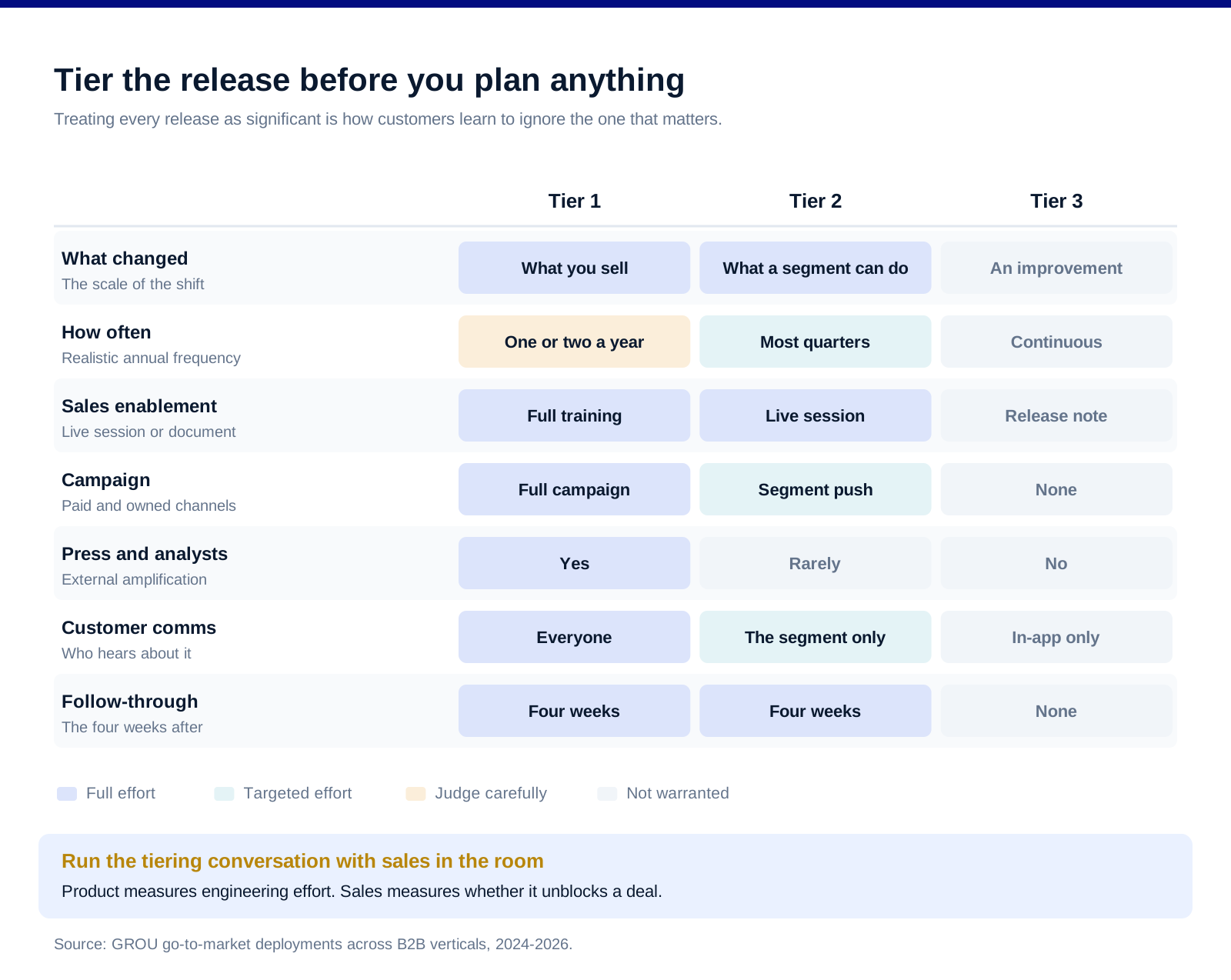
The first decision is the one most teams skip, and skipping it costs more than any tactical mistake later.
Tier 1 changes what the company is. A new product line, a category move, something that changes the answer to "what do you sell". These earn a full campaign, analyst and press outreach, a launch event, sales training and a repositioned website. You get one or two a year at most, and treating a feature as tier 1 devalues the next real one.
Tier 2 changes what a segment can do. A significant capability that matters intensely to some customers and not at all to others. These earn enablement, a targeted campaign to the segment that cares, and customer communications. Most of what a product team ships that deserves attention is tier 2.
Tier 3 is a release note and an in-app message. Improvements, fixes, small additions. Announcing these with the same volume as tier 2 is how you teach customers to ignore your announcements.
The tiering conversation has to include sales. Product's view of significance and sales' view diverge constantly, because product measures engineering effort and sales measures whether it unblocks a deal. A small feature that removes a recurring objection is worth more launch effort than a large one nobody asked about.
The sequence, working backwards from the date
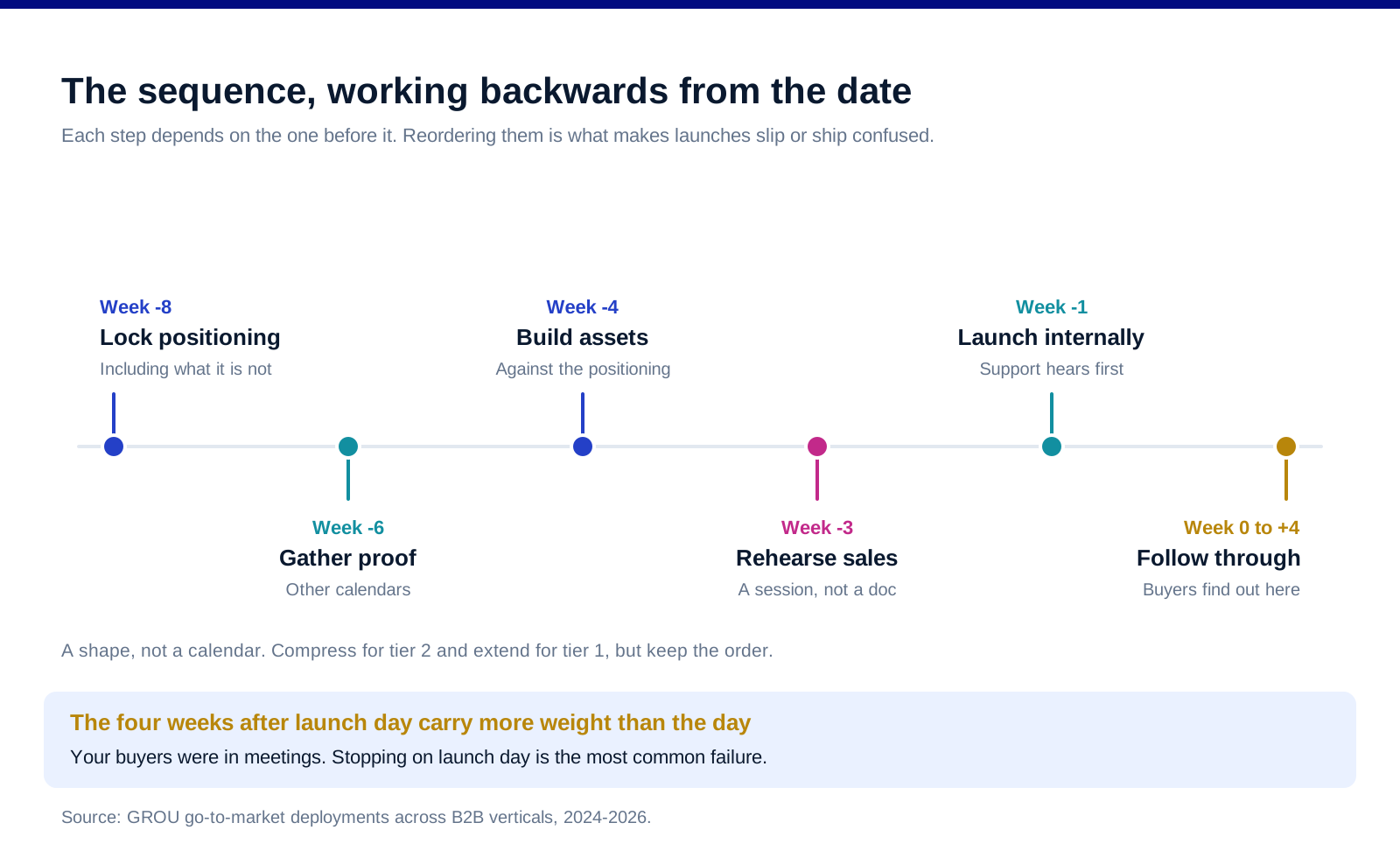
The timeline above is a shape rather than a calendar. Compress it for tier 2, extend it for tier 1, but keep the order, because each step depends on the one before it in a way that does not survive reordering.
Eight weeks out, lock the positioning. Who it is for, what it replaces, why now, and what it is not. That last one saves more deals than the first three. If positioning is still moving at four weeks out, the launch will slip or ship confused, and shipping confused is worse.
Six weeks out, write the proof. Customer quotes, a design partner story, before-and-after numbers if you have them. Proof takes longer to gather than anyone plans for because it depends on other people's calendars. Starting this at two weeks out is why launches ship with a feature list instead of evidence.
Four weeks out, build the assets against the positioning. Landing page, demo, one-pager, the pricing decision if there is one. Building assets before positioning is locked produces a rewrite, which is the most common source of launch slippage.
Three weeks out, enable sales and support. Not a deck sent by email. A live session, a battlecard covering objections and competitive comparisons, and a rehearsed demo. The test is whether a rep can explain the thing without opening anything.
One week out, launch internally. Everyone in the company should hear it before any customer does. Support especially, because they will field the first questions and nothing damages a launch faster than support not knowing what shipped.
Launch day, then the four weeks that matter more. The follow-through campaign is where B2B launches are won or lost, because your buyers were busy on launch day. Sequenced emails to the segment, a webinar, sales outreach to accounts where this removes a known objection, and a customer case study once the first adopters have results.
Who owns what
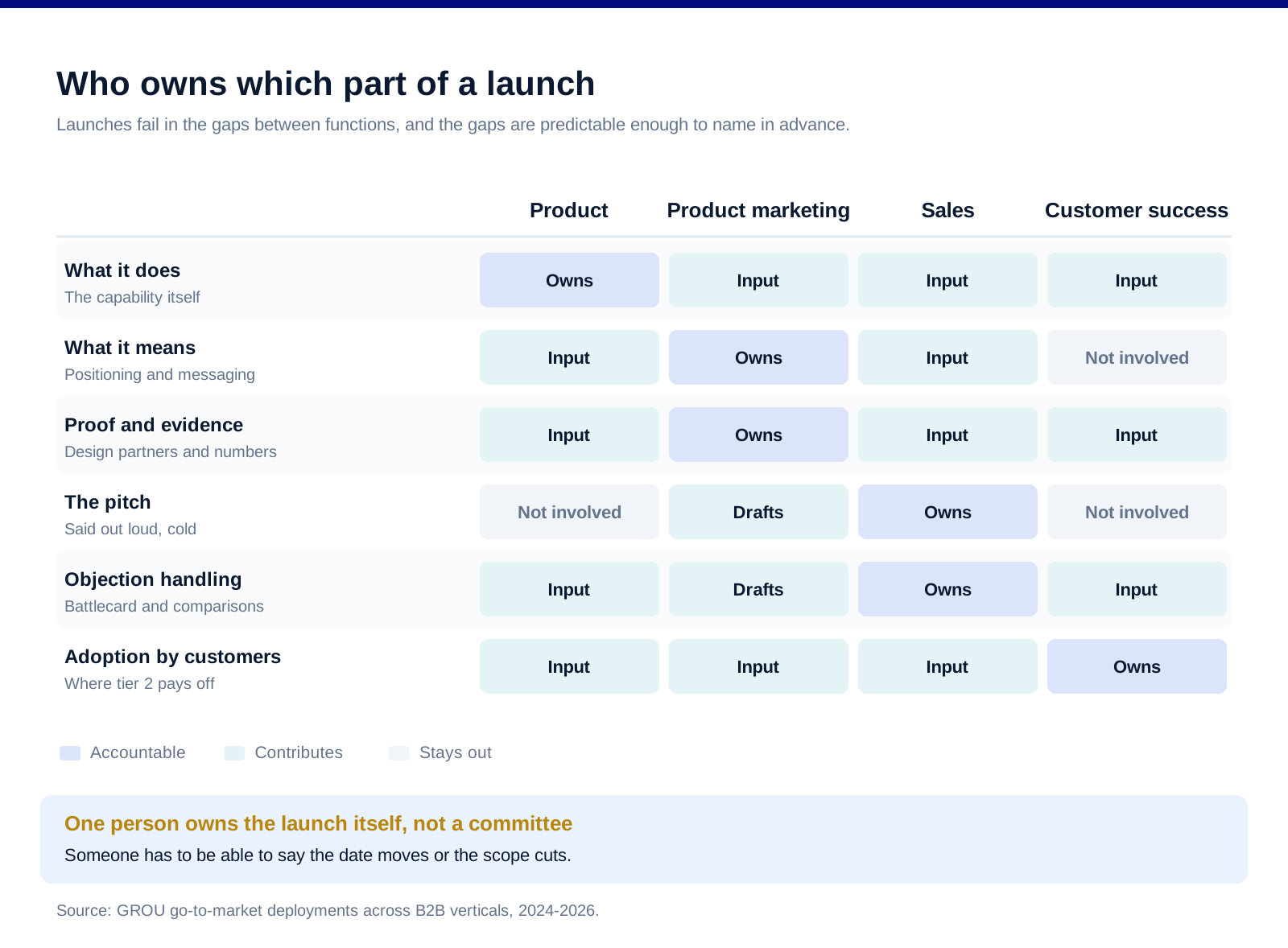
Launches fail in the gaps between functions, not inside them, and the gaps are predictable enough to name in advance.
Product owns what it does. Product marketing owns what it means. When product writes the external messaging you get a feature list. When marketing writes it without product you get claims the thing does not support. Both failure modes are visible in the first sales call.
Sales owns the conversation, and that requires rehearsal. Enablement is not a document handed over. It is a session where reps practise the pitch and someone objects, then a battlecard written from what came up in that session rather than from what marketing imagined would come up.
Customer success owns adoption, which is where tier 2 launches actually pay off. Existing customers adopting the new capability is usually worth more than new logos won by it, and it is the part with no owner in most launch plans. Someone has to decide which accounts get proactively walked through it.
Someone has to own the launch itself. Not a committee. One person who can say the date moves or the scope cuts. Launches without that person ship whatever happens to be ready.
Where launches actually go wrong
Launching to everyone. A tier 2 launch broadcast to the full customer base gets ignored by the 80% it does not apply to and trains them to ignore the next one. Segment first, always.
No proof. A B2B buyer reading a capability claim with no evidence attached discounts it entirely. One design partner with a real before-and-after outperforms a page of feature descriptions.
Enablement as a document. If reps have not said the words out loud before launch day, they will not say them on launch day.
Stopping at launch day. The single most common failure, and the cheapest to fix. Your buyers were in meetings. The four weeks after are where they find out.
Measuring reach. Impressions, opens and page views tell you the announcement was delivered, not that the launch worked. They are comfortable numbers, which is exactly why they get reported.
Positioning that never survived contact with sales. If the message was not tested against a real objection before launch, launch day is when you find out it does not hold.
The thirty-day read
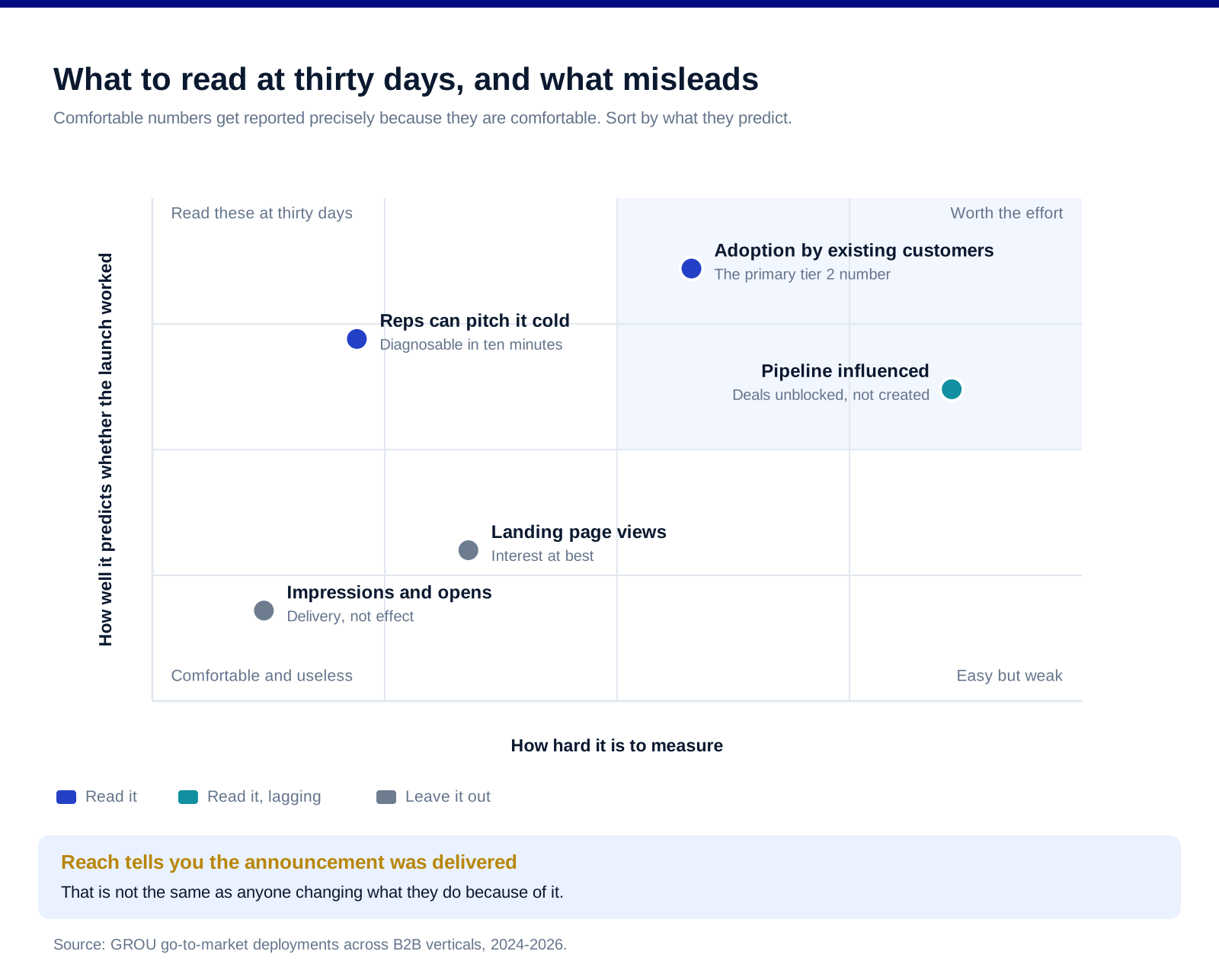
Judge a launch at thirty days on three things and ignore the rest until ninety.
Pipeline influenced, not pipeline sourced. New capabilities rarely create deals from nothing in a month. They unblock deals that already existed and shorten ones already moving. Look at opportunities where the launch was mentioned in a call, and at whether the stated objection stopped appearing.
Adoption among existing customers. For tier 2 this is the primary number. What share of the accounts it applies to have used it, and did the ones customer success reached proactively adopt at a visibly higher rate than the ones who only got the email.
Whether sales can explain it. Ask three reps to pitch it cold with no deck. If they cannot, nothing downstream will work, and this is diagnosable in ten minutes rather than in a quarter of disappointing numbers.
Anything at ninety days is a different question: retention effect, competitive win rate on deals where it comes up, and whether it changed which segment you win in. Those are real and they are not launch metrics, they are product metrics.
FAQ
How long before launch should you start planning a B2B product launch?
Eight weeks for a tier 1 launch, four to six for tier 2. The binding constraint is not asset production, it is gathering proof and getting sales genuinely enabled, both of which depend on other people's calendars. Teams that start at two weeks ship a feature list rather than a launch.
What makes a B2B launch different from a B2C launch?
The buyer is a committee, the sales cycle outlasts the announcement, and adoption by existing customers usually matters more than acquisition. That means enablement and customer success are core launch functions rather than afterthoughts, and it means the four weeks after launch day carry more weight than the day itself.
Should every product release get a launch?
No, and treating every release as a launch is the fastest way to make customers ignore the important ones. Tier releases into three levels: a full campaign, a targeted enablement and segment push, or a release note. Most releases are the third.
What should a sales enablement session cover before launch?
The positioning in one sentence, the specific buyer problem it solves, a rehearsed demo, the three most likely objections with answers, how it compares to the competitor reps hear most, and what it does not do. Run it live and let people push back, then write the battlecard from what actually came up.
How do you measure a B2B product launch?
At thirty days: pipeline influenced, adoption among the customers it applies to, and whether reps can explain it without a deck. At ninety: retention effect and competitive win rate where it comes up. Reach metrics tell you the announcement was delivered, which is not the same as it having worked.
What is the most common B2B launch mistake?
Stopping on launch day. The announcement goes out, the team moves on, and the buyers who were in meetings that week never hear about it again. The four-week follow-through campaign costs a fraction of the build and is the difference between a launch and a press release.
Bottom line
Tier the release before you plan it, because treating everything as significant makes nothing significant. Work backwards from the date so positioning locks before assets get built and sales rehearses before customers hear anything. Name one owner per workstream and one owner for the launch itself. Then keep going for four weeks after the date, because that is when your buyers actually find out. Measure influenced pipeline, adoption and whether a rep can explain it cold, and leave the impression counts out of the review entirely.
Want the launch turned into pipeline rather than an announcement? Book a call with GROU. We run go-to-market and demand generation inside B2B revenue engines across verticals.
We are GROU, a B2B pipeline agency that runs lead generation, outbound, and LinkedIn content for clients across manufacturing, fintech, iGaming, software, and professional services. The tiering model, sequence and ownership split reflect our go-to-market deployments between 2024 and 2026, anonymized to protect client confidentiality.
Most B2B launches fail in a way nobody records. The feature ships, the announcement goes out, a handful of customers notice, and six months later the company is still explaining what it does to prospects who should already know. Nothing went visibly wrong. The launch simply had no theory of who was supposed to change their behaviour and why.
This playbook covers how to size a launch honestly, the sequence that gets sales ready before customers hear anything, who owns which workstream, and how to tell within thirty days whether it worked.
TL;DR
Not every release deserves a launch, and treating them all the same is why launch fatigue sets in and why the one that mattered got ignored. Tier every release before you plan anything: a tier 1 launch changes the category conversation and earns a full campaign, tier 2 changes what a segment can do and earns enablement plus a targeted push, tier 3 is a release note. The sequence matters more than the assets, and it runs backwards from the date: positioning locked at eight weeks out, sales enablement complete at three weeks, internal launch at one week, external launch at zero, and the follow-through campaign in the four weeks after, which is the phase almost everyone skips. Ownership is the other failure point: product owns what it does, product marketing owns what it means, sales owns the conversation and customer success owns adoption, and a launch with no named owner per workstream will lose one of them silently. Measure at thirty days on pipeline influenced, adoption among existing customers, and whether sales can explain it without the deck. Reach is not a launch metric. The launch is the beginning of the go-to-market motion, not the end of the build, which is precisely backwards from how most roadmaps are written. Our go-to-market strategy guide covers the layer above this.
Tier the release before you plan anything
The first decision is the one most teams skip, and skipping it costs more than any tactical mistake later.
Tier 1 changes what the company is. A new product line, a category move, something that changes the answer to "what do you sell". These earn a full campaign, analyst and press outreach, a launch event, sales training and a repositioned website. You get one or two a year at most, and treating a feature as tier 1 devalues the next real one.
Tier 2 changes what a segment can do. A significant capability that matters intensely to some customers and not at all to others. These earn enablement, a targeted campaign to the segment that cares, and customer communications. Most of what a product team ships that deserves attention is tier 2.
Tier 3 is a release note and an in-app message. Improvements, fixes, small additions. Announcing these with the same volume as tier 2 is how you teach customers to ignore your announcements.
The tiering conversation has to include sales. Product's view of significance and sales' view diverge constantly, because product measures engineering effort and sales measures whether it unblocks a deal. A small feature that removes a recurring objection is worth more launch effort than a large one nobody asked about.
The sequence, working backwards from the date
The timeline above is a shape rather than a calendar. Compress it for tier 2, extend it for tier 1, but keep the order, because each step depends on the one before it in a way that does not survive reordering.
Eight weeks out, lock the positioning. Who it is for, what it replaces, why now, and what it is not. That last one saves more deals than the first three. If positioning is still moving at four weeks out, the launch will slip or ship confused, and shipping confused is worse.
Six weeks out, write the proof. Customer quotes, a design partner story, before-and-after numbers if you have them. Proof takes longer to gather than anyone plans for because it depends on other people's calendars. Starting this at two weeks out is why launches ship with a feature list instead of evidence.
Four weeks out, build the assets against the positioning. Landing page, demo, one-pager, the pricing decision if there is one. Building assets before positioning is locked produces a rewrite, which is the most common source of launch slippage.
Three weeks out, enable sales and support. Not a deck sent by email. A live session, a battlecard covering objections and competitive comparisons, and a rehearsed demo. The test is whether a rep can explain the thing without opening anything.
One week out, launch internally. Everyone in the company should hear it before any customer does. Support especially, because they will field the first questions and nothing damages a launch faster than support not knowing what shipped.
Launch day, then the four weeks that matter more. The follow-through campaign is where B2B launches are won or lost, because your buyers were busy on launch day. Sequenced emails to the segment, a webinar, sales outreach to accounts where this removes a known objection, and a customer case study once the first adopters have results.
Who owns what
Launches fail in the gaps between functions, not inside them, and the gaps are predictable enough to name in advance.
Product owns what it does. Product marketing owns what it means. When product writes the external messaging you get a feature list. When marketing writes it without product you get claims the thing does not support. Both failure modes are visible in the first sales call.
Sales owns the conversation, and that requires rehearsal. Enablement is not a document handed over. It is a session where reps practise the pitch and someone objects, then a battlecard written from what came up in that session rather than from what marketing imagined would come up.
Customer success owns adoption, which is where tier 2 launches actually pay off. Existing customers adopting the new capability is usually worth more than new logos won by it, and it is the part with no owner in most launch plans. Someone has to decide which accounts get proactively walked through it.
Someone has to own the launch itself. Not a committee. One person who can say the date moves or the scope cuts. Launches without that person ship whatever happens to be ready.
Where launches actually go wrong
Launching to everyone. A tier 2 launch broadcast to the full customer base gets ignored by the 80% it does not apply to and trains them to ignore the next one. Segment first, always.
No proof. A B2B buyer reading a capability claim with no evidence attached discounts it entirely. One design partner with a real before-and-after outperforms a page of feature descriptions.
Enablement as a document. If reps have not said the words out loud before launch day, they will not say them on launch day.
Stopping at launch day. The single most common failure, and the cheapest to fix. Your buyers were in meetings. The four weeks after are where they find out.
Measuring reach. Impressions, opens and page views tell you the announcement was delivered, not that the launch worked. They are comfortable numbers, which is exactly why they get reported.
Positioning that never survived contact with sales. If the message was not tested against a real objection before launch, launch day is when you find out it does not hold.
The thirty-day read
Judge a launch at thirty days on three things and ignore the rest until ninety.
Pipeline influenced, not pipeline sourced. New capabilities rarely create deals from nothing in a month. They unblock deals that already existed and shorten ones already moving. Look at opportunities where the launch was mentioned in a call, and at whether the stated objection stopped appearing.
Adoption among existing customers. For tier 2 this is the primary number. What share of the accounts it applies to have used it, and did the ones customer success reached proactively adopt at a visibly higher rate than the ones who only got the email.
Whether sales can explain it. Ask three reps to pitch it cold with no deck. If they cannot, nothing downstream will work, and this is diagnosable in ten minutes rather than in a quarter of disappointing numbers.
Anything at ninety days is a different question: retention effect, competitive win rate on deals where it comes up, and whether it changed which segment you win in. Those are real and they are not launch metrics, they are product metrics.
FAQ
How long before launch should you start planning a B2B product launch?
Eight weeks for a tier 1 launch, four to six for tier 2. The binding constraint is not asset production, it is gathering proof and getting sales genuinely enabled, both of which depend on other people's calendars. Teams that start at two weeks ship a feature list rather than a launch.
What makes a B2B launch different from a B2C launch?
The buyer is a committee, the sales cycle outlasts the announcement, and adoption by existing customers usually matters more than acquisition. That means enablement and customer success are core launch functions rather than afterthoughts, and it means the four weeks after launch day carry more weight than the day itself.
Should every product release get a launch?
No, and treating every release as a launch is the fastest way to make customers ignore the important ones. Tier releases into three levels: a full campaign, a targeted enablement and segment push, or a release note. Most releases are the third.
What should a sales enablement session cover before launch?
The positioning in one sentence, the specific buyer problem it solves, a rehearsed demo, the three most likely objections with answers, how it compares to the competitor reps hear most, and what it does not do. Run it live and let people push back, then write the battlecard from what actually came up.
How do you measure a B2B product launch?
At thirty days: pipeline influenced, adoption among the customers it applies to, and whether reps can explain it without a deck. At ninety: retention effect and competitive win rate where it comes up. Reach metrics tell you the announcement was delivered, which is not the same as it having worked.
What is the most common B2B launch mistake?
Stopping on launch day. The announcement goes out, the team moves on, and the buyers who were in meetings that week never hear about it again. The four-week follow-through campaign costs a fraction of the build and is the difference between a launch and a press release.
Bottom line
Tier the release before you plan it, because treating everything as significant makes nothing significant. Work backwards from the date so positioning locks before assets get built and sales rehearses before customers hear anything. Name one owner per workstream and one owner for the launch itself. Then keep going for four weeks after the date, because that is when your buyers actually find out. Measure influenced pipeline, adoption and whether a rep can explain it cold, and leave the impression counts out of the review entirely.
Want the launch turned into pipeline rather than an announcement? Book a call with GROU. We run go-to-market and demand generation inside B2B revenue engines across verticals.
We are GROU, a B2B pipeline agency that runs lead generation, outbound, and LinkedIn content for clients across manufacturing, fintech, iGaming, software, and professional services. The tiering model, sequence and ownership split reflect our go-to-market deployments between 2024 and 2026, anonymized to protect client confidentiality.
Most B2B launches fail in a way nobody records. The feature ships, the announcement goes out, a handful of customers notice, and six months later the company is still explaining what it does to prospects who should already know. Nothing went visibly wrong. The launch simply had no theory of who was supposed to change their behaviour and why.
This playbook covers how to size a launch honestly, the sequence that gets sales ready before customers hear anything, who owns which workstream, and how to tell within thirty days whether it worked.
TL;DR
Not every release deserves a launch, and treating them all the same is why launch fatigue sets in and why the one that mattered got ignored. Tier every release before you plan anything: a tier 1 launch changes the category conversation and earns a full campaign, tier 2 changes what a segment can do and earns enablement plus a targeted push, tier 3 is a release note. The sequence matters more than the assets, and it runs backwards from the date: positioning locked at eight weeks out, sales enablement complete at three weeks, internal launch at one week, external launch at zero, and the follow-through campaign in the four weeks after, which is the phase almost everyone skips. Ownership is the other failure point: product owns what it does, product marketing owns what it means, sales owns the conversation and customer success owns adoption, and a launch with no named owner per workstream will lose one of them silently. Measure at thirty days on pipeline influenced, adoption among existing customers, and whether sales can explain it without the deck. Reach is not a launch metric. The launch is the beginning of the go-to-market motion, not the end of the build, which is precisely backwards from how most roadmaps are written. Our go-to-market strategy guide covers the layer above this.
Tier the release before you plan anything
The first decision is the one most teams skip, and skipping it costs more than any tactical mistake later.
Tier 1 changes what the company is. A new product line, a category move, something that changes the answer to "what do you sell". These earn a full campaign, analyst and press outreach, a launch event, sales training and a repositioned website. You get one or two a year at most, and treating a feature as tier 1 devalues the next real one.
Tier 2 changes what a segment can do. A significant capability that matters intensely to some customers and not at all to others. These earn enablement, a targeted campaign to the segment that cares, and customer communications. Most of what a product team ships that deserves attention is tier 2.
Tier 3 is a release note and an in-app message. Improvements, fixes, small additions. Announcing these with the same volume as tier 2 is how you teach customers to ignore your announcements.
The tiering conversation has to include sales. Product's view of significance and sales' view diverge constantly, because product measures engineering effort and sales measures whether it unblocks a deal. A small feature that removes a recurring objection is worth more launch effort than a large one nobody asked about.
The sequence, working backwards from the date
The timeline above is a shape rather than a calendar. Compress it for tier 2, extend it for tier 1, but keep the order, because each step depends on the one before it in a way that does not survive reordering.
Eight weeks out, lock the positioning. Who it is for, what it replaces, why now, and what it is not. That last one saves more deals than the first three. If positioning is still moving at four weeks out, the launch will slip or ship confused, and shipping confused is worse.
Six weeks out, write the proof. Customer quotes, a design partner story, before-and-after numbers if you have them. Proof takes longer to gather than anyone plans for because it depends on other people's calendars. Starting this at two weeks out is why launches ship with a feature list instead of evidence.
Four weeks out, build the assets against the positioning. Landing page, demo, one-pager, the pricing decision if there is one. Building assets before positioning is locked produces a rewrite, which is the most common source of launch slippage.
Three weeks out, enable sales and support. Not a deck sent by email. A live session, a battlecard covering objections and competitive comparisons, and a rehearsed demo. The test is whether a rep can explain the thing without opening anything.
One week out, launch internally. Everyone in the company should hear it before any customer does. Support especially, because they will field the first questions and nothing damages a launch faster than support not knowing what shipped.
Launch day, then the four weeks that matter more. The follow-through campaign is where B2B launches are won or lost, because your buyers were busy on launch day. Sequenced emails to the segment, a webinar, sales outreach to accounts where this removes a known objection, and a customer case study once the first adopters have results.
Who owns what
Launches fail in the gaps between functions, not inside them, and the gaps are predictable enough to name in advance.
Product owns what it does. Product marketing owns what it means. When product writes the external messaging you get a feature list. When marketing writes it without product you get claims the thing does not support. Both failure modes are visible in the first sales call.
Sales owns the conversation, and that requires rehearsal. Enablement is not a document handed over. It is a session where reps practise the pitch and someone objects, then a battlecard written from what came up in that session rather than from what marketing imagined would come up.
Customer success owns adoption, which is where tier 2 launches actually pay off. Existing customers adopting the new capability is usually worth more than new logos won by it, and it is the part with no owner in most launch plans. Someone has to decide which accounts get proactively walked through it.
Someone has to own the launch itself. Not a committee. One person who can say the date moves or the scope cuts. Launches without that person ship whatever happens to be ready.
Where launches actually go wrong
Launching to everyone. A tier 2 launch broadcast to the full customer base gets ignored by the 80% it does not apply to and trains them to ignore the next one. Segment first, always.
No proof. A B2B buyer reading a capability claim with no evidence attached discounts it entirely. One design partner with a real before-and-after outperforms a page of feature descriptions.
Enablement as a document. If reps have not said the words out loud before launch day, they will not say them on launch day.
Stopping at launch day. The single most common failure, and the cheapest to fix. Your buyers were in meetings. The four weeks after are where they find out.
Measuring reach. Impressions, opens and page views tell you the announcement was delivered, not that the launch worked. They are comfortable numbers, which is exactly why they get reported.
Positioning that never survived contact with sales. If the message was not tested against a real objection before launch, launch day is when you find out it does not hold.
The thirty-day read
Judge a launch at thirty days on three things and ignore the rest until ninety.
Pipeline influenced, not pipeline sourced. New capabilities rarely create deals from nothing in a month. They unblock deals that already existed and shorten ones already moving. Look at opportunities where the launch was mentioned in a call, and at whether the stated objection stopped appearing.
Adoption among existing customers. For tier 2 this is the primary number. What share of the accounts it applies to have used it, and did the ones customer success reached proactively adopt at a visibly higher rate than the ones who only got the email.
Whether sales can explain it. Ask three reps to pitch it cold with no deck. If they cannot, nothing downstream will work, and this is diagnosable in ten minutes rather than in a quarter of disappointing numbers.
Anything at ninety days is a different question: retention effect, competitive win rate on deals where it comes up, and whether it changed which segment you win in. Those are real and they are not launch metrics, they are product metrics.
FAQ
How long before launch should you start planning a B2B product launch?
Eight weeks for a tier 1 launch, four to six for tier 2. The binding constraint is not asset production, it is gathering proof and getting sales genuinely enabled, both of which depend on other people's calendars. Teams that start at two weeks ship a feature list rather than a launch.
What makes a B2B launch different from a B2C launch?
The buyer is a committee, the sales cycle outlasts the announcement, and adoption by existing customers usually matters more than acquisition. That means enablement and customer success are core launch functions rather than afterthoughts, and it means the four weeks after launch day carry more weight than the day itself.
Should every product release get a launch?
No, and treating every release as a launch is the fastest way to make customers ignore the important ones. Tier releases into three levels: a full campaign, a targeted enablement and segment push, or a release note. Most releases are the third.
What should a sales enablement session cover before launch?
The positioning in one sentence, the specific buyer problem it solves, a rehearsed demo, the three most likely objections with answers, how it compares to the competitor reps hear most, and what it does not do. Run it live and let people push back, then write the battlecard from what actually came up.
How do you measure a B2B product launch?
At thirty days: pipeline influenced, adoption among the customers it applies to, and whether reps can explain it without a deck. At ninety: retention effect and competitive win rate where it comes up. Reach metrics tell you the announcement was delivered, which is not the same as it having worked.
What is the most common B2B launch mistake?
Stopping on launch day. The announcement goes out, the team moves on, and the buyers who were in meetings that week never hear about it again. The four-week follow-through campaign costs a fraction of the build and is the difference between a launch and a press release.
Bottom line
Tier the release before you plan it, because treating everything as significant makes nothing significant. Work backwards from the date so positioning locks before assets get built and sales rehearses before customers hear anything. Name one owner per workstream and one owner for the launch itself. Then keep going for four weeks after the date, because that is when your buyers actually find out. Measure influenced pipeline, adoption and whether a rep can explain it cold, and leave the impression counts out of the review entirely.
Want the launch turned into pipeline rather than an announcement? Book a call with GROU. We run go-to-market and demand generation inside B2B revenue engines across verticals.
We are GROU, a B2B pipeline agency that runs lead generation, outbound, and LinkedIn content for clients across manufacturing, fintech, iGaming, software, and professional services. The tiering model, sequence and ownership split reflect our go-to-market deployments between 2024 and 2026, anonymized to protect client confidentiality.

Pipeline OS Newsletter
Build qualified pipeline
Get weekly tactics to generate demand, improve lead quality, and book more meetings.






Trusted by industry leaders
Trusted by industry leaders
Trusted by industry leaders
Ready to build qualified pipeline?
Ready to build qualified pipeline?
Ready to build qualified pipeline?
Book a call to see if we're the right fit, or take the 2-minute quiz to get a clear starting point.
Book a call to see if we're the right fit, or take the 2-minute quiz to get a clear starting point.
Book a call to see if we're the right fit, or take the 2-minute quiz to get a clear starting point.
" height="30.21639343089746px" id="hfGbXmQR2" width="30.216393430897455px"/></svg>)
Copyright © 2026 – All Right Reserved
Copyright © 2026 – All Right Reserved
Copyright © 2026 – All Right Reserved