%22%3E%3C/path%3E%3Cpath d=%22M 63.072 7.554 C 62.258 8.022 61.577 8.689 61.092 9.493 L 61.092 7.076 L 57.158 7.076 L 57.158 22.64 L 61.089 22.64 L 61.089 14.888 C 61.089 13.446 61.403 12.434 62.03 11.853 C 62.818 11.218 63.818 10.907 64.826 10.982 L 65.868 10.982 L 65.868 6.851 C 64.891 6.834 63.926 7.076 63.073 7.554 Z%22 fill=%22rgb(17,17,17)%22%3E%3C/path%3E%3Cpath d=%22M 78.916 7.82 C 76.363 6.49 73.321 6.49 70.768 7.82 C 69.562 8.473 68.564 9.451 67.888 10.644 C 67.167 11.931 66.803 13.387 66.834 14.862 C 66.804 16.332 67.157 17.785 67.86 19.077 C 68.515 20.267 69.494 21.246 70.684 21.901 C 71.924 22.576 73.318 22.92 74.73 22.898 C 76.164 22.918 77.58 22.575 78.846 21.901 C 80.062 21.247 81.073 20.27 81.768 19.077 C 82.506 17.797 82.88 16.339 82.85 14.862 C 82.88 13.389 82.517 11.934 81.797 10.647 C 81.12 9.455 80.122 8.477 78.917 7.824 M 78.803 14.862 C 78.829 15.739 78.636 16.608 78.241 17.391 C 77.903 18.046 77.38 18.588 76.738 18.95 C 76.124 19.293 75.432 19.472 74.729 19.47 C 73.668 19.497 72.648 19.061 71.934 18.276 C 71.139 17.323 70.741 16.1 70.823 14.862 C 70.741 13.62 71.149 12.395 71.959 11.45 C 72.687 10.667 73.715 10.233 74.783 10.256 C 75.859 10.236 76.894 10.67 77.635 11.45 C 78.464 12.387 78.884 13.616 78.801 14.864%22 fill=%22rgb(17,17,17)%22%3E%3C/path%3E%3Cpath d=%22M 95.906 7.076 L 95.906 15.646 C 95.975 16.68 95.643 17.701 94.979 18.498 C 94.311 19.184 93.379 19.547 92.422 19.495 C 91.475 19.544 90.553 19.18 89.894 18.498 C 89.23 17.701 88.898 16.68 88.967 15.646 L 88.967 7.076 L 85.033 7.076 L 85.033 16.207 C 85 17.449 85.275 18.68 85.834 19.79 C 86.327 20.75 87.095 21.542 88.039 22.065 C 89.033 22.594 90.145 22.861 91.271 22.838 C 92.188 22.847 93.095 22.65 93.926 22.263 C 94.708 21.905 95.388 21.36 95.906 20.675 L 95.906 22.645 L 99.865 22.645 L 99.865 7.076 Z%22 fill=%22rgb(17,17,17)%22%3E%3C/path%3E%3Cpath d=%22M 4.513 15.626 C 4.511 10.815 7.606 6.549 12.181 5.059 C 16.756 3.57 21.77 5.195 24.601 9.086 L 27.816 5.87 C 24.074 1.186 17.981 -0.943 12.137 0.393 C 6.292 1.728 1.728 6.292 0.393 12.137 C -0.943 17.981 1.186 24.074 5.87 27.816 L 9.085 24.601 C 6.214 22.512 4.515 19.177 4.513 15.626%22 fill=%22rgb(32,62,235)%22%3E%3C/path%3E%3Cpath d=%22M 17.114 14.343 L 13.354 18.01 L 13.354 18.026 L 21.071 18.026 L 11.412 27.609 L 17.389 27.609 L 23.999 21.081 L 23.999 28.316 L 24.005 28.316 L 27.967 24.393 L 27.967 14.343 Z%22 fill=%22rgb(32,62,235)%22%3E%3C/path%3E%3C/g%3E%3C/svg%3E) ×
 ××
›
›
›
›
7 best advertising agencies in NYC for B2B in 2026
7 best advertising agencies in NYC for B2B in 2026
7 best advertising agencies in NYC for B2B in 2026
7 best advertising agencies in NYC for B2B in 2026
7 best advertising agencies in NYC for B2B in 2026
7 best advertising agencies in NYC for B2B in 2026

Author
Aljaz Peklaj

Most NYC agency shortlists start with the wrong filter. You've got seven agencies, sharp reels, and no clear answer on what a qualified meeting costs. B2B budgets disappear in that gap.
My verdict up front: Ironpaper is the strongest fit for complex B2B offers with long sales cycles; Divine Advertising is the better fit for small teams seeking senior involvement in paid media. Every entry below gets the same treatment: a buy-or-skip call tied to what the program delivers to pipeline.
Shortlist on three tests: category proof in your sector, reporting that shows cost per qualified lead, and a straight answer about a churned client.
Compare seven agencies: each gets a verdict tied to pipeline needs.
Use cost per qualified lead: a retainer alone won't tell you what the program delivers.
Connect the system: Grou's B2B pipeline work runs on the same principle, qualified demand over raw lead volume.
Table of Contents
1. Ironpaper
For B2B companies with a complex offer and a sales cycle that needs more than a paid-media vendor, Ironpaper is my #1 pick. The agency focuses on B2B demand generation and connects positioning, content, digital experiences, sales enablement, and revenue systems. That scope matters when marketing and sales have to agree on what counts as qualified demand instead of handing off a pile of form fills.
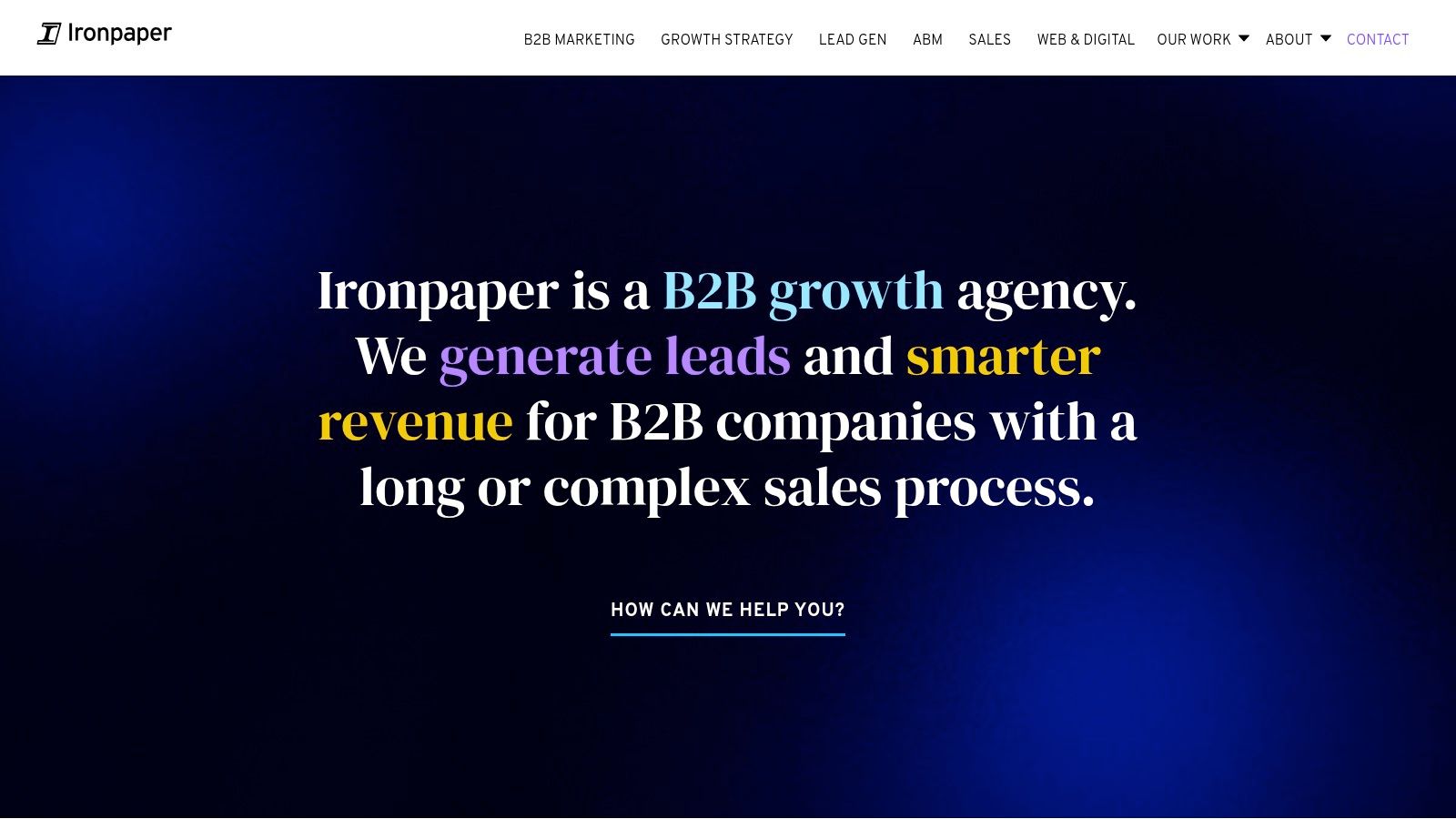
Its stated capabilities include ABM, messaging, conversion-focused websites, and marketing-to-sales alignment, a mix that suits SaaS, technology, manufacturing, and professional services teams working the path from target account to sales conversation. Review its B2B marketing agency profile while you check whether the proposed scope maps to your pipeline motion.
The trade-off is specialization. Ironpaper is a poor fit for a broad consumer campaign built on mass reach and entertainment-led creative. Pricing is quote-based, so request a written scope, price, and timeline before treating any budget or duration as settled. I would also ask for a sample outcome report and one example of a client relationship that ended, because a demand-gen agency should be able to discuss churn directly.
Buy if: you need strategy and execution tied to qualified B2B demand, and can scope the work around a longer sales cycle. Skip if: your primary requirement is consumer brand advertising or a narrow, single-channel campaign.
2. Divine Advertising
For a lean marketing team that wants direct access to senior practitioners on paid media, Divine Advertising is my second pick. The independent New York agency offers paid campaigns across Google, Meta, LinkedIn, and programmatic, alongside search, web development, creative, conversion optimization, analytics, and automation.
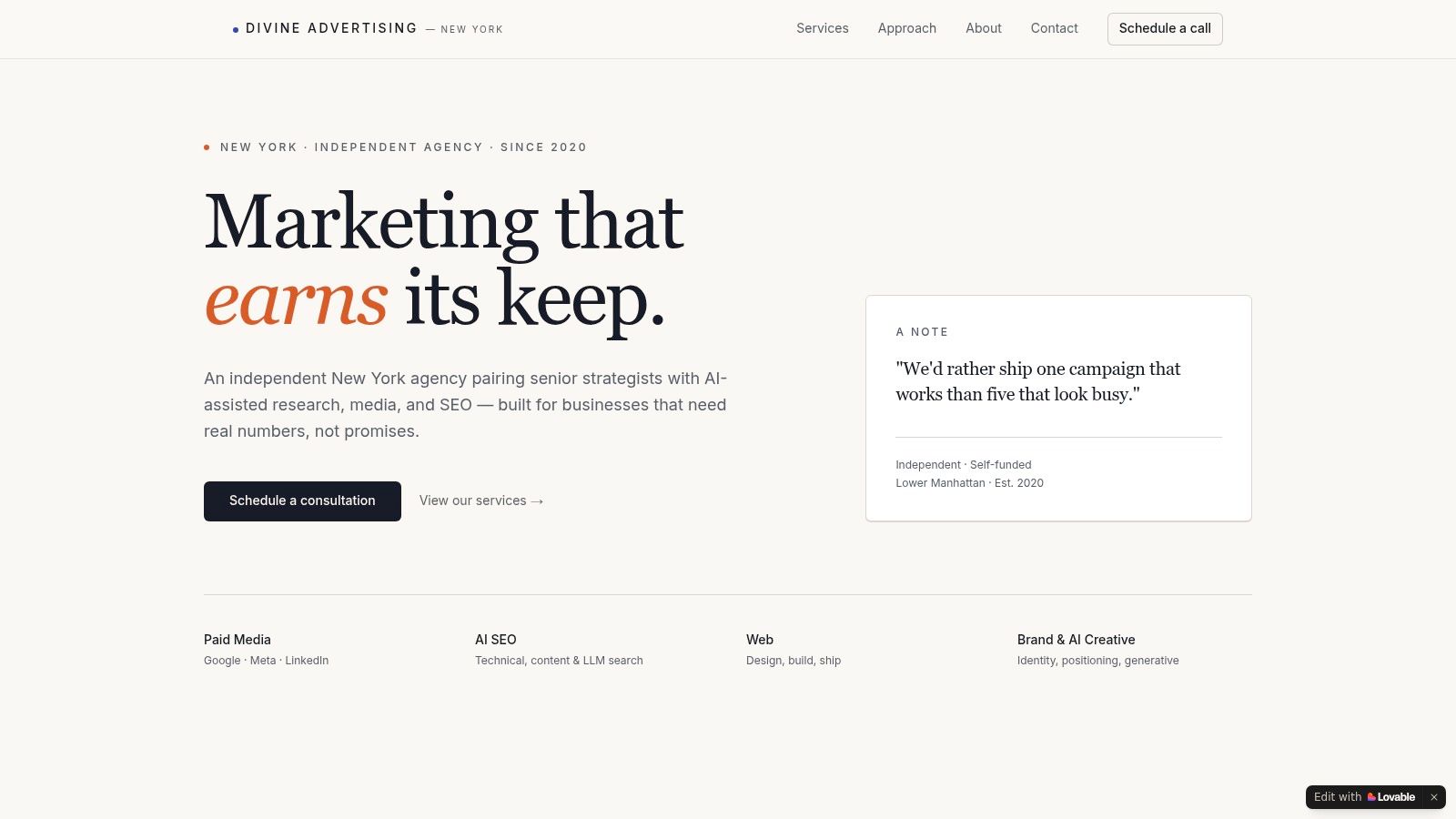
Its service mix is useful when ads, landing pages, and tracking need to work as one acquisition path. Divine says the people involved in pitching stay hands-on, and it describes its media buying as having no media-spend markups. Those are useful commitments to pin down in the proposal and contract. Its lead generation agency guide offers a useful frame for deciding whether the scope reaches beyond clicks into sales-qualified demand.
Capacity is the key trade-off. A deliberately small roster may be a poor fit for a large multinational program with many markets and parallel workstreams. Public pricing and detailed client case-study metrics weren't available in the reviewed material, so ask for a sample report and a named staffing plan before signing.
Buy if: you want senior involvement across paid acquisition and measurement. Skip if: your program needs a large distributed team or you can't proceed without public pricing and detailed case metrics.
3. R/GA
R/GA fits a different brief: the advertising needs to connect to a digital product, platform, or customer experience. Its work spans brand design, product and experience design, integrated campaigns, content, CRM, personalization, and lifecycle marketing. That range helps when a campaign promise has to carry through the website, onboarding, and customer communications.
The advantage is connecting creative decisions to the digital experience buyers encounter. Its capabilities include AI, commerce, digital platforms, and lifecycle work, alongside campaign development. For a B2B marketer, the practical question is whether the proposal maps those capabilities to a defined buying journey or sells a broad transformation when the immediate need is demand generation. Frame the scoping conversation the way you would evaluate a data-driven digital marketing agency: reporting cadence, measurement requirements, and who owns each deliverable.
Pricing is quote-based, and the breadth may be more than a single campaign or channel needs. Push for category proof in your vertical, and ask whether the team will discuss a churned account. Get a scoped team, concrete deliverables, and the link between the experience work and your pipeline measures in writing before you sign.
Buy if: the brief combines brand, technology, and customer experience. Skip if: you need a focused paid-media or outbound engagement with a short list of deliverables.
4. Giant Spoon
Experiential marketing is the brief here. Giant Spoon builds public-facing campaigns around live and cultural moments, with media behind them. Its capabilities cover strategy, creative, production, social, content, experiential work, media planning and buying, performance media, measurement, and reporting.
That combination suits a launch meant to be seen rather than a program meant to fill a sales calendar. The media arm can connect the activation to social, search, video, and out-of-home, and the public portfolio plus New York office give buyers material to review before a pitch. What a reel of high-visibility work can't prove is pipeline. It says nothing about lead qualification, sales follow-up, or CRM attribution, so ask for category proof in your sector and ask the team to walk through a churned account and what changed afterward.
Giant Spoon now operates within Wpromote, which makes the operating model and assigned team worth pinning down during procurement. Pricing isn't public, and productions plus media buys need custom scoping. Get named owners for media and reporting, and get pass-through costs in writing before you compare any fee against your cost per qualified lead.
Buy if: your plan depends on an experiential activation with supporting cross-channel media. Skip if: your core need is pipeline generation, outbound sales support, or a tightly scoped B2B demand program.
5. Mother New York
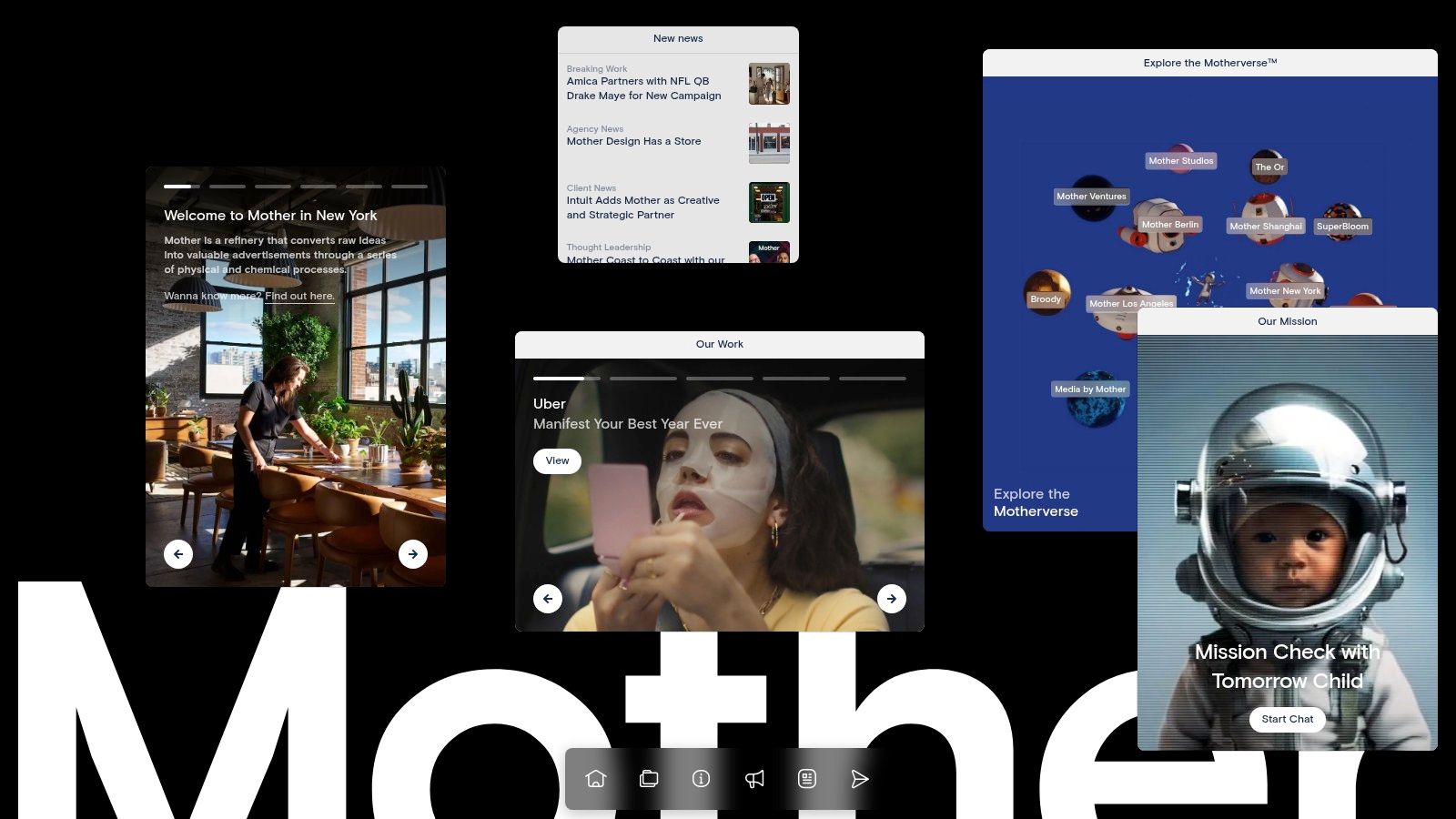
Mother New York makes sense when brand identity and original creative are the center of the brief. The independent Brooklyn agency spans brand building, design, production, product development, content, social activation, technology, media, and PR. Its public portfolio includes work for Uber, Amica, StreetEasy, Cheerios, and Intuit.
That breadth can keep creative disciplines together under one partner, and the public work gives buyers a way to judge style before a pitch. For a B2B company, though, creative range isn't a substitute for category proof. Ask to see work relevant to your audience and buying process, then examine how the agency proposes to connect campaign response to qualified opportunities.
If content is part of the plan, use this B2B content marketing agency framework to define the job each asset needs to do. Mother's pricing is quote-based. Buyers seeking outbound or pipeline generation should confirm that the proposed team has those capabilities, rather than assuming a full-service description includes them.
Buy if: you need brand building and creative production across disciplines. Skip if: you need a specialist to own prospecting, qualification, and pipeline reporting.
6. Anomaly
Anomaly's remit goes beyond conventional campaign work. It describes work across brand creation, innovation, products, platforms, intellectual property, design, activation, and production through Unreasonable Studios. That makes it a potential partner for a business challenge that needs both a new brand platform and a way to bring it to market.
The upside is scope. Anomaly can assemble teams around business challenges, which may suit companies exploring new products or a larger brand proposition. The trade-off is comparability: its stated value-based pricing model can be harder to assess alongside hourly or fixed-scope proposals. Ask the team to define the value, deliverables, assumptions, and decision points in terms your finance and revenue leaders can evaluate.
For a focused campaign, that broader remit may add process and cost without improving the result. Keep the pitch tied to the business problem and specify what success means before the agency shapes the scope.
Buy if: you're tackling brand or product innovation alongside advertising. Skip if: you need a narrow campaign with a defined channel, audience, and pipeline outcome.
7. Droga5
Droga5 is a candidate for ambitious integrated brand campaigns, not a default choice for lean B2B lead generation. The agency is part of Accenture Song and works across creative strategy, integrated campaigns, business design, and brand challenges. Its public portfolio includes work for Bosch, Coors Light, Paramount+, Levi's, and The New York Times.
The potential advantage is access to wider capabilities when the assignment reaches beyond advertising. That can be valuable for a large brand initiative with several connected workstreams. The risk for a B2B demand team is over-scoping. If the actual goal is to create qualified meetings in a defined market, a large integrated campaign may not be the shortest route to that outcome.
Pricing and scope are proposal-based. During the pitch, ask for a plan that names the target audience, the sales action expected, the reporting path, and the team responsible for each. Our guide to LinkedIn advertising agencies can help sharpen your paid social requirements before the conversation.
Buy if: the brief calls for high-profile creative and integrated brand work with access to wider business capabilities. Skip if: you need a lean lead-generation engagement with a direct line from media to qualified pipeline.
How the seven NYC agencies compare on pricing model, best fit, and main caution
Item | Pricing model | Best for | Main caution |
|---|---|---|---|
Ironpaper | Quote-based | B2B pipeline and demand generation | Not suited to broad consumer advertising |
Divine Advertising | Custom quote | Hands-on digital acquisition and measurement | Small roster may limit capacity for large programs |
R/GA | Quote-based | Integrated brand, digital experience, and lifecycle work | Broad scope may exceed a small campaign's needs |
Giant Spoon | Custom-scoped | High-visibility campaigns combining experiences and media | Clarify the team and operating structure following its 2025 move to Wpromote |
Mother New York | Quote-based | Multi-disciplinary brand building and creative work | Confirm the proposed team can support specialized lead generation |
Anomaly | Value-based pricing | Brand, product, and platform innovation | Pricing may be difficult to compare with fixed-scope proposals |
Droga5 | Proposal-based | Ambitious integrated brand campaigns | May not suit lean, narrowly scoped lead-generation work |
What agency costs mean for B2B pipeline
A retainer is a poor comparison unit when agencies sell different scopes. Compare cost per qualified lead, then trace each lead to a held meeting, SQL, opportunity, and closed revenue. Outsourced lead generation pricing swings widely depending on audience difficulty, targeting precision, and how strictly "qualified" gets defined, so a number quoted from another market tells you little about yours. What a lead costs matters less than what it becomes.
Two agencies can report the same cost per lead and deliver very different economics. One counts a gated-content download; the other counts a prospect who accepted a discovery call. Define qualification before the contract, because a cheap lead that sales rejects is the most expensive one in the funnel.
Grou's multi-channel outbound engine for Plastit, built to reach hardware buyers across Europe, generated 97 leads at a 7.9% reply rate. The lesson transfers: agree on qualification rules up front, then measure what happens after the lead enters the CRM.
The NYC market offers deep talent, and headcount and prestige say nothing about who will work your account. New York City's advertising employment rose 49.5%, from 46,700 jobs in December 2003 to 69,800 in December 2023, before declining from about 75,000 jobs in August 2022 to 67,500 by August 2025, according to the Center for an Urban Future's advertising careers research. Request named staffing, senior-to-junior hours, backup coverage, and examples delivered by the team you'll get.
Measurement and contract terms carry equal weight. Nielsen's Brand Lift framework describes measuring changes in awareness, favorability, purchase intent, sentiment, creative resonance, and content fit against historical norms. For a B2B program, define the baseline, the exposed-versus-control approach where feasible, sample requirements, and how campaign reporting connects to CRM opportunities. Clicks show activity. They don't establish pipeline impact.
The Association of National Advertisers' 2025 compensation survey addresses agency remuneration practices and AI's effect on compensation strategies. In your proposal, separate agency fees, media spend, platform costs, production, testing, and pass-through expenses. Define data ownership, revision limits, cancellation terms, reporting duties, and who can access the ad accounts. A low retainer can cost more than a premium one if the media and measurement terms stay opaque.
Where to start before you sign an agency retainer
Pull the last 90 days of agency reporting today. Mark every row as activity or outcome. Impressions, clicks, and sends are activity; qualified meetings, SQLs, and pipeline are outcomes. If the outcome column is empty, the budget is buying activity, regardless of how polished the deck looks.
A unified pipeline agency fits better than a New York creative or brand firm when list building, content, and outbound sit with separate vendors and nobody owns one reporting line from target account to closed revenue. The operating model matters: one target list, one message, clear qualification rules, and a shared view of what sales converts. Grou runs LinkedIn content, lead generation, and outbound as connected services under transparent retainer pricing, with a full execution team covering strategy, targeting, copywriting, sequencing, and reporting from day one.
The handoff between marketing and sales decides whether spend turns into revenue. Grou helped Isokon generate high-quality leads that contributed to a deal worth more than $20 million, which is what a clean handoff produces. Grou can give you a direct recommendation based on your market, offer, and goals after a call. For broader context on evaluating partners, use this guide to marketing agencies.
Grou is a B2B pipeline agency trusted by 50+ companies across iGaming, SaaS, manufacturing, and professional services. This shortlist applies three tests to public material and to Grou's own client results, and doesn't claim hands-on testing of every firm.
We connect LinkedIn content, lead generation, and outbound into one system with shared targeting and pipeline reporting. Bring your last 90 days of campaign data to a call, and Grou will give you a direct recommendation based on your market, offer, and goals.
Most NYC agency shortlists start with the wrong filter. You've got seven agencies, sharp reels, and no clear answer on what a qualified meeting costs. B2B budgets disappear in that gap.
My verdict up front: Ironpaper is the strongest fit for complex B2B offers with long sales cycles; Divine Advertising is the better fit for small teams seeking senior involvement in paid media. Every entry below gets the same treatment: a buy-or-skip call tied to what the program delivers to pipeline.
Shortlist on three tests: category proof in your sector, reporting that shows cost per qualified lead, and a straight answer about a churned client.
Compare seven agencies: each gets a verdict tied to pipeline needs.
Use cost per qualified lead: a retainer alone won't tell you what the program delivers.
Connect the system: Grou's B2B pipeline work runs on the same principle, qualified demand over raw lead volume.
Table of Contents
1. Ironpaper
For B2B companies with a complex offer and a sales cycle that needs more than a paid-media vendor, Ironpaper is my #1 pick. The agency focuses on B2B demand generation and connects positioning, content, digital experiences, sales enablement, and revenue systems. That scope matters when marketing and sales have to agree on what counts as qualified demand instead of handing off a pile of form fills.
Its stated capabilities include ABM, messaging, conversion-focused websites, and marketing-to-sales alignment, a mix that suits SaaS, technology, manufacturing, and professional services teams working the path from target account to sales conversation. Review its B2B marketing agency profile while you check whether the proposed scope maps to your pipeline motion.
The trade-off is specialization. Ironpaper is a poor fit for a broad consumer campaign built on mass reach and entertainment-led creative. Pricing is quote-based, so request a written scope, price, and timeline before treating any budget or duration as settled. I would also ask for a sample outcome report and one example of a client relationship that ended, because a demand-gen agency should be able to discuss churn directly.
Buy if: you need strategy and execution tied to qualified B2B demand, and can scope the work around a longer sales cycle. Skip if: your primary requirement is consumer brand advertising or a narrow, single-channel campaign.
2. Divine Advertising
For a lean marketing team that wants direct access to senior practitioners on paid media, Divine Advertising is my second pick. The independent New York agency offers paid campaigns across Google, Meta, LinkedIn, and programmatic, alongside search, web development, creative, conversion optimization, analytics, and automation.
Its service mix is useful when ads, landing pages, and tracking need to work as one acquisition path. Divine says the people involved in pitching stay hands-on, and it describes its media buying as having no media-spend markups. Those are useful commitments to pin down in the proposal and contract. Its lead generation agency guide offers a useful frame for deciding whether the scope reaches beyond clicks into sales-qualified demand.
Capacity is the key trade-off. A deliberately small roster may be a poor fit for a large multinational program with many markets and parallel workstreams. Public pricing and detailed client case-study metrics weren't available in the reviewed material, so ask for a sample report and a named staffing plan before signing.
Buy if: you want senior involvement across paid acquisition and measurement. Skip if: your program needs a large distributed team or you can't proceed without public pricing and detailed case metrics.
3. R/GA
R/GA fits a different brief: the advertising needs to connect to a digital product, platform, or customer experience. Its work spans brand design, product and experience design, integrated campaigns, content, CRM, personalization, and lifecycle marketing. That range helps when a campaign promise has to carry through the website, onboarding, and customer communications.
The advantage is connecting creative decisions to the digital experience buyers encounter. Its capabilities include AI, commerce, digital platforms, and lifecycle work, alongside campaign development. For a B2B marketer, the practical question is whether the proposal maps those capabilities to a defined buying journey or sells a broad transformation when the immediate need is demand generation. Frame the scoping conversation the way you would evaluate a data-driven digital marketing agency: reporting cadence, measurement requirements, and who owns each deliverable.
Pricing is quote-based, and the breadth may be more than a single campaign or channel needs. Push for category proof in your vertical, and ask whether the team will discuss a churned account. Get a scoped team, concrete deliverables, and the link between the experience work and your pipeline measures in writing before you sign.
Buy if: the brief combines brand, technology, and customer experience. Skip if: you need a focused paid-media or outbound engagement with a short list of deliverables.
4. Giant Spoon
Experiential marketing is the brief here. Giant Spoon builds public-facing campaigns around live and cultural moments, with media behind them. Its capabilities cover strategy, creative, production, social, content, experiential work, media planning and buying, performance media, measurement, and reporting.
That combination suits a launch meant to be seen rather than a program meant to fill a sales calendar. The media arm can connect the activation to social, search, video, and out-of-home, and the public portfolio plus New York office give buyers material to review before a pitch. What a reel of high-visibility work can't prove is pipeline. It says nothing about lead qualification, sales follow-up, or CRM attribution, so ask for category proof in your sector and ask the team to walk through a churned account and what changed afterward.
Giant Spoon now operates within Wpromote, which makes the operating model and assigned team worth pinning down during procurement. Pricing isn't public, and productions plus media buys need custom scoping. Get named owners for media and reporting, and get pass-through costs in writing before you compare any fee against your cost per qualified lead.
Buy if: your plan depends on an experiential activation with supporting cross-channel media. Skip if: your core need is pipeline generation, outbound sales support, or a tightly scoped B2B demand program.
5. Mother New York
Mother New York makes sense when brand identity and original creative are the center of the brief. The independent Brooklyn agency spans brand building, design, production, product development, content, social activation, technology, media, and PR. Its public portfolio includes work for Uber, Amica, StreetEasy, Cheerios, and Intuit.
That breadth can keep creative disciplines together under one partner, and the public work gives buyers a way to judge style before a pitch. For a B2B company, though, creative range isn't a substitute for category proof. Ask to see work relevant to your audience and buying process, then examine how the agency proposes to connect campaign response to qualified opportunities.
If content is part of the plan, use this B2B content marketing agency framework to define the job each asset needs to do. Mother's pricing is quote-based. Buyers seeking outbound or pipeline generation should confirm that the proposed team has those capabilities, rather than assuming a full-service description includes them.
Buy if: you need brand building and creative production across disciplines. Skip if: you need a specialist to own prospecting, qualification, and pipeline reporting.
6. Anomaly
Anomaly's remit goes beyond conventional campaign work. It describes work across brand creation, innovation, products, platforms, intellectual property, design, activation, and production through Unreasonable Studios. That makes it a potential partner for a business challenge that needs both a new brand platform and a way to bring it to market.
The upside is scope. Anomaly can assemble teams around business challenges, which may suit companies exploring new products or a larger brand proposition. The trade-off is comparability: its stated value-based pricing model can be harder to assess alongside hourly or fixed-scope proposals. Ask the team to define the value, deliverables, assumptions, and decision points in terms your finance and revenue leaders can evaluate.
For a focused campaign, that broader remit may add process and cost without improving the result. Keep the pitch tied to the business problem and specify what success means before the agency shapes the scope.
Buy if: you're tackling brand or product innovation alongside advertising. Skip if: you need a narrow campaign with a defined channel, audience, and pipeline outcome.
7. Droga5
Droga5 is a candidate for ambitious integrated brand campaigns, not a default choice for lean B2B lead generation. The agency is part of Accenture Song and works across creative strategy, integrated campaigns, business design, and brand challenges. Its public portfolio includes work for Bosch, Coors Light, Paramount+, Levi's, and The New York Times.
The potential advantage is access to wider capabilities when the assignment reaches beyond advertising. That can be valuable for a large brand initiative with several connected workstreams. The risk for a B2B demand team is over-scoping. If the actual goal is to create qualified meetings in a defined market, a large integrated campaign may not be the shortest route to that outcome.
Pricing and scope are proposal-based. During the pitch, ask for a plan that names the target audience, the sales action expected, the reporting path, and the team responsible for each. Our guide to LinkedIn advertising agencies can help sharpen your paid social requirements before the conversation.
Buy if: the brief calls for high-profile creative and integrated brand work with access to wider business capabilities. Skip if: you need a lean lead-generation engagement with a direct line from media to qualified pipeline.
How the seven NYC agencies compare on pricing model, best fit, and main caution
Item | Pricing model | Best for | Main caution |
|---|---|---|---|
Ironpaper | Quote-based | B2B pipeline and demand generation | Not suited to broad consumer advertising |
Divine Advertising | Custom quote | Hands-on digital acquisition and measurement | Small roster may limit capacity for large programs |
R/GA | Quote-based | Integrated brand, digital experience, and lifecycle work | Broad scope may exceed a small campaign's needs |
Giant Spoon | Custom-scoped | High-visibility campaigns combining experiences and media | Clarify the team and operating structure following its 2025 move to Wpromote |
Mother New York | Quote-based | Multi-disciplinary brand building and creative work | Confirm the proposed team can support specialized lead generation |
Anomaly | Value-based pricing | Brand, product, and platform innovation | Pricing may be difficult to compare with fixed-scope proposals |
Droga5 | Proposal-based | Ambitious integrated brand campaigns | May not suit lean, narrowly scoped lead-generation work |
What agency costs mean for B2B pipeline
A retainer is a poor comparison unit when agencies sell different scopes. Compare cost per qualified lead, then trace each lead to a held meeting, SQL, opportunity, and closed revenue. Outsourced lead generation pricing swings widely depending on audience difficulty, targeting precision, and how strictly "qualified" gets defined, so a number quoted from another market tells you little about yours. What a lead costs matters less than what it becomes.
Two agencies can report the same cost per lead and deliver very different economics. One counts a gated-content download; the other counts a prospect who accepted a discovery call. Define qualification before the contract, because a cheap lead that sales rejects is the most expensive one in the funnel.
Grou's multi-channel outbound engine for Plastit, built to reach hardware buyers across Europe, generated 97 leads at a 7.9% reply rate. The lesson transfers: agree on qualification rules up front, then measure what happens after the lead enters the CRM.
The NYC market offers deep talent, and headcount and prestige say nothing about who will work your account. New York City's advertising employment rose 49.5%, from 46,700 jobs in December 2003 to 69,800 in December 2023, before declining from about 75,000 jobs in August 2022 to 67,500 by August 2025, according to the Center for an Urban Future's advertising careers research. Request named staffing, senior-to-junior hours, backup coverage, and examples delivered by the team you'll get.
Measurement and contract terms carry equal weight. Nielsen's Brand Lift framework describes measuring changes in awareness, favorability, purchase intent, sentiment, creative resonance, and content fit against historical norms. For a B2B program, define the baseline, the exposed-versus-control approach where feasible, sample requirements, and how campaign reporting connects to CRM opportunities. Clicks show activity. They don't establish pipeline impact.
The Association of National Advertisers' 2025 compensation survey addresses agency remuneration practices and AI's effect on compensation strategies. In your proposal, separate agency fees, media spend, platform costs, production, testing, and pass-through expenses. Define data ownership, revision limits, cancellation terms, reporting duties, and who can access the ad accounts. A low retainer can cost more than a premium one if the media and measurement terms stay opaque.
Where to start before you sign an agency retainer
Pull the last 90 days of agency reporting today. Mark every row as activity or outcome. Impressions, clicks, and sends are activity; qualified meetings, SQLs, and pipeline are outcomes. If the outcome column is empty, the budget is buying activity, regardless of how polished the deck looks.
A unified pipeline agency fits better than a New York creative or brand firm when list building, content, and outbound sit with separate vendors and nobody owns one reporting line from target account to closed revenue. The operating model matters: one target list, one message, clear qualification rules, and a shared view of what sales converts. Grou runs LinkedIn content, lead generation, and outbound as connected services under transparent retainer pricing, with a full execution team covering strategy, targeting, copywriting, sequencing, and reporting from day one.
The handoff between marketing and sales decides whether spend turns into revenue. Grou helped Isokon generate high-quality leads that contributed to a deal worth more than $20 million, which is what a clean handoff produces. Grou can give you a direct recommendation based on your market, offer, and goals after a call. For broader context on evaluating partners, use this guide to marketing agencies.
Grou is a B2B pipeline agency trusted by 50+ companies across iGaming, SaaS, manufacturing, and professional services. This shortlist applies three tests to public material and to Grou's own client results, and doesn't claim hands-on testing of every firm.
We connect LinkedIn content, lead generation, and outbound into one system with shared targeting and pipeline reporting. Bring your last 90 days of campaign data to a call, and Grou will give you a direct recommendation based on your market, offer, and goals.
Pipeline OS Newsletter
Build qualified pipeline
Get weekly tactics to generate demand, improve lead quality, and book more meetings.



Trusted by industry leaders
Trusted by industry leaders
Trusted by industry leaders
Ready to build qualified pipeline?
Ready to build qualified pipeline?
Ready to build qualified pipeline?
Book a call to see if we're the right fit, or take the 2-minute quiz to get a clear starting point.
Book a call to see if we're the right fit, or take the 2-minute quiz to get a clear starting point.
Book a call to see if we're the right fit, or take the 2-minute quiz to get a clear starting point.
" height="30.21639343089746px" id="hfGbXmQR2" width="30.216393430897455px"/></svg>)
Copyright © 2026 – All Right Reserved
Copyright © 2026 – All Right Reserved
Copyright © 2026 – All Right Reserved