%22%3E%3C/path%3E%3Cpath d=%22M 63.072 7.554 C 62.258 8.022 61.577 8.689 61.092 9.493 L 61.092 7.076 L 57.158 7.076 L 57.158 22.64 L 61.089 22.64 L 61.089 14.888 C 61.089 13.446 61.403 12.434 62.03 11.853 C 62.818 11.218 63.818 10.907 64.826 10.982 L 65.868 10.982 L 65.868 6.851 C 64.891 6.834 63.926 7.076 63.073 7.554 Z%22 fill=%22rgb(17,17,17)%22%3E%3C/path%3E%3Cpath d=%22M 78.916 7.82 C 76.363 6.49 73.321 6.49 70.768 7.82 C 69.562 8.473 68.564 9.451 67.888 10.644 C 67.167 11.931 66.803 13.387 66.834 14.862 C 66.804 16.332 67.157 17.785 67.86 19.077 C 68.515 20.267 69.494 21.246 70.684 21.901 C 71.924 22.576 73.318 22.92 74.73 22.898 C 76.164 22.918 77.58 22.575 78.846 21.901 C 80.062 21.247 81.073 20.27 81.768 19.077 C 82.506 17.797 82.88 16.339 82.85 14.862 C 82.88 13.389 82.517 11.934 81.797 10.647 C 81.12 9.455 80.122 8.477 78.917 7.824 M 78.803 14.862 C 78.829 15.739 78.636 16.608 78.241 17.391 C 77.903 18.046 77.38 18.588 76.738 18.95 C 76.124 19.293 75.432 19.472 74.729 19.47 C 73.668 19.497 72.648 19.061 71.934 18.276 C 71.139 17.323 70.741 16.1 70.823 14.862 C 70.741 13.62 71.149 12.395 71.959 11.45 C 72.687 10.667 73.715 10.233 74.783 10.256 C 75.859 10.236 76.894 10.67 77.635 11.45 C 78.464 12.387 78.884 13.616 78.801 14.864%22 fill=%22rgb(17,17,17)%22%3E%3C/path%3E%3Cpath d=%22M 95.906 7.076 L 95.906 15.646 C 95.975 16.68 95.643 17.701 94.979 18.498 C 94.311 19.184 93.379 19.547 92.422 19.495 C 91.475 19.544 90.553 19.18 89.894 18.498 C 89.23 17.701 88.898 16.68 88.967 15.646 L 88.967 7.076 L 85.033 7.076 L 85.033 16.207 C 85 17.449 85.275 18.68 85.834 19.79 C 86.327 20.75 87.095 21.542 88.039 22.065 C 89.033 22.594 90.145 22.861 91.271 22.838 C 92.188 22.847 93.095 22.65 93.926 22.263 C 94.708 21.905 95.388 21.36 95.906 20.675 L 95.906 22.645 L 99.865 22.645 L 99.865 7.076 Z%22 fill=%22rgb(17,17,17)%22%3E%3C/path%3E%3Cpath d=%22M 4.513 15.626 C 4.511 10.815 7.606 6.549 12.181 5.059 C 16.756 3.57 21.77 5.195 24.601 9.086 L 27.816 5.87 C 24.074 1.186 17.981 -0.943 12.137 0.393 C 6.292 1.728 1.728 6.292 0.393 12.137 C -0.943 17.981 1.186 24.074 5.87 27.816 L 9.085 24.601 C 6.214 22.512 4.515 19.177 4.513 15.626%22 fill=%22rgb(32,62,235)%22%3E%3C/path%3E%3Cpath d=%22M 17.114 14.343 L 13.354 18.01 L 13.354 18.026 L 21.071 18.026 L 11.412 27.609 L 17.389 27.609 L 23.999 21.081 L 23.999 28.316 L 24.005 28.316 L 27.967 24.393 L 27.967 14.343 Z%22 fill=%22rgb(32,62,235)%22%3E%3C/path%3E%3C/g%3E%3C/svg%3E) ×
× ××
××›
›
›
›
B2B content marketing agency: how to choose one that actually builds pipeline
B2B content marketing agency: how to choose one that actually builds pipeline
B2B content marketing agency: how to choose one that actually builds pipeline
B2B content marketing agency: how to choose one that actually builds pipeline
B2B content marketing agency: how to choose one that actually builds pipeline
B2B content marketing agency: how to choose one that actually builds pipeline

Author
Aljaz Peklaj

Your content agency is publishing posts, your LinkedIn looks active, and sales still asks the same question every week, where are the qualified meetings? That gap usually comes from one mistake. You hired for content production, not pipeline construction.
Hire a B2B content marketing agency that owns pipeline contribution, not one that reports impressions and post volume.
Run a 6-step selection process, and take your time. Fast agency choices usually create slow cleanup.
Manage the engagement with decision-focused check-ins and quarterly evaluation, not recurring status theater.
Judge results by meetings, opportunities, revenue, and signal quality, because attention without structure doesn't become pipeline.
Table of Contents
What a pipeline-focused b2b content marketing agency actually does
Most agencies still act like content ends at publish. That's outdated. A real B2B content marketing agency should be accountable for what happens after attention shows up.
The market gap is obvious. Only 18% of top agencies track content performance to closed revenue via outbound, yet founder thought leadership on LinkedIn can lift inbound reply rates by 35% when paired with targeted outreach, based on The Starr Conspiracy's agency analysis. If your agency can't connect content to outbound, it isn't building pipeline. It's feeding a vanity dashboard.
Content is one layer of the engine
A pipeline-focused agency should run four connected motions:
Content strategy: Message map, buyer questions, proof themes, and channel roles.
Founder or executive LinkedIn content: Posts that build familiarity before outreach lands.
Signal-based outbound: Triggers from hiring, market movement, content engagement, and account activity.
Lead gen workflow: Routing replies, qualification rules, CRM tagging, and meeting handoff.
That system matters more in verticals like iGaming, SaaS, manufacturing, legal tech, and pharma, where buyers need trust before they book. Content isn't there to entertain. It's there to remove doubt.
Practical rule: If the agency starts with “how many posts do you want per month,” end the call.
The tool stack should also be concrete. I want to hear Apollo for account and contact coverage, Clay for enrichment and trigger building, Sales Navigator for persona targeting, Lemlist, Instantly, or Smartlead for outbound execution, and HubSpot for attribution and reply routing. For LinkedIn distribution, HeyReach is often part of the motion when teams need account-level sequencing.
If you're comparing adjacent channel specialists, a good B2B podcast marketing agency can make sense when executive content needs a long-form trust layer. Just don't confuse a distribution channel with a pipeline system.
The agency should connect attention to meetings
The operational question is simple. What happens when someone reads, watches, clicks, replies, or visits?
A serious agency maps that flow. Blog readers move into internal links, demo pages, or outbound retargeting lists. LinkedIn engagers get pulled into warm outbound sequences. Email replies route to the right AE with qualification notes already attached. Content performance gets read alongside meetings created, not instead of them.
This is why I prefer agencies that think like RevOps teams. If you want a reference point for that mindset, data-driven digital marketing agency models are closer to the truth than old-school content shops.
One option in this category is Grou. It runs LinkedIn content, outbound, and lead generation in one operating system, which is closer to how pipeline is built than channel-by-channel outsourcing.
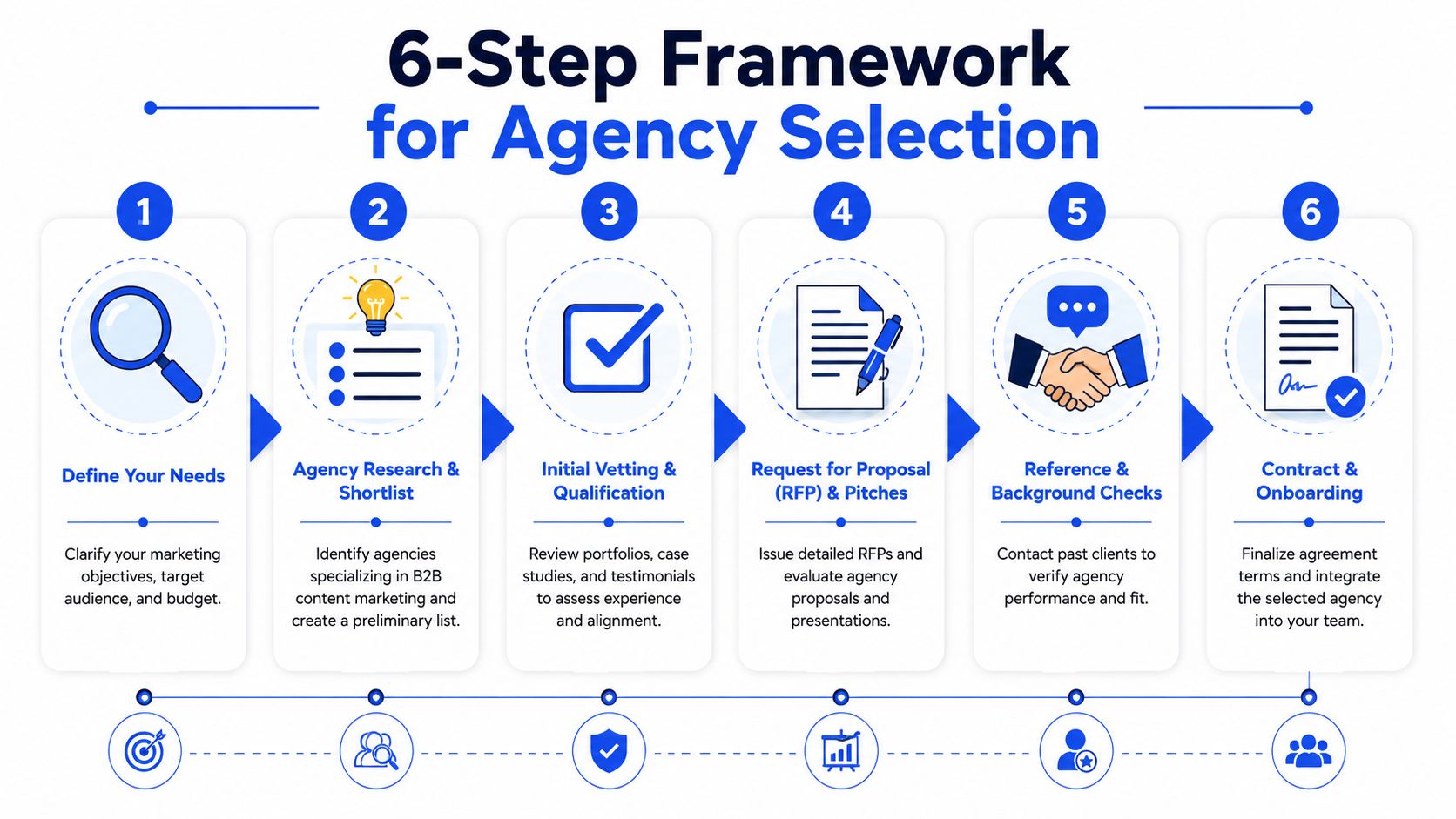
A 6-step framework for selecting the right agency
Agency selection goes wrong before the first proposal lands. The buyer hasn't defined what the agency needs to do, so every pitch sounds plausible. That's why average agency evaluation feels noisy and why so many teams regret the choice later.
Start with business outcomes, not channels
Step 1 is a written one-pager. Before you speak with any agency, define what content must do for the business. Pipeline creation, founder authority, account warming for outbound, recruitment visibility, sales enablement, or a mix. If you skip this, you'll buy deliverables instead of outcomes.
That document should answer three things:
What business outcome matters most
Who the exact ICP is
What sales motion the content must support
For teams trying to find the right search marketing firm, the same rule applies. Start with the business problem, not the channel label.
Build a shortlist the right way
Step 2 is sourcing. Don't start with generic Google results. Agencies that rank for broad category terms are good at SEO. That doesn't prove they're good at pipeline. Better sources are peer referrals, trusted operator communities around Apollo, Clay, and Lemlist, and agencies whose client work you already notice in-market.
Step 3 is shortlist discipline. Narrow to 4 to 6 agencies for initial conversations. More than that creates decision fatigue. Fewer than that hides meaningful variation in quality and working style. The first call should be 30 minutes with a senior operator, not a long sales production.
A good initial call sounds like diligence. They should ask about ACV, sales cycle, current conversion points, content-to-meeting path, CRM hygiene, and founder availability. If the first half hour is mostly their deck, keep moving.
The kickoff conversation predicts the engagement better than the pitch polish does.
Inspect recent proof, then run a pilot
Step 4 is contextual proof. Ask one hard question: can you show me work for a company in our vertical, at our stage, with a similar ACV, from the last 12 months? Not adjacent. Not “we also work in B2B.” Recent and relevant.
For iGaming, SaaS, manufacturing, legal tech, and pharma, context matters because trigger logic, compliance language, and persona objections vary a lot. A generic agency can still produce clean copy. It usually can't produce predictable pipeline.
Step 5 is current-client diligence. Speak with 2 current clients, not polished references from years ago. Ask what works, what doesn't, where the agency pushes back, and whether they'd hire them again. The answer you're listening for isn't perfection. It's operational honesty.
Step 6 is a paid pilot. Run a small project before a full retainer. A strategy sprint, 3 to 5 posts, or a single campaign concept is enough to test process quality, speed, and communication. The pilot range I like is €1,500 to €5,000, because it's enough to produce real output without forcing a six-month commitment. That's a better filter than any proposal.
Retainers for specialist B2B SaaS agencies typically start at $8,000 to $15,000 per month, with a common media spend to agency fee ratio of 3:1 to 5:1, according to Jordan Digital Marketing's agency pricing review. That means a cheap pilot isn't about saving money. It's about reducing expensive misalignment.
If you need a reference for what a connected pipeline partner looks like beyond content alone, compare agencies against a proper lead generation agency model. The strongest content partners increasingly look like that.
Red flags that signal a bad agency fit
Most bad agency decisions don't come from hidden fraud. They come from predictable buyer errors. You looked at the wrong signals.

Cheap usually means expensive later
The first red flag is selection by price alone. Cheap agencies usually sell output volume because they can't sell commercial thinking. You'll get posts, maybe blogs, maybe a monthly report. What you won't get is a structured path from attention to qualified conversation.
The second red flag is buying agency size. Bigger doesn't mean better. Smaller doesn't mean more senior. What matters is the exact team on your account, how stable it is, and whether the people in the sale are the people in delivery.
Use this quick screen before a second meeting:
Ask who will do the work: Get names, roles, and actual involvement.
Ask how they report pipeline: If they stay at traffic and engagement, that's the warning.
Ask how they handle pushback: Agencies that agree with everything are dangerous.
Ask what happens in the first 30 days: Vague answers usually mean vague operations.
Decks, RFPs, and chemistry can fool you
Glossy decks are often a proxy for marketing skill, not delivery quality. Strong visual storytelling is useful, but it doesn't tell you whether they can structure a CRM property, build a trigger list in Clay, or route warm replies to SDRs inside HubSpot.
Standardized RFPs have the same problem. They reward agencies that are good at filling templates. They don't reward the team most likely to generate meetings. If you already know your requirements, use them to guide a live working session instead.
A short video discussion on agency evaluation can help your team align before vendor calls:
Initial chemistry is the last trap. The salesperson isn't always the operator. If you love the sales lead but never meet the strategist, account lead, or outbound specialist, you're buying the wrong person.
If an agency pressures you for a quick yes, assume they don't want the work inspected closely.
The agencies worth hiring usually tolerate scrutiny well. They don't panic when you ask for current clients, real workflows, or a paid pilot. They expect that level of diligence.
What real pipeline results look like with numbers
Most agency content about “results” is useless because it shows soft metrics or hides the cost side. Real evaluation needs spend, meetings, opportunities, closed revenue, and context.
An 8-month iGaming campaign with real revenue impact
Here is a real campaign structure from a B2B SaaS company in the iGaming compliance space. The company had roughly 50 employees, sold to compliance and risk leaders, and had an average ACV of roughly €80k.
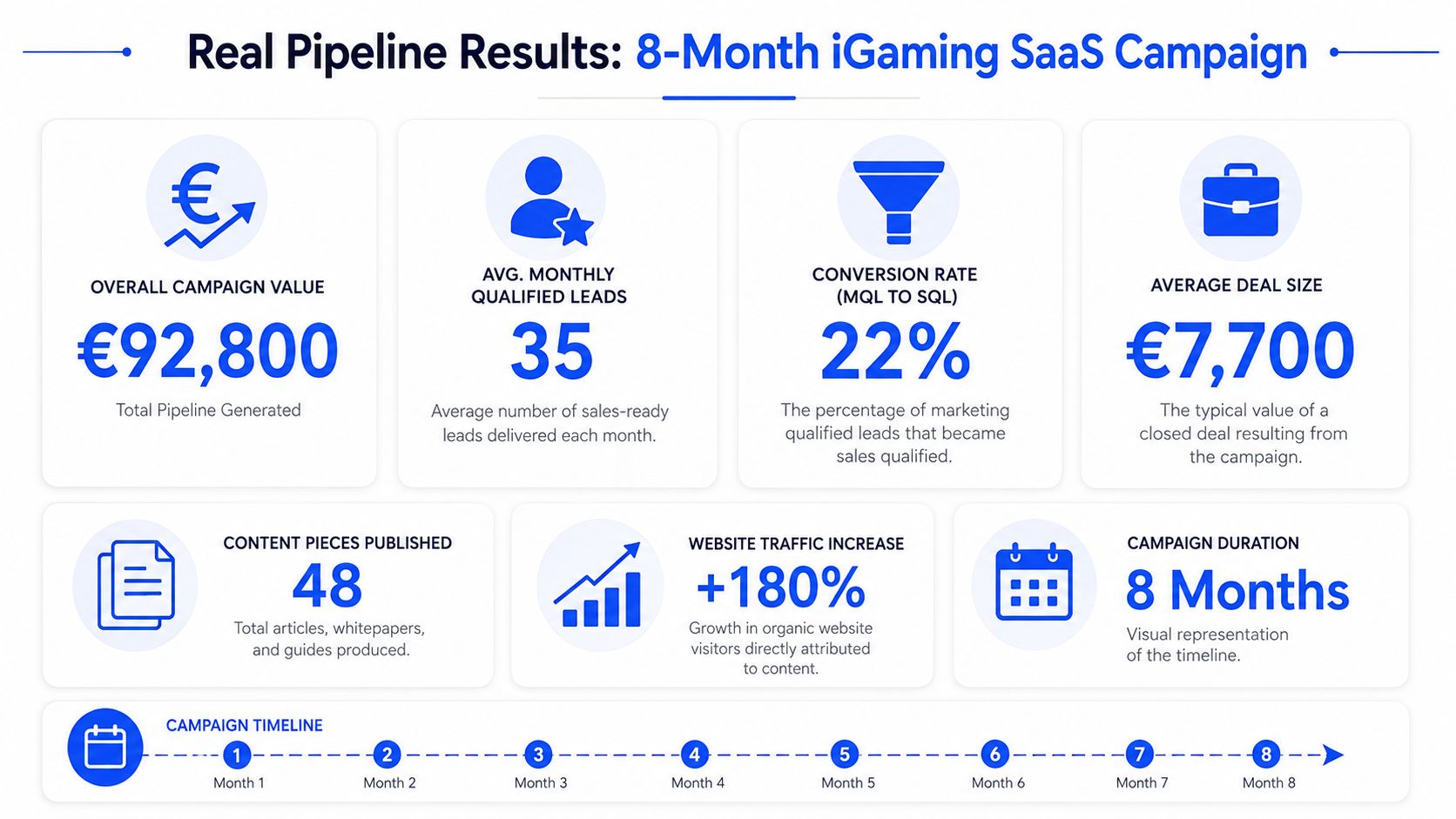
The campaign ran for 8 months and combined founder LinkedIn content, outbound across LinkedIn and email, and paid LinkedIn amplification around ICE Barcelona as the market anchor.
Performance looked like this:
Total agency spend: roughly €92,800
Qualified meetings booked: 134
Qualified opportunities created: 67
Closed-won deals during the engagement: 11
Additional closed-won deals in the 4 months after the engagement: 4
Total closed revenue attributable: roughly €1.24M ARR across 15 deals
Pipeline still active at the end of the engagement: roughly €620k
Direct ROI: roughly 13.4x
Total ROI including late-stage pipeline at expected close rates: roughly 16.2x
LinkedIn-specific and outbound-specific signals also mattered:
Area | Result |
|---|---|
Founder audience | 1,200 followers to 4,800 |
ICP-fit inbound DMs | 1 to 2 per month to 14 to 18 per month |
Outbound blended reply rate | 14.2% |
End-to-end meeting conversion | 4.7% |
Average sales cycle on outbound-sourced deals | 42 days |
That result was not normal. It was a top performer, and the reasons were structural. The ACV was high. The founder posted 3 times per week. The vertical had clean buying signals around regulation. The event anchor forced decisions. The internal sales team followed up fast.
High ROI from content-plus-outbound usually says as much about the client system as the agency system.
What a strong but more typical result looks like
A more typical strong result looked like this: B2B SaaS client, roughly €35k average ACV, 6-month engagement, roughly €46k total spend, 78 qualified meetings, 6 closed deals, roughly €210k closed revenue, roughly 4.6x direct ROI, and roughly €180k in active pipeline expected to close at 30% probability, which brought adjusted ROI to roughly 5.8x.
That's the benchmark range I trust more. Strong work often lands in the 4 to 6x range over six months when attribution is handled accurately and the sales team can convert what marketing creates.
For broader context, the average 2025 ROI for content marketing was $7.65 for every $1 spent, and organic traffic converts at a 2.8x higher rate than paid traffic, according to Omnibound's B2B content marketing statistics. That doesn't mean your agency will hit that exact return. It means content can be commercially strong when distribution, outbound, and conversion paths are in place.
When you review agency performance, pair campaign numbers with a clear lead generation KPI framework. Otherwise you'll end up debating activity instead of commercial output.
How to manage the agency relationship for results
A good agency can still fail inside a bad operating cadence. Most weekly check-ins are too long, too broad, and too polite. They drift into status updates because nobody set them up as decision forums.
Run shorter meetings with decisions on the agenda
The structure I recommend is simple. Weekly during the first 60 days, then bi-weekly for most mature engagements. Keep the call to 30 to 45 minutes, never 60 by default. Use video, shared dashboards, and an agenda sent 24 hours in advance.
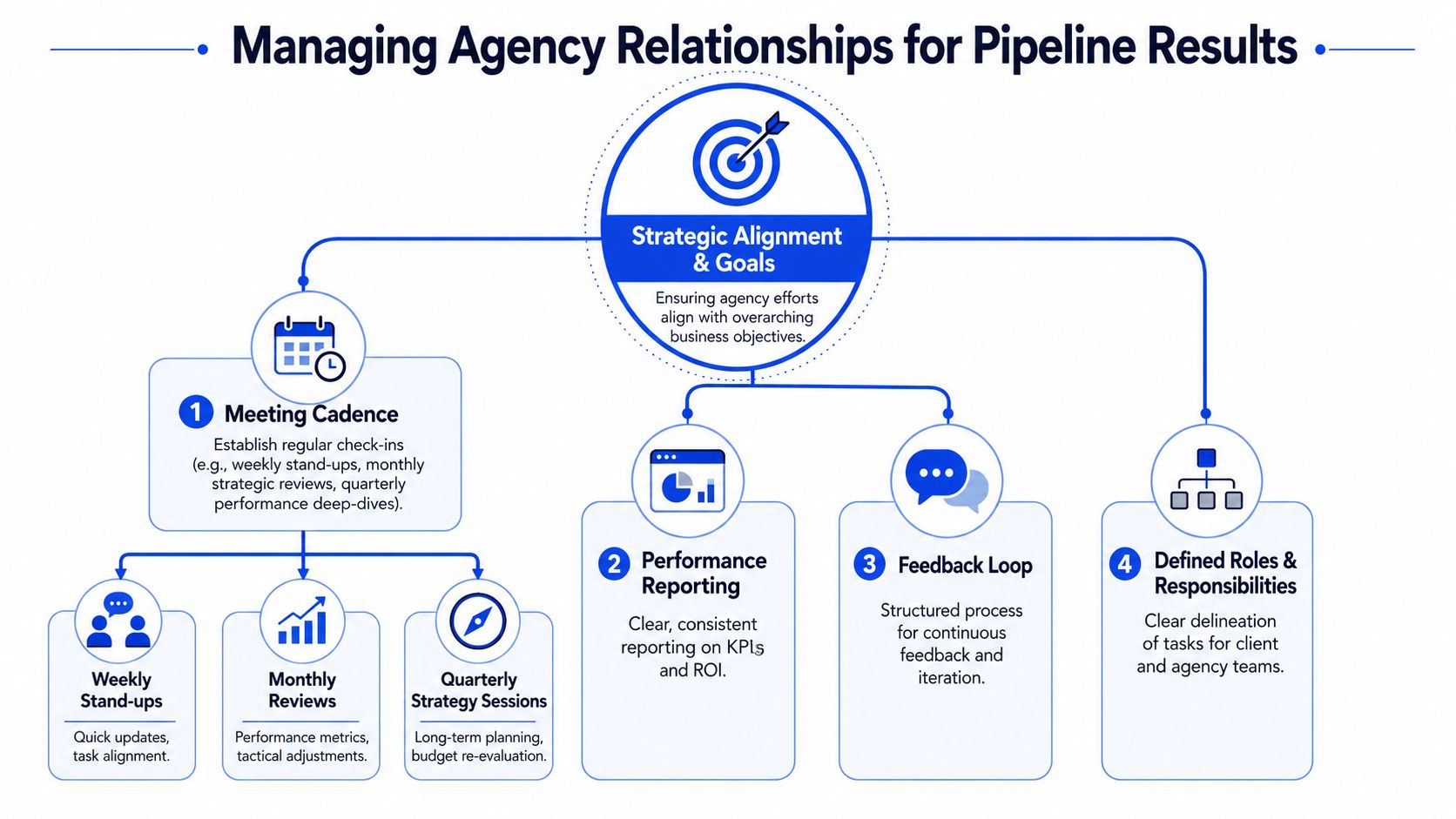
A clean 30-minute agenda looks like this:
Minutes 0 to 5: Review the shared dashboard, quickly.
Minutes 5 to 15: Discuss issues that need a decision.
Minutes 15 to 25: Confirm what ships next and who owns it.
Minutes 25 to 30: Capture blockers, approvals, and strategic changes.
The discipline matters more than the format.
Async prep is mandatory: If they show up and explain the numbers from scratch, they're wasting your time.
Written recap follows every call: Decisions, owners, due dates.
Live dashboard beats slides: Slides hide too much.
Cancel meetings with no decisions: Replace them with a written update.
If you're trying to fix a broken client-agency rhythm, this often starts with tighter sales and marketing alignment. Most reporting friction is really ownership friction.
Use five criteria for quarterly evaluation
Quarterly reviews should not ask whether the agency is “doing a good job.” That's too soft. Use five criteria and score each one.
Criterion | What to look for |
|---|---|
Business outcomes | Qualified meetings, pipeline value, closed revenue |
Signal layer maturity | Better targeting, better triggers, better message fit over time |
Communication quality | Problems flagged early, not after you notice them |
Team continuity | Same core operators still on the account |
Willingness to push back | They challenge bad requests with a better option |
The business context for this is already clear. Companies with active blogs generate 67% more leads monthly than those without, and 80% of B2B deals are won by the vendor a buyer favored before first contact, according to Salesgenie's content marketing statistics. That means content does influence pipeline before sales ever gets involved. It also means your agency must be judged by how well it shapes that pre-contact preference.
One more metric I'd insist on if the program includes blogs. A strong agency should drive a 25% blog-to-site navigation rate, where readers continue to other pages through embedded links, and top teams target a 3x improvement over the baseline B2B campaign conversion rate of 0.8% to 1.1%, based on First Page Sage's B2B content benchmarks. That metric is useful because it checks whether content is moving readers deeper into the buying path.
Good agencies don't just report what happened. They tell you what decision the data requires next.
Your next step to building a pipeline engine
If your current agency can't show the path from content to meetings, don't start with a vendor search. Start with an internal audit. You need to know whether the system is weak, the team is weak, or the measurement is weak.
Run a Friday audit on your current content
Take your last ten published assets, blog posts, founder posts, webinars, newsletters, whatever is central to your motion, and score each one against three questions:
Did this asset target a defined ICP and buying trigger
Did it push the reader into a next step, page path, or reply action
Did your CRM capture any downstream meeting, opportunity, or revenue signal
If you can't answer the third question for most assets, your issue isn't “content quality.” It's operating design.
Then review speed. Projection data from 2026 shows 72% of B2B buyers expect personalized, role-specific content within 48 hours of first contact, agencies using AI agents for persona alignment can deliver first qualified leads in under 30 days, and AEO now captures 40% of B2B search intent, according to The Growth Syndicate's agency guide. If your agency still treats content as a quarterly publishing calendar with no fast-turn response layer, it's behind.
Make one CRM change by Monday
Add one required property to every opportunity influenced by content or outbound. Call it content-assisted opportunity or warm-source asset. Force the owning rep to log the specific asset, post, or sequence that created familiarity before the meeting.
That one field changes behavior. Marketing starts thinking about downstream influence. Sales starts reporting what warmed the account. RevOps gets a cleaner view of content-assisted SQLs and pipeline.
If you need a wider operating model, review your current motion against a proper B2B demand generation system. The point isn't to publish more. The point is to turn structured attention into qualified conversations with less guesswork.
GROU is a global B2B pipeline agency working across iGaming, SaaS, manufacturing, legal tech, pharma, and other complex B2B markets. Our method is simple, structure turns attention into pipeline by connecting LinkedIn content, lead generation, outbound, and reporting inside one operating system.
If your current agency review is overdue, book one working session with Grou and bring three things, your last 90 days of content, your meeting-held data, and your CRM attribution fields. Use that session to inspect where attention stops and where pipeline should start.
Your content agency is publishing posts, your LinkedIn looks active, and sales still asks the same question every week, where are the qualified meetings? That gap usually comes from one mistake. You hired for content production, not pipeline construction.
Hire a B2B content marketing agency that owns pipeline contribution, not one that reports impressions and post volume.
Run a 6-step selection process, and take your time. Fast agency choices usually create slow cleanup.
Manage the engagement with decision-focused check-ins and quarterly evaluation, not recurring status theater.
Judge results by meetings, opportunities, revenue, and signal quality, because attention without structure doesn't become pipeline.
Table of Contents
What a pipeline-focused b2b content marketing agency actually does
Most agencies still act like content ends at publish. That's outdated. A real B2B content marketing agency should be accountable for what happens after attention shows up.
The market gap is obvious. Only 18% of top agencies track content performance to closed revenue via outbound, yet founder thought leadership on LinkedIn can lift inbound reply rates by 35% when paired with targeted outreach, based on The Starr Conspiracy's agency analysis. If your agency can't connect content to outbound, it isn't building pipeline. It's feeding a vanity dashboard.
Content is one layer of the engine
A pipeline-focused agency should run four connected motions:
Content strategy: Message map, buyer questions, proof themes, and channel roles.
Founder or executive LinkedIn content: Posts that build familiarity before outreach lands.
Signal-based outbound: Triggers from hiring, market movement, content engagement, and account activity.
Lead gen workflow: Routing replies, qualification rules, CRM tagging, and meeting handoff.
That system matters more in verticals like iGaming, SaaS, manufacturing, legal tech, and pharma, where buyers need trust before they book. Content isn't there to entertain. It's there to remove doubt.
Practical rule: If the agency starts with “how many posts do you want per month,” end the call.
The tool stack should also be concrete. I want to hear Apollo for account and contact coverage, Clay for enrichment and trigger building, Sales Navigator for persona targeting, Lemlist, Instantly, or Smartlead for outbound execution, and HubSpot for attribution and reply routing. For LinkedIn distribution, HeyReach is often part of the motion when teams need account-level sequencing.
If you're comparing adjacent channel specialists, a good B2B podcast marketing agency can make sense when executive content needs a long-form trust layer. Just don't confuse a distribution channel with a pipeline system.
The agency should connect attention to meetings
The operational question is simple. What happens when someone reads, watches, clicks, replies, or visits?
A serious agency maps that flow. Blog readers move into internal links, demo pages, or outbound retargeting lists. LinkedIn engagers get pulled into warm outbound sequences. Email replies route to the right AE with qualification notes already attached. Content performance gets read alongside meetings created, not instead of them.
This is why I prefer agencies that think like RevOps teams. If you want a reference point for that mindset, data-driven digital marketing agency models are closer to the truth than old-school content shops.
One option in this category is Grou. It runs LinkedIn content, outbound, and lead generation in one operating system, which is closer to how pipeline is built than channel-by-channel outsourcing.
A 6-step framework for selecting the right agency
Agency selection goes wrong before the first proposal lands. The buyer hasn't defined what the agency needs to do, so every pitch sounds plausible. That's why average agency evaluation feels noisy and why so many teams regret the choice later.
Start with business outcomes, not channels
Step 1 is a written one-pager. Before you speak with any agency, define what content must do for the business. Pipeline creation, founder authority, account warming for outbound, recruitment visibility, sales enablement, or a mix. If you skip this, you'll buy deliverables instead of outcomes.
That document should answer three things:
What business outcome matters most
Who the exact ICP is
What sales motion the content must support
For teams trying to find the right search marketing firm, the same rule applies. Start with the business problem, not the channel label.
Build a shortlist the right way
Step 2 is sourcing. Don't start with generic Google results. Agencies that rank for broad category terms are good at SEO. That doesn't prove they're good at pipeline. Better sources are peer referrals, trusted operator communities around Apollo, Clay, and Lemlist, and agencies whose client work you already notice in-market.
Step 3 is shortlist discipline. Narrow to 4 to 6 agencies for initial conversations. More than that creates decision fatigue. Fewer than that hides meaningful variation in quality and working style. The first call should be 30 minutes with a senior operator, not a long sales production.
A good initial call sounds like diligence. They should ask about ACV, sales cycle, current conversion points, content-to-meeting path, CRM hygiene, and founder availability. If the first half hour is mostly their deck, keep moving.
The kickoff conversation predicts the engagement better than the pitch polish does.
Inspect recent proof, then run a pilot
Step 4 is contextual proof. Ask one hard question: can you show me work for a company in our vertical, at our stage, with a similar ACV, from the last 12 months? Not adjacent. Not “we also work in B2B.” Recent and relevant.
For iGaming, SaaS, manufacturing, legal tech, and pharma, context matters because trigger logic, compliance language, and persona objections vary a lot. A generic agency can still produce clean copy. It usually can't produce predictable pipeline.
Step 5 is current-client diligence. Speak with 2 current clients, not polished references from years ago. Ask what works, what doesn't, where the agency pushes back, and whether they'd hire them again. The answer you're listening for isn't perfection. It's operational honesty.
Step 6 is a paid pilot. Run a small project before a full retainer. A strategy sprint, 3 to 5 posts, or a single campaign concept is enough to test process quality, speed, and communication. The pilot range I like is €1,500 to €5,000, because it's enough to produce real output without forcing a six-month commitment. That's a better filter than any proposal.
Retainers for specialist B2B SaaS agencies typically start at $8,000 to $15,000 per month, with a common media spend to agency fee ratio of 3:1 to 5:1, according to Jordan Digital Marketing's agency pricing review. That means a cheap pilot isn't about saving money. It's about reducing expensive misalignment.
If you need a reference for what a connected pipeline partner looks like beyond content alone, compare agencies against a proper lead generation agency model. The strongest content partners increasingly look like that.
Red flags that signal a bad agency fit
Most bad agency decisions don't come from hidden fraud. They come from predictable buyer errors. You looked at the wrong signals.
Cheap usually means expensive later
The first red flag is selection by price alone. Cheap agencies usually sell output volume because they can't sell commercial thinking. You'll get posts, maybe blogs, maybe a monthly report. What you won't get is a structured path from attention to qualified conversation.
The second red flag is buying agency size. Bigger doesn't mean better. Smaller doesn't mean more senior. What matters is the exact team on your account, how stable it is, and whether the people in the sale are the people in delivery.
Use this quick screen before a second meeting:
Ask who will do the work: Get names, roles, and actual involvement.
Ask how they report pipeline: If they stay at traffic and engagement, that's the warning.
Ask how they handle pushback: Agencies that agree with everything are dangerous.
Ask what happens in the first 30 days: Vague answers usually mean vague operations.
Decks, RFPs, and chemistry can fool you
Glossy decks are often a proxy for marketing skill, not delivery quality. Strong visual storytelling is useful, but it doesn't tell you whether they can structure a CRM property, build a trigger list in Clay, or route warm replies to SDRs inside HubSpot.
Standardized RFPs have the same problem. They reward agencies that are good at filling templates. They don't reward the team most likely to generate meetings. If you already know your requirements, use them to guide a live working session instead.
A short video discussion on agency evaluation can help your team align before vendor calls:
Initial chemistry is the last trap. The salesperson isn't always the operator. If you love the sales lead but never meet the strategist, account lead, or outbound specialist, you're buying the wrong person.
If an agency pressures you for a quick yes, assume they don't want the work inspected closely.
The agencies worth hiring usually tolerate scrutiny well. They don't panic when you ask for current clients, real workflows, or a paid pilot. They expect that level of diligence.
What real pipeline results look like with numbers
Most agency content about “results” is useless because it shows soft metrics or hides the cost side. Real evaluation needs spend, meetings, opportunities, closed revenue, and context.
An 8-month iGaming campaign with real revenue impact
Here is a real campaign structure from a B2B SaaS company in the iGaming compliance space. The company had roughly 50 employees, sold to compliance and risk leaders, and had an average ACV of roughly €80k.
The campaign ran for 8 months and combined founder LinkedIn content, outbound across LinkedIn and email, and paid LinkedIn amplification around ICE Barcelona as the market anchor.
Performance looked like this:
Total agency spend: roughly €92,800
Qualified meetings booked: 134
Qualified opportunities created: 67
Closed-won deals during the engagement: 11
Additional closed-won deals in the 4 months after the engagement: 4
Total closed revenue attributable: roughly €1.24M ARR across 15 deals
Pipeline still active at the end of the engagement: roughly €620k
Direct ROI: roughly 13.4x
Total ROI including late-stage pipeline at expected close rates: roughly 16.2x
LinkedIn-specific and outbound-specific signals also mattered:
Area | Result |
|---|---|
Founder audience | 1,200 followers to 4,800 |
ICP-fit inbound DMs | 1 to 2 per month to 14 to 18 per month |
Outbound blended reply rate | 14.2% |
End-to-end meeting conversion | 4.7% |
Average sales cycle on outbound-sourced deals | 42 days |
That result was not normal. It was a top performer, and the reasons were structural. The ACV was high. The founder posted 3 times per week. The vertical had clean buying signals around regulation. The event anchor forced decisions. The internal sales team followed up fast.
High ROI from content-plus-outbound usually says as much about the client system as the agency system.
What a strong but more typical result looks like
A more typical strong result looked like this: B2B SaaS client, roughly €35k average ACV, 6-month engagement, roughly €46k total spend, 78 qualified meetings, 6 closed deals, roughly €210k closed revenue, roughly 4.6x direct ROI, and roughly €180k in active pipeline expected to close at 30% probability, which brought adjusted ROI to roughly 5.8x.
That's the benchmark range I trust more. Strong work often lands in the 4 to 6x range over six months when attribution is handled accurately and the sales team can convert what marketing creates.
For broader context, the average 2025 ROI for content marketing was $7.65 for every $1 spent, and organic traffic converts at a 2.8x higher rate than paid traffic, according to Omnibound's B2B content marketing statistics. That doesn't mean your agency will hit that exact return. It means content can be commercially strong when distribution, outbound, and conversion paths are in place.
When you review agency performance, pair campaign numbers with a clear lead generation KPI framework. Otherwise you'll end up debating activity instead of commercial output.
How to manage the agency relationship for results
A good agency can still fail inside a bad operating cadence. Most weekly check-ins are too long, too broad, and too polite. They drift into status updates because nobody set them up as decision forums.
Run shorter meetings with decisions on the agenda
The structure I recommend is simple. Weekly during the first 60 days, then bi-weekly for most mature engagements. Keep the call to 30 to 45 minutes, never 60 by default. Use video, shared dashboards, and an agenda sent 24 hours in advance.
A clean 30-minute agenda looks like this:
Minutes 0 to 5: Review the shared dashboard, quickly.
Minutes 5 to 15: Discuss issues that need a decision.
Minutes 15 to 25: Confirm what ships next and who owns it.
Minutes 25 to 30: Capture blockers, approvals, and strategic changes.
The discipline matters more than the format.
Async prep is mandatory: If they show up and explain the numbers from scratch, they're wasting your time.
Written recap follows every call: Decisions, owners, due dates.
Live dashboard beats slides: Slides hide too much.
Cancel meetings with no decisions: Replace them with a written update.
If you're trying to fix a broken client-agency rhythm, this often starts with tighter sales and marketing alignment. Most reporting friction is really ownership friction.
Use five criteria for quarterly evaluation
Quarterly reviews should not ask whether the agency is “doing a good job.” That's too soft. Use five criteria and score each one.
Criterion | What to look for |
|---|---|
Business outcomes | Qualified meetings, pipeline value, closed revenue |
Signal layer maturity | Better targeting, better triggers, better message fit over time |
Communication quality | Problems flagged early, not after you notice them |
Team continuity | Same core operators still on the account |
Willingness to push back | They challenge bad requests with a better option |
The business context for this is already clear. Companies with active blogs generate 67% more leads monthly than those without, and 80% of B2B deals are won by the vendor a buyer favored before first contact, according to Salesgenie's content marketing statistics. That means content does influence pipeline before sales ever gets involved. It also means your agency must be judged by how well it shapes that pre-contact preference.
One more metric I'd insist on if the program includes blogs. A strong agency should drive a 25% blog-to-site navigation rate, where readers continue to other pages through embedded links, and top teams target a 3x improvement over the baseline B2B campaign conversion rate of 0.8% to 1.1%, based on First Page Sage's B2B content benchmarks. That metric is useful because it checks whether content is moving readers deeper into the buying path.
Good agencies don't just report what happened. They tell you what decision the data requires next.
Your next step to building a pipeline engine
If your current agency can't show the path from content to meetings, don't start with a vendor search. Start with an internal audit. You need to know whether the system is weak, the team is weak, or the measurement is weak.
Run a Friday audit on your current content
Take your last ten published assets, blog posts, founder posts, webinars, newsletters, whatever is central to your motion, and score each one against three questions:
Did this asset target a defined ICP and buying trigger
Did it push the reader into a next step, page path, or reply action
Did your CRM capture any downstream meeting, opportunity, or revenue signal
If you can't answer the third question for most assets, your issue isn't “content quality.” It's operating design.
Then review speed. Projection data from 2026 shows 72% of B2B buyers expect personalized, role-specific content within 48 hours of first contact, agencies using AI agents for persona alignment can deliver first qualified leads in under 30 days, and AEO now captures 40% of B2B search intent, according to The Growth Syndicate's agency guide. If your agency still treats content as a quarterly publishing calendar with no fast-turn response layer, it's behind.
Make one CRM change by Monday
Add one required property to every opportunity influenced by content or outbound. Call it content-assisted opportunity or warm-source asset. Force the owning rep to log the specific asset, post, or sequence that created familiarity before the meeting.
That one field changes behavior. Marketing starts thinking about downstream influence. Sales starts reporting what warmed the account. RevOps gets a cleaner view of content-assisted SQLs and pipeline.
If you need a wider operating model, review your current motion against a proper B2B demand generation system. The point isn't to publish more. The point is to turn structured attention into qualified conversations with less guesswork.
GROU is a global B2B pipeline agency working across iGaming, SaaS, manufacturing, legal tech, pharma, and other complex B2B markets. Our method is simple, structure turns attention into pipeline by connecting LinkedIn content, lead generation, outbound, and reporting inside one operating system.
If your current agency review is overdue, book one working session with Grou and bring three things, your last 90 days of content, your meeting-held data, and your CRM attribution fields. Use that session to inspect where attention stops and where pipeline should start.
Your content agency is publishing posts, your LinkedIn looks active, and sales still asks the same question every week, where are the qualified meetings? That gap usually comes from one mistake. You hired for content production, not pipeline construction.
Hire a B2B content marketing agency that owns pipeline contribution, not one that reports impressions and post volume.
Run a 6-step selection process, and take your time. Fast agency choices usually create slow cleanup.
Manage the engagement with decision-focused check-ins and quarterly evaluation, not recurring status theater.
Judge results by meetings, opportunities, revenue, and signal quality, because attention without structure doesn't become pipeline.
Table of Contents
What a pipeline-focused b2b content marketing agency actually does
Most agencies still act like content ends at publish. That's outdated. A real B2B content marketing agency should be accountable for what happens after attention shows up.
The market gap is obvious. Only 18% of top agencies track content performance to closed revenue via outbound, yet founder thought leadership on LinkedIn can lift inbound reply rates by 35% when paired with targeted outreach, based on The Starr Conspiracy's agency analysis. If your agency can't connect content to outbound, it isn't building pipeline. It's feeding a vanity dashboard.
Content is one layer of the engine
A pipeline-focused agency should run four connected motions:
Content strategy: Message map, buyer questions, proof themes, and channel roles.
Founder or executive LinkedIn content: Posts that build familiarity before outreach lands.
Signal-based outbound: Triggers from hiring, market movement, content engagement, and account activity.
Lead gen workflow: Routing replies, qualification rules, CRM tagging, and meeting handoff.
That system matters more in verticals like iGaming, SaaS, manufacturing, legal tech, and pharma, where buyers need trust before they book. Content isn't there to entertain. It's there to remove doubt.
Practical rule: If the agency starts with “how many posts do you want per month,” end the call.
The tool stack should also be concrete. I want to hear Apollo for account and contact coverage, Clay for enrichment and trigger building, Sales Navigator for persona targeting, Lemlist, Instantly, or Smartlead for outbound execution, and HubSpot for attribution and reply routing. For LinkedIn distribution, HeyReach is often part of the motion when teams need account-level sequencing.
If you're comparing adjacent channel specialists, a good B2B podcast marketing agency can make sense when executive content needs a long-form trust layer. Just don't confuse a distribution channel with a pipeline system.
The agency should connect attention to meetings
The operational question is simple. What happens when someone reads, watches, clicks, replies, or visits?
A serious agency maps that flow. Blog readers move into internal links, demo pages, or outbound retargeting lists. LinkedIn engagers get pulled into warm outbound sequences. Email replies route to the right AE with qualification notes already attached. Content performance gets read alongside meetings created, not instead of them.
This is why I prefer agencies that think like RevOps teams. If you want a reference point for that mindset, data-driven digital marketing agency models are closer to the truth than old-school content shops.
One option in this category is Grou. It runs LinkedIn content, outbound, and lead generation in one operating system, which is closer to how pipeline is built than channel-by-channel outsourcing.
A 6-step framework for selecting the right agency
Agency selection goes wrong before the first proposal lands. The buyer hasn't defined what the agency needs to do, so every pitch sounds plausible. That's why average agency evaluation feels noisy and why so many teams regret the choice later.
Start with business outcomes, not channels
Step 1 is a written one-pager. Before you speak with any agency, define what content must do for the business. Pipeline creation, founder authority, account warming for outbound, recruitment visibility, sales enablement, or a mix. If you skip this, you'll buy deliverables instead of outcomes.
That document should answer three things:
What business outcome matters most
Who the exact ICP is
What sales motion the content must support
For teams trying to find the right search marketing firm, the same rule applies. Start with the business problem, not the channel label.
Build a shortlist the right way
Step 2 is sourcing. Don't start with generic Google results. Agencies that rank for broad category terms are good at SEO. That doesn't prove they're good at pipeline. Better sources are peer referrals, trusted operator communities around Apollo, Clay, and Lemlist, and agencies whose client work you already notice in-market.
Step 3 is shortlist discipline. Narrow to 4 to 6 agencies for initial conversations. More than that creates decision fatigue. Fewer than that hides meaningful variation in quality and working style. The first call should be 30 minutes with a senior operator, not a long sales production.
A good initial call sounds like diligence. They should ask about ACV, sales cycle, current conversion points, content-to-meeting path, CRM hygiene, and founder availability. If the first half hour is mostly their deck, keep moving.
The kickoff conversation predicts the engagement better than the pitch polish does.
Inspect recent proof, then run a pilot
Step 4 is contextual proof. Ask one hard question: can you show me work for a company in our vertical, at our stage, with a similar ACV, from the last 12 months? Not adjacent. Not “we also work in B2B.” Recent and relevant.
For iGaming, SaaS, manufacturing, legal tech, and pharma, context matters because trigger logic, compliance language, and persona objections vary a lot. A generic agency can still produce clean copy. It usually can't produce predictable pipeline.
Step 5 is current-client diligence. Speak with 2 current clients, not polished references from years ago. Ask what works, what doesn't, where the agency pushes back, and whether they'd hire them again. The answer you're listening for isn't perfection. It's operational honesty.
Step 6 is a paid pilot. Run a small project before a full retainer. A strategy sprint, 3 to 5 posts, or a single campaign concept is enough to test process quality, speed, and communication. The pilot range I like is €1,500 to €5,000, because it's enough to produce real output without forcing a six-month commitment. That's a better filter than any proposal.
Retainers for specialist B2B SaaS agencies typically start at $8,000 to $15,000 per month, with a common media spend to agency fee ratio of 3:1 to 5:1, according to Jordan Digital Marketing's agency pricing review. That means a cheap pilot isn't about saving money. It's about reducing expensive misalignment.
If you need a reference for what a connected pipeline partner looks like beyond content alone, compare agencies against a proper lead generation agency model. The strongest content partners increasingly look like that.
Red flags that signal a bad agency fit
Most bad agency decisions don't come from hidden fraud. They come from predictable buyer errors. You looked at the wrong signals.
Cheap usually means expensive later
The first red flag is selection by price alone. Cheap agencies usually sell output volume because they can't sell commercial thinking. You'll get posts, maybe blogs, maybe a monthly report. What you won't get is a structured path from attention to qualified conversation.
The second red flag is buying agency size. Bigger doesn't mean better. Smaller doesn't mean more senior. What matters is the exact team on your account, how stable it is, and whether the people in the sale are the people in delivery.
Use this quick screen before a second meeting:
Ask who will do the work: Get names, roles, and actual involvement.
Ask how they report pipeline: If they stay at traffic and engagement, that's the warning.
Ask how they handle pushback: Agencies that agree with everything are dangerous.
Ask what happens in the first 30 days: Vague answers usually mean vague operations.
Decks, RFPs, and chemistry can fool you
Glossy decks are often a proxy for marketing skill, not delivery quality. Strong visual storytelling is useful, but it doesn't tell you whether they can structure a CRM property, build a trigger list in Clay, or route warm replies to SDRs inside HubSpot.
Standardized RFPs have the same problem. They reward agencies that are good at filling templates. They don't reward the team most likely to generate meetings. If you already know your requirements, use them to guide a live working session instead.
A short video discussion on agency evaluation can help your team align before vendor calls:
Initial chemistry is the last trap. The salesperson isn't always the operator. If you love the sales lead but never meet the strategist, account lead, or outbound specialist, you're buying the wrong person.
If an agency pressures you for a quick yes, assume they don't want the work inspected closely.
The agencies worth hiring usually tolerate scrutiny well. They don't panic when you ask for current clients, real workflows, or a paid pilot. They expect that level of diligence.
What real pipeline results look like with numbers
Most agency content about “results” is useless because it shows soft metrics or hides the cost side. Real evaluation needs spend, meetings, opportunities, closed revenue, and context.
An 8-month iGaming campaign with real revenue impact
Here is a real campaign structure from a B2B SaaS company in the iGaming compliance space. The company had roughly 50 employees, sold to compliance and risk leaders, and had an average ACV of roughly €80k.
The campaign ran for 8 months and combined founder LinkedIn content, outbound across LinkedIn and email, and paid LinkedIn amplification around ICE Barcelona as the market anchor.
Performance looked like this:
Total agency spend: roughly €92,800
Qualified meetings booked: 134
Qualified opportunities created: 67
Closed-won deals during the engagement: 11
Additional closed-won deals in the 4 months after the engagement: 4
Total closed revenue attributable: roughly €1.24M ARR across 15 deals
Pipeline still active at the end of the engagement: roughly €620k
Direct ROI: roughly 13.4x
Total ROI including late-stage pipeline at expected close rates: roughly 16.2x
LinkedIn-specific and outbound-specific signals also mattered:
Area | Result |
|---|---|
Founder audience | 1,200 followers to 4,800 |
ICP-fit inbound DMs | 1 to 2 per month to 14 to 18 per month |
Outbound blended reply rate | 14.2% |
End-to-end meeting conversion | 4.7% |
Average sales cycle on outbound-sourced deals | 42 days |
That result was not normal. It was a top performer, and the reasons were structural. The ACV was high. The founder posted 3 times per week. The vertical had clean buying signals around regulation. The event anchor forced decisions. The internal sales team followed up fast.
High ROI from content-plus-outbound usually says as much about the client system as the agency system.
What a strong but more typical result looks like
A more typical strong result looked like this: B2B SaaS client, roughly €35k average ACV, 6-month engagement, roughly €46k total spend, 78 qualified meetings, 6 closed deals, roughly €210k closed revenue, roughly 4.6x direct ROI, and roughly €180k in active pipeline expected to close at 30% probability, which brought adjusted ROI to roughly 5.8x.
That's the benchmark range I trust more. Strong work often lands in the 4 to 6x range over six months when attribution is handled accurately and the sales team can convert what marketing creates.
For broader context, the average 2025 ROI for content marketing was $7.65 for every $1 spent, and organic traffic converts at a 2.8x higher rate than paid traffic, according to Omnibound's B2B content marketing statistics. That doesn't mean your agency will hit that exact return. It means content can be commercially strong when distribution, outbound, and conversion paths are in place.
When you review agency performance, pair campaign numbers with a clear lead generation KPI framework. Otherwise you'll end up debating activity instead of commercial output.
How to manage the agency relationship for results
A good agency can still fail inside a bad operating cadence. Most weekly check-ins are too long, too broad, and too polite. They drift into status updates because nobody set them up as decision forums.
Run shorter meetings with decisions on the agenda
The structure I recommend is simple. Weekly during the first 60 days, then bi-weekly for most mature engagements. Keep the call to 30 to 45 minutes, never 60 by default. Use video, shared dashboards, and an agenda sent 24 hours in advance.
A clean 30-minute agenda looks like this:
Minutes 0 to 5: Review the shared dashboard, quickly.
Minutes 5 to 15: Discuss issues that need a decision.
Minutes 15 to 25: Confirm what ships next and who owns it.
Minutes 25 to 30: Capture blockers, approvals, and strategic changes.
The discipline matters more than the format.
Async prep is mandatory: If they show up and explain the numbers from scratch, they're wasting your time.
Written recap follows every call: Decisions, owners, due dates.
Live dashboard beats slides: Slides hide too much.
Cancel meetings with no decisions: Replace them with a written update.
If you're trying to fix a broken client-agency rhythm, this often starts with tighter sales and marketing alignment. Most reporting friction is really ownership friction.
Use five criteria for quarterly evaluation
Quarterly reviews should not ask whether the agency is “doing a good job.” That's too soft. Use five criteria and score each one.
Criterion | What to look for |
|---|---|
Business outcomes | Qualified meetings, pipeline value, closed revenue |
Signal layer maturity | Better targeting, better triggers, better message fit over time |
Communication quality | Problems flagged early, not after you notice them |
Team continuity | Same core operators still on the account |
Willingness to push back | They challenge bad requests with a better option |
The business context for this is already clear. Companies with active blogs generate 67% more leads monthly than those without, and 80% of B2B deals are won by the vendor a buyer favored before first contact, according to Salesgenie's content marketing statistics. That means content does influence pipeline before sales ever gets involved. It also means your agency must be judged by how well it shapes that pre-contact preference.
One more metric I'd insist on if the program includes blogs. A strong agency should drive a 25% blog-to-site navigation rate, where readers continue to other pages through embedded links, and top teams target a 3x improvement over the baseline B2B campaign conversion rate of 0.8% to 1.1%, based on First Page Sage's B2B content benchmarks. That metric is useful because it checks whether content is moving readers deeper into the buying path.
Good agencies don't just report what happened. They tell you what decision the data requires next.
Your next step to building a pipeline engine
If your current agency can't show the path from content to meetings, don't start with a vendor search. Start with an internal audit. You need to know whether the system is weak, the team is weak, or the measurement is weak.
Run a Friday audit on your current content
Take your last ten published assets, blog posts, founder posts, webinars, newsletters, whatever is central to your motion, and score each one against three questions:
Did this asset target a defined ICP and buying trigger
Did it push the reader into a next step, page path, or reply action
Did your CRM capture any downstream meeting, opportunity, or revenue signal
If you can't answer the third question for most assets, your issue isn't “content quality.” It's operating design.
Then review speed. Projection data from 2026 shows 72% of B2B buyers expect personalized, role-specific content within 48 hours of first contact, agencies using AI agents for persona alignment can deliver first qualified leads in under 30 days, and AEO now captures 40% of B2B search intent, according to The Growth Syndicate's agency guide. If your agency still treats content as a quarterly publishing calendar with no fast-turn response layer, it's behind.
Make one CRM change by Monday
Add one required property to every opportunity influenced by content or outbound. Call it content-assisted opportunity or warm-source asset. Force the owning rep to log the specific asset, post, or sequence that created familiarity before the meeting.
That one field changes behavior. Marketing starts thinking about downstream influence. Sales starts reporting what warmed the account. RevOps gets a cleaner view of content-assisted SQLs and pipeline.
If you need a wider operating model, review your current motion against a proper B2B demand generation system. The point isn't to publish more. The point is to turn structured attention into qualified conversations with less guesswork.
GROU is a global B2B pipeline agency working across iGaming, SaaS, manufacturing, legal tech, pharma, and other complex B2B markets. Our method is simple, structure turns attention into pipeline by connecting LinkedIn content, lead generation, outbound, and reporting inside one operating system.
If your current agency review is overdue, book one working session with Grou and bring three things, your last 90 days of content, your meeting-held data, and your CRM attribution fields. Use that session to inspect where attention stops and where pipeline should start.
Pipeline OS Newsletter
Build qualified pipeline
Get weekly tactics to generate demand, improve lead quality, and book more meetings.







Trusted by industry leaders
Trusted by industry leaders
Trusted by industry leaders
Ready to build qualified pipeline?
Ready to build qualified pipeline?
Ready to build qualified pipeline?
Book a call to see if we're the right fit, or take the 2-minute quiz to get a clear starting point.
Book a call to see if we're the right fit, or take the 2-minute quiz to get a clear starting point.
Book a call to see if we're the right fit, or take the 2-minute quiz to get a clear starting point.
" height="30.21639343089746px" id="hfGbXmQR2" width="30.216393430897455px"/></svg>)
Copyright © 2026 – All Right Reserved
Copyright © 2026 – All Right Reserved
Copyright © 2026 – All Right Reserved