%22%3E%3C/path%3E%3Cpath d=%22M 63.072 7.554 C 62.258 8.022 61.577 8.689 61.092 9.493 L 61.092 7.076 L 57.158 7.076 L 57.158 22.64 L 61.089 22.64 L 61.089 14.888 C 61.089 13.446 61.403 12.434 62.03 11.853 C 62.818 11.218 63.818 10.907 64.826 10.982 L 65.868 10.982 L 65.868 6.851 C 64.891 6.834 63.926 7.076 63.073 7.554 Z%22 fill=%22rgb(17,17,17)%22%3E%3C/path%3E%3Cpath d=%22M 78.916 7.82 C 76.363 6.49 73.321 6.49 70.768 7.82 C 69.562 8.473 68.564 9.451 67.888 10.644 C 67.167 11.931 66.803 13.387 66.834 14.862 C 66.804 16.332 67.157 17.785 67.86 19.077 C 68.515 20.267 69.494 21.246 70.684 21.901 C 71.924 22.576 73.318 22.92 74.73 22.898 C 76.164 22.918 77.58 22.575 78.846 21.901 C 80.062 21.247 81.073 20.27 81.768 19.077 C 82.506 17.797 82.88 16.339 82.85 14.862 C 82.88 13.389 82.517 11.934 81.797 10.647 C 81.12 9.455 80.122 8.477 78.917 7.824 M 78.803 14.862 C 78.829 15.739 78.636 16.608 78.241 17.391 C 77.903 18.046 77.38 18.588 76.738 18.95 C 76.124 19.293 75.432 19.472 74.729 19.47 C 73.668 19.497 72.648 19.061 71.934 18.276 C 71.139 17.323 70.741 16.1 70.823 14.862 C 70.741 13.62 71.149 12.395 71.959 11.45 C 72.687 10.667 73.715 10.233 74.783 10.256 C 75.859 10.236 76.894 10.67 77.635 11.45 C 78.464 12.387 78.884 13.616 78.801 14.864%22 fill=%22rgb(17,17,17)%22%3E%3C/path%3E%3Cpath d=%22M 95.906 7.076 L 95.906 15.646 C 95.975 16.68 95.643 17.701 94.979 18.498 C 94.311 19.184 93.379 19.547 92.422 19.495 C 91.475 19.544 90.553 19.18 89.894 18.498 C 89.23 17.701 88.898 16.68 88.967 15.646 L 88.967 7.076 L 85.033 7.076 L 85.033 16.207 C 85 17.449 85.275 18.68 85.834 19.79 C 86.327 20.75 87.095 21.542 88.039 22.065 C 89.033 22.594 90.145 22.861 91.271 22.838 C 92.188 22.847 93.095 22.65 93.926 22.263 C 94.708 21.905 95.388 21.36 95.906 20.675 L 95.906 22.645 L 99.865 22.645 L 99.865 7.076 Z%22 fill=%22rgb(17,17,17)%22%3E%3C/path%3E%3Cpath d=%22M 4.513 15.626 C 4.511 10.815 7.606 6.549 12.181 5.059 C 16.756 3.57 21.77 5.195 24.601 9.086 L 27.816 5.87 C 24.074 1.186 17.981 -0.943 12.137 0.393 C 6.292 1.728 1.728 6.292 0.393 12.137 C -0.943 17.981 1.186 24.074 5.87 27.816 L 9.085 24.601 C 6.214 22.512 4.515 19.177 4.513 15.626%22 fill=%22rgb(32,62,235)%22%3E%3C/path%3E%3Cpath d=%22M 17.114 14.343 L 13.354 18.01 L 13.354 18.026 L 21.071 18.026 L 11.412 27.609 L 17.389 27.609 L 23.999 21.081 L 23.999 28.316 L 24.005 28.316 L 27.967 24.393 L 27.967 14.343 Z%22 fill=%22rgb(32,62,235)%22%3E%3C/path%3E%3C/g%3E%3C/svg%3E) ×
× ××
××›
›
›
›
B2B demand generation: The pipeline engine playbook
B2B demand generation: The pipeline engine playbook
B2B demand generation: The pipeline engine playbook
B2B demand generation: The pipeline engine playbook
B2B demand generation: The pipeline engine playbook
B2B demand generation: The pipeline engine playbook

Author
Aljaz Peklaj

Most advice on b2b demand generation gets one thing wrong. It treats demand gen as a prettier label for lead gen, then wonders why pipeline stays fragile, conversations start cold, and every deal turns into a pricing discussion.
That confusion costs real revenue. If you're only harvesting people already in-market, you're competing at the most crowded point of the buyer journey. If you're only publishing content and waiting for inbound, you're building audience without a capture system. Predictable pipeline needs both motions, planted and harvested, tied together by one operating model.
TL;DR
Demand gen and lead gen are different jobs. Demand gen plants awareness and preference. Lead gen harvests existing intent into meetings and opportunities.
The handoff needs a system. LinkedIn content, outbound, CRM, enrichment, and reply routing should work as one motion, not as separate channel teams.
Measure planting with planting metrics. Revenue matters, but CPL and last-touch attribution will kill a good demand program before it compounds.
Start with latent demand first. The fastest early win usually comes from activating credibility you already have in the market, then building the longer compounding layer around it.
Table of Contents
The most expensive mistake in B2B marketing
The expensive mistake isn't poor creative, weak SDRs, or low ad spend. It's calling a harvest motion a planting motion, then judging the whole pipeline by the wrong expectation.
A lot of teams say they want demand gen, but what they buy is outbound, paid lead capture, and retargeting. That's lead gen. Useful, necessary, often profitable. But it's still a capture system aimed at people who already feel the problem.
Demand gen is different. It builds recognition, trust, and category understanding before the buyer asks for a demo. It shapes what the market believes, so that when a real buying window opens, your name is already in the consideration set.
Why this confusion gets expensive fast
If you treat lead gen as demand gen, every meeting starts colder than it should. Reps spend the first call educating instead of qualifying. Deals become more price-sensitive because the buyer doesn't yet understand why your way of solving the problem is different.
If you treat demand gen as lead gen, you'll shut it down too early. You'll look at MQL volume, ask why content isn't producing instant demos, and cut the one thing that was warming future pipeline.
Practical rule: Lead gen asks who is ready now. Demand gen decides who thinks of you later.
The fix isn't philosophical. It's operational.
Split the motions clearly → one team or workflow plants, another harvests, both use the same ICP and message map
Connect them directly → content engagement should change outbound priority, sequencing, and sales follow-up
Use different scorecards → meetings and pipeline for harvest, warmer inbound and branded demand signals for planting
Activate latent demand first → if your founder, sales team, or customer base already has market credibility, use that before trying to manufacture attention from zero
Most stalled pipelines don't need more random activity. They need cleaner architecture.
Demand gen vs lead gen an operator's definition
Most definitions of demand gen vs lead gen are too abstract to be useful. Operators need a cleaner split.
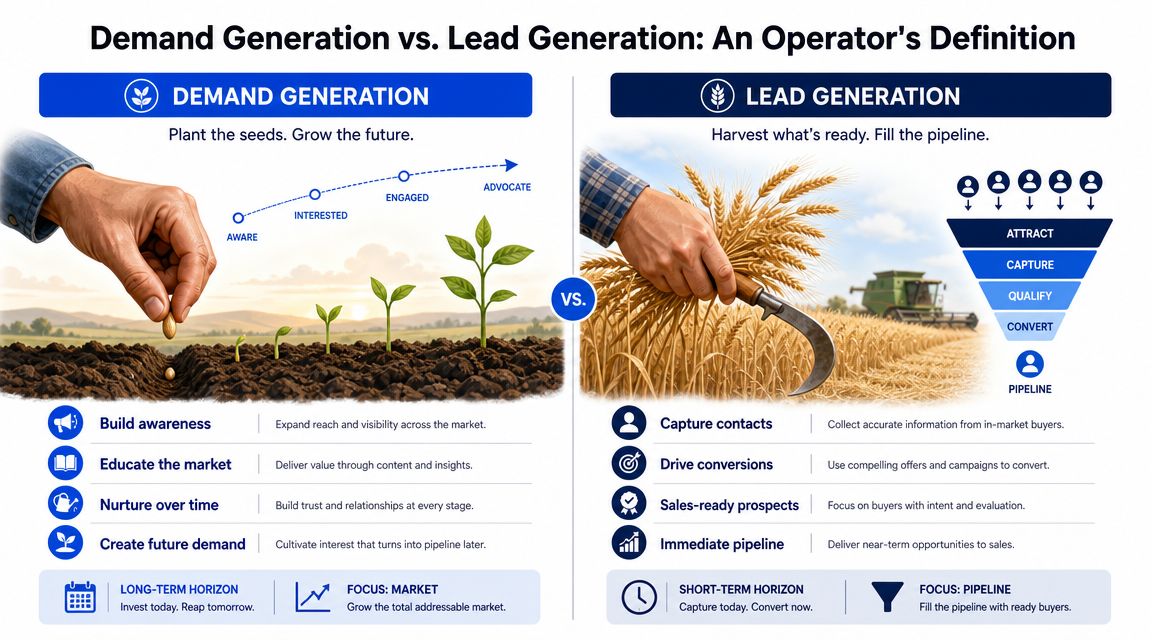
Demand gen is planting. You put ideas into the market that help buyers name a problem, understand its cost, and trust your perspective before they start a vendor search.
Lead gen is harvesting. You find the people already close to action and move them into a conversation, a meeting, and a qualified opportunity.
Two motions, two outputs
Demand gen produces market readiness. The output isn't a lead record. It's a buyer who has seen your thinking on LinkedIn, heard you on a podcast, read your newsletter, and arrives already oriented to your framing.
Lead gen produces contact conversion. The output is much tighter, a reply, a booked call, a hand-raiser, a qualified thread in HubSpot, Salesforce, or another CRM.
A useful way to frame the split:
Motion | Job | Common channels | Feedback loop | Primary output |
|---|---|---|---|---|
Demand gen | Plant awareness and preference | LinkedIn content, founder brand, newsletters, podcasts, webinars | Months | Warmer market |
Lead gen | Capture existing intent | Outbound email, LinkedIn outreach, paid lead capture, retargeting | Days to weeks | Meetings and pipeline |
That channel split also matches what the market already shows. In a 2025 summary, content marketing was cited as the most effective demand generation strategy by 83% of B2B marketers, and LinkedIn drives 80% of B2B leads according to The Insight Collective's demand generation statistics. That tells you where planting and harvesting naturally meet.
Where most teams break it
They separate these motions by team, by tool, and by reporting line. Marketing publishes content with no route into sales action. Sales runs Apollo or Sales Navigator lists with no awareness of who has already engaged with the brand.
That split creates two bad outcomes:
Cold harvesting where outreach lands on the right accounts with no prior trust
Uncaptured planting where engaged buyers like posts, read content, then disappear because no one acted
If you want a broader primer on the category itself, Fame's piece on effective demand gen marketing is a useful external read. For the operational distinction we use in practice, this breakdown of demand generation vs lead generation is the cleaner frame.
How to build your demand generation channels
Most companies don't have a channel problem. They have a consistency problem and a message problem.
The strongest demand channels in B2B are usually not the flashiest ones. They are the channels your buyers already use to evaluate credibility, especially founder LinkedIn content, a newsletter with a clear point of view, and selective podcast appearances or hosted conversations.
Start with three content pillars
Don't start with formats. Start with the three topics your market will trust you to own.
A practical set usually looks like this:
The buyer problem
Name the operational pain in plain language. For a legal tech company, that might be slow intake, poor matter visibility, or low adoption after implementation.The broken default Explain why the usual fix doesn't work. Strong content then earns attention. Not because it's louder, because it gives buyers a better diagnosis.
The practical path forward
Show the workflow, not just the opinion. Buyers trust specificity. If you say outreach should be signal-based, show the trigger, the routing rule, and the message change.
Good demand content doesn't try to close. It helps the right buyer say, "that's exactly the problem we're dealing with."
For deeper guidance on turning those ideas into assets, this B2B content marketing guide is a useful companion.
Build a simple publishing stack
You do not need a bloated MarTech setup to start. You need a stack that helps one idea move across multiple surfaces without creating admin drag.
A practical version:
LinkedIn for founder and executive posts
HubSpot to capture inbound, tag self-reported attribution, and log contact history
beehiiv or HubSpot email for the newsletter
Notion or Airtable for editorial planning
Canva or Figma for simple visual formatting
Sales Navigator to monitor target accounts and buyer movement
If you're publishing three founder posts a week, one newsletter every one or two weeks, and repurposing podcast or sales-call insights into those formats, that's enough to build signal. Teams often fail because they overbuild before they outpublish.
What good founder-led content looks like
The best B2B LinkedIn posts usually follow one of three structures.
Strong opinion plus evidence
Example shape → "Most demand gen programs fail because they publish without a capture system." Then explain the workflow behind the claim.Observed mistake plus correction Example shape → "Teams track post likes and miss the buyers who later visit the site unobserved." Then show what to track instead.
Client pattern without fabricated detail
Example shape → "In SaaS and manufacturing, the same issue shows up. Sales gets a list, marketing gets a content calendar, and neither side shares signals." Then unpack the fix.
Keep the mechanics tight. Three posts a week is enough if the themes repeat deliberately. The market needs repeated exposure to the same message from slightly different angles.
A simple operating rhythm works well here, → Monday for point of view, Wednesday for a field observation, Friday for a practical breakdown. One idea should also feed your newsletter intro, outbound opener themes, and comments from the sales team.
The reverse signal loop connecting content to pipeline
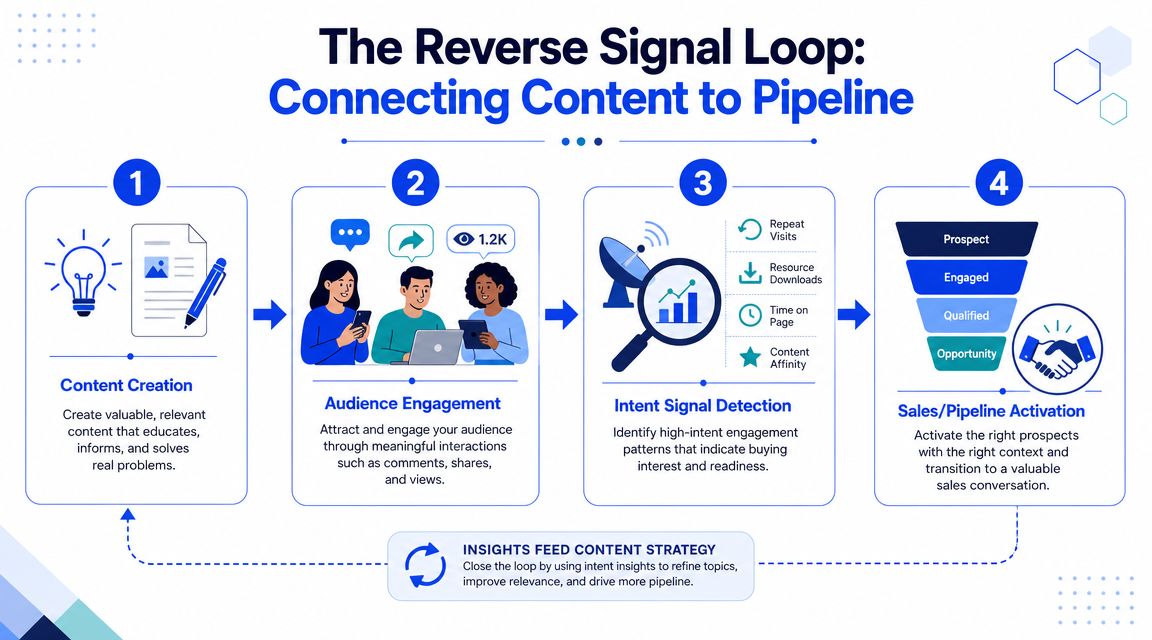
An audience isn't pipeline. It becomes pipeline when engagement changes who sales contacts, how fast they act, and what message they send.
That's the role of the reverse signal loop. Instead of waiting for a form fill, you watch for account and contact behavior, enrich it, and feed it back into outbound fast enough to matter.
The four-step workflow
A useful demand system now relies on intent architecture, not just broad lead capture. Informa TechTarget's guide to B2B demand generation explains the distinction well, account-level intent tells you which company is showing research behavior, and individual-level intent helps identify the right person and message. That's the logic behind this workflow.
Publish to the same ICP you plan to prospect
Your content and your outbound list should point at the same market. If your founder is posting for SaaS revenue leaders, don't hand the SDR team a list of unrelated operations contacts.Detect engagement from target accounts
Use LinkedIn engagement, website visits, demo page traffic, webinar activity, and contact-level signals. Clay, Apollo, Sales Navigator, and HubSpot can all play a role here depending on your stack.Route engaged accounts into priority outbound
The moment someone from the ICP engages, they should move up the queue. The rule matters more than the tool. If routing waits for a weekly spreadsheet review, the signal decays.Change the outreach based on the signal
Don't send the same email to a silent prospect and a buyer who just engaged with your content. Reference the topic, the trigger, or the business issue they interacted with.
Speed is crucial. The Insight Collective argues that best-in-class 2026 demand generation must identify high-value accounts showing early buying signals and track engagement across multiple touchpoints. That's directionally right, but the key advantage comes from routing and response discipline.
Field note: Signal value drops fast when sales sees it after the buyer has moved on.
Teams that want to formalize this can borrow from any strong feedback loop design. Capture the signal, score it, route it, act on it, and feed the outcome back into the model.
What the 30-day result actually means
Here's the cleanest way to think about early wins. A true demand engine compounds slowly. What can happen quickly is activation of latent demand.
One practical example looked like this:
In week one, the team locked the ICP, message map, and three content pillars
The founder LinkedIn profile was rewritten to turn visits into conversations
Over the next weeks, the founder published three posts a week tied to the same message used in outbound
Prospects on the outbound list saw connection requests and contextual touches before the email landed
Anyone from the ICP who engaged got pushed into priority outreach within 48 hours
That system generated 14 qualified conversations and €180k of early pipeline in 30 days, but the distinction matters. It did not create market demand from zero. It activated trust the founder had already built over years and added a harvest layer on top.
Tool-wise, stacks often converge around these solutions: Clay for enrichment and routing logic, Apollo for contact sourcing and sequencing, Lemlist or Instantly for outbound execution, HeyReach for LinkedIn automation support, HubSpot for CRM and lifecycle visibility. One option in this category is Grou, which combines LinkedIn content, lead generation, and outbound into a single pipeline workflow.
Measuring demand gen without killing it
The easiest way to ruin a good demand program is to judge it like a paid lead form campaign.
That happens constantly. A team funds founder content, webinars, newsletter distribution, and ungated education. Then someone asks for CPL and last-touch ROI after a few weeks. The program looks weak on paper, gets cut, and six months later sales is back to cold prospecting into a market that barely knows the brand.
The metrics that distort the program
Two things are true at the same time. First, demand gen should connect to revenue. Second, not every meaningful signal appears cleanly in attribution software.
That tension shows up in current reporting. Pipeline360 notes that revenue generated became a top KPI for 42% of B2B marketing teams, while measuring results and making data actionable were cited as the two biggest challenges, at 41% and 39% in its 2025 demand generation statistics summary. That's exactly why teams need a separate scorecard for planting.
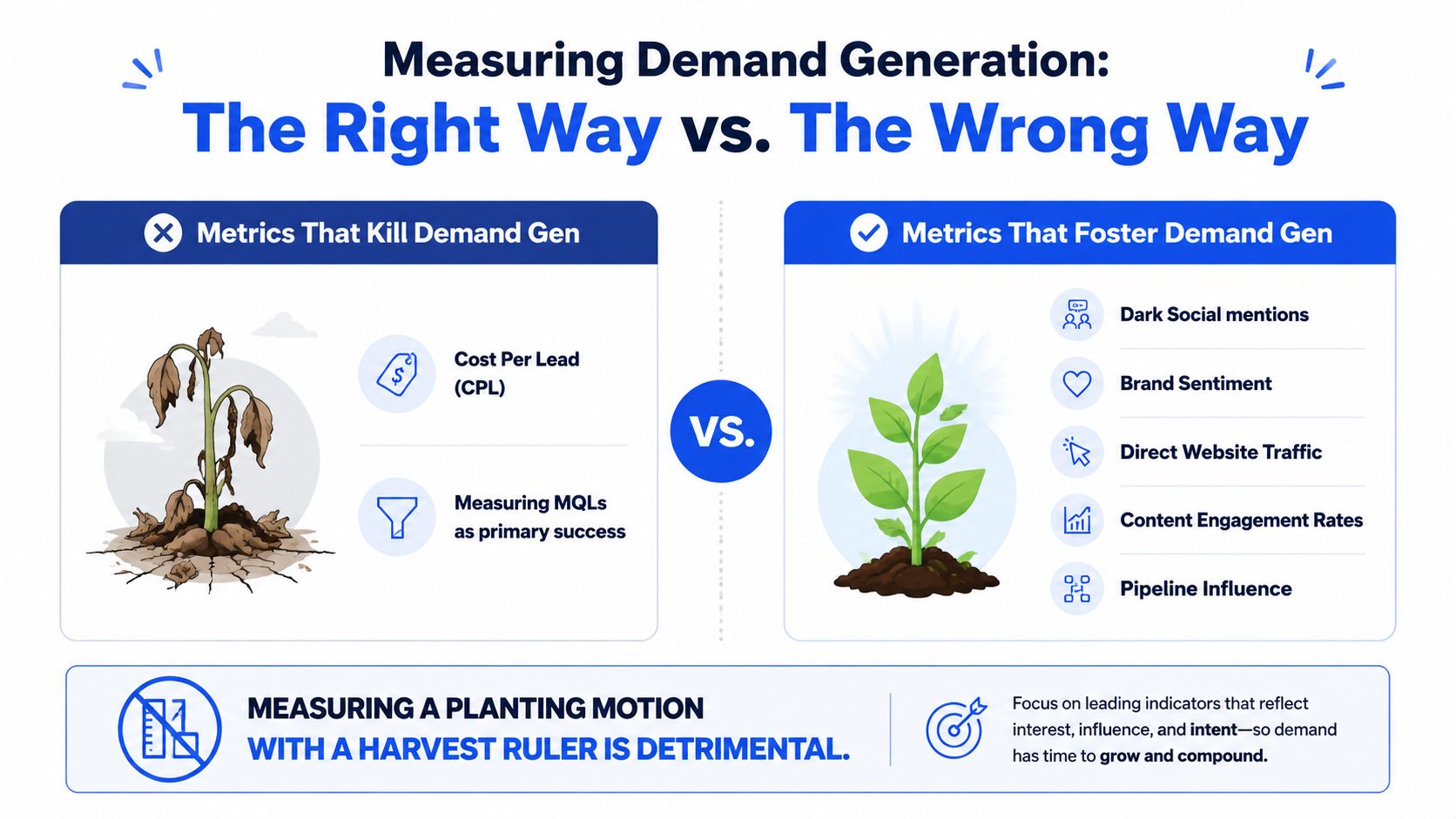
The worst metrics for demand gen are usually:
Cost per lead because demand gen often improves the efficiency of other channels rather than producing neat lead units by itself
Last-touch attribution because it overcredits the final conversion event and undercredits the months of warming before it
Post engagement totals because likes are weak proxies for commercial impact
If you're trying to measure marketing beyond vanity metrics, the key is to separate visible platform activity from buyer behavior that affects sales outcomes.
The scorecard that protects demand gen
A better scorecard looks at whether the market is getting warmer and whether influenced deals behave differently from cold ones.
Use a mix like this:
Branded search trend
This is one of the cleanest signs that buyers are seeking you by name rather than stumbling into you through generic demand capture.Inbound conversation quality
Track whether inbound calls start with better context, less basic education, and clearer problem awareness.Direct and dark social traffic patterns
Some of your most valuable traffic won't carry a clean referral path. That's normal in B2B.Self-reported attribution
Add one field on key forms asking how the buyer heard about you. Software misses podcasts, Slack threads, forwarded newsletters, and remembered LinkedIn posts. Buyers often don't.Win rate and sales cycle on demand-influenced deals
Compare opportunities where the account engaged with content before entering pipeline against fully cold opportunities.
For the harvest side, keep the standard conversion and pipeline metrics in a separate reporting view. That's where this lead generation KPI breakdown becomes useful. The mistake is not using lead metrics. The mistake is using them for the wrong motion.
Buyers rarely tell you "your attribution model worked." They tell you "I've been following your content for months."
A practical 30 and 90-day implementation plan
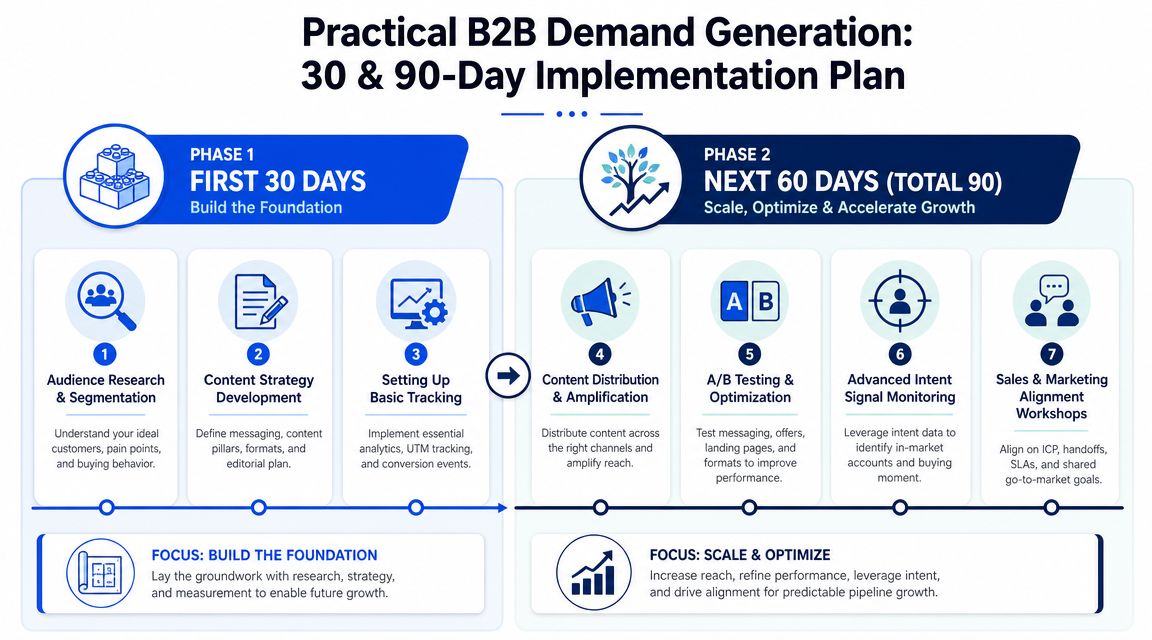
A good b2b demand generation system doesn't start with channel sprawl. It starts with message discipline, signal capture, and one operating cadence that sales and marketing both trust.
The first phase should feel controlled, not ambitious. You're building the foundation that makes later compounding possible.
Days 1 to 30
Use the first month to activate what's already there.
Lock the ICP and message map
Pick one commercial segment, one buyer set, and three repeatable problem themes. If your market statement changes every week, nothing compounds.Rebuild the founder profile and core assets
Your LinkedIn profile should convert profile views into conversations. Tight headline, clear problem statement, proof-based featured section, direct CTA.Ship three posts a week
Keep them tied to the same three pillars. Repetition is a feature, not a flaw.Build the reverse signal loop
Decide what counts as a signal, where it gets logged, who gets alerted, and how fast outreach changes after the signal appears.Align outbound with content themes
If content says one thing and outbound says another, trust breaks fast.
A simple working checklist helps here:
Data setup → target account list, CRM fields, attribution field, engagement tagging
Tool setup → HubSpot, Apollo, Clay, Sales Navigator, and your sending tool of choice
Execution rhythm → weekly content plan, daily signal review, sales follow-up rules
Review cadence → one weekly pipeline review, one content and messaging review
If your team needs help tightening the outbound side of that system, this guide to a lead generation campaign is a useful parallel read.
A lightweight content process from adjacent creator workflows can also help founders stay consistent. Narrareach has a practical example of a social media strategy for writers that translates well to founder-led B2B content because it forces theme discipline instead of random posting.
This walkthrough is worth watching before you build the first sprint:
Days 31 to 90
The next phase is where you stop acting like a content team and start acting like a pipeline system.
Focus the next 60 days on:
Reviewing early signal quality
Which posts drew the right accounts, not the most engagement. Which outbound messages converted faster after a content touch.Adding a newsletter
This gives you a higher-intent owned channel and a place to expand ideas beyond social post length.Repurposing aggressively
One founder insight should become a LinkedIn post, newsletter section, outbound opener angle, and talking point for sales calls.Tracking the right indicators
Watch for warmer inbound, more direct traffic, better meeting quality, and shorter path from first touch to real conversation.
By day 90, you should know four things. Which message themes attract the right accounts. Which signals predict replies. Which routes between content and outbound are too slow. Which parts of the system still depend on manual effort.
Your next step is to audit your pipeline motion
Reading about b2b demand generation doesn't fix the pipeline. An audit does.
Take 30 minutes this week and answer three questions with your revenue team.
How much of our current effort is planting versus harvesting
What exact system connects content engagement to outbound action
How do we currently measure whether planting is working
The answers usually expose the bottleneck fast. Some teams have strong harvesting and almost no planting, so every quarter starts from zero. Others have founder content, webinars, and audience attention, but no signal routing into sales, so interest never turns into qualified pipeline.
Start with the biggest gap, not with a full transformation plan. If your market already knows the founder, activate latent demand and install the reverse loop. If your outbound machine is busy but cold, fix the message and publish consistently to the same ICP you're prospecting.
Most pipeline problems aren't caused by a lack of tactics. They're caused by disconnected motions.
If you want a second set of eyes on that motion, Grou works with B2B teams to connect LinkedIn content, outbound, and lead generation into one pipeline system. A useful next step is a simple audit of your ICP, message map, signal routing, and measurement model so you can see where attention is getting lost before it becomes revenue.
Most advice on b2b demand generation gets one thing wrong. It treats demand gen as a prettier label for lead gen, then wonders why pipeline stays fragile, conversations start cold, and every deal turns into a pricing discussion.
That confusion costs real revenue. If you're only harvesting people already in-market, you're competing at the most crowded point of the buyer journey. If you're only publishing content and waiting for inbound, you're building audience without a capture system. Predictable pipeline needs both motions, planted and harvested, tied together by one operating model.
TL;DR
Demand gen and lead gen are different jobs. Demand gen plants awareness and preference. Lead gen harvests existing intent into meetings and opportunities.
The handoff needs a system. LinkedIn content, outbound, CRM, enrichment, and reply routing should work as one motion, not as separate channel teams.
Measure planting with planting metrics. Revenue matters, but CPL and last-touch attribution will kill a good demand program before it compounds.
Start with latent demand first. The fastest early win usually comes from activating credibility you already have in the market, then building the longer compounding layer around it.
Table of Contents
The most expensive mistake in B2B marketing
The expensive mistake isn't poor creative, weak SDRs, or low ad spend. It's calling a harvest motion a planting motion, then judging the whole pipeline by the wrong expectation.
A lot of teams say they want demand gen, but what they buy is outbound, paid lead capture, and retargeting. That's lead gen. Useful, necessary, often profitable. But it's still a capture system aimed at people who already feel the problem.
Demand gen is different. It builds recognition, trust, and category understanding before the buyer asks for a demo. It shapes what the market believes, so that when a real buying window opens, your name is already in the consideration set.
Why this confusion gets expensive fast
If you treat lead gen as demand gen, every meeting starts colder than it should. Reps spend the first call educating instead of qualifying. Deals become more price-sensitive because the buyer doesn't yet understand why your way of solving the problem is different.
If you treat demand gen as lead gen, you'll shut it down too early. You'll look at MQL volume, ask why content isn't producing instant demos, and cut the one thing that was warming future pipeline.
Practical rule: Lead gen asks who is ready now. Demand gen decides who thinks of you later.
The fix isn't philosophical. It's operational.
Split the motions clearly → one team or workflow plants, another harvests, both use the same ICP and message map
Connect them directly → content engagement should change outbound priority, sequencing, and sales follow-up
Use different scorecards → meetings and pipeline for harvest, warmer inbound and branded demand signals for planting
Activate latent demand first → if your founder, sales team, or customer base already has market credibility, use that before trying to manufacture attention from zero
Most stalled pipelines don't need more random activity. They need cleaner architecture.
Demand gen vs lead gen an operator's definition
Most definitions of demand gen vs lead gen are too abstract to be useful. Operators need a cleaner split.
Demand gen is planting. You put ideas into the market that help buyers name a problem, understand its cost, and trust your perspective before they start a vendor search.
Lead gen is harvesting. You find the people already close to action and move them into a conversation, a meeting, and a qualified opportunity.
Two motions, two outputs
Demand gen produces market readiness. The output isn't a lead record. It's a buyer who has seen your thinking on LinkedIn, heard you on a podcast, read your newsletter, and arrives already oriented to your framing.
Lead gen produces contact conversion. The output is much tighter, a reply, a booked call, a hand-raiser, a qualified thread in HubSpot, Salesforce, or another CRM.
A useful way to frame the split:
Motion | Job | Common channels | Feedback loop | Primary output |
|---|---|---|---|---|
Demand gen | Plant awareness and preference | LinkedIn content, founder brand, newsletters, podcasts, webinars | Months | Warmer market |
Lead gen | Capture existing intent | Outbound email, LinkedIn outreach, paid lead capture, retargeting | Days to weeks | Meetings and pipeline |
That channel split also matches what the market already shows. In a 2025 summary, content marketing was cited as the most effective demand generation strategy by 83% of B2B marketers, and LinkedIn drives 80% of B2B leads according to The Insight Collective's demand generation statistics. That tells you where planting and harvesting naturally meet.
Where most teams break it
They separate these motions by team, by tool, and by reporting line. Marketing publishes content with no route into sales action. Sales runs Apollo or Sales Navigator lists with no awareness of who has already engaged with the brand.
That split creates two bad outcomes:
Cold harvesting where outreach lands on the right accounts with no prior trust
Uncaptured planting where engaged buyers like posts, read content, then disappear because no one acted
If you want a broader primer on the category itself, Fame's piece on effective demand gen marketing is a useful external read. For the operational distinction we use in practice, this breakdown of demand generation vs lead generation is the cleaner frame.
How to build your demand generation channels
Most companies don't have a channel problem. They have a consistency problem and a message problem.
The strongest demand channels in B2B are usually not the flashiest ones. They are the channels your buyers already use to evaluate credibility, especially founder LinkedIn content, a newsletter with a clear point of view, and selective podcast appearances or hosted conversations.
Start with three content pillars
Don't start with formats. Start with the three topics your market will trust you to own.
A practical set usually looks like this:
The buyer problem
Name the operational pain in plain language. For a legal tech company, that might be slow intake, poor matter visibility, or low adoption after implementation.The broken default Explain why the usual fix doesn't work. Strong content then earns attention. Not because it's louder, because it gives buyers a better diagnosis.
The practical path forward
Show the workflow, not just the opinion. Buyers trust specificity. If you say outreach should be signal-based, show the trigger, the routing rule, and the message change.
Good demand content doesn't try to close. It helps the right buyer say, "that's exactly the problem we're dealing with."
For deeper guidance on turning those ideas into assets, this B2B content marketing guide is a useful companion.
Build a simple publishing stack
You do not need a bloated MarTech setup to start. You need a stack that helps one idea move across multiple surfaces without creating admin drag.
A practical version:
LinkedIn for founder and executive posts
HubSpot to capture inbound, tag self-reported attribution, and log contact history
beehiiv or HubSpot email for the newsletter
Notion or Airtable for editorial planning
Canva or Figma for simple visual formatting
Sales Navigator to monitor target accounts and buyer movement
If you're publishing three founder posts a week, one newsletter every one or two weeks, and repurposing podcast or sales-call insights into those formats, that's enough to build signal. Teams often fail because they overbuild before they outpublish.
What good founder-led content looks like
The best B2B LinkedIn posts usually follow one of three structures.
Strong opinion plus evidence
Example shape → "Most demand gen programs fail because they publish without a capture system." Then explain the workflow behind the claim.Observed mistake plus correction Example shape → "Teams track post likes and miss the buyers who later visit the site unobserved." Then show what to track instead.
Client pattern without fabricated detail
Example shape → "In SaaS and manufacturing, the same issue shows up. Sales gets a list, marketing gets a content calendar, and neither side shares signals." Then unpack the fix.
Keep the mechanics tight. Three posts a week is enough if the themes repeat deliberately. The market needs repeated exposure to the same message from slightly different angles.
A simple operating rhythm works well here, → Monday for point of view, Wednesday for a field observation, Friday for a practical breakdown. One idea should also feed your newsletter intro, outbound opener themes, and comments from the sales team.
The reverse signal loop connecting content to pipeline
An audience isn't pipeline. It becomes pipeline when engagement changes who sales contacts, how fast they act, and what message they send.
That's the role of the reverse signal loop. Instead of waiting for a form fill, you watch for account and contact behavior, enrich it, and feed it back into outbound fast enough to matter.
The four-step workflow
A useful demand system now relies on intent architecture, not just broad lead capture. Informa TechTarget's guide to B2B demand generation explains the distinction well, account-level intent tells you which company is showing research behavior, and individual-level intent helps identify the right person and message. That's the logic behind this workflow.
Publish to the same ICP you plan to prospect
Your content and your outbound list should point at the same market. If your founder is posting for SaaS revenue leaders, don't hand the SDR team a list of unrelated operations contacts.Detect engagement from target accounts
Use LinkedIn engagement, website visits, demo page traffic, webinar activity, and contact-level signals. Clay, Apollo, Sales Navigator, and HubSpot can all play a role here depending on your stack.Route engaged accounts into priority outbound
The moment someone from the ICP engages, they should move up the queue. The rule matters more than the tool. If routing waits for a weekly spreadsheet review, the signal decays.Change the outreach based on the signal
Don't send the same email to a silent prospect and a buyer who just engaged with your content. Reference the topic, the trigger, or the business issue they interacted with.
Speed is crucial. The Insight Collective argues that best-in-class 2026 demand generation must identify high-value accounts showing early buying signals and track engagement across multiple touchpoints. That's directionally right, but the key advantage comes from routing and response discipline.
Field note: Signal value drops fast when sales sees it after the buyer has moved on.
Teams that want to formalize this can borrow from any strong feedback loop design. Capture the signal, score it, route it, act on it, and feed the outcome back into the model.
What the 30-day result actually means
Here's the cleanest way to think about early wins. A true demand engine compounds slowly. What can happen quickly is activation of latent demand.
One practical example looked like this:
In week one, the team locked the ICP, message map, and three content pillars
The founder LinkedIn profile was rewritten to turn visits into conversations
Over the next weeks, the founder published three posts a week tied to the same message used in outbound
Prospects on the outbound list saw connection requests and contextual touches before the email landed
Anyone from the ICP who engaged got pushed into priority outreach within 48 hours
That system generated 14 qualified conversations and €180k of early pipeline in 30 days, but the distinction matters. It did not create market demand from zero. It activated trust the founder had already built over years and added a harvest layer on top.
Tool-wise, stacks often converge around these solutions: Clay for enrichment and routing logic, Apollo for contact sourcing and sequencing, Lemlist or Instantly for outbound execution, HeyReach for LinkedIn automation support, HubSpot for CRM and lifecycle visibility. One option in this category is Grou, which combines LinkedIn content, lead generation, and outbound into a single pipeline workflow.
Measuring demand gen without killing it
The easiest way to ruin a good demand program is to judge it like a paid lead form campaign.
That happens constantly. A team funds founder content, webinars, newsletter distribution, and ungated education. Then someone asks for CPL and last-touch ROI after a few weeks. The program looks weak on paper, gets cut, and six months later sales is back to cold prospecting into a market that barely knows the brand.
The metrics that distort the program
Two things are true at the same time. First, demand gen should connect to revenue. Second, not every meaningful signal appears cleanly in attribution software.
That tension shows up in current reporting. Pipeline360 notes that revenue generated became a top KPI for 42% of B2B marketing teams, while measuring results and making data actionable were cited as the two biggest challenges, at 41% and 39% in its 2025 demand generation statistics summary. That's exactly why teams need a separate scorecard for planting.
The worst metrics for demand gen are usually:
Cost per lead because demand gen often improves the efficiency of other channels rather than producing neat lead units by itself
Last-touch attribution because it overcredits the final conversion event and undercredits the months of warming before it
Post engagement totals because likes are weak proxies for commercial impact
If you're trying to measure marketing beyond vanity metrics, the key is to separate visible platform activity from buyer behavior that affects sales outcomes.
The scorecard that protects demand gen
A better scorecard looks at whether the market is getting warmer and whether influenced deals behave differently from cold ones.
Use a mix like this:
Branded search trend
This is one of the cleanest signs that buyers are seeking you by name rather than stumbling into you through generic demand capture.Inbound conversation quality
Track whether inbound calls start with better context, less basic education, and clearer problem awareness.Direct and dark social traffic patterns
Some of your most valuable traffic won't carry a clean referral path. That's normal in B2B.Self-reported attribution
Add one field on key forms asking how the buyer heard about you. Software misses podcasts, Slack threads, forwarded newsletters, and remembered LinkedIn posts. Buyers often don't.Win rate and sales cycle on demand-influenced deals
Compare opportunities where the account engaged with content before entering pipeline against fully cold opportunities.
For the harvest side, keep the standard conversion and pipeline metrics in a separate reporting view. That's where this lead generation KPI breakdown becomes useful. The mistake is not using lead metrics. The mistake is using them for the wrong motion.
Buyers rarely tell you "your attribution model worked." They tell you "I've been following your content for months."
A practical 30 and 90-day implementation plan
A good b2b demand generation system doesn't start with channel sprawl. It starts with message discipline, signal capture, and one operating cadence that sales and marketing both trust.
The first phase should feel controlled, not ambitious. You're building the foundation that makes later compounding possible.
Days 1 to 30
Use the first month to activate what's already there.
Lock the ICP and message map
Pick one commercial segment, one buyer set, and three repeatable problem themes. If your market statement changes every week, nothing compounds.Rebuild the founder profile and core assets
Your LinkedIn profile should convert profile views into conversations. Tight headline, clear problem statement, proof-based featured section, direct CTA.Ship three posts a week
Keep them tied to the same three pillars. Repetition is a feature, not a flaw.Build the reverse signal loop
Decide what counts as a signal, where it gets logged, who gets alerted, and how fast outreach changes after the signal appears.Align outbound with content themes
If content says one thing and outbound says another, trust breaks fast.
A simple working checklist helps here:
Data setup → target account list, CRM fields, attribution field, engagement tagging
Tool setup → HubSpot, Apollo, Clay, Sales Navigator, and your sending tool of choice
Execution rhythm → weekly content plan, daily signal review, sales follow-up rules
Review cadence → one weekly pipeline review, one content and messaging review
If your team needs help tightening the outbound side of that system, this guide to a lead generation campaign is a useful parallel read.
A lightweight content process from adjacent creator workflows can also help founders stay consistent. Narrareach has a practical example of a social media strategy for writers that translates well to founder-led B2B content because it forces theme discipline instead of random posting.
This walkthrough is worth watching before you build the first sprint:
Days 31 to 90
The next phase is where you stop acting like a content team and start acting like a pipeline system.
Focus the next 60 days on:
Reviewing early signal quality
Which posts drew the right accounts, not the most engagement. Which outbound messages converted faster after a content touch.Adding a newsletter
This gives you a higher-intent owned channel and a place to expand ideas beyond social post length.Repurposing aggressively
One founder insight should become a LinkedIn post, newsletter section, outbound opener angle, and talking point for sales calls.Tracking the right indicators
Watch for warmer inbound, more direct traffic, better meeting quality, and shorter path from first touch to real conversation.
By day 90, you should know four things. Which message themes attract the right accounts. Which signals predict replies. Which routes between content and outbound are too slow. Which parts of the system still depend on manual effort.
Your next step is to audit your pipeline motion
Reading about b2b demand generation doesn't fix the pipeline. An audit does.
Take 30 minutes this week and answer three questions with your revenue team.
How much of our current effort is planting versus harvesting
What exact system connects content engagement to outbound action
How do we currently measure whether planting is working
The answers usually expose the bottleneck fast. Some teams have strong harvesting and almost no planting, so every quarter starts from zero. Others have founder content, webinars, and audience attention, but no signal routing into sales, so interest never turns into qualified pipeline.
Start with the biggest gap, not with a full transformation plan. If your market already knows the founder, activate latent demand and install the reverse loop. If your outbound machine is busy but cold, fix the message and publish consistently to the same ICP you're prospecting.
Most pipeline problems aren't caused by a lack of tactics. They're caused by disconnected motions.
If you want a second set of eyes on that motion, Grou works with B2B teams to connect LinkedIn content, outbound, and lead generation into one pipeline system. A useful next step is a simple audit of your ICP, message map, signal routing, and measurement model so you can see where attention is getting lost before it becomes revenue.
Most advice on b2b demand generation gets one thing wrong. It treats demand gen as a prettier label for lead gen, then wonders why pipeline stays fragile, conversations start cold, and every deal turns into a pricing discussion.
That confusion costs real revenue. If you're only harvesting people already in-market, you're competing at the most crowded point of the buyer journey. If you're only publishing content and waiting for inbound, you're building audience without a capture system. Predictable pipeline needs both motions, planted and harvested, tied together by one operating model.
TL;DR
Demand gen and lead gen are different jobs. Demand gen plants awareness and preference. Lead gen harvests existing intent into meetings and opportunities.
The handoff needs a system. LinkedIn content, outbound, CRM, enrichment, and reply routing should work as one motion, not as separate channel teams.
Measure planting with planting metrics. Revenue matters, but CPL and last-touch attribution will kill a good demand program before it compounds.
Start with latent demand first. The fastest early win usually comes from activating credibility you already have in the market, then building the longer compounding layer around it.
Table of Contents
The most expensive mistake in B2B marketing
The expensive mistake isn't poor creative, weak SDRs, or low ad spend. It's calling a harvest motion a planting motion, then judging the whole pipeline by the wrong expectation.
A lot of teams say they want demand gen, but what they buy is outbound, paid lead capture, and retargeting. That's lead gen. Useful, necessary, often profitable. But it's still a capture system aimed at people who already feel the problem.
Demand gen is different. It builds recognition, trust, and category understanding before the buyer asks for a demo. It shapes what the market believes, so that when a real buying window opens, your name is already in the consideration set.
Why this confusion gets expensive fast
If you treat lead gen as demand gen, every meeting starts colder than it should. Reps spend the first call educating instead of qualifying. Deals become more price-sensitive because the buyer doesn't yet understand why your way of solving the problem is different.
If you treat demand gen as lead gen, you'll shut it down too early. You'll look at MQL volume, ask why content isn't producing instant demos, and cut the one thing that was warming future pipeline.
Practical rule: Lead gen asks who is ready now. Demand gen decides who thinks of you later.
The fix isn't philosophical. It's operational.
Split the motions clearly → one team or workflow plants, another harvests, both use the same ICP and message map
Connect them directly → content engagement should change outbound priority, sequencing, and sales follow-up
Use different scorecards → meetings and pipeline for harvest, warmer inbound and branded demand signals for planting
Activate latent demand first → if your founder, sales team, or customer base already has market credibility, use that before trying to manufacture attention from zero
Most stalled pipelines don't need more random activity. They need cleaner architecture.
Demand gen vs lead gen an operator's definition
Most definitions of demand gen vs lead gen are too abstract to be useful. Operators need a cleaner split.
Demand gen is planting. You put ideas into the market that help buyers name a problem, understand its cost, and trust your perspective before they start a vendor search.
Lead gen is harvesting. You find the people already close to action and move them into a conversation, a meeting, and a qualified opportunity.
Two motions, two outputs
Demand gen produces market readiness. The output isn't a lead record. It's a buyer who has seen your thinking on LinkedIn, heard you on a podcast, read your newsletter, and arrives already oriented to your framing.
Lead gen produces contact conversion. The output is much tighter, a reply, a booked call, a hand-raiser, a qualified thread in HubSpot, Salesforce, or another CRM.
A useful way to frame the split:
Motion | Job | Common channels | Feedback loop | Primary output |
|---|---|---|---|---|
Demand gen | Plant awareness and preference | LinkedIn content, founder brand, newsletters, podcasts, webinars | Months | Warmer market |
Lead gen | Capture existing intent | Outbound email, LinkedIn outreach, paid lead capture, retargeting | Days to weeks | Meetings and pipeline |
That channel split also matches what the market already shows. In a 2025 summary, content marketing was cited as the most effective demand generation strategy by 83% of B2B marketers, and LinkedIn drives 80% of B2B leads according to The Insight Collective's demand generation statistics. That tells you where planting and harvesting naturally meet.
Where most teams break it
They separate these motions by team, by tool, and by reporting line. Marketing publishes content with no route into sales action. Sales runs Apollo or Sales Navigator lists with no awareness of who has already engaged with the brand.
That split creates two bad outcomes:
Cold harvesting where outreach lands on the right accounts with no prior trust
Uncaptured planting where engaged buyers like posts, read content, then disappear because no one acted
If you want a broader primer on the category itself, Fame's piece on effective demand gen marketing is a useful external read. For the operational distinction we use in practice, this breakdown of demand generation vs lead generation is the cleaner frame.
How to build your demand generation channels
Most companies don't have a channel problem. They have a consistency problem and a message problem.
The strongest demand channels in B2B are usually not the flashiest ones. They are the channels your buyers already use to evaluate credibility, especially founder LinkedIn content, a newsletter with a clear point of view, and selective podcast appearances or hosted conversations.
Start with three content pillars
Don't start with formats. Start with the three topics your market will trust you to own.
A practical set usually looks like this:
The buyer problem
Name the operational pain in plain language. For a legal tech company, that might be slow intake, poor matter visibility, or low adoption after implementation.The broken default Explain why the usual fix doesn't work. Strong content then earns attention. Not because it's louder, because it gives buyers a better diagnosis.
The practical path forward
Show the workflow, not just the opinion. Buyers trust specificity. If you say outreach should be signal-based, show the trigger, the routing rule, and the message change.
Good demand content doesn't try to close. It helps the right buyer say, "that's exactly the problem we're dealing with."
For deeper guidance on turning those ideas into assets, this B2B content marketing guide is a useful companion.
Build a simple publishing stack
You do not need a bloated MarTech setup to start. You need a stack that helps one idea move across multiple surfaces without creating admin drag.
A practical version:
LinkedIn for founder and executive posts
HubSpot to capture inbound, tag self-reported attribution, and log contact history
beehiiv or HubSpot email for the newsletter
Notion or Airtable for editorial planning
Canva or Figma for simple visual formatting
Sales Navigator to monitor target accounts and buyer movement
If you're publishing three founder posts a week, one newsletter every one or two weeks, and repurposing podcast or sales-call insights into those formats, that's enough to build signal. Teams often fail because they overbuild before they outpublish.
What good founder-led content looks like
The best B2B LinkedIn posts usually follow one of three structures.
Strong opinion plus evidence
Example shape → "Most demand gen programs fail because they publish without a capture system." Then explain the workflow behind the claim.Observed mistake plus correction Example shape → "Teams track post likes and miss the buyers who later visit the site unobserved." Then show what to track instead.
Client pattern without fabricated detail
Example shape → "In SaaS and manufacturing, the same issue shows up. Sales gets a list, marketing gets a content calendar, and neither side shares signals." Then unpack the fix.
Keep the mechanics tight. Three posts a week is enough if the themes repeat deliberately. The market needs repeated exposure to the same message from slightly different angles.
A simple operating rhythm works well here, → Monday for point of view, Wednesday for a field observation, Friday for a practical breakdown. One idea should also feed your newsletter intro, outbound opener themes, and comments from the sales team.
The reverse signal loop connecting content to pipeline
An audience isn't pipeline. It becomes pipeline when engagement changes who sales contacts, how fast they act, and what message they send.
That's the role of the reverse signal loop. Instead of waiting for a form fill, you watch for account and contact behavior, enrich it, and feed it back into outbound fast enough to matter.
The four-step workflow
A useful demand system now relies on intent architecture, not just broad lead capture. Informa TechTarget's guide to B2B demand generation explains the distinction well, account-level intent tells you which company is showing research behavior, and individual-level intent helps identify the right person and message. That's the logic behind this workflow.
Publish to the same ICP you plan to prospect
Your content and your outbound list should point at the same market. If your founder is posting for SaaS revenue leaders, don't hand the SDR team a list of unrelated operations contacts.Detect engagement from target accounts
Use LinkedIn engagement, website visits, demo page traffic, webinar activity, and contact-level signals. Clay, Apollo, Sales Navigator, and HubSpot can all play a role here depending on your stack.Route engaged accounts into priority outbound
The moment someone from the ICP engages, they should move up the queue. The rule matters more than the tool. If routing waits for a weekly spreadsheet review, the signal decays.Change the outreach based on the signal
Don't send the same email to a silent prospect and a buyer who just engaged with your content. Reference the topic, the trigger, or the business issue they interacted with.
Speed is crucial. The Insight Collective argues that best-in-class 2026 demand generation must identify high-value accounts showing early buying signals and track engagement across multiple touchpoints. That's directionally right, but the key advantage comes from routing and response discipline.
Field note: Signal value drops fast when sales sees it after the buyer has moved on.
Teams that want to formalize this can borrow from any strong feedback loop design. Capture the signal, score it, route it, act on it, and feed the outcome back into the model.
What the 30-day result actually means
Here's the cleanest way to think about early wins. A true demand engine compounds slowly. What can happen quickly is activation of latent demand.
One practical example looked like this:
In week one, the team locked the ICP, message map, and three content pillars
The founder LinkedIn profile was rewritten to turn visits into conversations
Over the next weeks, the founder published three posts a week tied to the same message used in outbound
Prospects on the outbound list saw connection requests and contextual touches before the email landed
Anyone from the ICP who engaged got pushed into priority outreach within 48 hours
That system generated 14 qualified conversations and €180k of early pipeline in 30 days, but the distinction matters. It did not create market demand from zero. It activated trust the founder had already built over years and added a harvest layer on top.
Tool-wise, stacks often converge around these solutions: Clay for enrichment and routing logic, Apollo for contact sourcing and sequencing, Lemlist or Instantly for outbound execution, HeyReach for LinkedIn automation support, HubSpot for CRM and lifecycle visibility. One option in this category is Grou, which combines LinkedIn content, lead generation, and outbound into a single pipeline workflow.
Measuring demand gen without killing it
The easiest way to ruin a good demand program is to judge it like a paid lead form campaign.
That happens constantly. A team funds founder content, webinars, newsletter distribution, and ungated education. Then someone asks for CPL and last-touch ROI after a few weeks. The program looks weak on paper, gets cut, and six months later sales is back to cold prospecting into a market that barely knows the brand.
The metrics that distort the program
Two things are true at the same time. First, demand gen should connect to revenue. Second, not every meaningful signal appears cleanly in attribution software.
That tension shows up in current reporting. Pipeline360 notes that revenue generated became a top KPI for 42% of B2B marketing teams, while measuring results and making data actionable were cited as the two biggest challenges, at 41% and 39% in its 2025 demand generation statistics summary. That's exactly why teams need a separate scorecard for planting.
The worst metrics for demand gen are usually:
Cost per lead because demand gen often improves the efficiency of other channels rather than producing neat lead units by itself
Last-touch attribution because it overcredits the final conversion event and undercredits the months of warming before it
Post engagement totals because likes are weak proxies for commercial impact
If you're trying to measure marketing beyond vanity metrics, the key is to separate visible platform activity from buyer behavior that affects sales outcomes.
The scorecard that protects demand gen
A better scorecard looks at whether the market is getting warmer and whether influenced deals behave differently from cold ones.
Use a mix like this:
Branded search trend
This is one of the cleanest signs that buyers are seeking you by name rather than stumbling into you through generic demand capture.Inbound conversation quality
Track whether inbound calls start with better context, less basic education, and clearer problem awareness.Direct and dark social traffic patterns
Some of your most valuable traffic won't carry a clean referral path. That's normal in B2B.Self-reported attribution
Add one field on key forms asking how the buyer heard about you. Software misses podcasts, Slack threads, forwarded newsletters, and remembered LinkedIn posts. Buyers often don't.Win rate and sales cycle on demand-influenced deals
Compare opportunities where the account engaged with content before entering pipeline against fully cold opportunities.
For the harvest side, keep the standard conversion and pipeline metrics in a separate reporting view. That's where this lead generation KPI breakdown becomes useful. The mistake is not using lead metrics. The mistake is using them for the wrong motion.
Buyers rarely tell you "your attribution model worked." They tell you "I've been following your content for months."
A practical 30 and 90-day implementation plan
A good b2b demand generation system doesn't start with channel sprawl. It starts with message discipline, signal capture, and one operating cadence that sales and marketing both trust.
The first phase should feel controlled, not ambitious. You're building the foundation that makes later compounding possible.
Days 1 to 30
Use the first month to activate what's already there.
Lock the ICP and message map
Pick one commercial segment, one buyer set, and three repeatable problem themes. If your market statement changes every week, nothing compounds.Rebuild the founder profile and core assets
Your LinkedIn profile should convert profile views into conversations. Tight headline, clear problem statement, proof-based featured section, direct CTA.Ship three posts a week
Keep them tied to the same three pillars. Repetition is a feature, not a flaw.Build the reverse signal loop
Decide what counts as a signal, where it gets logged, who gets alerted, and how fast outreach changes after the signal appears.Align outbound with content themes
If content says one thing and outbound says another, trust breaks fast.
A simple working checklist helps here:
Data setup → target account list, CRM fields, attribution field, engagement tagging
Tool setup → HubSpot, Apollo, Clay, Sales Navigator, and your sending tool of choice
Execution rhythm → weekly content plan, daily signal review, sales follow-up rules
Review cadence → one weekly pipeline review, one content and messaging review
If your team needs help tightening the outbound side of that system, this guide to a lead generation campaign is a useful parallel read.
A lightweight content process from adjacent creator workflows can also help founders stay consistent. Narrareach has a practical example of a social media strategy for writers that translates well to founder-led B2B content because it forces theme discipline instead of random posting.
This walkthrough is worth watching before you build the first sprint:
Days 31 to 90
The next phase is where you stop acting like a content team and start acting like a pipeline system.
Focus the next 60 days on:
Reviewing early signal quality
Which posts drew the right accounts, not the most engagement. Which outbound messages converted faster after a content touch.Adding a newsletter
This gives you a higher-intent owned channel and a place to expand ideas beyond social post length.Repurposing aggressively
One founder insight should become a LinkedIn post, newsletter section, outbound opener angle, and talking point for sales calls.Tracking the right indicators
Watch for warmer inbound, more direct traffic, better meeting quality, and shorter path from first touch to real conversation.
By day 90, you should know four things. Which message themes attract the right accounts. Which signals predict replies. Which routes between content and outbound are too slow. Which parts of the system still depend on manual effort.
Your next step is to audit your pipeline motion
Reading about b2b demand generation doesn't fix the pipeline. An audit does.
Take 30 minutes this week and answer three questions with your revenue team.
How much of our current effort is planting versus harvesting
What exact system connects content engagement to outbound action
How do we currently measure whether planting is working
The answers usually expose the bottleneck fast. Some teams have strong harvesting and almost no planting, so every quarter starts from zero. Others have founder content, webinars, and audience attention, but no signal routing into sales, so interest never turns into qualified pipeline.
Start with the biggest gap, not with a full transformation plan. If your market already knows the founder, activate latent demand and install the reverse loop. If your outbound machine is busy but cold, fix the message and publish consistently to the same ICP you're prospecting.
Most pipeline problems aren't caused by a lack of tactics. They're caused by disconnected motions.
If you want a second set of eyes on that motion, Grou works with B2B teams to connect LinkedIn content, outbound, and lead generation into one pipeline system. A useful next step is a simple audit of your ICP, message map, signal routing, and measurement model so you can see where attention is getting lost before it becomes revenue.

Pipeline OS Newsletter
Build qualified pipeline
Get weekly tactics to generate demand, improve lead quality, and book more meetings.







Trusted by industry leaders
Trusted by industry leaders
Trusted by industry leaders
Ready to build qualified pipeline?
Ready to build qualified pipeline?
Ready to build qualified pipeline?
Book a call to see if we're the right fit, or take the 2-minute quiz to get a clear starting point.
Book a call to see if we're the right fit, or take the 2-minute quiz to get a clear starting point.
Book a call to see if we're the right fit, or take the 2-minute quiz to get a clear starting point.
" height="30.21639343089746px" id="hfGbXmQR2" width="30.216393430897455px"/></svg>)
Copyright © 2026 – All Right Reserved
Copyright © 2026 – All Right Reserved
Copyright © 2026 – All Right Reserved